ECO 506 Health Care Economics Lecture Notes Secondary


- Slides: 40
ECO 506– Health Care Economics Lecture Notes
Secondary Markets: Hospital Services Definitions and Trends Types Federal vs. non-federal Community vs. long term Non-profit vs. for profit vs. state/local Other trends: from 55 to 80 Long term: D decreases substantially Community: D increases 65 -75: D increases for all 75 to present: D decreases for all Table 14. 1, p. 306
Table 14. 2: Changes in In Patient vs. Out Patient Because decreased demand, must be more cost conscious Also decreasing occupancy rates and length of stay Organization Use Non-profit as an example What if profit > 0? Can make profits, just cannot distribute to owners => what to do with profits? Who is the residual claiment (to the profit)? Hospital administration Patients ( Decreased P, increased Quality) DRS (increase their profit)
2 Separate Organizations 1 st: Management Board of Trustees selects President and other administrative staff 2 nd: Medical Staff Comprised mostly of Drs. apply for privileges to admit patients, perform procedures, etc. Privileges granted by staff
Who controls the hospital? Drs? Arguments in favor of Drs If Drs. have privileges at many hospitals then bring patients => lots of power to get what they want…or leave. Arguments against Drs/Favor Management More to be cost conscious due to decreased demand => More hospitals are relying on Drs as employees with contracts with HMOs, employers to generate patients.
Hospital Cost Inflation A. Trends in hospital cost inflation Look at costs/patient days, costs/admission, and total expenses/capital Note: these are not homogeneous => could be quality differences. Table 14. 2 shows the following general patterns (1) increase in costs occurred consistently through the whole series => not a new problem (2) However, more of a problem post 1966 (larger increases) (3) 1972 -1974: not a problem during Nixon price control years (4) Late 70 s: real rate of increase lower although nominal rate constant. Why? Book claims voluntary controls to avoid regulation but not consistent with chapter on regulation.
(5) moderated even more during 80 s, perhaps due to Recession Competition Price controls Also, look at table 14. 2 Hospital costs as a percent of total increase then decrease Government share of costs increase/medicare Private insurance increase then decrease
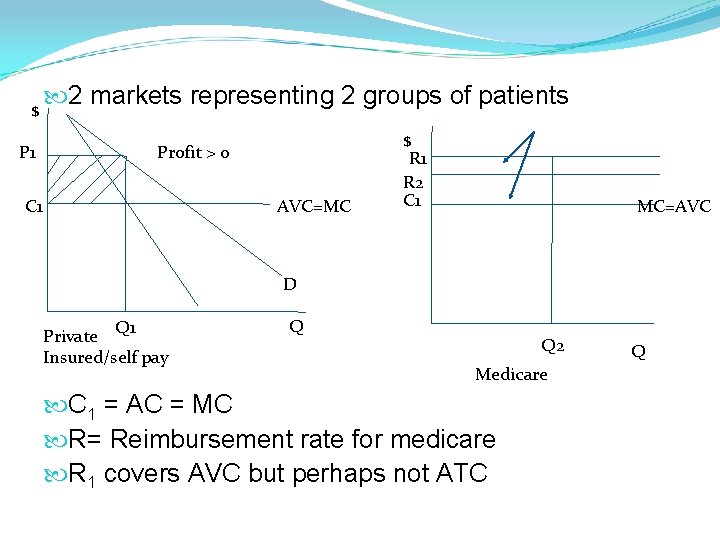
Hospital Cost Shifting Hospitals provide large amounts of uncompensated care. Why? Both legal and ethical reasons Who gets it? Un-insured (most) Under-insured Are these costs passed on to those who pay? (hospital cost shifting) Argument in favor is quite simple– must cover the costs somehow => make up costs from paying market Look at a simple profit-max model
$ P 1 2 markets representing 2 groups of patients Profit > 0 C 1 AVC=MC $ R 1 R 2 C 1 MC=AVC D Private Q 1 Insured/self pay Q Q 2 Medicare C 1 = AC = MC R= Reimbursement rate for medicare R 1 covers AVC but perhaps not ATC Q
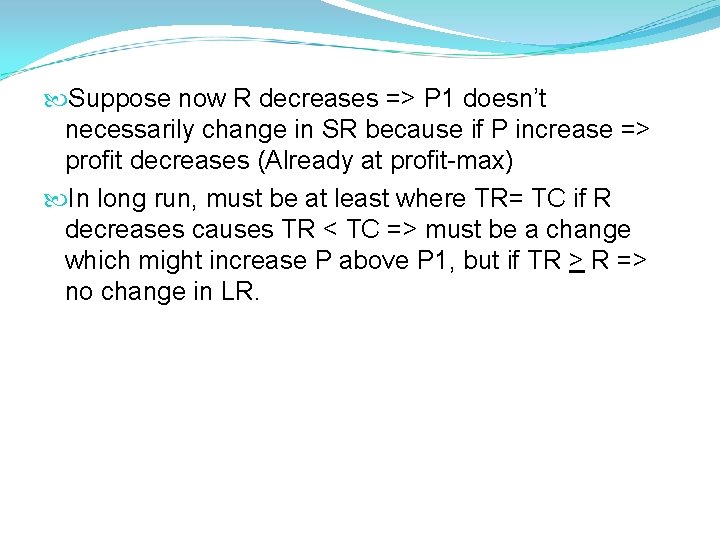
Suppose now R decreases => P 1 doesn’t necessarily change in SR because if P increase => profit decreases (Already at profit-max) In long run, must be at least where TR= TC if R decreases causes TR < TC => must be a change which might increase P above P 1, but if TR > R => no change in LR.
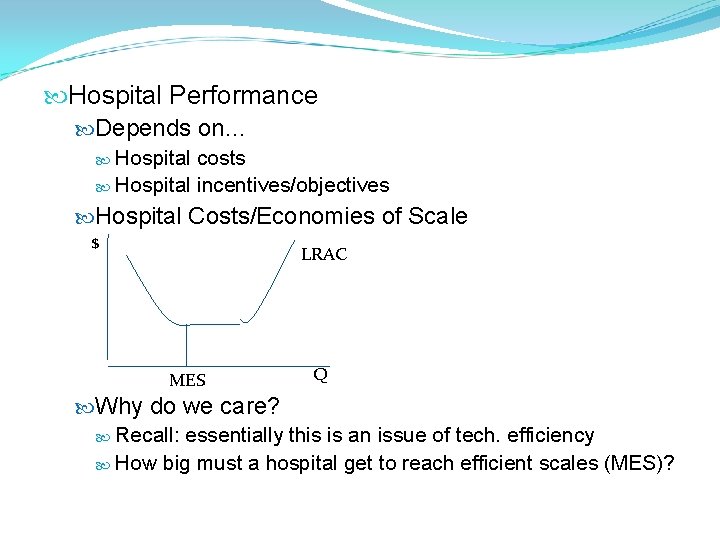
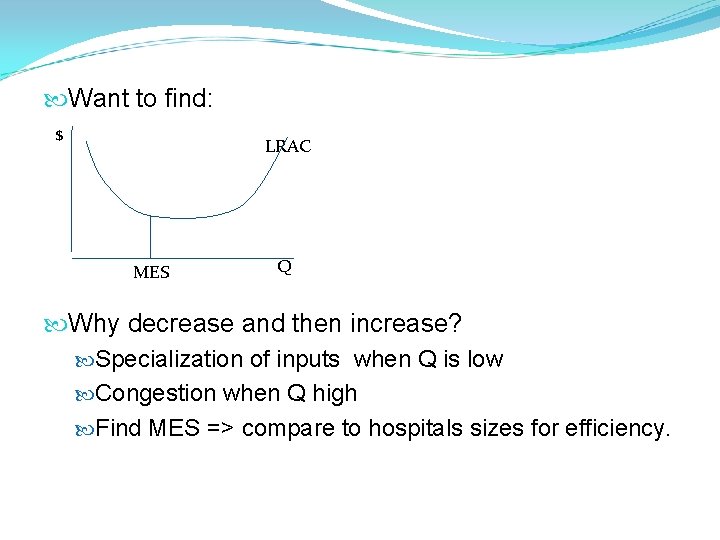
Hospital Performance Depends on… Hospital costs Hospital incentives/objectives Hospital Costs/Economies of Scale $ LRAC MES Q Why do we care? Recall: essentially this is an issue of tech. efficiency How big must a hospital get to reach efficient scales (MES)?
Or, put differently, are hospitals large because of (1) Economies of Scale => public policy =regulate (2) Lack of competition => Public policy = antitrust Empirical- want to estimate LRAC => use multiple regression analysis Problems Quality differences between hospitals Case mix different Hospital service mix available Severity of illness Input prices Educational hospital?
Want to find: $ LRAC MES Q Why decrease and then increase? Specialization of inputs when Q is low Congestion when Q high Find MES => compare to hospitals sizes for efficiency.
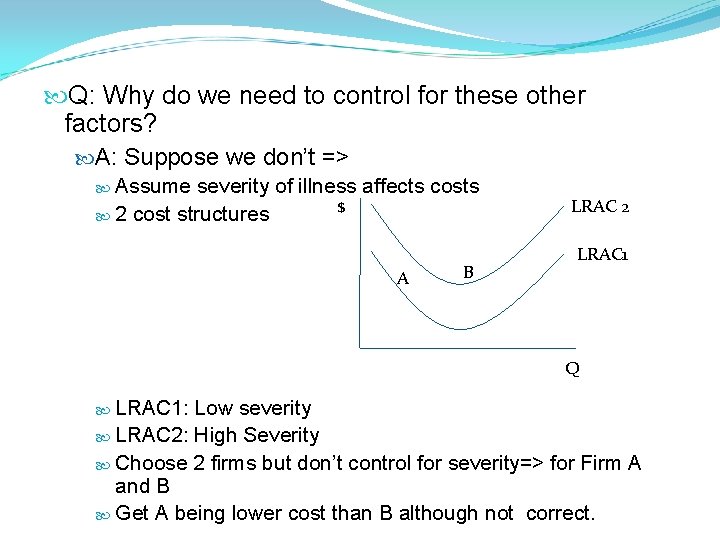
Q: Why do we need to control for these other factors? A: Suppose we don’t => Assume severity of illness affects costs $ 2 cost structures A B LRAC 2 LRAC 1 Q LRAC 1: Low severity LRAC 2: High Severity Choose 2 firms but don’t control for severity=> for Firm A and B Get A being lower cost than B although not correct.
Conclusions Initially consensus = appeared to be slight economies of scale with MES ~ 250 but LRC did not dip much Problems discussed earlier especially WRT controlling for theoretically relevant but unobtainable data destroyed this consensus Some raise possibility of diseconomies of scale Survival analysis: if size of hospitals increase over time => must have some advantage like economies of scale. If decrease => disadvantage Survival analysis finds slight economies of scale in hospitals That is, smaller to medium size hospitals are more likely to survive.
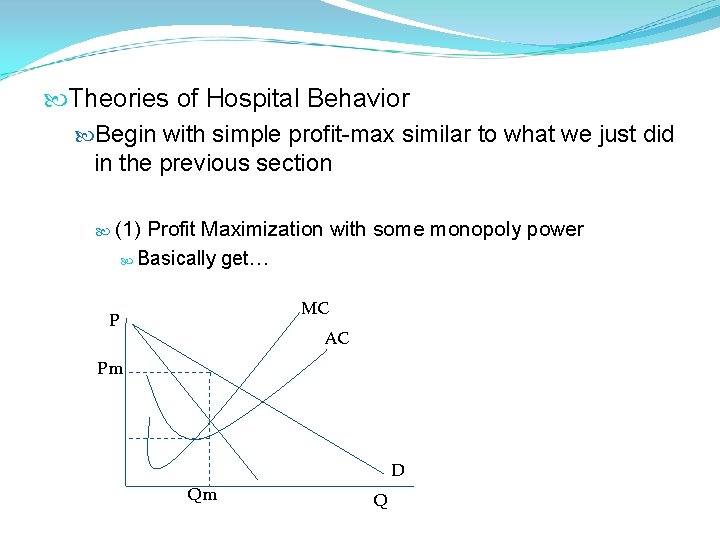
Theories of Hospital Behavior Begin with simple profit-max similar to what we just did in the previous section (1) Profit Maximization with some monopoly power Basically get… MC P AC Pm D Qm Q
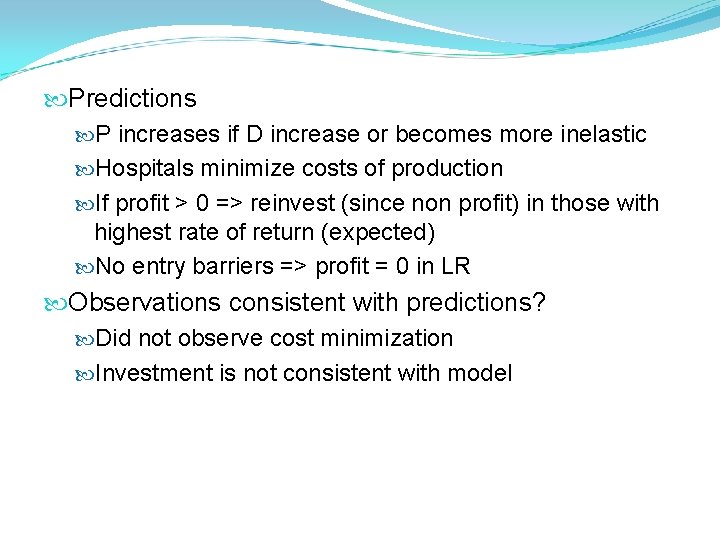
Predictions P increases if D increase or becomes more inelastic Hospitals minimize costs of production If profit > 0 => reinvest (since non profit) in those with highest rate of return (expected) No entry barriers => profit = 0 in LR Observations consistent with predictions? Did not observe cost minimization Investment is not consistent with model
Invested in services which lost money Plus cross subsidized low profit treatments => not minimizing costs (economies of scope) Barriers to entry must exist since not minimizing costs What do physicians do? Model assumes a passive role. This is not consistent either. Physician Control Model Assume: Physician decides treatment mix as patient’s agent Patient doesn’t care what to mix or prices of inputs only total price and output. Drs. may decide input mix to max own income or utility Or can view Drs as contractor and gets what is left over after pay hospital its costs.
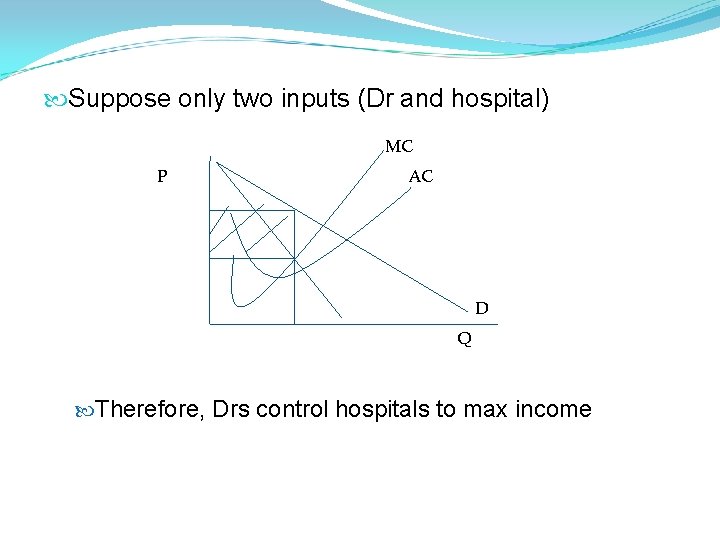
Suppose only two inputs (Dr and hospital) MC P AC D Q Therefore, Drs control hospitals to max income
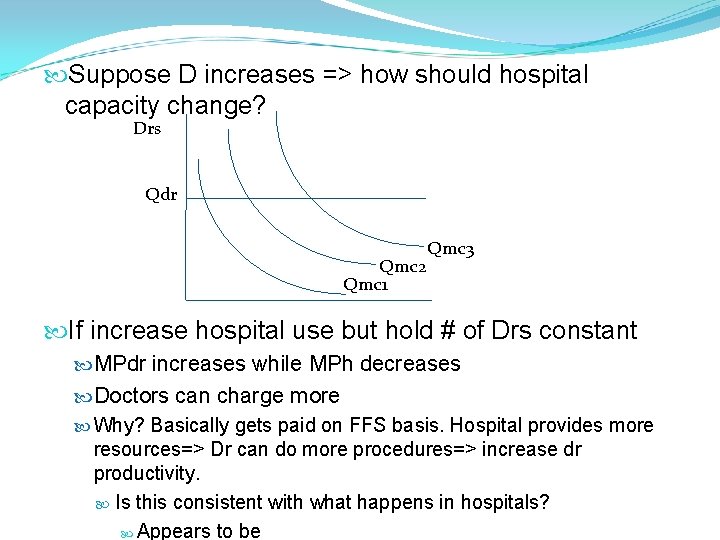
Suppose D increases => how should hospital capacity change? Drs Qdr Qmc 2 Qmc 1 Qmc 3 If increase hospital use but hold # of Drs constant MPdr increases while MPh decreases Doctors can charge more Why? Basically gets paid on FFS basis. Hospital provides more resources=> Dr can do more procedures=> increase dr productivity. Is this consistent with what happens in hospitals? Appears to be
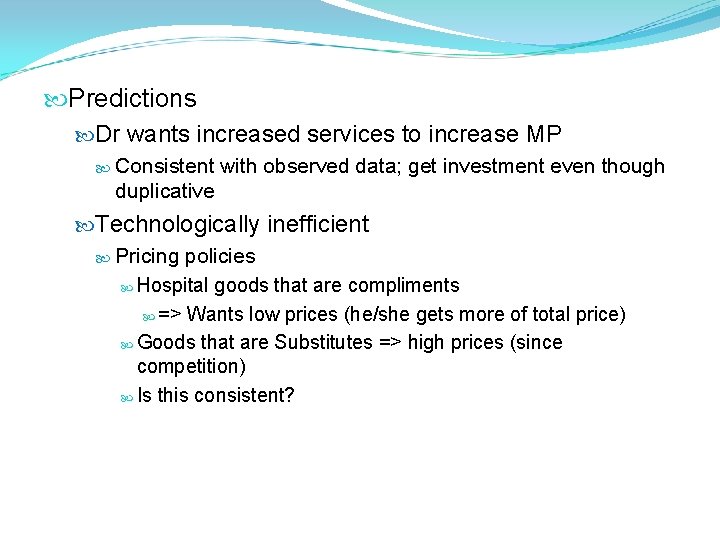
Predictions Dr wants increased services to increase MP Consistent with observed data; get investment even though duplicative Technologically inefficient Pricing policies Hospital goods that are compliments => Wants low prices (he/she gets more of total price) Goods that are Substitutes => high prices (since competition) Is this consistent?
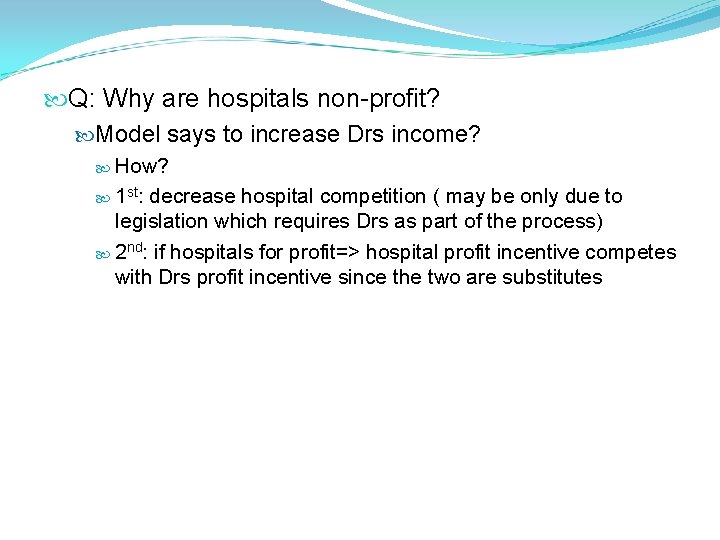
Q: Why are hospitals non-profit? Model says to increase Drs income? How? 1 st: decrease hospital competition ( may be only due to legislation which requires Drs as part of the process) 2 nd: if hospitals for profit=> hospital profit incentive competes with Drs profit incentive since the two are substitutes
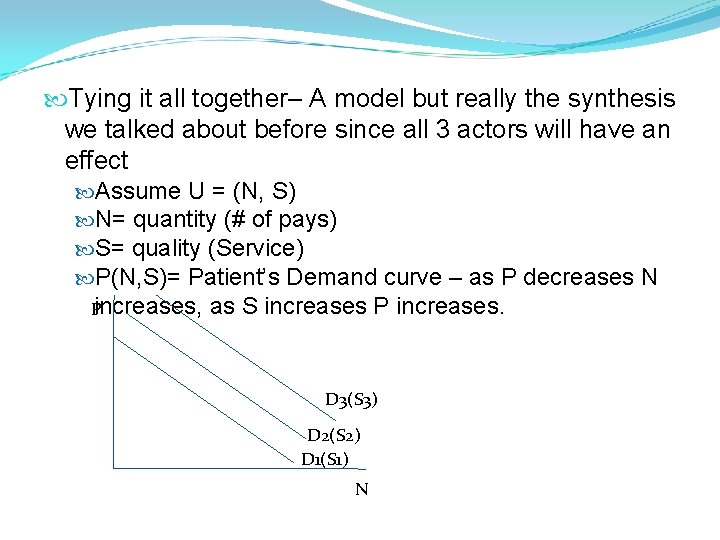
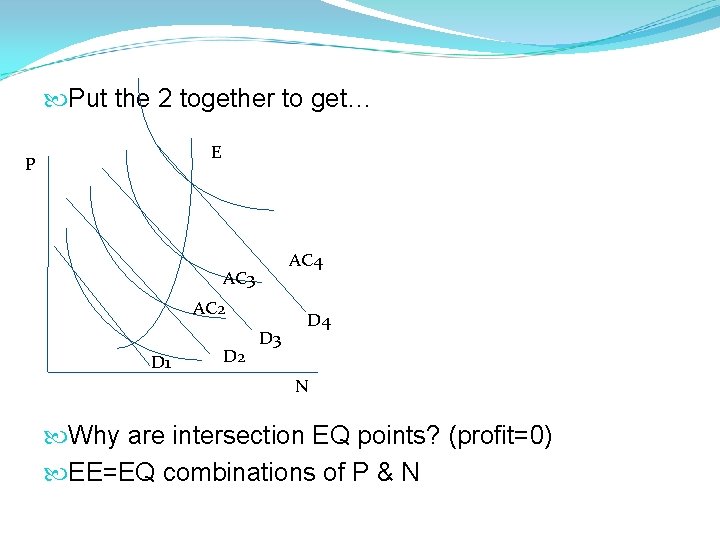
Tying it all together– A model but really the synthesis we talked about before since all 3 actors will have an effect Assume U = (N, S) N= quantity (# of pays) S= quality (Service) P(N, S)= Patient’s Demand curve – as P decreases N Pincreases, as S increases P increases. D 3(S 3) D 2(S 2) D 1(S 1) N
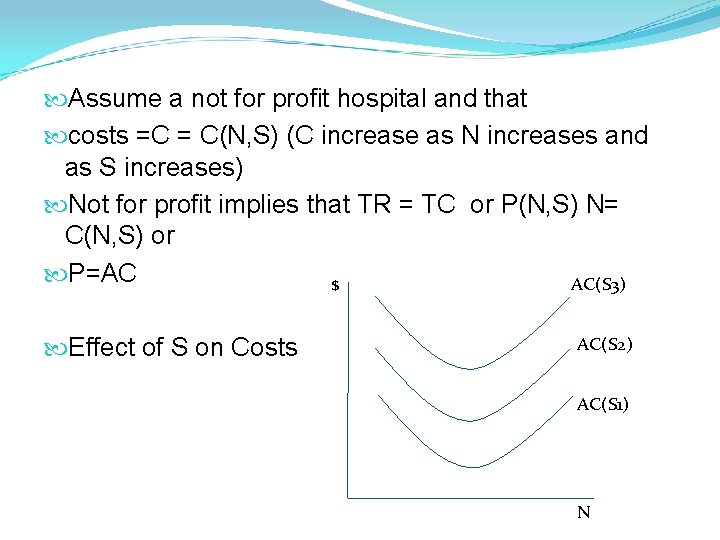
Assume a not for profit hospital and that costs =C = C(N, S) (C increase as N increases and as S increases) Not for profit implies that TR = TC or P(N, S) N= C(N, S) or P=AC $ AC(S 3) Effect of S on Costs AC(S 2) AC(S 1) N
Put the 2 together to get… E P AC 4 AC 3 AC 2 D 1 D 2 D 3 D 4 N Why are intersection EQ points? (profit=0) EE=EQ combinations of P & N
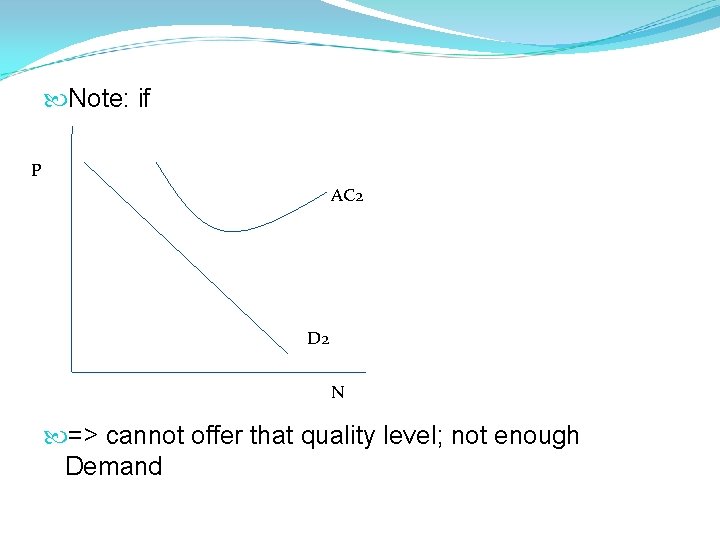
Note: if P AC 2 D 2 N => cannot offer that quality level; not enough Demand
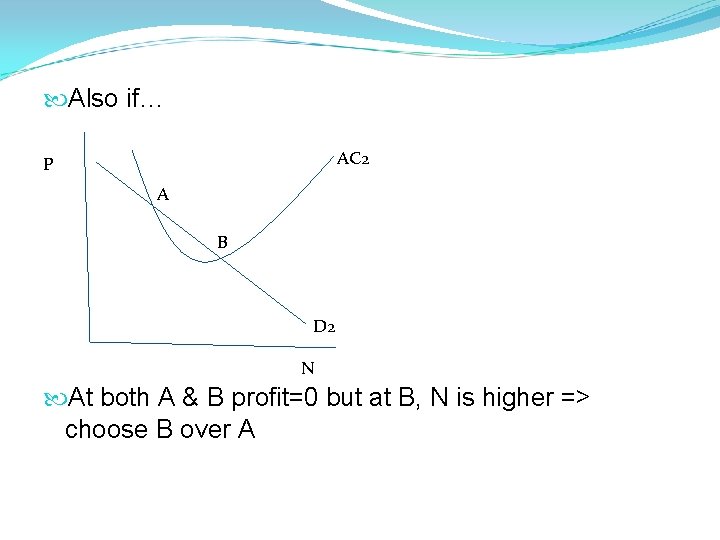
Also if… AC 2 P A B D 2 N At both A & B profit=0 but at B, N is higher => choose B over A
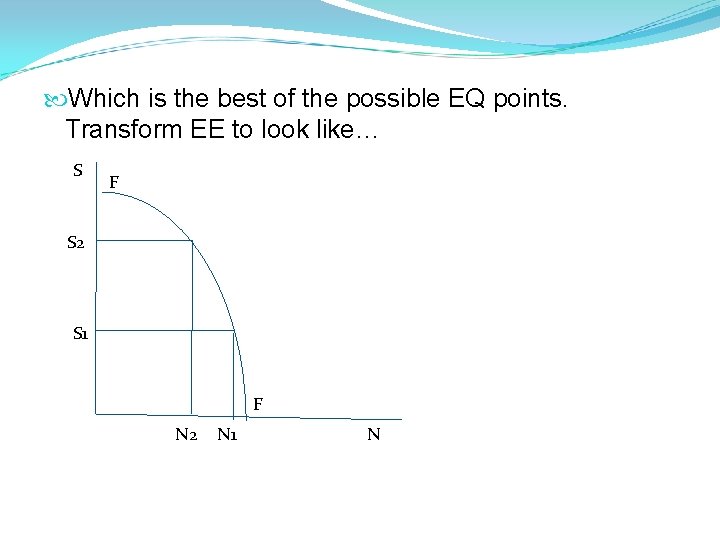
Which is the best of the possible EQ points. Transform EE to look like… S F S 2 S 1 F N 2 N 1 N
Now put with U(N, S) Utility max combination of N&S S S* I 3 I 2 I 1 N* N
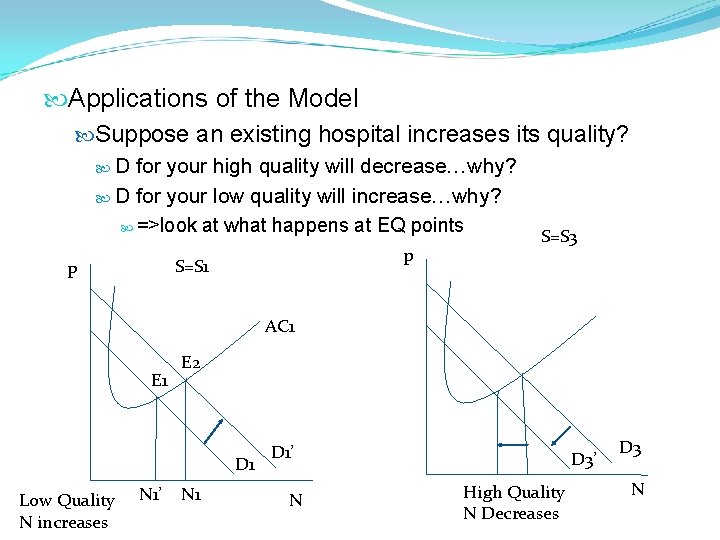
Applications of the Model Suppose an existing hospital increases its quality? D for your high quality will decrease…why? D for your low quality will increase…why? =>look at what happens at EQ points p S=S 1 P S=S 3 AC 1 E 2 D 1 Low Quality N increases N 1’ N 1 D 1’ N D 3’ High Quality N Decreases D 3 N
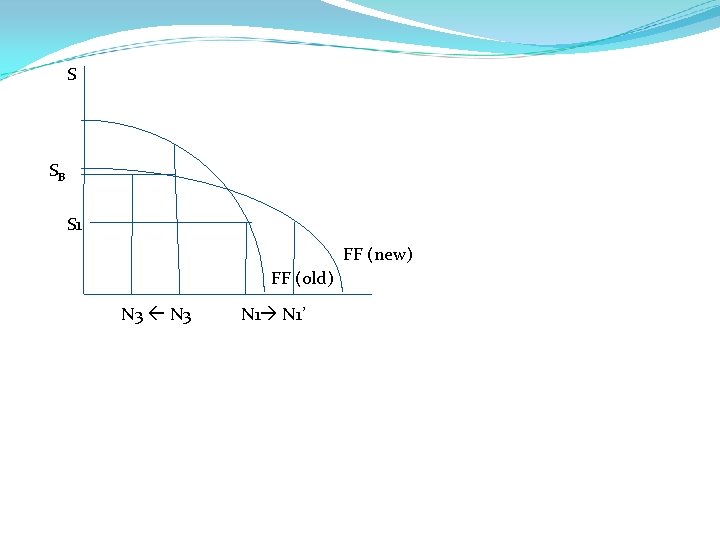
S SB S 1 FF (new) FF (old) N 3 N 1 N 1’
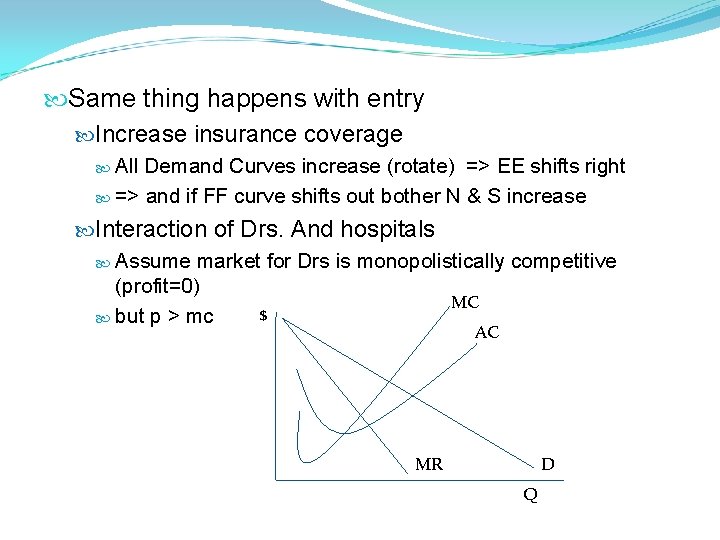
Same thing happens with entry Increase insurance coverage All Demand Curves increase (rotate) => EE shifts right => and if FF curve shifts out bother N & S increase Interaction of Drs. And hospitals Assume market for Drs is monopolistically competitive (profit=0) MC $ but p > mc AC MR D Q
But if hospitals decrease Drs…AC => Drs make profit as long as not low enough to induce entry. How do hospitals decrease AC? By increasing quality What do hospitals get out of this? Patients: hospitals increase doctors’ profits but get patients in return Competition (how do hospitals compete? ) Old Style Patients have complete insurance (is this true)=> they like more services and cost not an issue => attracting patients and Drs the same increased quality and increased costs
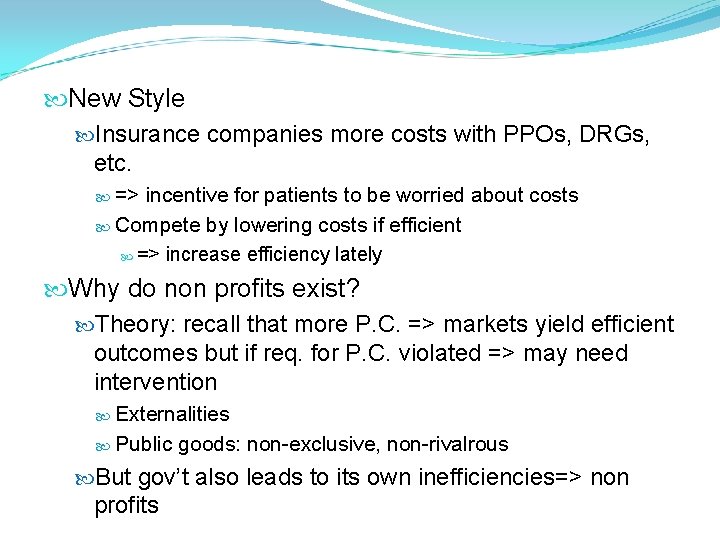
New Style Insurance companies more costs with PPOs, DRGs, etc. => incentive for patients to be worried about costs Compete by lowering costs if efficient => increase efficiency lately Why do non profits exist? Theory: recall that more P. C. => markets yield efficient outcomes but if req. for P. C. violated => may need intervention Externalities Public goods: non-exclusive, non-rivalrous But gov’t also leads to its own inefficiencies=> non profits
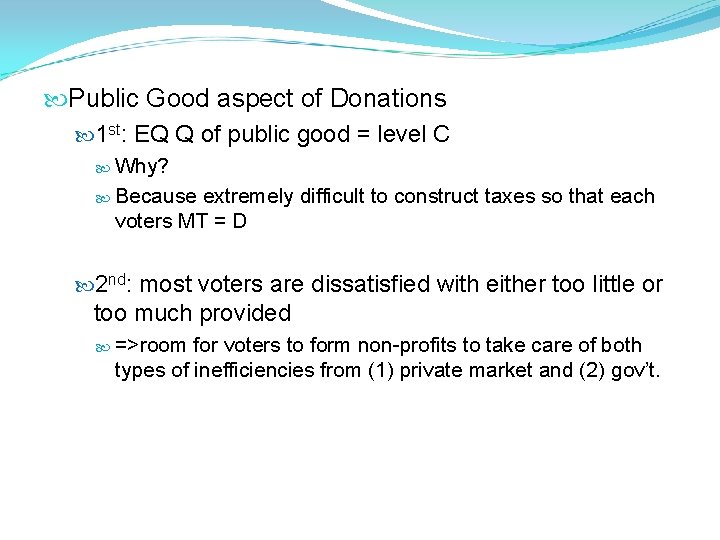
Public Good aspect of Donations 1 st: EQ Q of public good = level C Why? Because extremely difficult to construct taxes so that each voters MT = D 2 nd: most voters are dissatisfied with either too little or too much provided =>room for voters to form non-profits to take care of both types of inefficiencies from (1) private market and (2) gov’t.
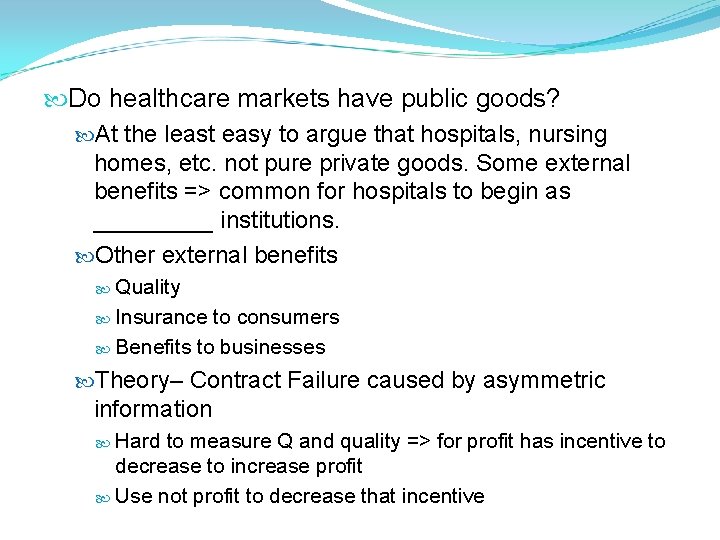
Do healthcare markets have public goods? At the least easy to argue that hospitals, nursing homes, etc. not pure private goods. Some external benefits => common for hospitals to begin as _____ institutions. Other external benefits Quality Insurance to consumers Benefits to businesses Theory– Contract Failure caused by asymmetric information Hard to measure Q and quality => for profit has incentive to decrease to increase profit Use not profit to decrease that incentive
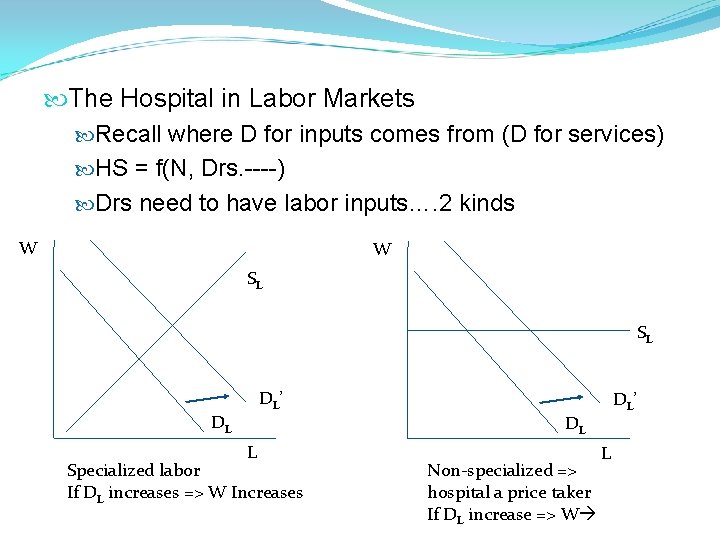
The Hospital in Labor Markets Recall where D for inputs comes from (D for services) HS = f(N, Drs. ----) Drs need to have labor inputs…. 2 kinds W W SL SL DL ’ DL L Specialized labor If DL increases => W Increases Non-specialized => hospital a price taker If DL increase => W L
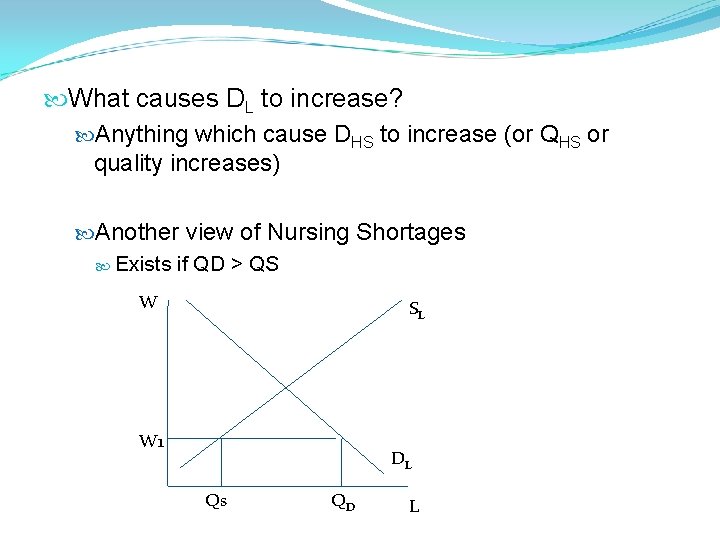
What causes DL to increase? Anything which cause DHS to increase (or QHS or quality increases) Another view of Nursing Shortages Exists if QD > QS W SL W 1 DL Qs QD L
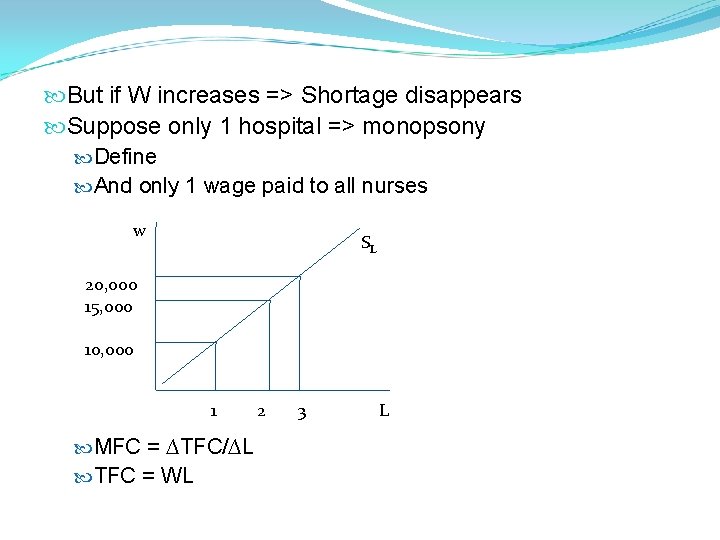
But if W increases => Shortage disappears Suppose only 1 hospital => monopsony Define And only 1 wage paid to all nurses w SL 20, 000 15, 000 10, 000 1 MFC = ∆TFC/∆L TFC = WL 2 3 L
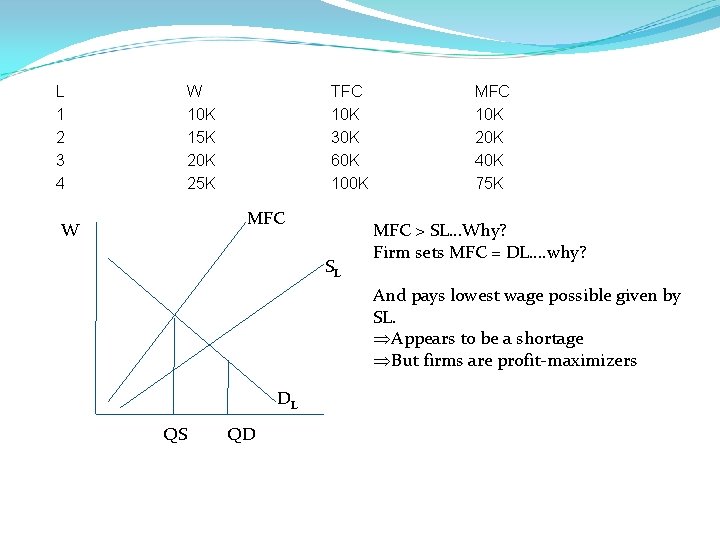
L 1 2 3 4 W 10 K 15 K 20 K 25 K TFC 10 K 30 K 60 K 100 K MFC W SL MFC 10 K 20 K 40 K 75 K MFC > SL…Why? Firm sets MFC = DL…. why? And pays lowest wage possible given by SL. ÞAppears to be a shortage ÞBut firms are profit-maximizers DL QS QD