
Grammatical functions and Pragmatic considerations in clause combining
Grammatical functions and Pragmatic considerations in clause combining Mark Donohue Australian National University mark. donohue@anu. edu. au International Workshop on Clause Combining in and around Indonesia TUFS, 7 -8 October 2012
Overview • Introduction • Skou: – Clause combining as a syntactically-governed process; – Clause combining as a pragmatically free process – Skou, Tukang Besi • Tukang Besi: – Clause combining as a syntactically-governed process – Clause combining as a pragmatically free process; • Strategies for success?
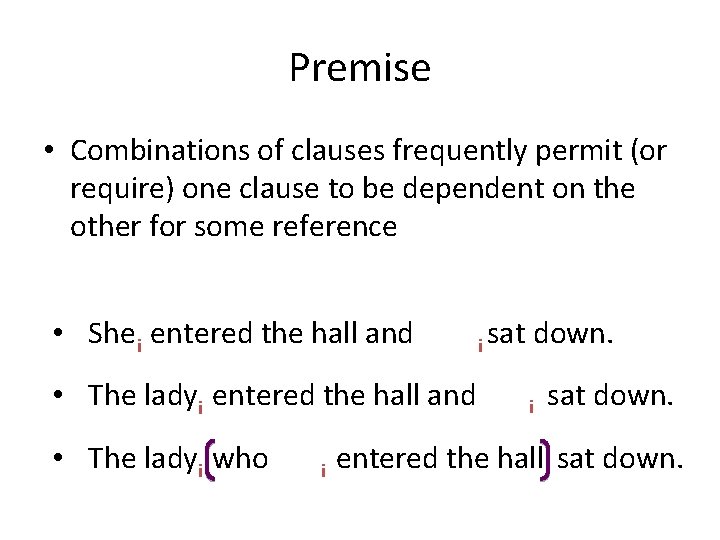
Premise • Combinations of clauses frequently permit (or require) one clause to be dependent on the other for some reference • She i entered the hall and shej, i sat down. • The ladyi entered the hall and shei, j sat down. • The ladyi who shei? entered the hall sat down.
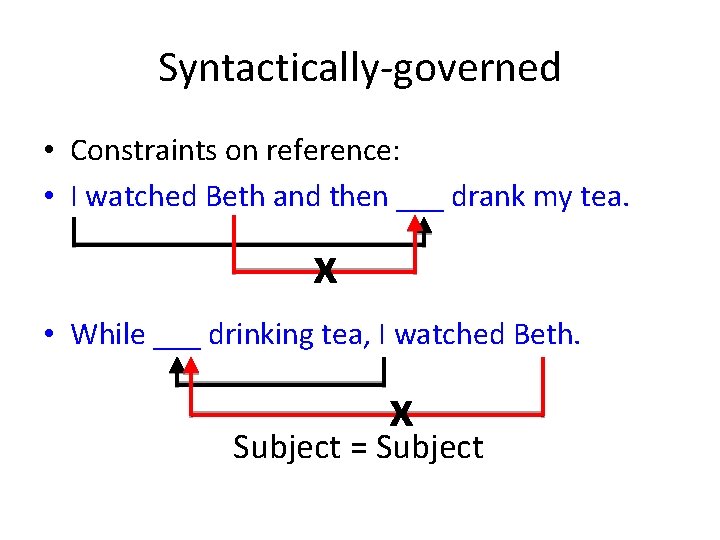
Syntactically-governed • Constraints on reference: • I watched Beth and then ___ drank my tea. x • While ___ drinking tea, I watched Beth. x Subject = Subject
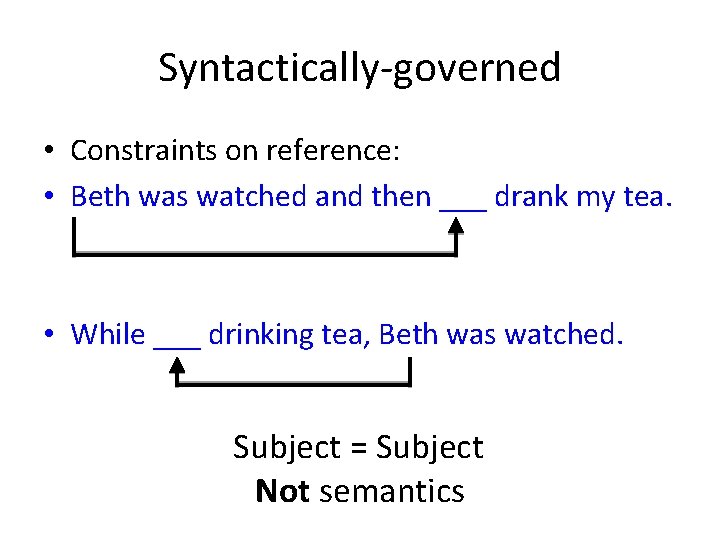
Syntactically-governed • Constraints on reference: • Beth was watched and then ___ drank my tea. • While ___ drinking tea, Beth was watched. Subject = Subject Not semantics
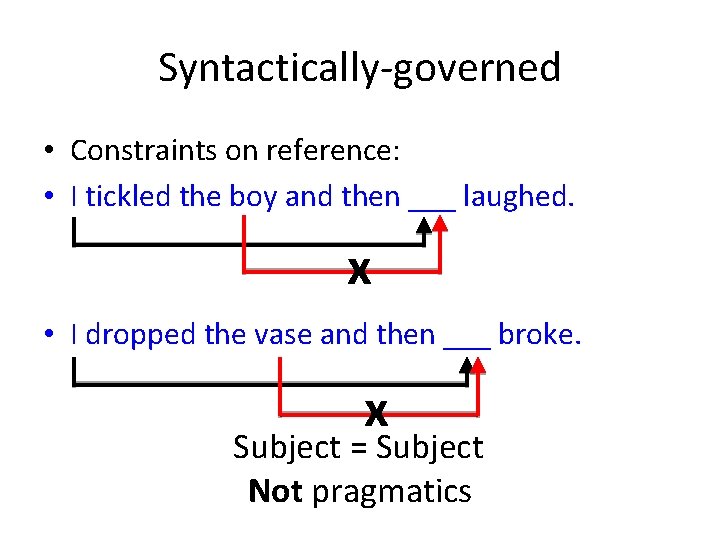
Syntactically-governed • Constraints on reference: • I tickled the boy and then ___ laughed. x • I dropped the vase and then ___ broke. x Subject = Subject Not pragmatics
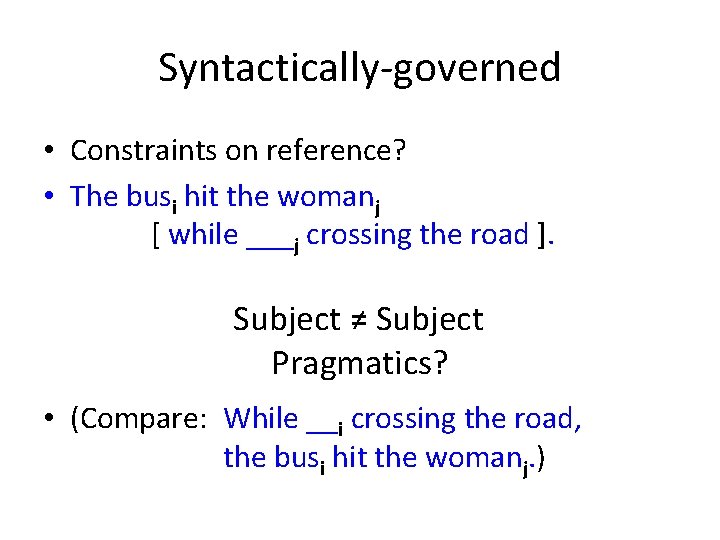
Syntactically-governed • Constraints on reference? • The busi hit the womanj [ while ___j crossing the road ]. Subject ≠ Subject Pragmatics? • (Compare: While __i crossing the road, the busi hit the womanj. )
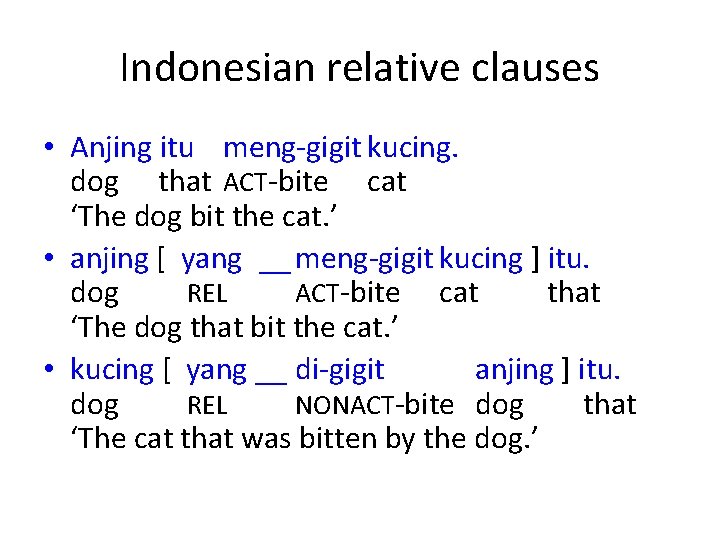
Indonesian relative clauses • Anjing itu meng-gigit kucing. dog that ACT-bite cat ‘The dog bit the cat. ’ • anjing [ yang __ meng-gigit kucing ] itu. dog REL ACT-bite cat that ‘The dog that bit the cat. ’ • kucing [ yang __ di-gigit anjing ] itu. dog REL NONACT-bite dog that ‘The cat that was bitten by the dog. ’
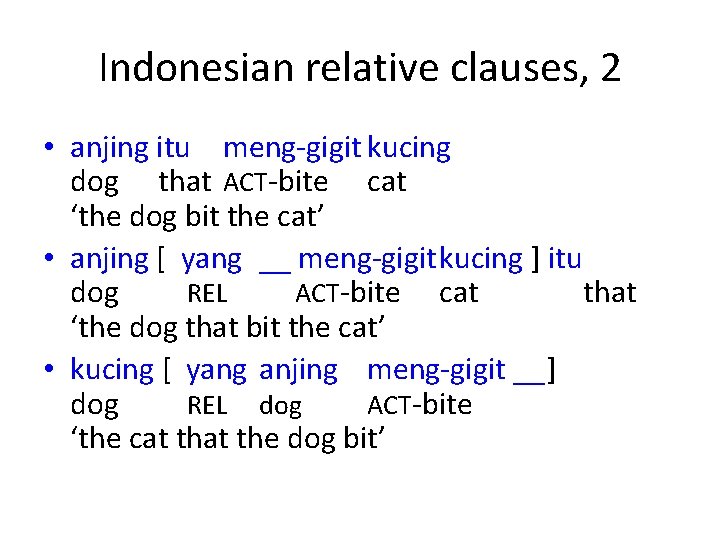
Indonesian relative clauses, 2 • anjing itu meng-gigit kucing dog that ACT-bite cat ‘the dog bit the cat’ • anjing [ yang __ meng-gigitkucing ] itu dog REL ACT-bite cat that ‘the dog that bit the cat’ • kucing [ yang anjing meng-gigit __] dog REL dog ACT-bite ‘the cat the dog bit’

Overview • Introduction • Skou: – Clause combining as a syntactically-governed process; – Clause combining as a pragmatically free process – Skou, Tukang Besi • Tukang Besi: – Clause combining as a syntactically-governed process – Clause combining as a pragmatically free process; • Strategies for success?
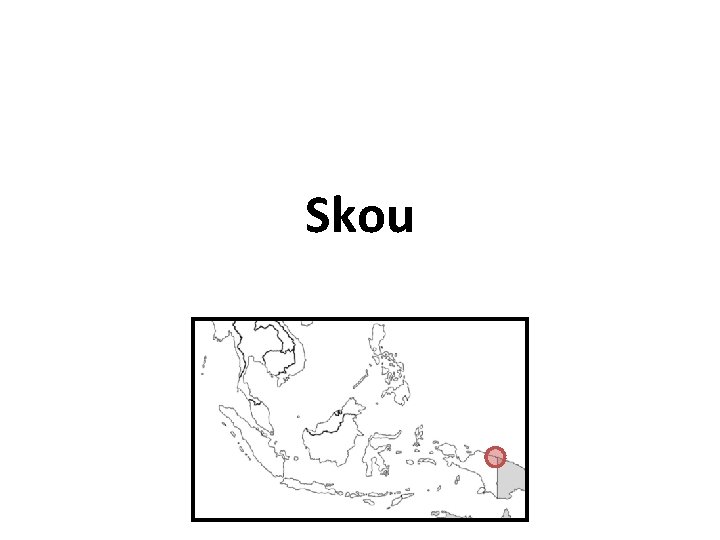
Skou
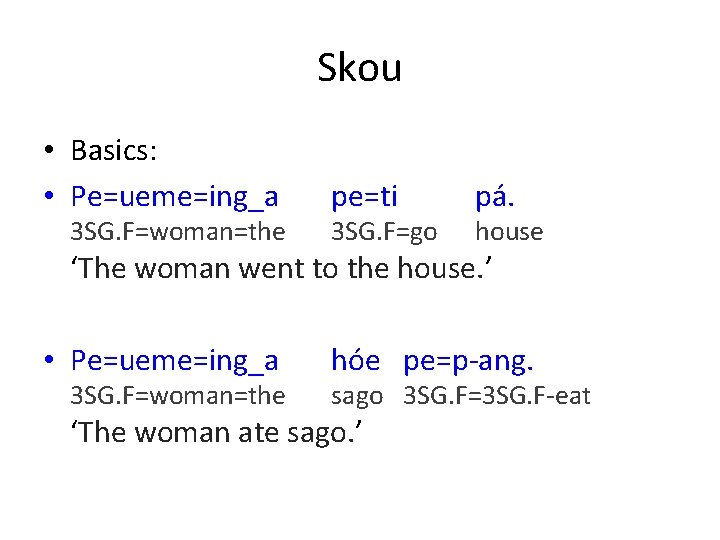
Skou • Basics: • Pe=ueme=ing_a 3 SG. F=woman=the pe=ti 3 SG. F=go pá. house ‘The woman went to the house. ’ • Pe=ueme=ing_a 3 SG. F=woman=the hóe pe=p-ang. sago 3 SG. F=3 SG. F-eat ‘The woman ate sago. ’
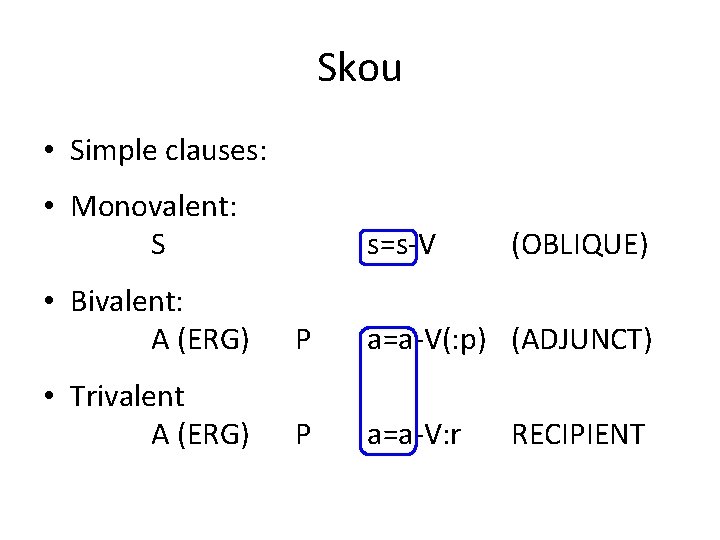
Skou • Simple clauses: • Monovalent: S s=s-V (OBLIQUE) • Bivalent: A (ERG) P a=a-V(: p) (ADJUNCT) • Trivalent A (ERG) P a=a-V: r RECIPIENT
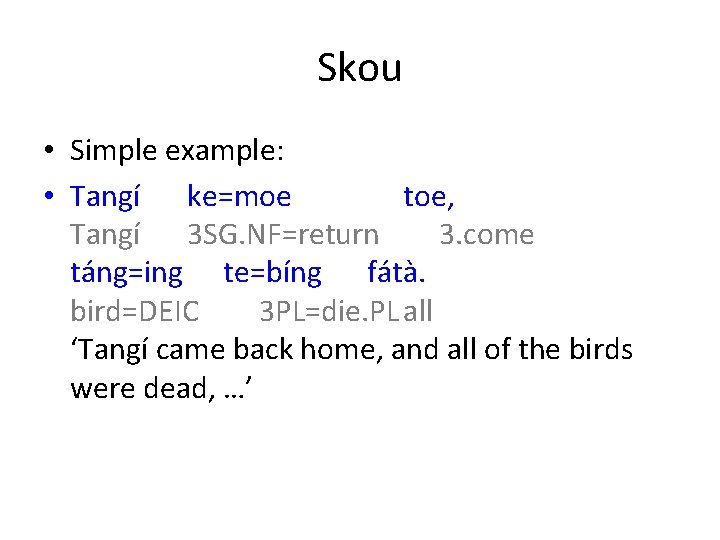
Skou • Simple example: • Tangí ke=moe toe, Tangí 3 SG. NF=return 3. come táng=ing te=bíng fátà. bird=DEIC 3 PL=die. PL all ‘Tangí came back home, and all of the birds were dead, …’
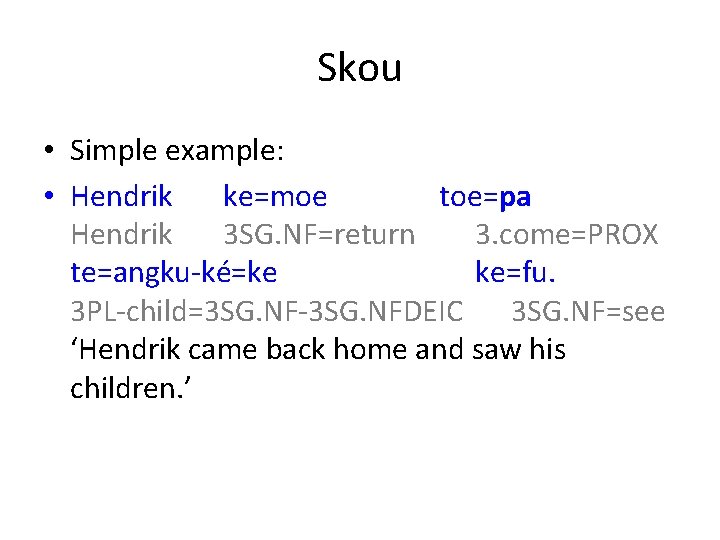
Skou • Simple example: • Hendrik ke=moe toe=pa Hendrik 3 SG. NF=return 3. come=PROX te=angku-ké=ke ke=fu. 3 PL-child=3 SG. NF-3 SG. NFDEIC 3 SG. NF=see ‘Hendrik came back home and saw his children. ’
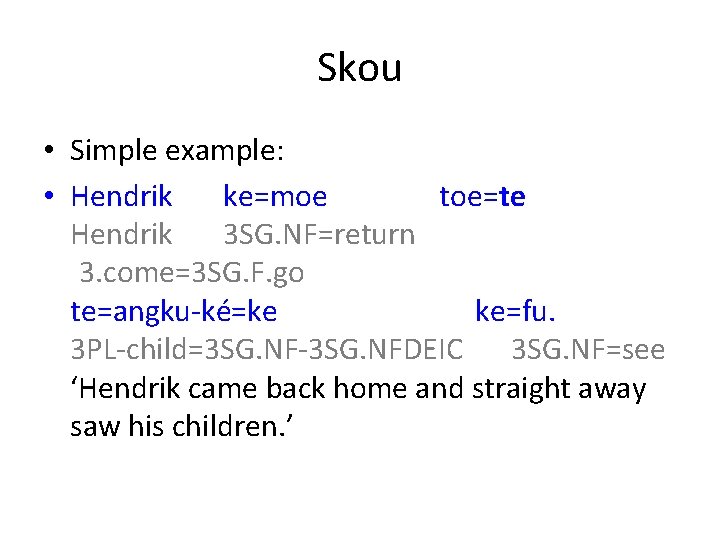
Skou • Simple example: • Hendrik ke=moe toe=te Hendrik 3 SG. NF=return 3. come=3 SG. F. go te=angku-ké=ke ke=fu. 3 PL-child=3 SG. NF-3 SG. NFDEIC 3 SG. NF=see ‘Hendrik came back home and straight away saw his children. ’
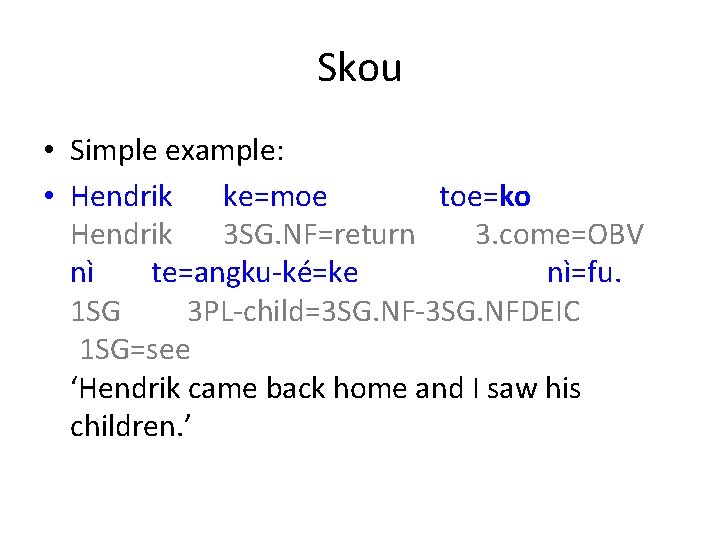
Skou • Simple example: • Hendrik ke=moe toe=ko Hendrik 3 SG. NF=return 3. come=OBV nì te=angku-ké=ke nì=fu. 1 SG 3 PL-child=3 SG. NF-3 SG. NFDEIC 1 SG=see ‘Hendrik came back home and I saw his children. ’

Skou • Additional example: • Pe Hendrik pe=w-á=ko 3 SG. F Hendrik 3 SG. NF=3 SG. NF-hit=OBV ke=wang. 3 SG. NF=die ‘She killed Hendrik. ’
Overview • Introduction • Skou: – Clause combining as a syntactically-governed process; – Clause combining as a pragmatically free process – Skou, Tukang Besi • Tukang Besi: – Clause combining as a syntactically-governed process – Clause combining as a pragmatically free process; • Strategies for success?
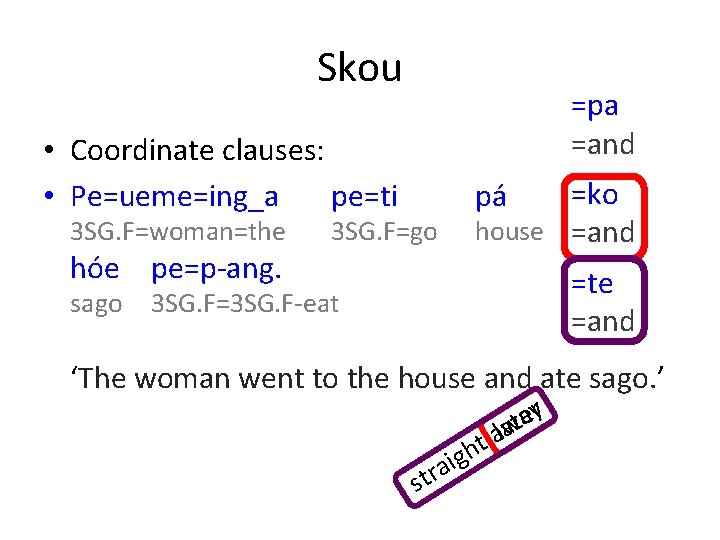
Skou =pa =and • Coordinate clauses: • Pe=ueme=ing_a pe=ti 3 SG. F=woman=the hóe pe=p-ang. sago 3 SG. F=go =ko house =and pá =te =and 3 SG. F=3 SG. F-eat ‘The woman went to the house and ate sago. ’ yr e a t aw t al st h g i ra
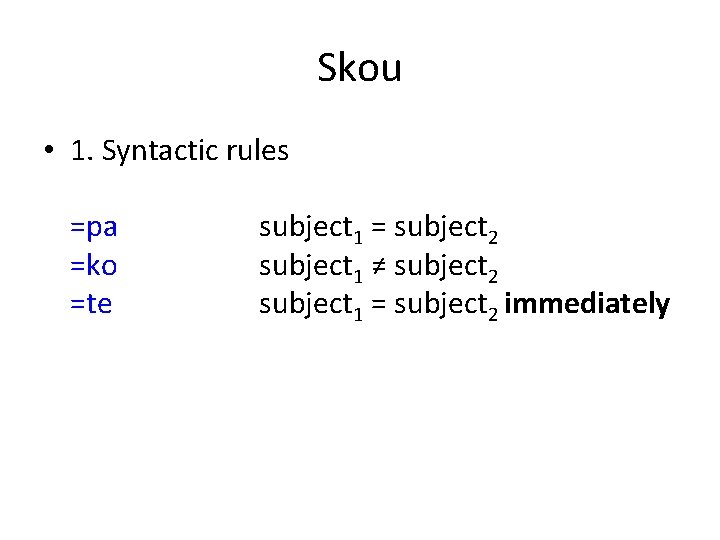
Skou • 1. Syntactic rules =pa =ko =te subject 1 = subject 2 subject 1 ≠ subject 2 subject 1 = subject 2 immediately
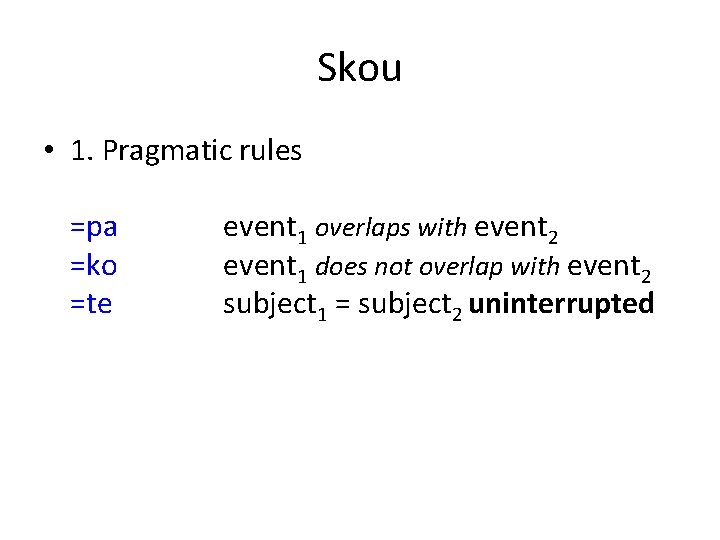
Skou • 1. Pragmatic rules =pa =ko =te event 1 overlaps with event 2 event 1 does not overlap with event 2 subject 1 = subject 2 uninterrupted
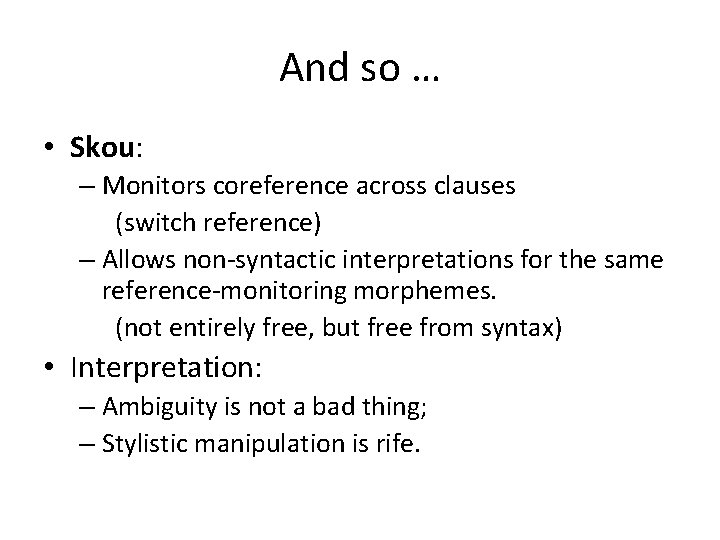
And so … • Skou: – Monitors coreference across clauses (switch reference) – Allows non-syntactic interpretations for the same reference-monitoring morphemes. (not entirely free, but free from syntax) • Interpretation: – Ambiguity is not a bad thing; – Stylistic manipulation is rife.

Aside: strong ellipsis
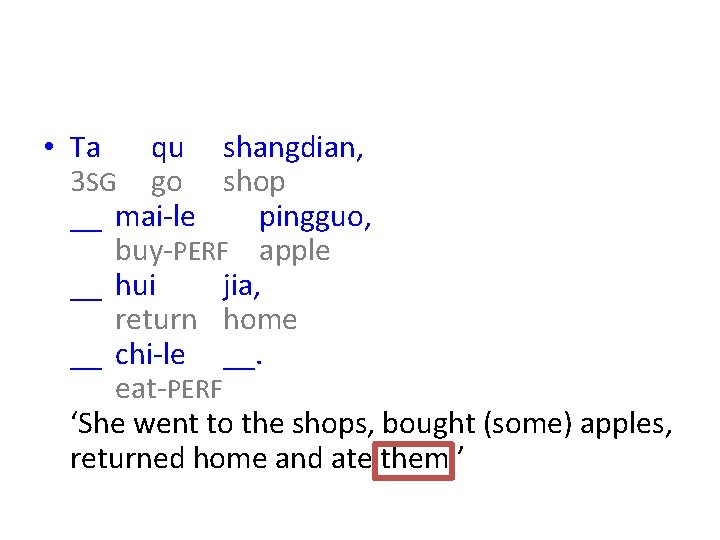
• Ta qu shangdian, 3 SG go shop __ mai-le pingguo, buy-PERF apple __ hui jia, return home __ chi-le __. eat-PERF ‘She went to the shops, bought (some) apples, returned home and ate them. ’
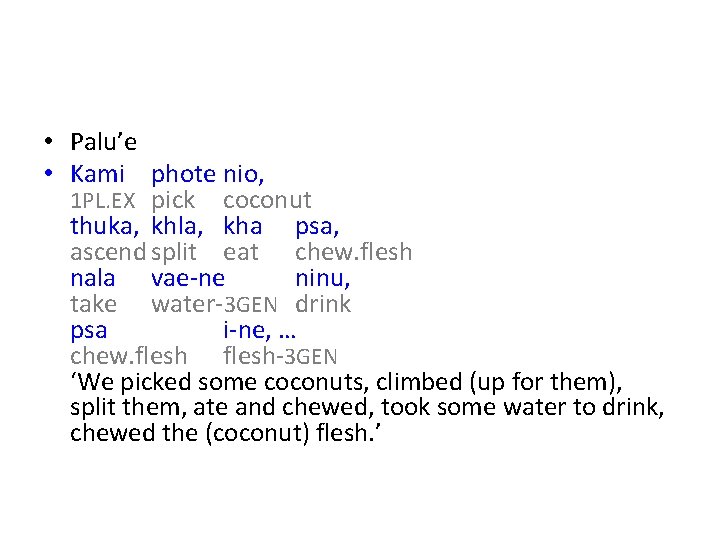
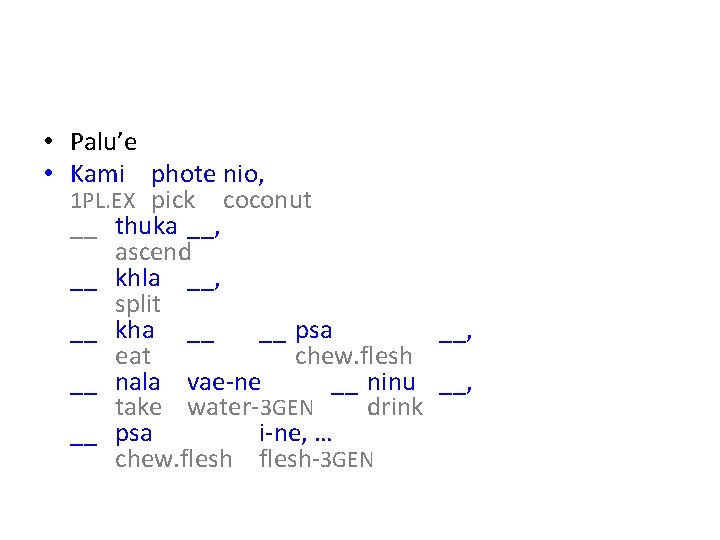
• Palu’e • Kami phote nio, 1 PL. EX pick coconut thuka, khla, kha psa, ascend split eat chew. flesh nala vae-ne ninu, take water-3 GEN drink psa i-ne, … chew. flesh-3 GEN ‘We picked some coconuts, climbed (up for them), split them, ate and chewed, took some water to drink, chewed the (coconut) flesh. ’
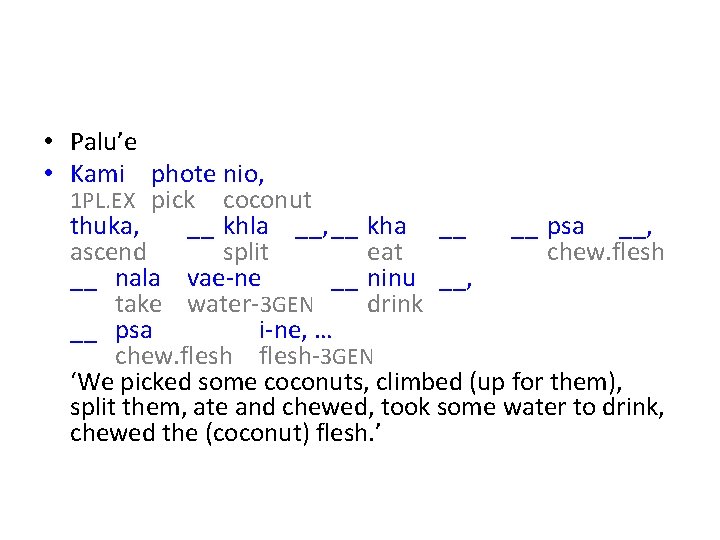
• Palu’e • Kami phote nio, 1 PL. EX pick coconut thuka, __ khla __, __ kha __ __ psa __, ascend split eat chew. flesh __ nala vae-ne __ ninu __, take water-3 GEN drink __ psa i-ne, … chew. flesh-3 GEN ‘We picked some coconuts, climbed (up for them), split them, ate and chewed, took some water to drink, chewed the (coconut) flesh. ’


Overview • Introduction • Skou: – Clause combining as a syntactically-governed process; – Clause combining as a pragmatically free process – Skou, Tukang Besi • Tukang Besi: – Clause combining as a syntactically-governed process – Clause combining as a pragmatically free process; • Strategies for success?
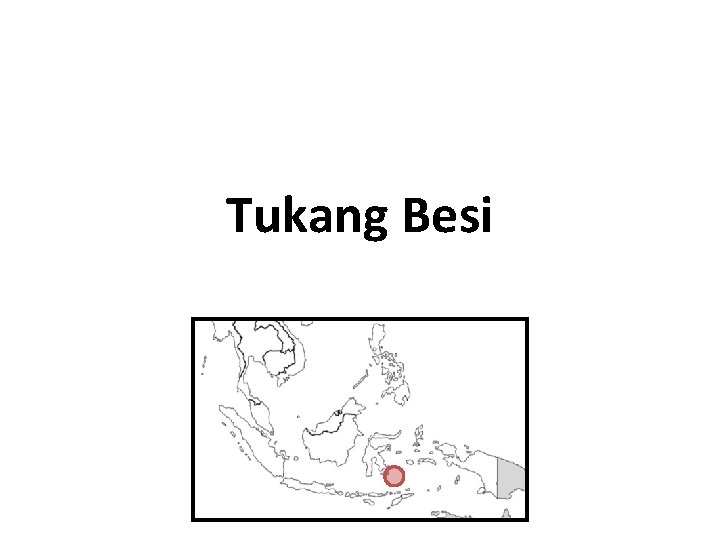
Tukang Besi
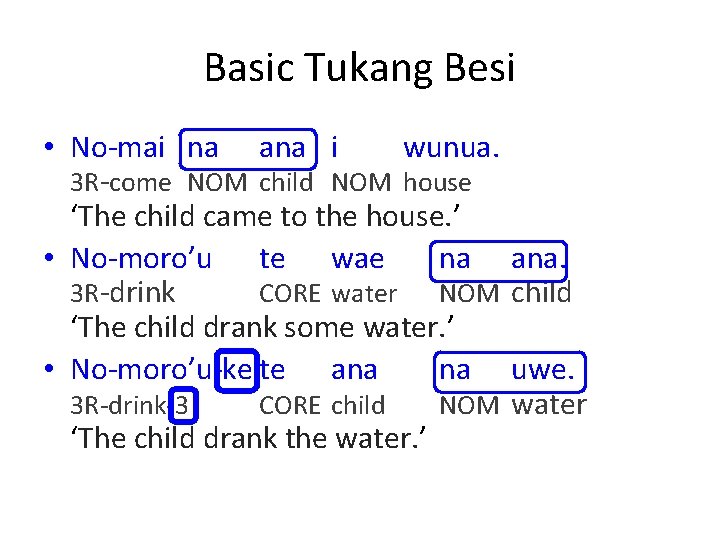
Basic Tukang Besi • No-mai na ana i wunua. 3 R-come NOM child NOM house ‘The child came to the house. ’ • No-moro’u te wae na ana. 3 R-drink CORE water NOM child ‘The child drank some water. ’ • No-moro’u-ke te ana na uwe. 3 R-drink-3 CORE child NOM water ‘The child drank the water. ’
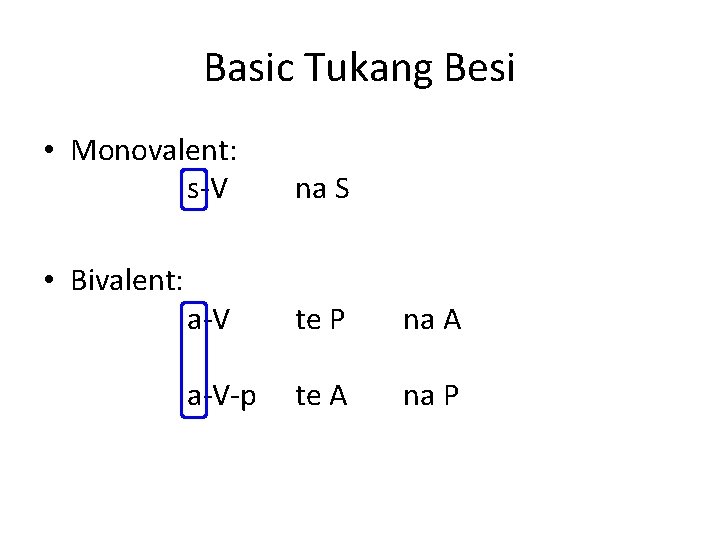
Basic Tukang Besi • Monovalent: s-V • Bivalent: na S a-V te P na A a-V-p te A na P
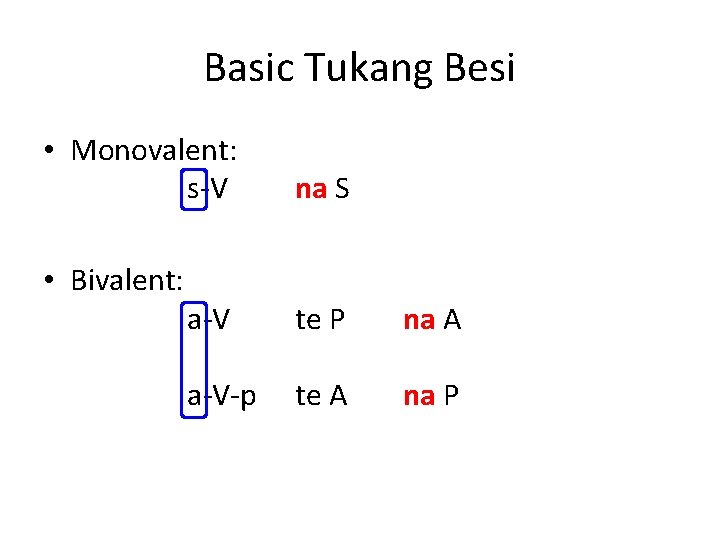
Basic Tukang Besi • Monovalent: s-V • Bivalent: na S a-V te P na A a-V-p te A na P
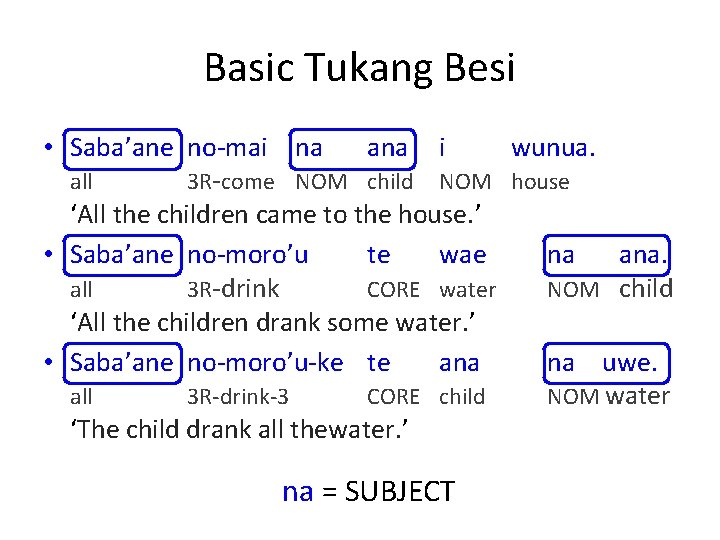
Basic Tukang Besi • Saba’ane no-mai na ana i wunua. all 3 R-come NOM child NOM house ‘All the children came to the house. ’ • Saba’ane no-moro’u te wae na ana. all 3 R-drink CORE water NOM child ‘All the children drank some water. ’ • Saba’ane no-moro’u-ke te ana na uwe. all 3 R-drink-3 CORE child NOM water ‘The child drank all thewater. ’ na = SUBJECT

Tukang Besi • No-mai na ana maka no-kede. 3 R-come NOM child and. then 3 R-sit ‘The child came and then sat down. ’ • Sa-mai-no na ana no-kede. when-come-3 GEN NOM child 3 R-sit ‘When the child came, s/he sat down. ’
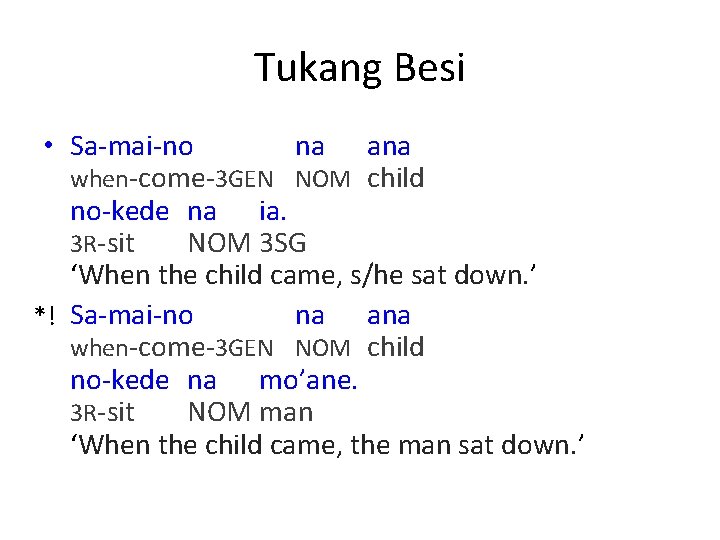
Tukang Besi • Sa-mai-no na ana when-come-3 GEN NOM child no-kede na ia. 3 R-sit NOM 3 SG ‘When the child came, s/he sat down. ’ na ana *! • Sa-mai-no when-come-3 GEN NOM child no-kede na mo’ane. 3 R-sit NOM man ‘When the child came, the man sat down. ’
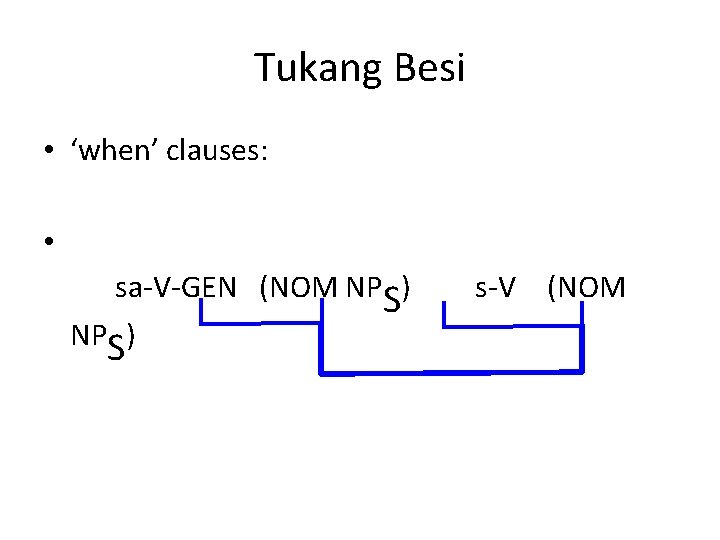
Tukang Besi • ‘when’ clauses: • sa-V-GEN (NOM NPS) s-V (NOM
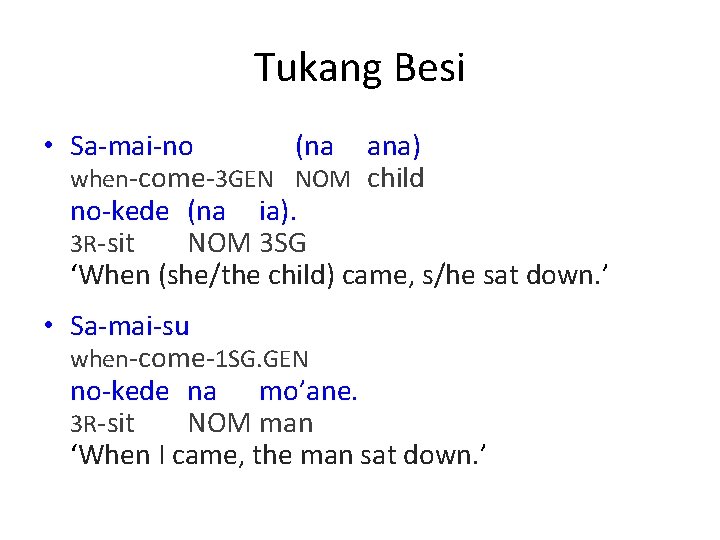
Tukang Besi • Sa-mai-no (na ana) when-come-3 GEN NOM child no-kede (na ia). 3 R-sit NOM 3 SG ‘When (she/the child) came, s/he sat down. ’ • Sa-mai-su when-come-1 SG. GEN no-kede na mo’ane. 3 R-sit NOM man ‘When I came, the man sat down. ’
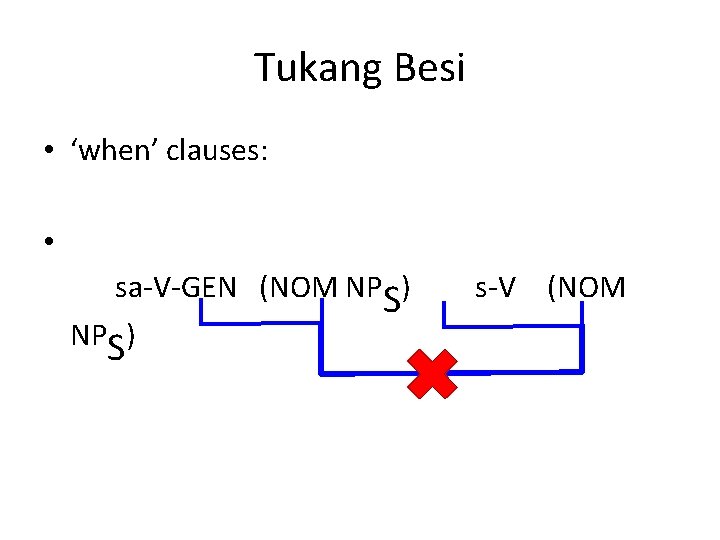
Tukang Besi • ‘when’ clauses: • sa-V-GEN (NOM NPS) s-V (NOM
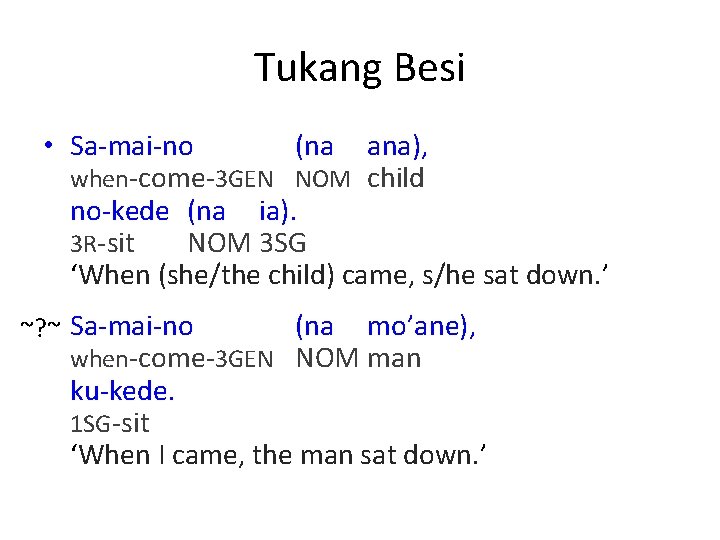
Tukang Besi • Sa-mai-no (na ana), when-come-3 GEN NOM child no-kede (na ia). 3 R-sit NOM 3 SG ‘When (she/the child) came, s/he sat down. ’ • Sa-mai-no ~? ~ (na mo’ane), when-come-3 GEN NOM man ku-kede. 1 SG-sit ‘When I came, the man sat down. ’
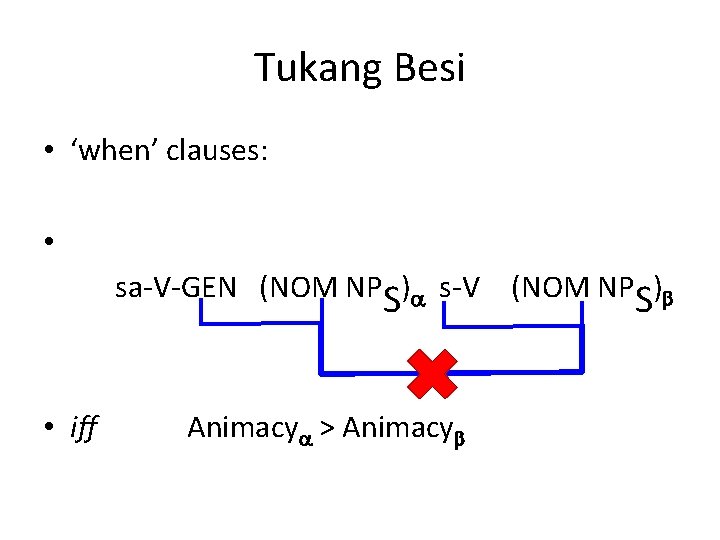
Tukang Besi • ‘when’ clauses: • sa-V-GEN (NOM NPS)a s-V (NOM NPS)b • iff Animacya > Animacyb
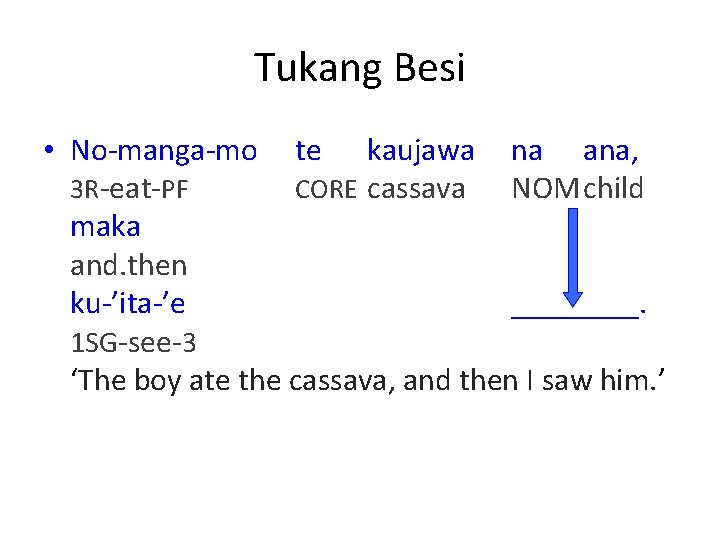
Tukang Besi • No-manga-mo te kaujawa na ana, 3 R-eat-PF CORE cassava NOMchild maka and. then ku-’ita-’e ____. 1 SG-see-3 ‘The boy ate the cassava, and then I saw him. ’

Tukang Besi • No-mai-mo na anabou, 3 R-come-PF NOMboy maka and. then ku-’ita-’e ____. 1 SG-see-3 ‘The boy came, and I saw him. ’
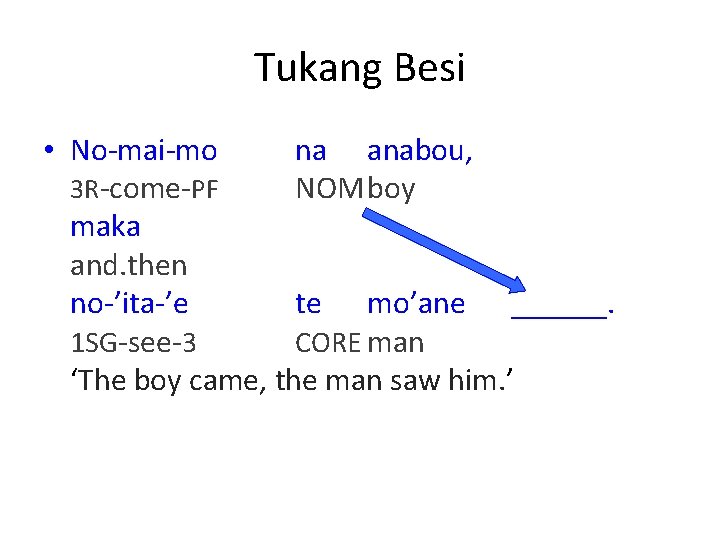
Tukang Besi • No-mai-mo na anabou, 3 R-come-PF NOMboy maka and. then no-’ita-’e te mo’ane ______. 1 SG-see-3 CORE man ‘The boy came, the man saw him. ’
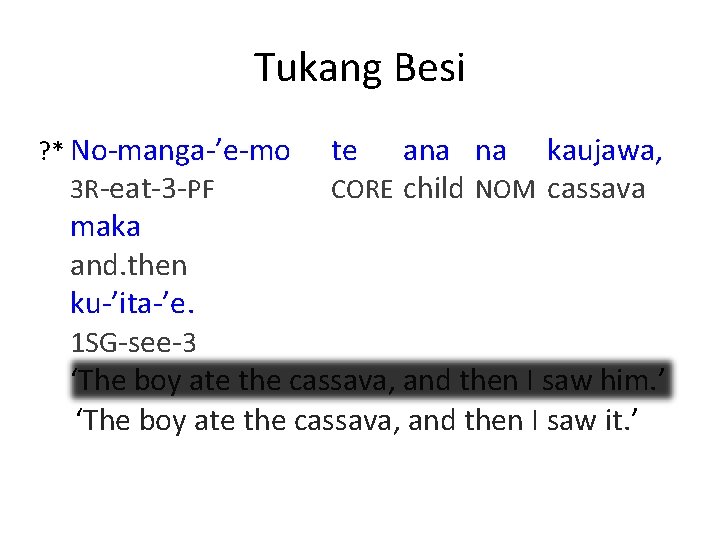
Tukang Besi • No-manga-’e-mo ? * 3 R-eat-3 -PF te ana na kaujawa, CORE child NOM cassava maka and. then ku-’ita-’e. 1 SG-see-3 ‘The boy ate the cassava, and then I saw him. ’ ‘The boy ate the cassava, and then I saw it. ’
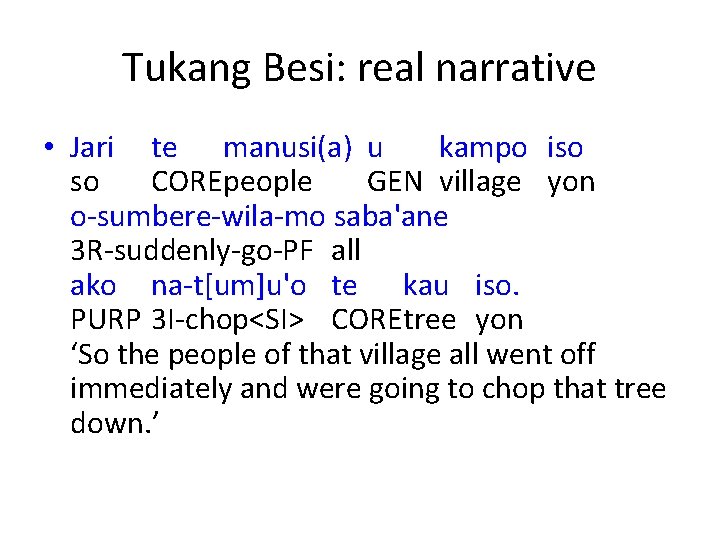
Tukang Besi: real narrative • Jari te manusi(a) u kampo iso so COREpeople GEN village yon o-sumbere-wila-mo saba'ane 3 R-suddenly-go-PF all ako na-t[um]u'o te kau iso. PURP 3 I-chop<SI> COREtree yon ‘So the people of that village all went off immediately and were going to chop that tree down. ’
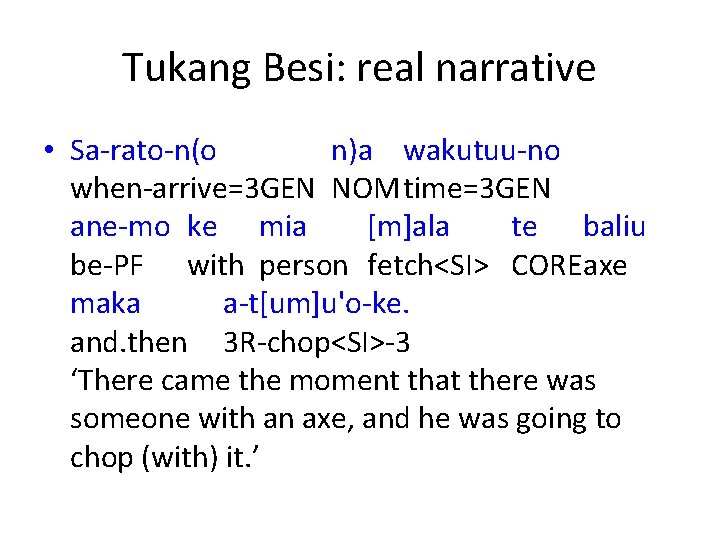
Tukang Besi: real narrative • Sa-rato-n(o n)a wakutuu-no when-arrive=3 GEN NOMtime=3 GEN ane-mo ke mia [m]ala te baliu be-PF with person fetch<SI> COREaxe maka a-t[um]u'o-ke. and. then 3 R-chop<SI>-3 ‘There came the moment that there was someone with an axe, and he was going to chop (with) it. ’
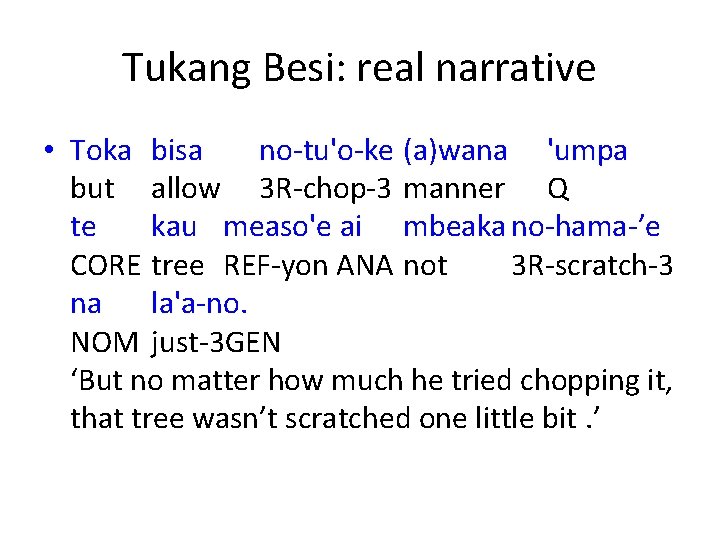
Tukang Besi: real narrative • Toka bisa no-tu'o-ke (a)wana 'umpa but allow 3 R-chop-3 manner Q te kau measo'e ai mbeaka no-hama-’e CORE tree REF-yon ANA not 3 R-scratch-3 na la'a-no. NOM just-3 GEN ‘But no matter how much he tried chopping it, that tree wasn’t scratched one little bit. ’
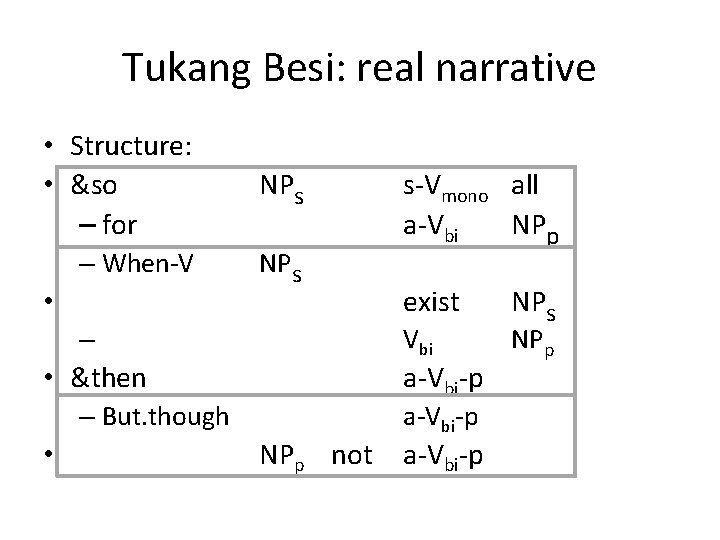
Tukang Besi: real narrative • Structure: • &so – for NPs – When-V NPs • exist Vbi – • &then a-Vbi-p – But. though • s-Vmono all a-Vbi NPp not a-Vbi-p NPs NPp
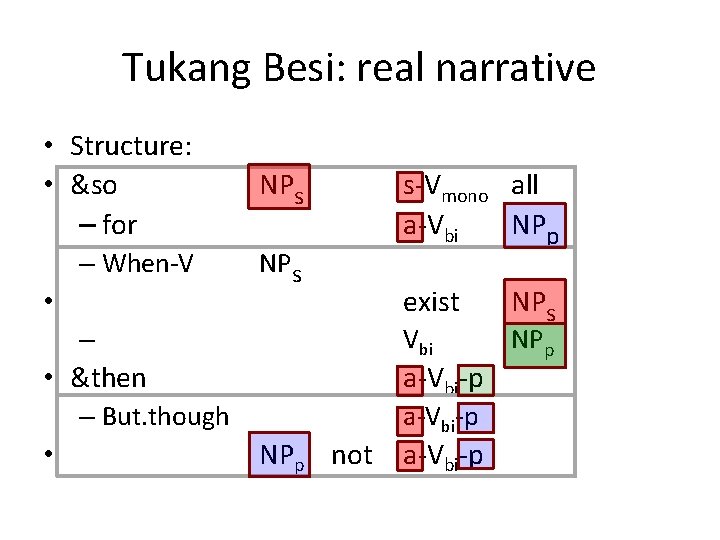
Tukang Besi: real narrative • Structure: • &so – for NPs – When-V NPs • exist Vbi – • &then a-Vbi-p – But. though • s-Vmono all a-Vbi NPp not a-Vbi-p NPs NPp
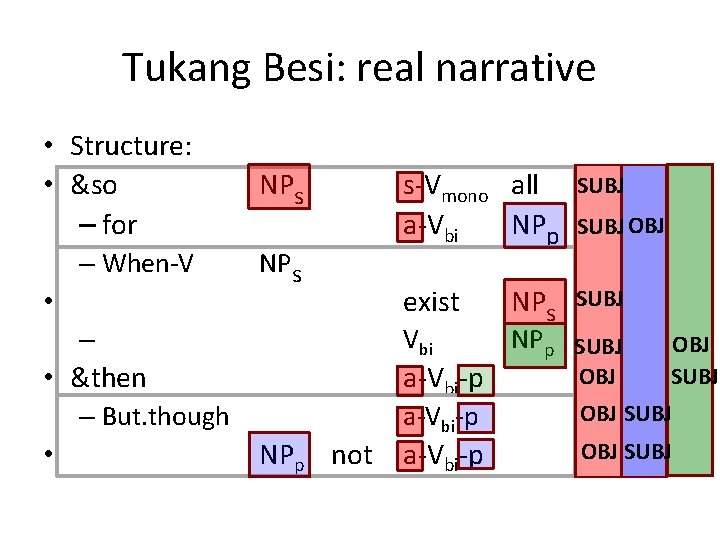
Tukang Besi: real narrative • Structure: • &so – for NPs – When-V NPs • SUBJ exist SUBJ Vbi – • &then a-Vbi-p – But. though • s-Vmono all a-Vbi NPp not a-Vbi-p NPs SUBJ OBJ NPp SUBJ OBJ SUBJ
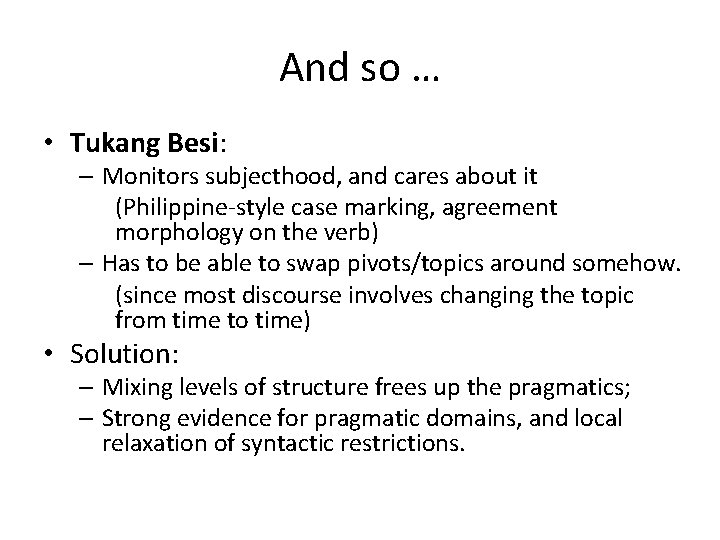
And so … • Tukang Besi: – Monitors subjecthood, and cares about it (Philippine-style case marking, agreement morphology on the verb) – Has to be able to swap pivots/topics around somehow. (since most discourse involves changing the topic from time to time) • Solution: – Mixing levels of structure frees up the pragmatics; – Strong evidence for pragmatic domains, and local relaxation of syntactic restrictions.

Overview • Introduction • Skou: – Clause combining as a syntactically-governed process; – Clause combining as a pragmatically free process – Skou, Tukang Besi • Tukang Besi: – Clause combining as a syntactically-governed process – Clause combining as a pragmatically free process; • Strategies for success?
Conclusions • Syntax matters; • Pragmatics matters; • The relative weight is not predictable, and has to be investigated language by language, ‘construction’ by ‘construction’
The end


• Palu’e • Kami phote nio, 1 PL. EX pick coconut __ thuka __, ascend __ khla __, split __ kha __ __ psa __, eat chew. flesh __ nala vae-ne __ ninu __, take water-3 GEN drink __ psa i-ne, … chew. flesh-3 GEN
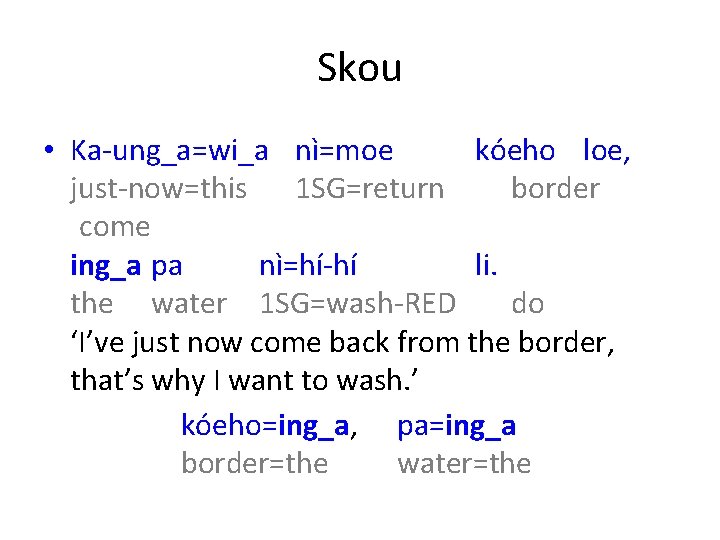
Skou • Ka-ung_a=wi_a nì=moe kóeho loe, just-now=this 1 SG=return border come ing_a pa nì=hí-hí li. the water 1 SG=wash-RED do ‘I’ve just now come back from the border, that’s why I want to wash. ’ kóeho=ing_a, pa=ing_a border=the water=the
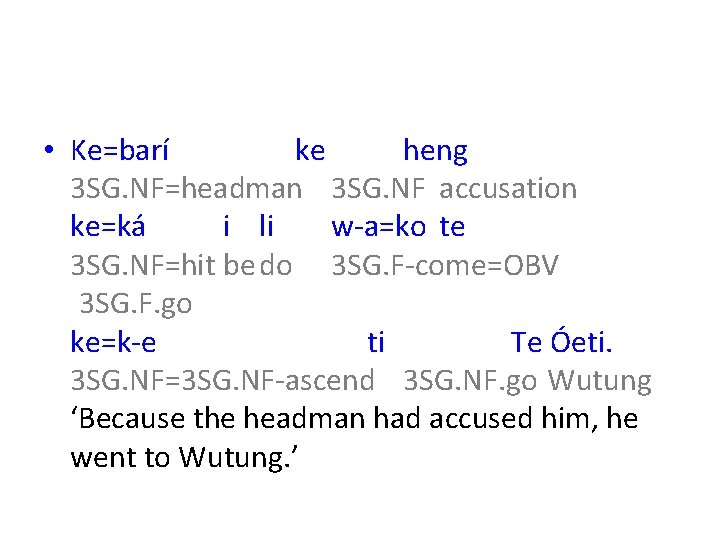
• Ke=barí ke heng 3 SG. NF=headman 3 SG. NF accusation ke=ká i li w-a=ko te 3 SG. NF=hit be do 3 SG. F-come=OBV 3 SG. F. go ke=k-e ti Te Óeti. 3 SG. NF=3 SG. NF-ascend 3 SG. NF. go Wutung ‘Because the headman had accused him, he went to Wutung. ’
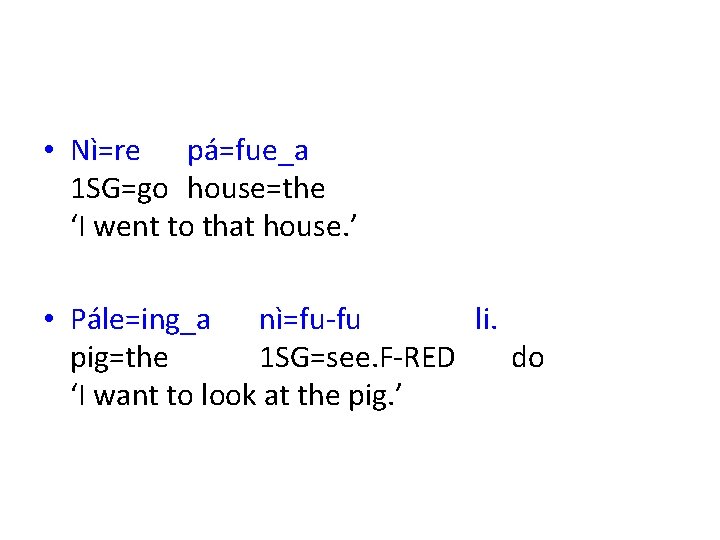
• Nì=re pá=fue_a 1 SG=go house=the ‘I went to that house. ’ • Pále=ing_a nì=fu-fu li. pig=the 1 SG=see. F-RED do ‘I want to look at the pig. ’
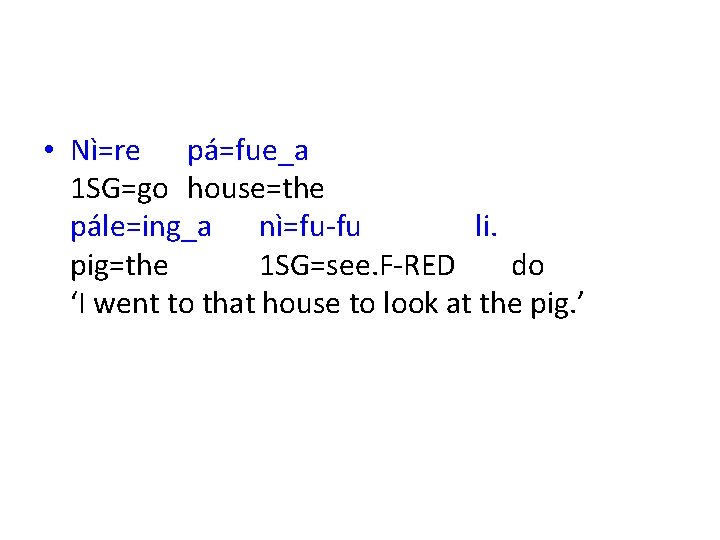
• Nì=re pá=fue_a 1 SG=go house=the pále=ing_a nì=fu-fu li. pig=the 1 SG=see. F-RED do ‘I went to that house to look at the pig. ’
- Slides: 66