Enumerative Lattice Algorithms in any Norm via MEllipsoid













- Slides: 51
Enumerative Lattice Algorithms in any Norm via M-Ellipsoid Coverings Daniel Dadush (CWI) Joint with Chris Peikert and Santosh Vempala
Outline 1) Introduction: Classic Lattice Problems. 2) Results: Algorithms for SVP / CVP / IP. 3) Analysis of SVP algorithm. 4) How to build M-ellipsoid. 5) Conclusions / Open Problems.
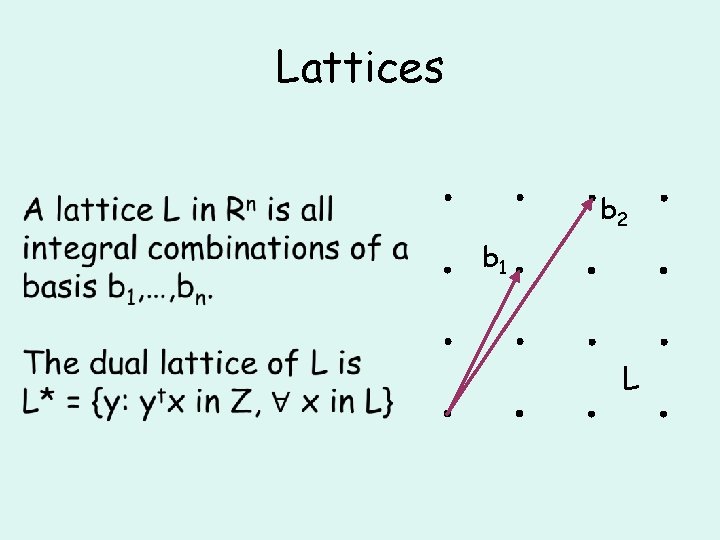
Lattices b 2 b 1 L
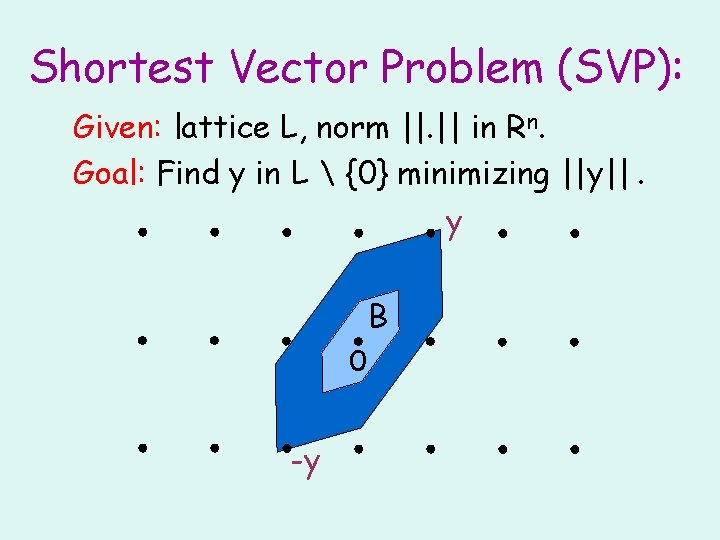
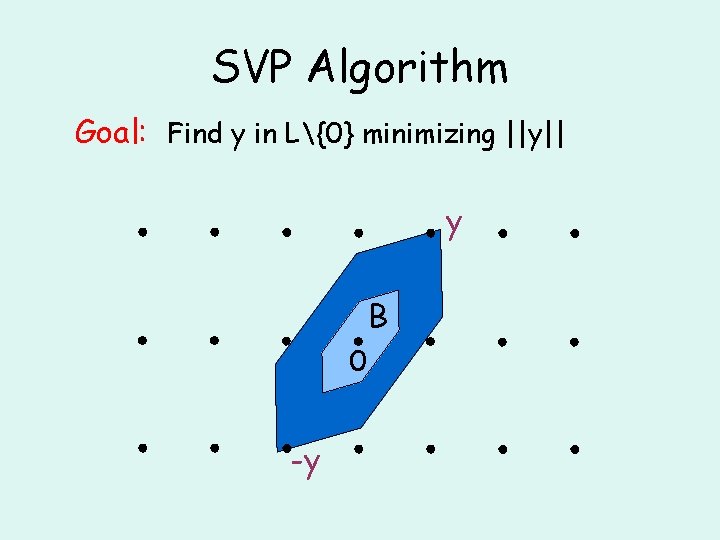
Shortest Vector Problem (SVP): Given: lattice L, norm ||. || in Rn. Goal: Find y in L {0} minimizing ||y||. y B 0 -y
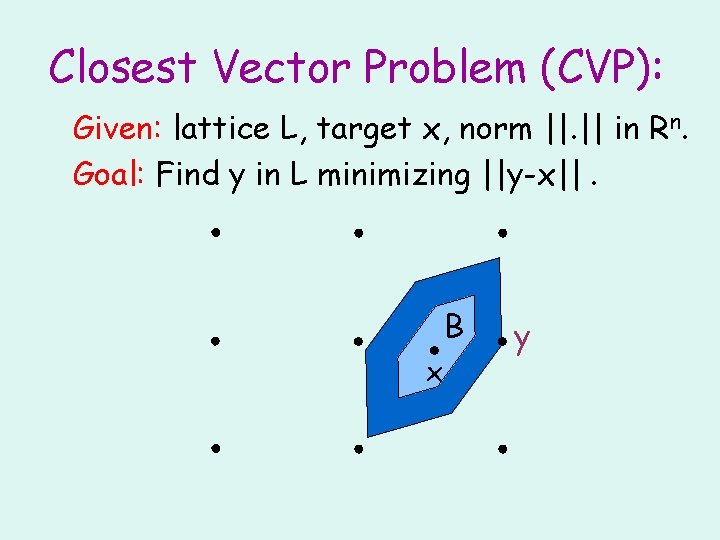
Closest Vector Problem (CVP): Given: lattice L, target x, norm ||. || in Rn. Goal: Find y in L minimizing ||y-x||. B x y
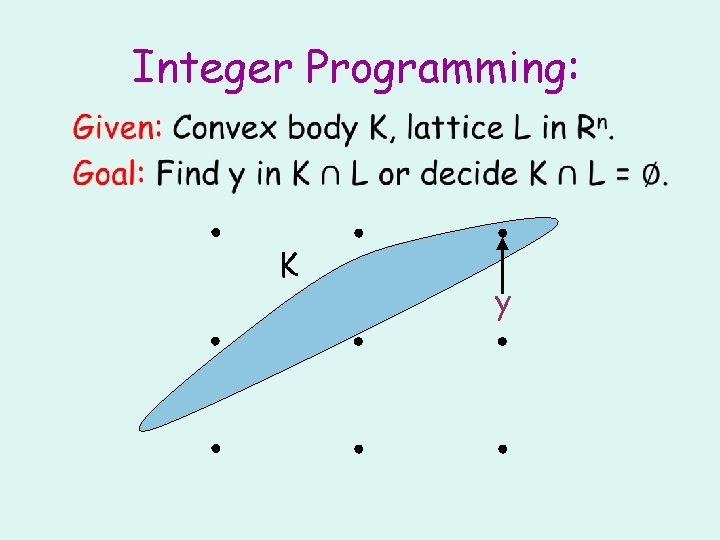
Integer Programming: • K y
Applications / Motivation • Algebra: § Factoring polynomials, solving integer linear systems, diophantine approximation, etc. • Optimization: § IP models many discrete optimization problems. • Cryptography: § Many cryptographic primitives based on variants of SVP & CVP (LWE, SIS, etc. ). • Geometry of Numbers: § Rich interaction between lattices and convexity.
Hardness IP: NP-Hard. SVP: hard to approximate for all lp norms within any constant factor [Ajt 98, CN 98, Mic 98, Kho 03, …]. CVP: hard to approximated for all lp norms within factor nc/loglogn [ABSS 93, DKRS 98]. Don’t expect to solve (or even closely approximate) any of these in polynomial time.
SVP / CVP Algorithms Basis Reduction: 1980’s starts with LLL ‘ 83 Use Local Search on Bases + Exhaustive Search (iteratively) to to solve (approx-) SVP / CVP under l 2. Randomized Sieve: 2000’s starts with AKS 01 Sample Exponentially many Lattice Points, Combine them to make shorter & shorter (closer & closer) lattice vectors. Voronoi cell based: 2010 - Micciancio Voulgaris (MV) Build Voronoi cell of Lattice and use it to perform very efficient Lattice Point Search under l 2.
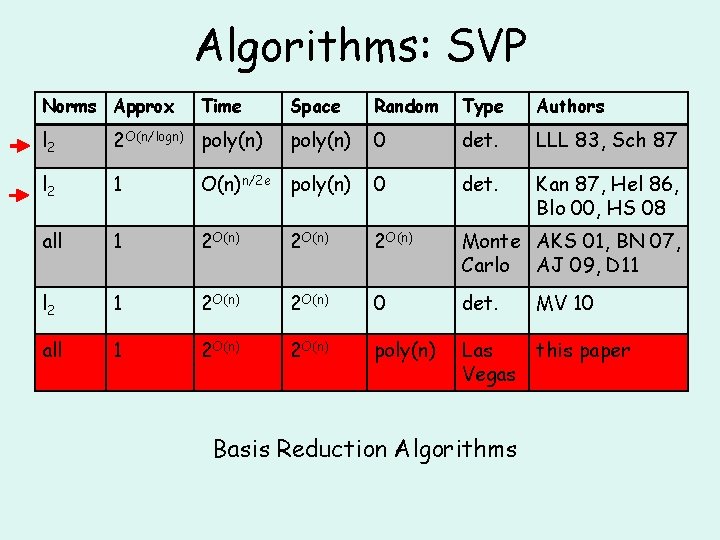
Algorithms: SVP Norms Approx Time Space Random Type Authors poly(n) 0 det. LLL 83, Sch 87 Kan 87, Hel 86, Blo 00, HS 08 l 2 2 O(n/logn) poly(n) l 2 1 O(n)n/2 e poly(n) 0 det. all 1 2 O(n) Monte AKS 01, BN 07, Carlo AJ 09, D 11 l 2 1 2 O(n) 0 det. MV 10 all 1 2 O(n) poly(n) Las Vegas this paper Basis Reduction Algorithms
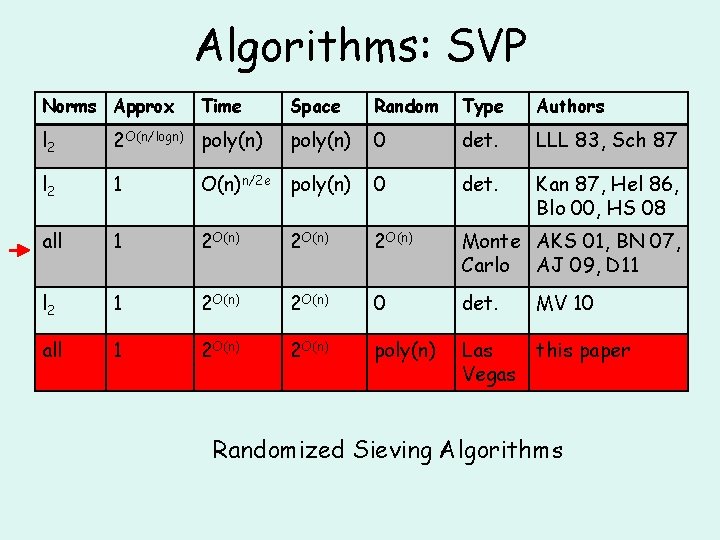
Algorithms: SVP Norms Approx Time Space Random Type Authors poly(n) 0 det. LLL 83, Sch 87 Kan 87, Hel 86, Blo 00, HS 08 l 2 2 O(n/logn) poly(n) l 2 1 O(n)n/2 e poly(n) 0 det. all 1 2 O(n) Monte AKS 01, BN 07, Carlo AJ 09, D 11 l 2 1 2 O(n) 0 det. MV 10 all 1 2 O(n) poly(n) Las Vegas this paper Randomized Sieving Algorithms
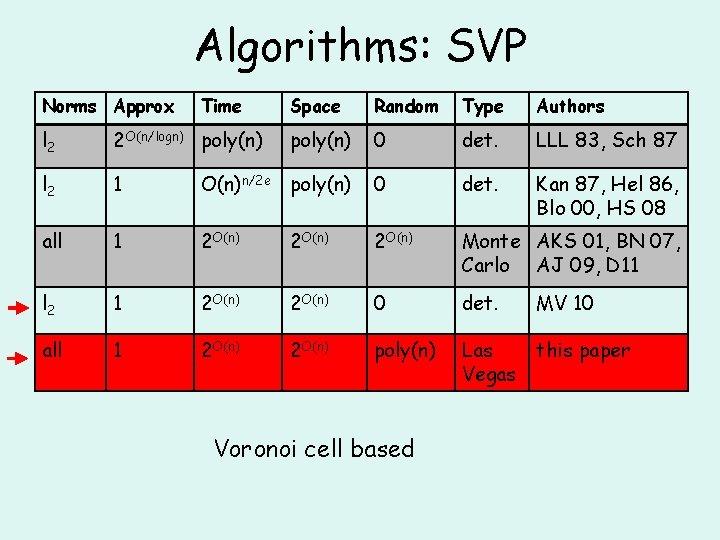
Algorithms: SVP Norms Approx Time Space Random Type Authors poly(n) 0 det. LLL 83, Sch 87 Kan 87, Hel 86, Blo 00, HS 08 l 2 2 O(n/logn) poly(n) l 2 1 O(n)n/2 e poly(n) 0 det. all 1 2 O(n) Monte AKS 01, BN 07, Carlo AJ 09, D 11 l 2 1 2 O(n) 0 det. MV 10 all 1 2 O(n) poly(n) Las Vegas this paper Voronoi cell based
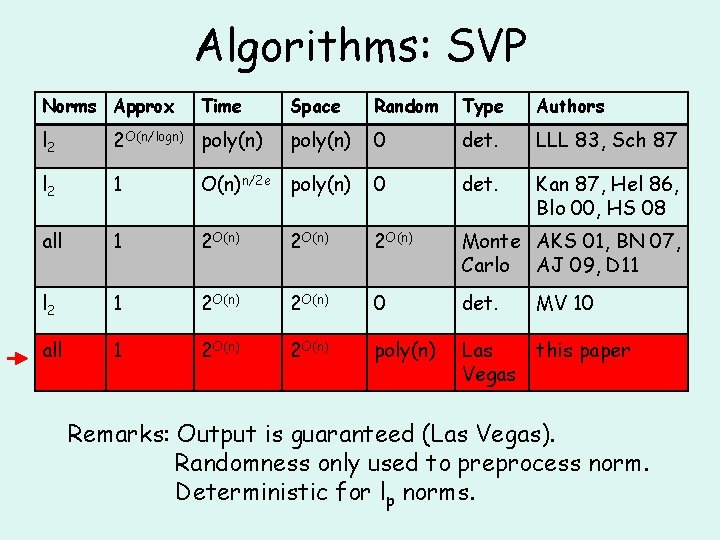
Algorithms: SVP Norms Approx Time Space Random Type Authors poly(n) 0 det. LLL 83, Sch 87 Kan 87, Hel 86, Blo 00, HS 08 l 2 2 O(n/logn) poly(n) l 2 1 O(n)n/2 e poly(n) 0 det. all 1 2 O(n) Monte AKS 01, BN 07, Carlo AJ 09, D 11 l 2 1 2 O(n) 0 det. MV 10 all 1 2 O(n) poly(n) Las Vegas this paper Remarks: Output is guaranteed (Las Vegas). Randomness only used to preprocess norm. Deterministic for lp norms.
Algorithms: CVP Norms Approx Time Space Random Type Authors l 2 2 O(n/logn) poly(n) 0 det. LLL 83, Bab 86 Sch 87 l 2 1 O(n)n/2 poly(n) 0 det. Kan 87, Hel 86, Blo 00, HS 08 all 1+� (1/� )O(n) Monte AKS 01 -02, BN Carlo 07, AJ 09, D 11 “ 1 * d. O(n) “ “ l 2 1 2 O(n) 0 det. MV 10 all 1 * d. O(n) 2 O(n) poly(n) Las Vegas this paper * assume distance to target ≤ d x (length of SVP)
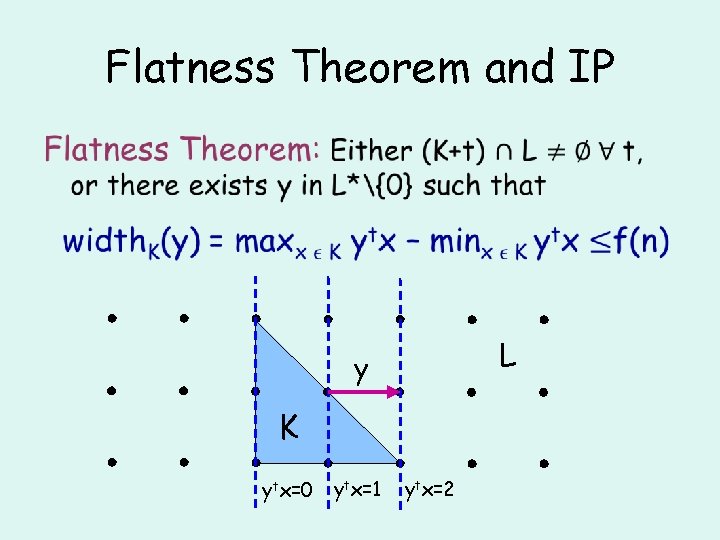
Flatness Theorem and IP • L y K ytx=0 ytx=1 ytx=2
Flatness Theorem and IP •
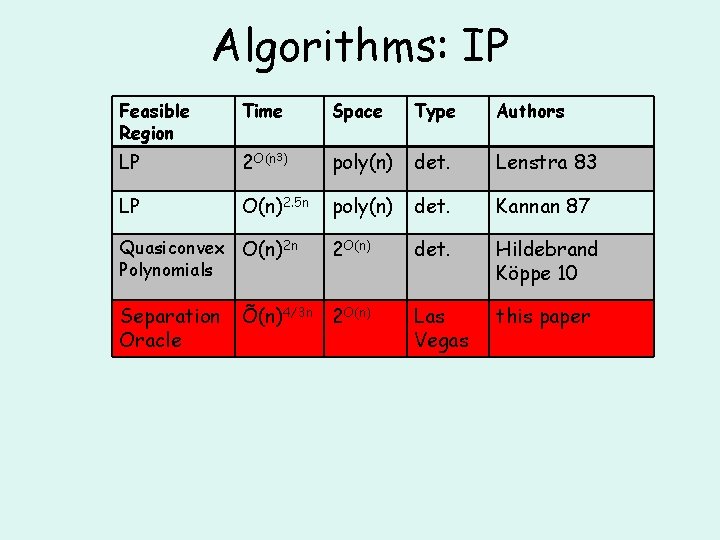
Algorithms: IP Feasible Region Time Space Type Authors LP 2 O(n 3) poly(n) det. Lenstra 83 LP O(n)2. 5 n poly(n) det. Kannan 87 2 O(n) det. Hildebrand Köppe 10 Las Vegas this paper Quasiconvex O(n)2 n Polynomials Separation Oracle Õ(n)4/3 n 2 O(n)
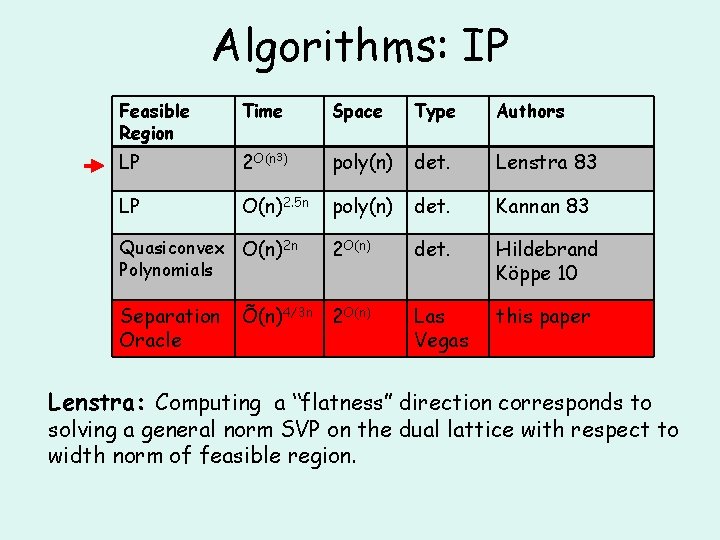
Algorithms: IP Feasible Region Time Space Type Authors LP 2 O(n 3) poly(n) det. Lenstra 83 LP O(n)2. 5 n poly(n) det. Kannan 87 2 O(n) det. Hildebrand Köppe 10 Las Vegas this paper Quasiconvex O(n)2 n Polynomials Separation Oracle Õ(n)4/3 n 2 O(n) Lenstra: Any n dimensional IP can be reduced to bounded number of n-1 dimensional IPs by computing a “flatness” direction of the feasible region.
Algorithms: IP Feasible Region Time Space Type Authors LP 2 O(n 3) poly(n) det. Lenstra 83 LP O(n)2. 5 n poly(n) det. Kannan 83 2 O(n) det. Hildebrand Köppe 10 Las Vegas this paper Quasiconvex O(n)2 n Polynomials Separation Oracle Õ(n)4/3 n 2 O(n) Lenstra: Computing a “flatness” direction corresponds to solving a general norm SVP on the dual lattice with respect to width norm of feasible region.
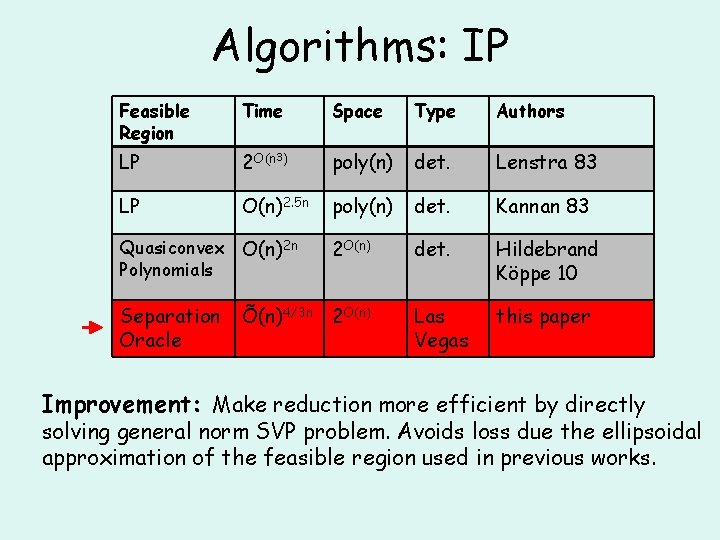
Algorithms: IP Feasible Region Time Space Type Authors LP 2 O(n 3) poly(n) det. Lenstra 83 LP O(n)2. 5 n poly(n) det. Kannan 83 2 O(n) det. Hildebrand Köppe 10 Las Vegas this paper Quasiconvex O(n)2 n Polynomials Separation Oracle Õ(n)4/3 n 2 O(n) Improvement: Make reduction more efficient by directly solving general norm SVP problem. Avoids loss due the ellipsoidal approximation of the feasible region used in previous works.
Core Algorithm •
SVP Algorithm Goal: Find y in L{0} minimizing ||y|| y B 0 -y
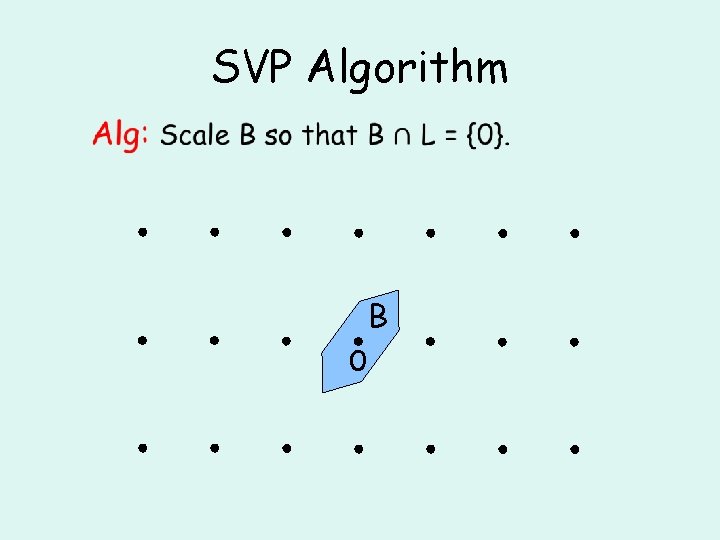
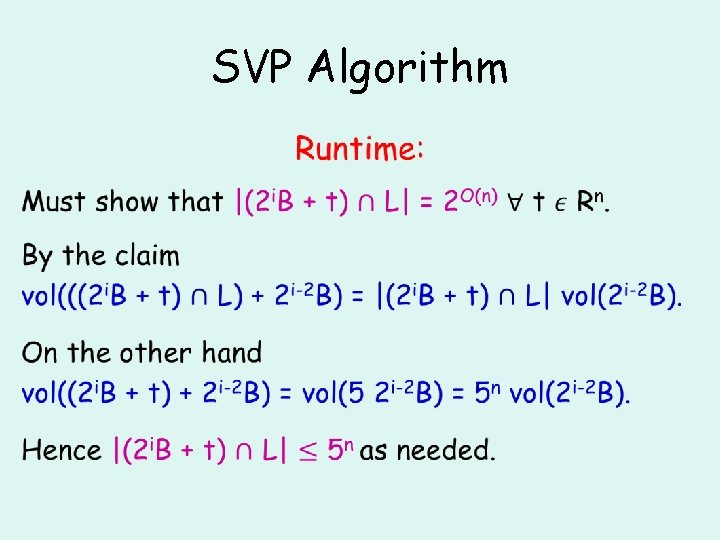
SVP Algorithm • B 0
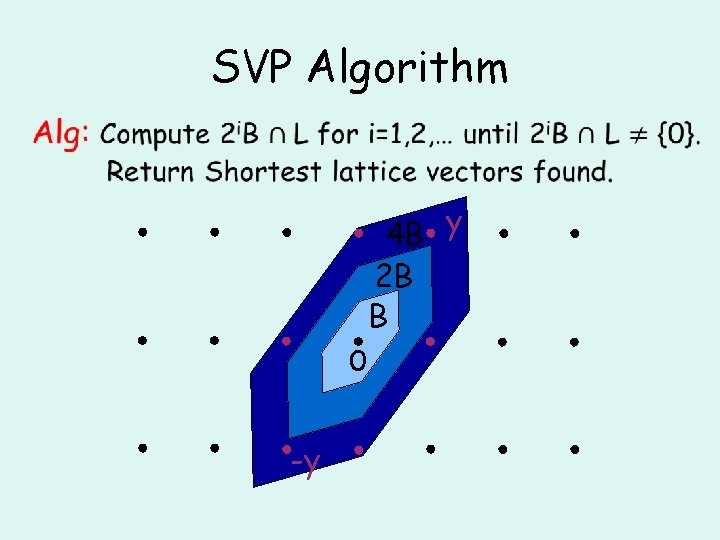
SVP Algorithm • y 4 B 2 B B 0 -y
SVP Algorithm • 2 i-2 B x y
SVP Algorithm •
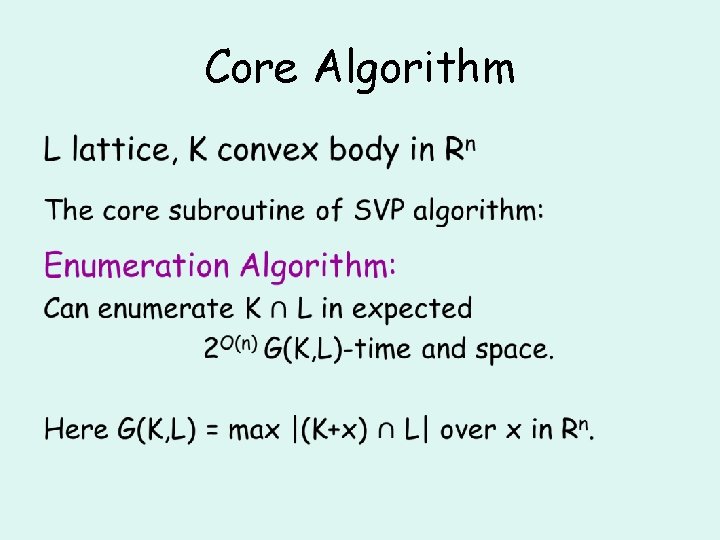
Enumeration Algorithm: • This is a slight tweak of the Micciancio. Voulgaris algorithm for CVP.
MV: Voronoi Cell e 2 V VR(Z 2, B 2) = {� e 1, � e 2} -e 1 0 -e 2 e 1
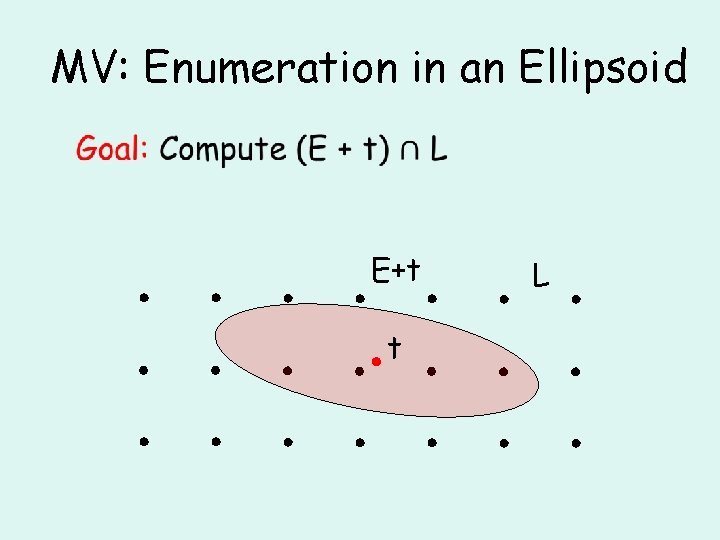
MV: Enumeration in an Ellipsoid • E+t t L
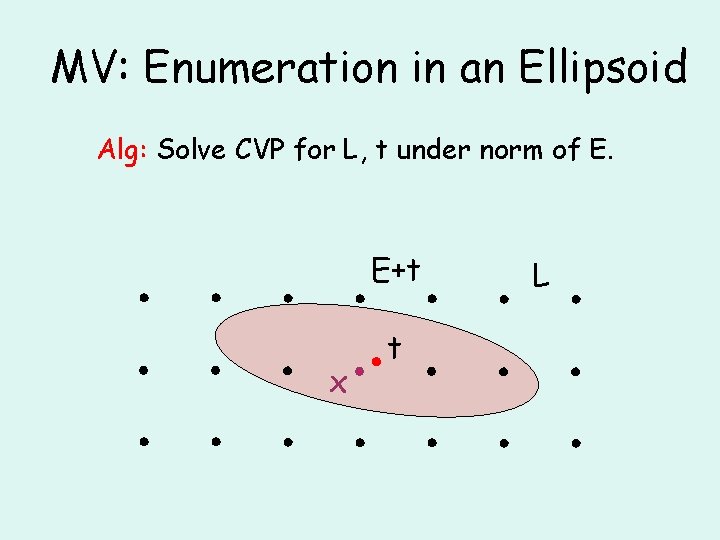
MV: Enumeration in an Ellipsoid Alg: Solve CVP for L, t under norm of E. E+t x t L
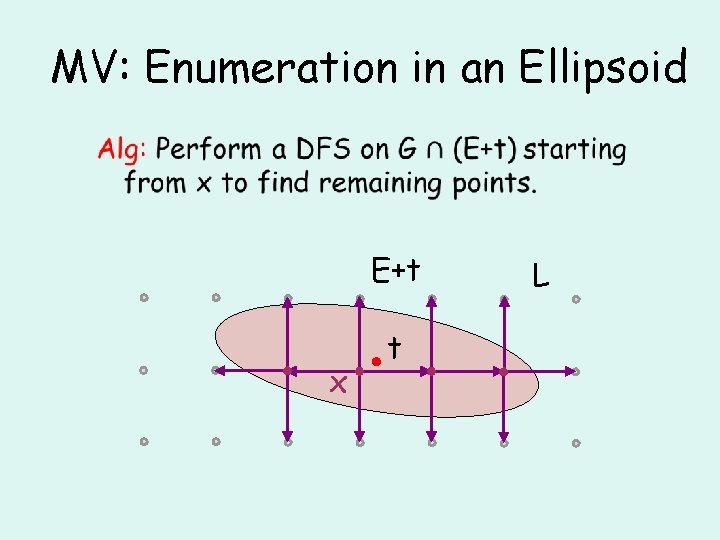
MV: Enumeration in an Ellipsoid • E+t x t L
MV: Enumeration in an Ellipsoid • E+t x t L
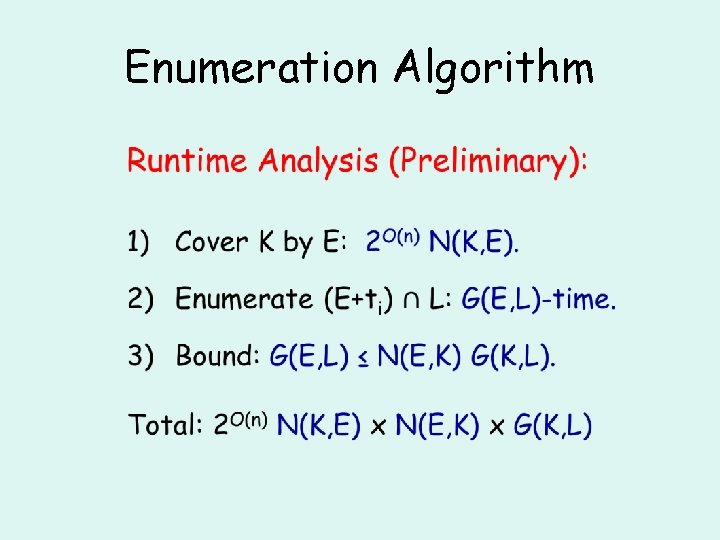
Enumeration Algorithm: •
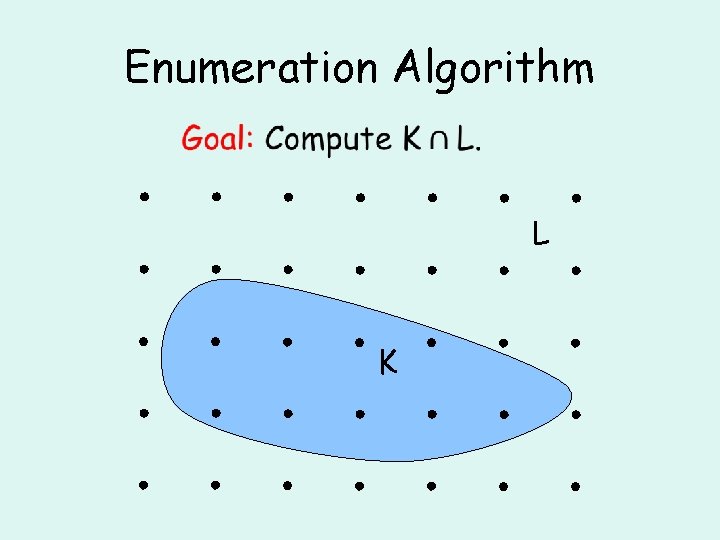
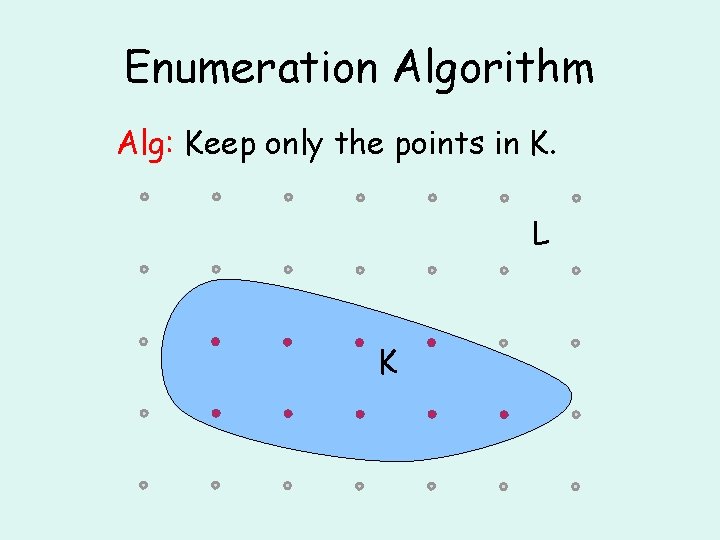
Enumeration Algorithm • L K
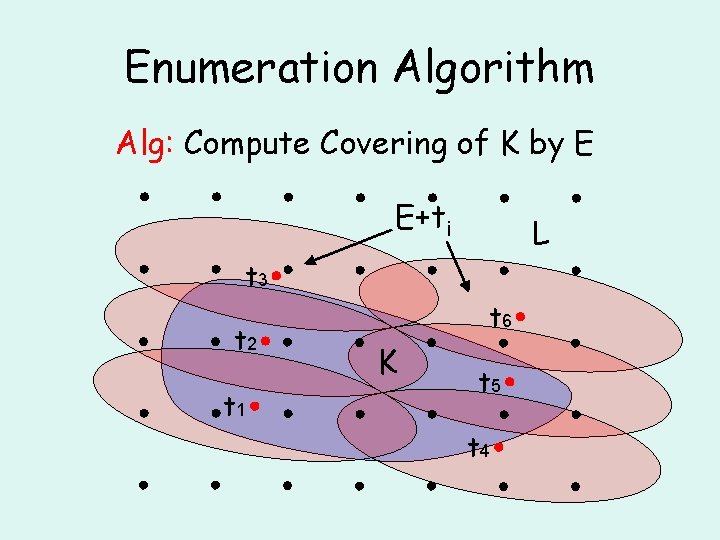
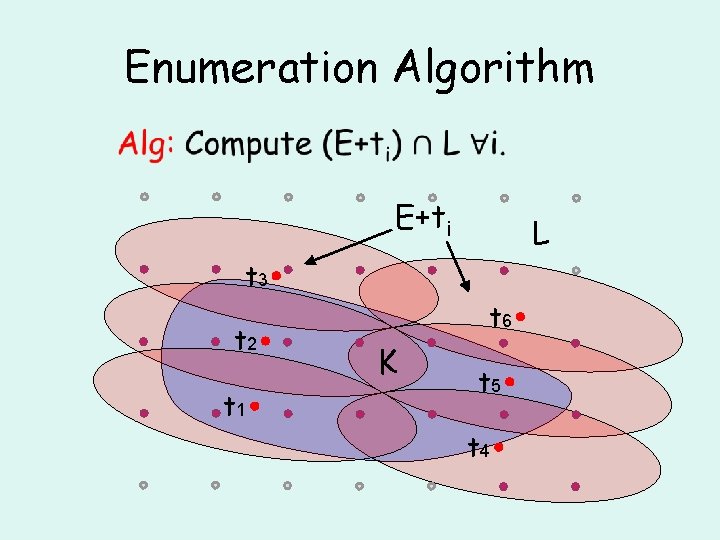
Enumeration Algorithm Alg: Compute Covering of K by E E+ti L t 3 t 2 t 1 t 6 K t 5 t 4
Enumeration Algorithm • E+ti L t 3 t 2 t 1 t 6 K t 5 t 4
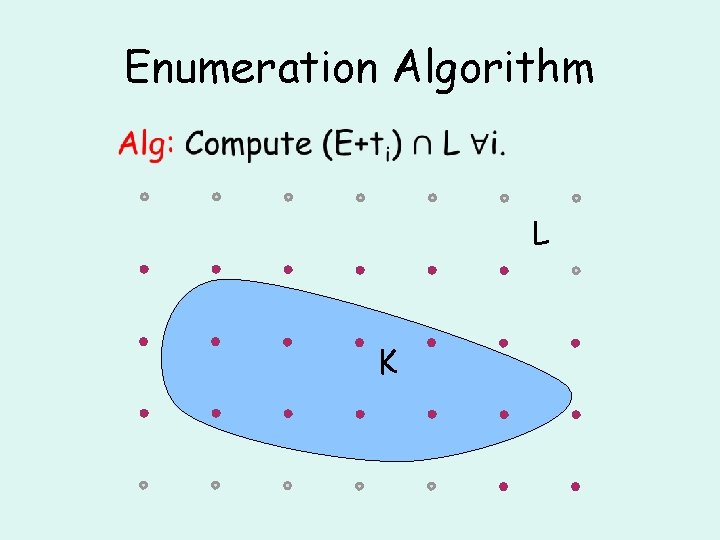
Enumeration Algorithm • L K
Enumeration Algorithm Alg: Keep only the points in K. L K
Enumeration Algorithm •
The M-Ellipsoid Need to bound N(K, E) x N(E, K). What ellipsoid do we use for E? An M-Ellipsoid of K is an ellipsoid E satisfying 1. N(K, E) = 2 O(n). 2. N(E, K) = 2 O(n). Existence first proven by Milman ‘ 86. How do we build it? Want Las Vegas algorithm.
Klartag’s Procedure [K 06] •
Klartag’s Procedure [K 06] •
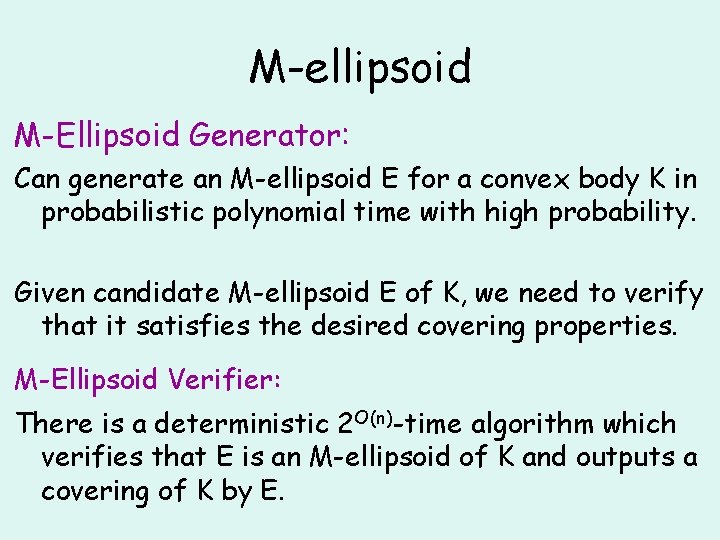
M-ellipsoid M-Ellipsoid Generator: Can generate an M-ellipsoid E for a convex body K in probabilistic polynomial time with high probability. Given candidate M-ellipsoid E of K, we need to verify that it satisfies the desired covering properties. M-Ellipsoid Verifier: There is a deterministic 2 O(n)-time algorithm which verifies that E is an M-ellipsoid of K and outputs a covering of K by E.
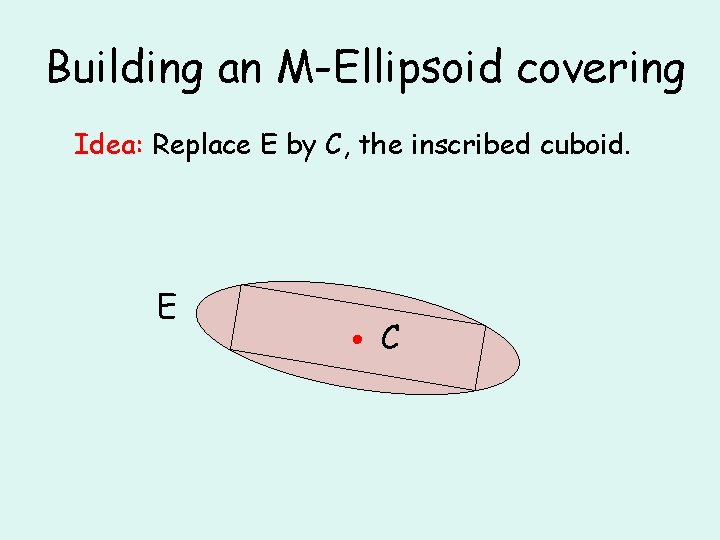
Building an M-Ellipsoid covering Idea: Replace E by C, the inscribed cuboid. E C
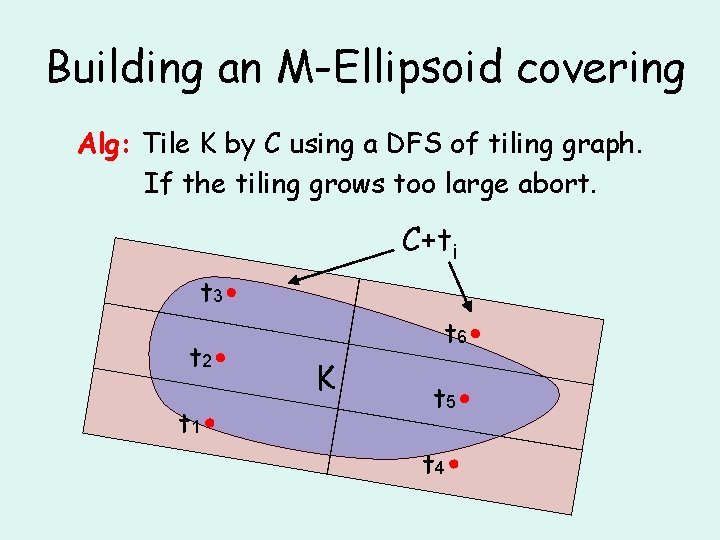
Building an M-Ellipsoid covering Alg: Tile K by C using a DFS of tiling graph. If the tiling grows too large abort. C+ti t 3 t 2 t 1 t 6 K t 5 t 4
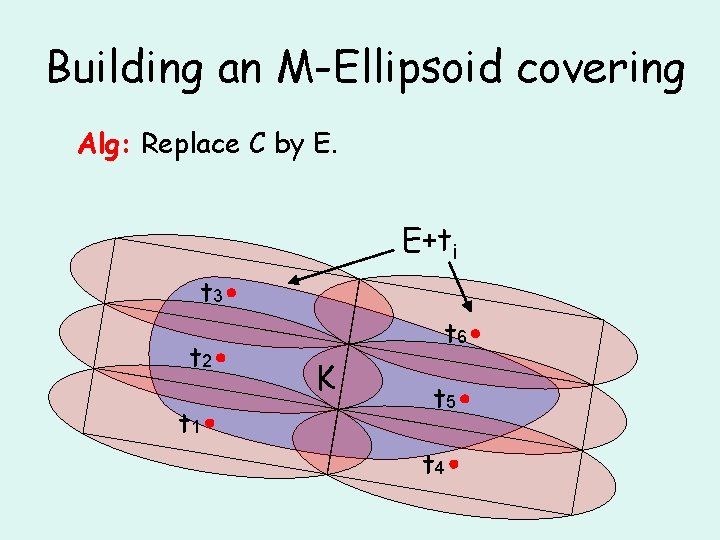
Building an M-Ellipsoid covering Alg: Replace C by E. E+ti t 3 t 2 t 1 t 6 K t 5 t 4
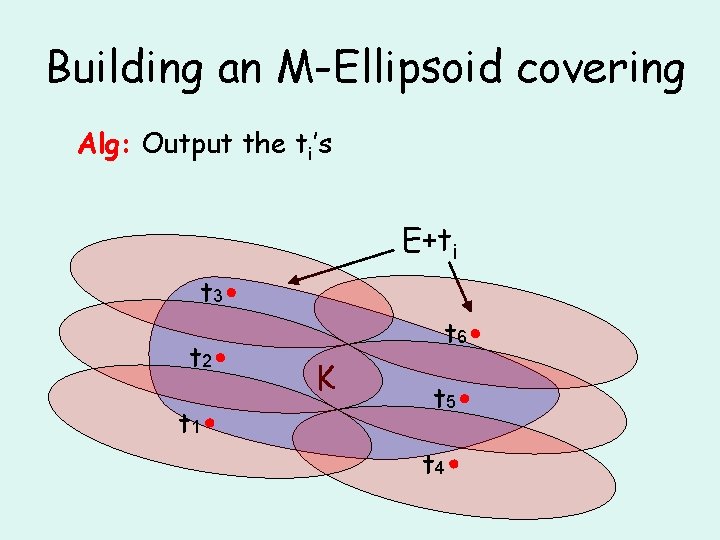
Building an M-Ellipsoid covering Alg: Output the ti’s E+ti t 3 t 2 t 1 t 6 K t 5 t 4
Building an M-Ellipsoid covering How do we verify N(E, K) = 2 O(n)? Don’t know how to do this directly. Idea: use duality of entropy N(E, K) ~= N((K-K)*, E*) Apply previous algorithm to get an existential proof.
Conclusions 1) Give new lattice point enumeration procedure (should be useful elsewhere). 2) Apply it to give first Las Vegas 2 O(n)-time algorithm for SVP under general norms. 3) Improve complexity of IP. 4) Introduce use of the M-ellipsoid into design of lattice algorithms.
Open Problems 1) Time vs Space Tradeoff: What can we do with 2 O(n ) –space, for 0 < < 1? (even for l 2) 2) Las Vegas algorithm for (1+eps)-CVP? 3) Compute N(E, K) directly (avoid duality of entropy)? 4) Solve IP in O(n)(1 - )n-time, for any fixed > 0. (more powerful Flatness Theorem? )
THANK YOU!