
Building Effective Teams 30 000 Foot View Team
Building Effective Teams
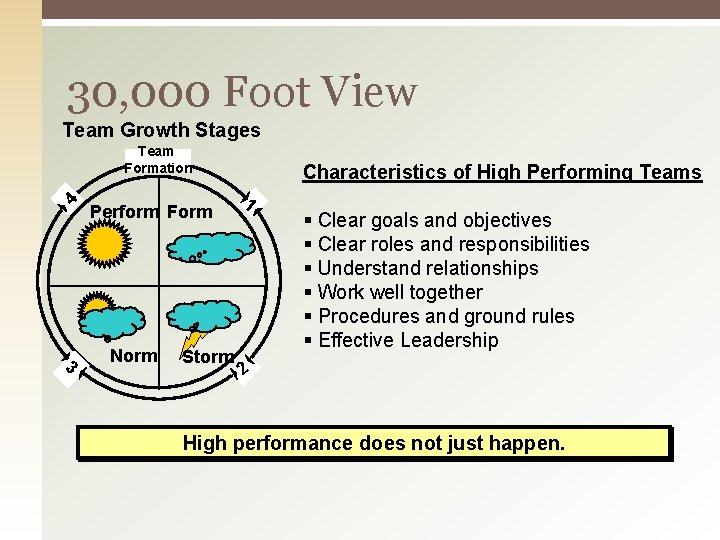
30, 000 Foot View Team Growth Stages 4 Team Formation 3 Perform Form Norm Storm Characteristics of High Performing Teams 1 § Clear goals and objectives § Clear roles and responsibilities § Understand relationships § Work well together § Procedures and ground rules § Effective Leadership 2 High performance does not just happen.
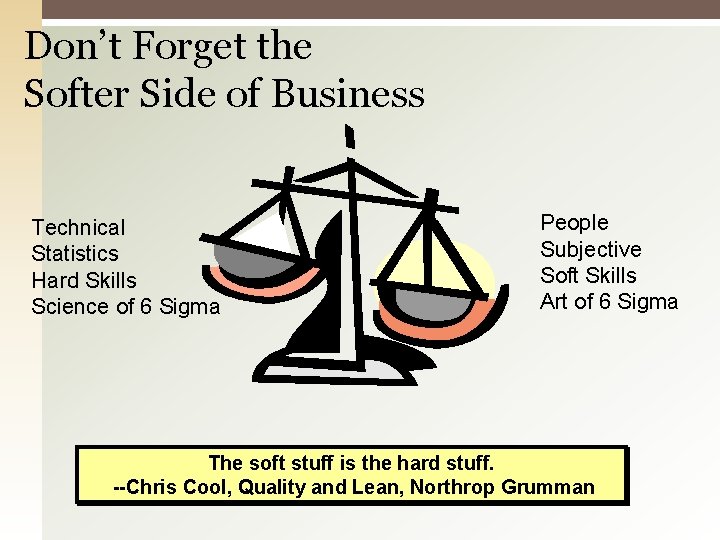
Don’t Forget the Softer Side of Business Technical Statistics Hard Skills Science of 6 Sigma People Subjective Soft Skills Art of 6 Sigma The soft stuff is the hard stuff. --Chris Cool, Quality and Lean, Northrop Grumman
Why Teams Improves productivity Better results (products, processes, services) Better able to handle complex problems Can handle many aspects of the business Differentiation through diversity of thoughts and ideas Improves morale, enthusiasm and creativity Networking (broader base, learned experiences) Teams succeed over the work of the lone genius!
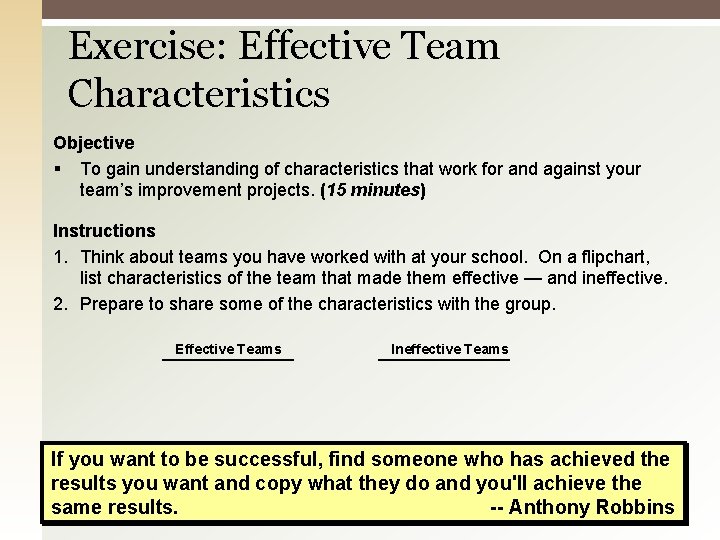
Exercise: Effective Team Characteristics Objective § To gain understanding of characteristics that work for and against your team’s improvement projects. (15 minutes) Instructions 1. Think about teams you have worked with at your school. On a flipchart, list characteristics of the team that made them effective — and ineffective. 2. Prepare to share some of the characteristics with the group. Effective Teams Ineffective Teams If you want to be successful, find someone who has achieved the results you want and copy what they do and you'll achieve the same results. -- Anthony Robbins
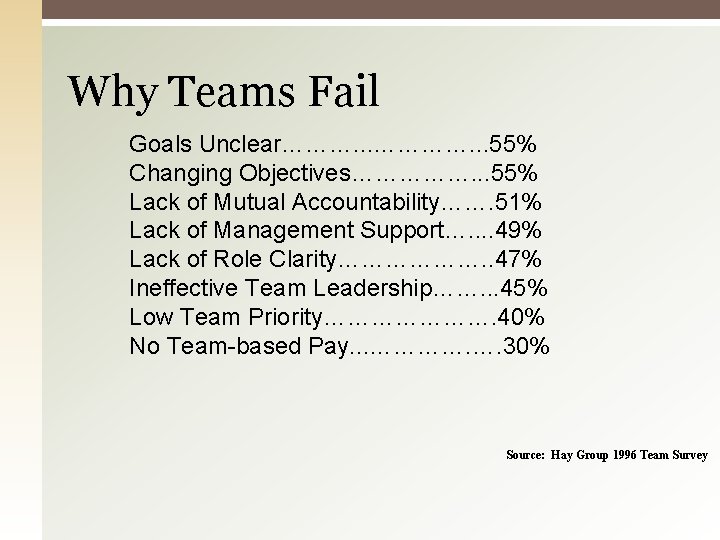
Why Teams Fail Goals Unclear………. . . …………. . . 55% Changing Objectives……………. . . 55% Lack of Mutual Accountability……. 51% Lack of Management Support…. . 49% Lack of Role Clarity………………. . 47% Ineffective Team Leadership……. . . 45% Low Team Priority…………………. 40% No Team-based Pay. . . …………. …. 30% Source: Hay Group 1996 Team Survey
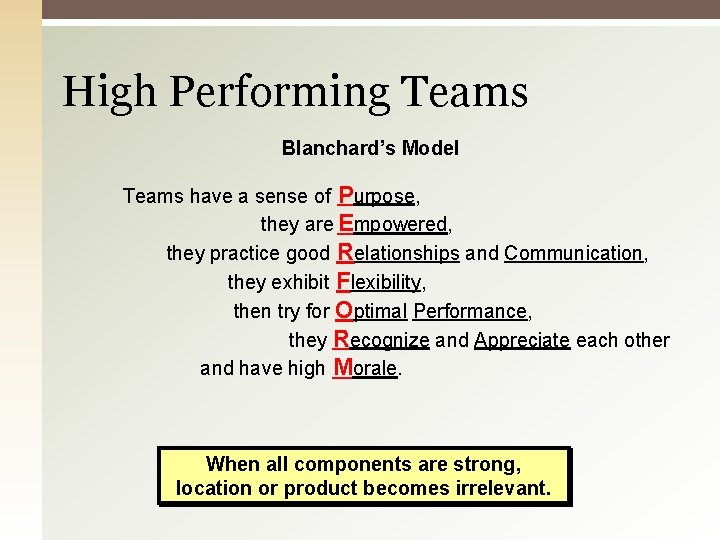
High Performing Teams Blanchard’s Model Teams have a sense of Purpose, they are Empowered, they practice good Relationships and Communication, they exhibit Flexibility, then try for Optimal Performance, they Recognize and Appreciate each other and have high Morale. When all components are strong, location or product becomes irrelevant.
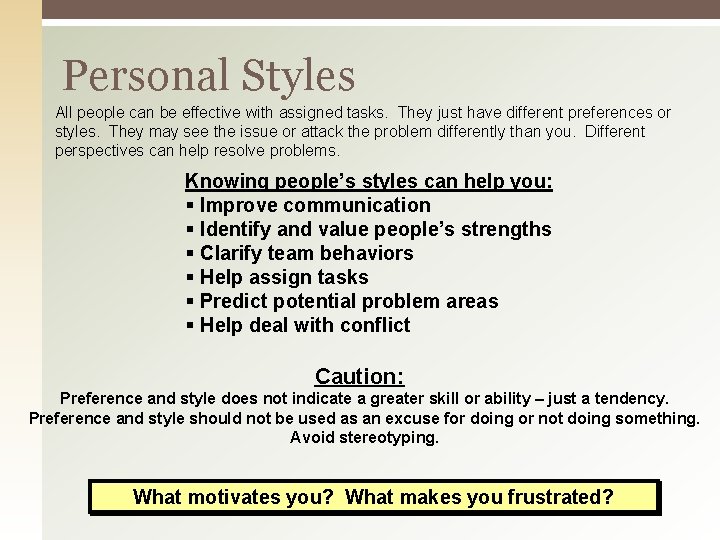
Personal Styles All people can be effective with assigned tasks. They just have different preferences or styles. They may see the issue or attack the problem differently than you. Different perspectives can help resolve problems. Knowing people’s styles can help you: § Improve communication § Identify and value people’s strengths § Clarify team behaviors § Help assign tasks § Predict potential problem areas § Help deal with conflict Caution: Preference and style does not indicate a greater skill or ability – just a tendency. Preference and style should not be used as an excuse for doing or not doing something. Avoid stereotyping. What motivates you? What makes you frustrated?
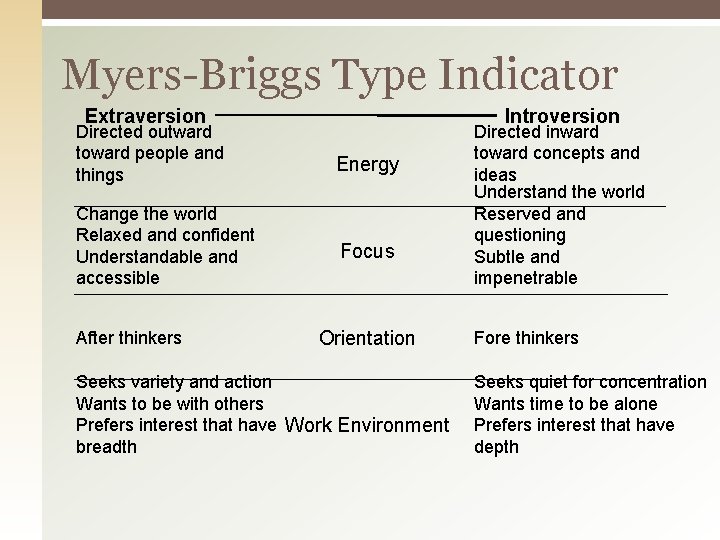
Myers-Briggs Type Indicator Extraversion Directed outward toward people and things Change the world Relaxed and confident Understandable and accessible After thinkers Introversion Energy Focus Orientation Seeks variety and action Wants to be with others Prefers interest that have Work Environment breadth Directed inward toward concepts and ideas Understand the world Reserved and questioning Subtle and impenetrable Fore thinkers Seeks quiet for concentration Wants time to be alone Prefers interest that have depth
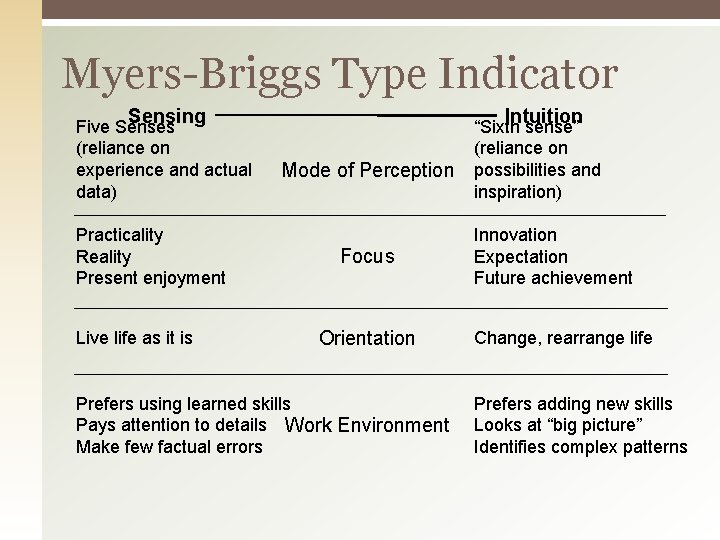
Myers-Briggs Type Indicator Sensing Five Senses (reliance on experience and actual data) Practicality Reality Present enjoyment Live life as it is Intuition Mode of Perception Focus Orientation Prefers using learned skills Pays attention to details Work Environment Make few factual errors “Sixth sense” (reliance on possibilities and inspiration) Innovation Expectation Future achievement Change, rearrange life Prefers adding new skills Looks at “big picture” Identifies complex patterns
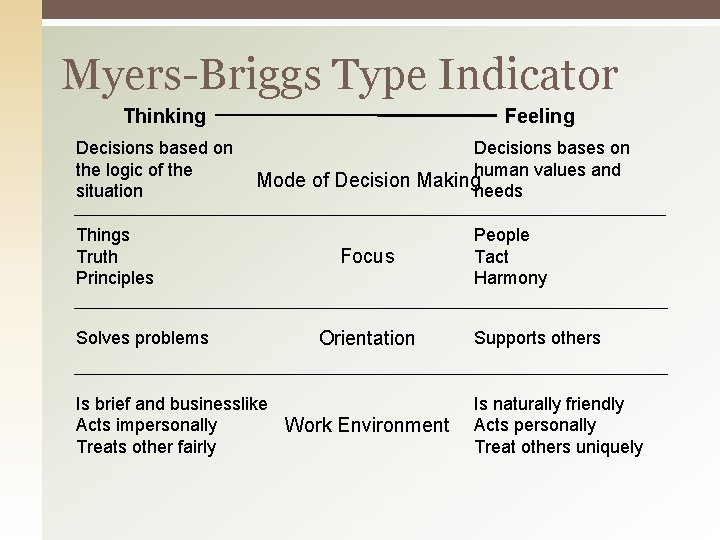
Myers-Briggs Type Indicator Thinking Decisions based on the logic of the situation Things Truth Principles Solves problems Feeling Decisions bases on human values and Mode of Decision Making needs Focus Orientation Is brief and businesslike Acts impersonally Work Environment Treats other fairly People Tact Harmony Supports others Is naturally friendly Acts personally Treat others uniquely
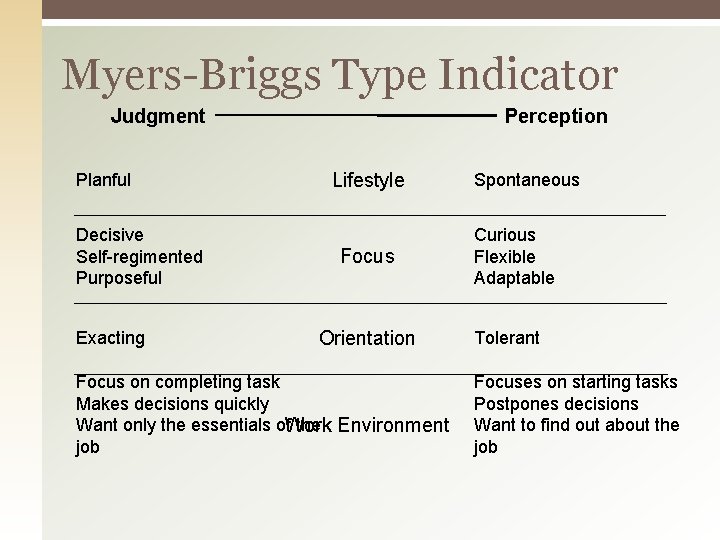
Myers-Briggs Type Indicator Judgment Planful Decisive Self-regimented Purposeful Exacting Perception Lifestyle Focus Orientation Focus on completing task Makes decisions quickly Want only the essentials of. Work the Environment job Spontaneous Curious Flexible Adaptable Tolerant Focuses on starting tasks Postpones decisions Want to find out about the job
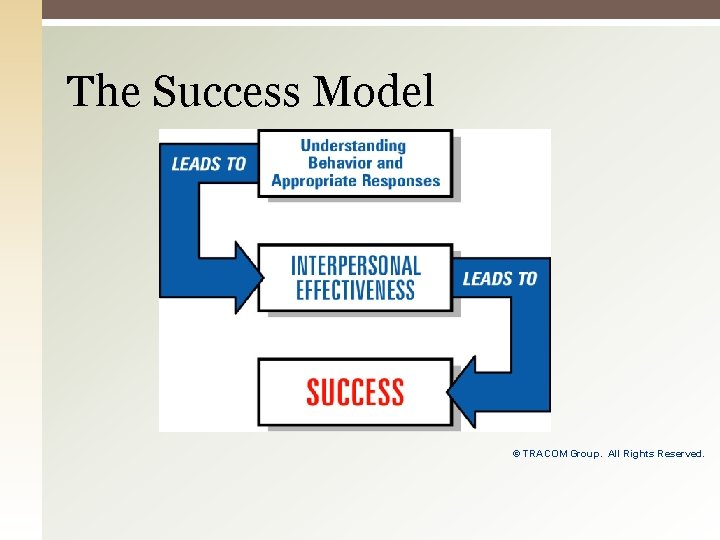
The Success Model © TRACOM Group. All Rights Reserved.

Gain Team Member’s Commitment § § Change can be achieved through commitment or compliance. While building commitment is usually the goal of the change management effort, it is expensive. . . Compliance Commitment “I have to do it this new way” “I want to do it this new way” Reaction “I will react to this change - if I must” Testing “I must absorb this change” Negative perception “I feel threatened by this change” Action “I will act to achieve this change” Testing “I will put myself at stake for this change” Positive perception “I see the opportunity in this change” Engagement “I see the implications for me/us” Understanding “I know why and what will change” Awareness “I am being told about something”

Characteristics of Effective Teams § Effective teamwork encompasses: – Developing a charter – Defining team members’/leader’s roles – Establishing procedures and ground rules – Establishing relationships Effective Teams Which individuals do which activities or tasks? How do we feel about each other, talk with each other, and affect each other? What do we do, intend to do, and why? (Purpose, Scope, Goals, Selection) How do we do what we do? What processes and systematic approaches do we use?
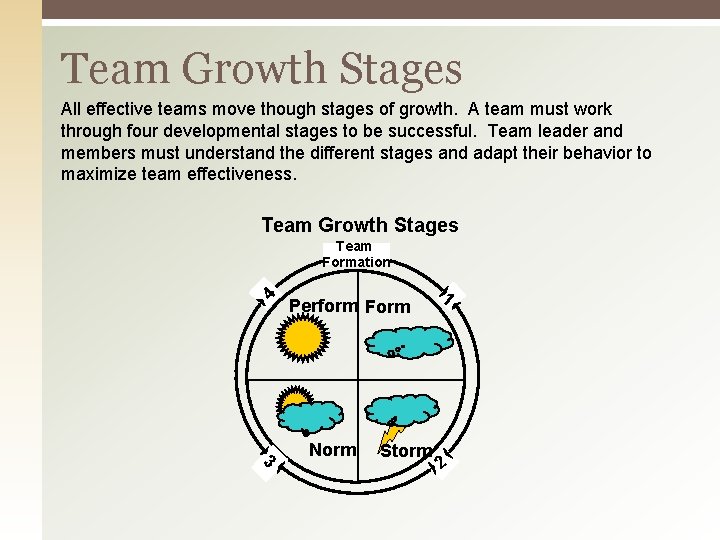
Team Growth Stages All effective teams move though stages of growth. A team must work through four developmental stages to be successful. Team leader and members must understand the different stages and adapt their behavior to maximize team effectiveness. Team Growth Stages 4 Team Formation 3 Perform Form Norm Storm 1 2

Team Development FORM STORM NORM PRODUCTIVITY (COMPETENCE) MORALE (COMMITMENT) PERFORM
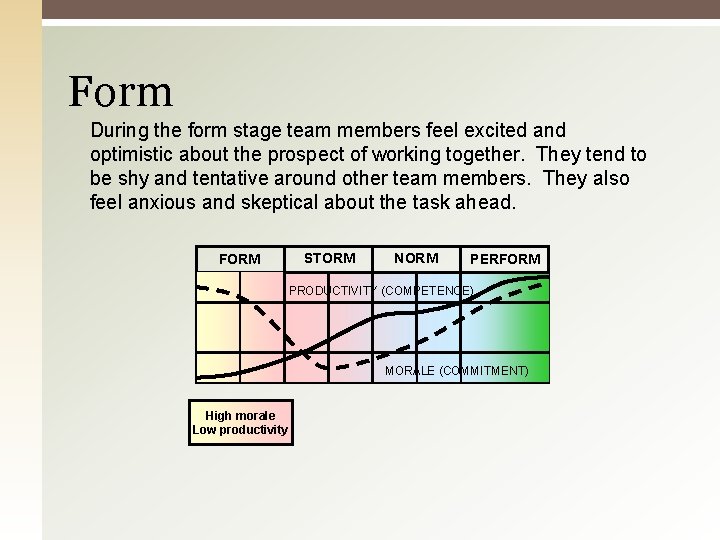
Form During the form stage team members feel excited and optimistic about the prospect of working together. They tend to be shy and tentative around other team members. They also feel anxious and skeptical about the task ahead. FORM STORM NORM PERFORM PRODUCTIVITY (COMPETENCE) MORALE (COMMITMENT) High morale Low productivity
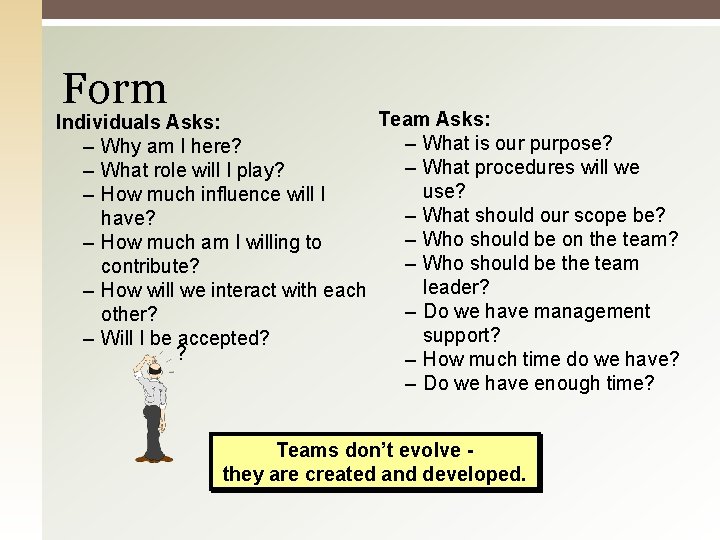
Form Team Asks: Individuals Asks: – What is our purpose? – Why am I here? – What procedures will we – What role will I play? use? – How much influence will I – What should our scope be? have? – Who should be on the team? – How much am I willing to – Who should be the team contribute? leader? – How will we interact with each – Do we have management other? support? – Will I be accepted? ? – How much time do we have? – Do we have enough time? Teams don’t evolve they are created and developed.
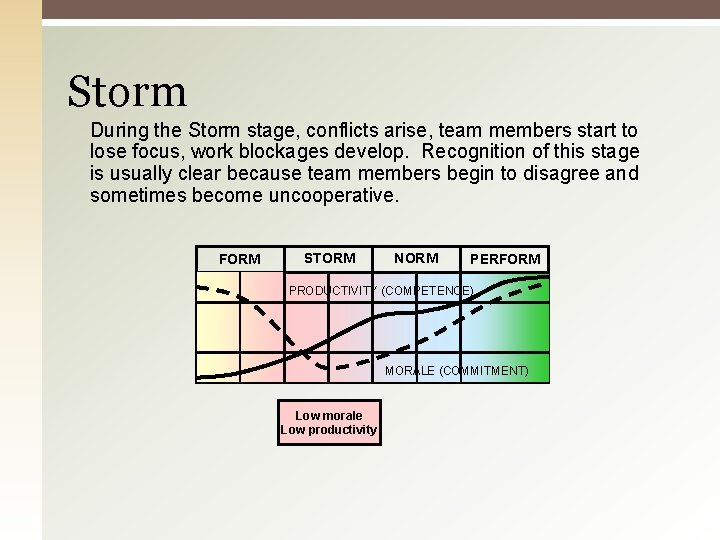
Storm During the Storm stage, conflicts arise, team members start to lose focus, work blockages develop. Recognition of this stage is usually clear because team members begin to disagree and sometimes become uncooperative. FORM STORM NORM PERFORM PRODUCTIVITY (COMPETENCE) MORALE (COMMITMENT) Low morale Low productivity
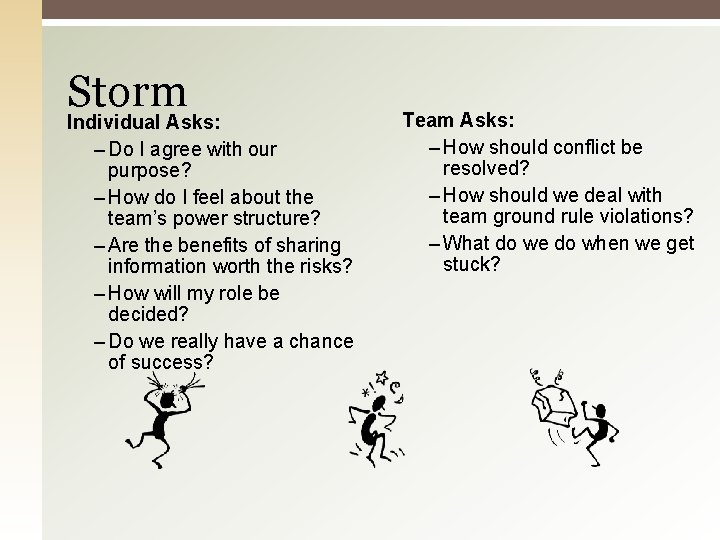
Storm Individual Asks: – Do I agree with our purpose? – How do I feel about the team’s power structure? – Are the benefits of sharing information worth the risks? – How will my role be decided? – Do we really have a chance of success? Team Asks: – How should conflict be resolved? – How should we deal with team ground rule violations? – What do we do when we get stuck?
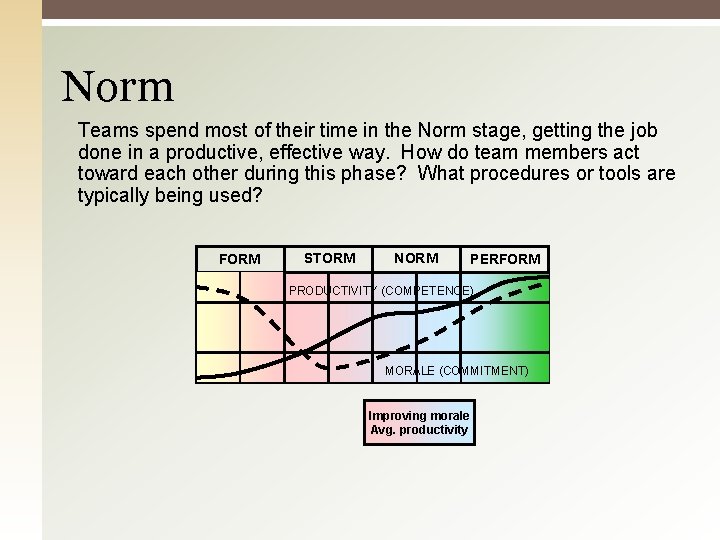
Norm Teams spend most of their time in the Norm stage, getting the job done in a productive, effective way. How do team members act toward each other during this phase? What procedures or tools are typically being used? FORM STORM NORM PERFORM PRODUCTIVITY (COMPETENCE) MORALE (COMMITMENT) Improving morale Avg. productivity
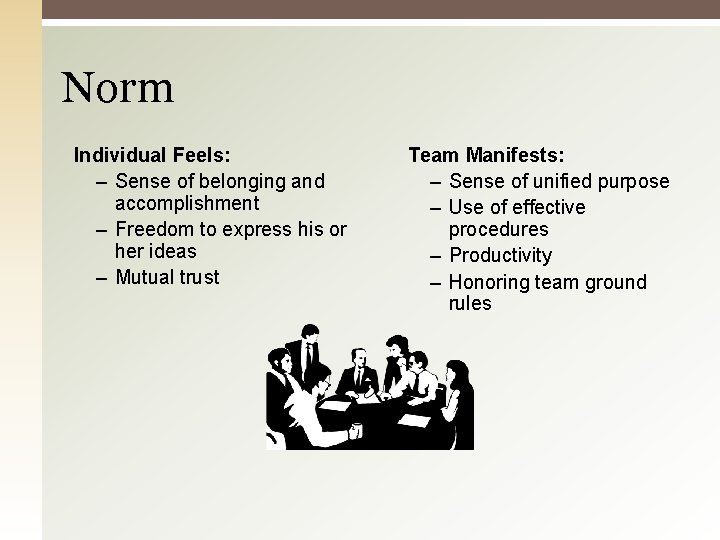
Norm Individual Feels: – Sense of belonging and accomplishment – Freedom to express his or her ideas – Mutual trust Team Manifests: – Sense of unified purpose – Use of effective procedures – Productivity – Honoring team ground rules
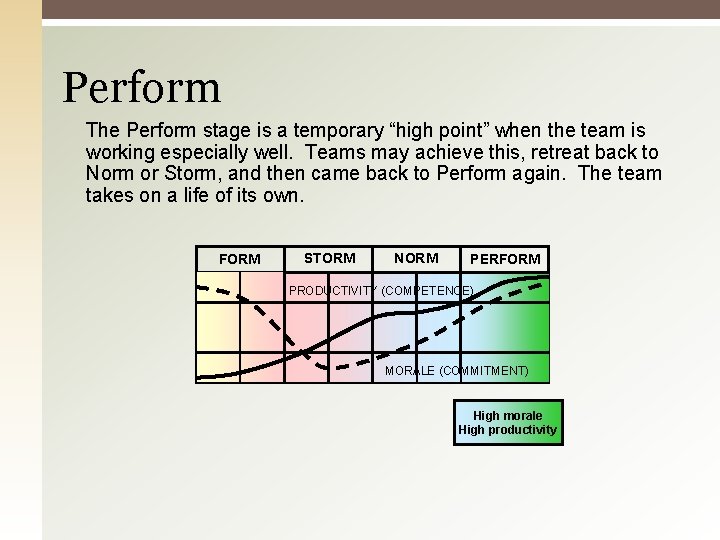
Perform The Perform stage is a temporary “high point” when the team is working especially well. Teams may achieve this, retreat back to Norm or Storm, and then came back to Perform again. The team takes on a life of its own. FORM STORM NORM PERFORM PRODUCTIVITY (COMPETENCE) MORALE (COMMITMENT) High morale High productivity
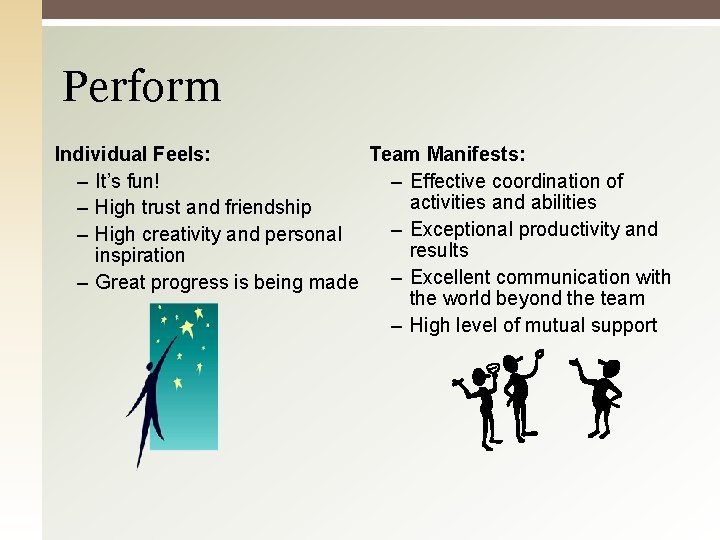
Perform Individual Feels: Team Manifests: – It’s fun! – Effective coordination of activities and abilities – High trust and friendship – Exceptional productivity and – High creativity and personal results inspiration – Excellent communication with – Great progress is being made the world beyond the team – High level of mutual support
Conflict Resolution In order for teams to move forward from Storm to Norm, teams must understand: How to identify conflict and how to resolve it How to identify blockages and how to unblock How team blockages affect progress and how to unblock them When managed correctly, conflict produces new ideas, solves problems, expands capabilities, and improves creativity.
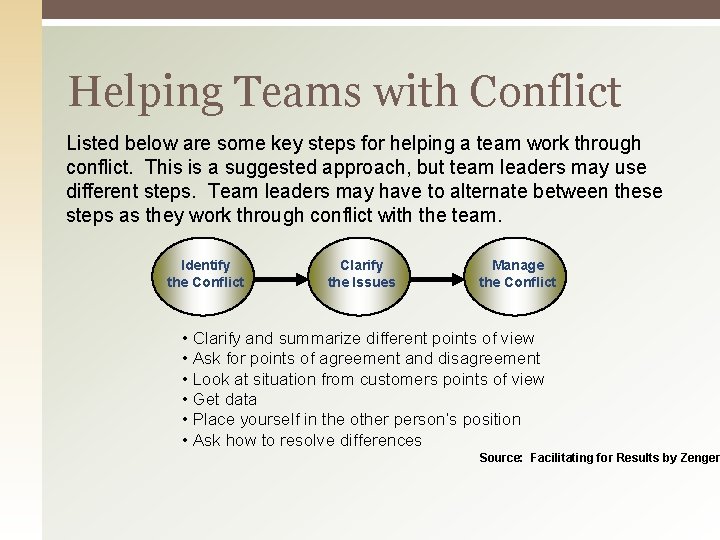
Helping Teams with Conflict Listed below are some key steps for helping a team work through conflict. This is a suggested approach, but team leaders may use different steps. Team leaders may have to alternate between these steps as they work through conflict with the team. Identify the Conflict Clarify the Issues Manage the Conflict • Clarify and summarize different points of view • Ask for points of agreement and disagreement • Look at situation from customers points of view • Get data • Place yourself in the other person’s position • Ask how to resolve differences Source: Facilitating for Results by Zenger
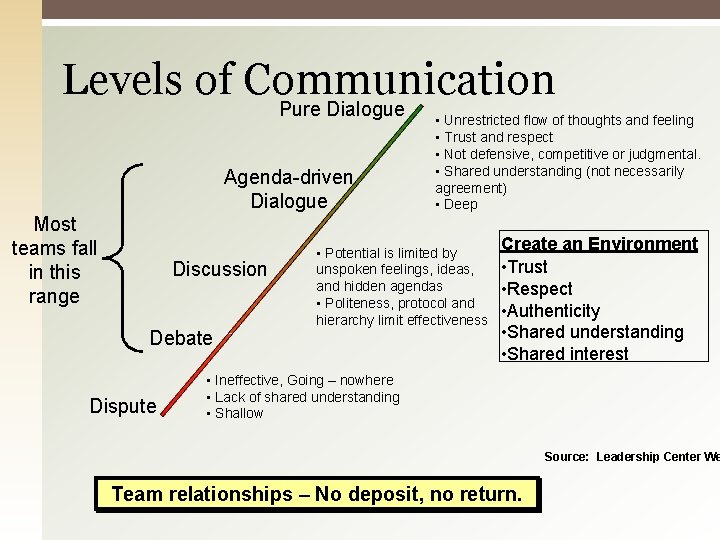
Levels of Communication Pure Dialogue Agenda-driven Dialogue Most teams fall in this range Discussion Debate Dispute • Unrestricted flow of thoughts and feeling • Trust and respect • Not defensive, competitive or judgmental. • Shared understanding (not necessarily agreement) • Deep • Potential is limited by unspoken feelings, ideas, and hidden agendas • Politeness, protocol and hierarchy limit effectiveness Create an Environment • Trust • Respect • Authenticity • Shared understanding • Shared interest • Ineffective, Going – nowhere • Lack of shared understanding • Shallow Source: Leadership Center We Team relationships – No deposit, no return.
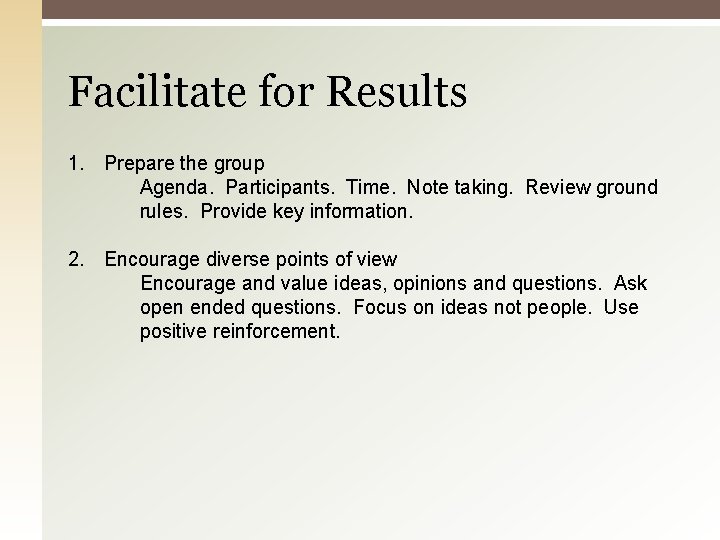
Facilitate for Results 1. Prepare the group Agenda. Participants. Time. Note taking. Review ground rules. Provide key information. 2. Encourage diverse points of view Encourage and value ideas, opinions and questions. Ask open ended questions. Focus on ideas not people. Use positive reinforcement.
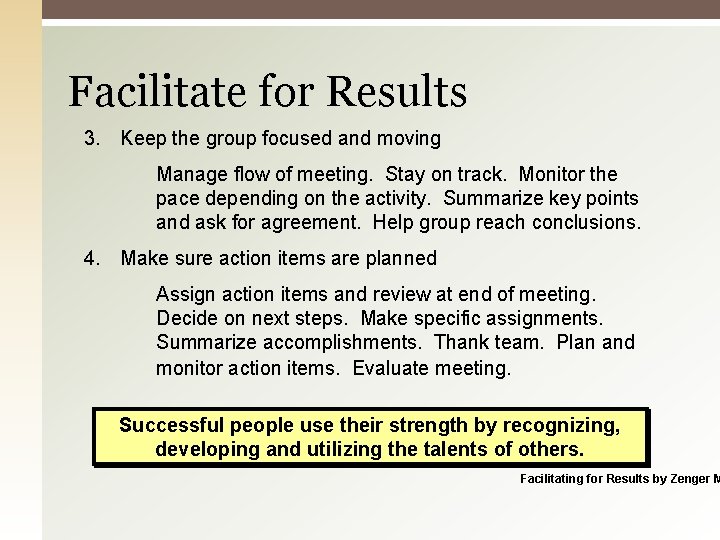
Facilitate for Results 3. Keep the group focused and moving Manage flow of meeting. Stay on track. Monitor the pace depending on the activity. Summarize key points and ask for agreement. Help group reach conclusions. 4. Make sure action items are planned Assign action items and review at end of meeting. Decide on next steps. Make specific assignments. Summarize accomplishments. Thank team. Plan and monitor action items. Evaluate meeting. Successful people use their strength by recognizing, developing and utilizing the talents of others. Facilitating for Results by Zenger M
Class Discussion: Leadership Who comes to mind when you think of great leaders? Person Why? The greatest oak was once a little nut that held its ground.
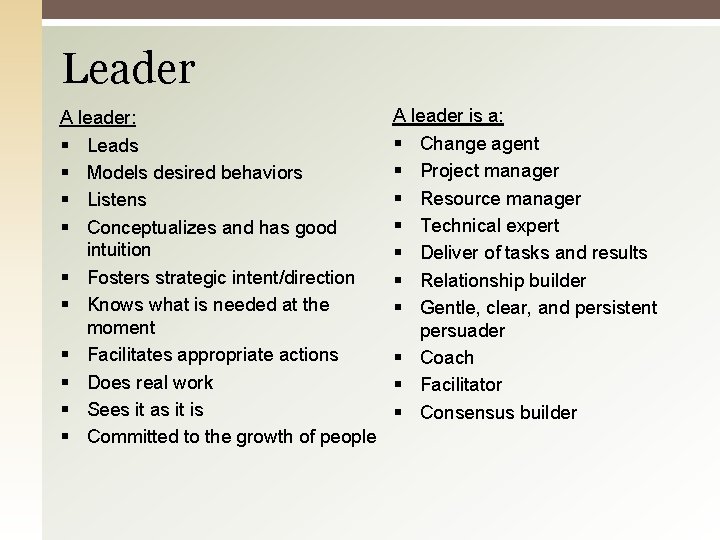
Leader A leader: § Leads § Models desired behaviors § Listens § Conceptualizes and has good intuition § Fosters strategic intent/direction § Knows what is needed at the moment § Facilitates appropriate actions § Does real work § Sees it as it is § Committed to the growth of people A leader is a: § Change agent § Project manager § Resource manager § Technical expert § Deliver of tasks and results § Relationship builder § Gentle, clear, and persistent persuader § Coach § Facilitator § Consensus builder
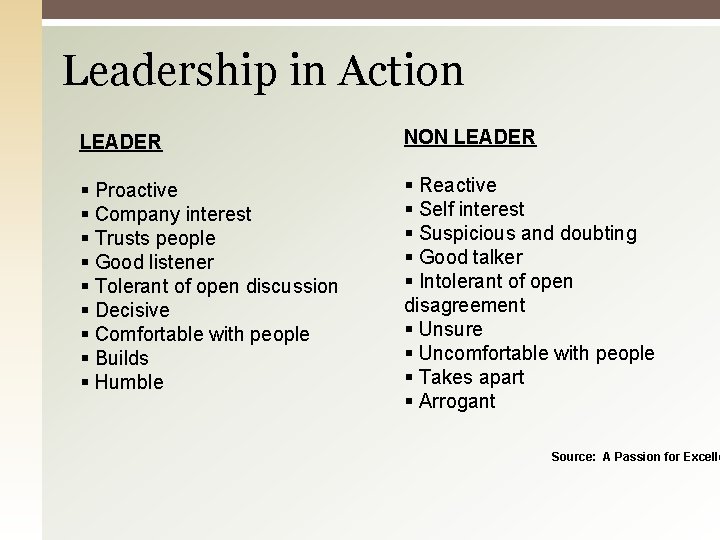
Leadership in Action LEADER NON LEADER § Proactive § Company interest § Trusts people § Good listener § Tolerant of open discussion § Decisive § Comfortable with people § Builds § Humble § Reactive § Self interest § Suspicious and doubting § Good talker § Intolerant of open disagreement § Unsure § Uncomfortable with people § Takes apart § Arrogant Source: A Passion for Excelle
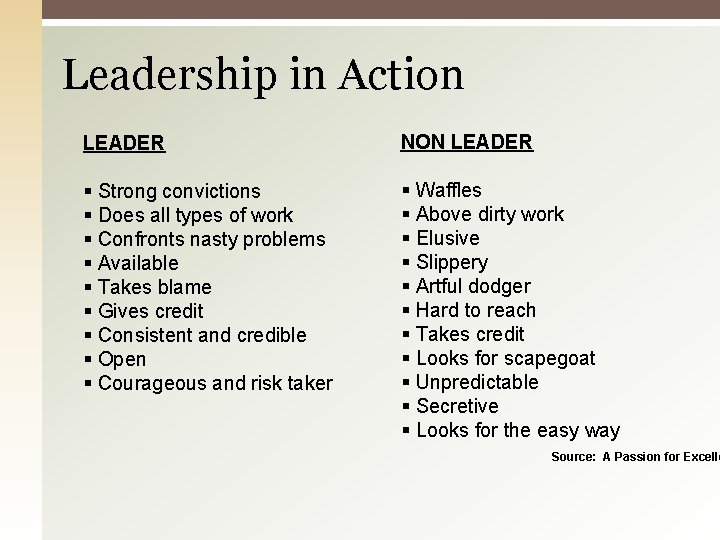
Leadership in Action LEADER NON LEADER § Strong convictions § Does all types of work § Confronts nasty problems § Available § Takes blame § Gives credit § Consistent and credible § Open § Courageous and risk taker § Waffles § Above dirty work § Elusive § Slippery § Artful dodger § Hard to reach § Takes credit § Looks for scapegoat § Unpredictable § Secretive § Looks for the easy way Source: A Passion for Excelle
References Team Development at Caterpillar, Stan Geisz, Dennis Bechtel, Lyle Cunningham, Dave Drosner, Larry Hildebrand, Jay Messerschmidt, Tom Vogelsang, July 1997 A Passion for Excellence, Tom Peters, Nancy Austin, 1985 Di-a-logic. Practices for Effective Conservation, Leadership Center West Facilitating for Results, Zenger Miller Meyers – Briggs Indicator in Organizations, Sandra Kerbs Hirsh, 1991 Social Styles, TRACOM Group
- Slides: 35