
ISO 13485 2016 Norm for regulatory compliance Alice



- Slides: 92
ISO 13485: 2016 Norm for regulatory compliance Alice Ravizza 3 rd - 7 th September 2018 UBORA Design School 2018 - Pisa Name and Surname
Risk subjects • Manufacturer is compelled to evaluate impact of use of the device: • • On patient On intended user On bystanders On general environment • Manufacturer is compelled to evaluate effect of product impact in all life cycle, from manufacturing to disposal
Norms • Device lifecycle is regulated as per: • ISO 13485 for Quality Systems • ISO 14971 for Risk Management • ISO 14155 and various guidelines for Clinical Investigations • Each product category is then regulated by technical norms • • For electro medical devices For sterile devices For devices in contact with the body Multiple harmonised and not harmonised norms for technical regulation
Quality Management System • Full company management system • Internal processes • Processes directed to the customer • Continuous feedback • For an organization to function effectively, it has to identify and manage numerous linked processes
Definitions…. • Process: an integrated set of activities that uses resources to transform inputs into outputs • System: several processes are interconnected using such input-output relationships. • NOTE: Processes are interconnected to form a system because the output from one process becomes the input for another process.
Process approach: a management strategy • Managers shall identify and rule: • processes that make up their organization, • the interaction between these processes • the inputs and outputs that glue these processes together • Each process is evaluated by its capacity to reach a set goal
Typical processes for any company • Quality Management/ Management review • Training • Design and Development • Production Management • Service Provision • Logistic Management • Customer Relationship Management • Product Purchasing/ Supplier qualification
Manufacturers’ responsibility • Develop the QS and apply regulation as applicable to their specific products and operations • Establish • requirements for each type or family of devices to ensure that devices are safe and effective, • methods and procedures to design, produce, distribute, etc. devices that meet the requirements
General rule for all systems The responsibility for • meeting system and product requirements • having objective evidence of meeting these requirements MAY NOT BE DELEGATED
Aim of the standard ISO 13485: 2016 clause 1. 1 • Specify requirements on SYSTEM • Facilitate global alignment of appropriate regulatory requirements • Provide an unique, integrated approach Evaluation of process risk Subsequent management
Receivers ISO 13485: 2016 clause 1. 1 • Companies that need to implement and maintain a “strong” QMS • Consistently manage the life cycle of a MD or IVD • Meet customer requirements • Meet regulatory requirements • Any company regardless size or type • Manufacturers of finished devices • Manufacturers of subassemblies (no regulatory requirements as per MDD or IVD) • Suppliers of services
Receivers • organization involved in stages of the life-cycle of a medical device • including the design and development, production, storage and distribution, installation or servicing of medical devices, and the design, development, and provision of associated activities • suppliers or other external parties providing goods and services • sterilization services, calibration services, distribution services)
Mandatory? • Voluntarily choose to conform to the requirements of this standard • OR may be required by contract to conform • As all HARMONISED standards, allows claiming presumption of compliance to Essential Requirements of Medical Device Directive/ IVD Directive
Role of the company • The organization shall: • identify its role(s) under appropriate regulatory requirements, • identify the regulatory requirements that are appropriate for its activities under these roles, and • incorporate these appropriate regulatory requirements within its quality management system.
Relationship to other standards • Can be used as an part of an integrated system • Business 9001 series • Environment ISO 14000 series • Health and safety • Ethics
Relationship to ISO 9001: 2015 • Common approach: • process approach • risk-based thinking • Different structure • ISO 13485: 2016 still reflects the structure from ISO 9001: 2008
ISO 9001: 2015 ISO 13485: 2016 Understanding the context of the organization, its quality management system and processes Quality management system Leadership, policy and responsibilities Management Processes for planning and consideration of risks and opportunities Resource management Processes for support, including resources, people and information Product realization Operational processes related to customers and products and services Processes for performance evaluation Processes for improvement Measurement, analysis and improvement
Risk based approach • “One size fits all” or “worst case” approach is not feasible • Technically • economically • “Sizing” the system on the company • • • objectives, products / services Processes size and organizational structure appropriate regulatory requirements
Limitations to applicability • Some product limitations (clause 6, 7 or 8) • • • Not Not Not sterile (waive 6. 4. 2 and 7. 5. 1. 3) cleaned (waive 7. 5. 1. 2. 1) installed (waive 7. 5. 1. 2. 2) serviced (waive 7. 5. 1. 2. 3) active implantable (waive 8. 2. 4. 2) • Exclusion of design activities
4 Quality management system • QMS defined and maintained • According to ISO standard • According to regulatory requirements • Documentation of role of organization • manufacturer, authorized representative, importer or distributor.
System planning clause 4. 1. 2 • Determine processes • Control them via a risk based approach • Determine process flow/interactions
System functioning clause 4. 1. 3 and 5. 4. 2 • Criteria and methods to ensure process effectiveness • Resources • Achieve planned results (including quality objectives) • Monitor, measure • Record (written)
System change control clause 4. 1. 4 • Impact on QMS • Impact on products • Control: • Non- distruption of QMS (see also clause 5. 4. 2) • Compliance to regulatory requirements
Control of outsourced processes Clause 4. 1. 5 • The organization shall retain responsibility of conformity • Monitor and control • Written quality agreements
SW validation clause 4. 1. 6 • SW used in the QMS • First use • changes • Risk based approach to SW validation • NOTE: written records required • NOTE: CEI 62304
4. 2 Documentation requirements • Quality policy • Quality objectives • Quality manual • Procedures and records • Documents for planning, operation and control (work instructions) • Others?
4. 2. 2 Quality manual (unvaried) • a) the scope of the QMS, • justification for any exclusion or non-application; • b) the documented procedures; • outline the structure of the documentation • c) interaction between the processes
4. 2. 3 Medical device file • For each medical device type or medical device family • Documents generated to demonstrate conformity with • requirement of ISO • compliance with applicable regulatory requirements
Contents of file • a) general description of the medical device, intended use/purpose, and labelling, including any instructions for use; • b) specifications for product; • c) specifications or procedures for manufacturing, packaging, storage, handling and distribution; • d) procedures for measuring and monitoring; • e) as appropriate, requirements for installation; • f) as appropriate, procedures for servicing.
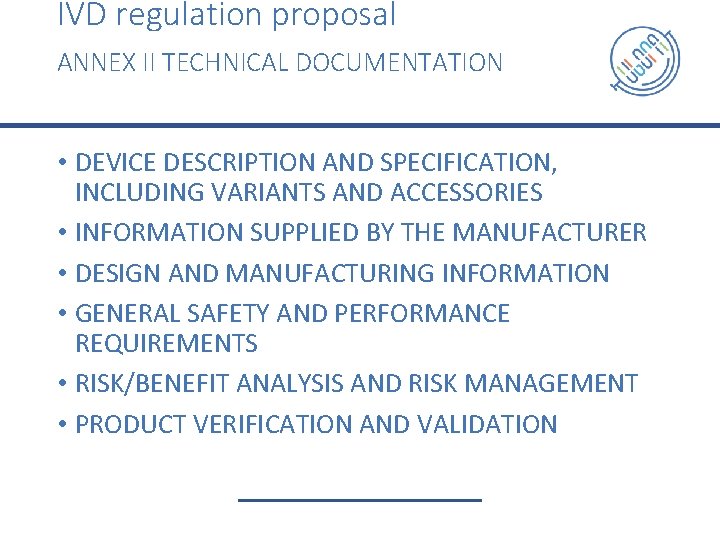
IVD regulation proposal ANNEX II TECHNICAL DOCUMENTATION • DEVICE DESCRIPTION AND SPECIFICATION, INCLUDING VARIANTS AND ACCESSORIES • INFORMATION SUPPLIED BY THE MANUFACTURER • DESIGN AND MANUFACTURING INFORMATION • GENERAL SAFETY AND PERFORMANCE REQUIREMENTS • RISK/BENEFIT ANALYSIS AND RISK MANAGEMENT • PRODUCT VERIFICATION AND VALIDATION
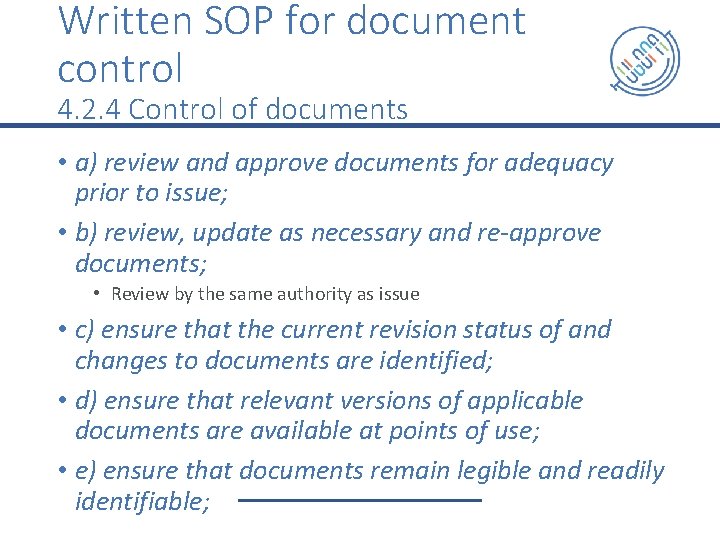
Written SOP for document control 4. 2. 4 Control of documents • a) review and approve documents for adequacy prior to issue; • b) review, update as necessary and re-approve documents; • Review by the same authority as issue • c) ensure that the current revision status of and changes to documents are identified; • d) ensure that relevant versions of applicable documents are available at points of use; • e) ensure that documents remain legible and readily identifiable;
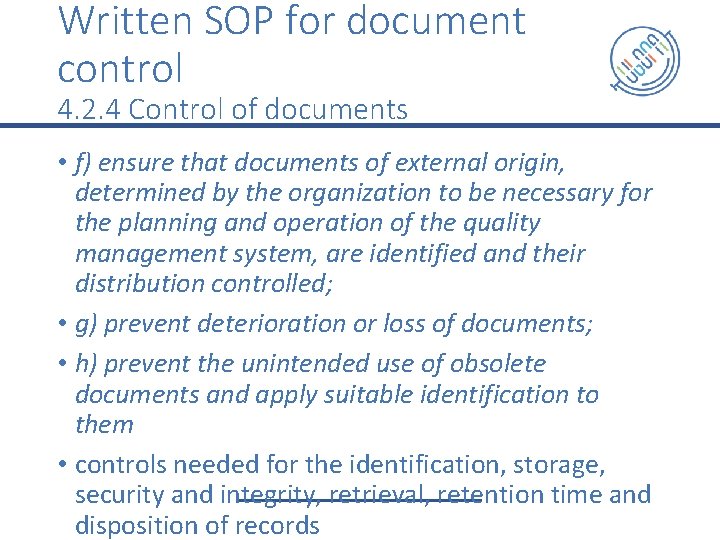
Written SOP for document control 4. 2. 4 Control of documents • f) ensure that documents of external origin, determined by the organization to be necessary for the planning and operation of the quality management system, are identified and their distribution controlled; • g) prevent deterioration or loss of documents; • h) prevent the unintended use of obsolete documents and apply suitable identification to them • controls needed for the identification, storage, security and integrity, retrieval, retention time and disposition of records
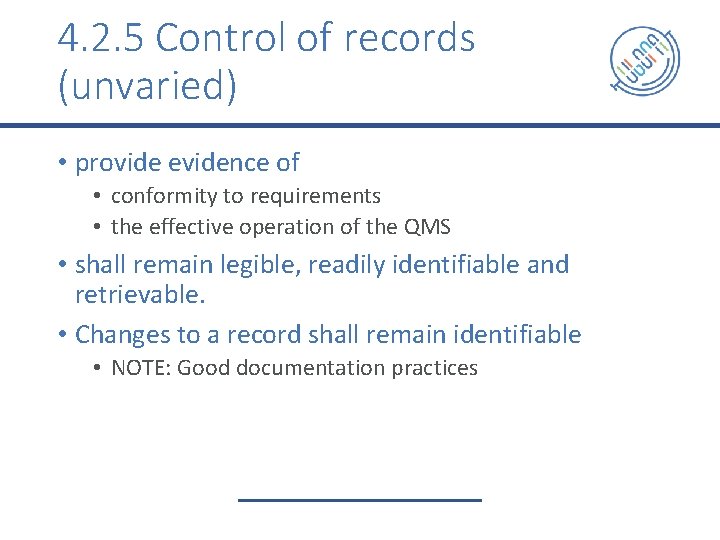
4. 2. 5 Control of records (unvaried) • provide evidence of • conformity to requirements • the effective operation of the QMS • shall remain legible, readily identifiable and retrievable. • Changes to a record shall remain identifiable • NOTE: Good documentation practices
Filing of documents and records • Filing for a predefined period • Procedures: At least same of medical device lifetime • BUT • At least more than the resulting records • Records: at least 2 years from release • BUT filing time also in compliance to regulatory requirements
5. 1 Management commitment and 5. 2 customer focus • Communication • Quality policy • Quality objectives • Management reviews • Availability of resources • Customer focus • Regulatory requirements focus
5. 3 Quality policy • a) is applicable to the purpose of the organization; • b) includes a commitment to comply with requirements and to maintain the effectiveness of the quality management system; • c) provides a framework for establishing and reviewing quality objectives; • d) is communicated and understood within the organization; • e) is reviewed for continuing suitability.
5. 4. 1 Quality objectives • Efficiency, efficacy • Regulatory requirements • Product requirements (example: expected Aq. Ls) • Measurable • Consistent with the quality policy
5. 5. 1 Responsibility and authority 5. 5. 2 Management representative • Define and communicate responsibilities • Organizational chart • Job profiles • Personnel affecting quality • ensure the independence and authority • Management representative • Responsible of QMs • Reports to top management • Promotes the QMS in the organization
5. 6 Management review • Top management responsibility • documented planned intervals • Evaluate the need of change to the QMS • Risk based approach • NOTE: written procedure and records required
5. 6. 2 Review input • a) feedback; • From customers • From predicate devices • b) complaint handling; • c) reporting to regulatory authorities; • d) audits; • e) monitoring and measurement of processes; • f) monitoring and measurement of product;
5. 6. 2 Review input • g) corrective action; • h) preventive action • i) follow-up actions from previous management reviews; • j) changes that could affect the quality management system; • k) recommendations for improvement; • l) applicable new or revised regulatory requirements.
Inputs from other clauses • Status of work environments (clause 6. 4. 1) • Information from servicing activities (clause 7. 5. 4) • DHF Change control (clause 7. 3. 10) • Other chosen by organization
5. 6. 3 Review output • Improvement • Of system • Of product • Changes for new regulatory requirements • Resources needed
Documented procedure for HR (unvaried) 6. 2 Human resources • establishing competence, • providing needed training, • achieve or maintain the necessary competence • Check effectiveness (risk based approach) • ensuring awareness of personnel • NOTE: records of education, training, skills and experience
Written procedure 6. 3 Infrastructure • Requirements for the infrastructure • a) buildings, workspace and associated utilities; • b) process equipment (both hardware and software); • c) supporting services • Ensure that infrastructures are adequate for processes, prevent product mixup • Define maintenance • NOTE: Keep records of maintenance
6. 4. 1 Work environment 6. 4. 2 Contamination control • Requirements for work environment • Requirements for health, cleanliness and clothing of personnel • Processes to maintain adequacy • Reference norms ISO 14644 (cleanrooms) and ISO 14698 (biocontamination control) • Prevent contamination of work environment or other product
7. 1 Planning of product realization • document one or more processes for risk management in product realization • Plan product realization • quality objectives/ product specs • Equipment, infrastructure and work environment; • verification, validation, monitoring, measurement, inspection and test, product acceptance • handling, storage, distribution and traceability • records
Process risk management • Process criticality level • Required product verification/ quality control • Required process validation • Training • Equipment maintenance • Work environment maintenance
7. 2. 1 Determination of requirements related to product • Specified by customer • Delivery • Post delivery • Not specified by customer, defined by the intended use • Regulatory • User training
7. 2. 2 Review of requirements related to product • Product ID and requirements • Regulatory requirements • traceability • Contract and order • User training • Change control • NOTE: records of review
7. 2. 3 Communication • To customers • a) product information; • b) enquiries, contracts or order handling, including amendments; • c) customer feedback, including complaints; • d) advisory notices. • To regulatory authorities • Meddev
7. 3 Design and development • Documented procedure • • Plan Input Output Review Verification Validation Transfer Change control • Documented DHF to be kept updated with changes (clause 7. 3. 10)
7. 3. 2 Design and development planning • a) the design and development stages; • b) the review(s) for each stage; • c) the verification, validation, and design transfer activities at each stage; • d) the responsibilities and authorities • e) traceability of outputs to inputs; • f) the resources (including competence)
7. 3. 3 Design and development inputs • defined per class • • • a) functional, performance, b) regulatory requirements and standards; c) applicable output(s) of risk management; d) information derived from previous designs; e) other requirements safety • reviewed for adequacy and approved. • complete, unambiguous, and not in conflict with each other. ,
7. 3. 4 Design and development outputs • Meet inputs • Provide appropriate info • Adequate for subsequent verification and validation • Specify essential product specs • List of materials • Shape/ design • Packaging • Refer to QC criteria
7. 3. 5 Design and development review • Systematic review • At predefined stages • Evaluate ability of results to match inputs • Propose corrective actions • representatives of functions concerned with the design and development stage being reviewed, as well as other specialist personnel
7. 3. 6 Design and development verification • Aim: ensure that the outputs have met the inputs • Document verification plans that include methods, acceptance criteria and, as appropriate, statistical techniques with rationale for sample size • Verification of connections as applicable
7. 3. 7 Design and development validation • Ensure that device meets the intended use • methods, acceptance criteria, and, as appropriate, statistical techniques with rationale for sample size • Representative product • Clinical evaluation/ performance evaluation as integral part of validation • Completed prior to product release
7. 3. 8 Design and development transfer • Transfer of design and development outputs to commercial manufacturing • Issue of manufacturing work instructions • Process capability • Process validation • QC processes validation
7. 3. 9 Control of design and development changes • Evaluation of impact of change • • function, performance, usability, Safety applicable regulatory requirements Existing product • Review, verification, validaiton • Formal approval and release
7. 4. 1 Purchasing process • Selection (risk based) • Supplier performance • Product impact • Monitoring and continuous evaluation • NC control proportionate to supplier risk class • NOTE: records of evaluation, selection, monitoring and re-evaluation
7. 4. 2 Purchasing information • Information on product • Specs • Quality levels for acceptance • Information on supplier • QMS • Personnel training • As applicable, written agreement that the supplier notify the organization of changes • NOTE: records for traceability
7. 4. 3 Verification of purchased product • Extent of verification as per risk assessment • Supplier performance • Product • Changes of purchased products and their impact • Verification at supplier shall be described in the quality contracts • NOTE: records of verification and change control
7. 5. 1 Control of production and service provision (unvaried) • Production control (manufacturing, labeling, packaging, release, post delivery activites) • Qualification of infrastructure • Monitoring and control equipment • Traceability as per Serial Number or Batch number
7. 5. 2 Cleanliness of product (unvaried) 7. 5. 5 Particular requirements for sterile medical devices • Control of cleanliness status • Prior or alternate to sterilization • Control of cleaning processes • Removal of process residues • Can be manufactured out of cleanroom prior of (validated) cleaning procedures • Traceability of sterilization batch
7. 5. 3 Installation activities 7. 5. 4 Servicing activities • Performance and validation of installation • Control of external providers of installation/ servicing processes • Analysis of servicing records for NC control and improvement
7. 5. 6 Validation of processes for production and service provision • For high risk processes • resulting output cannot be or is not verified • deficiencies become apparent only after the product is in use or the service has been delivered • Demonstrate the ability of these processes to achieve planned results consistently • Required for sterilization and for packaging (clause 7. 5. 7)
Validation SOP • criteria for review and approval of the processes; • equipment qualification • qualification of personnel; • methods, procedures and acceptance criteria; • as appropriate, statistical techniques (rationale for sample sizes) • revalidation, including criteria for revalidation; • approval of changes to the processes • NOTE: records required
SW validation (see also clause 4. 1. 6) • SW used in production and service provision • Risk based approach to validation of SW used in production • At first use • Change control
7. 5. 8 Identification (unvaried) • Throughout the whole device life • production, storage, installation and servicing • Identification of QC status • Includes cleanliness status • UDI number as per applicable regulation • Identification of returned product
7. 5. 9 Traceability (unvaried) • As per regulatory requirements • Detailed requirement for implantables • records of components, materials, and conditions for the work environment • Traceability by distributors • Detailed requirements for customer property identification and state of compliance
7. 5. 11 Preservation of product • during processing, storage, handling, and distribution • protect product from alteration, contamination or damage • packaging design (and validation) • Labeling with storage instructions • NOTE: record of special storage conditions
Equipment SOP (unvaried) 7. 6 Control of monitoring and measuring equipment • Monitoring and measurement consistent with product quality criteria • Equipment • • Identified Calibrated and recalibrated Protected by tampering Protected during storage and handling • Control of instrument NC
8 Measurement, analysis and improvement • Product conformity • QMS continuous effectiveness • Appropriate (statistical) methods • Appropriate depth of controls
Feedback SOP 8. 2. 1 Feedback • Feedback on whether the organization • Has met customer requirements • Post production information as per regulatory requirements • Feedback output is the input of risk management • Product conformity • Improvement
Complaint SOP 8. 2. 2 Complaint handling • a) receiving and recording information; • b) evaluating information, determine if is a complaint; • Justification of not acceptance of complaint • c) investigating complaints; • Including impact of external parties • d) determining the need to CA reporting • e) handling of complaint-related (NC product) product; • f) determining the need to initiate corrections or corrective actions
8. 2. 3 Reporting to regulatory authorities • the organization shall document procedures for providing notification to the appropriate regulatory authorities. • NOTE: appropriate records
8. 2. 4 Internal audit • Compliance to • planned and documented arrangements, • requirements of this International Standard, • quality management system requirements established by the organization, • applicable regulatory requirements • Also product requirements • Effective implementation and maintenance
Audit SOP (unvaried) • Responsibilities (impartiality and competence) • Planning • conducting audits • recording and reporting • Audit plan as per risk approach • Process criticality • Results from previous audits • Reporting of NC found during audits • Follow up of CA
8. 2. 5 Monitoring and measurement • Of processes (clause 8. 2. 5) • Suitable methods for monitoring • Production records and evaluation of collected data • Of products (clause 8. 2. 6) • Evidence of conformity with the acceptance criteria • Identify of control personnel • For release • For any control for implantables • Quarantine of products under QC evaluation
NC product SOP 8. 3 Control of nonconforming product • Aim: NC product is identified and controlled to prevent its unintended use or delivery. • Identification and documentation • Segregation, • Evaluation, • determination of the need for an investigation • notification of any external party responsible for the NC • Disposition of nonconforming product • Rationale of decisions
8. 3. 2 Actions in response to NC product detected before delivery • NC correction (reword see clause 8. 3. 4) • Limitation to use • Use under concession • • Justified Approved by customer Still in compliance with regulatory requirements Detailed record (of justification and responsible board)
Regrade for use under concession • 3. 12. 4 regrade: alteration of the grade of a NC product in order to make it conform to requirements differing from the initial requirements • 3. 6. 3 grade: category or rank given to different requirements for an object having the same functional use
8. 3. 3 Actions in response to NC product detected after delivery • action appropriate to the effects, or potential effects • document procedures for issuing advisory notices • At any time • NOTE: new clause but same content as old version
SOP for rework 8. 3. 4 Rework • takes into account the potential adverse effect of the rework • procedures shall undergo the same review and approval as the original procedure • product shall be verified • Increased sampling?
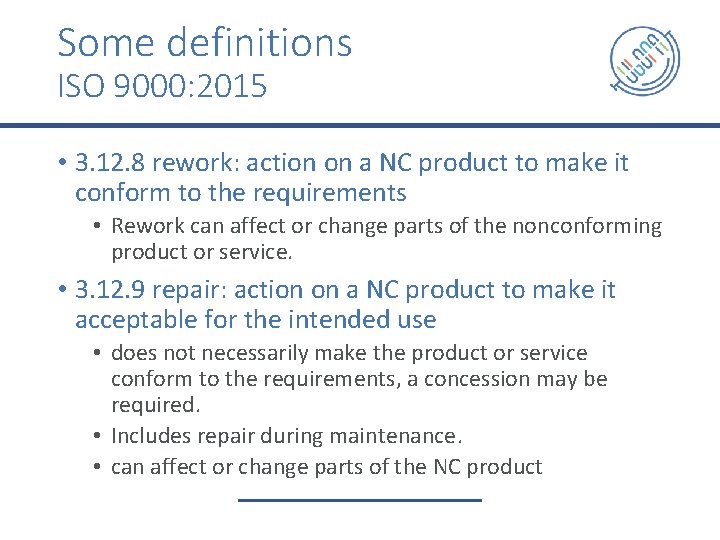
Some definitions ISO 9000: 2015 • 3. 12. 8 rework: action on a NC product to make it conform to the requirements • Rework can affect or change parts of the nonconforming product or service. • 3. 12. 9 repair: action on a NC product to make it acceptable for the intended use • does not necessarily make the product or service conform to the requirements, a concession may be required. • Includes repair during maintenance. • can affect or change parts of the NC product
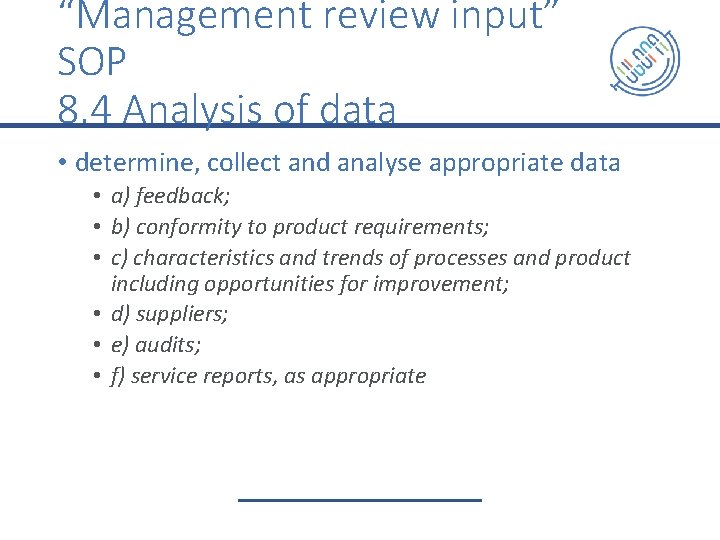
“Management review input” SOP 8. 4 Analysis of data • determine, collect and analyse appropriate data • a) feedback; • b) conformity to product requirements; • c) characteristics and trends of processes and product including opportunities for improvement; • d) suppliers; • e) audits; • f) service reports, as appropriate
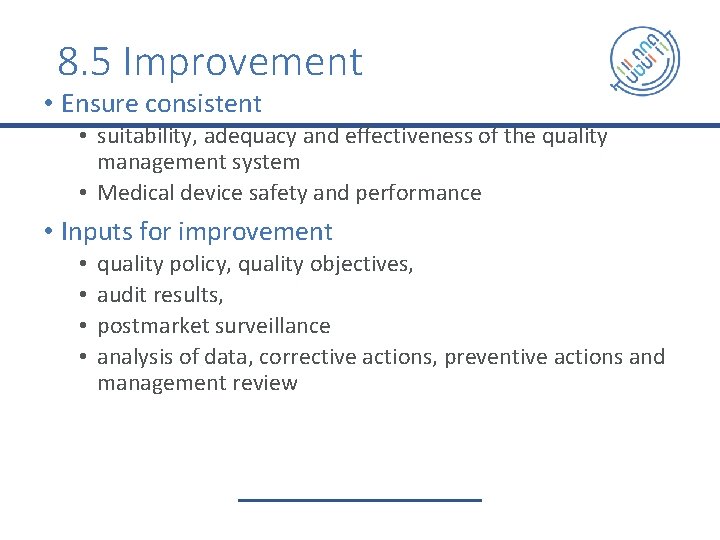
8. 5 Improvement • Ensure consistent • suitability, adequacy and effectiveness of the quality management system • Medical device safety and performance • Inputs for improvement • • quality policy, quality objectives, audit results, postmarket surveillance analysis of data, corrective actions, preventive actions and management review
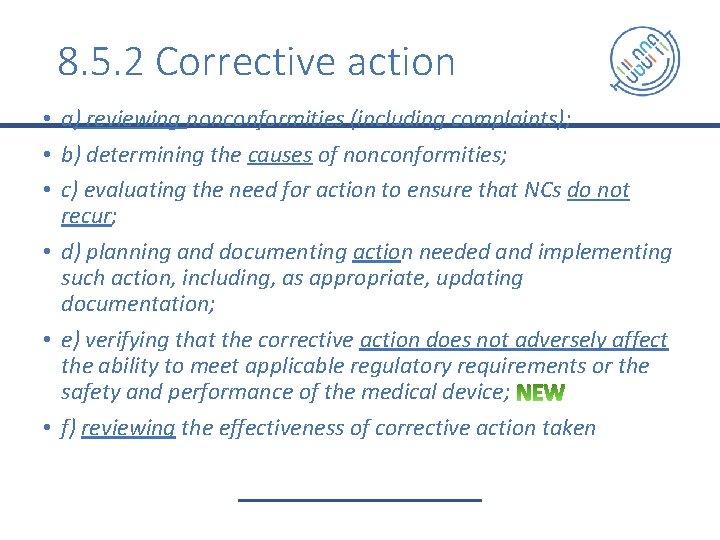
8. 5. 2 Corrective action • a) reviewing nonconformities (including complaints); • b) determining the causes of nonconformities; • c) evaluating the need for action to ensure that NCs do not recur; • d) planning and documenting action needed and implementing such action, including, as appropriate, updating documentation; • e) verifying that the corrective action does not adversely affect the ability to meet applicable regulatory requirements or the safety and performance of the medical device; • f) reviewing the effectiveness of corrective action taken
8. 5. 3 Preventive action a) determining potential NCs and their causes; b) evaluating the need for action to prevent occurrence c) planning and documenting action needed and implementing such action, including, as appropriate, updating documentation; d) verifying that the action does not adversely affect the ability to meet applicable regulatory requirements or the safety and performance of the medical device; e) reviewing the effectiveness of the preventive action taken, as appropriate.
This project has received funding from the European Union’s Horizon 2020 research and innovation programme under grant agreement No 731053 3 rd - 7 th September 2018 UBORA Design School 2018 - Pisa 92