Emergency Care THIRTEENTH EDITION CHAPTER 15 Communication and
- Slides: 70
Emergency Care THIRTEENTH EDITION CHAPTER 15 Communication and Documentation Emergency Care, 13 e Daniel Limmer | Michael F. O'Keefe Copyright © 2016, 2012, 2009 by Pearson Education, Inc. All Rights Reserved
Multimedia Directory Slide 21 Effective Communication Video Emergency Care, 13 e Daniel Limmer | Michael F. O'Keefe Copyright © 2016, 2012, 2009 by Pearson Education, Inc. All Rights Reserved
Topics • Communication Systems and Radio Communication • The Verbal Report • Interpersonal Communication • Prehospital Care Report • Special Documentation Issues Emergency Care, 13 e Daniel Limmer | Michael F. O'Keefe Copyright © 2016, 2012, 2009 by Pearson Education, Inc. All Rights Reserved
Communication Systems and Radio Communication Emergency Care, 13 e Daniel Limmer | Michael F. O'Keefe Copyright © 2016, 2012, 2009 by Pearson Education, Inc. All Rights Reserved
Communication Systems • EMS uses various communication systems: § § Radios One-way pagers Cell phones Traditional telephones (landlines) continued on next slide Emergency Care, 13 e Daniel Limmer | Michael F. O'Keefe Copyright © 2016, 2012, 2009 by Pearson Education, Inc. All Rights Reserved
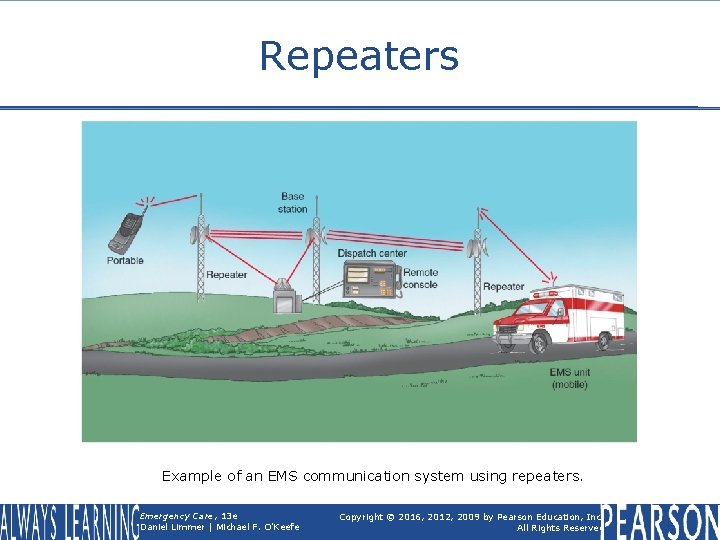
Communication Systems • EMS radio systems consist of: § § § Base stations Mobile radios Portable radios Repeaters Cell phones Telemetry Emergency Care, 13 e Daniel Limmer | Michael F. O'Keefe Copyright © 2016, 2012, 2009 by Pearson Education, Inc. All Rights Reserved
Repeaters Example of an EMS communication system using repeaters. Emergency Care, 13 e Daniel Limmer | Michael F. O'Keefe Copyright © 2016, 2012, 2009 by Pearson Education, Inc. All Rights Reserved
Radio Communication • Regulated by the Federal Communications Commission (FCC) § Assigns and licenses designated radio frequencies § Establishes rules regarding appropriate language § Monitors radio traffic Emergency Care, 13 e Daniel Limmer | Michael F. O'Keefe Copyright © 2016, 2012, 2009 by Pearson Education, Inc. All Rights Reserved
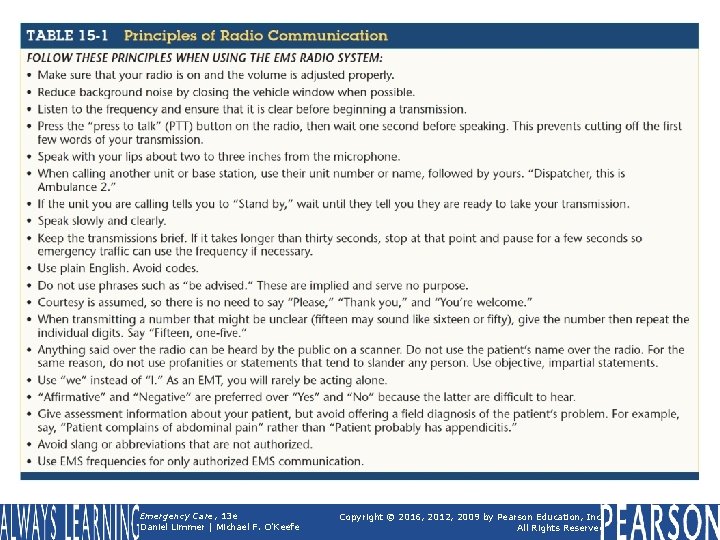
TABLE 15 -1 Principles of Radio Communication Emergency Care, 13 e Daniel Limmer | Michael F. O'Keefe Copyright © 2016, 2012, 2009 by Pearson Education, Inc. All Rights Reserved
Radio Transmissions throughout the Call • Initial call often comes via telephone but may be radioed from another agency. • Without prompt and efficient dispatch and receipt of information, ambulances can be sent to the wrong location. § If two units transmit simultaneously, only one will be heard by listeners. continued on next slide Emergency Care, 13 e Daniel Limmer | Michael F. O'Keefe Copyright © 2016, 2012, 2009 by Pearson Education, Inc. All Rights Reserved
Radio Transmissions throughout the Call • Without prompt and efficient dispatch and receipt of information, ambulances can be sent to the wrong location. § Dispatch often confirms receipt of transmission by repeating part of it back. • Dispatch may end transmission with time for documentation. § According to 24 -hour clock continued on next slide Emergency Care, 13 e Daniel Limmer | Michael F. O'Keefe Copyright © 2016, 2012, 2009 by Pearson Education, Inc. All Rights Reserved
Radio Transmissions throughout the Call • Carry portable radio whenever you leave unit. • Radios need proper care and maintenance. Emergency Care, 13 e Daniel Limmer | Michael F. O'Keefe Copyright © 2016, 2012, 2009 by Pearson Education, Inc. All Rights Reserved
Radio Medical Reports • Report must be given to destination hospital so it can prepare for arrival. § Usually done by radio § Structured to present only most important information § Speak clearly and slowly. Emergency Care, 13 e Daniel Limmer | Michael F. O'Keefe Copyright © 2016, 2012, 2009 by Pearson Education, Inc. All Rights Reserved
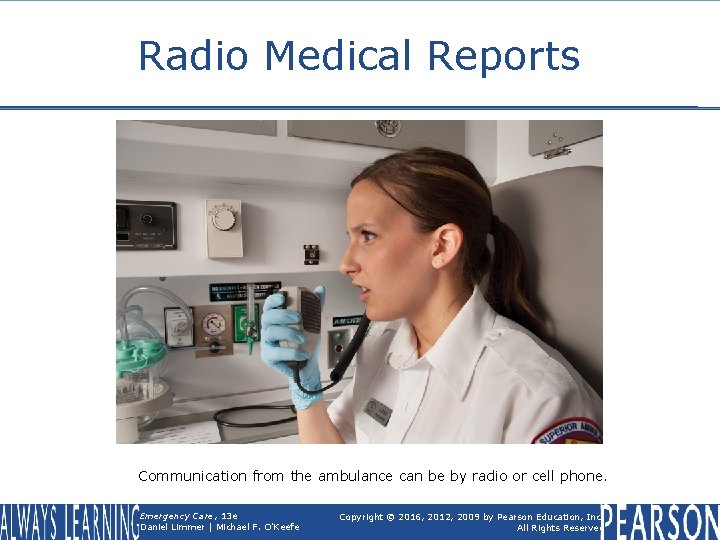
Radio Medical Reports Communication from the ambulance can be by radio or cell phone. Emergency Care, 13 e Daniel Limmer | Michael F. O'Keefe Copyright © 2016, 2012, 2009 by Pearson Education, Inc. All Rights Reserved
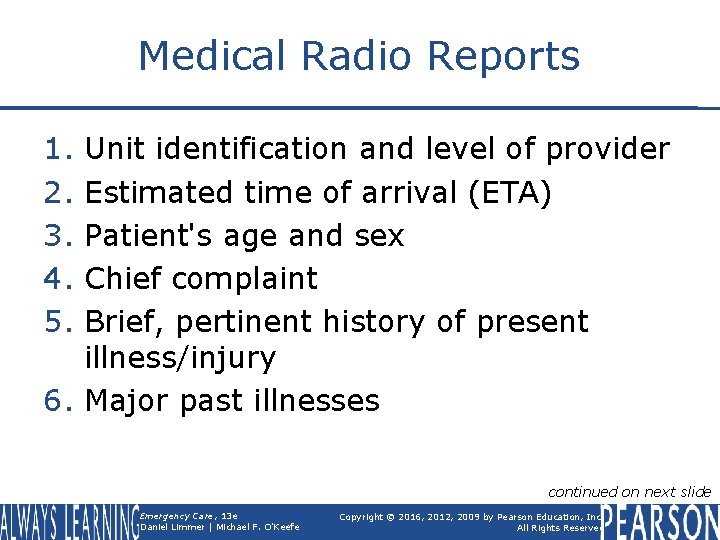
Medical Radio Reports 1. 2. 3. 4. 5. Unit identification and level of provider Estimated time of arrival (ETA) Patient's age and sex Chief complaint Brief, pertinent history of present illness/injury 6. Major past illnesses continued on next slide Emergency Care, 13 e Daniel Limmer | Michael F. O'Keefe Copyright © 2016, 2012, 2009 by Pearson Education, Inc. All Rights Reserved
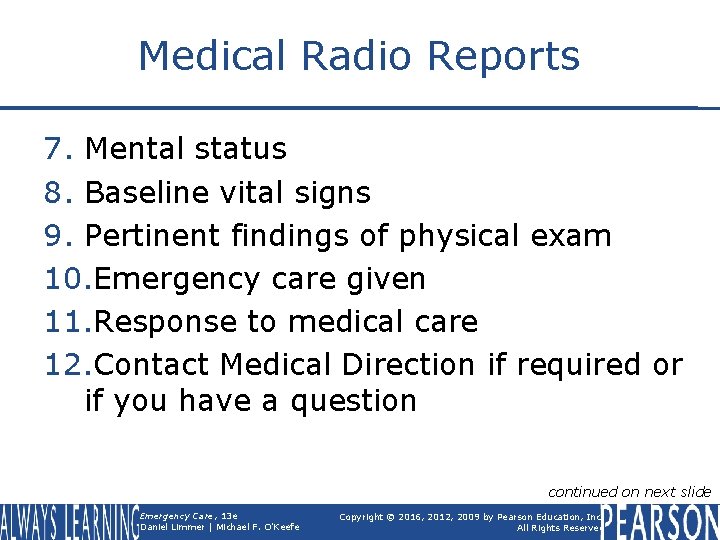
Medical Radio Reports 7. Mental status 8. Baseline vital signs 9. Pertinent findings of physical exam 10. Emergency care given 11. Response to medical care 12. Contact Medical Direction if required or if you have a question continued on next slide Emergency Care, 13 e Daniel Limmer | Michael F. O'Keefe Copyright © 2016, 2012, 2009 by Pearson Education, Inc. All Rights Reserved
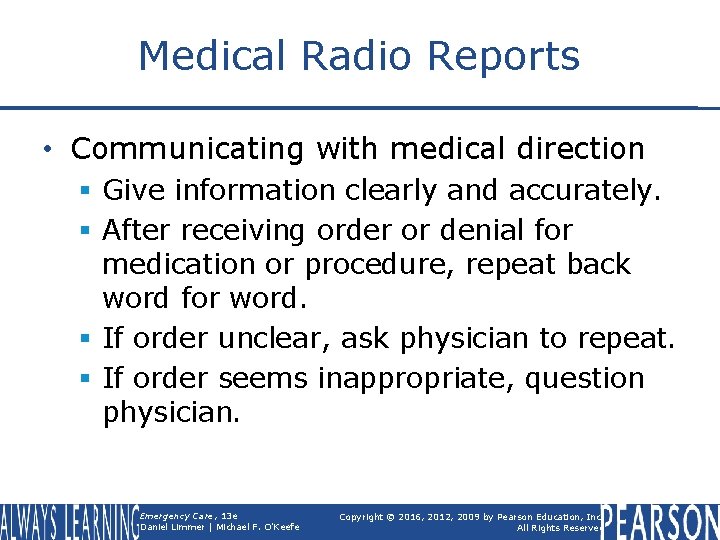
Medical Radio Reports • Communicating with medical direction § Give information clearly and accurately. § After receiving order or denial for medication or procedure, repeat back word for word. § If order unclear, ask physician to repeat. § If order seems inappropriate, question physician. Emergency Care, 13 e Daniel Limmer | Michael F. O'Keefe Copyright © 2016, 2012, 2009 by Pearson Education, Inc. All Rights Reserved
The Verbal Report Emergency Care, 13 e Daniel Limmer | Michael F. O'Keefe Copyright © 2016, 2012, 2009 by Pearson Education, Inc. All Rights Reserved
The Verbal Report • Given upon arrival at destination • Introduce patient by name. • Give complete and detailed report. continued on next slide Emergency Care, 13 e Daniel Limmer | Michael F. O'Keefe Copyright © 2016, 2012, 2009 by Pearson Education, Inc. All Rights Reserved
The Verbal Report • Elements of verbal report § § Chief complaint History that was not given previously Assessment treatment given en route Additional vital signs taken en route Emergency Care, 13 e Daniel Limmer | Michael F. O'Keefe Copyright © 2016, 2012, 2009 by Pearson Education, Inc. All Rights Reserved
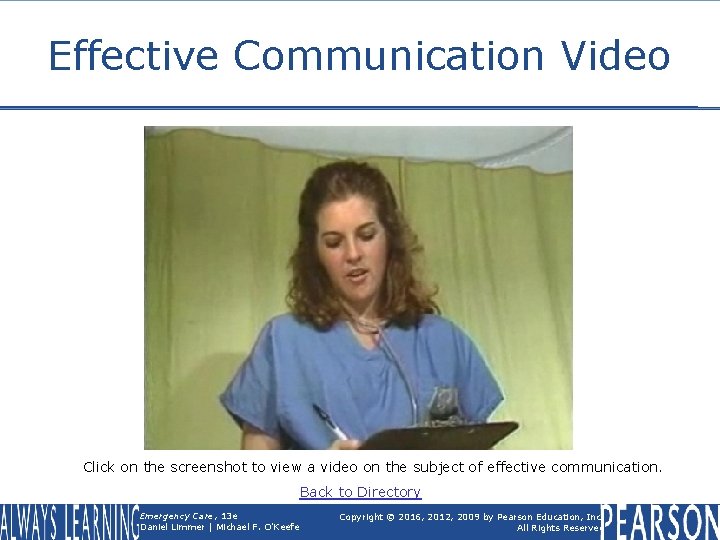
Effective Communication Video Click on the screenshot to view a video on the subject of effective communication. Back to Directory Emergency Care, 13 e Daniel Limmer | Michael F. O'Keefe Copyright © 2016, 2012, 2009 by Pearson Education, Inc. All Rights Reserved
Interpersonal Communication Emergency Care, 13 e Daniel Limmer | Michael F. O'Keefe Copyright © 2016, 2012, 2009 by Pearson Education, Inc. All Rights Reserved
Team Communication • EMT must communicate with others involved in patient's care. § First responders § Advanced EMTs, paramedics § Home healthcare aides, family • Speak candidly and respectfully. • Collect information about patient. Emergency Care, 13 e Daniel Limmer | Michael F. O'Keefe Copyright © 2016, 2012, 2009 by Pearson Education, Inc. All Rights Reserved
Therapeutic Communication • Communication techniques learned by experience § May be more difficult with those in crisis • Everyone can improve communication skills. continued on next slide Emergency Care, 13 e Daniel Limmer | Michael F. O'Keefe Copyright © 2016, 2012, 2009 by Pearson Education, Inc. All Rights Reserved
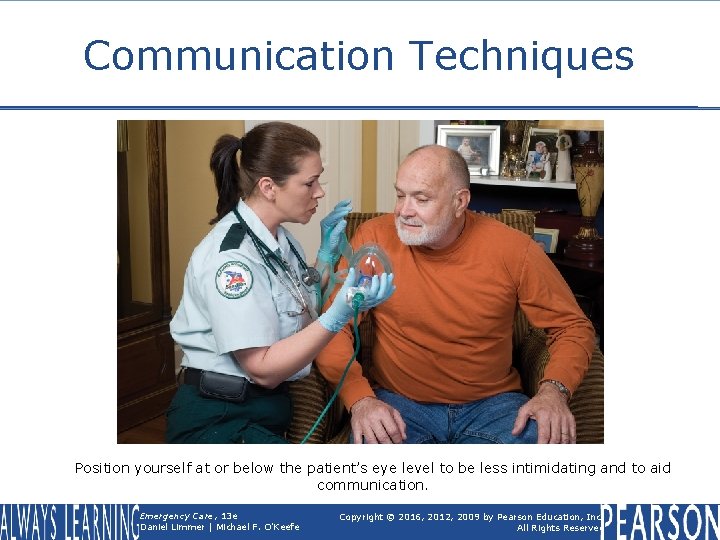
Therapeutic Communication • Use eye contact. § Shows interest, comfort, and respect • Be aware of position and body language. § Face patient at eye level with arms down. Emergency Care, 13 e Daniel Limmer | Michael F. O'Keefe Copyright © 2016, 2012, 2009 by Pearson Education, Inc. All Rights Reserved
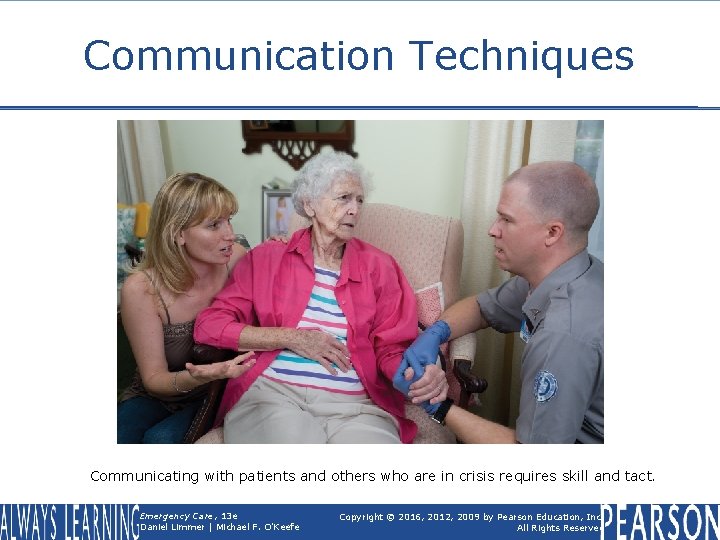
Communication Techniques Communicating with patients and others who are in crisis requires skill and tact. Emergency Care, 13 e Daniel Limmer | Michael F. O'Keefe Copyright © 2016, 2012, 2009 by Pearson Education, Inc. All Rights Reserved
Therapeutic Communication • Use language the patient can understand. § Do not use medical terms. § Explain procedures. • Be honest. § Dishonesty ruins confidence and rapport. continued on next slide Emergency Care, 13 e Daniel Limmer | Michael F. O'Keefe Copyright © 2016, 2012, 2009 by Pearson Education, Inc. All Rights Reserved
Therapeutic Communication • Use patient's proper name. § Sign of respect, especially with older patients • Listen. § Important to establish trust Emergency Care, 13 e Daniel Limmer | Michael F. O'Keefe Copyright © 2016, 2012, 2009 by Pearson Education, Inc. All Rights Reserved
Communication Techniques Position yourself at or below the patient’s eye level to be less intimidating and to aid communication. Emergency Care, 13 e Daniel Limmer | Michael F. O'Keefe Copyright © 2016, 2012, 2009 by Pearson Education, Inc. All Rights Reserved
Therapeutic Communication • Special considerations § Always be compassionate and respectful if the patient: • Has a mental disability • Has visual or hearing impairments • Has any language barriers Emergency Care, 13 e Daniel Limmer | Michael F. O'Keefe Copyright © 2016, 2012, 2009 by Pearson Education, Inc. All Rights Reserved
Pediatric Note • Pediatric patients § Come down to their level. § Be truthful. Emergency Care, 13 e Daniel Limmer | Michael F. O'Keefe Copyright © 2016, 2012, 2009 by Pearson Education, Inc. All Rights Reserved
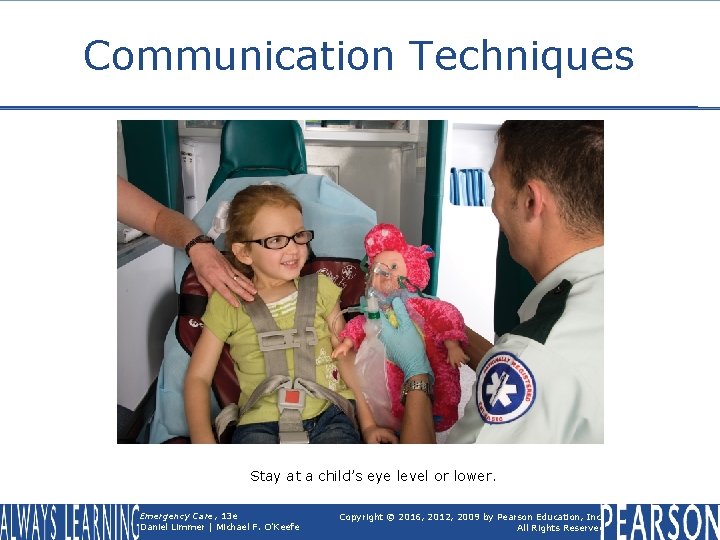
Communication Techniques Stay at a child’s eye level or lower. Emergency Care, 13 e Daniel Limmer | Michael F. O'Keefe Copyright © 2016, 2012, 2009 by Pearson Education, Inc. All Rights Reserved
Prehospital Care Report Emergency Care, 13 e Daniel Limmer | Michael F. O'Keefe Copyright © 2016, 2012, 2009 by Pearson Education, Inc. All Rights Reserved
Prehospital Care Report • Written documentation of everything that happened during call • Several forms § § Handwritten Laptop Tablet Pen-based computers • Drop (transfer) report Emergency Care, 13 e Daniel Limmer | Michael F. O'Keefe Copyright © 2016, 2012, 2009 by Pearson Education, Inc. All Rights Reserved
Functions of the Prehospital Care Report • Patient Care Record § Documents findings and treatment § Conveys picture of scene § Entered into patient's permanent medical record continued on next slide Emergency Care, 13 e Daniel Limmer | Michael F. O'Keefe Copyright © 2016, 2012, 2009 by Pearson Education, Inc. All Rights Reserved
Functions of the Prehospital Care Report • Legal Document § Can be subpoenaed and used as evidence § May help patient win a case § May be used against you in case of negligence continued on next slide Emergency Care, 13 e Daniel Limmer | Michael F. O'Keefe Copyright © 2016, 2012, 2009 by Pearson Education, Inc. All Rights Reserved
Functions of the Prehospital Care Report • Administrative Purposes § Insurance information § Billing address continued on next slide Emergency Care, 13 e Daniel Limmer | Michael F. O'Keefe Copyright © 2016, 2012, 2009 by Pearson Education, Inc. All Rights Reserved
Functions of the Prehospital Care Report • Education and Research § § Clinical research Statistics Continuing education Tracking EMT's personal experience continued on next slide Emergency Care, 13 e Daniel Limmer | Michael F. O'Keefe Copyright © 2016, 2012, 2009 by Pearson Education, Inc. All Rights Reserved
Functions of the Prehospital Care Report • Quality Improvement § Routine call review § Ensures compliance to standards § Can reveal providers deserving special recognition § Can reveal opportunities for improvement Emergency Care, 13 e Daniel Limmer | Michael F. O'Keefe Copyright © 2016, 2012, 2009 by Pearson Education, Inc. All Rights Reserved
Elements of the Prehospital Care Report • Data Elements § National Highway Traffic Safety Administration (NHTSA) • More than four hundred elements • Minimum data set available nationwide continued on next slide Emergency Care, 13 e Daniel Limmer | Michael F. O'Keefe Copyright © 2016, 2012, 2009 by Pearson Education, Inc. All Rights Reserved
Elements of the Prehospital Care Report • Run Data § Agency name, date, times, call number, unit personnel, levels of certification, other information mandated by service § Use official time given by dispatch so all times in report match continued on next slide Emergency Care, 13 e Daniel Limmer | Michael F. O'Keefe Copyright © 2016, 2012, 2009 by Pearson Education, Inc. All Rights Reserved
Elements of the Prehospital Care Report • Patient Information § § § Name, address, phone number Sex, age, and date of birth Weight Race and/or ethnicity Billing and insurance information continued on next slide Emergency Care, 13 e Daniel Limmer | Michael F. O'Keefe Copyright © 2016, 2012, 2009 by Pearson Education, Inc. All Rights Reserved
Elements of the Prehospital Care Report • Information Gathered during the Call § General impression of patient § Narrative summary of call § Patient's prior aid, past medical history, physical exam results, vital signs, ECG results, procedures and treatments, medications administered, and other information as required by your service § Transport information continued on next slide Emergency Care, 13 e Daniel Limmer | Michael F. O'Keefe Copyright © 2016, 2012, 2009 by Pearson Education, Inc. All Rights Reserved
Elements of the Prehospital Care Report • Narrative Sections § Objective information • Observable, measurable, verifiable § Subjective information • Subject to interpretation or opinion (often reported by patient) continued on next slide Emergency Care, 13 e Daniel Limmer | Michael F. O'Keefe Copyright © 2016, 2012, 2009 by Pearson Education, Inc. All Rights Reserved
Elements of the Prehospital Care Report • Narrative Sections § Chief complaint • Primary complaint, as stated by patient • Best recorded as a direct quote § Pertinent negatives • Important negative findings continued on next slide Emergency Care, 13 e Daniel Limmer | Michael F. O'Keefe Copyright © 2016, 2012, 2009 by Pearson Education, Inc. All Rights Reserved
Elements of the Prehospital Care Report • Narrative Sections § Avoid radio codes and nonstandard abbreviations. § Write legibly and use correct spelling. • Information must be read easily and accurately. • PCR is a reflection of your care. § Use appropriate medical terminology. § If it's not written down, you didn't do it. Emergency Care, 13 e Daniel Limmer | Michael F. O'Keefe Copyright © 2016, 2012, 2009 by Pearson Education, Inc. All Rights Reserved
Special Documentation Issues Emergency Care, 13 e Daniel Limmer | Michael F. O'Keefe Copyright © 2016, 2012, 2009 by Pearson Education, Inc. All Rights Reserved
Legal Issues • Confidentiality § Covered by the Health Insurance Portability and Accountability Act (HIPAA) § Accountability and security • Patient Refusals § High liability § Document all details in a "refusal of care" form. continued on next slide Emergency Care, 13 e Daniel Limmer | Michael F. O'Keefe Copyright © 2016, 2012, 2009 by Pearson Education, Inc. All Rights Reserved
Legal Issues • Falsification § Covering up errors § Recording something you forgot to do • Correction of Errors § Mistakes in documentation § Additions Emergency Care, 13 e Daniel Limmer | Michael F. O'Keefe Copyright © 2016, 2012, 2009 by Pearson Education, Inc. All Rights Reserved
Think About It • You respond to a call for an unconscious male. Upon arrival the patient is awake, alert, and walking away. He states he was just sleeping, and does not need or want treatment or transport. continued on next slide Emergency Care, 13 e Daniel Limmer | Michael F. O'Keefe Copyright © 2016, 2012, 2009 by Pearson Education, Inc. All Rights Reserved
Think About It • Is this a patient? • Is a complete assessment and physical exam needed? • How will you document this call? • Should you obtain a formal patient refusal? Emergency Care, 13 e Daniel Limmer | Michael F. O'Keefe Copyright © 2016, 2012, 2009 by Pearson Education, Inc. All Rights Reserved
Special Situations • Multiple-Casualty Incidents § Logistical problem for EMS § Many patients § Care and evaluation by several providers at different times and locations continued on next slide Emergency Care, 13 e Daniel Limmer | Michael F. O'Keefe Copyright © 2016, 2012, 2009 by Pearson Education, Inc. All Rights Reserved
Special Situations • Special Situation Reports § § § Exposure to infectious disease Injury to yourself or another EMT Hazardous or unsafe scenes Referrals to social service agencies Mandatory reports for child or elderly abuse Emergency Care, 13 e Daniel Limmer | Michael F. O'Keefe Copyright © 2016, 2012, 2009 by Pearson Education, Inc. All Rights Reserved
Chapter Review Emergency Care, 13 e Daniel Limmer | Michael F. O'Keefe Copyright © 2016, 2012, 2009 by Pearson Education, Inc. All Rights Reserved
Chapter Review • When calling in patient information, include these elements: § § § Unit identification and level of provider Estimated time of arrival Patient's age and sex Chief complaint Brief, pertinent history of the present illness continued on next slide Emergency Care, 13 e Daniel Limmer | Michael F. O'Keefe Copyright © 2016, 2012, 2009 by Pearson Education, Inc. All Rights Reserved
Chapter Review • When calling in patient information, include these elements: § § § Major past illnesses Mental status Baseline vital signs Pertinent findings of the physical exam Emergency medical care given Response to emergency medical care continued on next slide Emergency Care, 13 e Daniel Limmer | Michael F. O'Keefe Copyright © 2016, 2012, 2009 by Pearson Education, Inc. All Rights Reserved
Chapter Review • When calling in patient information, include these elements: § Contact made with medical direction if required or if you have questions • When completing the prehospital care report, or PCR, include the following: § Patient's name, address, date of birth, age, sex continued on next slide Emergency Care, 13 e Daniel Limmer | Michael F. O'Keefe Copyright © 2016, 2012, 2009 by Pearson Education, Inc. All Rights Reserved
Chapter Review • When completing the prehospital care report, or PCR, include the following: § Billing and insurance information (in many jurisdictions) § Nature of the call § Mechanism of injury § Location where the patient was found continued on next slide Emergency Care, 13 e Daniel Limmer | Michael F. O'Keefe Copyright © 2016, 2012, 2009 by Pearson Education, Inc. All Rights Reserved
Chapter Review • When completing the prehospital care report, or PCR, include the following: § Treatment administered before arrival of the EMT (by bystanders, Emergency Medical Responders, or others) § Signs and symptoms § Baseline and subsequent vital signs continued on next slide Emergency Care, 13 e Daniel Limmer | Michael F. O'Keefe Copyright © 2016, 2012, 2009 by Pearson Education, Inc. All Rights Reserved
Chapter Review • When completing the prehospital care report, or PCR, include the following: § Secondary assessment § Care administered and the effect that the care had on the patient (e. g. , improved, no change) § Changes in condition throughout the call continued on next slide Emergency Care, 13 e Daniel Limmer | Michael F. O'Keefe Copyright © 2016, 2012, 2009 by Pearson Education, Inc. All Rights Reserved
Chapter Review • A PCR may be a legal document in a court proceeding. • Data from PCRs may help determine future treatments, trends, research, and quality improvement • Your report should "paint a picture" of your patient and their condition, accurately describing your contact with the patient throughout the call. Emergency Care, 13 e Daniel Limmer | Michael F. O'Keefe Copyright © 2016, 2012, 2009 by Pearson Education, Inc. All Rights Reserved
Remember • Emergency medical communication comes in many forms and is essential to team-based patient care. • The medical radio report is structured to present pertinent facts about the patient without providing more detail than necessary. continued on next slide Emergency Care, 13 e Daniel Limmer | Michael F. O'Keefe Copyright © 2016, 2012, 2009 by Pearson Education, Inc. All Rights Reserved
Remember • A proper verbal report will include the chief complaint, any history that was not given previously, additional treatment given, and additional vital signs taken en route. continued on next slide Emergency Care, 13 e Daniel Limmer | Michael F. O'Keefe Copyright © 2016, 2012, 2009 by Pearson Education, Inc. All Rights Reserved
Remember • Interpersonal communication is often challenging in EMS. Adopting best practices can improve communication capabilities significantly. • Confidentiality, patient refusals, and falsification of records are all-important legal concepts that an EMT must consider when documenting a call. Emergency Care, 13 e Daniel Limmer | Michael F. O'Keefe Copyright © 2016, 2012, 2009 by Pearson Education, Inc. All Rights Reserved
Questions to Consider • How can you improve your interpersonal communication with patients and team members? • What is "objective" and "subjective" information in the narrative portion of the PCR? Emergency Care, 13 e Daniel Limmer | Michael F. O'Keefe Copyright © 2016, 2012, 2009 by Pearson Education, Inc. All Rights Reserved
Critical Thinking • Organize this random information, and present a radio report to the hospital. § Chest pain radiating to shoulder § 56 years old § Oxygen applied at 15 L/minute via nonrebreather § Alert and oriented § Female continued on next slide Emergency Care, 13 e Daniel Limmer | Michael F. O'Keefe Copyright © 2016, 2012, 2009 by Pearson Education, Inc. All Rights Reserved
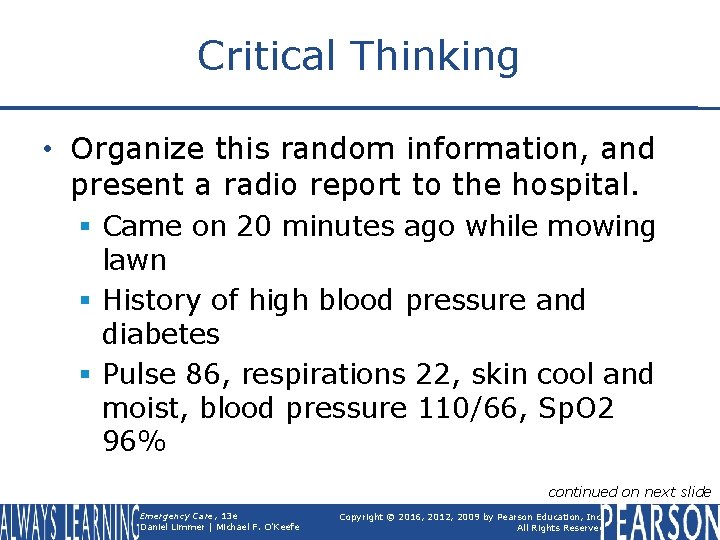
Critical Thinking • Organize this random information, and present a radio report to the hospital. § Came on 20 minutes ago while mowing lawn § History of high blood pressure and diabetes § Pulse 86, respirations 22, skin cool and moist, blood pressure 110/66, Sp. O 2 96% continued on next slide Emergency Care, 13 e Daniel Limmer | Michael F. O'Keefe Copyright © 2016, 2012, 2009 by Pearson Education, Inc. All Rights Reserved
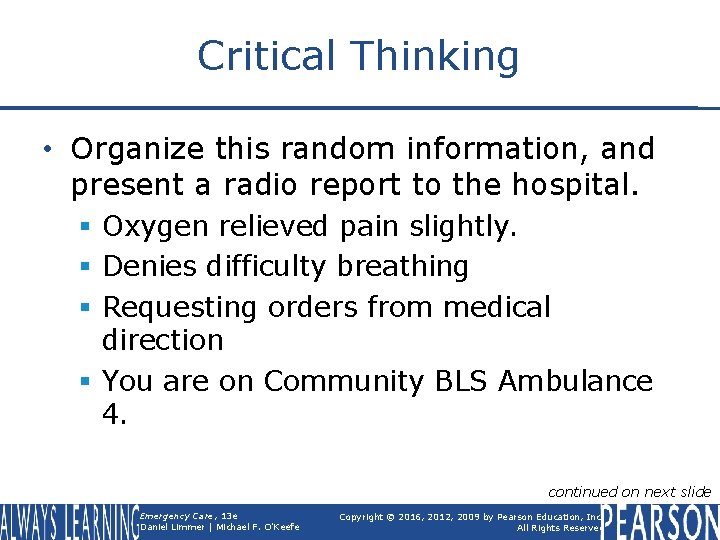
Critical Thinking • Organize this random information, and present a radio report to the hospital. § Oxygen relieved pain slightly. § Denies difficulty breathing § Requesting orders from medical direction § You are on Community BLS Ambulance 4. continued on next slide Emergency Care, 13 e Daniel Limmer | Michael F. O'Keefe Copyright © 2016, 2012, 2009 by Pearson Education, Inc. All Rights Reserved
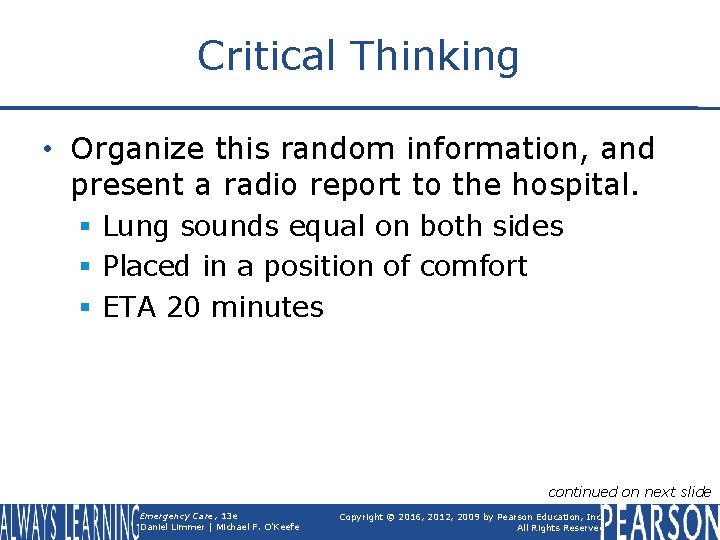
Critical Thinking • Organize this random information, and present a radio report to the hospital. § Lung sounds equal on both sides § Placed in a position of comfort § ETA 20 minutes continued on next slide Emergency Care, 13 e Daniel Limmer | Michael F. O'Keefe Copyright © 2016, 2012, 2009 by Pearson Education, Inc. All Rights Reserved
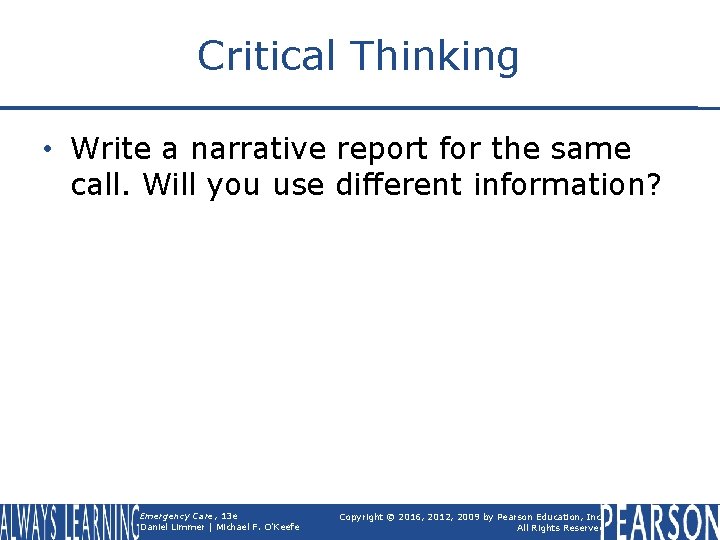
Critical Thinking • Write a narrative report for the same call. Will you use different information? Emergency Care, 13 e Daniel Limmer | Michael F. O'Keefe Copyright © 2016, 2012, 2009 by Pearson Education, Inc. All Rights Reserved