CHAPTER 32 EMERGENCY HEALTH CAREERS lesson 1 Aspiration
- Slides: 31
CHAPTER 32 EMERGENCY HEALTH CAREERS lesson 1 Aspiration Cardiopulmonary Critical Aura Consciousness Endotracheal intubation Journal question: What personal characteristics might make a student a good candidate for a career in emergency health? . Copyright © 2012, 2007, 2003, 1997, 1991 by Mosby, Inc. , an affiliate of Elsevier Inc. 1
Chapter 32 Objectives . Define at least 10 terms relating to emergency health care. Specify the role of the emergency medical technician, and emergency room personnel, including personal qualities, levels of education, and credentialing requirements. Copyright © 2012, 2007, 2003, 1997, 1991 by Mosby, Inc. , an affiliate of Elsevier Inc. 2
Chapter 32 Objectives . Identify three levels of care that have been developed to provide first aid. Identify at least six types of external wounds, and describe the first aid treatment for each. Identify at least three types of burns, and describe the first aid treatment for each. Copyright © 2012, 2007, 2003, 1997, 1991 by Mosby, Inc. , an affiliate of Elsevier Inc. 3
Careers in Emergency Health The goal of modern emergency care is immediate aid. The emergency medical services (EMS) system is a coordinated response by all levels of practitioners to accidents and sudden illness. Ø . In most areas, EMS services are initiated through the use of the 9 -1 -1 telephone call. Copyright © 2012, 2007, 2003, 1997, 1991 by Mosby, Inc. , an affiliate of Elsevier Inc. 4
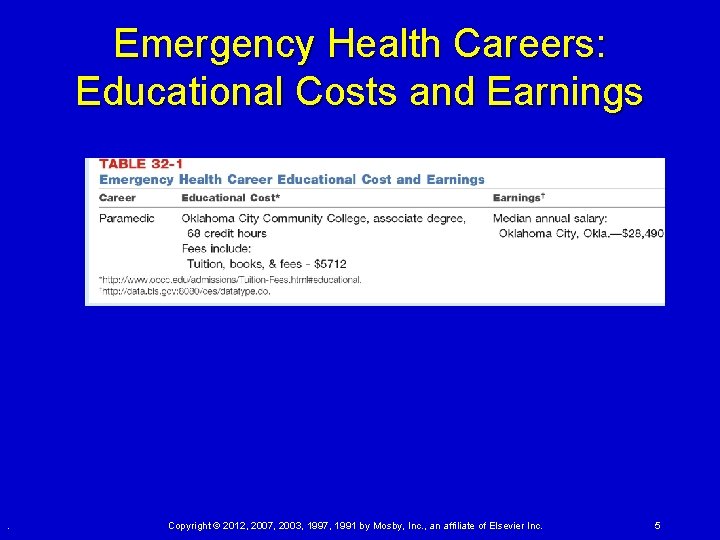
Emergency Health Careers: Educational Costs and Earnings . Copyright © 2012, 2007, 2003, 1997, 1991 by Mosby, Inc. , an affiliate of Elsevier Inc. 5
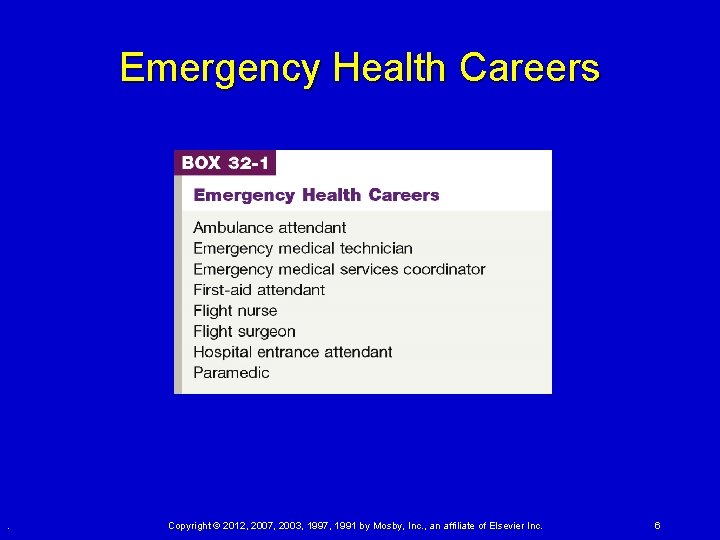
Emergency Health Careers . Copyright © 2012, 2007, 2003, 1997, 1991 by Mosby, Inc. , an affiliate of Elsevier Inc. 6
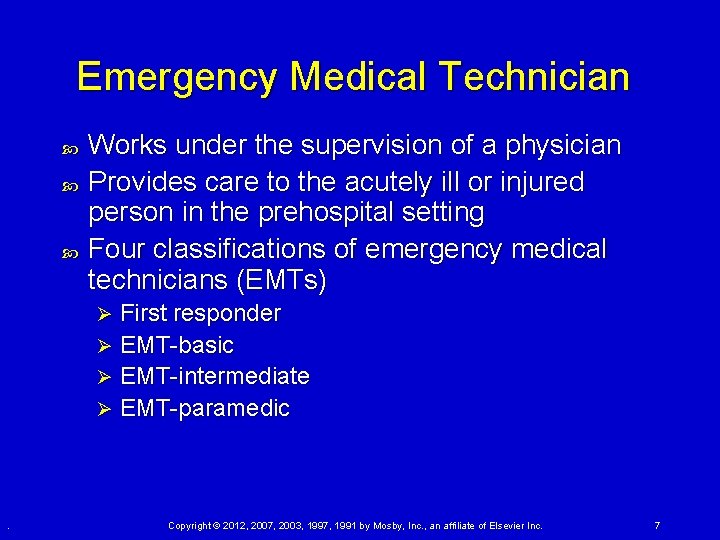
Emergency Medical Technician Works under the supervision of a physician Provides care to the acutely ill or injured person in the prehospital setting Four classifications of emergency medical technicians (EMTs) First responder Ø EMT-basic Ø EMT-intermediate Ø EMT-paramedic Ø . Copyright © 2012, 2007, 2003, 1997, 1991 by Mosby, Inc. , an affiliate of Elsevier Inc. 7
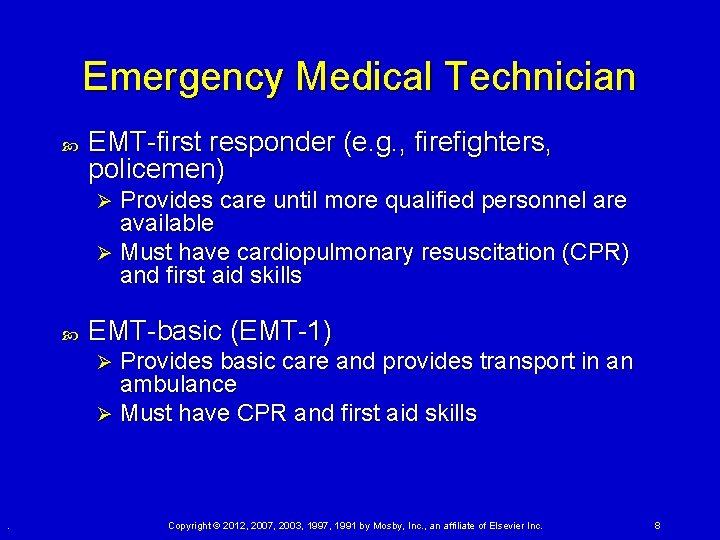
Emergency Medical Technician EMT-first responder (e. g. , firefighters, policemen) Provides care until more qualified personnel are available Ø Must have cardiopulmonary resuscitation (CPR) and first aid skills Ø EMT-basic (EMT-1) Provides basic care and provides transport in an ambulance Ø Must have CPR and first aid skills Ø . Copyright © 2012, 2007, 2003, 1997, 1991 by Mosby, Inc. , an affiliate of Elsevier Inc. 8
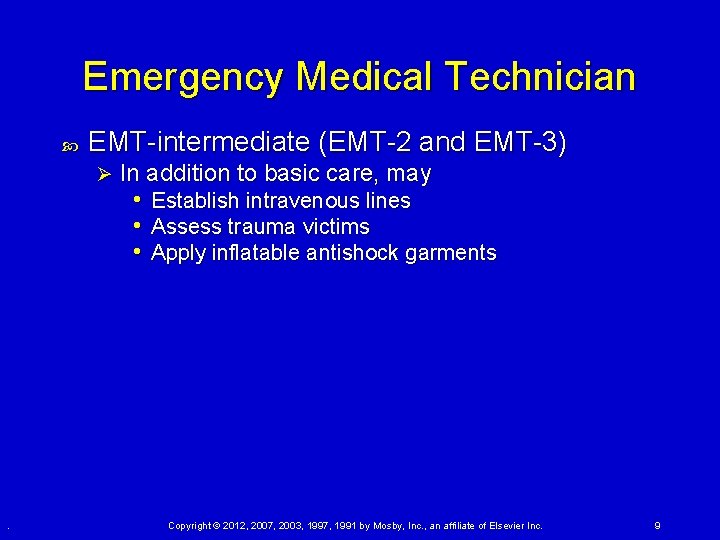
Emergency Medical Technician EMT-intermediate (EMT-2 and EMT-3) Ø . In addition to basic care, may • • • Establish intravenous lines Assess trauma victims Apply inflatable antishock garments Copyright © 2012, 2007, 2003, 1997, 1991 by Mosby, Inc. , an affiliate of Elsevier Inc. 9
Emergency Medical Technician EMT-paramedic (EMT-P or EMT-4) Provides advanced life support Ø Skilled in all duties of other EMT personnel and in monitoring electrocardiographic (ECG) readings and defibrillation Ø May administer medication and perform endotracheal intubation Ø . Copyright © 2012, 2007, 2003, 1997, 1991 by Mosby, Inc. , an affiliate of Elsevier Inc. 10
Emergency Medical Technician Training Ø Requirements vary by state. • At least 18 years old and high school diploma • Registration with the National Registry of Emergency Medical Technicians (required by 38 states) • Supervised internship included in training EMT certification is required by all states. Ø Recertification Ø . Copyright © 2012, 2007, 2003, 1997, 1991 by Mosby, Inc. , an affiliate of Elsevier Inc. 11
Flight Rescue Professions Flight paramedics Advanced cardiac life support (ACLS) certification Ø Prior field experience Ø Flight nurses Registered nurse with several years of critical care experience Ø ACLS and critical care certification Ø Flight respiratory therapists Must be certified respiratory therapist Ø Critical care experience Ø . Copyright © 2012, 2007, 2003, 1997, 1991 by Mosby, Inc. , an affiliate of Elsevier Inc. 12
Emergency Procedures Purpose of first aid is to sustain life and prevent death. Agencies that award certification in first aid American Red Cross Ø American Health Association Ø . Copyright © 2012, 2007, 2003, 1997, 1991 by Mosby, Inc. , an affiliate of Elsevier Inc. 13
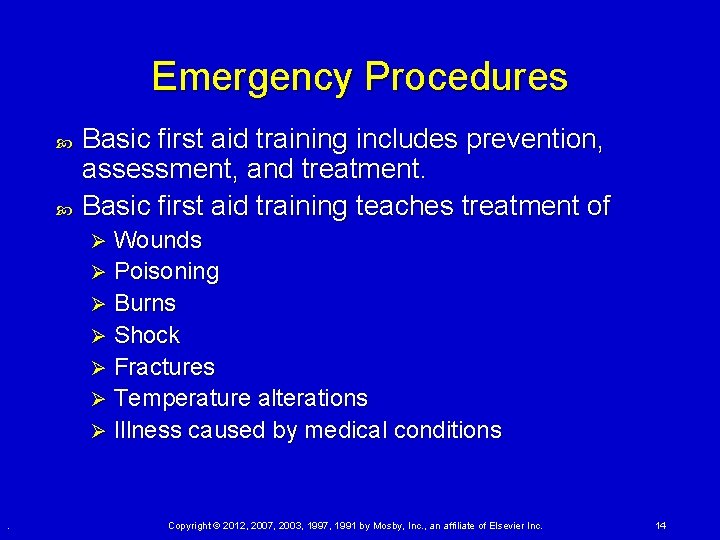
Emergency Procedures Basic first aid training includes prevention, assessment, and treatment. Basic first aid training teaches treatment of Wounds Ø Poisoning Ø Burns Ø Shock Ø Fractures Ø Temperature alterations Ø Illness caused by medical conditions Ø . Copyright © 2012, 2007, 2003, 1997, 1991 by Mosby, Inc. , an affiliate of Elsevier Inc. 14
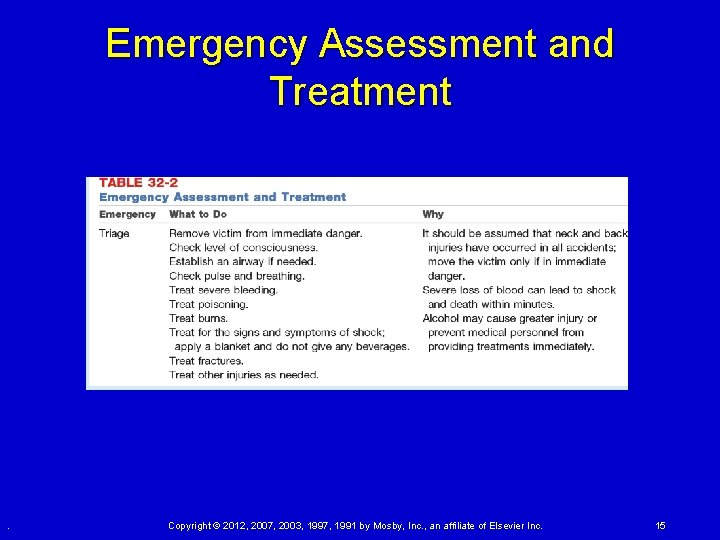
Emergency Assessment and Treatment . Copyright © 2012, 2007, 2003, 1997, 1991 by Mosby, Inc. , an affiliate of Elsevier Inc. 15
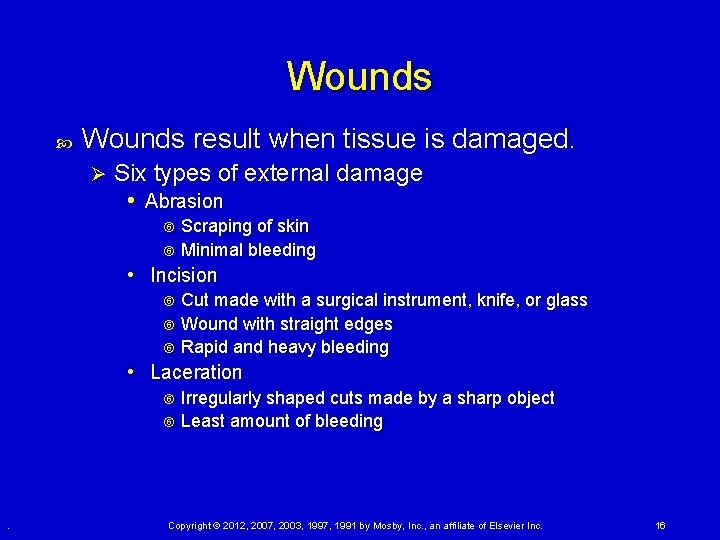
Wounds result when tissue is damaged. Ø Six types of external damage • Abrasion Scraping of skin Minimal bleeding • Incision Cut made with a surgical instrument, knife, or glass Wound with straight edges Rapid and heavy bleeding • Laceration Irregularly shaped cuts made by a sharp object Least amount of bleeding . Copyright © 2012, 2007, 2003, 1997, 1991 by Mosby, Inc. , an affiliate of Elsevier Inc. 16
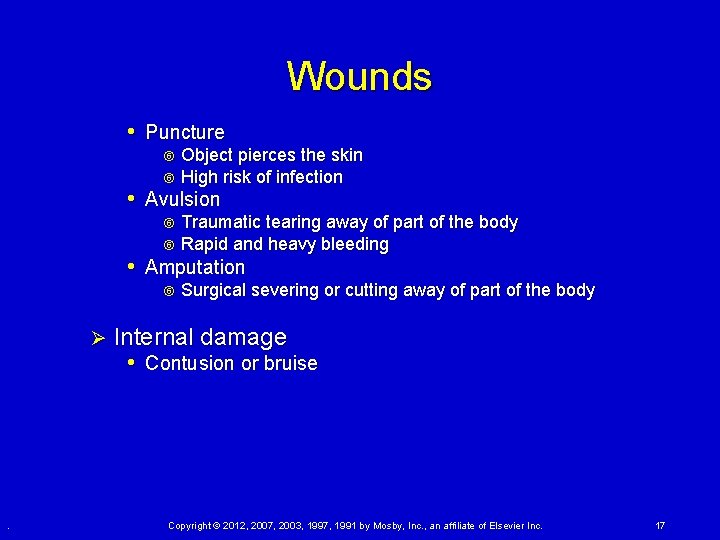
Wounds • Puncture Object pierces the skin High risk of infection • Avulsion Traumatic tearing away of part of the body Rapid and heavy bleeding • Amputation Ø . Surgical severing or cutting away of part of the body Internal damage • Contusion or bruise Copyright © 2012, 2007, 2003, 1997, 1991 by Mosby, Inc. , an affiliate of Elsevier Inc. 17
Bleeding Arterial bleeding Bright red blood Ø Pulses as the heart beats Ø Most serious Ø Venous bleeding Darker color Ø Does not pulse Ø Capillary bleeding Ø . Oozes at the surface of the skin Copyright © 2012, 2007, 2003, 1997, 1991 by Mosby, Inc. , an affiliate of Elsevier Inc. 18
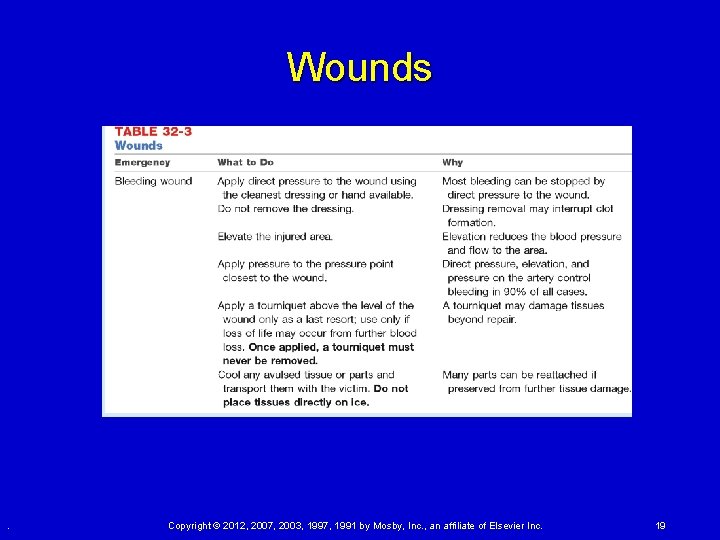
Wounds . Copyright © 2012, 2007, 2003, 1997, 1991 by Mosby, Inc. , an affiliate of Elsevier Inc. 19
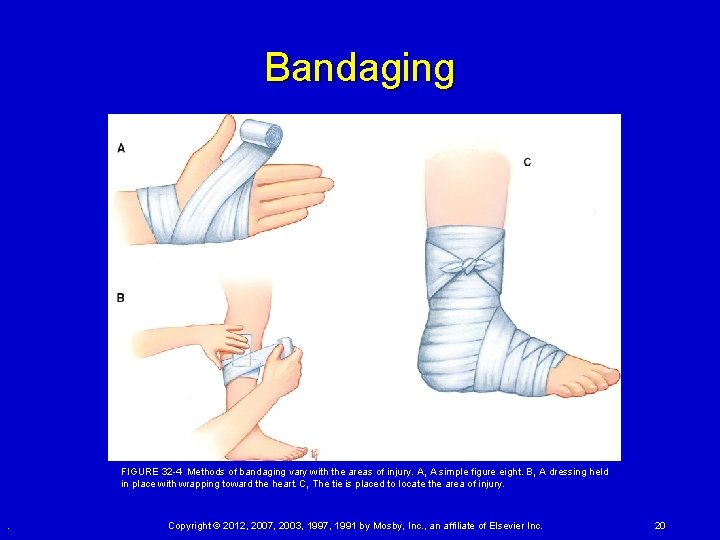
Bandaging FIGURE 32 -4 Methods of bandaging vary with the areas of injury. A, A simple figure eight. B, A dressing held in place with wrapping toward the heart. C, The tie is placed to locate the area of injury. . Copyright © 2012, 2007, 2003, 1997, 1991 by Mosby, Inc. , an affiliate of Elsevier Inc. 20
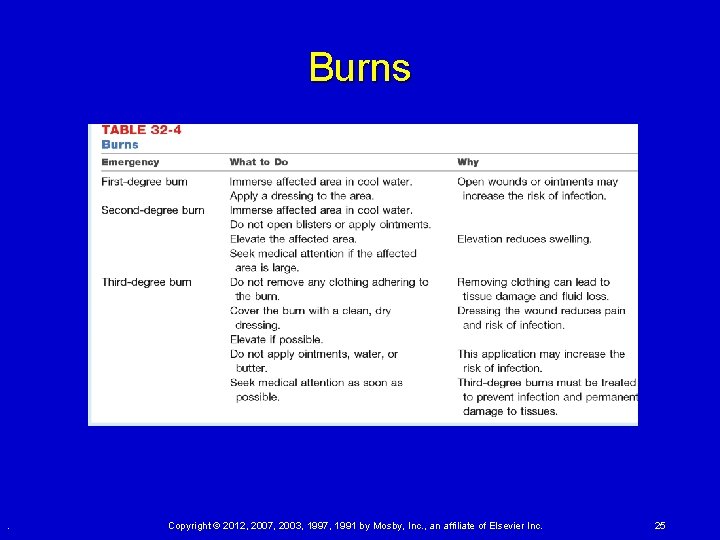
Burns . Burns may result from exposure to heat, chemicals, or radiation. Severity is determined by location, depth, and size. Burns to the face, arms, legs, and genitals are the most critical. Copyright © 2012, 2007, 2003, 1997, 1991 by Mosby, Inc. , an affiliate of Elsevier Inc. 21
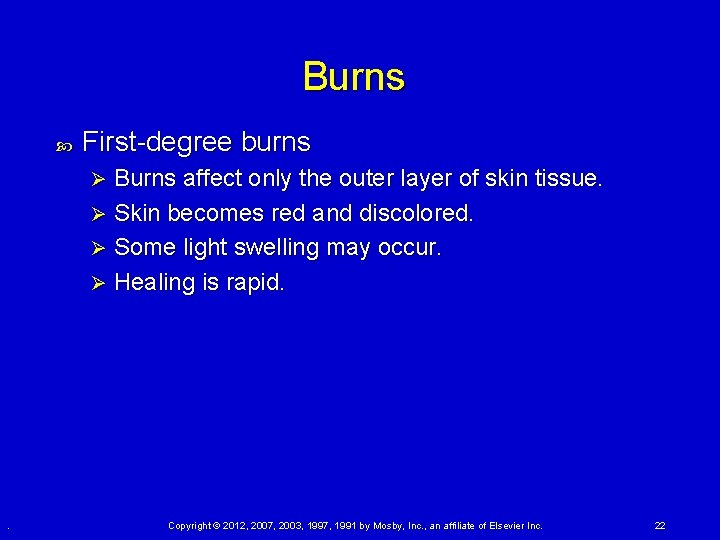
Burns First-degree burns Burns affect only the outer layer of skin tissue. Ø Skin becomes red and discolored. Ø Some light swelling may occur. Ø Healing is rapid. Ø . Copyright © 2012, 2007, 2003, 1997, 1991 by Mosby, Inc. , an affiliate of Elsevier Inc. 22
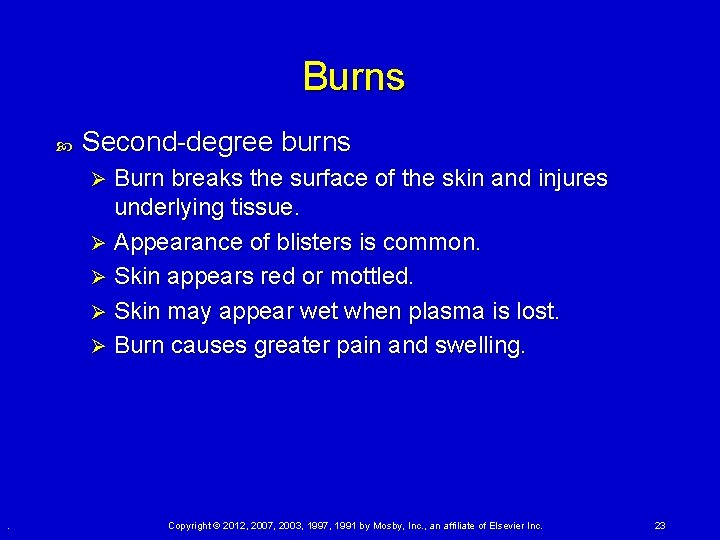
Burns Second-degree burns Burn breaks the surface of the skin and injures underlying tissue. Ø Appearance of blisters is common. Ø Skin appears red or mottled. Ø Skin may appear wet when plasma is lost. Ø Burn causes greater pain and swelling. Ø . Copyright © 2012, 2007, 2003, 1997, 1991 by Mosby, Inc. , an affiliate of Elsevier Inc. 23
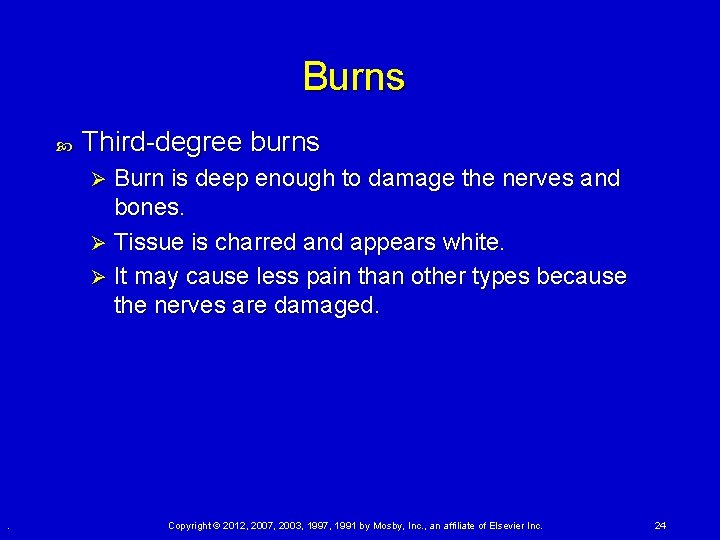
Burns Third-degree burns Burn is deep enough to damage the nerves and bones. Ø Tissue is charred and appears white. Ø It may cause less pain than other types because the nerves are damaged. Ø . Copyright © 2012, 2007, 2003, 1997, 1991 by Mosby, Inc. , an affiliate of Elsevier Inc. 24
Burns . Copyright © 2012, 2007, 2003, 1997, 1991 by Mosby, Inc. , an affiliate of Elsevier Inc. 25
Summary . The role of emergency personnel is to provide immediate care resulting from illness or injury. Three levels of care have been developed to provide immediate care: bystander or first responder, EMT, and advanced emergency personnel. Copyright © 2012, 2007, 2003, 1997, 1991 by Mosby, Inc. , an affiliate of Elsevier Inc. 26
Summary . External wounds include abrasions, punctures, and incisions. Burns may be classified as first, second, or third degree. Copyright © 2012, 2007, 2003, 1997, 1991 by Mosby, Inc. , an affiliate of Elsevier Inc. 27
Review The goal of modern emergency care includes: a. Giving immediate aid at the scene b. Transporting the victim to a hospital c. Administering CPR d. Treating shock e. All of the above . Copyright © 2012, 2007, 2003, 1997, 1991 by Mosby, Inc. , an affiliate of Elsevier Inc. 28
Review The goal of modern emergency care includes: a. Giving immediate aid at the scene b. Transporting the victim to a hospital c. Administering CPR d. Treating shock e. All of the above . Copyright © 2012, 2007, 2003, 1997, 1991 by Mosby, Inc. , an affiliate of Elsevier Inc. 29
Review Abrasions result from: a. An object piercing the skin b. The scraping of skin or mucous membrane from the surface c. The tearing away of part of the body d. A cut from a knife e. A cut from a sharp object . Copyright © 2012, 2007, 2003, 1997, 1991 by Mosby, Inc. , an affiliate of Elsevier Inc. 30
Review Abrasions result from: a. An object piercing the skin b. The scraping of skin or mucous membrane from the surface c. The tearing away of part of the body d. A cut from a knife e. A cut from a sharp object . Copyright © 2012, 2007, 2003, 1997, 1991 by Mosby, Inc. , an affiliate of Elsevier Inc. 31