ECOTOURISM Ecotourism is one of the fastest and


- Slides: 59
ECOTOURISM
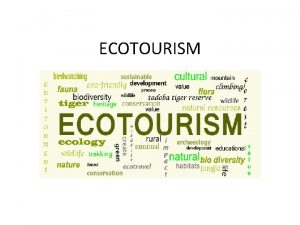
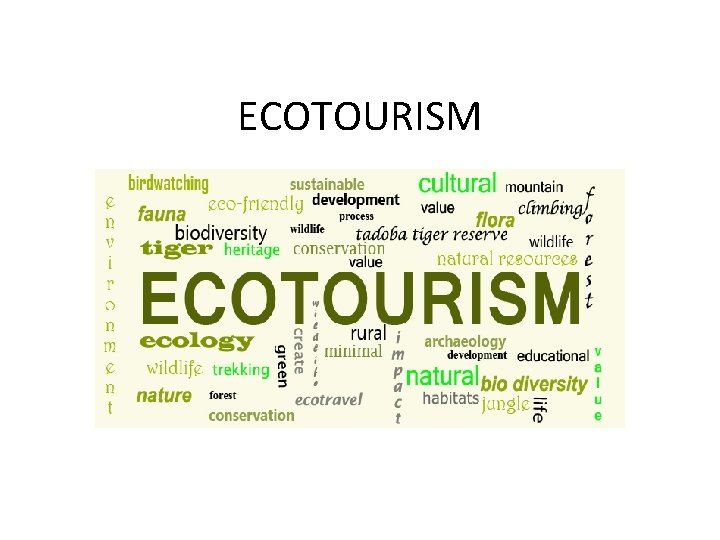
Ecotourism is one of the fastest and largest growing global tourism market. The World Tourism Organisation ( WTO) showed that tourism in the niche markets was growing faster than traditional mass tourism. Ecotourism can be defined as responsible travel to natural areas that conserves the environment and improves the well-being of local people. There are many other terms for ecotourism used today such as responsible travel, green tourism and humane tourism.
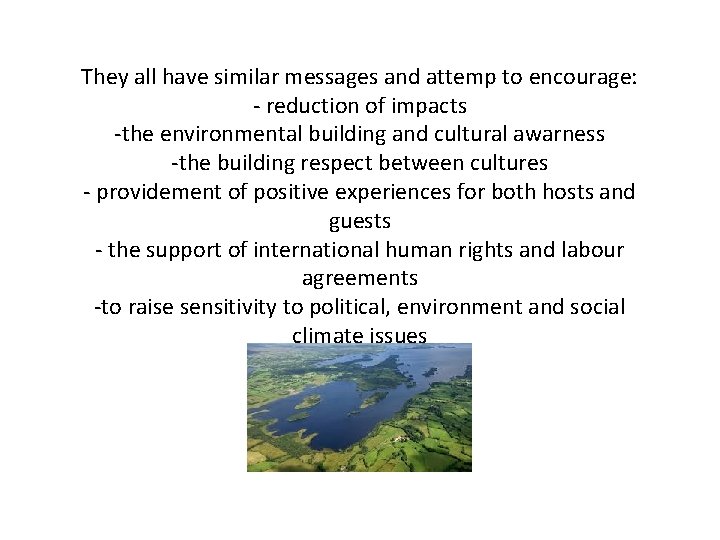
They all have similar messages and attemp to encourage: - reduction of impacts -the environmental building and cultural awarness -the building respect between cultures - providement of positive experiences for both hosts and guests - the support of international human rights and labour agreements -to raise sensitivity to political, environment and social climate issues
AIMS AND OBJECTIVES OF ECOTOURISM Hector Ceballos-Lascurain is credited with coining the term “ecotourism” in 1983 when was describing a new form of nature travel. Since that time many definitions have been offered to describe ecotourism such as responsible tourism, green tourism acc. Essentially they all mean the same that is – travel to an area that does not cause damage but helps to conserve the environment and at the same time can help to improve the well-being of indigenous people.
It should help to educate the visitor and maintain the delicate ecosystems that exist. It should be remembered that ecotourism is not necessarily about being small-scale. In fact there are many large ecotourism resorts where they use good practice particulary in the energy and waste technologies. Ecotourism aims to sustain the natural environment whilst allowing tourists to enjoy and partake in activities. Tourists are encouraged to understand the impact that they may have on both the landscape and on local community
Respect is the key term here; tourists must consider their actions and endeavour to create as little negative impact as possible. This includes impacts on both the culture and the ecology of an area. Many organisations that aim to adhere to ecotourism principles understand that this is a way of life where values and attitudes are incorporated into a clear vision for future sustainability
ROLES OF ORGANISATIONS INVOLVED IN RAISING AWARENESS OF ECOTOURISM Different organisations are involved in ecotourism: The ecotourism aims and objectives will differ according to the nature of the organisation involved such as whether they are public, private and voluntary.
PUBLIC SECTOR These are governments funded and supported projects. In the Fermanagh District of Northern Ireland , they have put together a tourism strategy with their key partners- The District Council, and the Nothern Ireland Tourist Board.
The strategy is based on a ten year plan for tourism development. The main aims of the project include: -_Creation of new markets ready products by enterprises in less visited rural area - creation of the first ecotourism certfication programme in Ireland -development of a range of ecotourism packages to appeal to regional, national and international tourists -delivery of real economic benefits at ground level for product providers and communities
VOLUNTARY SECTOR Organisations that are not-for-profit often have strong conservation and preservation themes at heart. Earthwatch is a global environmental organisation. It was founded in Boston, Massachesetts, USA in 1971.
It was born out of the need to discover new funding mechanism for scientific research after government support diminished. Its mission is to engage people worldwide in scientific research and educate and promote the understanding for action in sustainability. The voluntary sector also includes pressure groups such as Friends on the Earth, Tourism Concern and Greenpeace.
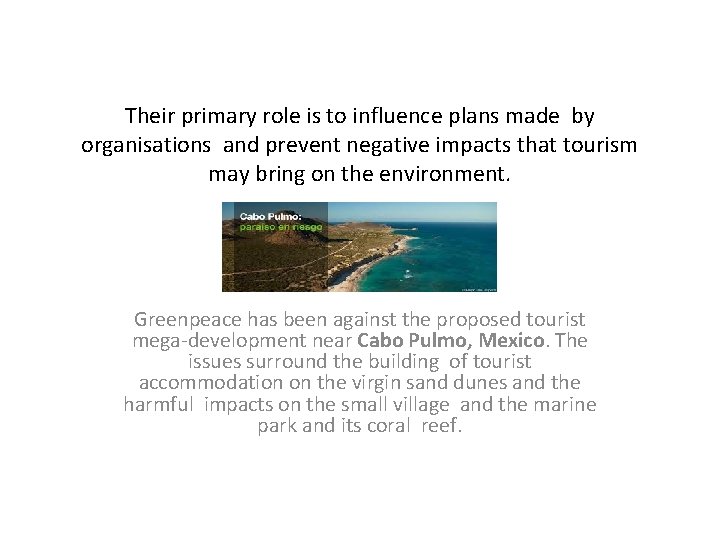
Their primary role is to influence plans made by organisations and prevent negative impacts that tourism may bring on the environment. Greenpeace has been against the proposed tourist mega-development near Cabo Pulmo, Mexico. The issues surround the building of tourist accommodation on the virgin sand dunes and the harmful impacts on the small village and the marine park and its coral reef.
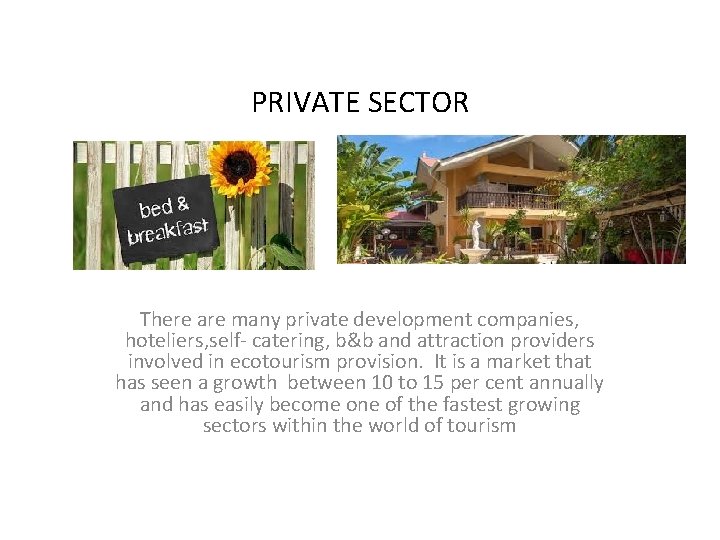
PRIVATE SECTOR There are many private development companies, hoteliers, self- catering, b&b and attraction providers involved in ecotourism provision. It is a market that has seen a growth between 10 to 15 per cent annually and has easily become one of the fastest growing sectors within the world of tourism
However , some tourism organisation and operators “cash in” on marketing advantages and may actually be doing very little in relation to the ideals and principles of ecotourism. It often falls to governments to take up the management and protection of ecotourism sites. They are not always successful as with any publically funded concern, budgets are scrutinised and often such projects will be given less significance than say, health care or education. The management of ecotourism sites therefore often become the concern of private enterprises. Private companies obviously wish to make a profit. It might be a balance in term of both economic and enviromental outcomes.
Good practice and recognition is encouraged each year by the World Travel and Tourism Council who give awards for best practice in sustainable tourism. In 2010 the Global Tourism Business Awards went to the Accor group. Accor is based in France and is one of the word’s leadind hospitality groups, and the leader in Europe , as well as the global leader in services to corporate clients and public institutions.
It operates in nearly 100 countries with 150 000 employees. The reason why Accor won this category is based on their philosophy of hospitality and respect for different cultures, incorporating environmental best practices in all its operations. At the same time they incorporate eco practices including the reduction of water and energy consumption, and the improvement of waste sorting and recycling, as well as the preservation of biodiversity.
Ecotourism has many doubters and is open to criticism from some quarters. Many of the ecotourism travel destinations are based in environmentally sensitive areas and it could be said that ecotourism operations actually fail to live up to the conservation ideals that need to be served in order to support an area. This could have detrimental consequences for the region. Obviously tourists will increase the total population number of visitors to an area, albeit over a temporary period of time. The carrying capacity of an area is often subject to great demands and stresses. Overcrowding exacerbates these stresses.
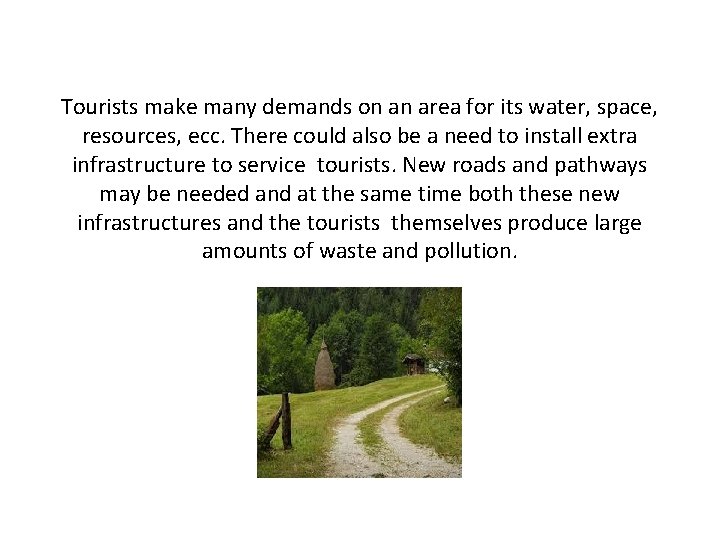
Tourists make many demands on an area for its water, space, resources, ecc. There could also be a need to install extra infrastructure to service tourists. New roads and pathways may be needed and at the same time both these new infrastructures and the tourists themselves produce large amounts of waste and pollution.
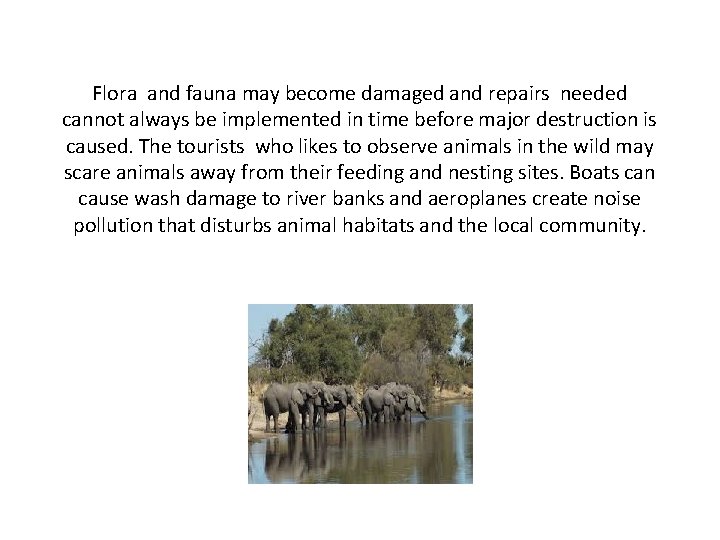
Flora and fauna may become damaged and repairs needed cannot always be implemented in time before major destruction is caused. The tourists who likes to observe animals in the wild may scare animals away from their feeding and nesting sites. Boats can cause wash damage to river banks and aeroplanes create noise pollution that disturbs animal habitats and the local community.
GUIDE FOR ECOTOURISM Some tour operators who compile “ responsibleecotourism holidays” provide information on how their holidays can help the local communiuty, conservation method and support a network of tourism providers in a destination. Today there are many ecotourism holidays available for customers to choose from.
CONTRIBUTION OF ECOTOURISM TO CULTURES AND BELIEFS Ecotourism focuses attention on and contributes to a variety of cultures and beliefs. It is important to note that the contribution of ecotourism on these cultures and beliefs may not always be positive and indeed may cause many negative impacts.
LANGUAGE Language particulary in its written form can be thought of as a symbol system, engaged in representing the world. The power of language has the potential to influence and shape thought and action.
There are many estimations of the number of languages in the world today. It is difficult to give an exact figure as it is not always easy to define what a language is, indeed, the difference between a language and a dialect is not always clear or easily described. Sometimes , the distinctions are based purely on geographical, political or religious reasons. It is estimated that the number of languages in the world varies between 2800 and 8000. The most widely spoken languages are Mandarin, English, Spanish, Bengali and Hindi. Ecotourism providers do not have to be able to speak all of the most popular languages, and tourists who visit ecotourism sites will not expect hosts to be multi-lingual.
Many ecotourism providers will make an effort to be able to communicate with a variety of visitors and English is one language that is used in the travel and tourism industries particulary in airline and flight communucation. To be able to retain a language or dialect within a destination is vital in sustaining the traditions and lifestyles of that area. With the influx of tourists, the language and custums can become altered over time and these changes may cause some languages to be lost forever. Language is an important expression of our humour, love and lives. It is a proof of one’s existence
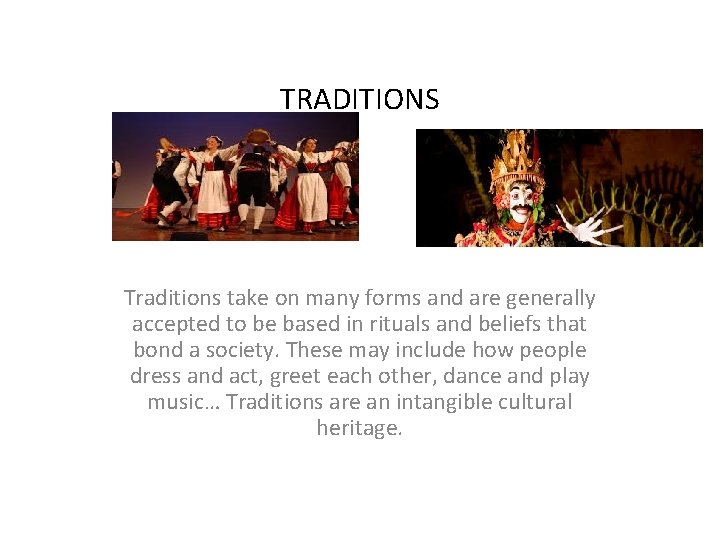
TRADITIONS Traditions take on many forms and are generally accepted to be based in rituals and beliefs that bond a society. These may include how people dress and act, greet each other, dance and play music… Traditions are an intangible cultural heritage.
UNESCO ensures that it is not only monuments and collections of objects that have protection but also includes traditions or living works that have been inherited such as music, performing arts, social practices ecc. Intangible cutural heritage is seen to be an important factor in maintaining cultural diversity. It leads to the continuance of traditional skills that can be retained for future generations and could also bring some economic benefits. The importance of providing a link from our past is seen as vital and gives a real sense of identity to both young and old. It is not only local people who benefit from such protection; it is also the eco turists as they prefer to visit destinations where the importance of retaining cultural heritage traditions exists.
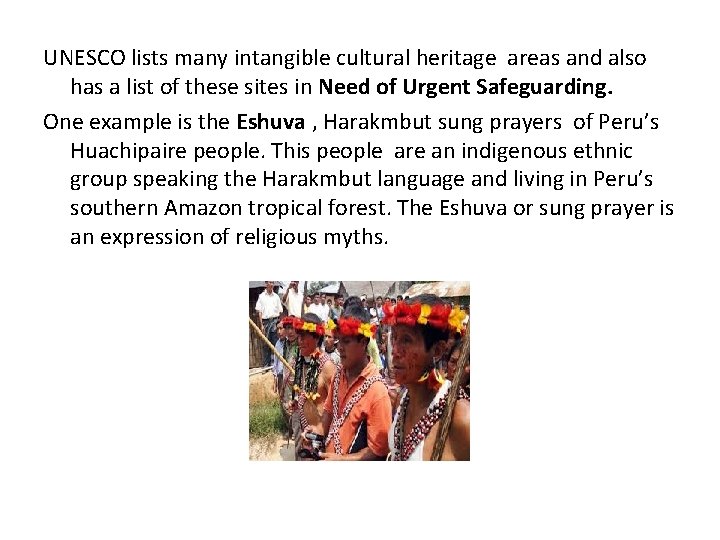
UNESCO lists many intangible cultural heritage areas and also has a list of these sites in Need of Urgent Safeguarding. One example is the Eshuva , Harakmbut sung prayers of Peru’s Huachipaire people. This people are an indigenous ethnic group speaking the Harakmbut language and living in Peru’s southern Amazon tropical forest. The Eshuva or sung prayer is an expression of religious myths.
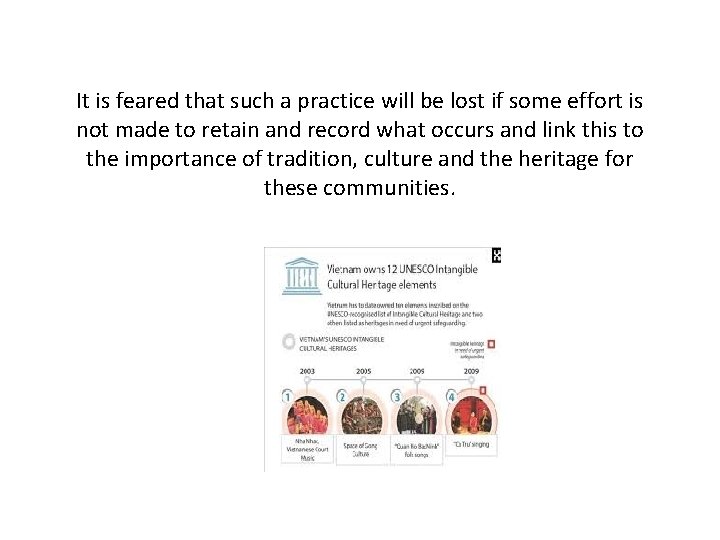
It is feared that such a practice will be lost if some effort is not made to retain and record what occurs and link this to the importance of tradition, culture and the heritage for these communities.
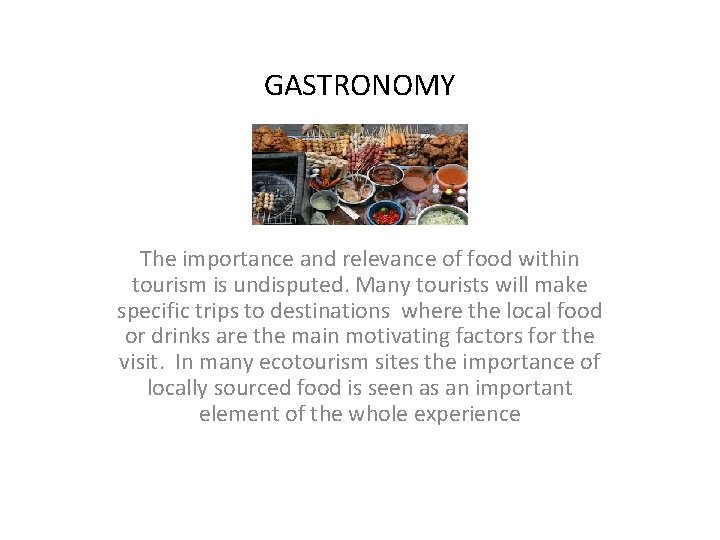
GASTRONOMY The importance and relevance of food within tourism is undisputed. Many tourists will make specific trips to destinations where the local food or drinks are the main motivating factors for the visit. In many ecotourism sites the importance of locally sourced food is seen as an important element of the whole experience
Food and its preparation are often integral to custom and tradition and is seen as an important message for visitors to learn and understand the significance of the produce and the meaning attached to certain products and methods of delivery. Eco tourists know that local food is sustainable food By patronising locally owened restaurants and hotels that work with farmers in the community, eco-travellers support local agriculture and reduce the environmental cost of shipping food over long distances. .
ICTA The International Culinary Tourism Association (ICTA) was founded in 2003 and is a not-for-profit organisation considered the world’s leading authority on culinary travel. They provide community, education and consultancy to the food service and tourism industries all around the world
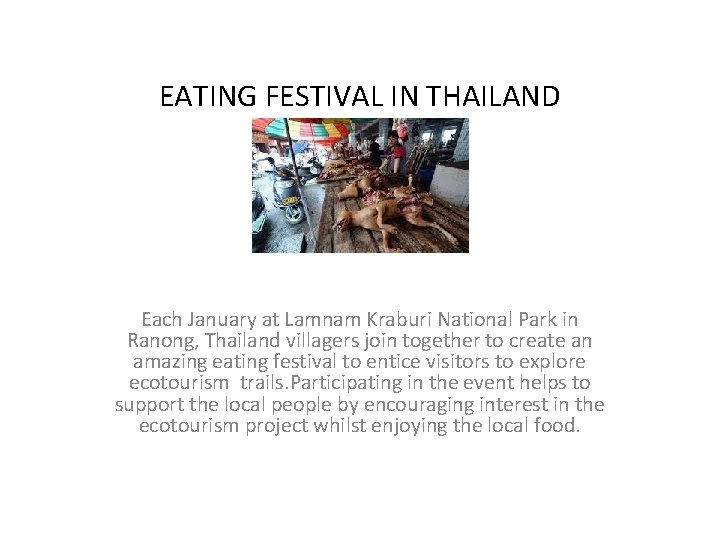
EATING FESTIVAL IN THAILAND Each January at Lamnam Kraburi National Park in Ranong, Thailand villagers join together to create an amazing eating festival to entice visitors to explore ecotourism trails. Participating in the event helps to support the local people by encouraging interest in the ecotourism project whilst enjoying the local food.
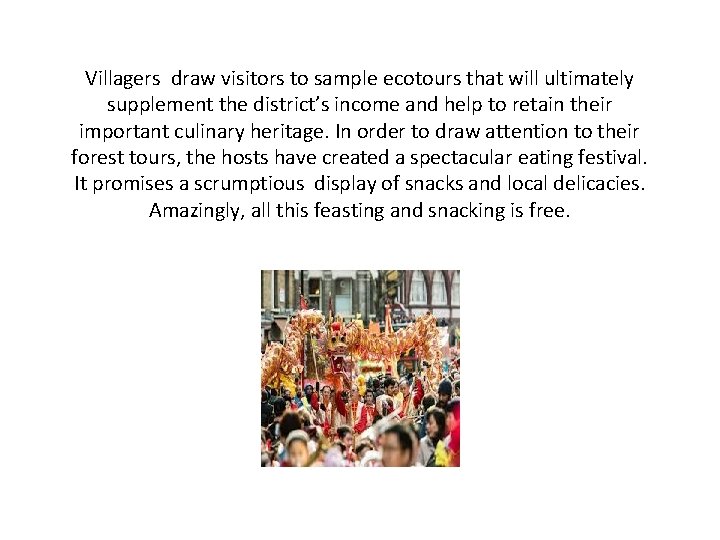
Villagers draw visitors to sample ecotours that will ultimately supplement the district’s income and help to retain their important culinary heritage. In order to draw attention to their forest tours, the hosts have created a spectacular eating festival. It promises a scrumptious display of snacks and local delicacies. Amazingly, all this feasting and snacking is free.
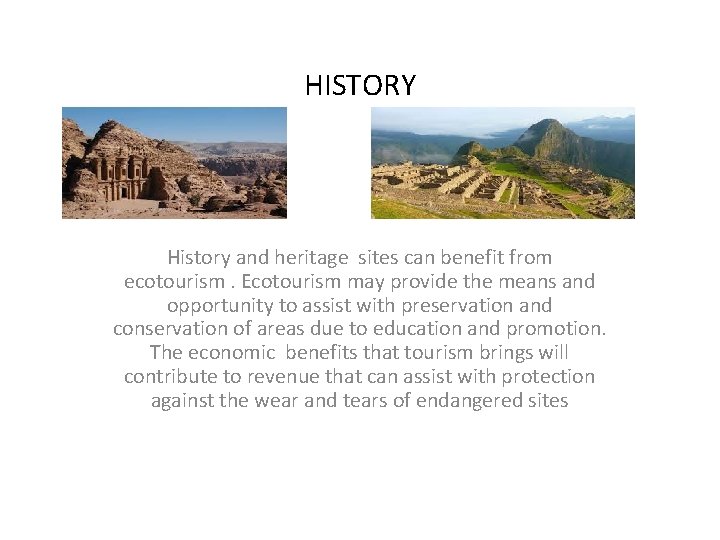
HISTORY History and heritage sites can benefit from ecotourism. Ecotourism may provide the means and opportunity to assist with preservation and conservation of areas due to education and promotion. The economic benefits that tourism brings will contribute to revenue that can assist with protection against the wear and tears of endangered sites
An environmental impact assessment is often needed to assess the long term planning and protection for the area. One of the main organisations which helps to promote and classify sites of historic significance is UNESCO An Historical site can be damaged for: - Neglet -Acts of war or terrorism(war in Iraq or Afghanistan) -excessive running costs ( such as lighting, heating or redecoratio) -accidents (fire, earthquakes, vulcanoes)
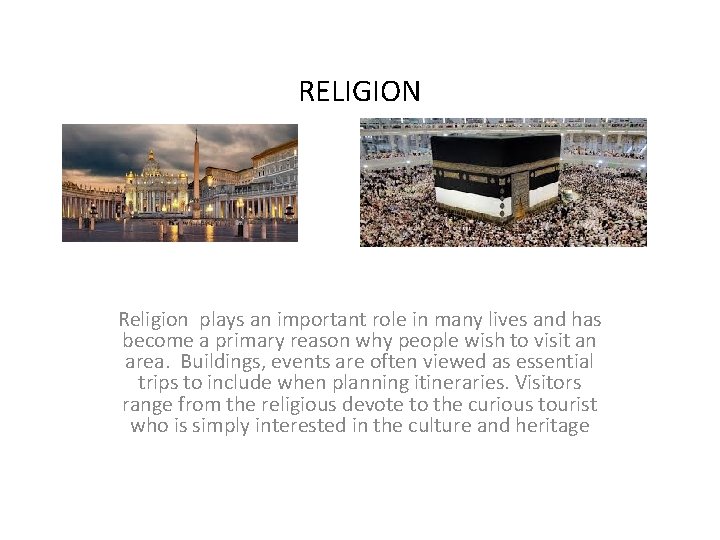
RELIGION Religion plays an important role in many lives and has become a primary reason why people wish to visit an area. Buildings, events are often viewed as essential trips to include when planning itineraries. Visitors range from the religious devote to the curious tourist who is simply interested in the culture and heritage
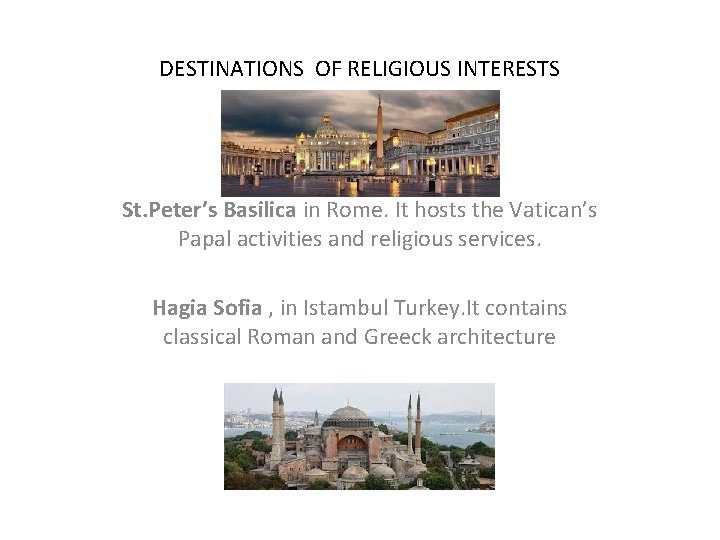
DESTINATIONS OF RELIGIOUS INTERESTS St. Peter’s Basilica in Rome. It hosts the Vatican’s Papal activities and religious services. Hagia Sofia , in Istambul Turkey. It contains classical Roman and Greeck architecture
The Wailing Wall , Jerusalem. It is considered to be the remnant of the old Jewish Temple built by King Solomon. Mecca is Islam’s holiest site in Saudi Arabia. It is the birth place of Muhammad and site of the composition of Quran
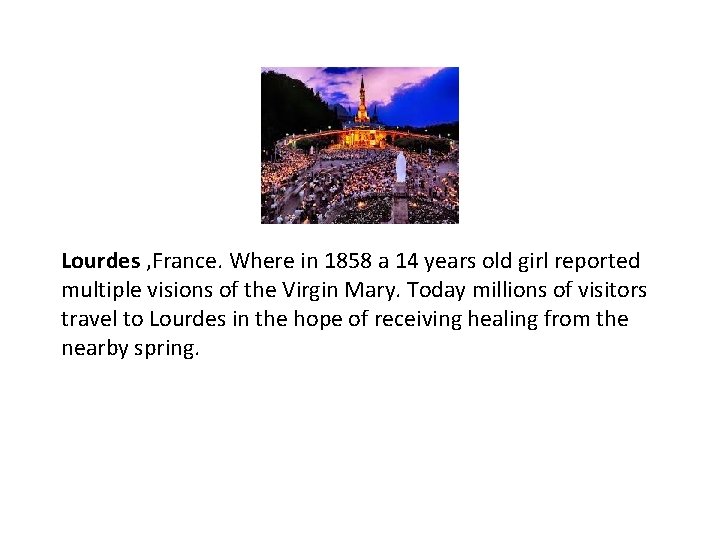
Lourdes , France. Where in 1858 a 14 years old girl reported multiple visions of the Virgin Mary. Today millions of visitors travel to Lourdes in the hope of receiving healing from the nearby spring.
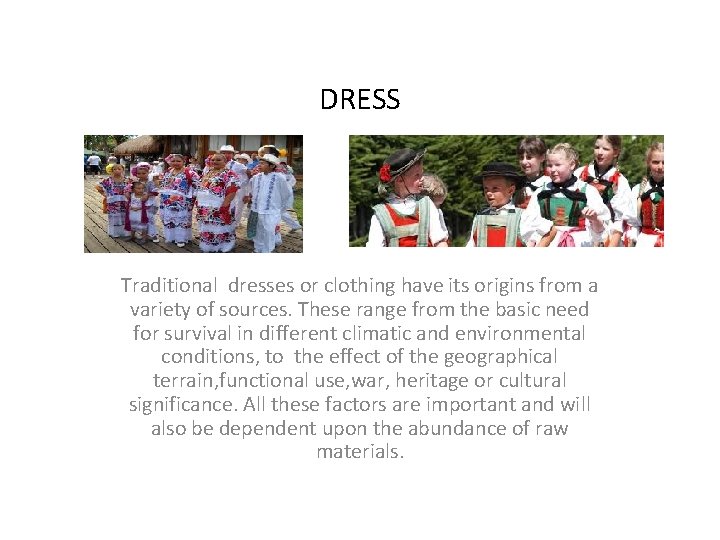
DRESS Traditional dresses or clothing have its origins from a variety of sources. These range from the basic need for survival in different climatic and environmental conditions, to the effect of the geographical terrain, functional use, war, heritage or cultural significance. All these factors are important and will also be dependent upon the abundance of raw materials.
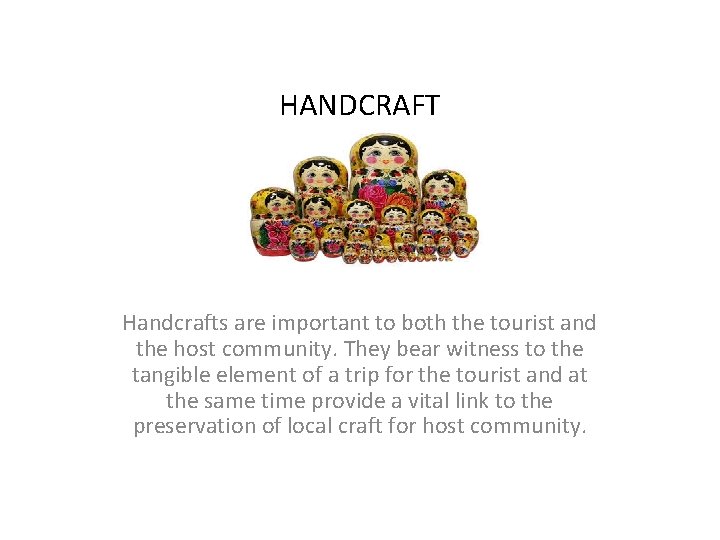
HANDCRAFT Handcrafts are important to both the tourist and the host community. They bear witness to the tangible element of a trip for the tourist and at the same time provide a vital link to the preservation of local craft for host community.
The question of authenticity and its importance remain high for the eco tourist. The preservation craft helps to retain local customs and perpetuates the passing of skills to the next generation. The Matryoshka doll, for example, is the name for the Russian nesting doll. These are a set of wooden dolls of decreasing size that sit one inside the other. They are thought to originate during the 1800 s. The largest figure is usually of a woman dressed in a sarafan( a Russian peasant dress) There is much beautiful artistry in the painting of these dolls and they often follow a theme. There is also a negative side to the sale of traditional handcrafts, this can involve the fabrication of goods. There have been well documented cases including the killing of rhinos for their horns and tigers for their fur.
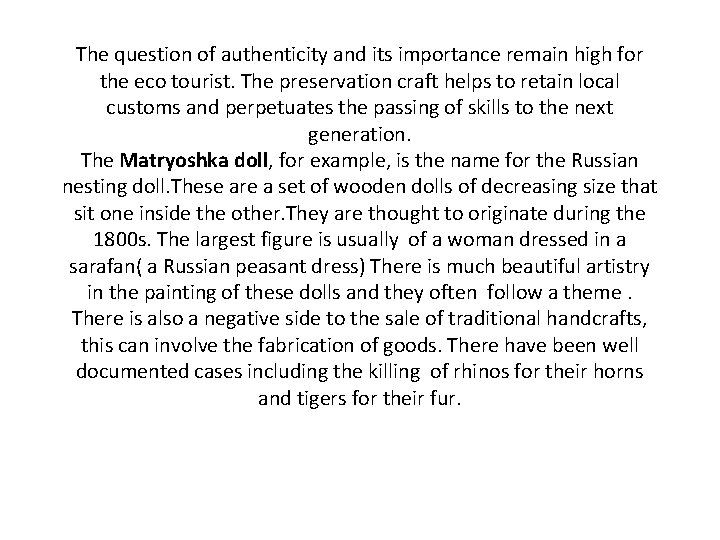
ART AND MUSIC Art and music can help to explain the importance , character and identity of a region. Areas become synonymous with certain sounds and images. ( Blue music in New Orleans, Reggae in Jamaica)Building also become associated with music such as The Opera House in Milan or the Syney Opera House.
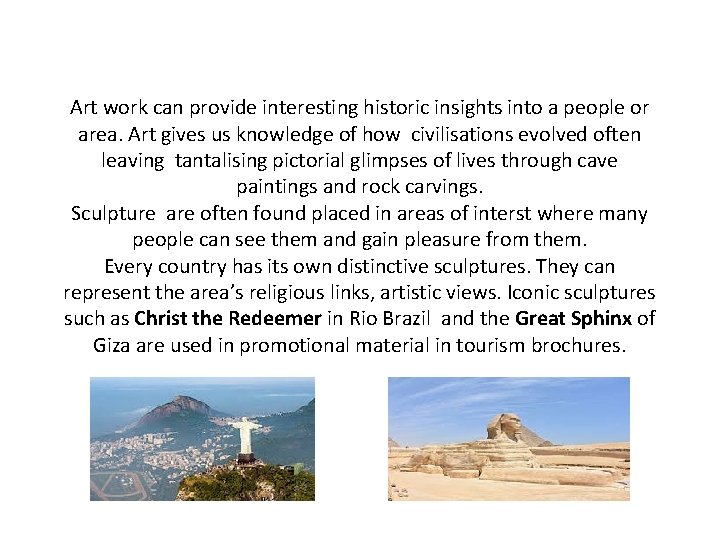
Art work can provide interesting historic insights into a people or area. Art gives us knowledge of how civilisations evolved often leaving tantalising pictorial glimpses of lives through cave paintings and rock carvings. Sculpture are often found placed in areas of interst where many people can see them and gain pleasure from them. Every country has its own distinctive sculptures. They can represent the area’s religious links, artistic views. Iconic sculptures such as Christ the Redeemer in Rio Brazil and the Great Sphinx of Giza are used in promotional material in tourism brochures.
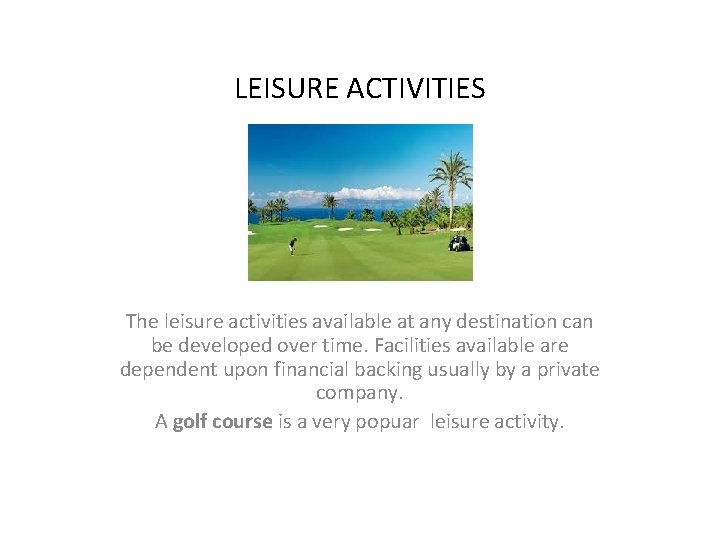
LEISURE ACTIVITIES The leisure activities available at any destination can be developed over time. Facilities available are dependent upon financial backing usually by a private company. A golf course is a very popuar leisure activity.
The land space usage that a golf course requires is enormous and the requirements to make it function can often be exhaustive for an area and extremely costly. Golf courses are fed with staggering amounts of water. They are often developed on important ecosystems, like wetlands and rainforests, and are heavily doused with toxic pesticides which leach into the surrounding area. If there is not enough rainfall, then water has to be supplied in other way. This can cause serious changes in the natural water cycle and harm local flora and fauna. The water used on one golf course could supply a town of 12 000 inhabitants with enough water for a whole year. Golf courses also require large amount of pesticides, herbicides and colouring agents.
In Las Vegas , USA they use recycled water-that is waste water that has been treated to be used safely on golf courses. The Las Vegas Valley Water District (LVVWD) delivers recycled water to golf courses, parks and other facilities, which would otherwise use drinking water for irrigation. . This type of technology and improvements in water treatment is vital for the tourism leisure industry as it contributes to cost cutting and provides atainable resource that was previously thought to be depleted
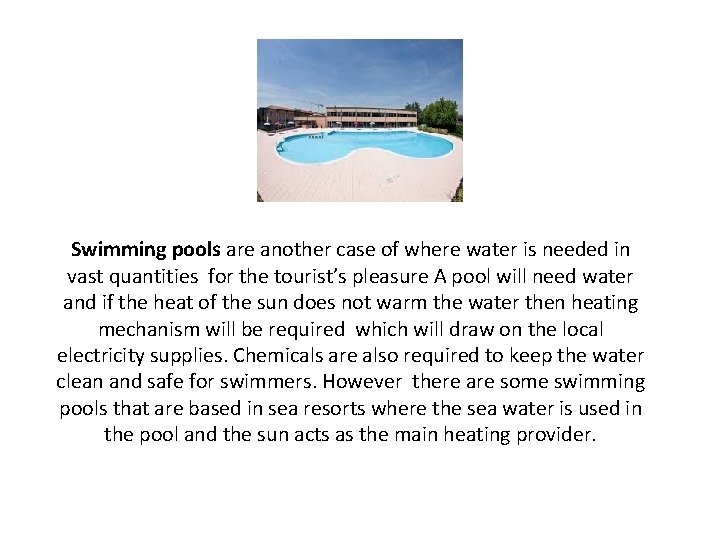
Swimming pools are another case of where water is needed in vast quantities for the tourist’s pleasure A pool will need water and if the heat of the sun does not warm the water then heating mechanism will be required which will draw on the local electricity supplies. Chemicals are also required to keep the water clean and safe for swimmers. However there are some swimming pools that are based in sea resorts where the sea water is used in the pool and the sun acts as the main heating provider.
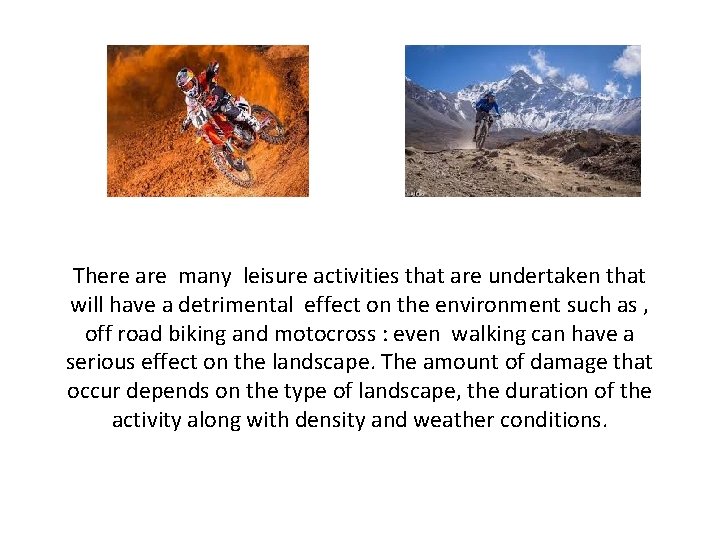
There are many leisure activities that are undertaken that will have a detrimental effect on the environment such as , off road biking and motocross : even walking can have a serious effect on the landscape. The amount of damage that occur depends on the type of landscape, the duration of the activity along with density and weather conditions.
IMPORTANCE OF THE ENVIRONMENT AS TOURISM RESOURCE HISTORICAL SITES Ecotourism can help to provide protection for ancient and historical sites. There are documented cases where wars, act of terrorism and barbarism have caused the distruction of these sites such as those in Afghanistan. Through education these sites can be conserved by including them as UNESCO sites and by continual monitoring. The World Monuments Fund (WMF) is a private international not-for-profit making organisation that is dedicated to the preservation of historic architecture and cultural heritage sites around the world.
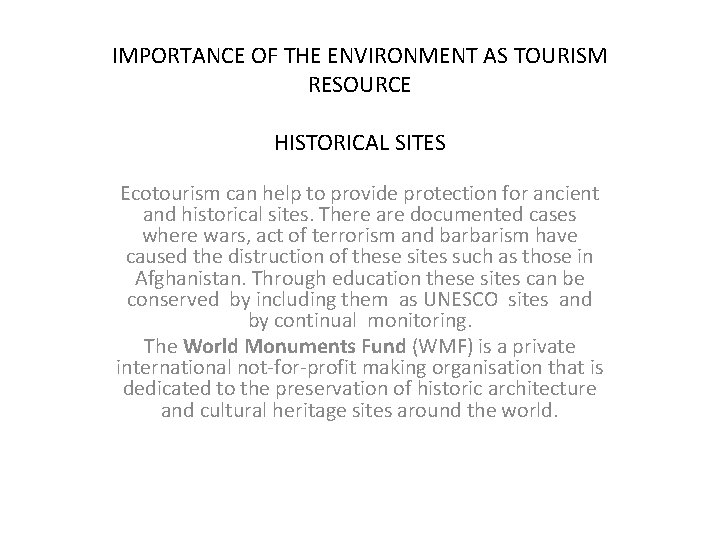
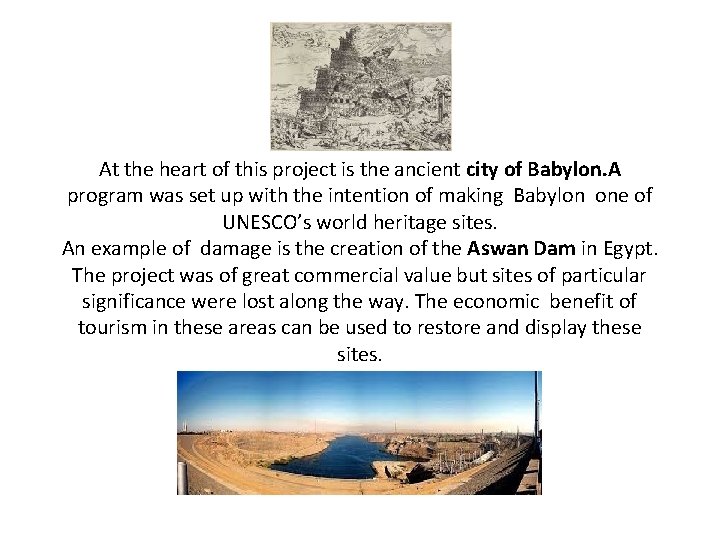
At the heart of this project is the ancient city of Babylon. A program was set up with the intention of making Babylon one of UNESCO’s world heritage sites. An example of damage is the creation of the Aswan Dam in Egypt. The project was of great commercial value but sites of particular significance were lost along the way. The economic benefit of tourism in these areas can be used to restore and display these sites.
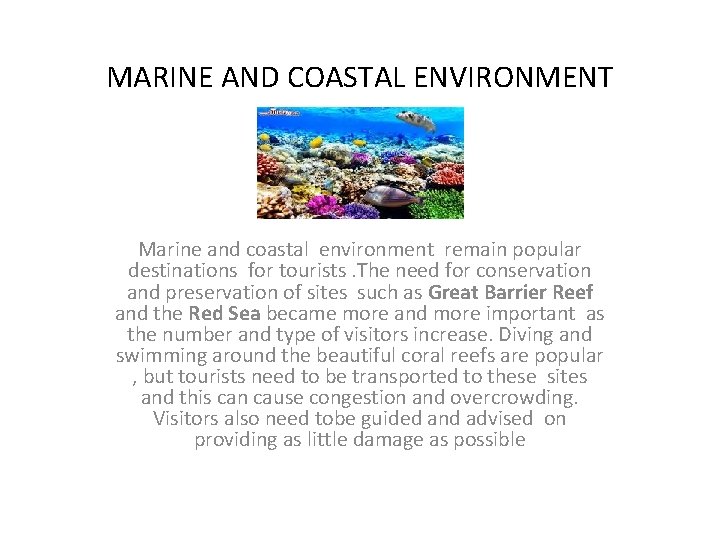
MARINE AND COASTAL ENVIRONMENT Marine and coastal environment remain popular destinations for tourists. The need for conservation and preservation of sites such as Great Barrier Reef and the Red Sea became more and more important as the number and type of visitors increase. Diving and swimming around the beautiful coral reefs are popular , but tourists need to be transported to these sites and this can cause congestion and overcrowding. Visitors also need tobe guided and advised on providing as little damage as possible
Money brought into an area by a tourist is spent in the local services and facilities. Then the economic benefits of bringing tourists to these areas can be beneficial to the local community through the multiplier effect.
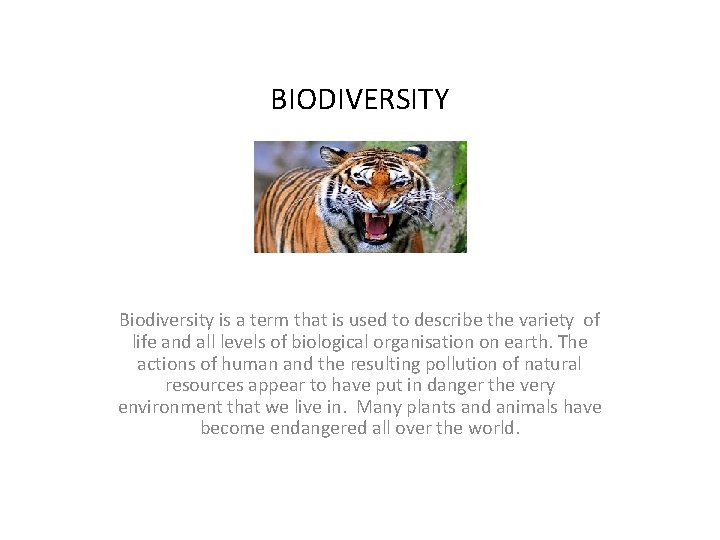
BIODIVERSITY Biodiversity is a term that is used to describe the variety of life and all levels of biological organisation on earth. The actions of human and the resulting pollution of natural resources appear to have put in danger the very environment that we live in. Many plants and animals have become endangered all over the world.
The International Union for the Conservation of Nature has a list of species that they believe to be endangered. It is called Red List and includes more than 16 000 species worldwide thought to be threatened with extinction. One in four mammal species, one in eight bird species and one in three amphibian species are on the list
ENERGY SYSTEMS • The usage of energy has become an important consideration in travel and tourism particularly as the energy usage is seen as a major threat to the sustainability of tourism. Tourists contribute to the energy use by travelling to a destination and then by their activities when they arrive. Remote areas that provide ecotourism facilities for tourists can often do much to reduce energy consumption by providing alternative means of power through natural resources, such as from the sun and wind. They may use composting toilets and low energy light bulbs, showers and heating. Often bicycles are preferred to cars and tourists are encouraged to take less damaging forms of travel.
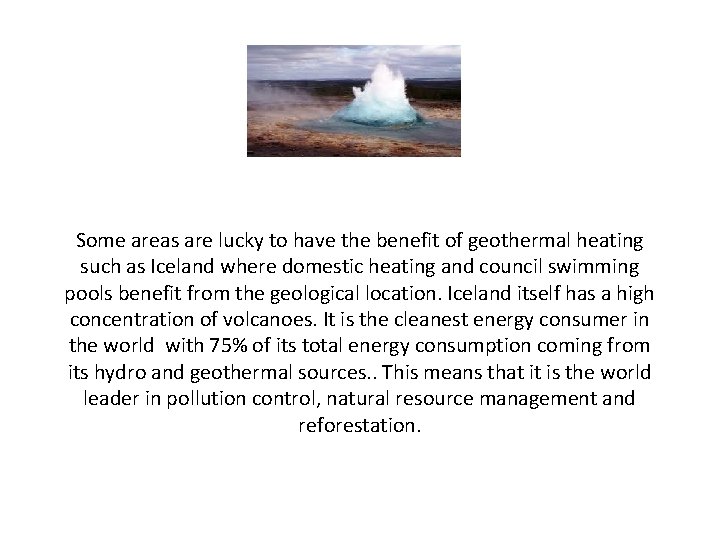
Some areas are lucky to have the benefit of geothermal heating such as Iceland where domestic heating and council swimming pools benefit from the geological location. Iceland itself has a high concentration of volcanoes. It is the cleanest energy consumer in the world with 75% of its total energy consumption coming from its hydro and geothermal sources. . This means that it is the world leader in pollution control, natural resource management and reforestation.
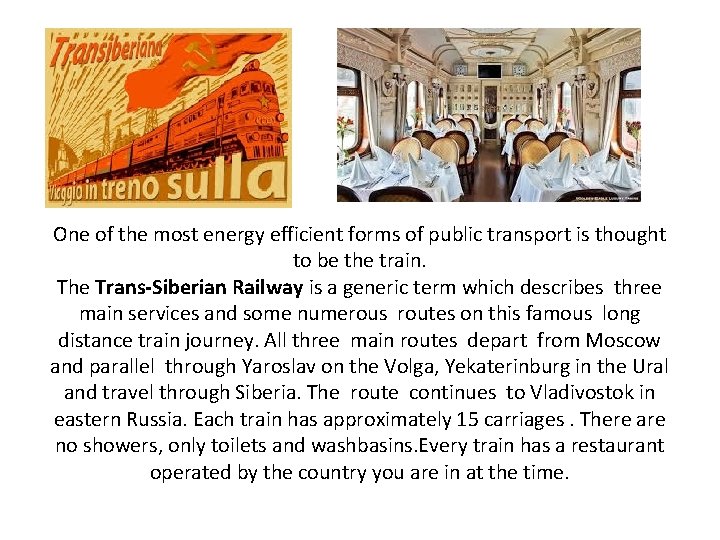
One of the most energy efficient forms of public transport is thought to be the train. The Trans-Siberian Railway is a generic term which describes three main services and some numerous routes on this famous long distance train journey. All three main routes depart from Moscow and parallel through Yaroslav on the Volga, Yekaterinburg in the Ural and travel through Siberia. The route continues to Vladivostok in eastern Russia. Each train has approximately 15 carriages. There are no showers, only toilets and washbasins. Every train has a restaurant operated by the country you are in at the time.
This is a leisurely way to travel, a responsible form of travel and an essential goal for any eco-tourist. Noise pollution ad CO 2 emissions are far less than that of an aircraft and of course you can have the opportunity to enjoy the scenery. Thus ecotourists can travel in the awareness that they are attempting to keep emissions to a minimum. At the same time the journey allows stops at a variety of destinations along the route where support for local restaurants, art and craft is ensured. The route crosses ten time zones. All timetables, station clocks, train clocks and announcements are Moscow time based. The trip on the train is more than just a train ride, it is an adventure where you will mix with people from a wide range of nationalities and cultures.