CS 267 Unified Parallel C UPC Kathy Yelick
- Slides: 64
CS 267 Unified Parallel C (UPC) Kathy Yelick http: //upc. lbl. gov Slides adapted from some by Tarek El-Ghazawi (GWU) 9/18/2020 CS 267 Lecture: UPC 1
UPC Outline 1. 2. 3. 4. 5. 6. 7. 8. 8. 9. Background UPC Execution Model Basic Memory Model: Shared vs. Private Scalars Synchronization Collectives Data and Pointers Dynamic Memory Management Programming Examples Performance Tuning and Early Results Concluding Remarks 9/18/2020 CS 267 Lecture: UPC 2
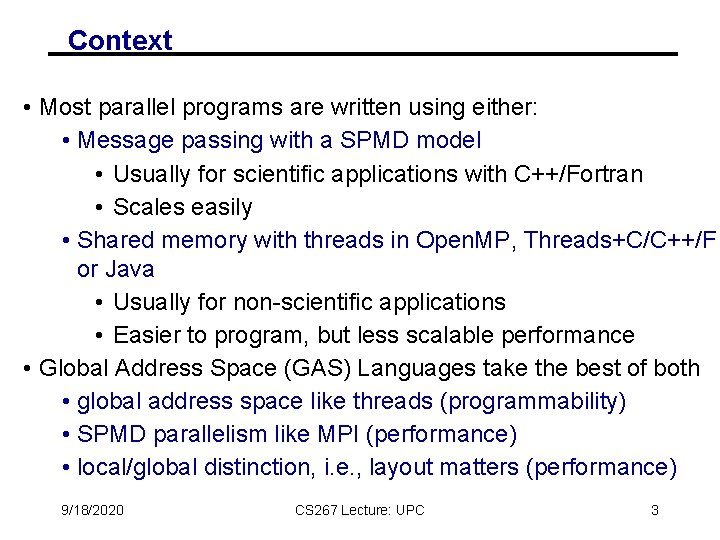
Context • Most parallel programs are written using either: • Message passing with a SPMD model • Usually for scientific applications with C++/Fortran • Scales easily • Shared memory with threads in Open. MP, Threads+C/C++/F or Java • Usually for non-scientific applications • Easier to program, but less scalable performance • Global Address Space (GAS) Languages take the best of both • global address space like threads (programmability) • SPMD parallelism like MPI (performance) • local/global distinction, i. e. , layout matters (performance) 9/18/2020 CS 267 Lecture: UPC 3
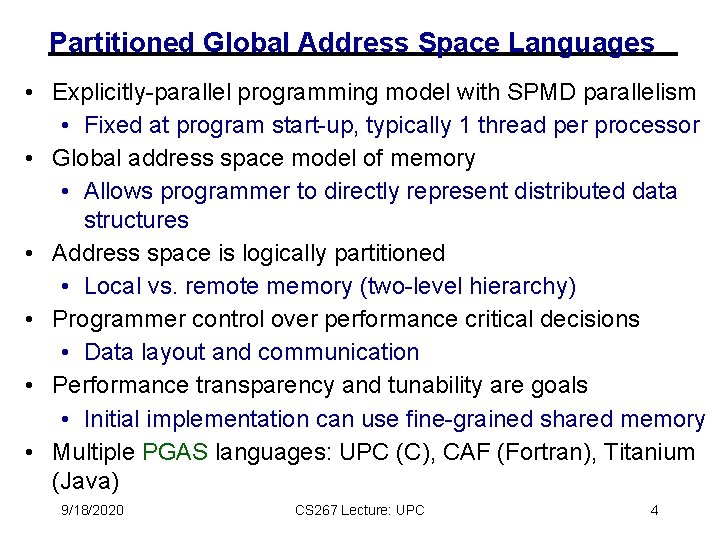
Partitioned Global Address Space Languages • Explicitly-parallel programming model with SPMD parallelism • Fixed at program start-up, typically 1 thread per processor • Global address space model of memory • Allows programmer to directly represent distributed data structures • Address space is logically partitioned • Local vs. remote memory (two-level hierarchy) • Programmer control over performance critical decisions • Data layout and communication • Performance transparency and tunability are goals • Initial implementation can use fine-grained shared memory • Multiple PGAS languages: UPC (C), CAF (Fortran), Titanium (Java) 9/18/2020 CS 267 Lecture: UPC 4
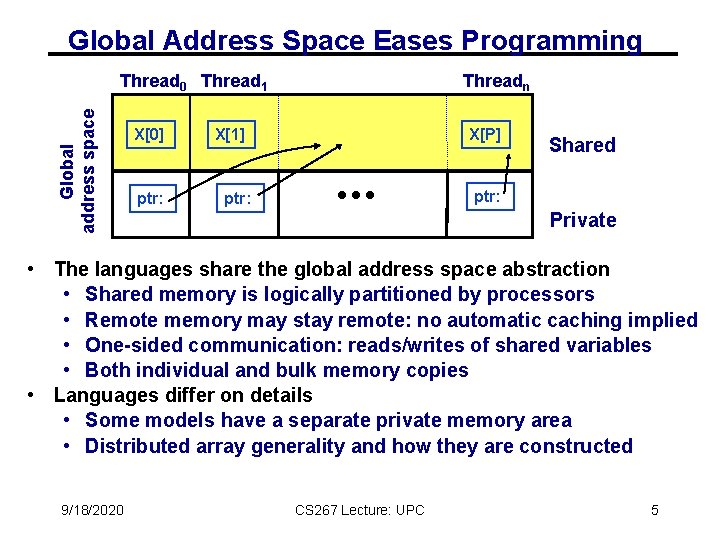
Global Address Space Eases Programming Global address space Thread 0 Thread 1 X[0] ptr: Threadn X[1] X[P] Shared ptr: Private • The languages share the global address space abstraction • Shared memory is logically partitioned by processors • Remote memory may stay remote: no automatic caching implied • One-sided communication: reads/writes of shared variables • Both individual and bulk memory copies • Languages differ on details • Some models have a separate private memory area • Distributed array generality and how they are constructed 9/18/2020 CS 267 Lecture: UPC 5
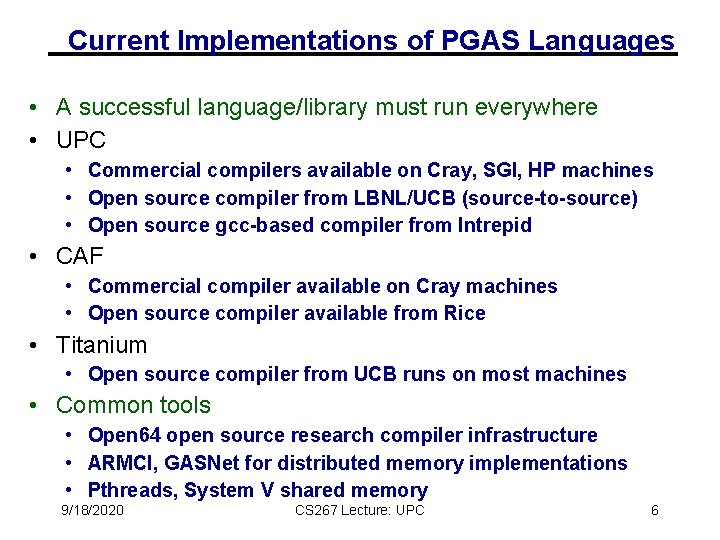
Current Implementations of PGAS Languages • A successful language/library must run everywhere • UPC • Commercial compilers available on Cray, SGI, HP machines • Open source compiler from LBNL/UCB (source-to-source) • Open source gcc-based compiler from Intrepid • CAF • Commercial compiler available on Cray machines • Open source compiler available from Rice • Titanium • Open source compiler from UCB runs on most machines • Common tools • Open 64 open source research compiler infrastructure • ARMCI, GASNet for distributed memory implementations • Pthreads, System V shared memory 9/18/2020 CS 267 Lecture: UPC 6
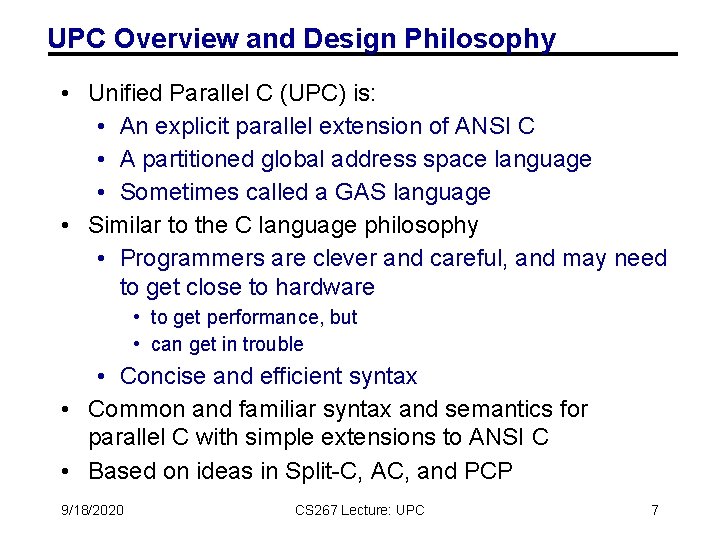
UPC Overview and Design Philosophy • Unified Parallel C (UPC) is: • An explicit parallel extension of ANSI C • A partitioned global address space language • Sometimes called a GAS language • Similar to the C language philosophy • Programmers are clever and careful, and may need to get close to hardware • to get performance, but • can get in trouble • Concise and efficient syntax • Common and familiar syntax and semantics for parallel C with simple extensions to ANSI C • Based on ideas in Split-C, AC, and PCP 9/18/2020 CS 267 Lecture: UPC 7
UPC Execution Model 9/18/2020 CS 267 Lecture: UPC 8
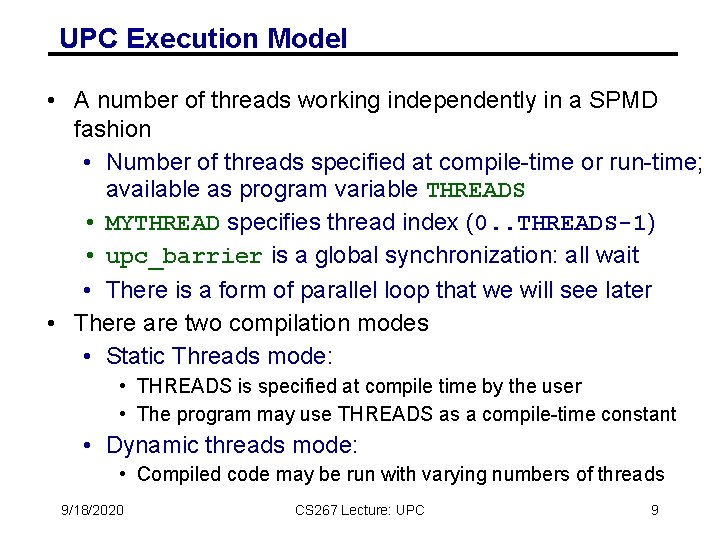
UPC Execution Model • A number of threads working independently in a SPMD fashion • Number of threads specified at compile-time or run-time; available as program variable THREADS • MYTHREAD specifies thread index (0. . THREADS-1) • upc_barrier is a global synchronization: all wait • There is a form of parallel loop that we will see later • There are two compilation modes • Static Threads mode: • THREADS is specified at compile time by the user • The program may use THREADS as a compile-time constant • Dynamic threads mode: • Compiled code may be run with varying numbers of threads 9/18/2020 CS 267 Lecture: UPC 9
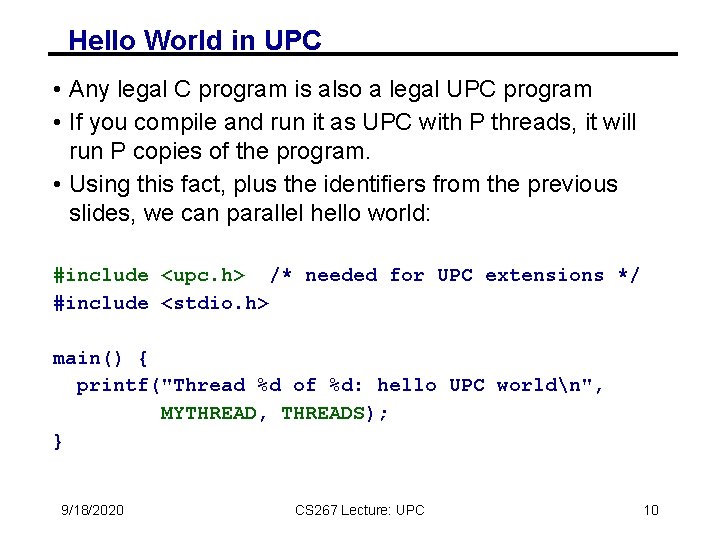
Hello World in UPC • Any legal C program is also a legal UPC program • If you compile and run it as UPC with P threads, it will run P copies of the program. • Using this fact, plus the identifiers from the previous slides, we can parallel hello world: #include <upc. h> /* needed for UPC extensions */ #include <stdio. h> main() { printf("Thread %d of %d: hello UPC worldn", MYTHREAD, THREADS); } 9/18/2020 CS 267 Lecture: UPC 10
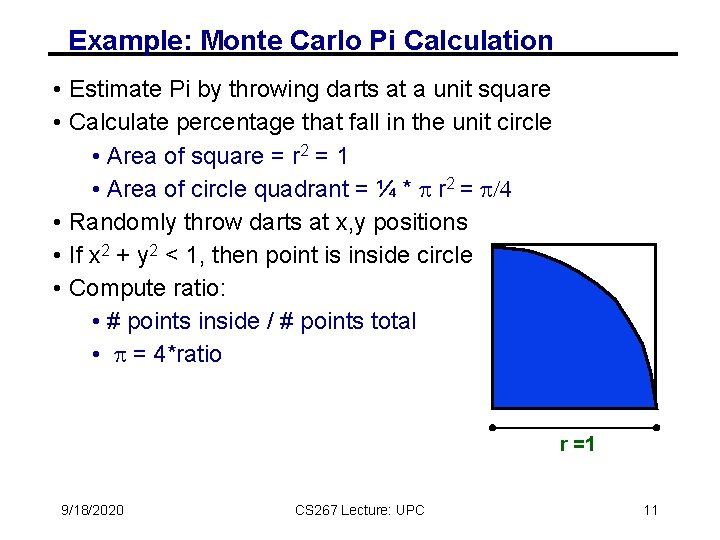
Example: Monte Carlo Pi Calculation • Estimate Pi by throwing darts at a unit square • Calculate percentage that fall in the unit circle • Area of square = r 2 = 1 • Area of circle quadrant = ¼ * p r 2 = p/4 • Randomly throw darts at x, y positions • If x 2 + y 2 < 1, then point is inside circle • Compute ratio: • # points inside / # points total • p = 4*ratio r =1 9/18/2020 CS 267 Lecture: UPC 11
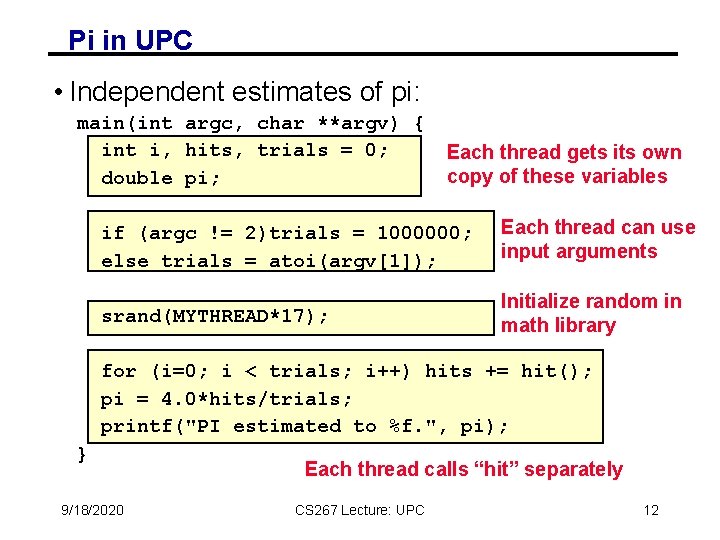
Pi in UPC • Independent estimates of pi: main(int argc, char **argv) { int i, hits, trials = 0; double pi; Each thread gets its own copy of these variables if (argc != 2)trials = 1000000; else trials = atoi(argv[1]); Each thread can use input arguments srand(MYTHREAD*17); Initialize random in math library for (i=0; i < trials; i++) hits += hit(); pi = 4. 0*hits/trials; printf("PI estimated to %f. ", pi); } 9/18/2020 Each thread calls “hit” separately CS 267 Lecture: UPC 12
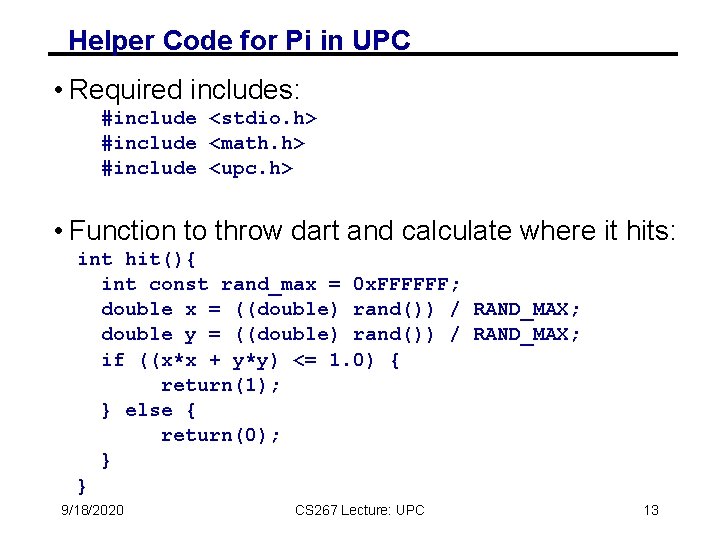
Helper Code for Pi in UPC • Required includes: #include <stdio. h> #include <math. h> #include <upc. h> • Function to throw dart and calculate where it hits: int hit(){ int const rand_max = 0 x. FFFFFF; double x = ((double) rand()) / RAND_MAX; double y = ((double) rand()) / RAND_MAX; if ((x*x + y*y) <= 1. 0) { return(1); } else { return(0); } } 9/18/2020 CS 267 Lecture: UPC 13
Shared vs. Private Variables 9/18/2020 CS 267 Lecture: UPC 14
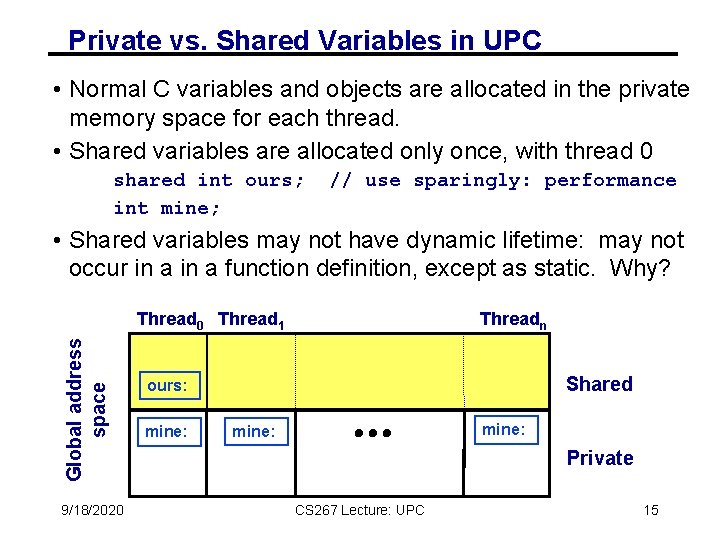
Private vs. Shared Variables in UPC • Normal C variables and objects are allocated in the private memory space for each thread. • Shared variables are allocated only once, with thread 0 shared int ours; int mine; // use sparingly: performance • Shared variables may not have dynamic lifetime: may not occur in a function definition, except as static. Why? Global address space Thread 0 Thread 1 9/18/2020 Threadn Shared ours: mine: Private CS 267 Lecture: UPC 15
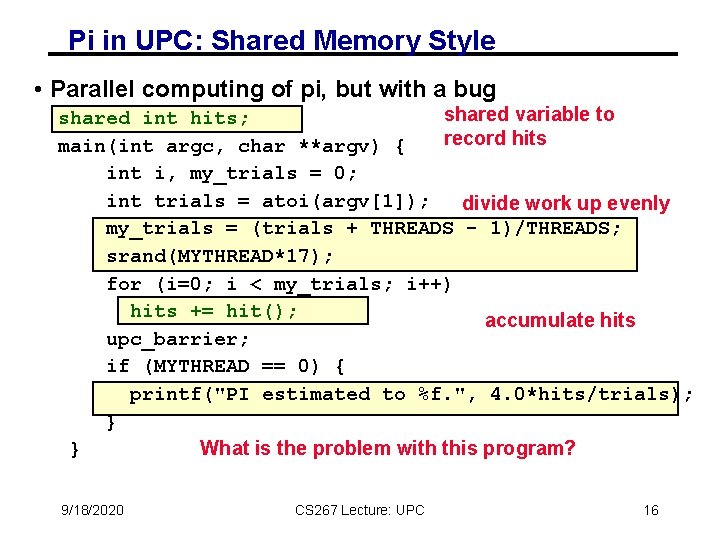
Pi in UPC: Shared Memory Style • Parallel computing of pi, but with a bug shared variable to shared int hits; record hits main(int argc, char **argv) { int i, my_trials = 0; int trials = atoi(argv[1]); divide work up evenly my_trials = (trials + THREADS - 1)/THREADS; srand(MYTHREAD*17); for (i=0; i < my_trials; i++) hits += hit(); accumulate hits upc_barrier; if (MYTHREAD == 0) { printf("PI estimated to %f. ", 4. 0*hits/trials); } What is the problem with this program? } 9/18/2020 CS 267 Lecture: UPC 16
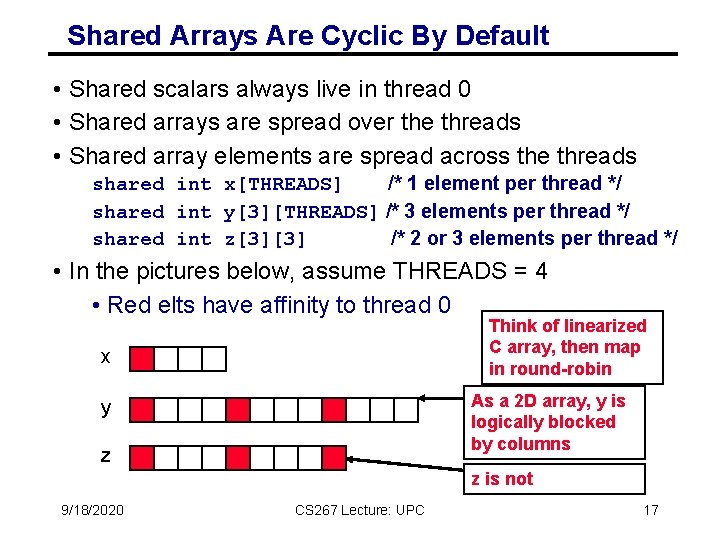
Shared Arrays Are Cyclic By Default • Shared scalars always live in thread 0 • Shared arrays are spread over the threads • Shared array elements are spread across the threads shared int x[THREADS] /* 1 element per thread */ shared int y[3][THREADS] /* 3 elements per thread */ shared int z[3][3] /* 2 or 3 elements per thread */ • In the pictures below, assume THREADS = 4 • Red elts have affinity to thread 0 Think of linearized C array, then map in round-robin x As a 2 D array, y is logically blocked by columns y z z is not 9/18/2020 CS 267 Lecture: UPC 17
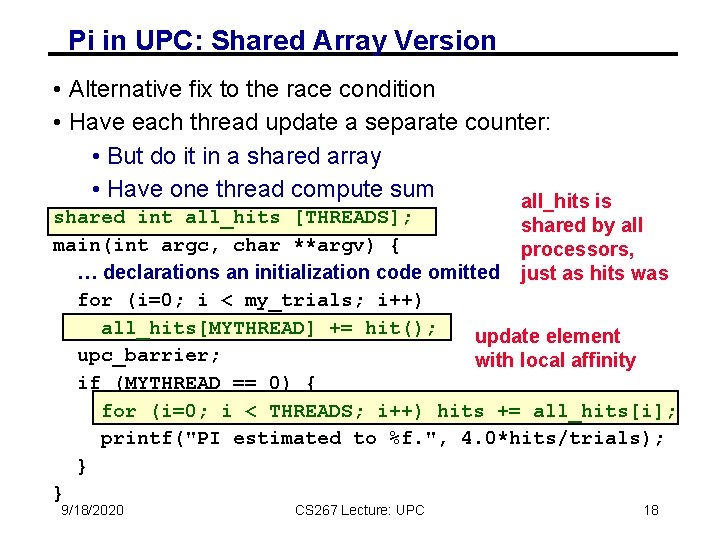
Pi in UPC: Shared Array Version • Alternative fix to the race condition • Have each thread update a separate counter: • But do it in a shared array • Have one thread compute sum all_hits is shared int all_hits [THREADS]; shared by all main(int argc, char **argv) { processors, … declarations an initialization code omitted just as hits was for (i=0; i < my_trials; i++) all_hits[MYTHREAD] += hit(); update element upc_barrier; with local affinity if (MYTHREAD == 0) { for (i=0; i < THREADS; i++) hits += all_hits[i]; printf("PI estimated to %f. ", 4. 0*hits/trials); } } 9/18/2020 CS 267 Lecture: UPC 18
UPC Synchronization 9/18/2020 CS 267 Lecture: UPC 19
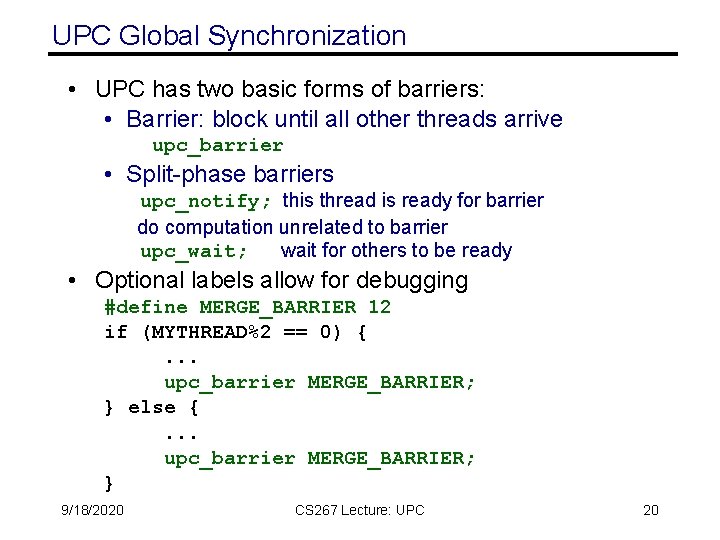
UPC Global Synchronization • UPC has two basic forms of barriers: • Barrier: block until all other threads arrive upc_barrier • Split-phase barriers upc_notify; this thread is ready for barrier do computation unrelated to barrier upc_wait; wait for others to be ready • Optional labels allow for debugging #define MERGE_BARRIER 12 if (MYTHREAD%2 == 0) {. . . upc_barrier MERGE_BARRIER; } else {. . . upc_barrier MERGE_BARRIER; } 9/18/2020 CS 267 Lecture: UPC 20
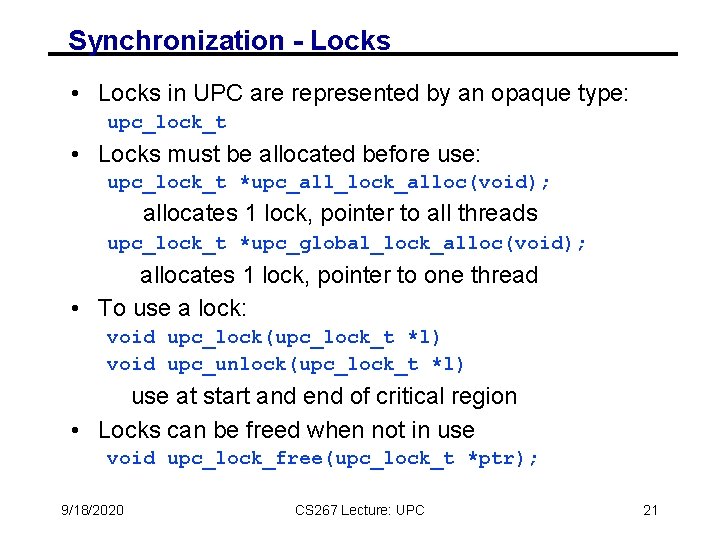
Synchronization - Locks • Locks in UPC are represented by an opaque type: upc_lock_t • Locks must be allocated before use: upc_lock_t *upc_all_lock_alloc(void); allocates 1 lock, pointer to all threads upc_lock_t *upc_global_lock_alloc(void); allocates 1 lock, pointer to one thread • To use a lock: void upc_lock(upc_lock_t *l) void upc_unlock(upc_lock_t *l) use at start and end of critical region • Locks can be freed when not in use void upc_lock_free(upc_lock_t *ptr); 9/18/2020 CS 267 Lecture: UPC 21
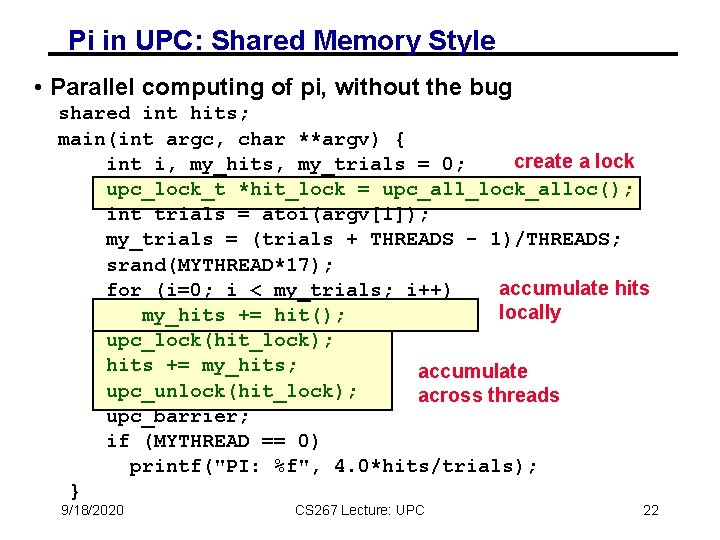
Pi in UPC: Shared Memory Style • Parallel computing of pi, without the bug shared int hits; main(int argc, char **argv) { create a lock int i, my_hits, my_trials = 0; upc_lock_t *hit_lock = upc_all_lock_alloc(); int trials = atoi(argv[1]); my_trials = (trials + THREADS - 1)/THREADS; srand(MYTHREAD*17); accumulate hits for (i=0; i < my_trials; i++) locally my_hits += hit(); upc_lock(hit_lock); hits += my_hits; accumulate upc_unlock(hit_lock); across threads upc_barrier; if (MYTHREAD == 0) printf("PI: %f", 4. 0*hits/trials); } 9/18/2020 CS 267 Lecture: UPC 22
UPC Collectives 9/18/2020 CS 267 Lecture: UPC 23
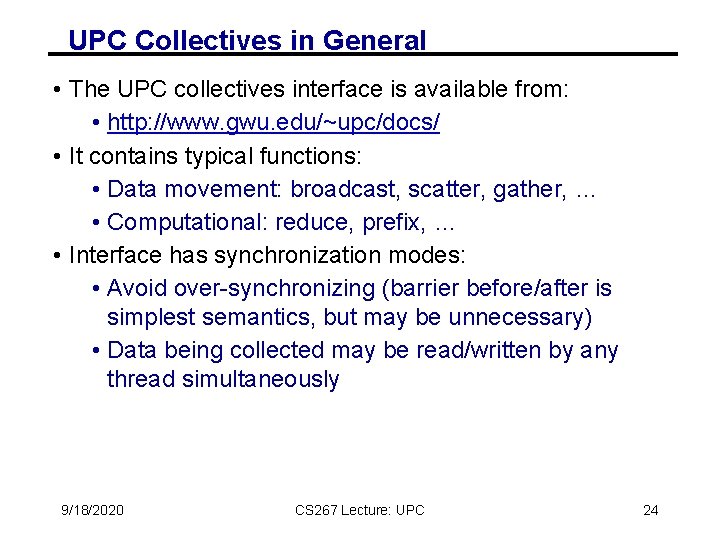
UPC Collectives in General • The UPC collectives interface is available from: • http: //www. gwu. edu/~upc/docs/ • It contains typical functions: • Data movement: broadcast, scatter, gather, … • Computational: reduce, prefix, … • Interface has synchronization modes: • Avoid over-synchronizing (barrier before/after is simplest semantics, but may be unnecessary) • Data being collected may be read/written by any thread simultaneously 9/18/2020 CS 267 Lecture: UPC 24
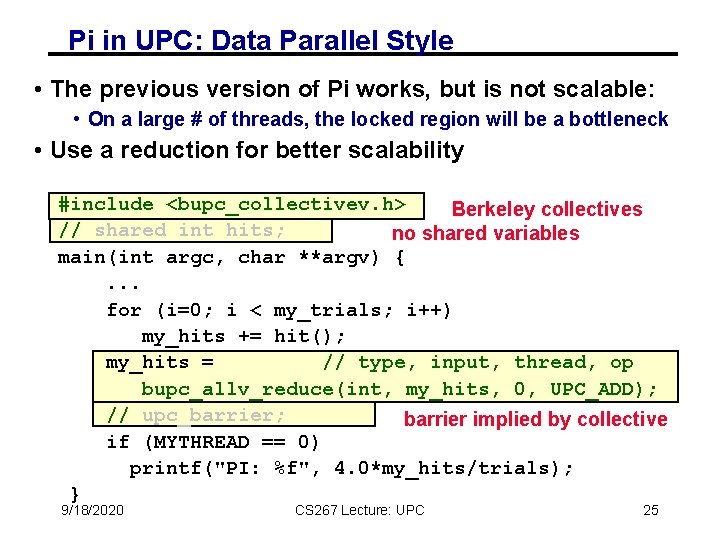
Pi in UPC: Data Parallel Style • The previous version of Pi works, but is not scalable: • On a large # of threads, the locked region will be a bottleneck • Use a reduction for better scalability #include <bupc_collectivev. h> Berkeley collectives // shared int hits; no shared variables main(int argc, char **argv) {. . . for (i=0; i < my_trials; i++) my_hits += hit(); my_hits = // type, input, thread, op bupc_allv_reduce(int, my_hits, 0, UPC_ADD); // upc_barrier; barrier implied by collective if (MYTHREAD == 0) printf("PI: %f", 4. 0*my_hits/trials); } 9/18/2020 CS 267 Lecture: UPC 25
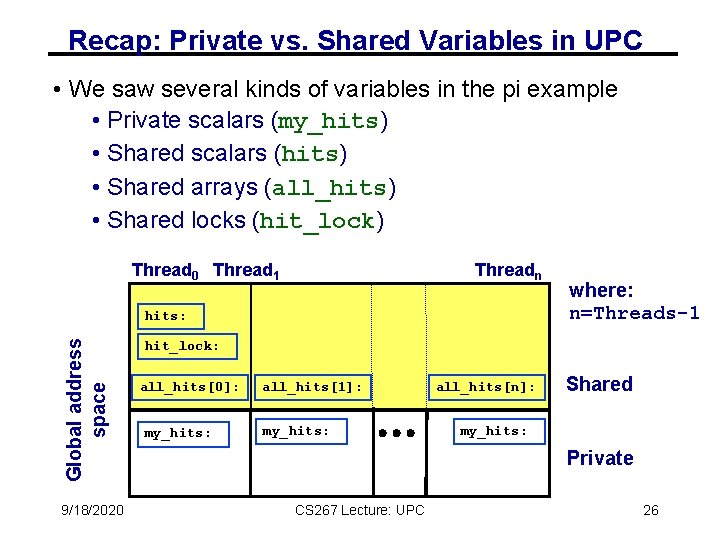
Recap: Private vs. Shared Variables in UPC • We saw several kinds of variables in the pi example • Private scalars (my_hits) • Shared scalars (hits) • Shared arrays (all_hits) • Shared locks (hit_lock) Thread 0 Thread 1 Threadn Global address space hits: 9/18/2020 where: n=Threads-1 hit_lock: all_hits[0]: my_hits: all_hits[1]: my_hits: all_hits[n]: Shared my_hits: Private CS 267 Lecture: UPC 26
Work Distribution Using upc_forall 9/18/2020 CS 267 Lecture: UPC 27
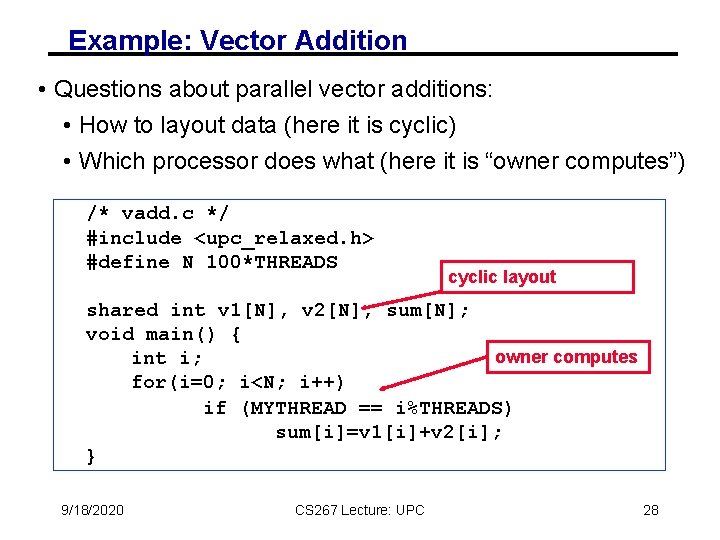
Example: Vector Addition • Questions about parallel vector additions: • How to layout data (here it is cyclic) • Which processor does what (here it is “owner computes”) /* vadd. c */ #include <upc_relaxed. h> #define N 100*THREADS cyclic layout shared int v 1[N], v 2[N], sum[N]; void main() { owner computes int i; for(i=0; i<N; i++) if (MYTHREAD == i%THREADS) sum[i]=v 1[i]+v 2[i]; } 9/18/2020 CS 267 Lecture: UPC 28
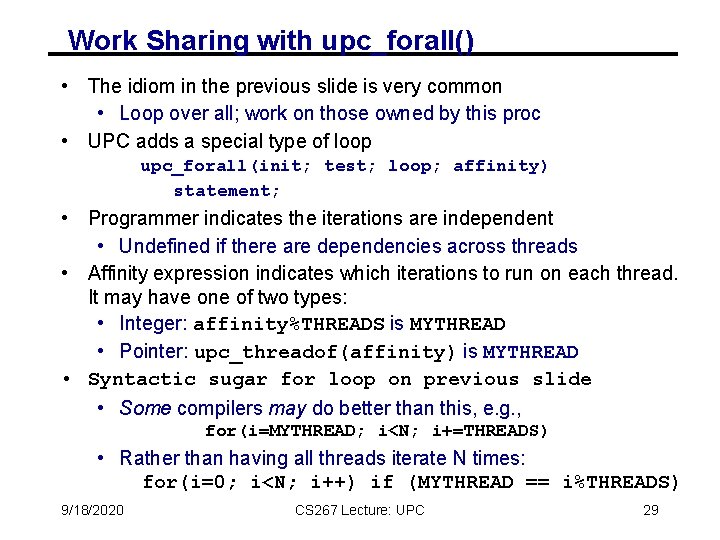
Work Sharing with upc_forall() • The idiom in the previous slide is very common • Loop over all; work on those owned by this proc • UPC adds a special type of loop upc_forall(init; test; loop; affinity) statement; • Programmer indicates the iterations are independent • Undefined if there are dependencies across threads • Affinity expression indicates which iterations to run on each thread. It may have one of two types: • Integer: affinity%THREADS is MYTHREAD • Pointer: upc_threadof(affinity) is MYTHREAD • Syntactic sugar for loop on previous slide • Some compilers may do better than this, e. g. , for(i=MYTHREAD; i<N; i+=THREADS) • Rather than having all threads iterate N times: for(i=0; i<N; i++) if (MYTHREAD == i%THREADS) 9/18/2020 CS 267 Lecture: UPC 29
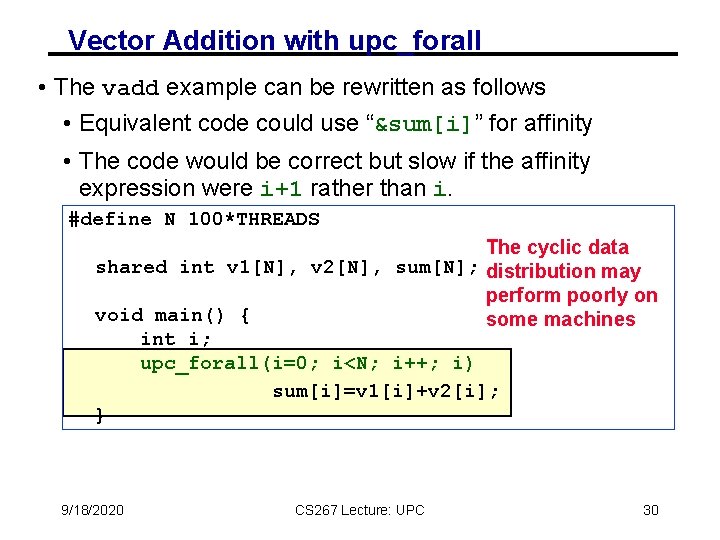
Vector Addition with upc_forall • The vadd example can be rewritten as follows • Equivalent code could use “&sum[i]” for affinity • The code would be correct but slow if the affinity expression were i+1 rather than i. #define N 100*THREADS The cyclic data shared int v 1[N], v 2[N], sum[N]; distribution may perform poorly on void main() { some machines int i; upc_forall(i=0; i<N; i++; i) sum[i]=v 1[i]+v 2[i]; } 9/18/2020 CS 267 Lecture: UPC 30
Distributed Arrays in UPC 9/18/2020 CS 267 Lecture: UPC 31
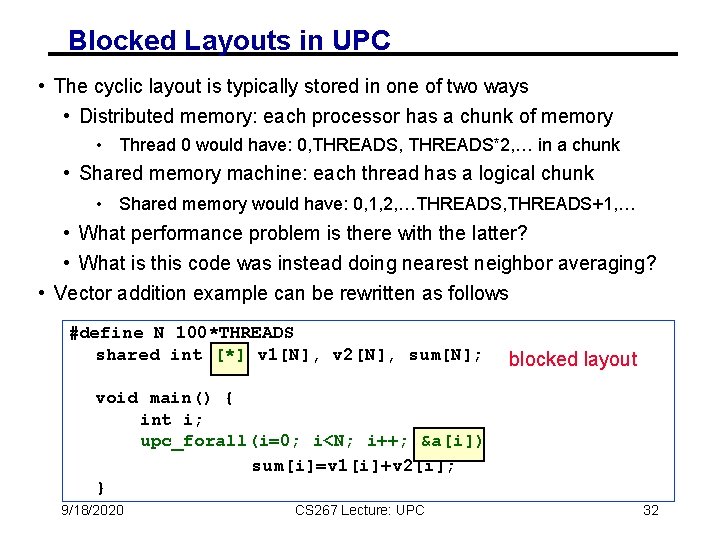
Blocked Layouts in UPC • The cyclic layout is typically stored in one of two ways • Distributed memory: each processor has a chunk of memory • Thread 0 would have: 0, THREADS*2, … in a chunk • Shared memory machine: each thread has a logical chunk • Shared memory would have: 0, 1, 2, …THREADS, THREADS+1, … • What performance problem is there with the latter? • What is this code was instead doing nearest neighbor averaging? • Vector addition example can be rewritten as follows #define N 100*THREADS shared int [*] v 1[N], v 2[N], sum[N]; blocked layout void main() { int i; upc_forall(i=0; i<N; i++; &a[i]) sum[i]=v 1[i]+v 2[i]; } 9/18/2020 CS 267 Lecture: UPC 32
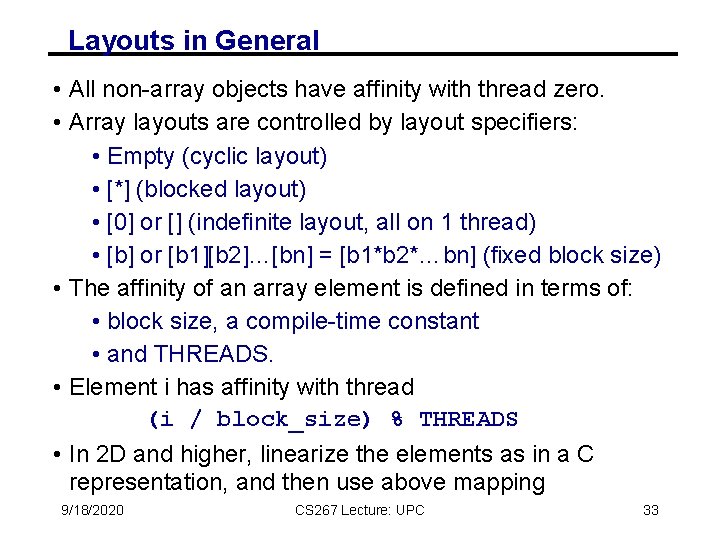
Layouts in General • All non-array objects have affinity with thread zero. • Array layouts are controlled by layout specifiers: • Empty (cyclic layout) • [*] (blocked layout) • [0] or [] (indefinite layout, all on 1 thread) • [b] or [b 1][b 2]…[bn] = [b 1*b 2*…bn] (fixed block size) • The affinity of an array element is defined in terms of: • block size, a compile-time constant • and THREADS. • Element i has affinity with thread (i / block_size) % THREADS • In 2 D and higher, linearize the elements as in a C representation, and then use above mapping 9/18/2020 CS 267 Lecture: UPC 33
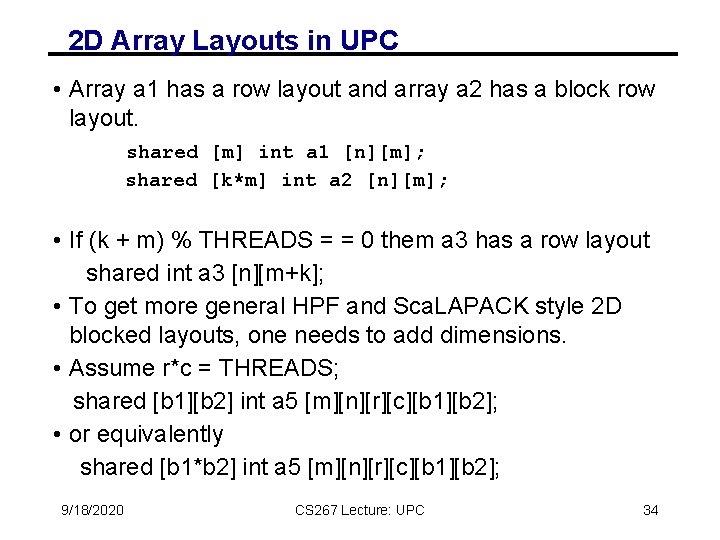
2 D Array Layouts in UPC • Array a 1 has a row layout and array a 2 has a block row layout. shared [m] int a 1 [n][m]; shared [k*m] int a 2 [n][m]; • If (k + m) % THREADS = = 0 them a 3 has a row layout shared int a 3 [n][m+k]; • To get more general HPF and Sca. LAPACK style 2 D blocked layouts, one needs to add dimensions. • Assume r*c = THREADS; shared [b 1][b 2] int a 5 [m][n][r][c][b 1][b 2]; • or equivalently shared [b 1*b 2] int a 5 [m][n][r][c][b 1][b 2]; 9/18/2020 CS 267 Lecture: UPC 34
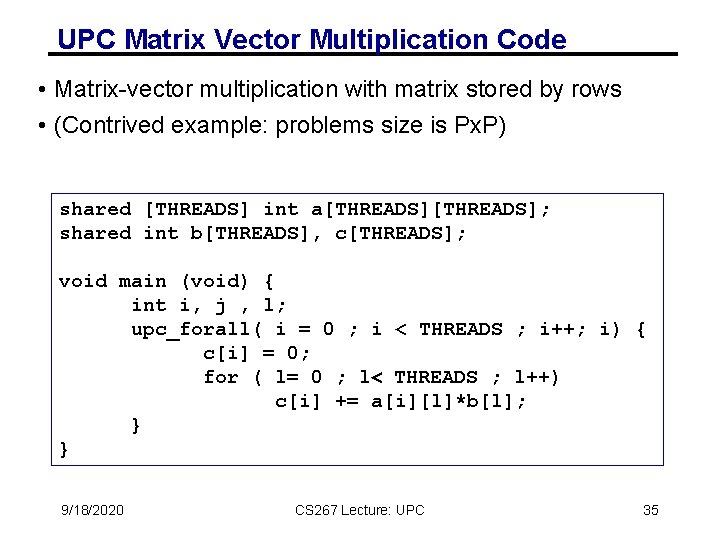
UPC Matrix Vector Multiplication Code • Matrix-vector multiplication with matrix stored by rows • (Contrived example: problems size is Px. P) shared [THREADS] int a[THREADS]; shared int b[THREADS], c[THREADS]; void main (void) { int i, j , l; upc_forall( i = 0 ; i < THREADS ; i++; i) { c[i] = 0; for ( l= 0 ; l THREADS ; l++) c[i] += a[i][l]*b[l]; } } 9/18/2020 CS 267 Lecture: UPC 35
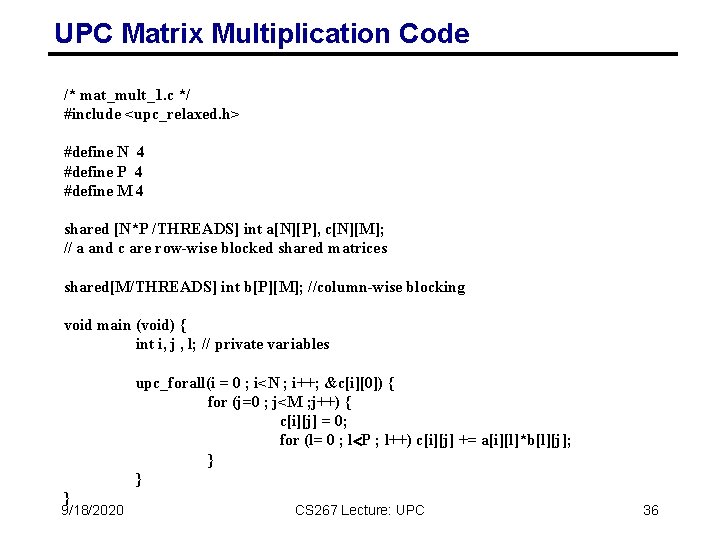
UPC Matrix Multiplication Code /* mat_mult_1. c */ #include <upc_relaxed. h> #define N 4 #define P 4 #define M 4 shared [N*P /THREADS] int a[N][P], c[N][M]; // a and c are row-wise blocked shared matrices shared[M/THREADS] int b[P][M]; //column-wise blocking void main (void) { int i, j , l; // private variables upc_forall(i = 0 ; i<N ; i++; &c[i][0]) { for (j=0 ; j<M ; j++) { c[i][j] = 0; for (l= 0 ; l P ; l++) c[i][j] += a[i][l]*b[l][j]; } } } 9/18/2020 CS 267 Lecture: UPC 36
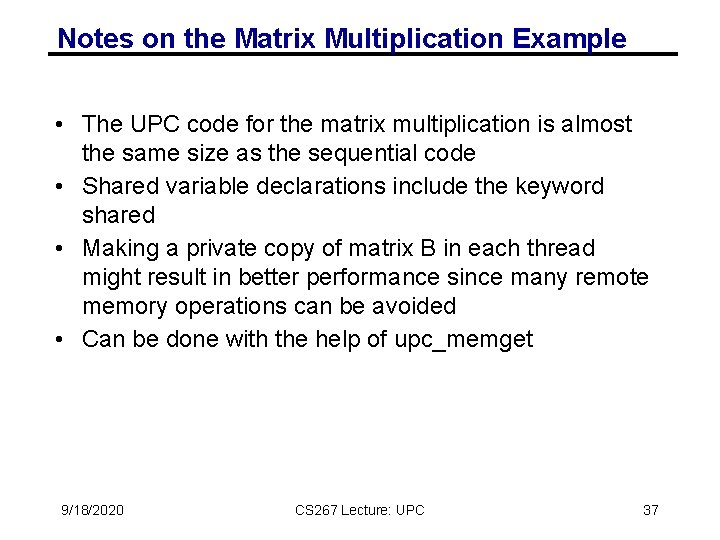
Notes on the Matrix Multiplication Example • The UPC code for the matrix multiplication is almost the same size as the sequential code • Shared variable declarations include the keyword shared • Making a private copy of matrix B in each thread might result in better performance since many remote memory operations can be avoided • Can be done with the help of upc_memget 9/18/2020 CS 267 Lecture: UPC 37
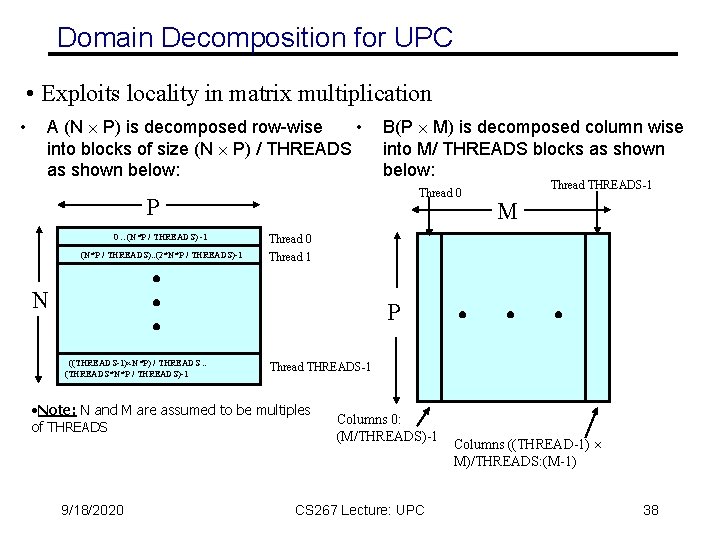
Domain Decomposition for UPC • Exploits locality in matrix multiplication • A (N P) is decomposed row-wise • into blocks of size (N P) / THREADS as shown below: B(P M) is decomposed column wise into M/ THREADS blocks as shown below: Thread 0 P 0. . (N*P / THREADS) -1 (N*P / THREADS). . (2*N*P / THREADS)-1 Thread THREADS-1 M Thread 0 Thread 1 N P ((THREADS-1) N*P) / THREADS. . (THREADS*N*P / THREADS)-1 Thread THREADS-1 • Note: N and M are assumed to be multiples of THREADS 9/18/2020 Columns 0: (M/THREADS)-1 CS 267 Lecture: UPC Columns ((THREAD-1) M)/THREADS: (M-1) 38
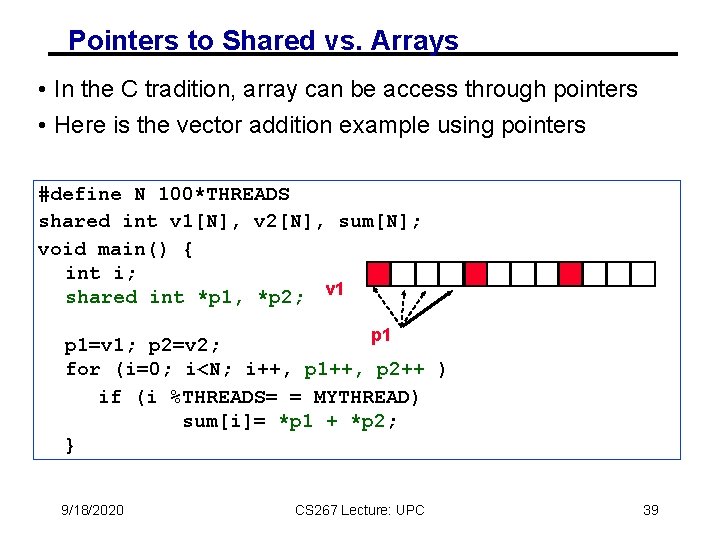
Pointers to Shared vs. Arrays • In the C tradition, array can be access through pointers • Here is the vector addition example using pointers #define N 100*THREADS shared int v 1[N], v 2[N], sum[N]; void main() { int i; shared int *p 1, *p 2; v 1 p 1=v 1; p 2=v 2; for (i=0; i<N; i++, p 1++, p 2++ ) if (i %THREADS= = MYTHREAD) sum[i]= *p 1 + *p 2; } 9/18/2020 CS 267 Lecture: UPC 39
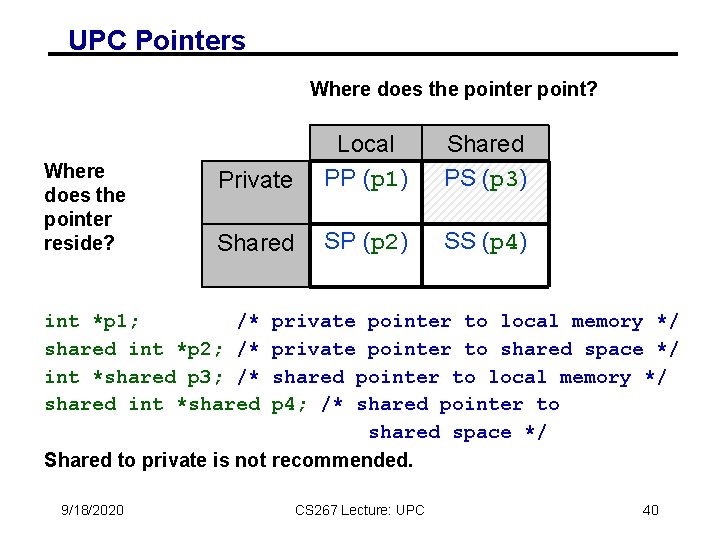
UPC Pointers Where does the pointer point? Where does the pointer reside? Private Local PP (p 1) Shared PS (p 3) Shared SP (p 2) SS (p 4) int *p 1; /* shared int *p 2; /* int *shared p 3; /* shared int *shared private pointer to local memory */ private pointer to shared space */ shared pointer to local memory */ p 4; /* shared pointer to shared space */ Shared to private is not recommended. 9/18/2020 CS 267 Lecture: UPC 40
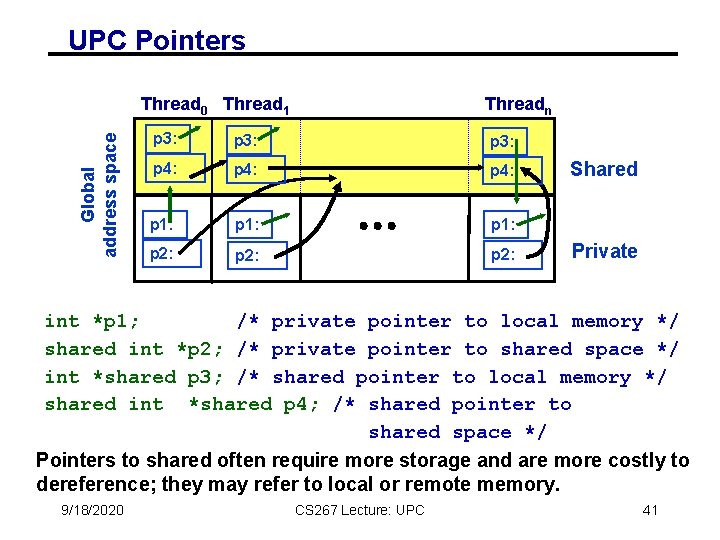
UPC Pointers Global address space Thread 0 Thread 1 Threadn p 3: p 4: p 1: p 2: Shared Private int *p 1; /* private pointer to local memory */ shared int *p 2; /* private pointer to shared space */ int *shared p 3; /* shared pointer to local memory */ shared int *shared p 4; /* shared pointer to shared space */ Pointers to shared often require more storage and are more costly to dereference; they may refer to local or remote memory. 9/18/2020 CS 267 Lecture: UPC 41
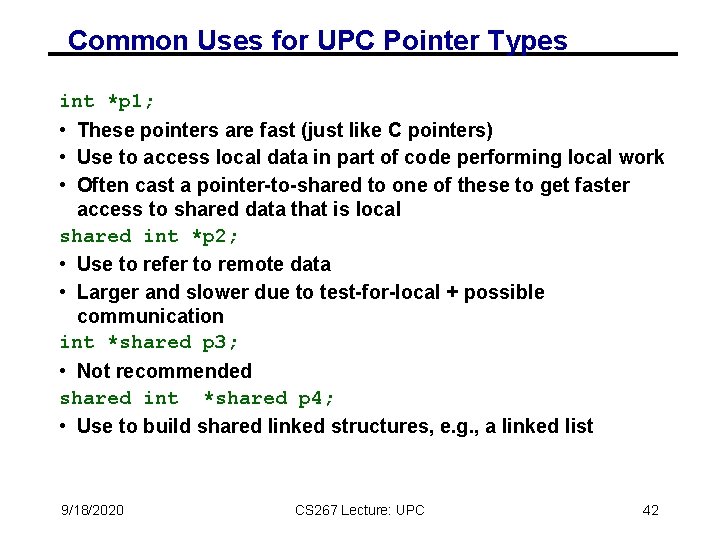
Common Uses for UPC Pointer Types int *p 1; • These pointers are fast (just like C pointers) • Use to access local data in part of code performing local work • Often cast a pointer-to-shared to one of these to get faster access to shared data that is local shared int *p 2; • Use to refer to remote data • Larger and slower due to test-for-local + possible communication int *shared p 3; • Not recommended shared int *shared p 4; • Use to build shared linked structures, e. g. , a linked list 9/18/2020 CS 267 Lecture: UPC 42
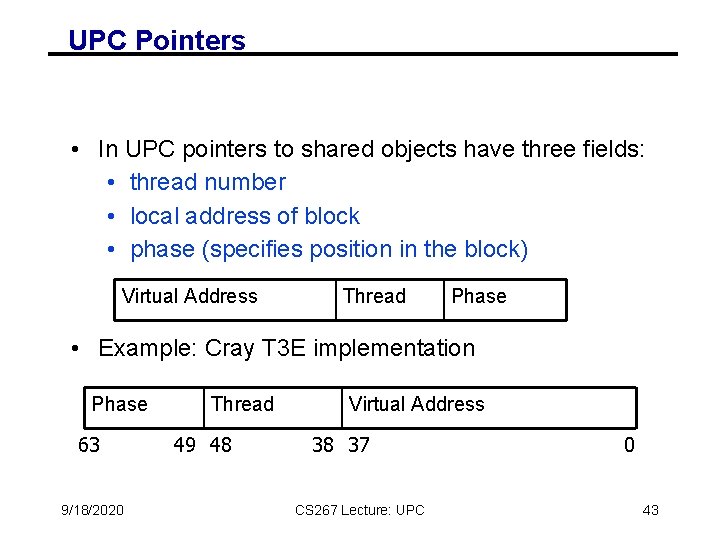
UPC Pointers • In UPC pointers to shared objects have three fields: • thread number • local address of block • phase (specifies position in the block) Virtual Address Thread Phase • Example: Cray T 3 E implementation Phase 63 9/18/2020 Thread 49 48 Virtual Address 38 37 CS 267 Lecture: UPC 0 43
UPC Pointers • Pointer arithmetic supports blocked and non-blocked array distributions • Casting of shared to private pointers is allowed but not vice versa ! • When casting a pointer-to-shared to a pointer-to-local, the thread number of the pointer to shared may be lost • Casting of shared to local is well defined only if the object pointed to by the pointer to shared has affinity with the thread performing the cast 9/18/2020 CS 267 Lecture: UPC 44
Special Functions • size_t upc_threadof(shared void *ptr); returns the thread number that has affinity to the pointer to shared • size_t upc_phaseof(shared void *ptr); returns the index (position within the block)field of the pointer to shared • shared void *upc_resetphase(shared void *ptr); resets the phase to zero 9/18/2020 CS 267 Lecture: UPC 45
Dynamic Memory Allocation in UPC • Dynamic memory allocation of shared memory is available in UPC • Functions can be collective or not • A collective function has to be called by every thread and will return the same value to all of them 9/18/2020 CS 267 Lecture: UPC 46
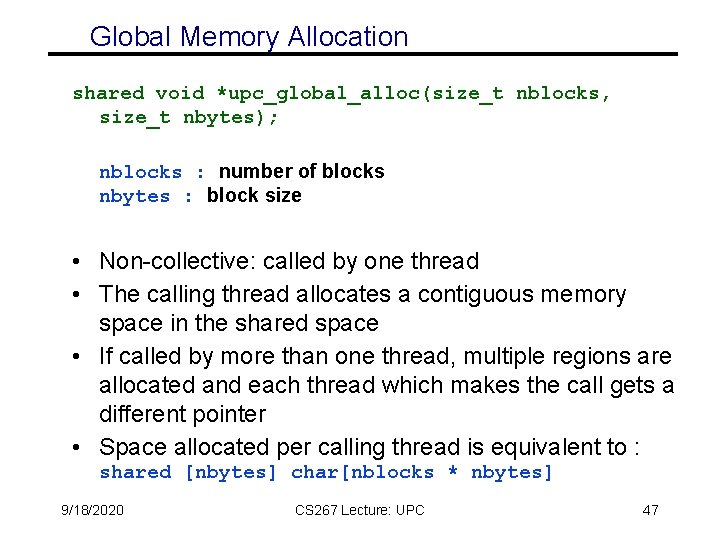
Global Memory Allocation shared void *upc_global_alloc(size_t nblocks, size_t nbytes); nblocks : number of blocks nbytes : block size • Non-collective: called by one thread • The calling thread allocates a contiguous memory space in the shared space • If called by more than one thread, multiple regions are allocated and each thread which makes the call gets a different pointer • Space allocated per calling thread is equivalent to : shared [nbytes] char[nblocks * nbytes] 9/18/2020 CS 267 Lecture: UPC 47
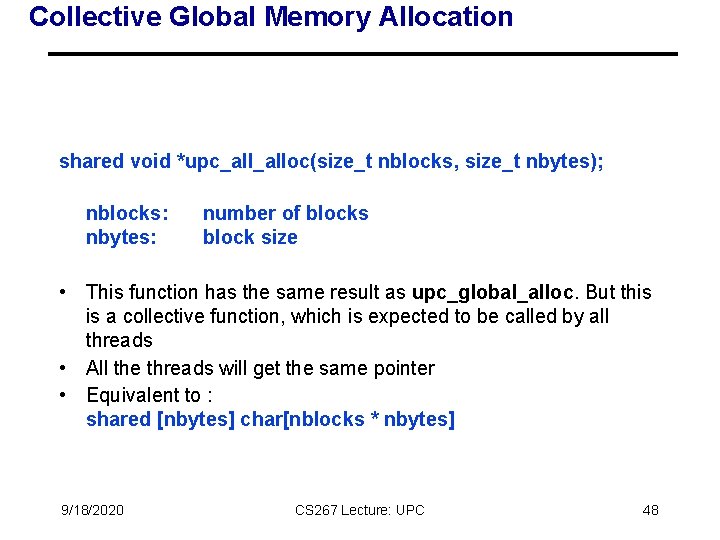
Collective Global Memory Allocation shared void *upc_alloc(size_t nblocks, size_t nbytes); nblocks: nbytes: number of blocks block size • This function has the same result as upc_global_alloc. But this is a collective function, which is expected to be called by all threads • All the threads will get the same pointer • Equivalent to : shared [nbytes] char[nblocks * nbytes] 9/18/2020 CS 267 Lecture: UPC 48
Memory Freeing void upc_free(shared void *ptr); • The upc_free function frees the dynamically allocated shared memory pointed to by ptr • upc_free is not collective 9/18/2020 CS 267 Lecture: UPC 49
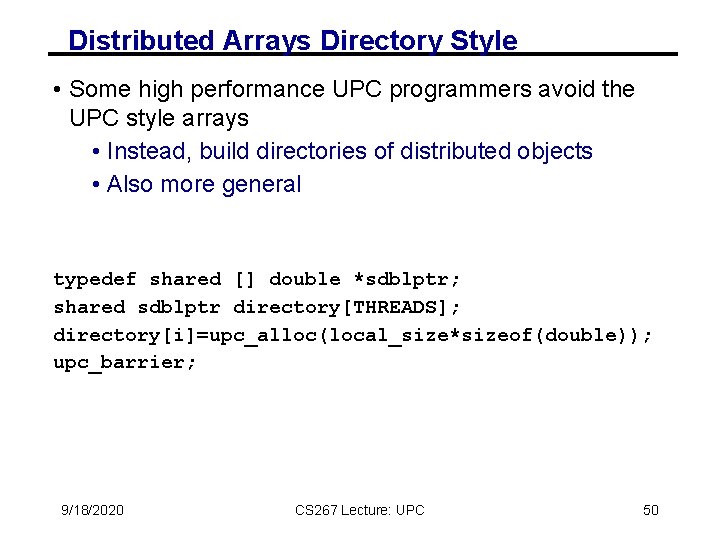
Distributed Arrays Directory Style • Some high performance UPC programmers avoid the UPC style arrays • Instead, build directories of distributed objects • Also more general typedef shared [] double *sdblptr; shared sdblptr directory[THREADS]; directory[i]=upc_alloc(local_size*sizeof(double)); upc_barrier; 9/18/2020 CS 267 Lecture: UPC 50
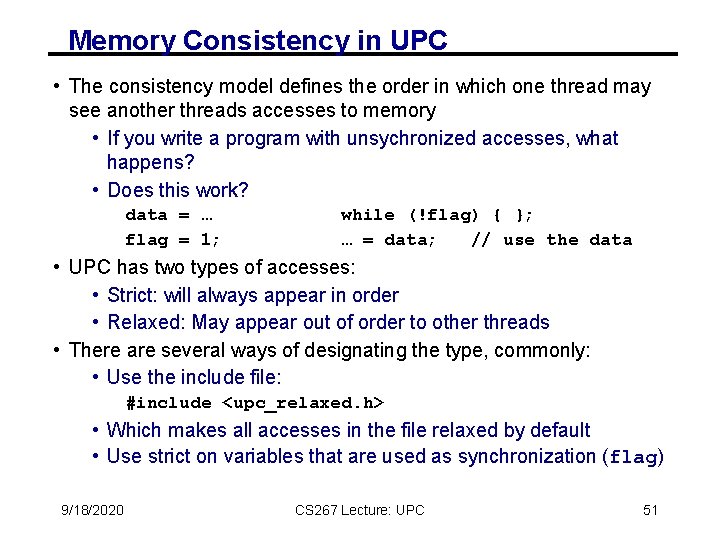
Memory Consistency in UPC • The consistency model defines the order in which one thread may see another threads accesses to memory • If you write a program with unsychronized accesses, what happens? • Does this work? data = … flag = 1; while (!flag) { }; … = data; // use the data • UPC has two types of accesses: • Strict: will always appear in order • Relaxed: May appear out of order to other threads • There are several ways of designating the type, commonly: • Use the include file: #include <upc_relaxed. h> • Which makes all accesses in the file relaxed by default • Use strict on variables that are used as synchronization (flag) 9/18/2020 CS 267 Lecture: UPC 51
Synchronization- Fence • Upc provides a fence construct • Equivalent to a null strict reference, and has the syntax • upc_fence; • UPC ensures that all shared references issued before the upc_fence are complete 9/18/2020 CS 267 Lecture: UPC 52
PGAS Languages have Performance Advantages Strategy for acceptance of a new language • Make it run faster than anything else Keys to high performance • Parallelism: • Scaling the number of processors • Maximize single node performance • Generate friendly code or use tuned libraries (BLAS, FFTW, etc. ) • Avoid (unnecessary) communication cost • Latency, bandwidth, overhead • Berkeley UPC and Titanium use GASNet communication layer • Avoid unnecessary delays due to dependencies • Load balance; Pipeline algorithmic dependencies 9/18/2020 CS 267 Lecture: UPC 53
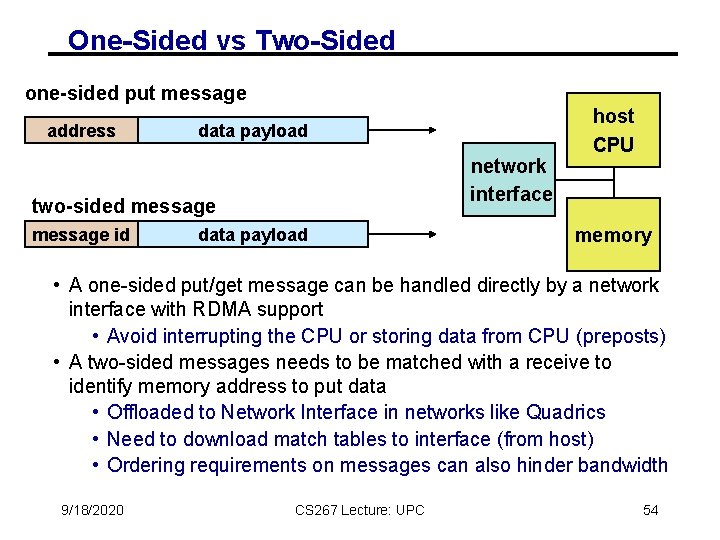
One-Sided vs Two-Sided one-sided put message address data payload network interface two-sided message id data payload host CPU memory • A one-sided put/get message can be handled directly by a network interface with RDMA support • Avoid interrupting the CPU or storing data from CPU (preposts) • A two-sided messages needs to be matched with a receive to identify memory address to put data • Offloaded to Network Interface in networks like Quadrics • Need to download match tables to interface (from host) • Ordering requirements on messages can also hinder bandwidth 9/18/2020 CS 267 Lecture: UPC 54
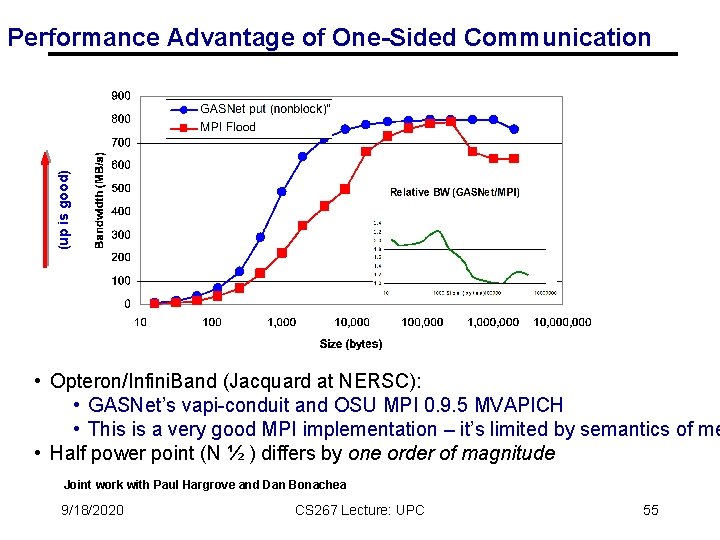
(up is good) Performance Advantage of One-Sided Communication • Opteron/Infini. Band (Jacquard at NERSC): • GASNet’s vapi-conduit and OSU MPI 0. 9. 5 MVAPICH • This is a very good MPI implementation – it’s limited by semantics of me • Half power point (N ½ ) differs by one order of magnitude Joint work with Paul Hargrove and Dan Bonachea 9/18/2020 CS 267 Lecture: UPC 55
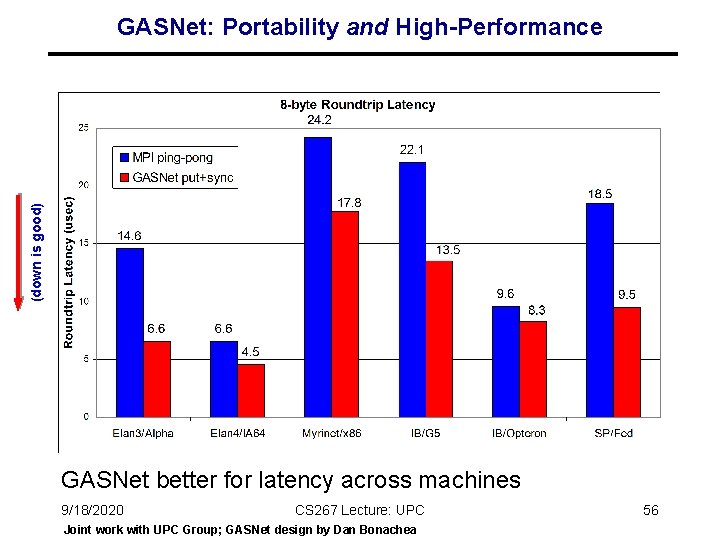
(down is good) GASNet: Portability and High-Performance GASNet better for latency across machines 9/18/2020 CS 267 Lecture: UPC Joint work with UPC Group; GASNet design by Dan Bonachea 56
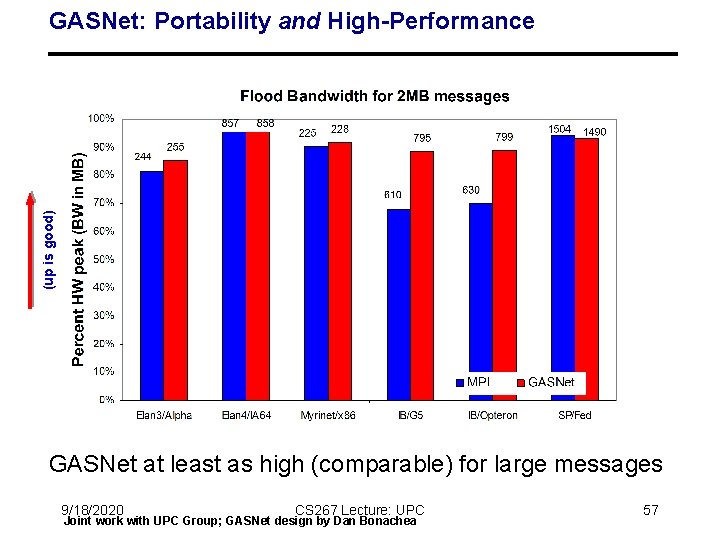
(up is good) GASNet: Portability and High-Performance GASNet at least as high (comparable) for large messages 9/18/2020 CS 267 Lecture: UPC Joint work with UPC Group; GASNet design by Dan Bonachea 57
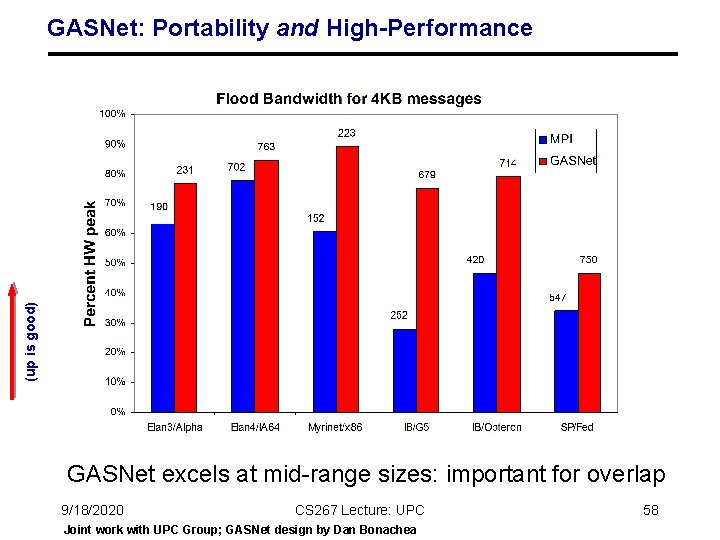
(up is good) GASNet: Portability and High-Performance GASNet excels at mid-range sizes: important for overlap 9/18/2020 CS 267 Lecture: UPC Joint work with UPC Group; GASNet design by Dan Bonachea 58
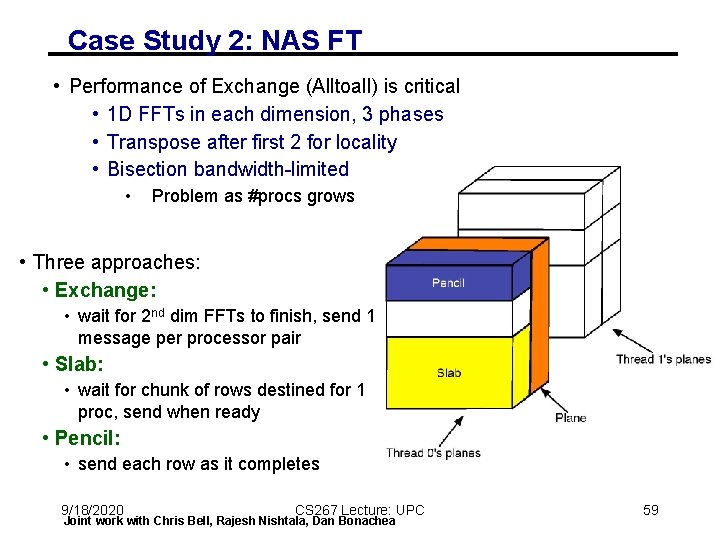
Case Study 2: NAS FT • Performance of Exchange (Alltoall) is critical • 1 D FFTs in each dimension, 3 phases • Transpose after first 2 for locality • Bisection bandwidth-limited • Problem as #procs grows • Three approaches: • Exchange: • wait for 2 nd dim FFTs to finish, send 1 message per processor pair • Slab: • wait for chunk of rows destined for 1 proc, send when ready • Pencil: • send each row as it completes 9/18/2020 CS 267 Lecture: UPC Joint work with Chris Bell, Rajesh Nishtala, Dan Bonachea 59
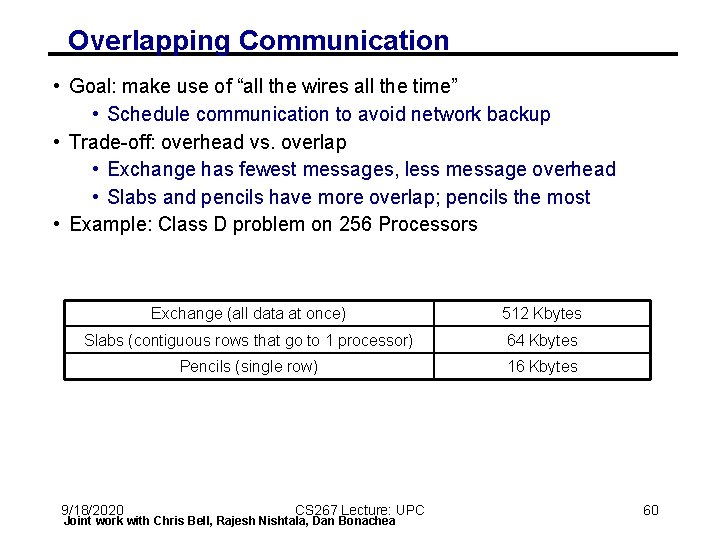
Overlapping Communication • Goal: make use of “all the wires all the time” • Schedule communication to avoid network backup • Trade-off: overhead vs. overlap • Exchange has fewest messages, less message overhead • Slabs and pencils have more overlap; pencils the most • Example: Class D problem on 256 Processors Exchange (all data at once) 512 Kbytes Slabs (contiguous rows that go to 1 processor) 64 Kbytes Pencils (single row) 16 Kbytes 9/18/2020 CS 267 Lecture: UPC Joint work with Chris Bell, Rajesh Nishtala, Dan Bonachea 60
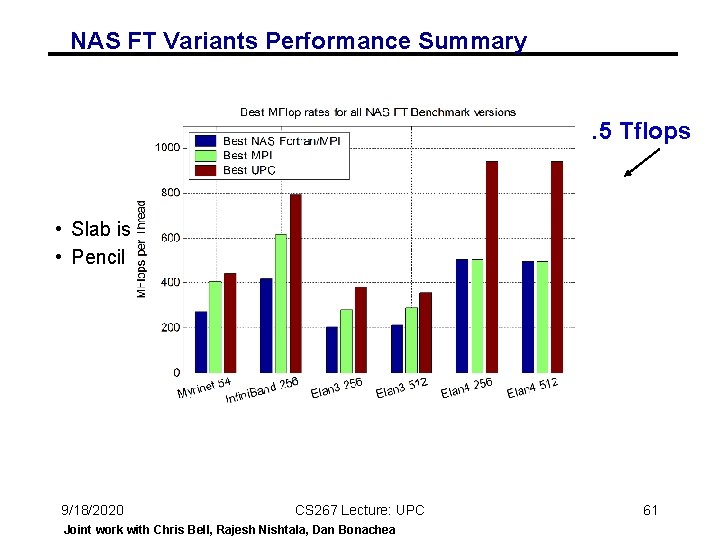
NAS FT Variants Performance Summary . 5 Tflops • Slab is always best for MPI; small message cost too high • Pencil is always best for UPC; more overlap 9/18/2020 CS 267 Lecture: UPC Joint work with Chris Bell, Rajesh Nishtala, Dan Bonachea 61
Case Study 2: LU Factorization • Direct methods have complicated dependencies • Especially with pivoting (unpredictable communication) • Especially for sparse matrices (dependence graph with holes) • LU Factorization in UPC • Use overlap ideas and multithreading to mask latency • Multithreaded: UPC threads + user threads + threaded BLAS • Panel factorization: Including pivoting • Update to a block of U • Trailing submatrix updates • Status: • Dense LU done: HPL-compliant • Sparse version underway 9/18/2020 Joint work with Parry Husbands CS 267 Lecture: UPC 62
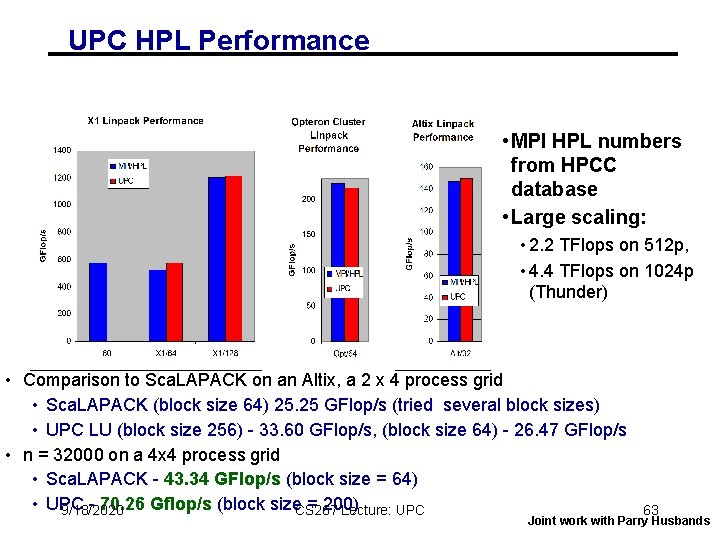
UPC HPL Performance • MPI HPL numbers from HPCC database • Large scaling: • 2. 2 TFlops on 512 p, • 4. 4 TFlops on 1024 p (Thunder) • Comparison to Sca. LAPACK on an Altix, a 2 x 4 process grid • Sca. LAPACK (block size 64) 25. 25 GFlop/s (tried several block sizes) • UPC LU (block size 256) - 33. 60 GFlop/s, (block size 64) - 26. 47 GFlop/s • n = 32000 on a 4 x 4 process grid • Sca. LAPACK - 43. 34 GFlop/s (block size = 64) • UPC - 70. 26 Gflop/s (block size. CS 267 = 200) 9/18/2020 Lecture: UPC 63 Joint work with Parry Husbands
Summary • UPC designed to be consistent with C • Some low level details, such as memory layout are exposed • Ability to use pointers and arrays interchangeably • Designed for high performance • Memory consistency explicit • Small implementation • Berkeley compiler (used for next homework) http: //upc. lbl. gov • Language specification and other documents http: //upc. gwu. edu 9/18/2020 CS 267 Lecture: UPC 64