
The PSP Association Presented by Kathy Weston Specialist
The PSP Association Presented by: Kathy Weston Specialist Care Advisor Working for a world free of PSP Registered charity numbers: England Wales 1037087 / Scotland SC 041199
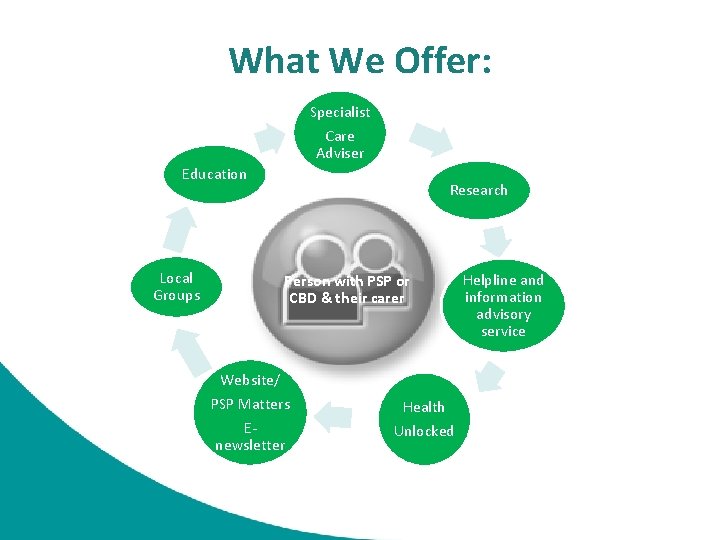
What We Offer: Specialist Care Adviser Education Local Groups Research Person with PSP or CBD & their carer Website/ PSP Matters Enewsletter Health Unlocked Helpline and information advisory service
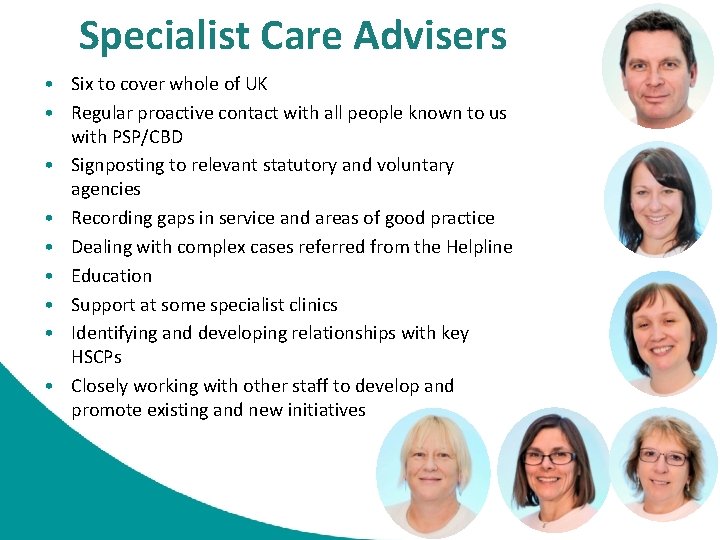
Specialist Care Advisers • Six to cover whole of UK • Regular proactive contact with all people known to us with PSP/CBD • Signposting to relevant statutory and voluntary agencies • Recording gaps in service and areas of good practice • Dealing with complex cases referred from the Helpline • Education • Support at some specialist clinics • Identifying and developing relationships with key HSCPs • Closely working with other staff to develop and promote existing and new initiatives
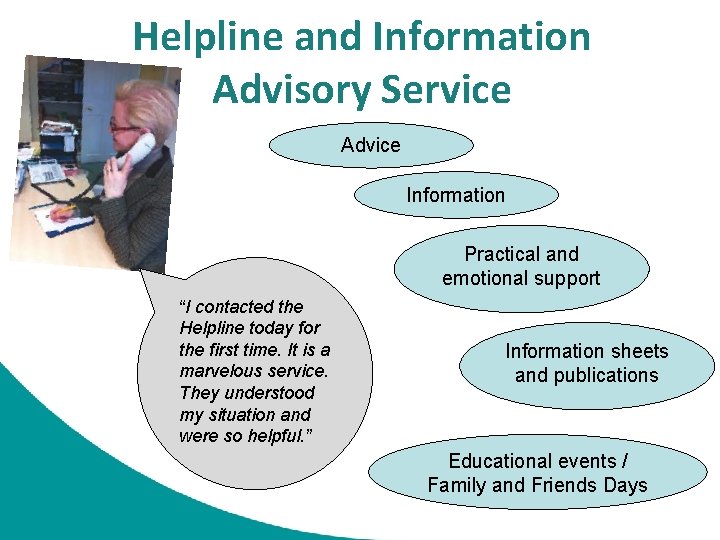
Helpline and Information Advisory Service Advice Information Practical and emotional support “I contacted the Helpline today for the first time. It is a marvelous service. They understood my situation and were so helpful. ” Information sheets and publications Educational events / Family and Friends Days
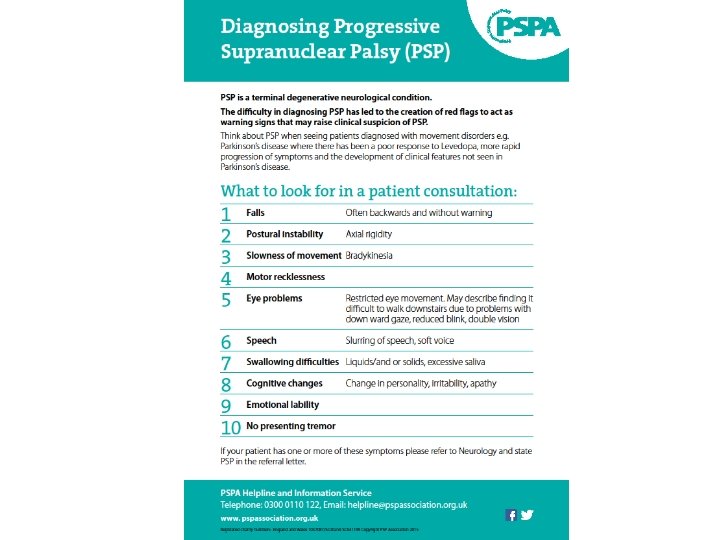
Symptoms of PSP • • Falls - often backwards Postural Instability Eye Problems Swallow Problems Speech Problems Cognitive Changes Bladder and Bowel Pain
Key Features of PSP • • • Little or no response to Levodopa No presenting tremor Rarely affects people under 40 Steady deterioration Restricted eye movement Neurofibrillary tangles not Lewy Bodies
What is CBD? • Cortico – affecting the brain cortex • Basal – also affecting other parts of the brain such as the basal ganglia • Degeneration – death of nerve cells in the brain
What is CBD? • • • Cortico Basal Degeneration Numbness, jerking fingers, loss of use of one hand Asymmetric; progressively affecting arm and leg Alien limb Less common disturbance of eye movement Increased frontal lobe deficit
How is PSP diagnosed • Historically the only reliable form of diagnosis was post-mortem • Diagnosis was usually given based on the clinical presentation and often delivered as “probable PSP”

Who is Eligible for NHS Continuing Healthcare? • NHS Continuing Healthcare is only available to those who meet specific eligibility criteria and are considered to have a ‘primary health need’. Not everyone with a long term condition will be eligible as assessment is based on the nature, complexity, unpredictability and intensity of identified health care needs.
Behaviour (CHC) • Frequently there is motor recklessness and impulsivity with lack of insight into risks • There may be fixed and rigid thinking making co-operation with aspects of care difficult • Challenging behaviour and/or mood changes may exist (e. g. aggression, frustration, depression) – requiring specialist advice
Cognition (CHC) • Executive functioning skills tend to be affected – slowness of thought, difficulty with recall, disorientation and memory loss. May be unable to follow instructions/respond appropriately • Capacity to make decisions is often impaired or lost – a high level of communication skill required of carers
Psychological/Emotional (CHC) • Anxiety, depression and/or agitation may require specialist advice to support and manage • Difficulties in sleeping/staying asleep with very disturbed nights • Constant fatigue • Emotional lability - behaviours may be inappropriate to the situation

Communication (CHC) • Speech may be very quiet and slurred or ability to speak at all may be lost • Ability to process information may be severely impaired and yes/no responses to questions confused (even when using signs) • Eye movements are often restricted so may be unable to use visual aids • Ongoing SALT assessment/review required
Mobility (CHC) • Motor recklessness and impulsivity often lead to a very high risk of falls (head injuries/fractures) so constant supervision is required and physiotherapy/OT review • Restricted vision often negatively impacts on the situation with failure to see hazards • May be unable to walk, have severe rigidity in muscles and/or be confined to bed
Nutrition (CHC) • The ability to swallow can be lost leading to high risk of aspiration not just on foods but on saliva even if Nil by mouth • May require assistance with feeding due to physical limitation of movement and high risk of aspirating – PEG may be discussed/fitted • Ongoing assessment/review by the SALT and dietitian is essential
Continence (CHC) • Incontinence may need managing. Support from a continence adviser may be required – management plan will need to consider an individuals cognitive abilities when deciding style of management • Constipation management is often an issue • Frequent UTI’s – sometimes without signs of infection
Skin Integrity (CHC) • Skin requires regular checking through the day, especially if unable to move limbs independently or walk • Individual may not use pressure relieving products despite encouragement to do so • Repetitive actions can lead to skin breakdown • Hand contractures leading to difficulty maintaining hygiene
Breathing (CHC) • There can be a high risk of chest infections due to aspirating on food/drinks/saliva • Referral to a respiratory specialist may be required • Input from a physiotherapist to advise on chest physiotherapy may be required
Medication (CHC) • Medication may need to be managed by skilled carers who can administer the prescribed daily medications and who can ascertain requirement to use other medications (eg for anxiety, agitation, pain etc)
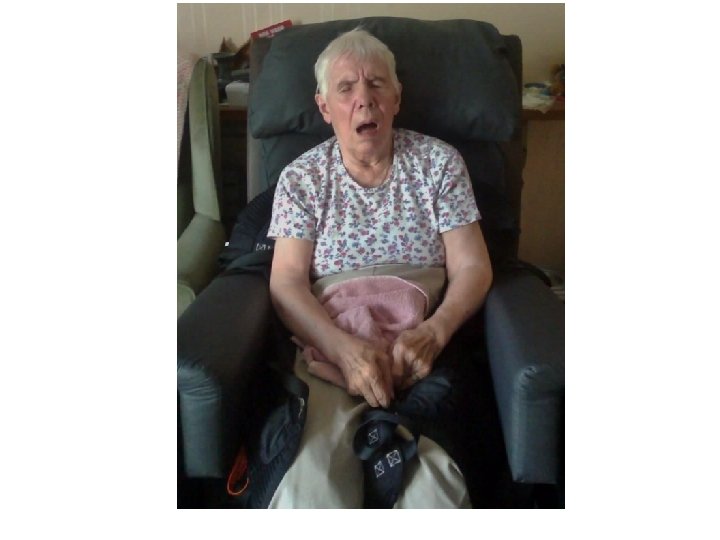
Altered states of consciousness (CHC) • Dependent upon stage of the condition • Significantly reduced blink rate and involuntary eye closure can make it appear that someone is asleep when they are not
Other Significant Care Needs (CHC) • May include management of fatigue, pain and co-existing conditions • Cognitive issues can affect any of the 12 domains, making care more complex
Overall Considerations (CHC) PSP is a progressive condition - the course of the condition can be very unpredictable Constant supervision and/or support may be required 24 hours a day A high level of MDT input and co-ordination from a keyworker is required Palliative care services usually have a key role from an early stage
What Does Quality Care Look Like? • Holistic approach • Right care and support in the right place at the right time • Being understood and supported by people who know about the conditions, so that appropriate and timely referrals can be made when needs change • Access to timely, accurate and relevant information to enable independence and make informed choices
Palliative Care • Improving with awareness of neurological illness • Focus on quality of life • Potential for rapid deterioration – proactive monitoring and symptom management • Include on GP palliative care registers / Gold Standards Framework (GSF) • Referral to specialist palliative care • Need for multi-disciplinary / multi agency care • Preferred Priorities of Care – Advance care planning • Advanced Decisions – Mental Capacity • Continuing Care Assessment • Hospice, respite care, outreach team • Carer support
A Carers View “This disease just takes and then takes again. Is there nothing that it will leave us, so we can have a tiny bit of normality…” (Anon – Health Unlocked 2014)
A Carers View “Sometimes I wonder what will happen if I just can’t do this anymore. And I know that is not an option. But the thing is I love him and sometimes I see him again, just for a moment, before he turns back into this person he has become – it breaks my heart…I am very, very tired and sad. ” (Jill - Health Unlocked 4 Dec 2014)
Further Reading • • https: //www. youtube. com/watch? v=VVWGut. Y 0 xbw https: //www. youtube. com/watch? v=u. U 2 c. LUlh. N 2 s Dudley Moore: An Intimate Portrait by Rena Fruchter Last Dance at the Savoy: Life, Love and Caring for Someone with Progressive Supranuclear Palsy by Kathryn Leigh Scott and Dr. Yvette Bordelon • You, me and PSP by Steve Dagnell – available exclusively from PSPA

For more information • Please look at our website: www. pspassociation. org. uk • or Telephone: 0300 0110 122 • or Email: helpline@pspassociation. org. uk • or Write to us at: The PSP Association PSP House 167 Watling Street West Towcester Northamptonshire NN 12 6 BX
- Slides: 32