Creating Reality From a Nonlinear Perspective The Illusion
- Slides: 24
Creating Reality From a Non-linear Perspective
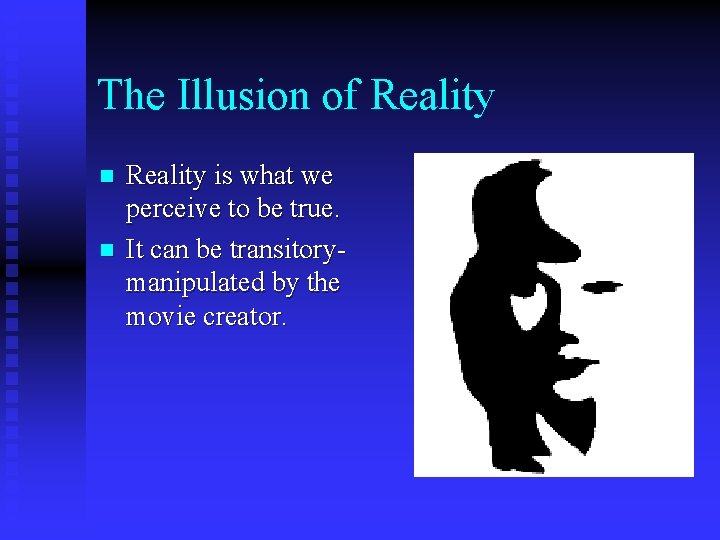
The Illusion of Reality n n Reality is what we perceive to be true. It can be transitorymanipulated by the movie creator.
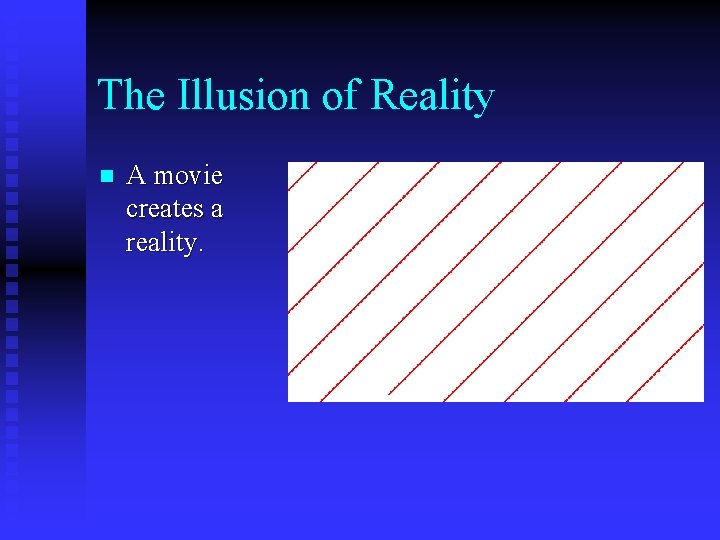
The Illusion of Reality n A movie creates a reality.
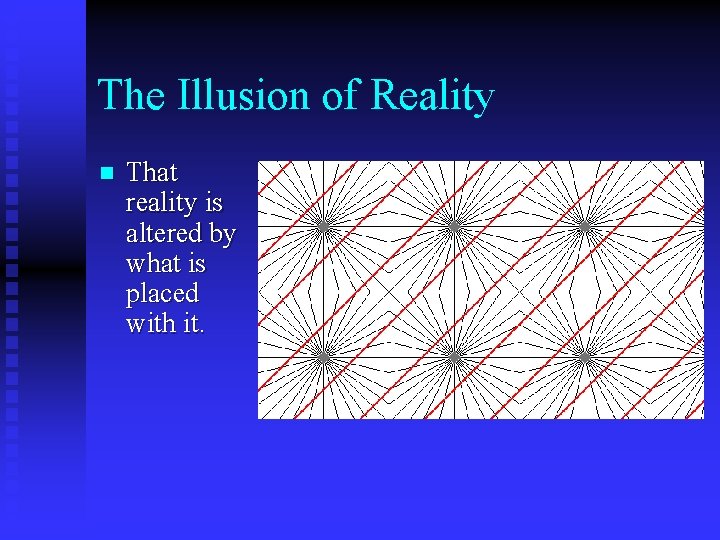
The Illusion of Reality n That reality is altered by what is placed with it.
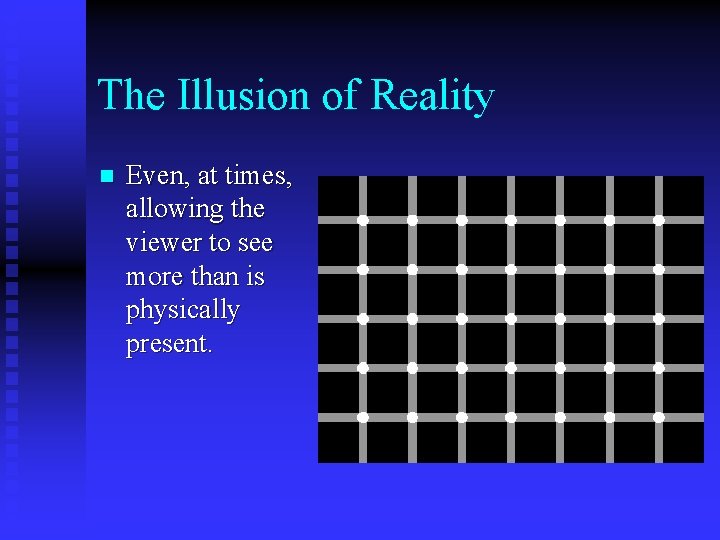
The Illusion of Reality n Even, at times, allowing the viewer to see more than is physically present.
Perspective n Edible, adj. : Good to eat, and wholesome to digest, as a worm to a toad, a toad to a snake, a snake to a pig, a pig to a man, and a man to a worm. -- Ambrose Bierce
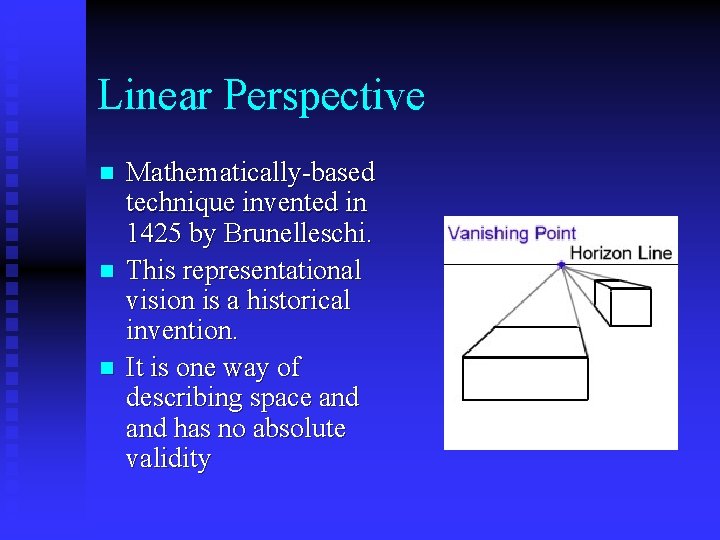
Linear Perspective n n n Mathematically-based technique invented in 1425 by Brunelleschi. This representational vision is a historical invention. It is one way of describing space and has no absolute validity
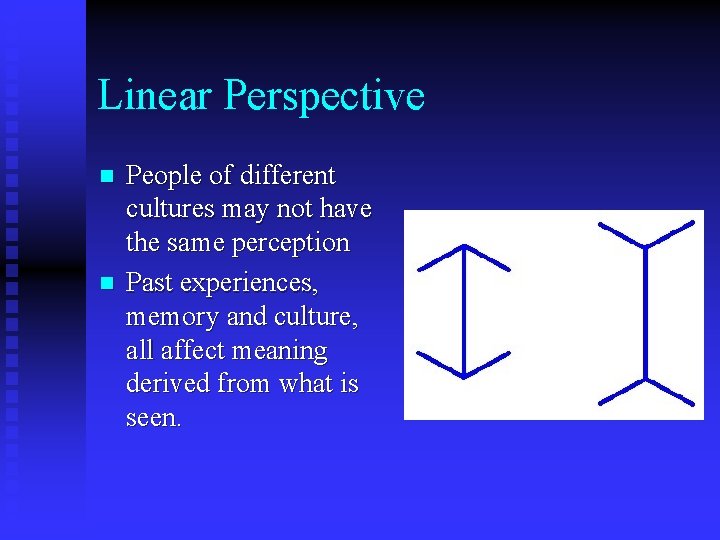
Linear Perspective n n People of different cultures may not have the same perception Past experiences, memory and culture, all affect meaning derived from what is seen.
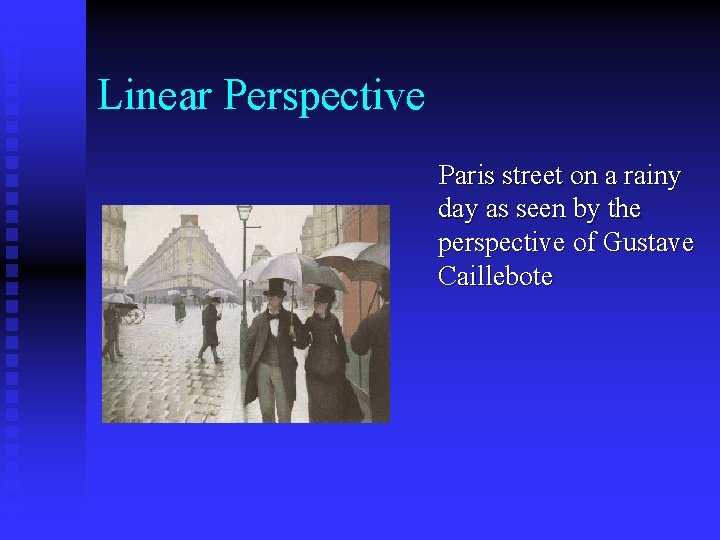
Linear Perspective Paris street on a rainy day as seen by the perspective of Gustave Caillebote
Emotional Perspective n When the perspective is created so that the viewer is in the same dimensional perspective as the movie creator, then we have also affected the viewer’s emotional perspective.
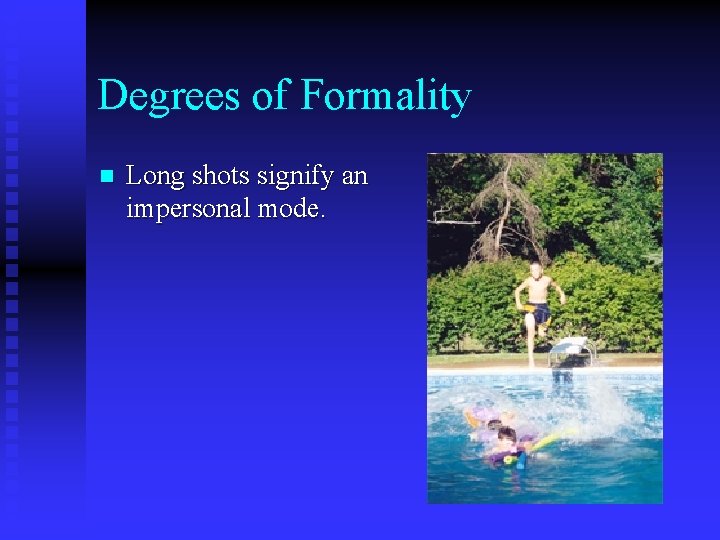
Degrees of Formality n Degrees of formality are reflected in shot sizes. n In camerawork, there are three main kinds of shot size: close-ups, medium shots and long-shots with variations in the degrees of distance in these shots.
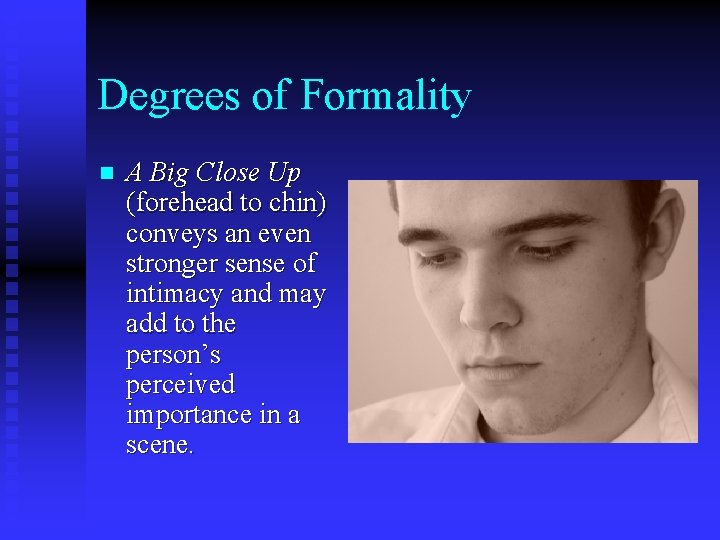
Degrees of Formality n A Big Close Up (forehead to chin) conveys an even stronger sense of intimacy and may add to the person’s perceived importance in a scene.
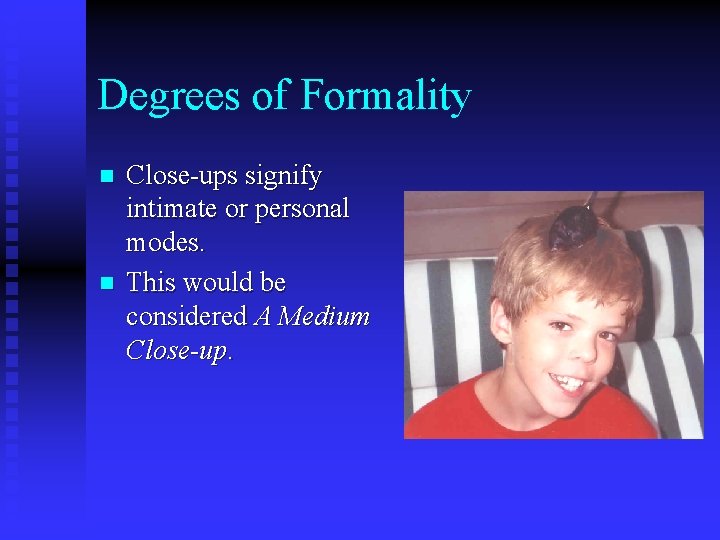
Degrees of Formality n n Close-ups signify intimate or personal modes. This would be considered A Medium Close-up.
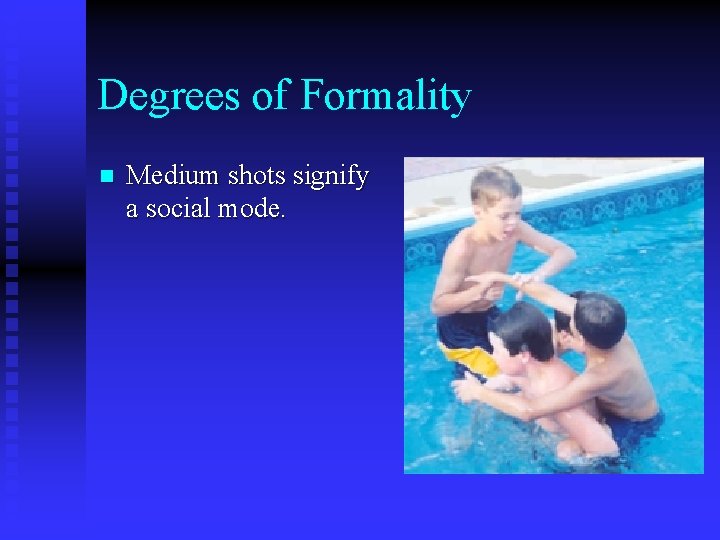
Degrees of Formality n Medium shots signify a social mode.
Degrees of Formality n Long shots signify an impersonal mode.
Emotional Perspective Angles of view are also significant indicators of social distance in movies. n Angles of view also can create an illusion of strength or weakness. n Consistent camera angle may be necessary to create a believable reality for the viewer n
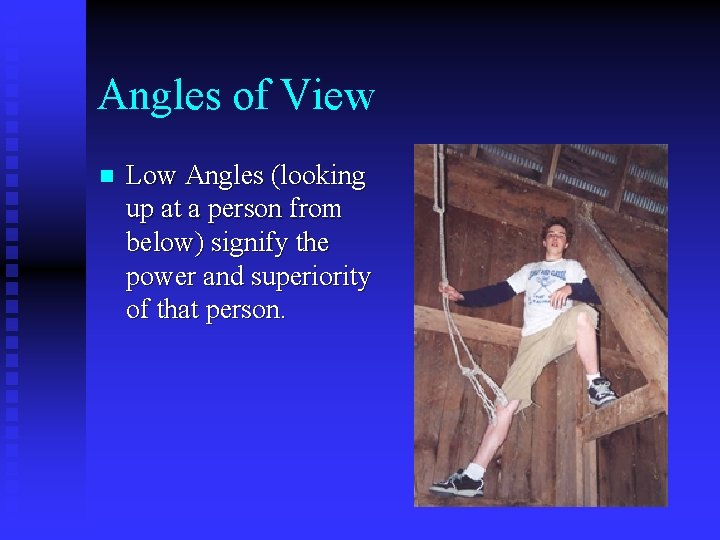
Angles of View n Low Angles (looking up at a person from below) signify the power and superiority of that person.
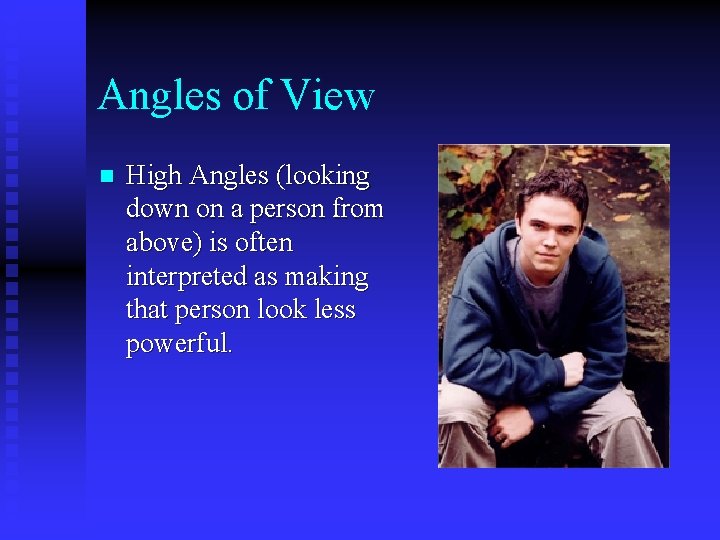
Angles of View n High Angles (looking down on a person from above) is often interpreted as making that person look less powerful.
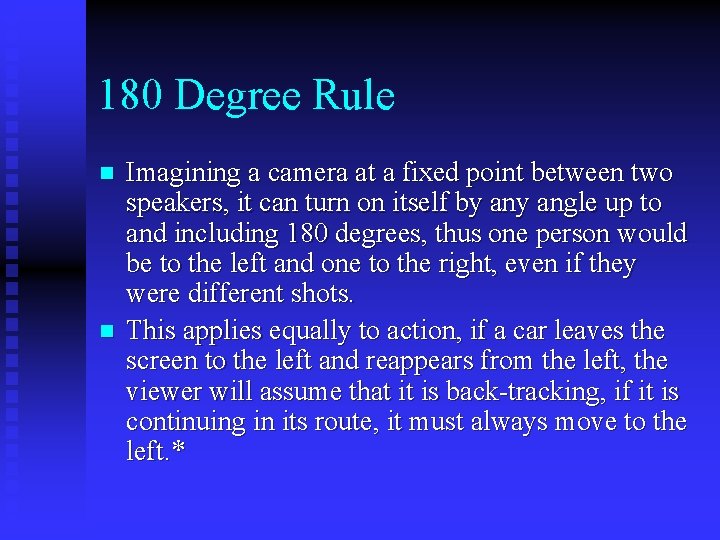
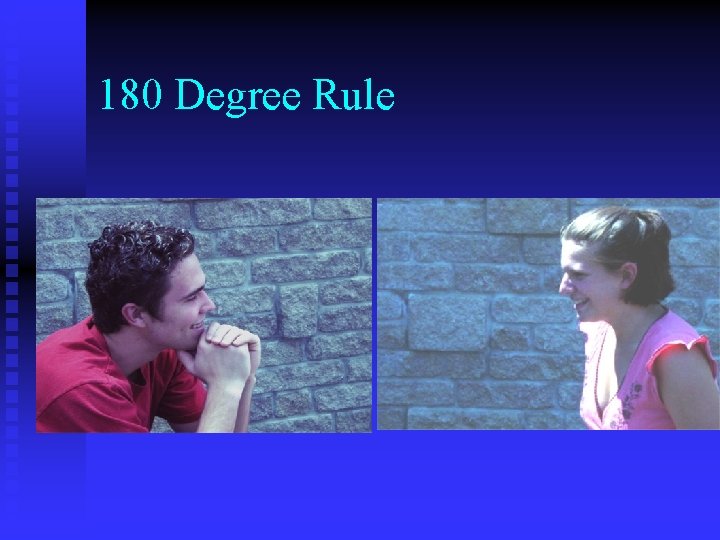
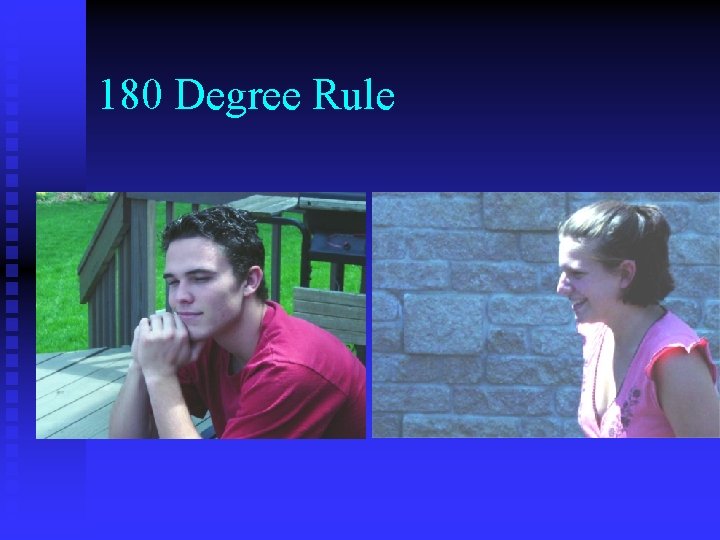
180 Degree Rule n n Imagining a camera at a fixed point between two speakers, it can turn on itself by angle up to and including 180 degrees, thus one person would be to the left and one to the right, even if they were different shots. This applies equally to action, if a car leaves the screen to the left and reappears from the left, the viewer will assume that it is back-tracking, if it is continuing in its route, it must always move to the left. *
180 Degree Rule
180 Degree Rule
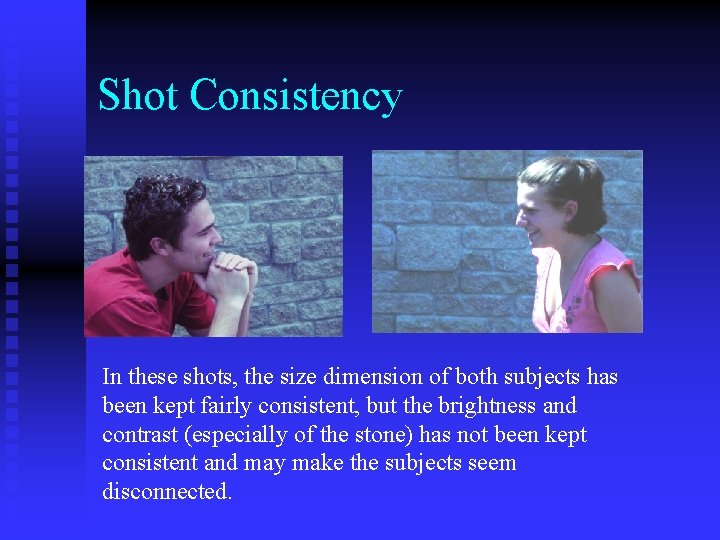
Shot Consistency In these shots, the size dimension of both subjects has been kept fairly consistent, but the brightness and contrast (especially of the stone) has not been kept consistent and may make the subjects seem disconnected.
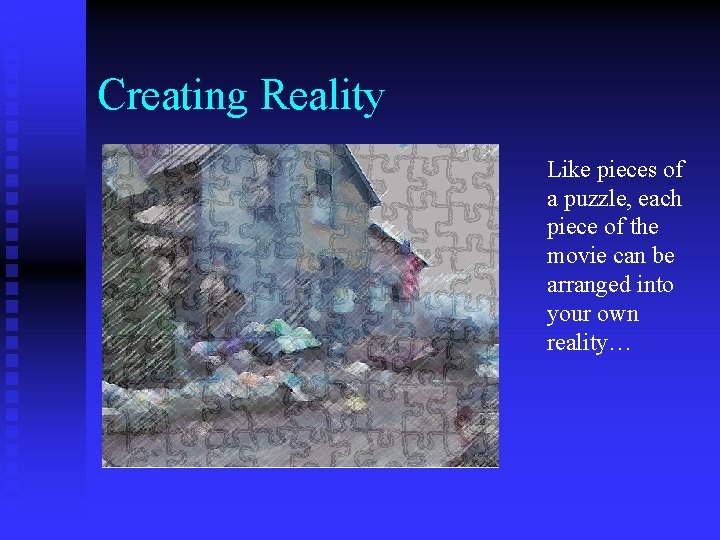
Creating Reality Like pieces of a puzzle, each piece of the movie can be arranged into your own reality…
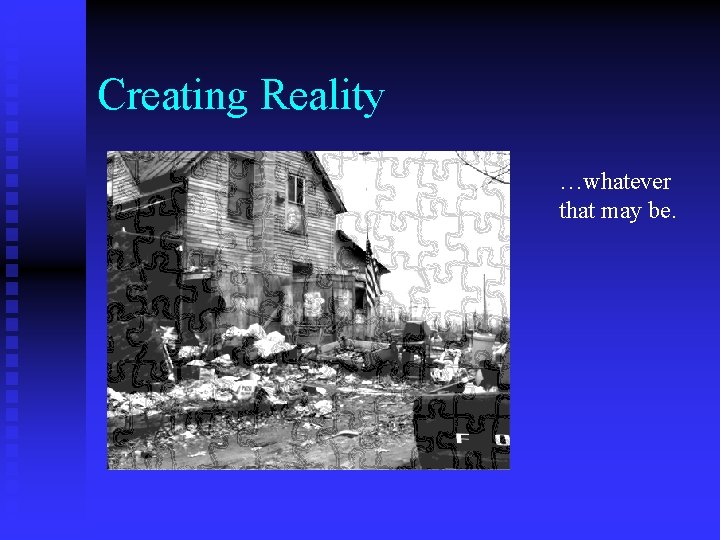
Creating Reality …whatever that may be.