Chris Atherton New prevalence rates emerging 1100 in























- Slides: 67
Chris Atherton
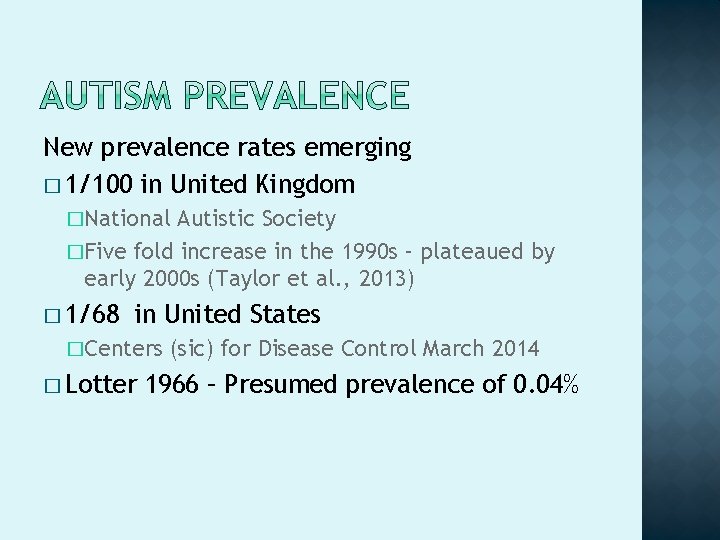
New prevalence rates emerging � 1/100 in United Kingdom �National Autistic Society �Five fold increase in the 1990 s – plateaued by early 2000 s (Taylor et al. , 2013) � 1/68 in United States �Centers � Lotter (sic) for Disease Control March 2014 1966 – Presumed prevalence of 0. 04%
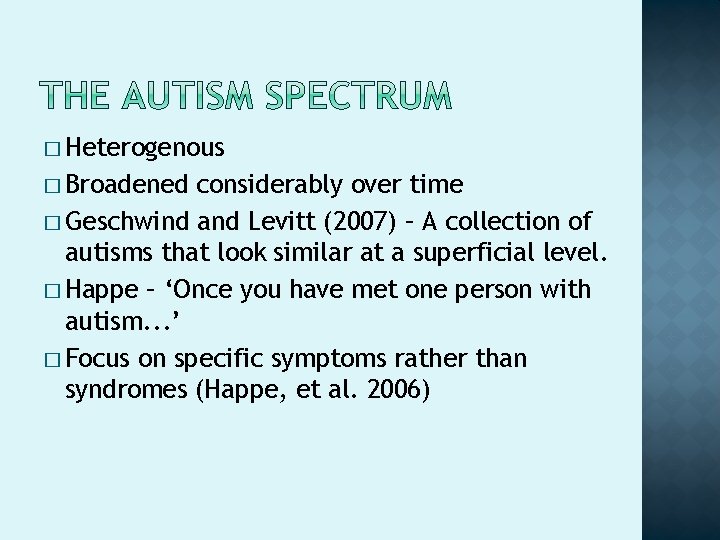
� Heterogenous � Broadened considerably over time � Geschwind and Levitt (2007) – A collection of autisms that look similar at a superficial level. � Happe – ‘Once you have met one person with autism. . . ’ � Focus on specific symptoms rather than syndromes (Happe, et al. 2006)
� 20% have rare genetic differences � Siblings are at higher risk (Ozonoff et al. , 2011)
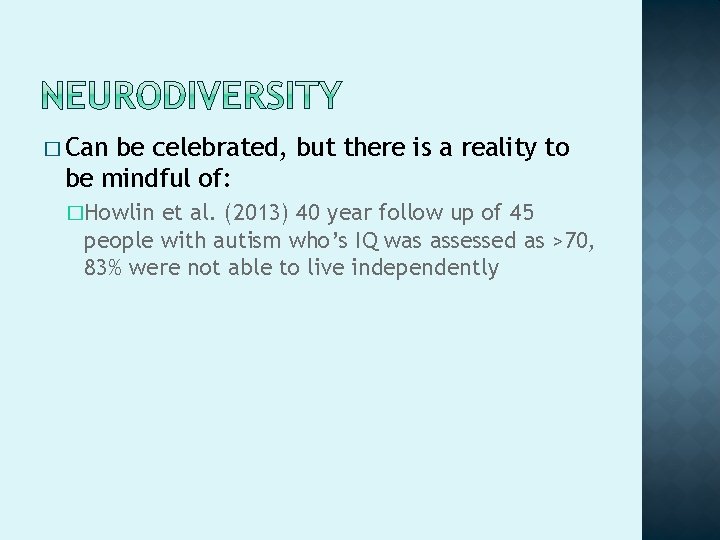
� Can be celebrated, but there is a reality to be mindful of: �Howlin et al. (2013) 40 year follow up of 45 people with autism who’s IQ was assessed as >70, 83% were not able to live independently
� Measles Mumps and Rubella Vacccine � MMR was implicated by Andrew Wakefield in a 1998 medical journal called Lancet. This paper was retracted in 2010, judged to be flawed and fraudulent, and Wakefield was struck off the doctor’s register after he was found guilty of professional misconduct and dishonesty. � Many subsequent large scale studies have failed to link the MMR to autism. � Vaccine rates struggle to reach pre-scare levels (The Psychologist, October 2014).
Refrigerator Mothers
Infantile Autism (1964)
� Infantile Autism (1964) � Debunked the refrigerator mother hypothesis � Identified autism as a cognitive dysfunction � ‘A single critical disability’ – impaired ability to relate new stimuli to remembered experience � Leads to inability to draw meaning from experience and to integrate sensations into a comprehensible whole � Inspired a generation of research into autistic cognition. � Rimland himself pursued possible links between autism and mercury poisoning through vaccination – debunked.
Wendy Lawson
Kurt Koffka, Father of Gestalt Psychology
� Hermelin and O’Connor (1970) � ‘what to went ship sea. ’ � ‘what ship went to sea. ’ � Non autistic children made fewer errors if the words made up meaningful sentences. Recall was much better in non autistic children. � Autistic children appeared to repeat the words without considering the meaning. � Unaware of Rimland’s book. � Had a Ph. D student called Uta Frith. . .
� Ten homographs �‘He played lead guitar’ �‘The box was made of lead. ’ �Children with autism found difficulty in ascribing meaning – identified by consistent pronunciation regardless of whether the sentence suggested crying or ripping. Autistic children tended to say ‘leed’. The early sentence context had not been taken into account. (Replicated by Happe, 1997) � Not an inability to extract meaning.
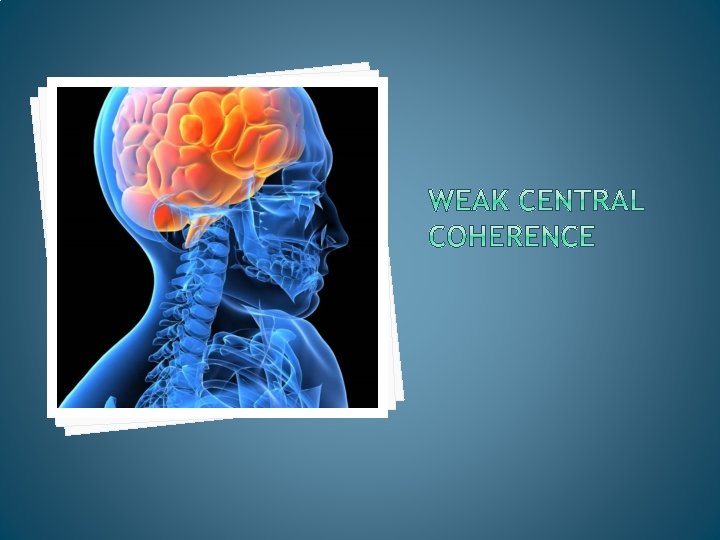
� Subsequent proposal by Frith (1989) of ‘weak central coherence’ – focus on detail and failure to draw information together to extract meaning.
� Strong coherence can be a hindrance (Shah and Frith, 1993) � Segmented versus un-segmented design � Segmented – Non autistic average 45 s � Un-segmented – Non autistic average 95 s � Segmented – Autistic average 45 s � Un-segmented – Autistic average 65 s � Autistic group presented strength in their perceptual reasoning.
� Concerns the ability to pull information together, for higher level cohesion � The inability to draw meaning as a ‘whole’. � Attempt to describe a range of non-social features of autism by proposal of a single cognitive mechanism. � Unusual cognitive strengths suggested by autistic behaviours: restricted interest, repetition, hypersensitivity, savant ability. � Uta Frith’s proposal: � ‘in an autistic brain, while the ability to discern a wide variety of things about the world is strong, the drive to make these various things cohere is weak. ’
Central coherence is descriptive Strength: �Language and Communication �Social Interaction Both are nuanced and contextually dependent Weakness: �Not particularly testable / falsifiable �Not part of mainstream cognitive psychology
Bayesian Perspective � The reduced influence of prior knowledge. � Information is inherently unreliable and therefore needs to be used in the context of previous knowledge (a mathematical concept applied in statistics) � Used increasingly in the context of perception – sensory information is also ambiguous and inherently unreliable.
� Experience determines likelihood � This restricts the possibilities we consider � Bayesian perspective proposes that autistic people have a broader categorisation of prior experience – past experience therefore has a less restrictive influence on perception of the present.
� ‘The curse of knowledge. ’ � Prior knowledge – experience of rectangular shapes in a 3 dimensional world. � People with autism were less susceptible to this effect.
� Rimland – Differences in information processing must come from differences in brain functioning � Under-connectivity (Wass, 2011) � Growing evidence for atypical brain connectivity in autism
� Main purpose of the nervous system is to anticipate what will happen next – survival instinct. � Minimising errors in this purpose is important – we encode how precise our predictions are by comparing our expectations with actual outcomes.
� Two interpretations: � Friston et al. (2013) – Precision is reduced and therefore prediction is weaker, so perception is dominated by the information at hand. � Van de Cruys et al. (2013) – Precision is heightened in prediction errors – small deviations from expectation becomes a significant error.
� Francesca Happe (1999) � Proposed a normal distribution of preference or bias. � Two extremes of a continuum: � Detail focussed strategy � Opposite preference � Suggestion that typically, detail focus would be typical of the autism phenotype. � Evidence that 50% of fathers, 30% of mothers of autistic children were stronger in detail focussed processing style. Not replicated in a sample of parents of dyslexic children. � Briskman, Happe & Frith 2001; Happe, Briskman & Frith, 2001)
� ‘Part of theory of autism’ Professor Francesca Happe � Leo Kanner - Inability to experience wholes without full attention to constituent parts – Distressed by tiny changes � Difference in central coherence in ASD not a deficit. � Differences found in non-autistic individuals.
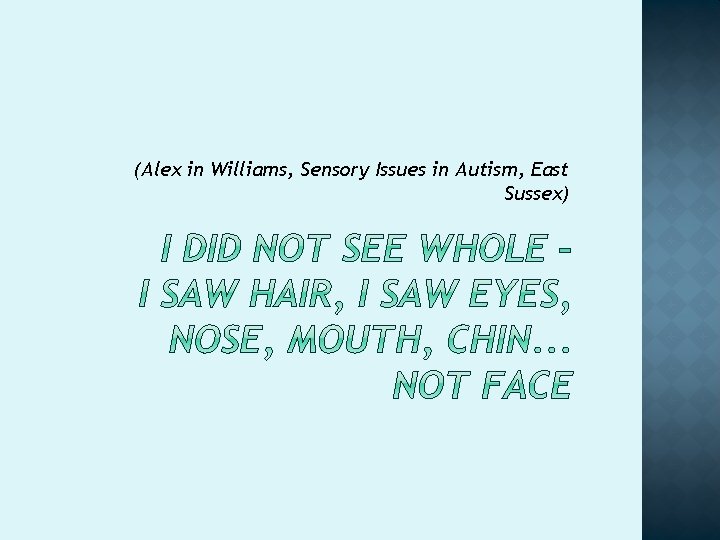
(Alex in Williams, Sensory Issues in Autism, East Sussex)
� Valuable Object
� Theory of Mind (Happé, 1994) � Central Coherence (Frith, 1989, 1994) � Executive Function (Hill, 2004) � Extreme Male Brain (Baron-Cohen, 2003)
� ‘Once you have met one person with Autism, you have met one person with autism’
� Not actually a ‘theory’! � Hugely significant feature of human cognition � Develops � Ability by or around the age of 4. to attribute mental states to others.
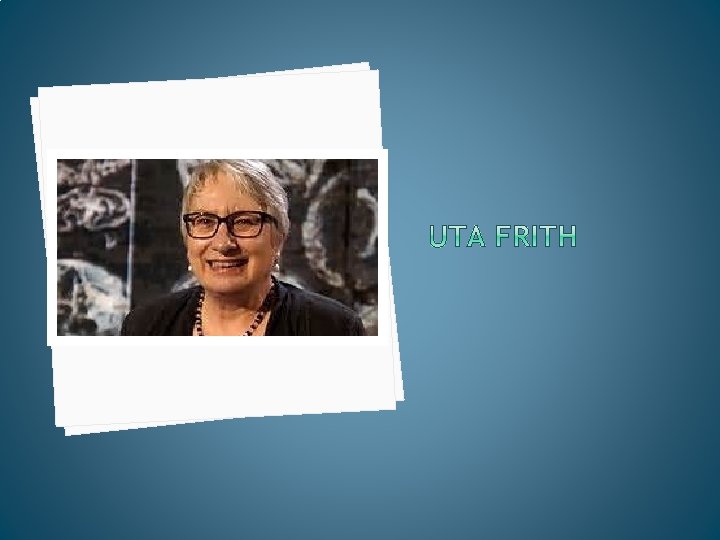
� Uta Frith � Professor of Cognitive Development London � Mind-blindness � Central Coherence
� Recognition of thoughts and feelings � ‘Mentalising’ Frith � Automatic ability to attribute mental states to yourself and other people. � To recognise � To communicate � To influence � Uniquely human?
� Hunt and flee in packs � Choose mates � Nurture young � Recognise others � Recognise emotions � Recognise status � Make alliances
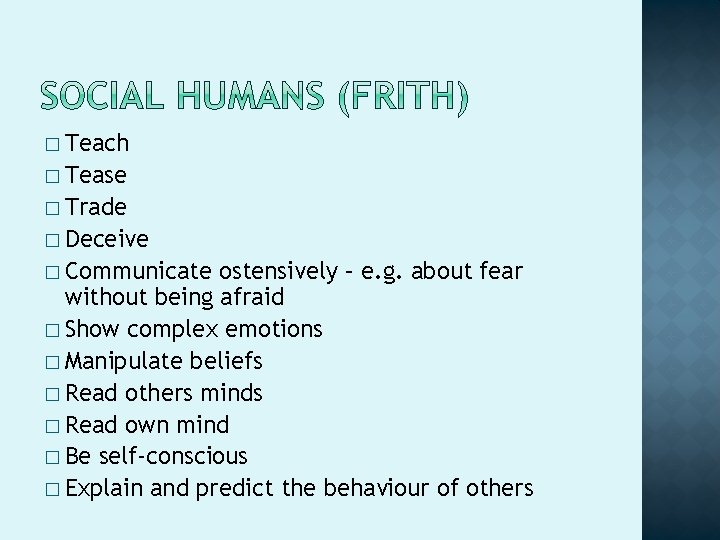
� Teach � Tease � Trade � Deceive � Communicate ostensively – e. g. about fear without being afraid � Show complex emotions � Manipulate beliefs � Read others minds � Read own mind � Be self-conscious � Explain and predict the behaviour of others
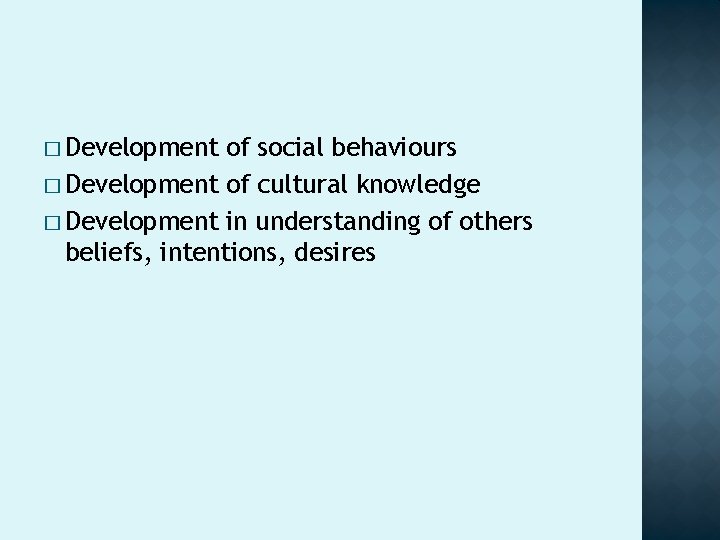
� Development of social behaviours � Development of cultural knowledge � Development in understanding of others beliefs, intentions, desires
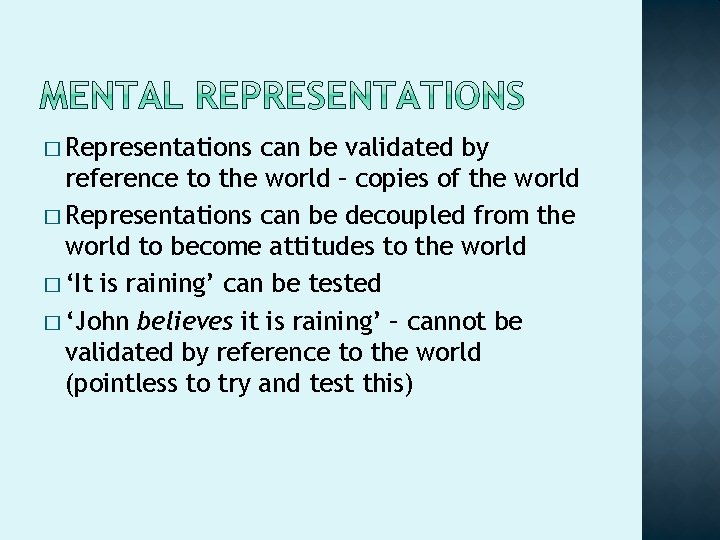
� Representations can be validated by reference to the world – copies of the world � Representations can be decoupled from the world to become attitudes to the world � ‘It is raining’ can be tested � ‘John believes it is raining’ – cannot be validated by reference to the world (pointless to try and test this)
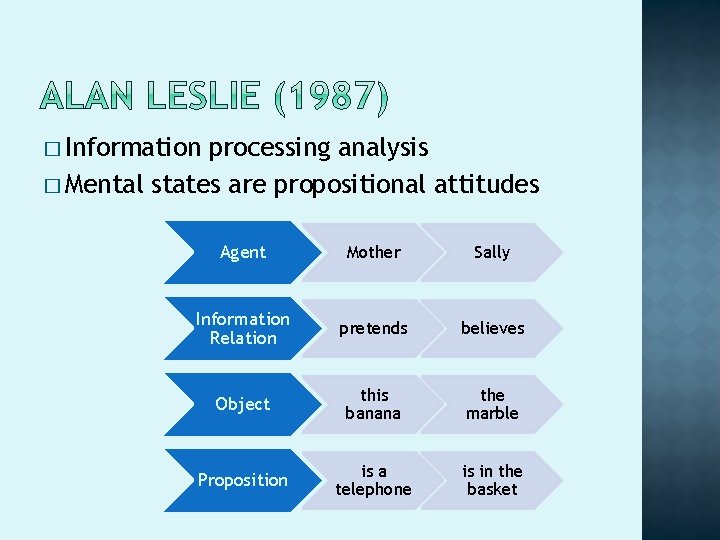
� Information processing analysis � Mental states are propositional attitudes Agent Mother Sally Information Relation pretends believes Object this banana the marble Proposition is a telephone is in the basket
� Develop at around the age of two � Representation of propositional attitudes must mark � Agent: who has the mental state? � Information Relation: what sort of attitude does the agent have? (belief, hope, pretend, dread) � “Not being able to understand that a person pretends had the same cause as not being able to understand that another person ‘intends’, ‘knows’, or ‘believes’. ” (Frith, 2012)
� John believes it is raining. � Agent – John � Information relation – belief about the world � Why does this benefit us? � Prediction – John is going to take my umbrella!!!
� Without reference to others psychological states, the behaviour of others becomes puzzling. � Social impairment = Theory of Mind. � False belief task paradigm was established – The Sally Anne Test (Baron-Cohen, Leslie & Frith, 1985).
� What is the neurological basis? � What if the neural connection was broken or faulty? What would that look like?
�Sally-Anne Test �http: //www. youtube. com/watch? v=qbk 3 HQ 6 he. Gk �Children at age 5 will pass this easily �Happe (1995) – Meta-analysis of false belief tests looking at probability of passing. �Autistic participants showed a 5 year delay, however almost all succeed on this task eventually. �Considerable developmental delay.
� Preventing �Physical harm from others means �Mental means
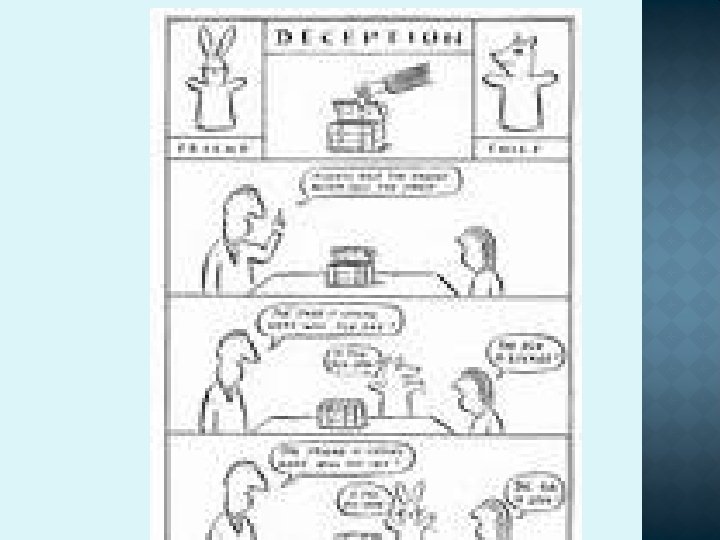
� Sabotage – there is a key to lock the box � Deception – there is no key to lock the box � Thief calls from a distance in the deception test – ‘Is that box locked? If it is I’m not going to come all the way over for the sweet’ � Many autistic children will fail the deception test and pass the sabotage test.
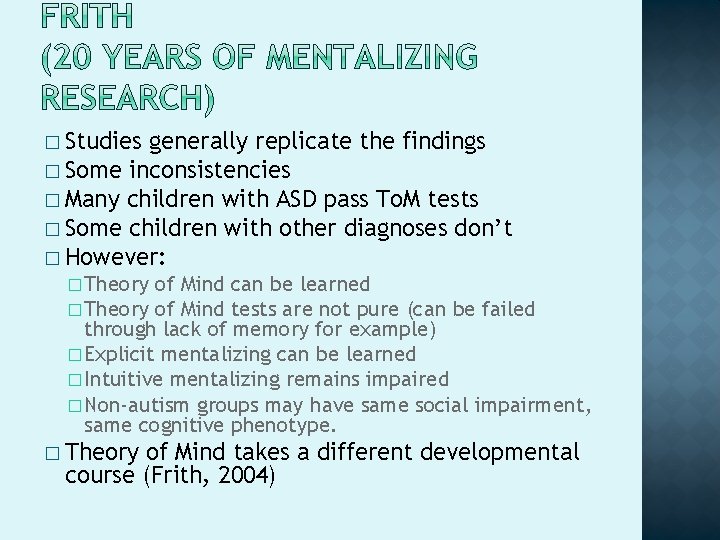
� Studies generally replicate the findings � Some inconsistencies � Many children with ASD pass To. M tests � Some children with other diagnoses don’t � However: � Theory of Mind can be learned of Mind tests are not pure (can be failed through lack of memory for example) � Explicit mentalizing can be learned � Intuitive mentalizing remains impaired � Non-autism groups may have same social impairment, same cognitive phenotype. � Theory of Mind takes a different developmental course (Frith, 2004)
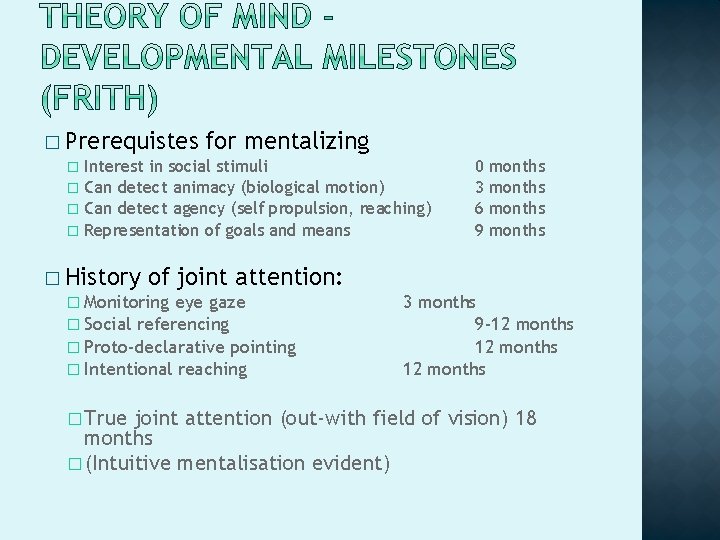
� Prerequistes for mentalizing � Interest in social stimuli � Can detect animacy (biological motion) � Can detect agency (self propulsion, reaching) � Representation of goals and means � History of joint attention: � Monitoring eye gaze � Social referencing � Proto-declarative pointing � Intentional reaching � True 0 3 6 9 months 3 months 9 -12 months joint attention (out-with field of vision) 18 months � (Intuitive mentalisation evident)
� From 18 months: �Pretend play �Word learning by intention monitoring �Understanding seeing / knowing �Deception �Understanding intention �Implicit false belief
� Age 4 -6 years �Justifying false belief by pointing out misleading reasons �Understanding higher order mental states � Sally Anne Test is a test of Explicit not Intuitive Mentalization � (1 in 5 passed in Baron-Cohen et al 1985)
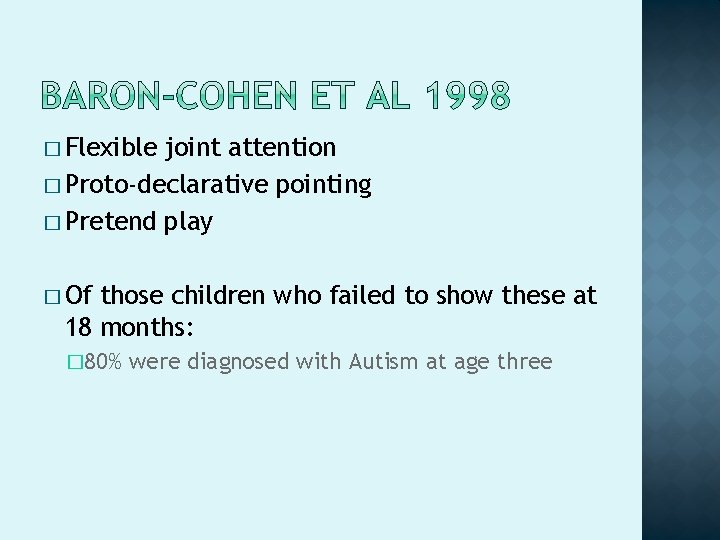
� Flexible joint attention � Proto-declarative pointing � Pretend play � Of those children who failed to show these at 18 months: � 80% were diagnosed with Autism at age three
� Castelli, Frith, Happe & Frith 2002 � Control Group � ASD Group (Passed Sally Anne Test) � Appropriate intentionality descriptions in control group hardly every replicated in ASD group. � E. g. http: //www. youtube. com/watch? v=n. Sk. KMTq. Fx. Y � 30 minutes.
� Medial prefrontal cortex � Superior temporal sulcus � Amygdala / Temporal poles � And others. . . Fusiform gyrus, cerebellum � Components show strong activity in the normal brain and weak connectivity in the ASD brain �Castelli et al 2000
� Egocentrism � Emotional dysregulation (inability to monitor internal mental representations) � Inability to switch between different perspectives � Explains some social impairments - specific and novel predictions derived from lack of intuitive Theory of Mind � Not sufficient to explain social impairments in their entirety. � Not specific to ASD, specific cognitive phenotype that is prevalent in people with ASD.
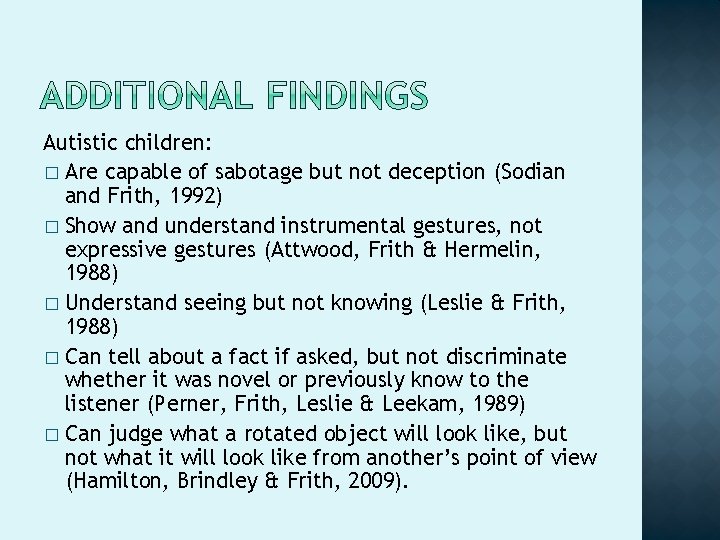
Autistic children: � Are capable of sabotage but not deception (Sodian and Frith, 1992) � Show and understand instrumental gestures, not expressive gestures (Attwood, Frith & Hermelin, 1988) � Understand seeing but not knowing (Leslie & Frith, 1988) � Can tell about a fact if asked, but not discriminate whether it was novel or previously know to the listener (Perner, Frith, Leslie & Leekam, 1989) � Can judge what a rotated object will look like, but not what it will look like from another’s point of view (Hamilton, Brindley & Frith, 2009).
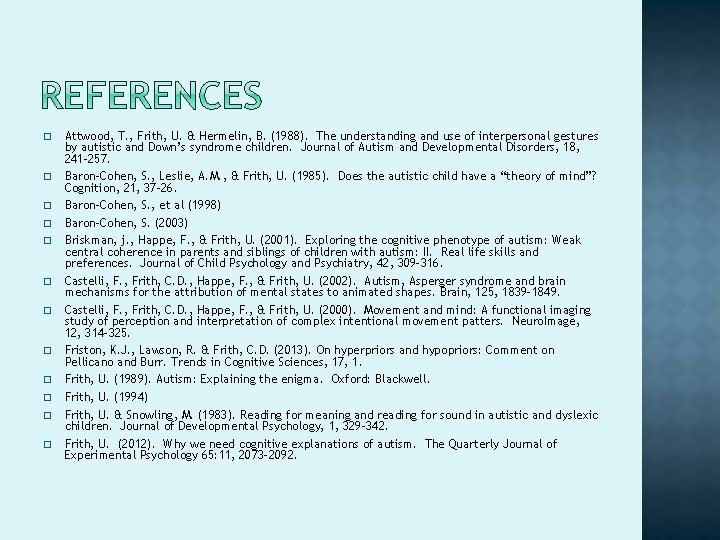
� � � Attwood, T. , Frith, U. & Hermelin, B. (1988). The understanding and use of interpersonal gestures by autistic and Down’s syndrome children. Journal of Autism and Developmental Disorders, 18, 241 -257. Baron-Cohen, S. , Leslie, A. M. , & Frith, U. (1985). Does the autistic child have a “theory of mind”? Cognition, 21, 37 -26. Baron-Cohen, S. , et al (1998) Baron-Cohen, S. (2003) Briskman, j. , Happe, F. , & Frith, U. (2001). Exploring the cognitive phenotype of autism: Weak central coherence in parents and siblings of children with autism: II. Real life skills and preferences. Journal of Child Psychology and Psychiatry, 42, 309 -316. Castelli, F. , Frith, C. D. , Happe, F. , & Frith, U. (2002). Autism, Asperger syndrome and brain mechanisms for the attribution of mental states to animated shapes. Brain, 125, 1839 -1849. Castelli, F. , Frith, C. D. , Happe, F. , & Frith, U. (2000). Movement and mind: A functional imaging study of perception and interpretation of complex intentional movement patters. Neuro. Image, 12, 314 -325. Friston, K. J. , Lawson, R. & Frith, C. D. (2013). On hyperpriors and hypopriors: Comment on Pellicano and Burr. Trends in Cognitive Sciences, 17, 1. Frith, U. (1989). Autism: Explaining the enigma. Oxford: Blackwell. Frith, U. (1994) Frith, U. & Snowling, M. (1983). Reading for meaning and reading for sound in autistic and dyslexic children. Journal of Developmental Psychology, 1, 329 -342. Frith, U. (2012). Why we need cognitive explanations of autism. The Quarterly Journal of Experimental Psychology 65: 11, 2073 -2092.
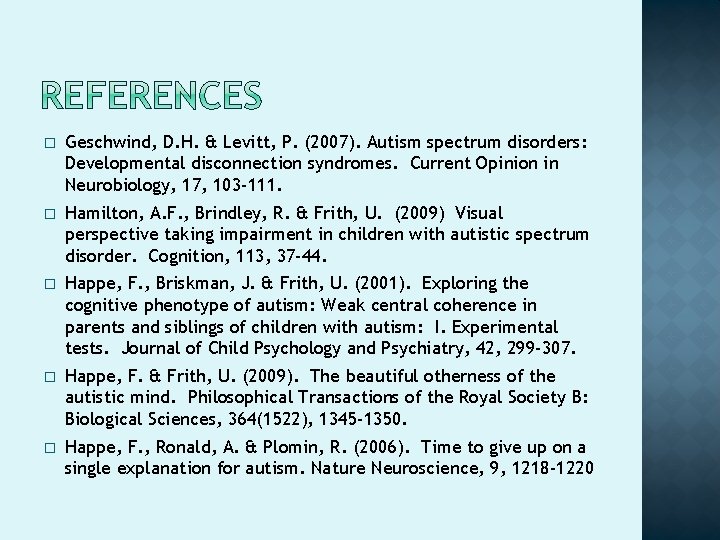
� Geschwind, D. H. & Levitt, P. (2007). Autism spectrum disorders: Developmental disconnection syndromes. Current Opinion in Neurobiology, 17, 103 -111. � Hamilton, A. F. , Brindley, R. & Frith, U. (2009) Visual perspective taking impairment in children with autistic spectrum disorder. Cognition, 113, 37 -44. � Happe, F. , Briskman, J. & Frith, U. (2001). Exploring the cognitive phenotype of autism: Weak central coherence in parents and siblings of children with autism: I. Experimental tests. Journal of Child Psychology and Psychiatry, 42, 299 -307. � Happe, F. & Frith, U. (2009). The beautiful otherness of the autistic mind. Philosophical Transactions of the Royal Society B: Biological Sciences, 364(1522), 1345 -1350. � Happe, F. , Ronald, A. & Plomin, R. (2006). Time to give up on a single explanation for autism. Nature Neuroscience, 9, 1218 -1220
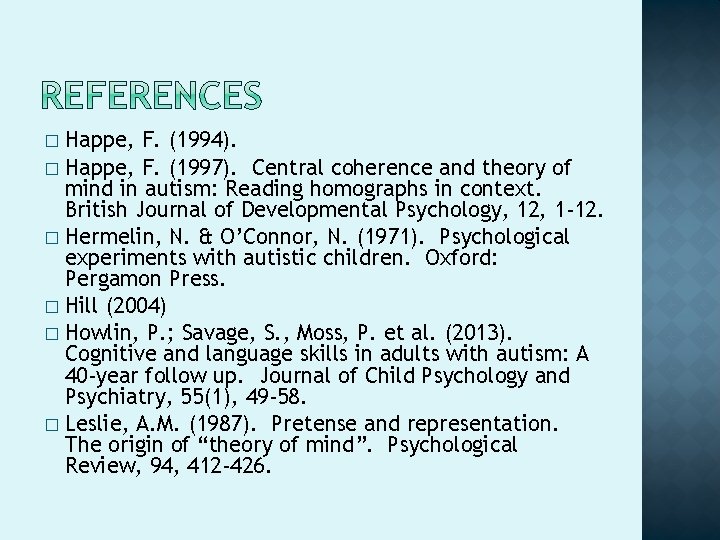
Happe, F. (1994). � Happe, F. (1997). Central coherence and theory of mind in autism: Reading homographs in context. British Journal of Developmental Psychology, 12, 1 -12. � Hermelin, N. & O’Connor, N. (1971). Psychological experiments with autistic children. Oxford: Pergamon Press. � Hill (2004) � Howlin, P. ; Savage, S. , Moss, P. et al. (2013). Cognitive and language skills in adults with autism: A 40 -year follow up. Journal of Child Psychology and Psychiatry, 55(1), 49 -58. � Leslie, A. M. (1987). Pretense and representation. The origin of “theory of mind”. Psychological Review, 94, 412 -426. �
� � � � Leslie, A. M. , & Frith, U. (1988). Autistic children’s understanding of seeing, knowing and believing. British Journal of Developmental Psychology, 6, 315 -324. Lotter, V. (1966) Epidemiology of autistic conditions in young children. Social Psychiatry and Psychiatric Epidemology, 1, 124 -135. Mitchell, P. , Mottron, L. , Soulieres, I. & Ropar, D. (2010). Susceptibility to the Shepard illusion in participants with autism: Reduced top-down influences within perception? Autism Research, 3, 113 -119. Ozonoff, S. , Young, G. S. , Carter, A. et al. (2011) Recurrence risk for autism spectrum disorders. Pediatrics. Doi: 10. 1542/peds. 2010 -2825. Pellicano, E. & Burr, D. (2012). When the world becomes ‘too real’: A Bayesian explanation of autistic perception. Trends in Cognitive Sciences, 16, 504 -510. Perner, J. , Frith, U. , Leslie, A. M. , & Leekam, S. (1989) Explorations of the autistic child’s theory of mind: Knowledge, belief and communication. Child Development, 60, 689 -700. Rimland, B. (1964) Infantile Autism: The syndrome and its implications for a neural theory of behaviour. Chicago: Appelton. Century-Crofts.
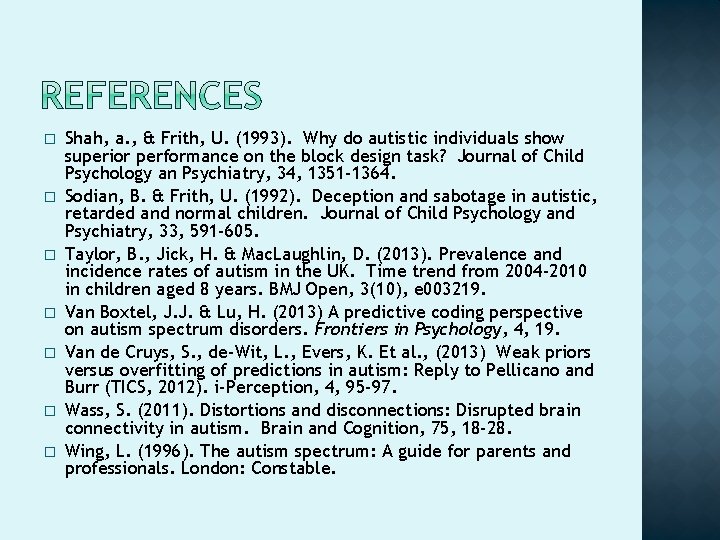
� � � � Shah, a. , & Frith, U. (1993). Why do autistic individuals show superior performance on the block design task? Journal of Child Psychology an Psychiatry, 34, 1351 -1364. Sodian, B. & Frith, U. (1992). Deception and sabotage in autistic, retarded and normal children. Journal of Child Psychology and Psychiatry, 33, 591 -605. Taylor, B. , Jick, H. & Mac. Laughlin, D. (2013). Prevalence and incidence rates of autism in the UK. Time trend from 2004 -2010 in children aged 8 years. BMJ Open, 3(10), e 003219. Van Boxtel, J. J. & Lu, H. (2013) A predictive coding perspective on autism spectrum disorders. Frontiers in Psychology, 4, 19. Van de Cruys, S. , de-Wit, L. , Evers, K. Et al. , (2013) Weak priors versus overfitting of predictions in autism: Reply to Pellicano and Burr (TICS, 2012). i-Perception, 4, 95 -97. Wass, S. (2011). Distortions and disconnections: Disrupted brain connectivity in autism. Brain and Cognition, 75, 18 -28. Wing, L. (1996). The autism spectrum: A guide for parents and professionals. London: Constable.