Chapter 2 Atoms and Elements Skip Scanning Tunneling
- Slides: 58
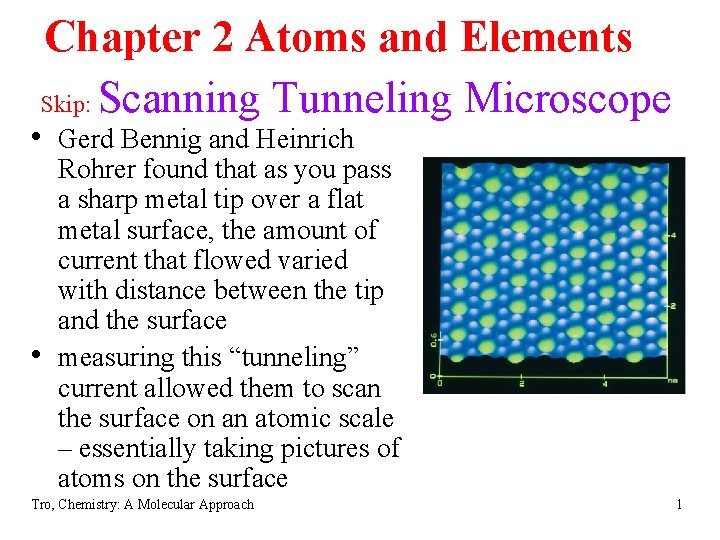
Chapter 2 Atoms and Elements Skip: Scanning Tunneling Microscope • Gerd Bennig and Heinrich • Rohrer found that as you pass a sharp metal tip over a flat metal surface, the amount of current that flowed varied with distance between the tip and the surface measuring this “tunneling” current allowed them to scan the surface on an atomic scale – essentially taking pictures of atoms on the surface Tro, Chemistry: A Molecular Approach 1
Read Early Philosophy of Matter • Some philosophers believed that matter had an ultimate, tiny, indivisible particle ü Leucippus and Democritus • Other philosophers believed that matter was infinitely divisible ü Plato and Aristotle • Since there was no experimental way of proving who was correct, the best debater was the person assumed correct, i. e. , Aristotle Tro, Chemistry: A Molecular Approach 2
Scientific Revolution • in the late 16 th century, the scientific approach to • understanding nature became established for the next 150+ years, observations about nature were made that could not easily be explained by the infinitely divisible matter concept Tro, Chemistry: A Molecular Approach 3
Law of Conservation of Mass • in a chemical reaction, matter • is neither created nor destroyed total mass of the materials you have before the reaction must equal the total mass of the materials you have at the end ütotal mass of reactants = total mass of products Tro, Chemistry: A Molecular Approach Antoine Lavoisier 1743 -1794 4
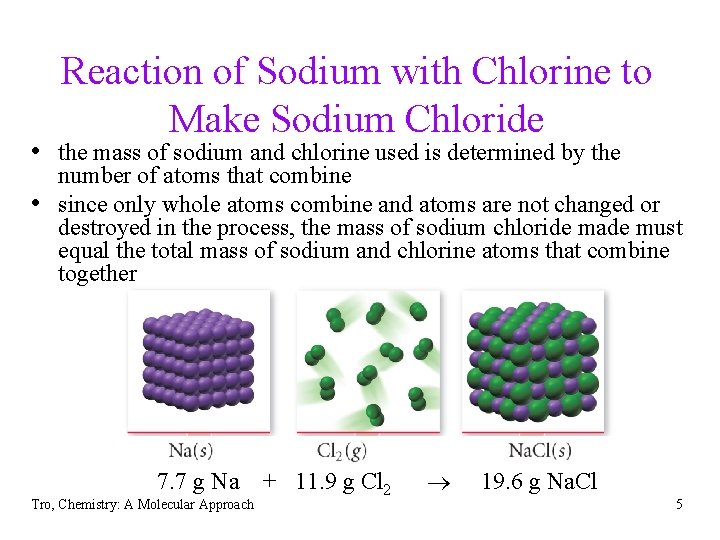
Reaction of Sodium with Chlorine to Make Sodium Chloride • the mass of sodium and chlorine used is determined by the • number of atoms that combine since only whole atoms combine and atoms are not changed or destroyed in the process, the mass of sodium chloride made must equal the total mass of sodium and chlorine atoms that combine together 7. 7 g Na Tro, Chemistry: A Molecular Approach + 11. 9 g Cl 2 19. 6 g Na. Cl 5
Law of Definite Proportions • All samples of a given compound, regardless of their source or how they Joseph Proust were prepared, have the same 1754 -1826 proportions of their constituent elements Tro, Chemistry: A Molecular Approach 6
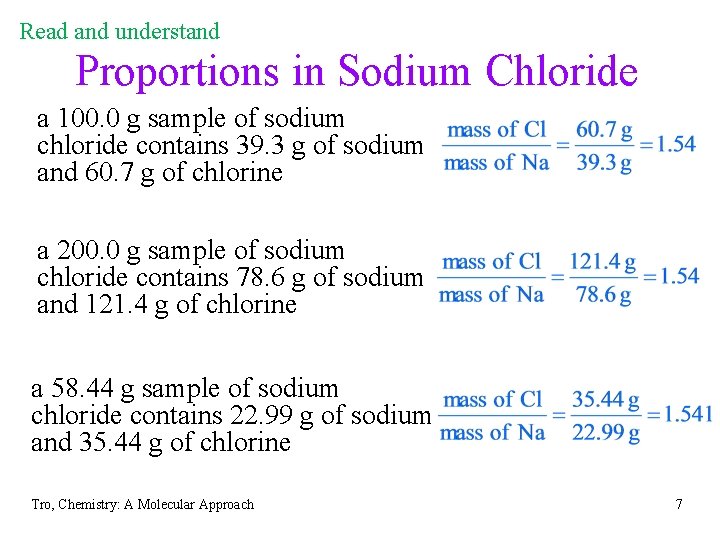
Read and understand Proportions in Sodium Chloride a 100. 0 g sample of sodium chloride contains 39. 3 g of sodium and 60. 7 g of chlorine a 200. 0 g sample of sodium chloride contains 78. 6 g of sodium and 121. 4 g of chlorine a 58. 44 g sample of sodium chloride contains 22. 99 g of sodium and 35. 44 g of chlorine Tro, Chemistry: A Molecular Approach 7
Law of Multiple Proportions • When two elements, (call them A and B), form two different compounds, the masses of B that combine with 1 g of A can be expressed as a ratio of small, whole numbers Tro, Chemistry: A Molecular Approach John Dalton 1766 -1844 8
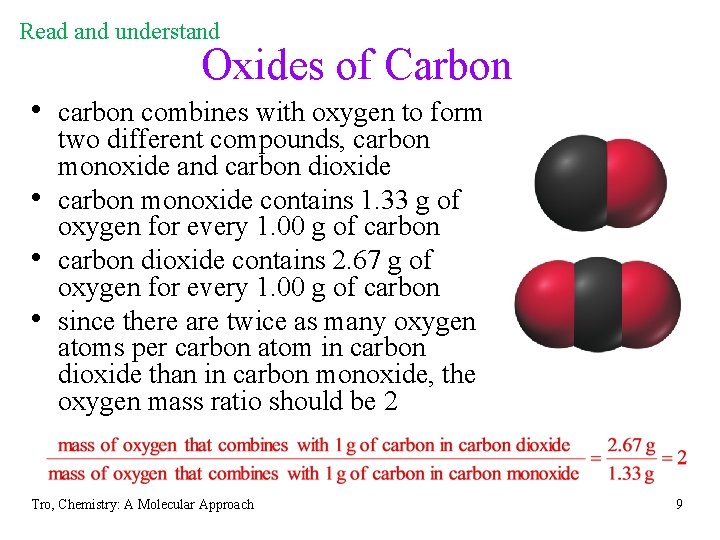
Read and understand Oxides of Carbon • carbon combines with oxygen to form • • • two different compounds, carbon monoxide and carbon dioxide carbon monoxide contains 1. 33 g of oxygen for every 1. 00 g of carbon dioxide contains 2. 67 g of oxygen for every 1. 00 g of carbon since there are twice as many oxygen atoms per carbon atom in carbon dioxide than in carbon monoxide, the oxygen mass ratio should be 2 Tro, Chemistry: A Molecular Approach 9
Dalton’s Atomic Theory • 1) 2) 3) 4) Dalton proposed a theory of matter based on it having ultimate, indivisible particles to explain these laws Each element is composed of tiny, indestructible particles called atoms All atoms of a given element have the same mass and other properties that distinguish them from atoms of other elements Atoms combine in simple, whole-number ratios to form molecules of compounds In a chemical reaction, atoms of one element cannot change into atoms of another element ü they simply rearrange the way they are attached Tro, Chemistry: A Molecular Approach 10
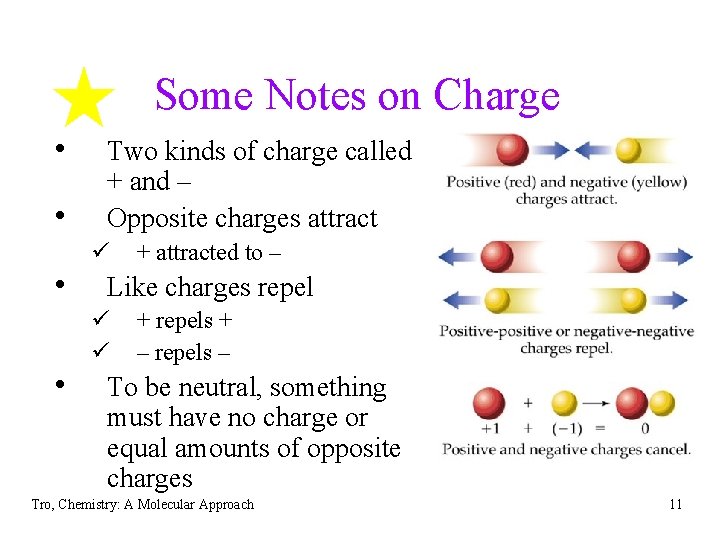
Some Notes on Charge • • Two kinds of charge called + and – Opposite charges attract ü • Like charges repel ü ü • + attracted to – + repels + – repels – To be neutral, something must have no charge or equal amounts of opposite charges Tro, Chemistry: A Molecular Approach 11
Electrons • • electrons are particles found in all atoms cathode rays are streams of electrons the electron has a charge of -1. 60 x 1019 C the electron has a mass of 9. 1 x 10 -28 g Tro, Chemistry: A Molecular Approach 12
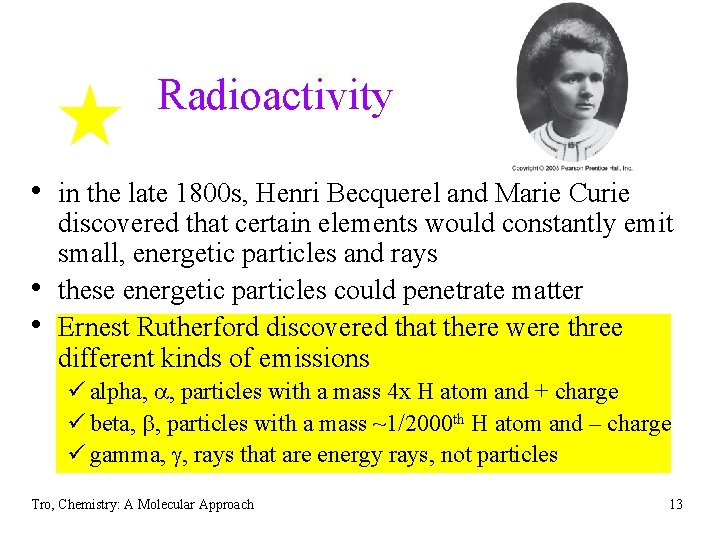
Radioactivity • in the late 1800 s, Henri Becquerel and Marie Curie • • discovered that certain elements would constantly emit small, energetic particles and rays these energetic particles could penetrate matter Ernest Rutherford discovered that there were three different kinds of emissions ü alpha, a, particles with a mass 4 x H atom and + charge ü beta, b, particles with a mass ~1/2000 th H atom and – charge ü gamma, g, rays that are energy rays, not particles Tro, Chemistry: A Molecular Approach 13
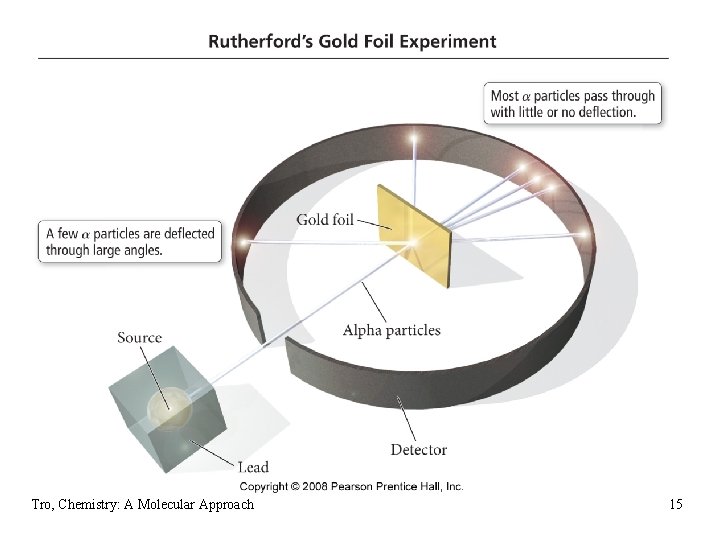
Read and understand slides 27 -32 Rutherford’s Experiment • How can you prove something is empty? • put something through it üuse large target atoms Øuse very thin sheets of target so do not absorb “bullet” üuse very small particle as bullet with very high energy Øbut not so small that electrons will affect it • bullet = alpha particles, target atoms = gold foil ü a particles have a mass of 4 amu & charge of +2 c. u. ü gold has a mass of 197 amu & is very malleable Tro, Chemistry: A Molecular Approach 14
Tro, Chemistry: A Molecular Approach 15
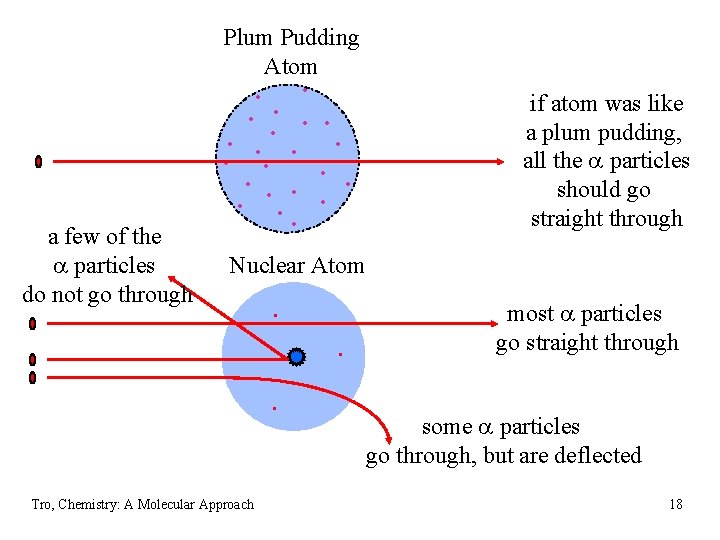
Rutherford’s Results • Over 98% of the a particles went straight • • through About 2% of the a particles went through but were deflected by large angles About 0. 01% of the a particles bounced off the gold foil ü“. . . as if you fired a 15” cannon shell at a piece of tissue paper and it came back and hit you. ” Tro, Chemistry: A Molecular Approach 16
Rutherford’s Conclusions • Atom mostly empty space übecause almost all the particles went straight through • Atom contains a dense particle that was small in volume compared to the atom but large in mass übecause of the few particles that bounced back • This dense particle was positively charged übecause of the large deflections of some of the particles Tro, Chemistry: A Molecular Approach 17
Plum Pudding Atom • • • a few of the a particles do not go through • • • if atom was like a plum pudding, all the a particles should go straight through Nuclear Atom . . . Tro, Chemistry: A Molecular Approach most a particles go straight through some a particles go through, but are deflected 18
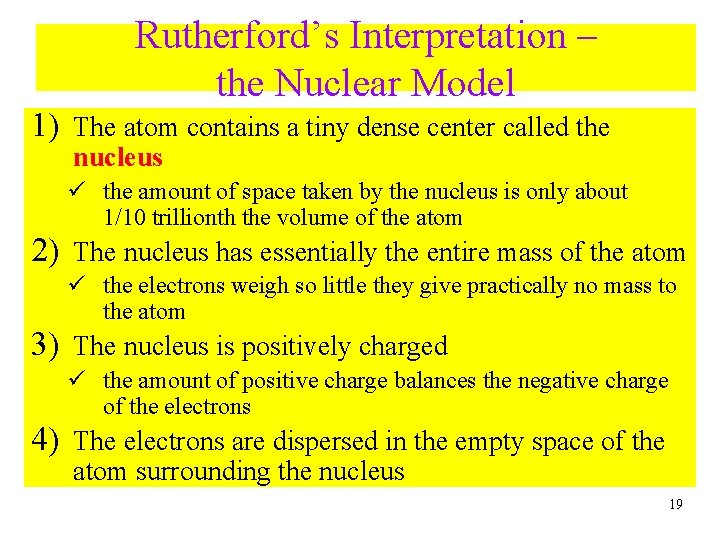
Rutherford’s Interpretation – the Nuclear Model 1) The atom contains a tiny dense center called the nucleus ü the amount of space taken by the nucleus is only about 1/10 trillionth the volume of the atom 2) The nucleus has essentially the entire mass of the atom ü the electrons weigh so little they give practically no mass to the atom 3) The nucleus is positively charged ü the amount of positive charge balances the negative charge of the electrons 4) The electrons are dispersed in the empty space of the atom surrounding the nucleus 19
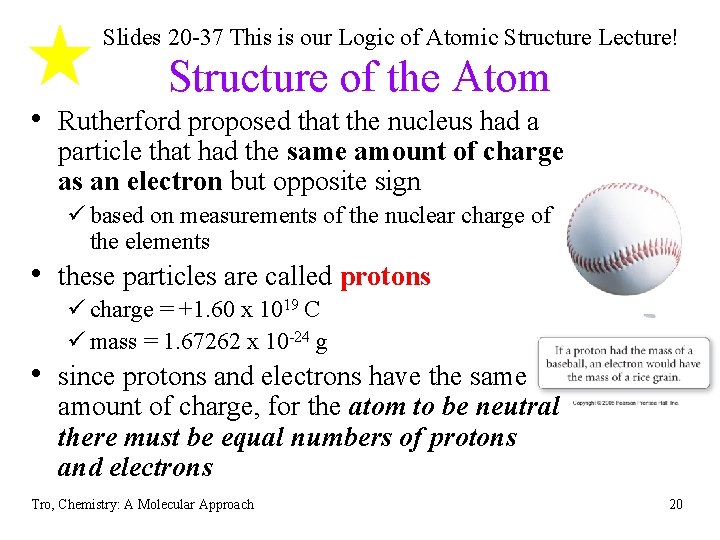
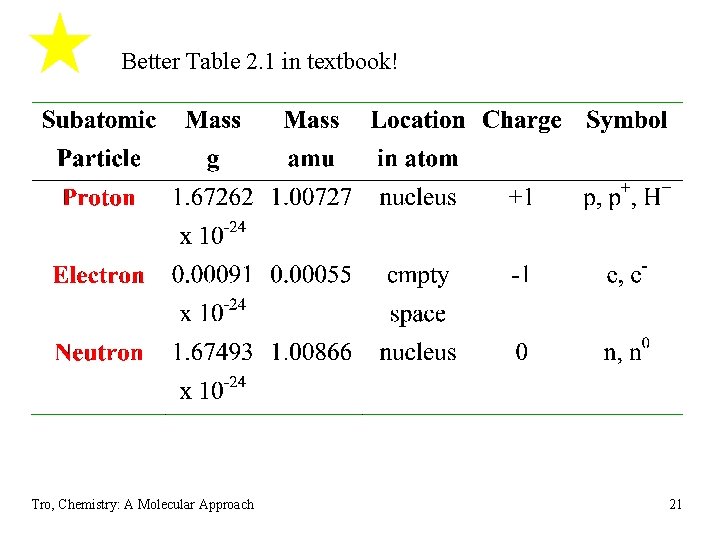
Slides 20 -37 This is our Logic of Atomic Structure Lecture! Structure of the Atom • Rutherford proposed that the nucleus had a particle that had the same amount of charge as an electron but opposite sign ü based on measurements of the nuclear charge of the elements • these particles are called protons ü charge = +1. 60 x 1019 C ü mass = 1. 67262 x 10 -24 g • since protons and electrons have the same amount of charge, for the atom to be neutral there must be equal numbers of protons and electrons Tro, Chemistry: A Molecular Approach 20
Better Table 2. 1 in textbook! Tro, Chemistry: A Molecular Approach 21
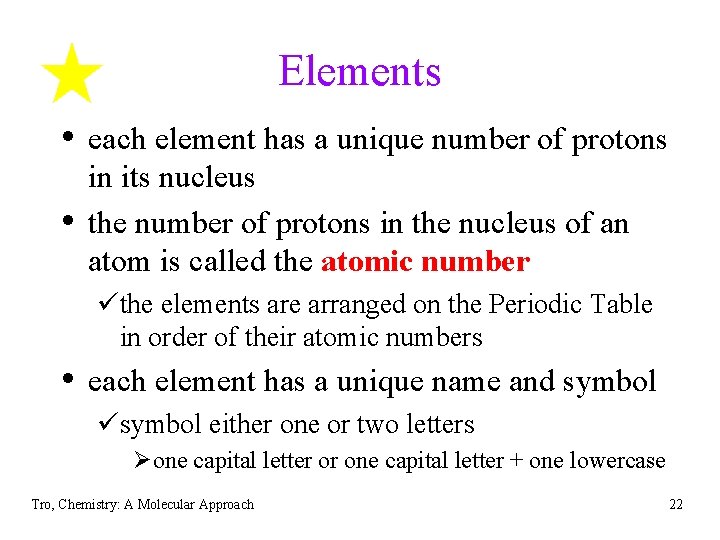
Elements • each element has a unique number of protons • in its nucleus the number of protons in the nucleus of an atom is called the atomic number üthe elements are arranged on the Periodic Table in order of their atomic numbers • each element has a unique name and symbol üsymbol either one or two letters Øone capital letter or one capital letter + one lowercase Tro, Chemistry: A Molecular Approach 22
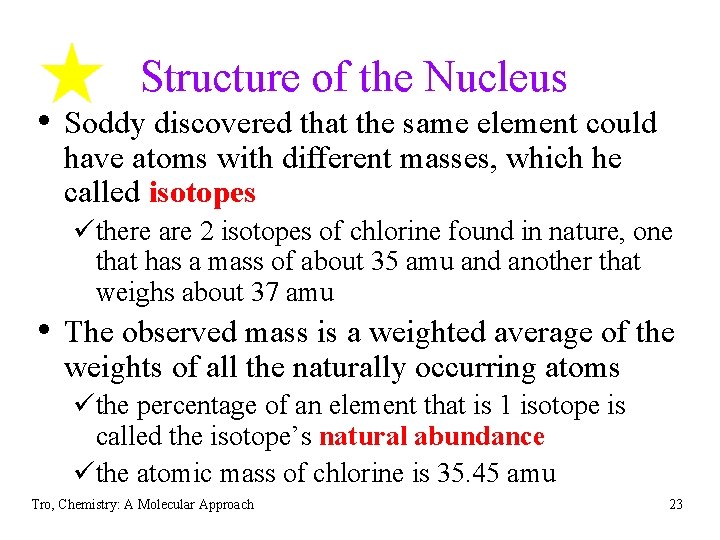
Structure of the Nucleus • Soddy discovered that the same element could have atoms with different masses, which he called isotopes üthere are 2 isotopes of chlorine found in nature, one that has a mass of about 35 amu and another that weighs about 37 amu • The observed mass is a weighted average of the weights of all the naturally occurring atoms üthe percentage of an element that is 1 isotope is called the isotope’s natural abundance üthe atomic mass of chlorine is 35. 45 amu Tro, Chemistry: A Molecular Approach 23
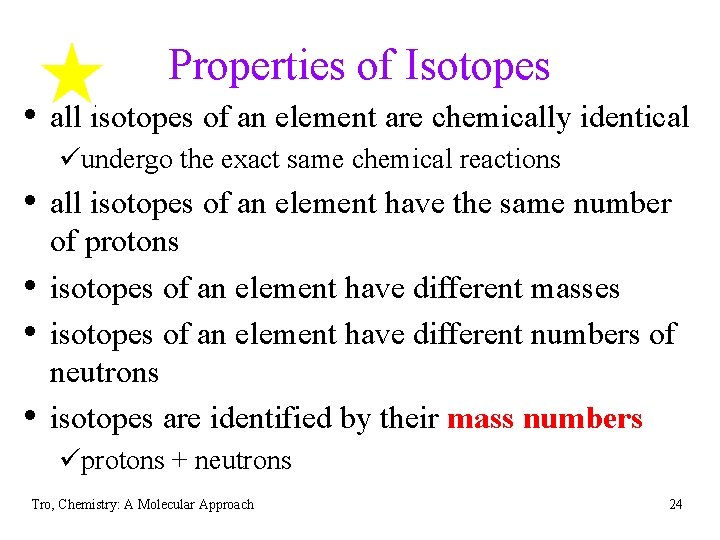
Properties of Isotopes • all isotopes of an element are chemically identical üundergo the exact same chemical reactions • all isotopes of an element have the same number • • • of protons isotopes of an element have different masses isotopes of an element have different numbers of neutrons isotopes are identified by their mass numbers üprotons + neutrons Tro, Chemistry: A Molecular Approach 24
Isotopes • Atomic Number ü Number of protons üZ • Mass Number ü Protons + Neutrons ü Whole number üA • Abundance = relative amount found in a sample Tro, Chemistry: A Molecular Approach 25
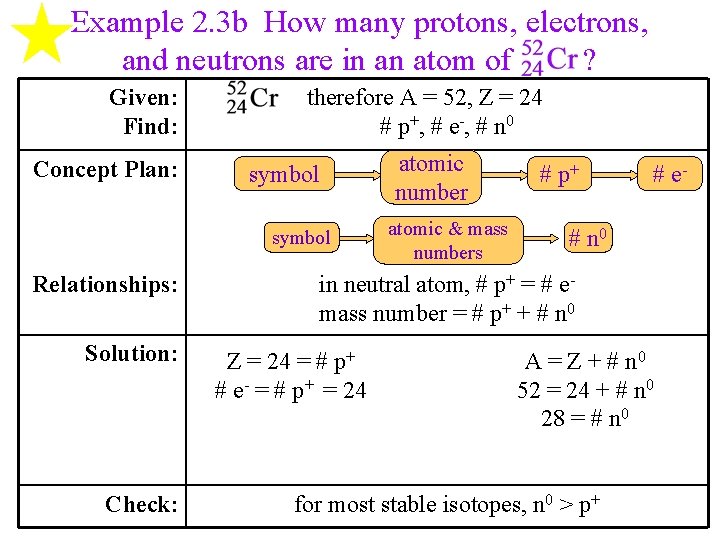
Example 2. 3 b How many protons, electrons, and neutrons are in an atom of ? Given: Find: Concept Plan: therefore A = 52, Z = 24 # p+, # e-, # n 0 symbol Relationships: Solution: Check: atomic number atomic & mass numbers # p+ # e- # n 0 in neutral atom, # p+ = # emass number = # p+ + # n 0 Z = 24 = # p+ # e- = # p+ = 24 A = Z + # n 0 52 = 24 + # n 0 28 = # n 0 for most stable isotopes, n 0 > p+
Reacting Atoms • when elements undergo chemical reactions, the reacting elements do not turn into other elements ü Statement 4 of Dalton’s Atomic Theory • this requires that all the atoms present when you start the • • reaction will still be there after the reaction since the number of protons determines the kind of element, the number of protons in the atom does not change in a chemical reaction however, many reactions involve transferring electrons from one atom to another Tro, Chemistry: A Molecular Approach 27
Charged Atoms • when atoms gain or lose electrons, they acquire a charge • charged particles are called ions • when atoms gain electrons, they become negatively • • charged ions, called anions when atoms lose electrons, they become positively charged ions, called cations behave much differently than the neutral atom ü e. g. , The metal sodium, made of neutral Na atoms, is highly reactive and quite unstable. However, the sodium cations, Na+, found in table salt are very nonreactive and stable • since materials like table salt are neutral, there must be equal amounts of charge from cations and anions in them Tro, Chemistry: A Molecular Approach 28
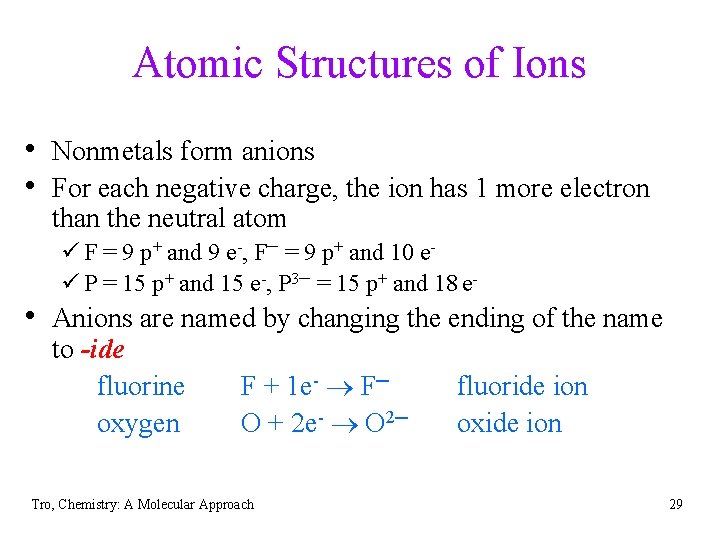
Atomic Structures of Ions • Nonmetals form anions • For each negative charge, the ion has 1 more electron than the neutral atom ü F = 9 p+ and 9 e-, F─ = 9 p+ and 10 eü P = 15 p+ and 15 e-, P 3─ = 15 p+ and 18 e- • Anions are named by changing the ending of the name to -ide fluorine oxygen F + 1 e- F─ O + 2 e- O 2─ Tro, Chemistry: A Molecular Approach fluoride ion oxide ion 29
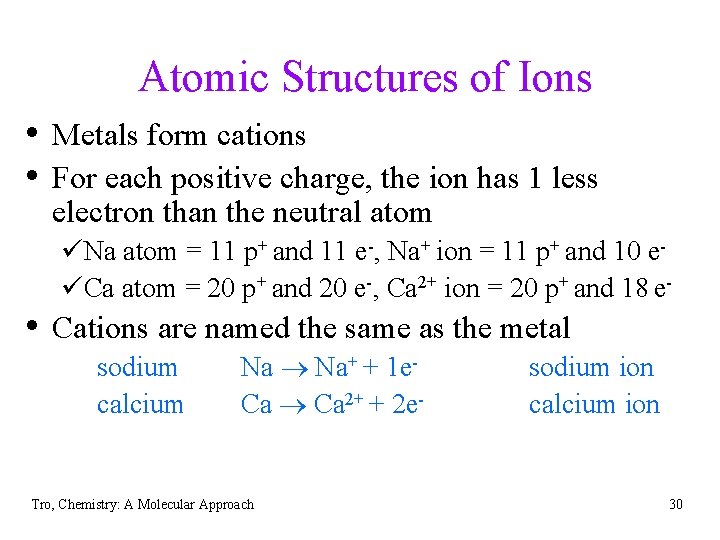
Atomic Structures of Ions • Metals form cations • For each positive charge, the ion has 1 less electron than the neutral atom üNa atom = 11 p+ and 11 e-, Na+ ion = 11 p+ and 10 eüCa atom = 20 p+ and 20 e-, Ca 2+ ion = 20 p+ and 18 e- • Cations are named the same as the metal sodium calcium Na Na+ + 1 e. Ca 2+ + 2 e- Tro, Chemistry: A Molecular Approach sodium ion calcium ion 30
Mendeleev • order elements by atomic mass • saw a repeating pattern of properties • Periodic Law – When the elements are arranged in • • • order of increasing atomic mass, certain sets of properties recur periodically put elements with similar properties in the same column used pattern to predict properties of undiscovered elements where atomic mass order did not fit other properties, he re-ordered by other properties ü Te & I Tro, Chemistry: A Molecular Approach 31
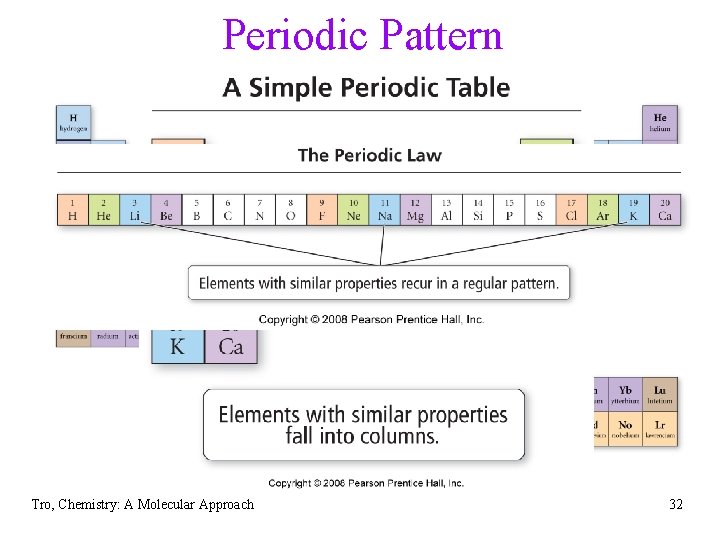
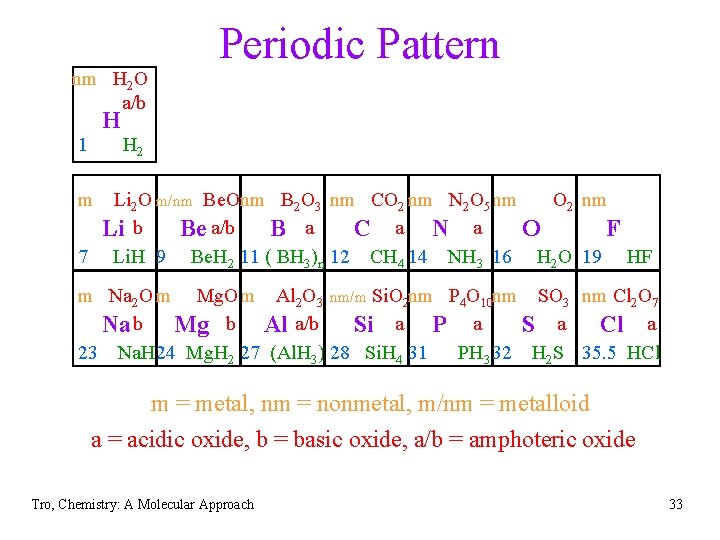
Periodic Pattern Tro, Chemistry: A Molecular Approach 32
nm H 2 O a/b Periodic Pattern H 1 H 2 m Li 2 O m/nm Be. Onm B 2 O 3 nm CO 2 nm N 2 O 5 nm O 2 nm Li b Be a/b B a C a N a O F 7 Li. H 9 Be. H 2 11 ( BH 3)n 12 CH 4 14 NH 3 16 H 2 O 19 HF m Na 2 O m Mg. O m Al 2 O 3 nm/m Si. O 2 nm P 4 O 10 nm SO 3 nm Cl 2 O 7 S a Cl a Na b Mg b Al a/b Si a P a 23 Na. H 24 Mg. H 2 27 (Al. H 3) 28 Si. H 4 31 PH 3 32 H 2 S 35. 5 HCl m = metal, nm = nonmetal, m/nm = metalloid a = acidic oxide, b = basic oxide, a/b = amphoteric oxide Tro, Chemistry: A Molecular Approach 33
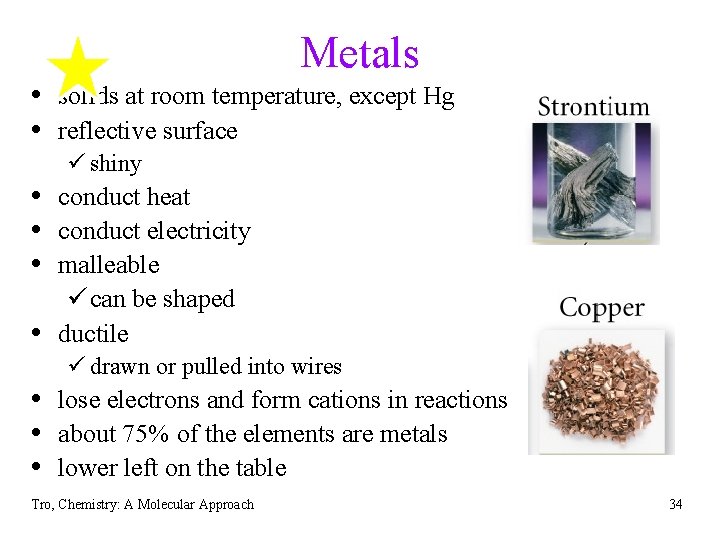
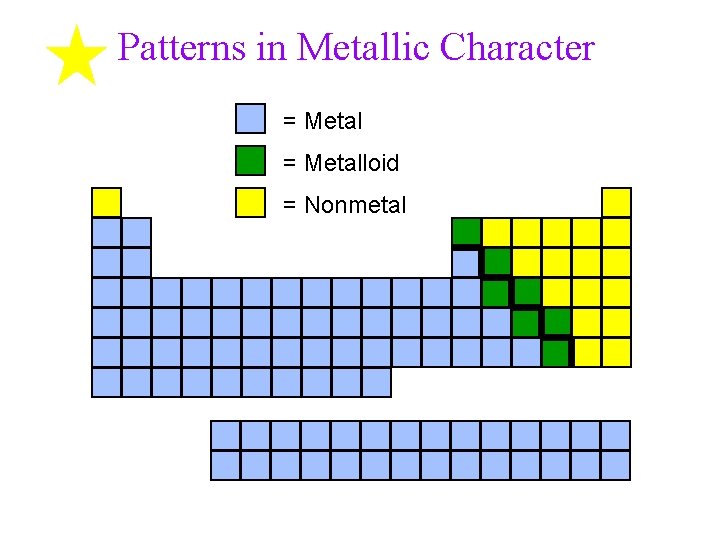
Metals • solids at room temperature, except Hg • reflective surface ü shiny • conduct heat • conduct electricity • malleable ü can be shaped • ductile ü drawn or pulled into wires • lose electrons and form cations in reactions • about 75% of the elements are metals • lower left on the table Tro, Chemistry: A Molecular Approach 34
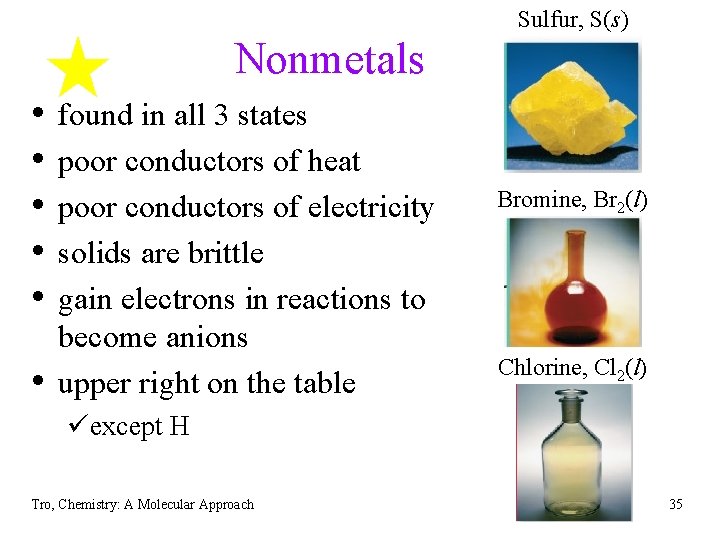
Sulfur, S(s) Nonmetals • • • found in all 3 states poor conductors of heat poor conductors of electricity solids are brittle gain electrons in reactions to become anions upper right on the table Bromine, Br 2(l) Chlorine, Cl 2(l) üexcept H Tro, Chemistry: A Molecular Approach 35
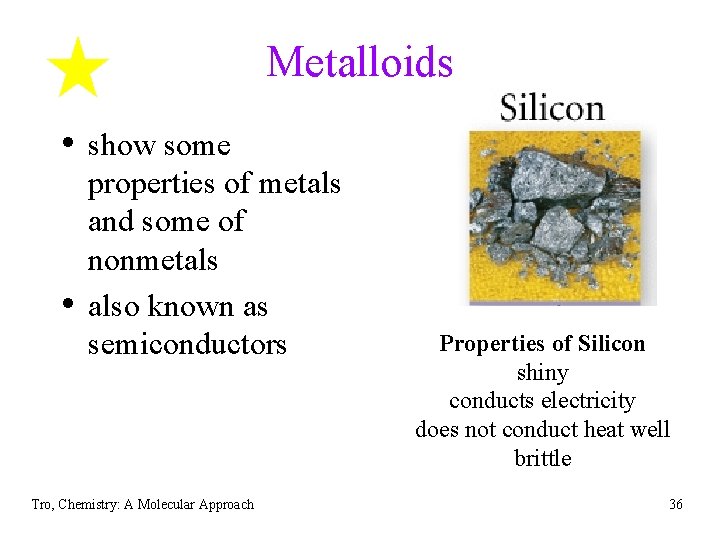
Metalloids • show some • properties of metals and some of nonmetals also known as semiconductors Tro, Chemistry: A Molecular Approach Properties of Silicon shiny conducts electricity does not conduct heat well brittle 36
Patterns in Metallic Character = Metalloid = Nonmetal
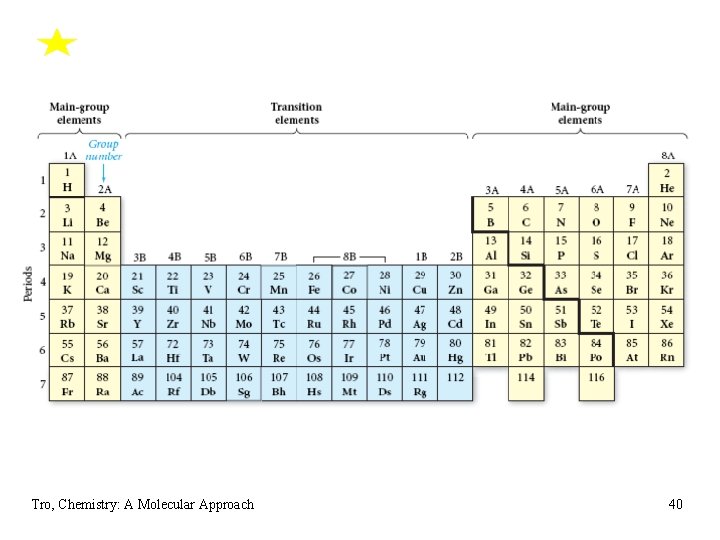
The Modern Periodic Table • Elements with similar chemical and physical • properties are in the same columns are called Groups or Families üdesignated by a number and letter at top • rows are called Periods • each period shows the pattern of properties repeated in the next period Tro, Chemistry: A Molecular Approach 38
The Modern Periodic Table • Main Group = Representative Elements = “A” • groups Transition Elements = “B” groups üall metals • Bottom Rows = Inner Transition Elements = Rare Earth Elements ümetals üreally belong in Period 6 & 7 Tro, Chemistry: A Molecular Approach 39
Tro, Chemistry: A Molecular Approach 40
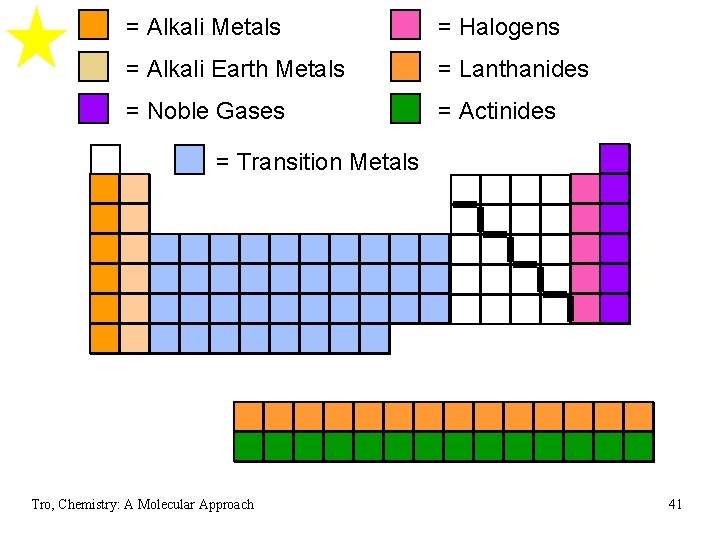
= Alkali Metals = Halogens = Alkali Earth Metals = Lanthanides = Noble Gases = Actinides = Transition Metals Tro, Chemistry: A Molecular Approach 41
Important Groups - Hydrogen • nonmetal • colorless, diatomic gas ü very low melting point and density • reacts with nonmetals to form molecular compounds ü HCl is acidic gas ü H 2 O is a liquid • reacts with metals to form hydrides ü metal hydrides react with water to form H 2 • HX dissolves in water to form acids Tro, Chemistry: A Molecular Approach 42
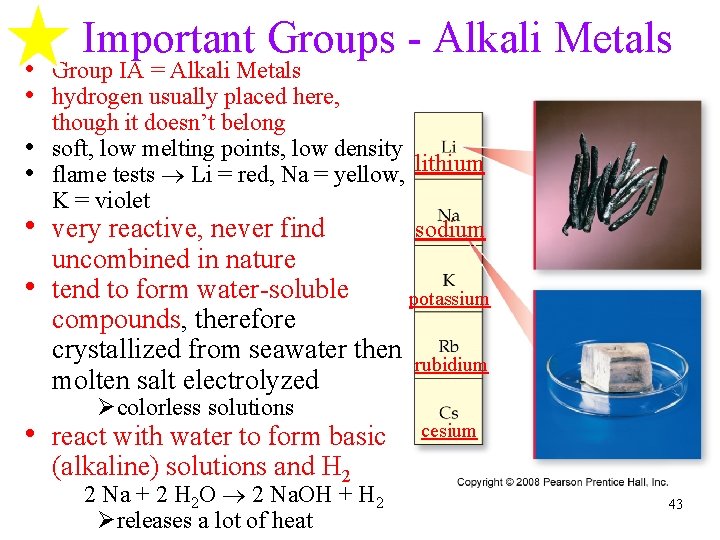
Important Groups - Alkali Metals • Group IA = Alkali Metals • hydrogen usually placed here, • • though it doesn’t belong soft, low melting points, low density flame tests Li = red, Na = yellow, lithium K = violet sodium very reactive, never find uncombined in nature tend to form water-soluble potassium compounds, therefore crystallized from seawater then rubidium molten salt electrolyzed Øcolorless solutions • react with water to form basic cesium (alkaline) solutions and H 2 2 Na + 2 H 2 O 2 Na. OH + H 2 Øreleases a lot of heat 43
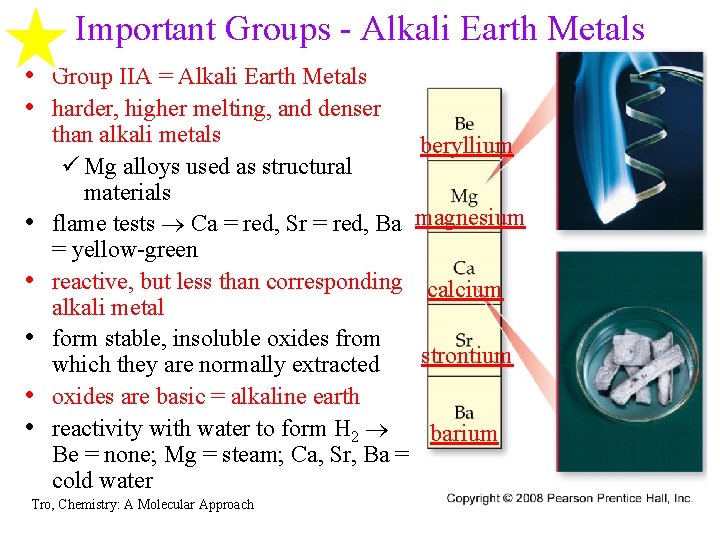
Important Groups - Alkali Earth Metals • Group IIA = Alkali Earth Metals • harder, higher melting, and denser • • • than alkali metals beryllium ü Mg alloys used as structural materials flame tests Ca = red, Sr = red, Ba magnesium = yellow-green reactive, but less than corresponding calcium alkali metal form stable, insoluble oxides from strontium which they are normally extracted oxides are basic = alkaline earth reactivity with water to form H 2 barium Be = none; Mg = steam; Ca, Sr, Ba = cold water Tro, Chemistry: A Molecular Approach 44
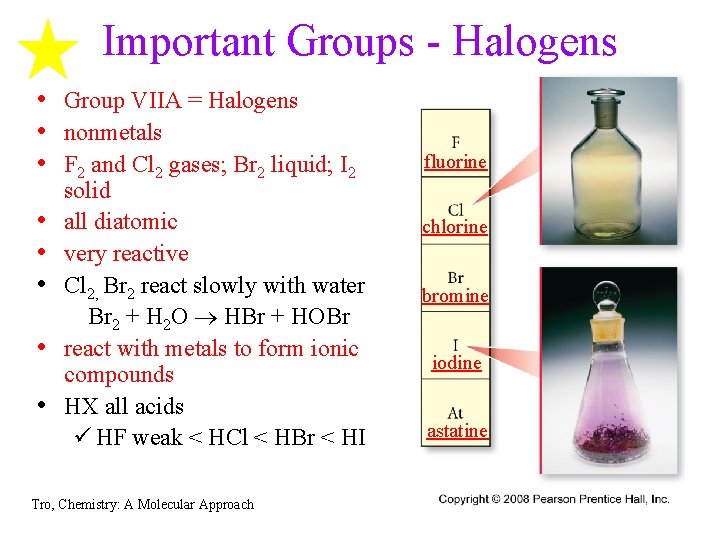
Important Groups - Halogens • Group VIIA = Halogens • nonmetals • F 2 and Cl 2 gases; Br 2 liquid; I 2 • • • solid all diatomic very reactive Cl 2, Br 2 react slowly with water Br 2 + H 2 O HBr + HOBr react with metals to form ionic compounds HX all acids ü HF weak < HCl < HBr < HI Tro, Chemistry: A Molecular Approach fluorine chlorine bromine iodine astatine 45
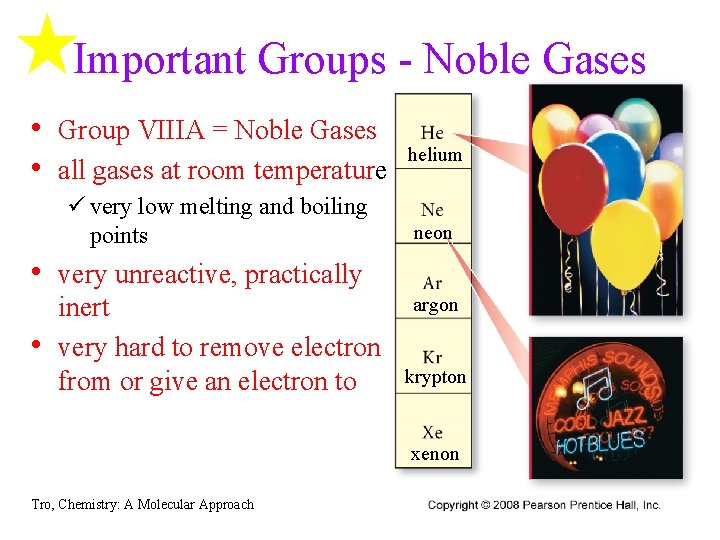
Important Groups - Noble Gases • Group VIIIA = Noble Gases • all gases at room temperature ü very low melting and boiling points helium neon • very unreactive, practically • inert very hard to remove electron from or give an electron to argon krypton xenon Tro, Chemistry: A Molecular Approach 46
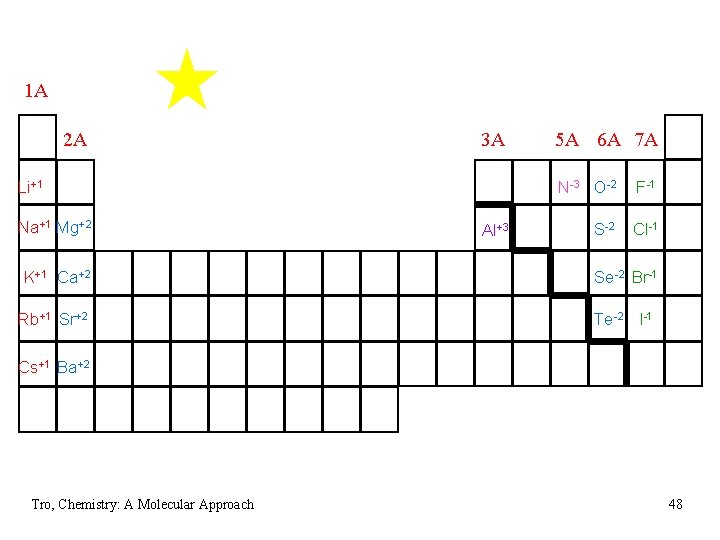
Ion Charge and the Periodic Table • the charge on an ion can often be • • • determined from an element’s position on the Periodic Table metals are always positively charged ions, nonmetals are negatively charged ions for many main group metals, the charge = the group number for nonmetals, the charge = the group number - 8 Tro, Chemistry: A Molecular Approach 47
1 A 2 A 3 A Li+1 Na+1 Mg+2 Al+3 5 A 6 A 7 A N-3 O-2 F-1 S-2 Cl-1 K+1 Ca+2 Se-2 Br-1 Rb+1 Sr+2 Te-2 I-1 Cs+1 Ba+2 Tro, Chemistry: A Molecular Approach 48
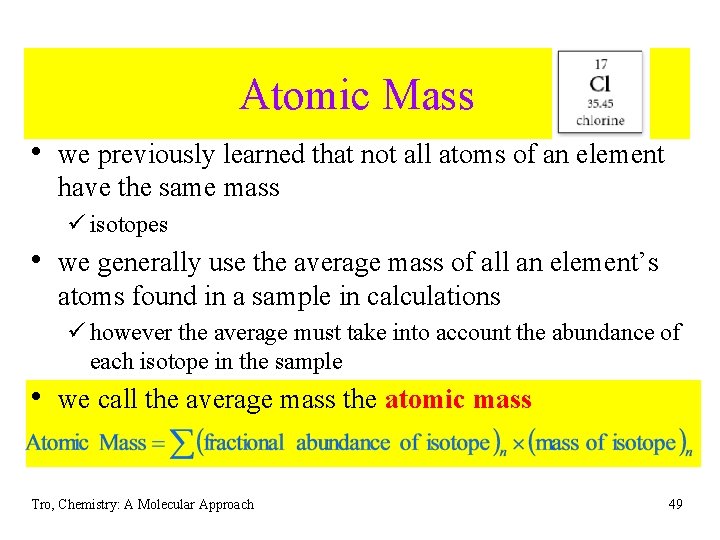
Atomic Mass • we previously learned that not all atoms of an element have the same mass ü isotopes • we generally use the average mass of all an element’s atoms found in a sample in calculations ü however the average must take into account the abundance of each isotope in the sample • we call the average mass the atomic mass Tro, Chemistry: A Molecular Approach 49
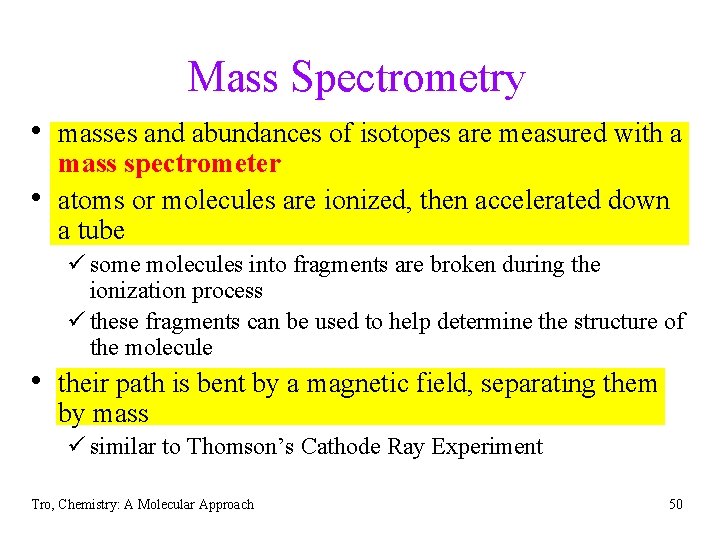
Mass Spectrometry • masses and abundances of isotopes are measured with a • mass spectrometer atoms or molecules are ionized, then accelerated down a tube ü some molecules into fragments are broken during the ionization process ü these fragments can be used to help determine the structure of the molecule • their path is bent by a magnetic field, separating them by mass ü similar to Thomson’s Cathode Ray Experiment Tro, Chemistry: A Molecular Approach 50
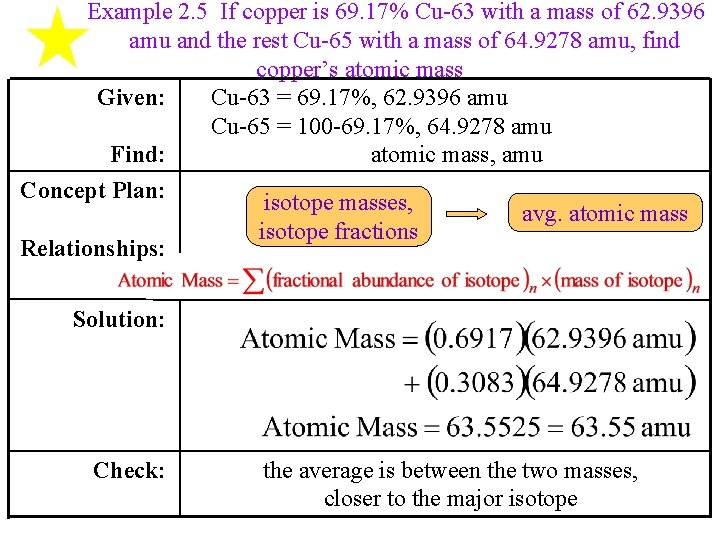
Example 2. 5 If copper is 69. 17% Cu-63 with a mass of 62. 9396 amu and the rest Cu-65 with a mass of 64. 9278 amu, find copper’s atomic mass Given: Cu-63 = 69. 17%, 62. 9396 amu Cu-65 = 100 -69. 17%, 64. 9278 amu Find: atomic mass, amu Concept Plan: isotope masses, avg. atomic mass isotope fractions Relationships: Solution: Check: the average is between the two masses, closer to the major isotope
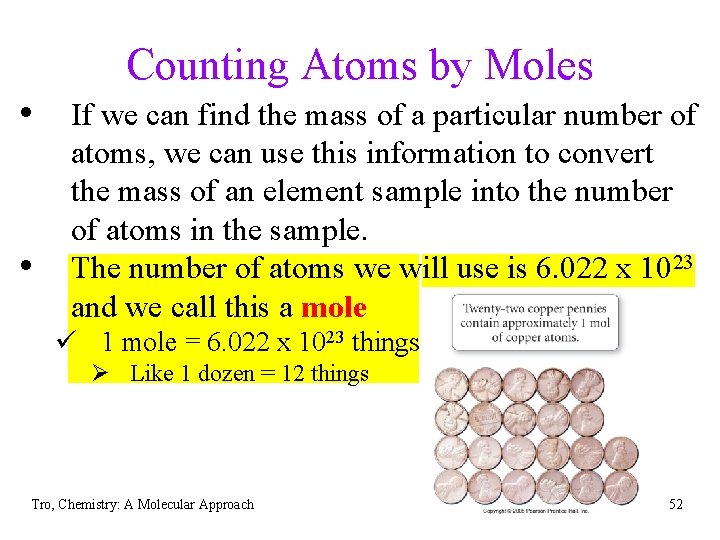
Counting Atoms by Moles • If we can find the mass of a particular number of • atoms, we can use this information to convert the mass of an element sample into the number of atoms in the sample. The number of atoms we will use is 6. 022 x 1023 and we call this a mole ü 1 mole = 6. 022 x 1023 things Ø Like 1 dozen = 12 things Tro, Chemistry: A Molecular Approach 52
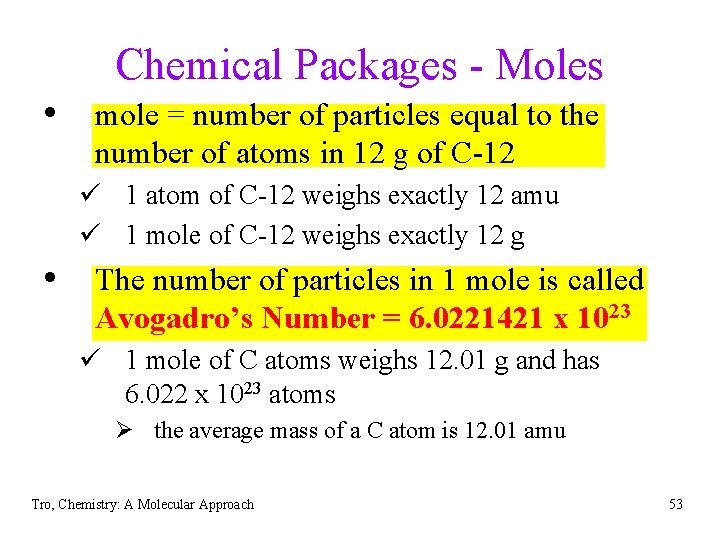
Chemical Packages - Moles • mole = number of particles equal to the number of atoms in 12 g of C-12 ü 1 atom of C-12 weighs exactly 12 amu ü 1 mole of C-12 weighs exactly 12 g • The number of particles in 1 mole is called Avogadro’s Number = 6. 0221421 x 1023 ü 1 mole of C atoms weighs 12. 01 g and has 6. 022 x 1023 atoms Ø the average mass of a C atom is 12. 01 amu Tro, Chemistry: A Molecular Approach 53
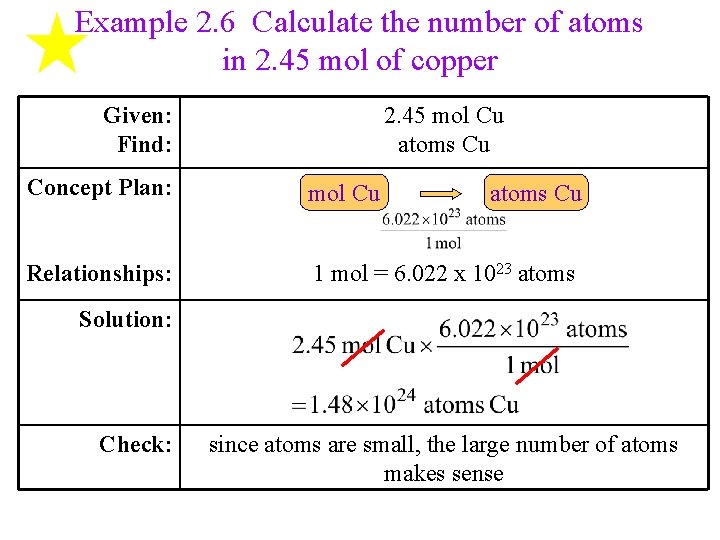
Example 2. 6 Calculate the number of atoms in 2. 45 mol of copper Given: Find: 2. 45 mol Cu atoms Cu Concept Plan: mol Cu Relationships: 1 mol = 6. 022 x 1023 atoms Cu Solution: Check: since atoms are small, the large number of atoms makes sense
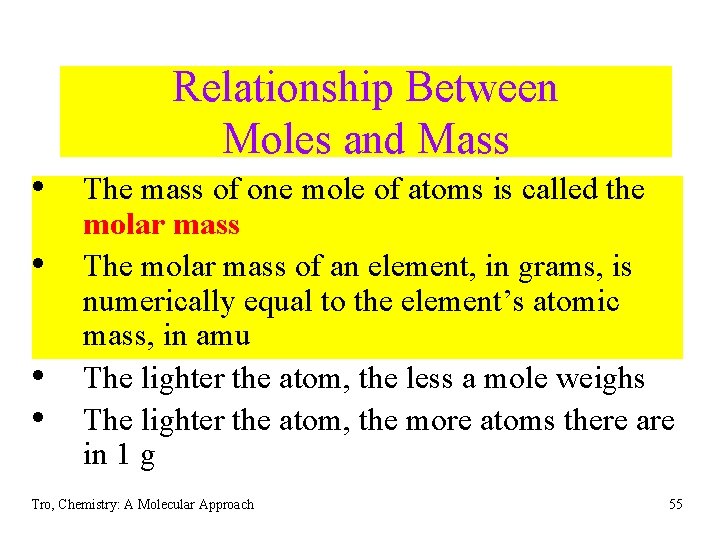
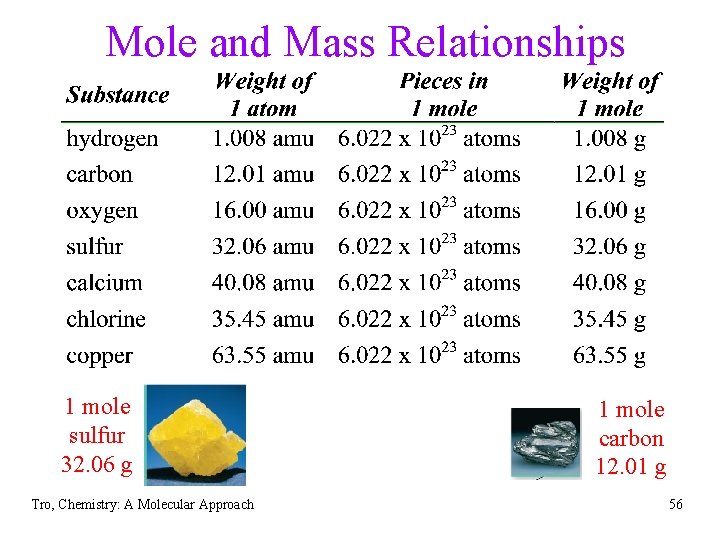
Relationship Between Moles and Mass • The mass of one mole of atoms is called the • • • molar mass The molar mass of an element, in grams, is numerically equal to the element’s atomic mass, in amu The lighter the atom, the less a mole weighs The lighter the atom, the more atoms there are in 1 g Tro, Chemistry: A Molecular Approach 55
Mole and Mass Relationships 1 mole sulfur 32. 06 g Tro, Chemistry: A Molecular Approach 1 mole carbon 12. 01 g 56
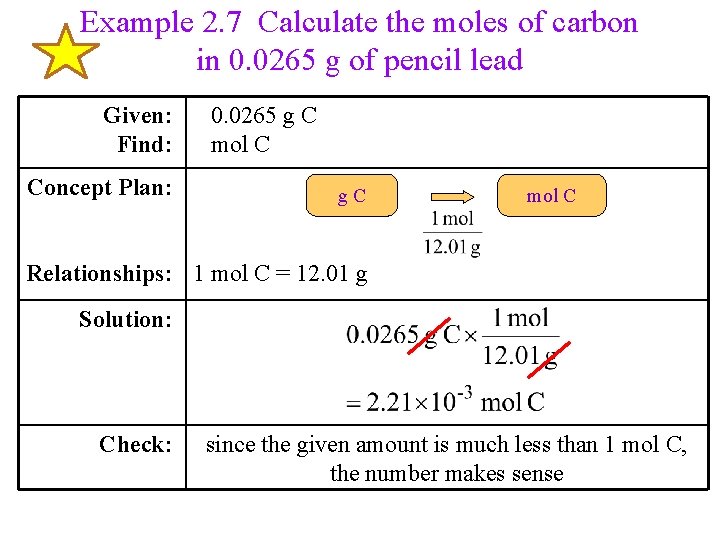
Example 2. 7 Calculate the moles of carbon in 0. 0265 g of pencil lead Given: Find: Concept Plan: 0. 0265 g C mol C g. C mol C Relationships: 1 mol C = 12. 01 g Solution: Check: since the given amount is much less than 1 mol C, the number makes sense
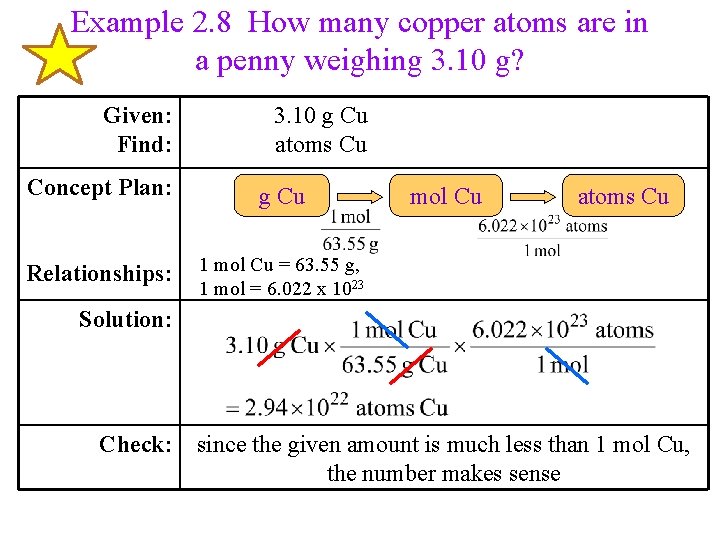
Example 2. 8 How many copper atoms are in a penny weighing 3. 10 g? Given: Find: 3. 10 g Cu atoms Cu Concept Plan: g Cu Relationships: 1 mol Cu = 63. 55 g, 1 mol = 6. 022 x 1023 mol Cu atoms Cu Solution: Check: since the given amount is much less than 1 mol Cu, the number makes sense