Chapter 16 The Infant Elsevier items and derived

- Slides: 48
Chapter 16 The Infant Elsevier items and derived items © 2015, 2011, 2007, 2006 by Saunders, an imprint of Elsevier Inc.
Lesson 16. 1 Objectives 2. Describe normal vital signs for a 1 -year-old infant. 3. Describe the physical and psychosocial development of infants from age 1 to 12 months, listing age-specific events and guidance when appropriate. 4. Discuss the major aspects of cognitive development in the first year of life. Elsevier items and derived items © 2015, 2011, 2007, 2006 by Saunders, an imprint of Elsevier Inc. 2
Lesson 16. 1 Objectives (cont. ) 5. Identify the approximate age for each of the following: posterior fontanelle has closed, central incisors appear, birth weight has tripled, child can sit steadily alone, child shows fear of strangers. 6. Relate the nursing responsibilities in health promotion and illness prevention in infants in the first year of life. Elsevier items and derived items © 2015, 2011, 2007, 2006 by Saunders, an imprint of Elsevier Inc. 3
Milestones (p. 386) Describes general patterns of achievement at various stages Ø Ø Often referred to as norms Nurse must understand normal range for milestone achievement • • Establishment of sleep-wake cycle Social smile Drinking from cup Separation anxiety Elsevier items and derived items © 2015, 2011, 2007, 2006 by Saunders, an imprint of Elsevier Inc. 4
When Milestones are Cause for Concern (p. 387) Advise parents that when a child has a sudden slowing, not typical for age, of any aspect of development, the child should be evaluated by a healthcare professional as soon as possible. Elsevier items and derived items © 2015, 2011, 2007, 2006 by Saunders, an imprint of Elsevier Inc. 5
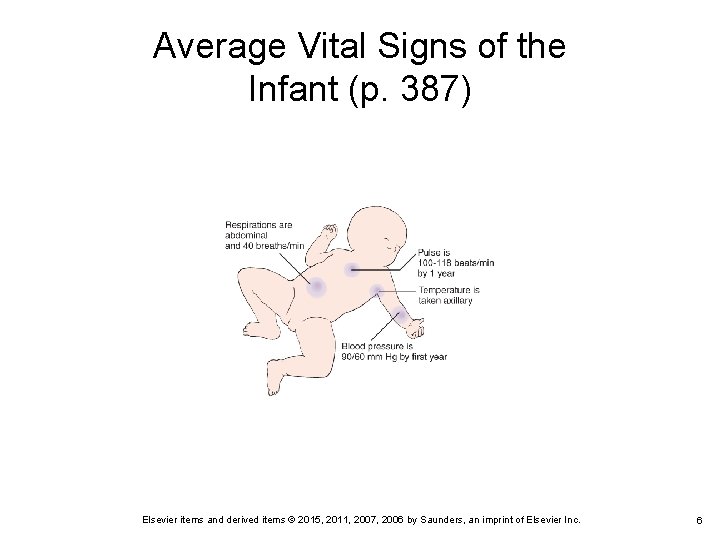
Average Vital Signs of the Infant (p. 387) Elsevier items and derived items © 2015, 2011, 2007, 2006 by Saunders, an imprint of Elsevier Inc. 6
Oral Stage (p. 387) Sucking brings comfort and relief from tension Important to hold infant during feedings Allow sufficient time for infant to suck Infants on IV fluid/nutrition need additional attention and a pacifier to ensure the need for sucking is satisfied When infants are able to use their hands more skillfully, they will gradually derive pleasure and comfort from other sources Elsevier items and derived items © 2015, 2011, 2007, 2006 by Saunders, an imprint of Elsevier Inc. 7
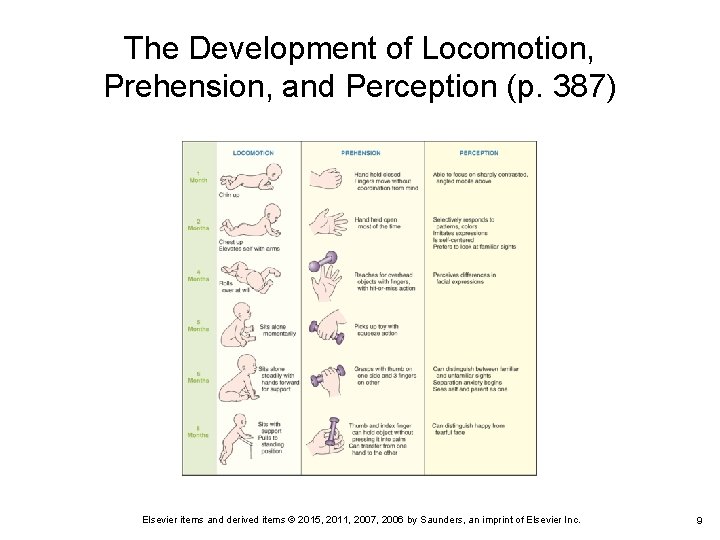
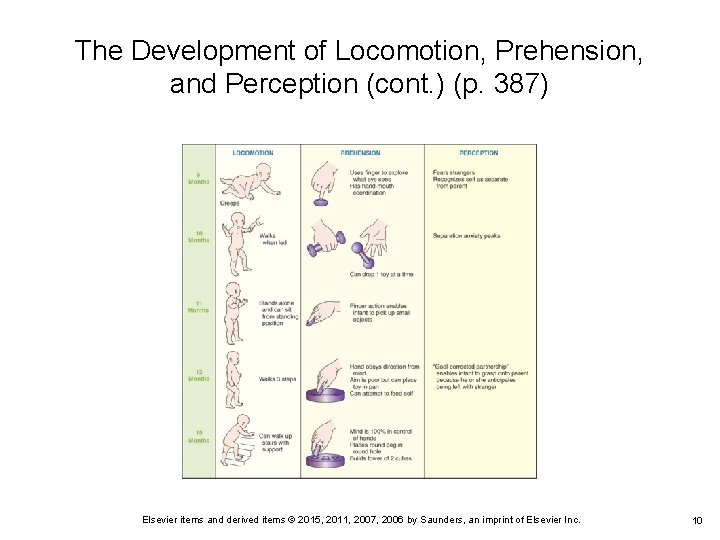
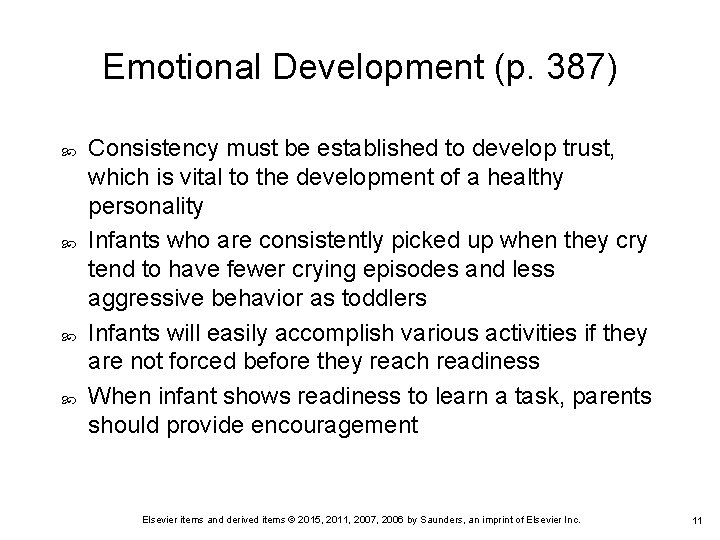
Motor Development (p. 387) Grasp reflex disappears around 3 months of age Prehension occurs around 5 to 6 months of age and follows an orderly sequence of development Parachute reflex appears around 7 to 9 months as a protective mechanism Pincer grasp well-established by 1 year of age Elsevier items and derived items © 2015, 2011, 2007, 2006 by Saunders, an imprint of Elsevier Inc. 8
The Development of Locomotion, Prehension, and Perception (p. 387) Elsevier items and derived items © 2015, 2011, 2007, 2006 by Saunders, an imprint of Elsevier Inc. 9
The Development of Locomotion, Prehension, and Perception (cont. ) (p. 387) Elsevier items and derived items © 2015, 2011, 2007, 2006 by Saunders, an imprint of Elsevier Inc. 10
Emotional Development (p. 387) Consistency must be established to develop trust, which is vital to the development of a healthy personality Infants who are consistently picked up when they cry tend to have fewer crying episodes and less aggressive behavior as toddlers Infants will easily accomplish various activities if they are not forced before they reach readiness When infant shows readiness to learn a task, parents should provide encouragement Elsevier items and derived items © 2015, 2011, 2007, 2006 by Saunders, an imprint of Elsevier Inc. 11
Need for Constant Care and Guidance (p. 388) Sensory stimulation is essential for the development of the infant’s thought processes and perceptual abilities A crying child should be soothed If the infant appears hungry, do not delay the feeding in order to adhere to a specific routine An infant can recognize warmth and affection or the lack thereof Elsevier items and derived items © 2015, 2011, 2007, 2006 by Saunders, an imprint of Elsevier Inc. 12
Development and Care (p. 388) Important to note that no two infants are the same Physical patterns cannot be separated from social patterns Abrupt changes do not take place with each new month of life Elsevier items and derived items © 2015, 2011, 2007, 2006 by Saunders, an imprint of Elsevier Inc. 13
Health Promotion (p. 394) Nurse’s responsibilities Ø Ø Guide parents and assist in the acquisition of necessary skills to ensure the healthy growth and development of their infant Provide appropriate community referrals as indicated Elsevier items and derived items © 2015, 2011, 2007, 2006 by Saunders, an imprint of Elsevier Inc. 14
Lesson 16. 2 Objectives 7. Discuss the approach and care of an infant with colic. 8. Discuss the development of favorable sleep patterns. 9. Examine nutrition counseling for the infant. 10. List four common concerns of parents about the feeding of infants. Elsevier items and derived items © 2015, 2011, 2007, 2006 by Saunders, an imprint of Elsevier Inc. 15
Lesson 16. 2 Objectives (cont. ) 11. Compare breastfeeding, bottle feeding, and the various infant formulas available. 12. Describe how to select and prepare solid foods for the infant. 13. Compare and contrast natural, organic, and processed foods. Elsevier items and derived items © 2015, 2011, 2007, 2006 by Saunders, an imprint of Elsevier Inc. 16
Coping with an Irritable Infant (p. 394) Whether irritable or lethargic, many of the same interventions can be used An irritable baby cries and may be difficult to soothe A lethargic baby may “shut down” and sleep in order to avoid an excessively stimulating (loud or noisy) environment Shield infant’s eyes from bright light Elsevier items and derived items © 2015, 2011, 2007, 2006 by Saunders, an imprint of Elsevier Inc. 17
Coping with an Irritable Infant (cont. ) (p. 394) Sit quietly with infant; don’t talk or sing Eliminate as much noise as possible Talk in a soft voice Swaddle snugly Change infant’s position slowly, avoid sudden movements Provide nonnutritive sucking Elsevier items and derived items © 2015, 2011, 2007, 2006 by Saunders, an imprint of Elsevier Inc. 18
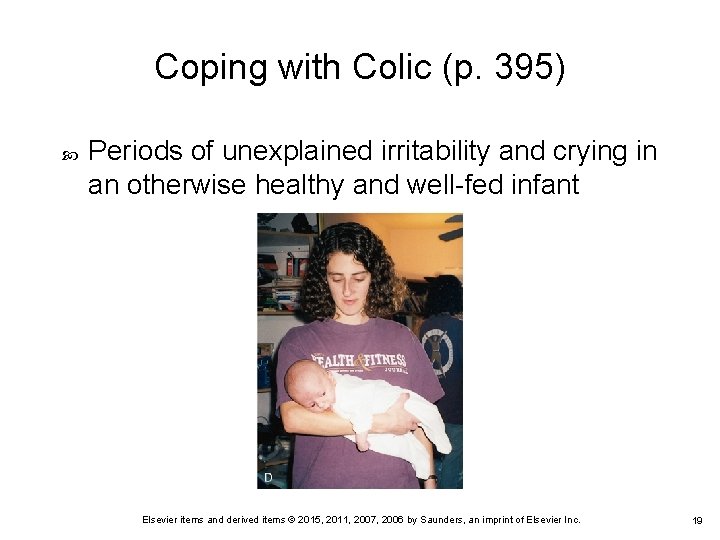
Coping with Colic (p. 395) Periods of unexplained irritability and crying in an otherwise healthy and well-fed infant Elsevier items and derived items © 2015, 2011, 2007, 2006 by Saunders, an imprint of Elsevier Inc. 19
Coping with the Lethargic Infant (p. 395) Some infants respond to an excessively stimulating environment by “shutting down” and sleeping. Coping strategies include: Ø Ø Ø Avoid bright lights. Move and handle the infant slowly and gently. Talk in a calm voice. Sit the infant upright at intervals. Slowly dress and undress the infant. Elsevier items and derived items © 2015, 2011, 2007, 2006 by Saunders, an imprint of Elsevier Inc. 20
Developing Positive Sleep Patterns (p. 395) Newborns sleep in 4 -hour intervals Ø By 4 to 6 months, can be up to 8 hours Synchronizing circadian rhythm of infant to family routine is a learned behavior Position infants on their backs on a firm mattress Infants rely on parent to soothe them back to sleep if awakened during the night Ø Assist infant to learn self-soothing behaviors Elsevier items and derived items © 2015, 2011, 2007, 2006 by Saunders, an imprint of Elsevier Inc. 21
Illness Prevention: Parent Education (p. 396) Stress importance of periodic health checks Ensure infant receives recommended vaccinations at appropriate times Provide education and anticipatory guidance for the developmental changes that occur Stress importance of changing diaper when it becomes wet or soiled Monitor growth of infant by documenting measurements on a growth chart Ensure adequate fluid and nutrition are provided Elsevier items and derived items © 2015, 2011, 2007, 2006 by Saunders, an imprint of Elsevier Inc. 22
Illness Prevention: Physical Examination (p. 396 -397) Physical examination in the clinic setting at least five times in the first year Ø Ø Ø Hearing and vision assessments as indicated Screening tests administered as required Growth grids and developmental screening Immunizations Nutritional counseling Provide appropriate education and/or explanations to the parents Elsevier items and derived items © 2015, 2011, 2007, 2006 by Saunders, an imprint of Elsevier Inc. 23
Infants with Special Needs (p. 396) Early intervention is essential in order to attain the best outcome for the infant/child Community referrals may be needed Early therapies may be needed, e. g. , speech, cognitive, neurodevelopmental Elsevier items and derived items © 2015, 2011, 2007, 2006 by Saunders, an imprint of Elsevier Inc. 24
Immunizations (p. 397) Stress repeatedly the importance of immunizations and timing of administration Delays in starting them can lead to increased risk of serious illness or even death Accurate records of immunizations received prevent confusion and duplication if the family moves Elsevier items and derived items © 2015, 2011, 2007, 2006 by Saunders, an imprint of Elsevier Inc. 25
Nutrition Counseling (p. 397) Solid food can slowly be added beginning around 6 months of age Ø Ø The tongue extrusion reflex has completely disappeared GI tract is mature enough to digest food Between 4 and 6 months, sucking is more mature, and munching or an up-and-down chewing/chomping motion ensues Elsevier items and derived items © 2015, 2011, 2007, 2006 by Saunders, an imprint of Elsevier Inc. 26
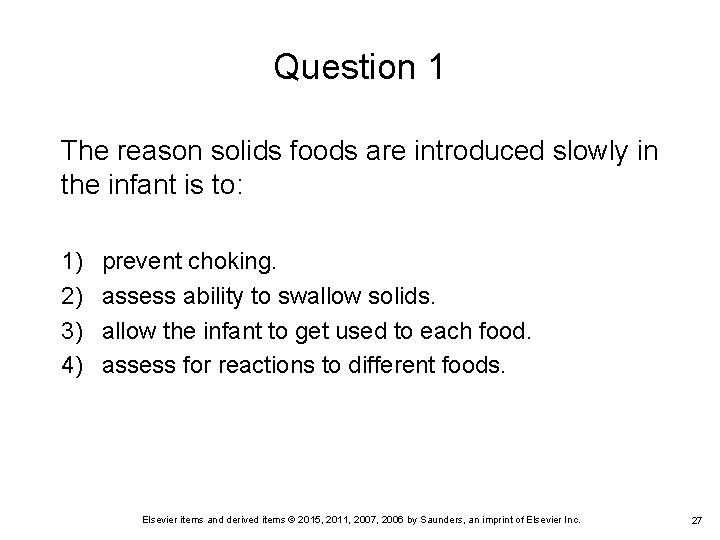
Question 1 The reason solids foods are introduced slowly in the infant is to: 1) 2) 3) 4) prevent choking. assess ability to swallow solids. allow the infant to get used to each food. assess for reactions to different foods. Elsevier items and derived items © 2015, 2011, 2007, 2006 by Saunders, an imprint of Elsevier Inc. 27
Parental Concerns (p. 397) Prior to teaching about infant nutrition, the nurse should assess Ø Ø Parental knowledge Infant developmental behavior, readiness Parent-child interaction Cultural and ethnic practices Elsevier items and derived items © 2015, 2011, 2007, 2006 by Saunders, an imprint of Elsevier Inc. 28
Determining Adequacy of Diet (p. 397) The infant has gained 4 to 7 oz. per week for the first 6 months. The infant has at least six wet diapers per day. The infant sleeps peacefully for several hours after feedings. Elsevier items and derived items © 2015, 2011, 2007, 2006 by Saunders, an imprint of Elsevier Inc. 29
Breastfeeding and Bottle Feeding (p. 397) Human milk is best for infants younger than 6 months Formulas that are cow’s milk based and ironfortified are recommended by the AAP Whole cow’s milk not given until after 1 year of age Elsevier items and derived items © 2015, 2011, 2007, 2006 by Saunders, an imprint of Elsevier Inc. 30
Absolute Contraindications to Breastfeeding (p. 398) Galactosemia Phenylketonuria HIV-positive mother Chemotherapy Radioactive isotope therapy Illicit drug use Active, untreated pulmonary tuberculosis Elsevier items and derived items © 2015, 2011, 2007, 2006 by Saunders, an imprint of Elsevier Inc. 31
Question 2 A breastfeeding mother is running a fever of 102º F. She reports “nasal congestion and sore throat. ” Should she be instructed to delay breastfeeding her infant? 1) Yes 2) No 3) Not sure Elsevier items and derived items © 2015, 2011, 2007, 2006 by Saunders, an imprint of Elsevier Inc. 32
Prebiotics and Probiotics (p. 399) Prebiotics Ø Ø Ø Nondigestible food ingredient Indirectly stimulates growth or activity of bifidobacterium (a microorganism) Assures balance of bacteria is maintained Probiotics Ø Ø Protective to GI tract Used to treat diarrhea Elsevier items and derived items © 2015, 2011, 2007, 2006 by Saunders, an imprint of Elsevier Inc. 33
Safe Bottle Feeding (p. 399) Check expiration date on container Follow instructions on how to mix, store, and give formula to infant Always use clean containers to mix/store formula Do not heat bottle in microwave Do not save formula that is left from a feeding; can lead to diarrhea Elsevier items and derived items © 2015, 2011, 2007, 2006 by Saunders, an imprint of Elsevier Inc. 34
Adding Solid Foods (p. 401) Do not introduce new food if infant is ill, as adverse effects such as allergic reactions may not be appropriately identified Rice cereal is recommended as first food Do not mix cereal or baby food in a bottle with formula Introduce one food at a time in small amounts Delay introduction of foods known to cause allergic responses, such as orange juice, fish, nuts, strawberries, chocolate, and egg whites Elsevier items and derived items © 2015, 2011, 2007, 2006 by Saunders, an imprint of Elsevier Inc. 35
Nursing Tip (p. 401) New solid foods should be introduced before the milk feeding to encourage the infant to try the new experience As solid food intake increases, the amount of formula or milk should decrease to avoid overfeeding Elsevier items and derived items © 2015, 2011, 2007, 2006 by Saunders, an imprint of Elsevier Inc. 36
Recommended Fat Intake During Infancy (p. 402) Infants require almost three times more calories per kilogram of weight than adults Easily digestible fats are needed for growth and development, including brain development By age 6 months, the digestive tract has the ability to digest fats present in food A well-balanced diet provides appropriate fat and cholesterol intake A low-fat diet should not be given to infants under 2 years of age Elsevier items and derived items © 2015, 2011, 2007, 2006 by Saunders, an imprint of Elsevier Inc. 37
Nursing Tip (p. 403) Encourage breastfeeding Discourage overfeeding Teach recognition of signs of satiety Prevent early introduction of solid foods Elsevier items and derived items © 2015, 2011, 2007, 2006 by Saunders, an imprint of Elsevier Inc. 38
Weaning (p. 403) Signs of readiness include Ø Ø Infant eagerly looks forward to new tastes and textures found on the spoon May not want to be held close during feedings May start to “bite” the nipple as teeth erupt Imitates parents/siblings Should be gradual, start with daytime then progress to nighttime Elsevier items and derived items © 2015, 2011, 2007, 2006 by Saunders, an imprint of Elsevier Inc. 39
Organic and Natural Foods (p. 403) Do not contain any additives Ø Ø Strict guidelines/regulations on soil, fertilizers, herbicides/pesticides If animal, no drugs or hormones are used prior to processing Nutritive value has not been shown by evidence-based research to be superior to nonorganic foods Stress importance of reading food labels Elsevier items and derived items © 2015, 2011, 2007, 2006 by Saunders, an imprint of Elsevier Inc. 40
Lesson 16. 3 Objectives 14. Discuss the development of feeding skills in the infant. 15. Discuss the nutritional needs of growing infants. 16. Discuss safety issues in the care of infants. 17. Discuss principles of safety during infancy. 18. Identify age-appropriate toys and their developmental or therapeutic value. Elsevier items and derived items © 2015, 2011, 2007, 2006 by Saunders, an imprint of Elsevier Inc. 41
Nursing Tip (p. 401) New solid foods should be introduced before the milk feedings to encourage the infant to try the new experience. Elsevier items and derived items © 2015, 2011, 2007, 2006 by Saunders, an imprint of Elsevier Inc. 42
Development of Feeding Skills (p. 402) 4 to 6 months of age Sucking more mature Munching (up and down chopping motions) appear Elsevier items and derived items © 2015, 2011, 2007, 2006 by Saunders, an imprint of Elsevier Inc. 43
Recommendation for increasing solid food intake (p. 401) New foods should not be introduced when the infant is ill because adverse responses may not be effectively assessed Fruit juices can begin around 5 to 6 months of age, when the infant begins to drink from a cup. Delay adding orange juice until closer to 1 year of age Other foods that should be delayed are: fish, nuts, strawberries, chocolate, and egg whites. Elsevier items and derived items © 2015, 2011, 2007, 2006 by Saunders, an imprint of Elsevier Inc. 44
Nutritional Needs of growing infants (p. 403) Rice cereal recommended as first solid food due to it being less allergenic Offer small amounts (1 teaspoon). Place on the back of the infant’s tongue Amounts of solid foods gradually increased Introduce a single food ingredient at a time Helps to determine if the infant has an allergy to the food Only offer a new food in a 4 -day to 1 -week period to help determine level of tolerance Elsevier items and derived items © 2015, 2011, 2007, 2006 by Saunders, an imprint of Elsevier Inc. 45
Infant Safety (p. 403) Car safety Ø Fall prevention Ø Ø Ø Rear-facing for infants younger than 1 year or 22 lb Never leave an infant unattended on a flat surface Crib rails should be raised and securely locked Protect from stairways and pools Toy safety Ø Ø Ø Should be appropriate for stage of development No small or removable parts that can be easily swallowed A child’s response to a toy may indicate readiness to learn new skills Elsevier items and derived items © 2015, 2011, 2007, 2006 by Saunders, an imprint of Elsevier Inc. 46
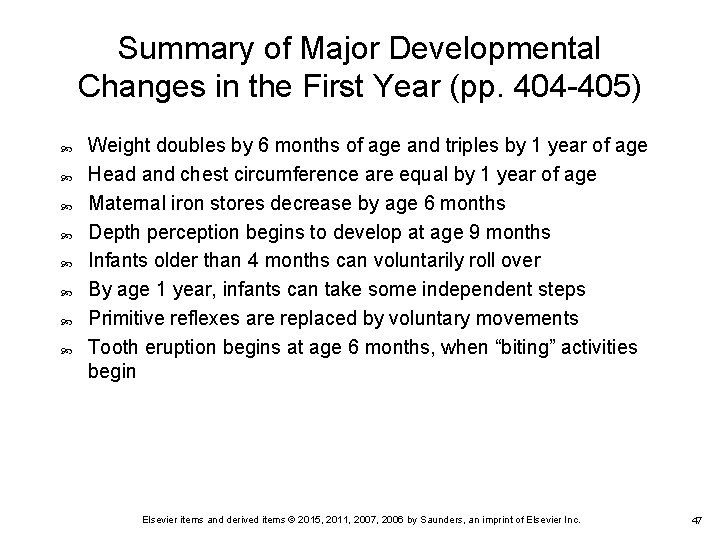
Summary of Major Developmental Changes in the First Year (pp. 404 -405) Weight doubles by 6 months of age and triples by 1 year of age Head and chest circumference are equal by 1 year of age Maternal iron stores decrease by age 6 months Depth perception begins to develop at age 9 months Infants older than 4 months can voluntarily roll over By age 1 year, infants can take some independent steps Primitive reflexes are replaced by voluntary movements Tooth eruption begins at age 6 months, when “biting” activities begin Elsevier items and derived items © 2015, 2011, 2007, 2006 by Saunders, an imprint of Elsevier Inc. 47
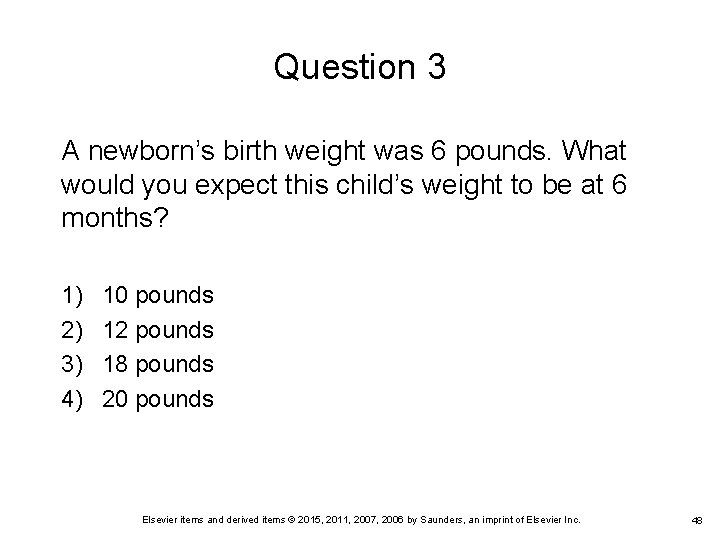
Question 3 A newborn’s birth weight was 6 pounds. What would you expect this child’s weight to be at 6 months? 1) 2) 3) 4) 10 pounds 12 pounds 18 pounds 20 pounds Elsevier items and derived items © 2015, 2011, 2007, 2006 by Saunders, an imprint of Elsevier Inc. 48