
Senses Chapter 10 Copyright 2016 by Elsevier Inc
Senses Chapter 10 Copyright © 2016 by Elsevier Inc. All rights reserved. 1
Learning Objectives Lesson 10. 1: Senses 1. 2. 3. 4. Classify the sense organs as general or special and explain the basic differences between the two groups. Discuss how a stimulus is converted into a sensation. Discuss the general sense organs and their functions. Describe the structure of the eye and the functions of its components. Copyright © 2016 by Elsevier Inc. All rights reserved. 2
Learning Objectives Lesson 10. 1: Senses (Cont. ) 5. 6. 7. 8. Discuss the anatomy of the ear and its sensory function in hearing and equilibrium. Describe the anatomy of the tongue and its sensory function in taste. Describe the anatomy of the nasal cavity and its sensory function in smell. Discuss how senses are integrated. Copyright © 2016 by Elsevier Inc. All rights reserved. 3
Classification of Senses General senses Ø Ø Often exist as individual cells or receptor units Widely distributed throughout the body Special senses Ø Ø Large and complex organs Localized grouping of specialized receptors Copyright © 2016 by Elsevier Inc. All rights reserved. 4
Classification of Senses (Cont. ) Sensory receptor types Ø Classification by presence or absence of covering capsule • • Encapsulated Unencapsulated (“free” or “naked”) Copyright © 2016 by Elsevier Inc. All rights reserved. 5
Classification of Senses (Cont. ) Classification by type of stimuli required to activate receptors Ø Ø Ø Photoreceptors (light) Chemoreceptors (chemicals) Pain receptors (injury) Thermoreceptors (temperature change) Mechanoreceptors (movement or deforming of capsule) Proprioceptors (position of body parts or changes in muscle length or tension) Copyright © 2016 by Elsevier Inc. All rights reserved. 6
Sensory Pathways All sense organs have common functional characteristics Ø Ø Ø All are able to detect a particular stimulus A stimulus is converted into a nerve impulse A nerve impulse is perceived as a sensation in the central nervous system Copyright © 2016 by Elsevier Inc. All rights reserved. 7
General Senses Distribution is widespread; single-cell receptors are common Examples (Figure 10 -1, Table 10 -1) Ø Free nerve endings • • • Ø Tactile (Meissner) corpuscles • • Ø Pain Temperature Crude touch Fine touch Vibration Bulbous (Ruffini) corpuscles • • Touch Pressure Copyright © 2016 by Elsevier Inc. All rights reserved. 8
General Senses (Cont. ) Examples Ø Lamellar (Pacini) corpuscles • • Ø Bulboid corpuscles (Krause end bulbs) • Ø Touch Golgi tendon receptors • Ø Pressure Vibration Important proprioceptors Muscle spindles • Important proprioceptors Copyright © 2016 by Elsevier Inc. All rights reserved. 9
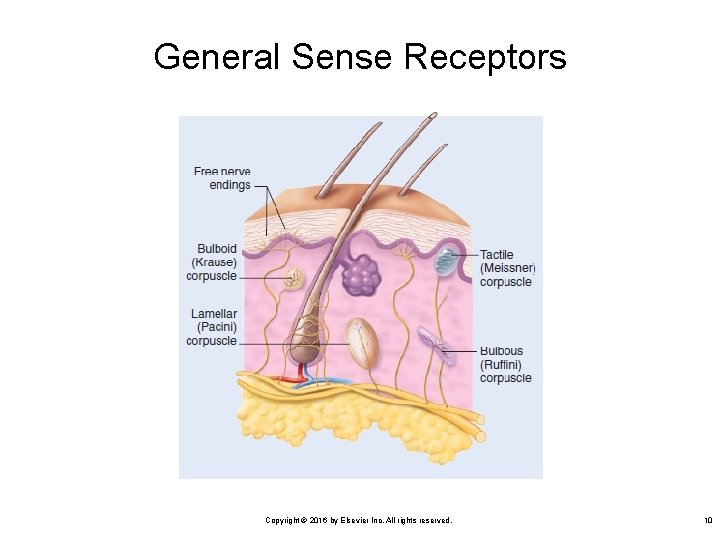
General Sense Receptors Copyright © 2016 by Elsevier Inc. All rights reserved. 10
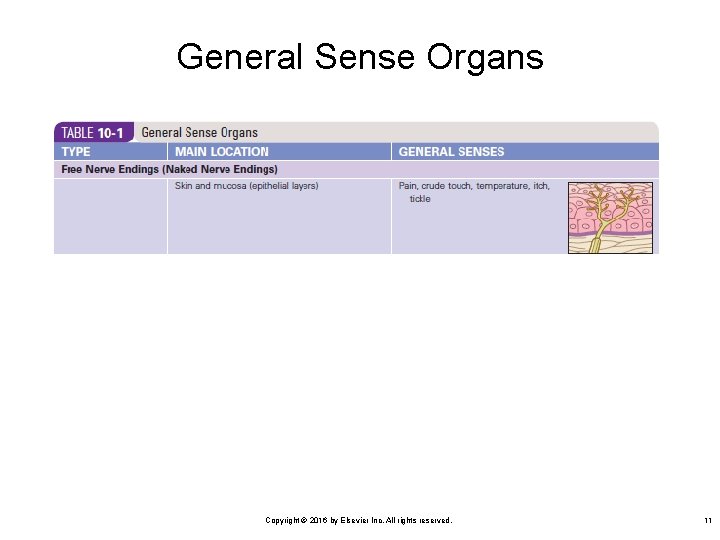
General Sense Organs Copyright © 2016 by Elsevier Inc. All rights reserved. 11
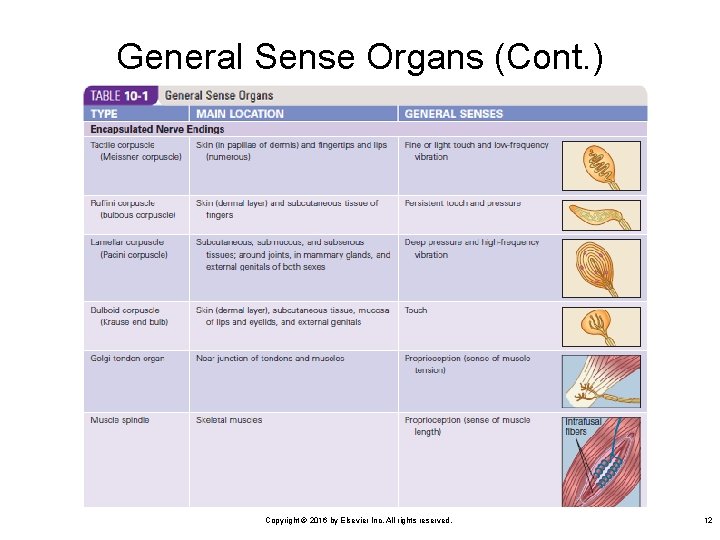
General Sense Organs (Cont. ) Copyright © 2016 by Elsevier Inc. All rights reserved. 12
Special Senses: Vision Structure and function of the eye (Figure 10 -2) Ø Sclera • Ø Choroid • Ø Tough outer coat; “white” of eye; cornea is transparent part of sclera over iris Pigmented vascular layer prevents scattering of light; front part of this layer made of ciliary muscle and iris, the colored part of the eye; the pupil is the hole in the center of the iris; contraction of iris muscle dilates or constricts pupil Retina (Figure 10 -4) • Innermost layer of the eye; contains rods (receptors for night vision) and cones (receptors for day vision and color vision) Copyright © 2016 by Elsevier Inc. All rights reserved. 13
Special Senses: Vision (Cont. ) Conjunctiva Ø Ø Mucous membrane covering the front surface of the sclera and also lines the eyelid Kept moist by tears found in the lacrimal gland Lens Ø Ø Transparent body behind the pupil Focuses light rays on the retina Copyright © 2016 by Elsevier Inc. All rights reserved. 14
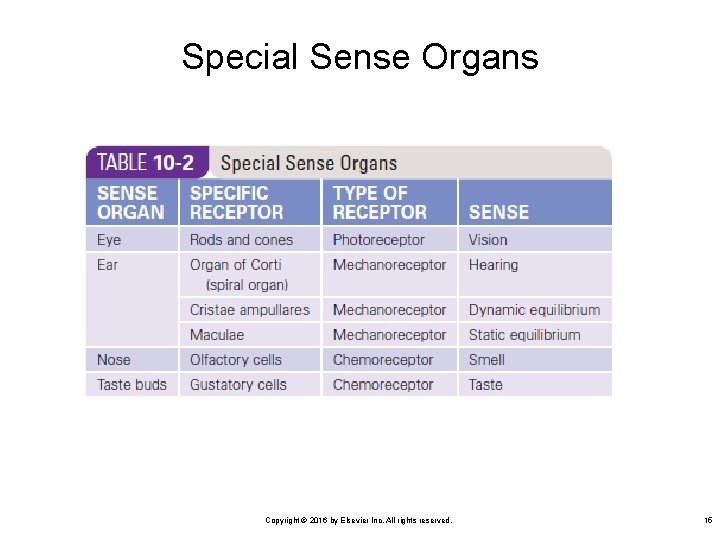
Special Sense Organs Copyright © 2016 by Elsevier Inc. All rights reserved. 15
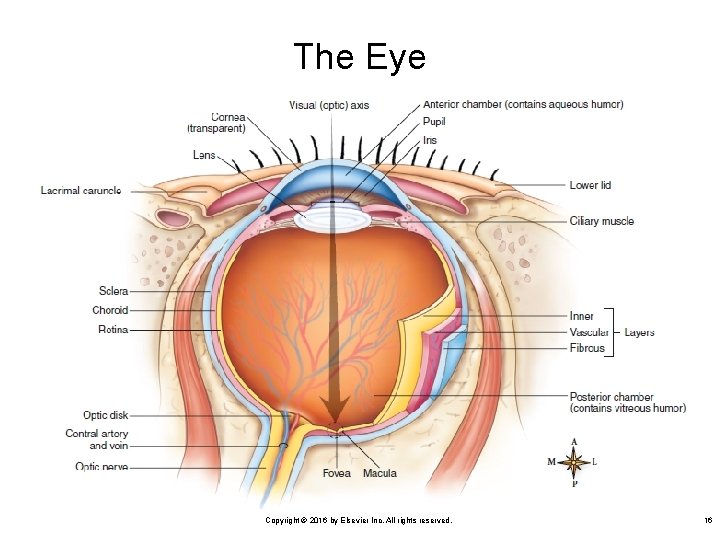
The Eye Copyright © 2016 by Elsevier Inc. All rights reserved. 16
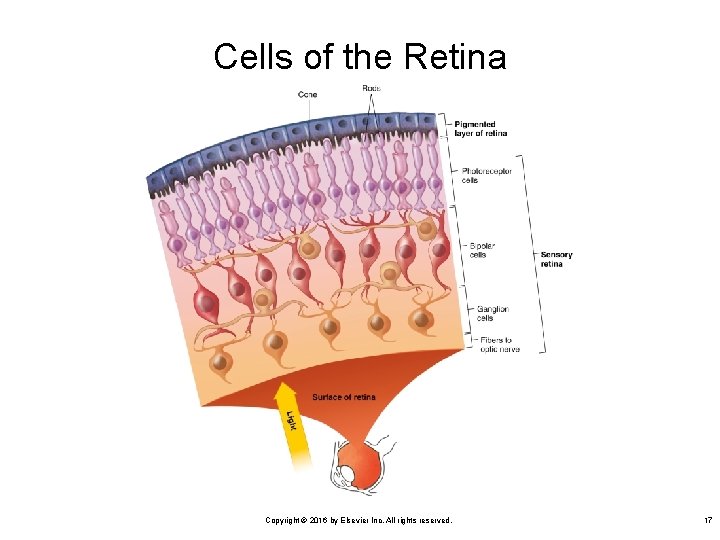
Cells of the Retina Copyright © 2016 by Elsevier Inc. All rights reserved. 17
Special Senses: Vision (Cont. ) Structure and function of the eye Ø Eye fluids • • Ø Aqueous humor: In anterior chamber in front of the lens Vitreous humor: In posterior chamber behind the lens Visual pathway • • Innermost layer of retina contains rods and cones Impulse travels from the rods and cones through the bipolar and ganglionic layers of retina (Figure 10 -4) Nerve impulse leaves the eye through the optic nerve; the point of exit is free of receptors and is therefore called a blind spot Visual interpretation occurs in the visual cortex of the cerebrum Copyright © 2016 by Elsevier Inc. All rights reserved. 18
Special Senses: Hearing and Equilibrium The ear functions in hearing and in equilibrium and balance Ø Receptors called mechanoreceptors Structure and function of the ear (Figure 10 -6) Ø External ear • • Auricle (pinna) External auditory canal Curving canal 2. 5 cm (1 inch) in length Contains ceruminous glands Ends at the tympanic membrane Copyright © 2016 by Elsevier Inc. All rights reserved. 19
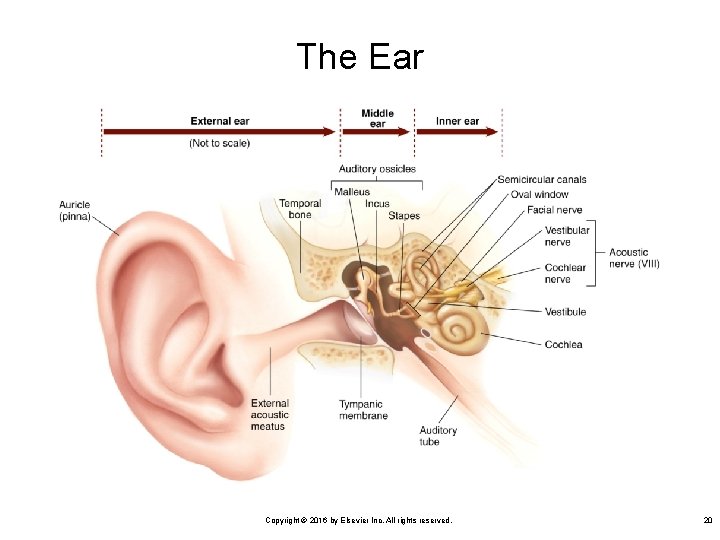
The Ear Copyright © 2016 by Elsevier Inc. All rights reserved. 20
Special Senses: Hearing and Equilibrium (Cont. ) Structure and function of the ear Ø Middle ear • Houses ear ossicles • • • Malleus Incus Stapes Ends in the oval window The auditory (eustachian) tube connects the middle ear to the throat Inflammation called otitis media Copyright © 2016 by Elsevier Inc. All rights reserved. 21
Special Senses: Hearing and Equilibrium (Cont. ) Structure and function of the ear Ø Inner ear (Figure 10 -8) • • • Bony labyrinth filled with perilymph Subdivided into the vestibule, semicircular canals, and cochlea Membranous labyrinth filled with endolymph The receptors for balance in the semicircular canals are called cristae ampullares Specialized hair cells on the organ of Corti respond when bent by the movement of surrounding endolymph set in motion by sound waves Copyright © 2016 by Elsevier Inc. All rights reserved. 22
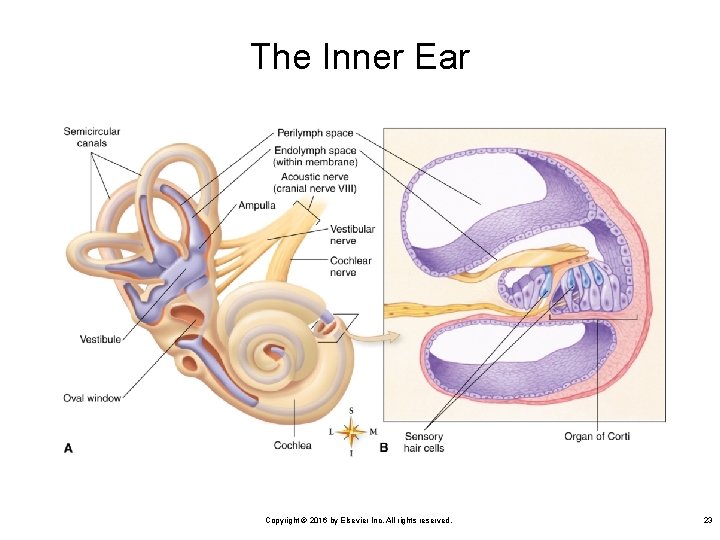
The Inner Ear Copyright © 2016 by Elsevier Inc. All rights reserved. 23
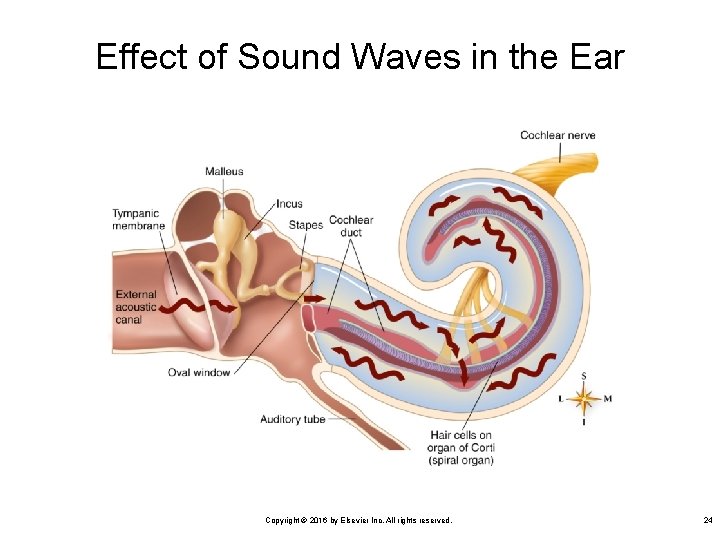
Effect of Sound Waves in the Ear Copyright © 2016 by Elsevier Inc. All rights reserved. 24
Special Senses: Taste Receptors are chemoreceptors called taste buds Two cranial nerves (VII and IX) carry gustatory impulses Most pathologists list four kinds of “primary” taste sensations: Sweet, sour, bitter, and salty Ø Ø Metallic and umami (meaty) tastes are also unique and may soon be added to the list of “primary” taste sensations Nasal congestion interferes with stimulation of olfactory receptors and thereby dulls taste sensations Copyright © 2016 by Elsevier Inc. All rights reserved. 25
Special Senses: Taste (Cont. ) Gustatory and olfactory senses work together to permit creation of many other taste sensations Copyright © 2016 by Elsevier Inc. All rights reserved. 26
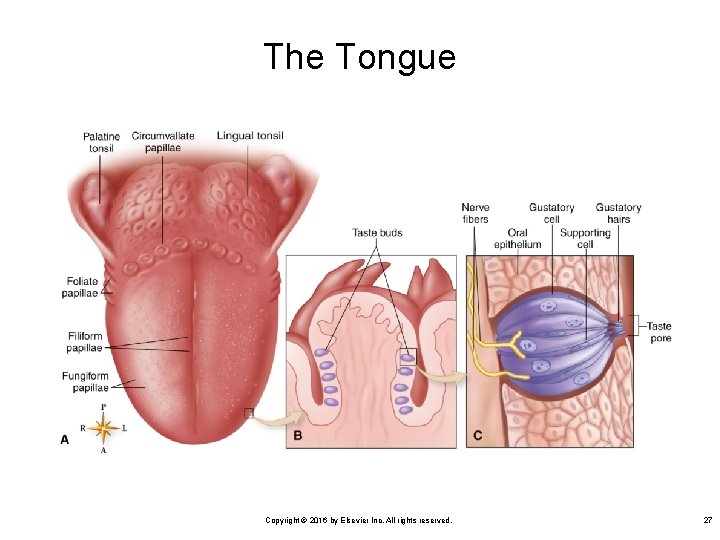
The Tongue Copyright © 2016 by Elsevier Inc. All rights reserved. 27
Special Senses: Smell Receptors for fibers of olfactory or cranial nerves lie in olfactory mucosa of nasal cavity Olfactory receptors are extremely sensitive but easily adapt (become fatigued) Odor-causing chemicals initiate a nervous signal that is interpreted as a specific odor by the brain Copyright © 2016 by Elsevier Inc. All rights reserved. 28
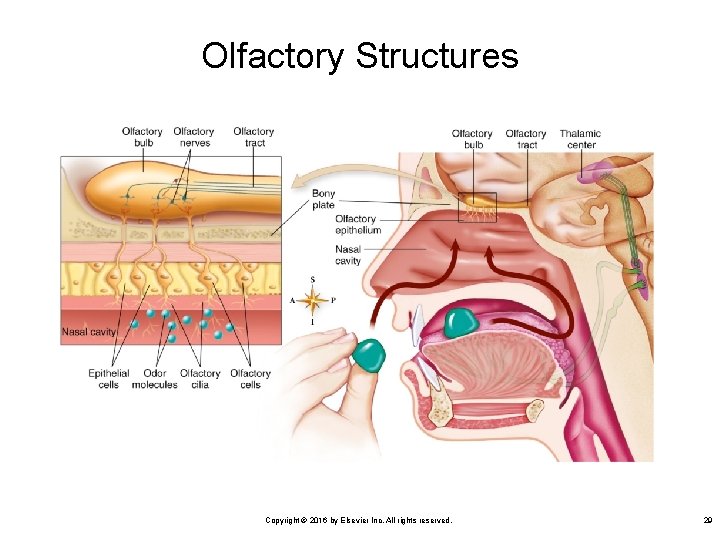
Olfactory Structures Copyright © 2016 by Elsevier Inc. All rights reserved. 29
Integration of Senses Sensations are all perceived in the brain, not at individual receptors scattered throughout body Severe nasal congestion can interfere with the stimulation of olfactory receptors by food odors in the mouth, which leads to dull flavor sensations Smell sensations are often powerful triggers of memory Copyright © 2016 by Elsevier Inc. All rights reserved. 30

Questions? Copyright © 2016 by Elsevier Inc. All rights reserved. 31
- Slides: 31