
Intracranial Pressure Chapter 56 Copyright 2017 Elsevier Inc












- Slides: 75
Intracranial Pressure Chapter 56 Copyright © 2017, Elsevier Inc. All Rights Reserved.
Case Study (©Creatas. Images/Creatas/Thinkstock) • A. T. is a 68 -year-old male brought to the ED with confusion, lethargy, and headache. • He was in a car accident 2 days ago where he hit his head on the windshield. Copyright © 2017, Elsevier Inc. All Rights Reserved.
Case Study (©Creatas. Images/Creatas/Thinkstock) • He felt fine at the time and did not seek medical care. Copyright © 2017, Elsevier Inc. All Rights Reserved.
Case Study (©Creatas. Images/Creatas/Thinkstock) • The health care provider suspects A. T. ’s symptoms may be caused by increased intracranial pressure (ICP). • What causes increased ICP? Copyright © 2017, Elsevier Inc. All Rights Reserved.
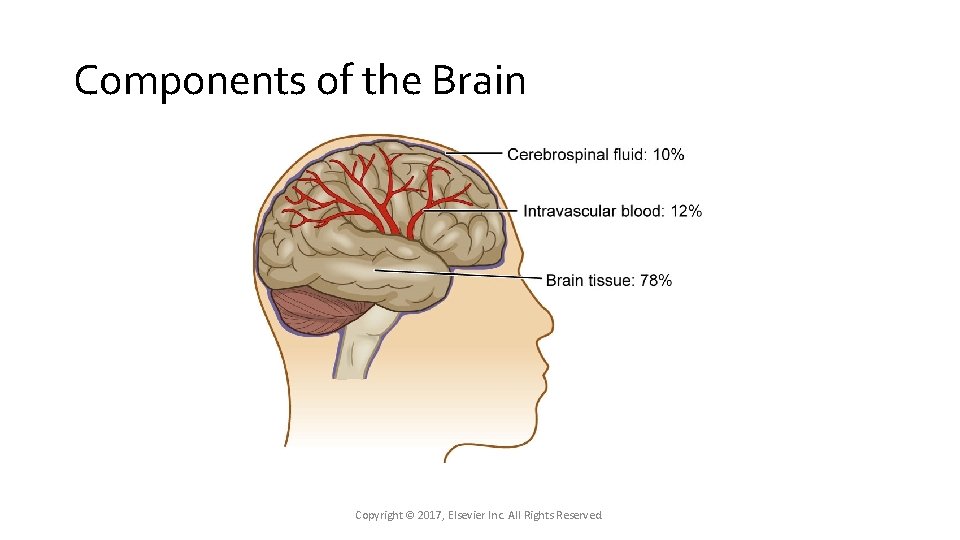
Intracranial Pressure • Skull has three essential components: 1. Brain tissue 2. Blood 3. Cerebrospinal fluid (CSF) Copyright © 2017, Elsevier Inc. All Rights Reserved.
Components of the Brain Copyright © 2017, Elsevier Inc. All Rights Reserved.
Intracranial Pressure • Factors that influence ICP • • • Arterial pressure Venous pressure Intraabdominal and intrathoracic pressure Posture Temperature Blood gases (CO 2 levels) Copyright © 2017, Elsevier Inc. All Rights Reserved.
Regulation and Maintenance • Monro-Kellie doctrine • If one component increases, another must decrease to maintain ICP • Normal ICP 5 to 15 mm Hg • Elevated if >20 mm Hg sustained Copyright © 2017, Elsevier Inc. All Rights Reserved.
Case Study (©Creatas. Images/Creatas/Thinkstock) • What compensatory mechanisms may have been at work in A. T. ’s body over the last few days in response to increased ICP? Copyright © 2017, Elsevier Inc. All Rights Reserved.
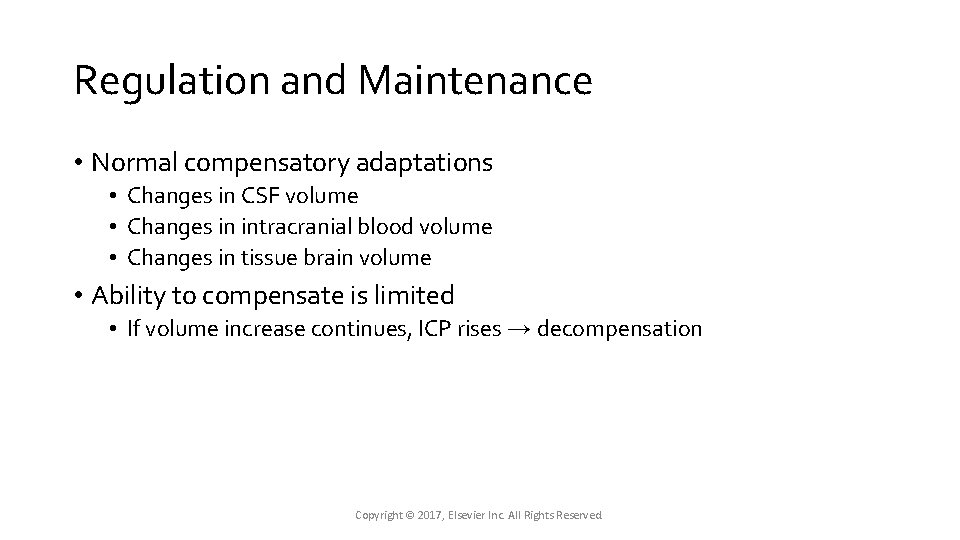
Regulation and Maintenance • Normal compensatory adaptations • Changes in CSF volume • Changes in intracranial blood volume • Changes in tissue brain volume • Ability to compensate is limited • If volume increase continues, ICP rises → decompensation Copyright © 2017, Elsevier Inc. All Rights Reserved.
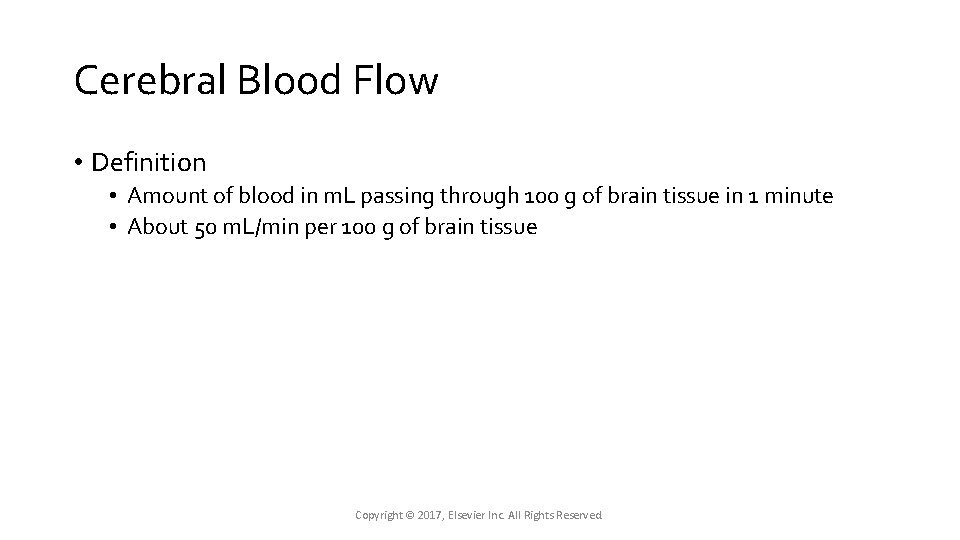
Cerebral Blood Flow • Definition • Amount of blood in m. L passing through 100 g of brain tissue in 1 minute • About 50 m. L/min per 100 g of brain tissue Copyright © 2017, Elsevier Inc. All Rights Reserved.
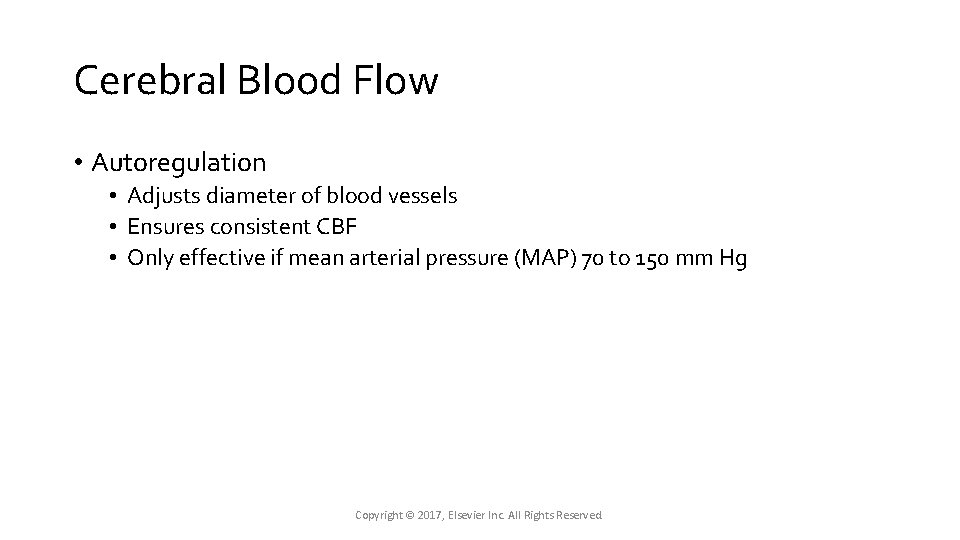
Cerebral Blood Flow • Autoregulation • Adjusts diameter of blood vessels • Ensures consistent CBF • Only effective if mean arterial pressure (MAP) 70 to 150 mm Hg Copyright © 2017, Elsevier Inc. All Rights Reserved.
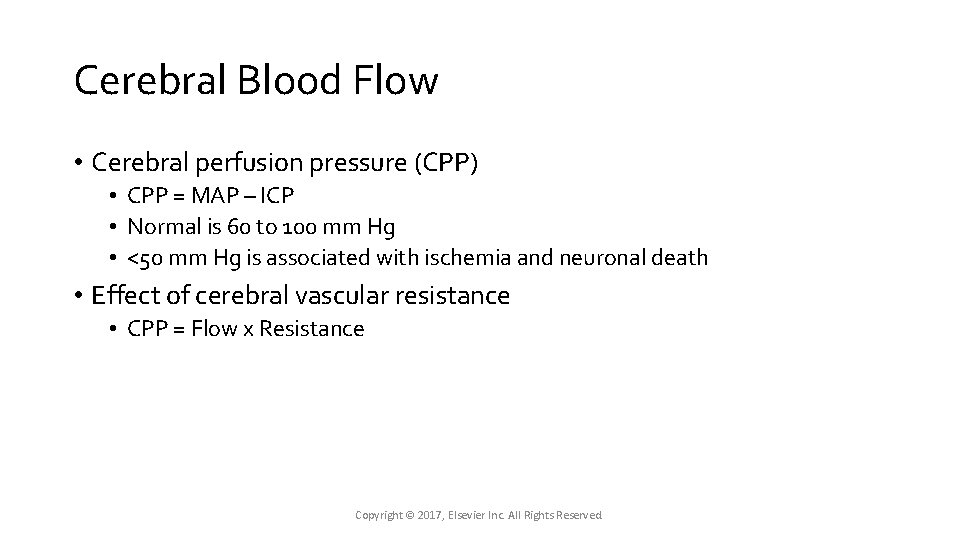
Cerebral Blood Flow • Cerebral perfusion pressure (CPP) • CPP = MAP – ICP • Normal is 60 to 100 mm Hg • <50 mm Hg is associated with ischemia and neuronal death • Effect of cerebral vascular resistance • CPP = Flow x Resistance Copyright © 2017, Elsevier Inc. All Rights Reserved.
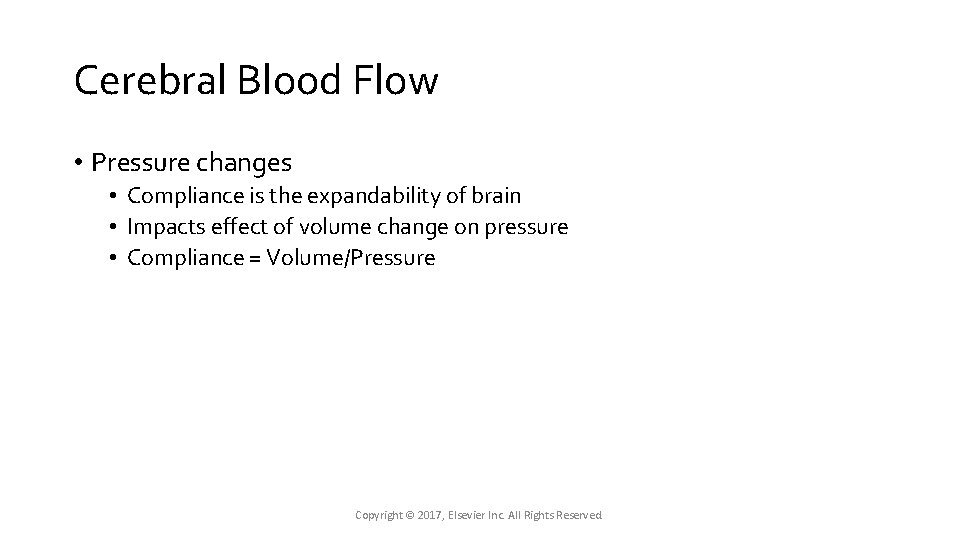
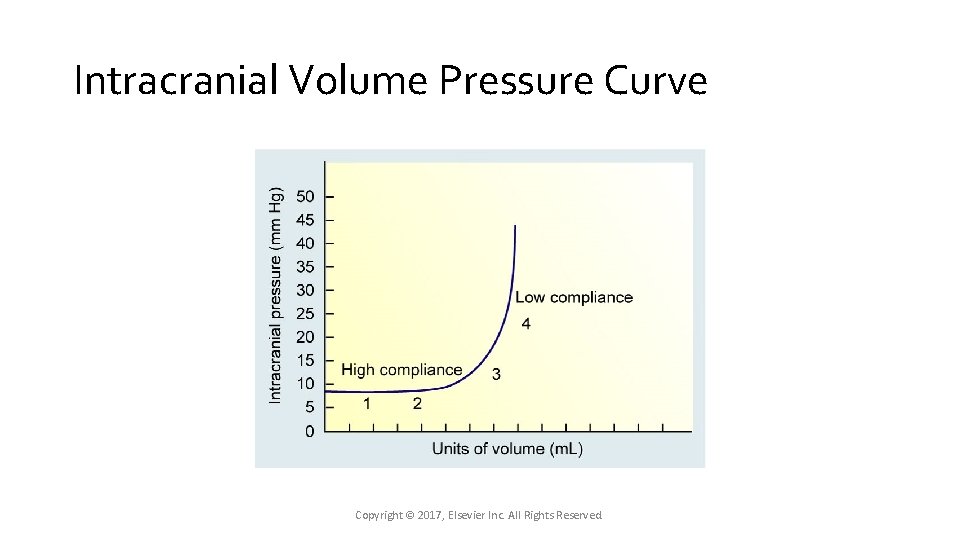
Cerebral Blood Flow • Pressure changes • Compliance is the expandability of brain • Impacts effect of volume change on pressure • Compliance = Volume/Pressure Copyright © 2017, Elsevier Inc. All Rights Reserved.
Intracranial Volume Pressure Curve Copyright © 2017, Elsevier Inc. All Rights Reserved.
Case Study (©Creatas. Images/Creatas/Thinkstock) • A. T. ’s BP is 144/54 mm Hg, HR 76 bpm, RR 12 breaths/minute, and Temp 98. 9 F. • His CT scan reveals a subacute subdural hematoma. • What stage of increased ICP is A. T. displaying? Copyright © 2017, Elsevier Inc. All Rights Reserved.
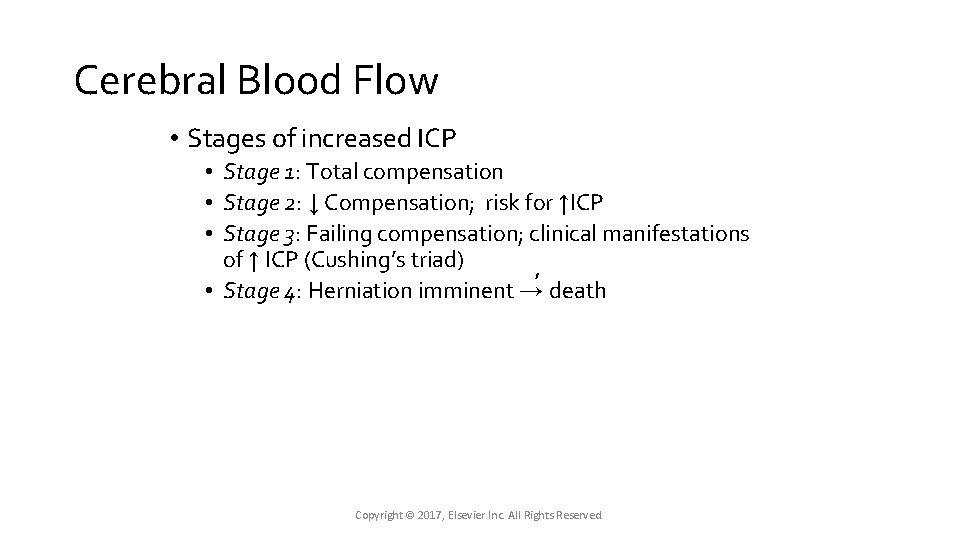
Cerebral Blood Flow • Stages of increased ICP • Stage 1: Total compensation • Stage 2: ↓ Compensation; risk for ↑ICP • Stage 3: Failing compensation; clinical manifestations of ↑ ICP (Cushing’s triad) , • Stage 4: Herniation imminent → death Copyright © 2017, Elsevier Inc. All Rights Reserved.
Cerebral Blood Flow • Factors affecting cerebral blood vessel tone • CO 2 • Hydrogen ion concentration Copyright © 2017, Elsevier Inc. All Rights Reserved.
Increased ICP • Life-threatening • Increase in any of three components • Brain tissue • Blood • CSF • ↑ Cerebral edema Copyright © 2017, Elsevier Inc. All Rights Reserved.
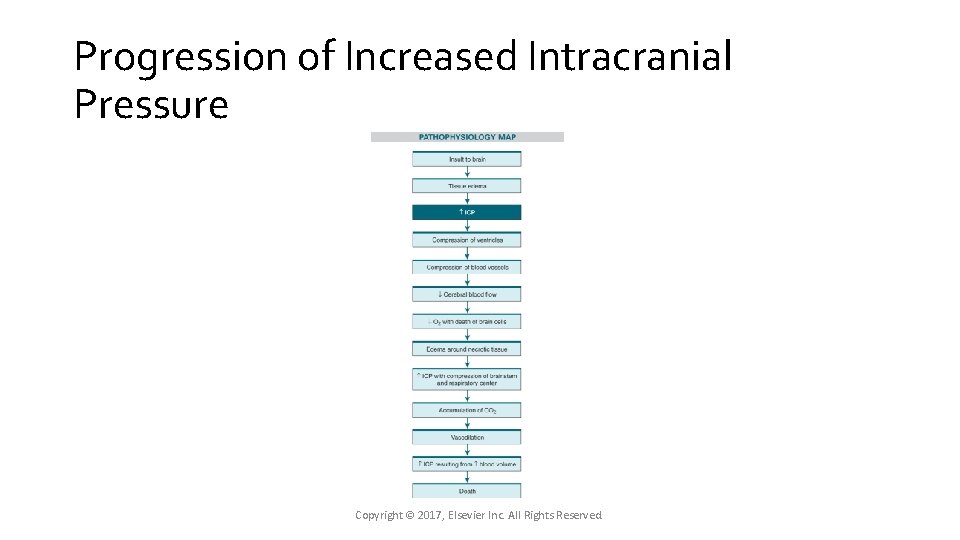
Progression of Increased Intracranial Pressure Copyright © 2017, Elsevier Inc. All Rights Reserved.
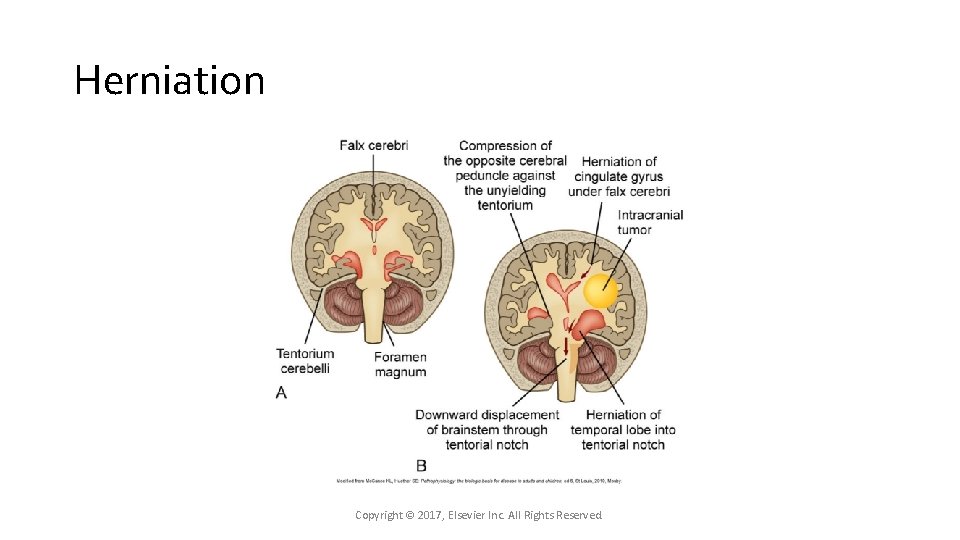
Herniation Copyright © 2017, Elsevier Inc. All Rights Reserved.
Cerebral Edema • ↑ Extravascular fluid in brain • Variety of causes • Three types of cerebral edema 1. Vasogenic 2. Cytotoxic 3. Interstitial Copyright © 2017, Elsevier Inc. All Rights Reserved.
Cerebral Edema • Vasogenic cerebral edema • • • Most common type Occurs mainly in white matter Fluid leaks from intravascular to extravascular space Variety of causes Continuum of symptoms → coma Copyright © 2017, Elsevier Inc. All Rights Reserved.
Cerebral Edema • Cytotoxic cerebral edema • Disruption of cell membrane integrity • Secondary to destructive lesions or trauma to brain tissue • Fluid shift from extracellular to intracellular Copyright © 2017, Elsevier Inc. All Rights Reserved.
Cerebral Edema • Interstitial cerebral edema • Usually result of hydrocephalus • Excess CSP production, obstruction of flow, or inability to reabsorb • Treat with ventriculostomy or shunt Copyright © 2017, Elsevier Inc. All Rights Reserved.
Case Study (©Creatas. Images/Creatas/Thinkstock) • For what additional clinical manifestations will you assess A. T. ? Copyright © 2017, Elsevier Inc. All Rights Reserved.
Clinical Manifestations • Change in level of consciousness • Change in vital signs • Cushing’s triad • Ocular signs Copyright © 2017, Elsevier Inc. All Rights Reserved.
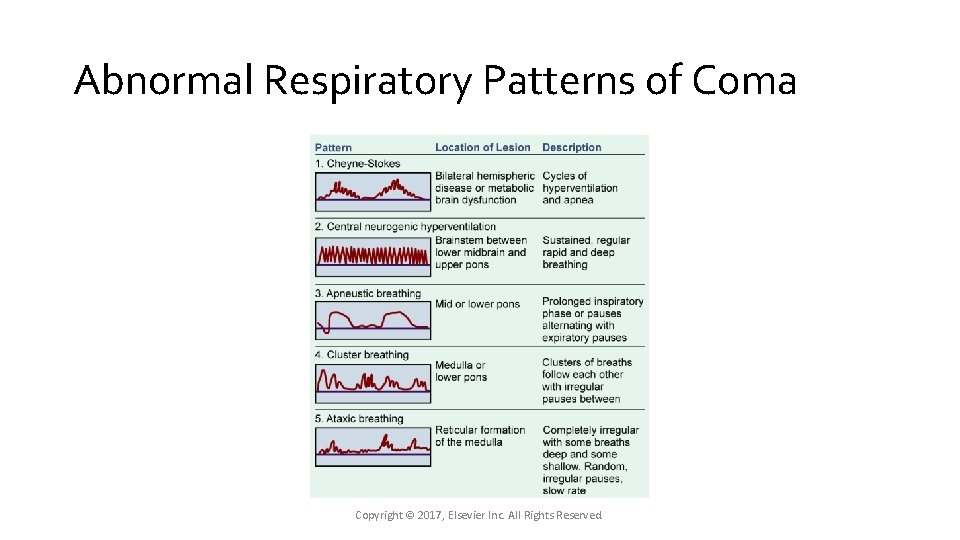
Clinical Manifestations • Change in level of consciousness • Flattening of affect → coma • Change in vital signs • Cushing’s triad (widened pulse pressure, bradycardia, irregular respirations) • Change in body temperature Copyright © 2017, Elsevier Inc. All Rights Reserved.
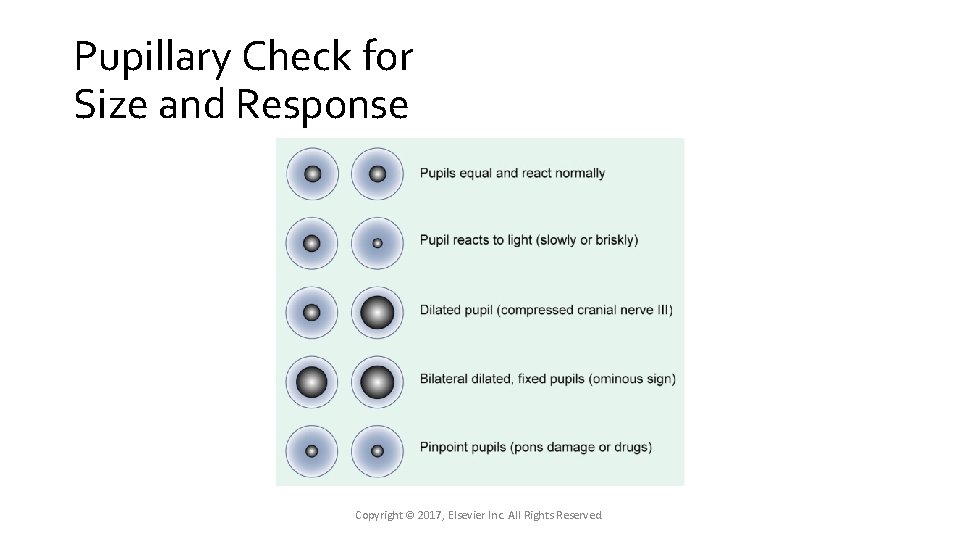
Clinical Manifestations • Compression of oculomotor nerve • • Unilateral pupil dilation Sluggish or no response to light Inability to move eye upward Eyelid ptosis Copyright © 2017, Elsevier Inc. All Rights Reserved.
Clinical Manifestations • Other cranial nerves • Diploplia, blurred vision, EOM changes Copyright © 2017, Elsevier Inc. All Rights Reserved.
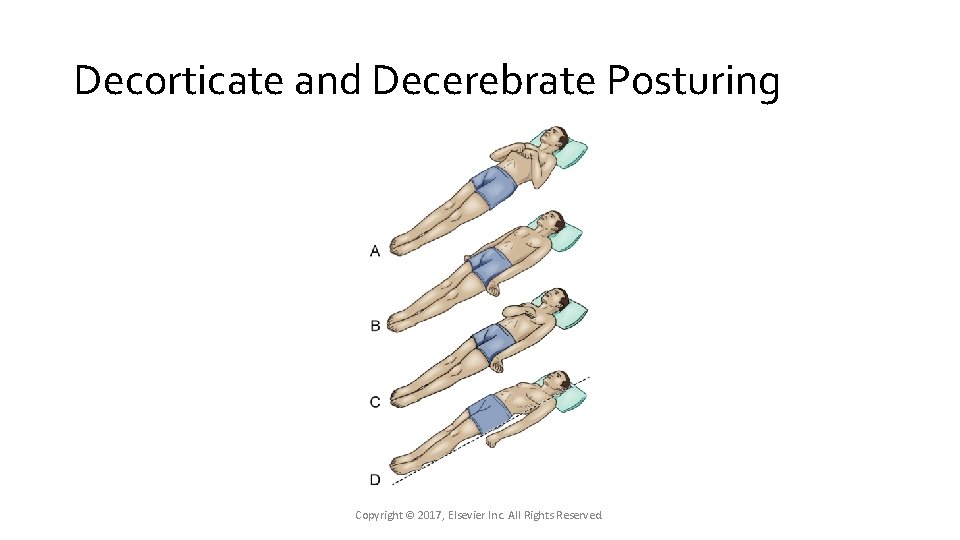
Clinical Manifestations • ↓ In motor function • Hemiparesis/hemiplegia • Decerebrate posturing (extensor) • Indicates more serious damage • Decorticate posturing (flexor) Copyright © 2017, Elsevier Inc. All Rights Reserved.
Decorticate and Decerebrate Posturing Copyright © 2017, Elsevier Inc. All Rights Reserved.
Clinical Manifestations • Headache • Often continuous • Worse in the morning • Vomiting • Not preceded by nausea • Projectile Copyright © 2017, Elsevier Inc. All Rights Reserved.
Complications • Inadequate cerebral perfusion • Cerebral herniation • Tentorial herniation • Uncal herniation • Cingulate herniation Copyright © 2017, Elsevier Inc. All Rights Reserved.
Diagnostic Studies • CT scan / MRI / PET • EEG • Cerebral angiography • ICP and brain tissue oxygenation measurement (LICOX catheter) • Doppler and evoked potential studies • NO lumbar puncture Copyright © 2017, Elsevier Inc. All Rights Reserved.
Measurement of ICP • Guides clinical care • Indications • Glasgow Coma Scale of ≤ 8 • Abnormal CT scans or MRI Copyright © 2017, Elsevier Inc. All Rights Reserved.
Case Study (©Creatas. Images/Creatas/Thinkstock) • A. T. ’s health care provider decides to insert a device to measure and monitor his ICP levels. • What types of monitoring devices are used to measure ICP? Copyright © 2017, Elsevier Inc. All Rights Reserved.
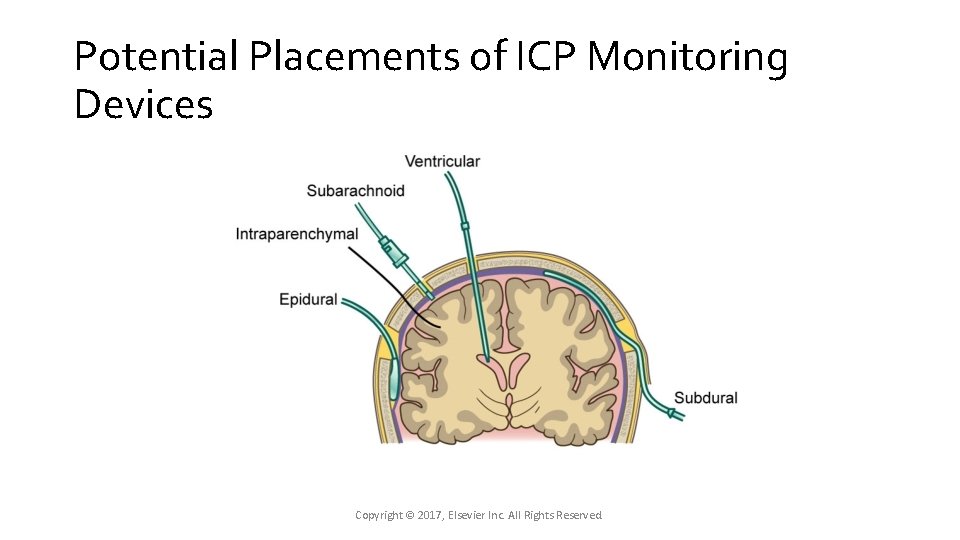
Potential Placements of ICP Monitoring Devices Copyright © 2017, Elsevier Inc. All Rights Reserved.
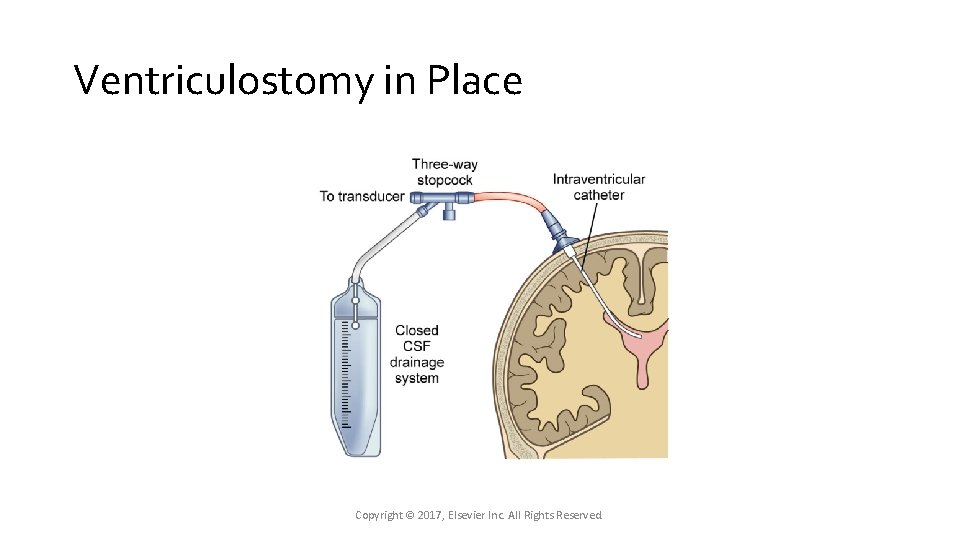
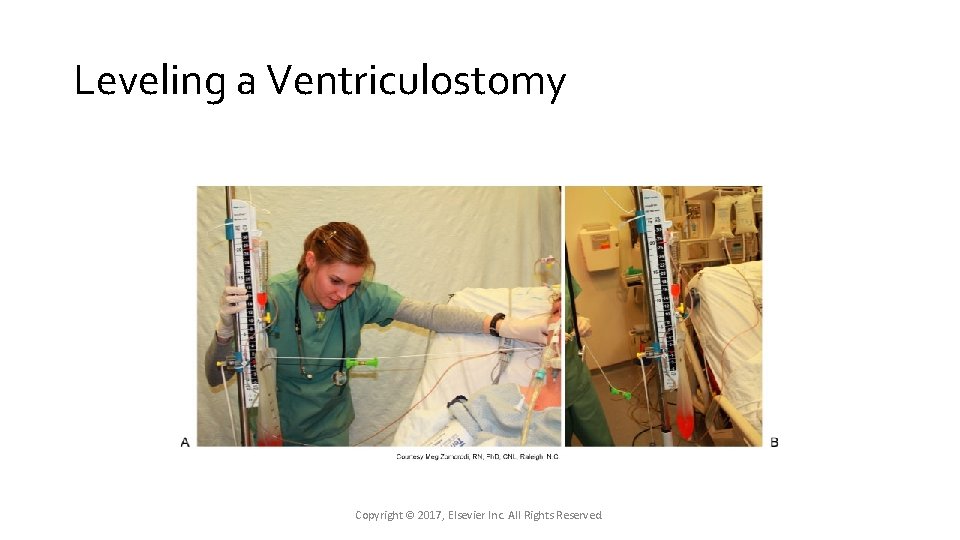
Measurement of ICP • Ventriculostomy • Catheter inserted into lateral ventricle • Coupled with an external transducer Copyright © 2017, Elsevier Inc. All Rights Reserved.
Ventriculostomy in Place Copyright © 2017, Elsevier Inc. All Rights Reserved.
Leveling a Ventriculostomy Copyright © 2017, Elsevier Inc. All Rights Reserved.
Measurement of ICP • Fiberoptic catheter • Sensor transducer located within catheter tip • Air pouch/pneumatic technology • Air-filled pouch at catheter tip Copyright © 2017, Elsevier Inc. All Rights Reserved.
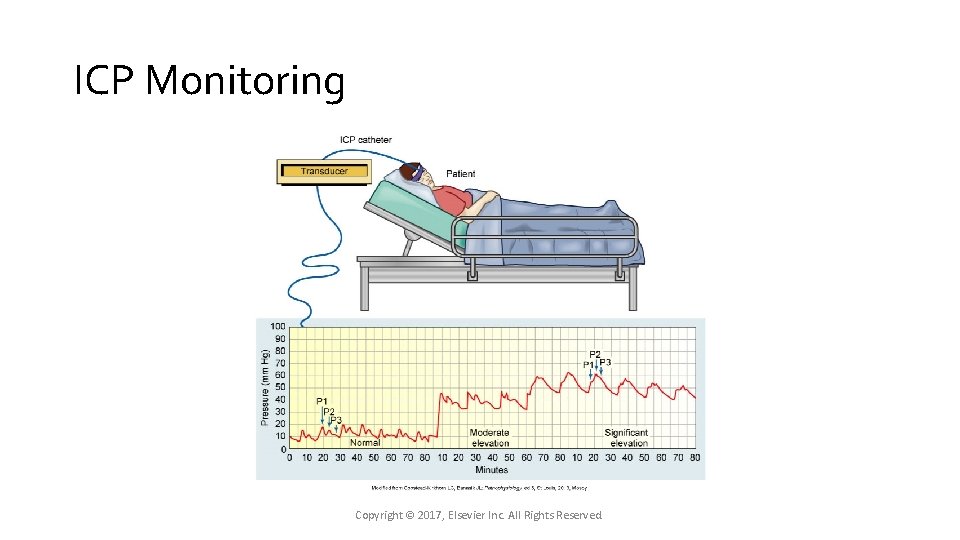
Measurement of ICP • Prevent and monitor for infection • Measure as mean pressure • Waveform should be recorded • Normal, elevated, and plateau waves Copyright © 2017, Elsevier Inc. All Rights Reserved.
ICP Monitoring Copyright © 2017, Elsevier Inc. All Rights Reserved.
Measurement of ICP • Evaluate changes with patient condition • Inaccurate readings caused by • CSF leaks • Obstruction in catheter/ kinks in tubing • Differences in height of bolt/transducer • Incorrect height of drainage system • Bubbles/air in tubing Copyright © 2017, Elsevier Inc. All Rights Reserved.
Measurement of ICP • Can control ICP by removing CSF (with ventricular catheter) • Intermittent or continuous drainage • Careful monitoring of volume of CSF drained is essential • Prevent infection and other complications Copyright © 2017, Elsevier Inc. All Rights Reserved.
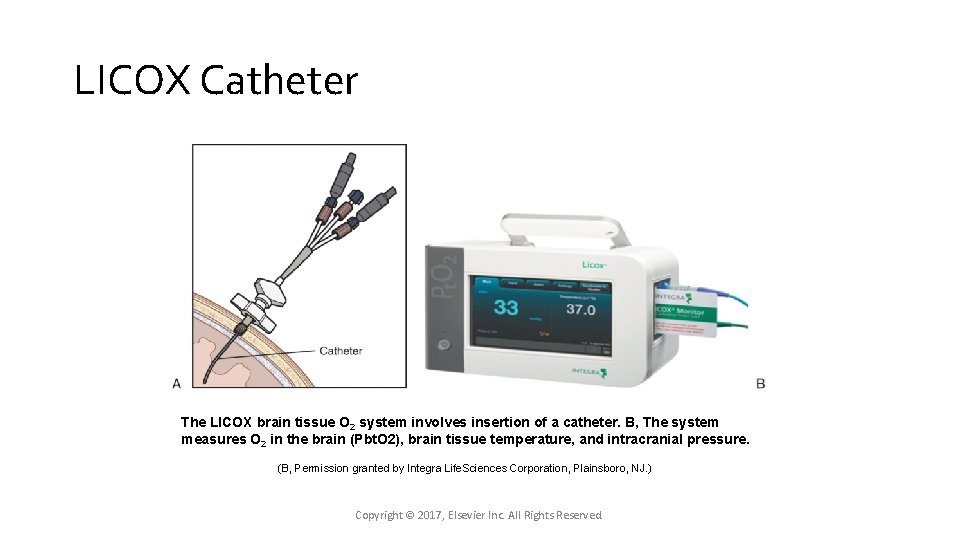
Measurement of Cerebral Oxygenation and Perfusion • LICOX catheter • Measures brain oxygenation (Pbt. O 2) and temperature • Placed in healthy white brain matter • Jugular venous bulb catheter • Measures jugular venous oxygen saturation (Sjv. O 2) Copyright © 2017, Elsevier Inc. All Rights Reserved.
LICOX Catheter The LICOX brain tissue O 2 system involves insertion of a catheter. B, The system measures O 2 in the brain (Pbt. O 2), brain tissue temperature, and intracranial pressure. (B, Permission granted by Integra Life. Sciences Corporation, Plainsboro, NJ. ) Copyright © 2017, Elsevier Inc. All Rights Reserved.
Interprofessional Care • Treat underlying cause • Adequate oxygenation • • Pa. O 2 > 100 mm Hg Pa. CO 2 35 -45 mm Hg Intubation Mechanical ventilation • Surgery Copyright © 2017, Elsevier Inc. All Rights Reserved.
Case Study (©Creatas. Images/Creatas/Thinkstock) • A. T. undergoes a craniotomy with burr holes to evacuate his hematoma. • He returns to the ICU with a venticulostomy in place. Copyright © 2017, Elsevier Inc. All Rights Reserved.
Case Study (©Creatas. Images/Creatas/Thinkstock) • Although his ICP is currently stable, you review potential drug therapies that could be used if his ICP rises again. Copyright © 2017, Elsevier Inc. All Rights Reserved.
Case Study (©Creatas. Images/Creatas/Thinkstock) • Name five classifications of drugs that might be used to treat increased intracranial pressure. Copyright © 2017, Elsevier Inc. All Rights Reserved.
Interprofessional Care • Drug Therapy • Mannitol (Osmitrol) • Plasma expansion • Osmotic effect • Monitor fluid and electrolyte status • Hypertonic saline • Moves water out of cells and into blood • Monitor BP and serum sodium levels Copyright © 2017, Elsevier Inc. All Rights Reserved.
Interprofessional Care • Drug Therapy • Corticosteroids • Vasogenic edema • Monitor fluid intake, serum sodium and glucose levels • Concurrent antacids, H 2 receptor blockers, proton pump inhibitors Copyright © 2017, Elsevier Inc. All Rights Reserved.
Interprofessional Care • Drug Therapy • • • Antiseizure medications Antipyretics Sedatives Analgesics Barbiturates Copyright © 2017, Elsevier Inc. All Rights Reserved.
Interprofessional Care • Nutritional Therapy • Hypermetabolic and hypercatabolic state ↑ need for glucose • Enteral or parenteral nutrition • Early feeding (within 3 days of injury) • Keep patient normovolemic • IV 0. 9% Na. Cl preferred over D 5 W or 0. 45% Na. Cl Copyright © 2017, Elsevier Inc. All Rights Reserved.
Case Study (©Creatas. Images/Creatas/Thinkstock) • How would you monitor A. T. ’s neurologic status postoperatively? Copyright © 2017, Elsevier Inc. All Rights Reserved.
Nursing Assessment • Subjective data • Level of consciousness (LOC) • Glasgow Coma Scale • Eye opening • Best verbal response • Best motor response Copyright © 2017, Elsevier Inc. All Rights Reserved.
Pupillary Check for Size and Response Copyright © 2017, Elsevier Inc. All Rights Reserved.
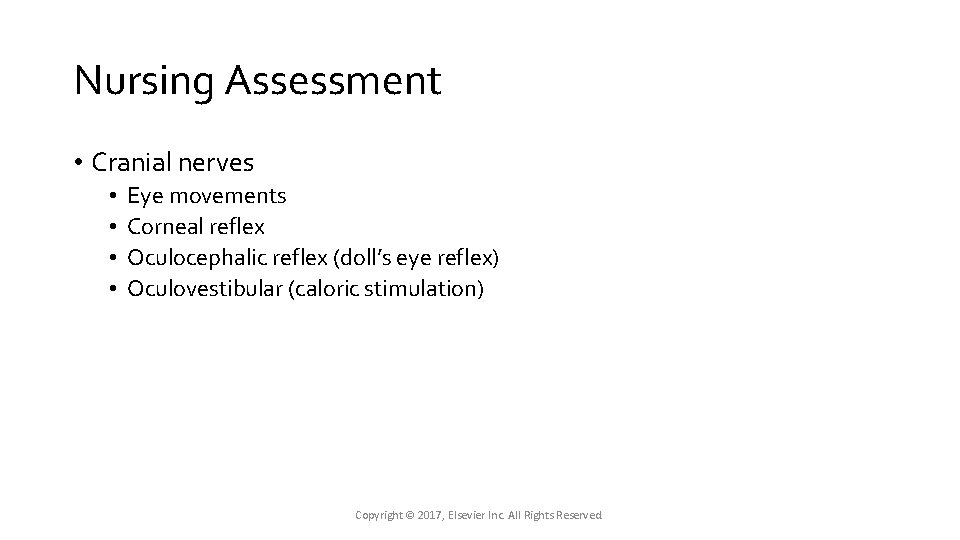
Nursing Assessment • Cranial nerves • • Eye movements Corneal reflex Oculocephalic reflex (doll’s eye reflex) Oculovestibular (caloric stimulation) Copyright © 2017, Elsevier Inc. All Rights Reserved.
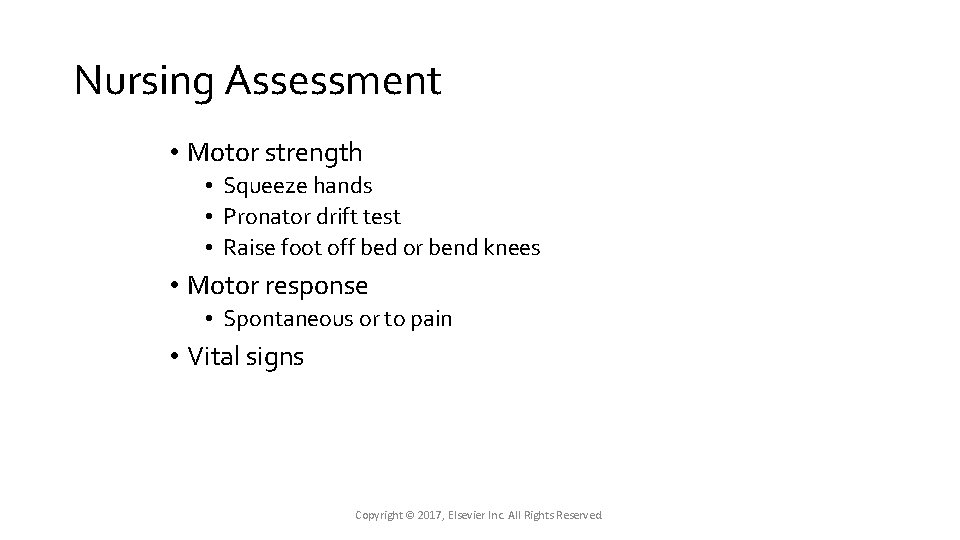
Nursing Assessment • Motor strength • Squeeze hands • Pronator drift test • Raise foot off bed or bend knees • Motor response • Spontaneous or to pain • Vital signs Copyright © 2017, Elsevier Inc. All Rights Reserved.
Abnormal Respiratory Patterns of Coma Copyright © 2017, Elsevier Inc. All Rights Reserved.
Case Study (©Creatas. Images/Creatas/Thinkstock) • What would be some priority nursing diagnoses for A. T. ? Copyright © 2017, Elsevier Inc. All Rights Reserved.
Nursing Diagnosis • Decreased intracranial adaptive capacity • Risk for ineffective cerebral tissue perfusion • Risk for disuse syndrome Copyright © 2017, Elsevier Inc. All Rights Reserved.
Nursing Planning • Overall Goals • • Maintain a patent airway ICP within normal limits Normal fluid and electrolyte balance Prevent complications secondary to immobility and decreased LOC Copyright © 2017, Elsevier Inc. All Rights Reserved.
Acute Care • Respiratory function • • • Maintain patent airway Elevate head of bed 30 degrees Suctioning needs Minimize abdominal distention Monitor ABGs Maintain ventilatory support Copyright © 2017, Elsevier Inc. All Rights Reserved.
Acute Care • Pain and anxiety management • • • Opioids Propofol (Diprivan) Dexmedetomidine (Precedex) Neuromuscular blocking agents Benzodiazepines Copyright © 2017, Elsevier Inc. All Rights Reserved.
Acute Care • Fluid and electrolyte balance • Monitor IV fluids • Daily electrolytes • Monitor for DI or SIADH • Monitor and minimize increases in ICP Copyright © 2017, Elsevier Inc. All Rights Reserved.
Case Study (©Creatas. Images/Creatas/Thinkstock) • What nursing measures can you use to prevent further increases in A. T. ’s ICP? Copyright © 2017, Elsevier Inc. All Rights Reserved.
Acute Care • Interventions to optimize ICP and CPP • • • HOB elevated appropriately Prevent extreme neck flexion Turn slowly Avoid coughing, straining, Valsalva Avoid hip flexion Copyright © 2017, Elsevier Inc. All Rights Reserved.
Case Study (©Creatas. Images/Creatas/Thinkstock) • A. T. continues to be somewhat confused even after evacuation of his subdural hematoma. • What nursing interventions would be appropriate to prevent further injury? Copyright © 2017, Elsevier Inc. All Rights Reserved.
Acute Care • Minimize complications of immobility • Protection from self-injury • Judicious use of restraints; sedatives • Seizure precautions • Quiet, nonstimulating environment • Psychologic considerations Copyright © 2017, Elsevier Inc. All Rights Reserved.
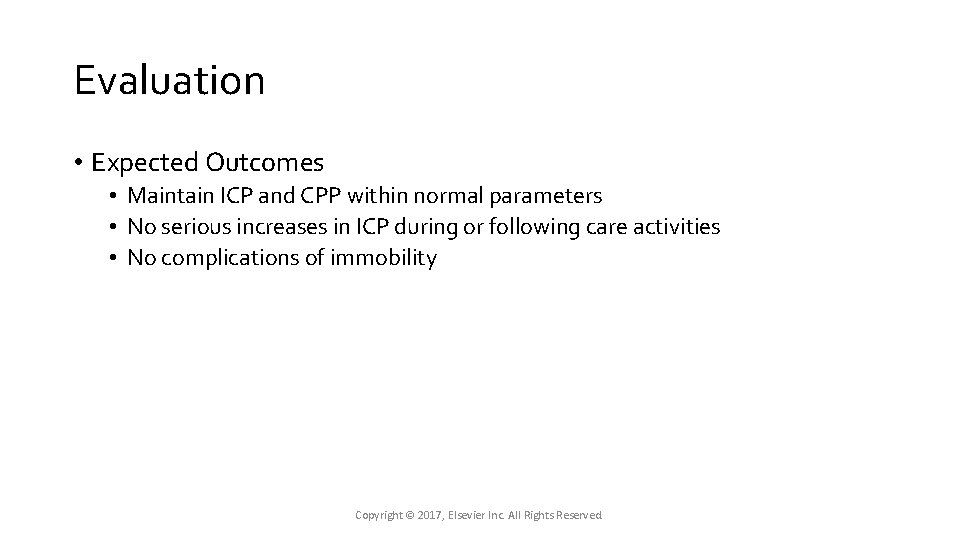
Evaluation • Expected Outcomes • Maintain ICP and CPP within normal parameters • No serious increases in ICP during or following care activities • No complications of immobility Copyright © 2017, Elsevier Inc. All Rights Reserved.
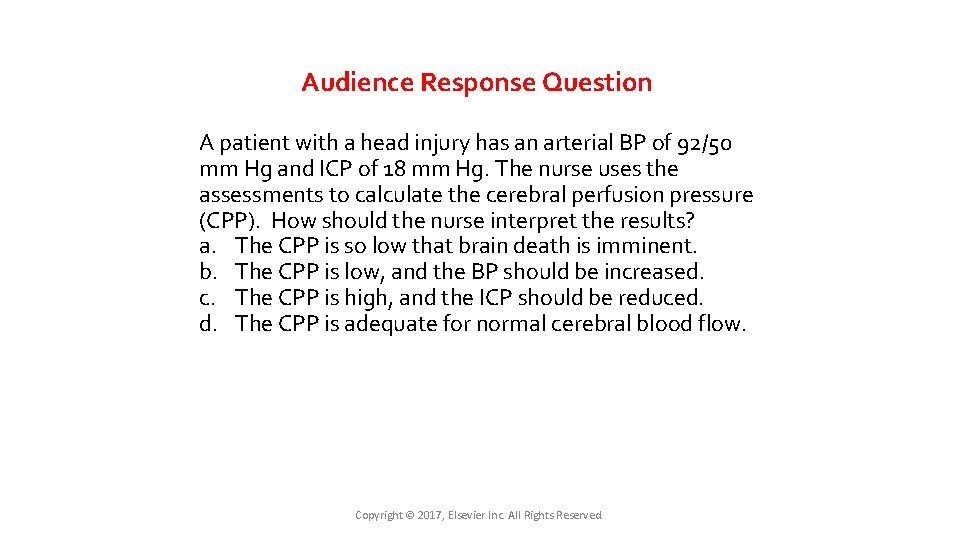
Audience Response Question A patient with a head injury has an arterial BP of 92/50 mm Hg and ICP of 18 mm Hg. The nurse uses the assessments to calculate the cerebral perfusion pressure (CPP). How should the nurse interpret the results? a. The CPP is so low that brain death is imminent. b. The CPP is low, and the BP should be increased. c. The CPP is high, and the ICP should be reduced. d. The CPP is adequate for normal cerebral blood flow. Copyright © 2017, Elsevier Inc. All Rights Reserved.
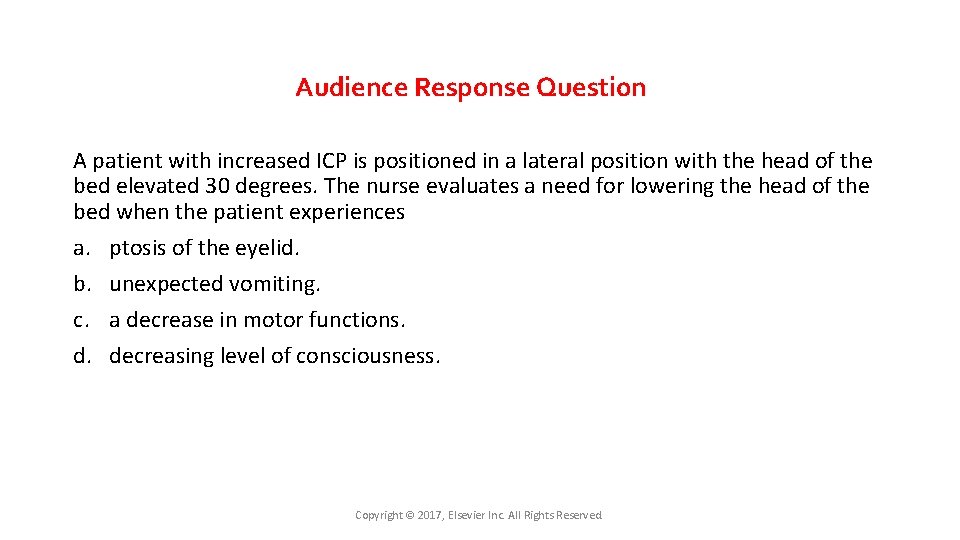
Audience Response Question A patient with increased ICP is positioned in a lateral position with the head of the bed elevated 30 degrees. The nurse evaluates a need for lowering the head of the bed when the patient experiences a. ptosis of the eyelid. b. unexpected vomiting. c. a decrease in motor functions. d. decreasing level of consciousness. Copyright © 2017, Elsevier Inc. All Rights Reserved.