Chapter 16 Aldehydes and Ketones I Nucleophilic Addition





- Slides: 42
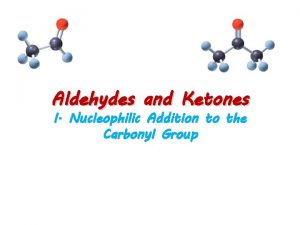
Chapter 16 Aldehydes and Ketones I. Nucleophilic Addition to the Carbonyl Group Chapter 16
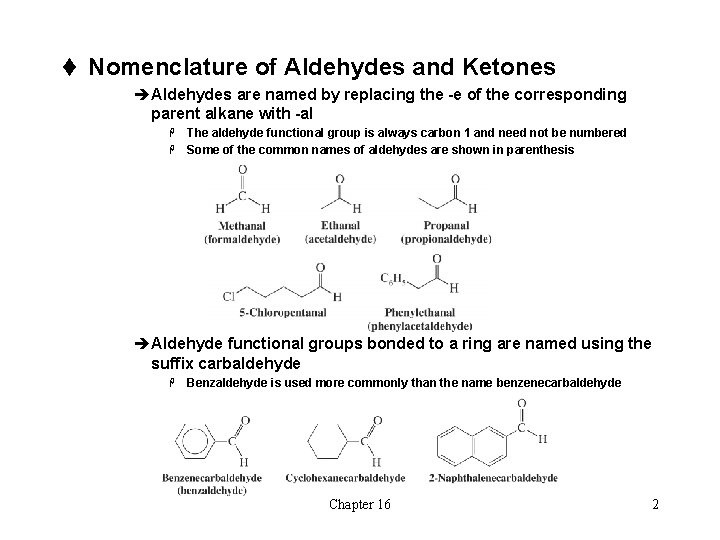
t Nomenclature of Aldehydes and Ketones èAldehydes are named by replacing the -e of the corresponding parent alkane with -al The aldehyde functional group is always carbon 1 and need not be numbered H Some of the common names of aldehydes are shown in parenthesis H èAldehyde functional groups bonded to a ring are named using the suffix carbaldehyde H Benzaldehyde is used more commonly than the name benzenecarbaldehyde Chapter 16 2
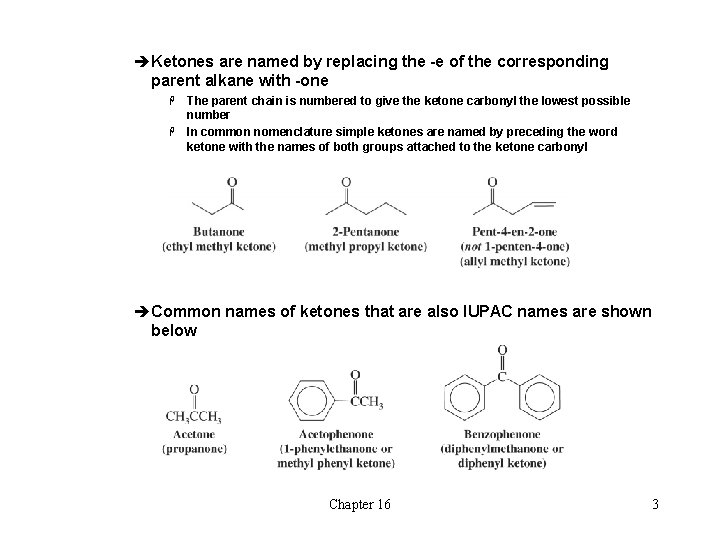
èKetones are named by replacing the -e of the corresponding parent alkane with -one The parent chain is numbered to give the ketone carbonyl the lowest possible number H In common nomenclature simple ketones are named by preceding the word ketone with the names of both groups attached to the ketone carbonyl H èCommon names of ketones that are also IUPAC names are shown below Chapter 16 3
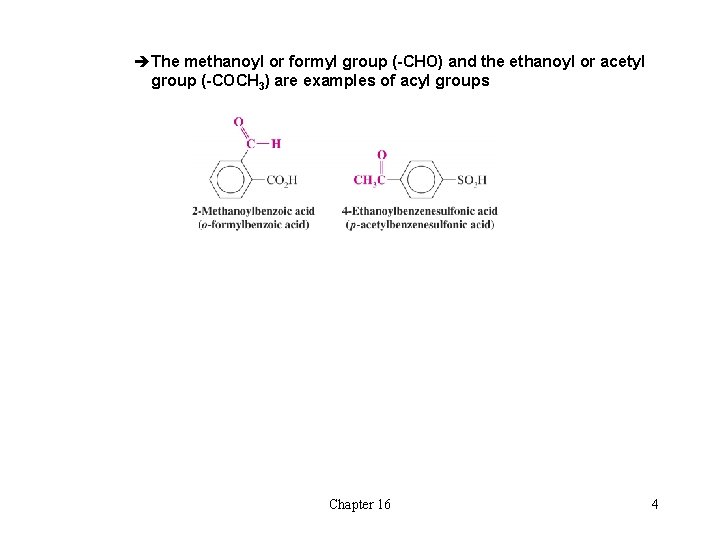
èThe methanoyl or formyl group (-CHO) and the ethanoyl or acetyl group (-COCH 3) are examples of acyl groups Chapter 16 4
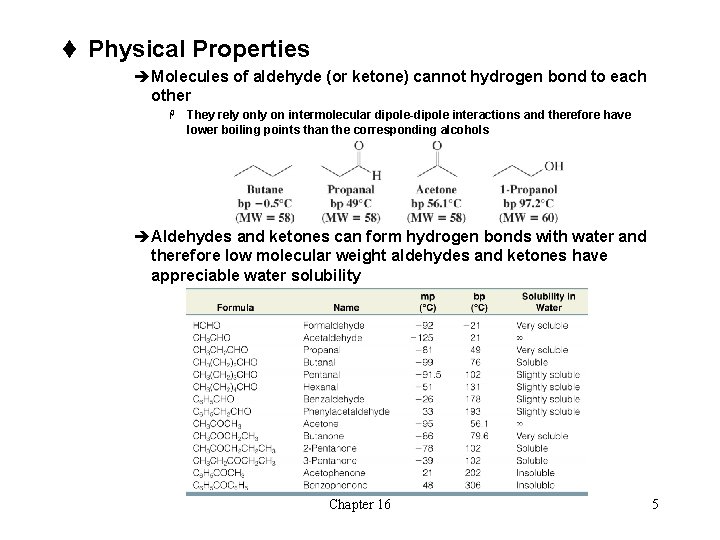
t Physical Properties èMolecules of aldehyde (or ketone) cannot hydrogen bond to each other H They rely on intermolecular dipole-dipole interactions and therefore have lower boiling points than the corresponding alcohols èAldehydes and ketones can form hydrogen bonds with water and therefore low molecular weight aldehydes and ketones have appreciable water solubility Chapter 16 5
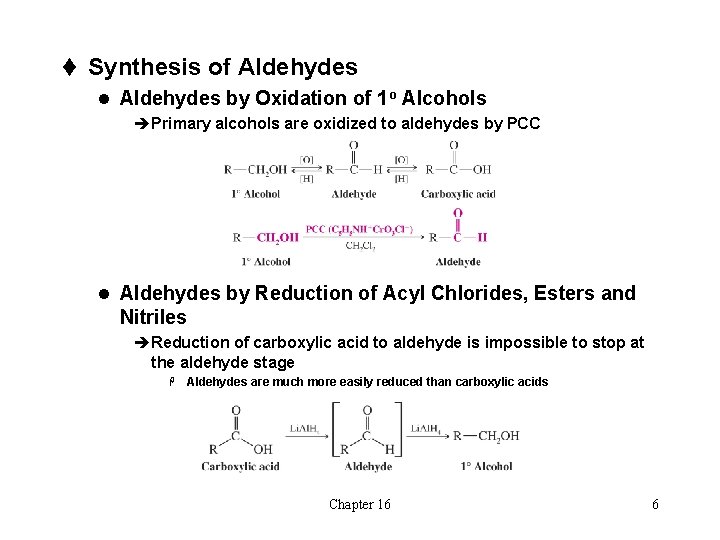
t Synthesis of Aldehydes l Aldehydes by Oxidation of 1 o Alcohols èPrimary alcohols are oxidized to aldehydes by PCC l Aldehydes by Reduction of Acyl Chlorides, Esters and Nitriles èReduction of carboxylic acid to aldehyde is impossible to stop at the aldehyde stage H Aldehydes are much more easily reduced than carboxylic acids Chapter 16 6
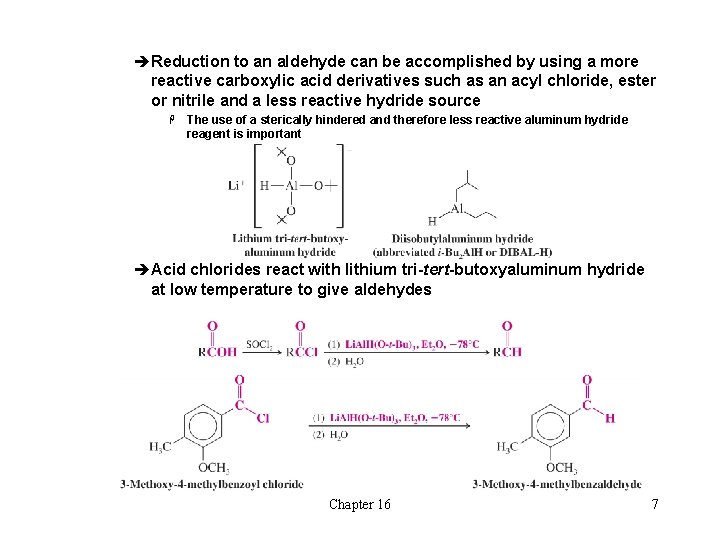
èReduction to an aldehyde can be accomplished by using a more reactive carboxylic acid derivatives such as an acyl chloride, ester or nitrile and a less reactive hydride source H The use of a sterically hindered and therefore less reactive aluminum hydride reagent is important èAcid chlorides react with lithium tri-tert-butoxyaluminum hydride at low temperature to give aldehydes Chapter 16 7
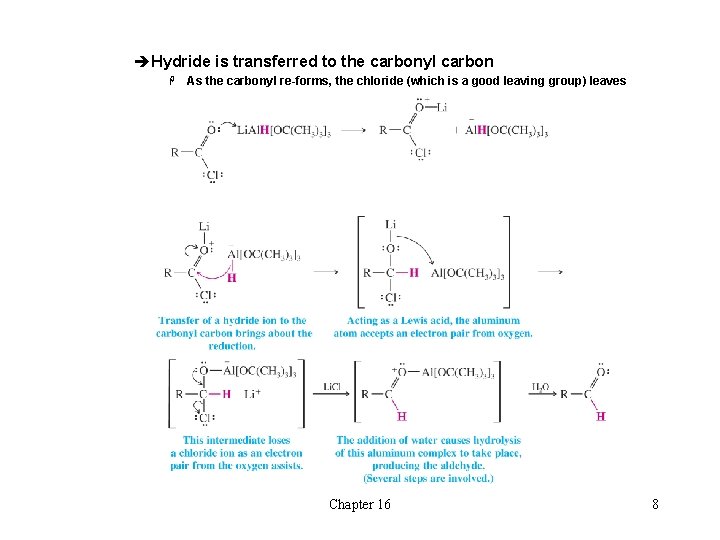
èHydride is transferred to the carbonyl carbon H As the carbonyl re-forms, the chloride (which is a good leaving group) leaves Chapter 16 8
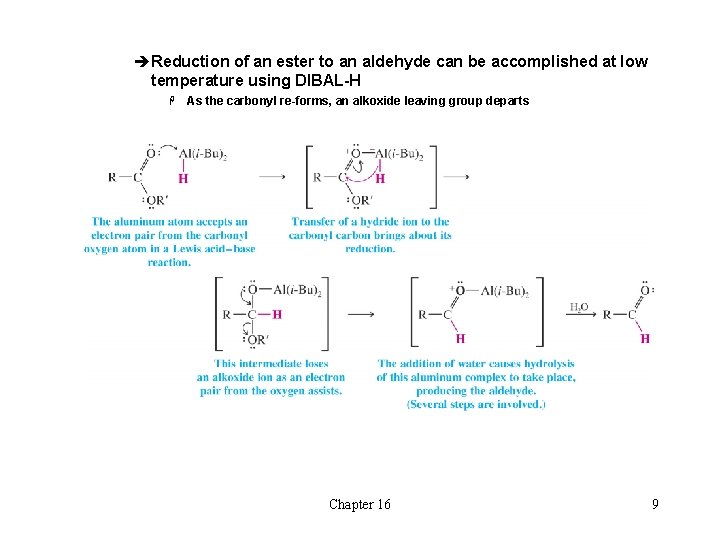
èReduction of an ester to an aldehyde can be accomplished at low temperature using DIBAL-H H As the carbonyl re-forms, an alkoxide leaving group departs Chapter 16 9
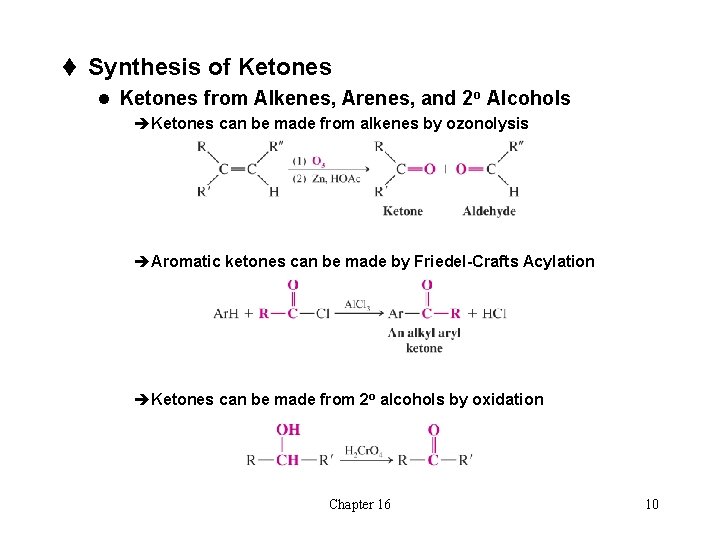
t Synthesis of Ketones l Ketones from Alkenes, Arenes, and 2 o Alcohols èKetones can be made from alkenes by ozonolysis èAromatic ketones can be made by Friedel-Crafts Acylation èKetones can be made from 2 o alcohols by oxidation Chapter 16 10
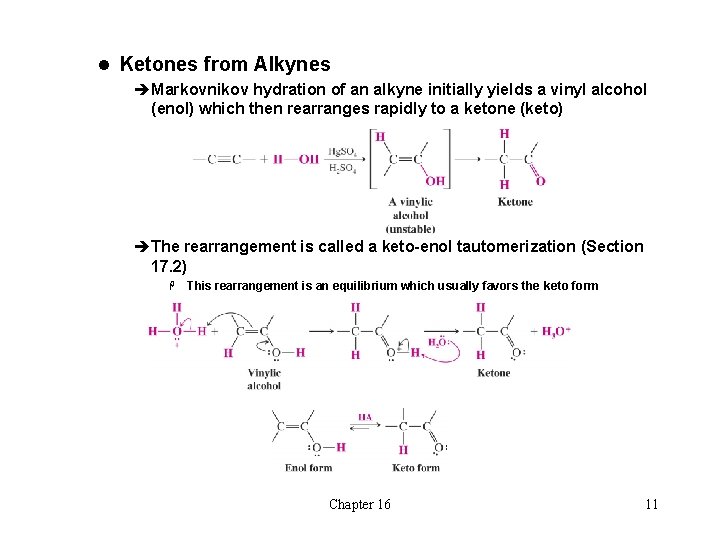
l Ketones from Alkynes èMarkovnikov hydration of an alkyne initially yields a vinyl alcohol (enol) which then rearranges rapidly to a ketone (keto) èThe rearrangement is called a keto-enol tautomerization (Section 17. 2) H This rearrangement is an equilibrium which usually favors the keto form Chapter 16 11
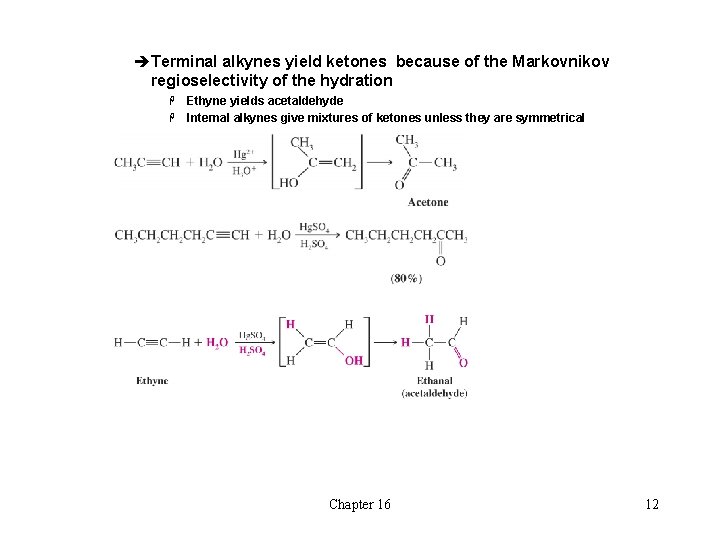
èTerminal alkynes yield ketones because of the Markovnikov regioselectivity of the hydration Ethyne yields acetaldehyde H Internal alkynes give mixtures of ketones unless they are symmetrical H Chapter 16 12
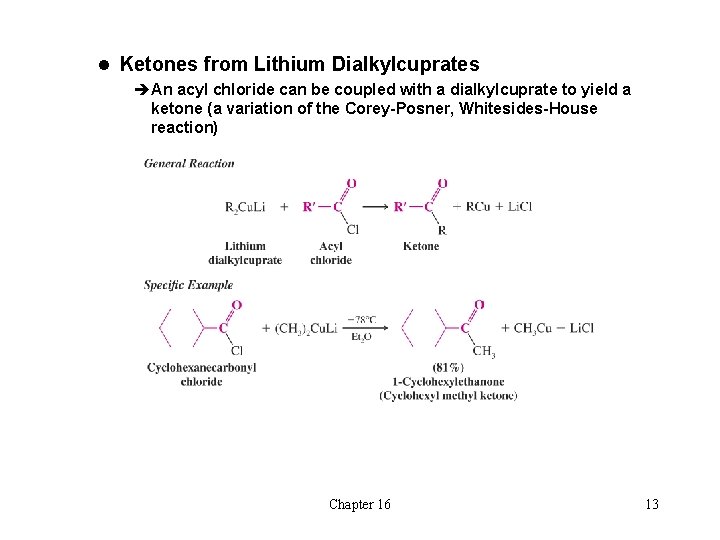
l Ketones from Lithium Dialkylcuprates èAn acyl chloride can be coupled with a dialkylcuprate to yield a ketone (a variation of the Corey-Posner, Whitesides-House reaction) Chapter 16 13
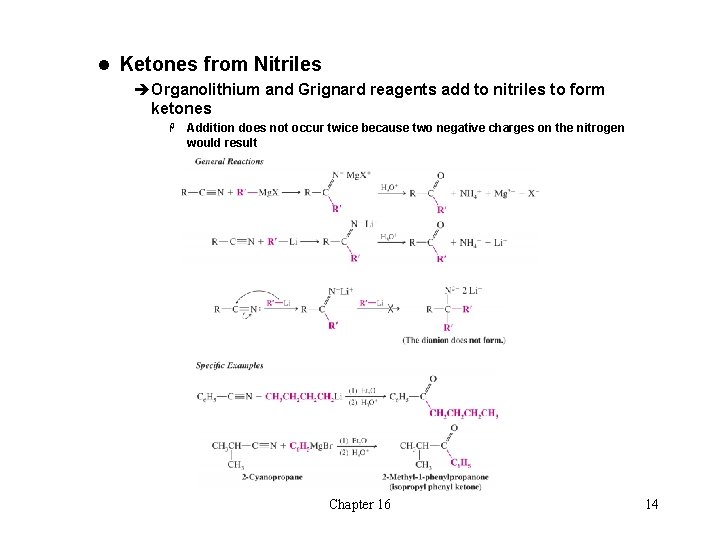
l Ketones from Nitriles èOrganolithium and Grignard reagents add to nitriles to form ketones H Addition does not occur twice because two negative charges on the nitrogen would result Chapter 16 14
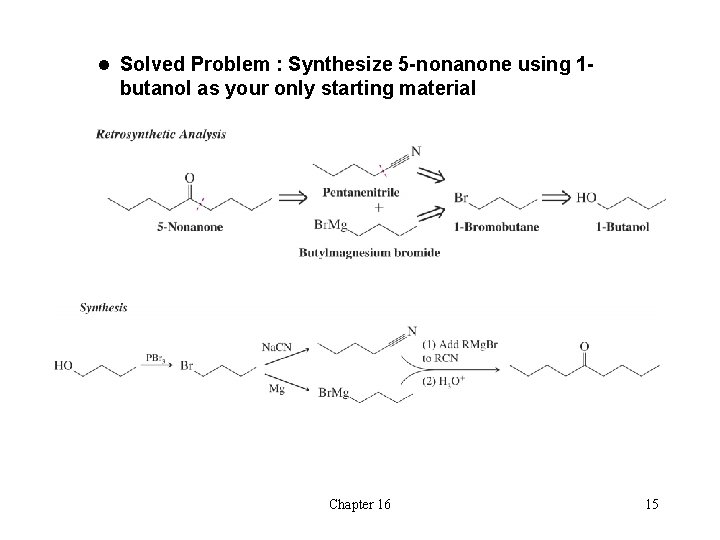
l Solved Problem : Synthesize 5 -nonanone using 1 - butanol as your only starting material Chapter 16 15
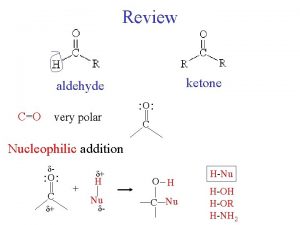
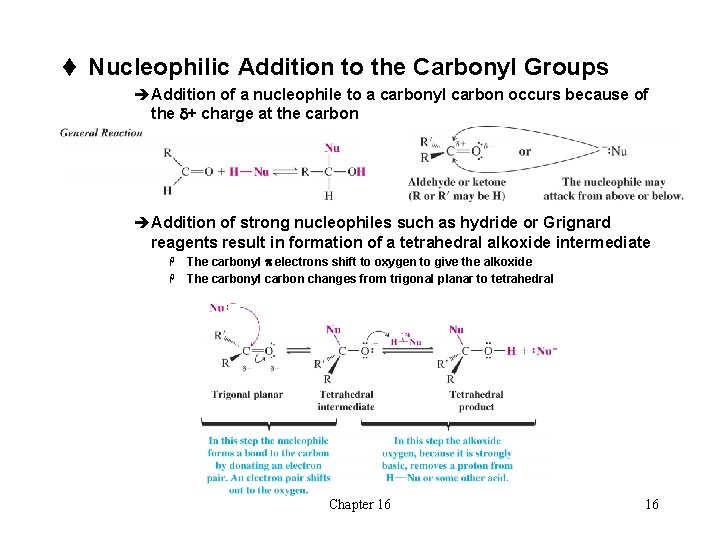
t Nucleophilic Addition to the Carbonyl Groups èAddition of a nucleophile to a carbonyl carbon occurs because of the d+ charge at the carbon èAddition of strong nucleophiles such as hydride or Grignard reagents result in formation of a tetrahedral alkoxide intermediate The carbonyl p electrons shift to oxygen to give the alkoxide H The carbonyl carbon changes from trigonal planar to tetrahedral H Chapter 16 16
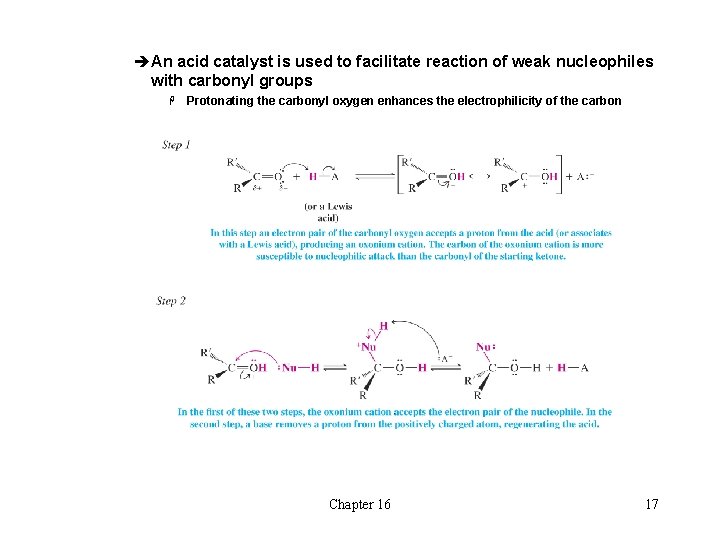
èAn acid catalyst is used to facilitate reaction of weak nucleophiles with carbonyl groups H Protonating the carbonyl oxygen enhances the electrophilicity of the carbon Chapter 16 17
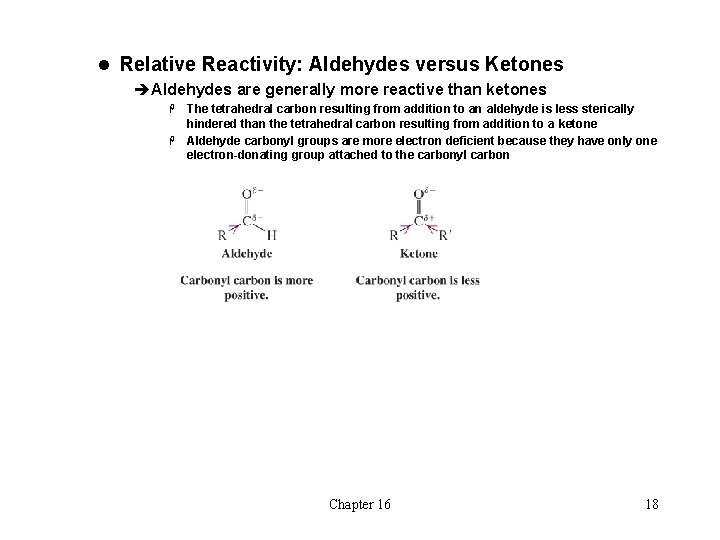
l Relative Reactivity: Aldehydes versus Ketones èAldehydes are generally more reactive than ketones The tetrahedral carbon resulting from addition to an aldehyde is less sterically hindered than the tetrahedral carbon resulting from addition to a ketone H Aldehyde carbonyl groups are more electron deficient because they have only one electron-donating group attached to the carbonyl carbon H Chapter 16 18
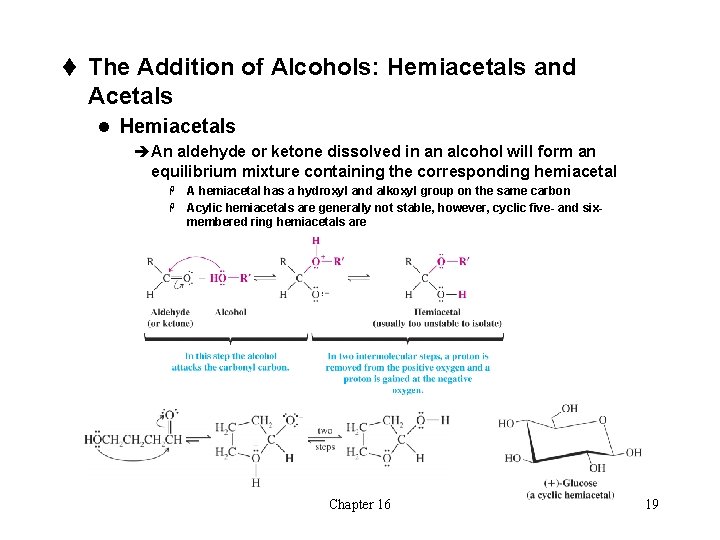
t The Addition of Alcohols: Hemiacetals and Acetals l Hemiacetals èAn aldehyde or ketone dissolved in an alcohol will form an equilibrium mixture containing the corresponding hemiacetal A hemiacetal has a hydroxyl and alkoxyl group on the same carbon H Acylic hemiacetals are generally not stable, however, cyclic five- and sixmembered ring hemiacetals are H Chapter 16 19
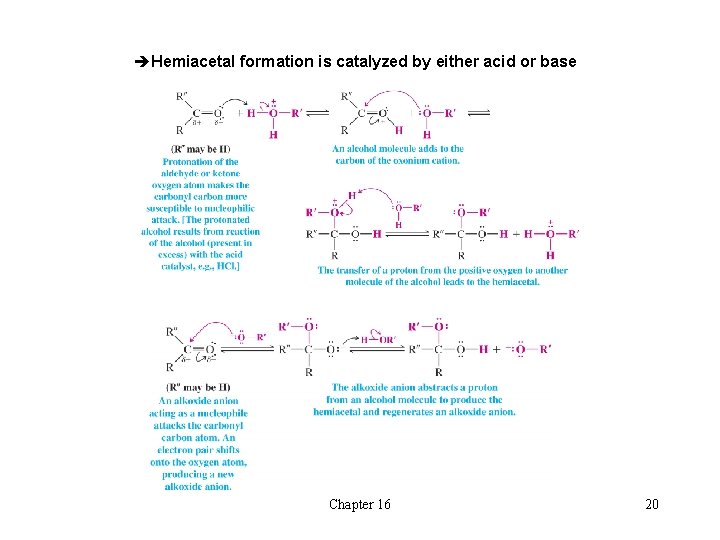
èHemiacetal formation is catalyzed by either acid or base Chapter 16 20
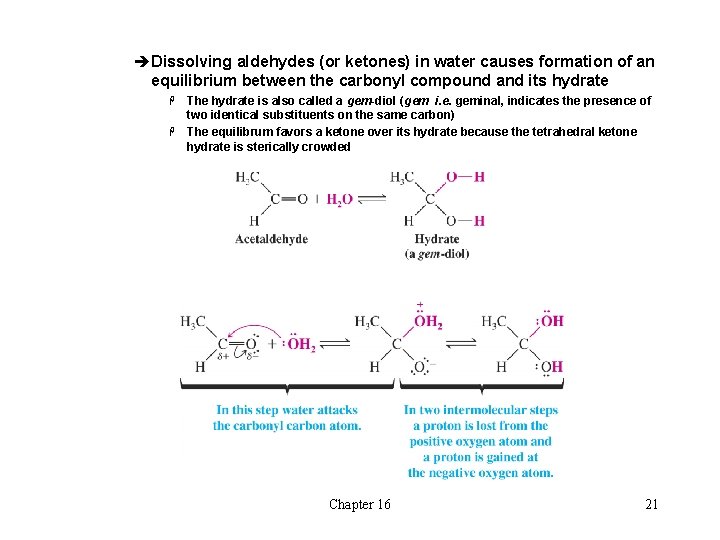
èDissolving aldehydes (or ketones) in water causes formation of an equilibrium between the carbonyl compound and its hydrate The hydrate is also called a gem-diol (gem i. e. geminal, indicates the presence of two identical substituents on the same carbon) H The equilibrum favors a ketone over its hydrate because the tetrahedral ketone hydrate is sterically crowded H Chapter 16 21
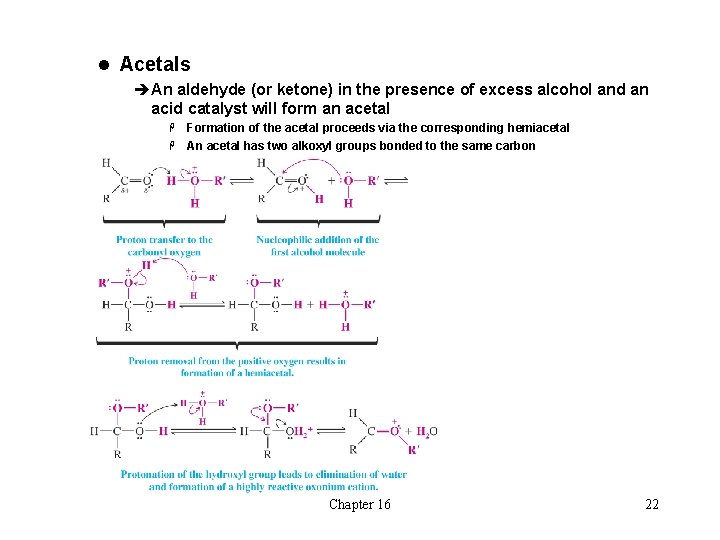
l Acetals èAn aldehyde (or ketone) in the presence of excess alcohol and an acid catalyst will form an acetal Formation of the acetal proceeds via the corresponding hemiacetal H An acetal has two alkoxyl groups bonded to the same carbon H Chapter 16 22
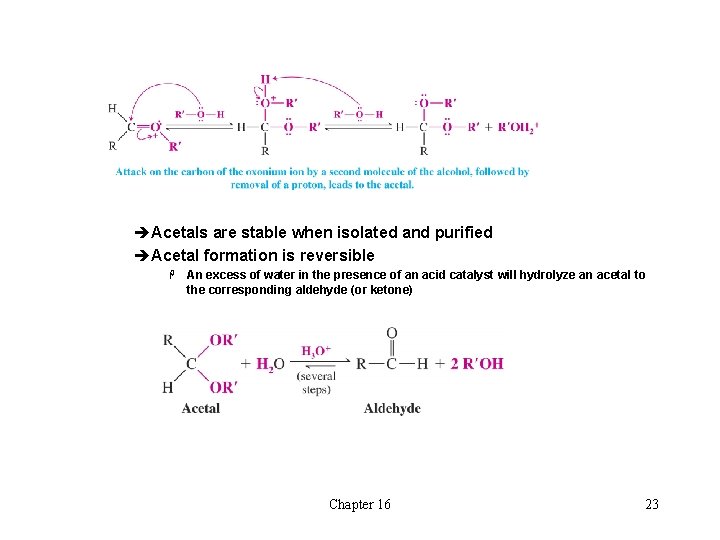
èAcetals are stable when isolated and purified èAcetal formation is reversible H An excess of water in the presence of an acid catalyst will hydrolyze an acetal to the corresponding aldehyde (or ketone) Chapter 16 23
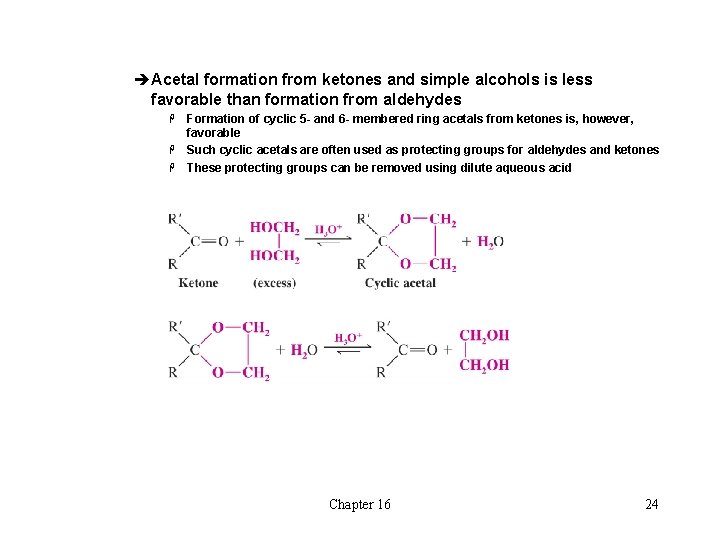
èAcetal formation from ketones and simple alcohols is less favorable than formation from aldehydes Formation of cyclic 5 - and 6 - membered ring acetals from ketones is, however, favorable H Such cyclic acetals are often used as protecting groups for aldehydes and ketones H These protecting groups can be removed using dilute aqueous acid H Chapter 16 24
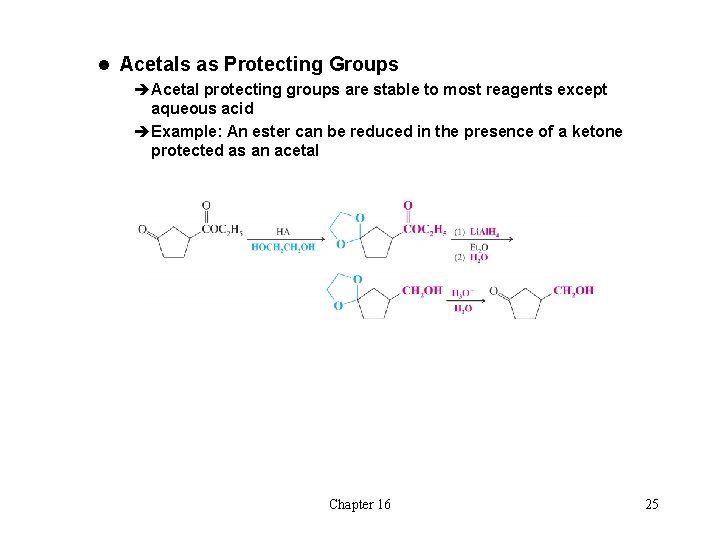
l Acetals as Protecting Groups èAcetal protecting groups are stable to most reagents except aqueous acid èExample: An ester can be reduced in the presence of a ketone protected as an acetal Chapter 16 25
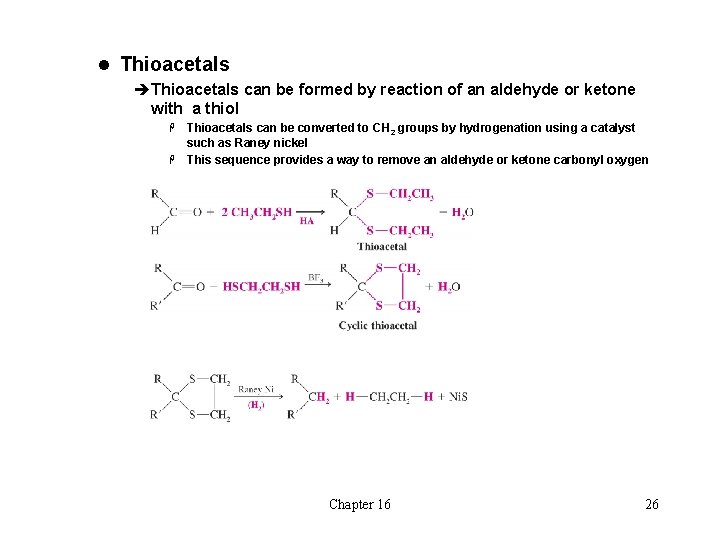
l Thioacetals èThioacetals can be formed by reaction of an aldehyde or ketone with a thiol Thioacetals can be converted to CH 2 groups by hydrogenation using a catalyst such as Raney nickel H This sequence provides a way to remove an aldehyde or ketone carbonyl oxygen H Chapter 16 26
t The Addition of Primary and Secondary Amines èAldehydes and ketones react with primary amines (and ammonia) to yield imines H They react with secondary amines to yield enamines Chapter 16 27
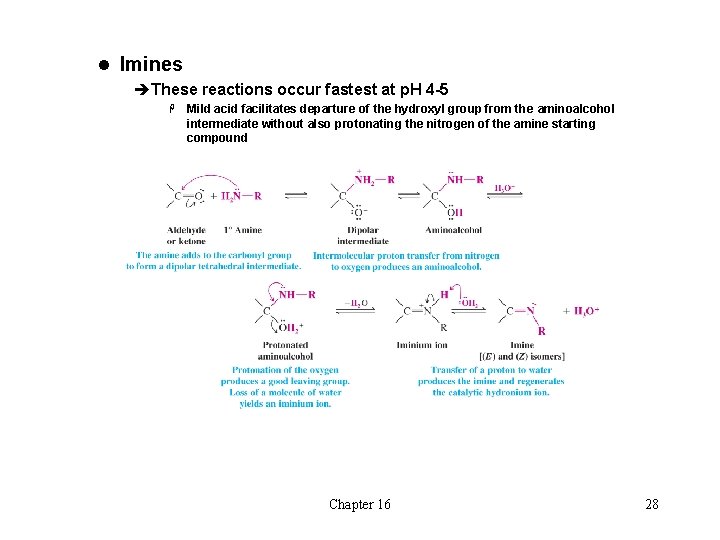
l Imines èThese reactions occur fastest at p. H 4 -5 H Mild acid facilitates departure of the hydroxyl group from the aminoalcohol intermediate without also protonating the nitrogen of the amine starting compound Chapter 16 28
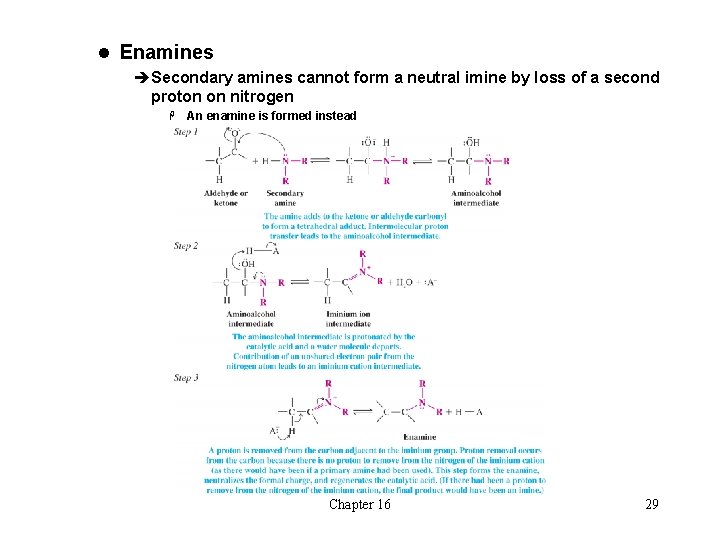
l Enamines èSecondary amines cannot form a neutral imine by loss of a second proton on nitrogen H An enamine is formed instead Chapter 16 29
t The Addition of Hydrogen Cyanide èAldehydes and ketone react with HCN to form a cyanohydrin H A catalytic amount of cyanide helps to speed the reaction èThe cyano group can be hydrolyzed or reduced Hydrolysis of a cyanohydrin produces an a-hydroxycarboxylic acid (Sec. 18. 8 H) H Reduction of a cyanohydrin produces a b-aminoalcohol H Chapter 16 30
t The Addition of Ylides: The Wittig Reaction èAldehydes and ketones react with phosphorous ylides to produce alkenes H An ylide is a neutral molecule with adjacent positive and negative charges Chapter 16 31
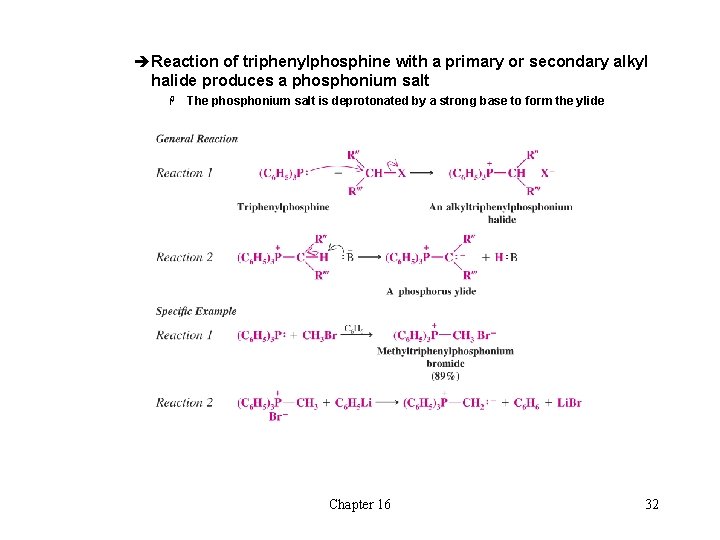
èReaction of triphenylphosphine with a primary or secondary alkyl halide produces a phosphonium salt H The phosphonium salt is deprotonated by a strong base to form the ylide Chapter 16 32
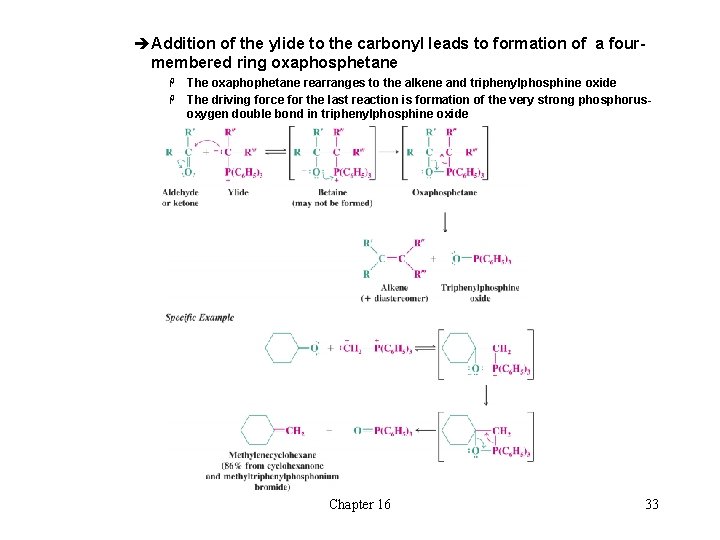
èAddition of the ylide to the carbonyl leads to formation of a fourmembered ring oxaphosphetane The oxaphophetane rearranges to the alkene and triphenylphosphine oxide H The driving force for the last reaction is formation of the very strong phosphorusoxygen double bond in triphenylphosphine oxide H Chapter 16 33
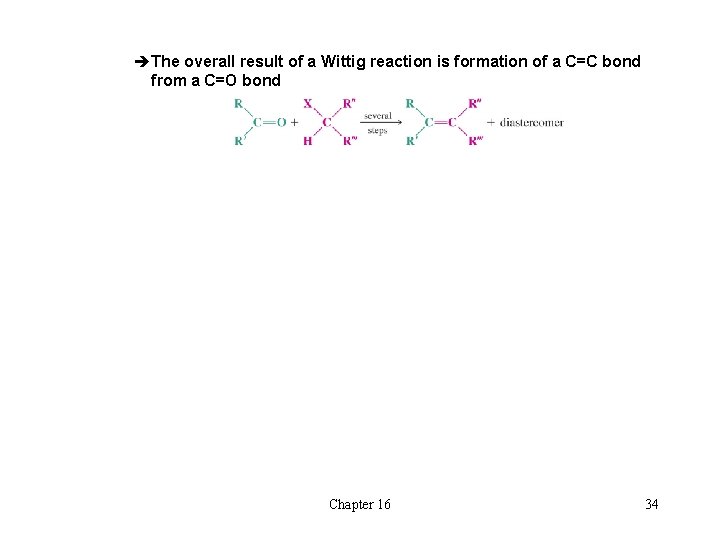
èThe overall result of a Wittig reaction is formation of a C=C bond from a C=O bond Chapter 16 34
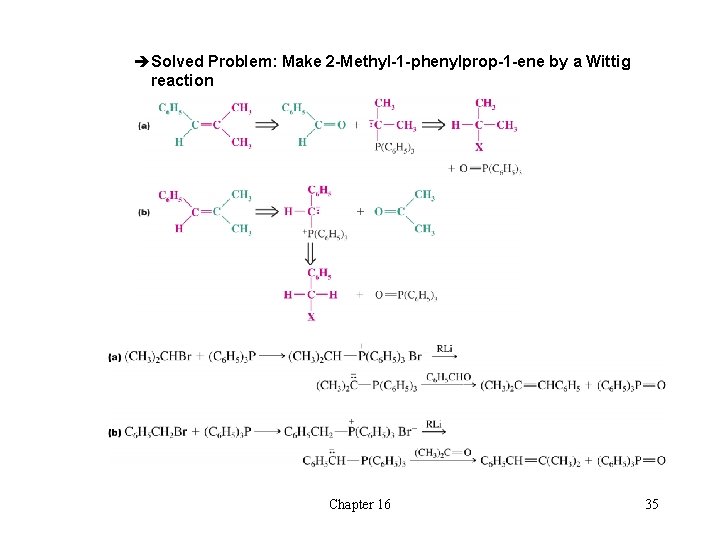
èSolved Problem: Make 2 -Methyl-1 -phenylprop-1 -ene by a Wittig reaction Chapter 16 35
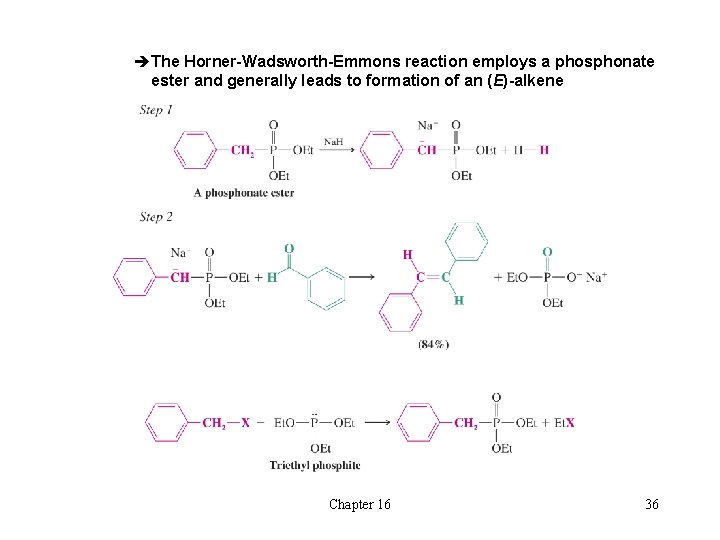
èThe Horner-Wadsworth-Emmons reaction employs a phosphonate ester and generally leads to formation of an (E)-alkene Chapter 16 36
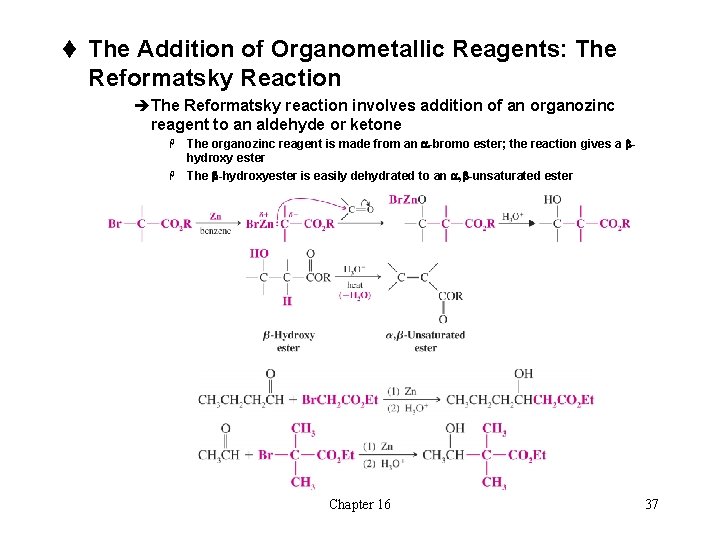
t The Addition of Organometallic Reagents: The Reformatsky Reaction èThe Reformatsky reaction involves addition of an organozinc reagent to an aldehyde or ketone The organozinc reagent is made from an a-bromo ester; the reaction gives a bhydroxy ester H The b-hydroxyester is easily dehydrated to an a, b-unsaturated ester H Chapter 16 37
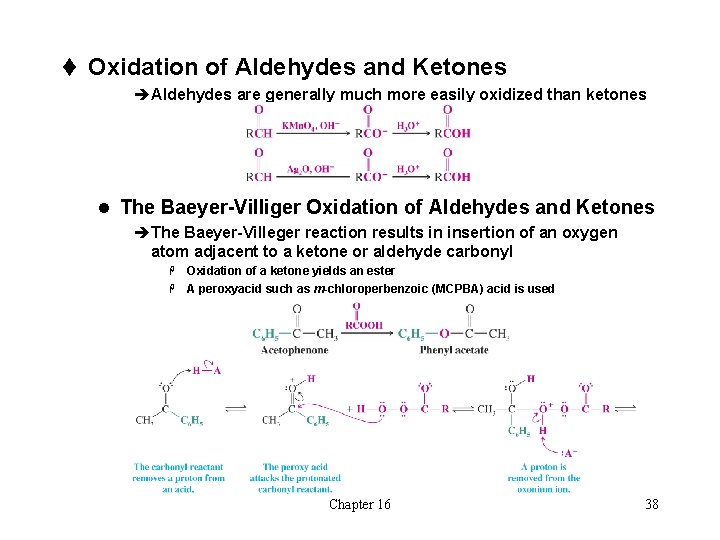
t Oxidation of Aldehydes and Ketones èAldehydes are generally much more easily oxidized than ketones l The Baeyer-Villiger Oxidation of Aldehydes and Ketones èThe Baeyer-Villeger reaction results in insertion of an oxygen atom adjacent to a ketone or aldehyde carbonyl Oxidation of a ketone yields an ester H A peroxyacid such as m-chloroperbenzoic (MCPBA) acid is used H Chapter 16 38
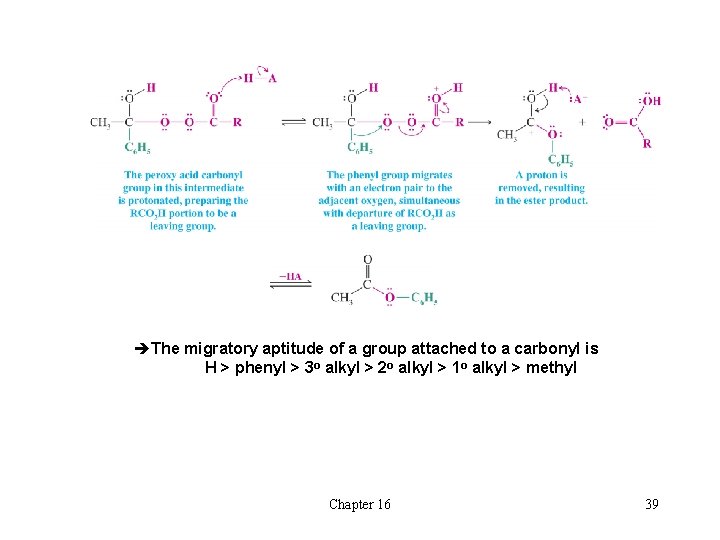
èThe migratory aptitude of a group attached to a carbonyl is H > phenyl > 3 o alkyl > 2 o alkyl > 1 o alkyl > methyl Chapter 16 39
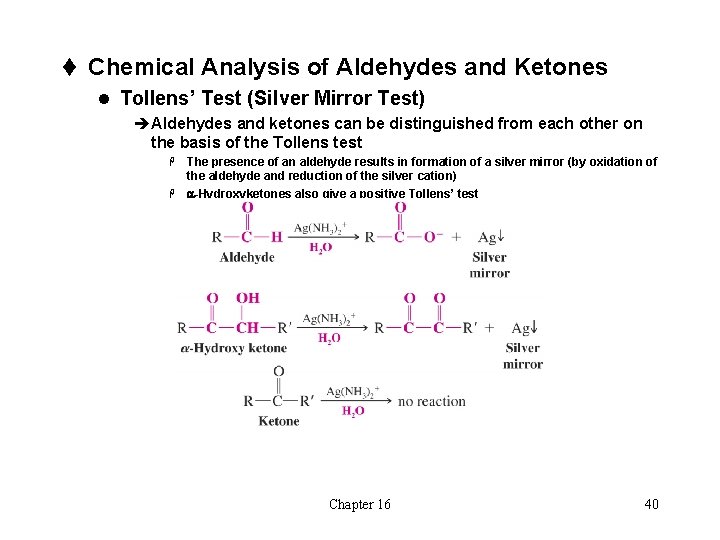
t Chemical Analysis of Aldehydes and Ketones l Tollens’ Test (Silver Mirror Test) èAldehydes and ketones can be distinguished from each other on the basis of the Tollens test The presence of an aldehyde results in formation of a silver mirror (by oxidation of the aldehyde and reduction of the silver cation) H a-Hydroxyketones also give a positive Tollens’ test H Chapter 16 40
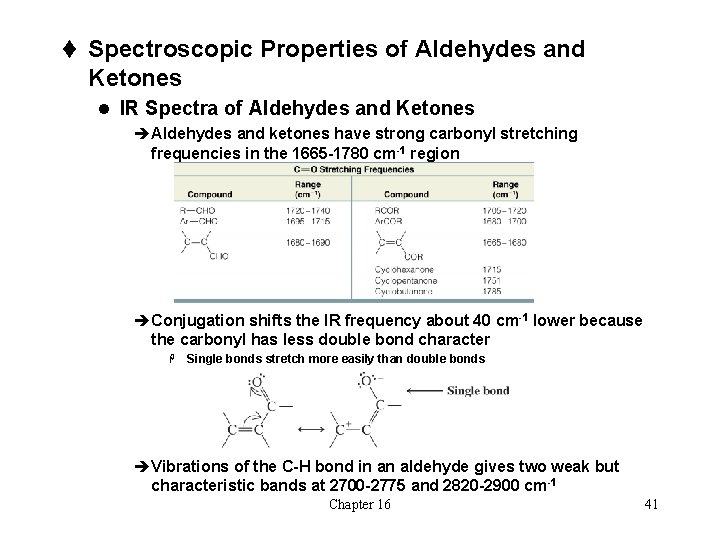
t Spectroscopic Properties of Aldehydes and Ketones l IR Spectra of Aldehydes and Ketones èAldehydes and ketones have strong carbonyl stretching frequencies in the 1665 -1780 cm-1 region èConjugation shifts the IR frequency about 40 cm-1 lower because the carbonyl has less double bond character H Single bonds stretch more easily than double bonds èVibrations of the C-H bond in an aldehyde gives two weak but characteristic bands at 2700 -2775 and 2820 -2900 cm-1 Chapter 16 41
l NMR Spectra of Aldehydes and Ketones è 13 C H è 1 H NMR Spectra Aldehyde and ketone carbonyl carbons give characteristic signals at d 180 -220 NMR Spectra Aldehyde protons give sharp signals at d 9 -12 H The aldehyde proton often shows coupling to the protons on the a-carbon H Protons on the a carbon generally appear at d 2. 0 -2. 3 H Chapter 16 42