
1 5 ALDEHYDES AND KETONES CARBONYL GROUP Both
1. 5 ALDEHYDES AND KETONES
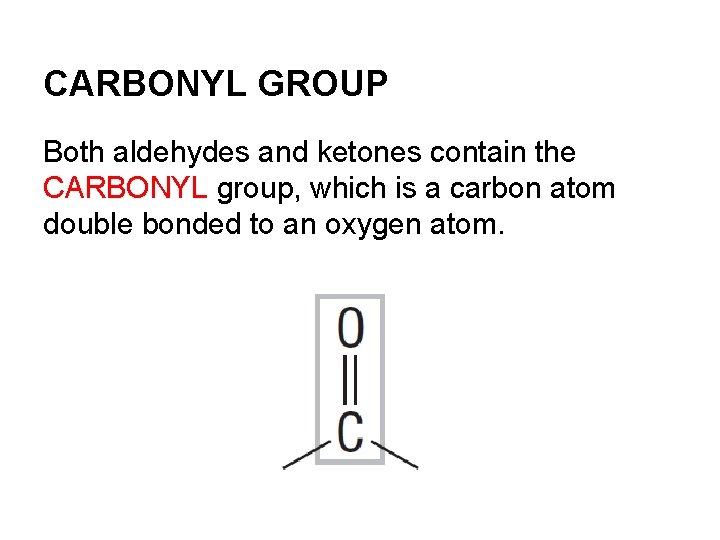
CARBONYL GROUP Both aldehydes and ketones contain the CARBONYL group, which is a carbon atom double bonded to an oxygen atom.
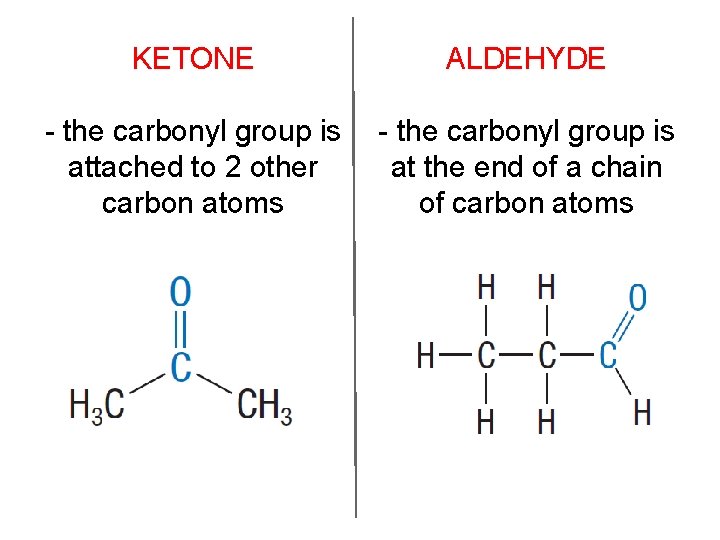
KETONE ALDEHYDE - the carbonyl group is attached to 2 other carbon atoms - the carbonyl group is at the end of a chain of carbon atoms
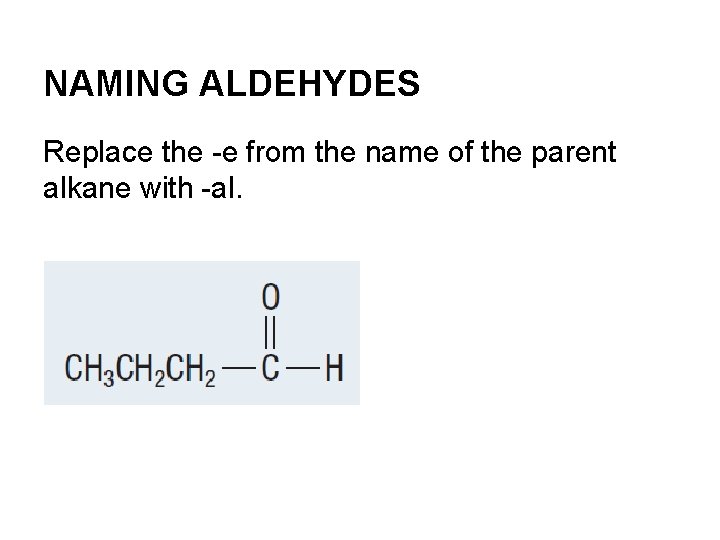
NAMING ALDEHYDES Replace the -e from the name of the parent alkane with -al.
DRAWING ALDEHYDES a) hexanal b) 7 -hydroxyoctanal
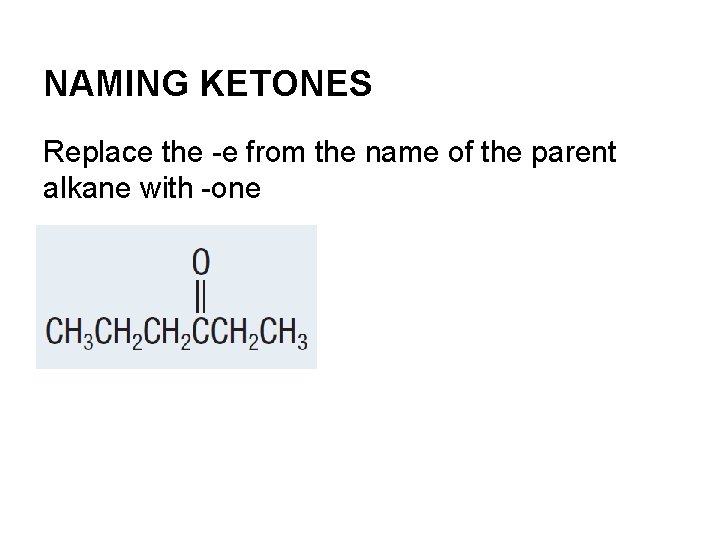
NAMING KETONES Replace the -e from the name of the parent alkane with -one
DRAWING KETONES Draw the structural formula for 4, 4 -dimethylheptan-2 -one

PRACTICE TIME! p. 41 1 & 2 p. 42 1 & 2
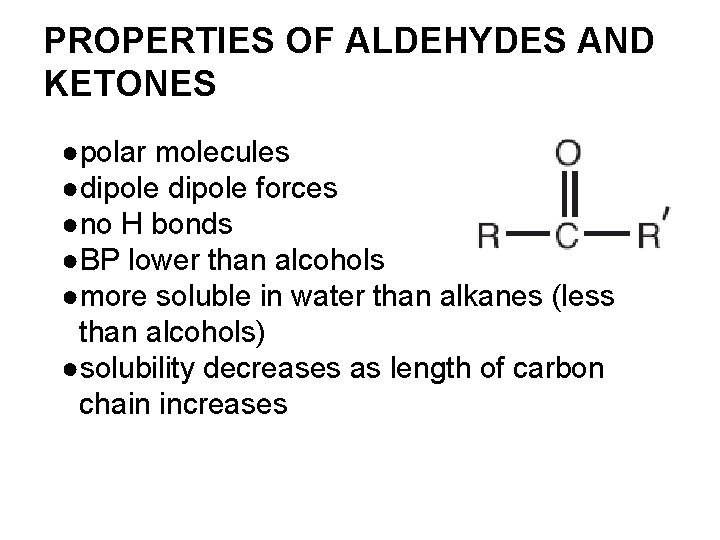
PROPERTIES OF ALDEHYDES AND KETONES ●polar molecules ●dipole forces ●no H bonds ●BP lower than alcohols ●more soluble in water than alkanes (less than alcohols) ●solubility decreases as length of carbon chain increases
FORMATION OF ALDEHYDES AND KETONES ●synthesized by the controlled oxidation of alcohol ●reactant not completely oxidized (like in combustion) and results in an aldehyde or a ketone ●oxidizing agents can vary; we simply refer to them as (O)
OXIDATION OF A PRIMARY ALCOHOL = AN ALDEHYDE ethanol + (O) -----> ethanal + water
OXIDATION OF A SECONDARY ALCOHOL = A KETONE propan-2 -ol water + (O) -----> propanone +
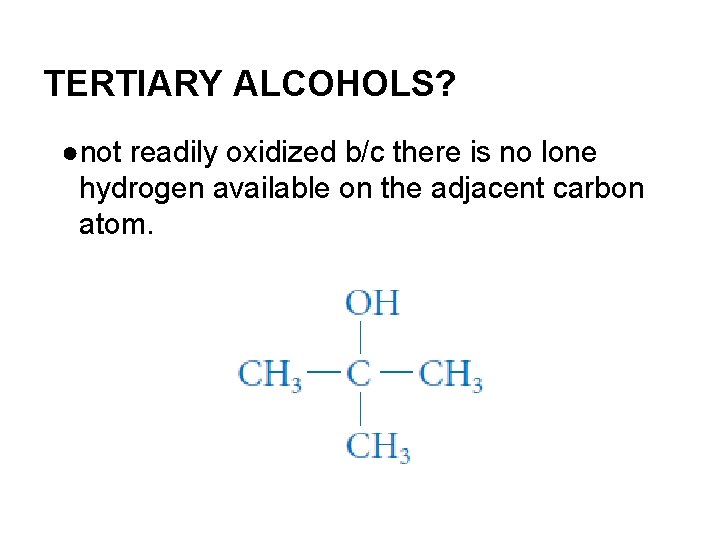
TERTIARY ALCOHOLS? ●not readily oxidized b/c there is no lone hydrogen available on the adjacent carbon atom.
HYDROGENATION REACTIONS ●recall that this involves the addition of hydrogen to another molecule ●in this case, the double bond is broken ●one H atom is added to the O atom and the other is added to the C atom. ●occur under high temperature and pressure as well as the presence of a catalyst.
HYDROGENATION OF AN ALDEHYDE = A PRIMARY ALCOHOL ethanal + H 2 gas -----> ethanol
HYDROGENATION OF AN KETONE = A SECONDARY ALCOHOL propanone + H 2 gas -----> propan-2 -ol
CHECK OUT TUTORIAL 3 ON P. 45 HOMEWORK: p. 45 #1 -3 p. 46 #1 -4
- Slides: 17