
Substitution and Elimination as Competing Reactions Alkyl halides
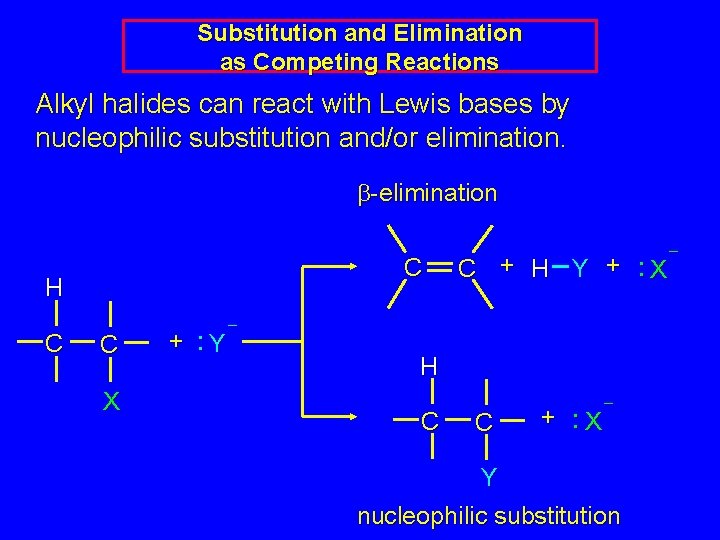
Substitution and Elimination as Competing Reactions Alkyl halides can react with Lewis bases by nucleophilic substitution and/or elimination. -elimination C H C C X + : Y C + H Y + : X – H C C + : X – Y nucleophilic substitution –
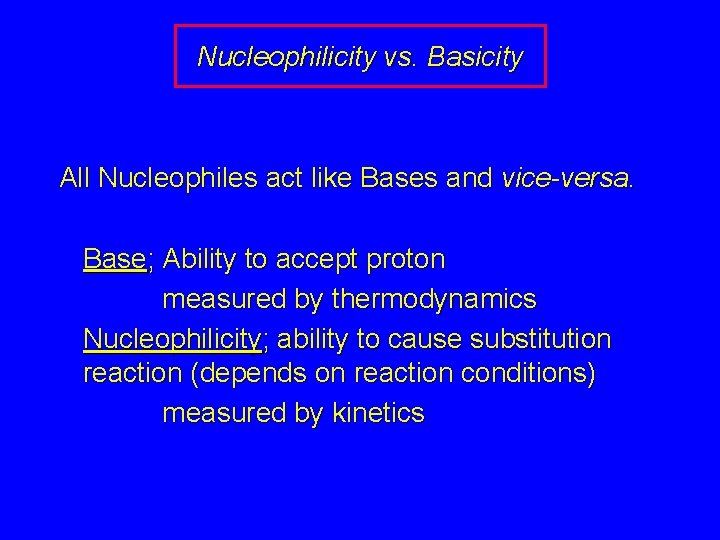
Nucleophilicity vs. Basicity All Nucleophiles act like Bases and vice-versa. Base; Ability to accept proton measured by thermodynamics Nucleophilicity; ability to cause substitution reaction (depends on reaction conditions) measured by kinetics
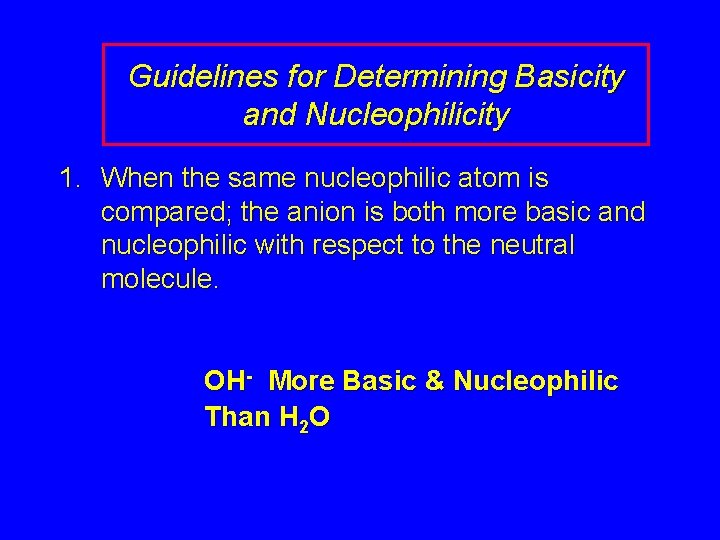
Guidelines for Determining Basicity and Nucleophilicity 1. When the same nucleophilic atom is compared; the anion is both more basic and nucleophilic with respect to the neutral molecule. OH- More Basic & Nucleophilic Than H 2 O

Table 8. 4 Nucleophilicity Rank Nucleophile Relative rate good HO–, RO– 104 RCO 2– 103 H 2 O, ROH 1 fair weak When the attacking atom is the same (oxygen in this case), nucleophilicity increases with increasing basicity.
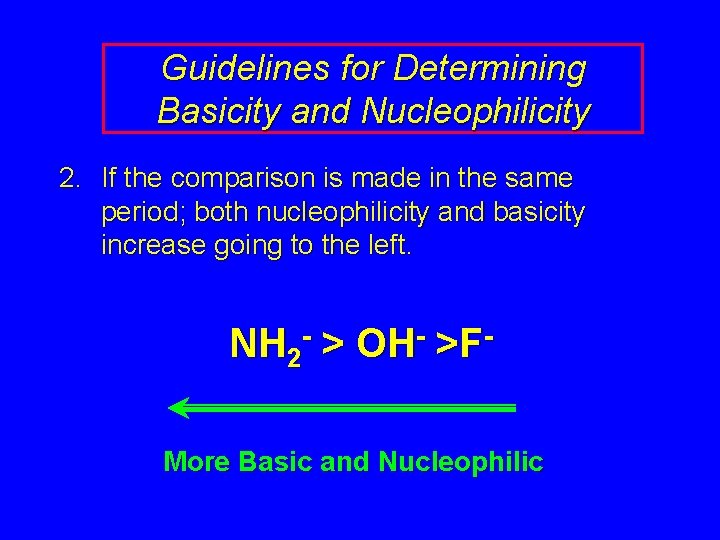
Guidelines for Determining Basicity and Nucleophilicity 2. If the comparison is made in the same period; both nucleophilicity and basicity increase going to the left. NH 2 - > OH- >FMore Basic and Nucleophilic
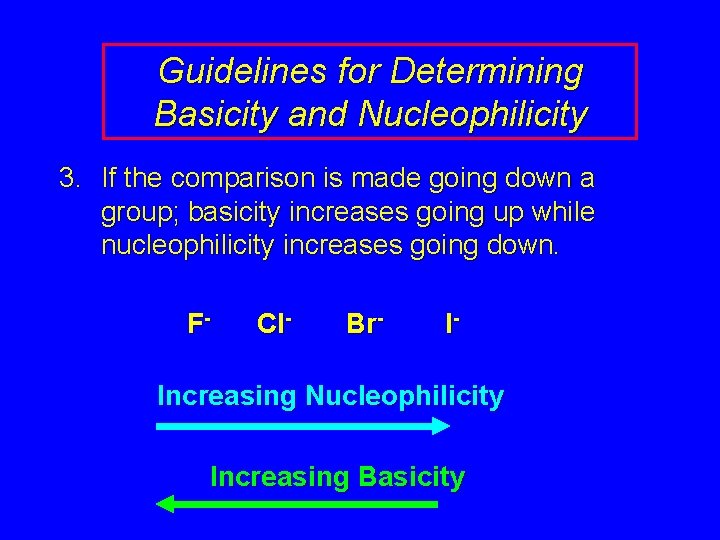
Guidelines for Determining Basicity and Nucleophilicity 3. If the comparison is made going down a group; basicity increases going up while nucleophilicity increases going down. F- Cl- Br- I- Increasing Nucleophilicity Increasing Basicity
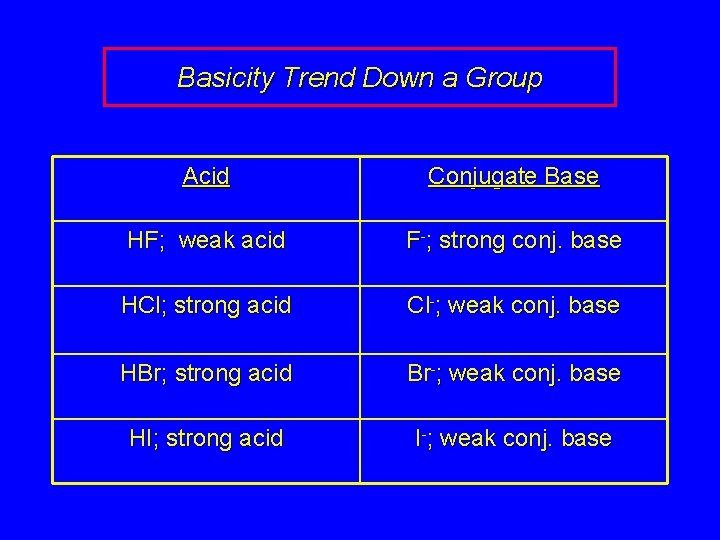
Basicity Trend Down a Group Acid Conjugate Base HF; weak acid F-; strong conj. base HCl; strong acid Cl-; weak conj. base HBr; strong acid Br-; weak conj. base HI; strong acid I-; weak conj. base
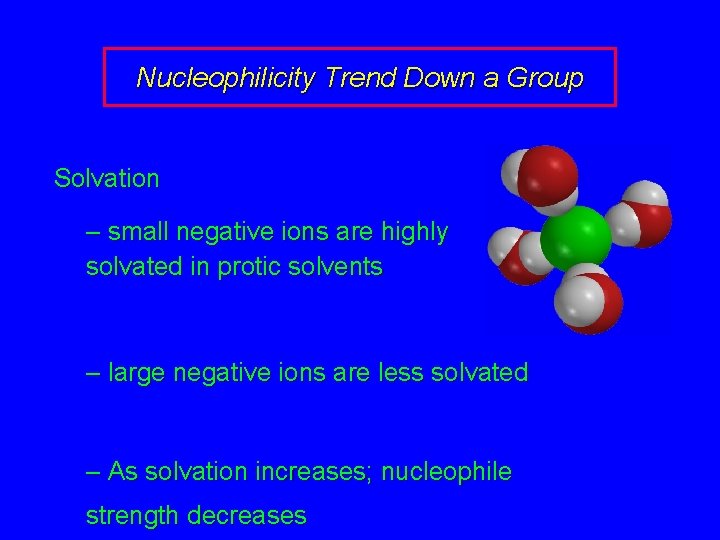
Nucleophilicity Trend Down a Group Solvation – small negative ions are highly solvated in protic solvents – large negative ions are less solvated – As solvation increases; nucleophile strength decreases

Table 8. 4 Nucleophilicity Rank Nucleophile Relative rate strong I- >105 good Br- 104 fair Cl-, F- 103 A tight solvent shell around an ion makes it less reactive. Larger ions are less solvated than smaller ones and are more nucleophilic.
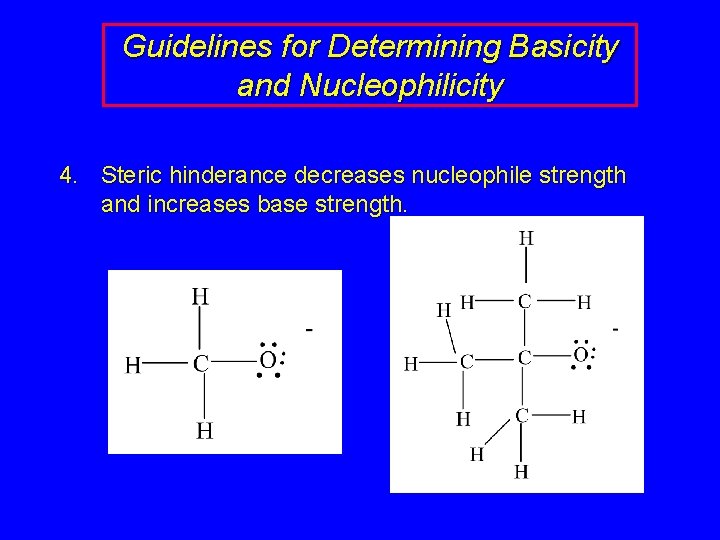
Guidelines for Determining Basicity and Nucleophilicity 4. Steric hinderance decreases nucleophile strength and increases base strength.

Substitution and Elimination as Competing Reactions Alkyl halides can react with Lewis bases by nucleophilic substitution and/or elimination. -elimination C H C C X + : Y C + H Y + : X – H C C + : X – Y nucleophilic substitution –
Substitution vs. Elimination Effect of Alkyl Halide 1° RX Formation of carbocation will not happen; rules out E 1 or SN 1 • Since primary alky halides are not sterically hindered; substitution likely • Bulky Base favors elimination over substitution
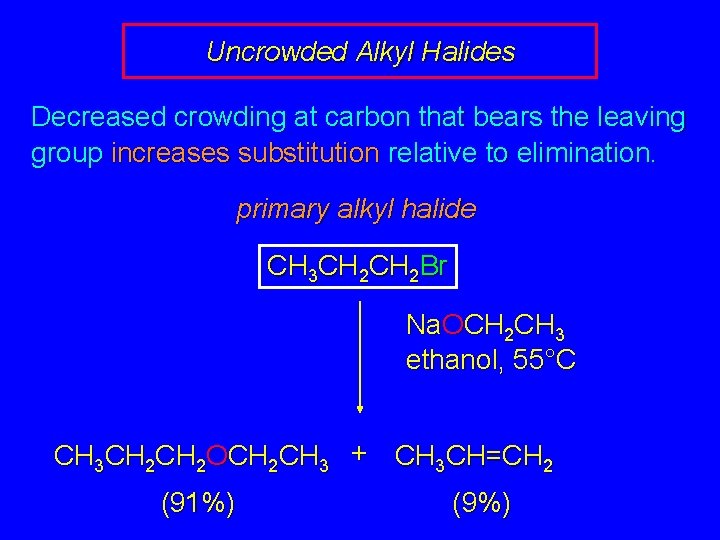
Uncrowded Alkyl Halides Decreased crowding at carbon that bears the leaving group increases substitution relative to elimination. primary alkyl halide CH 3 CH 2 Br Na. OCH 2 CH 3 ethanol, 55°C CH 3 CH 2 OCH 2 CH 3 + CH 3 CH=CH 2 (91%) (9%)

But a crowded alkoxide base can favor elimination even with a primary alkyl halide + bulky base CH 3(CH 2)15 CH 2 Br KOC(CH 3)3 tert-butyl alcohol, 40°C CH 3(CH 2)15 CH 2 OC(CH 3)3 + CH 3(CH 2)15 CH=CH 2 (13%) (87%)
Substitution vs. Elimination Effect of Alkyl Halide 3° RX • • SN 2 is unlikely due to steric hinderance Weak Nucleophile/ Polar Protic Solvent -> E 1/SN 1 – Steric hinderance of 3° RX make substitution unlikely except in solvolysis reactions • Strong Base/ Bulky Base -> E 2
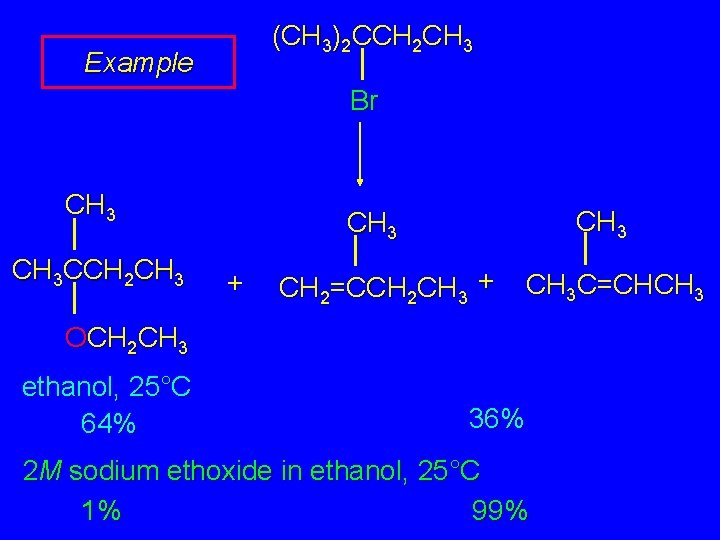
(CH 3)2 CCH 2 CH 3 Example Br CH 3 CCH 2 CH 3 + CH 2=CCH 2 CH 3 + CH 3 C=CHCH 3 OCH 2 CH 3 ethanol, 25°C 64% 36% 2 M sodium ethoxide in ethanol, 25°C 99% 1%
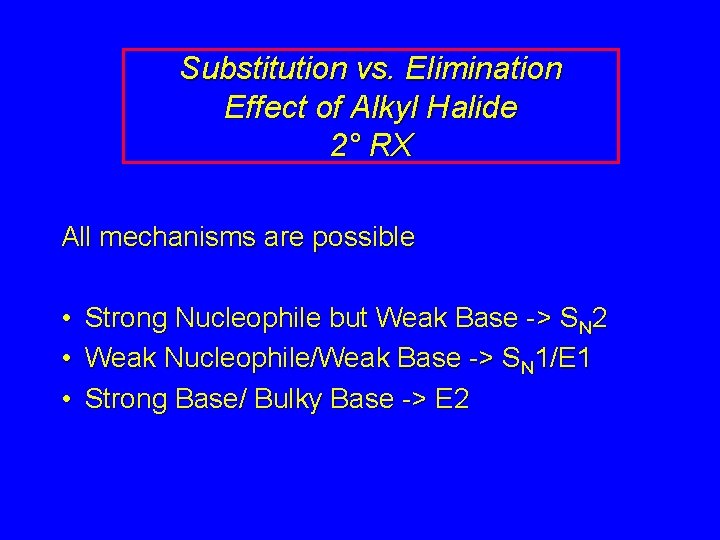
Substitution vs. Elimination Effect of Alkyl Halide 2° RX All mechanisms are possible • • • Strong Nucleophile but Weak Base -> SN 2 Weak Nucleophile/Weak Base -> SN 1/E 1 Strong Base/ Bulky Base -> E 2
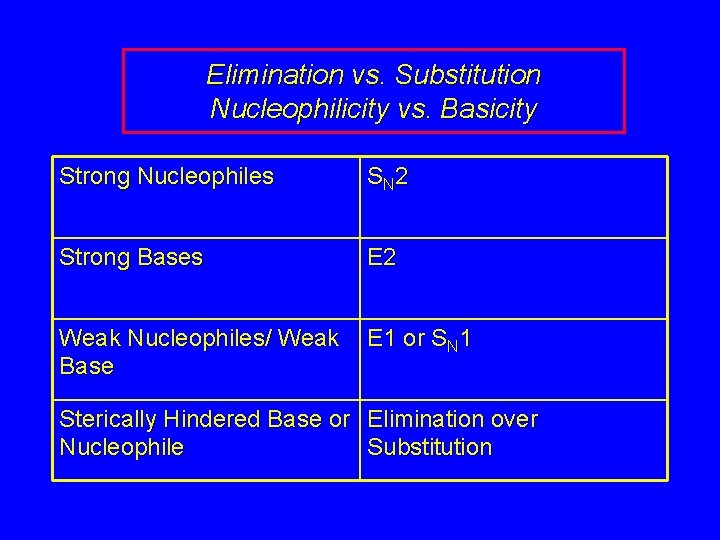
Elimination vs. Substitution Nucleophilicity vs. Basicity Strong Nucleophiles S N 2 Strong Bases E 2 Weak Nucleophiles/ Weak Base E 1 or SN 1 Sterically Hindered Base or Elimination over Nucleophile Substitution
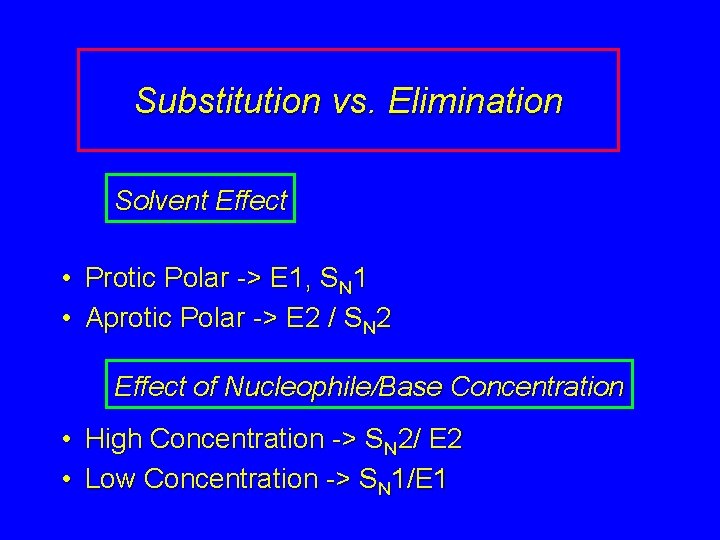
Substitution vs. Elimination Solvent Effect • Protic Polar -> E 1, SN 1 • Aprotic Polar -> E 2 / SN 2 Effect of Nucleophile/Base Concentration • High Concentration -> SN 2/ E 2 • Low Concentration -> SN 1/E 1
- Slides: 19