CHAPTER 1213 ENTITYRELATIONSHIP MODELING ENHANCED ENTITYRELATIONSHIP MODELING Pearson
- Slides: 87
CHAPTER 12+13 ENTITY-RELATIONSHIP MODELING & ENHANCED ENTITYRELATIONSHIP MODELING Pearson Education © 2014
CHAPTER 12 - OBJECTIVES • How to use Entity–Relationship (ER) modeling in database design. • Basic concepts associated with ER model. • How to identify and resolve problems with ER models called connection traps. • How to build an ER model from a requirements specification. 2 Pearson Education © 2014
CHAPTER 13 - OBJECTIVES • Limitations of basic concepts of the ER model and requirements to represent more complex applications using additional data modeling concepts. • Most useful additional data modeling concept of Enhanced ER (EER) model is called specialization/generalization. • A diagrammatic technique for displaying specialization/generalization in an EER diagram using UML. 3 Pearson Education © 2014
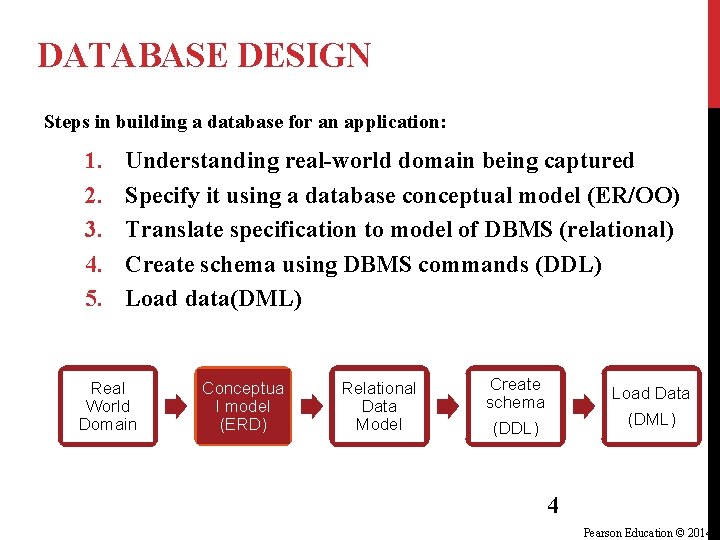
DATABASE DESIGN Steps in building a database for an application: 1. 2. 3. 4. 5. Understanding real-world domain being captured Specify it using a database conceptual model (ER/OO) Translate specification to model of DBMS (relational) Create schema using DBMS commands (DDL) Load data(DML) Real World Domain Conceptua l model (ERD) Relational Data Model Create schema (DDL) Load Data (DML) 4 Pearson Education © 2014
SECOND PHASE OF DATABASE DESIGN ER Diagram is used. • Does not include implementation details. • Users and developers can easily understand discuss. • Used to ensure all user requirements are met. • Enables designers to concentrate on specifying the properties of the data, without being concerned about storage details. Lecture 3 5 • Pearson Education © 2014
ENTITY-RELATIONSHIP MODEL (ER) OVERVIEW Entity-Relationship (ER) model is a popular highlevel description of the structure of the DB. graphical model for representing the conceptual model for the data. Based on a perception of a real world that consists of a collection of basic objects, called entities, and of the relationships among these objects. 6 The ER model can be directly translated into relational tables. Pearson Education © 2014
CONCEPTS OF THE ER MODEL • Entity types • Relationship types • Attributes 7 Pearson Education © 2014
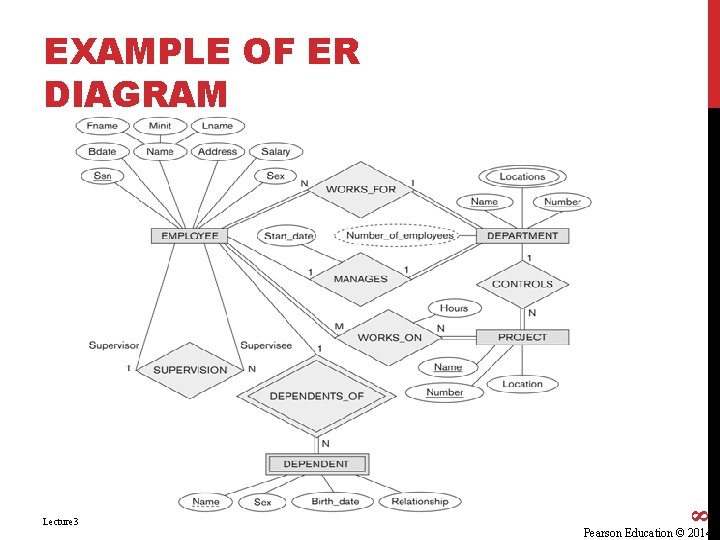
Lecture 3 8 EXAMPLE OF ER DIAGRAM Pearson Education © 2014
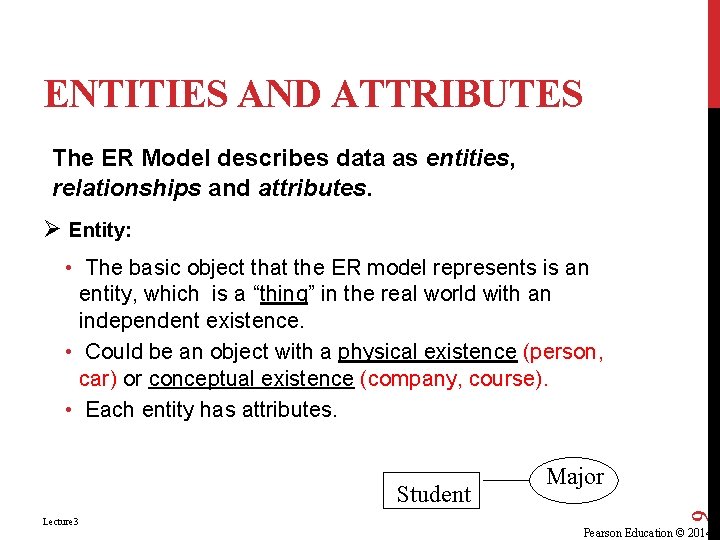
ENTITIES AND ATTRIBUTES The ER Model describes data as entities, relationships and attributes. Ø Entity: • The basic object that the ER model represents is an entity, which is a “thing” in the real world with an independent existence. • Could be an object with a physical existence (person, car) or conceptual existence (company, course). • Each entity has attributes. Lecture 3 9 Student Major Pearson Education © 2014
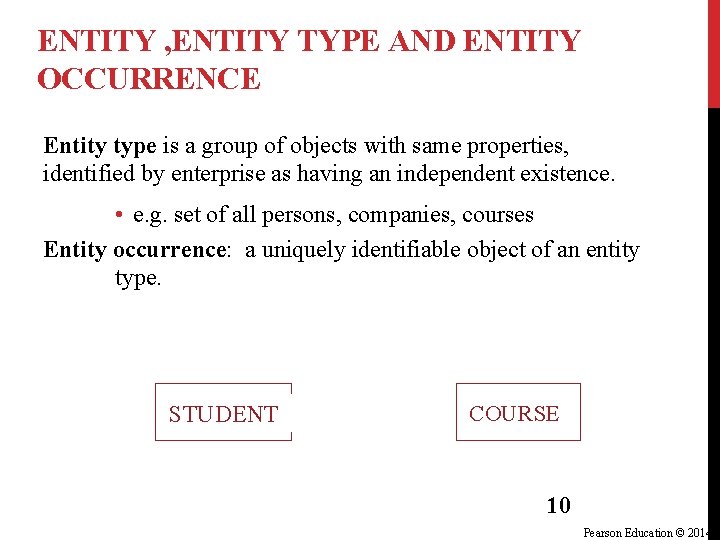
ENTITY , ENTITY TYPE AND ENTITY OCCURRENCE Entity type is a group of objects with same properties, identified by enterprise as having an independent existence. • e. g. set of all persons, companies, courses Entity occurrence: a uniquely identifiable object of an entity type. STUDENT COURSE 10 Pearson Education © 2014
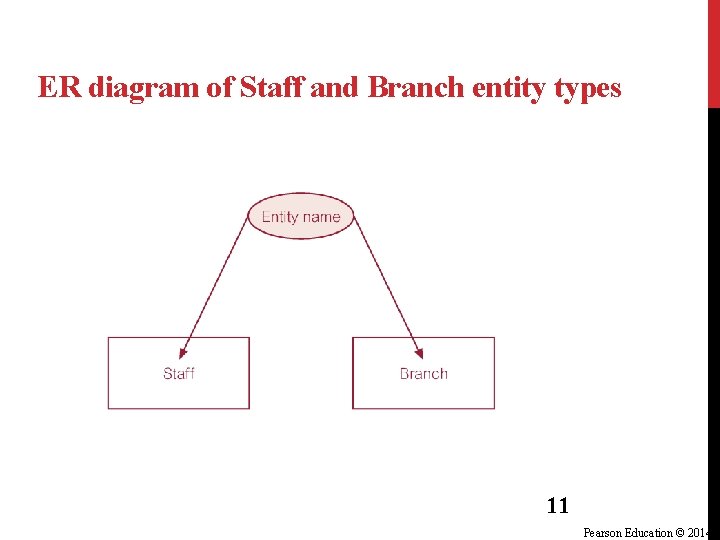
ER diagram of Staff and Branch entity types 11 Pearson Education © 2014
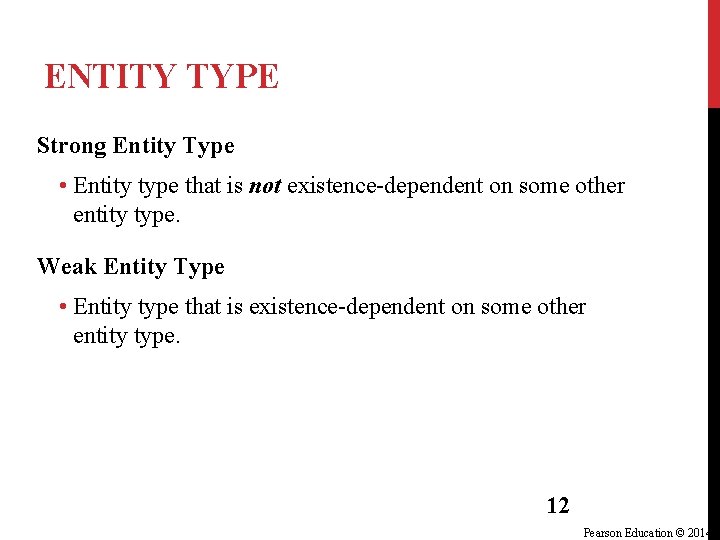
ENTITY TYPE Strong Entity Type • Entity type that is not existence-dependent on some other entity type. Weak Entity Type • Entity type that is existence-dependent on some other entity type. 12 Pearson Education © 2014
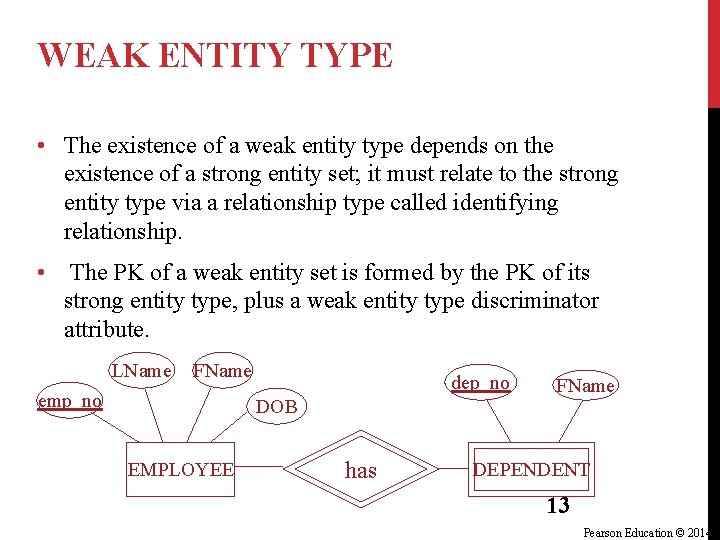
WEAK ENTITY TYPE • The existence of a weak entity type depends on the existence of a strong entity set; it must relate to the strong entity type via a relationship type called identifying relationship. • The PK of a weak entity set is formed by the PK of its strong entity type, plus a weak entity type discriminator attribute. LName FName emp_no dep_no DOB EMPLOYEE has FName DEPENDENT 13 Pearson Education © 2014
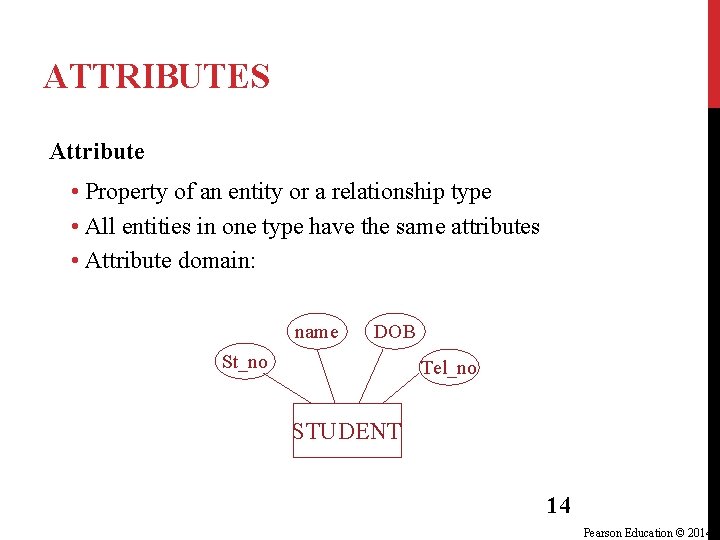
ATTRIBUTES Attribute • Property of an entity or a relationship type • All entities in one type have the same attributes • Attribute domain: name DOB St_no Tel_no STUDENT 14 Pearson Education © 2014
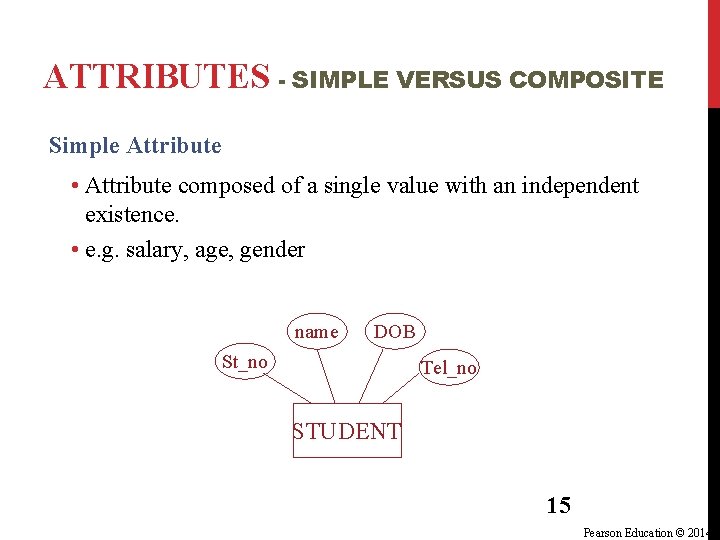
ATTRIBUTES - SIMPLE VERSUS COMPOSITE Simple Attribute • Attribute composed of a single value with an independent existence. • e. g. salary, age, gender name DOB St_no Tel_no STUDENT 15 Pearson Education © 2014
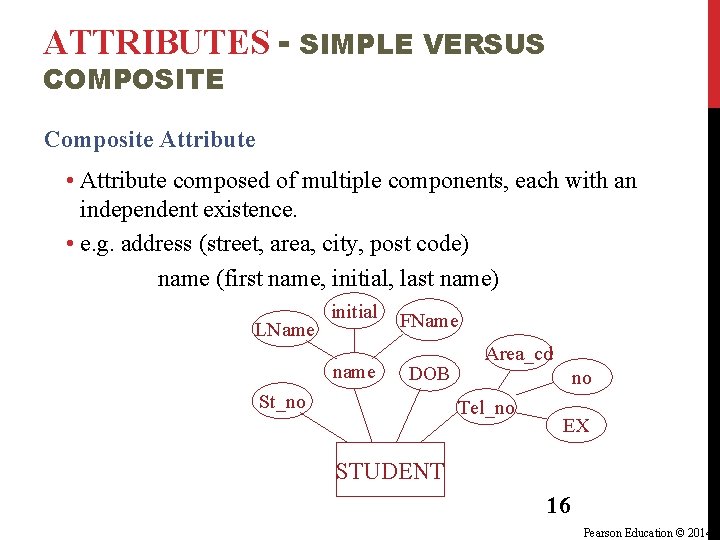
ATTRIBUTES COMPOSITE SIMPLE VERSUS Composite Attribute • Attribute composed of multiple components, each with an independent existence. • e. g. address (street, area, city, post code) name (first name, initial, last name) LName initial name FName DOB St_no Area_cd no Tel_no EX STUDENT 16 Pearson Education © 2014
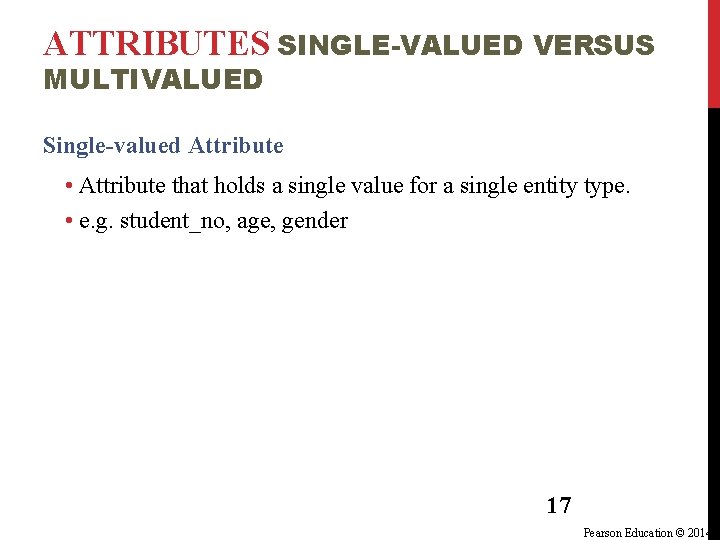
ATTRIBUTES SINGLE-VALUED VERSUS MULTIVALUED Single-valued Attribute • Attribute that holds a single value for a single entity type. • e. g. student_no, age, gender 17 Pearson Education © 2014
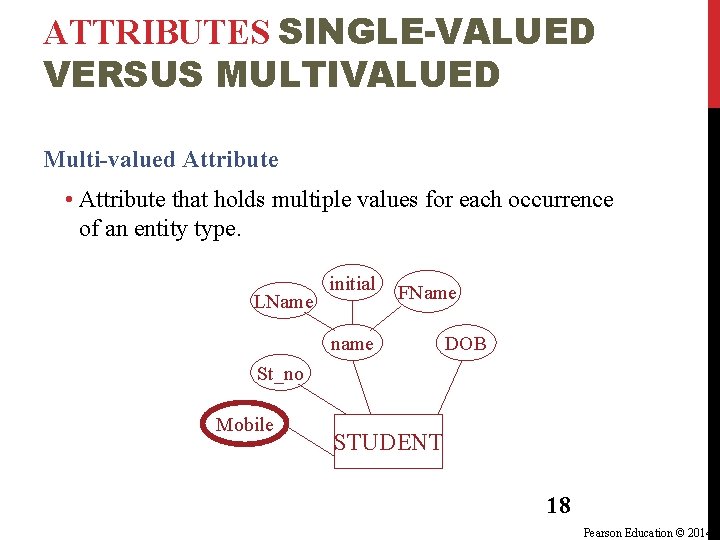
ATTRIBUTES SINGLE-VALUED VERSUS MULTIVALUED Multi-valued Attribute • Attribute that holds multiple values for each occurrence of an entity type. LName initial FName name DOB St_no Mobile STUDENT 18 Pearson Education © 2014
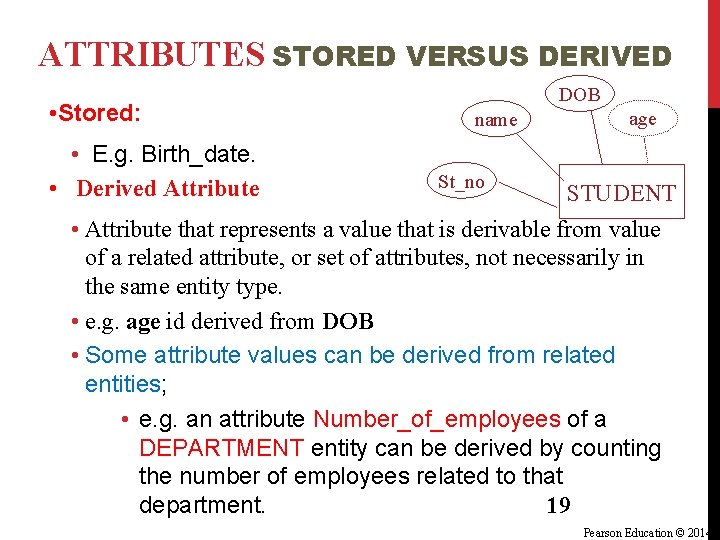
ATTRIBUTES STORED VERSUS DERIVED • Stored: • E. g. Birth_date. • Derived Attribute DOB name age St_no STUDENT • Attribute that represents a value that is derivable from value of a related attribute, or set of attributes, not necessarily in the same entity type. • e. g. age id derived from DOB • Some attribute values can be derived from related entities; • e. g. an attribute Number_of_employees of a DEPARTMENT entity can be derived by counting the number of employees related to that 19 department. Pearson Education © 2014
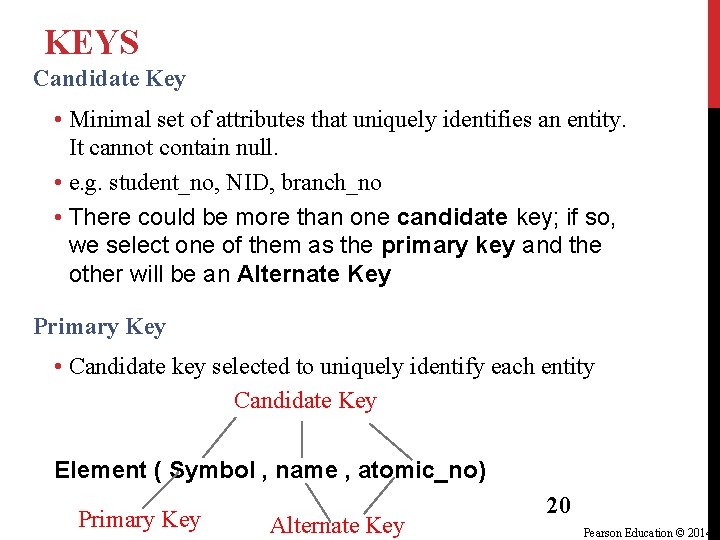
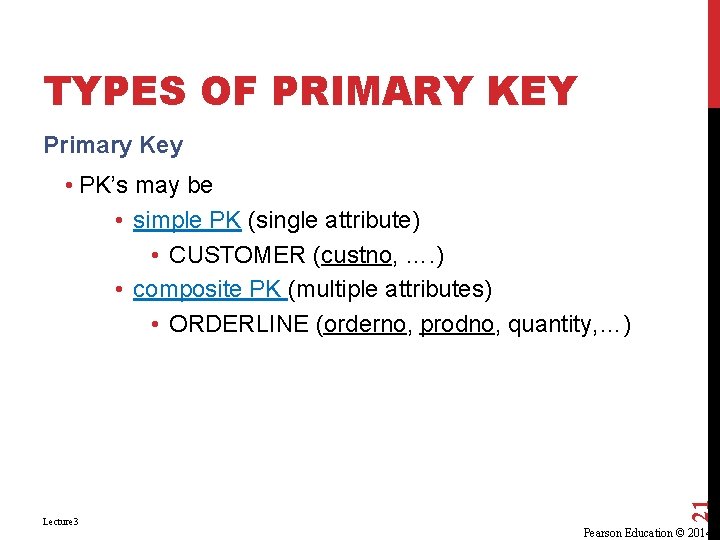
KEYS Candidate Key • Minimal set of attributes that uniquely identifies an entity. It cannot contain null. • e. g. student_no, NID, branch_no • There could be more than one candidate key; if so, we select one of them as the primary key and the other will be an Alternate Key Primary Key • Candidate key selected to uniquely identify each entity Candidate Key Element ( Symbol , name , atomic_no) Primary Key Alternate Key 20 Pearson Education © 2014
TYPES OF PRIMARY KEY Primary Key Lecture 3 21 • PK’s may be • simple PK (single attribute) • CUSTOMER (custno, …. ) • composite PK (multiple attributes) • ORDERLINE (orderno, prodno, quantity, …) Pearson Education © 2014
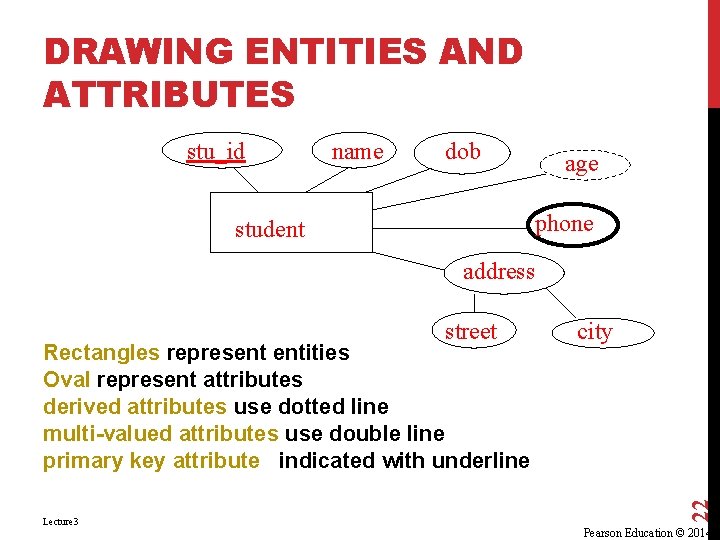
DRAWING ENTITIES AND ATTRIBUTES stu_id name dob age phone student address Rectangles represent entities Oval represent attributes derived attributes use dotted line multi-valued attributes use double line primary key attribute indicated with underline Lecture 3 city 22 street Pearson Education © 2014
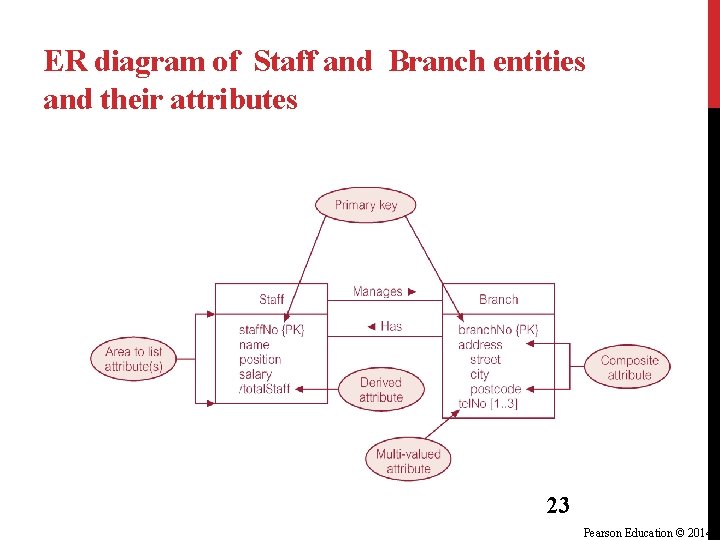
ER diagram of Staff and Branch entities and their attributes 23 Pearson Education © 2014
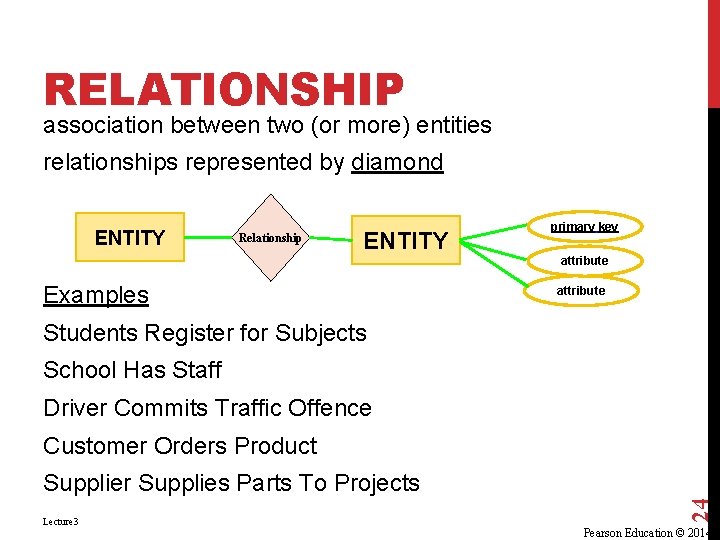
RELATIONSHIP association between two (or more) entities relationships represented by diamond ENTITY Relationship ENTITY primary key attribute Examples attribute Students Register for Subjects School Has Staff Driver Commits Traffic Offence Customer Orders Product Lecture 3 24 Supplier Supplies Parts To Projects Pearson Education © 2014
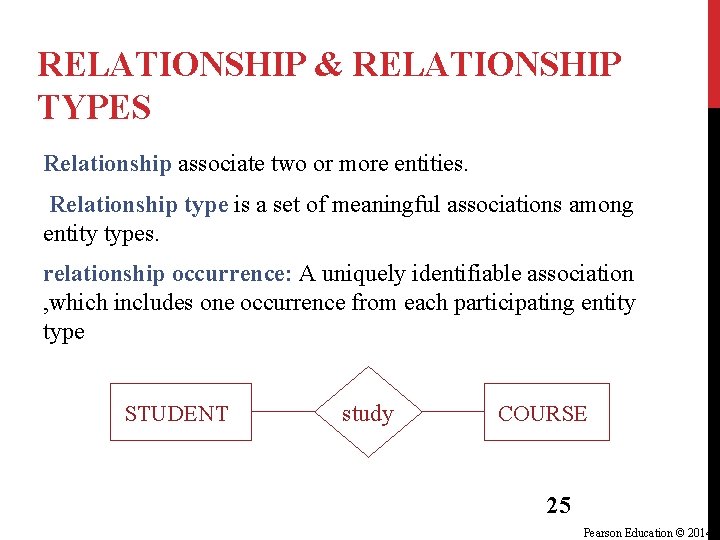
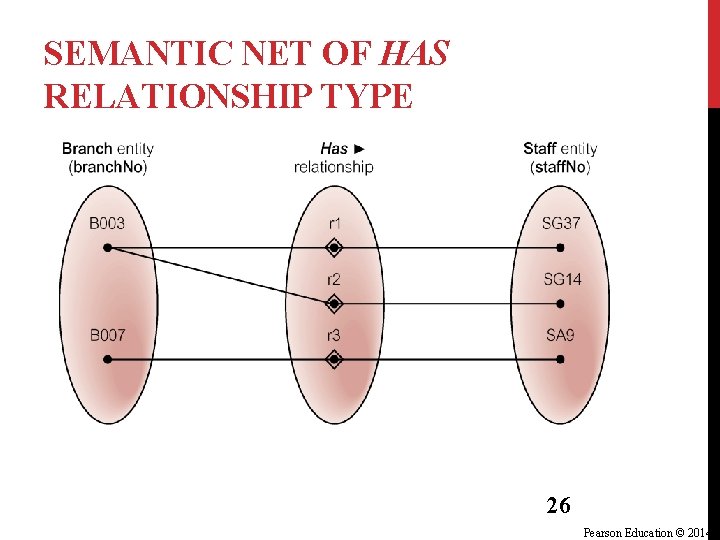
RELATIONSHIP & RELATIONSHIP TYPES Relationship associate two or more entities. Relationship type is a set of meaningful associations among entity types. relationship occurrence: A uniquely identifiable association , which includes one occurrence from each participating entity type STUDENT study COURSE 25 Pearson Education © 2014
SEMANTIC NET OF HAS RELATIONSHIP TYPE 26 Pearson Education © 2014
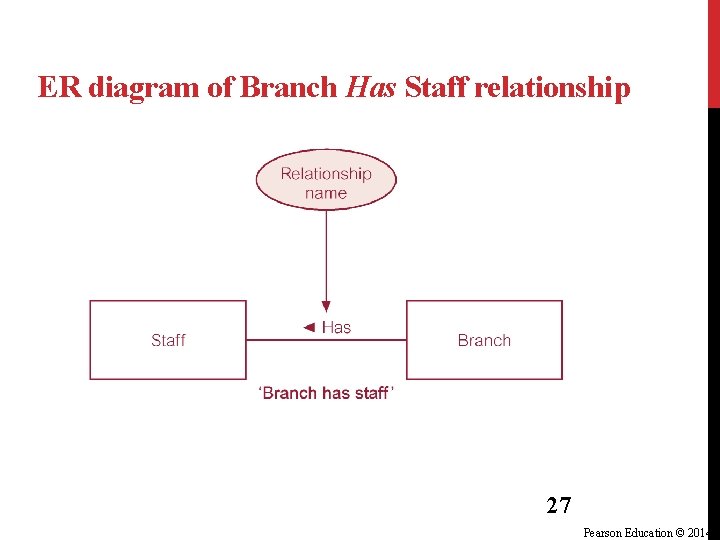
ER diagram of Branch Has Staff relationship 27 Pearson Education © 2014
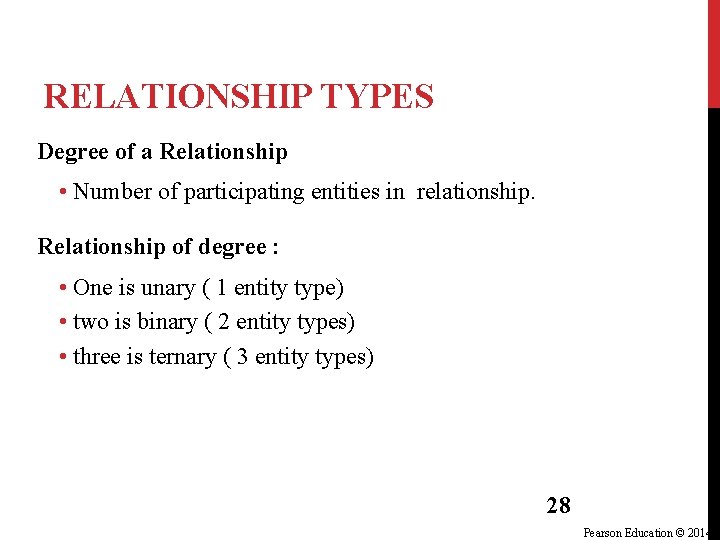
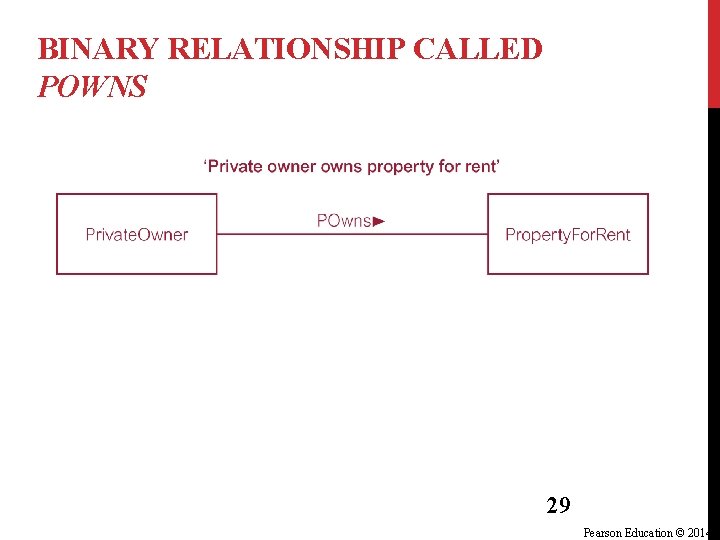
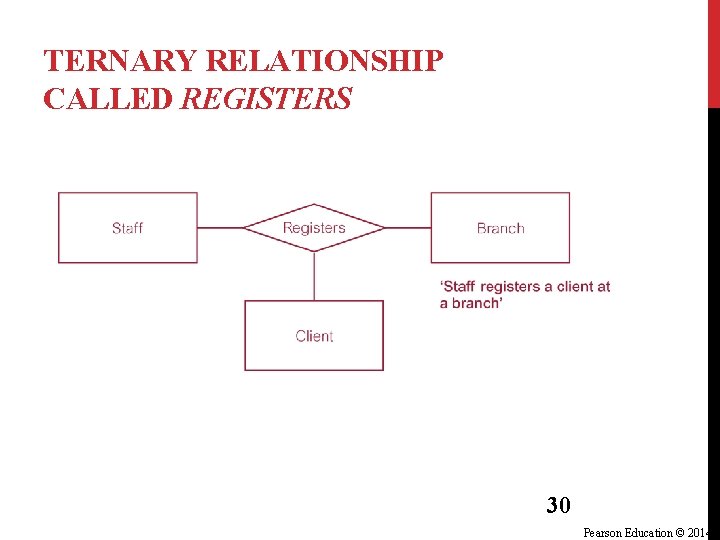
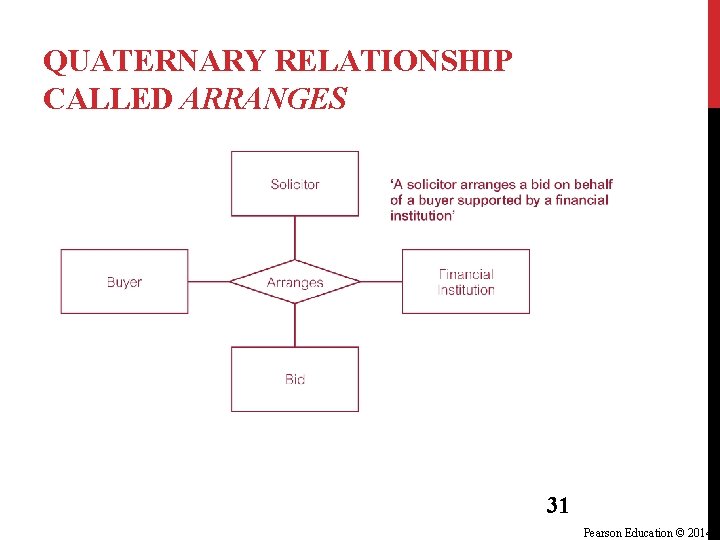
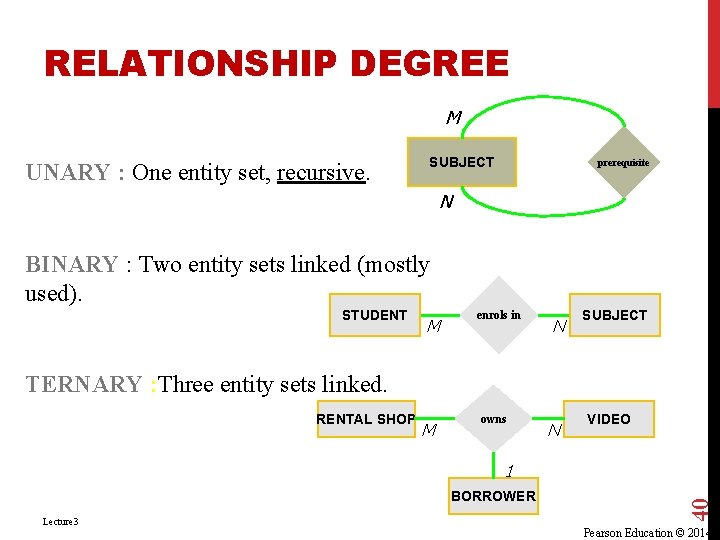
RELATIONSHIP TYPES Degree of a Relationship • Number of participating entities in relationship. Relationship of degree : • One is unary ( 1 entity type) • two is binary ( 2 entity types) • three is ternary ( 3 entity types) 28 Pearson Education © 2014
BINARY RELATIONSHIP CALLED POWNS 29 Pearson Education © 2014
TERNARY RELATIONSHIP CALLED REGISTERS 30 Pearson Education © 2014
QUATERNARY RELATIONSHIP CALLED ARRANGES 31 Pearson Education © 2014
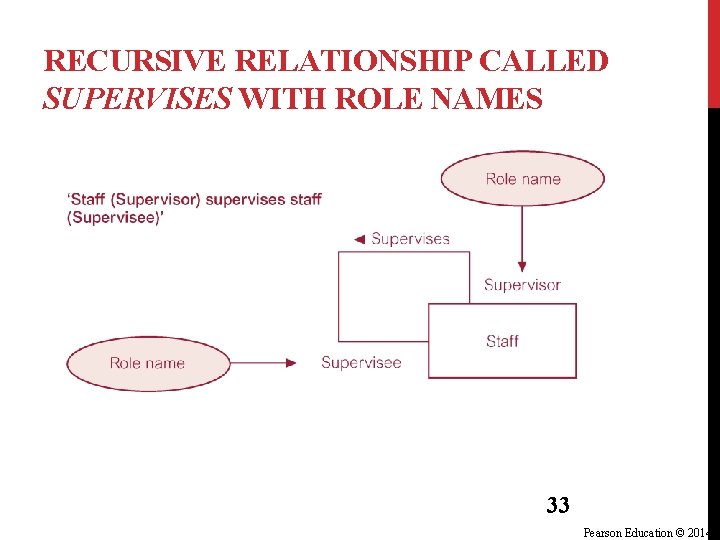
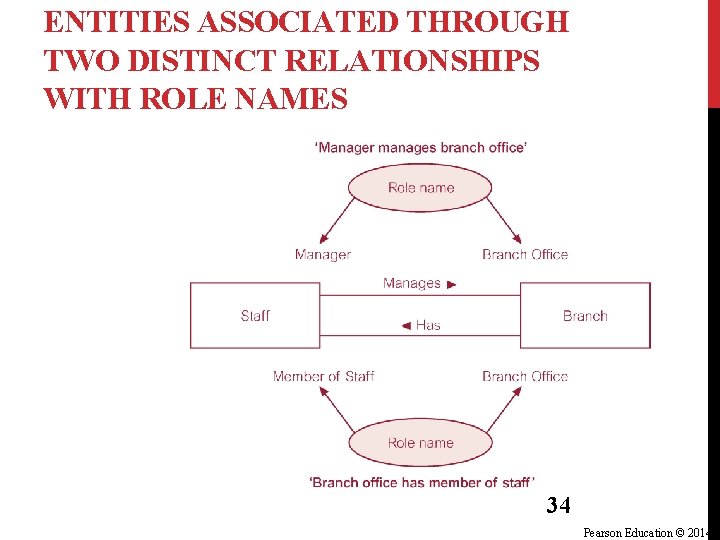
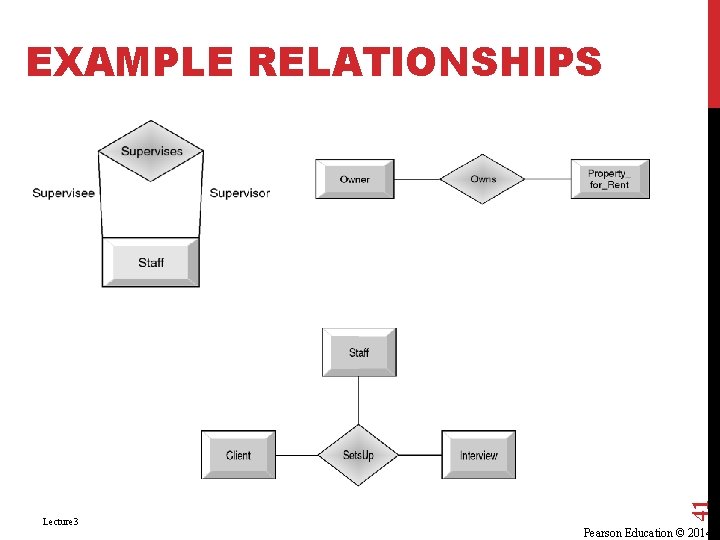
RELATIONSHIP TYPES Recursive Relationship • Relationship type where same entity type participates more than once in different roles. It is a Unary relationship. Role • Role indicates purpose that each participating entity type plays in a relationship. • Role can be used when two entities are associated through more than one relationship to classify the purpose of each relation. 32 Pearson Education © 2014
RECURSIVE RELATIONSHIP CALLED SUPERVISES WITH ROLE NAMES 33 Pearson Education © 2014
ENTITIES ASSOCIATED THROUGH TWO DISTINCT RELATIONSHIPS WITH ROLE NAMES 34 Pearson Education © 2014
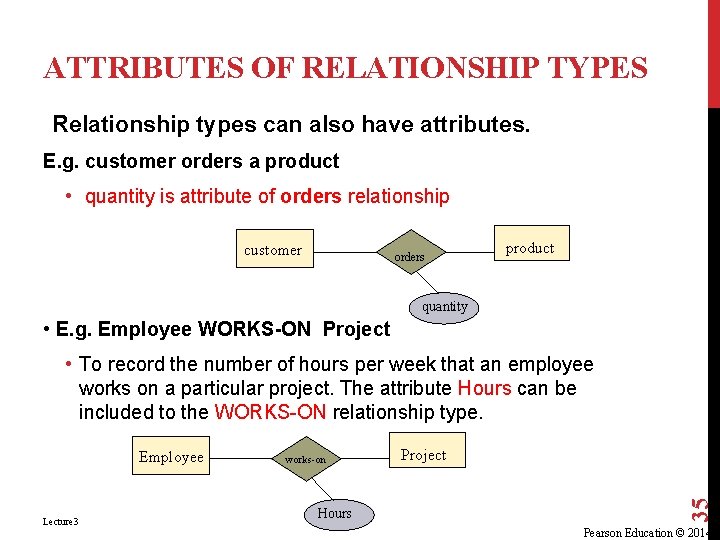
ATTRIBUTES OF RELATIONSHIP TYPES Relationship types can also have attributes. E. g. customer orders a product • quantity is attribute of orders relationship customer orders product quantity • E. g. Employee WORKS-ON Project • To record the number of hours per week that an employee works on a particular project. The attribute Hours can be included to the WORKS-ON relationship type. Lecture 3 works-on Hours Project 35 Employee Pearson Education © 2014
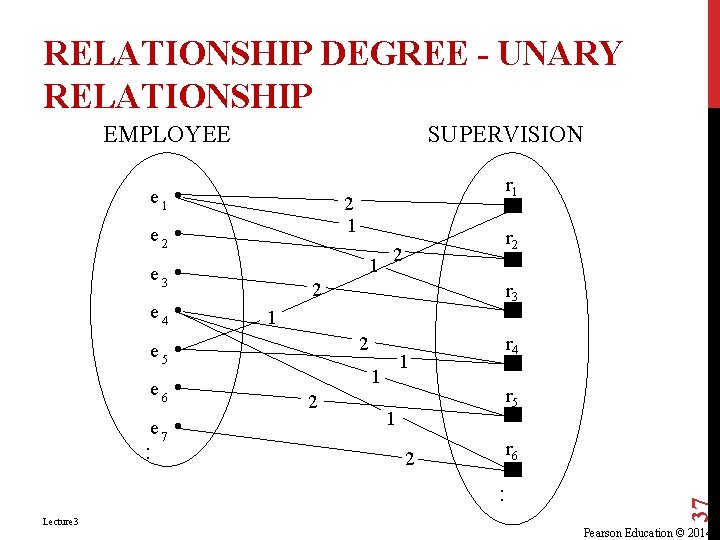
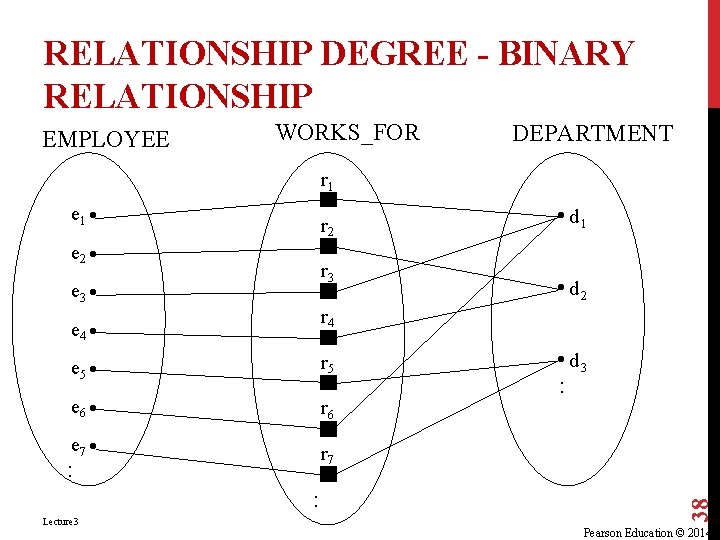
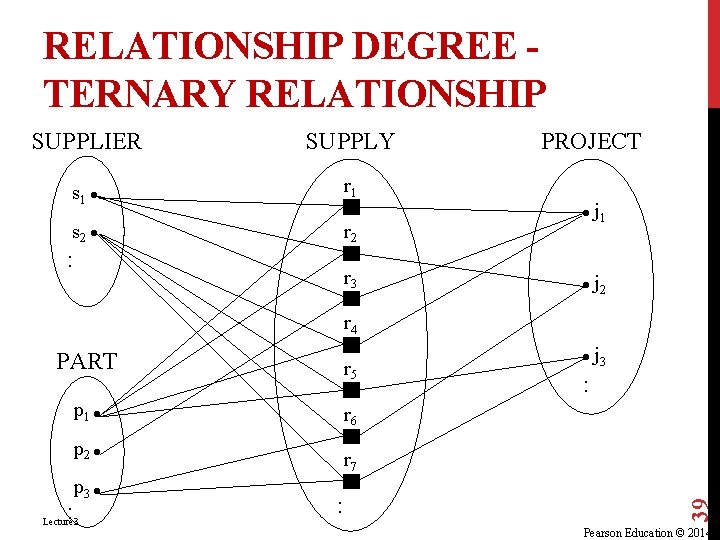
TYPES OF RELATIONSHIPS • Degree of relationship: is the number of entity types that participate in it Lecture 3 36 • UNARY – between entities from one entity set • BINARY – between entities from two entity sets • N-ARY – among entities from more than two entity sets Pearson Education © 2014
RELATIONSHIP DEGREE - UNARY RELATIONSHIP EMPLOYEE SUPERVISION e 1 2 1 e 2 1 e 4 e 7 : 2 2 r 3 1 2 e 5 e 6 r 2 1 1 2 r 4 r 5 1 2 r 6 : Lecture 3 37 e 3 r 1 Pearson Education © 2014
RELATIONSHIP DEGREE - BINARY RELATIONSHIP EMPLOYEE WORKS_FOR DEPARTMENT r 1 e 1 r 2 e 2 r 3 e 3 d 1 d 2 d 3 e 5 r 5 e 6 r 6 e 7 r 7 : : : 38 r 4 e 4 Lecture 3 Pearson Education © 2014
RELATIONSHIP DEGREE TERNARY RELATIONSHIP SUPPLIER SUPPLY s 1 r 1 s 2 : PROJECT j 1 j 2 j 3 r 2 r 3 r 4 PART r 5 p 1 r 6 : p 3 Lecture 3 r 7 : 39 p 2 : Pearson Education © 2014
RELATIONSHIP DEGREE M UNARY : One entity set, recursive. SUBJECT prerequisite N BINARY : Two entity sets linked (mostly used). STUDENT M enrols in N SUBJECT TERNARY : Three entity sets linked. RENTAL SHOP M owns N VIDEO BORROWER Lecture 3 40 1 Pearson Education © 2014
Lecture 3 41 EXAMPLE RELATIONSHIPS Pearson Education © 2014
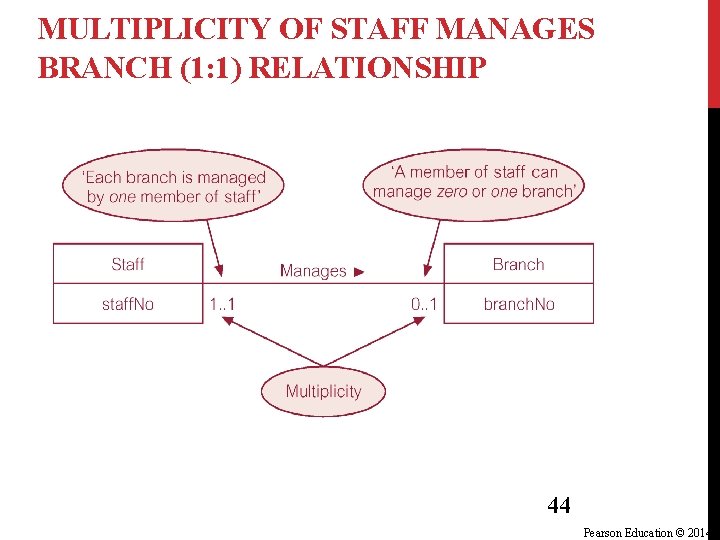
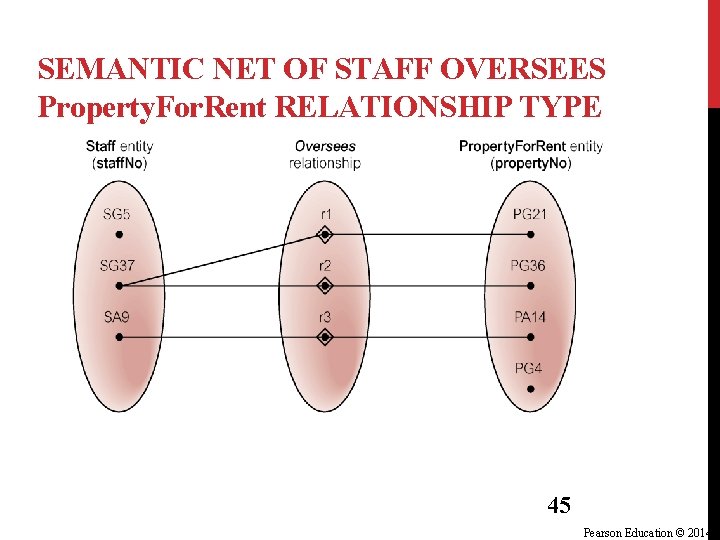
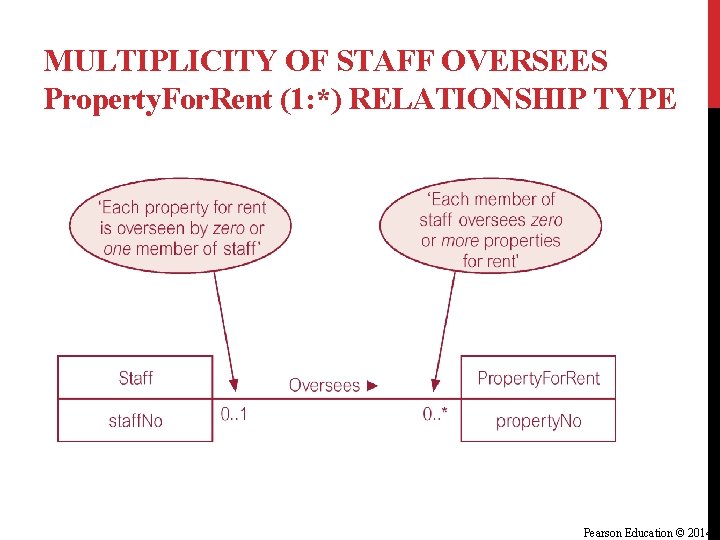
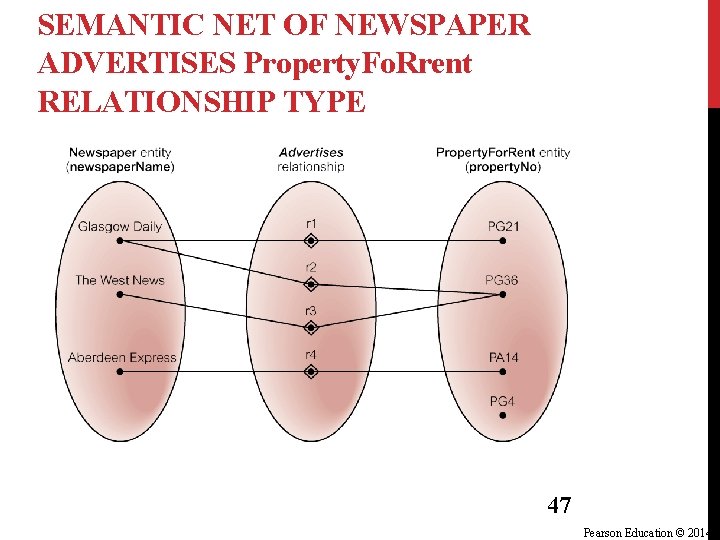
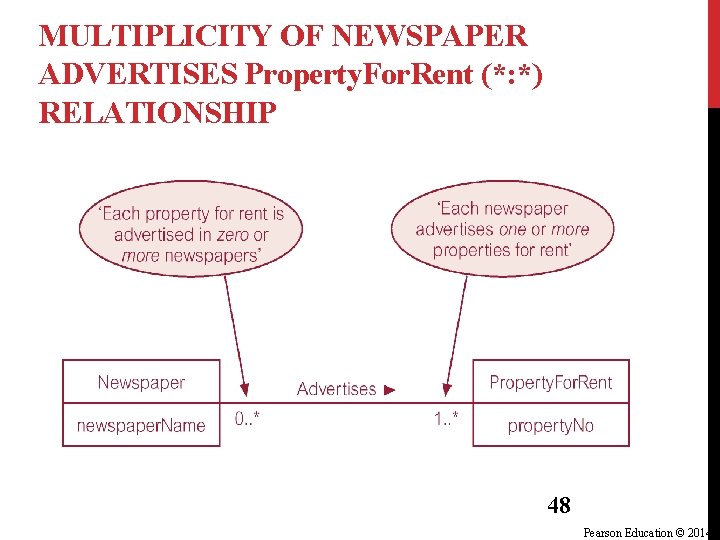
MULTIPLICITY • Multiplicity is the number (range) of possible entities that may relate to a single association through a particular relationship. • It is best determined using sample data. • Takes the form (min#, max#). 42 Pearson Education © 2014
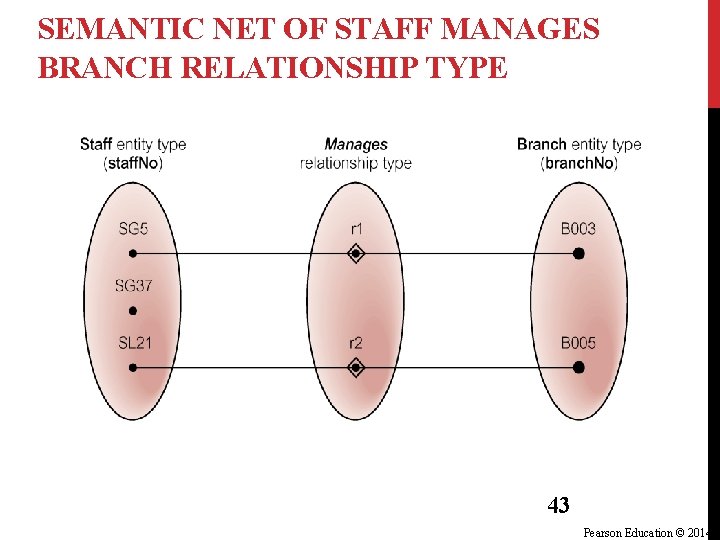
SEMANTIC NET OF STAFF MANAGES BRANCH RELATIONSHIP TYPE 43 Pearson Education © 2014
MULTIPLICITY OF STAFF MANAGES BRANCH (1: 1) RELATIONSHIP 44 Pearson Education © 2014
SEMANTIC NET OF STAFF OVERSEES Property. For. Rent RELATIONSHIP TYPE 45 Pearson Education © 2014
MULTIPLICITY OF STAFF OVERSEES Property. For. Rent (1: *) RELATIONSHIP TYPE Pearson Education © 2014
SEMANTIC NET OF NEWSPAPER ADVERTISES Property. Fo. Rrent RELATIONSHIP TYPE 47 Pearson Education © 2014
MULTIPLICITY OF NEWSPAPER ADVERTISES Property. For. Rent (*: *) RELATIONSHIP 48 Pearson Education © 2014
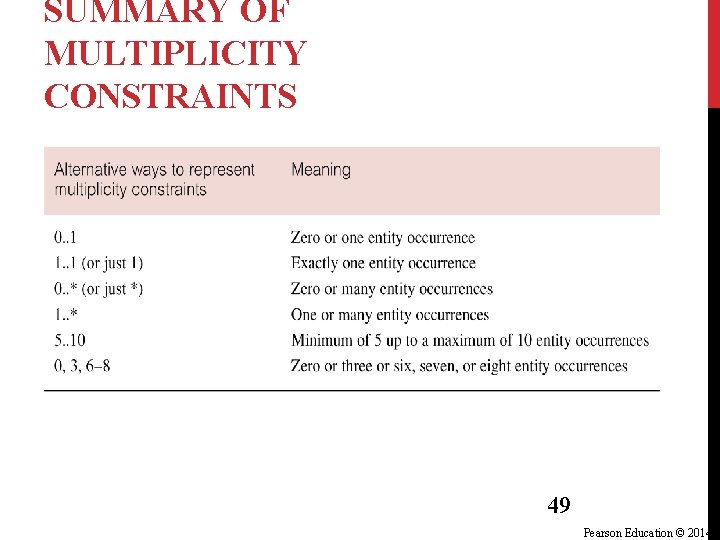
SUMMARY OF MULTIPLICITY CONSTRAINTS 49 Pearson Education © 2014
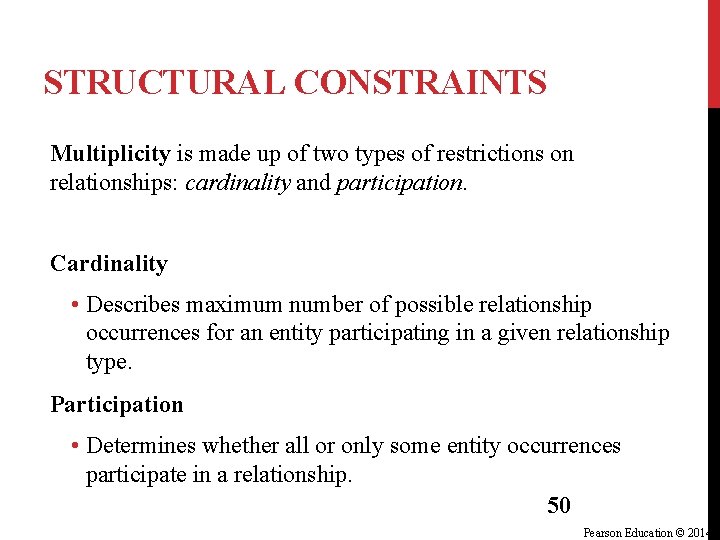
STRUCTURAL CONSTRAINTS Multiplicity is made up of two types of restrictions on relationships: cardinality and participation. Cardinality • Describes maximum number of possible relationship occurrences for an entity participating in a given relationship type. Participation • Determines whether all or only some entity occurrences participate in a relationship. 50 Pearson Education © 2014
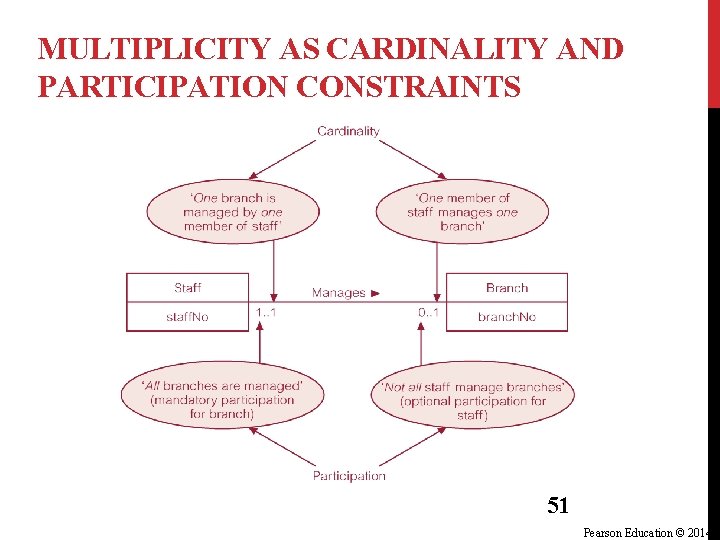
MULTIPLICITY AS CARDINALITY AND PARTICIPATION CONSTRAINTS 51 Pearson Education © 2014
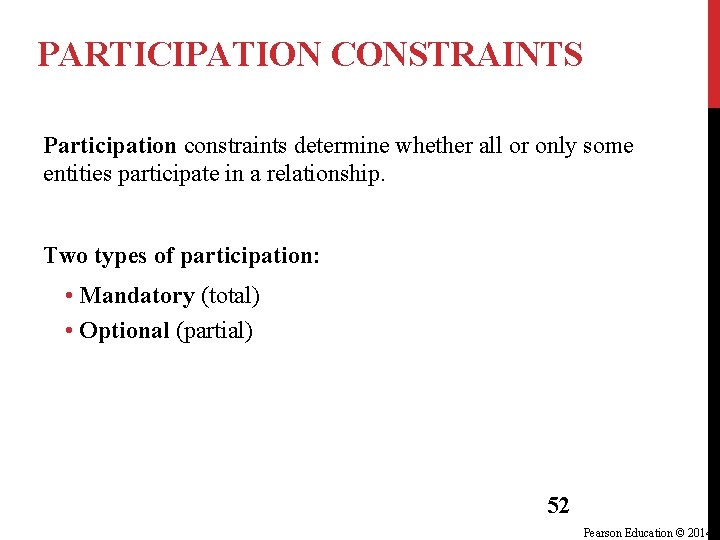
PARTICIPATION CONSTRAINTS Participation constraints determine whether all or only some entities participate in a relationship. Two types of participation: • Mandatory (total) • Optional (partial) 52 Pearson Education © 2014
PARTICIPATION CONSTRAINTS Mandatory (total) (1: *): if an entity’s existence requires the existence of an associated entity in a particular relationship (existence-dependent) • (e. g. CLASS taught-by PROFESSOR) CLASS is a total participator in the relation A weak entity always has a mandatory participation constraints but the opposite not always true. 53 Pearson Education © 2014
PARTICIPATION CONSTRAINTS Optional (partial) (0: *): if an entity’s existence does not require a corresponding entity in a particular relationship. (Not existence-dependent) • (e. g. PROFESSOR teach CLASS) PROFESSOR is a partial participator in the relation 54 Pearson Education © 2014
ER CASE STUDY Design s database for a bank with the following description: Each bank has a unique name. Each branch has a number, name, address (number, street, city), and a set of phones. Customer includes their name, set of address (P. O. Box, city, zip code, country), set of phones, and social security number. 55 Pearson Education © 2014
ER CASE STUDY cont. Accounts have numbers, types (e. g. saving, checking) and balance. Other branches might use the same designation for accounts. So to name an account uniquely, we need to give both the branch number to which this account belongs to and the account number. Not all bank customers must own accounts. An account must have only one customer. A customer may have many accounts and in different branches. A customer may have at most 5 accounts in the bank. 56 Pearson Education © 2014
PROBLEMS WITH ER MODELS • Problems may arise when designing a conceptual data model called connection traps. • Often due to a misinterpretation of the meaning of certain relationships. • Two main types of connection traps are called fan traps and chasm traps. 57 Pearson Education © 2014
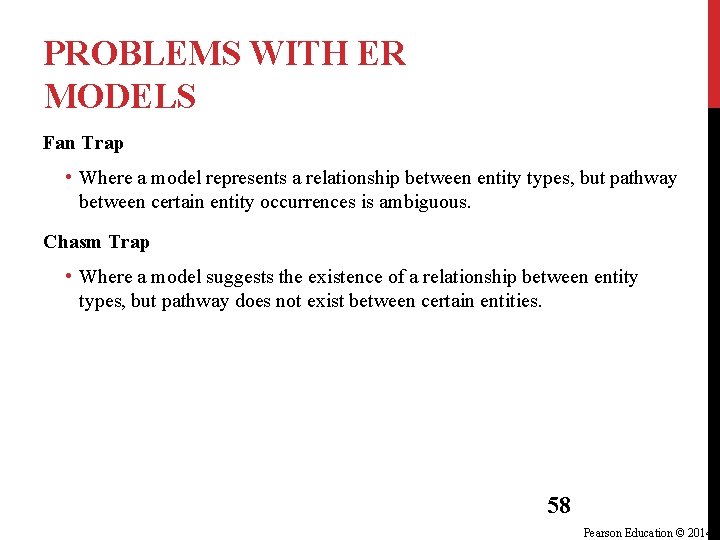
PROBLEMS WITH ER MODELS Fan Trap • Where a model represents a relationship between entity types, but pathway between certain entity occurrences is ambiguous. Chasm Trap • Where a model suggests the existence of a relationship between entity types, but pathway does not exist between certain entities. 58 Pearson Education © 2014
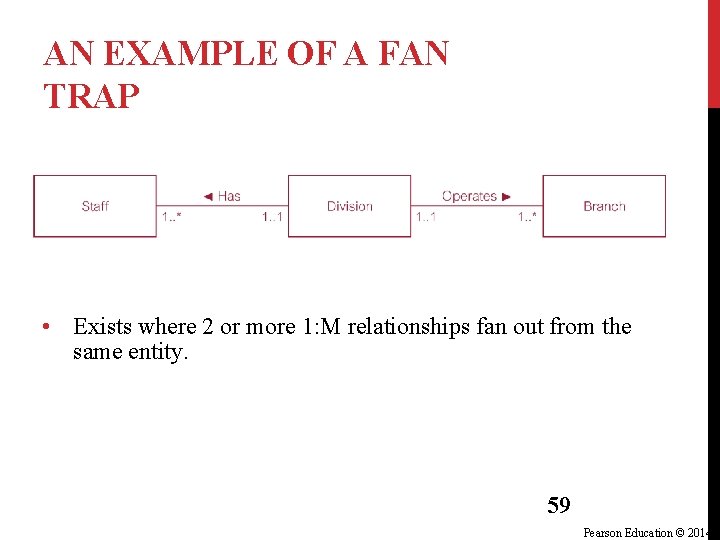
AN EXAMPLE OF A FAN TRAP • Exists where 2 or more 1: M relationships fan out from the same entity. 59 Pearson Education © 2014
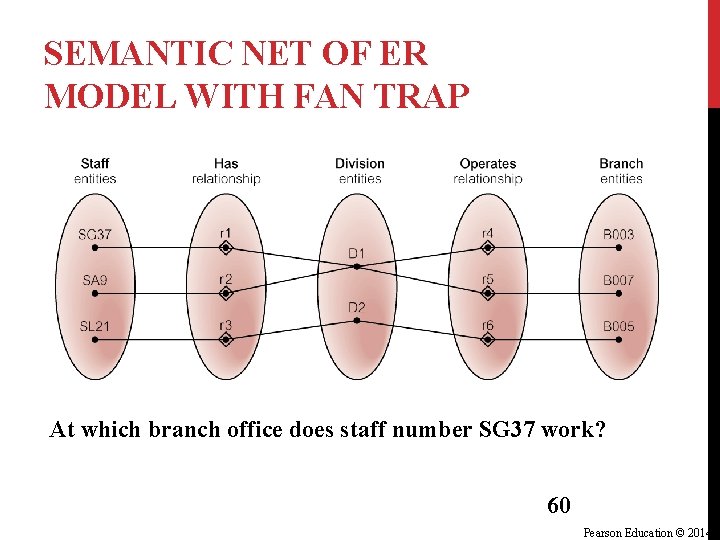
SEMANTIC NET OF ER MODEL WITH FAN TRAP At which branch office does staff number SG 37 work? 60 Pearson Education © 2014
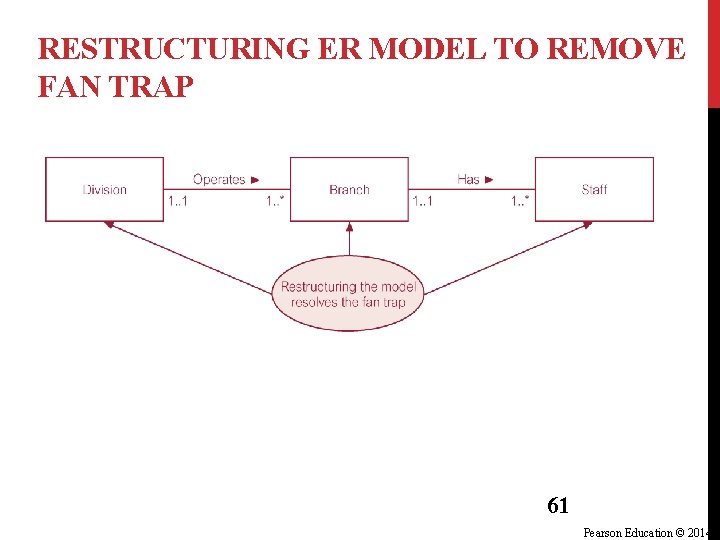
RESTRUCTURING ER MODEL TO REMOVE FAN TRAP 61 Pearson Education © 2014
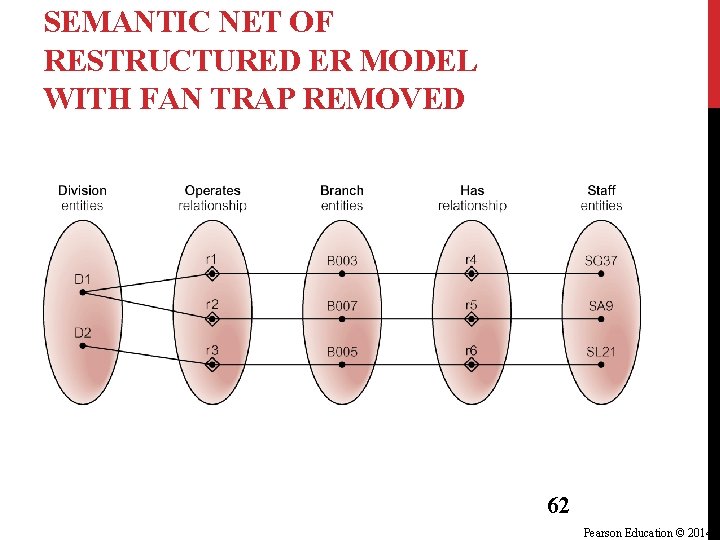
SEMANTIC NET OF RESTRUCTURED ER MODEL WITH FAN TRAP REMOVED SG 37 works at branch B 003. 62 Pearson Education © 2014
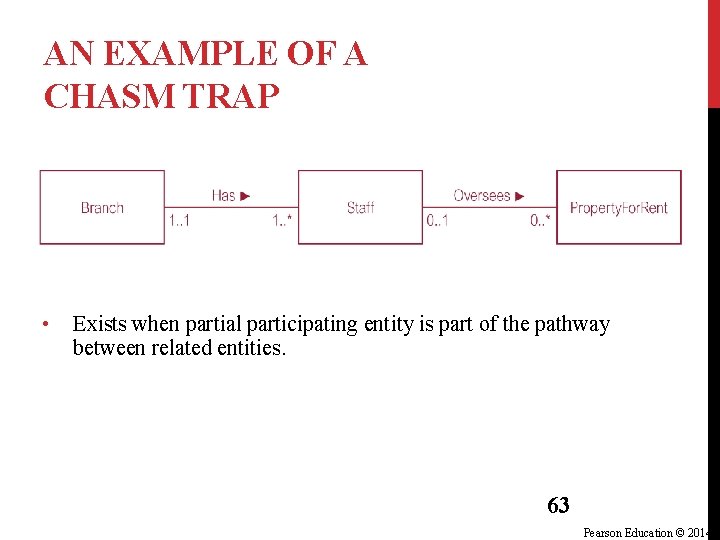
AN EXAMPLE OF A CHASM TRAP • Exists when partial participating entity is part of the pathway between related entities. 63 Pearson Education © 2014
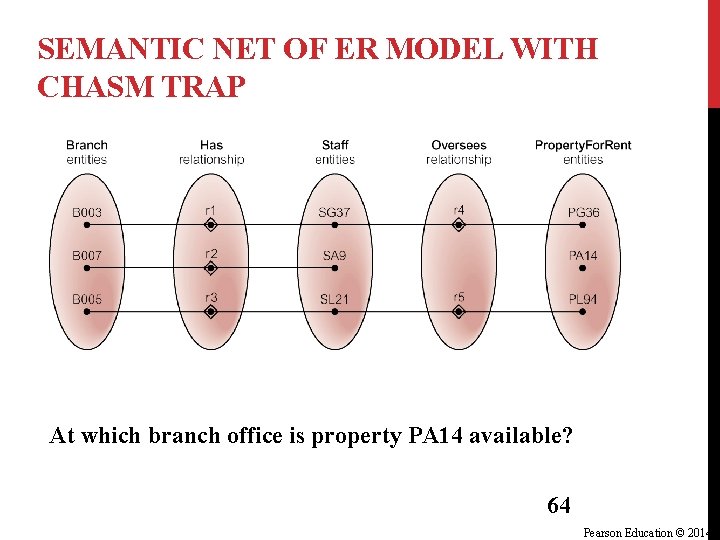
SEMANTIC NET OF ER MODEL WITH CHASM TRAP At which branch office is property PA 14 available? 64 Pearson Education © 2014
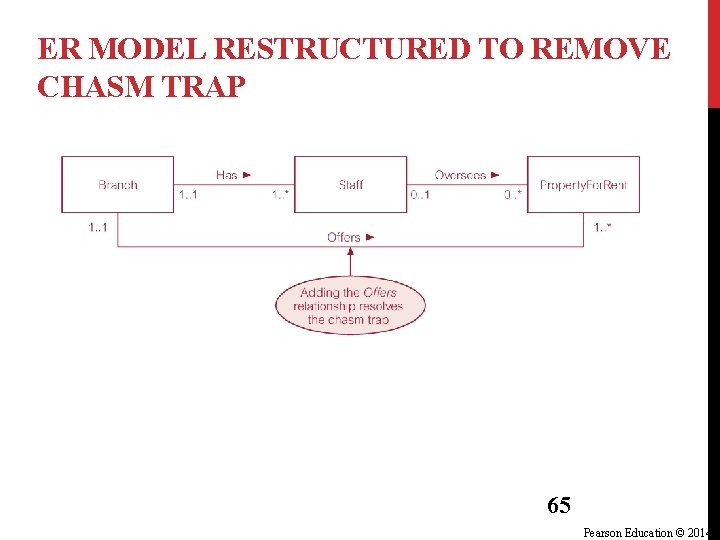
ER MODEL RESTRUCTURED TO REMOVE CHASM TRAP 65 Pearson Education © 2014
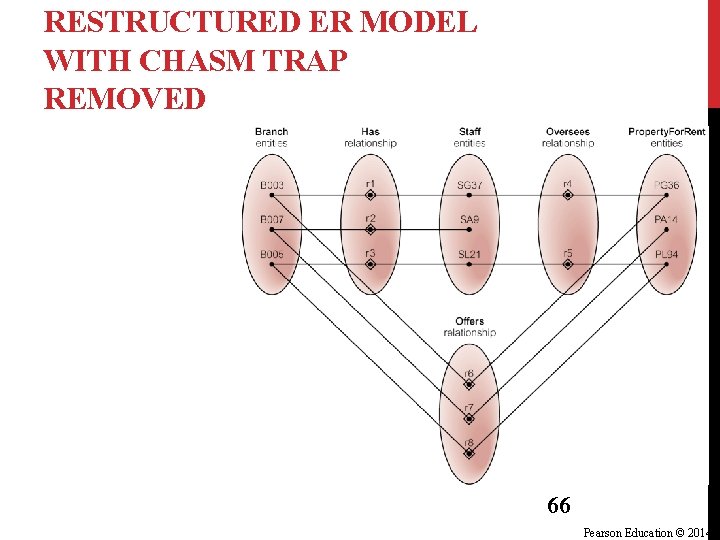
RESTRUCTURED ER MODEL WITH CHASM TRAP REMOVED 66 Pearson Education © 2014
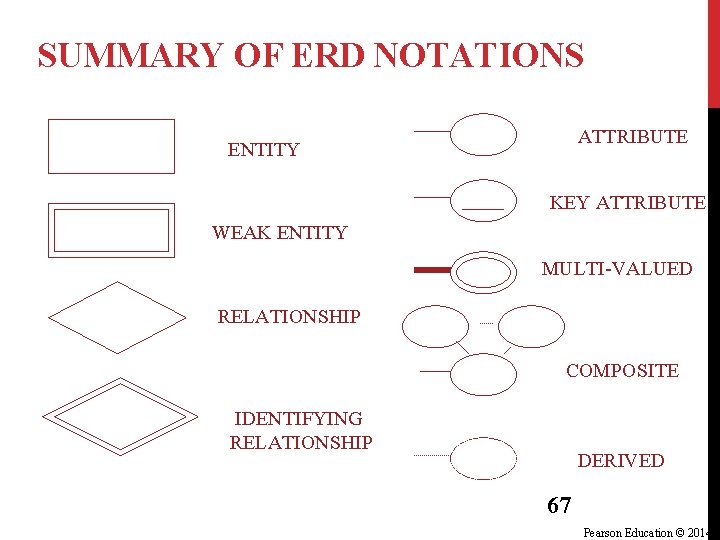
SUMMARY OF ERD NOTATIONS ATTRIBUTE ENTITY KEY ATTRIBUTE WEAK ENTITY MULTI-VALUED RELATIONSHIP COMPOSITE IDENTIFYING RELATIONSHIP DERIVED 67 Pearson Education © 2014
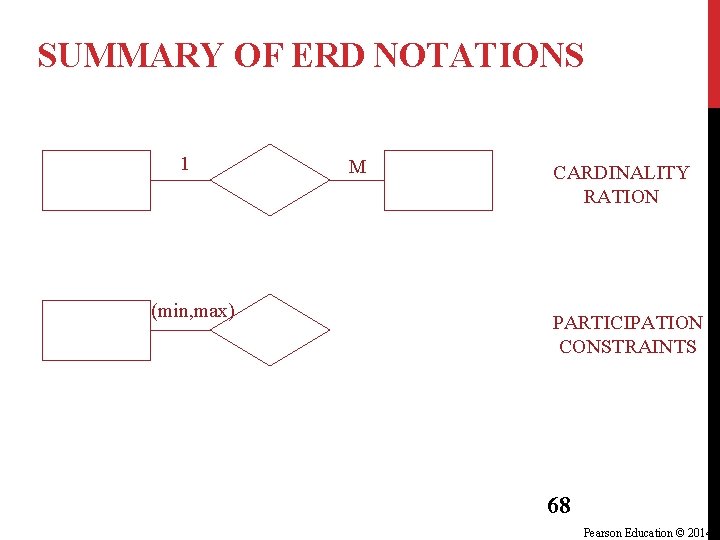
SUMMARY OF ERD NOTATIONS 1 (min, max) M CARDINALITY RATION PARTICIPATION CONSTRAINTS 68 Pearson Education © 2014
THE ENHANCED ENTITYRELATIONSHIP MODEL EER is an ER model supported with additional semantic concepts. Semantic concepts supported: • Specialization • Generalization 69 Pearson Education © 2014
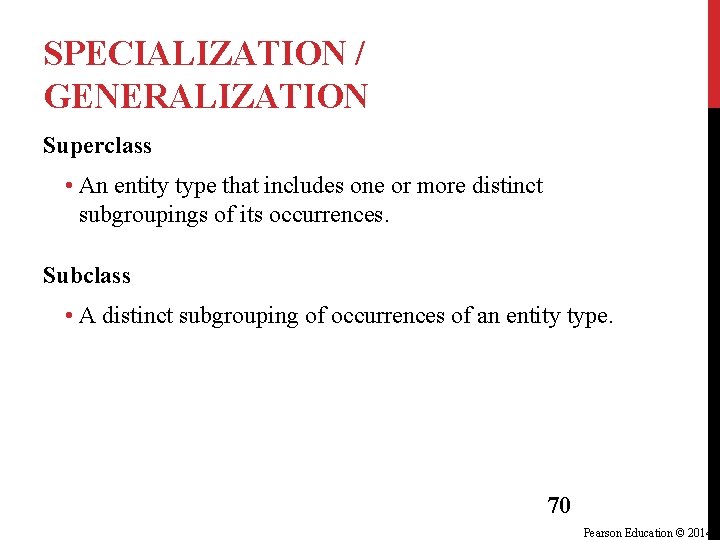
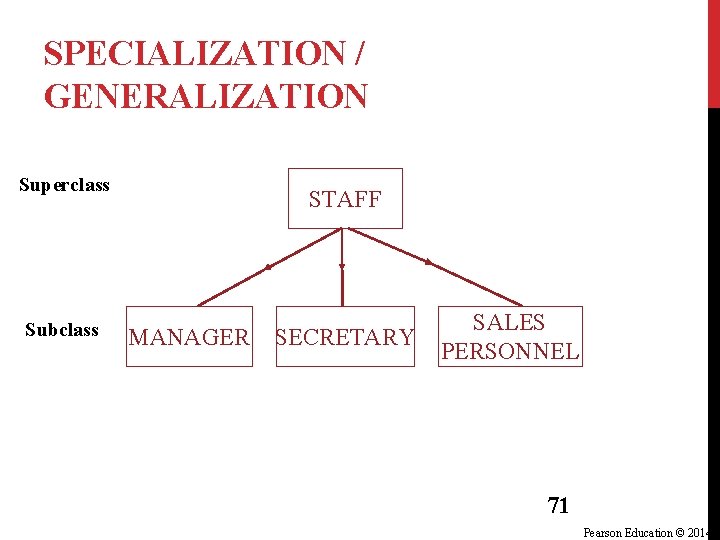
SPECIALIZATION / GENERALIZATION Superclass • An entity type that includes one or more distinct subgroupings of its occurrences. Subclass • A distinct subgrouping of occurrences of an entity type. 70 Pearson Education © 2014
SPECIALIZATION / GENERALIZATION Superclass Subclass STAFF MANAGER SECRETARY SALES PERSONNEL 71 Pearson Education © 2014
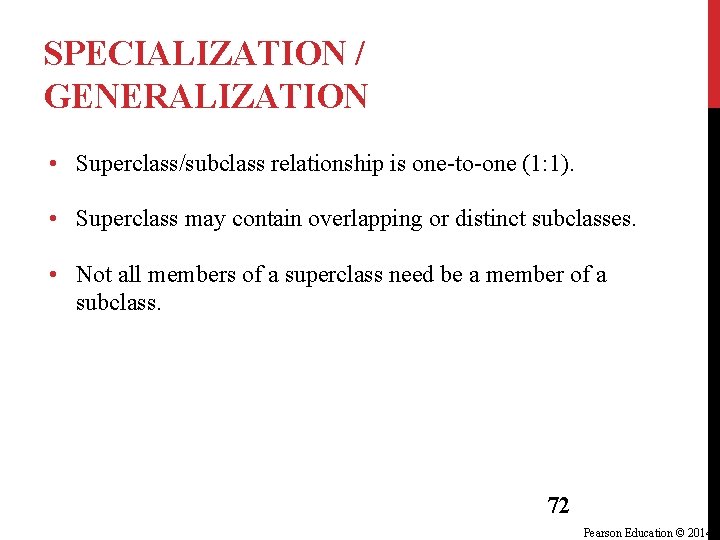
SPECIALIZATION / GENERALIZATION • Superclass/subclass relationship is one-to-one (1: 1). • Superclass may contain overlapping or distinct subclasses. • Not all members of a superclass need be a member of a subclass. 72 Pearson Education © 2014
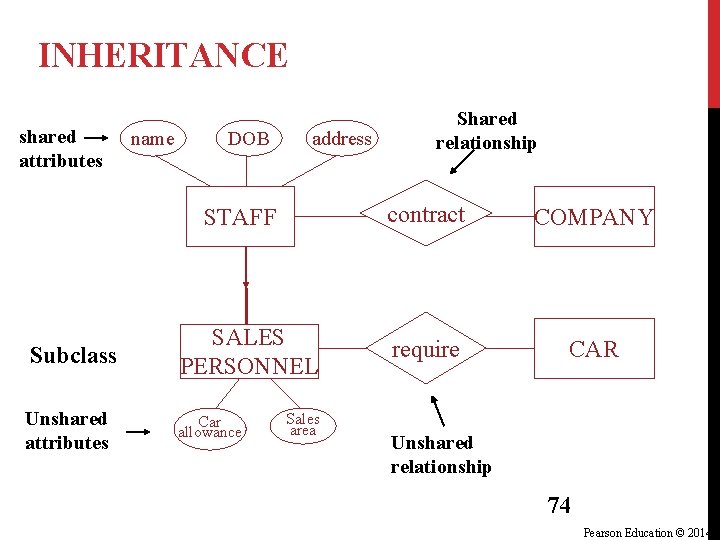
INHERITANCE Inheritance • A subclass entity type inherits all the attributes and relationships participation of the superclass entity type to which it is linked. 73 Pearson Education © 2014
INHERITANCE shared attributes name DOB address STAFF Subclass SALES PERSONNEL Unshared attributes Car allowance Sales area Shared relationship contract COMPANY require CAR Unshared relationship 74 Pearson Education © 2014
SPECIALIZATION / GENERALIZATION Specialization • Process of maximizing differences between members of an entity by identifying their distinguishing characteristics. Generalization • Process of minimizing differences between entities by identifying their common characteristics. 75 Pearson Education © 2014
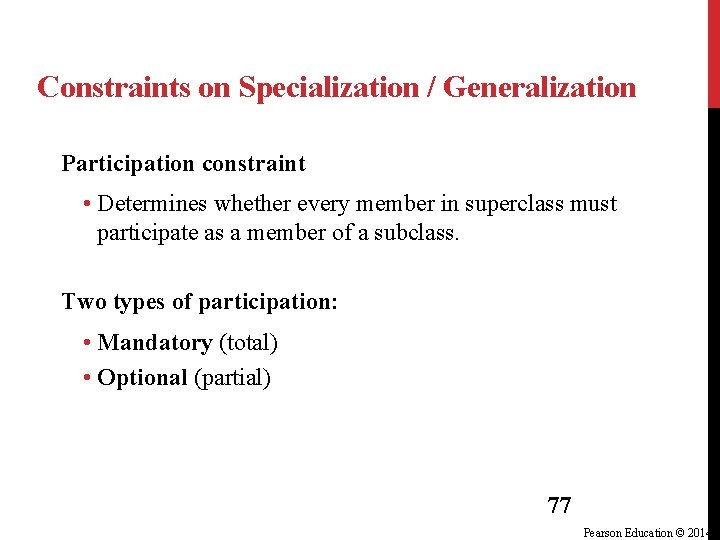
CONSTRAINTS ON SPECIALIZATION / GENERALIZATION Two constraints that may apply to a specialization/generalization: • participation constraints • disjoint constraints. 76 Pearson Education © 2014
Constraints on Specialization / Generalization Participation constraint • Determines whether every member in superclass must participate as a member of a subclass. Two types of participation: • Mandatory (total) • Optional (partial) 77 Pearson Education © 2014
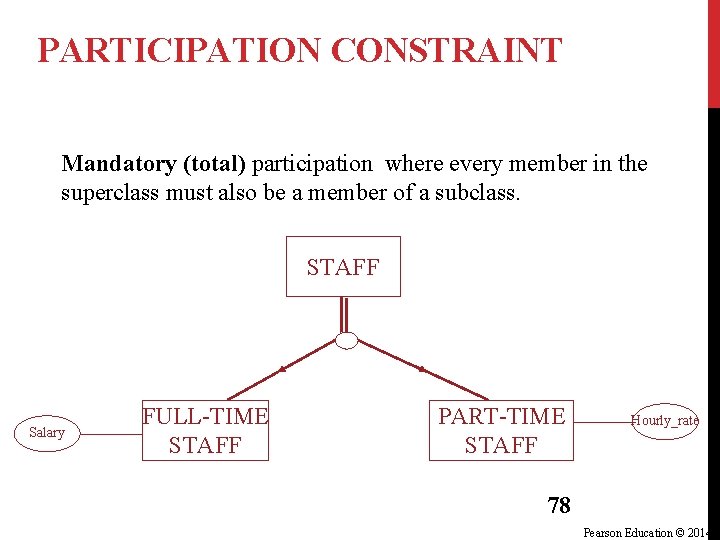
PARTICIPATION CONSTRAINT Mandatory (total) participation where every member in the superclass must also be a member of a subclass. STAFF Salary FULL-TIME STAFF PART-TIME STAFF Hourly_rate 78 Pearson Education © 2014
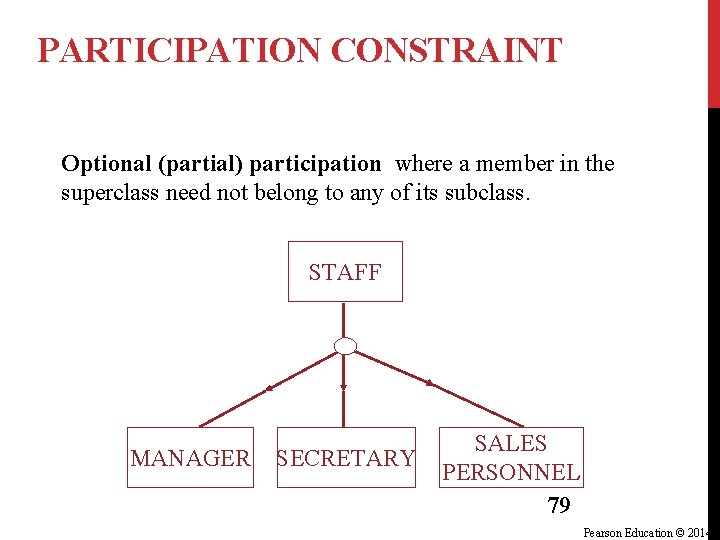
PARTICIPATION CONSTRAINT Optional (partial) participation where a member in the superclass need not belong to any of its subclass. STAFF MANAGER SECRETARY SALES PERSONNEL 79 Pearson Education © 2014
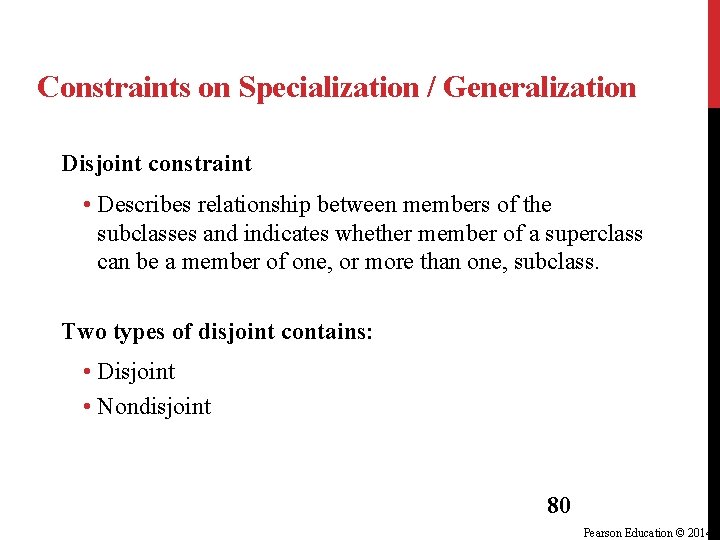
Constraints on Specialization / Generalization Disjoint constraint • Describes relationship between members of the subclasses and indicates whether member of a superclass can be a member of one, or more than one, subclass. Two types of disjoint contains: • Disjoint • Nondisjoint 80 Pearson Education © 2014
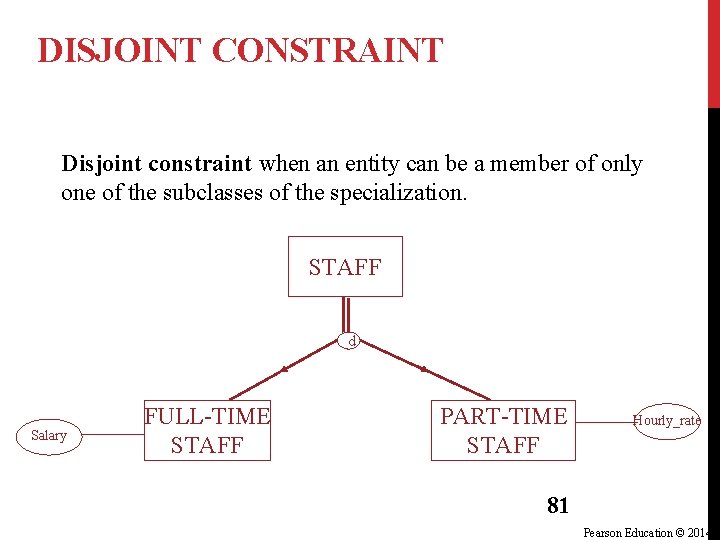
DISJOINT CONSTRAINT Disjoint constraint when an entity can be a member of only one of the subclasses of the specialization. STAFF d Salary FULL-TIME STAFF PART-TIME STAFF Hourly_rate 81 Pearson Education © 2014
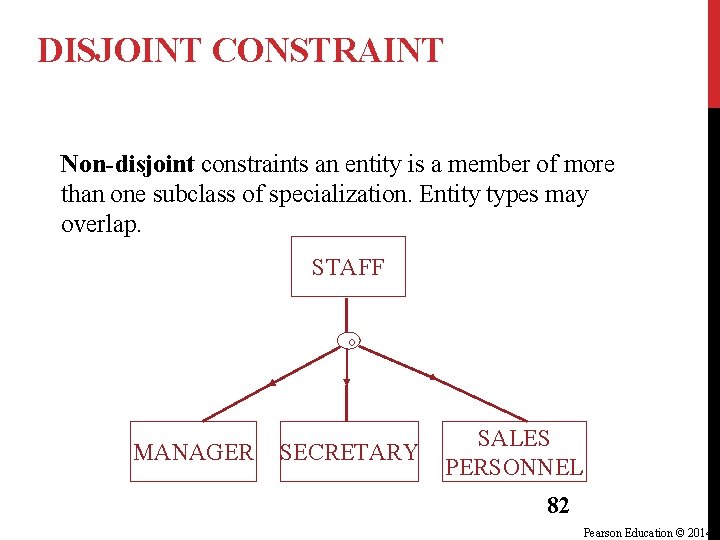
DISJOINT CONSTRAINT Non-disjoint constraints an entity is a member of more than one subclass of specialization. Entity types may overlap. STAFF o MANAGER SECRETARY SALES PERSONNEL 82 Pearson Education © 2014
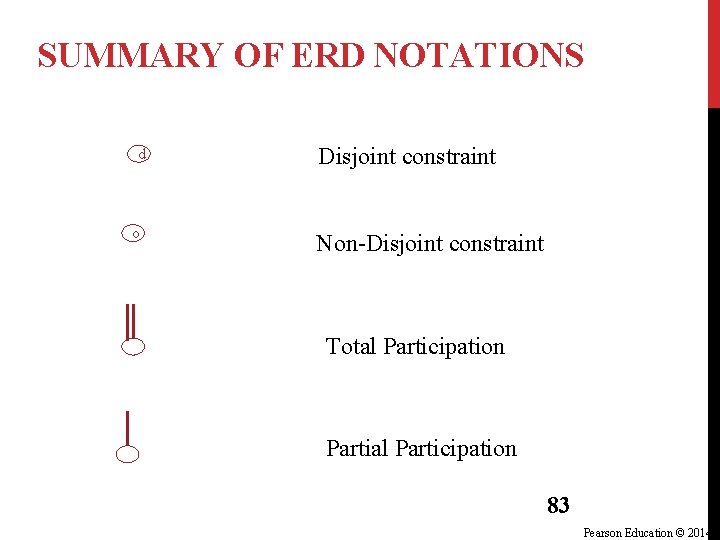
SUMMARY OF ERD NOTATIONS d o Disjoint constraint Non-Disjoint constraint Total Participation Partial Participation 83 Pearson Education © 2014
Lecture 3 84 ER DIAGRAMS IN ORACLE SOFTWARE Pearson Education © 2014
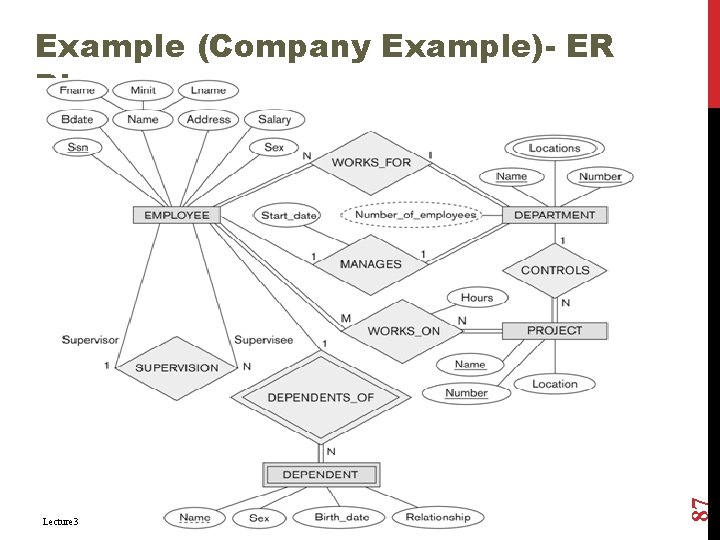
EXAMPLE (COMPANY) The COMPANY database keeps track of a company’s employees, departments and projects. The company is organized into departments. Each department has a unique name, a unique number, and a particular employee who manages the department. We keep track of the start date when that employee began managing the department. A department may have several locations. Lecture 3 85 A department controls a number of projects, each of which has a unique name, a unique number, and a single location. Pearson Education © 2014
EXAMPLE (COMPANY) We store each employee’s name, social security number, address, salary, sex, and birth date. An employee is assigned to one department but may work on several projects, which are not necessarily controlled by the same department. We keep track of the number of hours per week that an employee works on each project. We also keep track of the direct supervisor of each employee. Lecture 3 86 We want to keep track of the dependents of each employee for insurance purposes. We keep each dependent’s first name, sex, birth date, and relationship to the employee. Pearson Education © 2014
Lecture 3 87 Example (Company Example)- ER Diagram