Surface Modeling Parametric Surfaces Dr S M Malaek

- Slides: 32
Surface Modeling Parametric Surfaces Dr. S. M. Malaek Assistant: M. Younesi
n n n Surface Modeling There are two types of surfaces that are commonly used in modeling systems, parametric and implicit. Implicit Surface: f(x, y, z)=0 Example: (x-x 0)2+(y-y 0)2+(z-z 0)2 -r 2=0
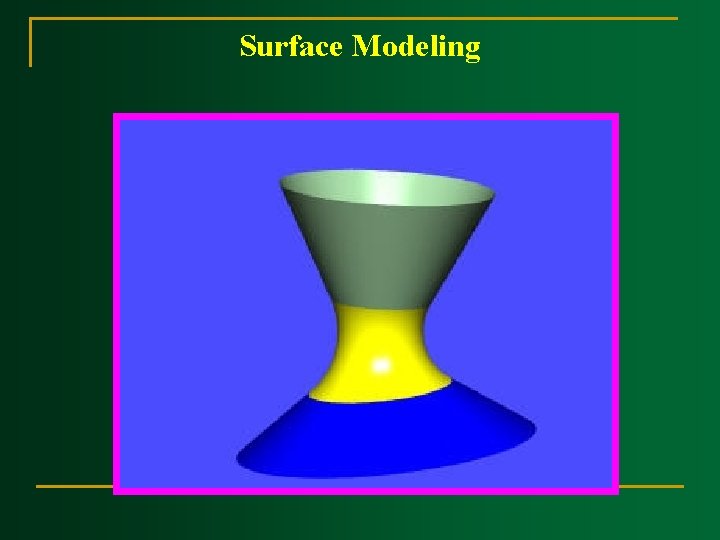
Surface Modeling
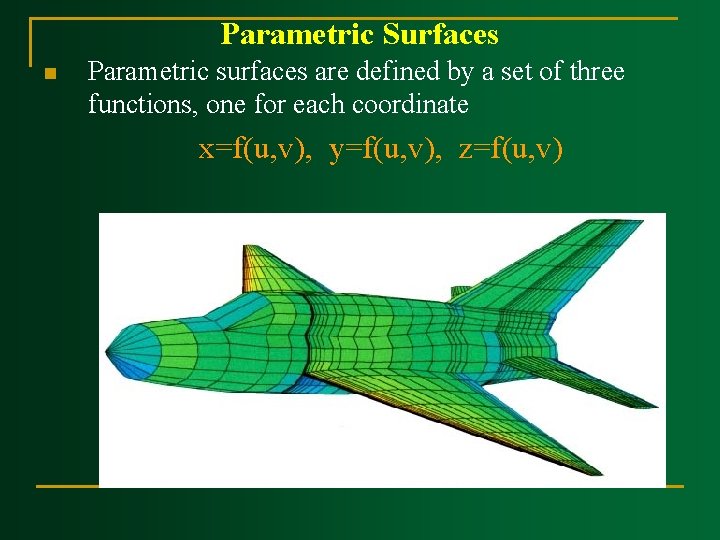
Parametric Surfaces n Parametric surfaces are defined by a set of three functions, one for each coordinate x=f(u, v), y=f(u, v), z=f(u, v)
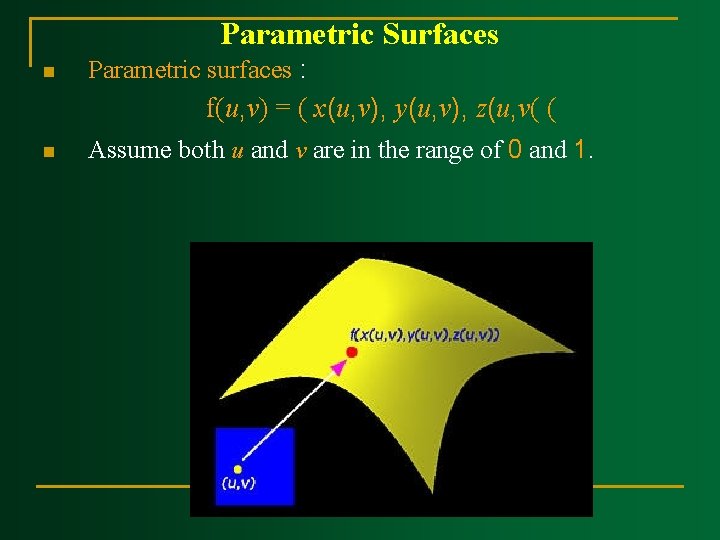
Parametric Surfaces n Parametric surfaces : f(u, v) = ( x(u, v), y(u, v), z(u, v( ( n Assume both u and v are in the range of 0 and 1.
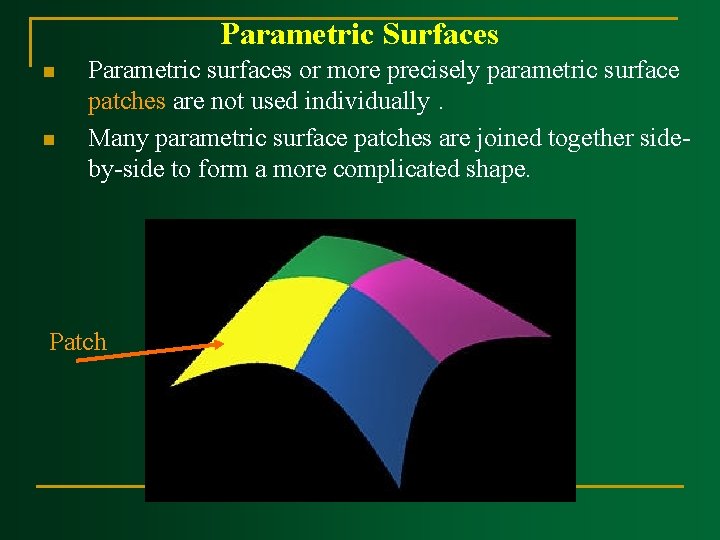
Parametric Surfaces n n Parametric surfaces or more precisely parametric surface patches are not used individually. Many parametric surface patches are joined together sideby-side to form a more complicated shape. Patch
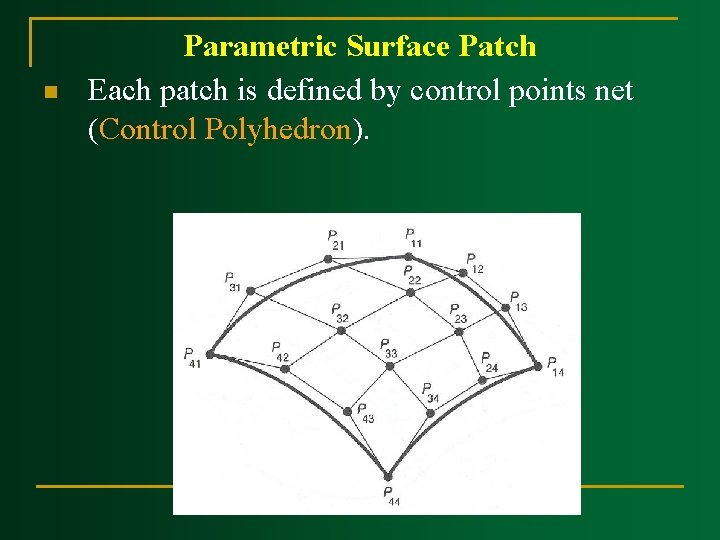
n Parametric Surface Patch Each patch is defined by control points net (Control Polyhedron).
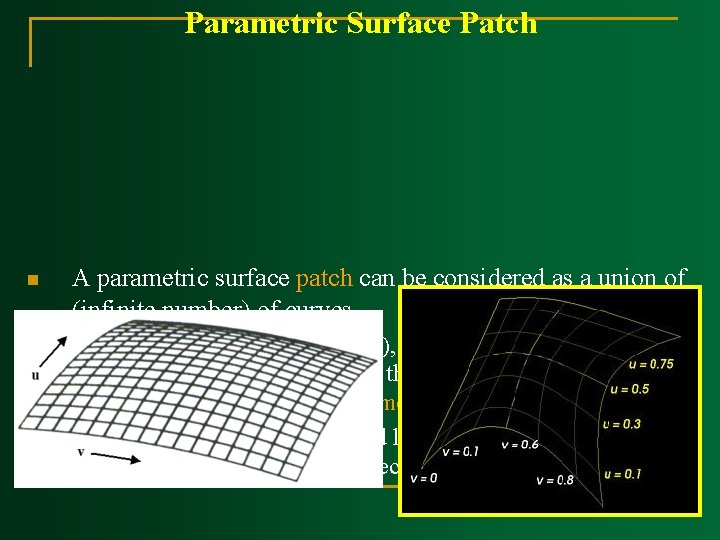
Parametric Surface Patch n A parametric surface patch can be considered as a union of (infinite number) of curves. n Given a parametric surface f(u, v), if u is fixed to a value, and let v vary, this generates a curve on the surface whose u coordinate is a constant. This is the isoparametric curve in the v direction. Similarly, fixing v to a value and letting u vary, we obtain an isoparametric curve whose v direction is a constant. n
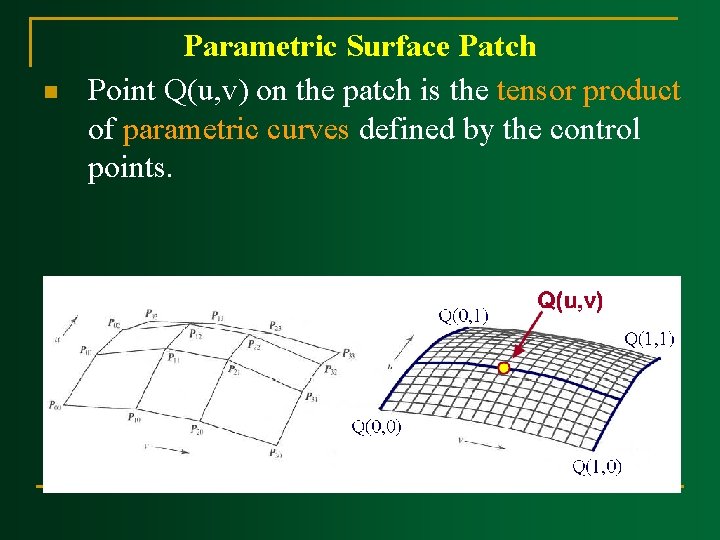
n Parametric Surface Patch Point Q(u, v) on the patch is the tensor product of parametric curves defined by the control points.
Bézier Surface Patch
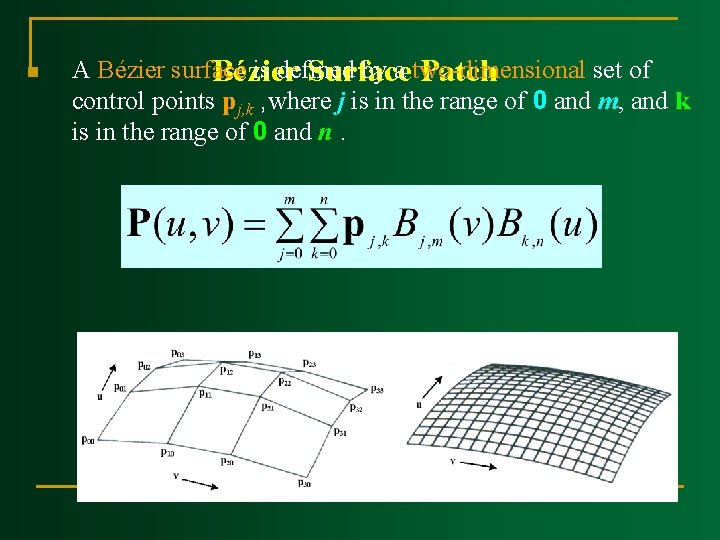
n A Bézier surface is defined by a two-dimensional set of Bézier Surface Patch control points pj, k , where j is in the range of 0 and m, and k is in the range of 0 and n.
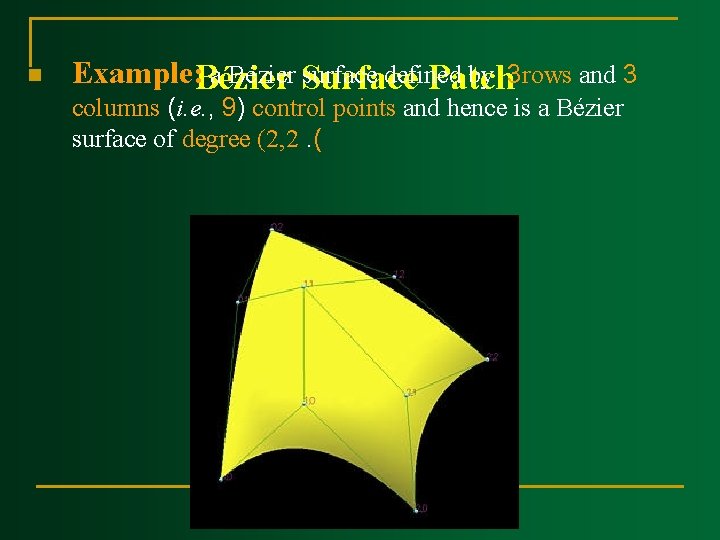
n Example: Bézier a Bézier Surface surface defined by 3 rows and 3 Patch columns (i. e. , 9) control points and hence is a Bézier surface of degree (2, 2. (
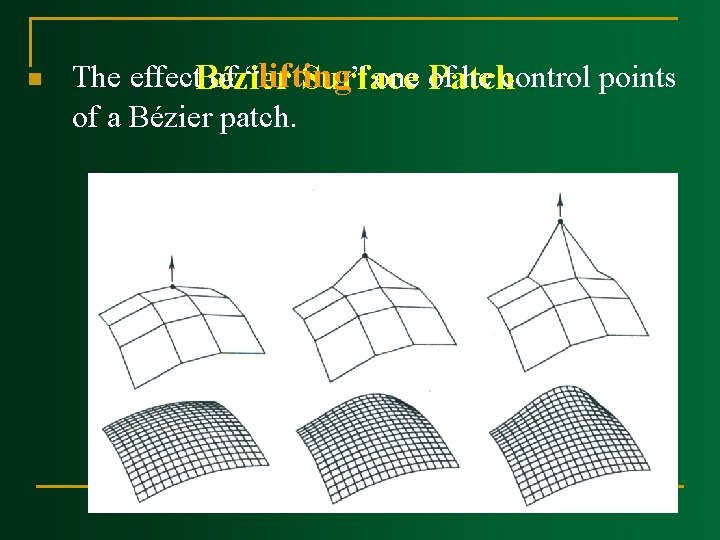
n The effect. Bézier of “lifting ” one of he control points Surface Patch of a Bézier patch.
Basis Functions of Bézier Surface Patches
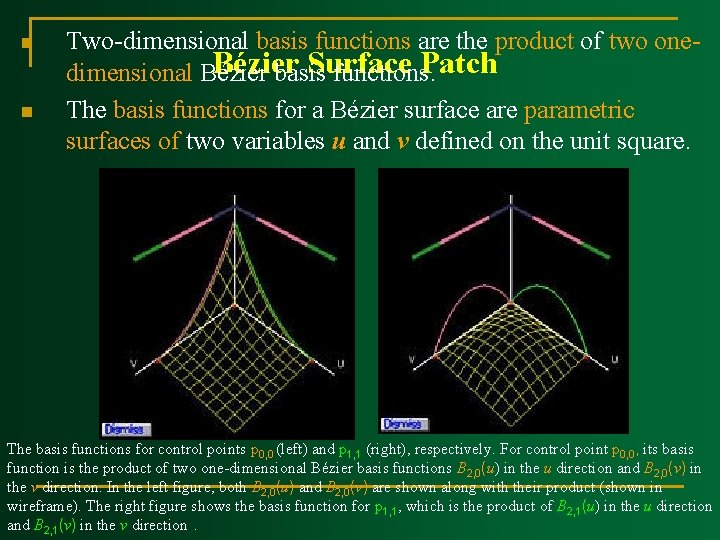
n n Two-dimensional basis functions are the product of two one. Bézier Surface Patch dimensional Bézier basis functions. The basis functions for a Bézier surface are parametric surfaces of two variables u and v defined on the unit square. The basis functions for control points p 0, 0 (left) and p 1, 1 (right), respectively. For control point p 0, 0, its basis function is the product of two one-dimensional Bézier basis functions B 2, 0(u) in the u direction and B 2, 0(v) in the v direction. In the left figure, both B 2, 0(u) and B 2, 0(v) are shown along with their product (shown in wireframe). The right figure shows the basis function for p 1, 1, which is the product of B 2, 1(u) in the u direction and B 2, 1(v) in the v direction.
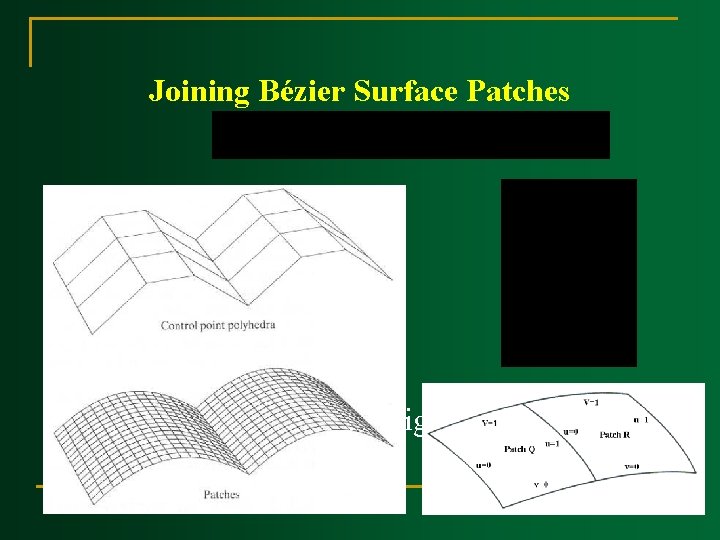
Joining Bézier Surface Patches
Joining Bézier Surface Patches n C 0 continuity requires aligning boundary curves.
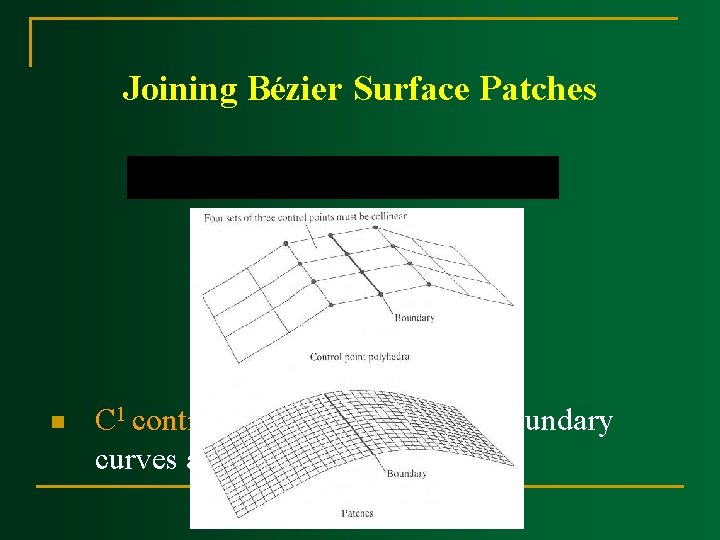
Joining Bézier Surface Patches n C 1 continuity requires aligning boundary curves and derivatives.
Properties Of Bézier Surface Patches
Properties Of Bézier Surface Patches n n n p(u, v) passes through the control points at the four corners of the control net: p 0, 0, pm, n and p 0, n. Nonnegativity: Bm, i(u) Bn, j(v) is nonnegative for all m, n, i, j and u and v in the range of 0 and 1. Partition of Unity: The sum of all Bm, i(u) Bn, j(v) is 1 for all u and v in the range of 0 and 1. Convex Hull Property: a Bézier surface p(u, v) lies in the convex hull defined by its control net. Affine Invariance
B-Spline Surface
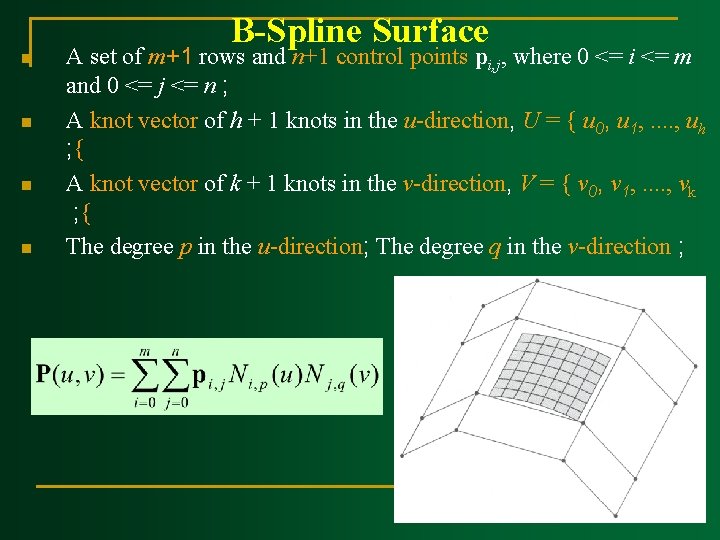
B-Spline Surface n n A set of m+1 rows and n+1 control points pi, j, where 0 <= i <= m and 0 <= j <= n ; A knot vector of h + 1 knots in the u-direction, U = { u 0, u 1, . . , uh ; { A knot vector of k + 1 knots in the v-direction, V = { v 0, v 1, . . , vk ; { The degree p in the u-direction; The degree q in the v-direction ;
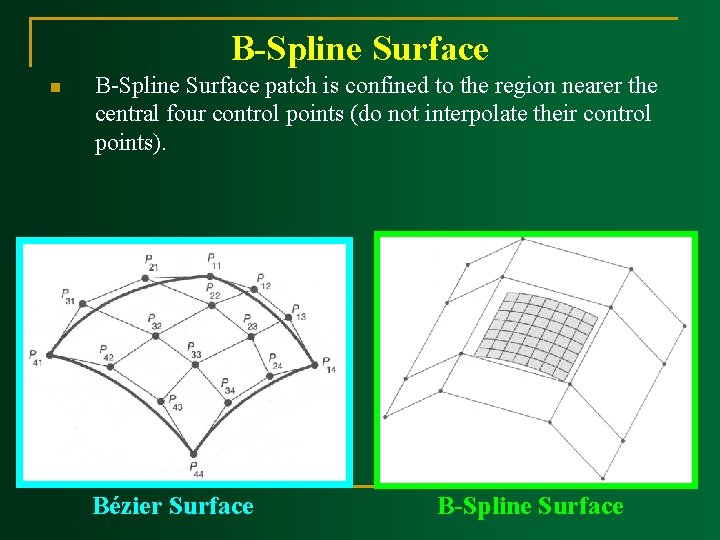
B-Spline Surface n B-Spline Surface patch is confined to the region nearer the central four control points (do not interpolate their control points). Bézier Surface B-Spline Surface
Basis Functions of B-Spline Surface
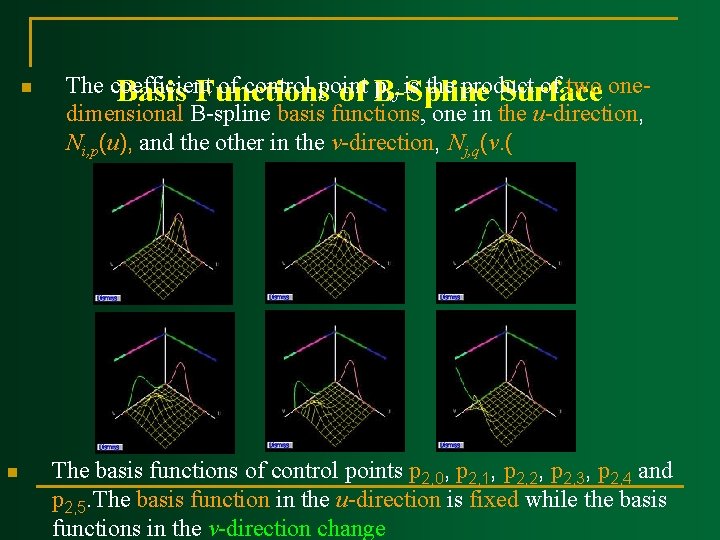
n n The coefficient of control point pi, j is the product of two one. Basis Functions of B-Spline Surface dimensional B-spline basis functions, one in the u-direction, Ni, p(u), and the other in the v-direction, Nj, q(v. ( The basis functions of control points p 2, 0, p 2, 1, p 2, 2, p 2, 3, p 2, 4 and p 2, 5. The basis function in the u-direction is fixed while the basis functions in the v-direction change
Clamped, Closed and Open B-Spline Surface
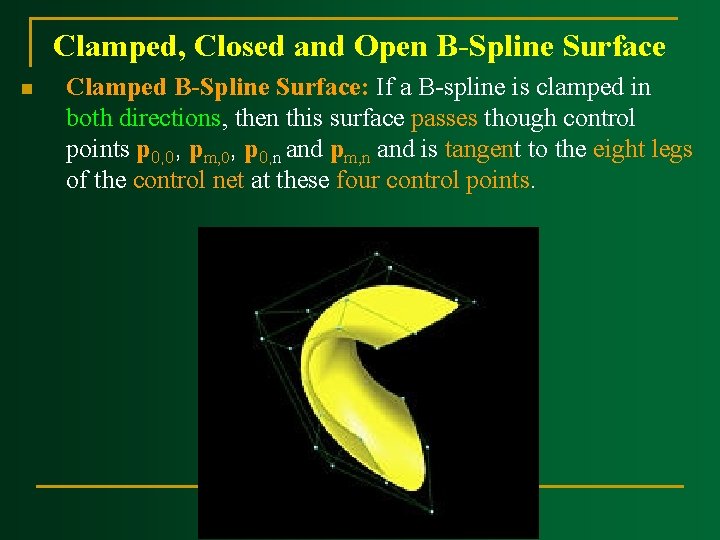
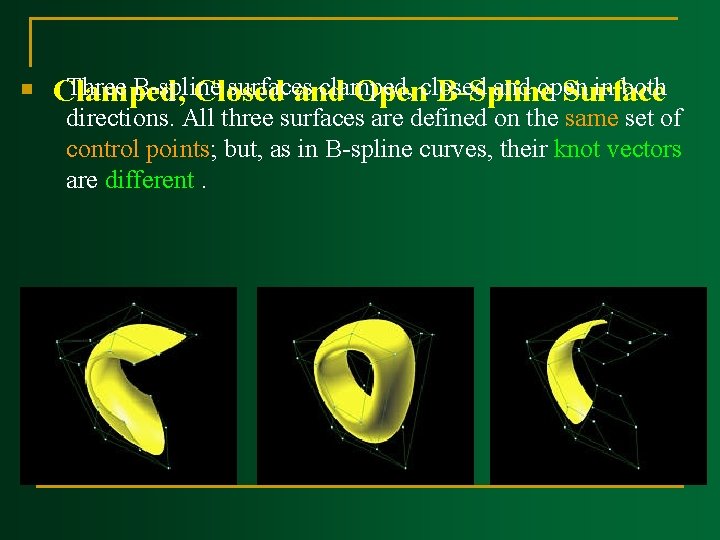
Clamped, Closed and Open B-Spline Surface n Clamped B-Spline Surface: If a B-spline is clamped in both directions, then this surface passes though control points p 0, 0, pm, 0, p 0, n and pm, n and is tangent to the eight legs of the control net at these four control points.
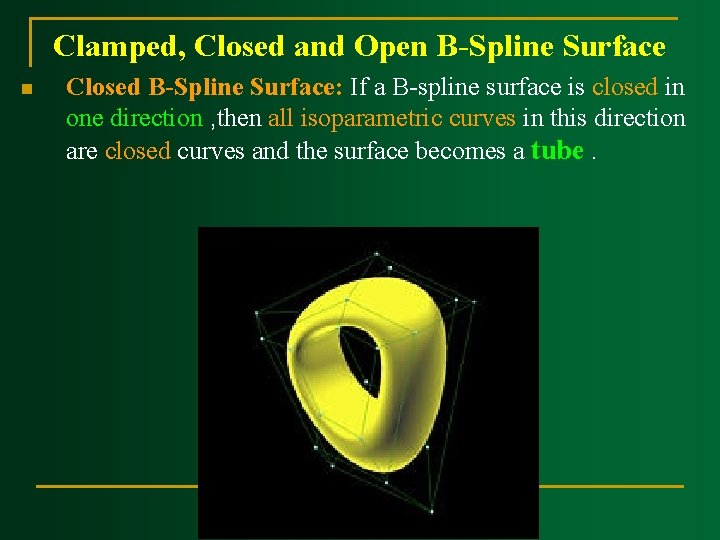
Clamped, Closed and Open B-Spline Surface n Closed B-Spline Surface: If a B-spline surface is closed in one direction , then all isoparametric curves in this direction are closed curves and the surface becomes a tube.
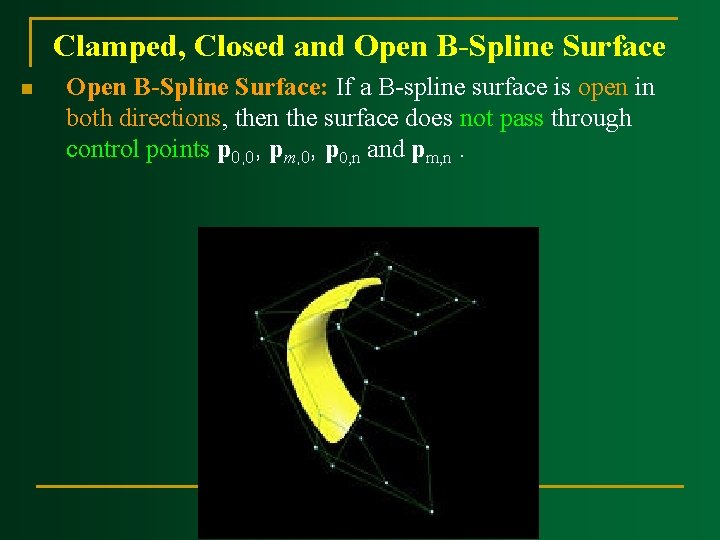
Clamped, Closed and Open B-Spline Surface n Open B-Spline Surface: If a B-spline surface is open in both directions, then the surface does not pass through control points p 0, 0, pm, 0, p 0, n and pm, n.
n Three B-spline surfaces clamped, and open in both Clamped, Closed and Openclosed B-Spline Surface directions. All three surfaces are defined on the same set of control points; but, as in B-spline curves, their knot vectors are different.
Properties Of B-Spline Surface
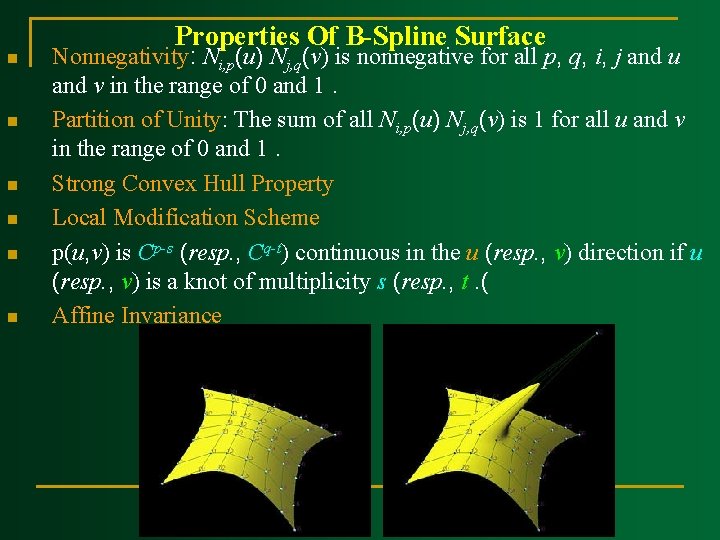
n n n Properties Of B-Spline Surface Nonnegativity: Ni, p(u) Nj, q(v) is nonnegative for all p, q, i, j and u and v in the range of 0 and 1. Partition of Unity: The sum of all Ni, p(u) Nj, q(v) is 1 for all u and v in the range of 0 and 1. Strong Convex Hull Property Local Modification Scheme p(u, v) is Cp-s (resp. , Cq-t) continuous in the u (resp. , v) direction if u (resp. , v) is a knot of multiplicity s (resp. , t. ( Affine Invariance