Chapter 11 Managing Human Resource Systems MGMT 3
- Slides: 65
Chapter 11 Managing Human Resource Systems MGMT 3 Chuck Williams Copyright © 2011 by Cengage Learning. All rights reserved Designed & Prepared by B-books, Ltd.
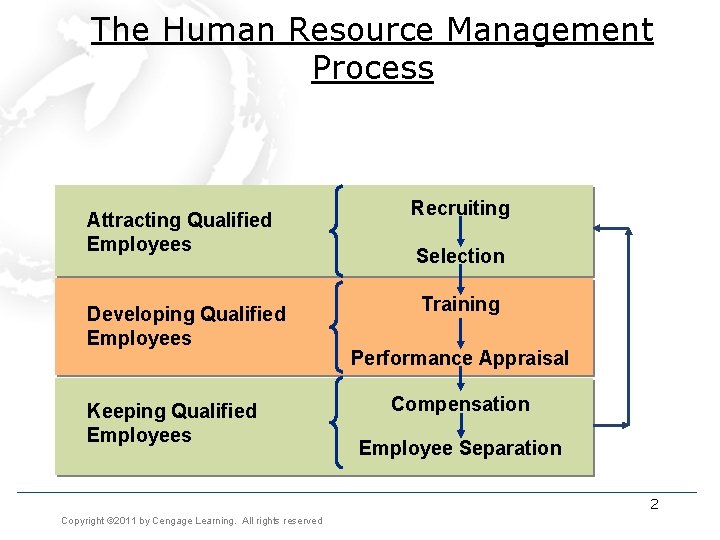
The Human Resource Management Process Attracting Qualified Employees Developing Qualified Employees Keeping Qualified Employees Recruiting Selection Training Performance Appraisal Compensation Employee Separation 2 Copyright © 2011 by Cengage Learning. All rights reserved
Employment Laws After reading this section, you should be able to: 1. explain how different employment laws affect human resource practice. 3 Copyright © 2011 by Cengage Learning. All rights reserved
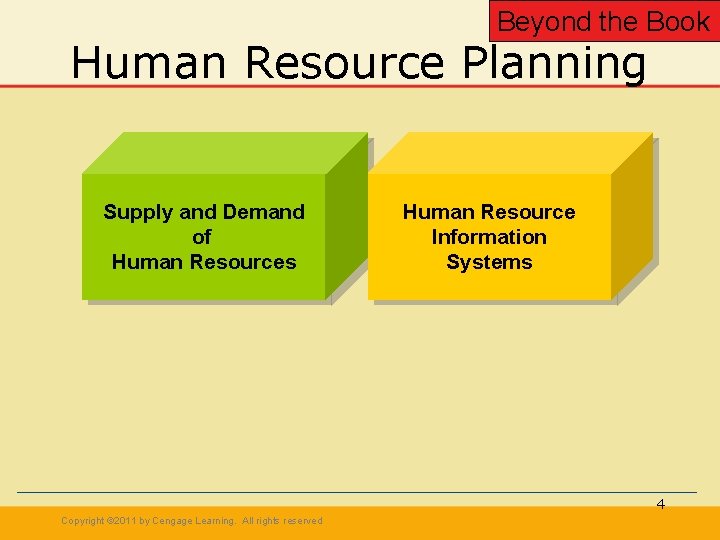
Beyond the Book Human Resource Planning Supply and Demand of Human Resources Human Resource Information Systems 4 Copyright © 2011 by Cengage Learning. All rights reserved
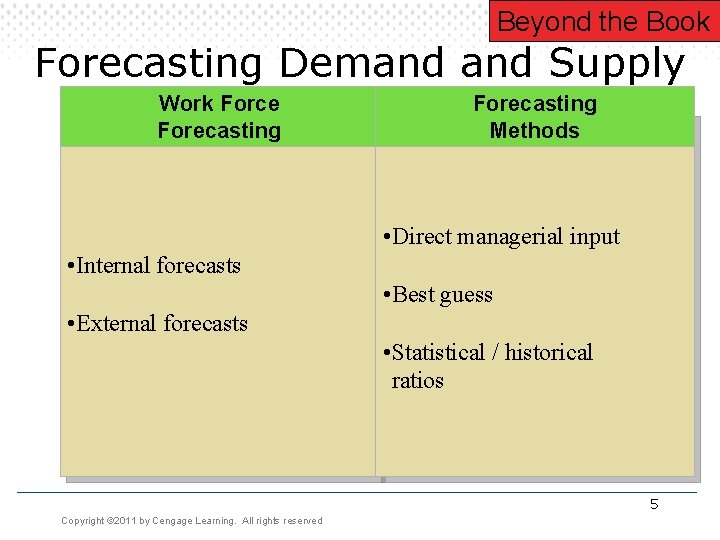
Beyond the Book Forecasting Demand Supply Work Force Forecasting Methods • Direct managerial input • Internal forecasts • Best guess • External forecasts • Statistical / historical ratios 5 Copyright © 2011 by Cengage Learning. All rights reserved
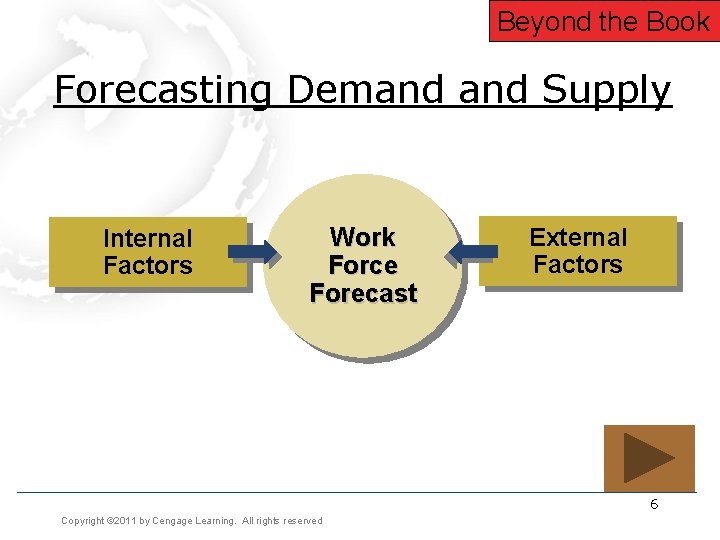
Beyond the Book Forecasting Demand Supply Internal Factors Work Force Forecast External Factors 6 Copyright © 2011 by Cengage Learning. All rights reserved
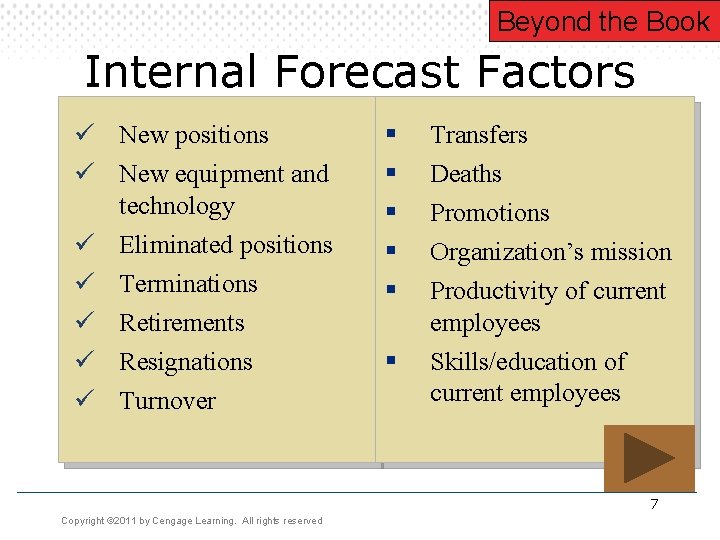
Beyond the Book Internal Forecast Factors ü New positions ü New equipment and technology ü Eliminated positions ü Terminations ü Retirements ü Resignations ü Turnover § § § Transfers Deaths Promotions Organization’s mission Productivity of current employees Skills/education of current employees 7 Copyright © 2011 by Cengage Learning. All rights reserved
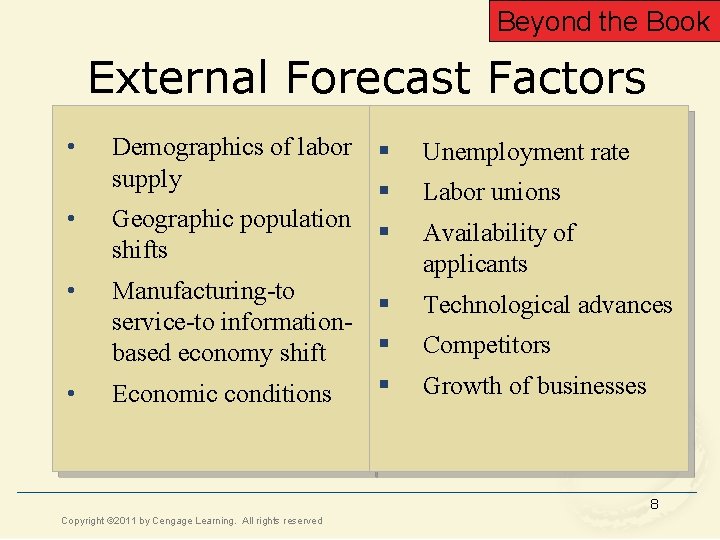
Beyond the Book External Forecast Factors • Demographics of labor supply § Unemployment rate • Geographic population shifts § Labor unions § • Manufacturing-to § service-to information§ based economy shift § Economic conditions Availability of applicants • Technological advances Competitors Growth of businesses 8 Copyright © 2011 by Cengage Learning. All rights reserved
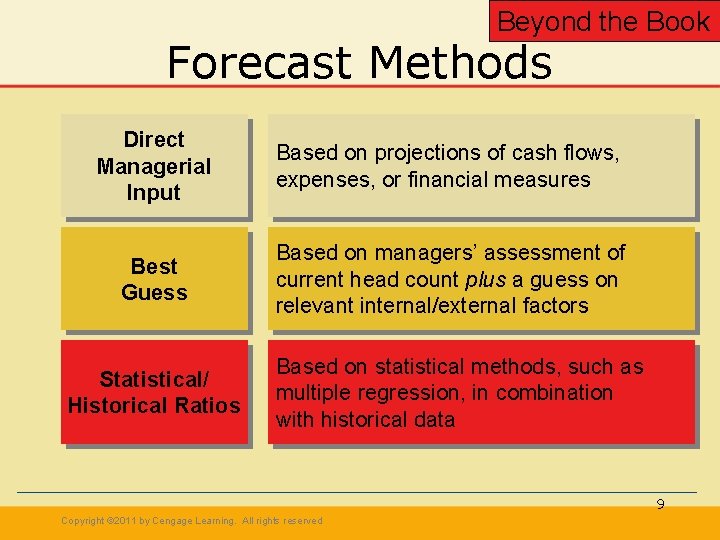
Beyond the Book Forecast Methods Direct Managerial Input Based on projections of cash flows, expenses, or financial measures Best Guess Based on managers’ assessment of current head count plus a guess on relevant internal/external factors Statistical/ Historical Ratios Based on statistical methods, such as multiple regression, in combination with historical data 9 Copyright © 2011 by Cengage Learning. All rights reserved
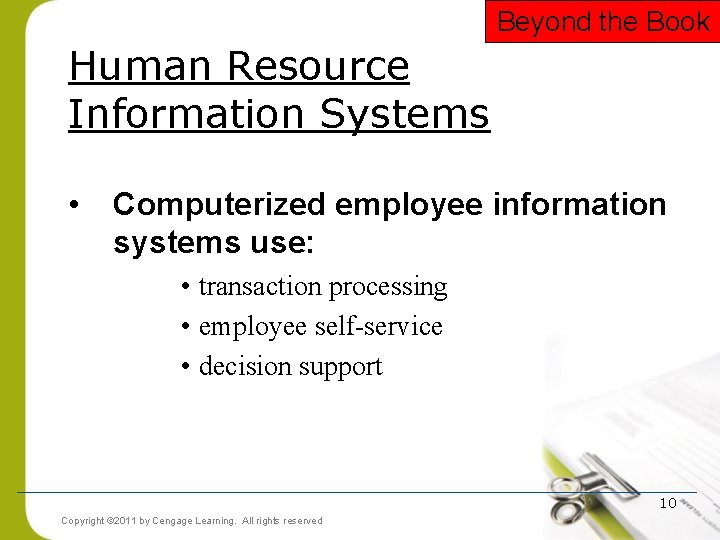
Beyond the Book Human Resource Information Systems • Computerized employee information systems use: • transaction processing • employee self-service • decision support 10 Copyright © 2011 by Cengage Learning. All rights reserved
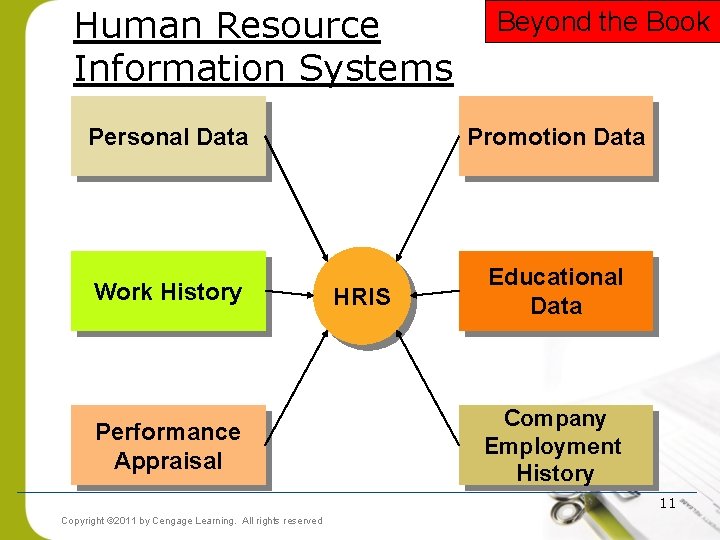
Human Resource Information Systems Beyond the Book Personal Data Promotion Data Work History Educational Data Performance Appraisal HRIS Company Employment History 11 Copyright © 2011 by Cengage Learning. All rights reserved
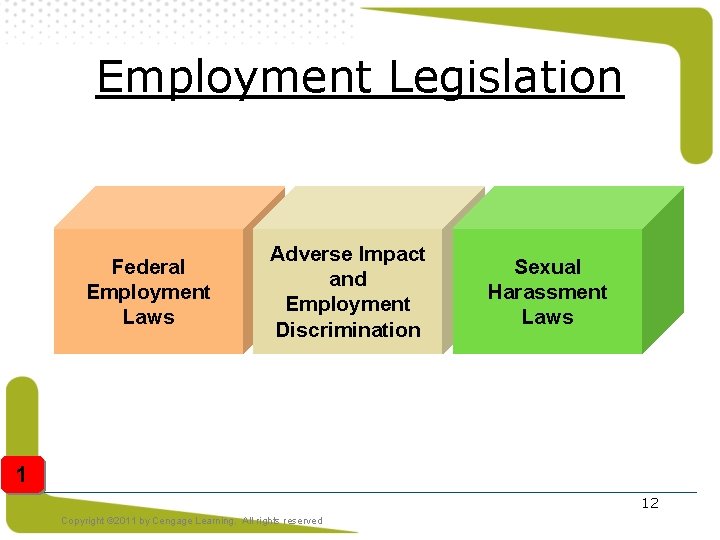
Employment Legislation Federal Employment Laws Adverse Impact and Employment Discrimination Sexual Harassment Laws 1 12 Copyright © 2011 by Cengage Learning. All rights reserved
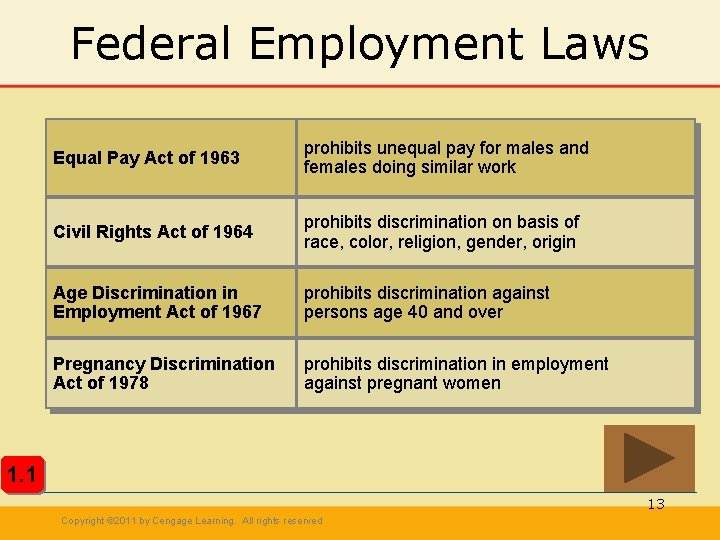
Federal Employment Laws Equal Pay Act of 1963 prohibits unequal pay for males and females doing similar work Civil Rights Act of 1964 prohibits discrimination on basis of race, color, religion, gender, origin Age Discrimination in Employment Act of 1967 prohibits discrimination against persons age 40 and over Pregnancy Discrimination Act of 1978 prohibits discrimination in employment against pregnant women 1. 1 13 Copyright © 2011 by Cengage Learning. All rights reserved
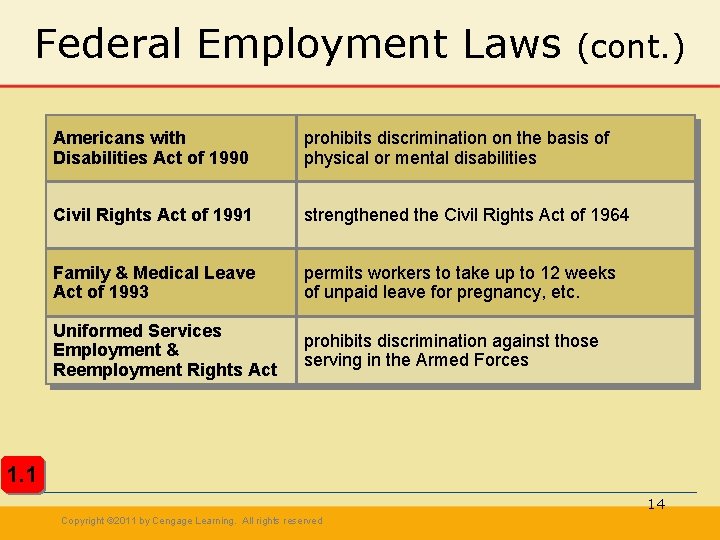
Federal Employment Laws (cont. ) Americans with Disabilities Act of 1990 prohibits discrimination on the basis of physical or mental disabilities Civil Rights Act of 1991 strengthened the Civil Rights Act of 1964 Family & Medical Leave Act of 1993 permits workers to take up to 12 weeks of unpaid leave for pregnancy, etc. Uniformed Services Employment & Reemployment Rights Act prohibits discrimination against those Adapted from Exhibit 11. 2 serving in the Armed Forces 1. 1 14 Copyright © 2011 by Cengage Learning. All rights reserved
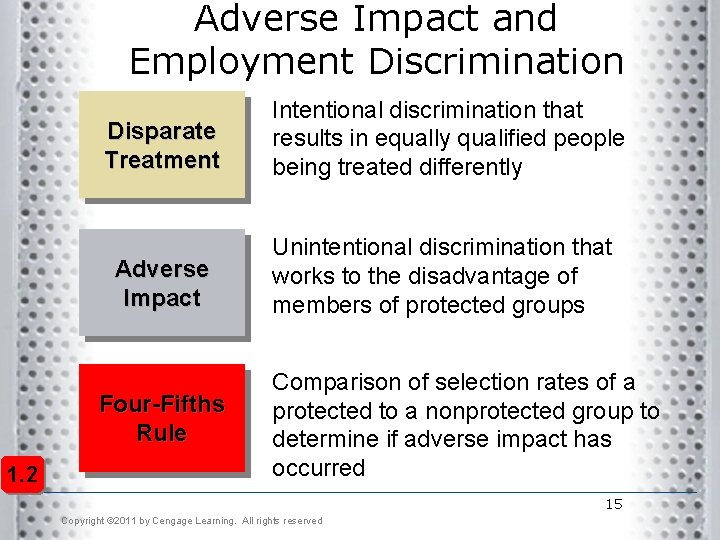
Adverse Impact and Employment Discrimination Disparate Treatment Intentional discrimination that results in equally qualified people being treated differently Adverse Impact Unintentional discrimination that works to the disadvantage of members of protected groups Four-Fifths Rule 1. 2 Comparison of selection rates of a protected to a nonprotected group to determine if adverse impact has occurred 15 Copyright © 2011 by Cengage Learning. All rights reserved
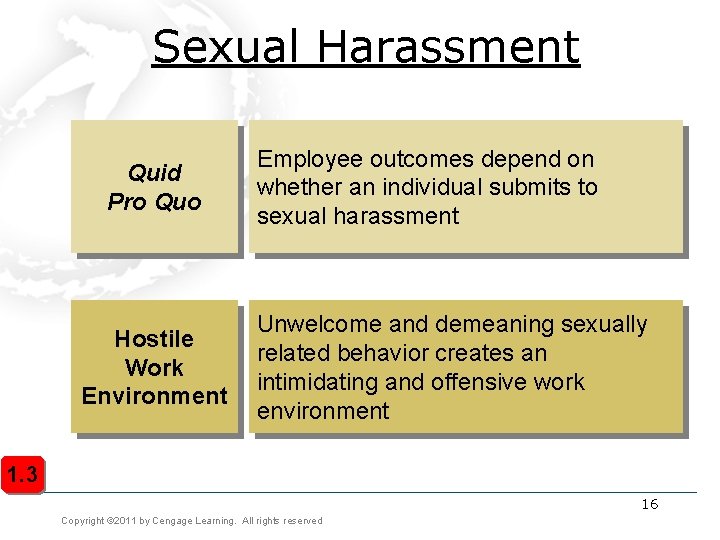
Sexual Harassment Quid Pro Quo Hostile Work Environment Employee outcomes depend on whether an individual submits to sexual harassment Unwelcome and demeaning sexually related behavior creates an intimidating and offensive work environment 1. 3 16 Copyright © 2011 by Cengage Learning. All rights reserved
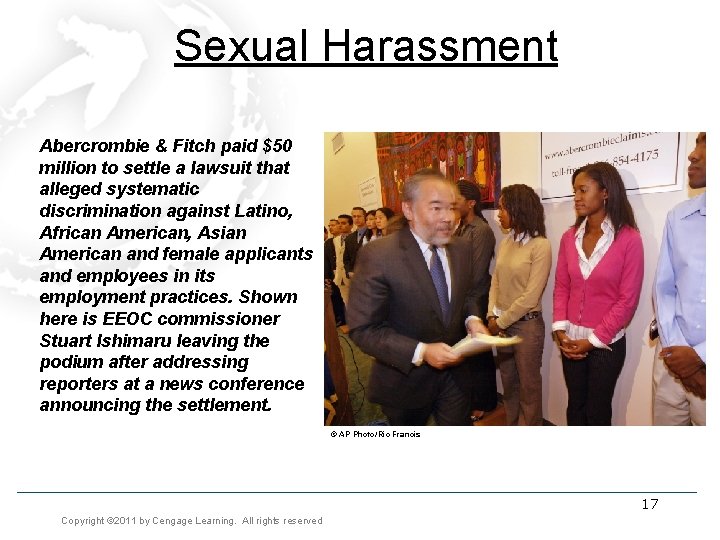
Sexual Harassment Abercrombie & Fitch paid $50 million to settle a lawsuit that alleged systematic discrimination against Latino, African American, Asian American and female applicants and employees in its employment practices. Shown here is EEOC commissioner Stuart Ishimaru leaving the podium after addressing reporters at a news conference announcing the settlement. © AP Photo/Ric Francis 17 Copyright © 2011 by Cengage Learning. All rights reserved
Company Responsibilities ü Respond immediately to make sure sexual harassment laws are followed ü Write a clear, understandable sexual harassment policy ü Establish clear reporting procedures ü Be in compliance with federal, state, and local sexual harassment laws 1. 3 18 Copyright © 2011 by Cengage Learning. All rights reserved
Finding Qualified Workers After reading these sections, you should be able to: 2. explain how companies use recruiting to find qualified job applicants. 3. describe the selection techniques and procedures that companies use when deciding which applicants should receive job offers. 19 Copyright © 2011 by Cengage Learning. All rights reserved
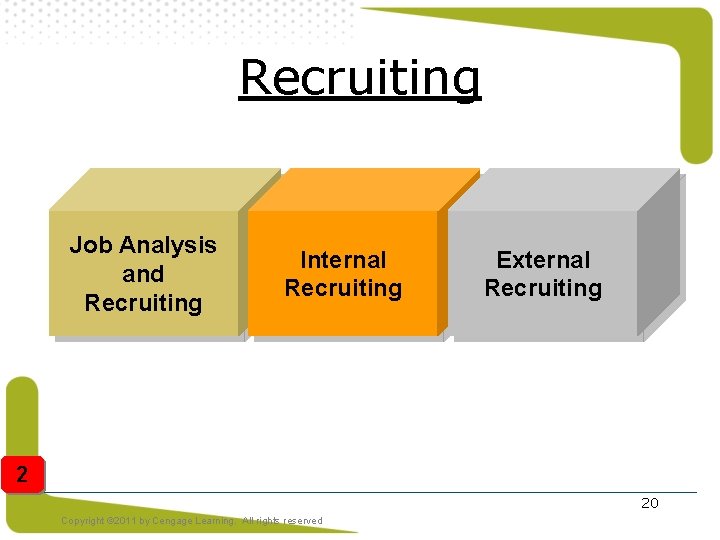
Recruiting Job Analysis and Recruiting Internal Recruiting External Recruiting 2 20 Copyright © 2011 by Cengage Learning. All rights reserved
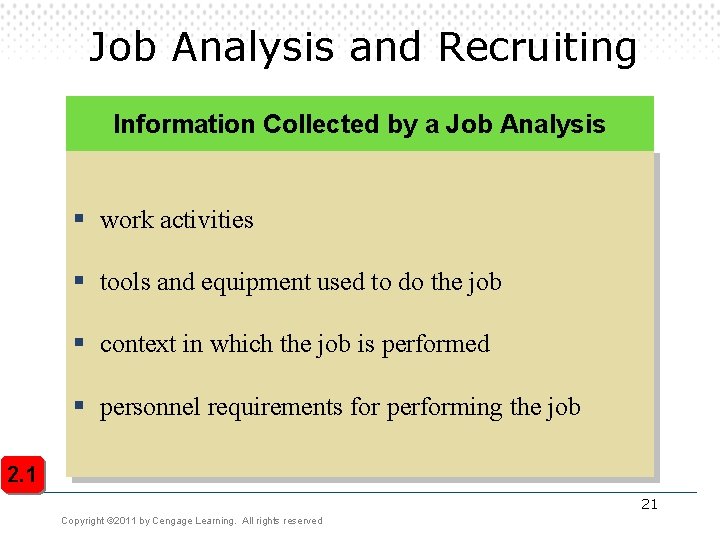
Job Analysis and Recruiting Information Collected by a Job Analysis § work activities § tools and equipment used to do the job § context in which the job is performed § personnel requirements for performing the job 2. 1 21 Copyright © 2011 by Cengage Learning. All rights reserved
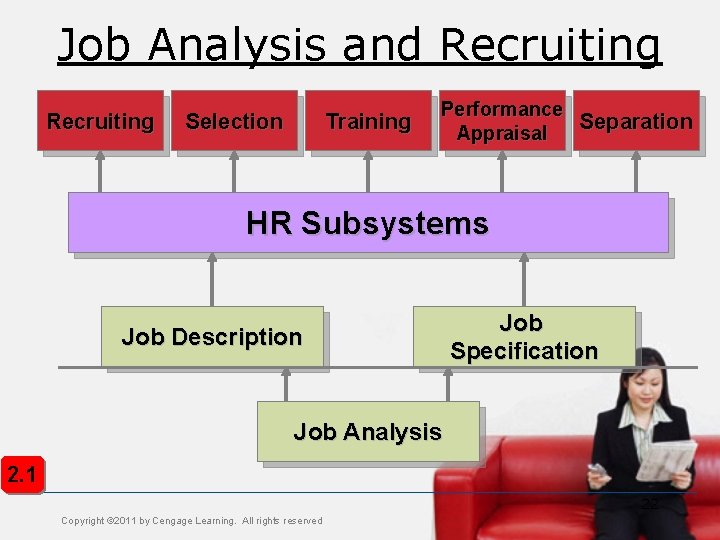
Job Analysis and Recruiting Selection Training Performance Separation Appraisal HR Subsystems Job Description Job Specification Job Analysis 2. 1 22 Copyright © 2011 by Cengage Learning. All rights reserved
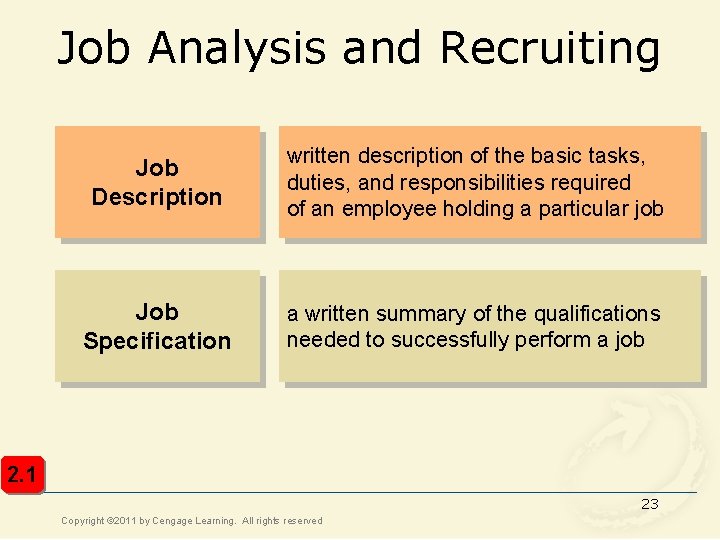
Job Analysis and Recruiting Job Description written description of the basic tasks, duties, and responsibilities required of an employee holding a particular job Job Specification a written summary of the qualifications needed to successfully perform a job 2. 1 23 Copyright © 2011 by Cengage Learning. All rights reserved
Internal Recruiting 2. 2 • A pool of applicants who already work for the company • “Promotion from within” • Improves employee morale and motivation • Reduces employer time and cost • Job posting is the procedure for internal advertising • Career path is a planned sequence of jobs 24 Copyright © 2011 by Cengage Learning. All rights reserved
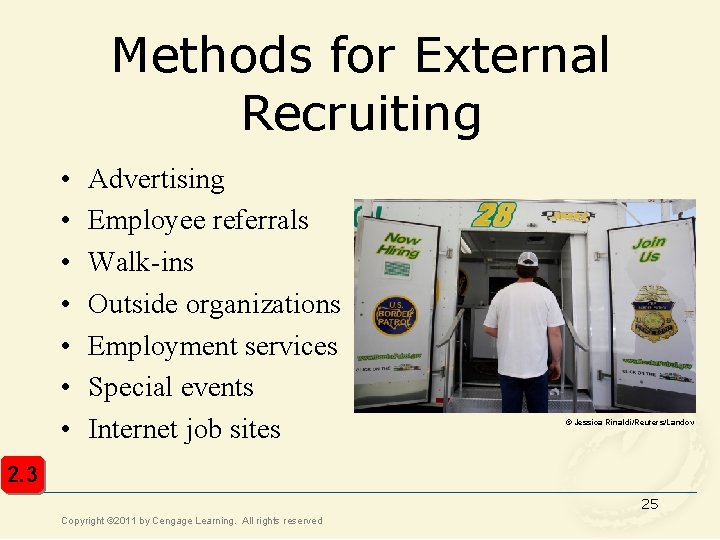
Methods for External Recruiting • • Advertising Employee referrals Walk-ins Outside organizations Employment services Special events Internet job sites © Jessica Rinaldi/Reuters/Landov 2. 3 25 Copyright © 2011 by Cengage Learning. All rights reserved
Company Websites: The New Job Board Beyond the Book Many companies are focusing on their own websites, rather than traditional job boards, when searching for prospective employees. This can save the company the cost of advertising on other sites, and on average they are finding the applicants that come through the company web site better qualified. They are also focusing on social media sites like Linked. In and Facebook. For job seekers, this means expanding their efforts to include every possible resource available. Source: J. De Avila, “Beyond Job Boards: Targeting the Source”, The Wall Street Journal, 2 July 2009. D 1. 26 Copyright © 2011 by Cengage Learning. All rights reserved
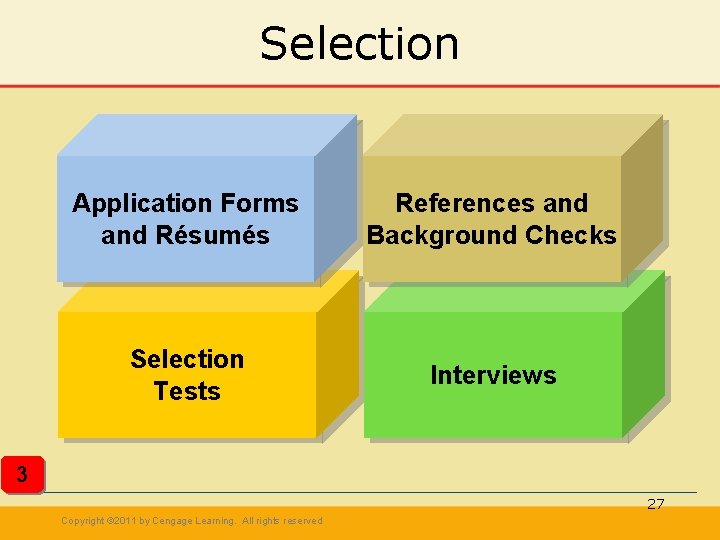
Selection Application Forms and Résumés References and Background Checks Selection Tests Interviews 3 27 Copyright © 2011 by Cengage Learning. All rights reserved
Topics Employers Should Avoid 1. Children 2. Age 3. Disabilities 4. Physical Characteristics 5. Name 7. Lawsuits 8. Arrest records 9. Smoking 3. 1 10. AIDS/HIV © SERDAR YAGCI/i. Stockphoto. com 6. Citizenship 28 Copyright © 2011 by Cengage Learning. All rights reserved
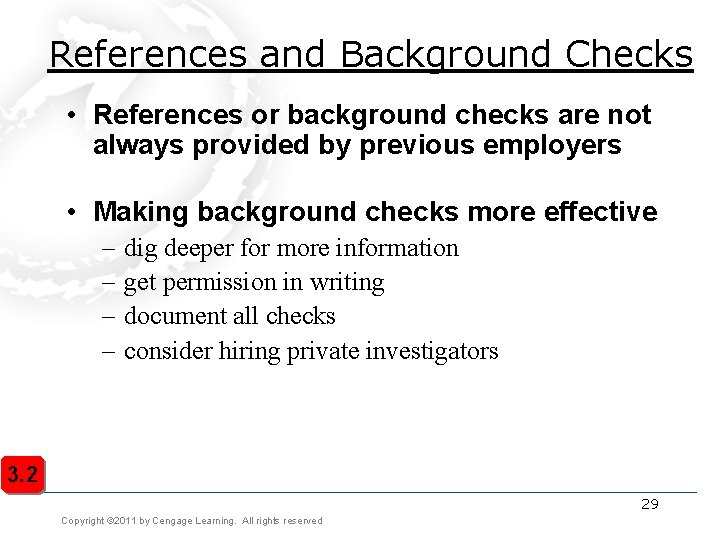
References and Background Checks • References or background checks are not always provided by previous employers • Making background checks more effective – – dig deeper for more information get permission in writing document all checks consider hiring private investigators 3. 2 29 Copyright © 2011 by Cengage Learning. All rights reserved
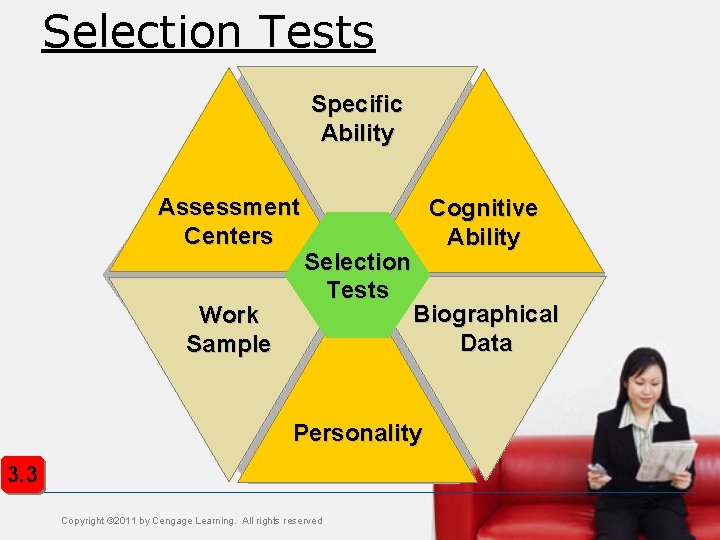
Selection Tests Specific Ability Assessment Centers Work Sample Selection Tests Cognitive Ability Biographical Data Personality 3. 3 30 Copyright © 2011 by Cengage Learning. All rights reserved
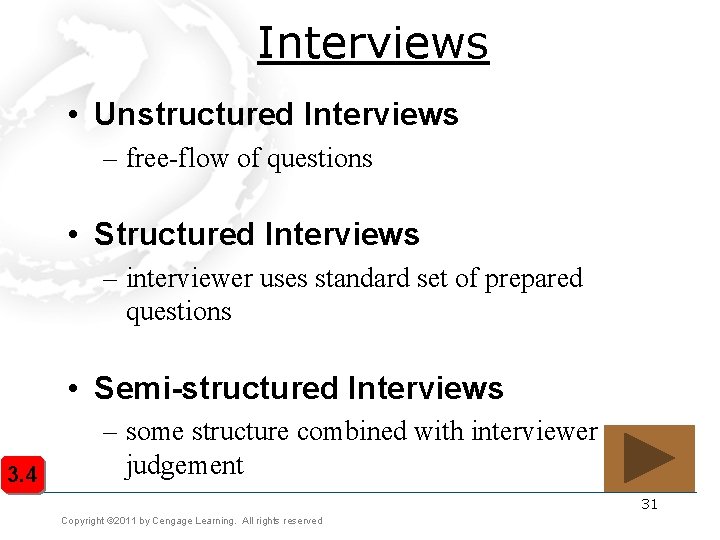
Interviews • Unstructured Interviews – free-flow of questions • Structured Interviews – interviewer uses standard set of prepared questions • Semi-structured Interviews 3. 4 – some structure combined with interviewer judgement 31 Copyright © 2011 by Cengage Learning. All rights reserved
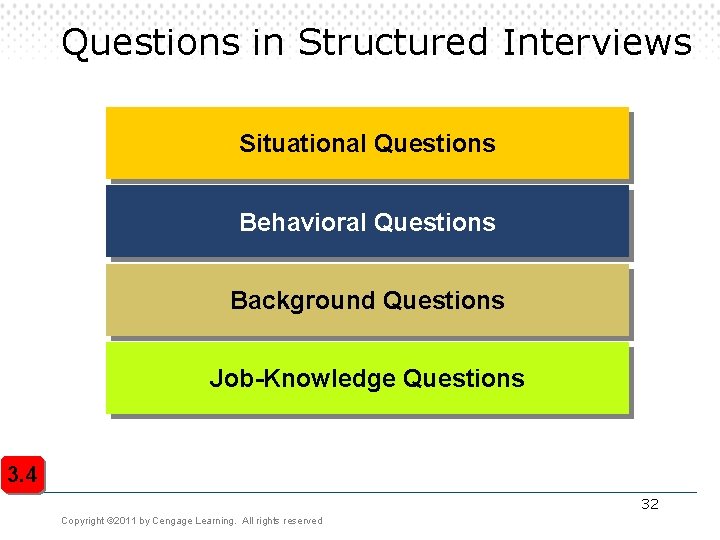
Questions in Structured Interviews Situational Questions Behavioral Questions Background Questions Job-Knowledge Questions 3. 4 32 Copyright © 2011 by Cengage Learning. All rights reserved
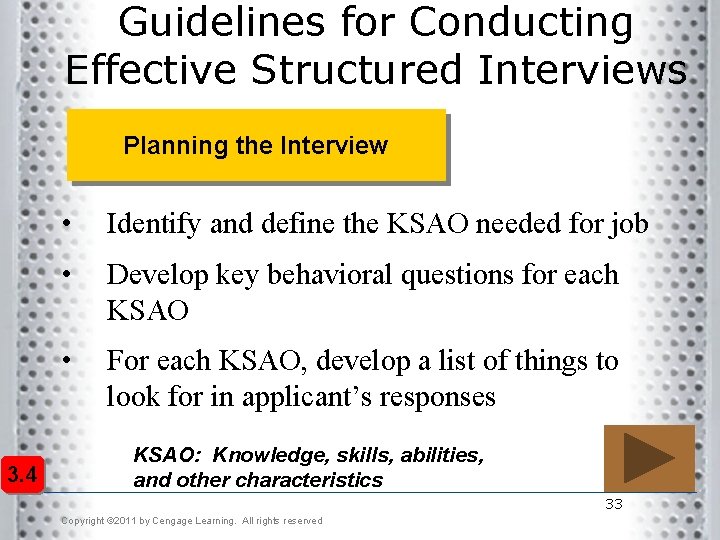
Guidelines for Conducting Effective Structured Interviews Planning the Interview 3. 4 • Identify and define the KSAO needed for job • Develop key behavioral questions for each KSAO • For each KSAO, develop a list of things to look for in applicant’s responses KSAO: Knowledge, skills, abilities, and other characteristics 33 Copyright © 2011 by Cengage Learning. All rights reserved
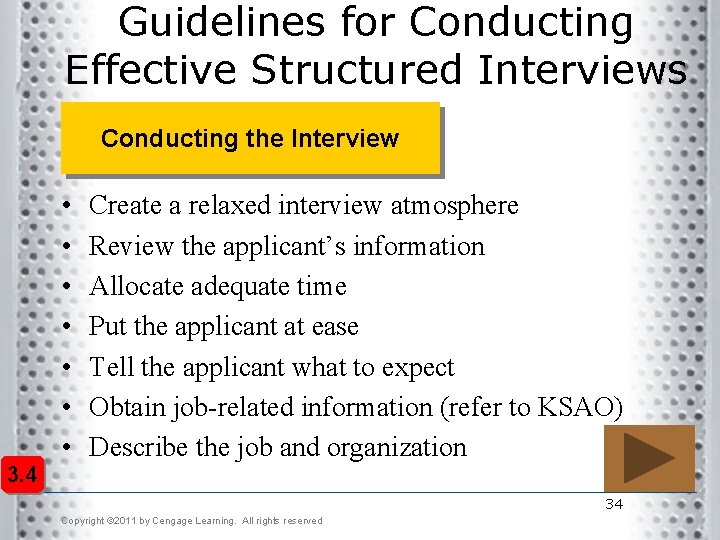
Guidelines for Conducting Effective Structured Interviews Conducting the Interview 3. 4 • • Create a relaxed interview atmosphere Review the applicant’s information Allocate adequate time Put the applicant at ease Tell the applicant what to expect Obtain job-related information (refer to KSAO) Describe the job and organization 34 Copyright © 2011 by Cengage Learning. All rights reserved
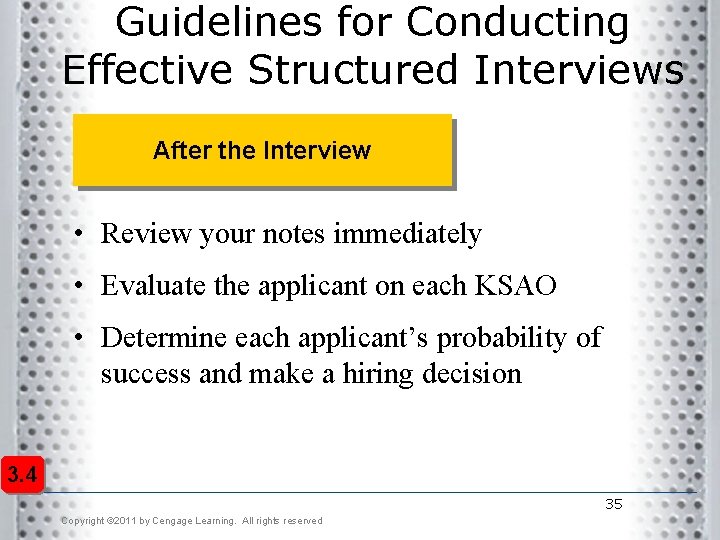
Guidelines for Conducting Effective Structured Interviews After the Interview • Review your notes immediately • Evaluate the applicant on each KSAO • Determine each applicant’s probability of success and make a hiring decision 3. 4 35 Copyright © 2011 by Cengage Learning. All rights reserved
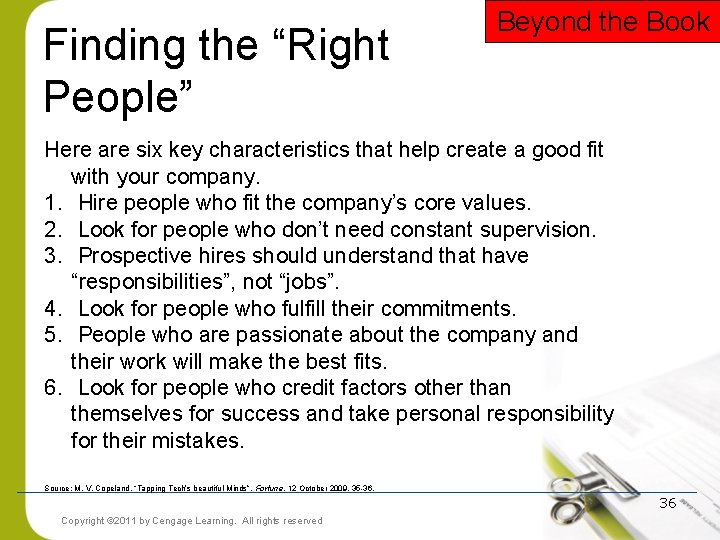
Finding the “Right People” Beyond the Book Here are six key characteristics that help create a good fit with your company. 1. Hire people who fit the company’s core values. 2. Look for people who don’t need constant supervision. 3. Prospective hires should understand that have “responsibilities”, not “jobs”. 4. Look for people who fulfill their commitments. 5. People who are passionate about the company and their work will make the best fits. 6. Look for people who credit factors other than themselves for success and take personal responsibility for their mistakes. Source: M. V. Copeland, “Tapping Tech’s beautiful Minds”, Fortune, 12 October 2009. 35 -36. 36 Copyright © 2011 by Cengage Learning. All rights reserved
Developing Qualified Workers After reading these sections, you should be able to: 4. describe how to determine training needs and select the appropriate training methods. 5. discuss how to use performance appraisal to give meaningful performance feedback. 37 Copyright © 2011 by Cengage Learning. All rights reserved
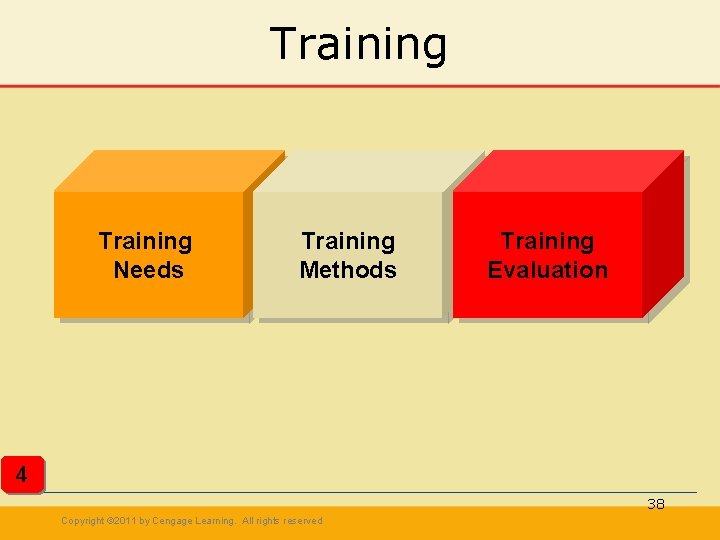
Training Needs Training Methods Training Evaluation 4 38 Copyright © 2011 by Cengage Learning. All rights reserved
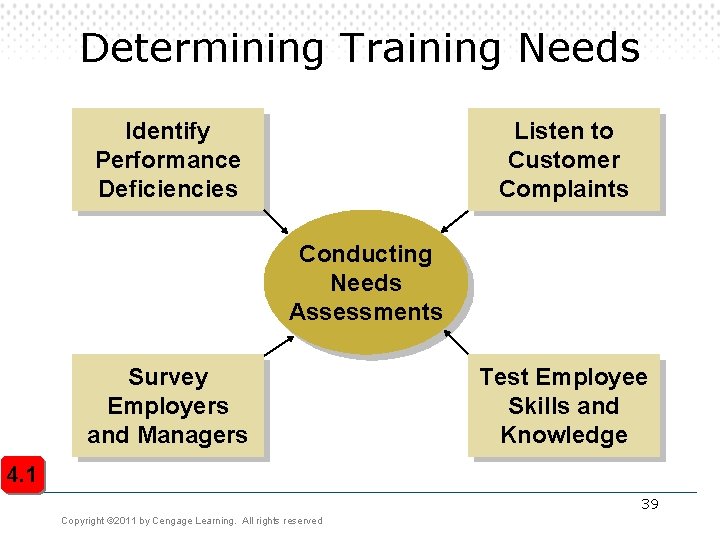
Determining Training Needs Identify Performance Deficiencies Listen to Customer Complaints Conducting Needs Assessments Survey Employers and Managers Test Employee Skills and Knowledge 4. 1 39 Copyright © 2011 by Cengage Learning. All rights reserved
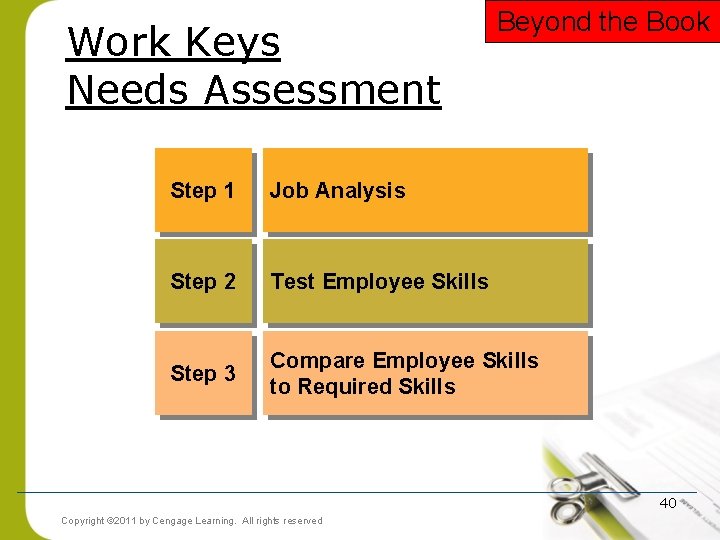
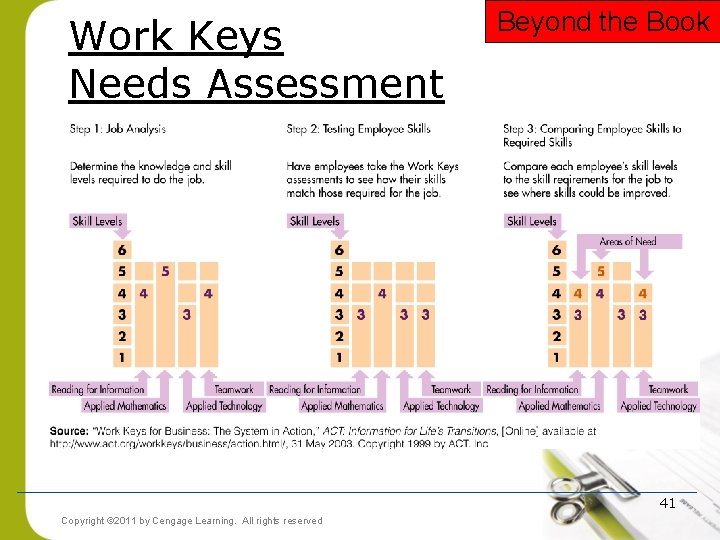
Work Keys Needs Assessment Beyond the Book Step 1 Job Analysis Step 2 Test Employee Skills Step 3 Compare Employee Skills to Required Skills 40 Copyright © 2011 by Cengage Learning. All rights reserved
Work Keys Needs Assessment Beyond the Book 41 Copyright © 2011 by Cengage Learning. All rights reserved
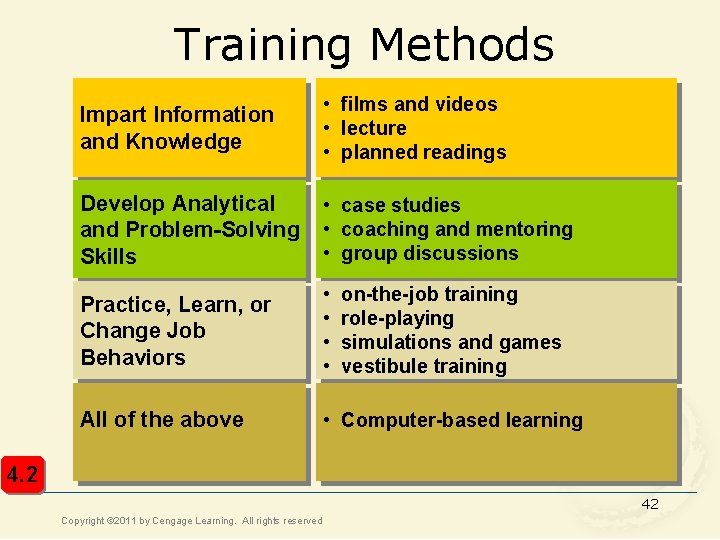
Training Methods Impart Information and Knowledge • films and videos • lecture • planned readings Develop Analytical and Problem-Solving Skills • case studies • coaching and mentoring • group discussions Practice, Learn, or Change Job Behaviors • • All of the above • Computer-based learning on-the-job training role-playing simulations and games vestibule training 4. 2 42 Copyright © 2011 by Cengage Learning. All rights reserved
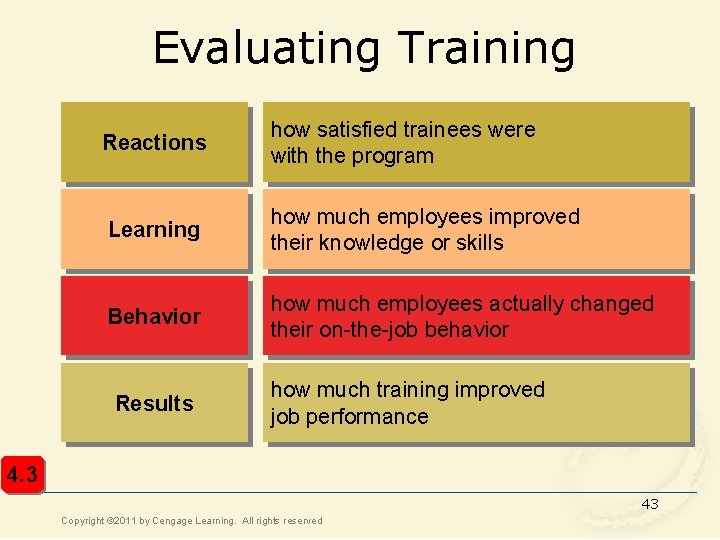
Evaluating Training Reactions how satisfied trainees were with the program Learning how much employees improved their knowledge or skills Behavior how much employees actually changed their on-the-job behavior Results how much training improved job performance 4. 3 43 Copyright © 2011 by Cengage Learning. All rights reserved
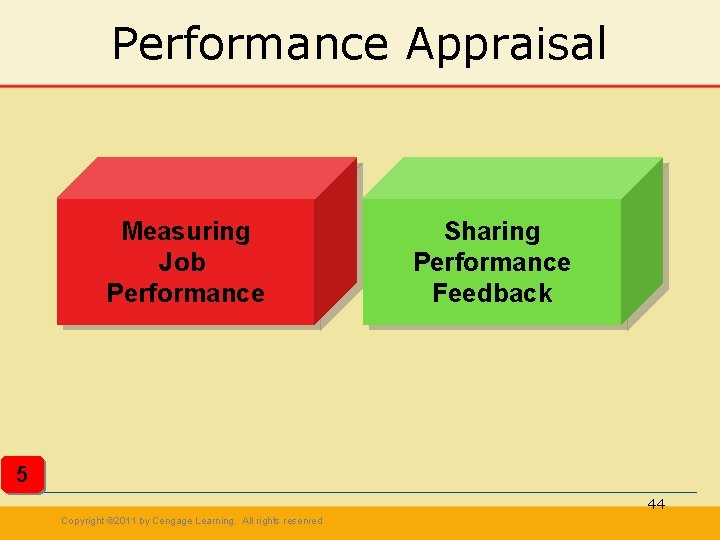
Performance Appraisal Measuring Job Performance Sharing Performance Feedback 5 44 Copyright © 2011 by Cengage Learning. All rights reserved
Measuring Job Performance: Common Rating Errors • Central tendency – all workers are rated as being average • Halo error – all workers are rated as performing at the same level in all parts of their jobs • Leniency error – all workers are rated as performing at a high level 5. 1 45 Copyright © 2011 by Cengage Learning. All rights reserved
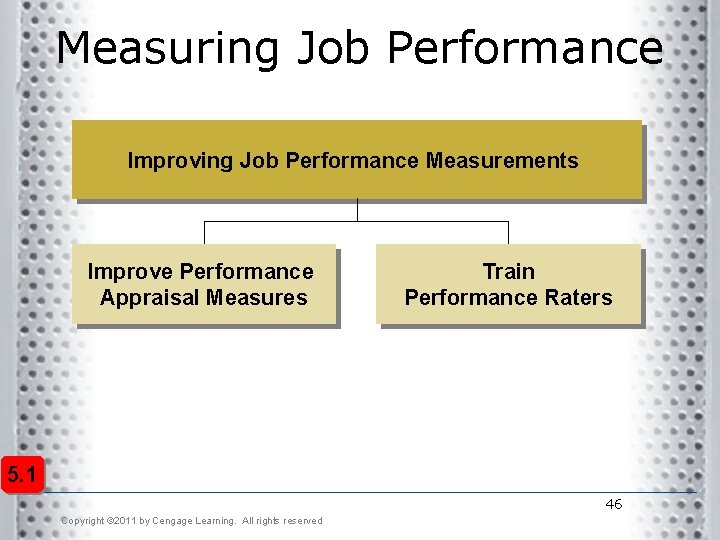
Measuring Job Performance Improving Job Performance Measurements Improve Performance Appraisal Measures Train Performance Raters 5. 1 46 Copyright © 2011 by Cengage Learning. All rights reserved
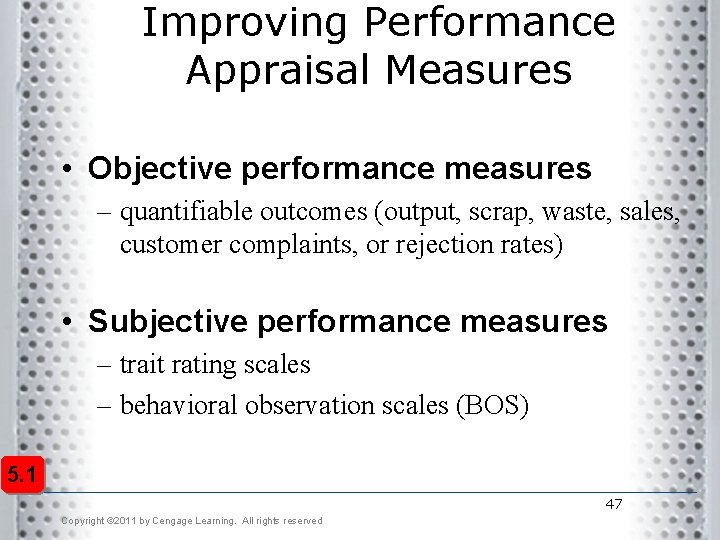
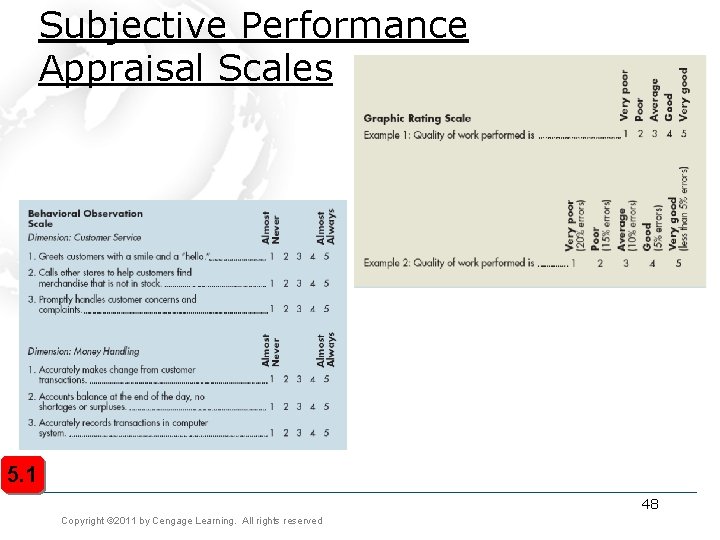
Improving Performance Appraisal Measures • Objective performance measures – quantifiable outcomes (output, scrap, waste, sales, customer complaints, or rejection rates) • Subjective performance measures – trait rating scales – behavioral observation scales (BOS) 5. 1 47 Copyright © 2011 by Cengage Learning. All rights reserved
Subjective Performance Appraisal Scales 5. 1 48 Copyright © 2011 by Cengage Learning. All rights reserved
Rater Training • Teach raters how to avoid errors • Improve rating accuracy • Video training and role playing often used 5. 1 49 Copyright © 2011 by Cengage Learning. All rights reserved
Sharing Performance Feedback • Managers often fail to effectively give employees performance feedback • 360 -degree feedback – boss, subordinates, peers, and the employee – best for employee development 5. 2 50 Copyright © 2011 by Cengage Learning. All rights reserved
Performance Feedback Recommendations for Sharing Performance Feedback 1. Separate developmental feedback from administrative feedback 2. Base performance appraisal feedback sessions on self-appraisals 3. Have people discuss the feedback they received with executive coaches or the people who provided it 5. 2 51 Copyright © 2011 by Cengage Learning. All rights reserved
Performance Feedback What to Discuss in Performance Appraisal Feedback Sessions • Overall progress • Problems encountered in meeting job requirements • Opportunities to improve performance • Long-range plans and opportunities • General discussion of possible plans and goals for the coming year 5. 2 52 Copyright © 2011 by Cengage Learning. All rights reserved
Keeping Qualified Workers After reading this section, you should be able to: 6. describe basic compensation strategies and discuss the four kinds of employee separations. 53 Copyright © 2011 by Cengage Learning. All rights reserved
Compensation Decisions Employment Benefits 6 54 Copyright © 2011 by Cengage Learning. All rights reserved
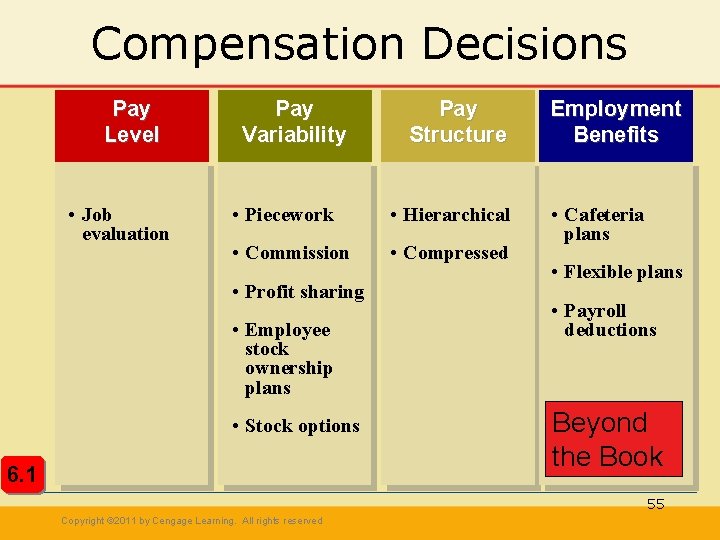
Compensation Decisions Pay Level • Job evaluation Pay Variability Pay Structure • Piecework • Hierarchical • Commission • Compressed • Profit sharing • Employee stock ownership plans • Stock options 6. 1 Employment Benefits • Cafeteria plans • Flexible plans • Payroll deductions Beyond the Book 55 Copyright © 2011 by Cengage Learning. All rights reserved
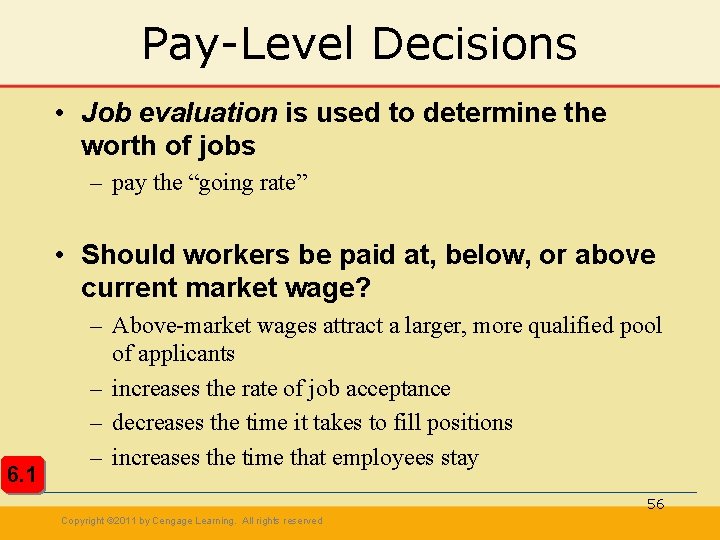
Pay-Level Decisions • Job evaluation is used to determine the worth of jobs – pay the “going rate” • Should workers be paid at, below, or above current market wage? 6. 1 – Above-market wages attract a larger, more qualified pool of applicants – increases the rate of job acceptance – decreases the time it takes to fill positions – increases the time that employees stay 56 Copyright © 2011 by Cengage Learning. All rights reserved
Pay Raises in the Recession Beyond the Book • Since the end of 2007, pay raises have been among the many cutbacks companies are making to get through the downturn. • The U. S. Labor Department reported that average pay had increased 2. 2% at the end of March 2009, down a full percentage point from a year earlier. • Analysts, however, estimate that top performing employees received on average 4% raises, compared to 0. 2% for lowest-ranking employees. Source: M. Sanserino, “Pay Raises Are the Smallest In Decades, Surveys Show”, The Wall Street Journal, 21 July 2009. D 1. 57 Copyright © 2011 by Cengage Learning. All rights reserved
Pay-Variability Decisions • • Piecework Commission Profit sharing Employee stock ownership plans (ESOPs) • Stock options 6. 1 58 Copyright © 2011 by Cengage Learning. All rights reserved
Pay-Structure Decisions § Hierarchical pay structures § big differences from one pay level to another § work best for independent work § Compressed pay structures § fewer pay levels with smaller differences in pay between pay levels § work best for interdependent work 6. 1 59 Copyright © 2011 by Cengage Learning. All rights reserved
Beyond the Book Employment Benefits • Compensation other than direct wages • Employee benefits are legally mandated: – Social Security – worker’s compensation – unemployment insurance • Cafeteria benefit plans – employees can select from optional benefits • Payroll deductions 60 Copyright © 2011 by Cengage Learning. All rights reserved
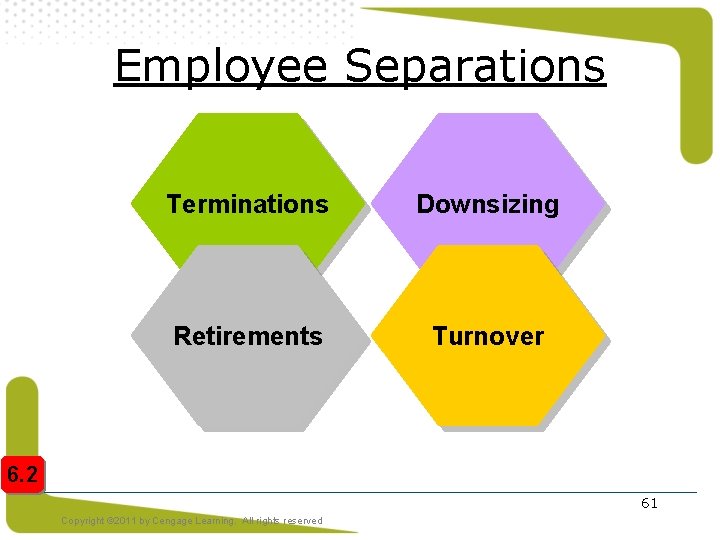
Employee Separations Terminations Downsizing Retirements Turnover 6. 2 61 Copyright © 2011 by Cengage Learning. All rights reserved
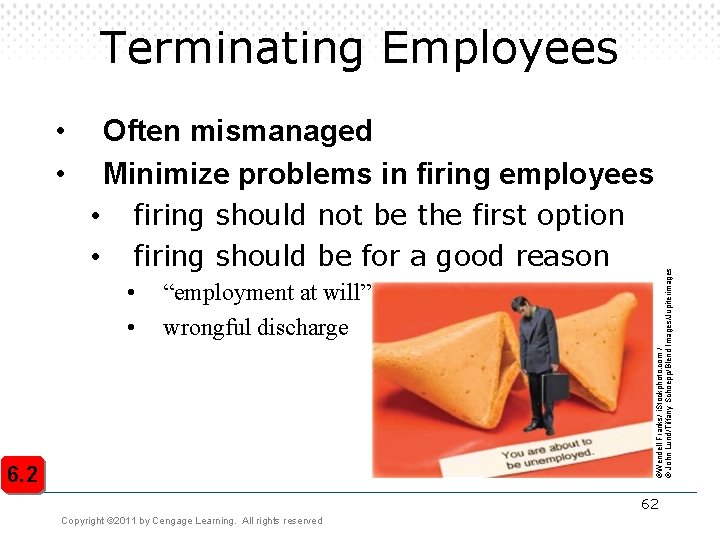
Terminating Employees • • firing should not be the first option firing should be for a good reason • • “employment at will” wrongful discharge 6. 2 ©Wendell Franks/ i. Stockphoto. com / © John Lund/Tiffany Schoepp/Blend Images/Jupiterimages Often mismanaged Minimize problems in firing employees 62 Copyright © 2011 by Cengage Learning. All rights reserved
Downsizing 1. Provide clear reasons for the layoffs. 2. Get information to avoid laying off employees with critical skills. 3. Train managers how to tell employees. 4. Give employees the bad news early in the day. 5. Provide outplacement services and counseling. 6. Communicate with survivors. 6. 3 63 Copyright © 2011 by Cengage Learning. All rights reserved
Retirement Early Retirement Incentive Programs… • offer financial benefits to encourage employees to retire. • are attractive to many employees. • are difficult to predict which or how many employees will use the program. • may cause the company to lose valuable employees. 6. 4 64 Copyright © 2011 by Cengage Learning. All rights reserved
Employee Turnover ü Loss of employees who voluntarily choose to leave the company ü Functional turnover (encouraged) • the loss of poor-performing employees ü Dysfunctional turnover (discouraged) • the loss of high performing employees 6. 5 65 Copyright © 2011 by Cengage Learning. All rights reserved