
Models for Human Resource Value Accounting Models for
- Slides: 7
Models for Human Resource Value Accounting
Models for Human Resource Value Accounting �Lev and Schwartz Model �Flamholtz Model �Hermanson’s Model
Lev and Schwartz Model �This model determines the value of human capital embodied in a person at a particular time �It is the present value of his remaining future earnings from employment in the form of direct & indirect payments & benefits
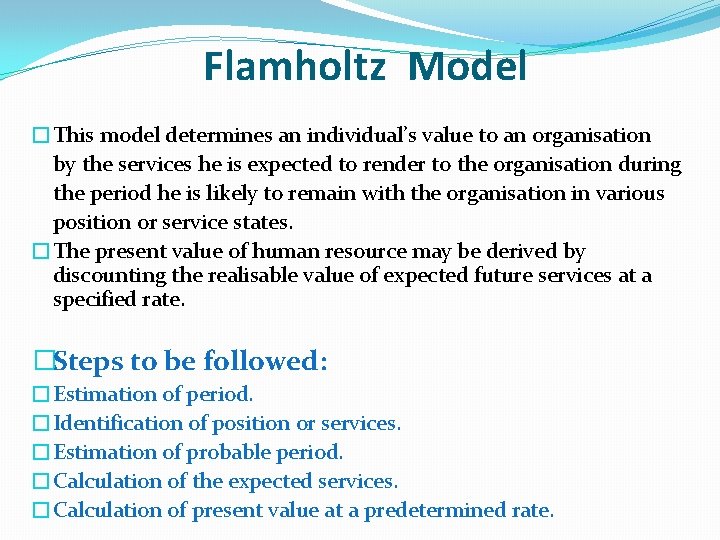
Flamholtz Model �This model determines an individual’s value to an organisation by the services he is expected to render to the organisation during the period he is likely to remain with the organisation in various position or service states. �The present value of human resource may be derived by discounting the realisable value of expected future services at a specified rate. �Steps to be followed: �Estimation of period. �Identification of position or services. �Estimation of probable period. �Calculation of the expected services. �Calculation of present value at a predetermined rate.
Hermanson’s Model Roger H. Hermanson has suggested two models for the measurement of human resources: �Unpurchased Goodwill Model �Adjusted Discounted Future Wage Model
Hermanson’s Unpurchased Goodwill Model �The value of HR is calculated by capitalising earnings in excess of normal earnings for the industry or the group of companies of which the firm is a part.
Hermanson’s Adjusted Discounted Future Wage Model �This model uses compensation as a surrogate measure of a person’s value to the firm. �Compensation means the present value of future stream of wages and salaries to employees of the firm. �The discounted future wage stream is adjusted by an “efficiency ratio” which is the weighted average of the ratio of return on investment of the given firm to all the firms in the economy for a specified period, usually five years. �The weights are assigned in the reverse order, i. e. 5 to the current year and 4 to next year and so on