
Managing Human Resources Bohlander Snell Sherman Chapter 7
Managing Human Resources Bohlander Snell Sherman Chapter 7 Career Development Managing Human Resources, 12 e, by Bohlander/Snell/Sherman © 2001 South-Western/Thomson Learning 1
Chapter 7 Learning Objectives Explain how a career development program integrates individual and organizational needs. Describe the conditions that help to make a career development program successful. Discuss how job opportunities can be inventoried and employee potential assessed. Describe the methods used for identifying and developing managerial talent. Managing Human Resources, 12 e, by Bohlander/Snell/Sherman © 2001 South-Western/Thomson Learning 2
Learning Objectives, cont. Cite the ways in which employers can facilitate the career development of women. Cite the ways in which employers can facilitate the career development of members of minority groups and of dual-career couples. Describe the various aspects of personal career development that one should consider. Managing Human Resources, 12 e, by Bohlander/Snell/Sherman © 2001 South-Western/Thomson Learning 3
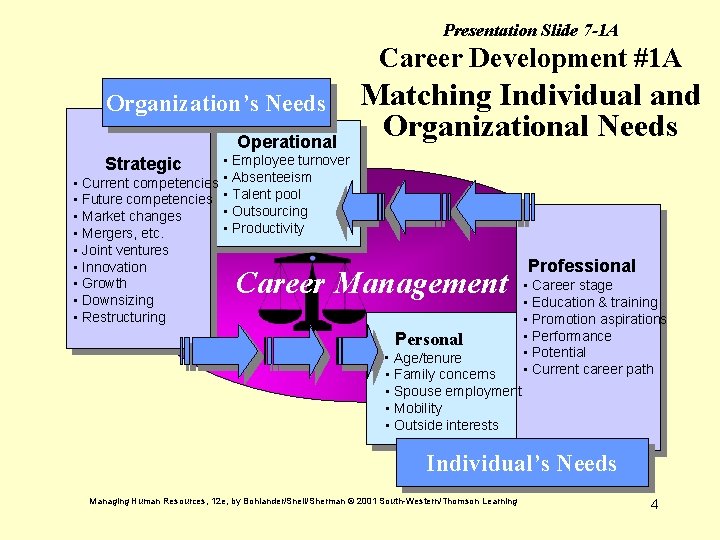
Presentation Slide 7 -1 A Career Development #1 A Organization’s Needs Operational Matching Individual and Organizational Needs • Employee turnover • Current competencies • Absenteeism • Future competencies • Talent pool • Outsourcing • Market changes • Productivity • Mergers, etc. Strategic • Joint ventures • Innovation • Growth • Downsizing • Restructuring Career Management Personal • Age/tenure • Family concerns • Spouse employment • Mobility • Outside interests Professional • Career stage • Education & training • Promotion aspirations • Performance • Potential • Current career path Individual’s Needs Managing Human Resources, 12 e, by Bohlander/Snell/Sherman © 2001 South-Western/Thomson Learning 4
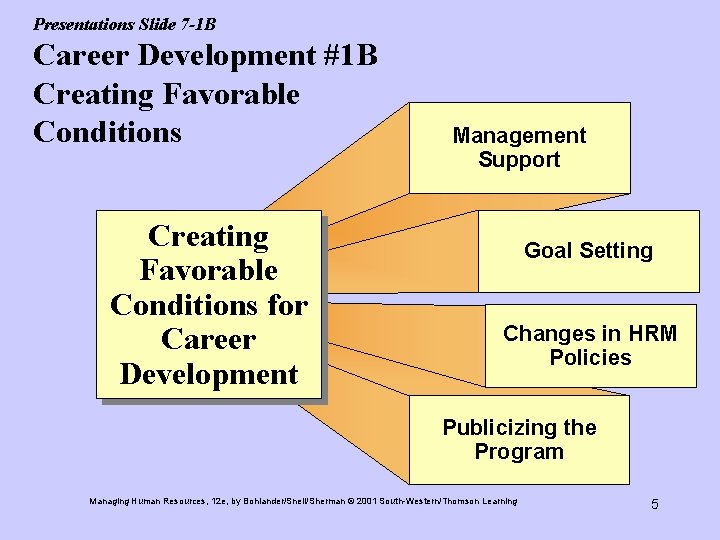
Presentations Slide 7 -1 B Career Development #1 B Creating Favorable Conditions for Career Development Management Support Goal Setting Changes in HRM Policies Publicizing the Program Managing Human Resources, 12 e, by Bohlander/Snell/Sherman © 2001 South-Western/Thomson Learning 5
Presentation Slide 7 -1 C Career Development #1 C Creating Favorable Conditions Management Participation u. Provide top management support u. Provide collaboration between line managers and HR managers u. Train management personnel Setting Goals u. Plan human resources strategy Changing HR Policies u. Provide for job rotation u. Provide outplacement service Announcing the Program u. Explain its philosophy Managing Human Resources, 12 e, by Bohlander/Snell/Sherman © 2001 South-Western/Thomson Learning 6
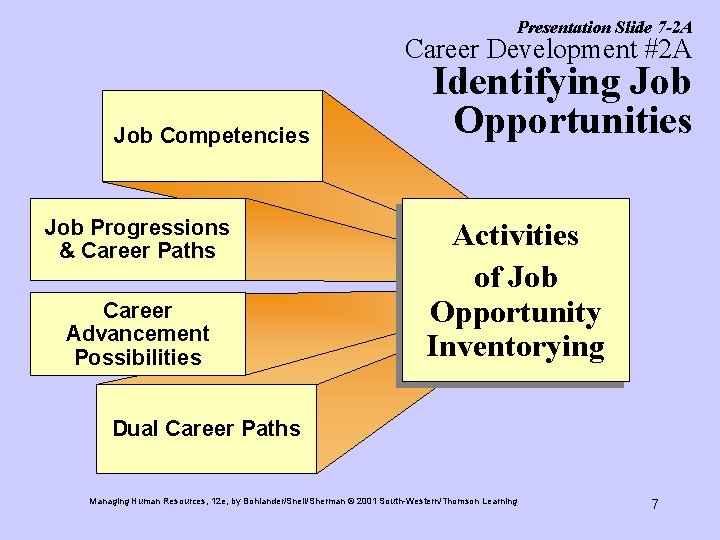
Presentation Slide 7 -2 A Career Development #2 A Job Competencies Job Progressions & Career Paths Career Advancement Possibilities Identifying Job Opportunities Activities of Job Opportunity Inventorying Dual Career Paths Managing Human Resources, 12 e, by Bohlander/Snell/Sherman © 2001 South-Western/Thomson Learning 7
Job Progressions Hierarchy of jobs a new employee might experience, ranging from a starting job to jobs that successively require more knowledge and/or skill Managing Human Resources, 12 e, by Bohlander/Snell/Sherman © 2001 South-Western/Thomson Learning 8
Career Paths Lines of advancement in an occupational field within an organization Managing Human Resources, 12 e, by Bohlander/Snell/Sherman © 2001 South-Western/Thomson Learning 9
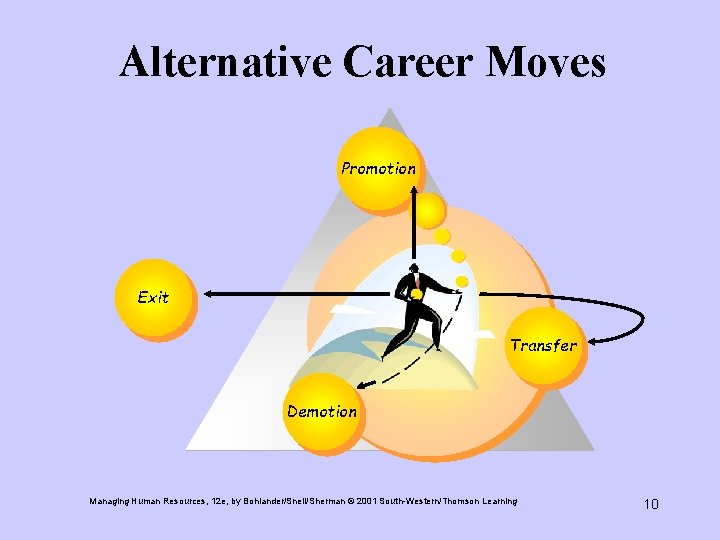
Alternative Career Moves Promotion Exit Transfer Demotion Managing Human Resources, 12 e, by Bohlander/Snell/Sherman © 2001 South-Western/Thomson Learning 10
Promotion Change of assignment to a job at a higher level in the organization Managing Human Resources, 12 e, by Bohlander/Snell/Sherman © 2001 South-Western/Thomson Learning 11
Transfer Placement of an individual in another job for which the duties, responsibilities, status, and remuneration are approximately equal to those of the previous job Managing Human Resources, 12 e, by Bohlander/Snell/Sherman © 2001 South-Western/Thomson Learning 12
Relocation Services provided to an employee who is transferred to a new location, which might include help in moving, in selling a home, in orienting to a new culture, and/or in learning a new language Managing Human Resources, 12 e, by Bohlander/Snell/Sherman © 2001 South-Western/Thomson Learning 13
Outplacement Services provided by organizations to help terminated employees find a new job Managing Human Resources, 12 e, by Bohlander/Snell/Sherman © 2001 South-Western/Thomson Learning 14
Presentation Slide 7 -2 B Career Development #2 B Determining Employee Potential Career Planning Workbooks u. Stimulate thinking about careers, strengths/limitations, development needs Career Planning Workshops u. Discuss and compare attitudes, concerns, plans Career Counseling u. Discuss job, career interests, goals Managing Human Resources, 12 e, by Bohlander/Snell/Sherman © 2001 South-Western/Thomson Learning 15
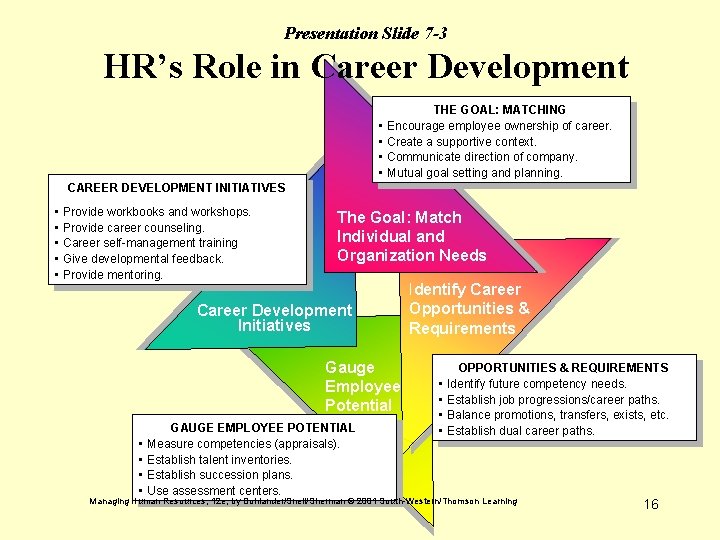
Presentation Slide 7 -3 HR’s Role in Career Development THE GOAL: MATCHING • Encourage employee ownership of career. • Create a supportive context. • Communicate direction of company. • Mutual goal setting and planning. CAREER DEVELOPMENT INITIATIVES • Provide workbooks and workshops. • Provide career counseling. • Career self-management training • Give developmental feedback. • Provide mentoring. The Goal: Match Individual and Organization Needs Career Development Initiatives Gauge Employee Potential GAUGE EMPLOYEE POTENTIAL • Measure competencies (appraisals). • Establish talent inventories. • Establish succession plans. • Use assessment centers. Identify Career Opportunities & Requirements OPPORTUNITIES & REQUIREMENTS • Identify future competency needs. • Establish job progressions/career paths. • Balance promotions, transfers, exists, etc. • Establish dual career paths. Managing Human Resources, 12 e, by Bohlander/Snell/Sherman © 2001 South-Western/Thomson Learning 16
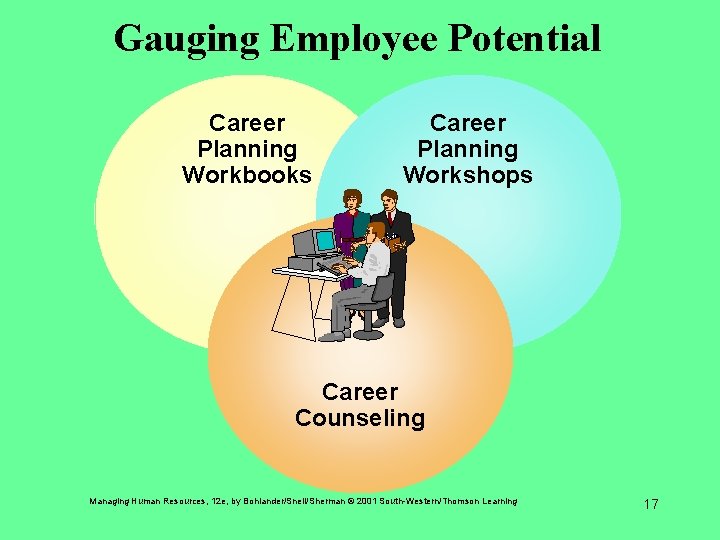
Gauging Employee Potential Career Planning Workbooks Career Planning Workshops Career Counseling Managing Human Resources, 12 e, by Bohlander/Snell/Sherman © 2001 South-Western/Thomson Learning 17
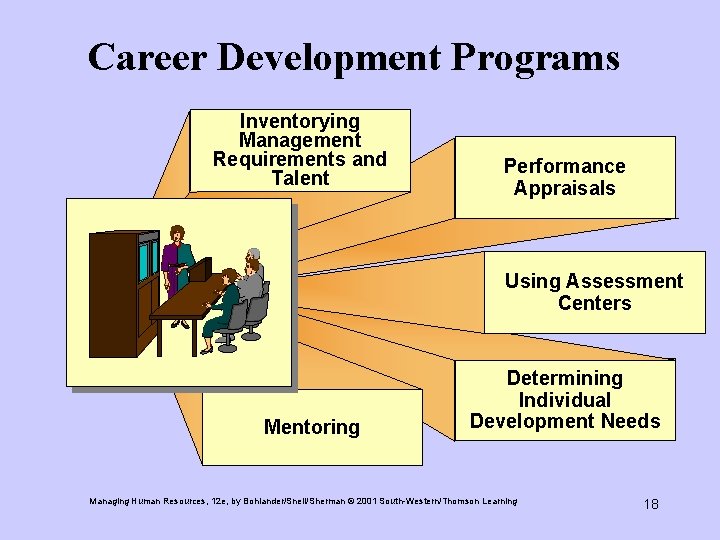
Career Development Programs Inventorying Management Requirements and Talent Performance Appraisals Using Assessment Centers Mentoring Determining Individual Development Needs Managing Human Resources, 12 e, by Bohlander/Snell/Sherman © 2001 South-Western/Thomson Learning 18
Assessment Center Process by which individuals are evaluated as they participate in a series of situations that resemble what they might be called upon to handle on the job Managing Human Resources, 12 e, by Bohlander/Snell/Sherman © 2001 South-Western/Thomson Learning 19
In-Basket Training Assessment-center process for evaluating trainees by simulating a real-life work situation. Managing Human Resources, 12 e, by Bohlander/Snell/Sherman © 2001 South-Western/Thomson Learning 20
Leaderless Group Discussions Assessment-center process that places trainees in a conference setting to discuss an assigned topic, either with or without designated group roles. Managing Human Resources, 12 e, by Bohlander/Snell/Sherman © 2001 South-Western/Thomson Learning 21
Career Counseling Process of discussing with employees their current job activities and performance, their personal and career interests and goals, their personal skills, and suitable career development objectives. Managing Human Resources, 12 e, by Bohlander/Snell/Sherman © 2001 South-Western/Thomson Learning 22
Fast-Track Program that encourages young managers with high potential to remain with an organization by enabling them to advance more rapidly than those with less potential Managing Human Resources, 12 e, by Bohlander/Snell/Sherman © 2001 South-Western/Thomson Learning 23
Mentors Executives who coach, advise, and encourage individuals of lesser rank Managing Human Resources, 12 e, by Bohlander/Snell/Sherman © 2001 South-Western/Thomson Learning 24
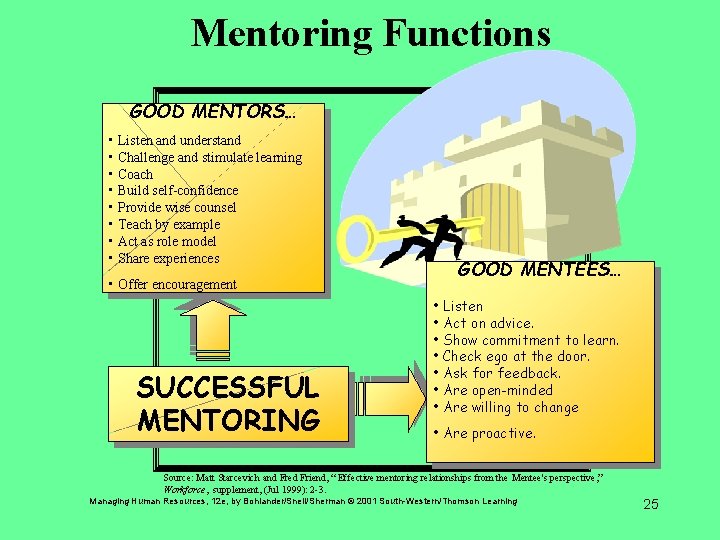
Mentoring Functions GOOD MENTORS… • Listen and understand • Challenge and stimulate learning • Coach • Build self-confidence • Provide wise counsel • Teach by example • Act as role model • Share experiences • Offer encouragement SUCCESSFUL MENTORING GOOD MENTEES… • Listen • Act on advice. • Show commitment to learn. • Check ego at the door. • Ask for feedback. • Are open-minded • Are willing to change • Are proactive. Source: Matt Starcevich and Fred Friend, “ Effective mentoring relationships from the Mentee's perspective, ” Workforce, supplement, (Jul 1999): 2 -3. Managing Human Resources, 12 e, by Bohlander/Snell/Sherman © 2001 South-Western/Thomson Learning 25
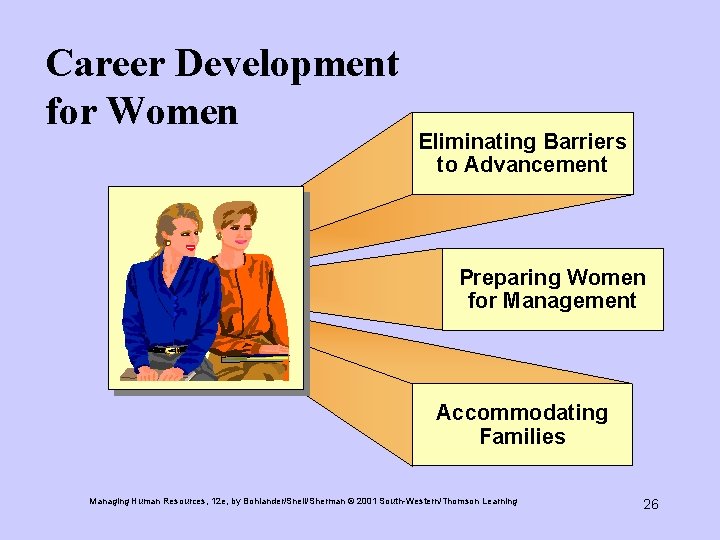
Career Development for Women Eliminating Barriers to Advancement Preparing Women for Management Accommodating Families Managing Human Resources, 12 e, by Bohlander/Snell/Sherman © 2001 South-Western/Thomson Learning 26
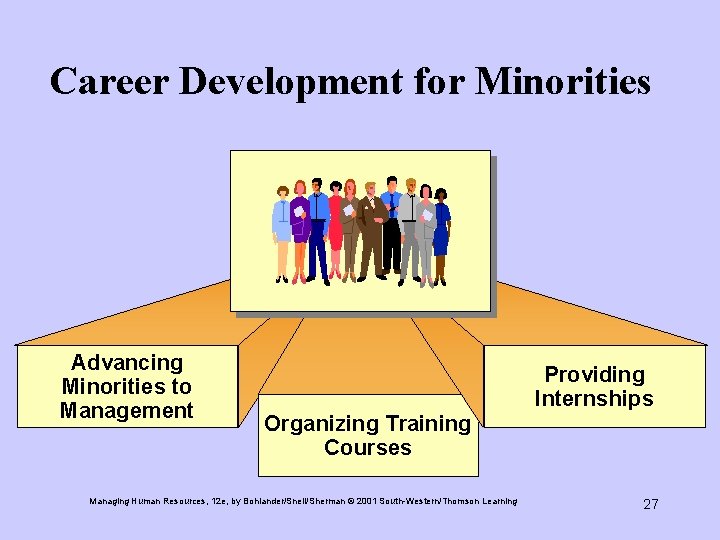
Career Development for Minorities Advancing Minorities to Management Providing Internships Organizing Training Courses Managing Human Resources, 12 e, by Bohlander/Snell/Sherman © 2001 South-Western/Thomson Learning 27
Dual-Career Partnerships Couples in which both members follow their own careers and actively support each other’s career development Managing Human Resources, 12 e, by Bohlander/Snell/Sherman © 2001 South-Western/Thomson Learning 28
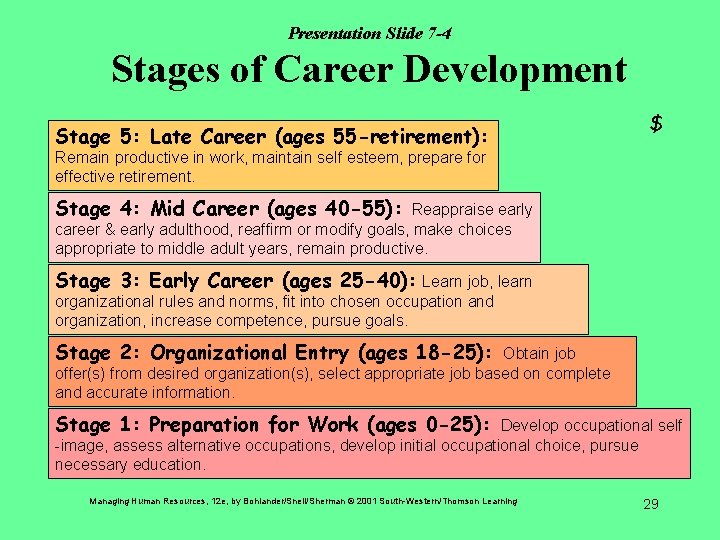
Presentation Slide 7 -4 Stages of Career Development Stage 5: Late Career (ages 55 -retirement): $ Remain productive in work, maintain self esteem, prepare for effective retirement. Stage 4: Mid Career (ages 40 -55): Reappraise early career & early adulthood, reaffirm or modify goals, make choices appropriate to middle adult years, remain productive. Stage 3: Early Career (ages 25 -40): Learn job, learn organizational rules and norms, fit into chosen occupation and organization, increase competence, pursue goals. Stage 2: Organizational Entry (ages 18 -25): Obtain job offer(s) from desired organization(s), select appropriate job based on complete and accurate information. Stage 1: Preparation for Work (ages 0 -25): Develop occupational self -image, assess alternative occupations, develop initial occupational choice, pursue necessary education. Managing Human Resources, 12 e, by Bohlander/Snell/Sherman © 2001 South-Western/Thomson Learning 29
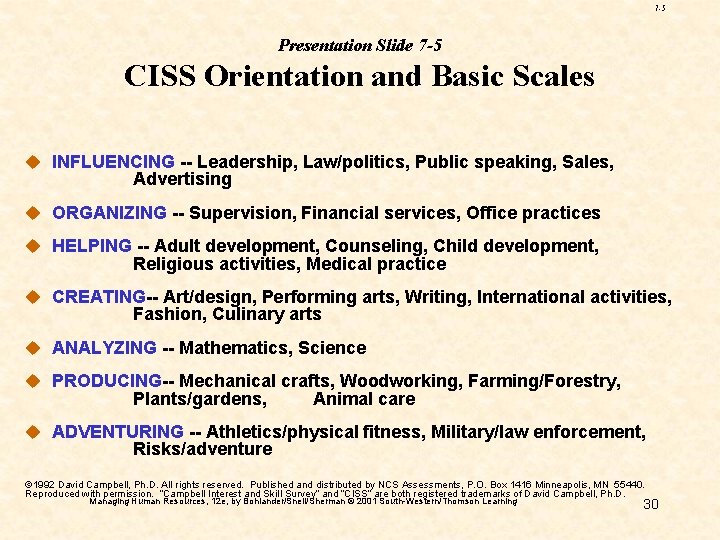
7 -5 Presentation Slide 7 -5 CISS Orientation and Basic Scales u INFLUENCING -- Leadership, Law/politics, Public speaking, Sales, Advertising u ORGANIZING -- Supervision, Financial services, Office practices u HELPING -- Adult development, Counseling, Child development, Religious activities, Medical practice u CREATING-- Art/design, Performing arts, Writing, International activities, Fashion, Culinary arts u ANALYZING -- Mathematics, Science u PRODUCING-- Mechanical crafts, Woodworking, Farming/Forestry, Plants/gardens, Animal care u ADVENTURING -- Athletics/physical fitness, Military/law enforcement, Risks/adventure © 1992 David Campbell, Ph. D. All rights reserved. Published and distributed by NCS Assessments, P. O. Box 1416 Minneapolis, MN 55440. Reproduced with permission. “Campbell Interest and Skill Survey” and “CISS” are both registered trademarks of David Campbell, Ph. D. Managing Human Resources, 12 e, by Bohlander/Snell/Sherman © 2001 South-Western/Thomson Learning 30
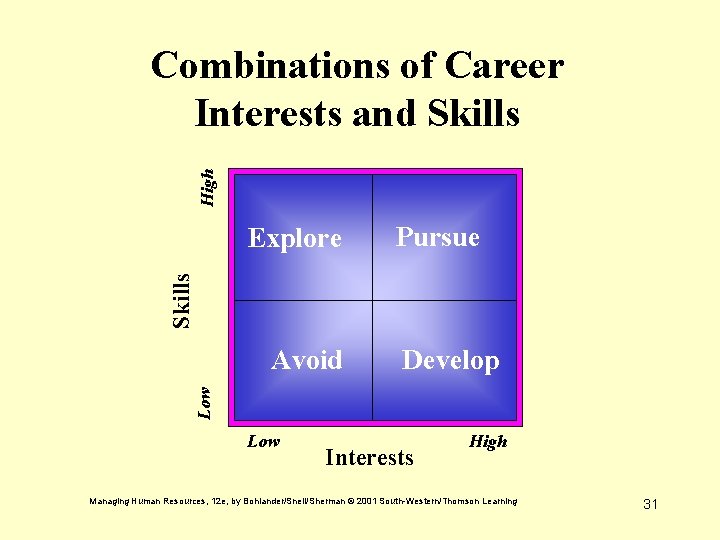
High Combinations of Career Interests and Skills Pursue Skills Explore Develop Low Avoid Low Interests High Managing Human Resources, 12 e, by Bohlander/Snell/Sherman © 2001 South-Western/Thomson Learning 31
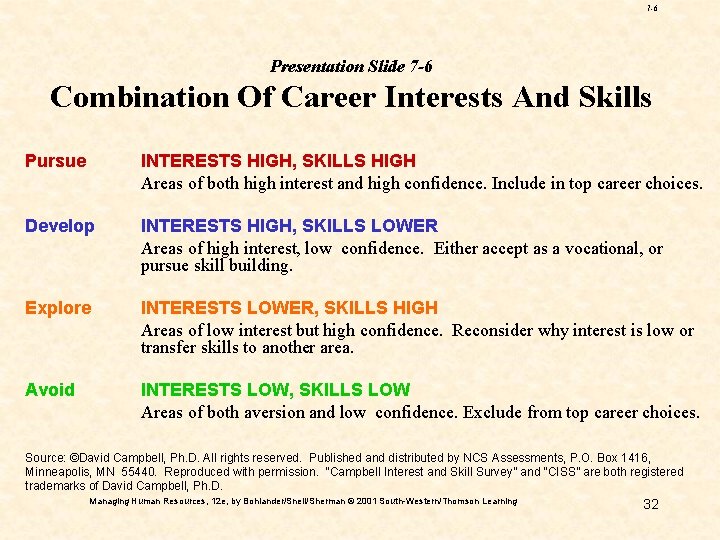
7 -6 Presentation Slide 7 -6 Combination Of Career Interests And Skills Pursue INTERESTS HIGH, SKILLS HIGH Areas of both high interest and high confidence. Include in top career choices. Develop INTERESTS HIGH, SKILLS LOWER Areas of high interest, low confidence. Either accept as a vocational, or pursue skill building. Explore INTERESTS LOWER, SKILLS HIGH Areas of low interest but high confidence. Reconsider why interest is low or transfer skills to another area. Avoid INTERESTS LOW, SKILLS LOW Areas of both aversion and low confidence. Exclude from top career choices. Source: ©David Campbell, Ph. D. All rights reserved. Published and distributed by NCS Assessments, P. O. Box 1416, Minneapolis, MN 55440. Reproduced with permission. “Campbell Interest and Skill Survey” and “CISS” are both registered trademarks of David Campbell, Ph. D. Managing Human Resources, 12 e, by Bohlander/Snell/Sherman © 2001 South-Western/Thomson Learning 32
Career Plateau Situation in which for either organizational or personal reasons the probability of moving up the career ladder is low Managing Human Resources, 12 e, by Bohlander/Snell/Sherman © 2001 South-Western/Thomson Learning 33
Entrepreneur One who starts, organizes, manages, and assumes responsibility for a business or other enterprise Managing Human Resources, 12 e, by Bohlander/Snell/Sherman © 2001 South-Western/Thomson Learning 34
- Slides: 34