
Training and Development Managing Human Resources Bohlander Snell
Training and Development Managing Human Resources Bohlander • Snell © 2007 Thomson/South-Western. All rights reserved. 14 th edition Power. Point Presentation by Charlie Cook The University of West Alabama
Objectives After studying this chapter, you should be able to: 1. Discuss the systems approach to training and development. 2. Describe the components of training-needs assessment. 3. Identify the principles of learning and describe how they facilitate training. 4. Identify the types of training methods used for managers and nonmanagers. 5. Discuss the advantages and disadvantages of various evaluation criteria. 6. Describe the special training programs that are currently popular. © 2007 Thomson/South-Western. All rights reserved. 7– 2
The Scope of Training • Training Ø Effort initiated by an organization to foster learning among its members. Ø Tends to be narrowly focused and oriented toward short-term performance concerns. • Development Ø Effort that is oriented more toward broadening an individual’s skills for the future responsibilities. © 2007 Thomson/South-Western. All rights reserved. 7– 3
The Systems Approach to Training and Development • Four Phases Ø Needs assessment Ø Program design Ø Implementation Ø Evaluation © 2007 Thomson/South-Western. All rights reserved. 7– 4
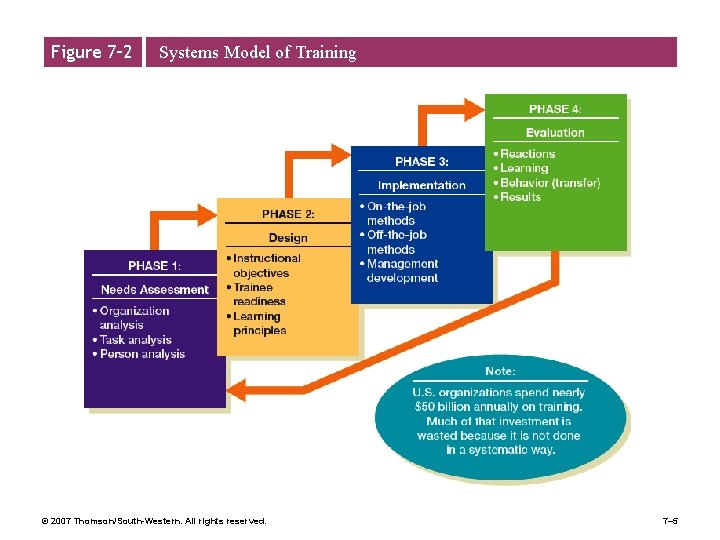
Figure 7– 2 Systems Model of Training © 2007 Thomson/South-Western. All rights reserved. 7– 5
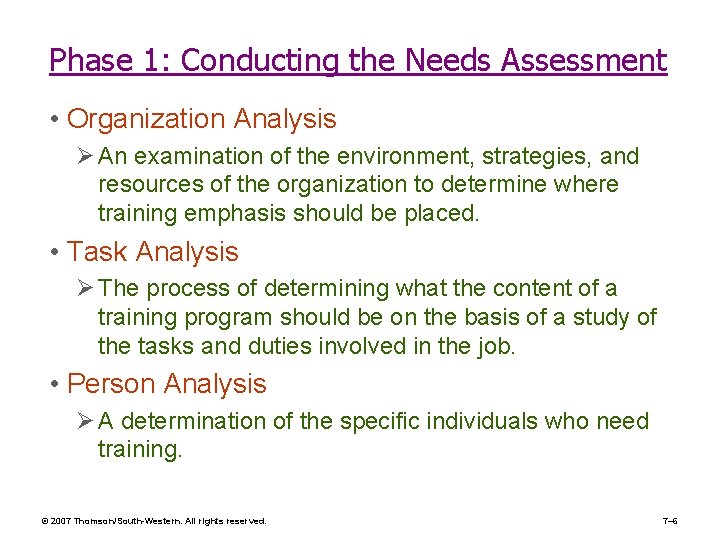
Phase 1: Conducting the Needs Assessment • Organization Analysis Ø An examination of the environment, strategies, and resources of the organization to determine where training emphasis should be placed. • Task Analysis Ø The process of determining what the content of a training program should be on the basis of a study of the tasks and duties involved in the job. • Person Analysis Ø A determination of the specific individuals who need training. © 2007 Thomson/South-Western. All rights reserved. 7– 6
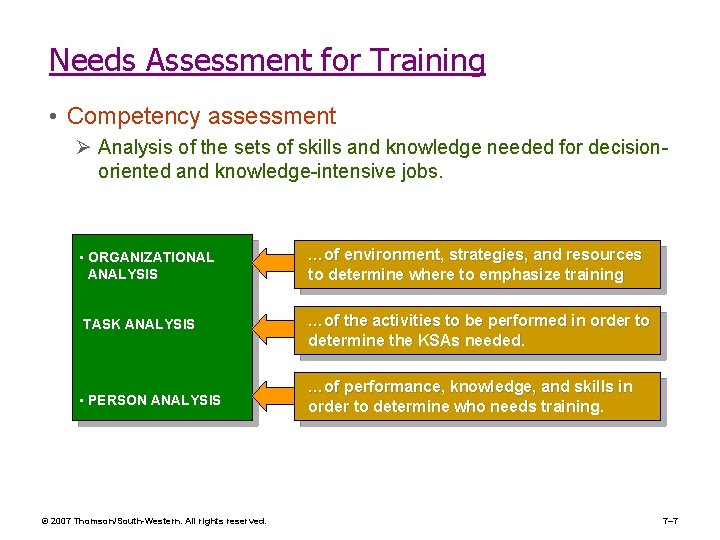
Needs Assessment for Training • Competency assessment Ø Analysis of the sets of skills and knowledge needed for decisionoriented and knowledge-intensive jobs. • ORGANIZATIONAL ANALYSIS …of environment, strategies, and resources to determine where to emphasize training TASK ANALYSIS …of the activities to be performed in order to determine the KSAs needed. • PERSON ANALYSIS …of performance, knowledge, and skills in order to determine who needs training. © 2007 Thomson/South-Western. All rights reserved. 7– 7
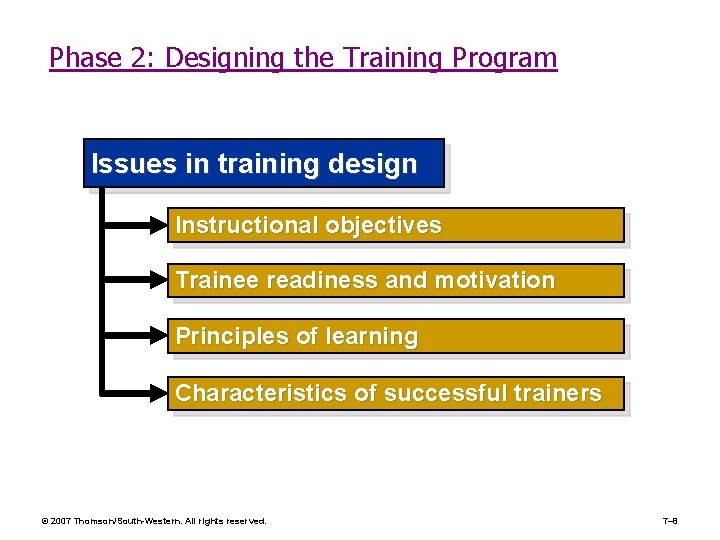
Phase 2: Designing the Training Program Issues in training design Instructional objectives Trainee readiness and motivation Principles of learning Characteristics of successful trainers © 2007 Thomson/South-Western. All rights reserved. 7– 8
Phase 2: Designing the Training Program • Instructional Objectives Ø Represent the desired outcomes of a training program v Performance-centered objectives Ø Provide a basis for choosing methods and materials and for selecting the means for assessing whether the instruction will be successful. © 2007 Thomson/South-Western. All rights reserved. 7– 9
Trainee Readiness and Motivation • Strategies for Creating a Motivated Training Environment: Ø Use positive reinforcement. Ø Eliminate threats and punishment. Ø Be flexible. Ø Have participants set personal goals. Ø Design interesting instruction. Ø Break down physical and psychological obstacles to learning. © 2007 Thomson/South-Western. All rights reserved. 7– 10
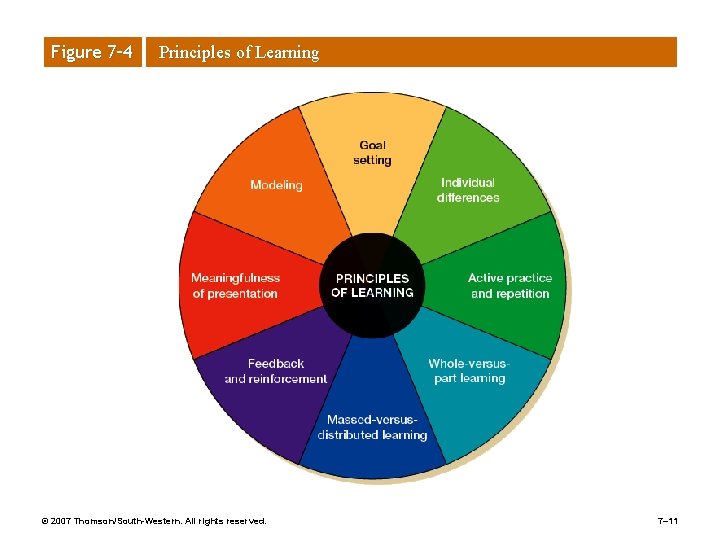
Figure 7– 4 Principles of Learning © 2007 Thomson/South-Western. All rights reserved. 7– 11
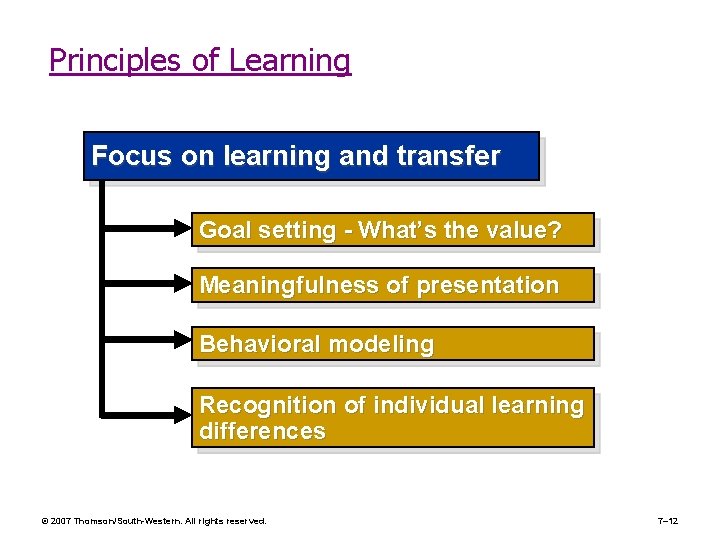
Principles of Learning Focus on learning and transfer Goal setting - What’s the value? Meaningfulness of presentation Behavioral modeling Recognition of individual learning differences © 2007 Thomson/South-Western. All rights reserved. 7– 12
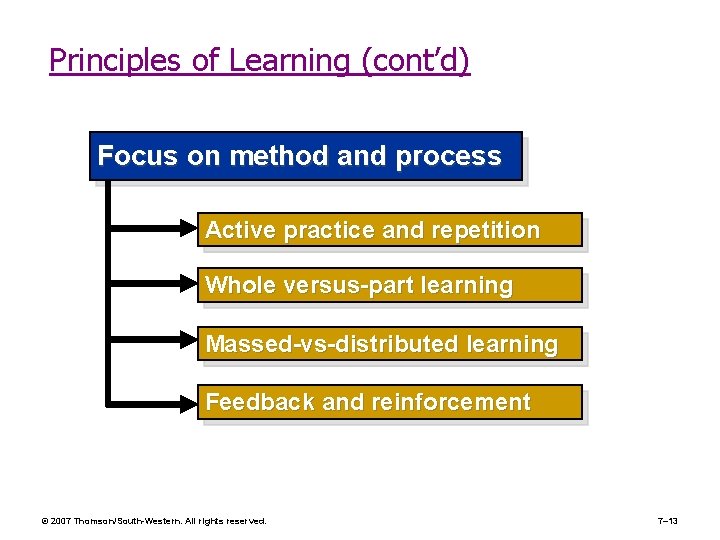
Principles of Learning (cont’d) Focus on method and process Active practice and repetition Whole versus-part learning Massed-vs-distributed learning Feedback and reinforcement © 2007 Thomson/South-Western. All rights reserved. 7– 13
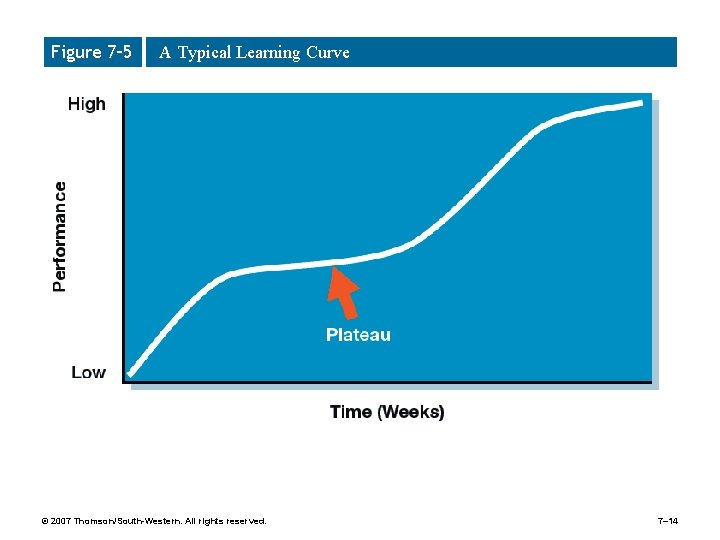
Figure 7– 5 A Typical Learning Curve © 2007 Thomson/South-Western. All rights reserved. 7– 14
Feedback and Reinforcement • Behavior Modification Ø The technique that operates on the principle that behavior that is rewarded, or positively reinforced, is repeated more frequently, whereas behavior that is penalized or unrewarded will decrease in frequency. © 2007 Thomson/South-Western. All rights reserved. 7– 15
Characteristics of Successful Instructors • Knowledge of the subject • Adaptability • Sincerity • Sense of humor • Interest • Clear instructions • Individual assistance • Enthusiasm © 2007 Thomson/South-Western. All rights reserved. 7– 16
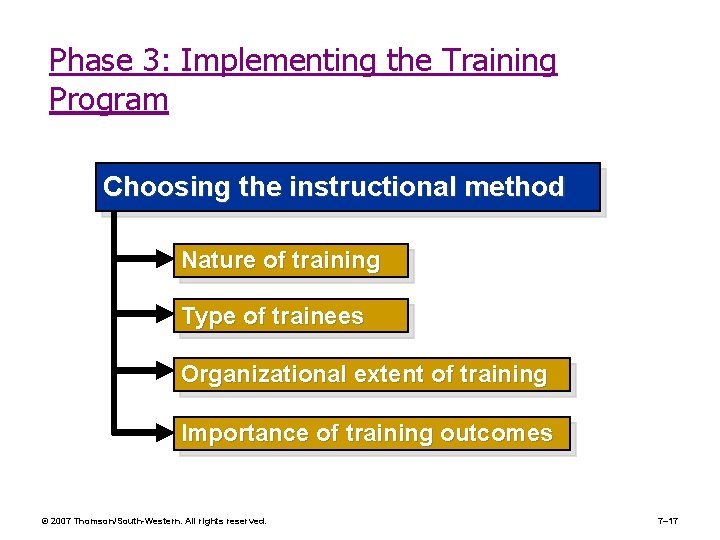
Phase 3: Implementing the Training Program Choosing the instructional method Nature of training Type of trainees Organizational extent of training Importance of training outcomes © 2007 Thomson/South-Western. All rights reserved. 7– 17
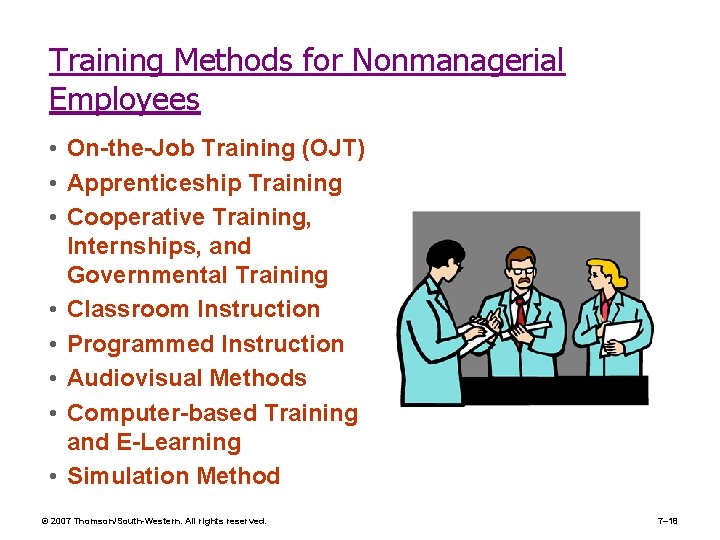
Training Methods for Nonmanagerial Employees • On-the-Job Training (OJT) • Apprenticeship Training • Cooperative Training, Internships, and Governmental Training • Classroom Instruction • Programmed Instruction • Audiovisual Methods • Computer-based Training and E-Learning • Simulation Method © 2007 Thomson/South-Western. All rights reserved. 7– 18
Training Methods for Nonmanagerial Employees (cont’d) • On-the-job training (OJT) Ø Method by which employees are given hands-on experience with instructions from their supervisor or other trainer. • Drawbacks Ø The lack of a well-structured training environment Ø Poor training skills of managers Ø The absence of well-defined job performance criteria © 2007 Thomson/South-Western. All rights reserved. 7– 19
On-the-Job Training • Overcoming OJT training problems 1. Develop realistic goals and/or measures for each OJT area. 2. Plan a specific training schedule for each trainee, including set periods for evaluation and feedback. 3. Help managers establish a nonthreatening atmosphere conducive to learning. 4. Conduct periodic evaluations, after training is completed, to prevent regression. © 2007 Thomson/South-Western. All rights reserved. 7– 20
Training Methods for Nonmanagerial Employees (cont’d) • Apprenticeship training Ø A system of training in which a worker entering the skilled trades is given thorough instruction and experience, both on and off the job, in the practical and theoretical aspects of the work. • Cooperative Training Ø A training program that combines practical on-the-job experience with formal educational classes. © 2007 Thomson/South-Western. All rights reserved. 7– 21
Training Methods for Nonmanagerial Employees (cont’d) • Internship Programs Ø Are jointly sponsored by colleges, universities, and other organizations that offer students the opportunity to gain real-life experience while allowing them to find out how they will perform in work organizations. • Classroom Instruction Ø Enables the maximum number of trainees to be handled by the minimum number of instructors. Ø “Blended” learning—lectures and demonstrations are combined with films, DVDs, and videotapes or computer instruction. © 2007 Thomson/South-Western. All rights reserved. 7– 22
Training Methods for Nonmanagerial Employees (cont’d) • Programmed Instruction Ø Referred to as self-directed learning—involves the use of books, manuals, or computers to break down subject matter content into highly organized, logical sequences that demand continuous response on the part of the trainee. • Audiovisual Methods Ø Technologies, such as CDs and DVDs, are used to teach skills and procedures by illustrating the steps in a procedure or interpersonal relations. © 2007 Thomson/South-Western. All rights reserved. 7– 23
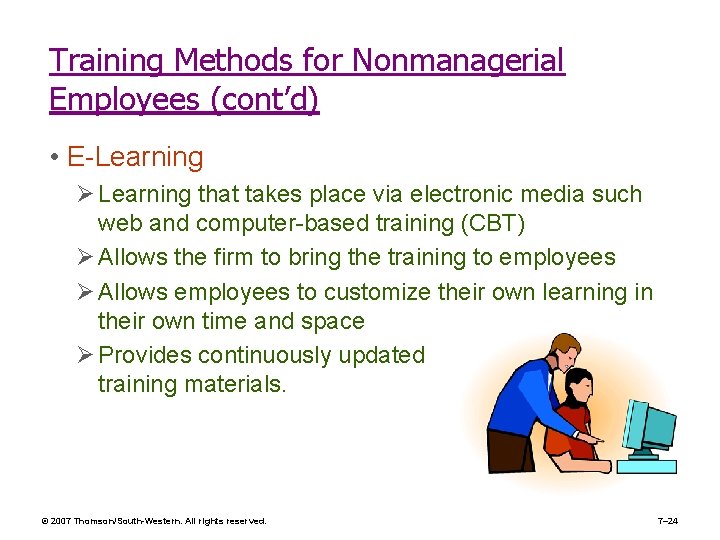
Training Methods for Nonmanagerial Employees (cont’d) • E-Learning Ø Learning that takes place via electronic media such web and computer-based training (CBT) Ø Allows the firm to bring the training to employees Ø Allows employees to customize their own learning in their own time and space Ø Provides continuously updated training materials. © 2007 Thomson/South-Western. All rights reserved. 7– 24
E-Learning Advantages Learning is self-paced. The training comes to the employee. The training is interactive. Employees do not have to wait for a scheduled training session. The training can focus on specific needs as revealed by built-in tests. Trainees can be referred to online help or written material. © 2007 Thomson/South-Western. All rights reserved. 7– 25
Training Methods for Nonmanagerial Employees (cont’d) • Simulation Ø The simulation method emphasizes realism in equipment and its operation at minimum cost and maximum safety. Ø Used when it is either impractical or unwise to train employees on the actual equipment used on the job. © 2007 Thomson/South-Western. All rights reserved. 7– 26
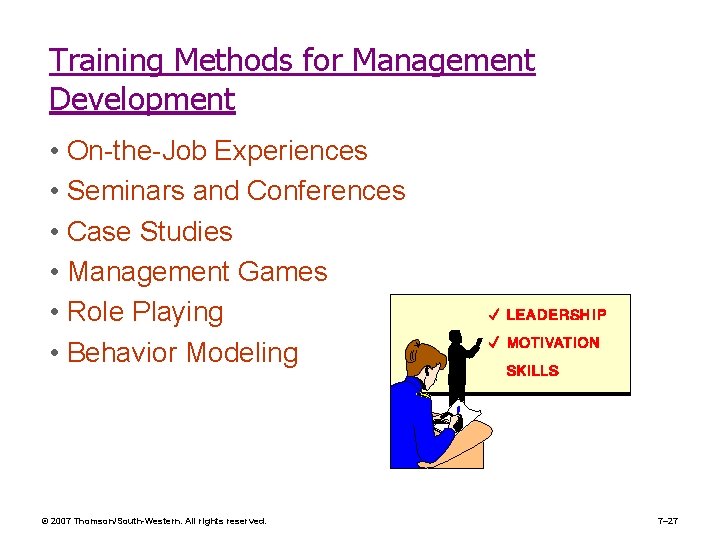
Training Methods for Management Development • On-the-Job Experiences • Seminars and Conferences • Case Studies • Management Games • Role Playing • Behavior Modeling © 2007 Thomson/South-Western. All rights reserved. 7– 27
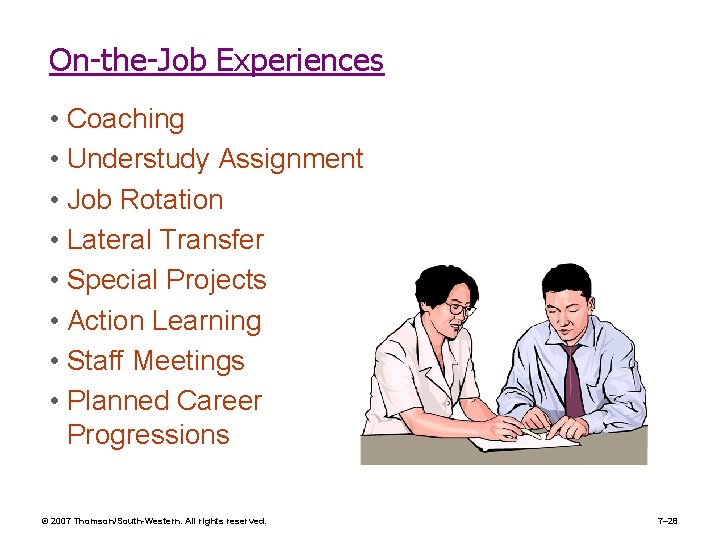
On-the-Job Experiences • Coaching • Understudy Assignment • Job Rotation • Lateral Transfer • Special Projects • Action Learning • Staff Meetings • Planned Career Progressions © 2007 Thomson/South-Western. All rights reserved. 7– 28
Case Studies • The use of case studies is most appropriate when: 1. Analytic, problem-solving, and critical thinking skills are most important. 2. The KSAs are complex and participants need time to master them. 3. Active participation is desired. 4. The process of learning (questioning, interpreting, and so on) is as important as the content. 5. Team problem solving and interaction are possible. © 2007 Thomson/South-Western. All rights reserved. 7– 29
Role Playing • Successful role play requires that instructors: Ø Ensure that group members are comfortable with each other. Ø Select and prepare the role players by introducing a specific situation. Ø To help participants prepare, ask them to describe potential characters. Ø Realize that volunteers make better role players. © 2007 Thomson/South-Western. All rights reserved. 7– 30
Role Playing (cont’d) • Successful role play requires that instructors: Ø Prepare the observers by giving them specific tasks (such as evaluation or feedback). Ø Guide the role-play enactment through its bumps (because it is not scripted). Ø Keep it short. Ø Discuss the enactment and prepare bulleted points of what was learned. © 2007 Thomson/South-Western. All rights reserved. 7– 31
Behavior Modeling • Behavior Modeling Ø An approach that demonstrates desired behavior and gives trainees the chance to practice and role-play those behaviors and receive feedback. Ø Involves four basic components: v Learning points v Model v Practice and role play v Feedback and reinforcement © 2007 Thomson/South-Western. All rights reserved. 7– 32
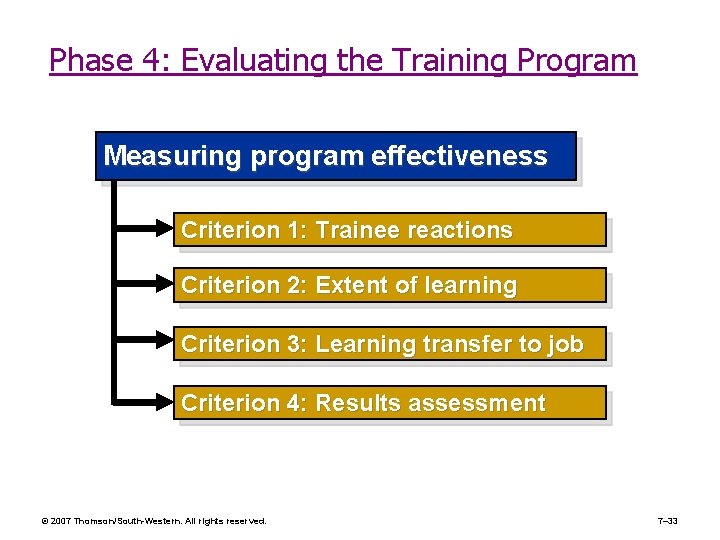
Phase 4: Evaluating the Training Program Measuring program effectiveness Criterion 1: Trainee reactions Criterion 2: Extent of learning Criterion 3: Learning transfer to job Criterion 4: Results assessment © 2007 Thomson/South-Western. All rights reserved. 7– 33
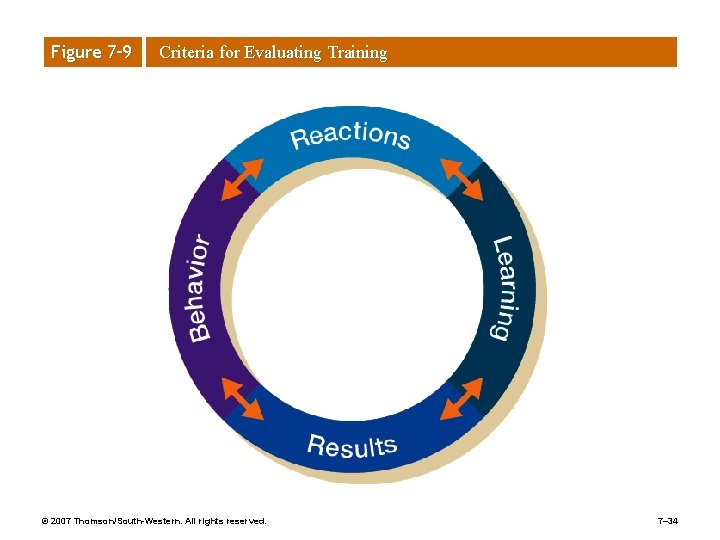
Figure 7– 9 Criteria for Evaluating Training © 2007 Thomson/South-Western. All rights reserved. 7– 34
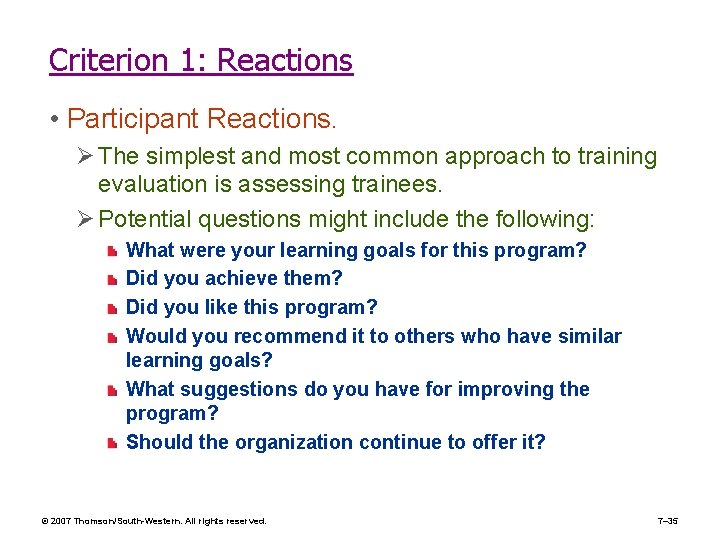
Criterion 1: Reactions • Participant Reactions. Ø The simplest and most common approach to training evaluation is assessing trainees. Ø Potential questions might include the following: What were your learning goals for this program? Did you achieve them? Did you like this program? Would you recommend it to others who have similar learning goals? What suggestions do you have for improving the program? Should the organization continue to offer it? © 2007 Thomson/South-Western. All rights reserved. 7– 35
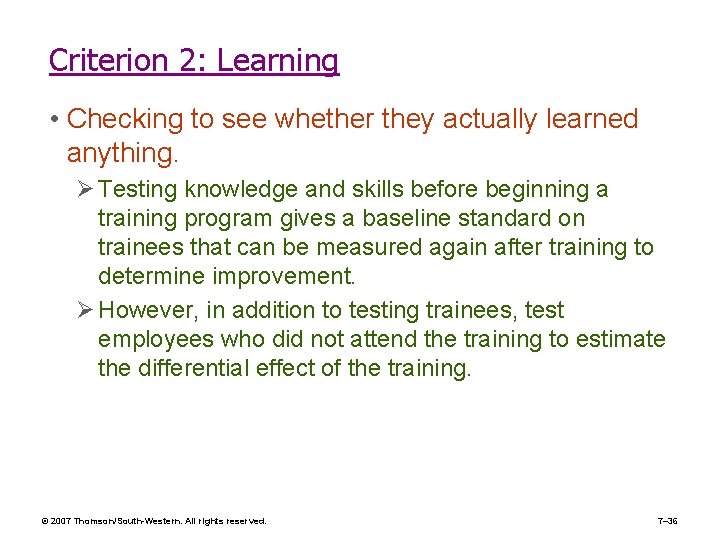
Criterion 2: Learning • Checking to see whether they actually learned anything. Ø Testing knowledge and skills before beginning a training program gives a baseline standard on trainees that can be measured again after training to determine improvement. Ø However, in addition to testing trainees, test employees who did not attend the training to estimate the differential effect of the training. © 2007 Thomson/South-Western. All rights reserved. 7– 36
Criterion 3: Behavior • Transfer of Training Ø Effective application of principles learned to what is required on the job. • Maximizing the Transfer of Training 1. 2. 3. 4. Feature identical elements Focus on general principles Establish a climate for transfer. Give employees transfer strategies © 2007 Thomson/South-Western. All rights reserved. 7– 37
Criterion 4: Results or Return on Investment (ROI) • Utility of Training Programs. Ø Calculating the benefits derived from training: How much did quality improve because of the training program? How much has it contributed to profits? What reduction in turnover and wasted materials did the company get after training? How much has productivity increased and by how much have costs been reduced? © 2007 Thomson/South-Western. All rights reserved. 7– 38
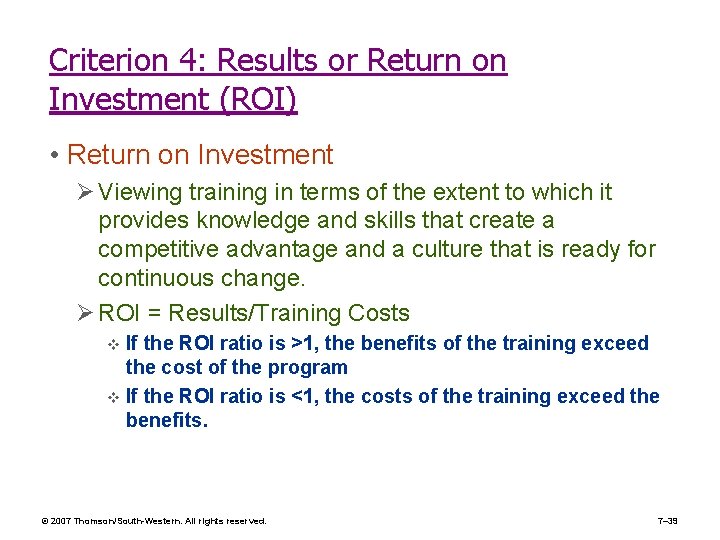
Criterion 4: Results or Return on Investment (ROI) • Return on Investment Ø Viewing training in terms of the extent to which it provides knowledge and skills that create a competitive advantage and a culture that is ready for continuous change. Ø ROI = Results/Training Costs If the ROI ratio is >1, the benefits of the training exceed the cost of the program v If the ROI ratio is <1, the costs of the training exceed the benefits. v © 2007 Thomson/South-Western. All rights reserved. 7– 39
Criterion 4: Results (cont’d) • Benchmarking Ø The process of measuring one’s own services and practices against the recognized leaders in order to identify areas for improvement. 1. Training activity: How much training is occurring? 2. Training results: Do training and development achieve their goals? 3. Training efficiency: Are resources utilized in the pursuit of this mission? © 2007 Thomson/South-Western. All rights reserved. 7– 40
Criterion 4: Results (cont’d) • Deming’s Benchmarking Model 1. Plan: conduct a self-audit to identify areas for benchmarking. 2. Do: collect data about activities. 3. Check: Analyze data. 4. Act: Establish goals, implement changes, monitor progress, and redefine benchmarks. © 2007 Thomson/South-Western. All rights reserved. 7– 41
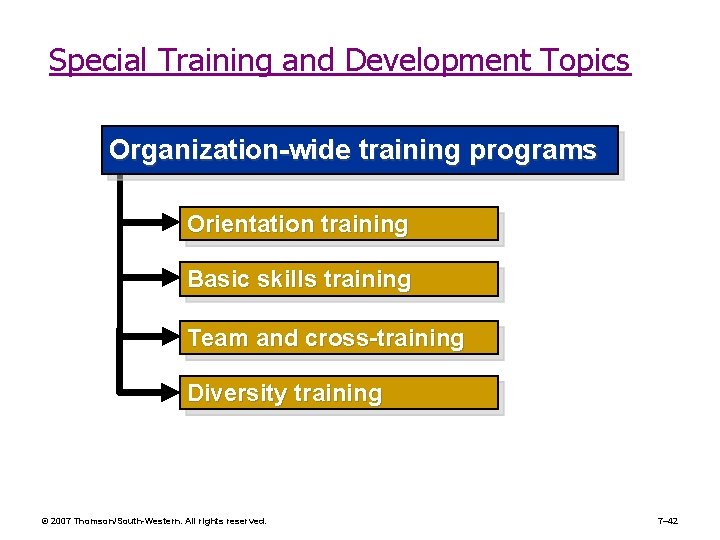
Special Training and Development Topics Organization-wide training programs Orientation training Basic skills training Team and cross-training Diversity training © 2007 Thomson/South-Western. All rights reserved. 7– 42
Special Topics in Training and Development (cont’d) • Orientation Ø A formal process of familiarizing new employees with the organization, their jobs, and their work units. Ø Benefits: 1. 2. 3. 4. 5. 6. Lower turnover Increased productivity Improved employee morale Lower recruiting and training costs Facilitation of learning Reduction of the new employee’s anxiety © 2007 Thomson/South-Western. All rights reserved. 7– 43
Special Topics in Training and Development (cont’d) • Basic Skills Training Ø Basic skills have become essential occupational qualifications, having profound implications for product quality, customer service, internal efficiency, and workplace and environmental safety. • Typical basic skills: Ø Reading, writing, computing, speaking, listening, problem solving, managing oneself, knowing how to learn, working as part of a team, leading others. © 2007 Thomson/South-Western. All rights reserved. 7– 44
Special Topics in Training and Development (cont’d) • To implement a successful program in basic and remedial skills: 1. Explain to employees why and how the training will help them in their jobs. 2. Relate the training to the employees’ goals. 3. Respect and consider participant experiences, and use these as a resource. 4. Use a task-centered or problem-centered approach so that participants “learn by doing. ” 5. Give feedback on progress toward meeting learning objectives. © 2007 Thomson/South-Western. All rights reserved. 7– 45
Special Topics in Training and Development (cont’d) • Team Training Issues 1. Team building is a difficult and comprehensive process. 2. Team development is not always a linear sequence of “forming, storming, norming, and performing. ” 3. Additional training is required to assimilate new members. 4. Behavioral and process skills need to be acquired through participative exercises. © 2007 Thomson/South-Western. All rights reserved. 7– 46
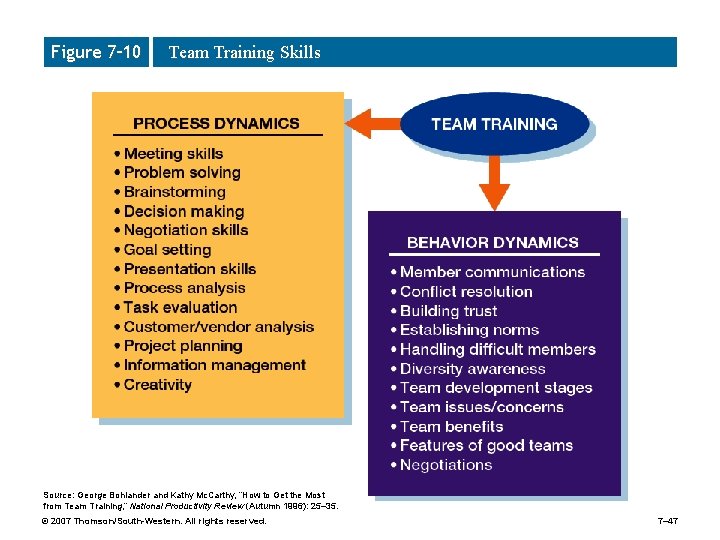
Figure 7– 10 Team Training Skills Source: George Bohlander and Kathy Mc. Carthy, “How to Get the Most from Team Training, ” National Productivity Review (Autumn 1996): 25– 35. © 2007 Thomson/South-Western. All rights reserved. 7– 47
Special Topics in Training and Development (cont’d) • Cross-Training Ø The process of training employees to do multiple jobs within an organization Gives firms flexible capacity. v Cuts turnover v Increase productivity v Pares down labor costs v Lays the foundation for careers rather than dead-end jobs. v © 2007 Thomson/South-Western. All rights reserved. 7– 48
- Slides: 48