
MANAGING GLOBAL HUMAN RESOURCES HR AND THE GLOBAL

MANAGING GLOBAL HUMAN RESOURCES

HR AND THE GLOBAL CHALLENGE With the globalisation of the world economy, even small firms are discovering that success depends on marketing and managing abroad. Managing HR internationally creates challenges. Rather than the distance, the main challenge is coping with the cultural, political, legal, and economic differences among countries.
INTERCOUNTRY DIFFERENCES AFFECTING HRM Cultural Political Legal Labour Relations Economic Systems
CULTURAL FACTORS Culture- Basic values the citizens adhere to, and in how these values manifest themselves in the nation’s arts, social programs, and ways of doing things. Cultural differences manifest themselves in differences in how people from different countries think, act, and expect others to act.
INTERNATIONAL HRM: ECONOMIC SYSTEMS Market Economy- governments play a relatively restrained role in deciding things such as what will be produced and sold, at what prices. Planned Economy- government decides and plans what to produce and sell, at what price. Mixed Economy- many industries are still under direct government control, while others make pricing and production decisions based on market demands.
INTERNATIONAL HRM: LEGAL, POLITICAL, AND LABOUR RELATIONS Employers going abroad must be familiar with the labour law systems in the countries they are entering. Legal differences blindside even sophisticated companies. Codetermination- employees have the legal right to a voice in setting company policies. Workers elect their own representatives to the supervisory board of the employer.
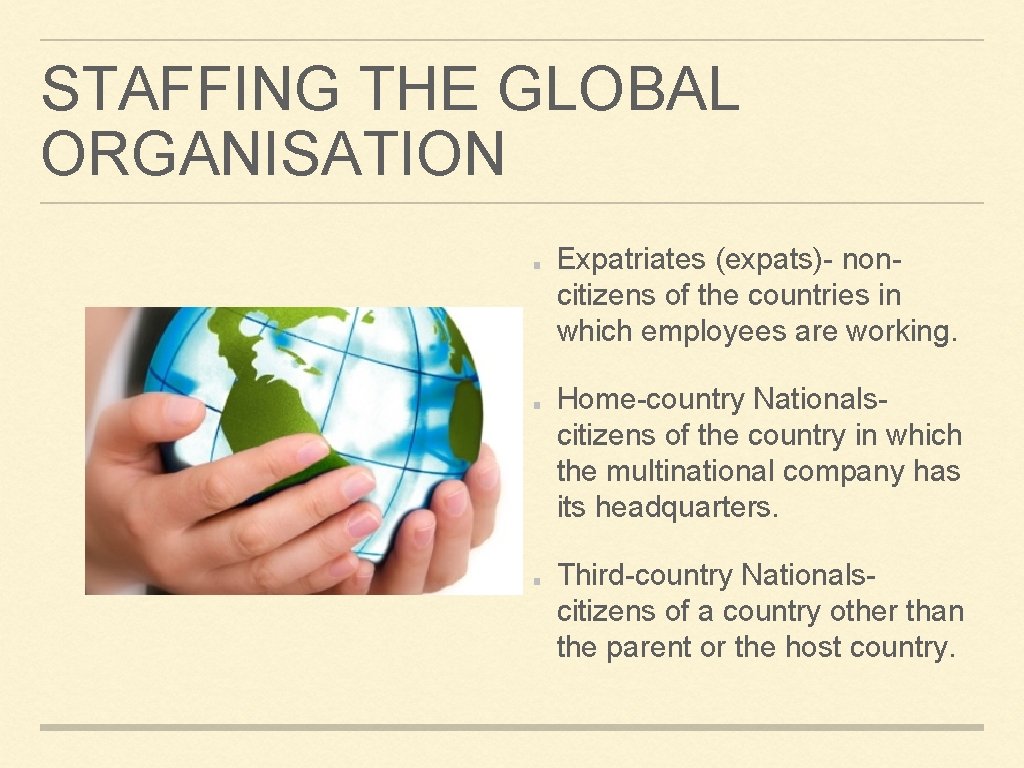
STAFFING THE GLOBAL ORGANISATION Expatriates (expats)- noncitizens of the countries in which employees are working. Home-country Nationalscitizens of the country in which the multinational company has its headquarters. Third-country Nationalscitizens of a country other than the parent or the host country.
STAFFING THE GLOBAL ORGANISATION Using locals- Employers may rely more on locals because the cost of using expats is usually far greater. Locals may view the multinational as a “better citizen” if it uses local management talent. Expats may overemphasise short-term results since there at the foreign subsidiary for only a few years. Using expats- Employers may not find local candidates with the required technical qualifications. Control is another reason of using expats. Expats are more likely to apply headquarters’ ways of doing things. Posting expats abroad is also expensive. Security problems is another issue expats face. Other solutions- Short-term/Commuter solutions involve frequent international travel but no formal relocation. Using Transnational Virtual Teams- groups of geographically dispersed coworkers who interact using a combination of telecommunications and information technologies to accomplish an organisational task.
MANAGEMENT VALUES AND INTERNATIONAL STAFFING POLICY Ethnocentric Practices- the notion that home-country attitudes, management style, knowledge, evaluation criteria, and managers are superior to anything the host country has to offer. Polycentric Practices- a conscious belief that only the host-country managers can ever really understand the culture and behaviour of the host-country market. Geocentric Practices- the belief that the firm’s whole management staff must be scoured on a global basis, on the assumption that the best manager of a specific position anywhere may be in any of the countries in which the firm operates.
WHY EXPAT ASSIGNMENTS FAIL? 5 factors that are important in International assignee success- 1. Job Knowledge and Motivation 2. Relational Skills 3. Flexibility/adaptability 4. Extra-cultural openness 5. Family situation
SELECTING EXPATRIATE MANAGERS Selection Testing- selecting managers for assignments abroad means testing them for traits that predict success in working abroad. Adaptability screening- a process that aims to assess the assignees’ (and spouses’) probable success in handling a foreign transfer.
ORIENTING AND TRAINING EMPLOYEES IN INTERNATIONAL ASSIGNMENT International assignees do best when they receive special training that they require. The training programs use lectures, simulation videos, and readings to prepare trainees. Some employers use returning managers as resources cultivate the global mind-sets of those departing.
ORIENTING AND TRAINING EMPLOYEES IN INTERNATIONAL ASSIGNMENT Example Training Program- 1. the basics of the new country’s history, politics, business norms, and education system and demographics. 2. an understanding how cultural values affect perceptions, values, and communications. 3. examples of why moving to a new country can be difficult and how to manage these challenges.
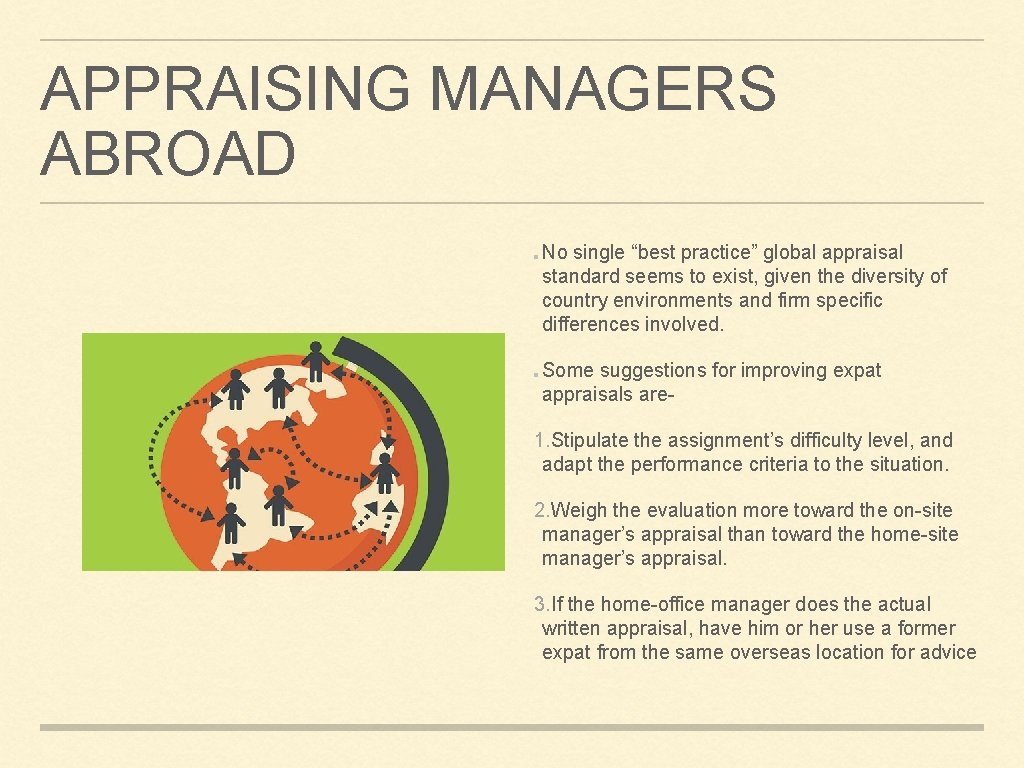
APPRAISING MANAGERS ABROAD No single “best practice” global appraisal standard seems to exist, given the diversity of country environments and firm specific differences involved. Some suggestions for improving expat appraisals are- 1. Stipulate the assignment’s difficulty level, and adapt the performance criteria to the situation. 2. Weigh the evaluation more toward the on-site manager’s appraisal than toward the home-site manager’s appraisal. 3. If the home-office manager does the actual written appraisal, have him or her use a former expat from the same overseas location for advice
COMPENSATING MANAGERS ABROAD International compensation presents some tricky problems. It seems logical to maintain company-wide pay scales and policies as it reduces the risk of perceived inequalities, and simplifies the job of keeping track of country-by-country wage rates. Yet, not adapting pay scales to local markets will produce even more problems. The fact that it is much more expensive to live in some countries than others has to be taken into account. One way to handle this problem is to pay a similar base salary companywide, then to add on various allowances according to individual market conditions.
THE BALANCE SHEET APPROACH The most common approach to formulating expat pay is to equalise purchasing power across countries. Each expat should enjoy the same standard of living he or she would have had at home. The balance sheet approach addresses four groups of expenses- 1. Income taxes 2. Housing 3. Goods and services 4. Discretionary expenses The employer estimates each of these four expenses in the expat’s home country, and in the host country. The employer than pays any differences- such as additional income taxes or housing expenses.
- Slides: 16