An explanation of Lean for SMEs LE LEAN

- Slides: 40
An explanation of Lean for SMEs LE LEAN - IFCIL ISO 9001
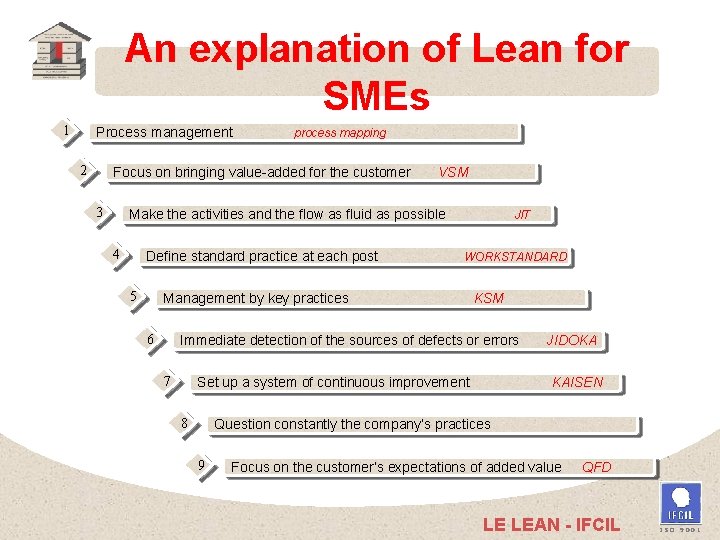
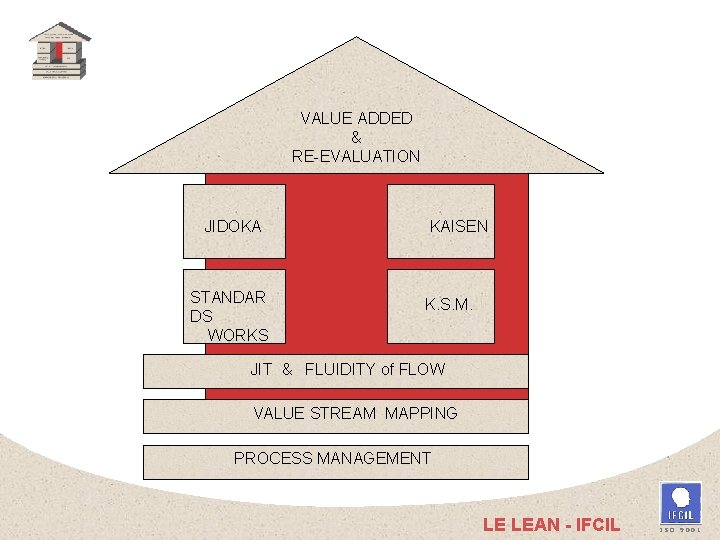
An explanation of Lean for SMEs 1 Process management process mapping 2 Focus on bringing value-added for the customer VSM 3 Make the activities and the flow as fluid as possible JIT 4 Define standard practice at each post WORKSTANDARD 5 Management by key practices KSM 6 Immediate detection of the sources of defects or errors JIDOKA 7 Set up a system of continuous improvement KAISEN 8 Question constantly the company’s practices 9 Focus on the customer’s expectations of added value QFD LE LEAN - IFCIL ISO 9001
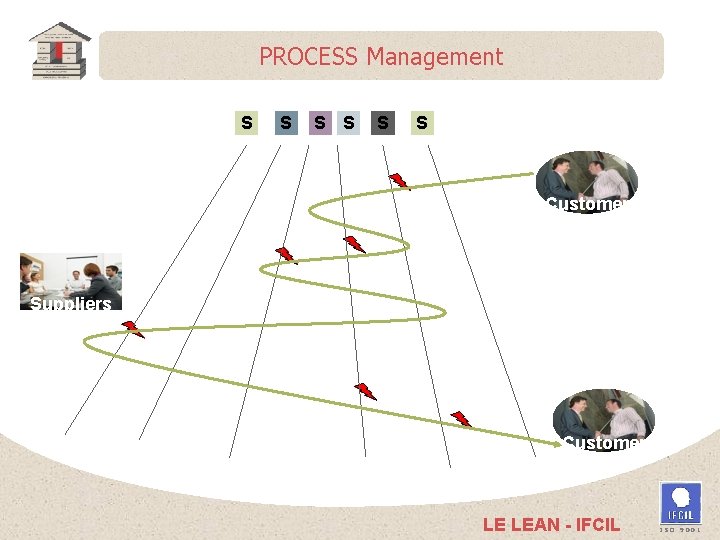
PROCESS Management S S S Customer Suppliers Customer LE LEAN - IFCIL ISO 9001
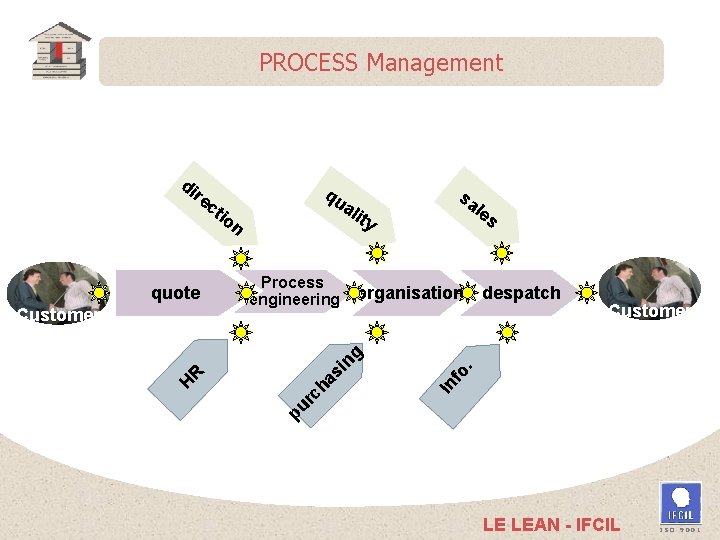
PROCESS Management di re quote qu sa ali io n Process engineering le ty s organisation despatch Customer . fo In si n rc ha pu H R g Customer ct LE LEAN - IFCIL ISO 9001
PROCESS Management The benefits of Process Management mean that Heads of organisations are able to: Clearly identify the steps in the construction of a service or product Define the quality levels required at the entry and exit of each process Identify risks at the interfaces between processes Empower each process manager Make each employee aware of their responsibility for the quality provided to the client Set up a steering process by quality efficiency LE LEAN - IFCIL ISO 9001
PROCESS Management With process management the chain of command is able to: Qualitatively follow each step of the product or service Establish a quality assurance system on each process Focus employees’ activity on specific quality objectives Empower teams throughout the process Define better the skills needed at each stage of the process LE LEAN - IFCIL ISO 9001
PROCESS Management With process management, thecompany employees : Understand better the contribution of their work Identify precisely what is expected of them in terms of downstream quality Measure the efficiency and quality of their work Share with a team performance issues of their process Pool the good practices with their colleagues Are fully committed to the company quality policy and developping their own quality control skills LE LEAN - IFCIL ISO 9001
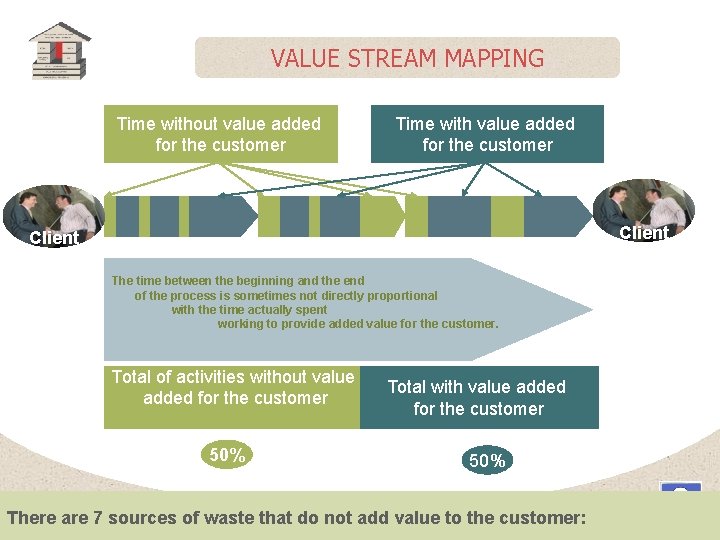
VALUE STREAM MAPPING Time without value added for the customer Time with value added for the customer Client The time between the beginning and the end of the process is sometimes not directly proportional with the time actually spent working to provide added value for the customer. Total of activities without value added for the customer 50% Total with value added for the customer 50% There are 7 sources of waste that do not add value to the LEcustomer: LEAN - IFCIL ISO 9001
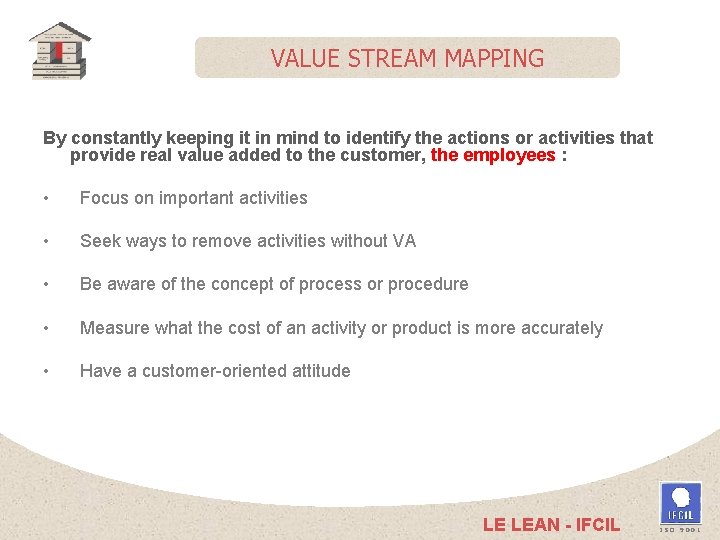
VALUE STREAM MAPPING By constantly keeping it in mind to identify the actions or activities that provide real value added to the customer, the employees : • Focus on important activities • Seek ways to remove activities without VA • Be aware of the concept of process or procedure • Measure what the cost of an activity or product is more accurately • Have a customer-oriented attitude LE LEAN - IFCIL ISO 9001
VALUE STREAM MAPPING The direction of the company with the VALUE STREAM MAPPING approach: Has a comprehensive vision of the process Reduces waste in an organized way. Focuses on the bottlenecks and quality problems Has a communication tool for all the staff Leads the change precisely and openly LE LEAN - IFCIL ISO 9001
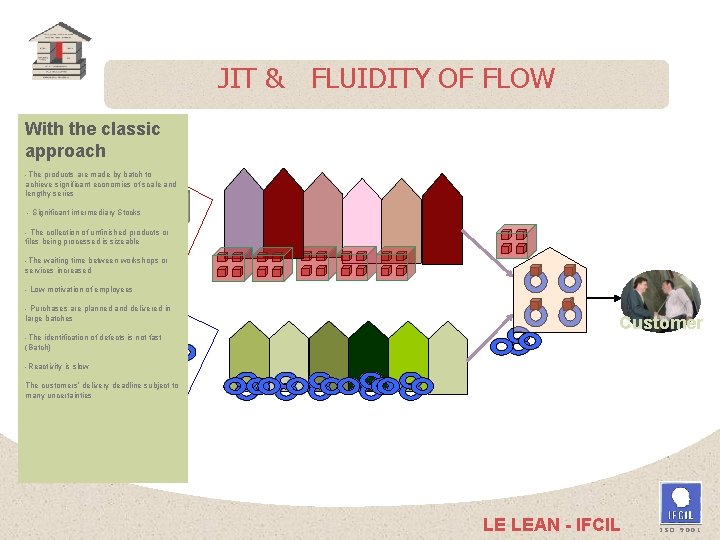
JIT & FLUIDITY OF FLOW With the classic approach -The products are made by batch to achieve significant economies of scale and lengthy series - Significant intermediary Stocks - The collection of unfinished products or files being processed is sizeable -The waiting time between workshops or services increased - Low motivation of employees - Purchases are planned and delivered in large batches -The identification of defects is not fast (Batch) Customer -Reactivity is slow The customers’ delivery deadline subject to many uncertainties LE LEAN - IFCIL ISO 9001
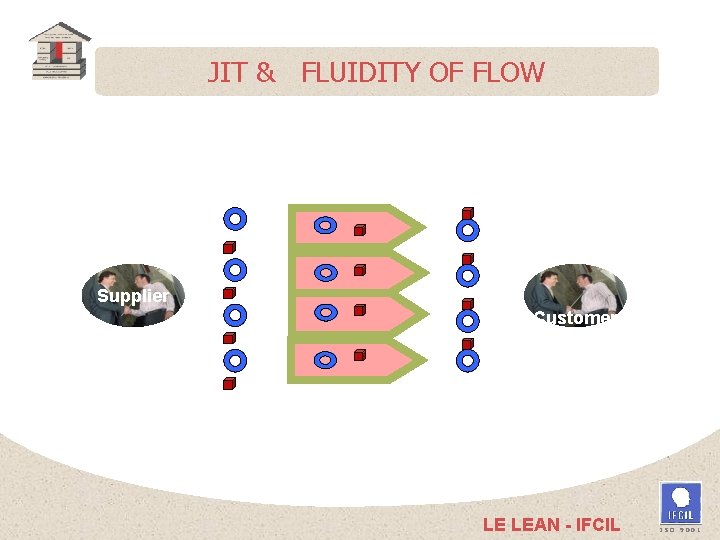
JIT &JAT & FLUIDITE DES FLUX FLUIDITY OF FLOW Supplier Customer LE LEAN - IFCIL ISO 9001
JIT & FLUIDITY OF FLOW The principles which make JIT effective • Produce steadily according to need: the rate of customer orders are directly proportional to the rate of production (Takt time) • Manufacture in small batches • Organise the versatility of a workstation rather than continuously moving from one step to another • Enrich the tasks • Organise the production around units fabricating the finished product or dealing with whole files LE LEAN - IFCIL ISO 9001
JAT & FLUIDITE DES FLUX Thanks to fluidity of flow, managers: • Identify the background problems in the treatment of information • Facilitate teamwork • Reduce time between workshops or services • Remove the actions with no value added • Reduce unnecessary handling between workshops or services LE LEAN - IFCIL ISO 9001
JAT & FLUIDITE DES FLUX Thanks to fluidity of flow, employees : • Understand the contribution of their work to the satisfaction of internal or external customers • Are encouraged to resolve problems immediately and collectively • Are more aware of quality • Are more responsive and aware of their responsibility • Are more versatile • Work better as a team LE LEAN - IFCIL ISO 9001
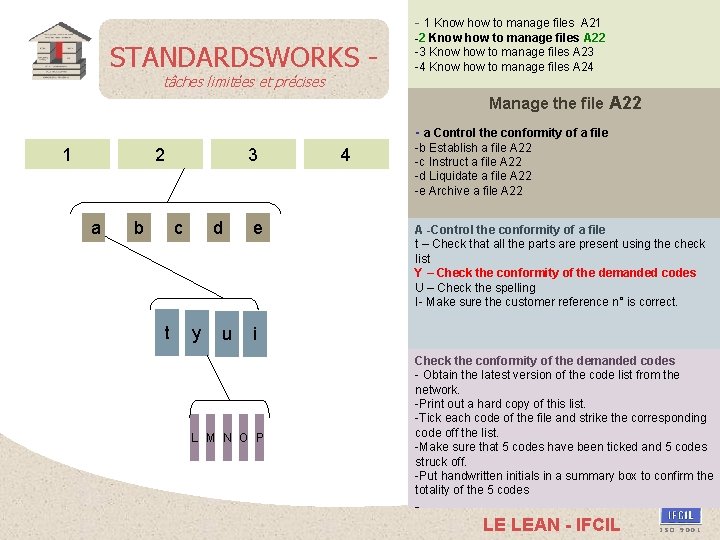
- 1 Know how to manage files A 21 STANDARDSWORKS tâches limitées et précises -2 Know how to manage files A 22 -3 Know how to manage files A 23 -4 Know how to manage files A 24 Manage the file A 22 - a Control the conformity of a file 1 2 a b 3 c t d y u e -b Establish a file A 22 -c Instruct a file A 22 -d Liquidate a file A 22 -e Archive a file A 22 A -Control the conformity of a file t – Check that all the parts are present using the check list Y – Check the conformity of the demanded codes U – Check the spelling I- Make sure the customer reference n° is correct. i L M N O P 1 4 Check the conformity of the demanded codes - Obtain the latest version of the code list from the network. -Print out a hard copy of this list. -Tick each code of the file and strike the corresponding code off the list. -Make sure that 5 codes have been ticked and 5 codes struck off. -Put handwritten initials in a summary box to confirm the totality of the 5 codes - LE LEAN - IFCIL ISO 9001
STANDARDWORKS - (Tasks limited and defined) Works standards allow employees to: • Know exactly how to carry out each task • Have a reference for good practice • Share the same practices as their colleagues. • Have a reference for conformity. • Be based upon a precise formalisation of guidelines that avoid errors LE LEAN - IFCIL ISO 9001
STANDARDWORKS - (Tasks limited and defined) Works standards allow managers to: • Standardize formally the practices expected at workstations. • Train each employee in a precise way. • Master the follow up of the acquisition of know how. • Integrate and monitor new collaborators. LE LEAN - IFCIL ISO 9001
STANDARDSWORKS - (Tasks limited and defined) Works standards allow heads of Human Resources to : • Have task files for each post. • Capitalise on the collective know how on processes. • Improve work practice. • Define training programmes in a precise way. LE LEAN - IFCIL ISO 9001
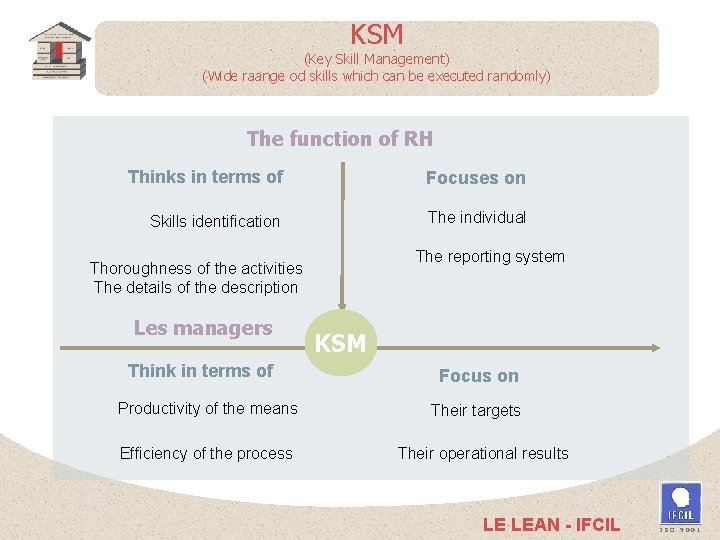
KSM (Key Skill Management) (Wide raange od skills which can be executed randomly) The function of RH Thinks in terms of Focuses on Skills identification The individual The reporting system Thoroughness of the activities The details of the description Les managers Think in terms of Productivity of the means Efficiency of the process KSM Focus on Their targets Their operational results LE LEAN - IFCIL ISO 9001
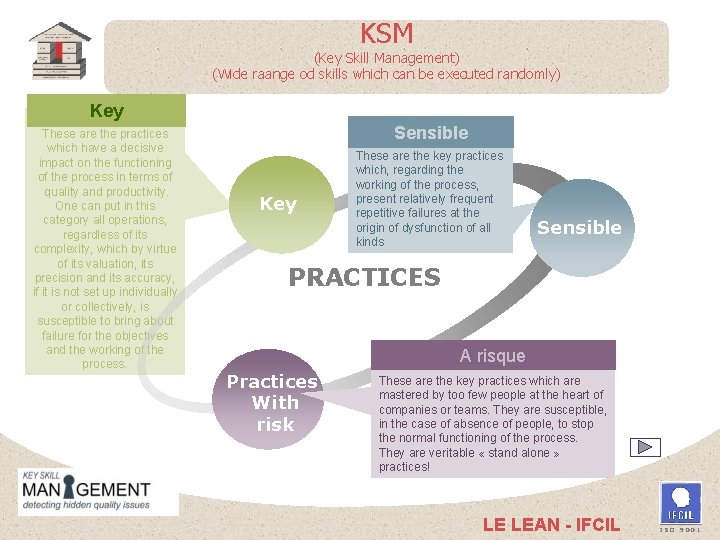
KSM (Key Skill Management) (Wide raange od skills which can be executed randomly) Key These are the practices which have a decisive impact on the functioning of the process in terms of quality and productivity. One can put in this category all operations, regardless of its complexity, which by virtue of its valuation, its precision and its accuracy, if it is not set up individually or collectively, is susceptible to bring about failure for the objectives and the working of the process. Sensible Key These are the key practices which, regarding the working of the process, present relatively frequent repetitive failures at the origin of dysfunction of all kinds Sensible PRACTICES A risque Practices With risk These are the key practices which are mastered by too few people at the heart of companies or teams. They are susceptible, in the case of absence of people, to stop the normal functioning of the process. They are veritable « stand alone » practices! LE LEAN - IFCIL ISO 9001
KSM (Key Skill Management) (Wide raange od skills which can be executed randomly) The KSM approach allows managers to: • Concentrate on the most important practices. • Integrate new collaborators safely • Establish a precise training programme • Recognize key activities linked to quality, productivity and safety. • Carry out annual appraisals which are factual and motivating LE LEAN - IFCIL ISO 9001
KSM (Key Skill Management) (Wide raange od skills which can be executed randomly) The KSM approach gives each employee : • A point of reference for good practice. • A clarification of the practices linked to their skills. • The means to place themselves precisely with respect to their post LE LEAN - IFCIL ISO 9001
KSM (Key Skill Management) (Wide raange od skills which can be executed randomly) The KSM approach allows heads of Human Resources to : • Make the link between their vision and the constraints of managers • Have a point of reference for the integration of temp staff or new collaborators • Situate each post in a practical manner with regards to skills • Give the appraisals a solid and universally recognisable basis LE LEAN - IFCIL ISO 9001
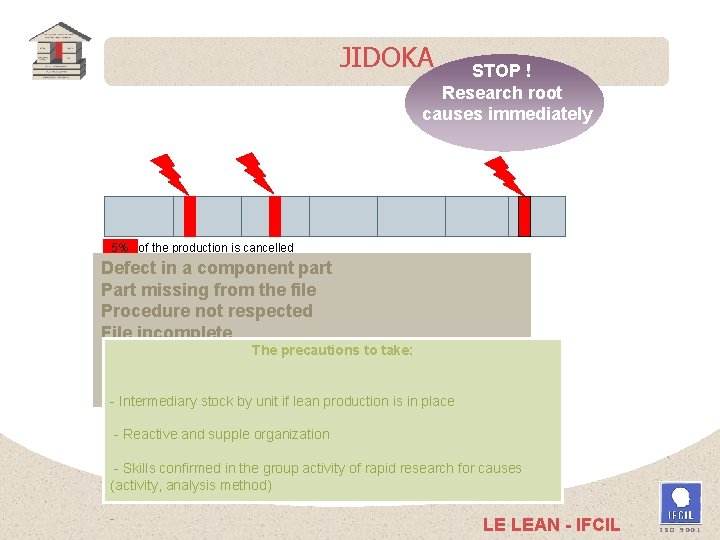
JIDOKA STOP ! Research root causes immediately 5% of the production is cancelled Defect in a component part 5 % of machine time Part missing from the file 10% of personnel time consacrated to rectifying, correcting or redoing Procedure not respected File incomplete The precautions to take: Material not in conformity Errors in the supplied data ETC. - Intermediary stock by unit if lean production is in place - Reactive and supple organization - Skills confirmed in the group activity of rapid research for causes (activity, analysis method) - LE LEAN - IFCIL ISO 9001
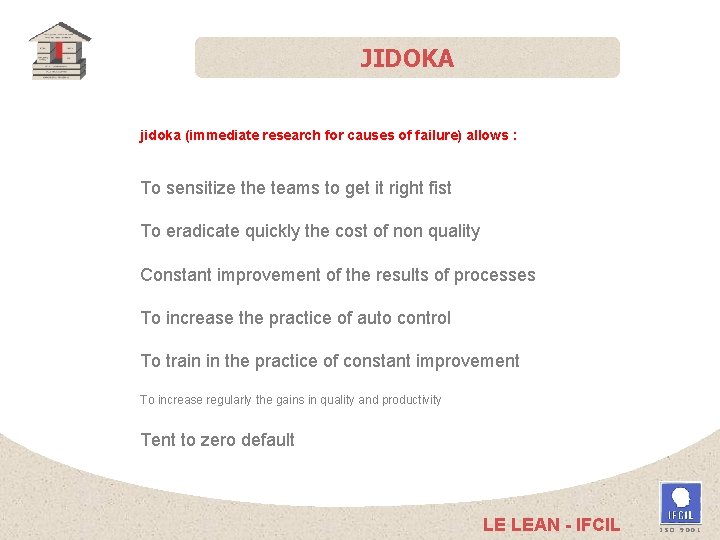
JIDOKA jidoka (immediate research for causes of failure) allows : To sensitize the teams to get it right fist To eradicate quickly the cost of non quality Constant improvement of the results of processes To increase the practice of auto control To train in the practice of constant improvement To increase regularly the gains in quality and productivity Tent to zero default LE LEAN - IFCIL ISO 9001
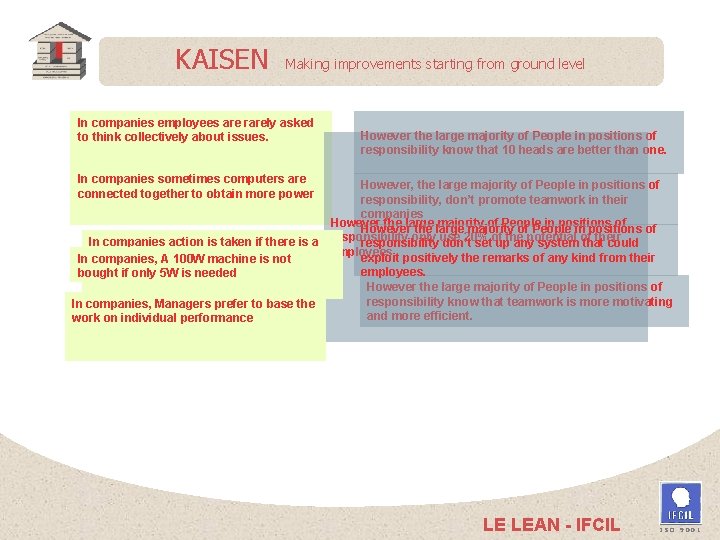
KAISEN Making improvements starting from ground level In companies employees are rarely asked to think collectively about issues. In companies sometimes computers are connected together to obtain more power In companies action is taken if there is a pop-up on the computer screen In warning companies, A 100 W machine is not bought if only 5 W is needed In companies, Managers prefer to base the work on individual performance However the large majority of People in positions of responsibility know that 10 heads are better than one. However, the large majority of People in positions of responsibility, don’t promote teamwork in their companies However the large majority of People in positions of responsibility only use 20% potential their responsibility don’t setof upthe any system of that could employees exploit positively the remarks of any kind from their employees. However the large majority of People in positions of responsibility know that teamwork is more motivating and more efficient. LE LEAN - IFCIL ISO 9001
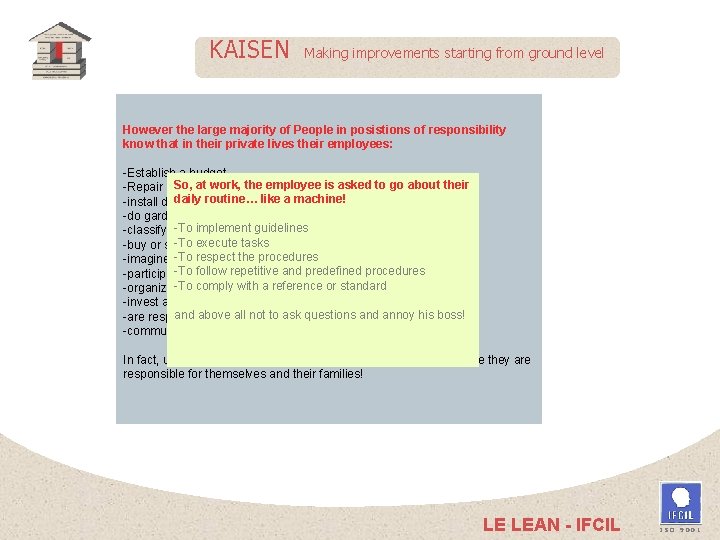
KAISEN Making improvements starting from ground level However the large majority of People in posistions of responsibility know that in their private lives their employees: -Establish a budget So, at work, the employee is asked to go about their -Repair systems more or less complex, daily routine… like a machine! -install devices at home -do gardening or DIY, -To implement guidelines -classify, organize, prepare projects, -To execute tasks -buy or share information, -To respect the procedures -imagine, create, anticipate -To follow repetitive and predefined procedures -participate in or lead associations, -To comply with a reference or standard -organize travel plans -invest and plan, and above all not to ask questions and annoy his boss! -are responsible for their children, -communicate, make decisions, create, In fact, use their brains effectively in a wide range of activities where they are responsible for themselves and their families! LE LEAN - IFCIL ISO 9001
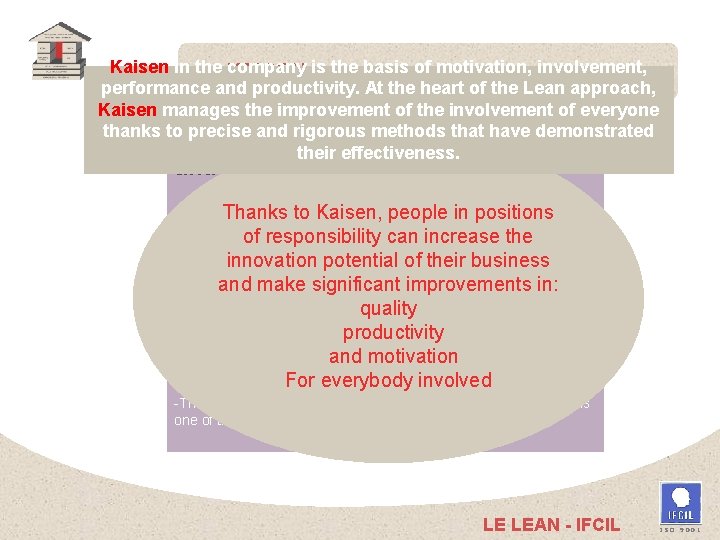
Kaisen in the KAISEN company is the basis of motivation, involvement, - Making improvements starting from ground level performance and productivity. At the heart of the Lean approach, Kaisen manages the improvement of the involvement of everyone thanks to precise and rigorous methods that have demonstrated Le Kaisen answers to this paradox their effectiveness. and rests on 4 principles : Thanks to Kaisen, people in positions -The expertise, intelligence and common sense of the personnel is not being positively used of responsibility can increase the innovation potential of their business -The possibilities of improvement are limitless and make significant improvements in: -Gains in productivity and quality are at the heart of the daily activity quality all day at the workstations productivity -Everyone will be more motivated if they participate in a collective and motivation work that uses all their intelligence and ability to make decisions For everybody involved -The implementation of continuous improvement (KAISEN) for all is one of the primary functions of the chain of command LE LEAN - IFCIL ISO 9001
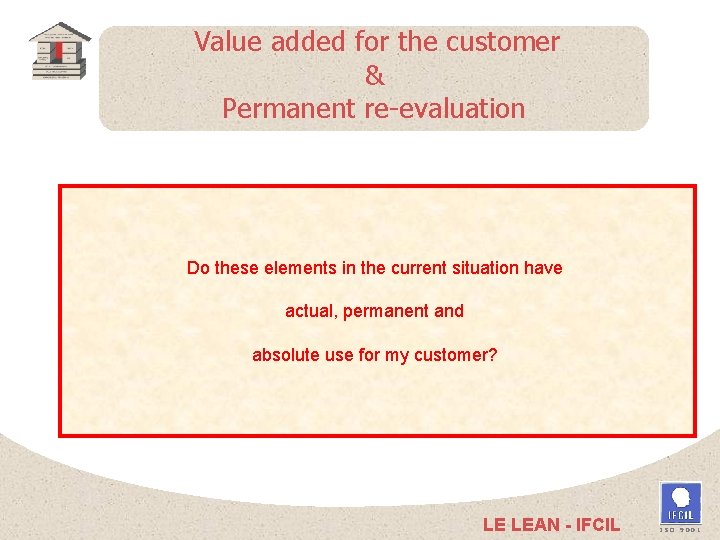
Value added for the customer & Permanent re-evaluation The organization - methods - procedures - the disposition – Do these elements in the current situation have ways of doing - versatility - ranking - storage - locations - circuits – lead time - travel - support - technology - machinery actual, permanent and - equipment - premises - habits - the material - the content – The Service – The Product - Permanently re-evaluate everything absolute use for my customer? LE LEAN - IFCIL ISO 9001
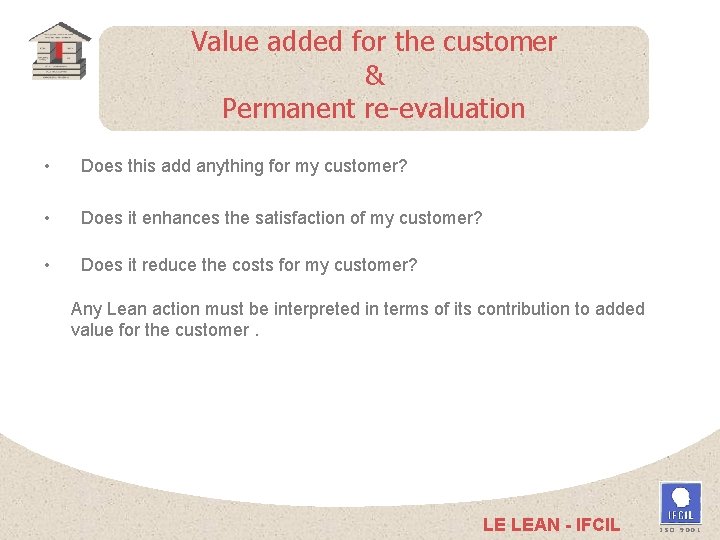
Value added for the customer & Permanent re-evaluation • Does this add anything for my customer? • Does it enhances the satisfaction of my customer? • Does it reduce the costs for my customer? Any Lean action must be interpreted in terms of its contribution to added value for the customer. LE LEAN - IFCIL ISO 9001
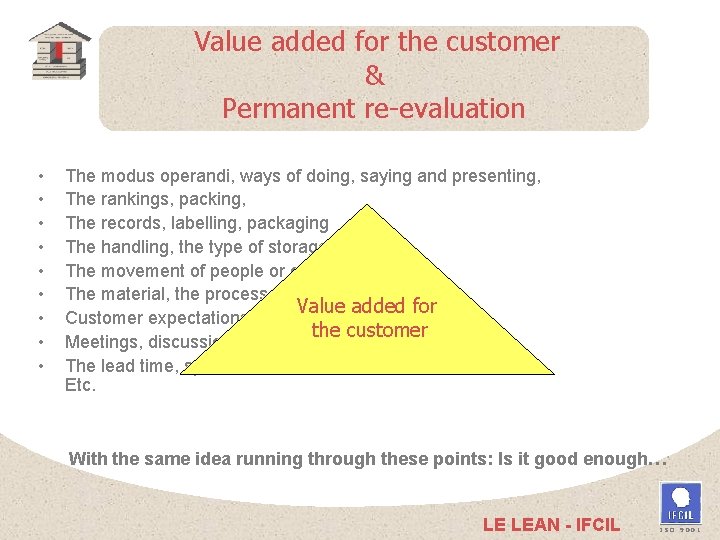
Value added for the customer & Permanent re-evaluation • • • The modus operandi, ways of doing, saying and presenting, The rankings, packing, The records, labelling, packaging The handling, the type of storage The movement of people or objects The material, the process Value added for Customer expectations the customer Meetings, discussions, information means The lead time, specifications Etc. With the same idea running through these points: Is it good enough… LE LEAN - IFCIL ISO 9001
VALUE ADDED & RE-EVALUATION JIDOKA STANDAR DS WORKS KAISEN K. S. M. JIT & FLUIDITY of FLOW VALUE STREAM MAPPING PROCESS MANAGEMENT LE LEAN - IFCIL ISO 9001
An explanation of Lean for SMEs THE END LE LEAN - IFCIL ISO 9001
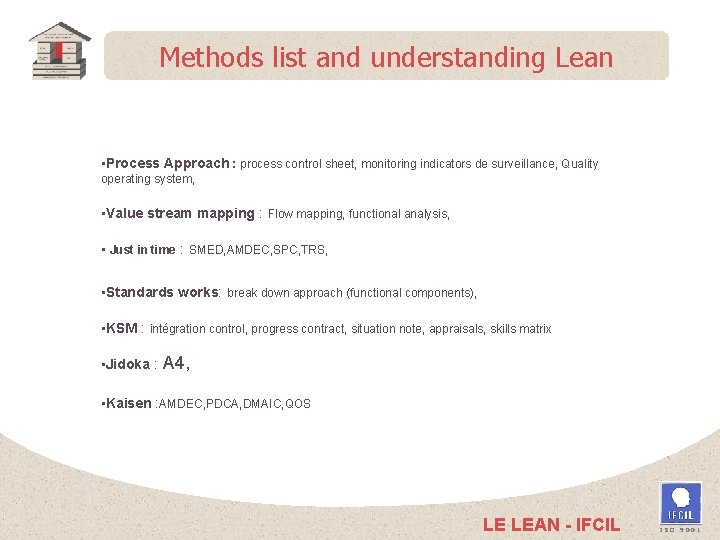
Methods list and understanding Lean • Process Approach : process control sheet, monitoring indicators de surveillance, Quality operating system, • Value stream mapping : Flow mapping, functional analysis, • Just in time : SMED, AMDEC, SPC, TRS, • Standards works: break down approach (functional components), • KSM : intégration control, progress contract, situation note, appraisals, skills matrix • Jidoka : A 4, • Kaisen : AMDEC, PDCA, DMAIC, QOS LE LEAN - IFCIL ISO 9001
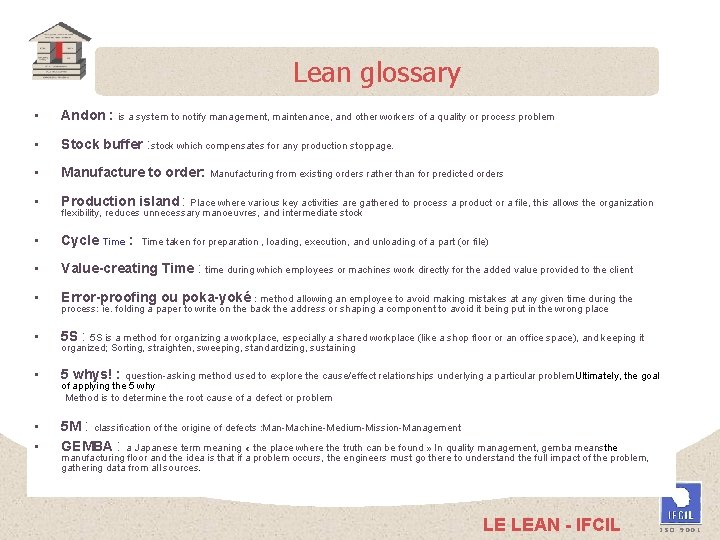
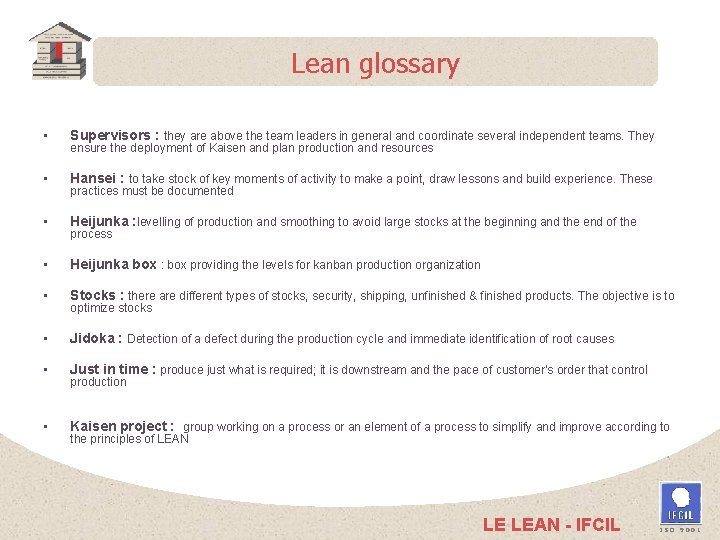
Lean glossary • Andon : is a system to notify management, maintenance, and other workers of a quality or process problem • Stock buffer : stock which compensates for any production stoppage. • Manufacture to order: Manufacturing from existing orders rather than for predicted orders • Production island : Place where various key activities are gathered to process a product or a file, this allows the organization • Cycle Time : • Value-creating Time : time during which employees or machines work directly for the added value provided to the client • Error-proofing ou poka-yoké : method allowing an employee to avoid making mistakes at any given time during the • 5 S : 5 S is a method for organizing a workplace, especially a shared workplace (like a shop floor or an office space), and keeping it • 5 whys! : question-asking method used to explore the cause/effect relationships underlying a particular problem Ultimately, the goal • • 5 M : classification of the origine of defects : Man-Machine-Medium-Mission-Management GEMBA : a Japanese term meaning « the place where the truth can be found » In quality management, gemba means the flexibility, reduces unnecessary manoeuvres, and intermediate stock Time taken for preparation , loading, execution, and unloading of a part (or file) process: ie. folding a paper to write on the back the address or shaping a component to avoid it being put in the wrong place organized; Sorting, straighten, sweeping, standardizing, sustaining of applying the 5 why Method is to determine the root cause of a defect or problem manufacturing floor and the idea is that if a problem occurs, the engineers must go there to understand the full impact of the problem, gathering data from all sources. LE LEAN - IFCIL ISO 9001
Lean glossary • Supervisors : they are above the team leaders in general and coordinate several independent teams. They • Hansei : to take stock of key moments of activity to make a point, draw lessons and build experience. These • Heijunka : levelling of production and smoothing to avoid large stocks at the beginning and the end of the • Heijunka box : box providing the levels for kanban production organization • Stocks : there are different types of stocks, security, shipping, unfinished & finished products. The objective is to • Jidoka : Detection of a defect during the production cycle and immediate identification of root causes • Just in time : produce just what is required; it is downstream and the pace of customer's order that control • Kaisen project : group working on a process or an element of a process to simplify and improve according to ensure the deployment of Kaisen and plan production and resources practices must be documented process optimize stocks production the principles of LEAN LE LEAN - IFCIL ISO 9001
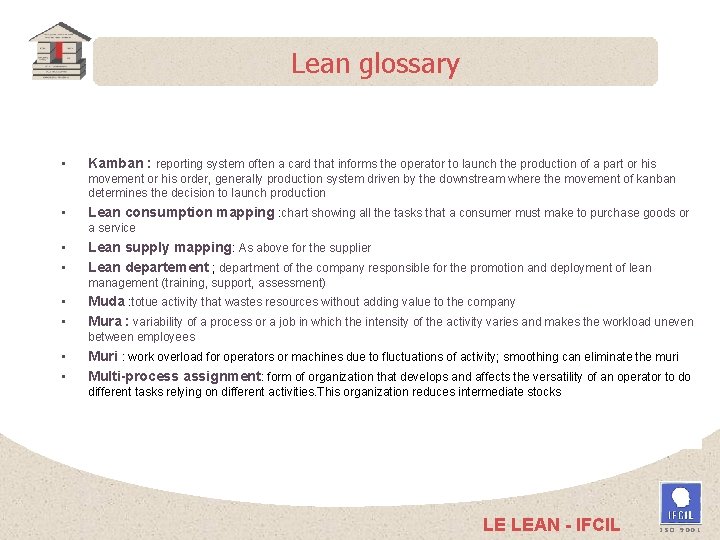
Lean glossary • Kamban : reporting system often a card that informs the operator to launch the production of a part or his movement or his order, generally production system driven by the downstream where the movement of kanban determines the decision to launch production • Lean consumption mapping : chart showing all the tasks that a consumer must make to purchase goods or a service • • Lean supply mapping: As above for the supplier Lean departement ; department of the company responsible for the promotion and deployment of lean management (training, support, assessment) • • Muda : totue activity that wastes resources without adding value to the company Mura : variability of a process or a job in which the intensity of the activity varies and makes the workload uneven between employees • • Muri : work overload for operators or machines due to fluctuations of activity; smoothing can eliminate the muri Multi-process assignment: form of organization that develops and affects the versatility of an operator to do different tasks relying on different activities. This organization reduces intermediate stocks LE LEAN - IFCIL ISO 9001
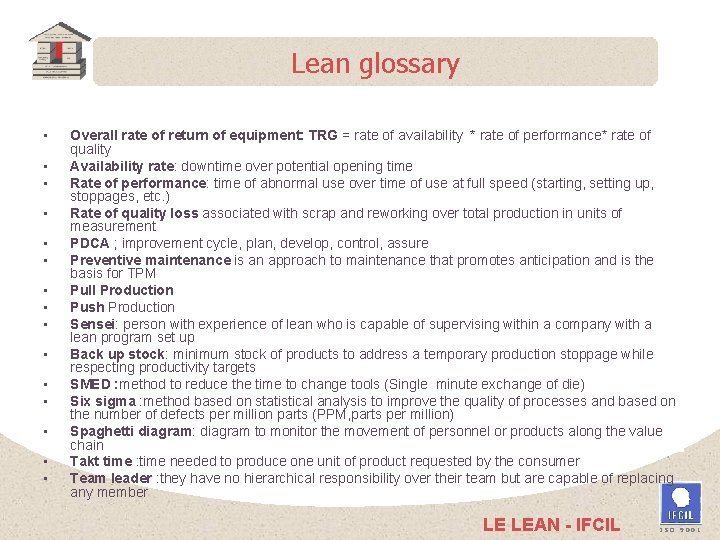
Lean glossary • • • • Overall rate of return of equipment: TRG = rate of availability * rate of performance* rate of quality Availability rate: downtime over potential opening time Rate of performance: time of abnormal use over time of use at full speed (starting, setting up, stoppages, etc. ) Rate of quality loss associated with scrap and reworking over total production in units of measurement PDCA ; improvement cycle, plan, develop, control, assure Preventive maintenance is an approach to maintenance that promotes anticipation and is the basis for TPM Pull Production Push Production Sensei: person with experience of lean who is capable of supervising within a company with a lean program set up Back up stock: minimum stock of products to address a temporary production stoppage while respecting productivity targets SMED : method to reduce the time to change tools (Single minute exchange of die) Six sigma : method based on statistical analysis to improve the quality of processes and based on the number of defects per million parts (PPM, parts per million) Spaghetti diagram: diagram to monitor the movement of personnel or products along the value chain Takt time : time needed to produce one unit of product requested by the consumer Team leader : they have no hierarchical responsibility over their team but are capable of replacing any member LE LEAN - IFCIL ISO 9001
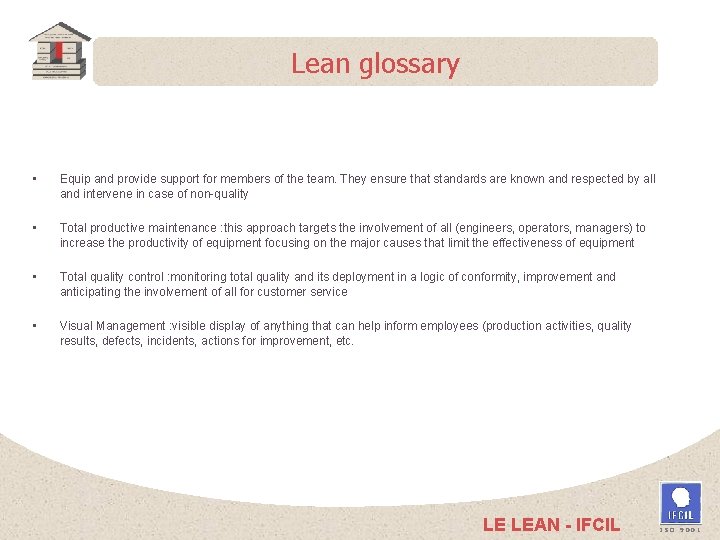
Lean glossary • Equip and provide support for members of the team. They ensure that standards are known and respected by all and intervene in case of non-quality • Total productive maintenance : this approach targets the involvement of all (engineers, operators, managers) to increase the productivity of equipment focusing on the major causes that limit the effectiveness of equipment • Total quality control : monitoring total quality and its deployment in a logic of conformity, improvement and anticipating the involvement of all for customer service • Visual Management : visible display of anything that can help inform employees (production activities, quality results, defects, incidents, actions for improvement, etc. LE LEAN - IFCIL ISO 9001