Algorithmic and Numerical Techniques for Atomistic Modeling Hasan

- Slides: 46
Algorithmic and Numerical Techniques for Atomistic Modeling Hasan Metin Aktulga Ph. D Thesis Defense June 23 rd, 2010
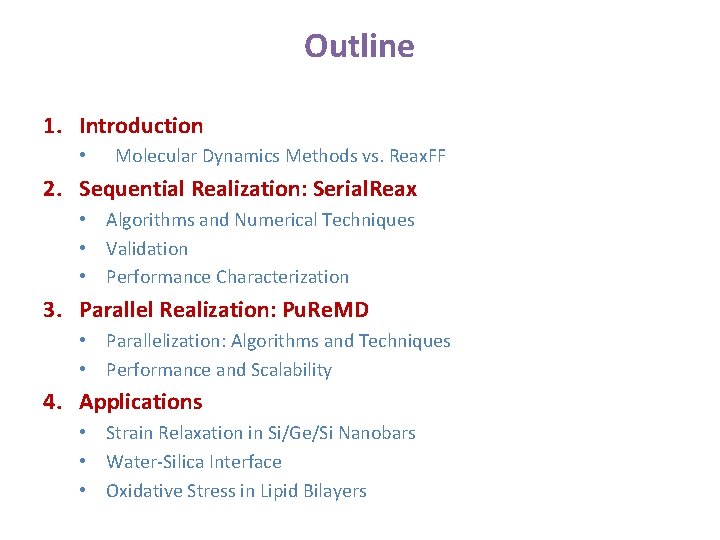
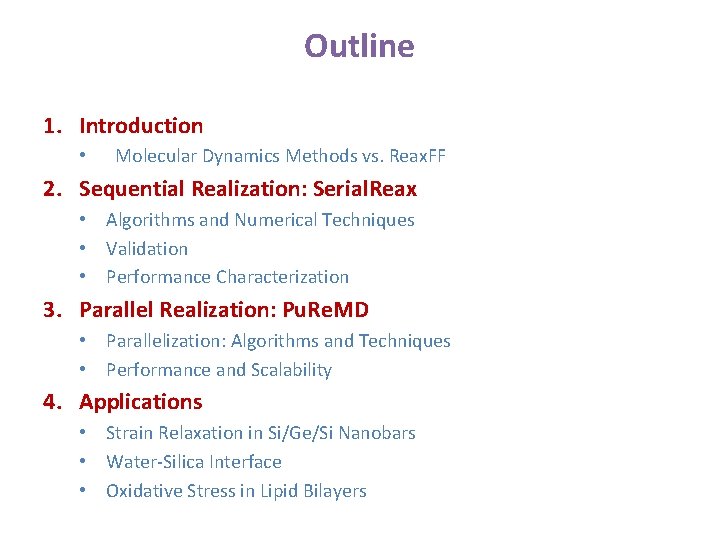
Outline 1. Introduction • Molecular Dynamics Methods vs. Reax. FF 2. Sequential Realization: Serial. Reax • Algorithms and Numerical Techniques • Validation • Performance Characterization 3. Parallel Realization: Pu. Re. MD • Parallelization: Algorithms and Techniques • Performance and Scalability 4. Applications • Strain Relaxation in Si/Ge/Si Nanobars • Water-Silica Interface • Oxidative Stress in Lipid Bilayers
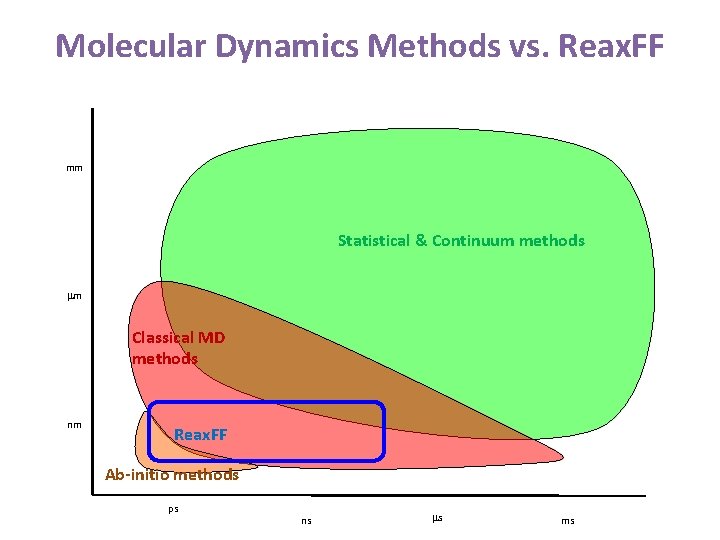
Molecular Dynamics Methods vs. Reax. FF mm Statistical & Continuum methods m Classical MD methods nm Reax. FF Ab-initio methods ps ns s ms
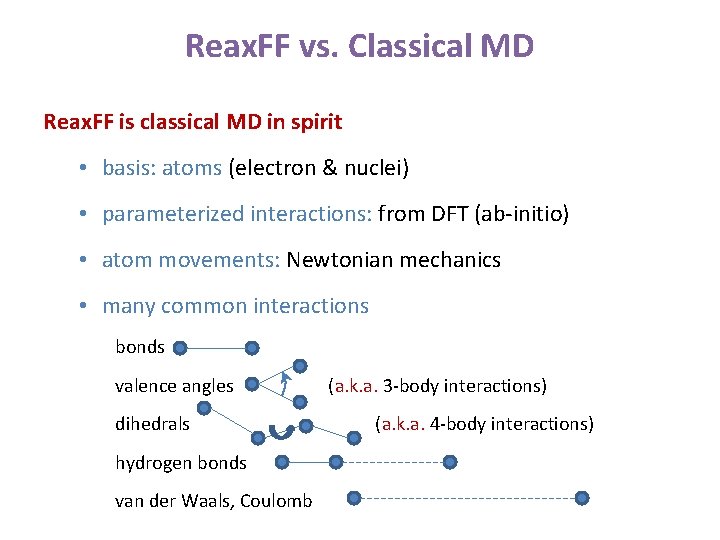
Reax. FF vs. Classical MD Reax. FF is classical MD in spirit • basis: atoms (electron & nuclei) • parameterized interactions: from DFT (ab-initio) • atom movements: Newtonian mechanics • many common interactions bonds valence angles dihedrals hydrogen bonds van der Waals, Coulomb (a. k. a. 3 -body interactions) (a. k. a. 4 -body interactions)
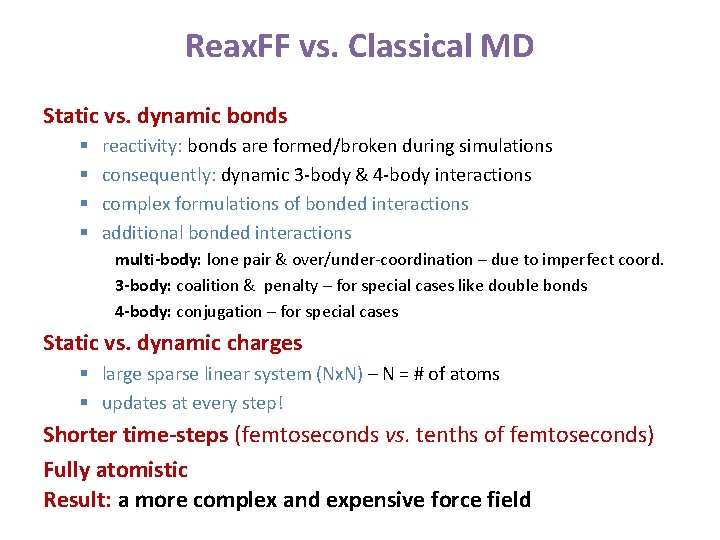
Reax. FF vs. Classical MD Static vs. dynamic bonds § § reactivity: bonds are formed/broken during simulations consequently: dynamic 3 -body & 4 -body interactions complex formulations of bonded interactions additional bonded interactions multi-body: lone pair & over/under-coordination – due to imperfect coord. 3 -body: coalition & penalty – for special cases like double bonds 4 -body: conjugation – for special cases Static vs. dynamic charges § large sparse linear system (Nx. N) – N = # of atoms § updates at every step! Shorter time-steps (femtoseconds vs. tenths of femtoseconds) Fully atomistic Result: a more complex and expensive force field
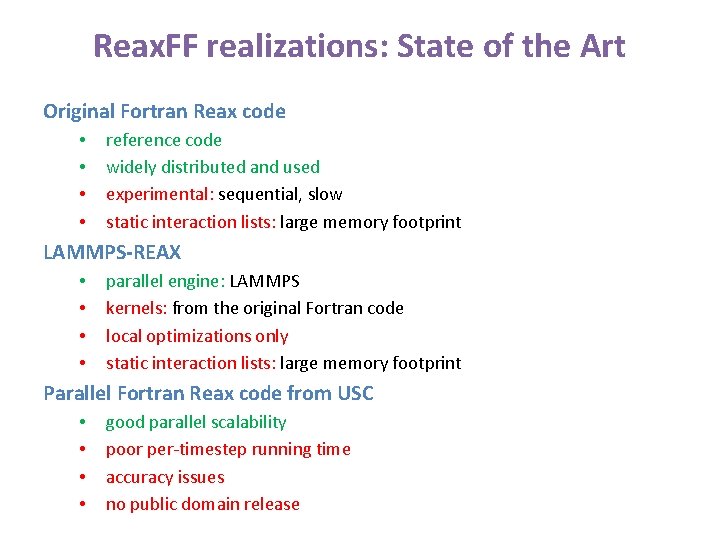
Reax. FF realizations: State of the Art Original Fortran Reax code • • reference code widely distributed and used experimental: sequential, slow static interaction lists: large memory footprint LAMMPS-REAX • • parallel engine: LAMMPS kernels: from the original Fortran code local optimizations only static interaction lists: large memory footprint Parallel Fortran Reax code from USC • • good parallel scalability poor per-timestep running time accuracy issues no public domain release
Outline 1. Introduction • Molecular Dynamics Methods vs. Reax. FF 2. Sequential Realization: Serial. Reax • Algorithms and Numerical Techniques • Validation • Performance Characterization 3. Parallel Realization: Pu. Re. MD • Parallelization: Algorithms and Techniques • Performance and Scalability 4. Applications • Strain Relaxation in Si/Ge/Si Nanobars • Water-Silica Interface • Oxidative Stress in Lipid Bilayers
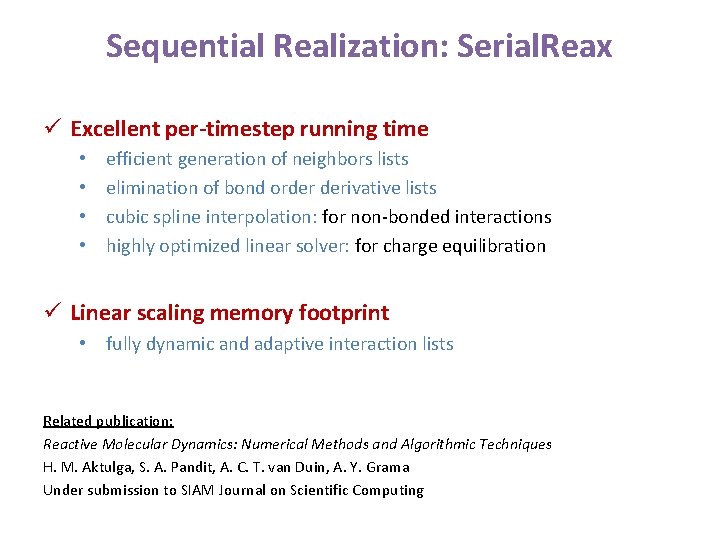
Sequential Realization: Serial. Reax ü Excellent per-timestep running time • • efficient generation of neighbors lists elimination of bond order derivative lists cubic spline interpolation: for non-bonded interactions highly optimized linear solver: for charge equilibration ü Linear scaling memory footprint • fully dynamic and adaptive interaction lists Related publication: Reactive Molecular Dynamics: Numerical Methods and Algorithmic Techniques H. M. Aktulga, S. A. Pandit, A. C. T. van Duin, A. Y. Grama Under submission to SIAM Journal on Scientific Computing
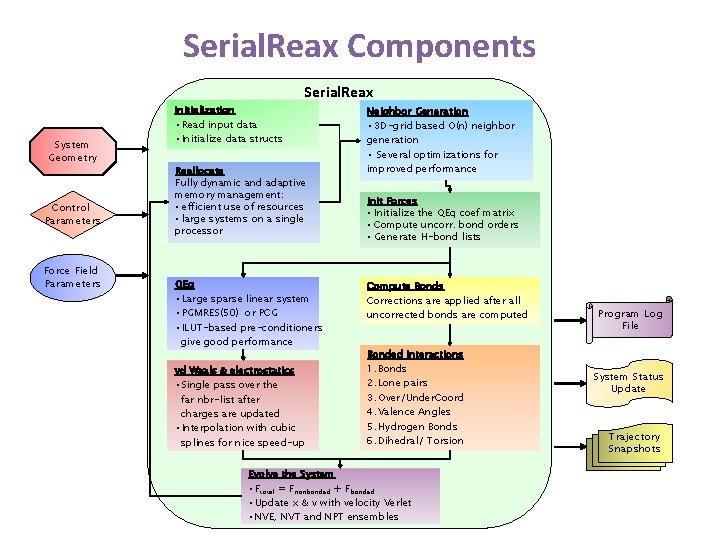
Serial. Reax Components Serial. Reax System Geometry Control Parameters Force Field Parameters Initialization • Read input data • Initialize data structs Reallocate Fully dynamic and adaptive memory management: • efficient use of resources • large systems on a single processor QEq • Large sparse linear system • PGMRES(50) or PCG • ILUT-based pre-conditioners give good performance vd Waals & electrostatics • Single pass over the far nbr-list after charges are updated • Interpolation with cubic splines for nice speed-up Neighbor Generation • 3 D-grid based O(n) neighbor generation • Several optimizations for improved performance Init Forces • Initialize the QEq coef matrix • Compute uncorr. bond orders • Generate H-bond lists Compute Bonds Corrections are applied after all uncorrected bonds are computed Bonded Interactions 1. Bonds 2. Lone pairs 3. Over/Under. Coord 4. Valence Angles 5. Hydrogen Bonds 6. Dihedral/ Torsion Evolve the System • Ftotal = Fnonbonded + Fbonded • Update x & v with velocity Verlet • NVE, NVT and NPT ensembles Program Log File System Status Update Trajectory Snapshots
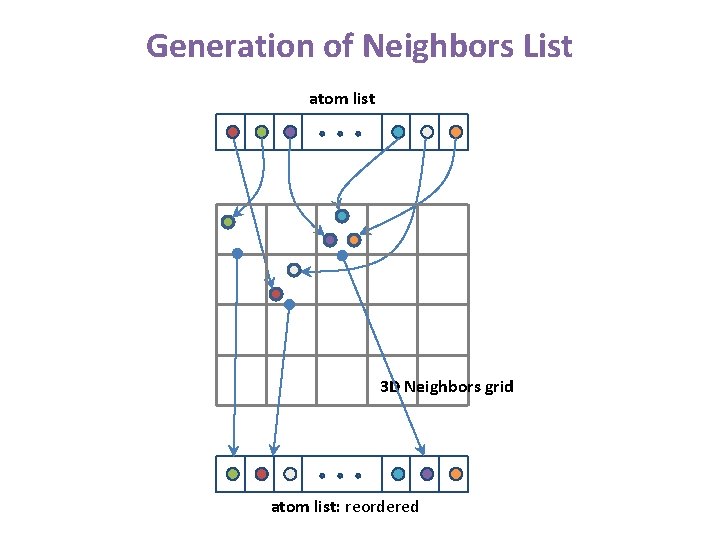
Generation of Neighbors List atom list 3 D Neighbors grid atom list: reordered
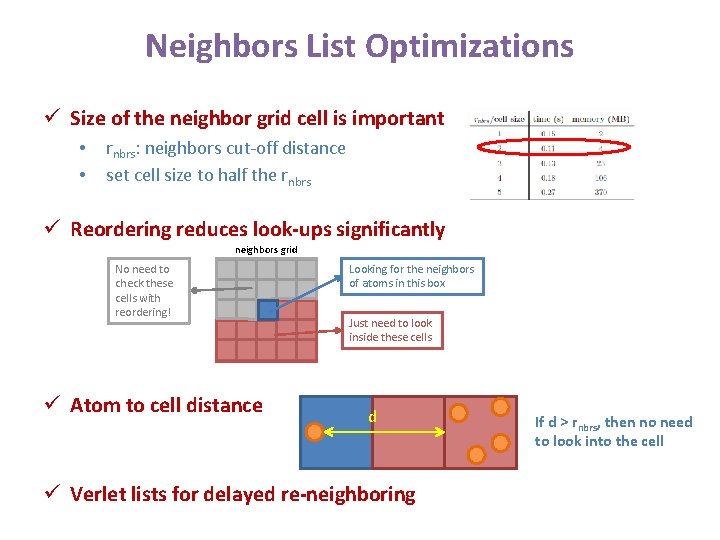
Neighbors List Optimizations ü Size of the neighbor grid cell is important • • rnbrs: neighbors cut-off distance set cell size to half the rnbrs ü Reordering reduces look-ups significantly neighbors grid No need to check these cells with reordering! ü Atom to cell distance Looking for the neighbors of atoms in this box Just need to look inside these cells d ü Verlet lists for delayed re-neighboring If d > rnbrs, then no need to look into the cell
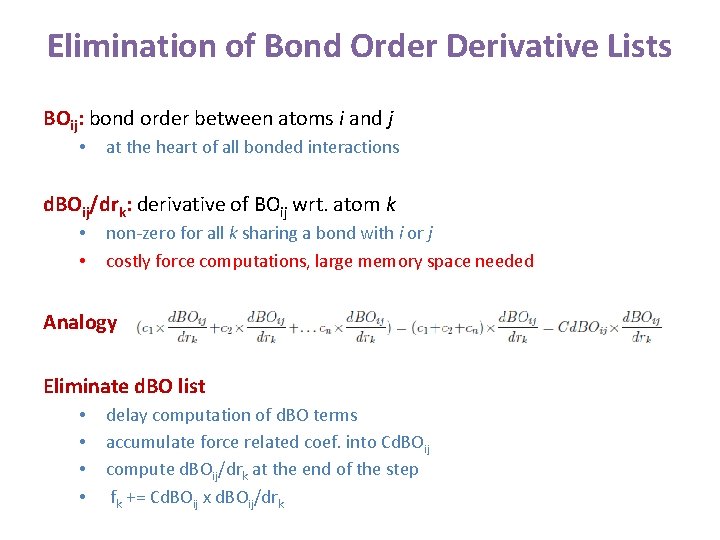
Elimination of Bond Order Derivative Lists BOij: bond order between atoms i and j • at the heart of all bonded interactions d. BOij/drk: derivative of BOij wrt. atom k • • non-zero for all k sharing a bond with i or j costly force computations, large memory space needed Analogy Eliminate d. BO list • • delay computation of d. BO terms accumulate force related coef. into Cd. BOij compute d. BOij/drk at the end of the step fk += Cd. BOij x d. BOij/drk
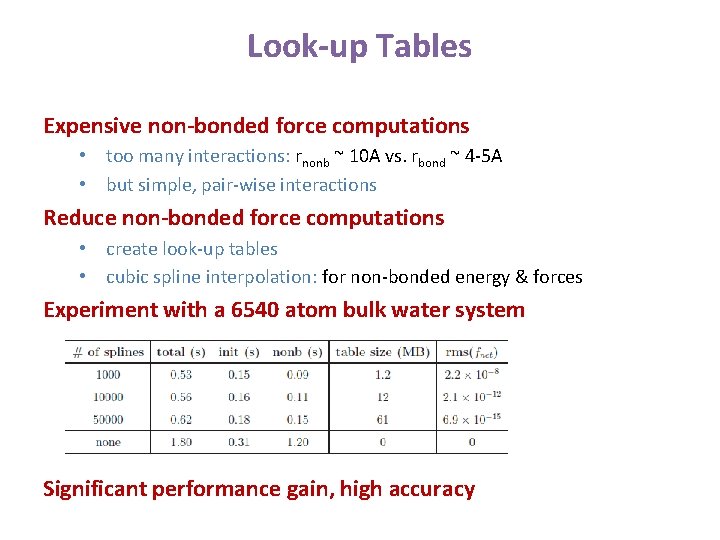
Look-up Tables Expensive non-bonded force computations • too many interactions: rnonb ~ 10 A vs. rbond ~ 4 -5 A • but simple, pair-wise interactions Reduce non-bonded force computations • create look-up tables • cubic spline interpolation: for non-bonded energy & forces Experiment with a 6540 atom bulk water system Significant performance gain, high accuracy
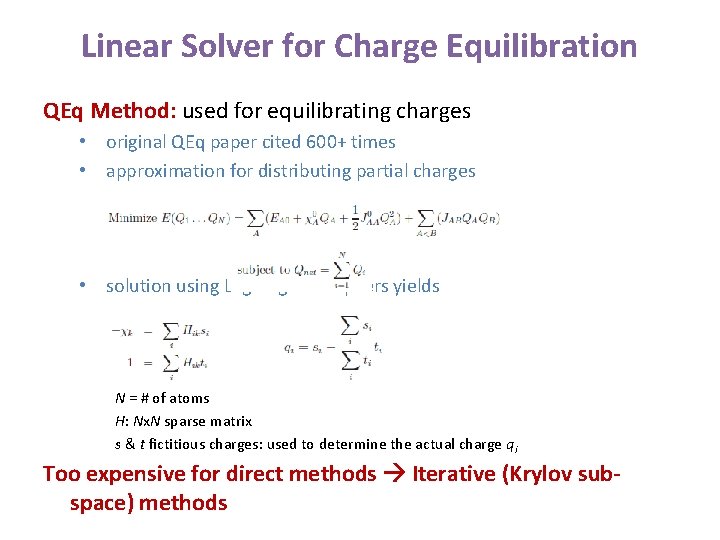
Linear Solver for Charge Equilibration QEq Method: used for equilibrating charges • original QEq paper cited 600+ times • approximation for distributing partial charges • solution using Lagrange multipliers yields N = # of atoms H: Nx. N sparse matrix s & t fictitious charges: used to determine the actual charge qi Too expensive for direct methods Iterative (Krylov subspace) methods
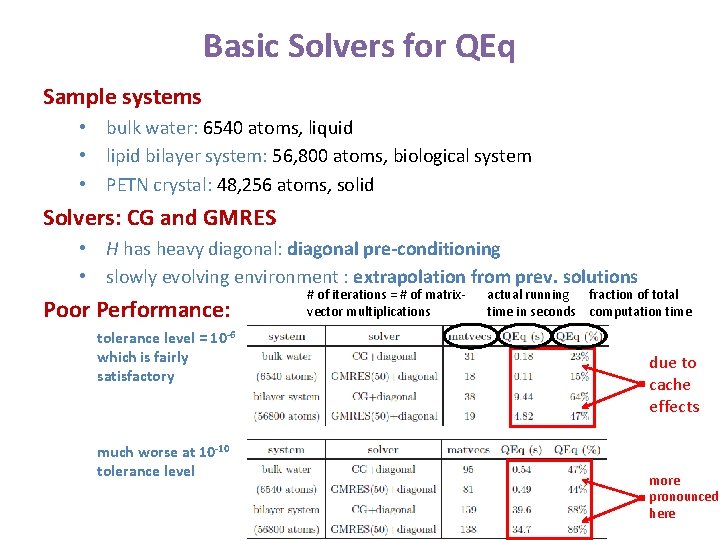
Basic Solvers for QEq Sample systems • bulk water: 6540 atoms, liquid • lipid bilayer system: 56, 800 atoms, biological system • PETN crystal: 48, 256 atoms, solid Solvers: CG and GMRES • H has heavy diagonal: diagonal pre-conditioning • slowly evolving environment : extrapolation from prev. solutions Poor Performance: tolerance level = 10 -6 which is fairly satisfactory much worse at 10 -10 tolerance level # of iterations = # of matrixvector multiplications actual running fraction of total time in seconds computation time due to cache effects more pronounced here
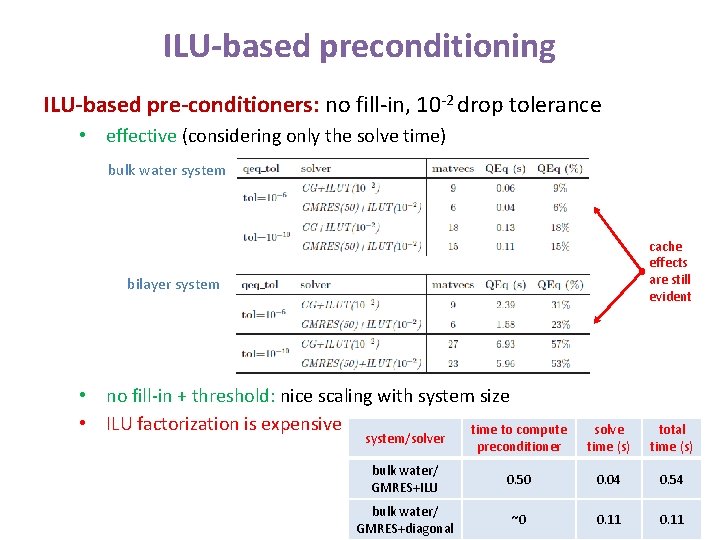
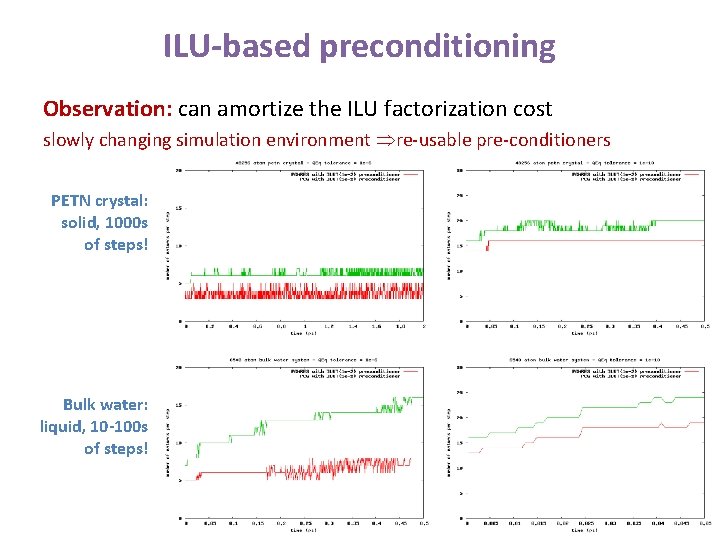
ILU-based preconditioning ILU-based pre-conditioners: no fill-in, 10 -2 drop tolerance • effective (considering only the solve time) bulk water system cache effects are still evident bilayer system • no fill-in + threshold: nice scaling with system size • ILU factorization is expensive time to compute preconditioner solve time (s) total time (s) bulk water/ GMRES+ILU 0. 50 0. 04 0. 54 bulk water/ GMRES+diagonal ~0 0. 11 system/solver
ILU-based preconditioning Observation: can amortize the ILU factorization cost slowly changing simulation environment re-usable pre-conditioners PETN crystal: solid, 1000 s of steps! Bulk water: liquid, 10 -100 s of steps!
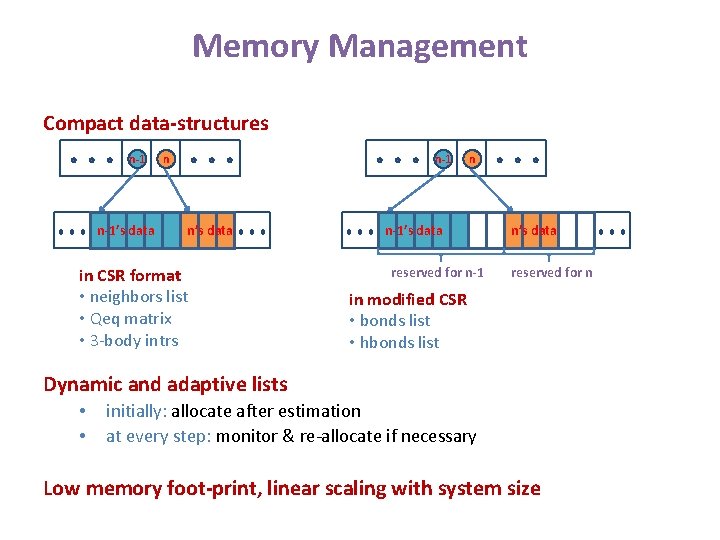
Memory Management Compact data-structures n-1’s data n n-1 n’s data in CSR format • neighbors list • Qeq matrix • 3 -body intrs n n-1’s data reserved for n-1 n’s data reserved for n in modified CSR • bonds list • hbonds list Dynamic and adaptive lists • • initially: allocate after estimation at every step: monitor & re-allocate if necessary Low memory foot-print, linear scaling with system size
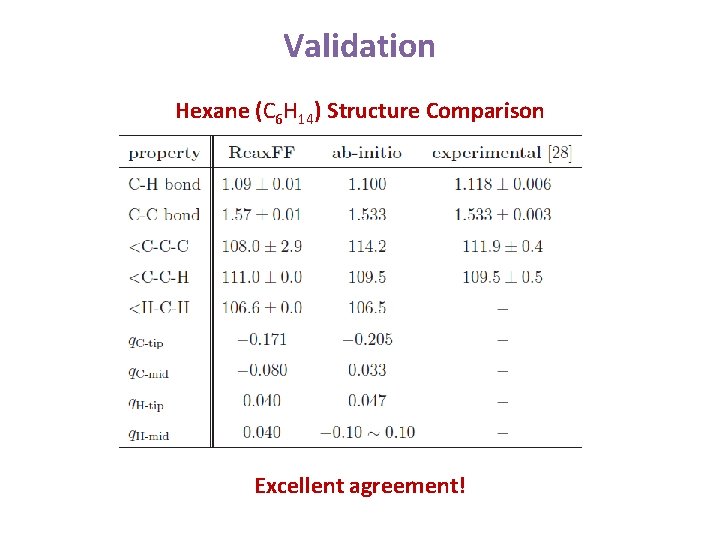
Validation Hexane (C 6 H 14) Structure Comparison Excellent agreement!
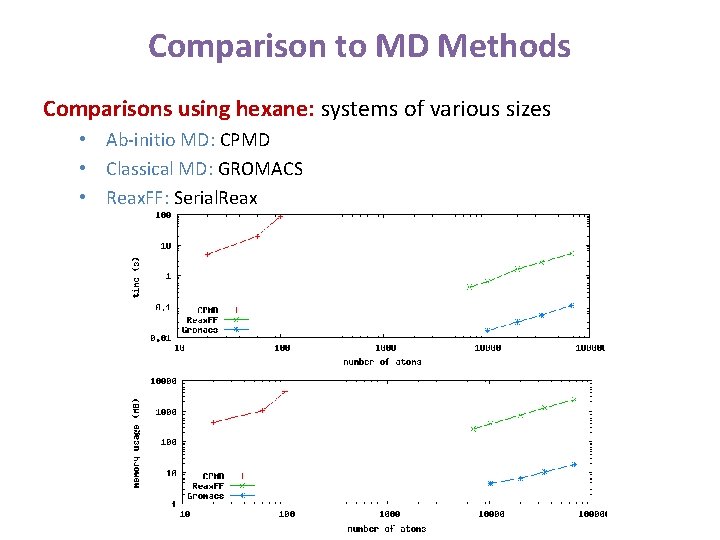
Comparison to MD Methods Comparisons using hexane: systems of various sizes • Ab-initio MD: CPMD • Classical MD: GROMACS • Reax. FF: Serial. Reax
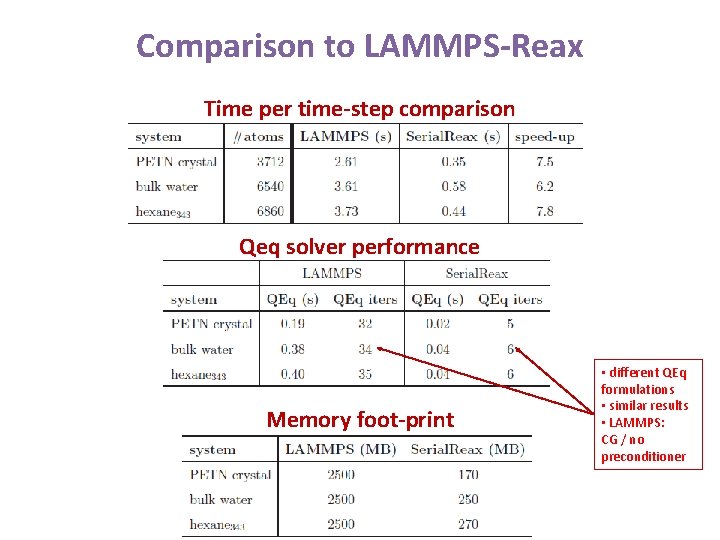
Comparison to LAMMPS-Reax Time per time-step comparison Qeq solver performance Memory foot-print • different QEq formulations • similar results • LAMMPS: CG / no preconditioner
Outline 1. Introduction • Molecular Dynamics Methods vs. Reax. FF 2. Sequential Realization: Serial. Reax • Algorithms and Numerical Techniques • Validation • Performance Characterization 3. Parallel Realization: Pu. Re. MD • Parallelization: Algorithms and Techniques • Performance and Scalability 4. Applications • Strain Relaxation in Si/Ge/Si Nanobars • Water-Silica Interface • Oxidative Stress in Lipid Bilayers
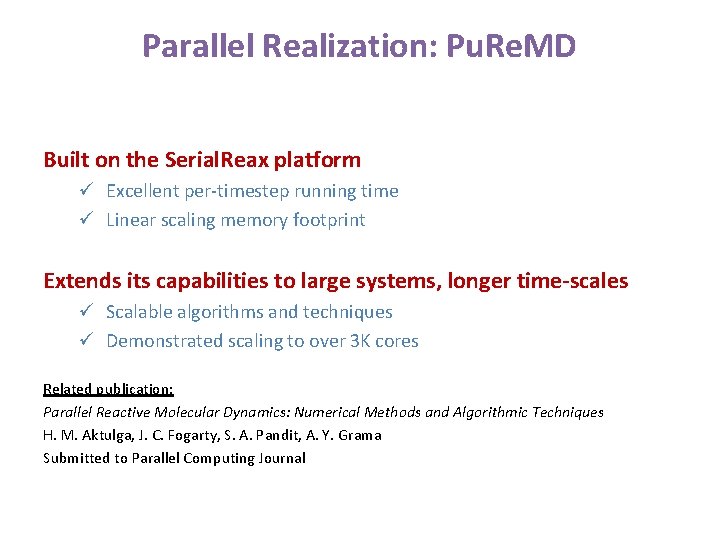
Parallel Realization: Pu. Re. MD Built on the Serial. Reax platform ü Excellent per-timestep running time ü Linear scaling memory footprint Extends its capabilities to large systems, longer time-scales ü Scalable algorithms and techniques ü Demonstrated scaling to over 3 K cores Related publication: Parallel Reactive Molecular Dynamics: Numerical Methods and Algorithmic Techniques H. M. Aktulga, J. C. Fogarty, S. A. Pandit, A. Y. Grama Submitted to Parallel Computing Journal
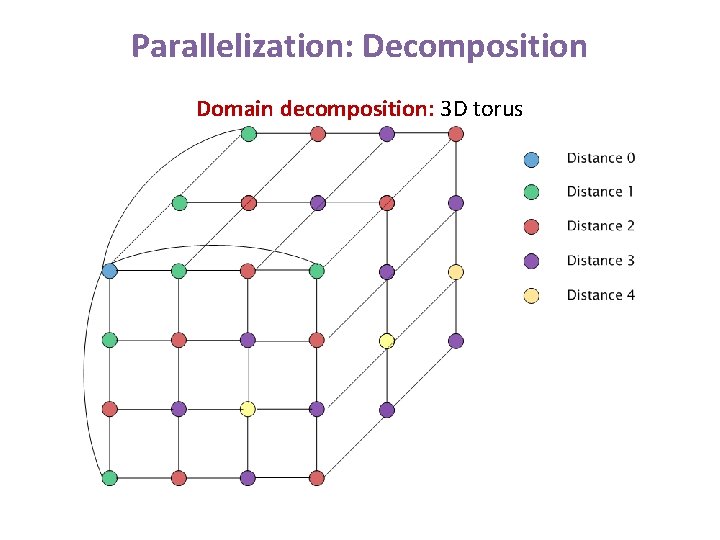
Parallelization: Decomposition Domain decomposition: 3 D torus
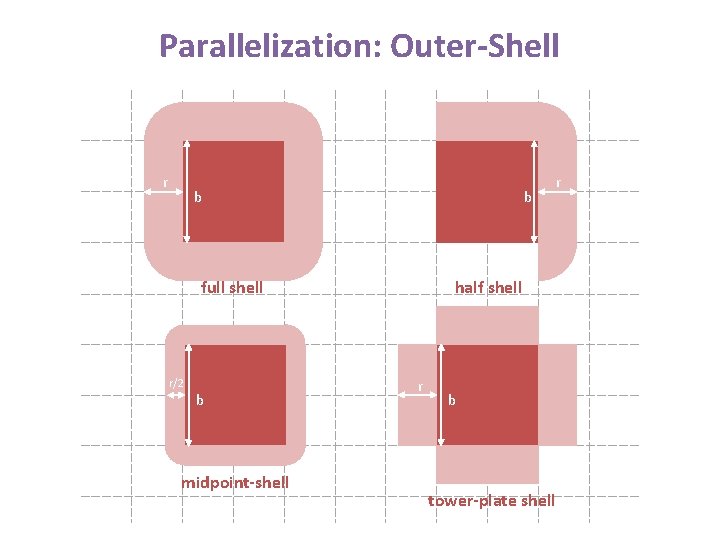
Parallelization: Outer-Shell r b b full shell r/2 b midpoint-shell half shell r b tower-plate shell r
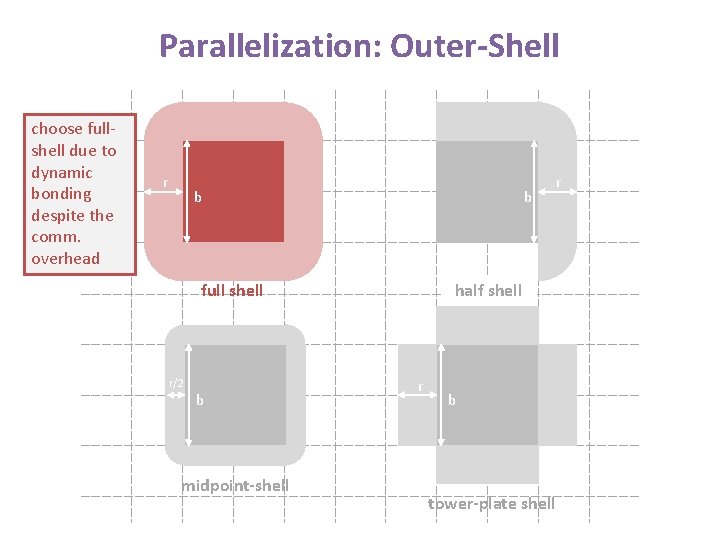
Parallelization: Outer-Shell choose fullshell due to dynamic bonding despite the comm. overhead r b b full shell r/2 b midpoint-shell half shell r b tower-plate shell r
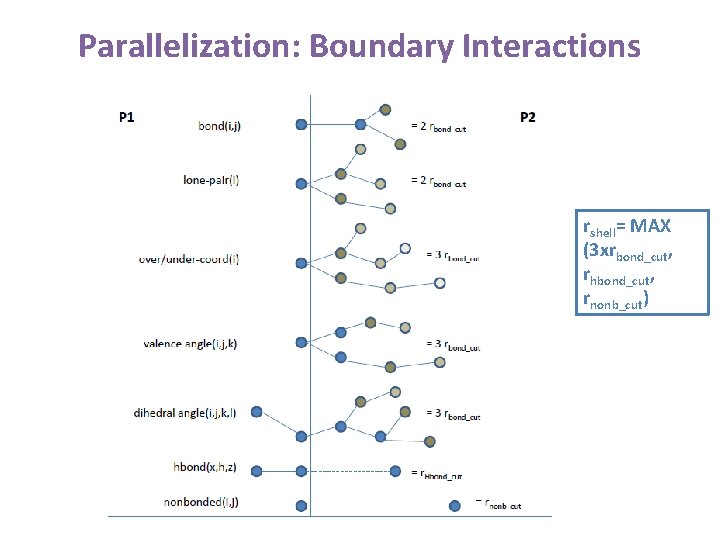
Parallelization: Boundary Interactions rshell= MAX (3 xrbond_cut, rhbond_cut, rnonb_cut)
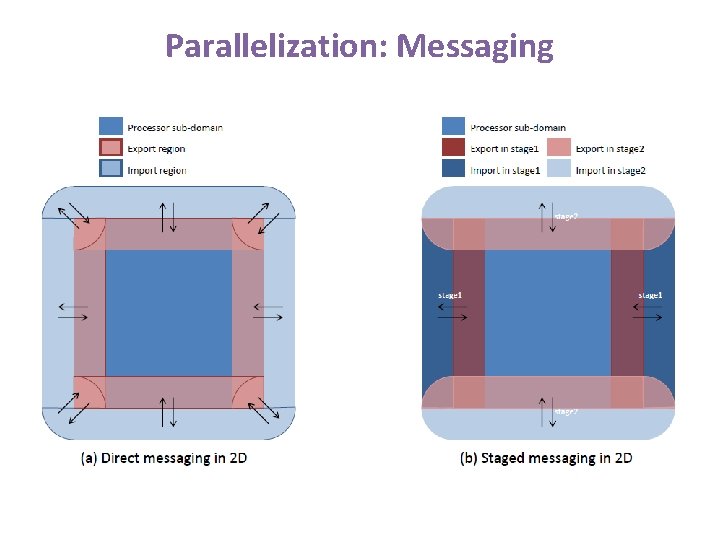
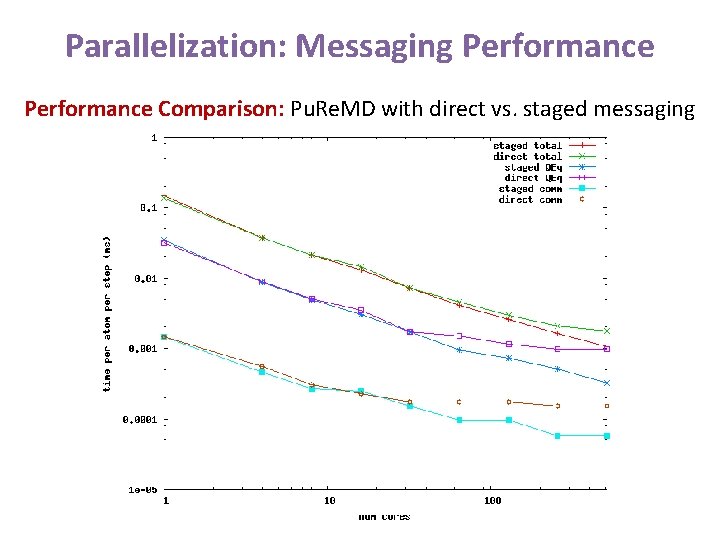
Parallelization: Messaging
Parallelization: Messaging Performance Comparison: Pu. Re. MD with direct vs. staged messaging
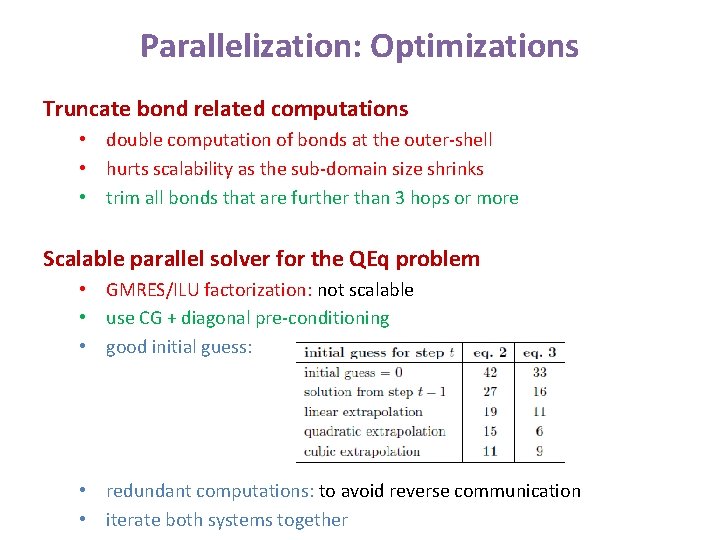
Parallelization: Optimizations Truncate bond related computations • double computation of bonds at the outer-shell • hurts scalability as the sub-domain size shrinks • trim all bonds that are further than 3 hops or more Scalable parallel solver for the QEq problem • GMRES/ILU factorization: not scalable • use CG + diagonal pre-conditioning • good initial guess: • redundant computations: to avoid reverse communication • iterate both systems together
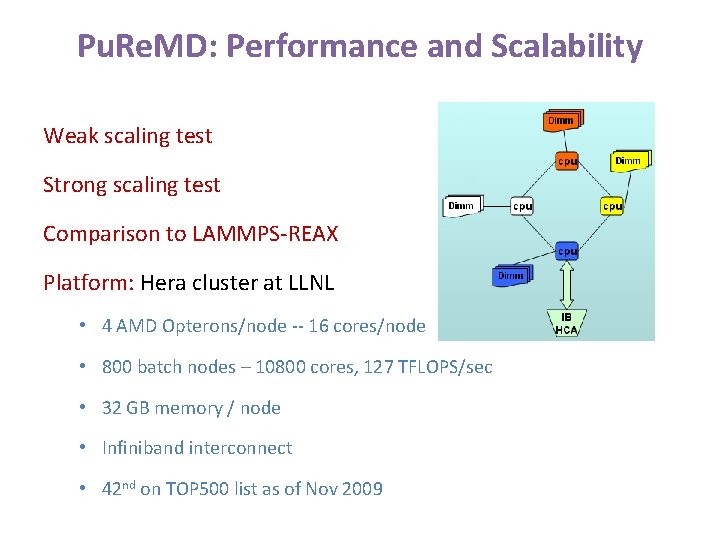
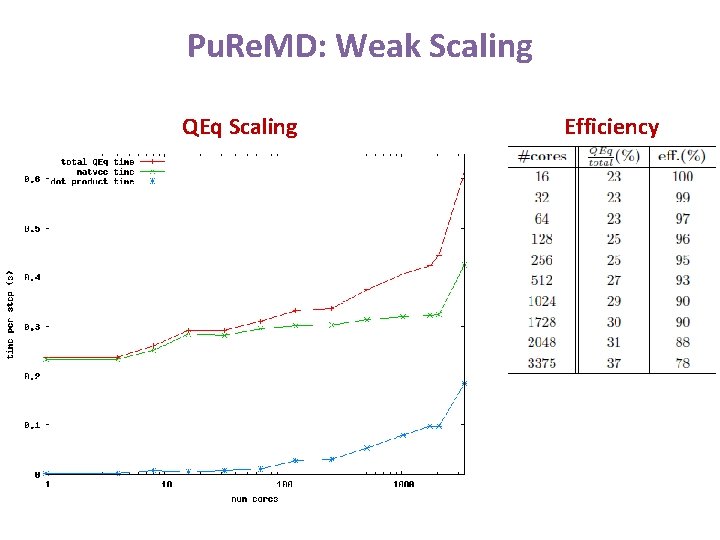
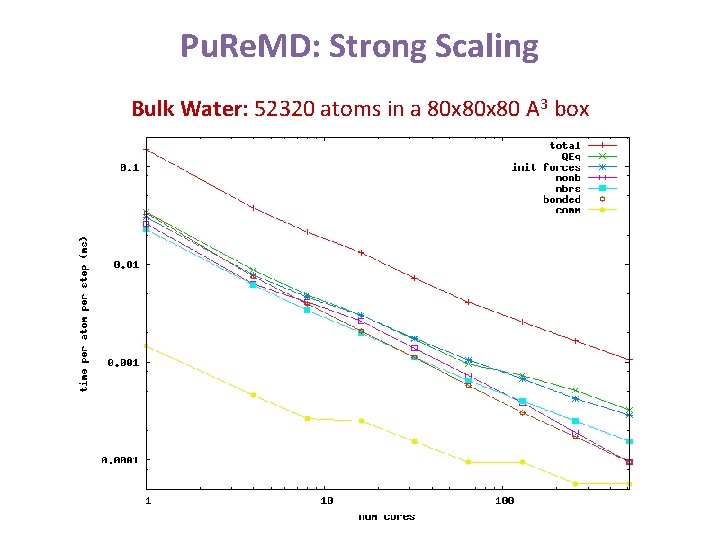
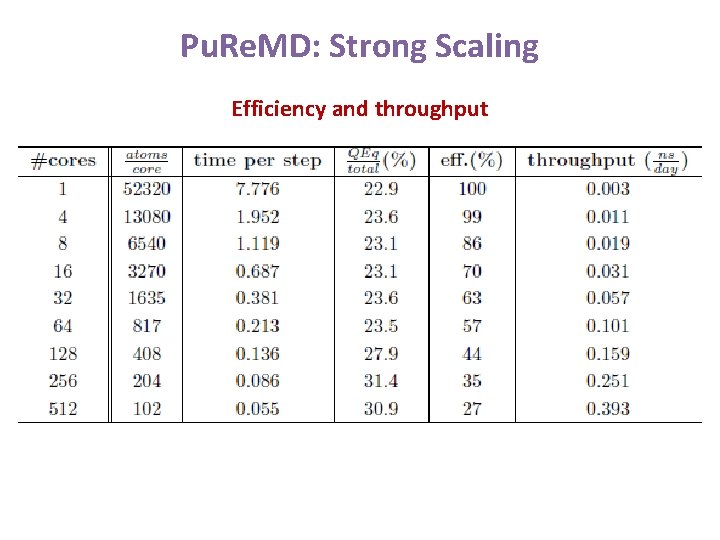
Pu. Re. MD: Performance and Scalability Weak scaling test Strong scaling test Comparison to LAMMPS-REAX Platform: Hera cluster at LLNL • 4 AMD Opterons/node -- 16 cores/node • 800 batch nodes – 10800 cores, 127 TFLOPS/sec • 32 GB memory / node • Infiniband interconnect • 42 nd on TOP 500 list as of Nov 2009
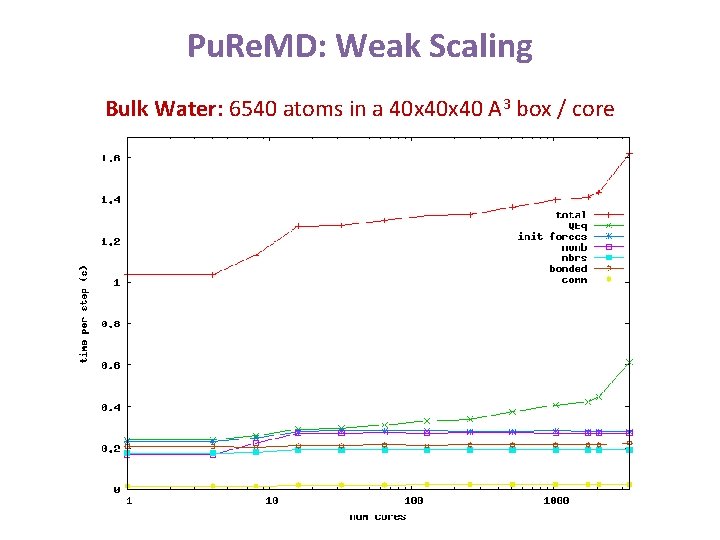
Pu. Re. MD: Weak Scaling Bulk Water: 6540 atoms in a 40 x 40 A 3 box / core
Pu. Re. MD: Weak Scaling QEq Scaling Efficiency
Pu. Re. MD: Strong Scaling Bulk Water: 52320 atoms in a 80 x 80 A 3 box
Pu. Re. MD: Strong Scaling Efficiency and throughput
Outline 1. Introduction • Molecular Dynamics Methods vs. Reax. FF 2. Sequential Realization: Serial. Reax • Algorithms and Numerical Techniques • Validation • Performance Characterization 3. Parallel Realization: Pu. Re. MD • Parallelization: Algorithms and Techniques • Performance and Scalability 4. Applications • Strain Relaxation in Si/Ge/Si Nanobars • Water-Silica Interface • Oxidative Stress in Lipid Bilayers
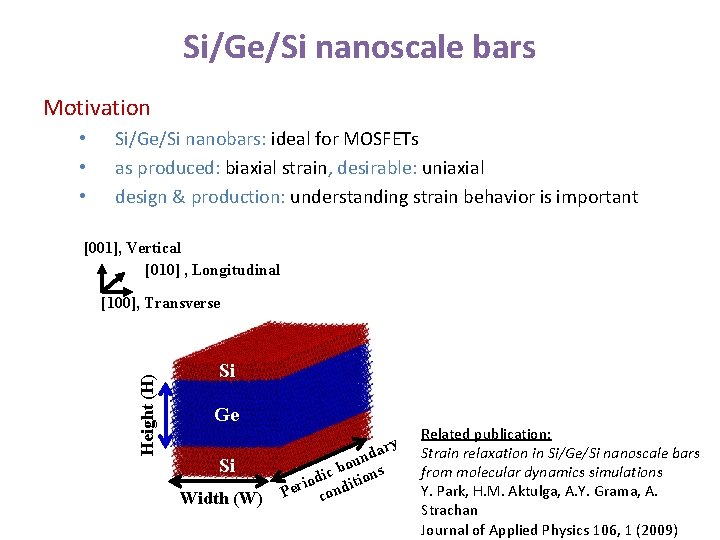
Si/Ge/Si nanoscale bars Motivation • • • Si/Ge/Si nanobars: ideal for MOSFETs as produced: biaxial strain, desirable: uniaxial design & production: understanding strain behavior is important [001], Vertical [010] , Longitudinal Height (H) [100], Transverse Si Ge Si Width (W) ary nd u o ic b tions d o i i Per cond Related publication: Strain relaxation in Si/Ge/Si nanoscale bars from molecular dynamics simulations Y. Park, H. M. Aktulga, A. Y. Grama, A. Strachan Journal of Applied Physics 106, 1 (2009)
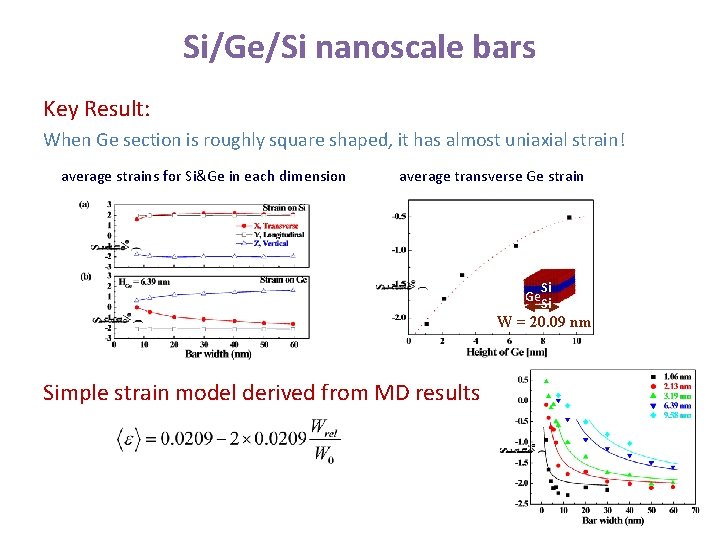
Si/Ge/Si nanoscale bars Key Result: When Ge section is roughly square shaped, it has almost uniaxial strain! average strains for Si&Ge in each dimension average transverse Ge strain Si Ge. Si W = 20. 09 nm Simple strain model derived from MD results
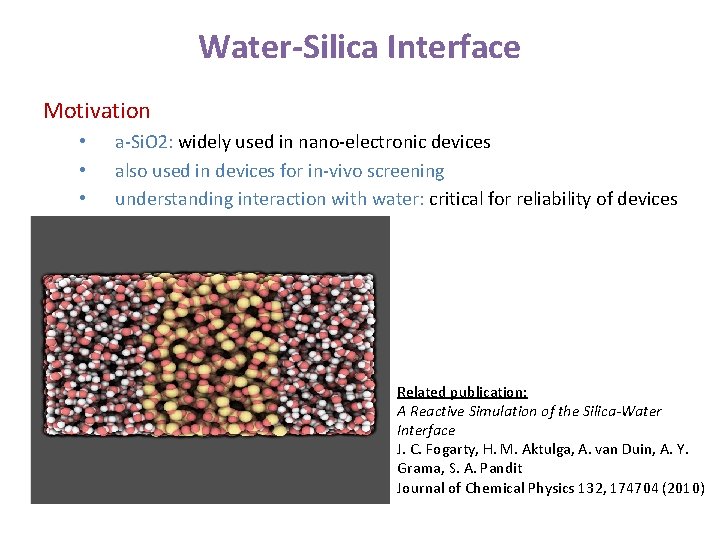
Water-Silica Interface Motivation • • • a-Si. O 2: widely used in nano-electronic devices also used in devices for in-vivo screening understanding interaction with water: critical for reliability of devices Related publication: A Reactive Simulation of the Silica-Water Interface J. C. Fogarty, H. M. Aktulga, A. van Duin, A. Y. Grama, S. A. Pandit Journal of Chemical Physics 132, 174704 (2010)
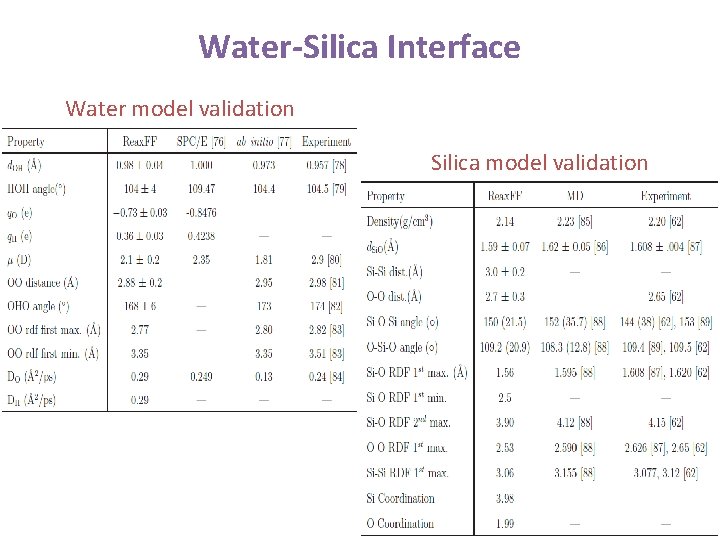
Water-Silica Interface Water model validation Silica model validation
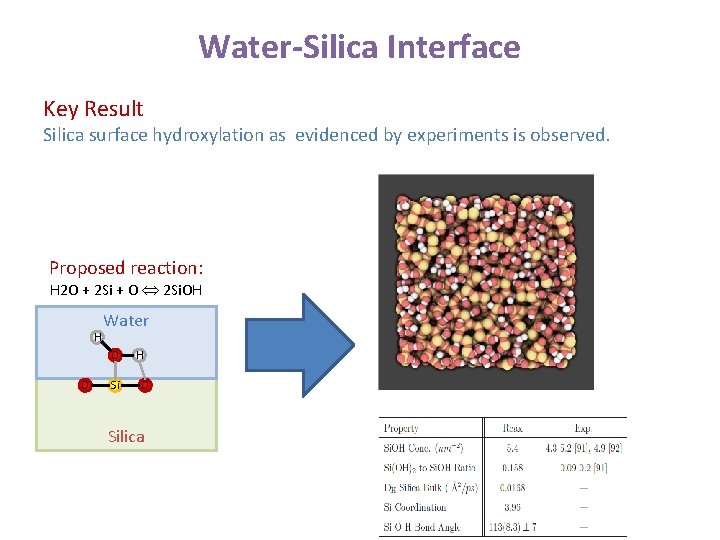
Water-Silica Interface Key Result Silica surface hydroxylation as evidenced by experiments is observed. Proposed reaction: H 2 O + 2 Si + O 2 Si. OH H Water O O Si H O Silica
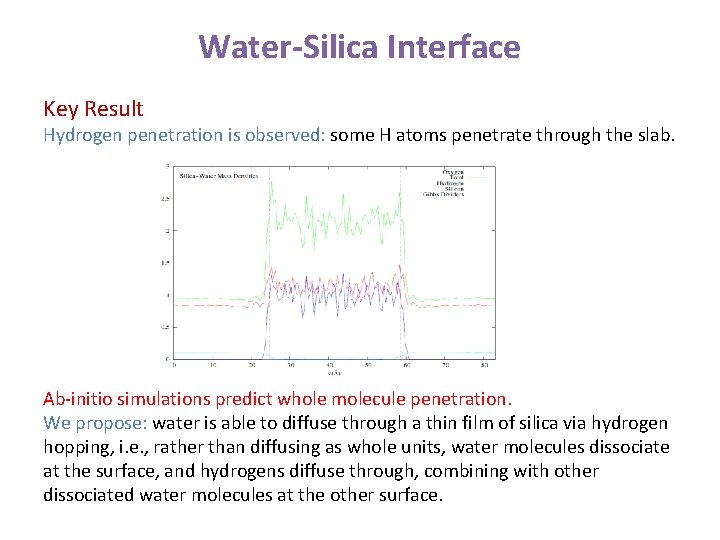
Water-Silica Interface Key Result Hydrogen penetration is observed: some H atoms penetrate through the slab. Ab-initio simulations predict whole molecule penetration. We propose: water is able to diffuse through a thin film of silica via hydrogen hopping, i. e. , rather than diffusing as whole units, water molecules dissociate at the surface, and hydrogens diffuse through, combining with other dissociated water molecules at the other surface.
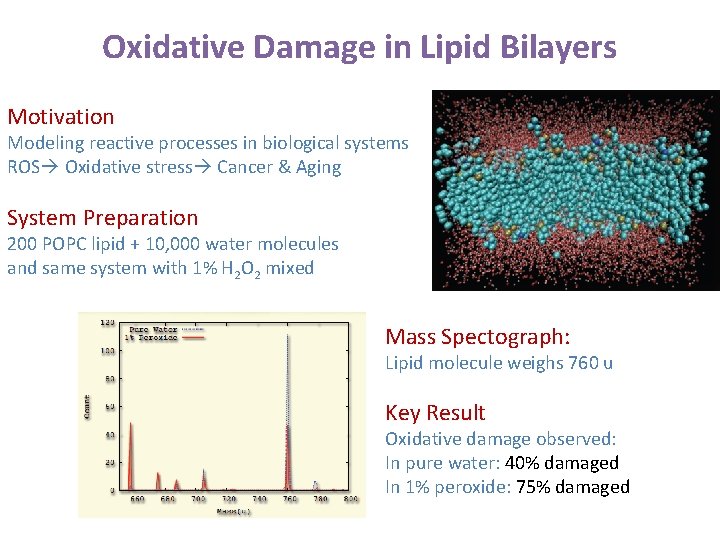
Oxidative Damage in Lipid Bilayers Motivation Modeling reactive processes in biological systems ROS Oxidative stress Cancer & Aging System Preparation 200 POPC lipid + 10, 000 water molecules and same system with 1% H 2 O 2 mixed Mass Spectograph: Lipid molecule weighs 760 u Key Result Oxidative damage observed: In pure water: 40% damaged In 1% peroxide: 75% damaged
Conclusions • • An efficient and scalable realization of Reax. FF through use of algorithmic and numerical techniques Detailed performance characterization; comparison to other methods Applications on various systems Beta version released: • Goddard/Cal. Tech, Buehler/MIT, van Duin/PSU, Strachan/Purdue, Pandit/USF, Germann/LANL, Quenneville/Spectral Sciences
Future Work • Enhancements to Pu. Re. MD: – Better algorithms & techniques, enhanced feature set, additional potentials, long range interactions & QEq, porting to GPU clusters & FPGAs. • Auto-Tuning of force field parameters • Applications to biophysical systems
References Reactive Molecular Dynamics: Numerical Methods and Algorithmic Techniques H. M. Aktulga, S. A. Pandit, A. C. T. van Duin, A. Y. Grama Under submission to SIAM Journal on Scientific Computing Parallel Reactive Molecular Dynamics: Numerical Methods and Algorithmic Techniques H. M. Aktulga, J. C. Fogarty, S. A. Pandit, A. Y. Grama Submitted to Parallel Computing Journal Strain relaxation in Si/Ge/Si nanoscale bars from molecular dynamics simulations Y. Park, H. M. Aktulga, A. Y. Grama, A. Strachan Journal of Applied Physics 106, 1 (2009) A Reactive Simulation of the Silica-Water Interface J. C. Fogarty, H. M. Aktulga, A. van Duin, A. Y. Grama, S. A. Pandit Journal of Chemical Physics 132, 174704 (2010)