9112021 11 THE MAKING OF NATIONAL MOVEMENT 1870












- Slides: 35
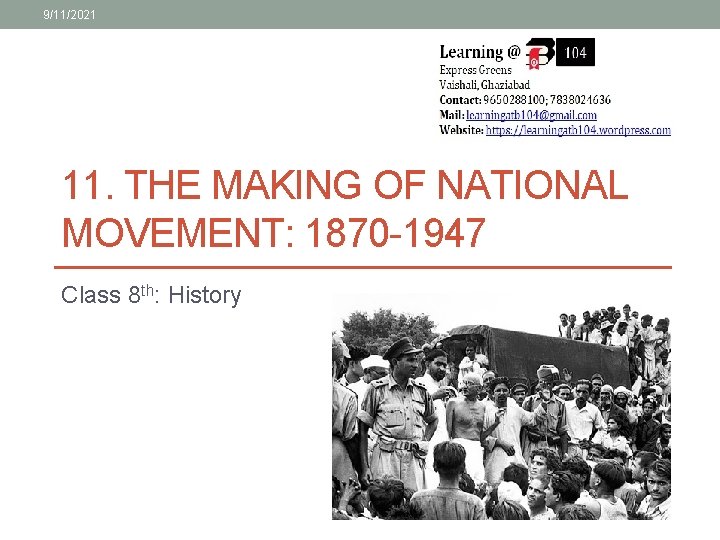
9/11/2021 11. THE MAKING OF NATIONAL MOVEMENT: 1870 -1947 Class 8 th: History
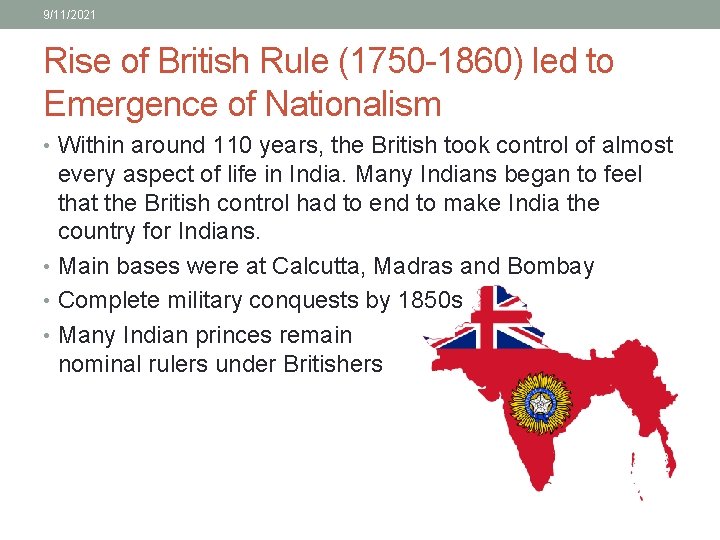
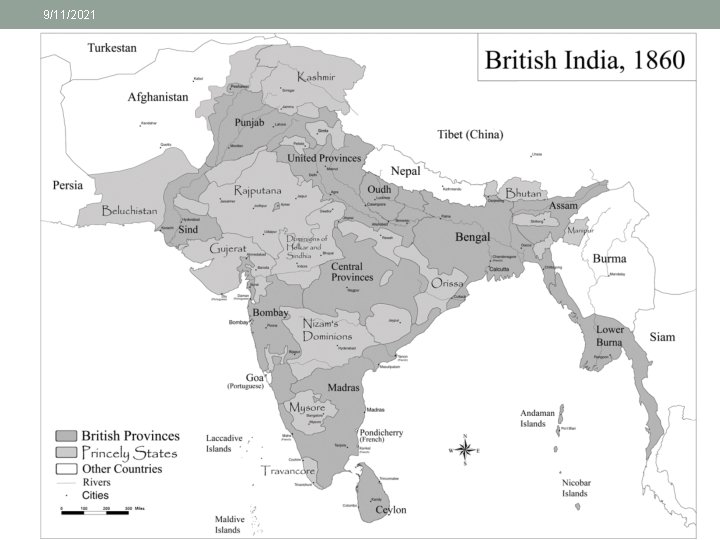
9/11/2021 Rise of British Rule (1750 -1860) led to Emergence of Nationalism • Within around 110 years, the British took control of almost every aspect of life in India. Many Indians began to feel that the British control had to end to make India the country for Indians. • Main bases were at Calcutta, Madras and Bombay • Complete military conquests by 1850 s • Many Indian princes remain nominal rulers under Britishers
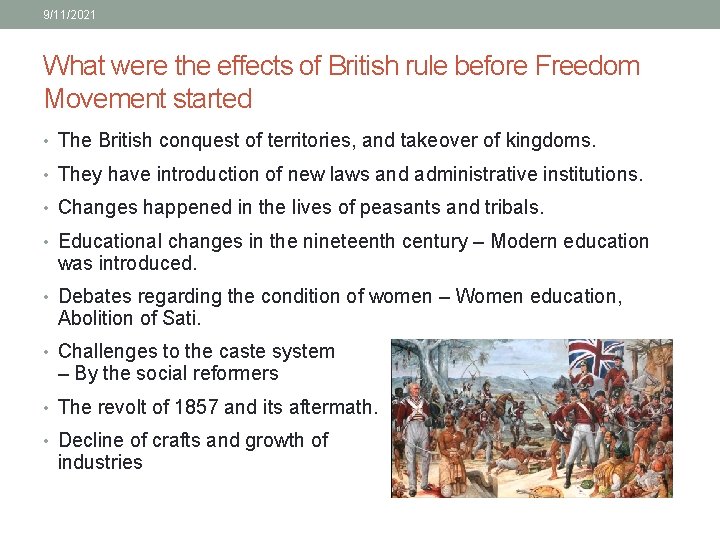
9/11/2021 What were the effects of British rule before Freedom Movement started • The British conquest of territories, and takeover of kingdoms. • They have introduction of new laws and administrative institutions. • Changes happened in the lives of peasants and tribals. • Educational changes in the nineteenth century – Modern education was introduced. • Debates regarding the condition of women – Women education, Abolition of Sati. • Challenges to the caste system – By the social reformers • The revolt of 1857 and its aftermath. • Decline of crafts and growth of industries
9/11/2021 Early Political Associations • After 1850, many political associations were formed. Most of them were formed in the 1870 s and 1880 s. Most of these associations were led by English-educated professionals. Some of the important ones were; the • Poona Sarvajanik Sabha • The Indian Association • The Madras Mahajan Sabha • The Bombay Presidency Association • The Indian National Congress was also formed during this period. The naming conventions of these political associations suggest that they wanted to take issues which affected all the people of India; although many of these associations functioned in specific parts of the country.
9/11/2021 Reasons for dissatisfaction with British rule in the 1870 s and 1880 s 1. The Arms Act was passed in 1878. This Act disallowed Indians from possessing arms. 2. The Vernacular Press Act was passed in 1878. This Act empowered the government to confiscate the assets of newspapers including their printing presses, if the newspaper published anything “objectionable”. 3. The government tried to introduce the Ilbert Bill in 1883. The bill made provisions for trial of British or European persons by Indians. Thus, the Ilbert Bill sought equality between British and Indian judges in the country. But the whites opposed the Bill and forced the government to withdraw it.
9/11/2021 Indian National Congress, 1885 • The Indian National Congress was established in 1885 at Bombay. In its first meeting at Bombay, 72 delegates from all over the country were present. • The early leadership was mainly composed of people from Bombay and Calcutta. Dadabhai Naoroji, Pherozeshah Mehta, Badruddin Tyabji, W. C. Bonneryji, Surendranath Banerji, Romesh Chandra Dutt, S. Subramania Iyer, etc. were part of the early leadership of Congress. • In its first 20 years, the Congress was “moderate” in its objectives and methods. During this period, the main demand of Congress was about getting a greater voice for Indians in the government and administration.
9/11/2021
9/11/2021 Early demands of Congress • The Congress wanted better representation of Indians in the Legislative Councils. • Introduction of the Legislative Council in those provinces where none existed. • The Congress made a demand for civil service examinations to be held in India also. • The Congress also demanded a separation of judiciary and executive, the repeal of Arms Act and freedom of speech and expression.
9/11/2021 Economic demands by Congress • Reduction in revenue, cut in military expenditure and more funds for irrigation. • The Congress also passed various resolutions on the salt tax, treatment of Indian labourers abroad and the suffering of forest dwellers. • These demands show that in spite of being a body of the educated elite, the Congress also talked about the common people. • The Moderate leaders wanted to create public awareness about the unjust nature of British rule. In order to do so, they published newspapers, wrote articles and tried to show the bad effects of the British rule.
9/11/2021 “Freedom is our Birthright” • 1890 - question about the style of Congress. New leaders (Bepin Chandra Pal, Bal Gangadhar Tilak and Lala Lajpat Rai) emerged who began to explore more radical objectives and methods. • Rely on one’s own strength • Tilak – “Freedom is my birthright and I shall have it” (Kesari – Marathi newspaper – strongest critics of British rule) • They criticized the Moderates for their “policy of prayers”. They argued that people should not believe on the so called good intentions of the government and must fight for swaraj.
9/11/2021
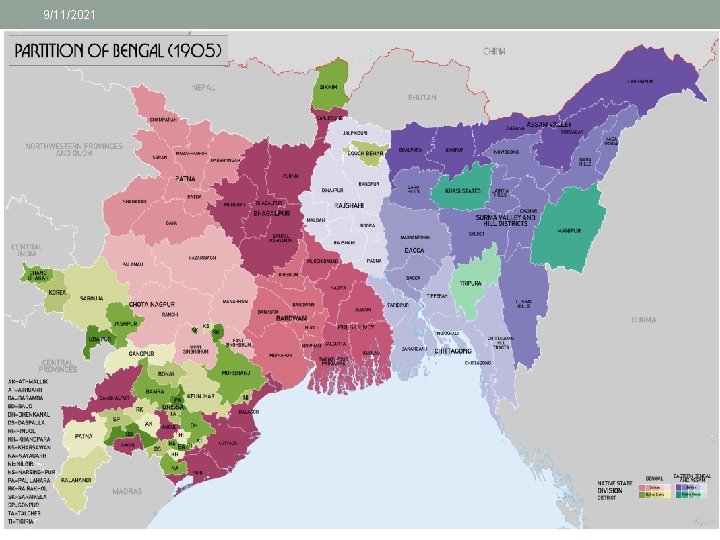
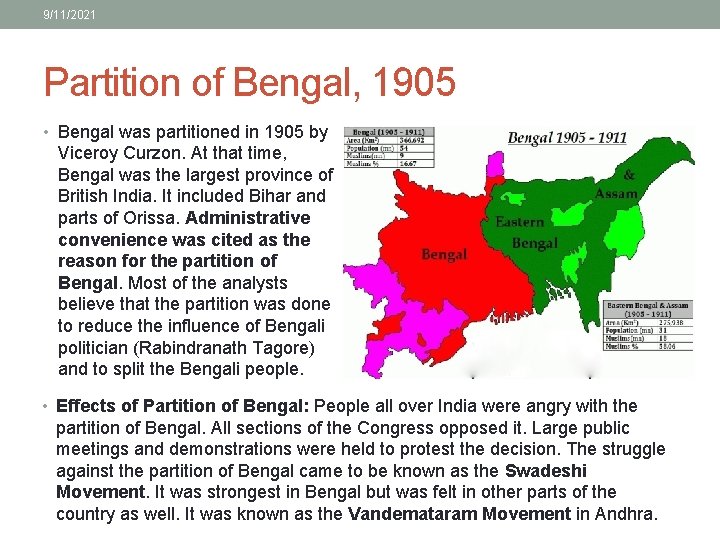
9/11/2021 Partition of Bengal, 1905 • Bengal was partitioned in 1905 by Viceroy Curzon. At that time, Bengal was the largest province of British India. It included Bihar and parts of Orissa. Administrative convenience was cited as the reason for the partition of Bengal. Most of the analysts believe that the partition was done to reduce the influence of Bengali politician (Rabindranath Tagore) and to split the Bengali people. • Effects of Partition of Bengal: People all over India were angry with the partition of Bengal. All sections of the Congress opposed it. Large public meetings and demonstrations were held to protest the decision. The struggle against the partition of Bengal came to be known as the Swadeshi Movement. It was strongest in Bengal but was felt in other parts of the country as well. It was known as the Vandemataram Movement in Andhra.
9/11/2021 Swadeshi Movement • Oppose the British rule. • Encourage the ideas of self-help, swadeshi enterprise. • Encourage national education and use of Indian languages. • The radicals advocated mass mobilization and boycott of British institutions and goods. Some leaders also suggested the use of revolutionary violence to overthrow British rule.
9/11/2021 Muslim League and Congress • Muslim League: The All India Muslim League was formed at Dacca in 1906; by a group of Muslim landlords and nawabs. The League supported the partition of Bengal. Some seats in the council were reserved for the Muslims. The League wanted the representatives for those seats to be elected by Muslim voters. This demand was willingly accepted by the government in 1909. • Split in Congress: There was a split in the Congress in 1907 (Moderates versus Extremists). The Moderates were opposed to the use of any kind of violence. After the split, the Congress came to be dominated by the Moderates. However, the two groups reunited in December 1915. In 1916, the Congress and the Muslim League signed the historic Lucknow Pact. They decided to work together for representative government in the country.
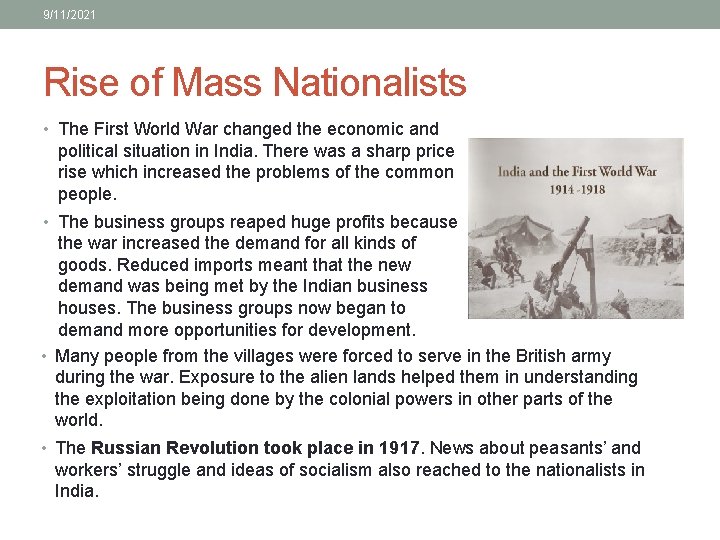
9/11/2021 Rise of Mass Nationalists • The First World War changed the economic and political situation in India. There was a sharp price rise which increased the problems of the common people. • The business groups reaped huge profits because the war increased the demand for all kinds of goods. Reduced imports meant that the new demand was being met by the Indian business houses. The business groups now began to demand more opportunities for development. • Many people from the villages were forced to serve in the British army during the war. Exposure to the alien lands helped them in understanding the exploitation being done by the colonial powers in other parts of the world. • The Russian Revolution took place in 1917. News about peasants’ and workers’ struggle and ideas of socialism also reached to the nationalists in India.
9/11/2021 Advent of Mahatma Gandhi (Click) • 1869 – DOB 02 October 1869 (Porbandar, Gujarat) • 1893 - 1869 + 24 years Studied • Moved to South Africa – Thrown out of train by a Britisher (racism) – black • • can’t sit in first class 1894 – Formed a group called Natal Indian Congress – Started Satyagrah in South Africa. Because of his movements against racial restrictions in South Africa, he had become a respected leader. 1915 - 1869 + 46 years Returned back to India Mahatma Gandhi first wanted to understand the people, their needs and overall situation in India. Hence, he spent his first year in India in travelling throughout the country. His earliest participation in local movements was in Champaran, Kheda and Ahmadabad. • 1917 – Champaran (Bihar) – Satyagrah & Sarbarmati Ashram established
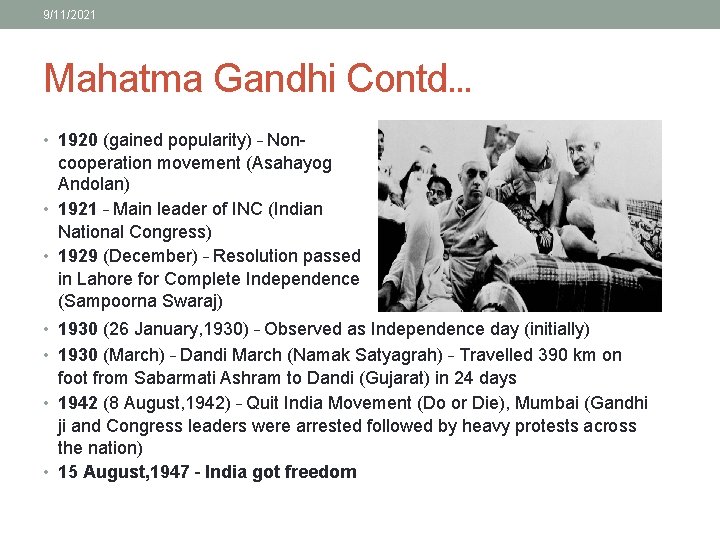
9/11/2021 Mahatma Gandhi Contd… • 1920 (gained popularity) – Non- cooperation movement (Asahayog Andolan) • 1921 – Main leader of INC (Indian National Congress) • 1929 (December) – Resolution passed in Lahore for Complete Independence (Sampoorna Swaraj) • 1930 (26 January, 1930) – Observed as Independence day (initially) • 1930 (March) – Dandi March (Namak Satyagrah) – Travelled 390 km on foot from Sabarmati Ashram to Dandi (Gujarat) in 24 days • 1942 (8 August, 1942) – Quit India Movement (Do or Die), Mumbai (Gandhi ji and Congress leaders were arrested followed by heavy protests across the nation) • 15 August, 1947 – India got freedom
9/11/2021 Rowlatt Act and Jallianwala Bagh Massacre (Click) • Rowlatt Act passed – 1919 • British government can imprison any person without any warrant for 2 years without trial. The Act curbed the freedom of expression and strengthened police powers. • Rowlatt Act Satyagrah • Nation wide hartal • Fasting • Civil disobedience Movement against some specific laws • Jallainwala Bagh Massacre – Why it happened? • Dr. Saiffuddin Kitchlew & Dr. Satyapal were arrested by Britishers under Rowlatt Act • Protestors gathered at Jallianwala Bagh on 13 th April 1919 (Baisakhi) • General Dyer opened fire on protestors • Rabindranath Tagore renounced his knighthood in protest of Jalianwala Bagh incident.
9/11/2021 Khilafat Movement, 1919
9/11/2021 Khilafat Agitation and the Non-Cooperation Movement, 1921 • After the First World War, a harsh treaty was imposed on the Turkish Khalifa. The leaders of the Khilafat Agitation; Mohammad Ali and Shaukat Ali wanted to associate with the Non-Cooperation Movement. The Muslims wanted the Khalifa to retain control over Muslim sacred places in the erstwhile Ottoman Empire (Turkey). Gandhiji supported the Khilafat Movement. • The Non-Cooperation Movement gained momentum through 1921 -22. Thousands of students left schools and colleges to join the movement. Many eminent professionals gave up their profession to join the movement. • Bonfires of foreign cloths were burnt. The boycott of foreign cloths resulted in imports falling drastically between 1920 and 1922.
9/11/2021 People’s Initiatives (Non-Cooperation Movement) • Motilal Nehru, C. R. Das, C. Rajgopalachari and Asaf Ali gave up their law practices • British titles were surrendered and legislatures were boycotted • The Patidar peasants of Kheda (Gujarat) organized non-violent campaigns against the high land revenue demand. • Liquor shops were picketed in coastal Andhra and interior Tamil Nadu. • The tribals and poor peasants in Guntur district (Andhra Pradesh) staged a number of forest satyagrahas; to protest against the new forest laws. • The Khilafat-Non-Cooperation Movement gave enormous support in Sind and Bengal. • In Punjab, the Akali agitation of the Sikhs demanded to remove the corrupt mahants from gurdwaras. • In Assam, the tea garden labourers demanded a big hike in their wages. They shouted the slogan, “Gandhi Maharaj ki jai”. In many folk songs of Assam; Gandhiji was referred to as “Gandhi Raja”.
9/11/2021 People’s Mahatma • Considered Massiah by some • Build class unity and not class conflict • Help in fight against zamindars • Peasants in Pratapgarh in United Provinces managed to stop illegal eviction of tenants
9/11/2021 Happenings during 1922 -29 • Gandhiji called off Non-Cooperation Movement in 1922 when people put fire to Police station in Chauri-Chaura (22 policemen died) • Called for constructive works in rural areas • Chittranjan Das (lawyer in East Bengal) and Motilal Nehru – party should fight elections to enter councils and influence govt. policies • Formation of RSS (Rashtriya Swamsewak Sangh) & Communist Party of India • Bhagat Singh – It takes a loud voice to make the deaf hear (Inquilab Zindabad) • 1927 – Simon Commission by Lord Simon to decide India’s political future with no Indian representative – created outrage in India – “Simon Go Back” • 1929 – Purna Swaraj (Complete Independence) under J. L. Nehru and 26 Jan, 1930 was observed as Independence day
9/11/2021 Dandi March/ Salt Satyagrah, 1930 (Click)
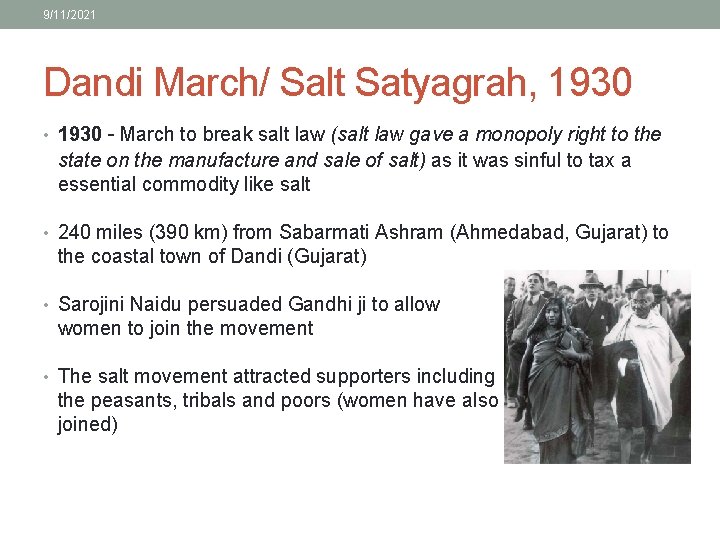
9/11/2021 Dandi March/ Salt Satyagrah, 1930 • 1930 – March to break salt law (salt law gave a monopoly right to the state on the manufacture and sale of salt) as it was sinful to tax a essential commodity like salt • 240 miles (390 km) from Sabarmati Ashram (Ahmedabad, Gujarat) to the coastal town of Dandi (Gujarat) • Sarojini Naidu persuaded Gandhi ji to allow women to join the movement • The salt movement attracted supporters including the peasants, tribals and poors (women have also joined)
9/11/2021 Activities in late 1930 s • 1935 – Govt. of India Act (provincial autonomy) • 1937 – Govt. announced elections to the provincial legislatures (Congress won in 7 of 11 provinces) • 1939 – Second World War started – Congress was ready to support British against Hitler (Germany) but wanted independence of India which was refused by British
9/11/2021 Indian National Army (Azad Hind Fauj), 1941
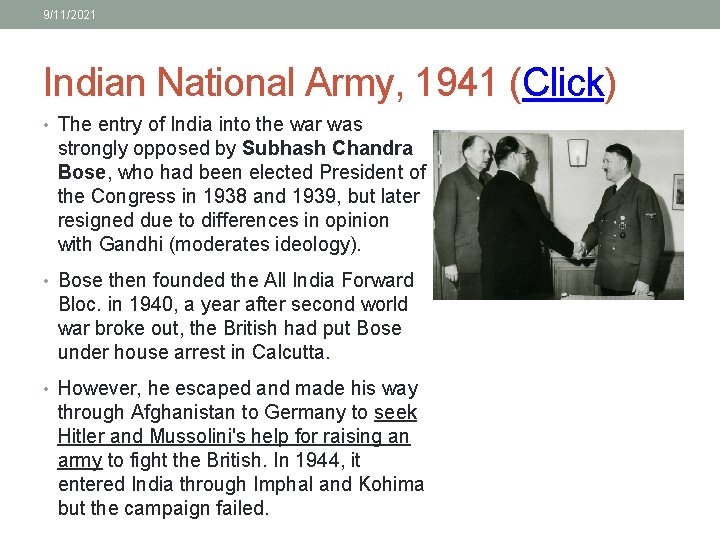
9/11/2021 Indian National Army, 1941 (Click) • The entry of India into the war was strongly opposed by Subhash Chandra Bose, who had been elected President of the Congress in 1938 and 1939, but later resigned due to differences in opinion with Gandhi (moderates ideology). • Bose then founded the All India Forward Bloc. in 1940, a year after second world war broke out, the British had put Bose under house arrest in Calcutta. • However, he escaped and made his way through Afghanistan to Germany to seek Hitler and Mussolini's help for raising an army to fight the British. In 1944, it entered India through Imphal and Kohima but the campaign failed.
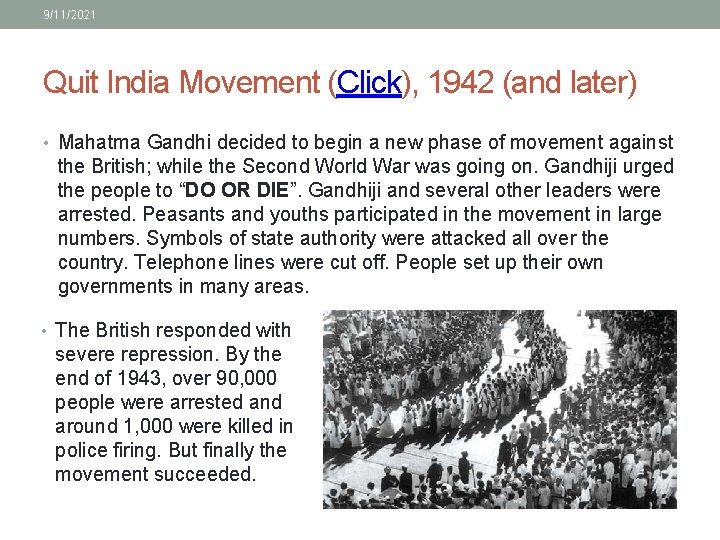
9/11/2021 Quit India Movement (Click), 1942 (and later) • Mahatma Gandhi decided to begin a new phase of movement against the British; while the Second World War was going on. Gandhiji urged the people to “DO OR DIE”. Gandhiji and several other leaders were arrested. Peasants and youths participated in the movement in large numbers. Symbols of state authority were attacked all over the country. Telephone lines were cut off. People set up their own governments in many areas. • The British responded with severe repression. By the end of 1943, over 90, 000 people were arrested and around 1, 000 were killed in police firing. But finally the movement succeeded.
9/11/2021 Partition (India and Pakistan) & Independence (Click)
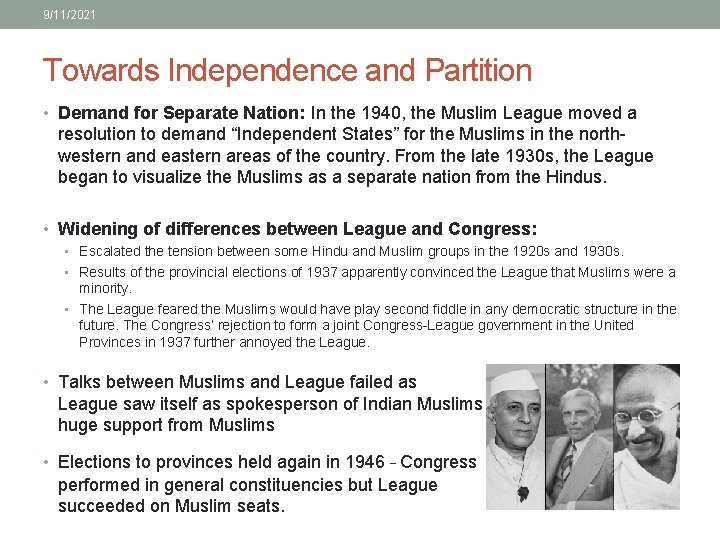
9/11/2021 Towards Independence and Partition • Demand for Separate Nation: In the 1940, the Muslim League moved a resolution to demand “Independent States” for the Muslims in the northwestern and eastern areas of the country. From the late 1930 s, the League began to visualize the Muslims as a separate nation from the Hindus. • Widening of differences between League and Congress: • Escalated the tension between some Hindu and Muslim groups in the 1920 s and 1930 s. • Results of the provincial elections of 1937 apparently convinced the League that Muslims were a minority. • The League feared the Muslims would have play second fiddle in any democratic structure in the future. The Congress’ rejection to form a joint Congress-League government in the United Provinces in 1937 further annoyed the League. • Talks between Muslims and League failed as League saw itself as spokesperson of Indian Muslims but Congress had a huge support from Muslims • Elections to provinces held again in 1946 – Congress performed in general constituencies but League succeeded on Muslim seats.
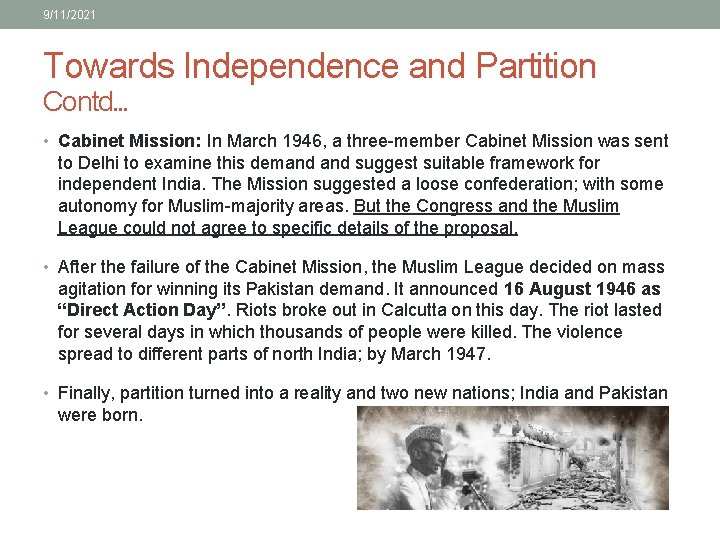
9/11/2021 Towards Independence and Partition Contd… • Cabinet Mission: In March 1946, a three-member Cabinet Mission was sent to Delhi to examine this demand suggest suitable framework for independent India. The Mission suggested a loose confederation; with some autonomy for Muslim-majority areas. But the Congress and the Muslim League could not agree to specific details of the proposal. • After the failure of the Cabinet Mission, the Muslim League decided on mass agitation for winning its Pakistan demand. It announced 16 August 1946 as “Direct Action Day”. Riots broke out in Calcutta on this day. The riot lasted for several days in which thousands of people were killed. The violence spread to different parts of north India; by March 1947. • Finally, partition turned into a reality and two new nations; India and Pakistan were born.
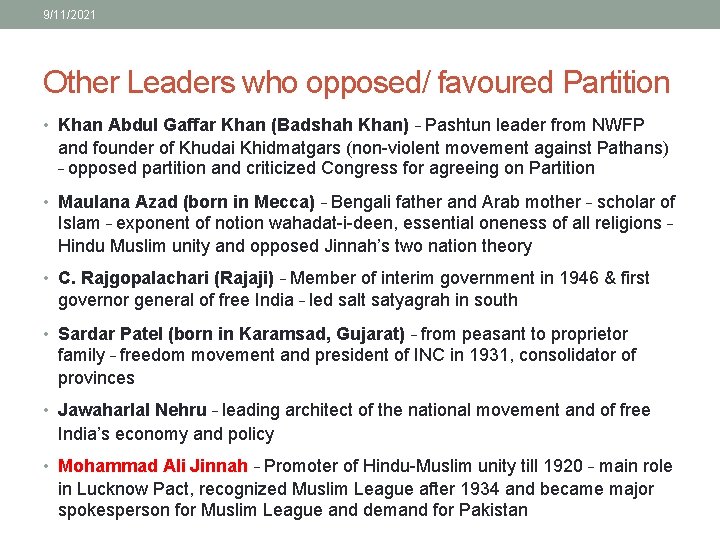
9/11/2021 Other Leaders who opposed/ favoured Partition • Khan Abdul Gaffar Khan (Badshah Khan) – Pashtun leader from NWFP and founder of Khudai Khidmatgars (non-violent movement against Pathans) – opposed partition and criticized Congress for agreeing on Partition • Maulana Azad (born in Mecca) – Bengali father and Arab mother – scholar of Islam – exponent of notion wahadat-i-deen, essential oneness of all religions – Hindu Muslim unity and opposed Jinnah’s two nation theory • C. Rajgopalachari (Rajaji) – Member of interim government in 1946 & first governor general of free India – led salt satyagrah in south • Sardar Patel (born in Karamsad, Gujarat) – from peasant to proprietor family – freedom movement and president of INC in 1931, consolidator of provinces • Jawaharlal Nehru – leading architect of the national movement and of free India’s economy and policy • Mohammad Ali Jinnah – Promoter of Hindu-Muslim unity till 1920 – main role in Lucknow Pact, recognized Muslim League after 1934 and became major spokesperson for Muslim League and demand for Pakistan
9/11/2021 Year 1878 1883 1885 1906 1914 1915 1916 1917 1919 1920 1927 1929 1930 1935 1937 1939 1941 1942 1946 1947 Activity Arms Act, Vernacular Press Act Illbert Bill Indian National Congress Partition of Bengal All India Muslim League formation, Dacca First World War Mahatma Gandhi returned to India Lucknow Pact Champaran Satyagrah & Sabarmati Ashram Rowlatt Act Jallianwala Bagh Massacre (13 th April) Khilafat Movement Non-cooperation Movement Simon Commission Purna Swaraj (Complete Independence) Salt Saytagrah/ Dandi March Civil Disobedience Movement Govt. of India Act (provincial autonomy) Elections to the Provincial Legislatures Second World War Indian National Army (Azaz Hind Fauj) Quit India Movement (8 th August) Direct Action Day Independence (15 th August) Important Years to remember
9/11/2021 THANK YOU !! Any Queries/ Doubts?