3 ROCKS 1 q Rocks are compact semihard
- Slides: 52
3. ROCKS 1
q Rocks are compact, semi-hard to hard mass composed of one or several minerals and/or mineraloids. q On the basis of their mode of origin, rocks can be divided into three basic types: • Igneous • Sedimentary • Metamorphic 2
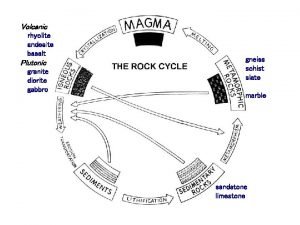
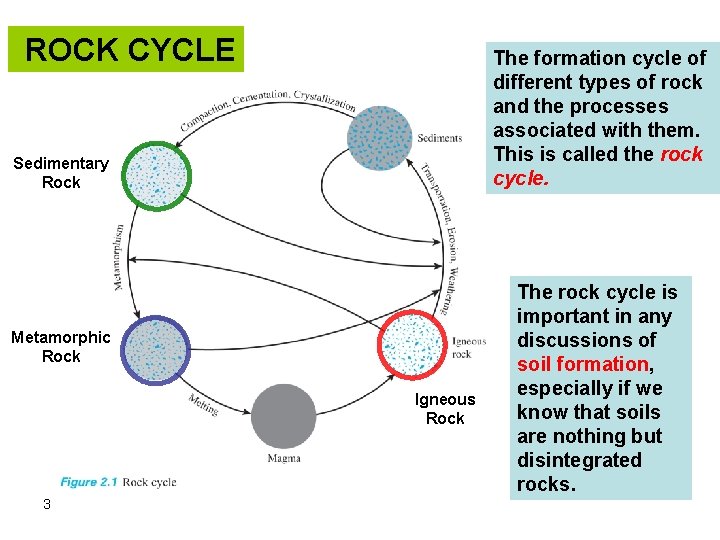
ROCK CYCLE The formation cycle of different types of rock and the processes associated with them. This is called the rock cycle. Sedimentary Rock Metamorphic Rock Igneous Rock 3 The rock cycle is important in any discussions of soil formation, especially if we know that soils are nothing but disintegrated rocks.
A. Igneous Rocks ü They are those that have solidified from a molten or partially molten material called Magma or Melt. ü Magma has originated well bellow the surface and ascended towards the surface, and has crystallized as solid rock either on the surface or deep within the earth's crust as temperature fell. ü The types of igneous rock formed by the cooling of magma depends on the i) composition of the magma; ii) the rate of cooling associated with it. 4
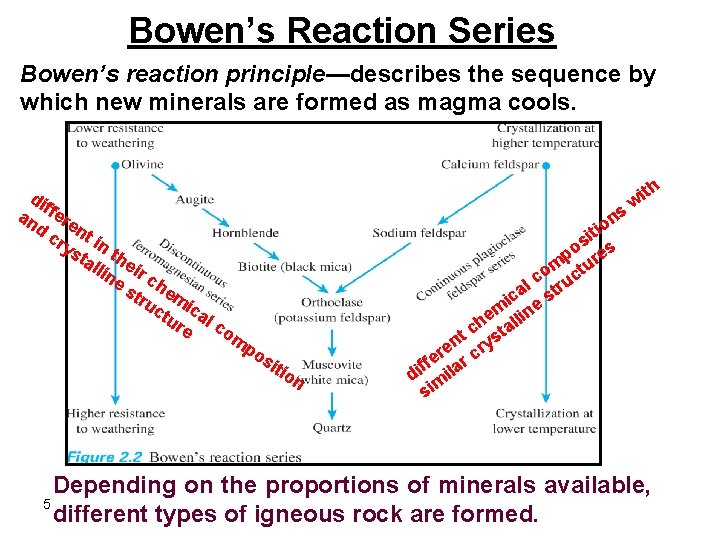
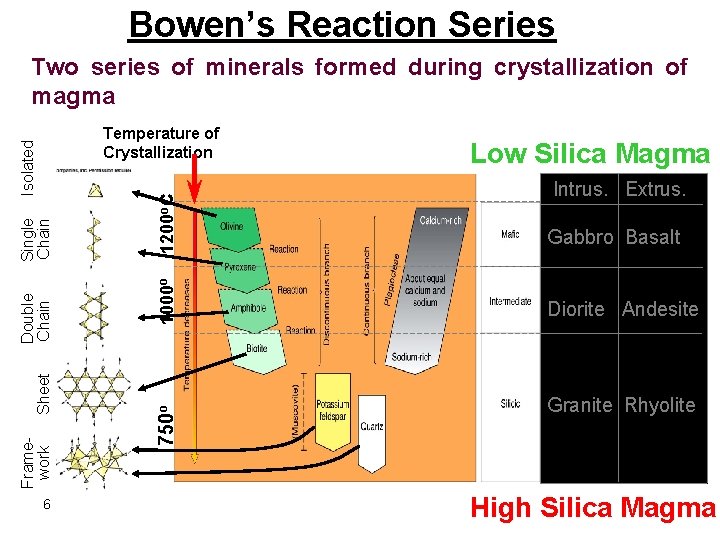
Bowen’s Reaction Series Bowen’s reaction principle—describes the sequence by which new minerals are formed as magma cools. di an ffere d cr nt in ys ta the llin ir e s ch tru em ct ica ur l c e o s n o m po sit io n th i w ti i s po res m tu o c ruc l t a ic e s m lin e h tal c nt rys e r c e f f ilar i d m si Depending on the proportions of minerals available, 5 different types of igneous rock are formed.
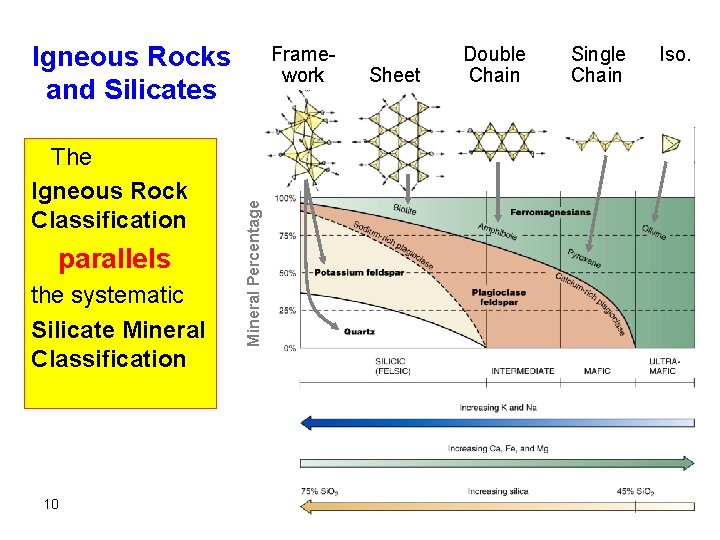
Bowen’s Reaction Series Two series of minerals formed during crystallization of magma 6 Low Silica Magma 1200 o. C 1000 o Intrus. Extrus. Gabbro Basalt Diorite Andesite 750 o Framework Sheet Double Chain Single Chain Isolated Temperature of Crystallization Granite Rhyolite High Silica Magma
Mineralogy of Igneous Rocks Many different types of minerals occur in igneous rocks, but only about eight are normally present as essential constituents of a rock. They are: • Quartz • Orthoclase • Plagioclase • Muscovite • Biotite • Hornblende • Augite • Olivine 7 Which of the eight are present is controlled primarily by the composition of the magma.
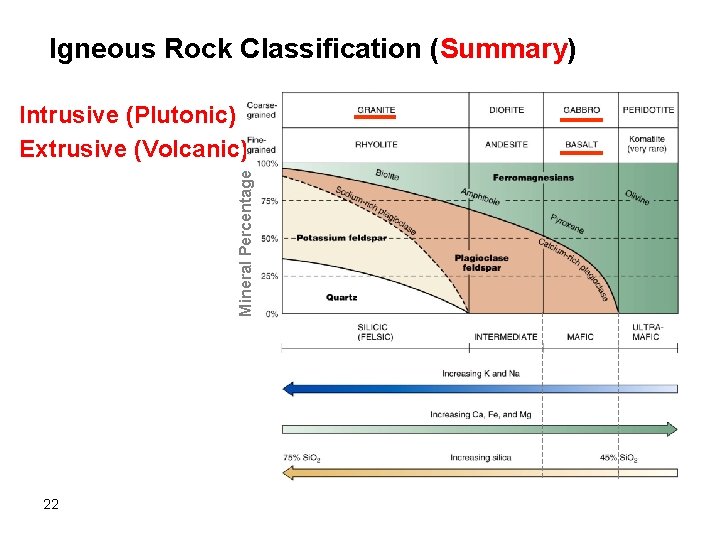
Classification of Igneous Rocks I. Classification based on content of silica The content of silica (Sio 2) in igneous rocks varies from over 80% to about 40%. Rocks containing much silica were originally called ACID, and those with less silica were called BASIC. 8
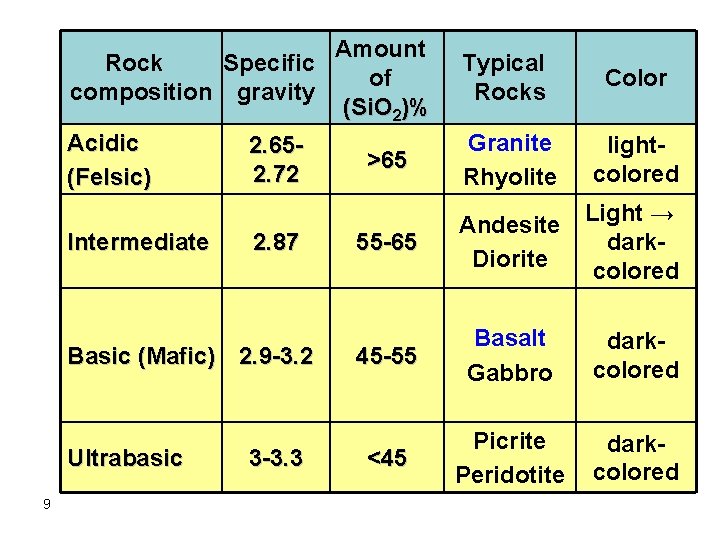
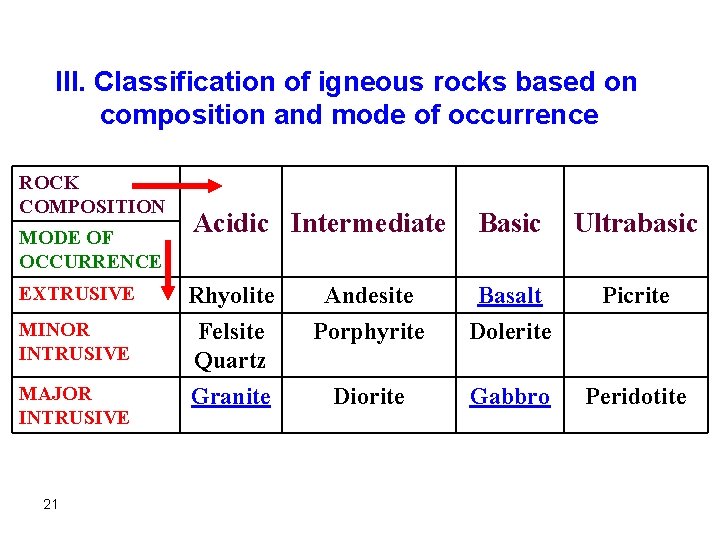
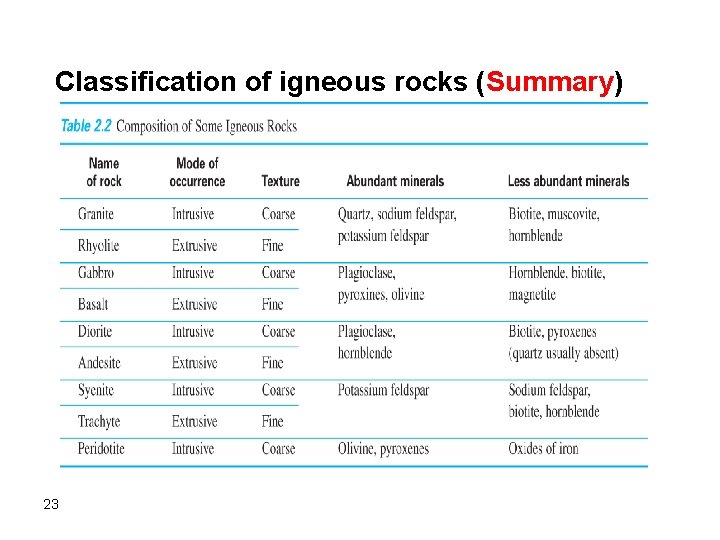
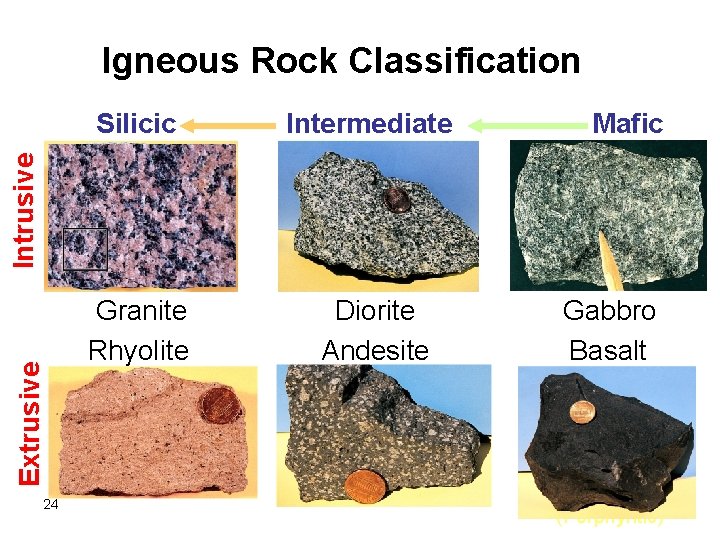
Rock Specific composition gravity Acidic (Felsic) Intermediate 2. 652. 72 2. 87 Basic (Mafic) 2. 9 -3. 2 Ultrabasic 9 3 -3. 3 Amount of (Si. O 2)% Typical Rocks Color >65 Granite Rhyolite lightcolored 55 -65 Andesite Diorite Light → darkcolored 45 -55 Basalt Gabbro darkcolored <45 Picrite Peridotite darkcolored
Igneous Rocks and Silicates parallels the systematic Silicate Mineral Classification 10 Mineral Percentage The Igneous Rock Classification Framework Sheet Double Chain Single Chain Iso.
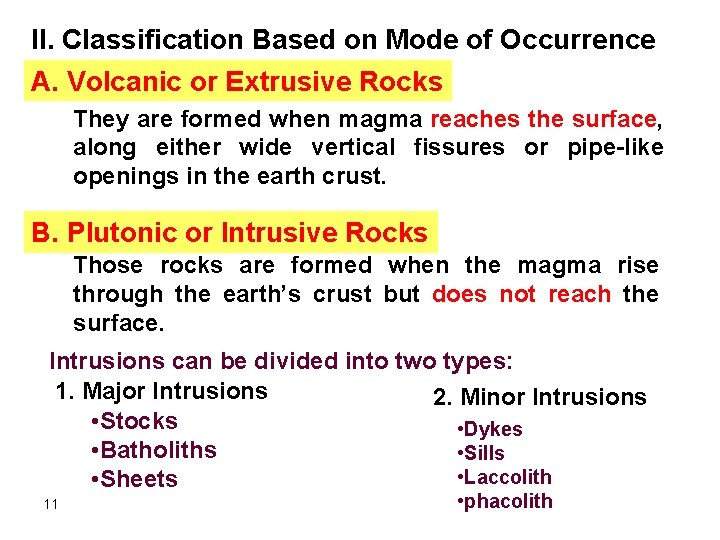
II. Classification Based on Mode of Occurrence A. Volcanic or Extrusive Rocks They are formed when magma reaches the surface, along either wide vertical fissures or pipe-like openings in the earth crust. B. Plutonic or Intrusive Rocks Those rocks are formed when the magma rise through the earth’s crust but does not reach the surface. Intrusions can be divided into two types: 1. Major Intrusions 2. Minor Intrusions • Stocks • Dykes • Batholiths • Sills • Laccolith • Sheets 11 • phacolith
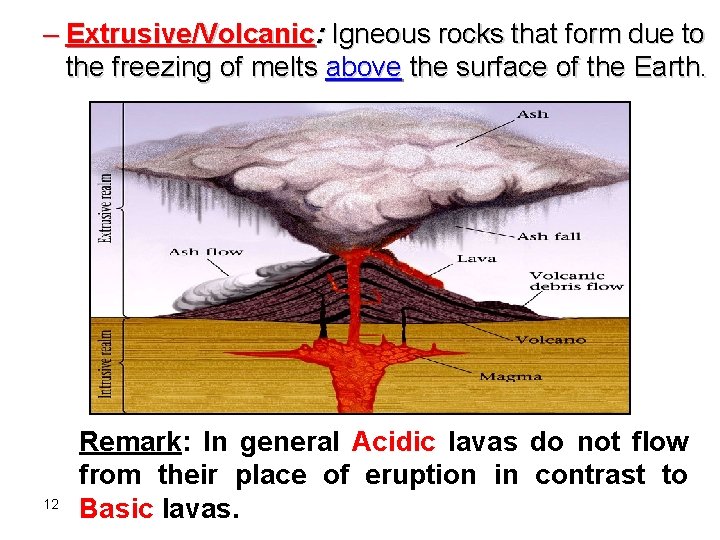
– Extrusive/Volcanic: Igneous rocks that form due to the freezing of melts above the surface of the Earth. 12 Remark: In general Acidic lavas do not flow from their place of eruption in contrast to Basic lavas.
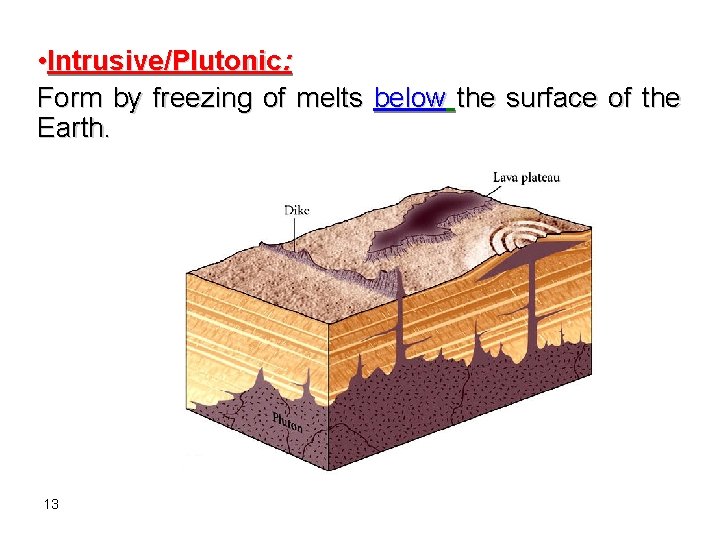
• Intrusive/Plutonic: Form by freezing of melts below the surface of the Earth. 13
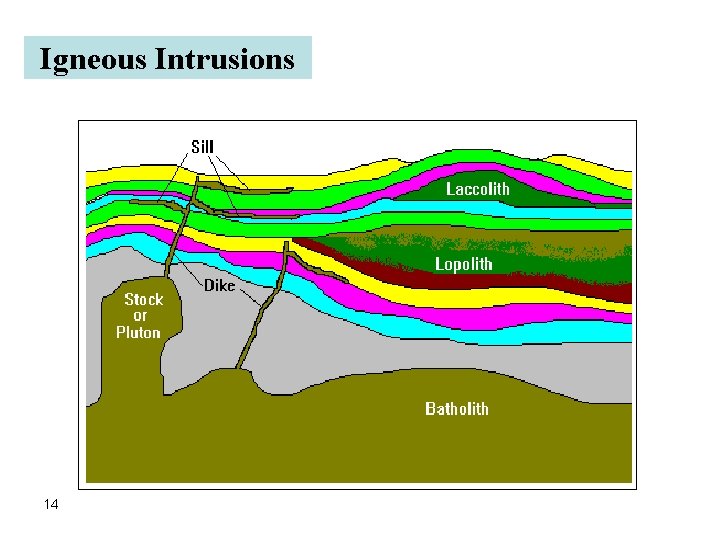
Igneous Intrusions 14
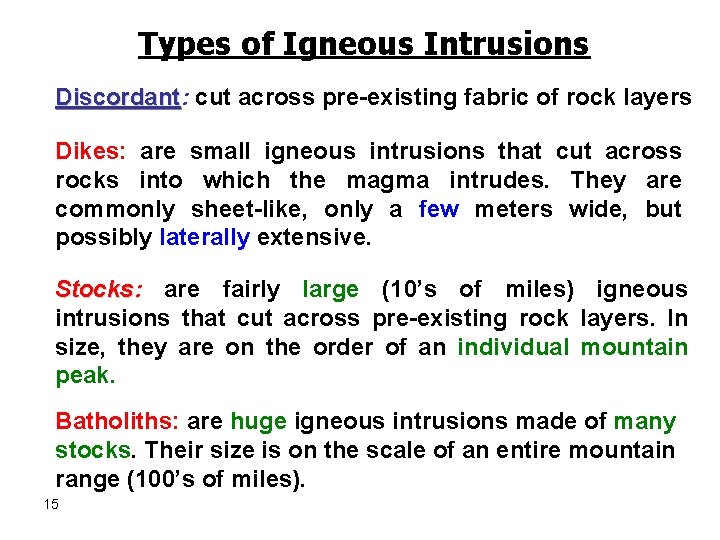
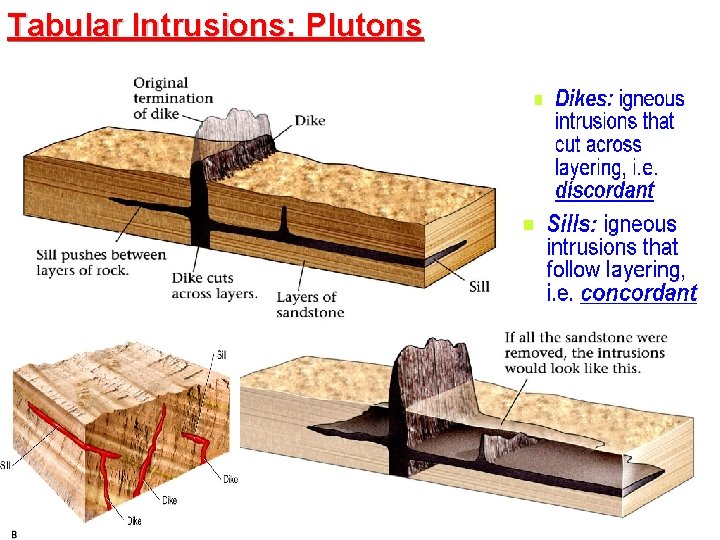
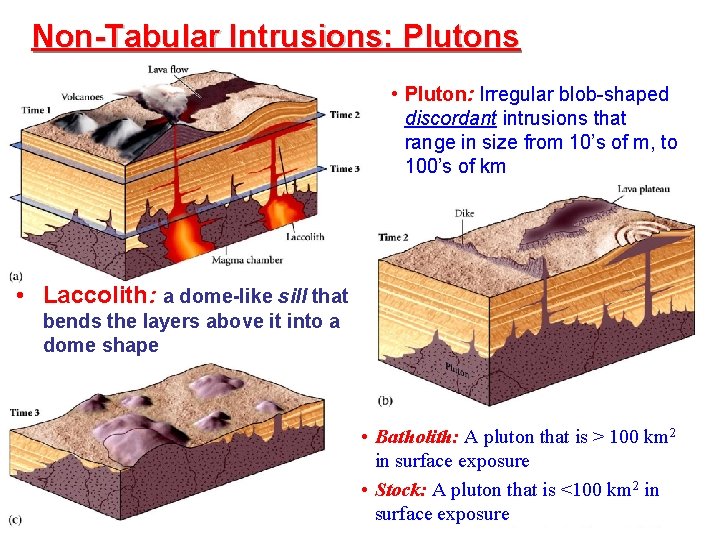
Types of Igneous Intrusions Discordant: Discordant cut across pre-existing fabric of rock layers Dikes: are small igneous intrusions that cut across rocks into which the magma intrudes. They are commonly sheet-like, only a few meters wide, but possibly laterally extensive. Stocks: are fairly large (10’s of miles) igneous intrusions that cut across pre-existing rock layers. In size, they are on the order of an individual mountain peak. Batholiths: are huge igneous intrusions made of many stocks. Their size is on the scale of an entire mountain range (100’s of miles). 15
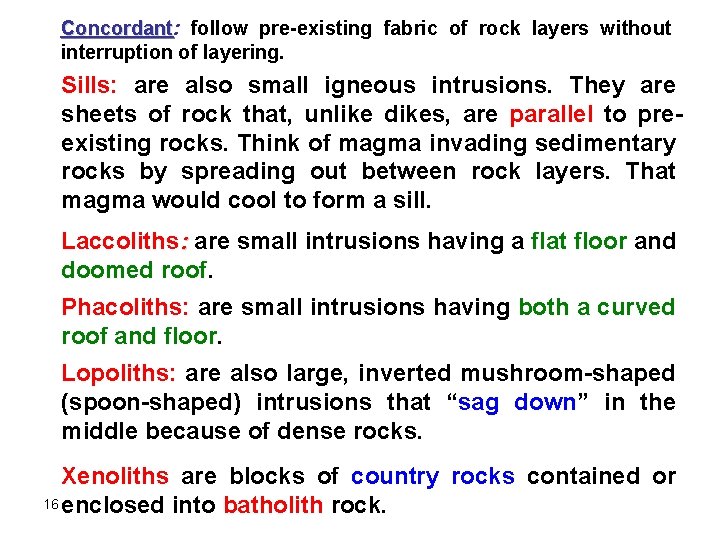
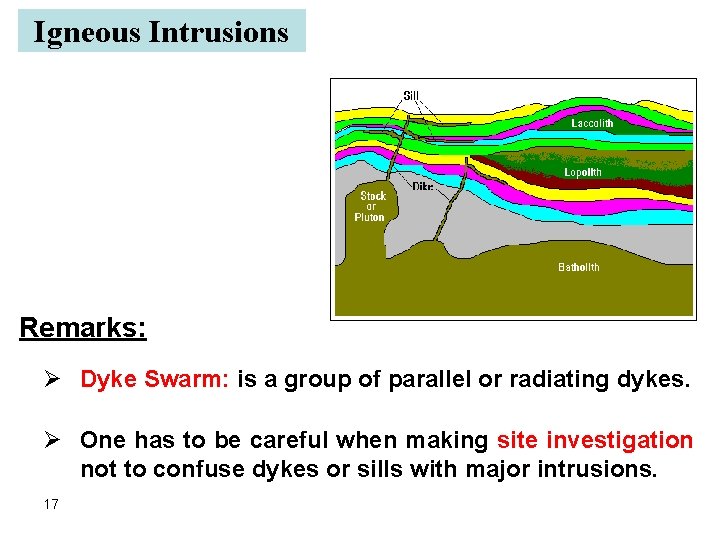
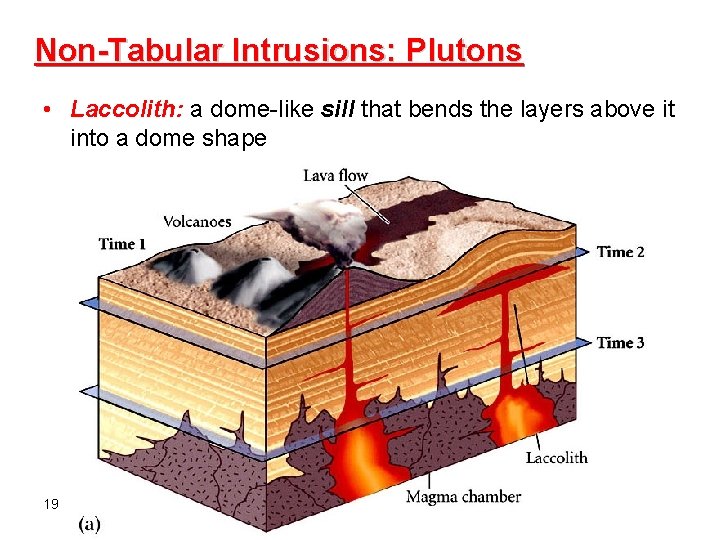
Concordant: Concordant follow pre-existing fabric of rock layers without interruption of layering. Sills: are also small igneous intrusions. They are sheets of rock that, unlike dikes, are parallel to preexisting rocks. Think of magma invading sedimentary rocks by spreading out between rock layers. That magma would cool to form a sill. Laccoliths: are small intrusions having a flat floor and doomed roof. Phacoliths: are small intrusions having both a curved roof and floor. Lopoliths: are also large, inverted mushroom-shaped (spoon-shaped) intrusions that “sag down” in the middle because of dense rocks. Xenoliths are blocks of country rocks contained or 16 enclosed into batholith rock.
Igneous Intrusions Remarks: Ø Dyke Swarm: is a group of parallel or radiating dykes. Ø One has to be careful when making site investigation not to confuse dykes or sills with major intrusions. 17
Tabular Intrusions: Plutons 18
Non-Tabular Intrusions: Plutons • Laccolith: a dome-like sill that bends the layers above it into a dome shape 19
Non-Tabular Intrusions: Plutons • Pluton: Irregular blob-shaped discordant intrusions that range in size from 10’s of m, to 100’s of km • Laccolith: a dome-like sill that bends the layers above it into a dome shape 20 • Batholith: A pluton that is > 100 km 2 in surface exposure • Stock: A pluton that is <100 km 2 in surface exposure
III. Classification of igneous rocks based on composition and mode of occurrence ROCK COMPOSITION MODE OF OCCURRENCE EXTRUSIVE MINOR INTRUSIVE MAJOR INTRUSIVE 21 Acidic Intermediate Rhyolite Felsite Quartz Granite Basic Ultrabasic Andesite Porphyrite Basalt Dolerite Picrite Diorite Gabbro Peridotite
Igneous Rock Classification (Summary) Mineral Percentage Intrusive (Plutonic) Extrusive (Volcanic) 22
Classification of igneous rocks (Summary) 23
Igneous Rock Classification Intermediate Granite Rhyolite Diorite Andesite Mafic Extrusive Intrusive Silicic 24 Gabbro Basalt (Porphyritic)
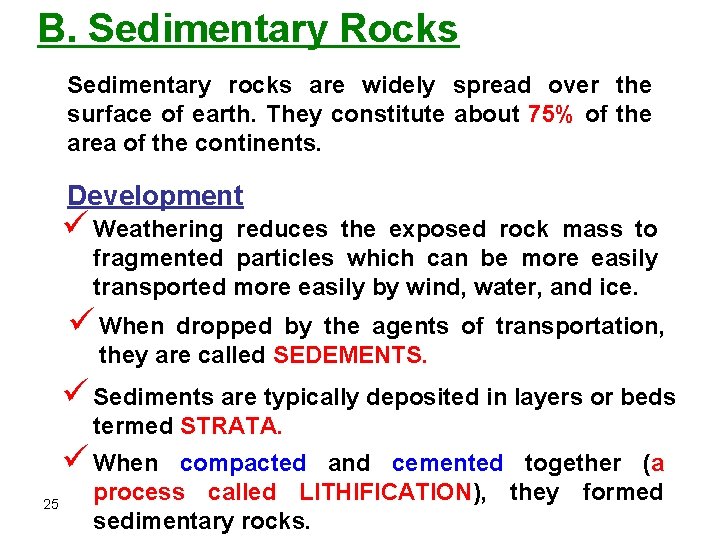
B. Sedimentary Rocks Sedimentary rocks are widely spread over the surface of earth. They constitute about 75% of the area of the continents. Development ü Weathering reduces the exposed rock mass to fragmented particles which can be more easily transported more easily by wind, water, and ice. ü When dropped by the agents of transportation, they are called SEDEMENTS. ü Sediments are typically deposited in layers or beds termed STRATA. ü When 25 compacted and cemented together (a process called LITHIFICATION), they formed sedimentary rocks.
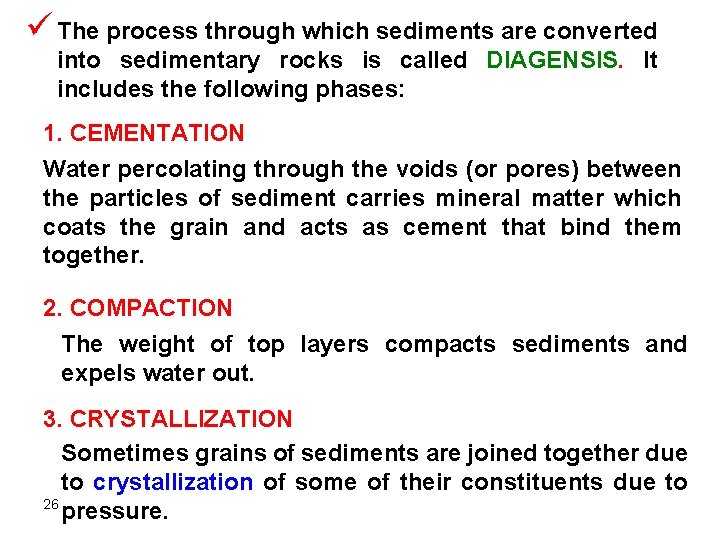
ü The process through which sediments are converted into sedimentary rocks is called DIAGENSIS. It includes the following phases: 1. CEMENTATION Water percolating through the voids (or pores) between the particles of sediment carries mineral matter which coats the grain and acts as cement that bind them together. 2. COMPACTION The weight of top layers compacts sediments and expels water out. 3. CRYSTALLIZATION Sometimes grains of sediments are joined together due to crystallization of some of their constituents due to 26 pressure.
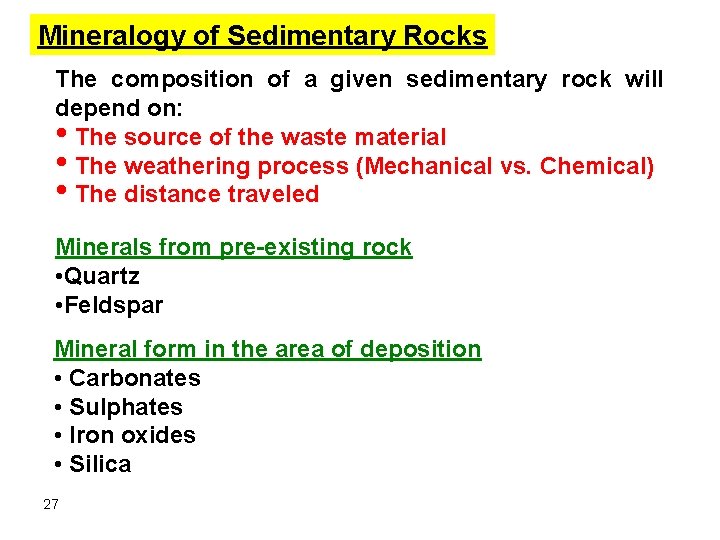
Mineralogy of Sedimentary Rocks The composition of a given sedimentary rock will depend on: • The source of the waste material • The weathering process (Mechanical vs. Chemical) • The distance traveled Minerals from pre-existing rock • Quartz • Feldspar Mineral form in the area of deposition • Carbonates • Sulphates • Iron oxides • Silica 27
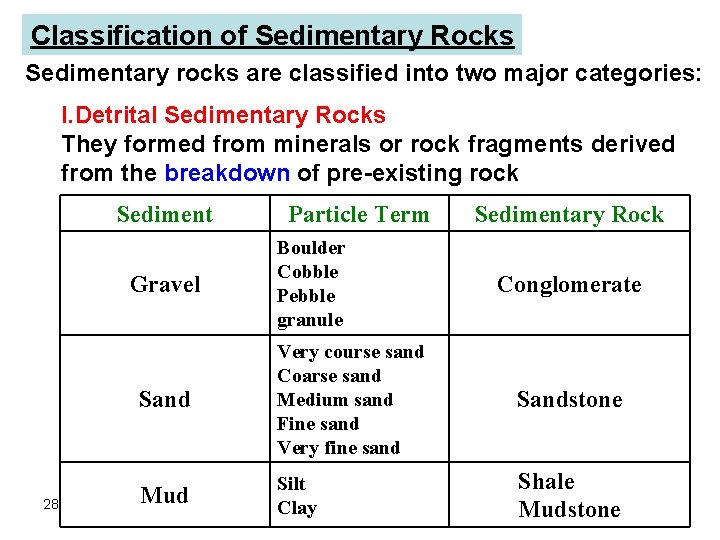
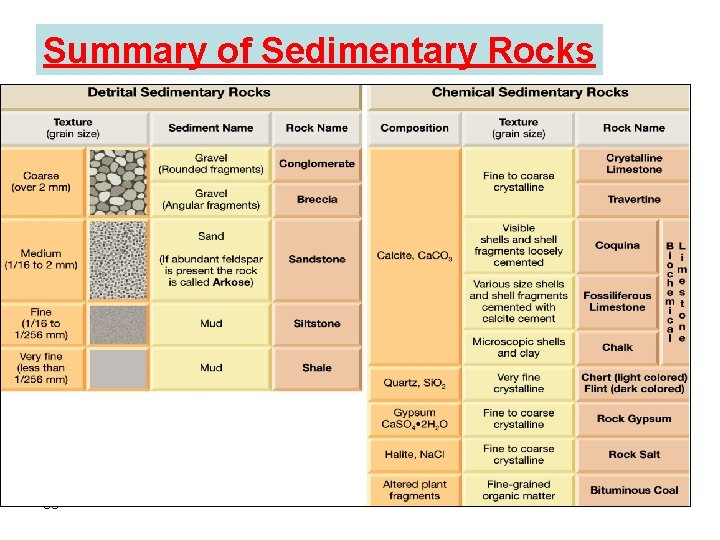
Classification of Sedimentary Rocks Sedimentary rocks are classified into two major categories: I. Detrital Sedimentary Rocks They formed from minerals or rock fragments derived from the breakdown of pre-existing rock Sediment Gravel 28 Particle Term Boulder Cobble Pebble granule Sedimentary Rock Conglomerate Sand Very course sand Coarse sand Medium sand Fine sand Very fine sand Sandstone Mud Silt Clay Shale Mudstone
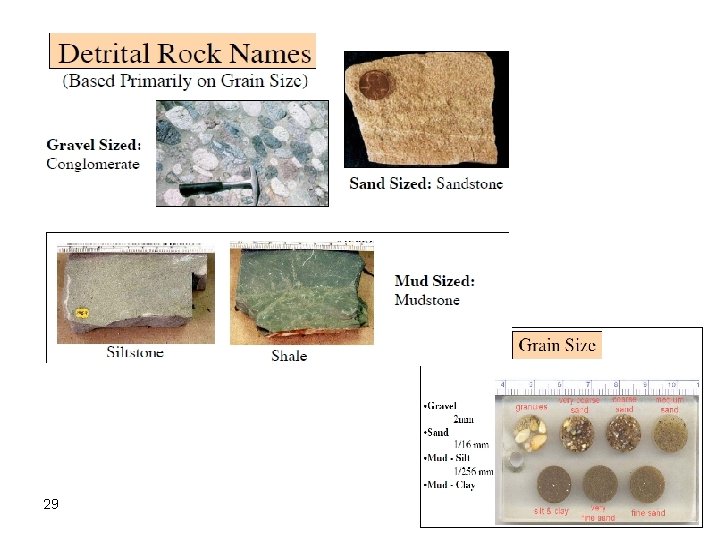
29
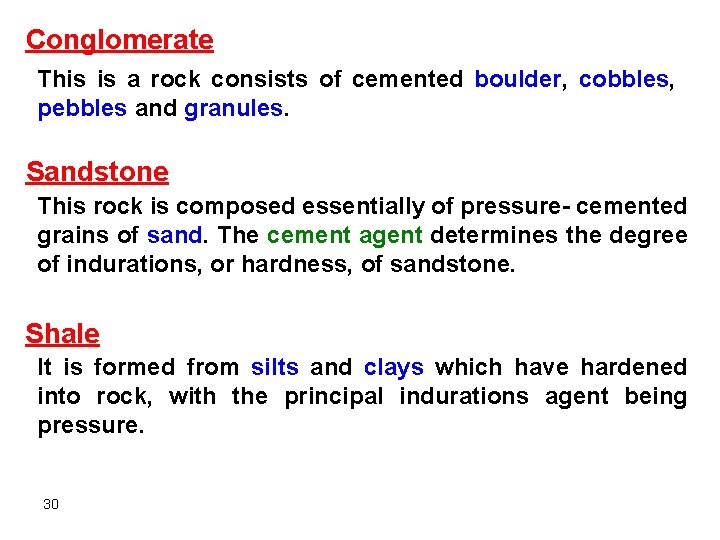
Conglomerate This is a rock consists of cemented boulder, cobbles, pebbles and granules. Sandstone This rock is composed essentially of pressure- cemented grains of sand. The cement agent determines the degree of indurations, or hardness, of sandstone. Shale It is formed from silts and clays which have hardened into rock, with the principal indurations agent being pressure. 30
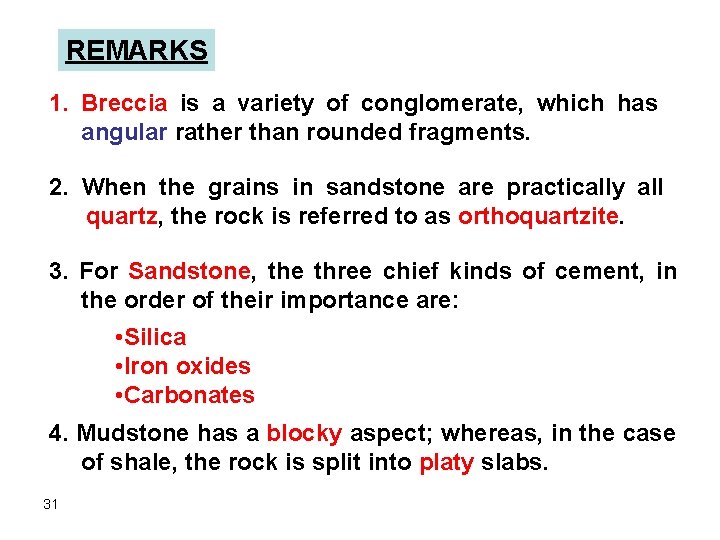
REMARKS 1. Breccia is a variety of conglomerate, which has angular rather than rounded fragments. 2. When the grains in sandstone are practically all quartz, the rock is referred to as orthoquartzite. 3. For Sandstone, the three chief kinds of cement, in the order of their importance are: • Silica • Iron oxides • Carbonates 4. Mudstone has a blocky aspect; whereas, in the case of shale, the rock is split into platy slabs. 31
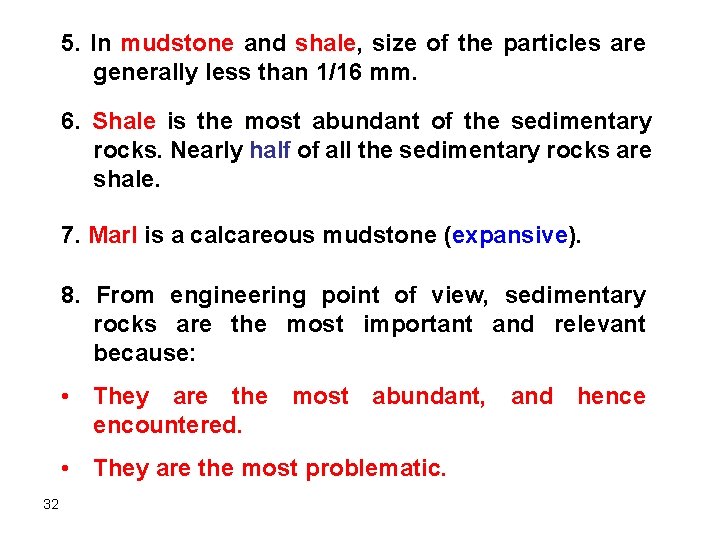
5. In mudstone and shale, size of the particles are generally less than 1/16 mm. 6. Shale is the most abundant of the sedimentary rocks. Nearly half of all the sedimentary rocks are shale. 7. Marl is a calcareous mudstone (expansive). 8. From engineering point of view, sedimentary rocks are the most important and relevant because: • They are the most abundant, and hence encountered. • They are the most problematic. 32
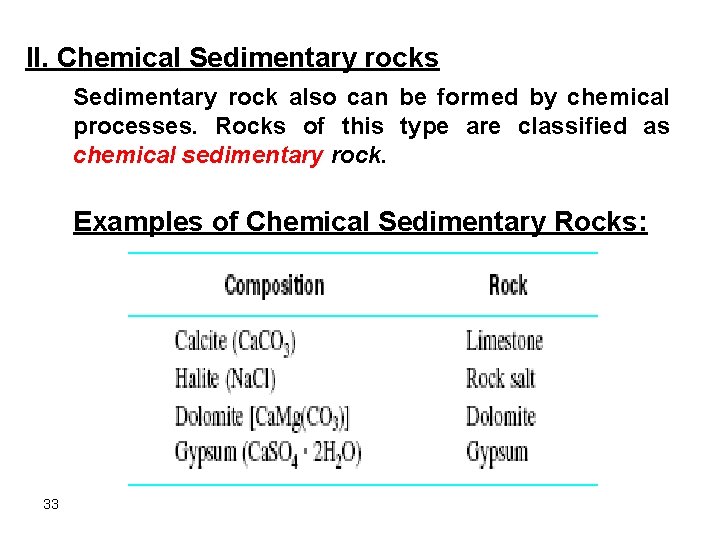
II. Chemical Sedimentary rocks Sedimentary rock also can be formed by chemical processes. Rocks of this type are classified as chemical sedimentary rock. Examples of Chemical Sedimentary Rocks: 33
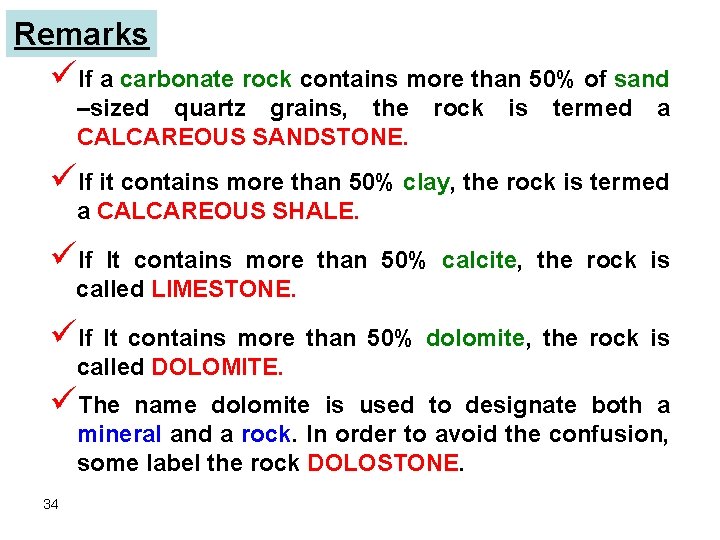
Remarks üIf a carbonate rock contains more than 50% of sand –sized quartz grains, the rock CALCAREOUS SANDSTONE. is termed a üIf it contains more than 50% clay, the rock is termed a CALCAREOUS SHALE. üIf It contains more than 50% calcite, the rock is called LIMESTONE. üIf It contains more than 50% dolomite, the rock is called DOLOMITE. üThe name dolomite is used to designate both a mineral and a rock. In order to avoid the confusion, some label the rock DOLOSTONE. 34
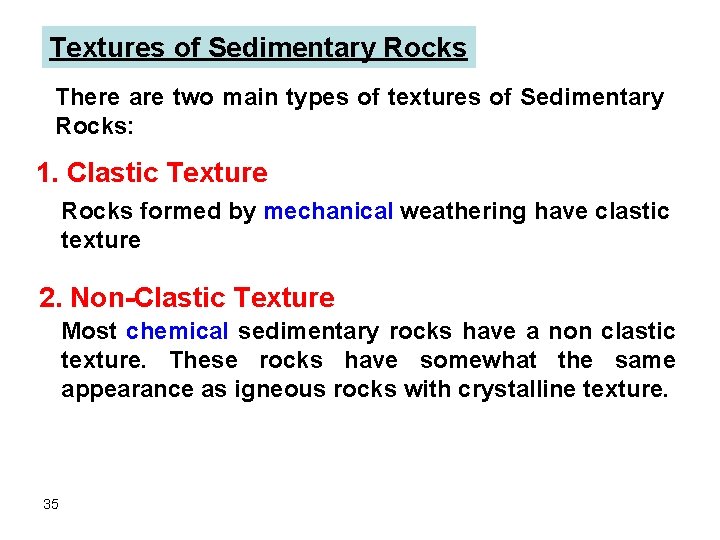
Textures of Sedimentary Rocks There are two main types of textures of Sedimentary Rocks: 1. Clastic Texture Rocks formed by mechanical weathering have clastic texture 2. Non-Clastic Texture Most chemical sedimentary rocks have a non clastic texture. These rocks have somewhat the same appearance as igneous rocks with crystalline texture. 35
Summary of Sedimentary Rocks 36
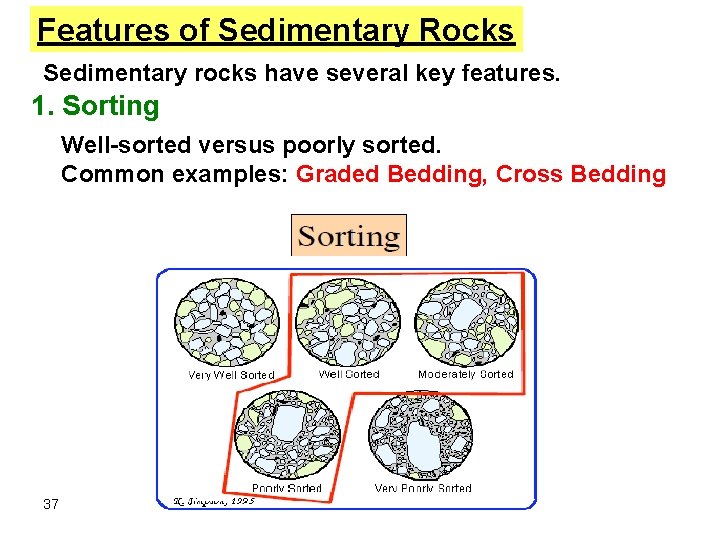
Features of Sedimentary Rocks Sedimentary rocks have several key features. 1. Sorting Well-sorted versus poorly sorted. Common examples: Graded Bedding, Cross Bedding 37
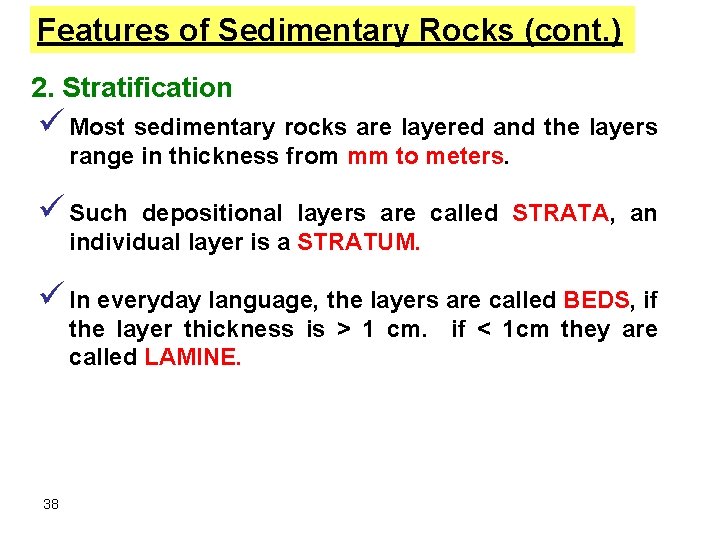
Features of Sedimentary Rocks (cont. ) 2. Stratification ü Most sedimentary rocks are layered and the layers range in thickness from mm to meters. ü Such depositional layers are called STRATA, an individual layer is a STRATUM. ü In everyday language, the layers are called BEDS, if the layer thickness is > 1 cm. if < 1 cm they are called LAMINE. 38
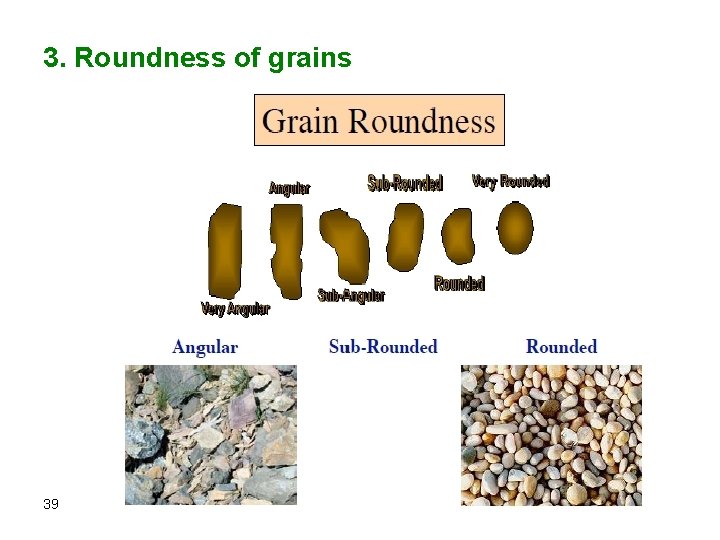
3. Roundness of grains 39
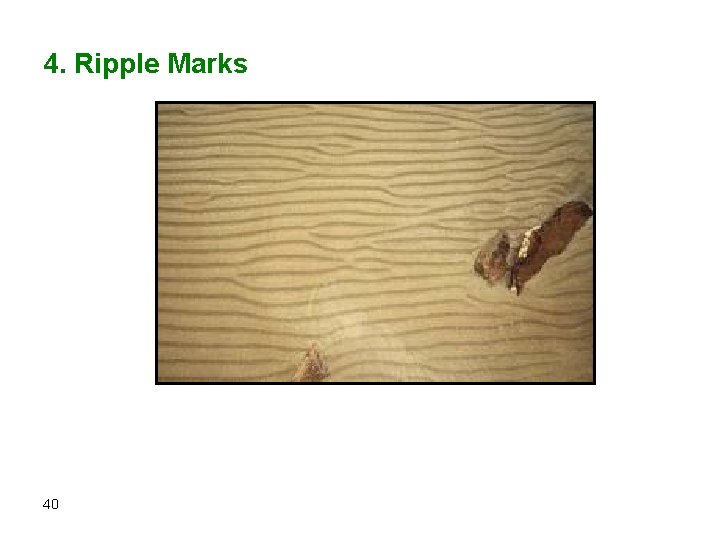
4. Ripple Marks 40
C. Metamorphic Rocks Ø Metamorphic rocks are formed if a rock is subjected to increase in temperature, pressure, or both, to such degree that a new TEXTURE or possibly a new MINERAL composition is produced. Ø The process of change is referred to as METAMORPHISM. It is derived from the Greek META which means change and MORPH, shape or form. Ø The original rock may be igneous, sedimentary or metamorphic. 41
Ø The origin of metamorphic rocks is the least clear among the three classes of rocks. Because no one has ever seen a metamorphic rock been formed, and for that reason many of our ideas about them are pure conjecture. Ø During metamorphism the minerals do not melt, but remain largely in the solid state. Ø The metamorphism process is isothermal process, i. e. the overall chemical composition of the rock is nearly the same before and after recrystallization. 42
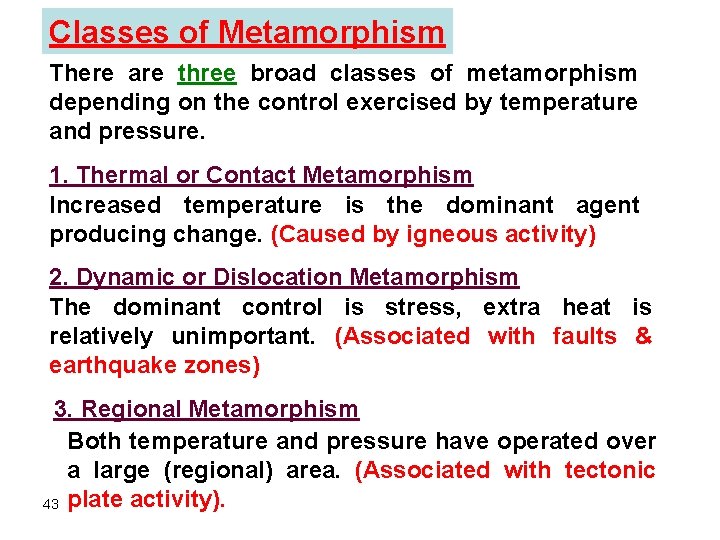
Classes of Metamorphism There are three broad classes of metamorphism depending on the control exercised by temperature and pressure. 1. Thermal or Contact Metamorphism Increased temperature is the dominant agent producing change. (Caused by igneous activity) 2. Dynamic or Dislocation Metamorphism The dominant control is stress, extra heat is relatively unimportant. (Associated with faults & earthquake zones) 3. Regional Metamorphism Both temperature and pressure have operated over a large (regional) area. (Associated with tectonic 43 plate activity).
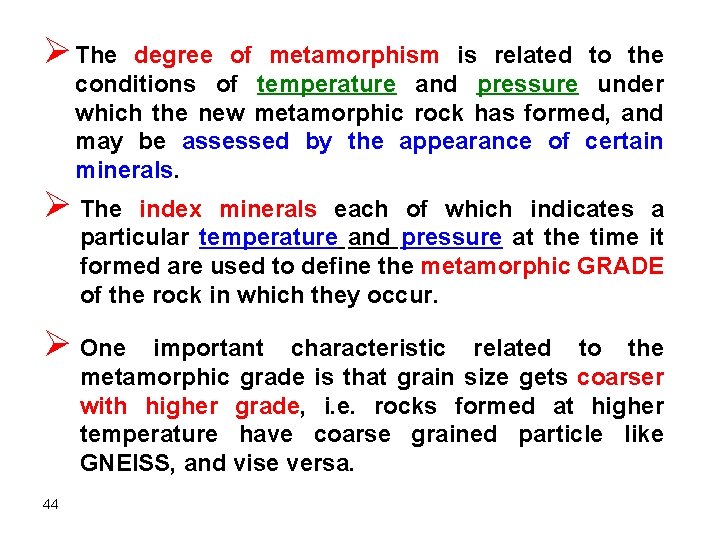
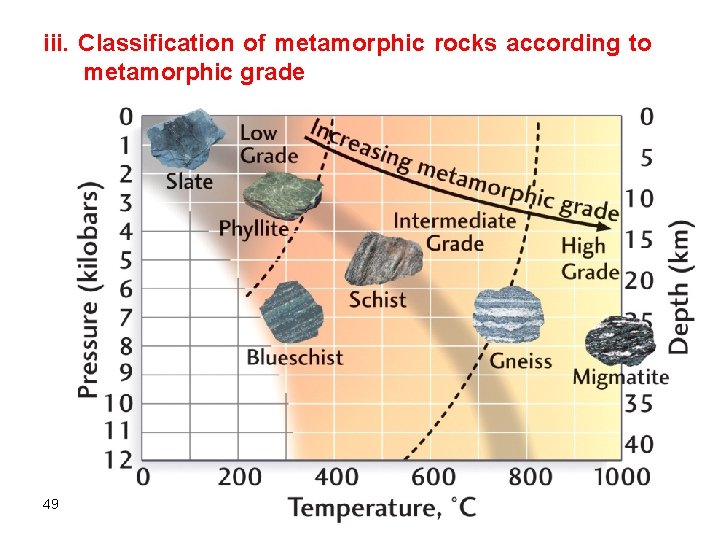
Ø The degree of metamorphism is related to the conditions of temperature and pressure under which the new metamorphic rock has formed, and may be assessed by the appearance of certain minerals. Ø The index minerals each of which indicates a particular temperature and pressure at the time it formed are used to define the metamorphic GRADE of the rock in which they occur. Ø One important characteristic related to the metamorphic grade is that grain size gets coarser with higher grade, i. e. rocks formed at higher temperature have coarse grained particle like GNEISS, and vise versa. 44
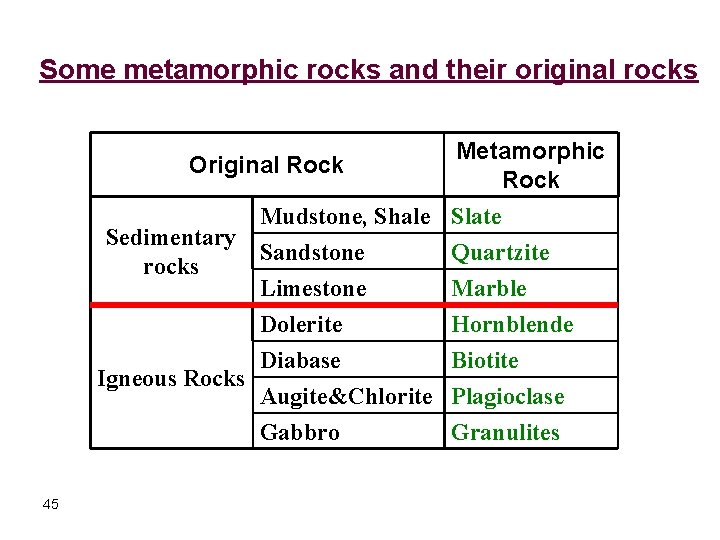
Some metamorphic rocks and their original rocks Metamorphic Original Rock Mudstone, Shale Slate Sedimentary Sandstone Quartzite rocks Limestone Marble Dolerite Hornblende Diabase Biotite Igneous Rocks Augite&Chlorite Plagioclase Gabbro 45 Granulites
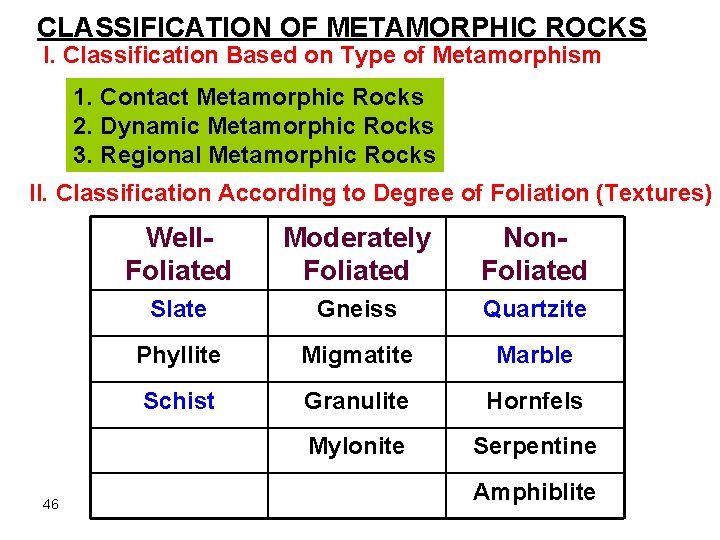
CLASSIFICATION OF METAMORPHIC ROCKS I. Classification Based on Type of Metamorphism 1. Contact Metamorphic Rocks 2. Dynamic Metamorphic Rocks 3. Regional Metamorphic Rocks II. Classification According to Degree of Foliation (Textures) 46 Well. Foliated Moderately Foliated Non. Foliated Slate Gneiss Quartzite Phyllite Migmatite Marble Schist Granulite Hornfels Mylonite Serpentine Amphiblite
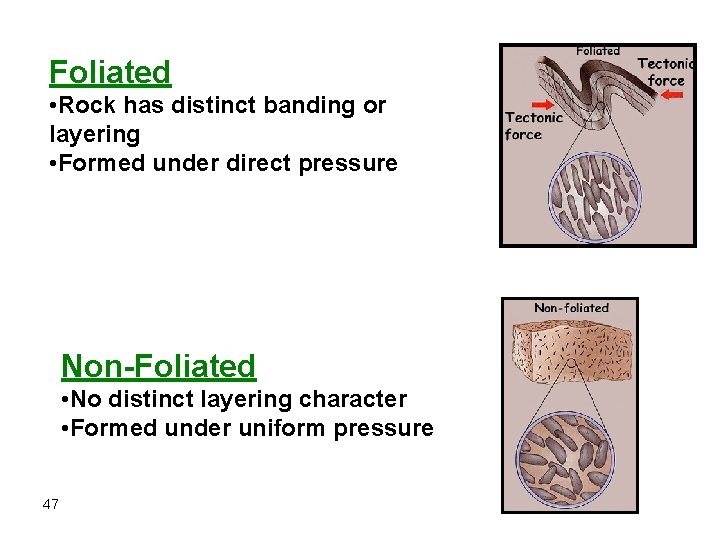
Foliated • Rock has distinct banding or layering • Formed under direct pressure Non-Foliated • No distinct layering character • Formed under uniform pressure 47
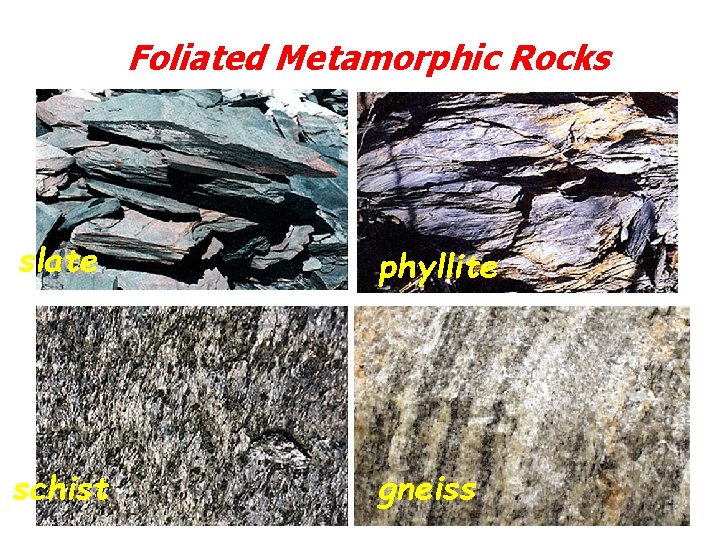
Foliated Metamorphic Rocks slate phyllite schist 48 gneiss
iii. Classification of metamorphic rocks according to metamorphic grade 49
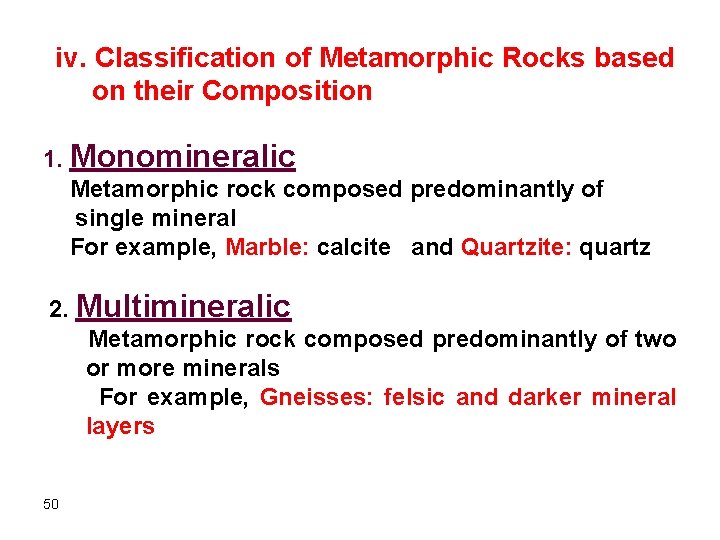
iv. Classification of Metamorphic Rocks based on their Composition 1. Monomineralic Metamorphic rock composed predominantly of single mineral For example, Marble: calcite and Quartzite: quartz 2. Multimineralic Metamorphic rock composed predominantly of two or more minerals For example, Gneisses: felsic and darker mineral layers 50
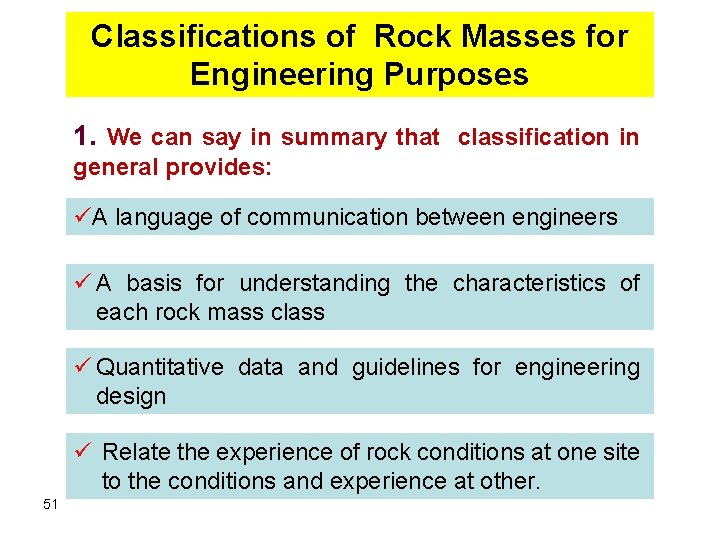
Classifications of Rock Masses for Engineering Purposes 1. We can say in summary that classification in general provides: üA language of communication between engineers ü A basis for understanding the characteristics of each rock mass class ü Quantitative data and guidelines for engineering design ü Relate the experience of rock conditions at one site to the conditions and experience at other. 51
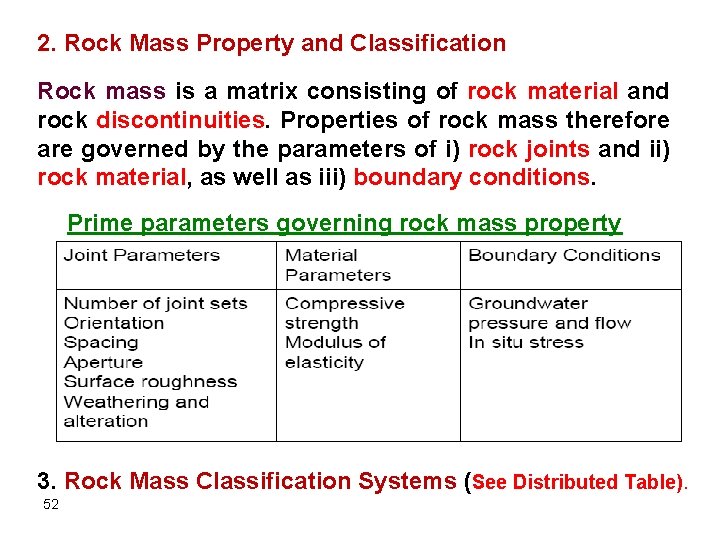
2. Rock Mass Property and Classification Rock mass is a matrix consisting of rock material and rock discontinuities. Properties of rock mass therefore are governed by the parameters of i) rock joints and ii) rock material, as well as iii) boundary conditions. Prime parameters governing rock mass property 3. Rock Mass Classification Systems (See Distributed Table). 52