
IS 800 2007 Section 8 Design of members
IS 800: 2007 Section 8 Design of members subjected to bending Dr S R Satish Kumar, IIT Madras
SECTION 8 DESIGN OF MEMBERS SUBJECTED TO BENDING 8. 1 General 8. 2 Design Strength in Bending (Flexure) 8. 2. 1 Laterally Supported Beam 8. 2. 2 Laterally Unsupported Beams 8. 3 Effective Length of Compression Flanges 8. 4 Shear ------------------------------------------------8. 5 Stiffened Web Panels 8. 5. 1 End Panels design 8. 5. 2 End Panels designed using Tension field action 8. 5. 3 Anchor forces 8. 6 Design of Beams and Plate Girders with Solid Webs 8. 6. 1 Minimum Web Thickness 8. 6. 2 Sectional Properties 8. 6. 3 Flanges Cont. . . Dr S R Satish Kumar, IIT Madras 2
SECTION 8 DESIGN OF MEMBERS SUBJECTED TO BENDING 8. 7 Stiffener Design 8. 7. 1 General 8. 7. 2 Design of Intermediate Transverse Web Stiffeners 8. 8 8. 9 8. 10 8. 7. 3 Load carrying stiffeners 8. 7. 4 Bearing Stiffeners 8. 7. 5 Design of Load Carrying Stiffeners 8. 7. 6 Design of Bearing Stiffeners 8. 7. 7 Design of Diagonal Stiffeners 8. 7. 8 Design of Tension Stiffeners 8. 7. 9 Torsional Stiffeners 8. 7. 10 Connection to Web of Load Carrying and Bearing Stiffeners 8. 7. 11 Connection to Flanges 8. 7. 12 Hollow Sections Box Girders Purlins and sheeting rails (girts) Bending in a Non-Principal Plane Dr S R Satish Kumar, IIT Madras 3
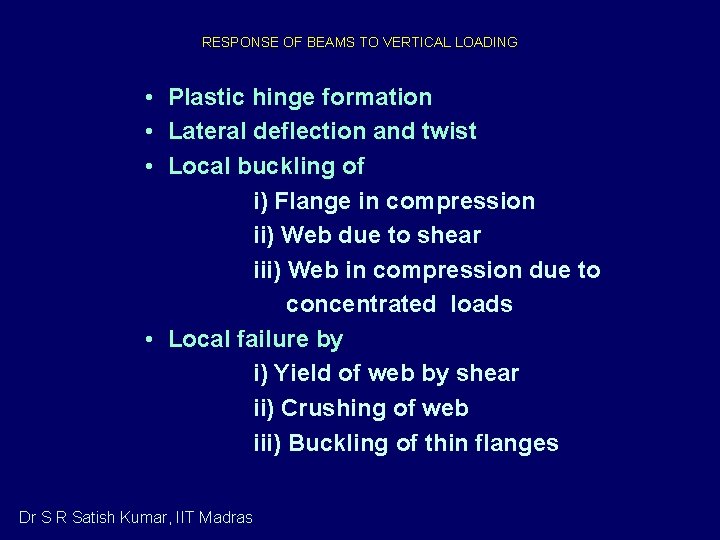
RESPONSE OF BEAMS TO VERTICAL LOADING • Plastic hinge formation • Lateral deflection and twist • Local buckling of i) Flange in compression ii) Web due to shear iii) Web in compression due to concentrated loads • Local failure by i) Yield of web by shear ii) Crushing of web iii) Buckling of thin flanges Dr S R Satish Kumar, IIT Madras
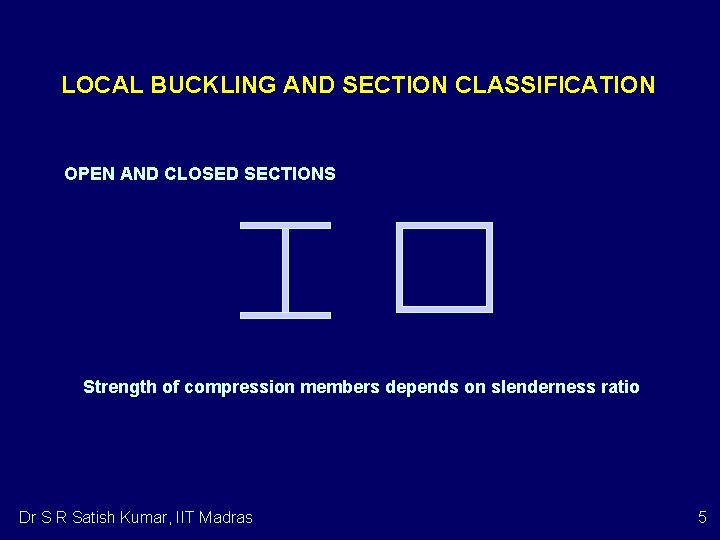
LOCAL BUCKLING AND SECTION CLASSIFICATION OPEN AND CLOSED SECTIONS Strength of compression members depends on slenderness ratio Dr S R Satish Kumar, IIT Madras 5
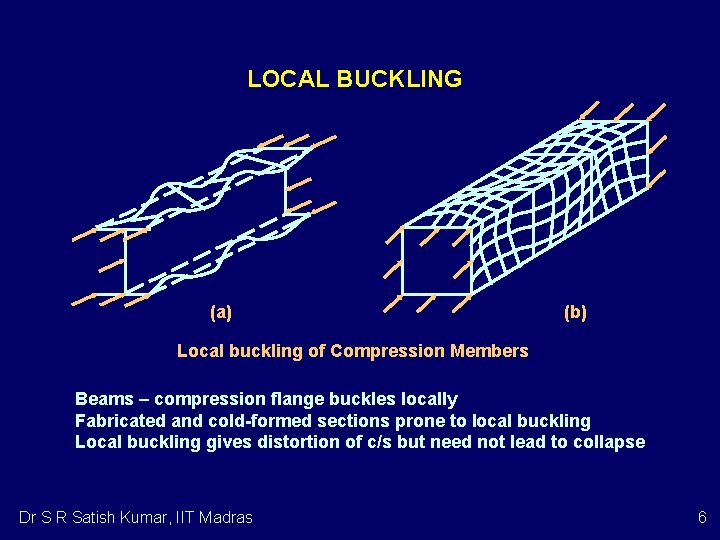
LOCAL BUCKLING (a) (b) Local buckling of Compression Members Beams – compression flange buckles locally Fabricated and cold-formed sections prone to local buckling Local buckling gives distortion of c/s but need not lead to collapse Dr S R Satish Kumar, IIT Madras 6
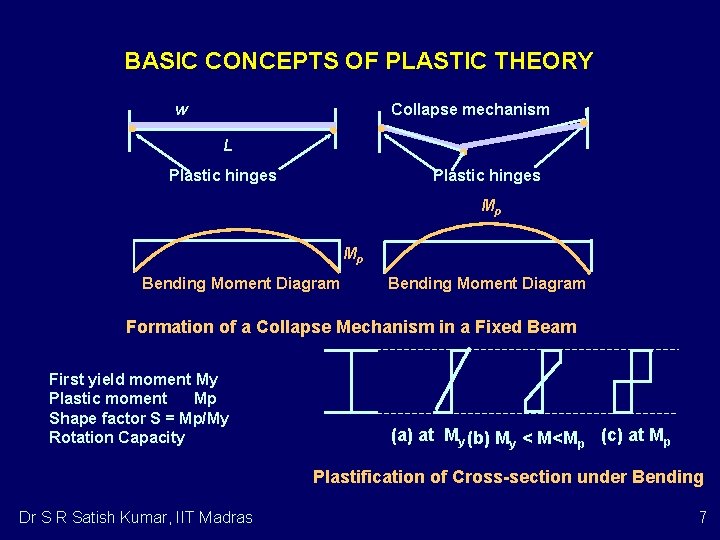
BASIC CONCEPTS OF PLASTIC THEORY w Collapse mechanism L Plastic hinges Mp Mp Bending Moment Diagram Formation of a Collapse Mechanism in a Fixed Beam First yield moment My Plastic moment Mp Shape factor S = Mp/My Rotation Capacity (a) at My (b) My < M<Mp (c) at Mp Plastification of Cross-section under Bending Dr S R Satish Kumar, IIT Madras 7
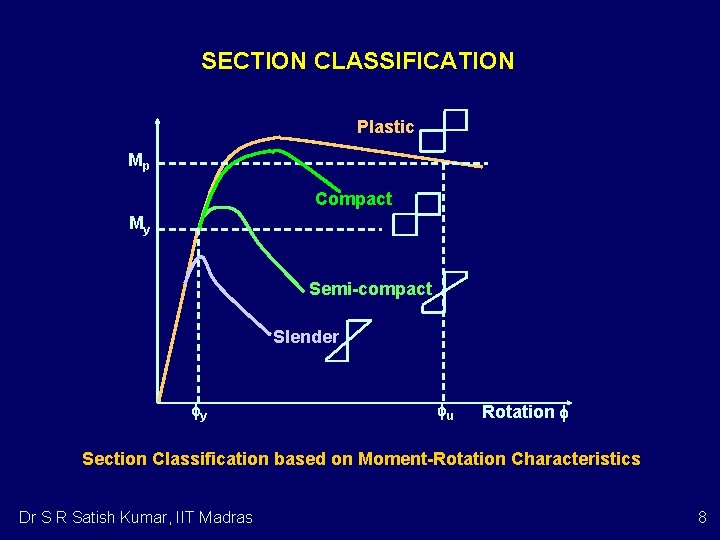
SECTION CLASSIFICATION Plastic Mp Compact My Semi-compact Slender y u Rotation Section Classification based on Moment-Rotation Characteristics Dr S R Satish Kumar, IIT Madras 8
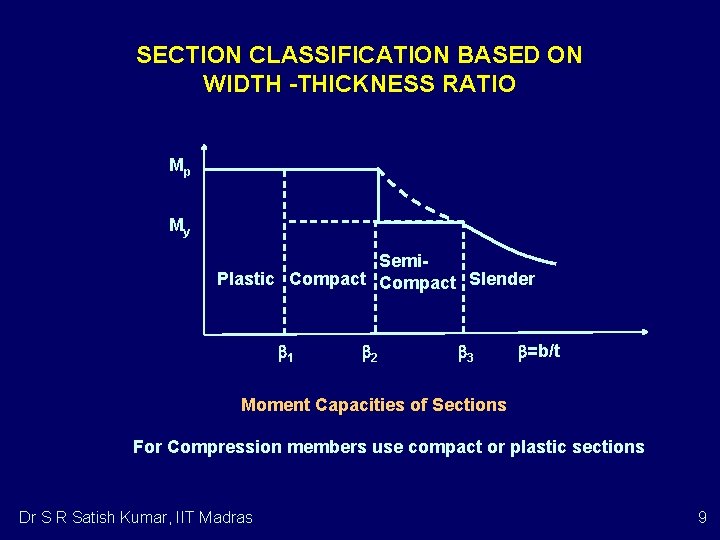
SECTION CLASSIFICATION BASED ON WIDTH -THICKNESS RATIO Mp My Semi. Plastic Compact Slender 1 2 3 =b/t Moment Capacities of Sections For Compression members use compact or plastic sections Dr S R Satish Kumar, IIT Madras 9
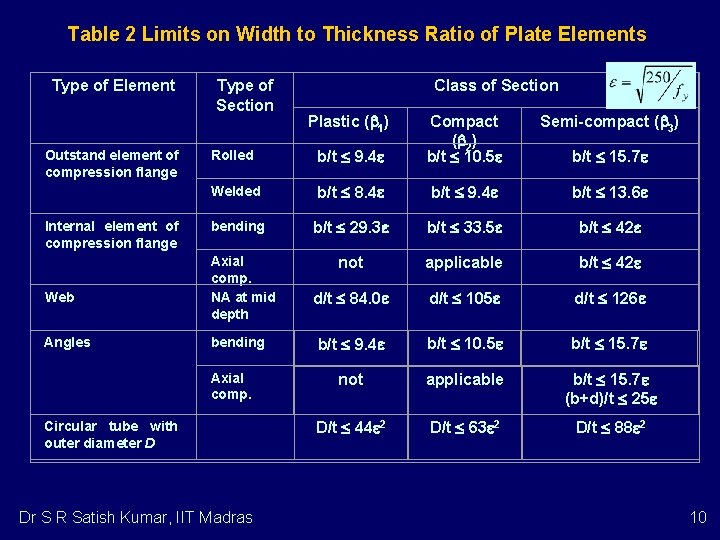
Table 2 Limits on Width to Thickness Ratio of Plate Elements Type of Element Outstand element of compression flange Internal element of compression flange Web Angles Type of Section Rolled b/t 9. 4 Compact ( 2) b/t 10. 5 Welded b/t 8. 4 b/t 9. 4 b/t 13. 6 bending b/t 29. 3 b/t 33. 5 b/t 42 not applicable b/t 42 d/t 84. 0 d/t 105 d/t 126 b/t 9. 4 b/t 10. 5 b/t 15. 7 not applicable b/t 15. 7 (b+d)/t 25 D/t 44 2 D/t 63 2 D/t 88 2 Axial comp. NA at mid depth bending Axial comp. Circular tube with outer diameter D Class of Section Dr S R Satish Kumar, IIT Madras Plastic ( 1) Semi-compact ( 3) b/t 15. 7 10
Condition for Beam Lateral Stability • 1 Laterally Supported Beam The design bending strength of beams, adequately supported against lateral torsional buckling (laterally supported beam) is governed by the yield stress • 2 Laterally Unsupported Beams When a beam is not adequately supported against lateral buckling (laterally un-supported beams) the design bending strength may be governed by lateral torsional buckling strength Dr S R Satish Kumar, IIT Madras 11
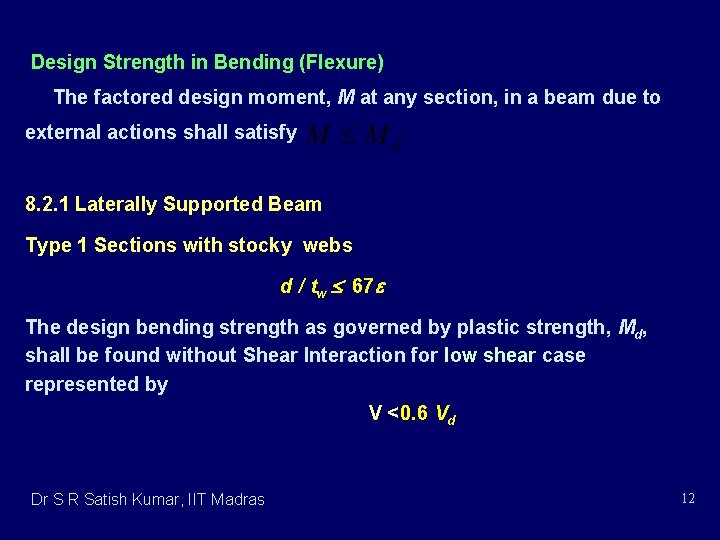
Design Strength in Bending (Flexure) The factored design moment, M at any section, in a beam due to external actions shall satisfy 8. 2. 1 Laterally Supported Beam Type 1 Sections with stocky webs d / tw 67 The design bending strength as governed by plastic strength, Md, shall be found without Shear Interaction for low shear case represented by V <0. 6 Vd Dr S R Satish Kumar, IIT Madras 12
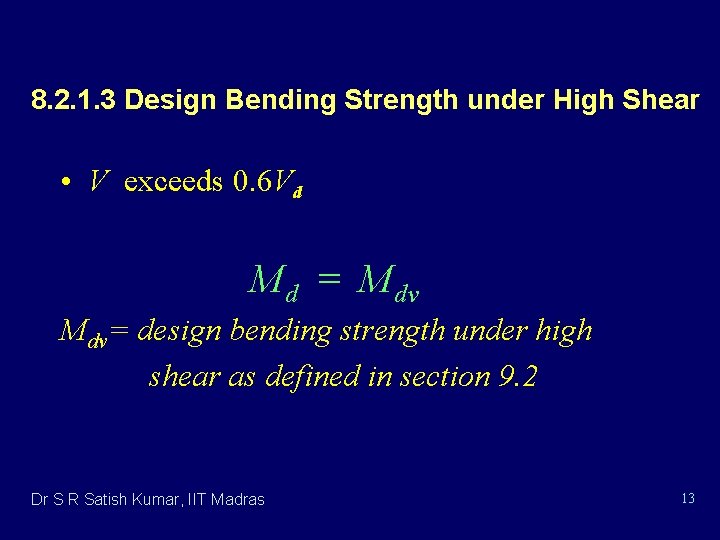
8. 2. 1. 3 Design Bending Strength under High Shear • V exceeds 0. 6 Vd Md = Mdv= design bending strength under high shear as defined in section 9. 2 Dr S R Satish Kumar, IIT Madras 13
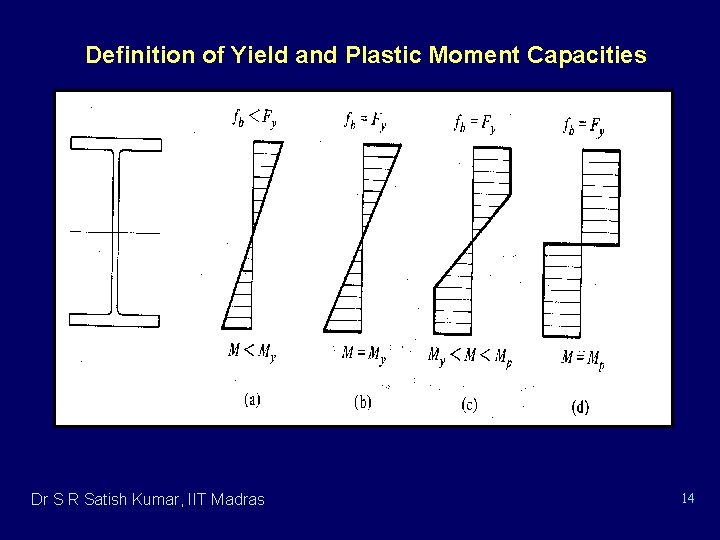
Definition of Yield and Plastic Moment Capacities Dr S R Satish Kumar, IIT Madras 14
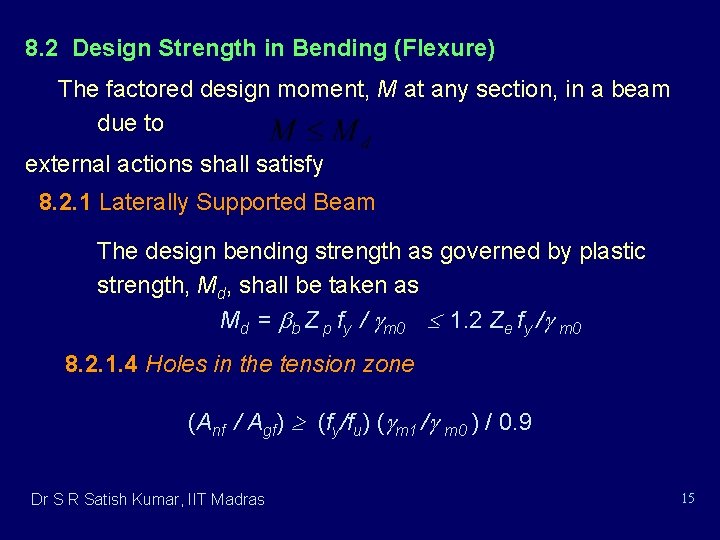
8. 2 Design Strength in Bending (Flexure) The factored design moment, M at any section, in a beam due to external actions shall satisfy 8. 2. 1 Laterally Supported Beam The design bending strength as governed by plastic strength, Md, shall be taken as Md = b Z p fy / m 0 1. 2 Ze fy / m 0 8. 2. 1. 4 Holes in the tension zone (Anf / Agf) (fy/fu) ( m 1 / m 0 ) / 0. 9 Dr S R Satish Kumar, IIT Madras 15
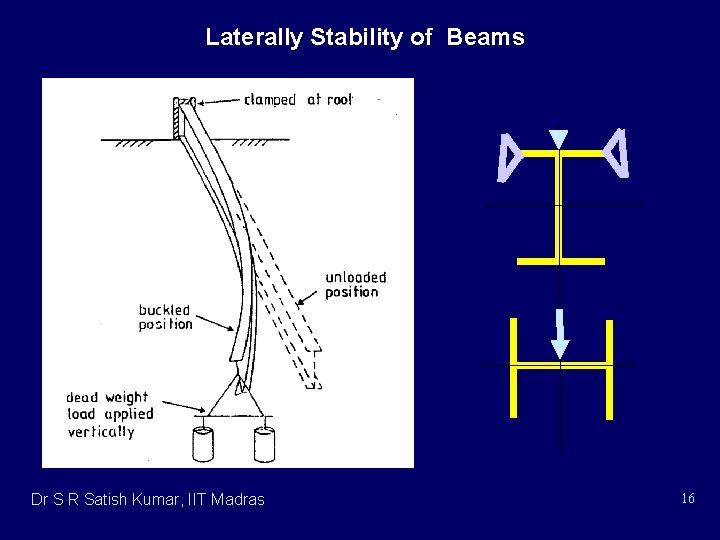
Laterally Stability of Beams Dr S R Satish Kumar, IIT Madras 16
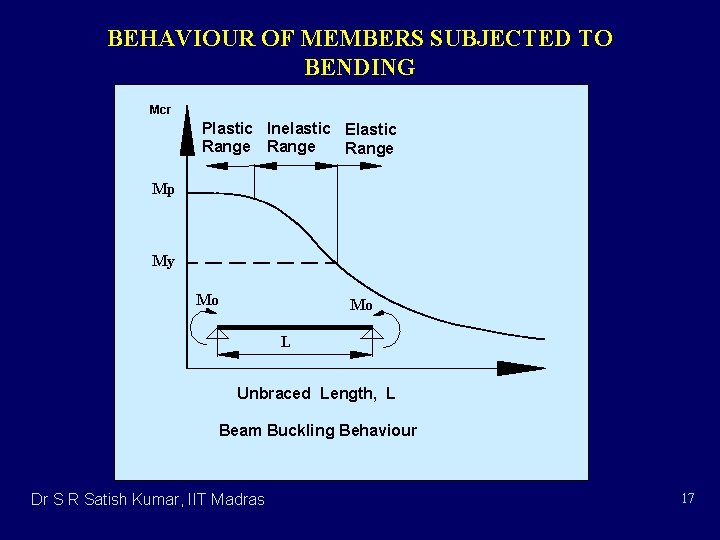
BEHAVIOUR OF MEMBERS SUBJECTED TO BENDING Mcr Plastic Inelastic Elastic Range Mp My Mo Mo L Unbraced Length, L Beam Buckling Behaviour Dr S R Satish Kumar, IIT Madras 17
LATERAL BUCKLING OF BEAMS · FACTORS TO BE CONSIDERED · Distance between lateral supports to the compression flange. · Restraints at the ends and at intermediate support locations (boundary conditions). · Type and position of the loads. · Moment gradient along the unsupported length. · Type of cross-section. · Non-prismatic nature of the member. · Material properties. · Magnitude and distribution of residual stresses. · Initial imperfections of geometry and eccentricity of loading. Dr S R Satish Kumar, IIT Madras 18
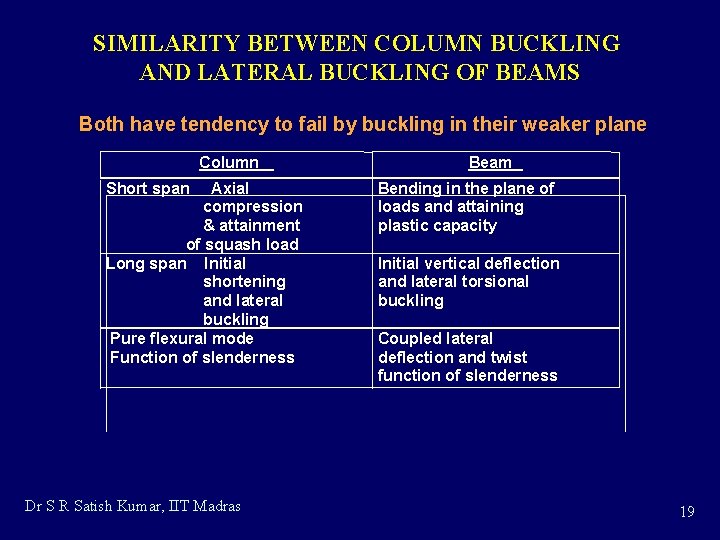
SIMILARITY BETWEEN COLUMN BUCKLING AND LATERAL BUCKLING OF BEAMS Both have tendency to fail by buckling in their weaker plane Column Short span Axial compression & attainment of squash load Long span Initial shortening and lateral buckling Pure flexural mode Function of slenderness Dr S R Satish Kumar, IIT Madras Beam Bending in the plane of loads and attaining plastic capacity Initial vertical deflection and lateral torsional buckling Coupled lateral deflection and twist function of slenderness 19
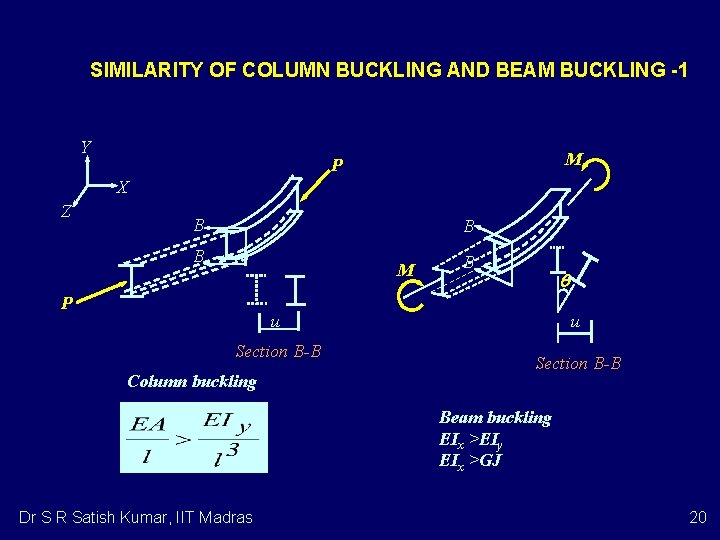
SIMILARITY OF COLUMN BUCKLING AND BEAM BUCKLING -1 Y M P X Z B B B M P B u Section B-B Column buckling u Section B-B Beam buckling EIx >EIy EIx >GJ Dr S R Satish Kumar, IIT Madras 20
LATERAL TORSIONAL BUCKLING OF SYMMETRIC SECTIONS Assumptions for the ideal (basic) case • Beam undistorted • Elastic behaviour • Loading by equal and opposite moments in the plane of the web • No residual stresses • Ends are simply supported vertically and laterally The bending moment at which a beam fails by lateral buckling when subjected to uniform end moment is called its elastic critical moment (Mcr) Dr S R Satish Kumar, IIT Madras
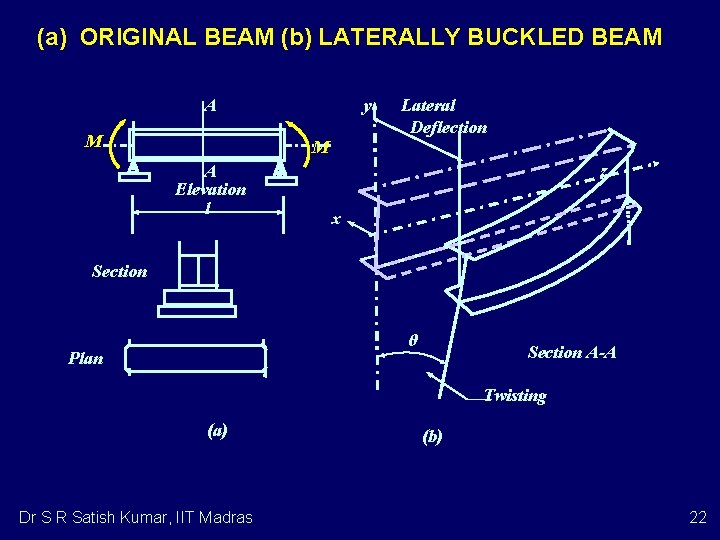
(a) ORIGINAL BEAM (b) LATERALLY BUCKLED BEAM A M y Lateral Deflection M A Elevation l z x Section θ Plan Section A-A Twisting (a) Dr S R Satish Kumar, IIT Madras (b) 22
![Mcr = [ (Torsional resistance )2 + (Warping resistance )2 ]1/2 or EIy =](http://slidetodoc.com/presentation_image_h/9be43b2722b8950669cbcaae51b42839/image-23.jpg "Mcr = [ (Torsional resistance )2 + (Warping resistance )2 ]1/2 or EIy =")
Mcr = [ (Torsional resistance )2 + (Warping resistance )2 ]1/2 or EIy = flexural rigidity GJ = torsional rigidity E = warping rigidity Dr S R Satish Kumar, IIT Madras
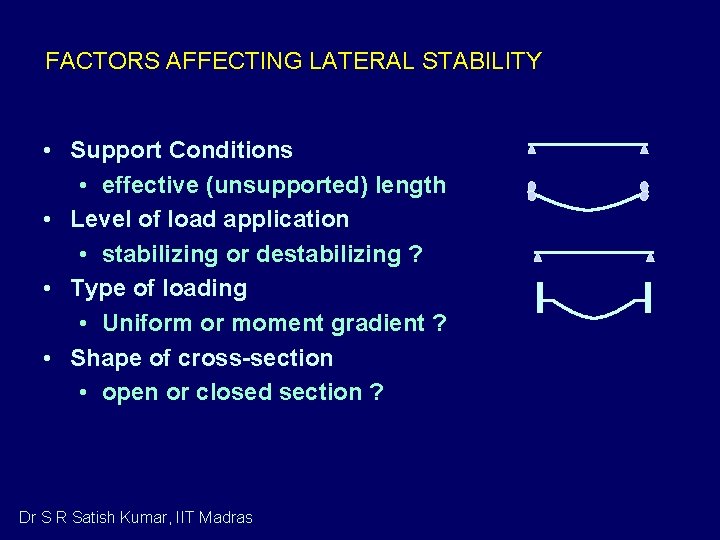
FACTORS AFFECTING LATERAL STABILITY • Support Conditions • effective (unsupported) length • Level of load application • stabilizing or destabilizing ? • Type of loading • Uniform or moment gradient ? • Shape of cross-section • open or closed section ? Dr S R Satish Kumar, IIT Madras
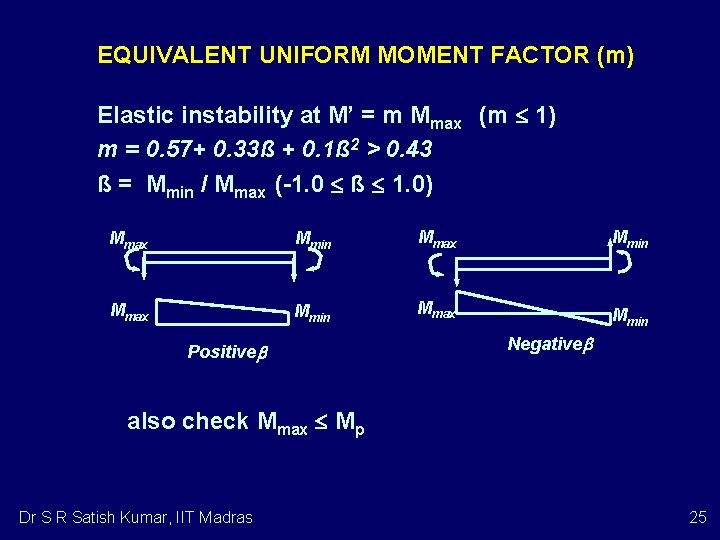
EQUIVALENT UNIFORM MOMENT FACTOR (m) Elastic instability at M’ = m Mmax (m 1) m = 0. 57+ 0. 33ß + 0. 1ß 2 > 0. 43 ß = Mmin / Mmax (-1. 0 ß 1. 0) Mmax Mmin Positive Negative also check Mmax Mp Dr S R Satish Kumar, IIT Madras 25
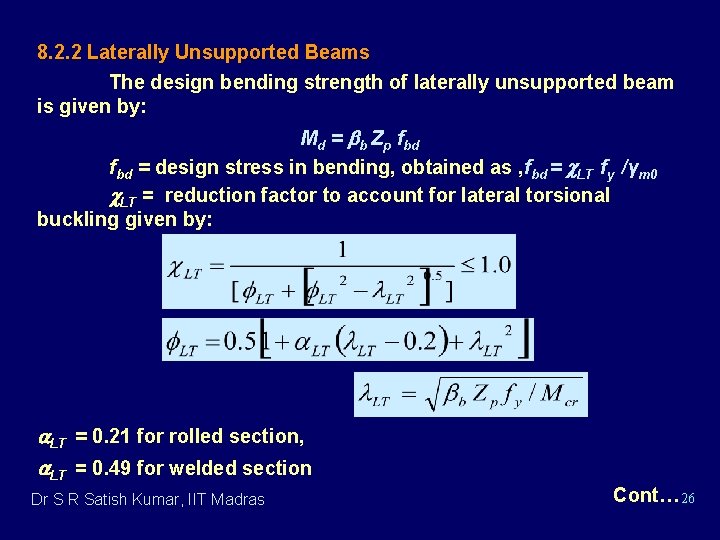
8. 2. 2 Laterally Unsupported Beams The design bending strength of laterally unsupported beam is given by: Md = b Zp fbd = design stress in bending, obtained as , fbd = LT fy /γm 0 LT = reduction factor to account for lateral torsional buckling given by: LT = 0. 21 for rolled section, LT = 0. 49 for welded section Dr S R Satish Kumar, IIT Madras Cont… 26
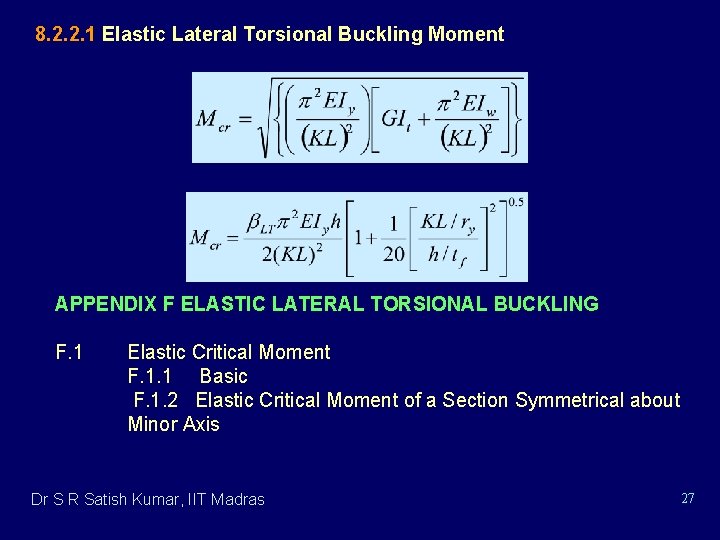
8. 2. 2. 1 Elastic Lateral Torsional Buckling Moment APPENDIX F ELASTIC LATERAL TORSIONAL BUCKLING F. 1 Elastic Critical Moment F. 1. 1 Basic F. 1. 2 Elastic Critical Moment of a Section Symmetrical about Minor Axis Dr S R Satish Kumar, IIT Madras 27
EFFECTIVE LATERAL RESTRAINT Provision of proper lateral bracing improves lateral stability Discrete and continuous bracing Cross sectional distortion in the hogging moment region Discrete bracing • Level of attachment to the beam • Level of application of the transverse load • Type of connection Properties of the beams • Bracing should be of sufficient stiffness to produce buckling between braces • Sufficient strength to withstand force transformed by beam before connecting Dr S R Satish Kumar, IIT Madras
BRACING REQUIREMENTS Effective bracing if they can resist not less than 1) 1% of the maximum force in the compression flange 2) Couple with lever arm distance between the flange centroid and force not less than 1% of compression flange force. Temporary bracing Dr S R Satish Kumar, IIT Madras 29
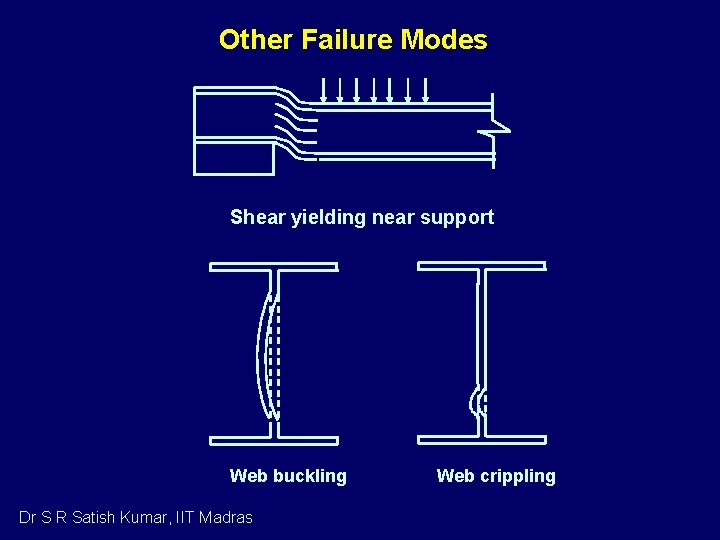
Other Failure Modes Shear yielding near support Web buckling Dr S R Satish Kumar, IIT Madras Web crippling
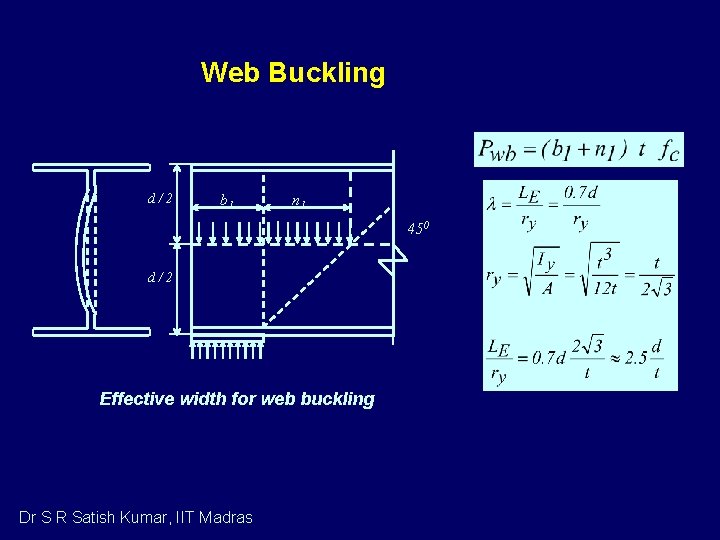
Web Buckling d/2 b 1 n 1 450 d/2 Effective width for web buckling Dr S R Satish Kumar, IIT Madras
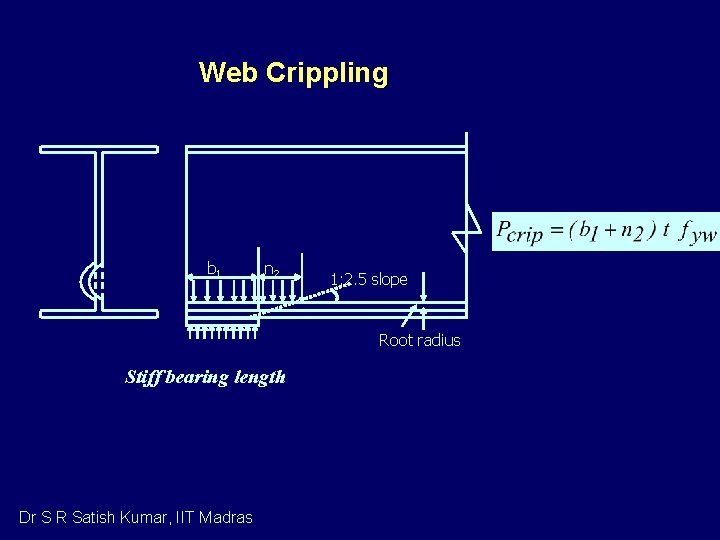
Web Crippling b 1 n 2 1: 2. 5 slope Root radius Stiff bearing length Dr S R Satish Kumar, IIT Madras
SUMMARY • Unrestrained beams , loaded in their stiffer planes may undergo lateral torsional buckling • The prime factors that influence the buckling strength of beams are unbraced span, Cross sectional shape, Type of end restraint and Distribution of moment • A simplified design approach has been presented • Behaviour of real beams, cantilever and continuous beams was described. • Cases of mono symmetric beams , non uniform beams and beams with unsymmetric sections were also discussed. Dr S R Satish Kumar, IIT Madras
- Slides: 33