
Compact MultiSignatures for Smaller Blockchains Dan Boneh Stanford
Compact Multi-Signatures for Smaller Blockchains Dan Boneh (Stanford University) Manu Drijvers (DFINITY) Gregory Neven (DFINITY) To appear at ASIACRYPT 2018 1
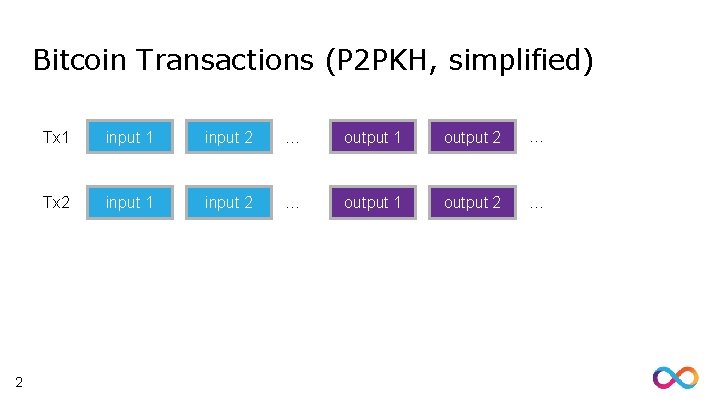
Bitcoin Transactions (P 2 PKH, simplified) 2 Tx 1 input 2 … output 1 output 2 … Tx 2 input 1 input 2 … output 1 output 2 …
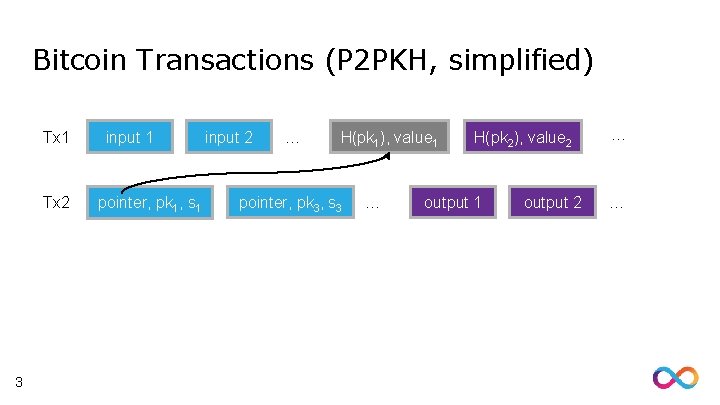
Bitcoin Transactions (P 2 PKH, simplified) Tx 1 Tx 2 3 input 1 pointer, pk 1, s 1 input 2 … H(pk 1), value 1 pointer, pk 3, s 3 … H(pk 2), value 2 output 1 output 2 … …
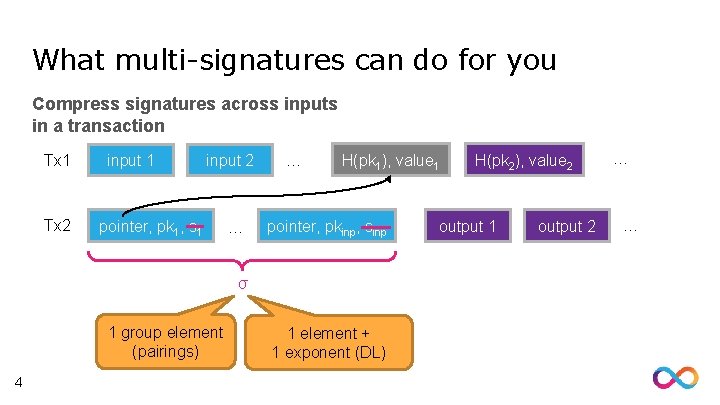
What multi-signatures can do for you Compress signatures across inputs in a transaction Tx 1 Tx 2 input 1 input 2 pointer, pk 1, s 1 … … H(pk 1), value 1 pointer, pkinp, sinp σ 1 group element (pairings) 4 1 element + 1 exponent (DL) H(pk 2), value 2 output 1 output 2 … …
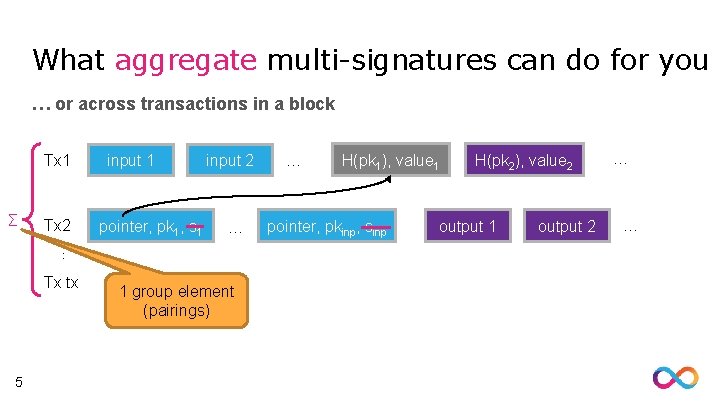
What aggregate multi-signatures can do for you … or across transactions in a block Tx 1 Σ Tx 2 input 1 pointer, pk 1, s 1 input 2 … … Tx tx 5 1 group element (pairings) … H(pk 1), value 1 pointer, pkinp, sinp H(pk 2), value 2 output 1 output 2 … …
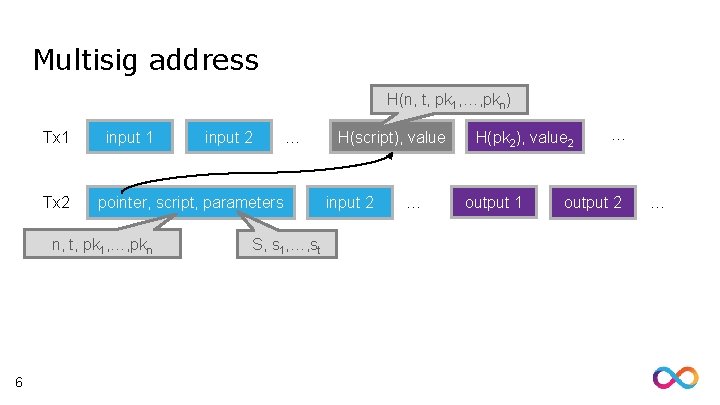
Multisig address H(n, t, pk 1, …, pkn) Tx 1 Tx 2 input 1 … pointer, script, parameters n, t, pk 1, …, pkn 6 input 2 S, s 1, …, st H(script), value input 2 … H(pk 2), value 2 output 1 … output 2 …
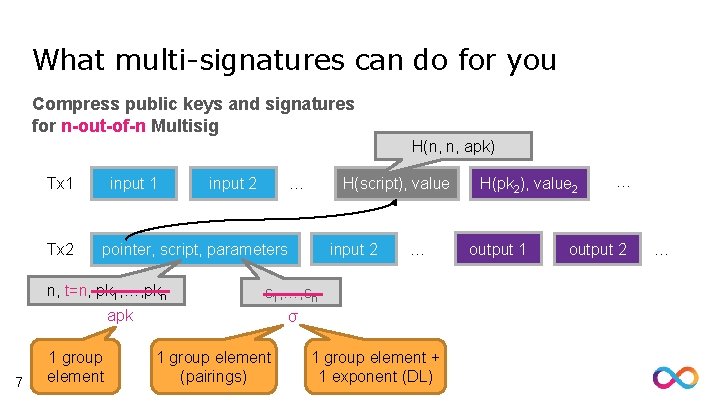
What multi-signatures can do for you Compress public keys and signatures for n-out-of-n Multisig H(n, n, apk) Tx 1 Tx 2 input 1 input 2 pointer, script, parameters n, t=n, pk 1, …, pkn 1 group element … s 1, …, sn apk 7 H(script), value … input 2 σ 1 group element (pairings) 1 group element + 1 exponent (DL) H(pk 2), value 2 output 1 … output 2 …
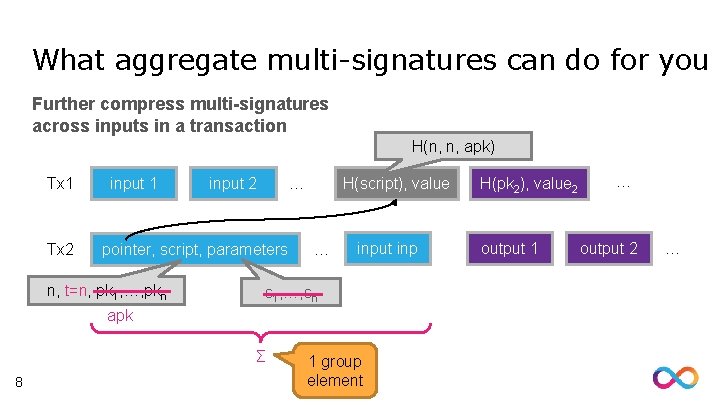
What aggregate multi-signatures can do for you Further compress multi-signatures across inputs in a transaction H(n, n, apk) Tx 1 Tx 2 input 1 pointer, script, parameters n, t=n, pk 1, …, pkn H(script), value … input 2 … input inp s 1, …, sn apk Σ 8 1 group element H(pk 2), value 2 output 1 … output 2 …
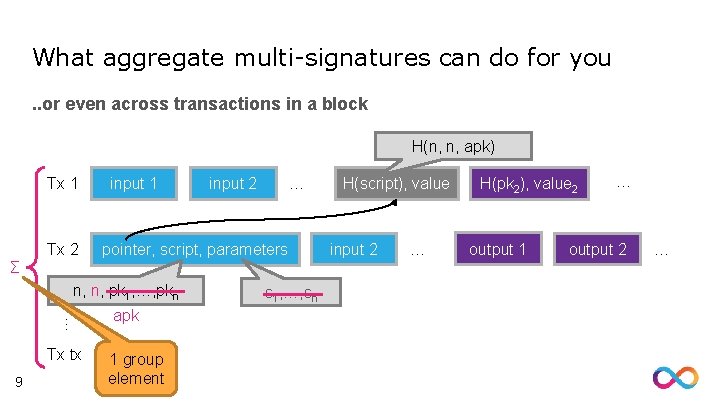
What aggregate multi-signatures can do for you. . or even across transactions in a block H(n, n, apk) Tx 1 Tx 2 input 1 … input 2 pointer, script, parameters Σ n, n, pk 1, …, pkn … Tx tx 9 apk 1 group element s 1, …, sn H(script), value input 2 … H(pk 2), value 2 output 1 … output 2 …
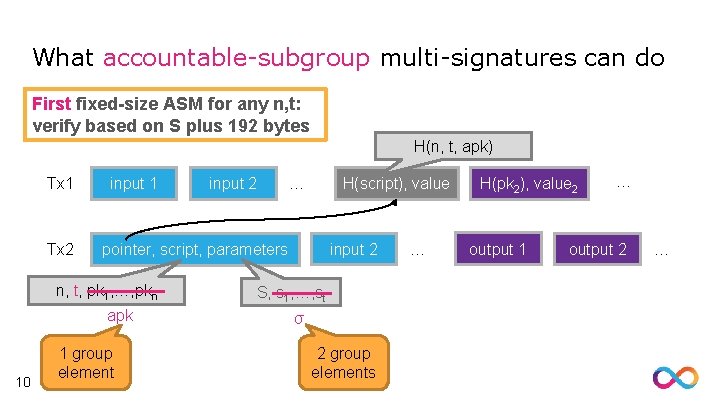
What accountable-subgroup multi-signatures can do First fixed-size ASM for any n, t: verify based on S plus 192 bytes H(n, t, apk) Tx 1 Tx 2 input 1 H(script), value … input 2 pointer, script, parameters n, t, pk 1, …, pkn apk 10 input 2 1 group element S, s 1, …, st σ 2 group elements … H(pk 2), value 2 output 1 … output 2 …
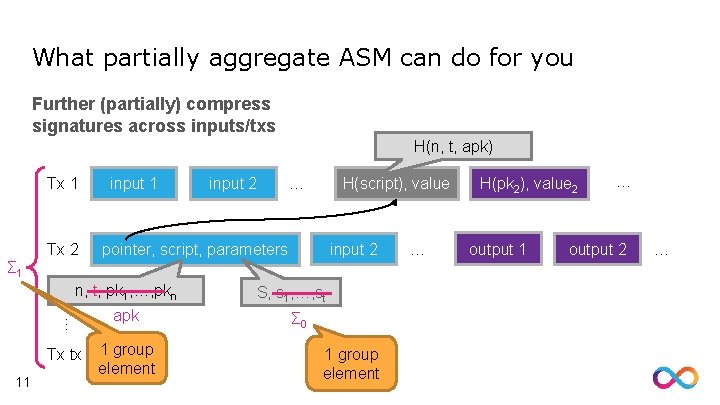
What partially aggregate ASM can do for you Further (partially) compress signatures across inputs/txs H(n, t, apk) Tx 1 Tx 2 input 1 input 2 H(script), value … input 2 pointer, script, parameters Σ 1 n, t, pk 1, …, pkn … Tx tx 11 apk 1 group element S, s 1, …, st Σ 0 1 group element … H(pk 2), value 2 output 1 … output 2 …
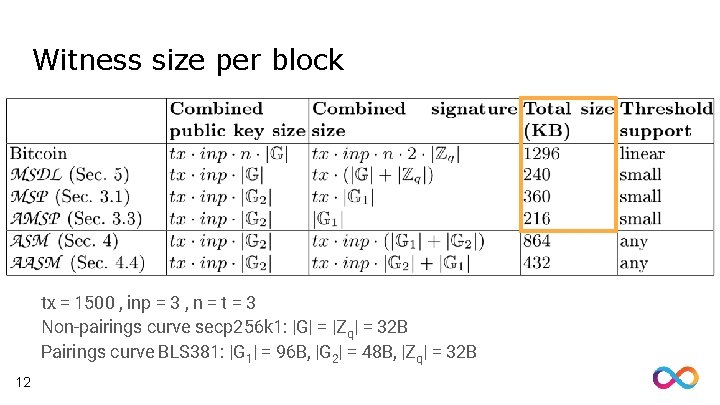
Witness size per block tx = 1500 , inp = 3 , n = t = 3 Non-pairings curve secp 256 k 1: |G| = |Zq| = 32 B Pairings curve BLS 381: |G 1| = 96 B, |G 2| = 48 B, |Zq| = 32 B 12
This talk ● Background: Discrete logarithms and pairings ● BLS signatures and rogue-key attacks ● Secure multi-signatures with key aggregation ● Accountable-subgroup multi-signatures ● Conclusion 13
Background: Discrete logarithms and pairings
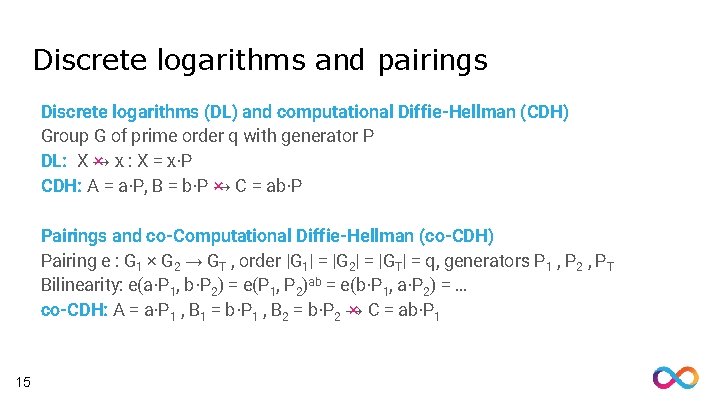
Discrete logarithms and pairings Discrete logarithms (DL) and computational Diffie-Hellman (CDH) Group G of prime order q with generator P × x : X = x∙P DL: X → × C = ab∙P CDH: A = a∙P, B = b∙P → Pairings and co-Computational Diffie-Hellman (co-CDH) Pairing e : G 1 × G 2 → GT , order |G 1| = |G 2| = |GT| = q, generators P 1 , P 2 , PT Bilinearity: e(a∙P 1, b∙P 2) = e(P 1, P 2)ab = e(b∙P 1, a∙P 2) = … × C = ab∙P 1 co-CDH: A = a∙P 1 , B 1 = b∙P 1 , B 2 = b∙P 2 → 15

Discrete logarithms and pairings Discrete logarithms (DL) and computational Diffie-Hellman (CDH) Group G of prime order q with generator P × x : X = x∙P DL: X → × C = ab∙P CDH: A = a∙P, B = b∙P → Pairings and Ψ-co-Computational Diffie-Hellman ( Ψ-co-CDH) Pairing e : G 1 × G 2 → GT , order |G 1| = |G 2| = |GT| = q, generators P 1 , P 2 , PT Bilinearity: e(a∙P 1, b∙P 2) = e(P 1, P 2)ab = e(b∙P 1, a∙P 2) = … Ψ-co-CDH: A = a∙P 1 , B 1 = b∙P 1 , B 2 = b∙P 2 → × C = ab∙P 1 with access to oracle Ψ(x∙P 2) → x∙P 1 16
BLS signatures and rogue-key attacks
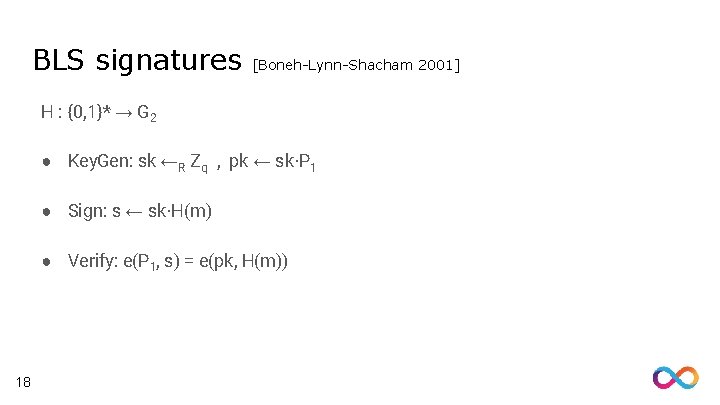
BLS signatures [Boneh-Lynn-Shacham 2001] H : {0, 1}* → G 2 ● Key. Gen: sk ←R Zq , pk ← sk∙P 1 ● Sign: s ← sk∙H(m) ● Verify: e(P 1, s) = e(pk, H(m)) 18
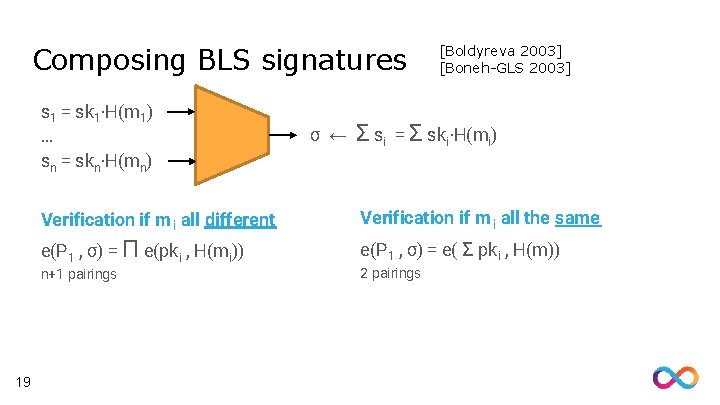
Composing BLS signatures s 1 = sk 1∙H(m 1) … sn = skn∙H(mn) 19 σ ← [Boldyreva 2003] [Boneh-GLS 2003] Σ si = Σ ski∙H(mi) Verification if m i all different Verification if m i all the same e(P 1 , σ) = Π e(pki , H(mi)) e(P 1 , σ) = e( Σ pki , H(m)) n+1 pairings 2 pairings
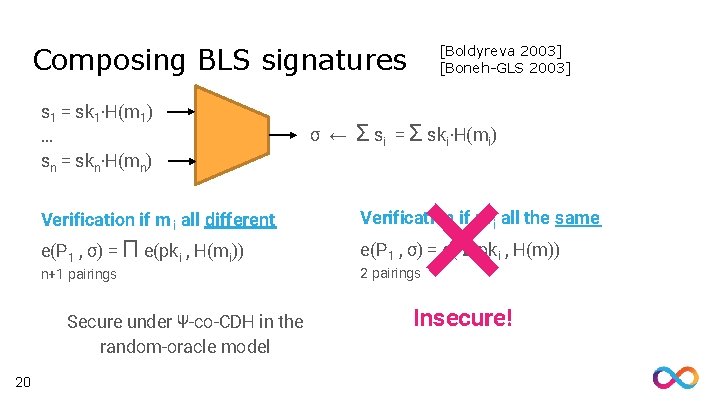
Composing BLS signatures s 1 = sk 1∙H(m 1) … sn = skn∙H(mn) Σ si = Σ ski∙H(mi) × Verification if m i all different Verification if m i all the same e(P 1 , σ) = Π e(pki , H(mi)) e(P 1 , σ) = e( Σ pki , H(m)) n+1 pairings 2 pairings Secure under Ψ-co-CDH in the random-oracle model 20 σ ← [Boldyreva 2003] [Boneh-GLS 2003] Insecure!
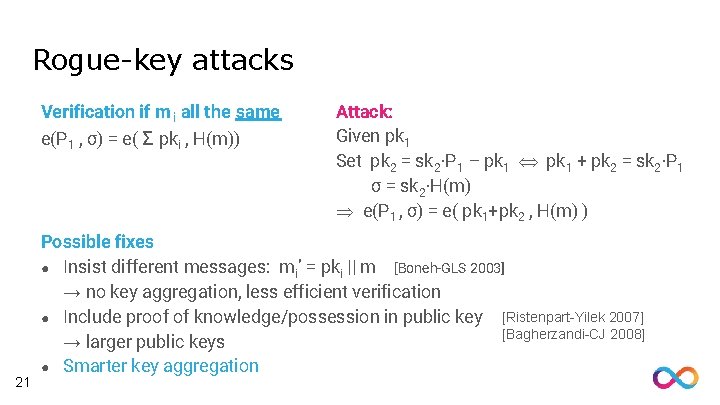
Rogue-key attacks Verification if m i all the same e(P 1 , σ) = e( Σ pki , H(m)) 21 Attack: Given pk 1 Set pk 2 = sk 2∙P 1 – pk 1 + pk 2 = sk 2∙P 1 σ = sk 2∙H(m) Þ e(P 1 , σ) = e( pk 1+pk 2 , H(m) ) Possible fixes ● Insist different messages: mi’ = pki || m [Boneh-GLS 2003] → no key aggregation, less efficient verification ● Include proof of knowledge/possession in public key [Ristenpart-Yilek 2007] [Bagherzandi-CJ 2008] → larger public keys ● Smarter key aggregation

Secure multi-signatures with key aggregation
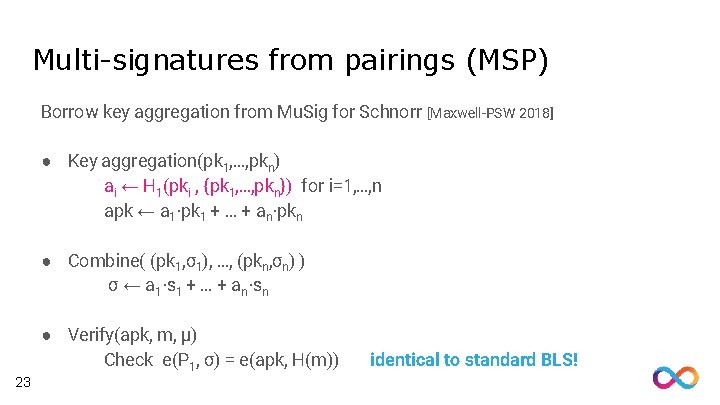
Multi-signatures from pairings (MSP) Borrow key aggregation from Mu. Sig for Schnorr [Maxwell-PSW 2018] ● Key aggregation(pk 1, …, pkn) ai ← H 1(pki , {pk 1, …, pkn}) for i=1, …, n apk ← a 1∙pk 1 + … + an∙pkn ● Combine( (pk 1, σ1), …, (pkn, σn) ) σ ← a 1∙s 1 + … + an∙sn ● Verify(apk, m, μ) Check e(P 1, σ) = e(apk, H(m)) 23 identical to standard BLS!
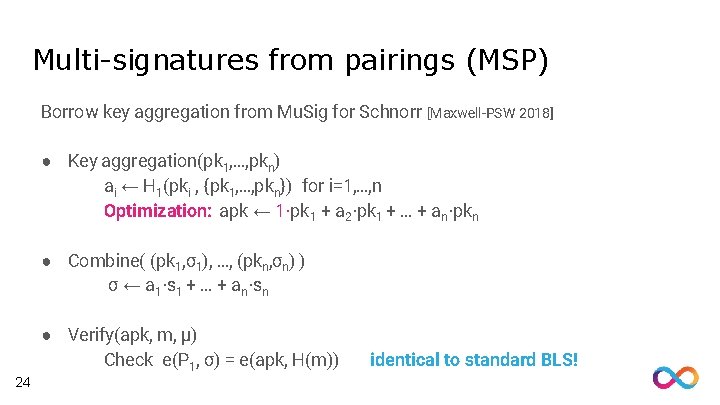
Multi-signatures from pairings (MSP) Borrow key aggregation from Mu. Sig for Schnorr [Maxwell-PSW 2018] ● Key aggregation(pk 1, …, pkn) ai ← H 1(pki , {pk 1, …, pkn}) for i=1, …, n Optimization: apk ← 1∙pk 1 + a 2∙pk 1 + … + an∙pkn ● Combine( (pk 1, σ1), …, (pkn, σn) ) σ ← a 1∙s 1 + … + an∙sn ● Verify(apk, m, μ) Check e(P 1, σ) = e(apk, H(m)) 24 identical to standard BLS!
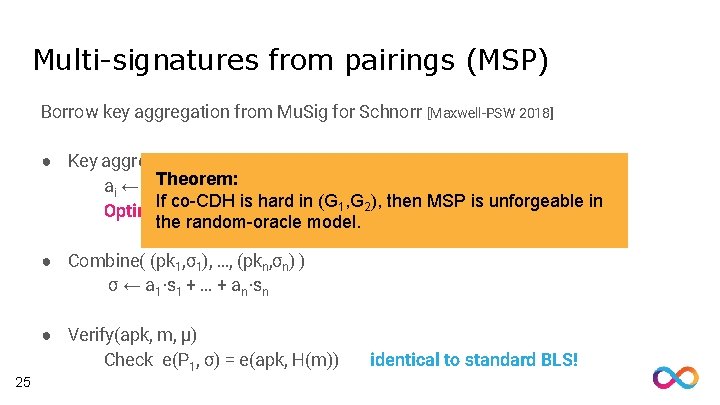
Multi-signatures from pairings (MSP) Borrow key aggregation from Mu. Sig for Schnorr [Maxwell-PSW 2018] ● Key aggregation(pk 1, …, pkn) ai ← H 1 Theorem: (pki , {pk 1, …, pkn}) for i=1, …, n If co-CDH is hard in (G 1, G 2), then MSP is unforgeable in Optimization: apk ← 1∙pk 1 + a 2∙pk 1 + … + an∙pkn the random-oracle model. ● Combine( (pk 1, σ1), …, (pkn, σn) ) σ ← a 1∙s 1 + … + an∙sn ● Verify(apk, m, μ) Check e(P 1, σ) = e(apk, H(m)) 25 identical to standard BLS!
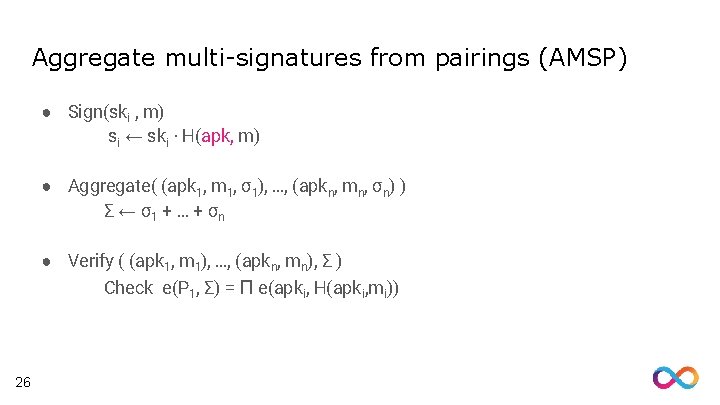
Aggregate multi-signatures from pairings (AMSP) ● Sign(ski , m) si ← ski ∙ H(apk, m) ● Aggregate( (apk 1, m 1, σ1), …, (apkn, mn, σn) ) Σ ← σ1 + … + σn ● Verify ( (apk 1, m 1), …, (apkn, mn), Σ ) Check e(P 1, Σ) = Π e(apki, H(apki, mi)) 26
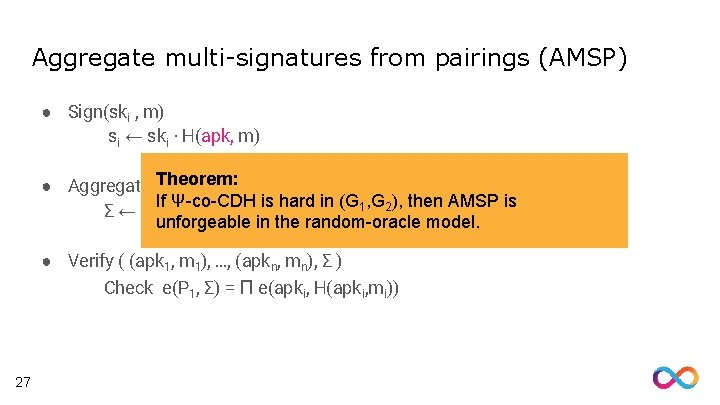
Aggregate multi-signatures from pairings (AMSP) ● Sign(ski , m) si ← ski ∙ H(apk, m) ● Aggregate(Theorem: (apk 1, m 1, μ 1), …, (apkn, mn, μn) ) If Ψ-co-CDH is hard in (G 1, G 2), then AMSP is Σ ← σ1 + … + σn unforgeable in the random-oracle model. ● Verify ( (apk 1, m 1), …, (apkn, mn), Σ ) Check e(P 1, Σ) = Π e(apki, H(apki, mi)) 27
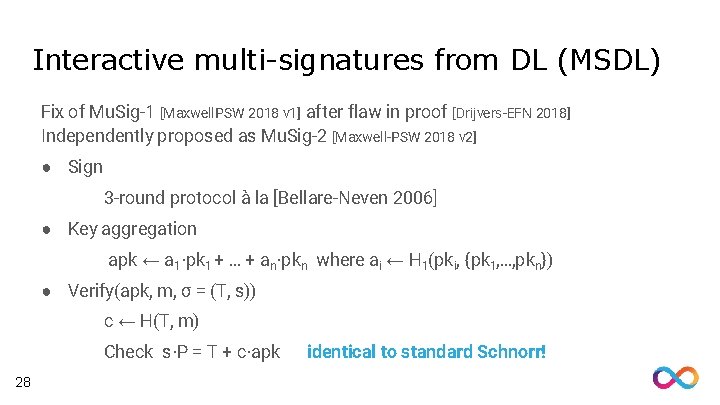
Interactive multi-signatures from DL (MSDL) Fix of Mu. Sig-1 [Maxwell. PSW 2018 v 1] after flaw in proof [Drijvers-EFN 2018] Independently proposed as Mu. Sig-2 [Maxwell-PSW 2018 v 2] ● Sign 3 -round protocol à la [Bellare-Neven 2006] ● Key aggregation apk ← a 1∙pk 1 + … + an∙pkn where ai ← H 1(pki, {pk 1, …, pkn}) ● Verify(apk, m, σ = (T, s)) c ← H(T, m) Check s∙P = T + c∙apk 28 identical to standard Schnorr!
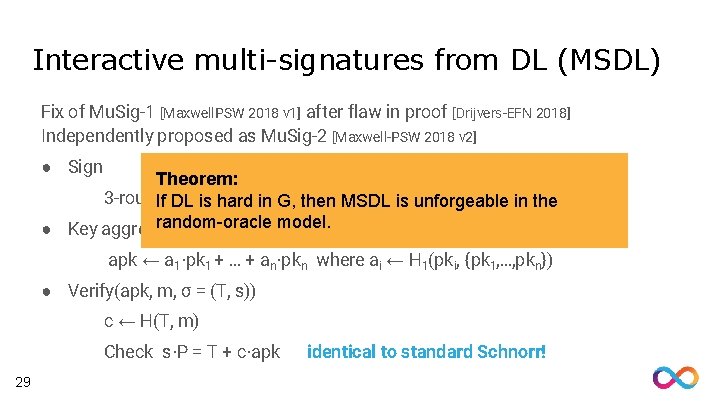
Interactive multi-signatures from DL (MSDL) Fix of Mu. Sig-1 [Maxwell. PSW 2018 v 1] after flaw in proof [Drijvers-EFN 2018] Independently proposed as Mu. Sig-2 [Maxwell-PSW 2018 v 2] ● Sign Theorem: 3 -round. If DL is hard in G, then MSDL is unforgeable in the protocol à la [Bellare-Neven 2006] random-oracle model. ● Key aggregation apk ← a 1∙pk 1 + … + an∙pkn where ai ← H 1(pki, {pk 1, …, pkn}) ● Verify(apk, m, σ = (T, s)) c ← H(T, m) Check s∙P = T + c∙apk 29 identical to standard Schnorr!
Accountable-subgroup multi-signatures
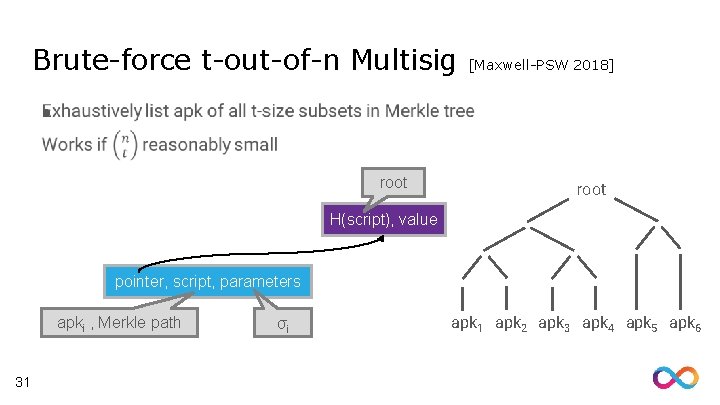
Brute-force t-out-of-n Multisig [Maxwell-PSW 2018] ● root H(script), value pointer, script, parameters apki , Merkle path 31 σi apk 1 apk 2 apk 3 apk 4 apk 5 apk 6
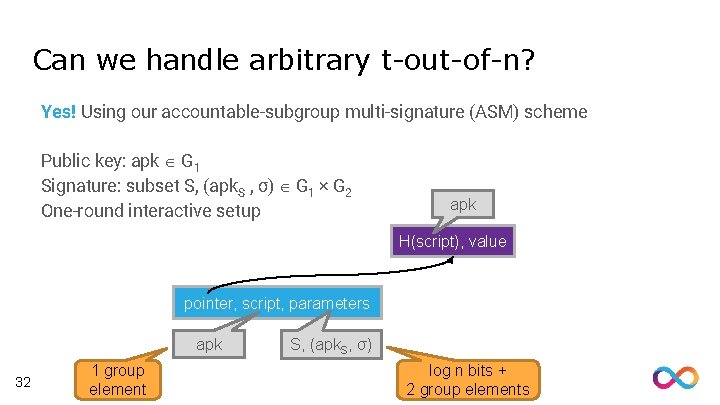
Can we handle arbitrary t-out-of-n? Yes! Using our accountable-subgroup multi-signature (ASM) scheme Public key: apk G 1 Signature: subset S, (apk. S , σ) G 1 × G 2 One-round interactive setup apk H(script), value pointer, script, parameters apk 32 1 group element S, (apk. S, σ) log n bits + 2 group elements
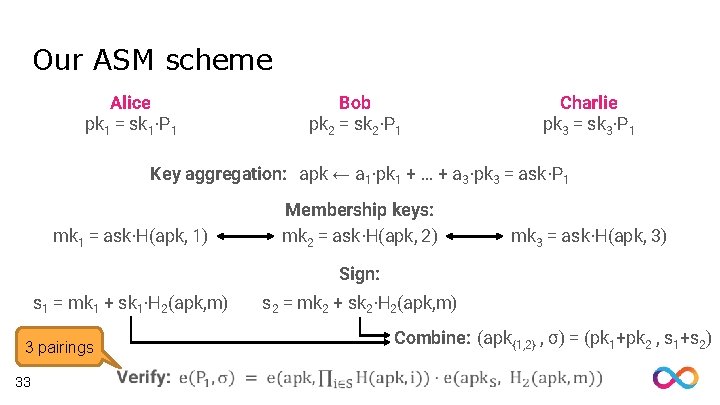
Our ASM scheme Alice pk 1 = sk 1∙P 1 Bob pk 2 = sk 2∙P 1 Charlie pk 3 = sk 3∙P 1 Key aggregation: apk ← a 1∙pk 1 + … + a 3∙pk 3 = ask∙P 1 mk 1 = ask∙H(apk, 1) Membership keys: mk 2 = ask∙H(apk, 2) mk 3 = ask∙H(apk, 3) Sign: s 1 = mk 1 + sk 1∙H 2(apk, m) Combine: (apk{1, 2} , σ) = (pk 1+pk 2 , s 1+s 2) 3 pairings 33 s 2 = mk 2 + sk 2∙H 2(apk, m)
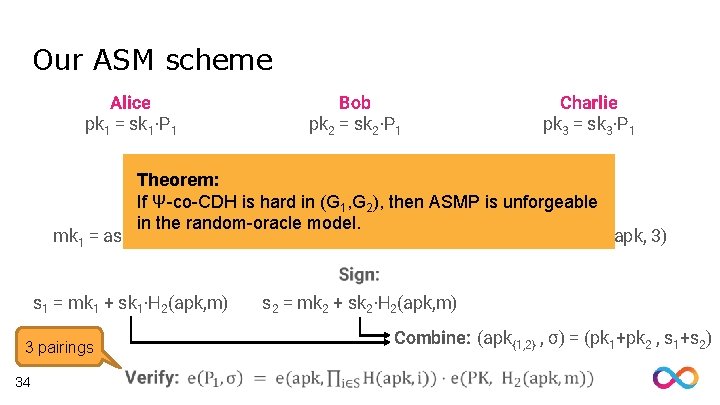
Our ASM scheme Alice pk 1 = sk 1∙P 1 Bob pk 2 = sk 2∙P 1 Charlie pk 3 = sk 3∙P 1 Theorem: If Ψ-co-CDH is hard in (G 1, G 2), then ASMP is unforgeable in the random-oracle model. mk 1 = ask∙H(apk, 1) mk 2 = ask∙H(apk, 2) mk 3 = ask∙H(apk, 3) s 1 = mk 1 + sk 1∙H 2(apk, m) 3 pairings 34 s 2 = mk 2 + sk 2∙H 2(apk, m) Combine: (apk{1, 2} , σ) = (pk 1+pk 2 , s 1+s 2)
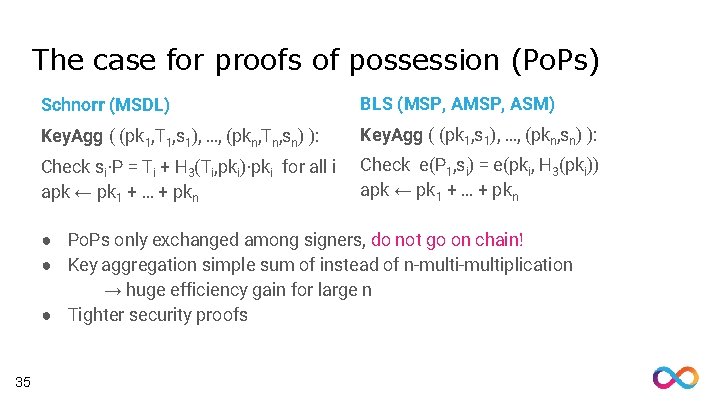
The case for proofs of possession (Po. Ps) Schnorr (MSDL) BLS (MSP, ASM) Key. Agg ( (pk 1, T 1, s 1), …, (pkn, Tn, sn) ): Key. Agg ( (pk 1, s 1), …, (pkn, sn) ): Check si∙P = Ti + H 3(Ti, pki)∙pki for all i apk ← pk 1 + … + pkn Check e(P 1, si) = e(pki, H 3(pki)) apk ← pk 1 + … + pkn ● Po. Ps only exchanged among signers, do not go on chain! ● Key aggregation simple sum of instead of n-multiplication → huge efficiency gain for large n ● Tighter security proofs 35

Conclusion
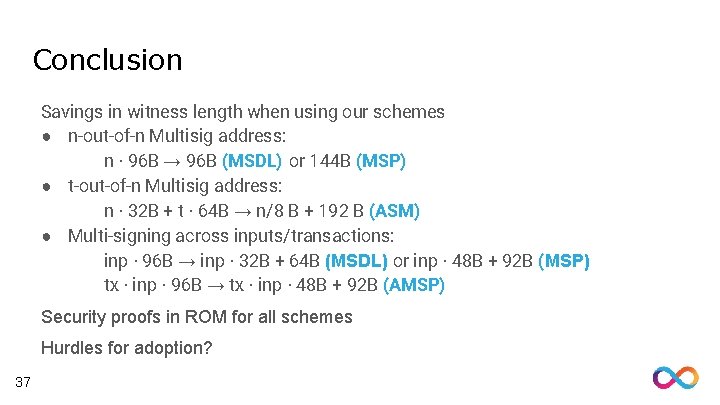
Conclusion Savings in witness length when using our schemes ● n-out-of-n Multisig address: n ∙ 96 B → 96 B (MSDL) or 144 B (MSP) ● t-out-of-n Multisig address: n ∙ 32 B + t ∙ 64 B → n/8 B + 192 B (ASM) ● Multi-signing across inputs/transactions: inp ∙ 96 B → inp ∙ 32 B + 64 B (MSDL) or inp ∙ 48 B + 92 B (MSP) tx ∙ inp ∙ 96 B → tx ∙ inp ∙ 48 B + 92 B (AMSP) Security proofs in ROM for all schemes Hurdles for adoption? 37

Thank you! https: //eprint. iacr. org/2018/483 38
- Slides: 38