
Preparation for Physics The Compact Muon Solenoid CMS
- Slides: 69
Preparation for Physics: The Compact Muon Solenoid (CMS) Detector Greg Rakness University of California, Los Angeles RNC Seminar 3 August 2009 Lawrence Berkeley National Lab 3 Aug 2009 G. Rakness (UCLA)
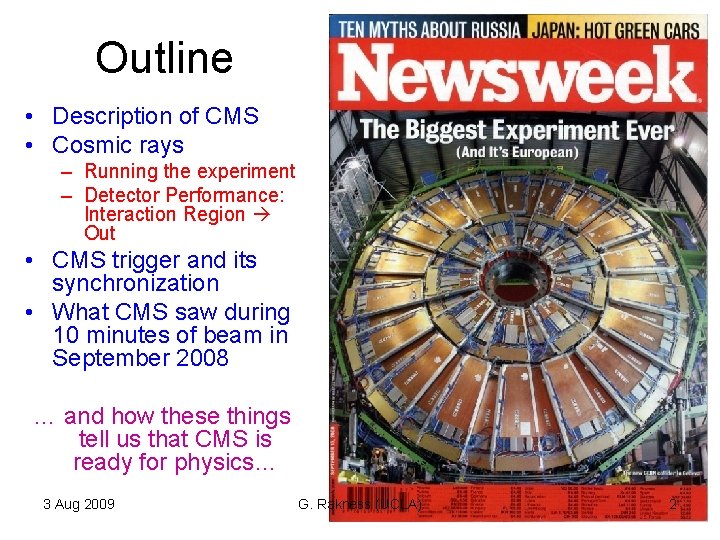
Outline • Description of CMS • Cosmic rays – Running the experiment – Detector Performance: Interaction Region Out • CMS trigger and its synchronization • What CMS saw during 10 minutes of beam in September 2008 … and how these things tell us that CMS is ready for physics… 3 Aug 2009 G. Rakness (UCLA) 2
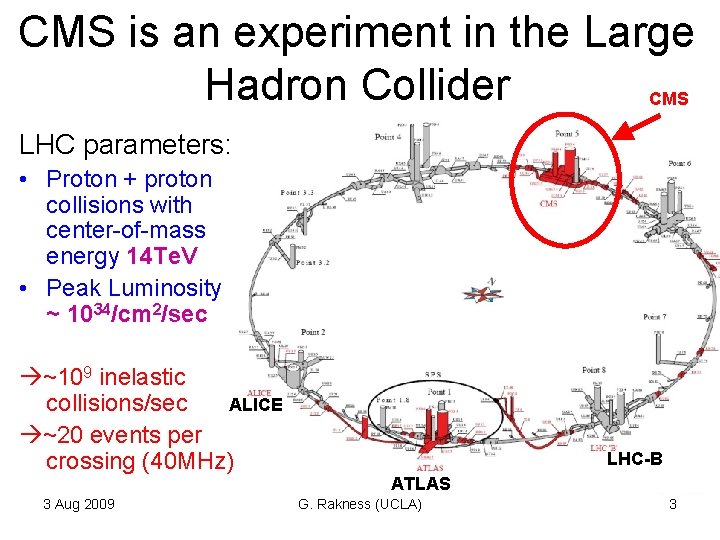
CMS is an experiment in the Large Hadron Collider CMS LHC parameters: • Proton + proton collisions with center-of-mass energy 14 Te. V • Peak Luminosity ~ 1034/cm 2/sec ~109 inelastic ALICE collisions/sec ~20 events per crossing (40 MHz) LHC-B ATLAS 3 Aug 2009 G. Rakness (UCLA) 3
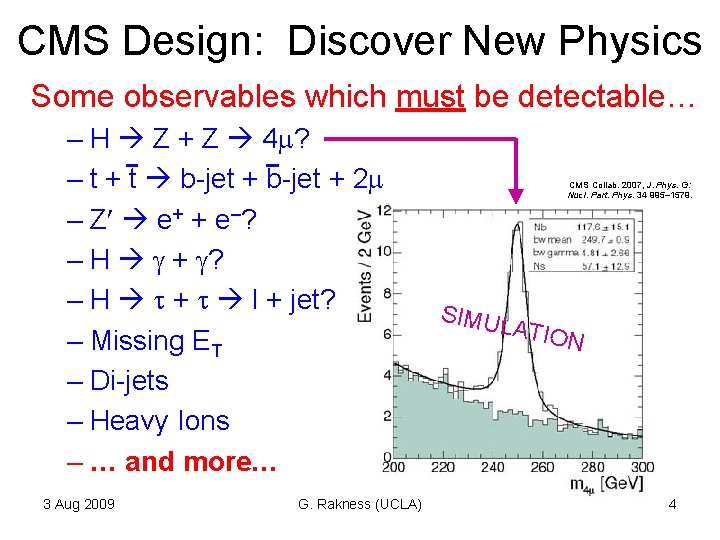
CMS Design: Discover New Physics Some observables which must be detectable… – H Z + Z 4 ? – t + t b-jet + 2 – Z e+ + e–? – H + l + jet? – Missing ET – Di-jets – Heavy Ions – … and more… 3 Aug 2009 G. Rakness (UCLA) CMS Collab. 2007, J. Phys. G: Nucl. Part. Phys. 34 995– 1579. SIMU LA TION 4
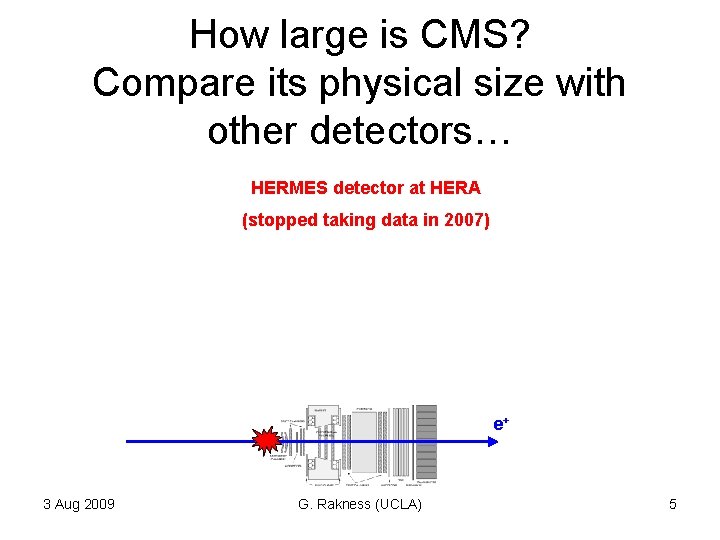
How large is CMS? Compare its physical size with other detectors… HERMES detector at HERA (stopped taking data in 2007) e+ 3 Aug 2009 G. Rakness (UCLA) 5
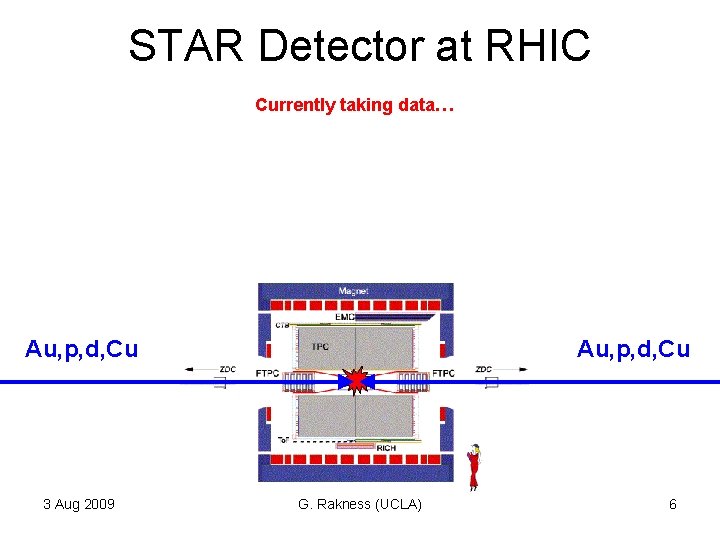
STAR Detector at RHIC Currently taking data… Au, p, d, Cu 3 Aug 2009 Au, p, d, Cu G. Rakness (UCLA) 6
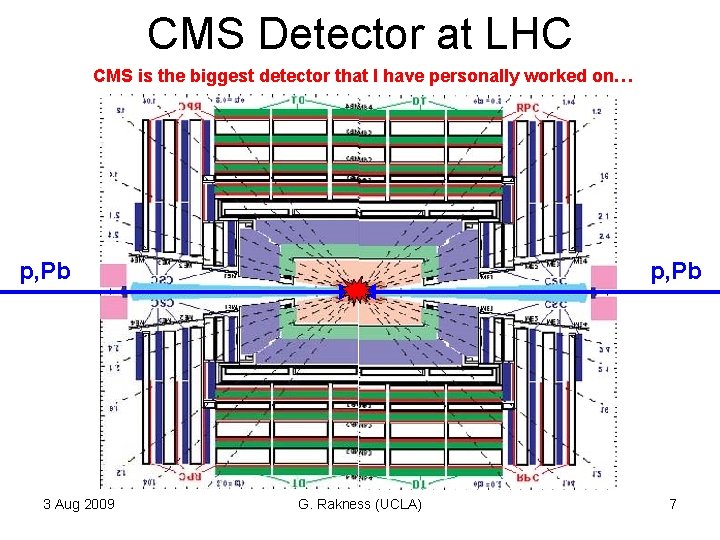
CMS Detector at LHC CMS is the biggest detector that I have personally worked on… p, Pb 3 Aug 2009 p, Pb G. Rakness (UCLA) 7
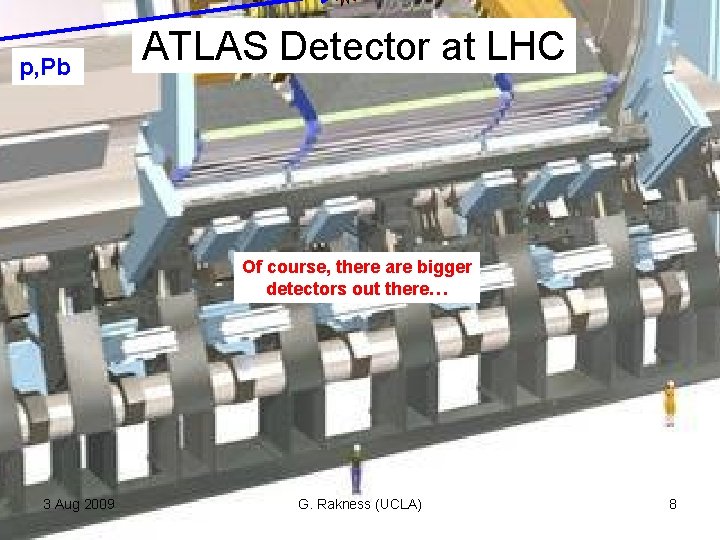
p, Pb ATLAS Detector at LHC Of course, there are bigger detectors out there… 3 Aug 2009 G. Rakness (UCLA) 8
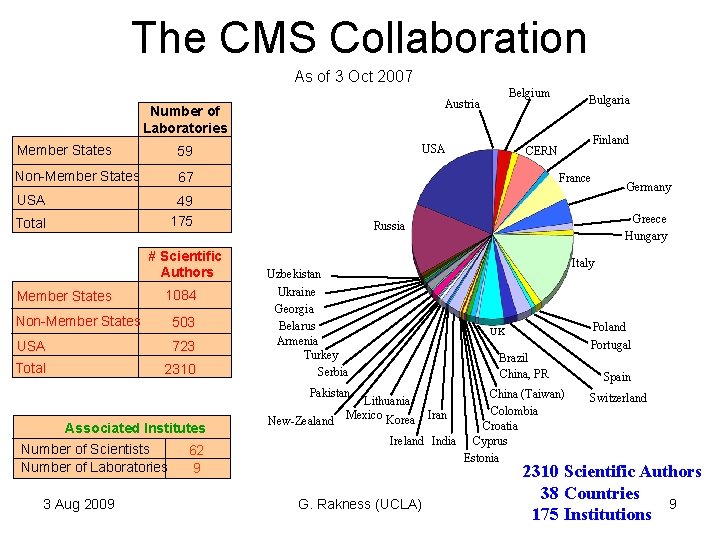
The CMS Collaboration As of 3 Oct 2007 Number of Laboratories Member States 59 Non-Member States 67 USA # Scientific Authors Member States 1084 Non-Member States 503 USA 723 Total 2310 Number of Scientists Number of Laboratories 3 Aug 2009 62 9 Finland CERN Italy Uzbekistan Ukraine Georgia Belarus Armenia Turkey Serbia New-Zealand Germany Greece Hungary Russia Pakistan Associated Institutes Bulgaria France 49 175 Total Belgium Austria Poland Portugal UK Brazil China, PR China (Taiwan) Colombia Iran Croatia Ireland India Cyprus Estonia Lithuania Mexico Korea G. Rakness (UCLA) Spain Switzerland 2310 Scientific Authors 38 Countries 9 175 Institutions
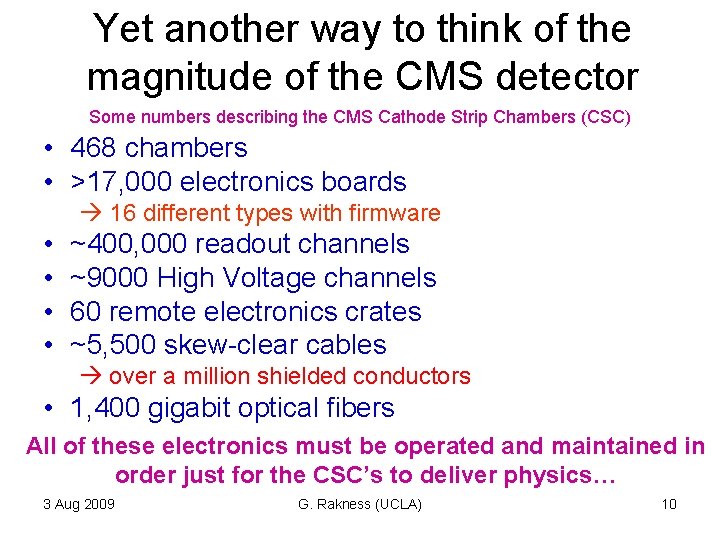
Yet another way to think of the magnitude of the CMS detector Some numbers describing the CMS Cathode Strip Chambers (CSC) • 468 chambers • >17, 000 electronics boards 16 different types with firmware • • ~400, 000 readout channels ~9000 High Voltage channels 60 remote electronics crates ~5, 500 skew-clear cables over a million shielded conductors • 1, 400 gigabit optical fibers All of these electronics must be operated and maintained in order just for the CSC’s to deliver physics… 3 Aug 2009 G. Rakness (UCLA) 10
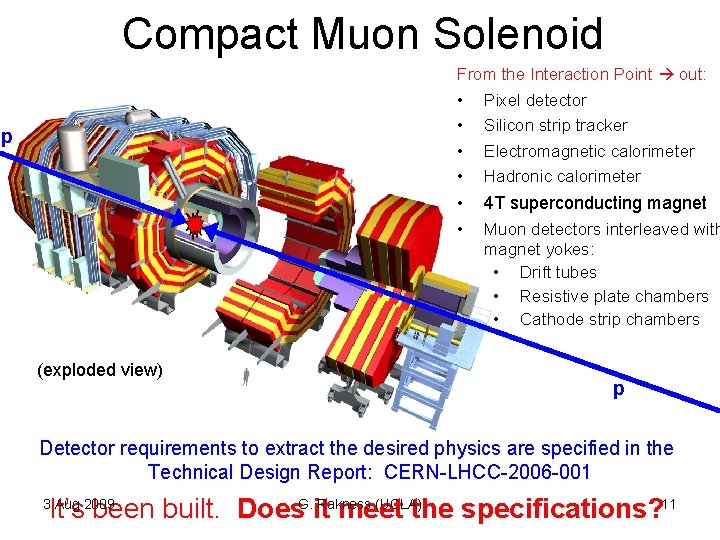
Compact Muon Solenoid From the Interaction Point out: p (exploded view) • • Pixel detector Silicon strip tracker Electromagnetic calorimeter Hadronic calorimeter • 4 T superconducting magnet • Muon detectors interleaved with magnet yokes: • Drift tubes • Resistive plate chambers • Cathode strip chambers p Detector requirements to extract the desired physics are specified in the Technical Design Report: CERN-LHCC-2006 -001 (UCLA) It’s been built. Does. G. it. Rakness meet the specifications? 11 3 Aug 2009
Accumulation of Cosmic Ray Data (Summer 2006 – now…) 3 Aug 2009 G. Rakness (UCLA) 12
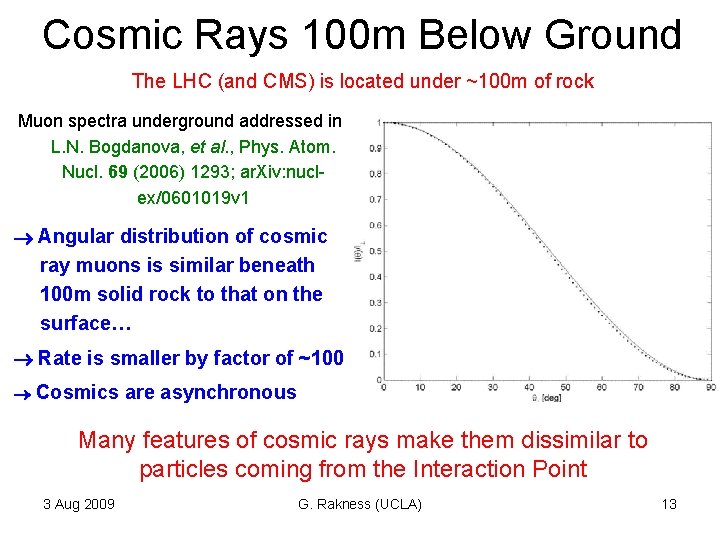
Cosmic Rays 100 m Below Ground The LHC (and CMS) is located under ~100 m of rock Muon spectra underground addressed in L. N. Bogdanova, et al. , Phys. Atom. Nucl. 69 (2006) 1293; ar. Xiv: nuclex/0601019 v 1 Angular distribution of cosmic ray muons is similar beneath 100 m solid rock to that on the surface… Rate is smaller by factor of ~100 Cosmics are asynchronous Many features of cosmic rays make them dissimilar to particles coming from the Interaction Point 3 Aug 2009 G. Rakness (UCLA) 13
Regarding Cosmic Ray Runs … we are not collecting millions of cosmic ray triggers for their own sake… Cosmic ray running prepares us to collect physics data when protons collide in the LHC later this year Greater exposure to operation before beam, greater chance of finding problems before beam Some CMS subdetectors have been operating 24/7 for months… 3 Aug 2009 G. Rakness (UCLA) 14
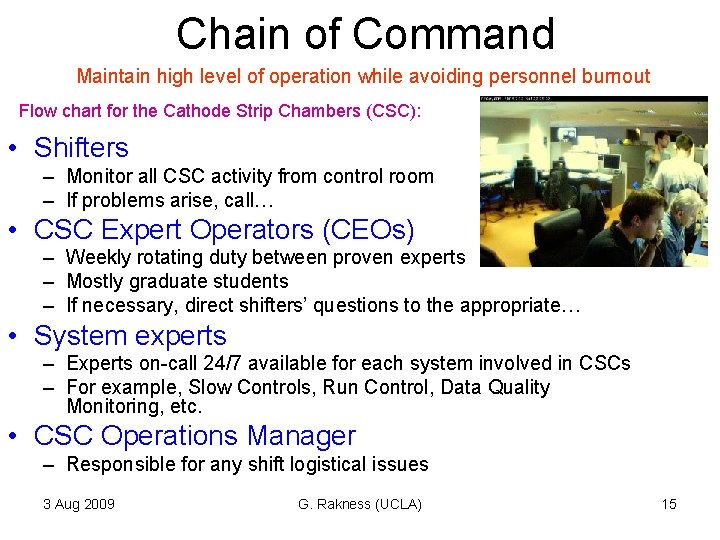
Chain of Command Maintain high level of operation while avoiding personnel burnout Flow chart for the Cathode Strip Chambers (CSC): • Shifters – Monitor all CSC activity from control room – If problems arise, call… • CSC Expert Operators (CEOs) – Weekly rotating duty between proven experts – Mostly graduate students – If necessary, direct shifters’ questions to the appropriate… • System experts – Experts on-call 24/7 available for each system involved in CSCs – For example, Slow Controls, Run Control, Data Quality Monitoring, etc. • CSC Operations Manager – Responsible for any shift logistical issues 3 Aug 2009 G. Rakness (UCLA) 15
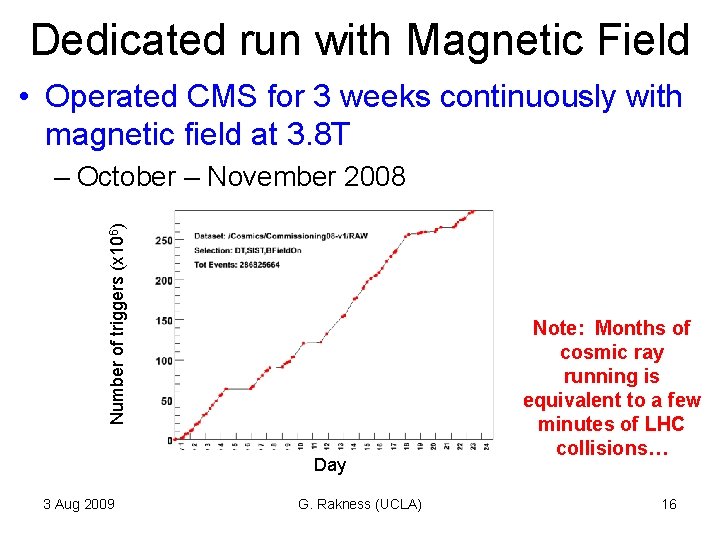
Dedicated run with Magnetic Field • Operated CMS for 3 weeks continuously with magnetic field at 3. 8 T Number of triggers (x 106) – October – November 2008 Day 3 Aug 2009 G. Rakness (UCLA) Note: Months of cosmic ray running is equivalent to a few minutes of LHC collisions… 16
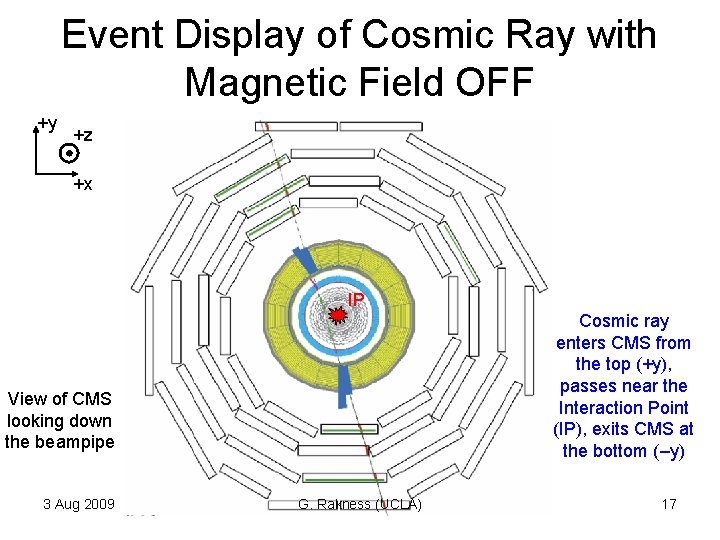
Event Display of Cosmic Ray with Magnetic Field OFF +y +z +x IP Cosmic ray enters CMS from the top (+y), passes near the Interaction Point (IP), exits CMS at the bottom (–y) View of CMS looking down the beampipe 3 Aug 2009 G. Rakness (UCLA) 17
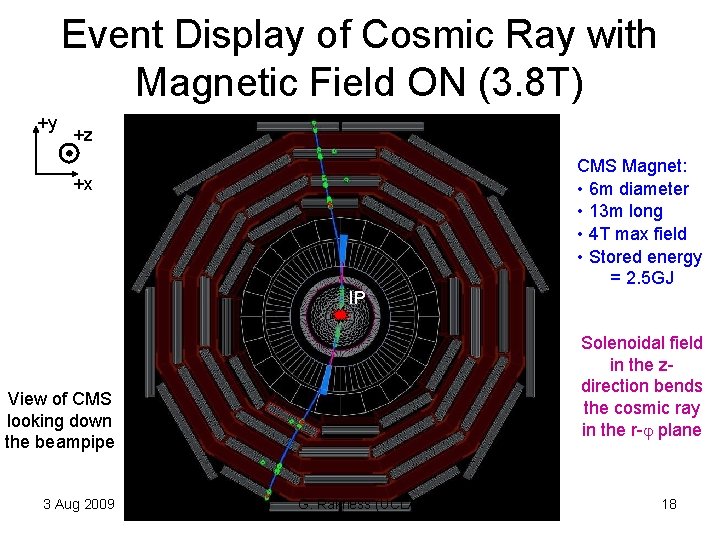
Event Display of Cosmic Ray with Magnetic Field ON (3. 8 T) +y +z +x IP Solenoidal field in the zdirection bends the cosmic ray in the r- plane View of CMS looking down the beampipe 3 Aug 2009 CMS Magnet: • 6 m diameter • 13 m long • 4 T max field • Stored energy = 2. 5 GJ G. Rakness (UCLA) 18
Response of CMS to Cosmic Rays Some morsels of detector performance, in the order that particles will see them when they come from the IP 3 Aug 2009 G. Rakness (UCLA) 19
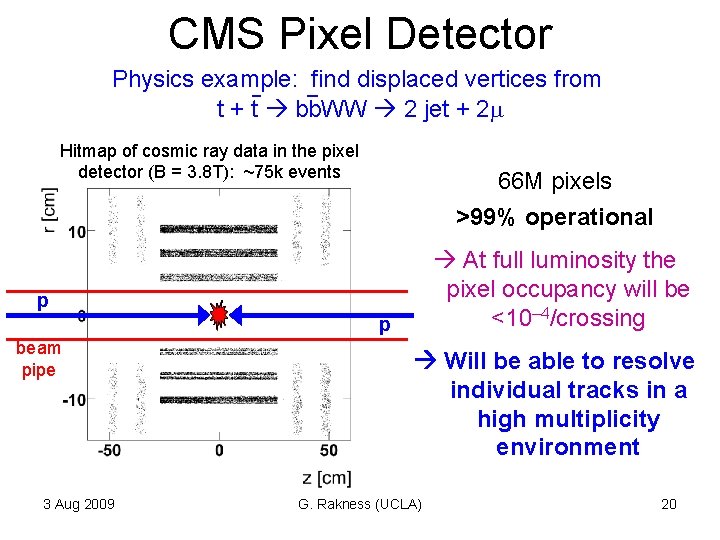
CMS Pixel Detector Physics example: find displaced vertices from t + t bb. WW 2 jet + 2 Hitmap of cosmic ray data in the pixel detector (B = 3. 8 T): ~75 k events 66 M pixels >99% operational At full luminosity the pixel occupancy will be <10– 4/crossing p p beam pipe 3 Aug 2009 Will be able to resolve individual tracks in a high multiplicity environment G. Rakness (UCLA) 20
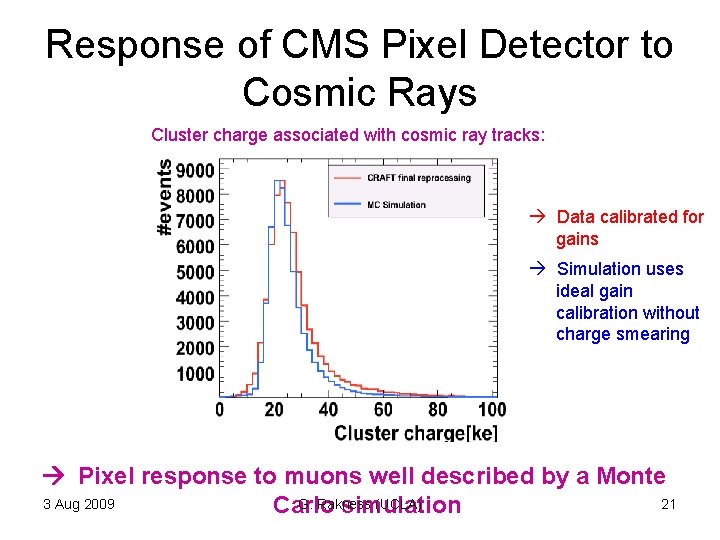
Response of CMS Pixel Detector to Cosmic Rays Cluster charge associated with cosmic ray tracks: Data calibrated for gains Simulation uses ideal gain calibration without charge smearing Pixel response to muons well described by a Monte 3 Aug 2009 G. Rakness (UCLA) 21 Carlo simulation
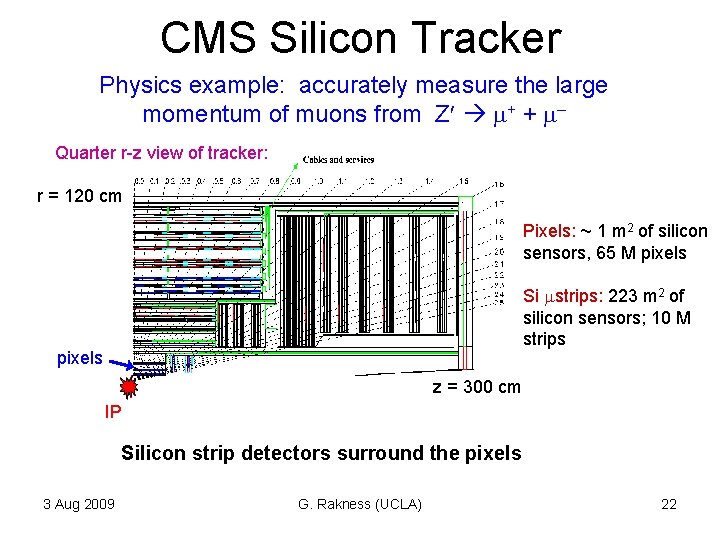
CMS Silicon Tracker Physics example: accurately measure the large momentum of muons from Z + + – Quarter r-z view of tracker: r = 120 cm Pixels: ~ 1 m 2 of silicon sensors, 65 M pixels Si strips: 223 m 2 of silicon sensors; 10 M strips pixels z = 300 cm IP Silicon strip detectors surround the pixels 3 Aug 2009 G. Rakness (UCLA) 22
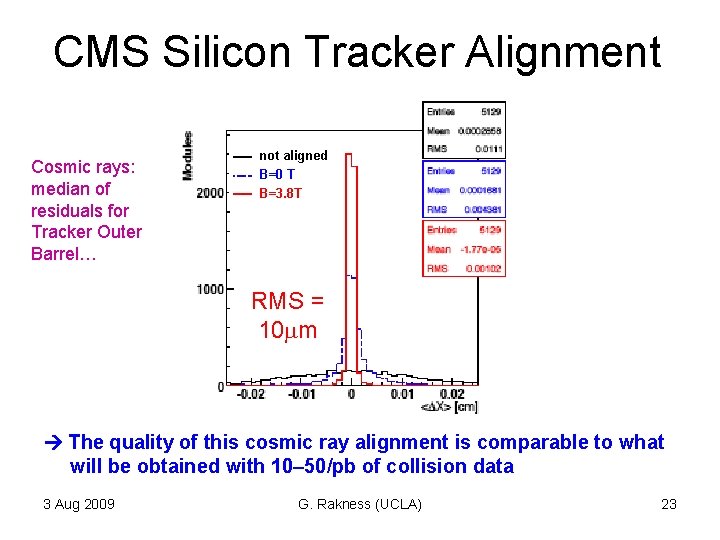
CMS Silicon Tracker Alignment Cosmic rays: median of residuals for Tracker Outer Barrel… not aligned B=0 T B=3. 8 T RMS = 10 m The quality of this cosmic ray alignment is comparable to what will be obtained with 10– 50/pb of collision data 3 Aug 2009 G. Rakness (UCLA) 23
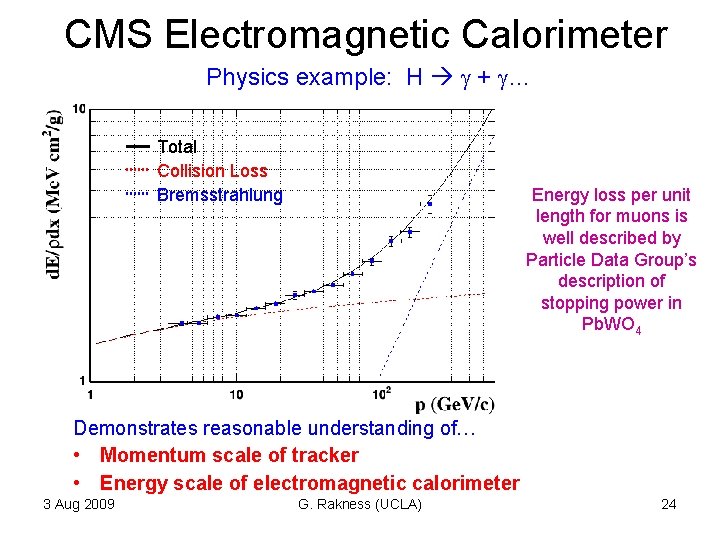
CMS Electromagnetic Calorimeter Physics example: H + … Total Collision Loss Bremsstrahlung Energy loss per unit length for muons is well described by Particle Data Group’s description of stopping power in Pb. WO 4 Demonstrates reasonable understanding of… • Momentum scale of tracker • Energy scale of electromagnetic calorimeter 3 Aug 2009 G. Rakness (UCLA) 24
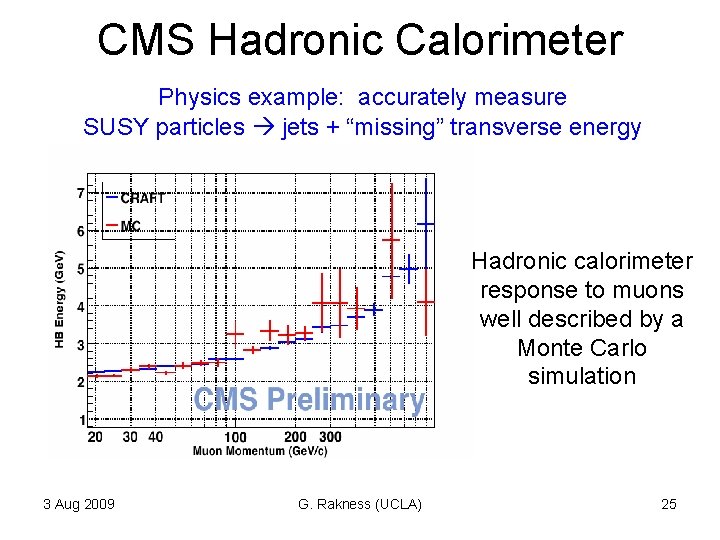
CMS Hadronic Calorimeter Physics example: accurately measure SUSY particles jets + “missing” transverse energy Hadronic calorimeter response to muons well described by a Monte Carlo simulation 3 Aug 2009 G. Rakness (UCLA) 25
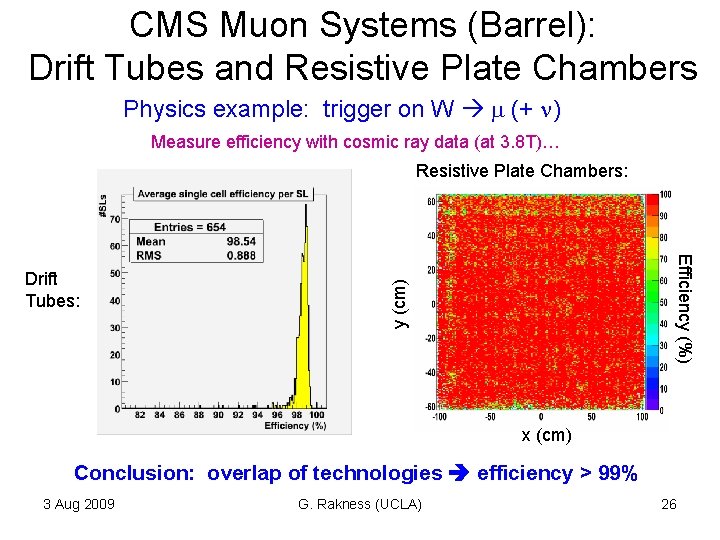
CMS Muon Systems (Barrel): Drift Tubes and Resistive Plate Chambers Physics example: trigger on W (+ ) Measure efficiency with cosmic ray data (at 3. 8 T)… Resistive Plate Chambers: y (cm) Efficiency (%) Drift Tubes: x (cm) Conclusion: overlap of technologies efficiency > 99% 3 Aug 2009 G. Rakness (UCLA) 26
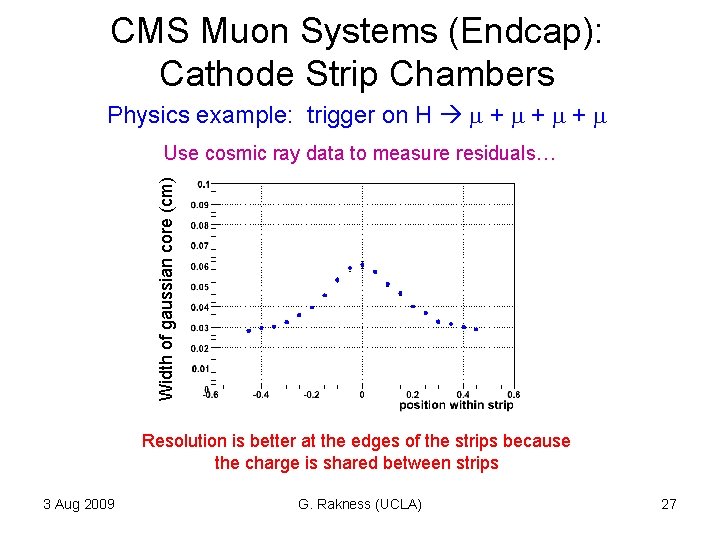
CMS Muon Systems (Endcap): Cathode Strip Chambers Physics example: trigger on H + + + Width of gaussian core (cm) Use cosmic ray data to measure residuals… Resolution is better at the edges of the strips because the charge is shared between strips 3 Aug 2009 G. Rakness (UCLA) 27
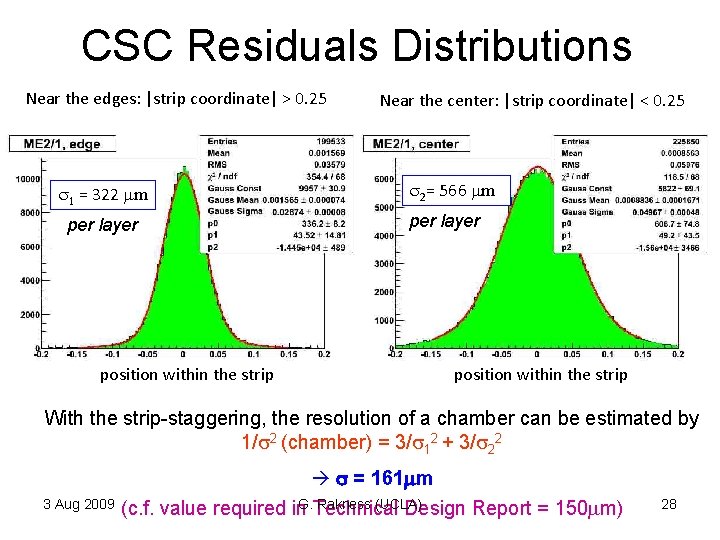
CSC Residuals Distributions Near the edges: |strip coordinate| > 0. 25 s 1 = 322 m per layer Near the center: |strip coordinate| < 0. 25 s 2= 566 m per layer position within the strip With the strip-staggering, the resolution of a chamber can be estimated by 1/s 2 (chamber) = 3/s 12 + 3/s 22 s = 161 m 3 Aug 2009 Rakness (UCLA) (c. f. value required in. G. Technical Design Report = 150 m) 28
CMS Level-1 Trigger It’s not a “detector, ” it selects what physics we get out of the detector… 3 Aug 2009 G. Rakness (UCLA) 29
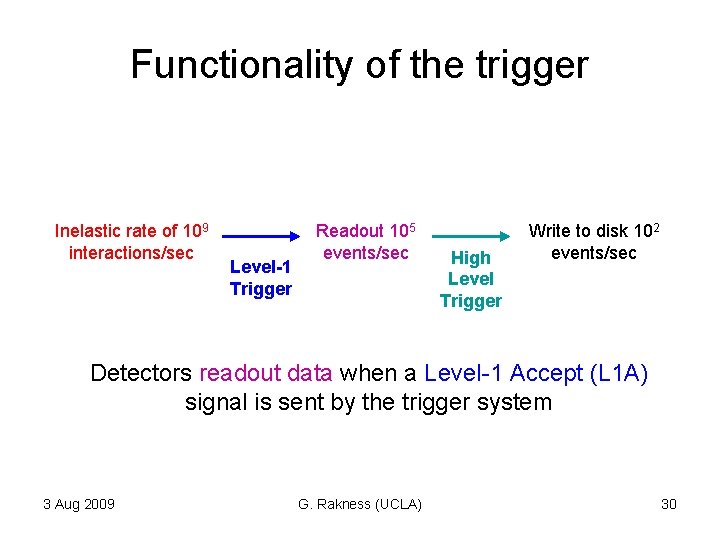
Functionality of the trigger Inelastic rate of 109 interactions/sec Level-1 Trigger Readout 105 events/sec High Level Trigger Write to disk 102 events/sec Detectors readout data when a Level-1 Accept (L 1 A) signal is sent by the trigger system 3 Aug 2009 G. Rakness (UCLA) 30
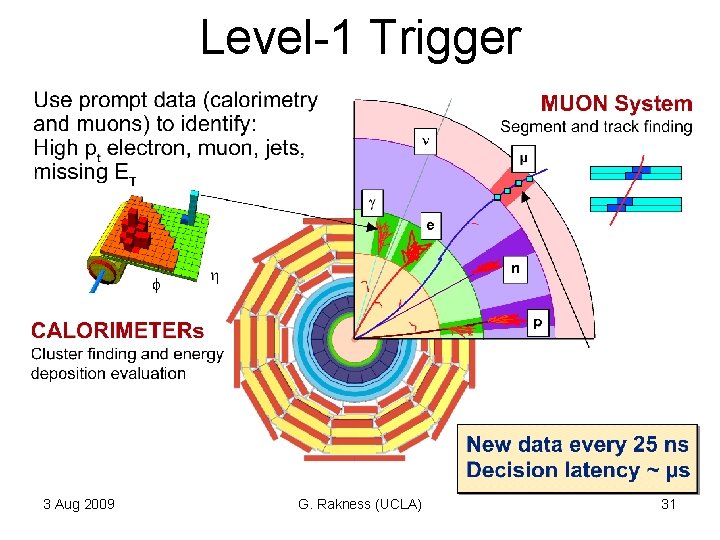
Level-1 Trigger 3 Aug 2009 G. Rakness (UCLA) 31
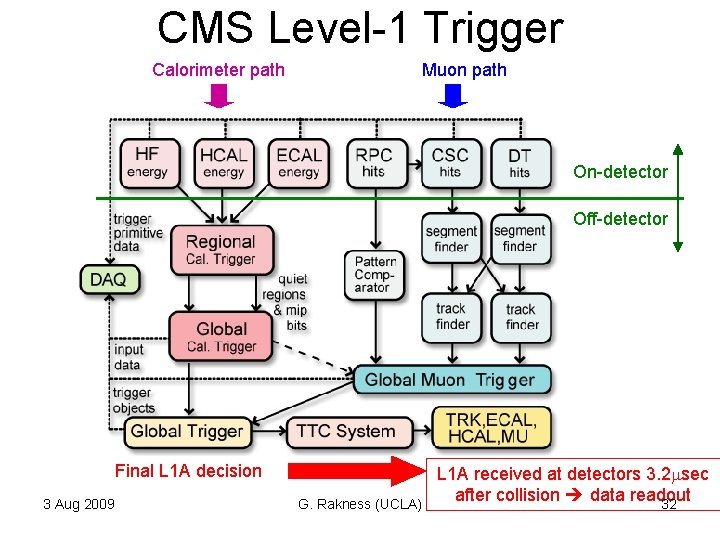
CMS Level-1 Trigger Calorimeter path Muon path On-detector Off-detector Final L 1 A decision 3 Aug 2009 G. Rakness (UCLA) L 1 A received at detectors 3. 2 sec after collision data readout 32
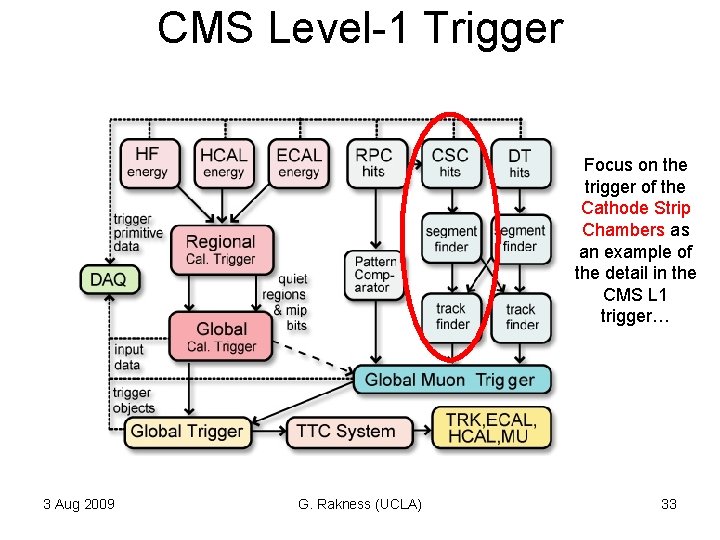
CMS Level-1 Trigger Focus on the trigger of the Cathode Strip Chambers as an example of the detail in the CMS L 1 trigger… 3 Aug 2009 G. Rakness (UCLA) 33
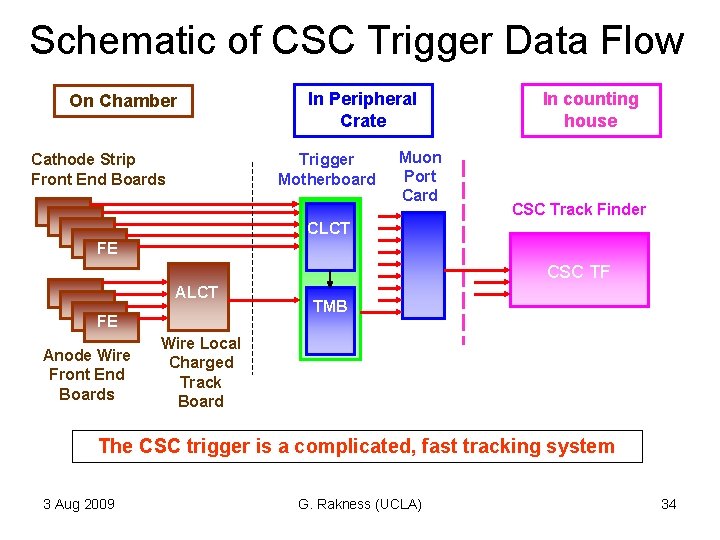
Schematic of CSC Trigger Data Flow On Chamber Cathode Strip Front End Boards In Peripheral Crate Trigger Motherboard Muon Port Card In counting house CSC Track Finder CLCT FE CSC TF ALCT FE Anode Wire Front End Boards TMB Wire Local Charged Track Board The CSC trigger is a complicated, fast tracking system 3 Aug 2009 G. Rakness (UCLA) 34
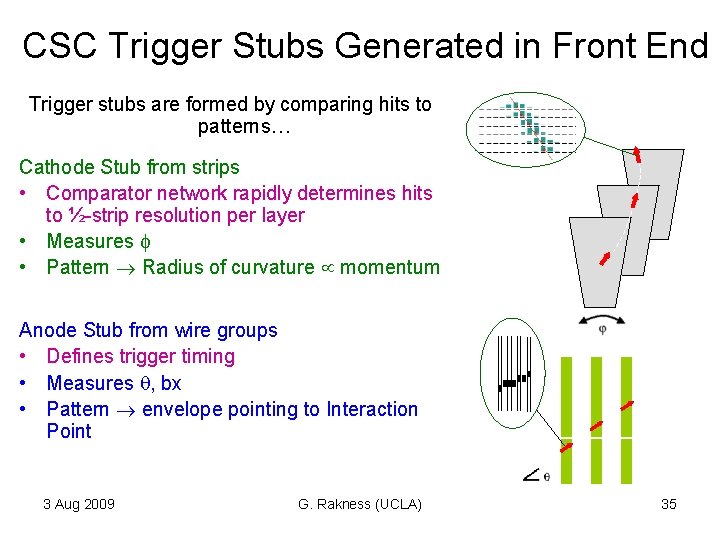
CSC Trigger Stubs Generated in Front End Trigger stubs are formed by comparing hits to patterns… Cathode Stub from strips • Comparator network rapidly determines hits to ½-strip resolution per layer • Measures f • Pattern Radius of curvature momentum Anode Stub from wire groups • Defines trigger timing • Measures , bx • Pattern envelope pointing to Interaction Point 3 Aug 2009 G. Rakness (UCLA) 35
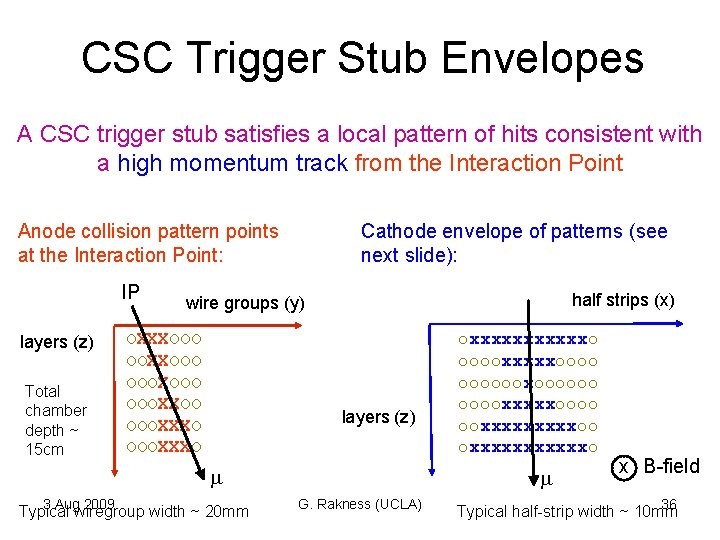
CSC Trigger Stub Envelopes A CSC trigger stub satisfies a local pattern of hits consistent with a high momentum track from the Interaction Point Cathode envelope of patterns (see next slide): Anode collision pattern points at the Interaction Point: IP layers (z) Total chamber depth ~ 15 cm half strips (x) wire groups (y) OXXXOOO OOOXOOO OOOXXXO layers (z) 3 Aug 2009 Typical wiregroup width ~ 20 mm oxxxxxxo ooooxxxxxooooooxooooooxxxxxoooo ooxxxxxoo oxxxxxxo G. Rakness (UCLA) x B-field 36 Typical half-strip width ~ 10 mm
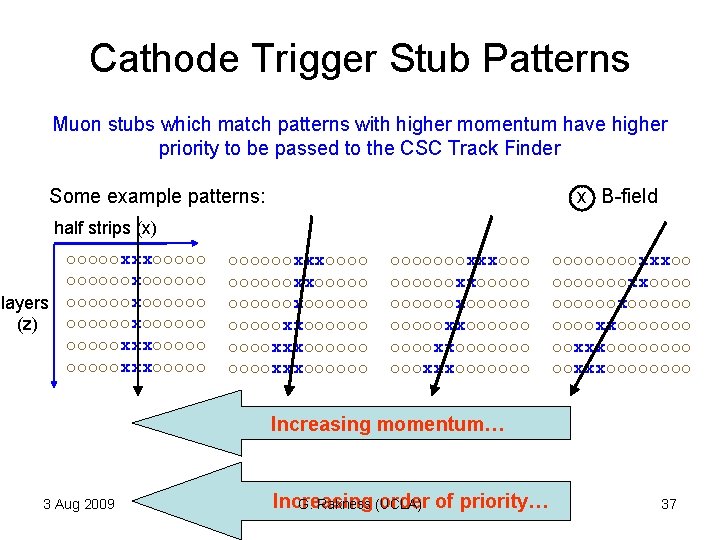
Cathode Trigger Stub Patterns Muon stubs which match patterns with higher momentum have higher priority to be passed to the CSC Track Finder Some example patterns: x B-field half strips (x) oooooxxxooooooxoooooo layers ooooooxoooooo (z) oooooxxxooooooxxxooooooxxooooooxooooooxxooooooxxxoooooooxxxooo ooooooxxooooooxooooooxxooooooxxooooooo oooxxxoooooooxxxoo oooooooxxooooooxooooooxxooooooo ooxxxoooooooo Increasing momentum… 3 Aug 2009 Increasing order of priority… G. Rakness (UCLA) 37
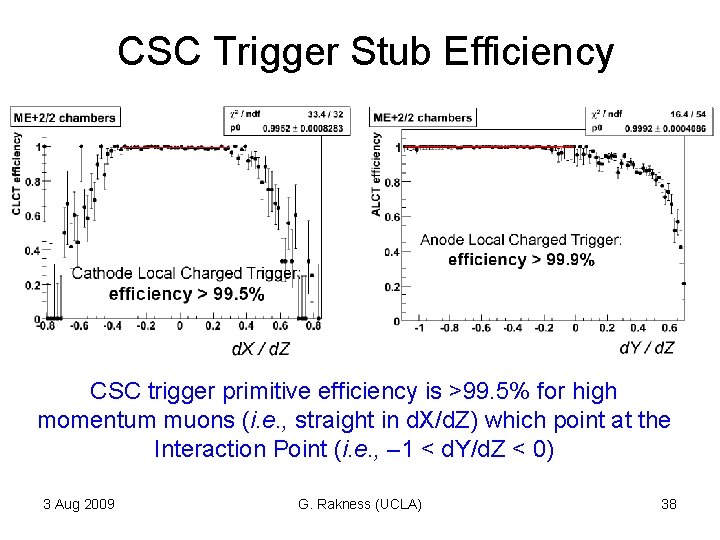
CSC Trigger Stub Efficiency CSC trigger primitive efficiency is >99. 5% for high momentum muons (i. e. , straight in d. X/d. Z) which point at the Interaction Point (i. e. , – 1 < d. Y/d. Z < 0) 3 Aug 2009 G. Rakness (UCLA) 38
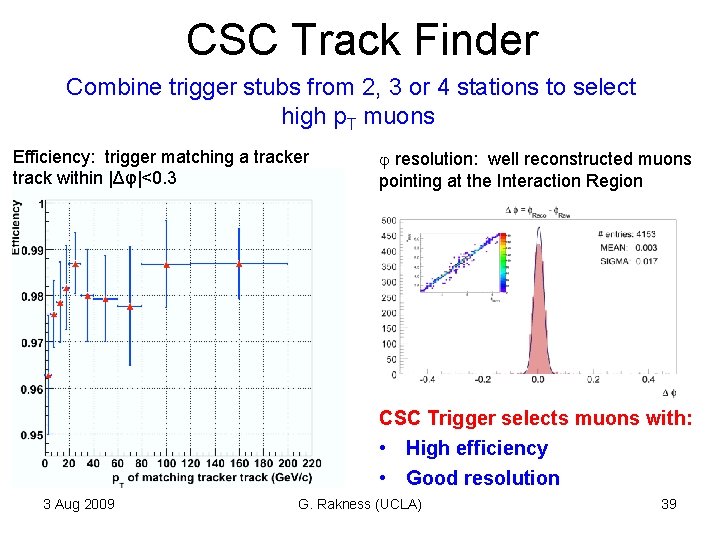
CSC Track Finder Combine trigger stubs from 2, 3 or 4 stations to select high p. T muons Efficiency: trigger matching a tracker track within |Δφ|<0. 3 resolution: well reconstructed muons pointing at the Interaction Region CSC Trigger selects muons with: • High efficiency • Good resolution 3 Aug 2009 G. Rakness (UCLA) 39
Trigger Synchronization 3 Aug 2009 G. Rakness (UCLA) 40
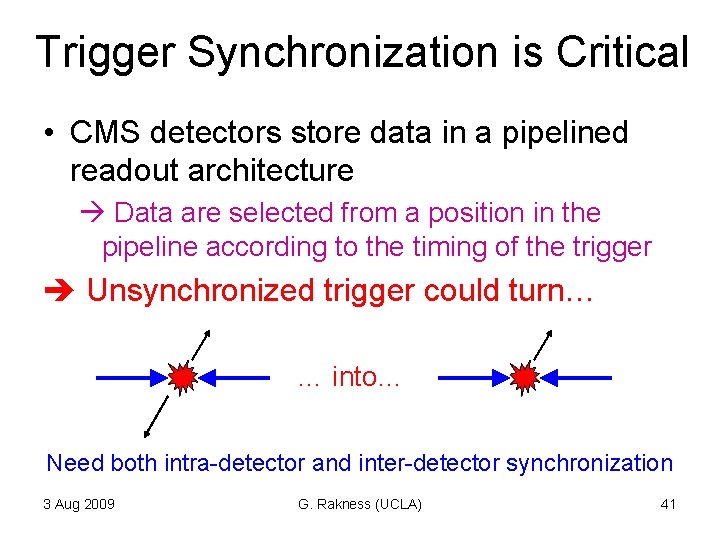
Trigger Synchronization is Critical • CMS detectors store data in a pipelined readout architecture Data are selected from a position in the pipeline according to the timing of the trigger Unsynchronized trigger could turn… … into… Need both intra-detector and inter-detector synchronization 3 Aug 2009 G. Rakness (UCLA) 41
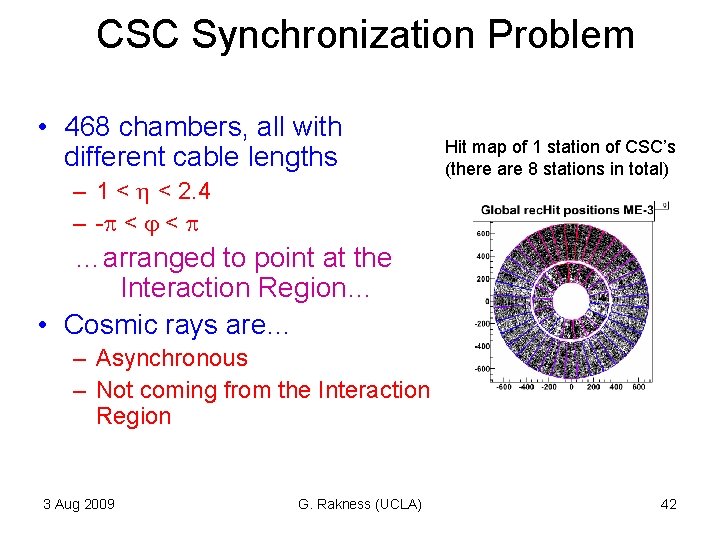
CSC Synchronization Problem • 468 chambers, all with different cable lengths – 1 < < 2. 4 – - < < Hit map of 1 station of CSC’s (there are 8 stations in total) …arranged to point at the Interaction Region… • Cosmic rays are… – Asynchronous – Not coming from the Interaction Region 3 Aug 2009 G. Rakness (UCLA) 42
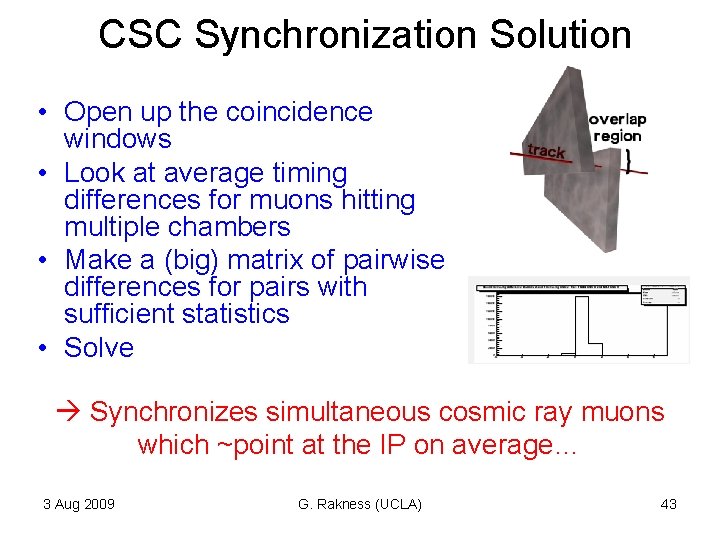
CSC Synchronization Solution • Open up the coincidence windows • Look at average timing differences for muons hitting multiple chambers • Make a (big) matrix of pairwise differences for pairs with sufficient statistics • Solve Synchronizes simultaneous cosmic ray muons which ~point at the IP on average… 3 Aug 2009 G. Rakness (UCLA) 43
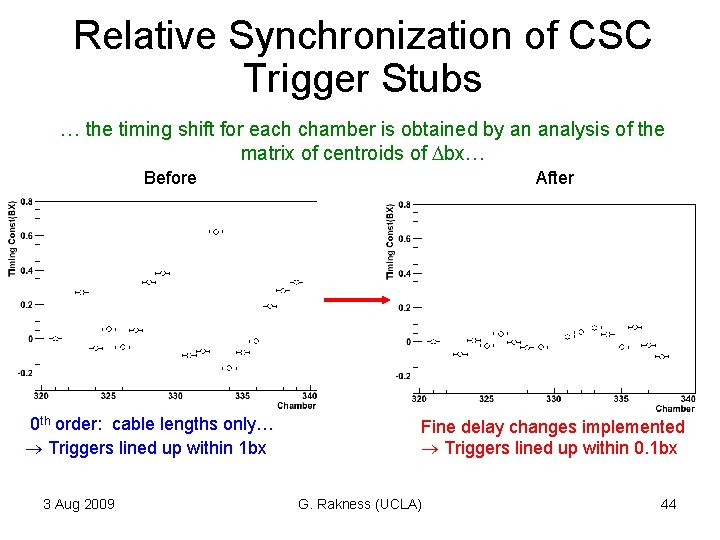
Relative Synchronization of CSC Trigger Stubs … the timing shift for each chamber is obtained by an analysis of the matrix of centroids of Dbx… Before 0 th order: cable lengths only… Triggers lined up within 1 bx 3 Aug 2009 After Fine delay changes implemented Triggers lined up within 0. 1 bx G. Rakness (UCLA) 44
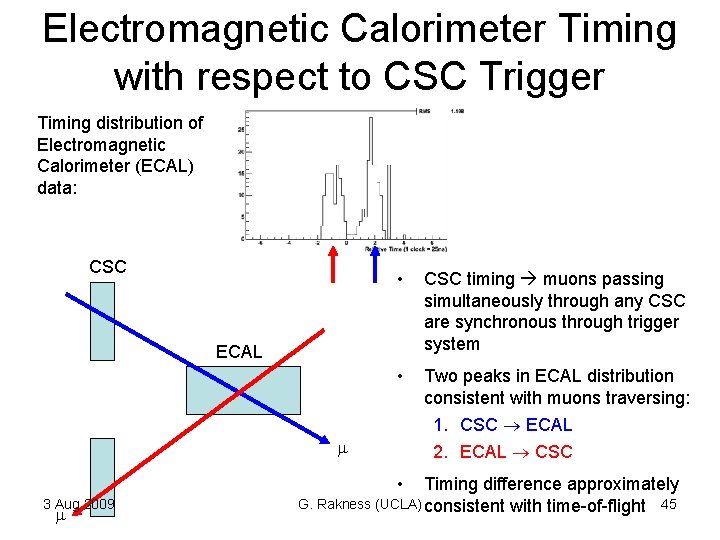
Electromagnetic Calorimeter Timing with respect to CSC Trigger Timing distribution of Electromagnetic Calorimeter (ECAL) data: CSC • CSC timing muons passing simultaneously through any CSC are synchronous through trigger system • Two peaks in ECAL distribution consistent with muons traversing: 1. CSC ECAL 2. ECAL CSC ECAL • 3 Aug 2009 Timing difference approximately G. Rakness (UCLA) consistent with time-of-flight 45
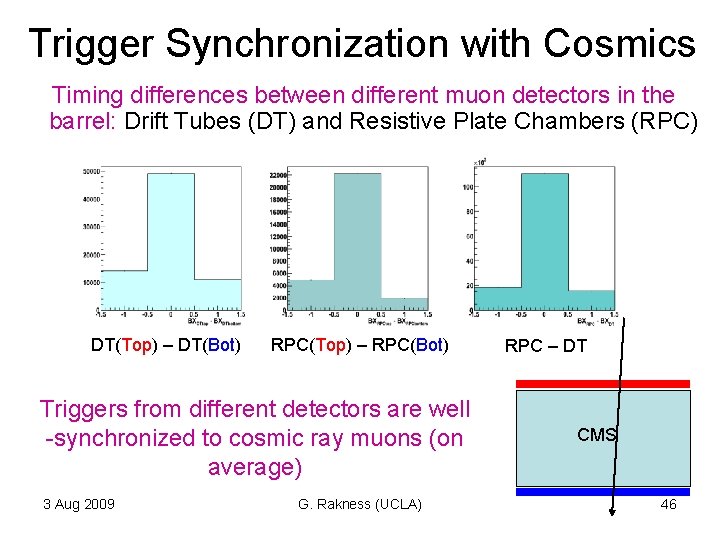
Trigger Synchronization with Cosmics Timing differences between different muon detectors in the barrel: Drift Tubes (DT) and Resistive Plate Chambers (RPC) DT(Top) – DT(Bot) RPC(Top) – RPC(Bot) Triggers from different detectors are well -synchronized to cosmic ray muons (on average) 3 Aug 2009 G. Rakness (UCLA) RPC – DT CMS 46
The response of CMS to cosmic rays looks good. How about something more substantial? 3 Aug 2009 G. Rakness (UCLA) 47
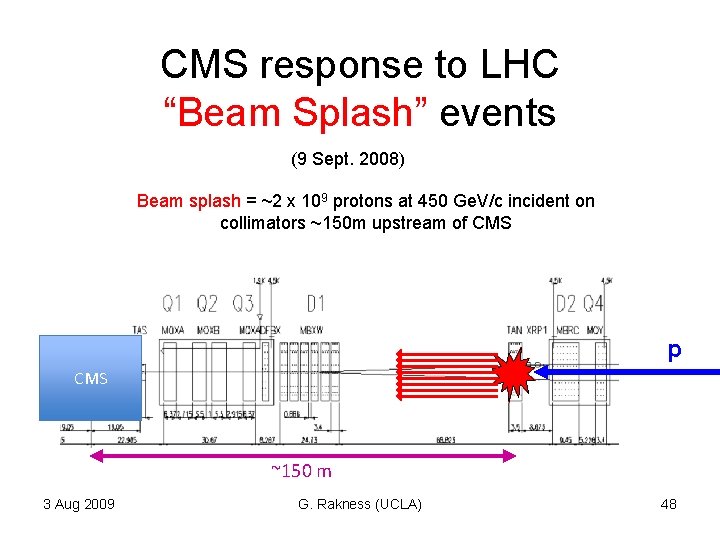
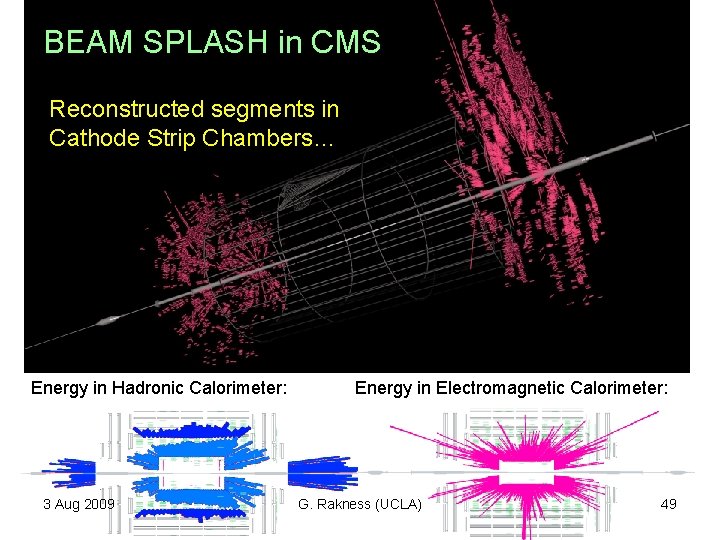
CMS response to LHC “Beam Splash” events (9 Sept. 2008) Beam splash = ~2 x 10⁹ protons at 450 Ge. V/c incident on collimators ~150 m upstream of CMS p CMS ~150 m 3 Aug 2009 G. Rakness (UCLA) 48
BEAM SPLASH in CMS Reconstructed segments in Cathode Strip Chambers… Energy in Hadronic Calorimeter: 3 Aug 2009 Energy in Electromagnetic Calorimeter: G. Rakness (UCLA) 49
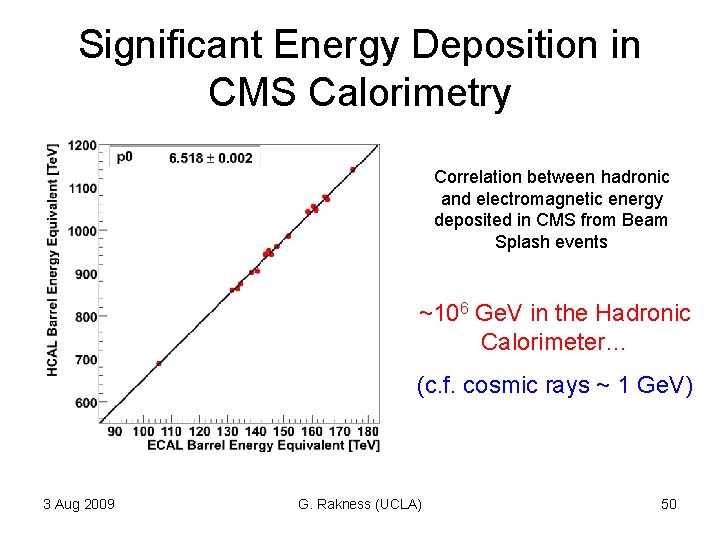
Significant Energy Deposition in CMS Calorimetry Correlation between hadronic and electromagnetic energy deposited in CMS from Beam Splash events ~106 Ge. V in the Hadronic Calorimeter… (c. f. cosmic rays ~ 1 Ge. V) 3 Aug 2009 G. Rakness (UCLA) 50
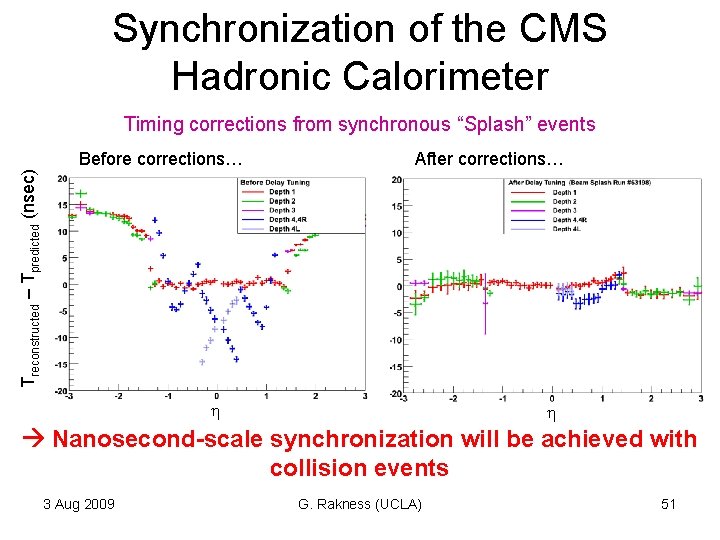
Synchronization of the CMS Hadronic Calorimeter Timing corrections from synchronous “Splash” events After corrections… Treconstructed – Tpredicted (nsec) Before corrections… Nanosecond-scale synchronization will be achieved with collision events 3 Aug 2009 G. Rakness (UCLA) 51
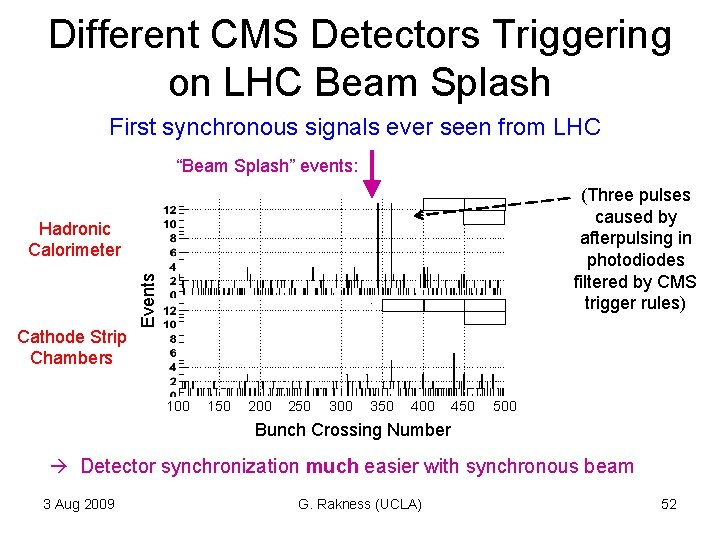
Different CMS Detectors Triggering on LHC Beam Splash First synchronous signals ever seen from LHC “Beam Splash” events: (Three pulses caused by afterpulsing in photodiodes filtered by CMS trigger rules) Cathode Strip Chambers Events Hadronic Calorimeter 100 150 200 250 300 350 400 450 500 Bunch Crossing Number Detector synchronization much easier with synchronous beam 3 Aug 2009 G. Rakness (UCLA) 52
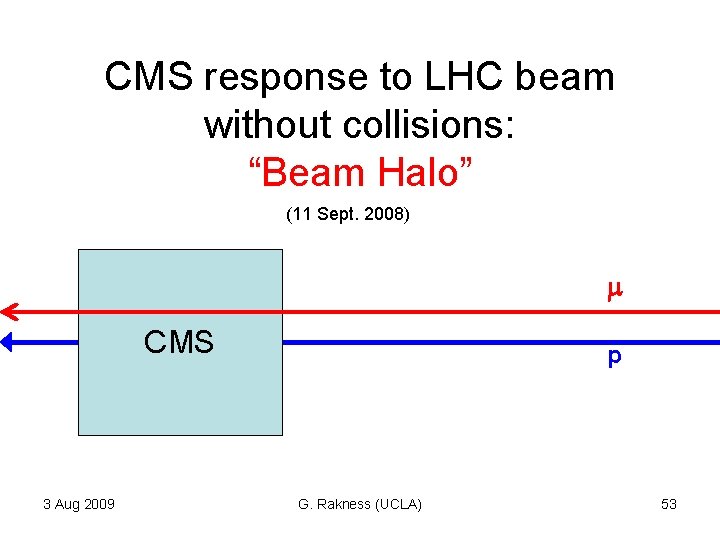
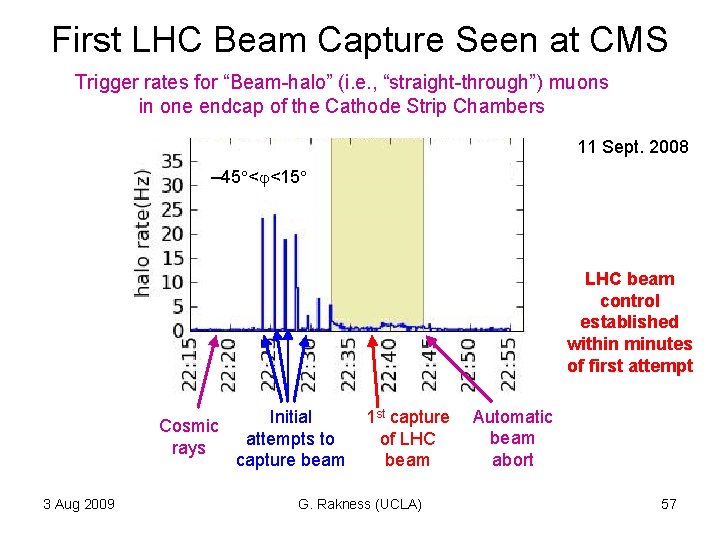
CMS response to LHC beam without collisions: “Beam Halo” (11 Sept. 2008) CMS 3 Aug 2009 p G. Rakness (UCLA) 53
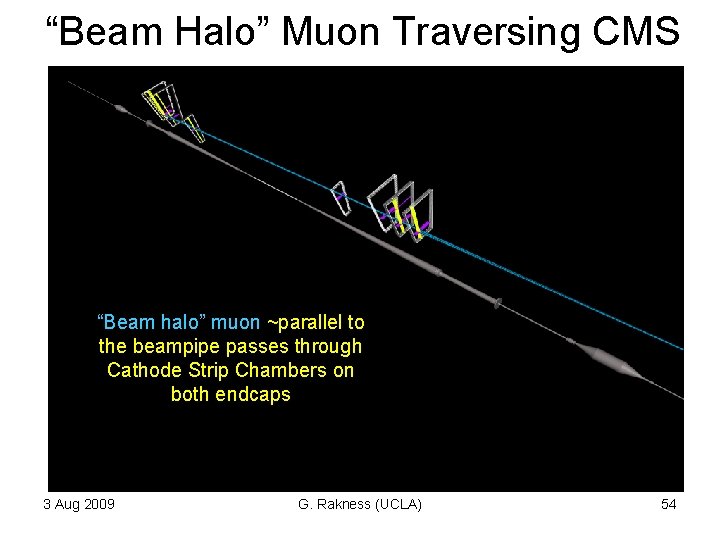
“Beam Halo” Muon Traversing CMS “Beam halo” muon ~parallel to the beampipe passes through Cathode Strip Chambers on both endcaps 3 Aug 2009 G. Rakness (UCLA) 54
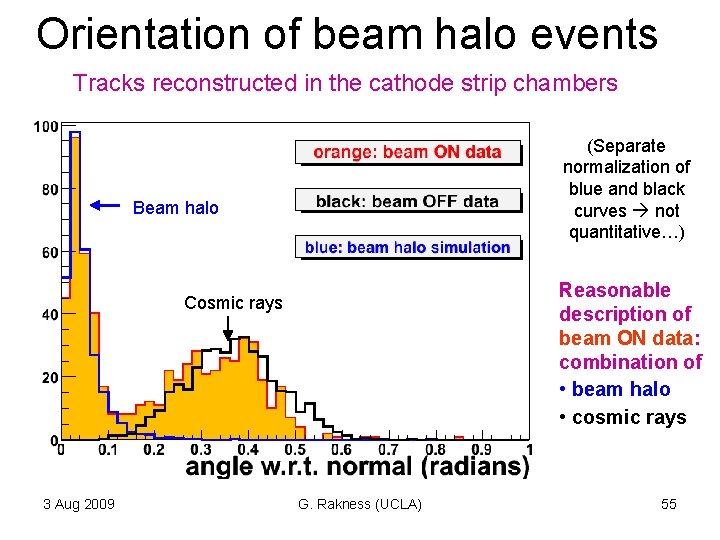
Orientation of beam halo events Tracks reconstructed in the cathode strip chambers (Separate normalization of blue and black curves not quantitative…) Beam halo Reasonable description of beam ON data: combination of • beam halo • cosmic rays Cosmic rays 3 Aug 2009 G. Rakness (UCLA) 55
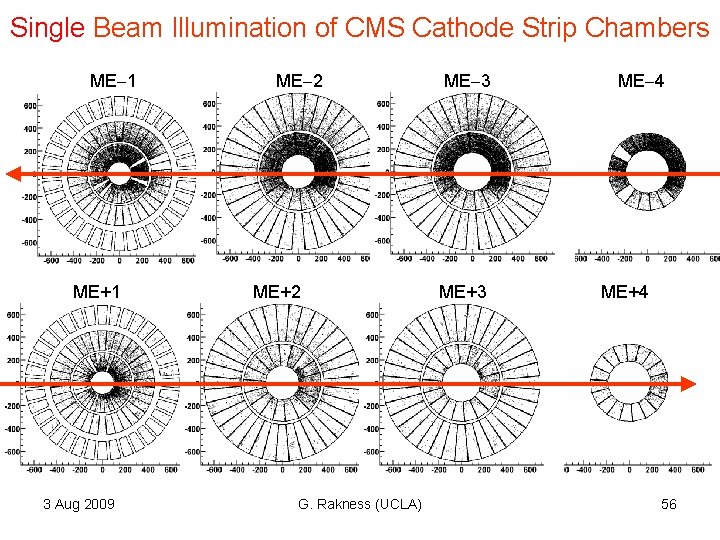
Single Beam Illumination of CMS Cathode Strip Chambers ME 1 ME+1 3 Aug 2009 ME 2 ME+2 G. Rakness (UCLA) ME 3 ME+3 ME 4 ME+4 56
First LHC Beam Capture Seen at CMS Trigger rates for “Beam-halo” (i. e. , “straight-through”) muons in one endcap of the Cathode Strip Chambers 11 Sept. 2008 – 45 < <15 LHC beam control established within minutes of first attempt Initial Cosmic attempts to rays capture beam 3 Aug 2009 1 st capture of LHC beam G. Rakness (UCLA) Automatic beam abort 57
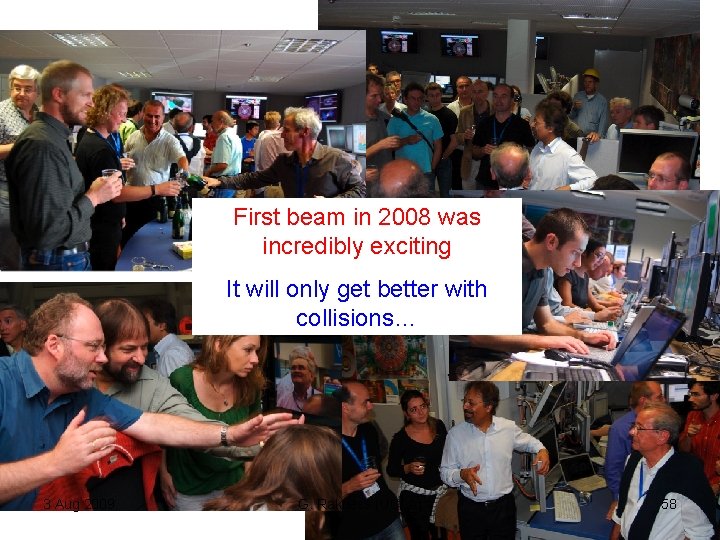
First beam in 2008 was incredibly exciting It will only get better with collisions… 3 Aug 2009 G. Rakness (UCLA) 58
Early Physics Program of CMS (I) 10/pb: Commission the detector… Detector synchronization and alignment In-situ calibration Commission trigger Start “physics commissioning” Jet and lepton rates; observe W, Z, top And, first look at possible extraordinary signatures… 3 Aug 2009 G. Rakness (UCLA) 59
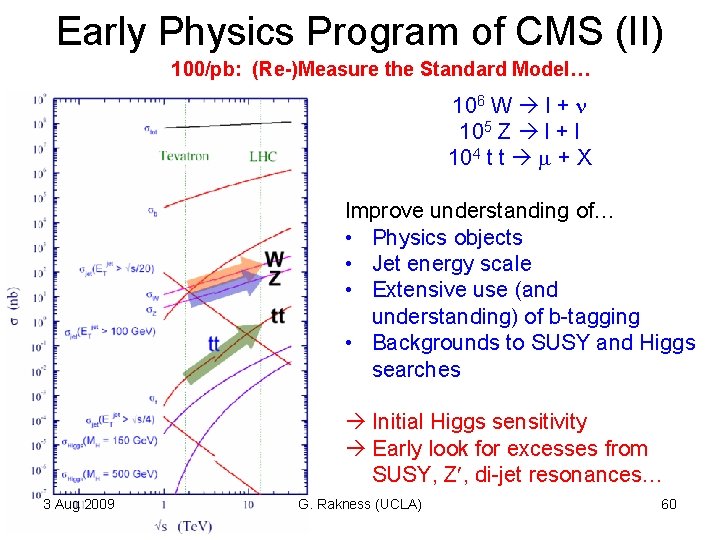
Early Physics Program of CMS (II) 100/pb: (Re-)Measure the Standard Model… 106 W l + 105 Z l + l 104 t t + X Improve understanding of… • Physics objects • Jet energy scale • Extensive use (and understanding) of b-tagging • Backgrounds to SUSY and Higgs searches Initial Higgs sensitivity Early look for excesses from SUSY, Z , di-jet resonances… 3 Aug 2009 G. Rakness (UCLA) 60
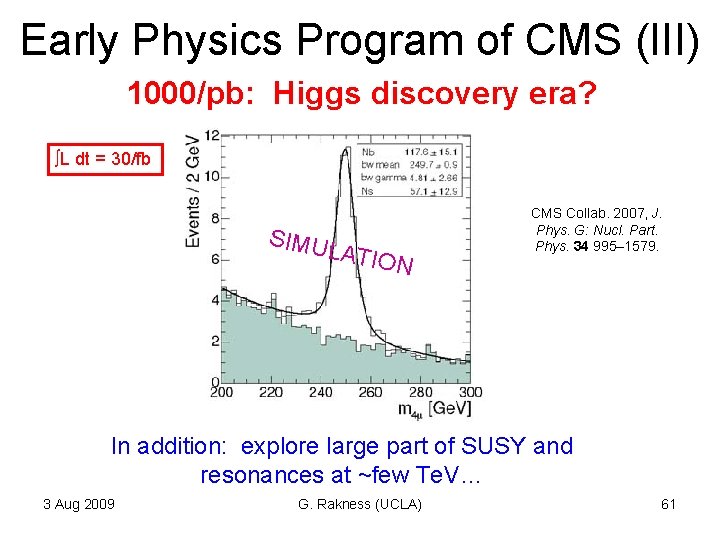
Early Physics Program of CMS (III) 1000/pb: Higgs discovery era? L dt = 30/fb SIMU LATIO N CMS Collab. 2007, J. Phys. G: Nucl. Part. Phys. 34 995– 1579. In addition: explore large part of SUSY and resonances at ~few Te. V… 3 Aug 2009 G. Rakness (UCLA) 61
Summary CMS is ready for beam We are eagerly anticipating proton collisions in the LHC. . . 3 Aug 2009 G. Rakness (UCLA) 62
Backup slides 3 Aug 2009 G. Rakness (UCLA) 63
High Level Trigger n Boundary conditions: u Code runs in a single processor, which analyzes one event at a time u HLT has access to full event data (full granularity and resolution) u Only limitations: CPU time Output selection rate (~102 Hz) Precision of calibration constants u Main requirements: Satisfy physics program: high efficiency Selection must be inclusive (to discover the unpredicted as well) Must not require precise knowledge of calibration/run conditions Efficiency must be measurable from data alone All algorithms/processors must be monitored closely 3 Aug 2009 G. Rakness (UCLA) 64
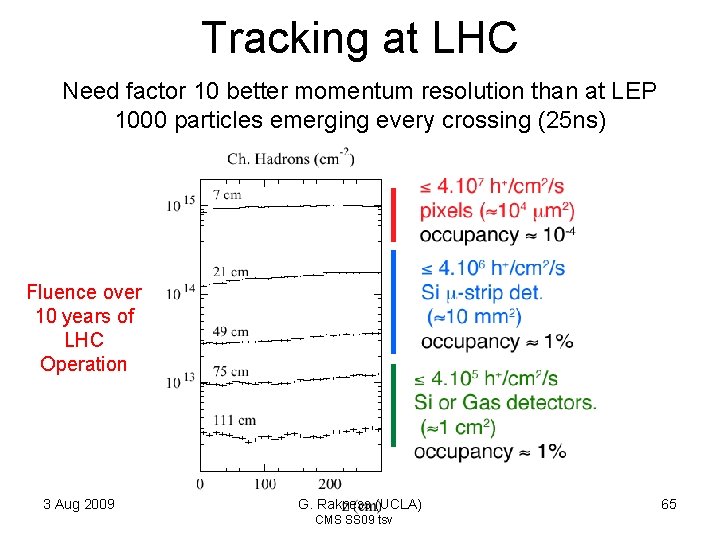
Tracking at LHC Need factor 10 better momentum resolution than at LEP 1000 particles emerging every crossing (25 ns) Fluence over 10 years of LHC Operation 3 Aug 2009 G. Rakness (UCLA) CMS SS 09 tsv 65
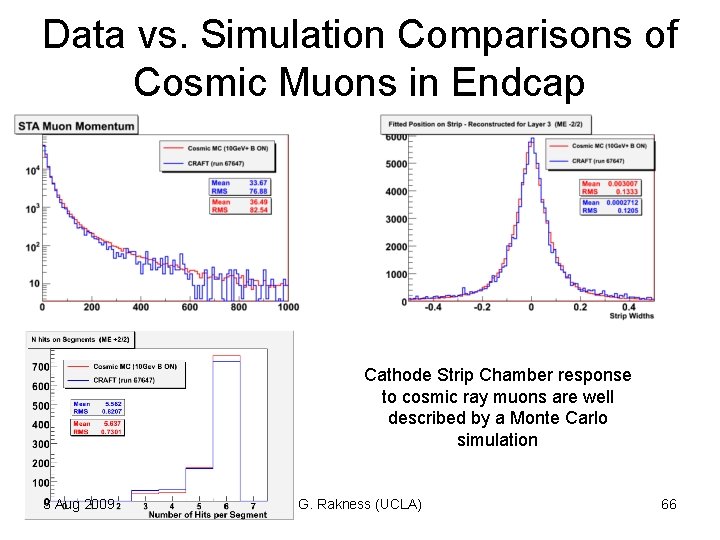
Data vs. Simulation Comparisons of Cosmic Muons in Endcap Cathode Strip Chamber response to cosmic ray muons are well described by a Monte Carlo simulation 3 Aug 2009 G. Rakness (UCLA) 66
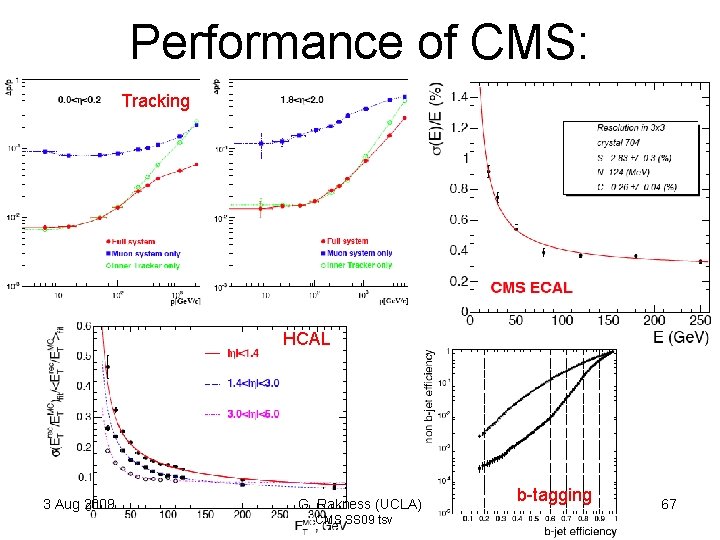
Performance of CMS: Overview Tracking HCAL 3 Aug 2009 G. Rakness (UCLA) CMS SS 09 tsv b-tagging 67
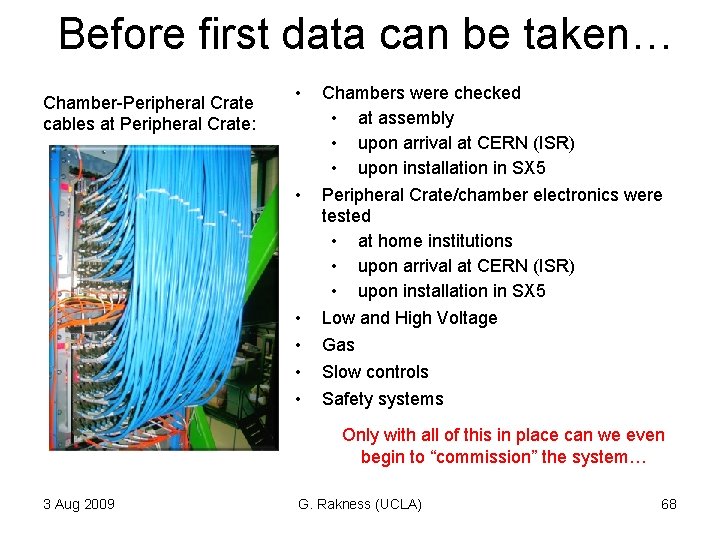
Before first data can be taken… Chamber-Peripheral Crate cables at Peripheral Crate: • Chambers were checked • at assembly • upon arrival at CERN (ISR) • upon installation in SX 5 • Peripheral Crate/chamber electronics were tested • at home institutions • upon arrival at CERN (ISR) • upon installation in SX 5 Low and High Voltage Gas Slow controls Safety systems • • Only with all of this in place can we even begin to “commission” the system… 3 Aug 2009 G. Rakness (UCLA) 68
CSC Configuration CSC is highly configurable: ~100 parameters per CSC Most CSC electronics are in experimental cavern (high radiation area): • FPGAs are not radiation hard prone to single event upsets • PROMs are radiation hard… • FPGA program stored on one set of PROMs • configuration parameters stored on another set of PROMs CSC Configuration = TTC “hard reset”: • FPGA program reloaded from PROMs • FPGA reads its configuration from configuration PROMs Solved issues: 1. Explicit configuration of TTCrq chip required 2. “Check configuration button” reads configuration from hardware and compares with configuration database values 3 Aug 2009 G. Rakness (UCLA) 69