
Interior Design I 4 0 Test Review 4

- Slides: 52
Interior Design I 4. 0 Test Review
4. 01 – Textile Fibers Textile Laws – to protect consumers (anyone who buys merchandise like towels, clothing, bedspreads, etc. ) Textile Fiber Products Identification Act: • Wool Products Labeling Act: • This law requires that fibers in a textile product must be labeled in order of predominance by weight and attached to the product. This law requires the manufacturer to include the labeling, identifying, and amount of natural fiber that comes from a sheep. Flammable Fabrics Act: • This law prevents manufacturers from producing home interior products from materials that burn easily.
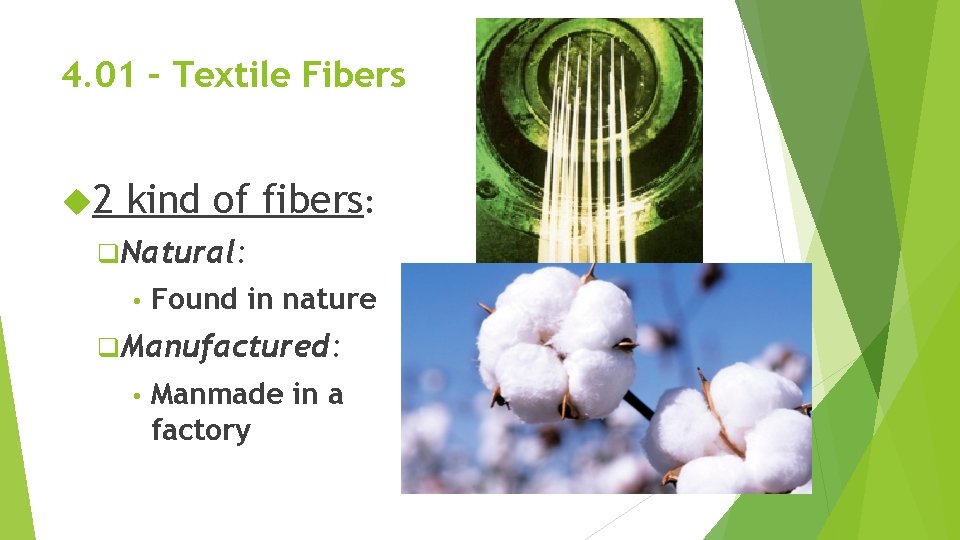
4. 01 – Textile Fibers 2 kind of fibers: q. Natural: • Found in nature q. Manufactured: • Manmade in a factory
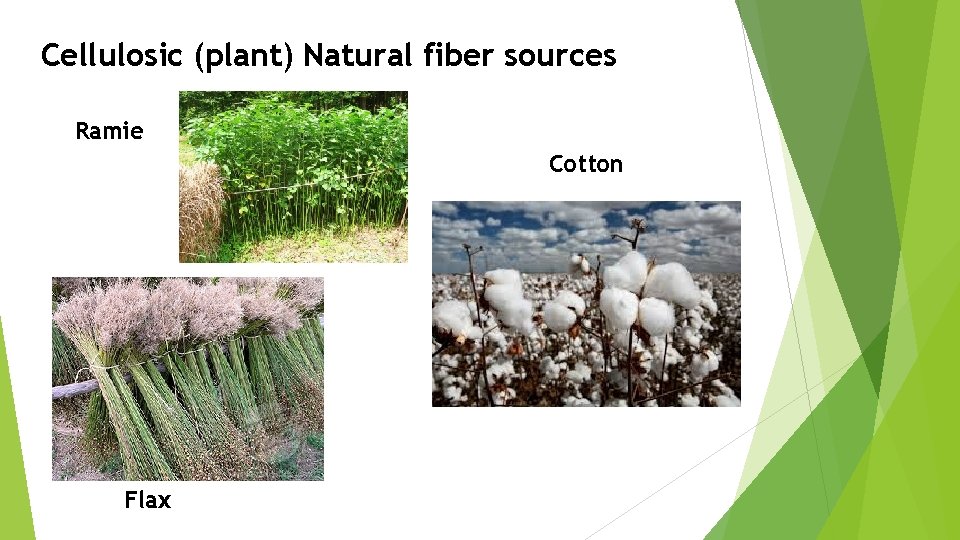
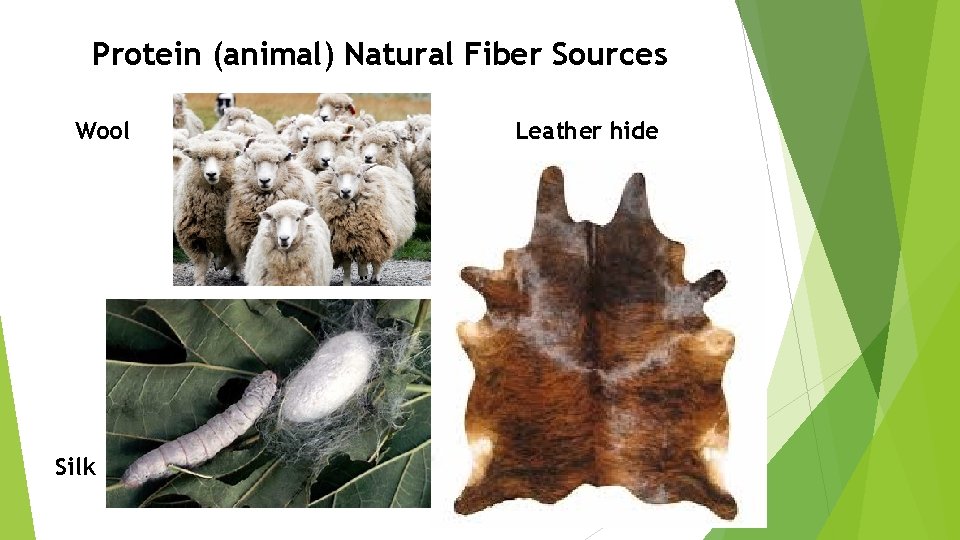
4. 01 – Textile Fibers 2 Kinds of Natural Fibers: Cellulosic Plants Natural fibers that come from the cellulose in a plant • Cotton • Flax • Ramie Protein Animals Natural fibers that come from animal sources • Leather (hide/skin) • Wool (hair) • Silk (cocoon of insects)
Cellulosic (plant) Natural fiber sources Ramie Cotton Flax
Protein (animal) Natural Fiber Sources Wool Silk Leather hide
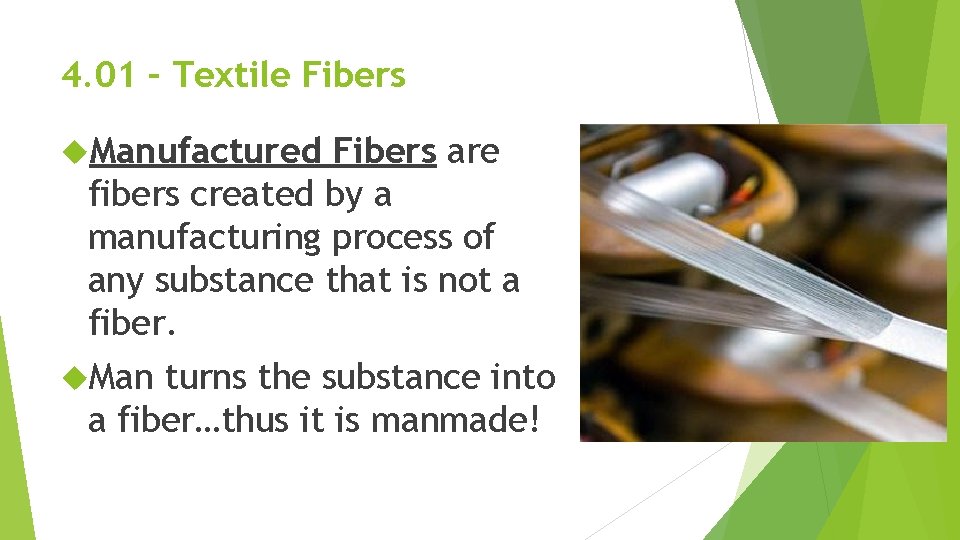
4. 01 – Textile Fibers Manufactured Fibers are fibers created by a manufacturing process of any substance that is not a fiber. Man turns the substance into a fiber…thus it is manmade!
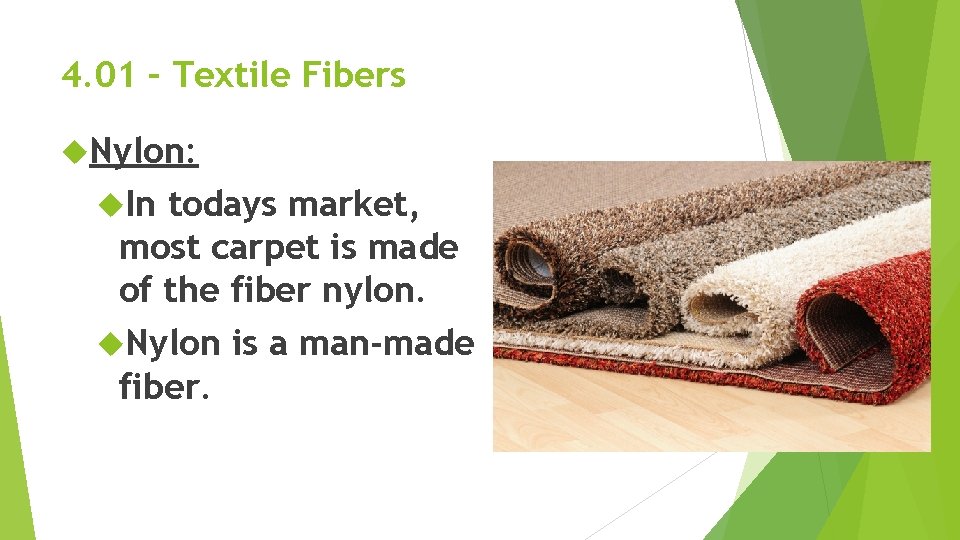
4. 01 – Textile Fibers Nylon: In todays market, most carpet is made of the fiber nylon. Nylon is a man-made fiber.
4. 01 – Textile Fibers Blended When Fibers: natural and manufactured fibers are combined to produce a better quality product. Just like blending more than one fruit/veggie together taste better!
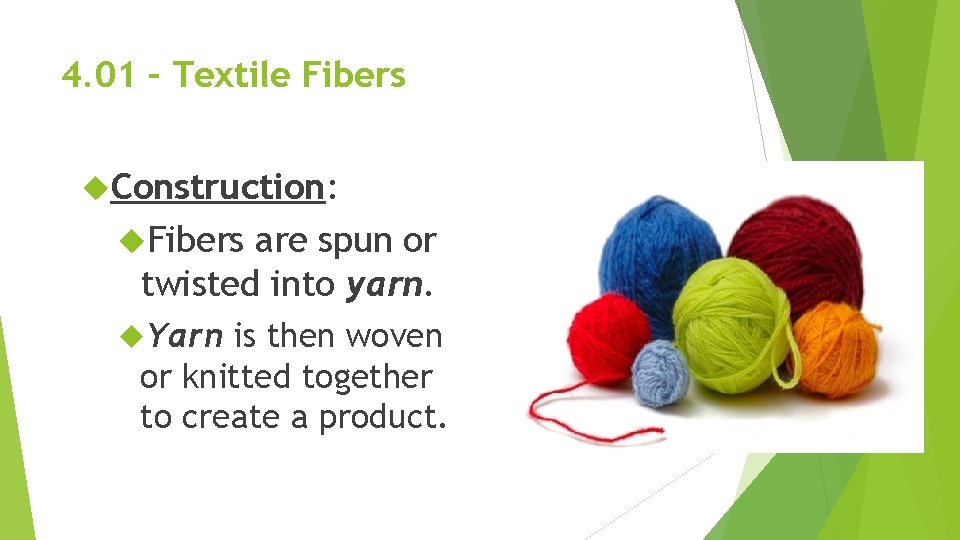
4. 01 – Textile Fibers Construction: Fibers are spun or twisted into yarn. Yarn is then woven or knitted together to create a product.
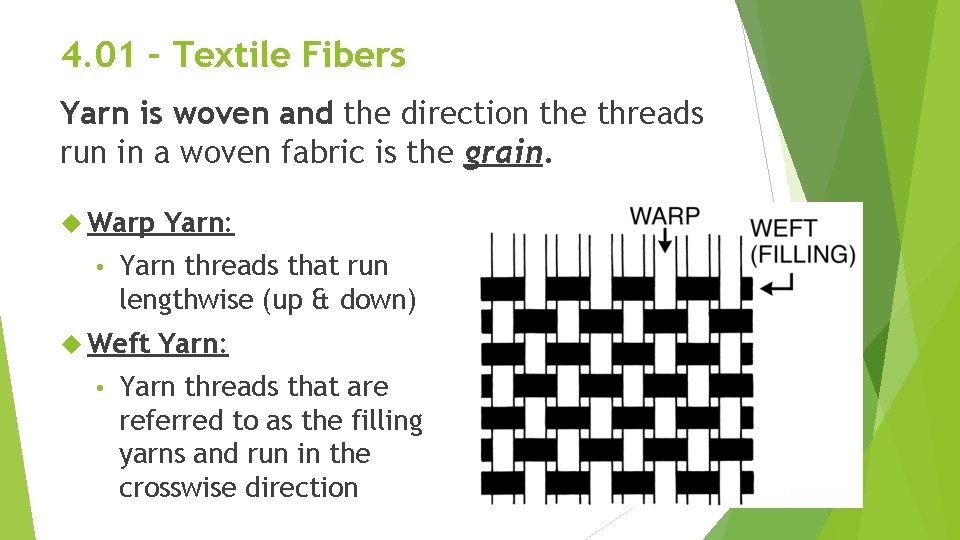
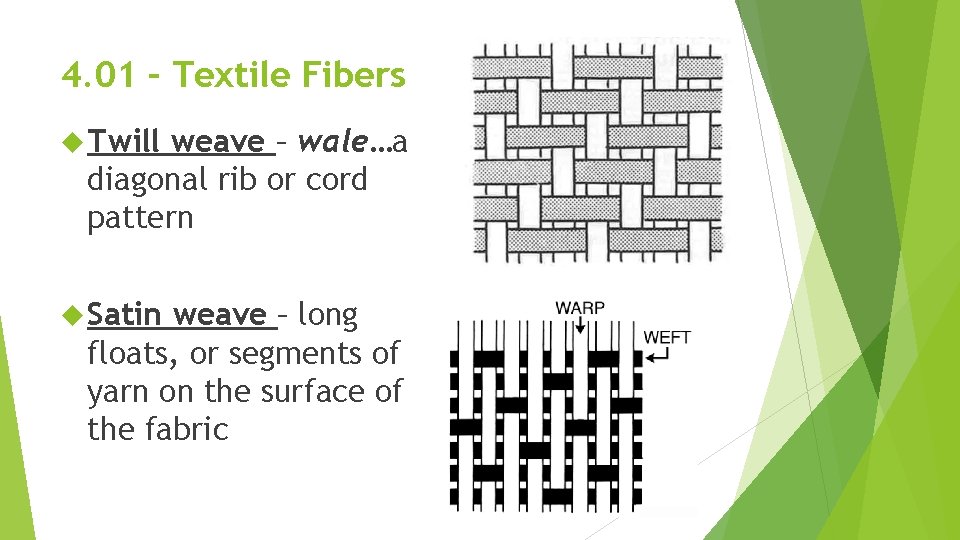
4. 01 – Textile Fibers Yarn is woven and the direction the threads run in a woven fabric is the grain. Warp • Yarn threads that run lengthwise (up & down) Weft • Yarn: Yarn threads that are referred to as the filling yarns and run in the crosswise direction
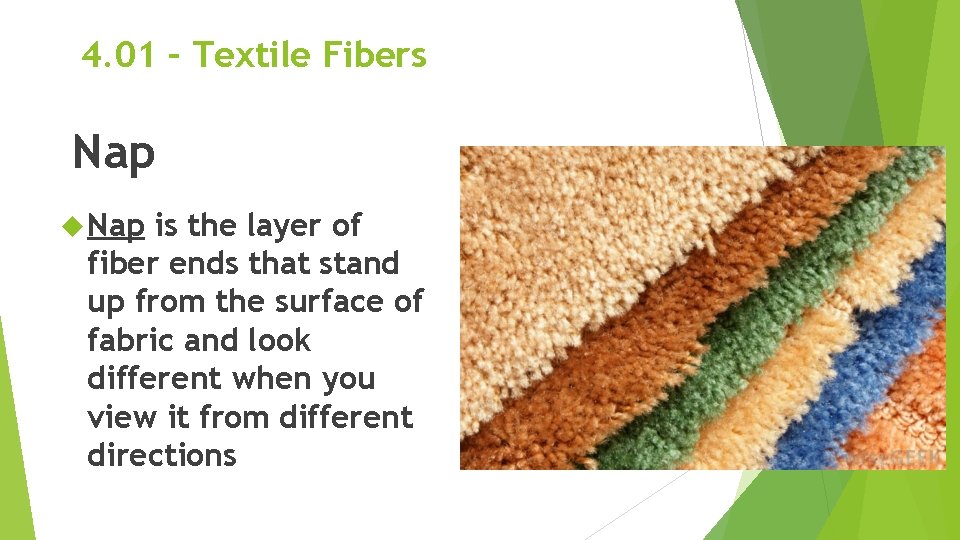
4. 01 – Textile Fibers Nap is the layer of fiber ends that stand up from the surface of fabric and look different when you view it from different directions
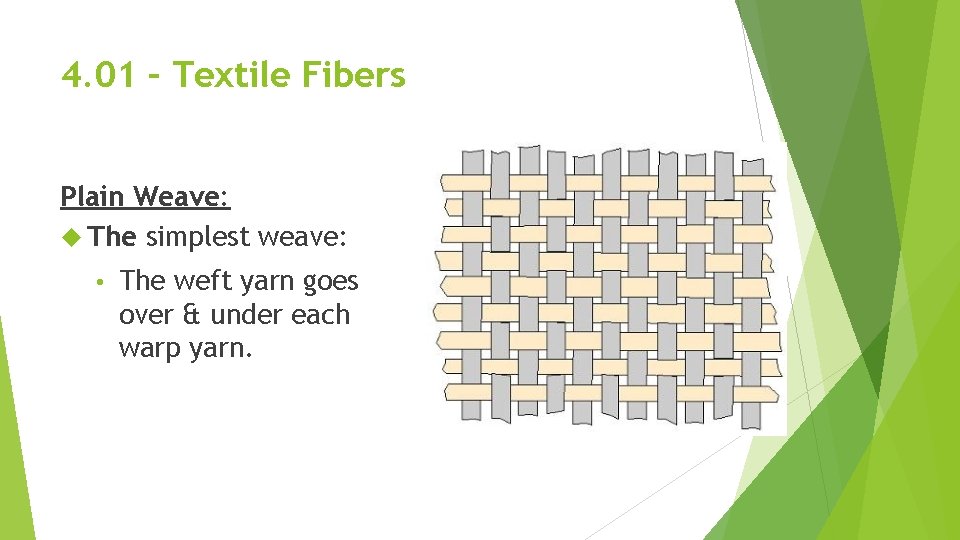
4. 01 – Textile Fibers Plain Weave: The simplest weave: • The weft yarn goes over & under each warp yarn.
4. 01 – Textile Fibers Twill weave – wale…a diagonal rib or cord pattern Satin weave – long floats, or segments of yarn on the surface of the fabric
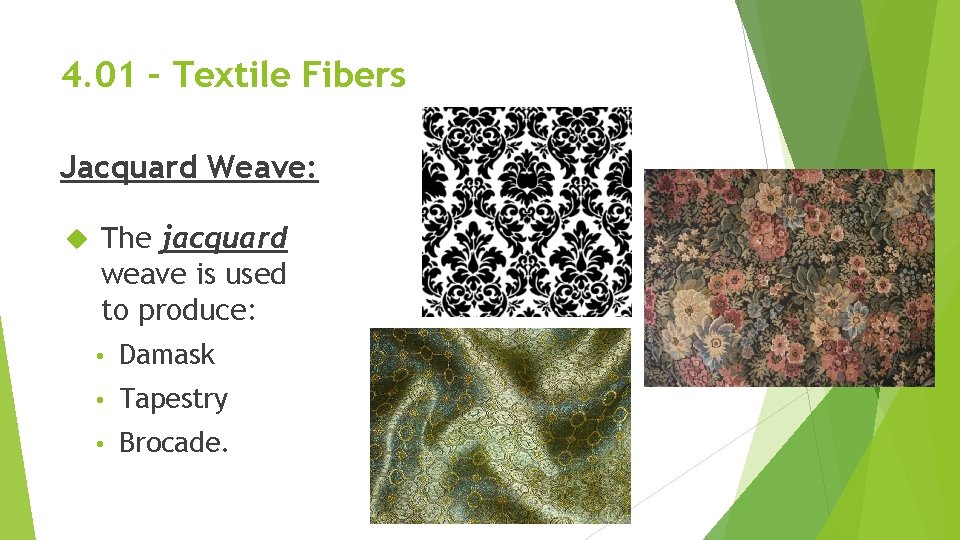
4. 01 – Textile Fibers Jacquard Weave: The jacquard weave is used to produce: • Damask • Tapestry • Brocade.
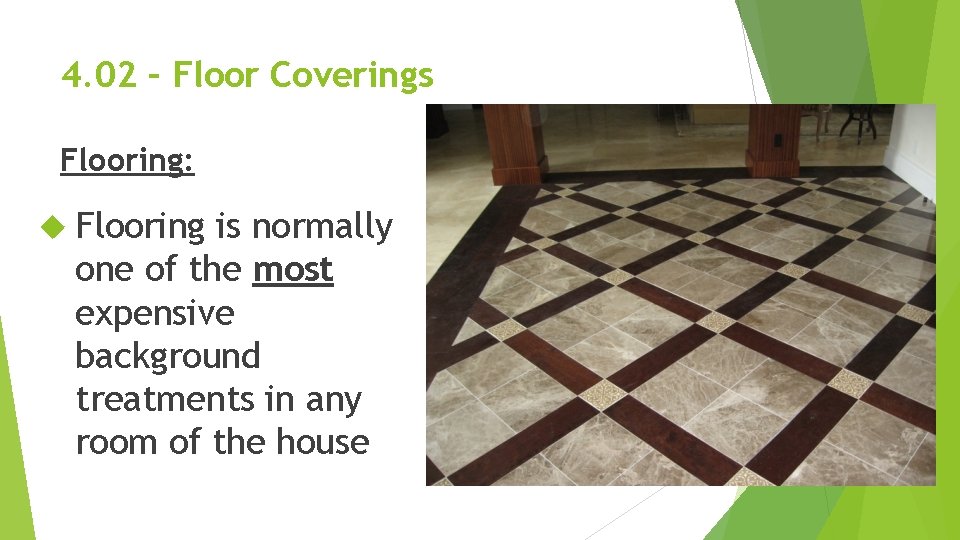
4. 02 – Floor Coverings Flooring: Flooring is normally one of the most expensive background treatments in any room of the house
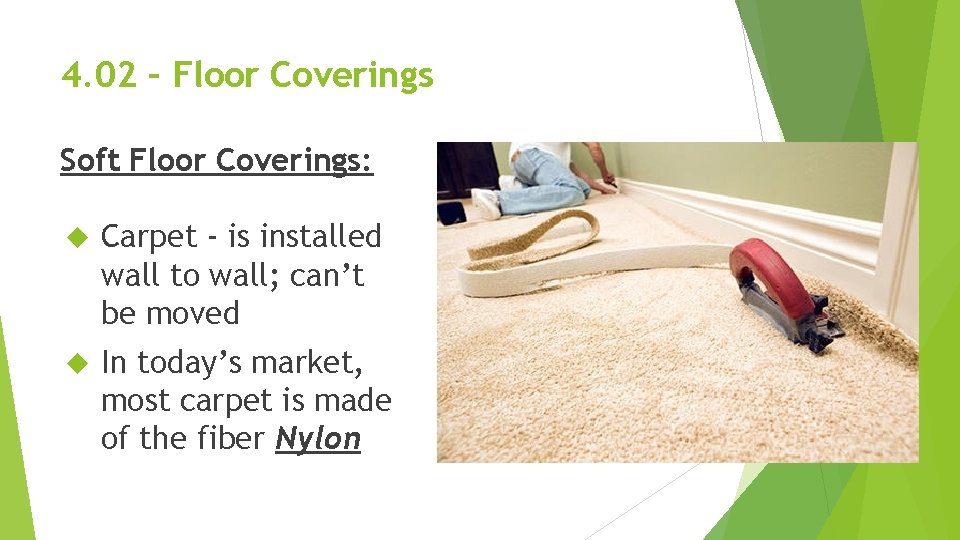
4. 02 – Floor Coverings Soft Floor Coverings: Carpet - is installed wall to wall; can’t be moved In today’s market, most carpet is made of the fiber Nylon
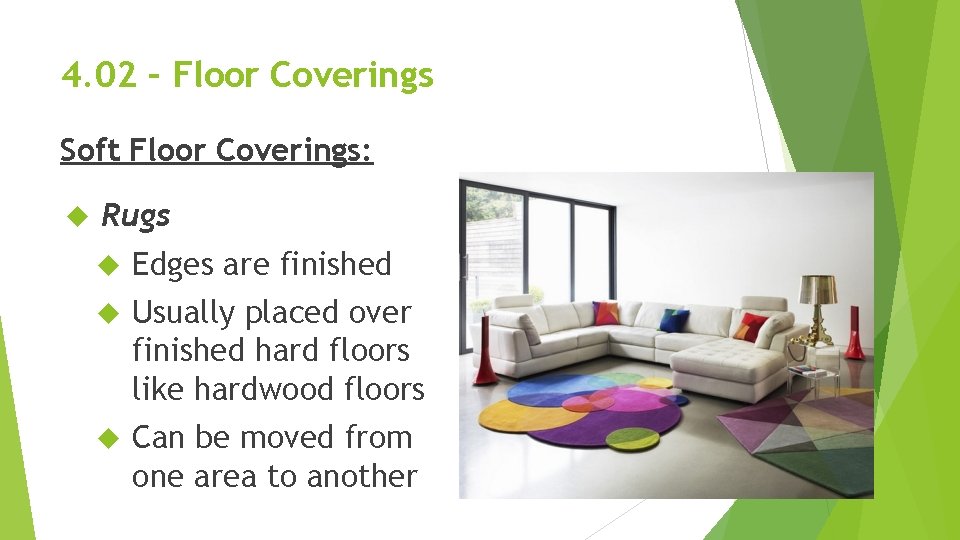
4. 02 – Floor Coverings Soft Floor Coverings: Rugs Edges are finished Usually placed over finished hard floors like hardwood floors Can be moved from one area to another
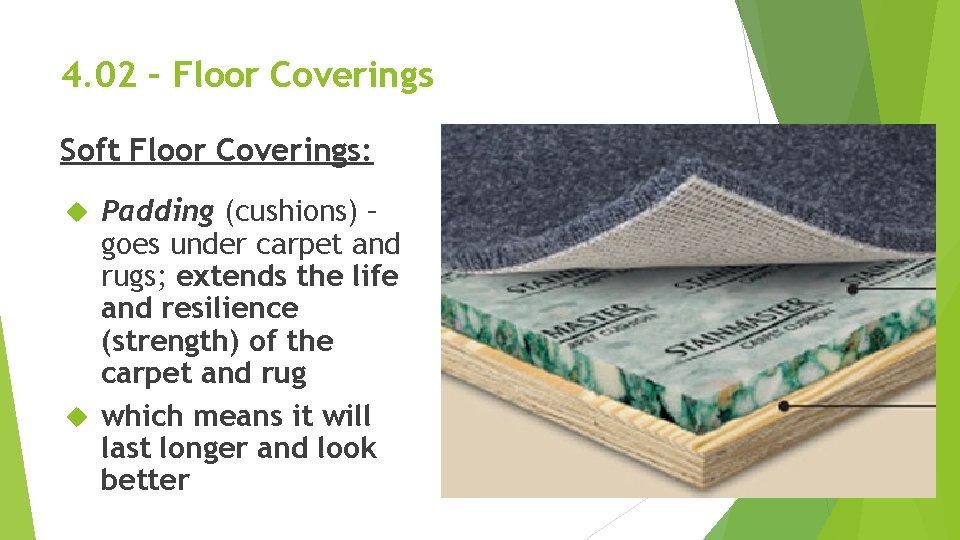
4. 02 – Floor Coverings Soft Floor Coverings: Padding (cushions) – goes under carpet and rugs; extends the life and resilience (strength) of the carpet and rug which means it will last longer and look better
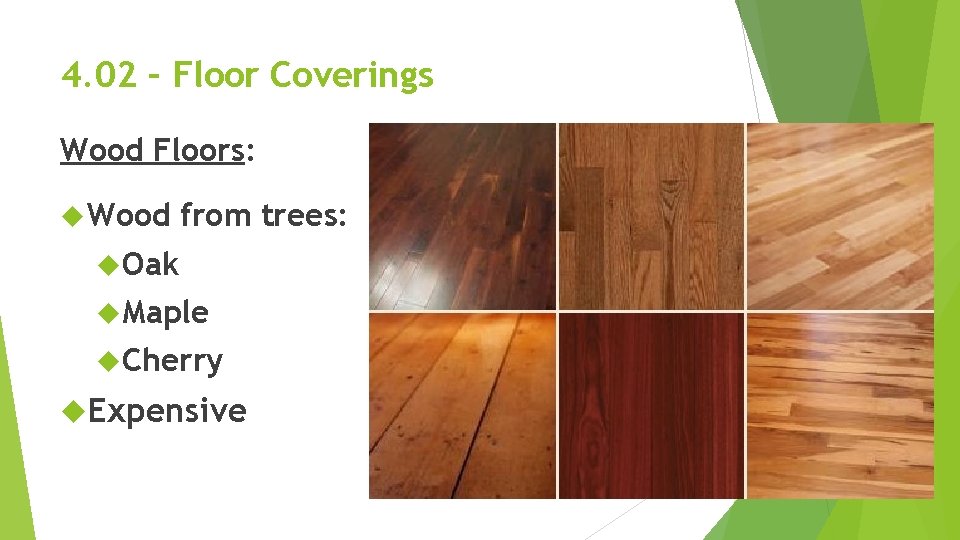
4. 02 – Floor Coverings Wood Floors: Wood from trees: Oak Maple Cherry Expensive
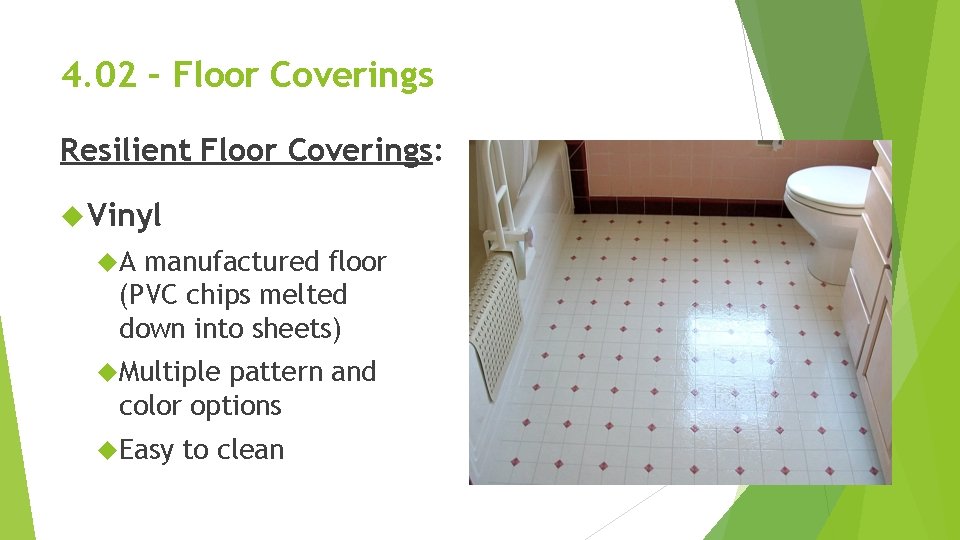
4. 02 – Floor Coverings Resilient Floor Coverings: Vinyl A manufactured floor (PVC chips melted down into sheets) Multiple pattern and color options Easy to clean
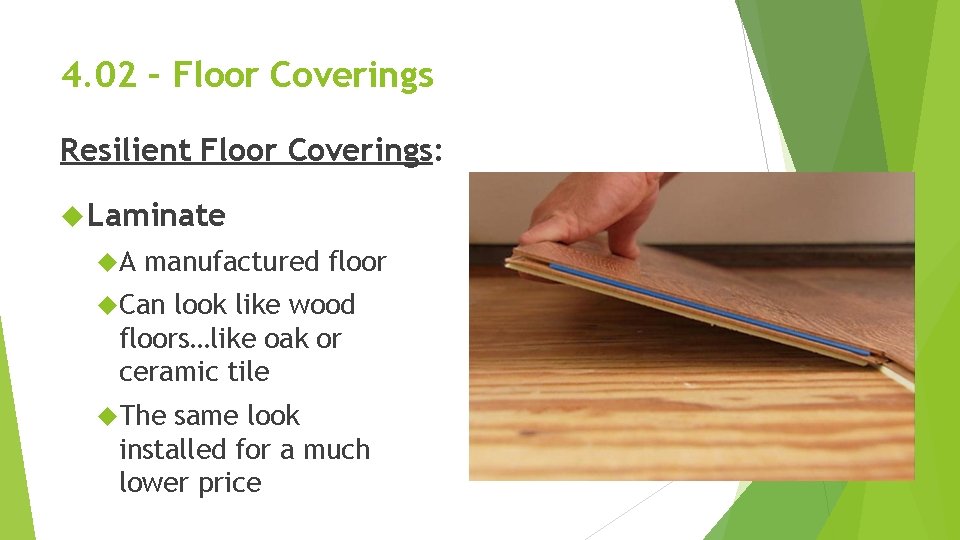
4. 02 – Floor Coverings Resilient Floor Coverings: Laminate A manufactured floor Can look like wood floors…like oak or ceramic tile The same look installed for a much lower price
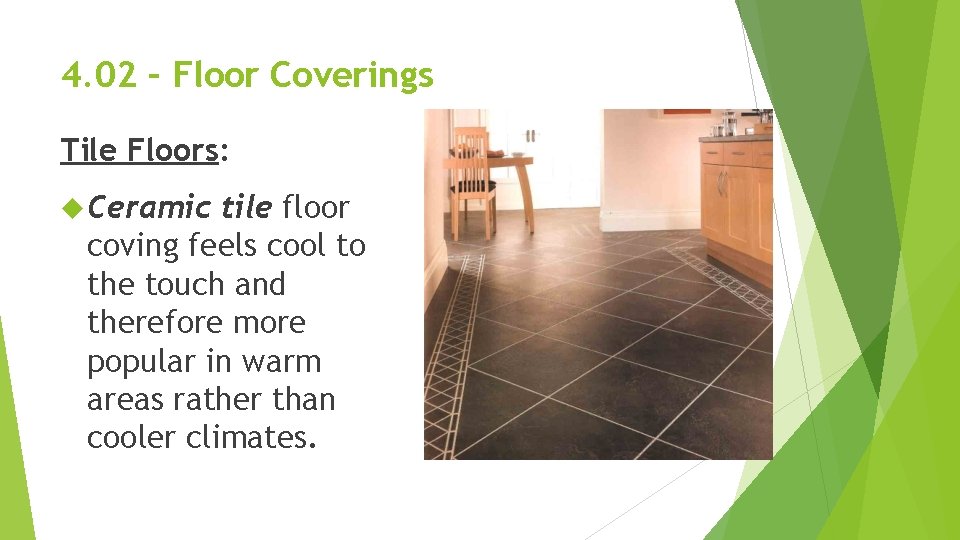
4. 02 – Floor Coverings Tile Floors: Ceramic tile floor coving feels cool to the touch and therefore more popular in warm areas rather than cooler climates.
4. 02 – Floor Coverings Floor Calculations: How does a consumer determine the number of square yards of floor coving needs for a room? Multiple the length times the width of the room and then divide by nine square feet. L x W / 9 = yards needed Yards needed x Price per yard = the cost for new floor
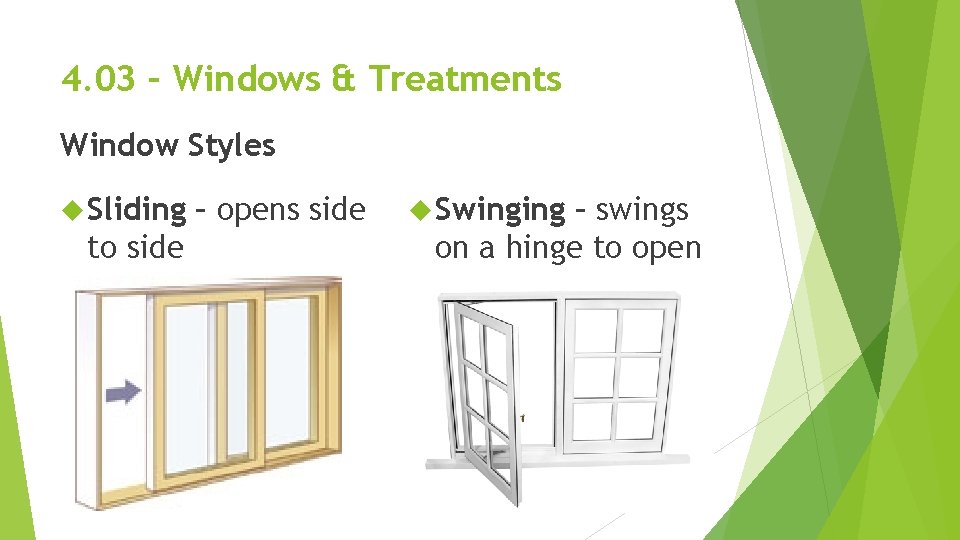
4. 03 – Windows & Treatments Window Styles Sliding to side – opens side Swinging – swings on a hinge to open
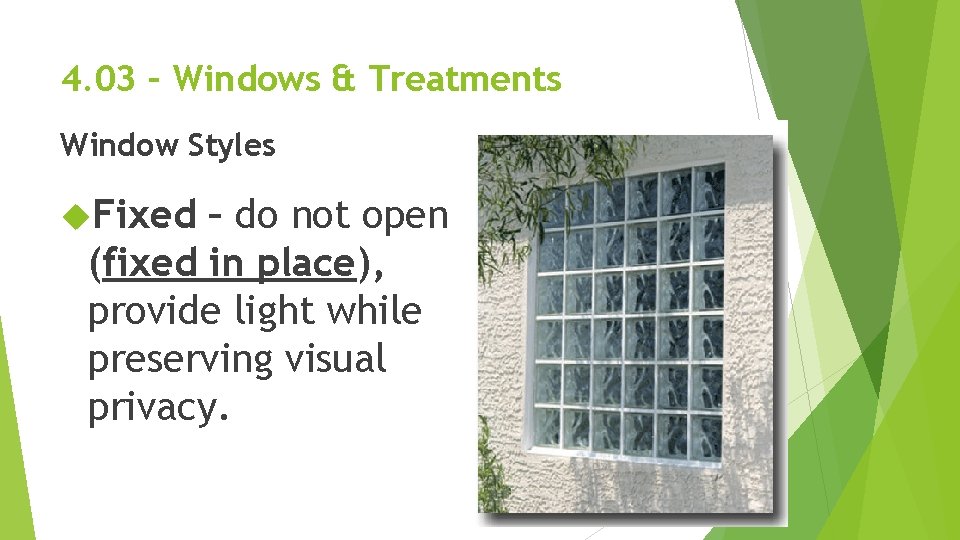
4. 03 – Windows & Treatments Window Styles Fixed – do not open (fixed in place), provide light while preserving visual privacy.
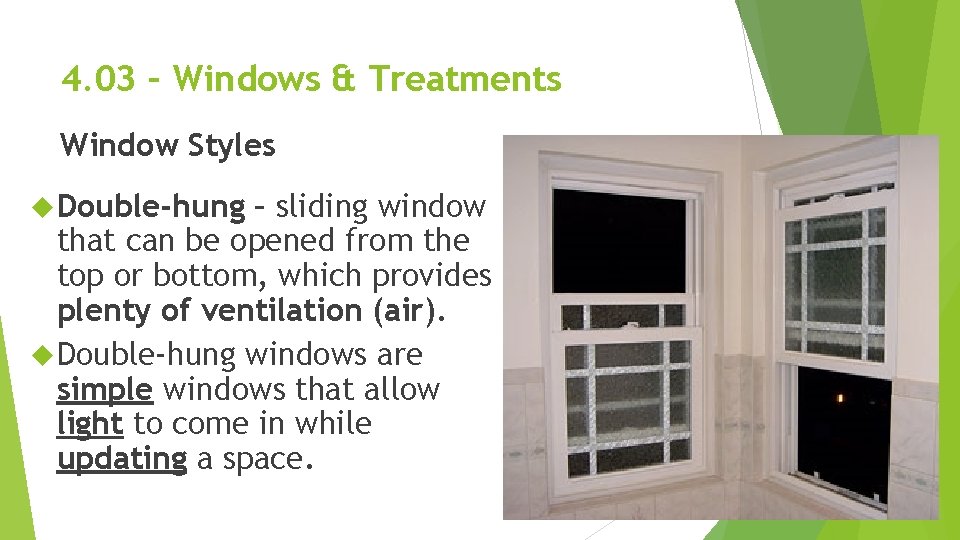
4. 03 – Windows & Treatments Window Styles Double-hung – sliding window that can be opened from the top or bottom, which provides plenty of ventilation (air). Double-hung windows are simple windows that allow light to come in while updating a space.
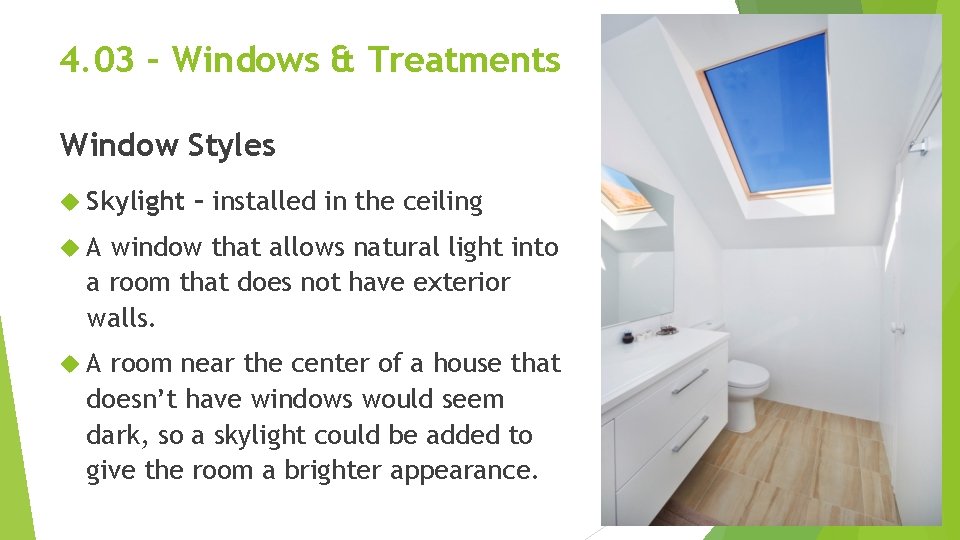
4. 03 – Windows & Treatments Window Styles Skylight – installed in the ceiling A window that allows natural light into a room that does not have exterior walls. A room near the center of a house that doesn’t have windows would seem dark, so a skylight could be added to give the room a brighter appearance.
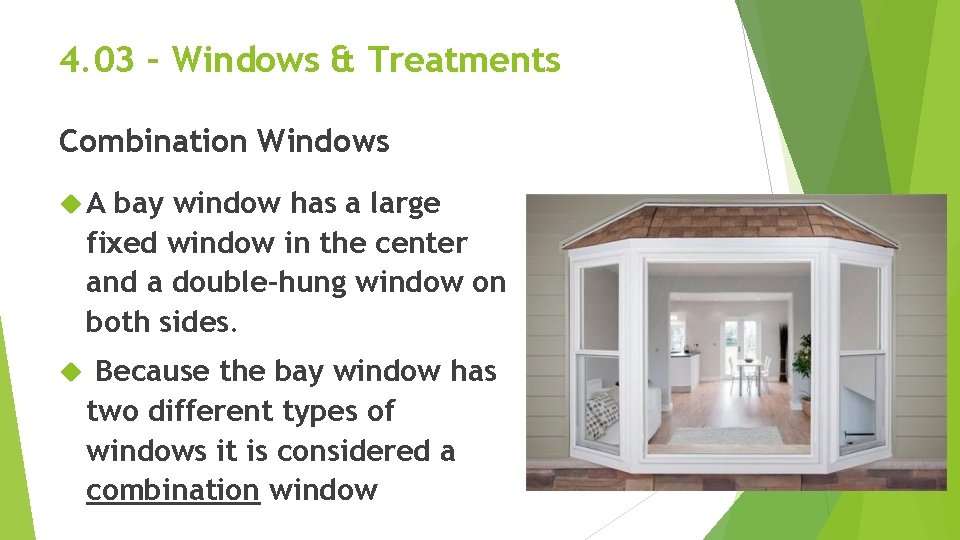
4. 03 – Windows & Treatments Combination Windows A bay window has a large fixed window in the center and a double-hung window on both sides. Because the bay window has two different types of windows it is considered a combination window
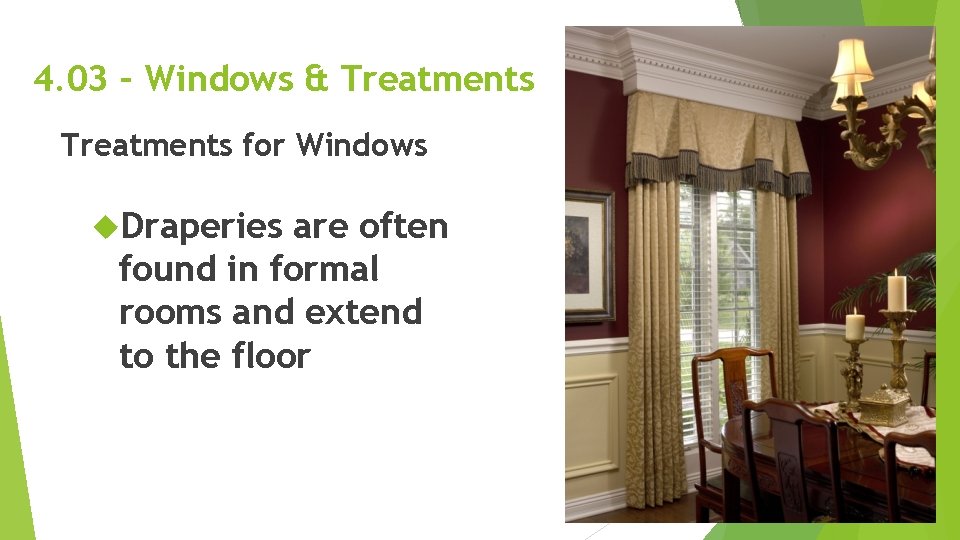
4. 03 – Windows & Treatments for Windows Draperies are often found in formal rooms and extend to the floor
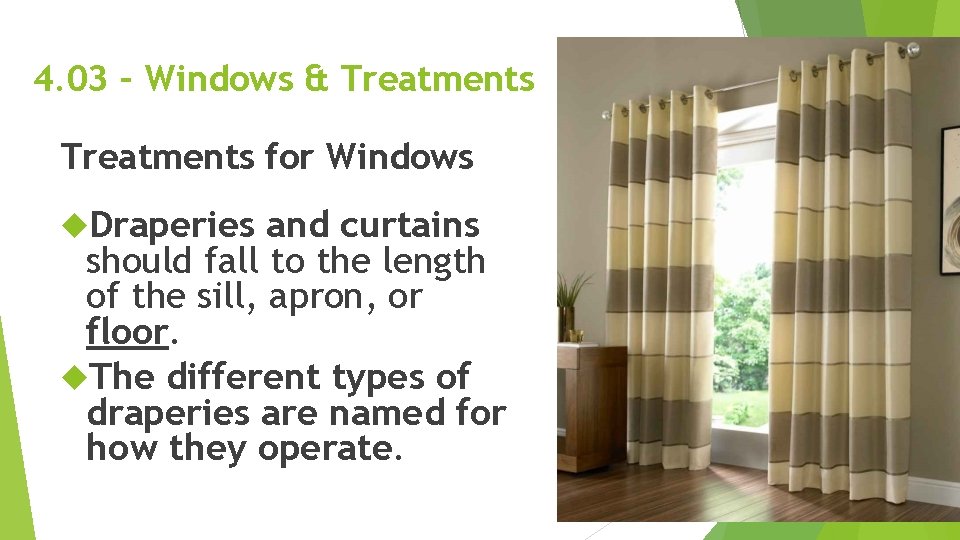
4. 03 – Windows & Treatments for Windows Draperies and curtains should fall to the length of the sill, apron, or floor. The different types of draperies are named for how they operate.
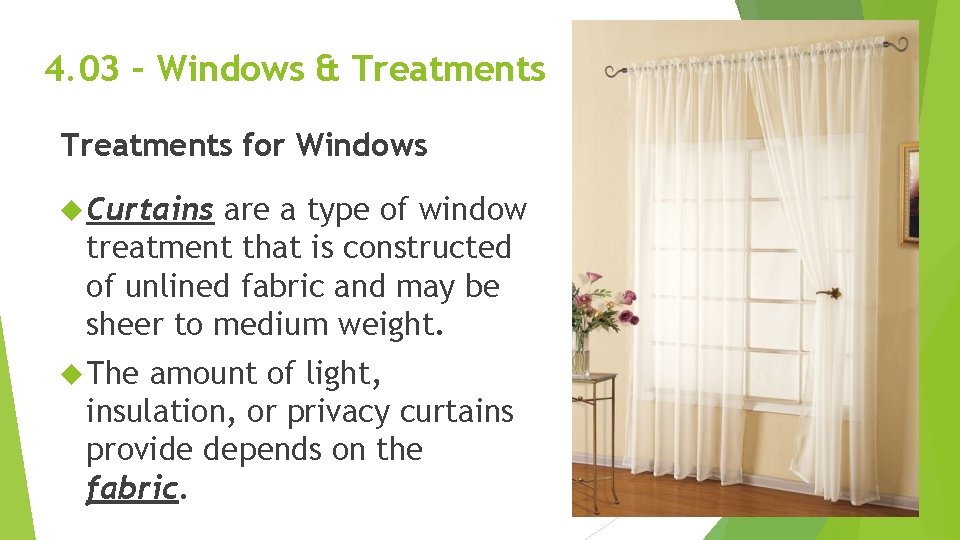
4. 03 – Windows & Treatments for Windows Curtains are a type of window treatment that is constructed of unlined fabric and may be sheer to medium weight. The amount of light, insulation, or privacy curtains provide depends on the fabric.
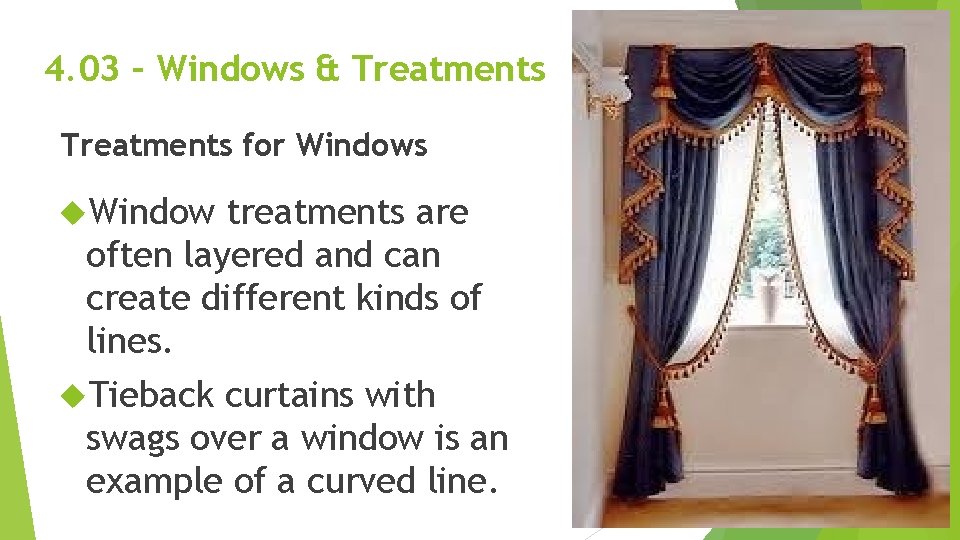
4. 03 – Windows & Treatments for Windows Window treatments are often layered and can create different kinds of lines. Tieback curtains with swags over a window is an example of a curved line.
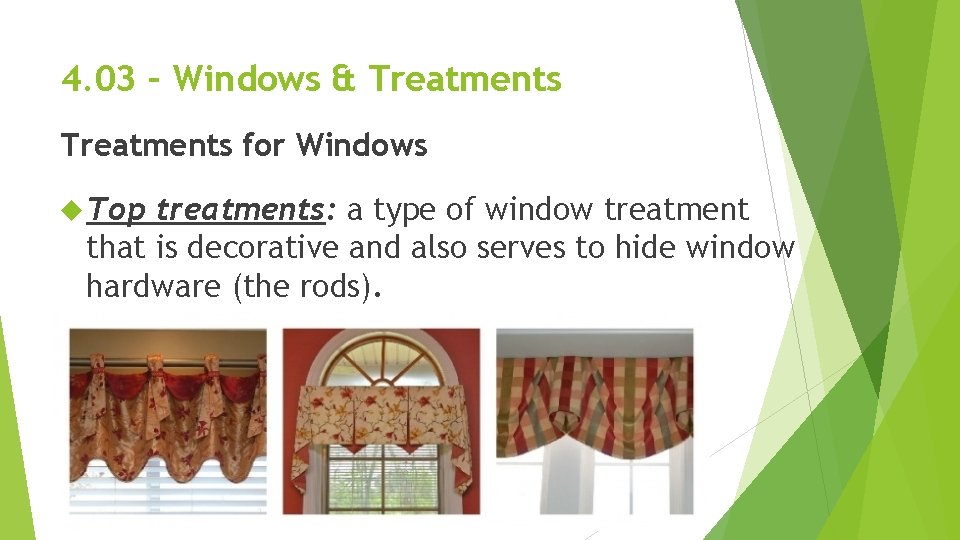
4. 03 – Windows & Treatments for Windows Top treatments: a type of window treatment that is decorative and also serves to hide window hardware (the rods).
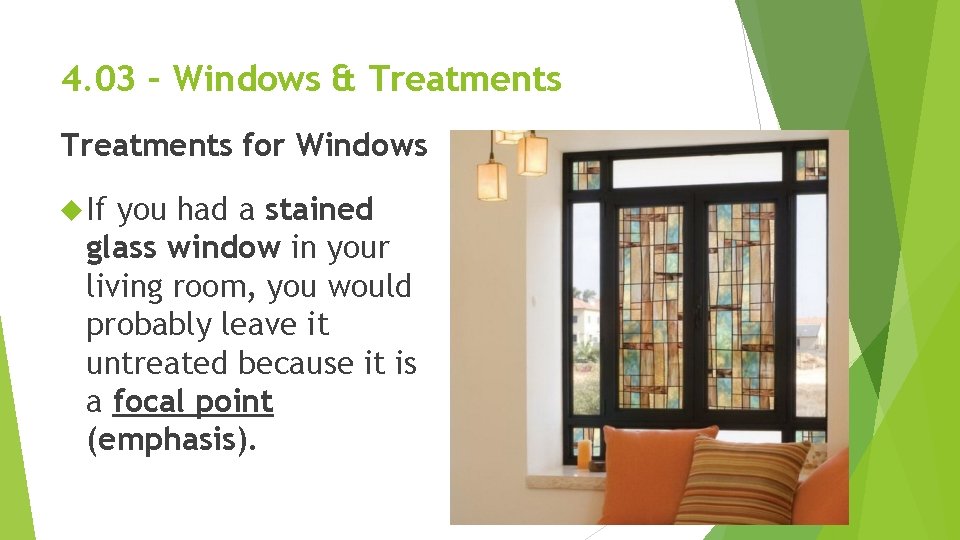
4. 03 – Windows & Treatments for Windows If you had a stained glass window in your living room, you would probably leave it untreated because it is a focal point (emphasis).
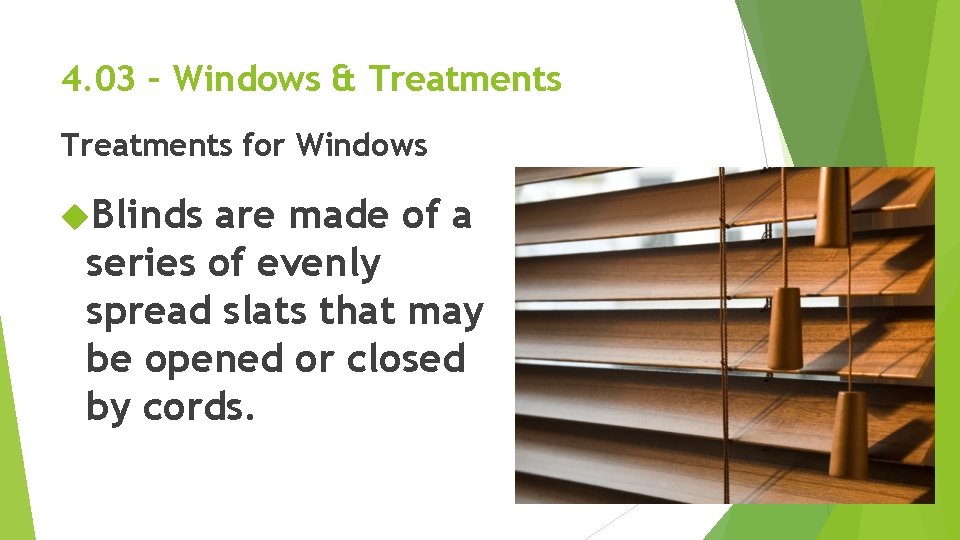
4. 03 – Windows & Treatments for Windows Blinds are made of a series of evenly spread slats that may be opened or closed by cords.
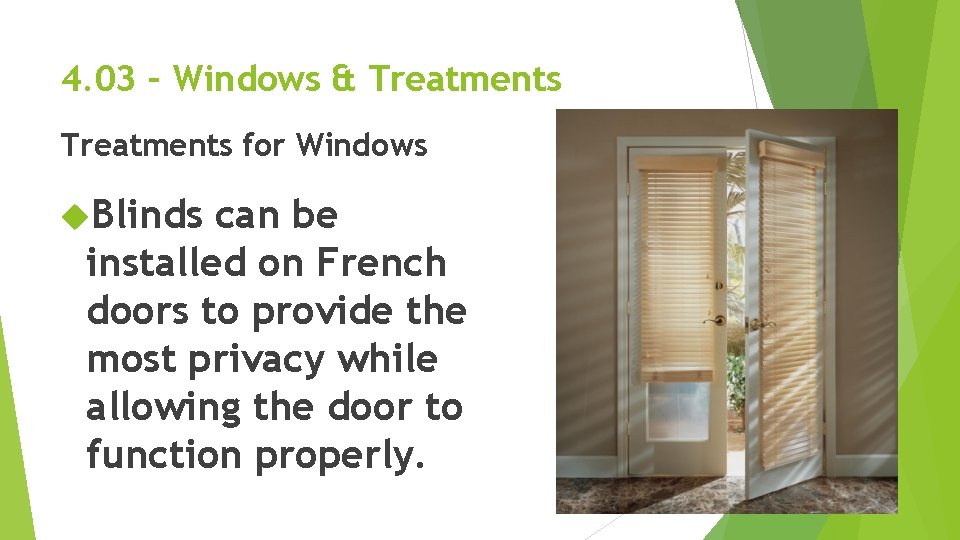
4. 03 – Windows & Treatments for Windows Blinds can be installed on French doors to provide the most privacy while allowing the door to function properly.
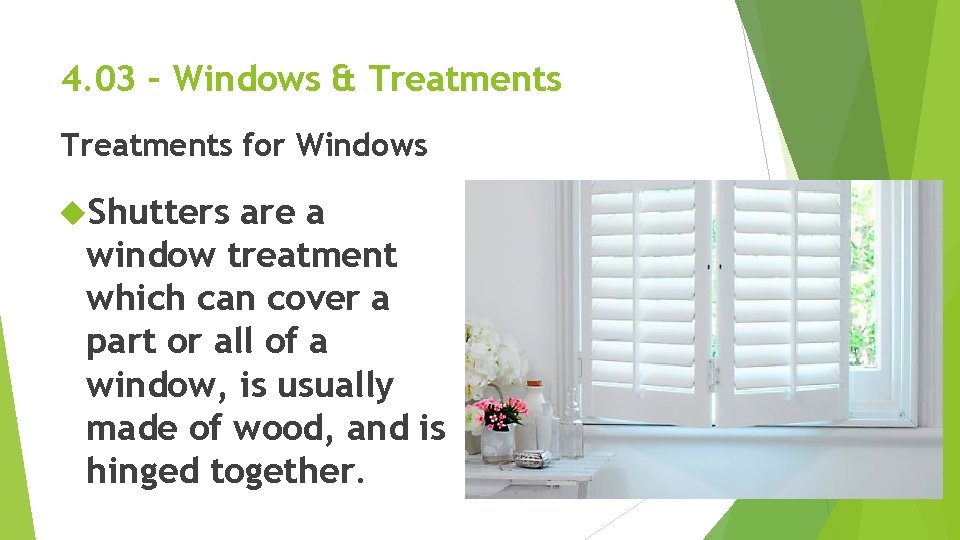
4. 03 – Windows & Treatments for Windows Shutters are a window treatment which can cover a part or all of a window, is usually made of wood, and is hinged together.
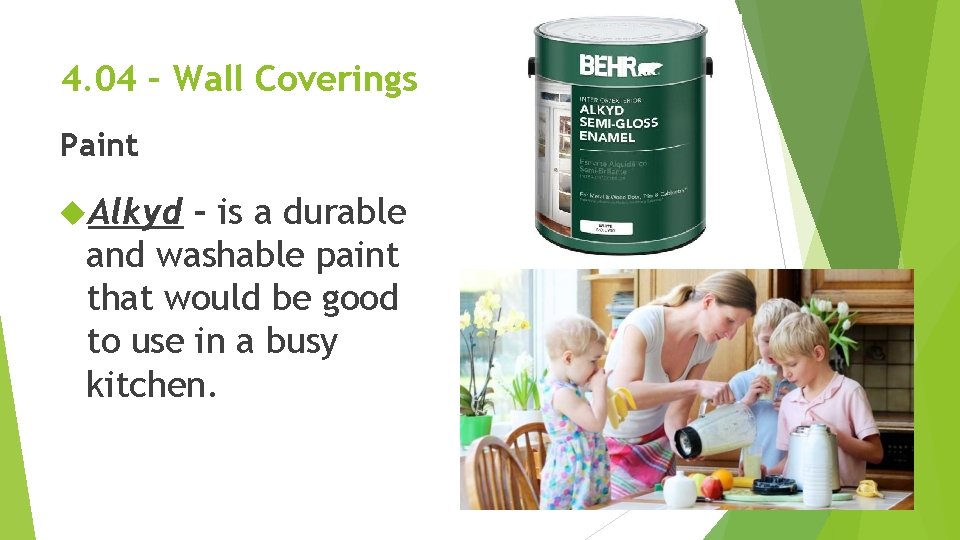
4. 04 – Wall Coverings Paint Alkyd – is a durable and washable paint that would be good to use in a busy kitchen.
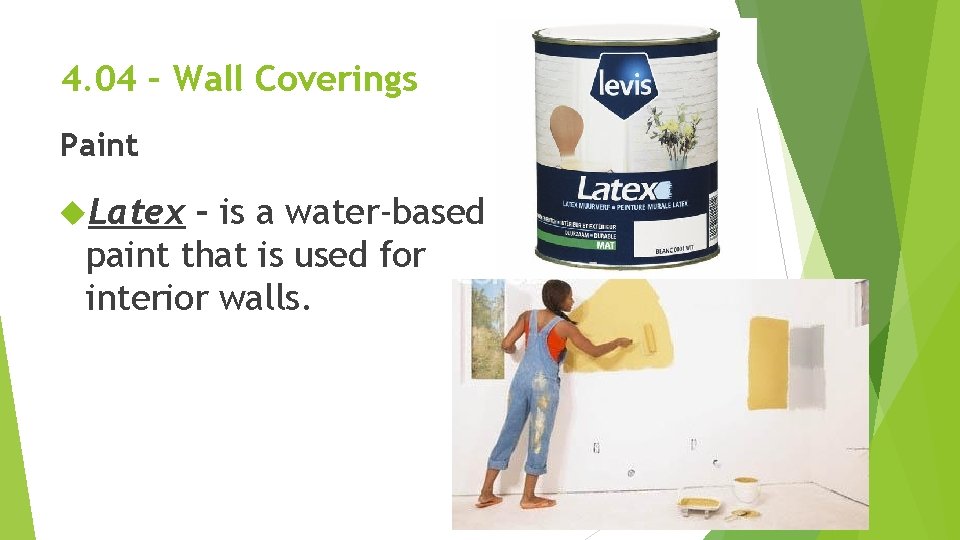
4. 04 – Wall Coverings Paint Latex – is a water-based paint that is used for interior walls.
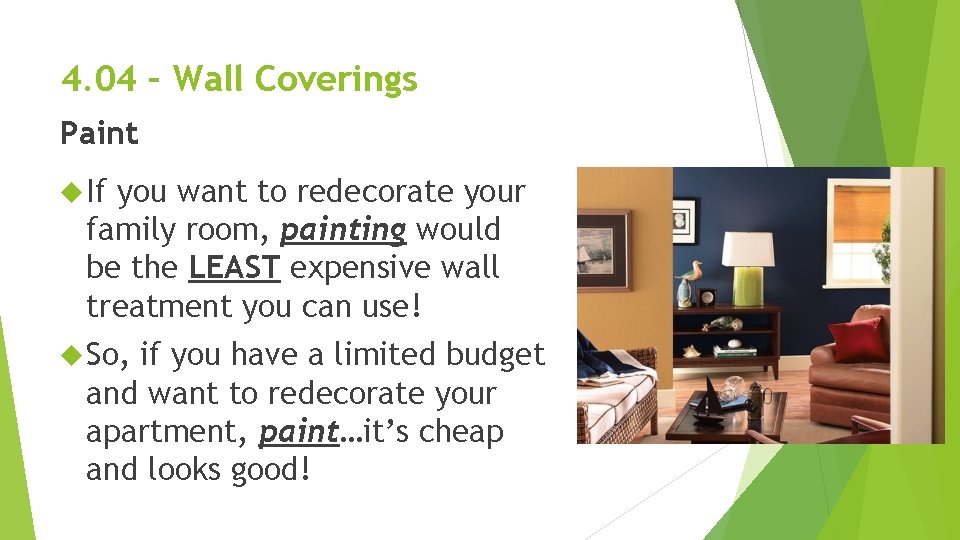
4. 04 – Wall Coverings Paint If you want to redecorate your family room, painting would be the LEAST expensive wall treatment you can use! So, if you have a limited budget and want to redecorate your apartment, paint…it’s cheap and looks good!
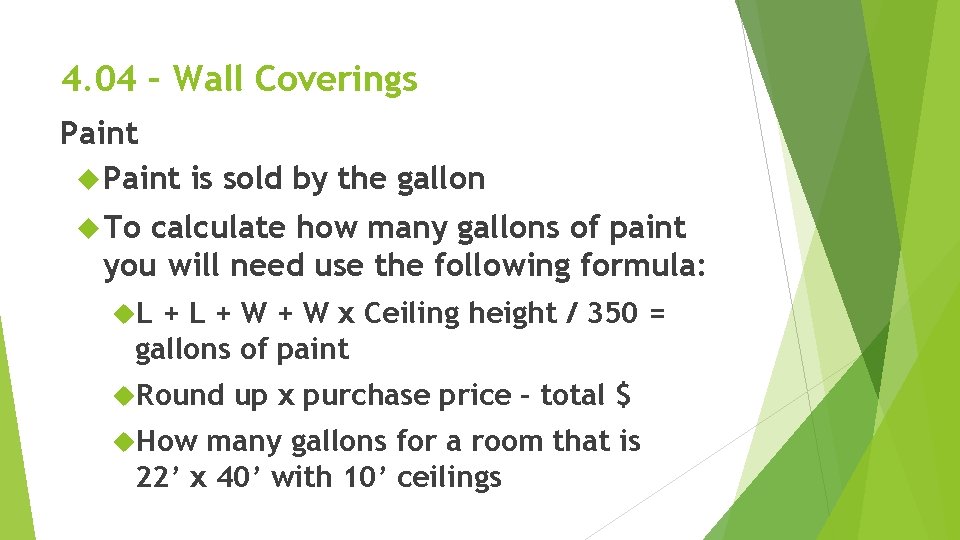
4. 04 – Wall Coverings Paint is sold by the gallon To calculate how many gallons of paint you will need use the following formula: L + W + W x Ceiling height / 350 = gallons of paint Round How up x purchase price – total $ many gallons for a room that is 22’ x 40’ with 10’ ceilings
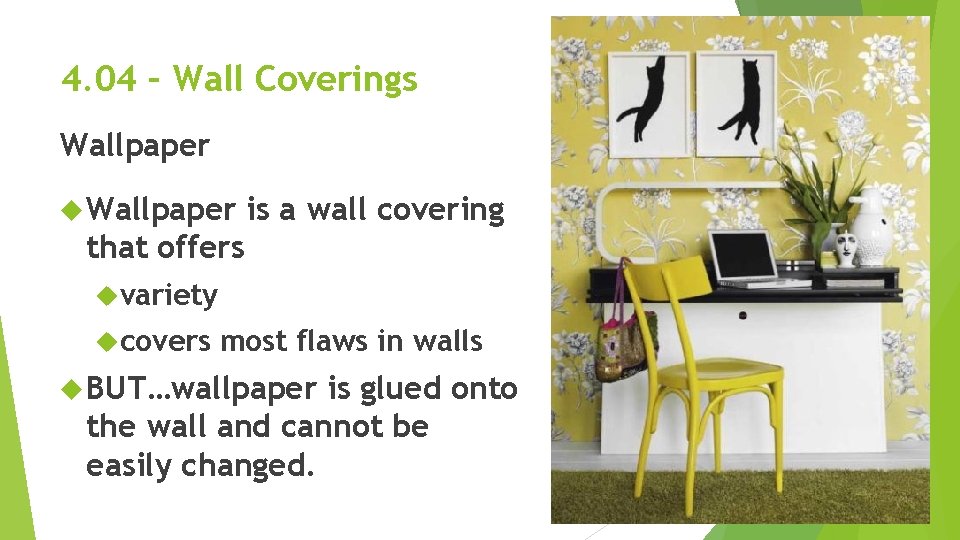
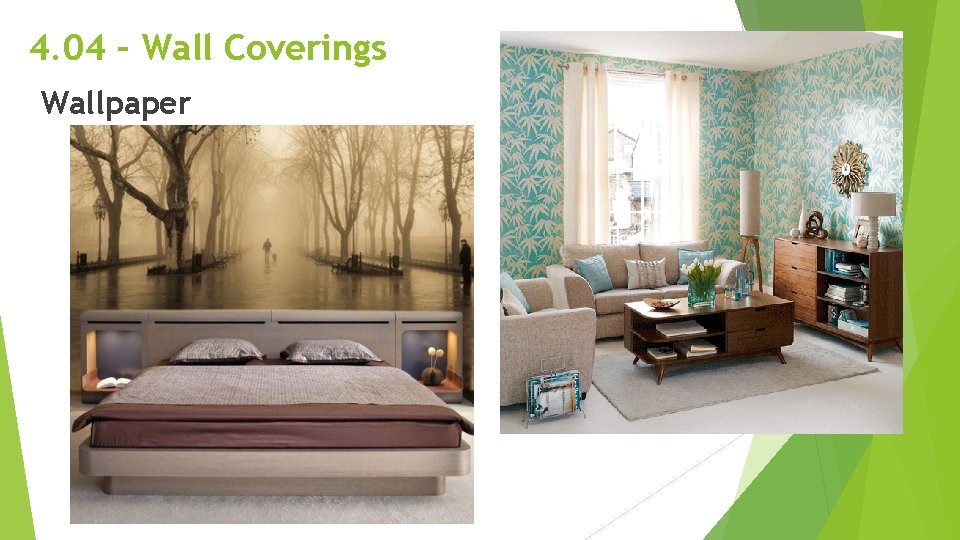
4. 04 – Wall Coverings Wallpaper is a wall covering that offers variety covers most flaws in walls BUT…wallpaper is glued onto the wall and cannot be easily changed.
4. 04 – Wall Coverings Wallpaper
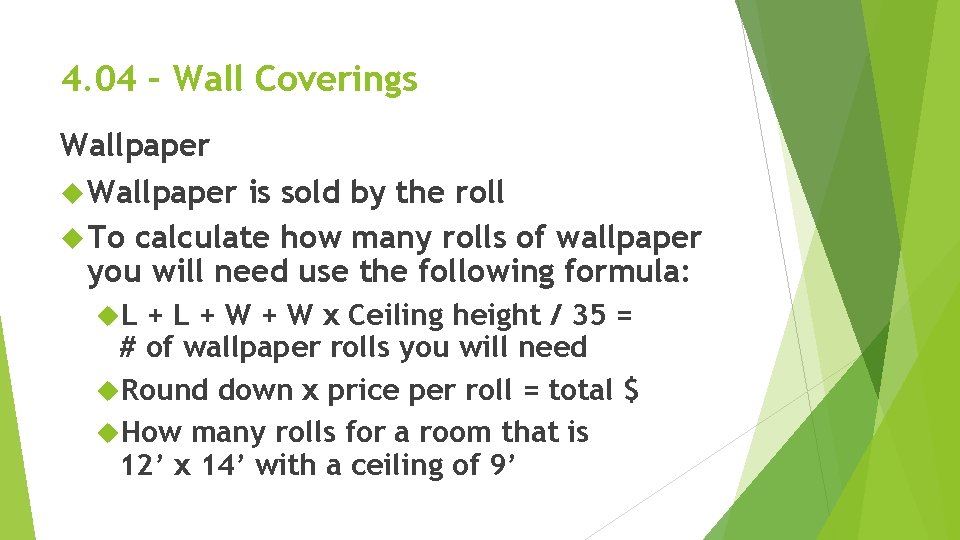
4. 04 – Wall Coverings Wallpaper is sold by the roll To calculate how many rolls of wallpaper you will need use the following formula: L + W + W x Ceiling height / 35 = # of wallpaper rolls you will need Round down x price per roll = total $ How many rolls for a room that is 12’ x 14’ with a ceiling of 9’
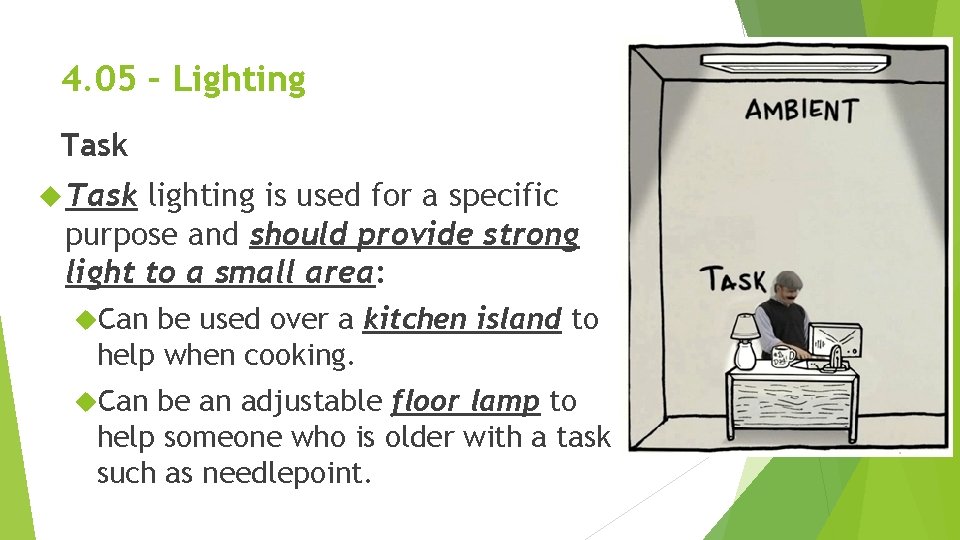
4. 05 – Lighting Task lighting is used for a specific purpose and should provide strong light to a small area: Can be used over a kitchen island to help when cooking. Can be an adjustable floor lamp to help someone who is older with a task such as needlepoint.
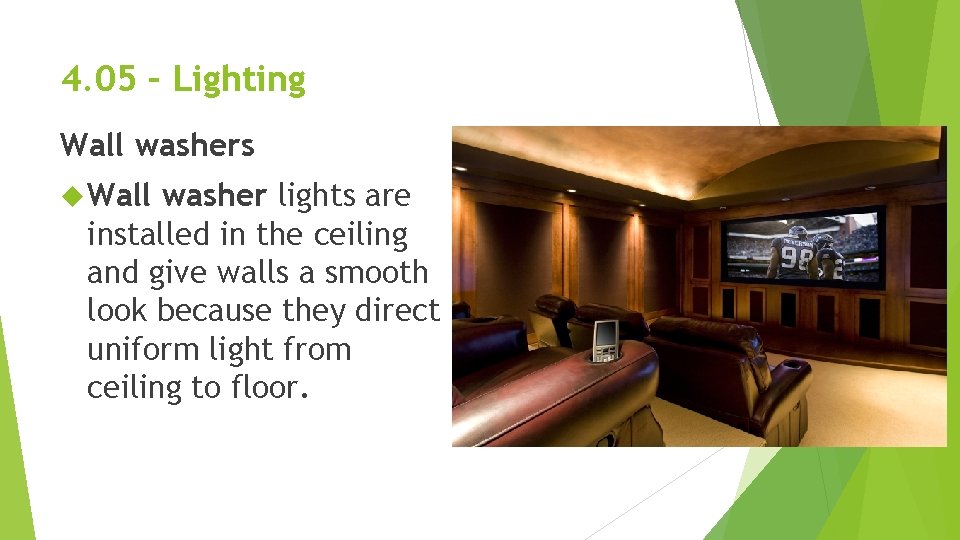
4. 05 – Lighting Wall washers Wall washer lights are installed in the ceiling and give walls a smooth look because they direct uniform light from ceiling to floor.
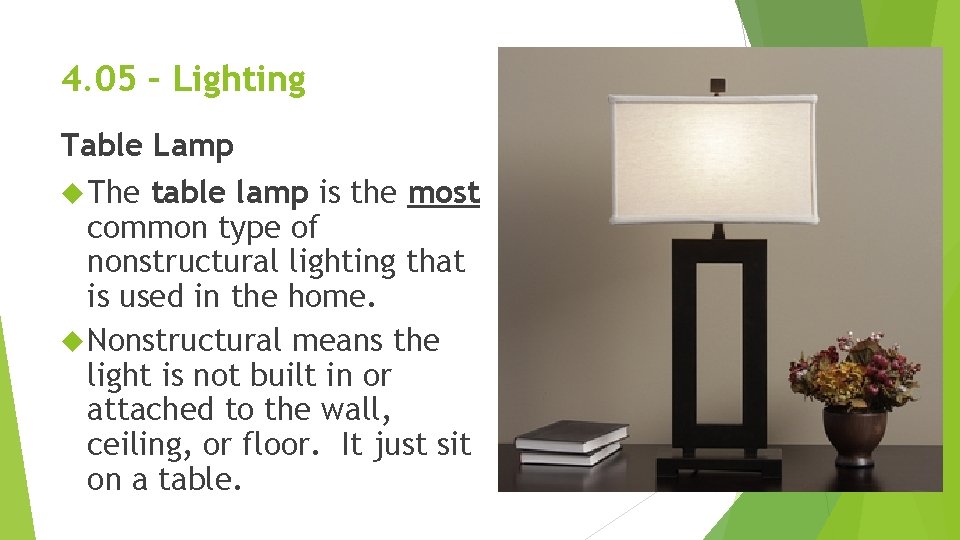
4. 05 – Lighting Table Lamp The table lamp is the most common type of nonstructural lighting that is used in the home. Nonstructural means the light is not built in or attached to the wall, ceiling, or floor. It just sit on a table.
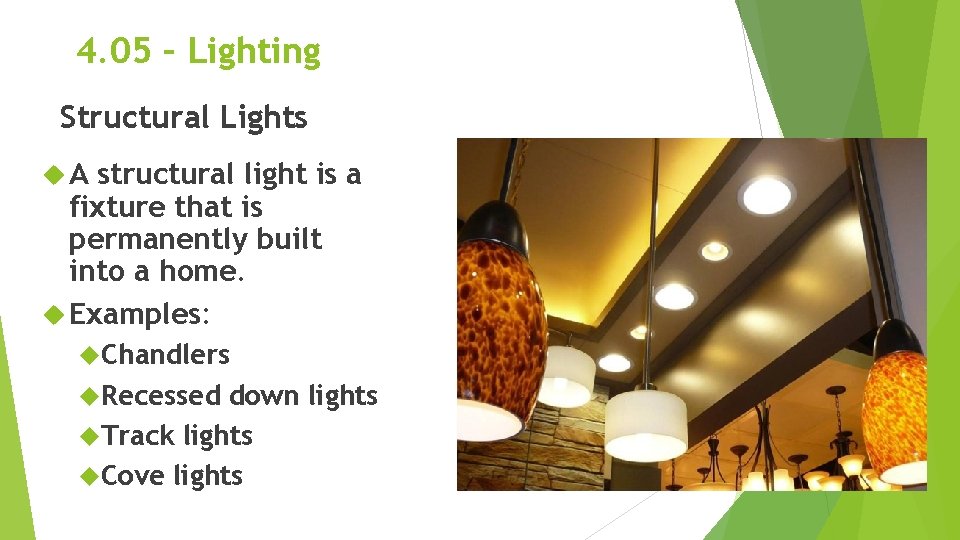
4. 05 – Lighting Structural Lights A structural light is a fixture that is permanently built into a home. Examples: Chandlers Recessed down lights Track lights Cove lights
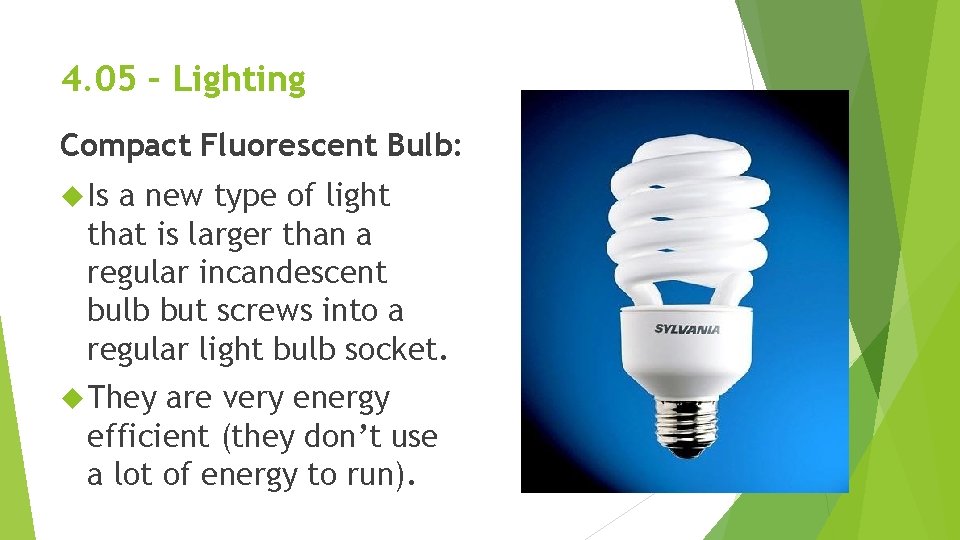
4. 05 – Lighting Compact Fluorescent Bulb: Is a new type of light that is larger than a regular incandescent bulb but screws into a regular light bulb socket. They are very energy efficient (they don’t use a lot of energy to run).
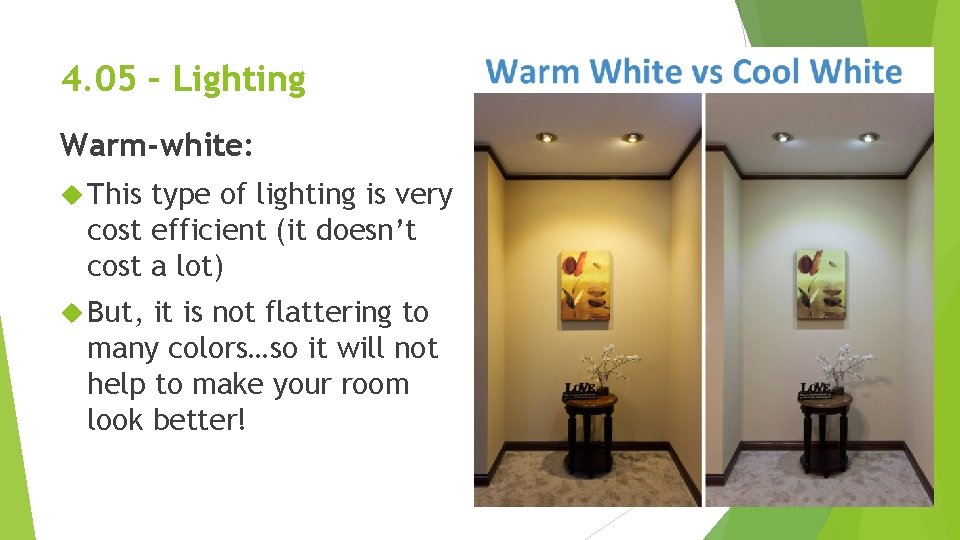
4. 05 – Lighting Warm-white: This type of lighting is very cost efficient (it doesn’t cost a lot) But, it is not flattering to many colors…so it will not help to make your room look better!
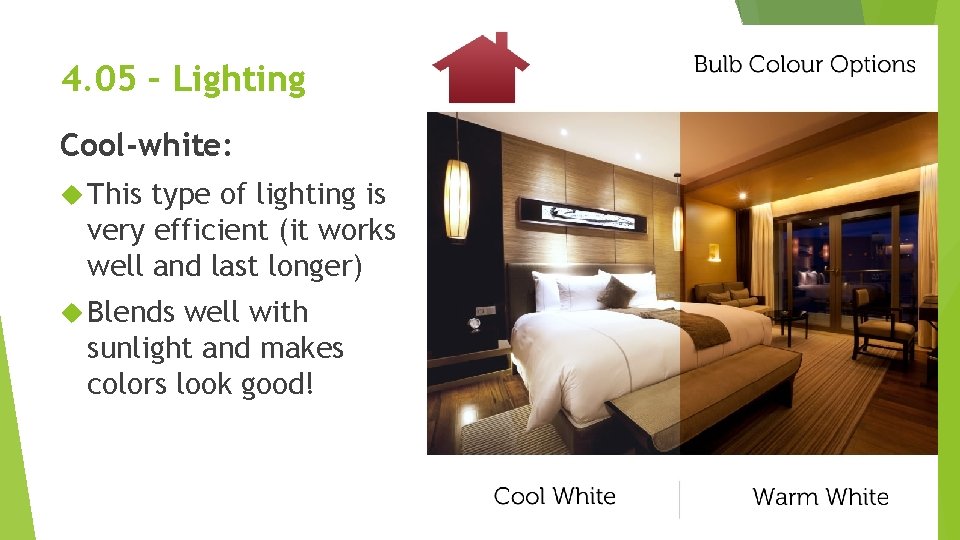
4. 05 – Lighting Cool-white: This type of lighting is very efficient (it works well and last longer) Blends well with sunlight and makes colors look good!