2110200 DISCRETE STRUCTURE 2110200 Discrete Structures Department of






- Slides: 83
2110200 DISCRETE STRUCTURE 2110200 Discrete Structures Department of Computer Engineering Faculty of ENGINEERING | Chulalongkorn University
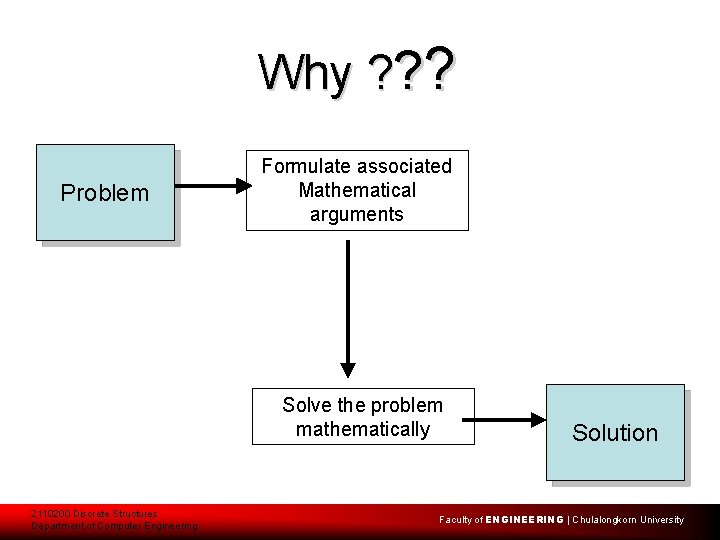
Why ? ? ? Problem Formulate associated Mathematical arguments Solve the problem mathematically 2110200 Discrete Structures Department of Computer Engineering Solution Faculty of ENGINEERING | Chulalongkorn University
Course Outline • • • 4 parts: Part 1: Discrete Math Fundamentals Part 2: Graphs and Trees Part 3: Counting Techniques Part 4: Number Theory 2110200 Discrete Structures Department of Computer Engineering Faculty of ENGINEERING | Chulalongkorn University
Goals of Discrete Math. • Mathematical Reasoning – Read, comprehend, and construct mathematical arguments • Combinatorial Analysis – Perform analysis to solve counting problems • Discrete Structure – Able to work with discrete structures: sets, graphs, finite-state machines, etc. 2110200 Discrete Structures Department of Computer Engineering Faculty of ENGINEERING | Chulalongkorn University
Goals of Discrete Math. • Algorithmic Thinking – Specify, verify, and analyze an algorithm • Applications and Modeling – Apply the obtained problem-solving skills to model and solve problems in computer science and other areas, such as: • • • Business Chemistry Linguistics Geology etc 2110200 Discrete Structures Department of Computer Engineering Faculty of ENGINEERING | Chulalongkorn University
Gateway to. . . Operating Systems Data Structures Computer Securities Automata Theory 2110200 Discrete Structures Department of Computer Engineering Database Theory Algorithms Formal Languages Compiler Theory Faculty of ENGINEERING | Chulalongkorn University
ABET Accreditation Programs containing the modifier “computer” in the title must also demonstrate that graduates have a knowledge of “discrete mathematics. ” 2110200 Discrete Structures Department of Computer Engineering Faculty of ENGINEERING | Chulalongkorn University
Foundations of Discrete Math. • Logic – Specify the meaning of Mathematical statements – Basis of all Mathematical reasoning • Sets – Sets are collections of objects, which are used for building many important discrete structures. • Functions – Used in the definition of some important structures – Represent complexity of an algorithm, and etc. 2110200 Discrete Structures Department of Computer Engineering Faculty of ENGINEERING | Chulalongkorn University
Logic Rules of logic gives precise meaning to mathematical statements. 2110200 Discrete Structures Department of Computer Engineering Faculty of ENGINEERING | Chulalongkorn University
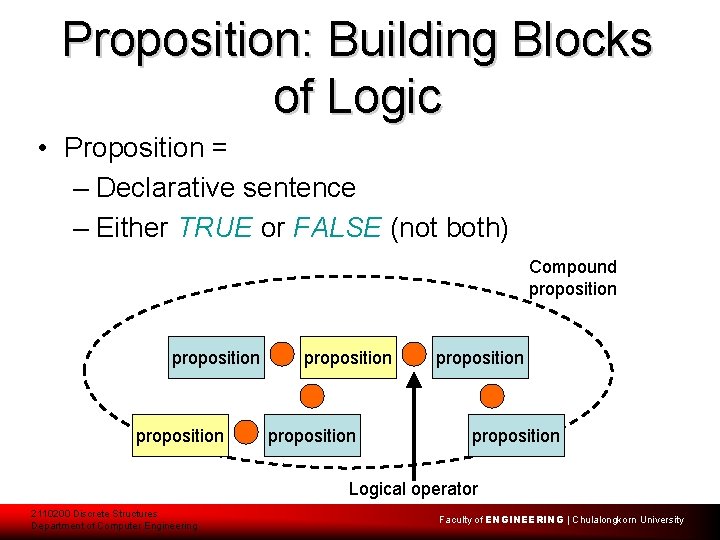
Proposition: Building Blocks of Logic • Proposition = – Declarative sentence – Either TRUE or FALSE (not both) Compound proposition proposition Logical operator 2110200 Discrete Structures Department of Computer Engineering Faculty of ENGINEERING | Chulalongkorn University
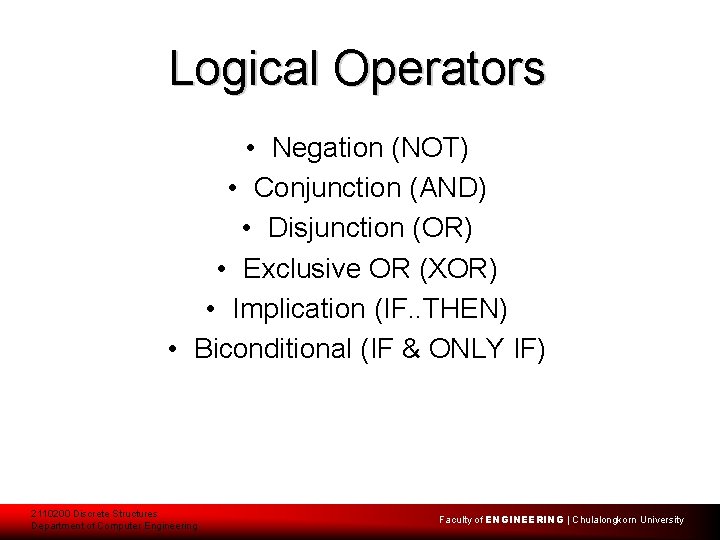
Logical Operators • Negation (NOT) • Conjunction (AND) • Disjunction (OR) • Exclusive OR (XOR) • Implication (IF. . THEN) • Biconditional (IF & ONLY IF) 2110200 Discrete Structures Department of Computer Engineering Faculty of ENGINEERING | Chulalongkorn University
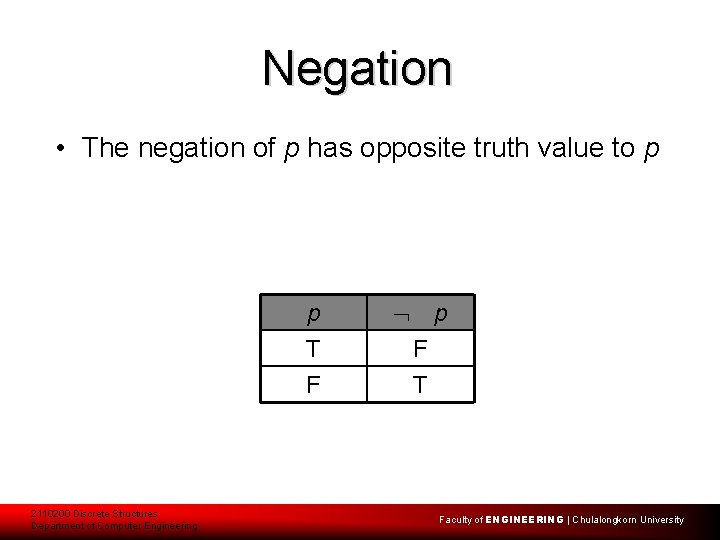
Negation • The negation of p has opposite truth value to p p T F 2110200 Discrete Structures Department of Computer Engineering p F T Faculty of ENGINEERING | Chulalongkorn University
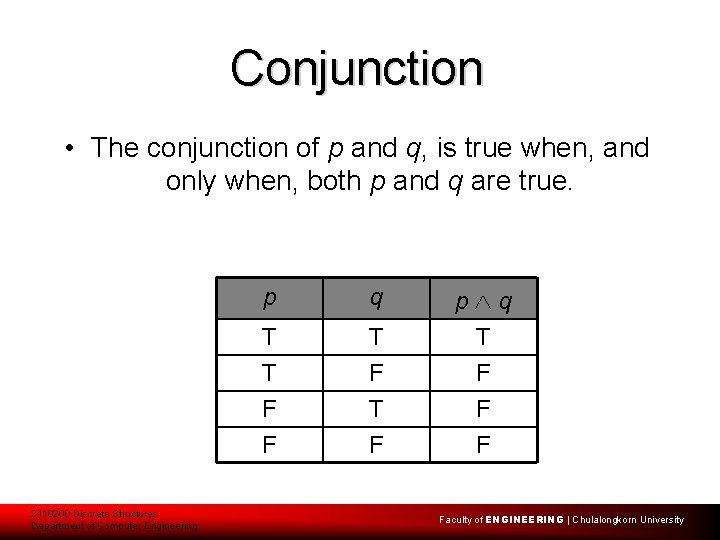
Conjunction • The conjunction of p and q, is true when, and only when, both p and q are true. 2110200 Discrete Structures Department of Computer Engineering p q T T F F T F T F Faculty of ENGINEERING | Chulalongkorn University
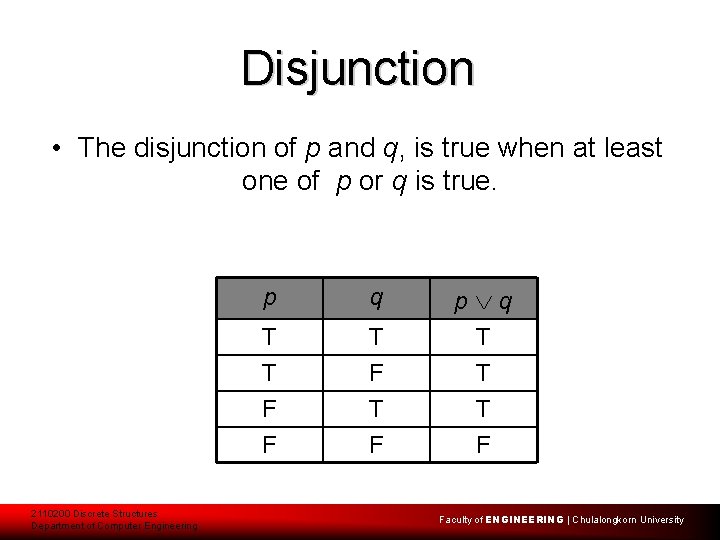
Disjunction • The disjunction of p and q, is true when at least one of p or q is true. 2110200 Discrete Structures Department of Computer Engineering p q T T F F T F T T T F Faculty of ENGINEERING | Chulalongkorn University
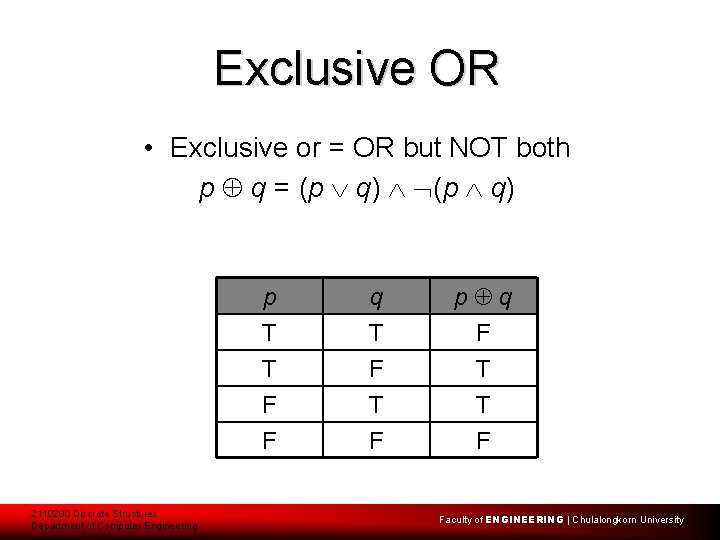
Exclusive OR • Exclusive or = OR but NOT both p q = (p q) 2110200 Discrete Structures Department of Computer Engineering p T T F q T F T p q F T T F Faculty of ENGINEERING | Chulalongkorn University
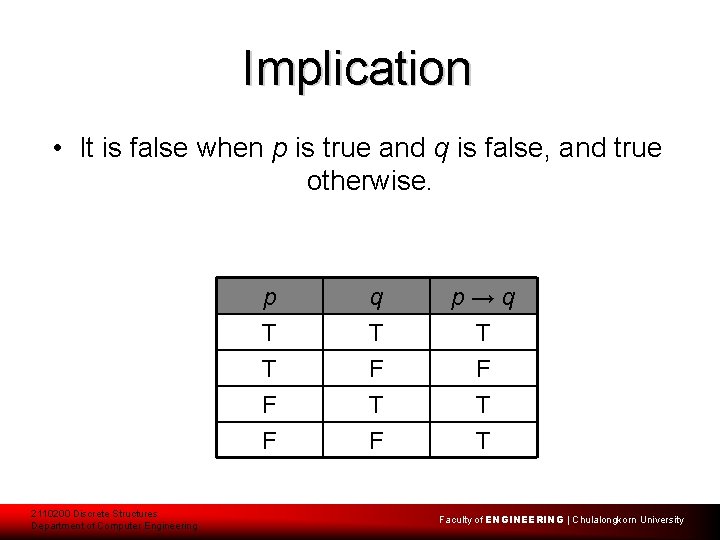
Implication • It is false when p is true and q is false, and true otherwise. 2110200 Discrete Structures Department of Computer Engineering p T T F q T F T p→q T F F T Faculty of ENGINEERING | Chulalongkorn University
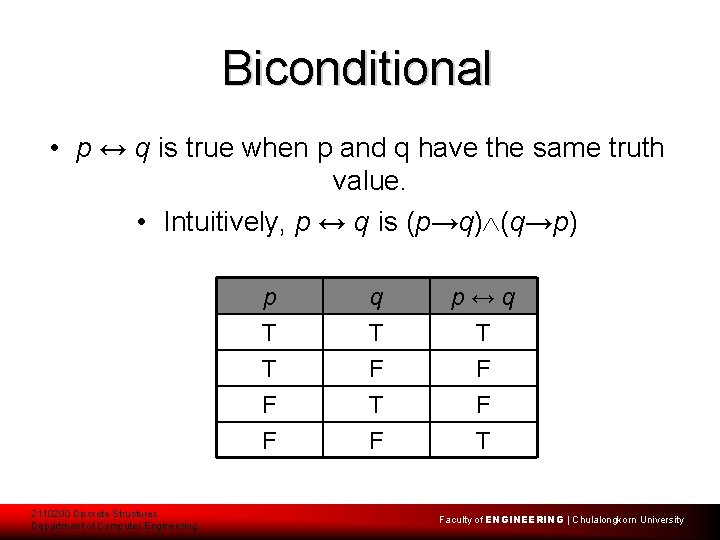
Biconditional • p ↔ q is true when p and q have the same truth value. • Intuitively, p ↔ q is (p→q) (q→p) 2110200 Discrete Structures Department of Computer Engineering p T T F q T F T p↔q T F F T Faculty of ENGINEERING | Chulalongkorn University
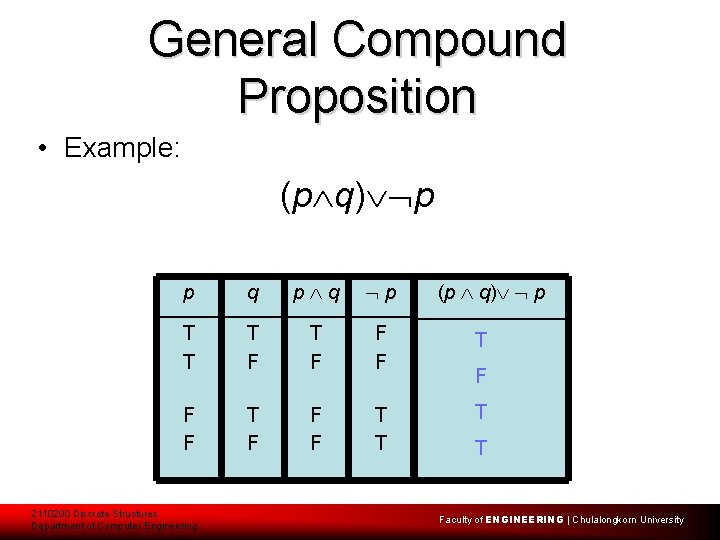
General Compound Proposition • Example: (p q) p p q p T T T F F F T T T 2110200 Discrete Structures Department of Computer Engineering (p q) p F T Faculty of ENGINEERING | Chulalongkorn University
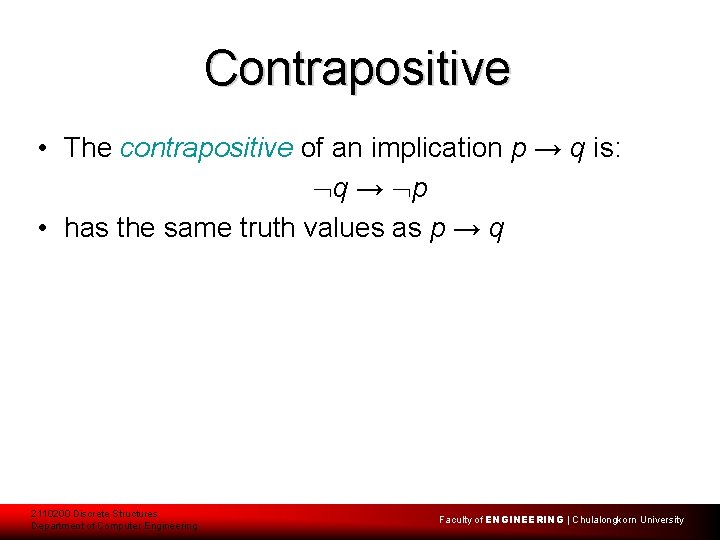
Contrapositive • The contrapositive of an implication p → q is: q → p • has the same truth values as p → q 2110200 Discrete Structures Department of Computer Engineering Faculty of ENGINEERING | Chulalongkorn University
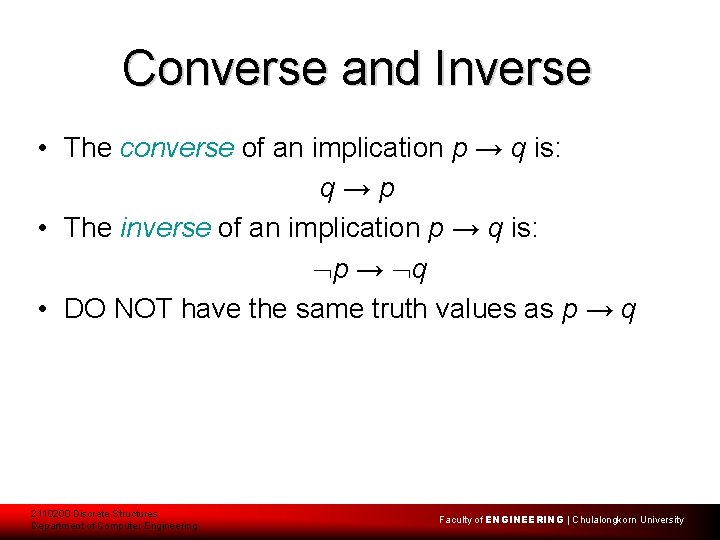
Converse and Inverse • The converse of an implication p → q is: q→p • The inverse of an implication p → q is: p → q • DO NOT have the same truth values as p → q 2110200 Discrete Structures Department of Computer Engineering Faculty of ENGINEERING | Chulalongkorn University
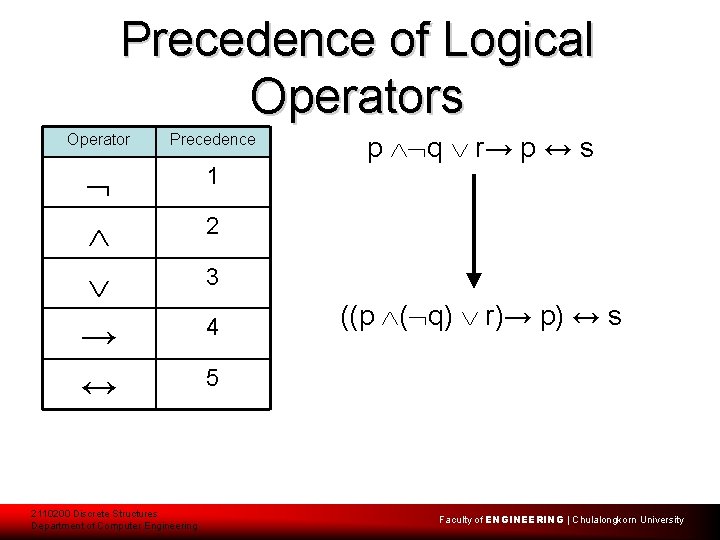
Precedence of Logical Operators Operator Precedence → ↔ 1 2110200 Discrete Structures Department of Computer Engineering p q r→ p ↔ s 2 3 4 ((p ( q) r)→ p) ↔ s 5 Faculty of ENGINEERING | Chulalongkorn University
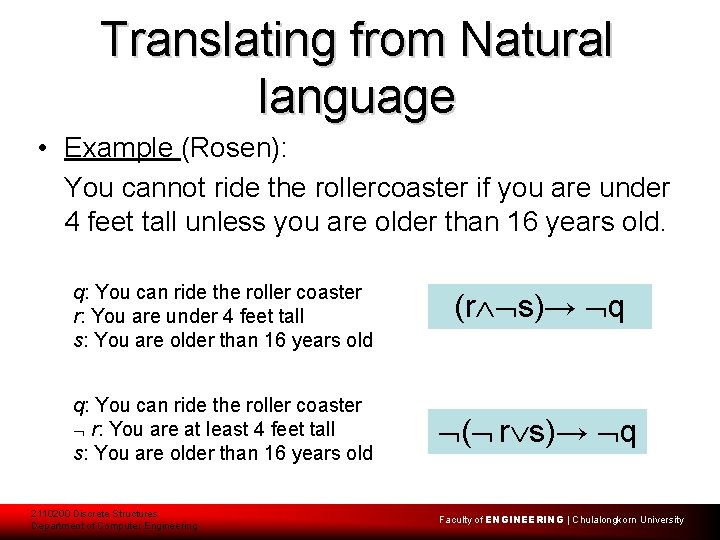
Translating from Natural language • Example (Rosen): You cannot ride the rollercoaster if you are under 4 feet tall unless you are older than 16 years old. q: You can ride the roller coaster r: You are under 4 feet tall s: You are older than 16 years old q: You can ride the roller coaster r: You are at least 4 feet tall s: You are older than 16 years old 2110200 Discrete Structures Department of Computer Engineering (r s)→ q ( r s)→ q Faculty of ENGINEERING | Chulalongkorn University
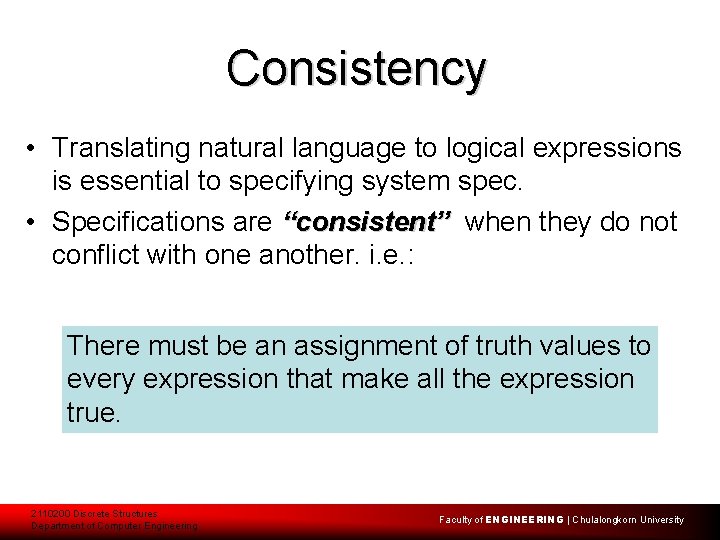
Consistency • Translating natural language to logical expressions is essential to specifying system spec. • Specifications are “consistent” when they do not conflict with one another. i. e. : There must be an assignment of truth values to every expression that make all the expression true. 2110200 Discrete Structures Department of Computer Engineering Faculty of ENGINEERING | Chulalongkorn University
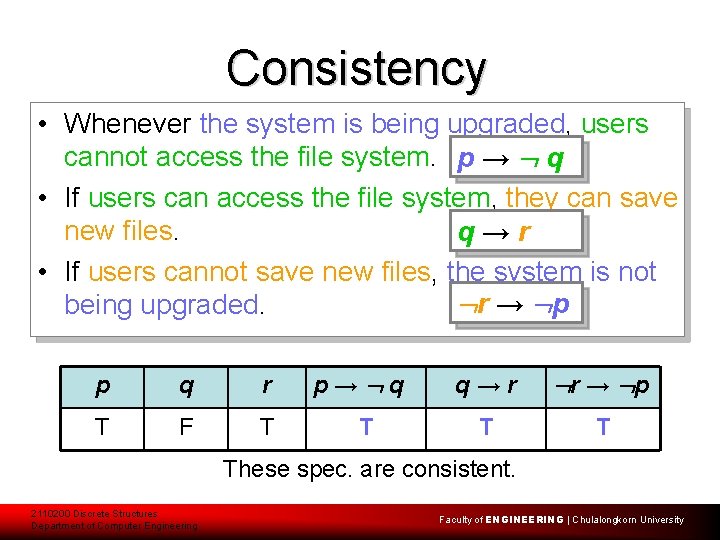
Consistency • Whenever the system is being upgraded, users cannot access the file system. • If users can access the file system, they can save new files. • If users cannot save new files, the system is not being upgraded. 2110200 Discrete Structures Department of Computer Engineering Faculty of ENGINEERING | Chulalongkorn University
Consistency • Whenever the system is being upgraded, users cannot access the file system. p → q • If users can access the file system, they can save new files. q→r • If users cannot save new files, the system is not r → p being upgraded. p q r T F T p→ q T q→r r → p T T These spec. are consistent. 2110200 Discrete Structures Department of Computer Engineering Faculty of ENGINEERING | Chulalongkorn University
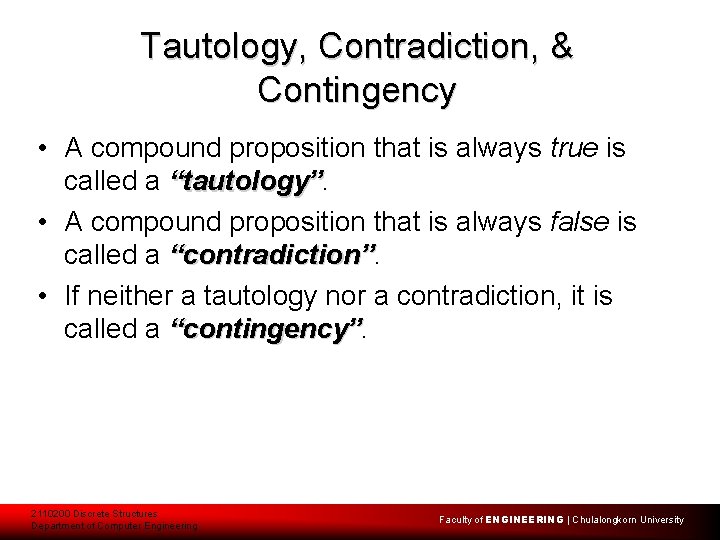
Tautology, Contradiction, & Contingency • A compound proposition that is always true is called a “tautology” • A compound proposition that is always false is called a “contradiction” • If neither a tautology nor a contradiction, it is called a “contingency” 2110200 Discrete Structures Department of Computer Engineering Faculty of ENGINEERING | Chulalongkorn University
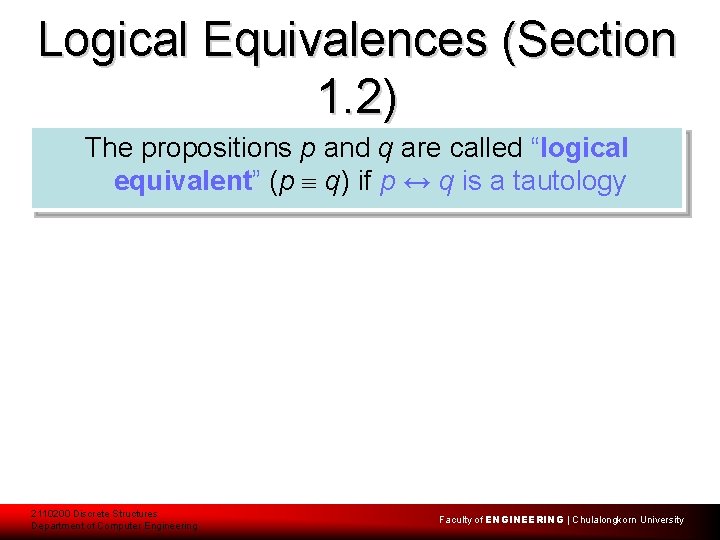
Logical Equivalences (Section 1. 2) The propositions p and q are called “logical equivalent” (p q) if p ↔ q is a tautology 2110200 Discrete Structures Department of Computer Engineering Faculty of ENGINEERING | Chulalongkorn University
Showing Logically Equivalent propositions 1 Show that the truth values of these propositions are always the same. → Construct truth tables. 2110200 Discrete Structures Department of Computer Engineering Faculty of ENGINEERING | Chulalongkorn University
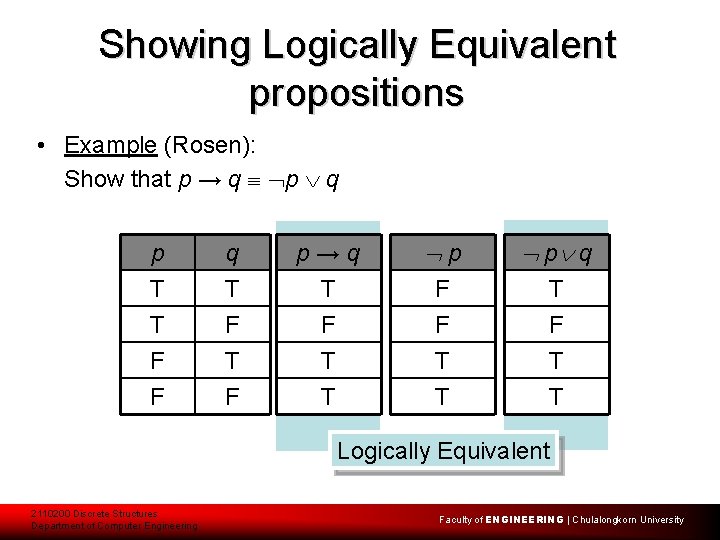
Showing Logically Equivalent propositions • Example (Rosen): Show that p → q p q p T T F q T F T p→q T F T p p q F F T T T Logically Equivalent 2110200 Discrete Structures Department of Computer Engineering Faculty of ENGINEERING | Chulalongkorn University
Showing Logically Equivalent propositions 1 Show that the truth values of these propositions are always the same. 2 Use series of established equivalences. 2110200 Discrete Structures Department of Computer Engineering Faculty of ENGINEERING | Chulalongkorn University
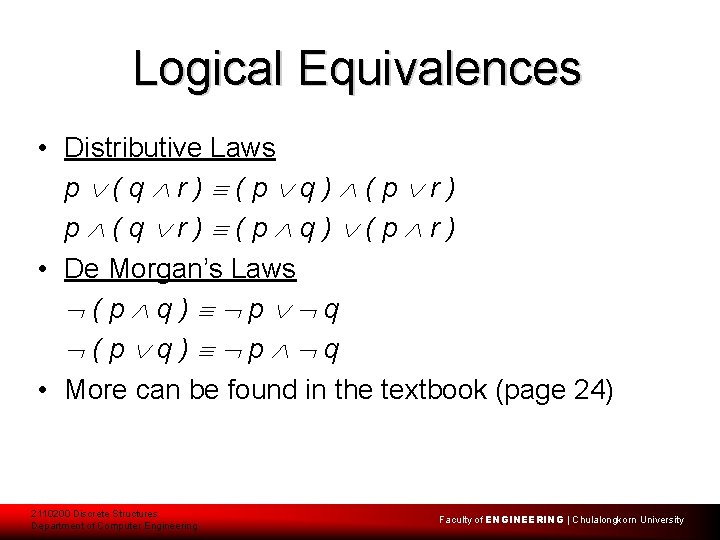
Logical Equivalences • Distributive Laws p (q r) (p q) (p r) • De Morgan’s Laws (p q) p q • More can be found in the textbook (page 24) 2110200 Discrete Structures Department of Computer Engineering Faculty of ENGINEERING | Chulalongkorn University
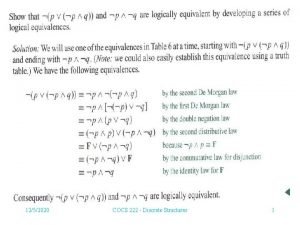
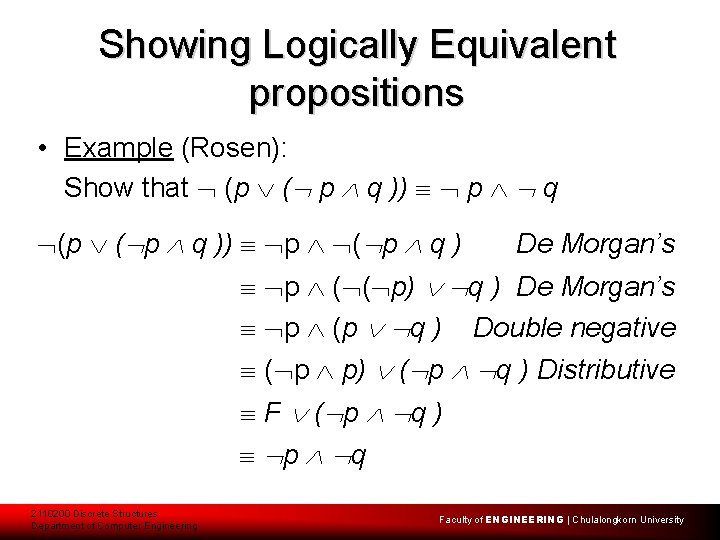
Showing Logically Equivalent propositions • Example (Rosen): Show that (p ( p q )) p q (p ( p q )) p ( p q ) De Morgan’s p ( ( p) q ) De Morgan’s p (p q ) Double negative ( p p) ( p q ) Distributive F ( p q ) p q 2110200 Discrete Structures Department of Computer Engineering Faculty of ENGINEERING | Chulalongkorn University
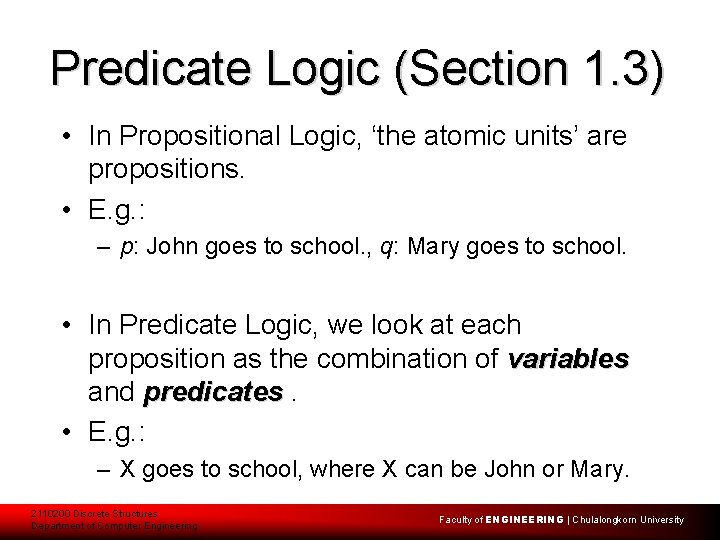
Predicate Logic (Section 1. 3) • In Propositional Logic, ‘the atomic units’ are propositions. • E. g. : – p: John goes to school. , q: Mary goes to school. • In Predicate Logic, we look at each proposition as the combination of variables and predicates. • E. g. : – X goes to school, where X can be John or Mary. 2110200 Discrete Structures Department of Computer Engineering Faculty of ENGINEERING | Chulalongkorn University
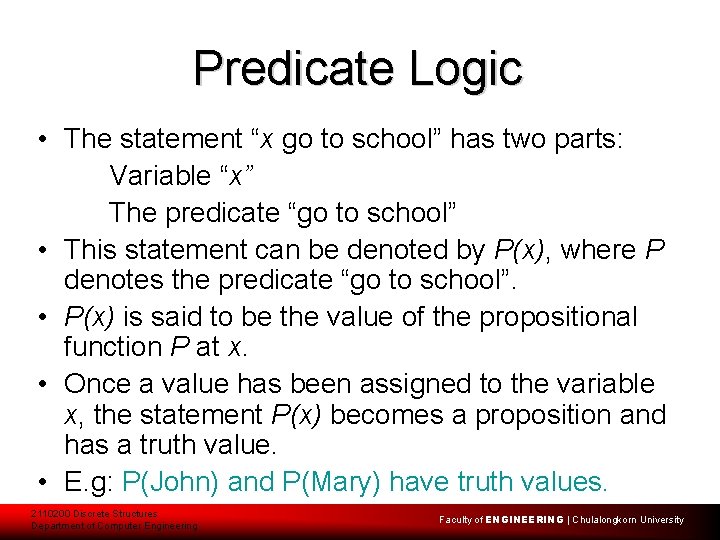
Predicate Logic • The statement “x go to school” has two parts: Variable “x” The predicate “go to school” • This statement can be denoted by P(x), where P denotes the predicate “go to school”. • P(x) is said to be the value of the propositional function P at x. • Once a value has been assigned to the variable x, the statement P(x) becomes a proposition and has a truth value. • E. g: P(John) and P(Mary) have truth values. 2110200 Discrete Structures Department of Computer Engineering Faculty of ENGINEERING | Chulalongkorn University
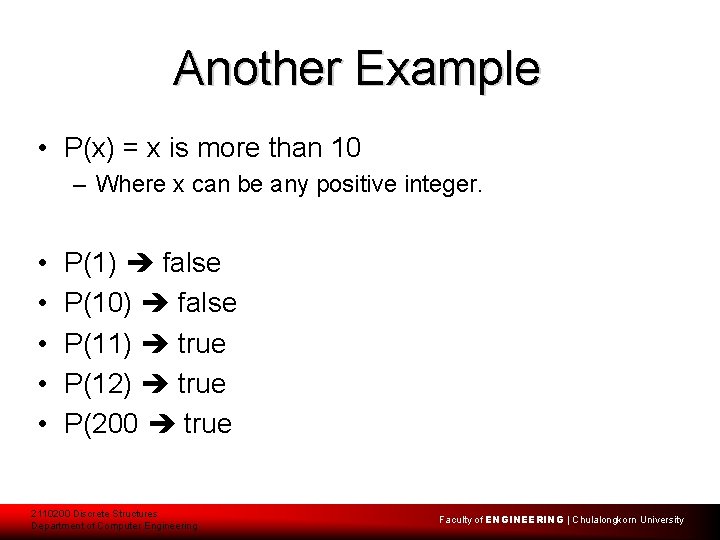
Another Example • P(x) = x is more than 10 – Where x can be any positive integer. • • • P(1) false P(10) false P(11) true P(12) true P(200 true 2110200 Discrete Structures Department of Computer Engineering Faculty of ENGINEERING | Chulalongkorn University
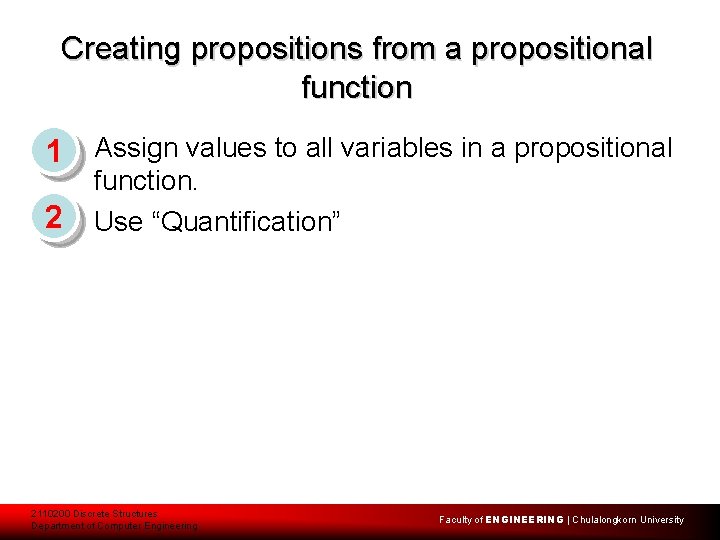
Creating propositions from a propositional function 1 Assign values to all variables in a propositional 2 function. Use “Quantification” 2110200 Discrete Structures Department of Computer Engineering Faculty of ENGINEERING | Chulalongkorn University
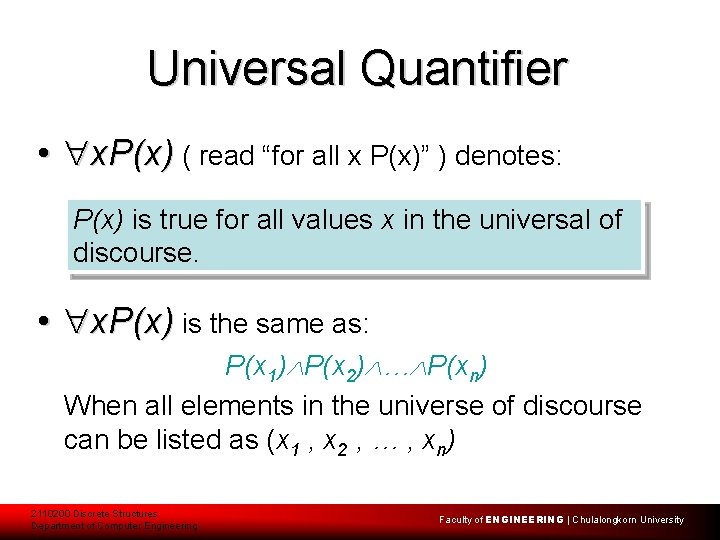
Universal Quantifier • x. P(x) ( read “for all x P(x)” ) denotes: P(x) is true for all values x in the universal of discourse. • x. P(x) is the same as: P(x 1) P(x 2) … P(xn) When all elements in the universe of discourse can be listed as (x 1 , x 2 , … , xn) 2110200 Discrete Structures Department of Computer Engineering Faculty of ENGINEERING | Chulalongkorn University
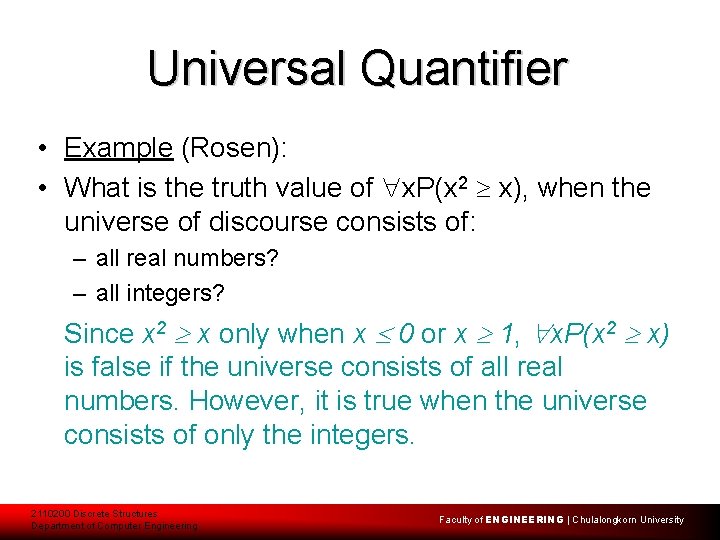
Universal Quantifier • Example (Rosen): • What is the truth value of x. P(x 2 x), when the universe of discourse consists of: – all real numbers? – all integers? Since x 2 x only when x 0 or x 1, x. P(x 2 x) is false if the universe consists of all real numbers. However, it is true when the universe consists of only the integers. 2110200 Discrete Structures Department of Computer Engineering Faculty of ENGINEERING | Chulalongkorn University
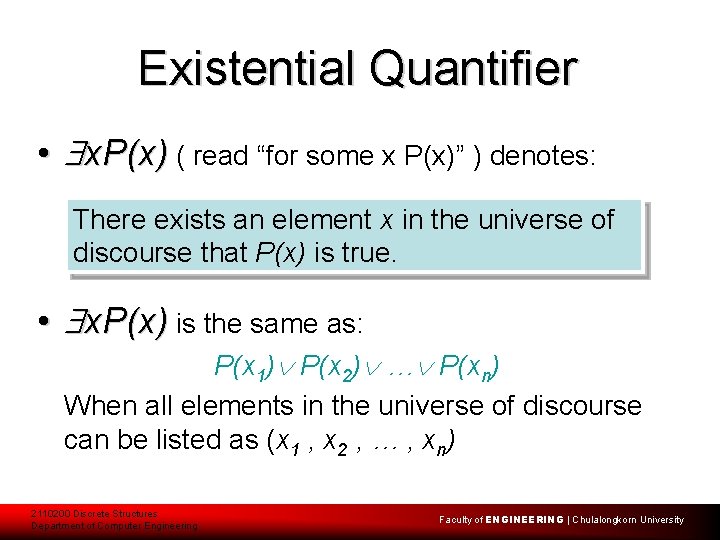
Existential Quantifier • x. P(x) ( read “for some x P(x)” ) denotes: There exists an element x in the universe of discourse that P(x) is true. • x. P(x) is the same as: P(x 1) P(x 2) … P(xn) When all elements in the universe of discourse can be listed as (x 1 , x 2 , … , xn) 2110200 Discrete Structures Department of Computer Engineering Faculty of ENGINEERING | Chulalongkorn University
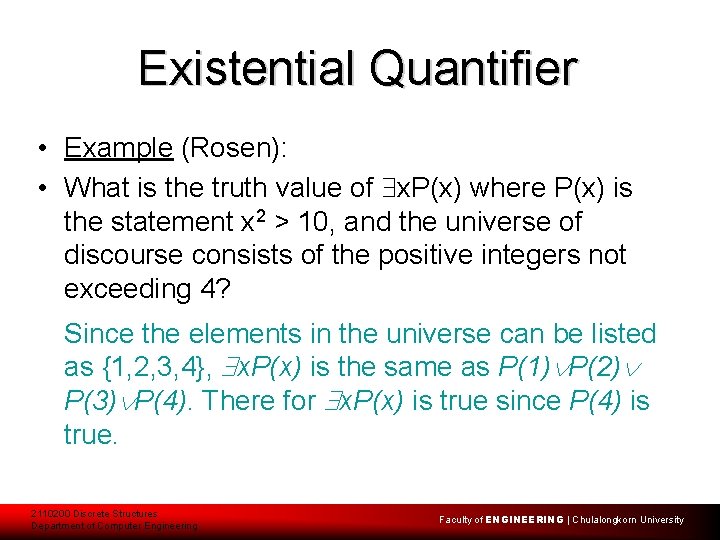
Existential Quantifier • Example (Rosen): • What is the truth value of x. P(x) where P(x) is the statement x 2 > 10, and the universe of discourse consists of the positive integers not exceeding 4? Since the elements in the universe can be listed as {1, 2, 3, 4}, x. P(x) is the same as P(1) P(2) P(3) P(4). There for x. P(x) is true since P(4) is true. 2110200 Discrete Structures Department of Computer Engineering Faculty of ENGINEERING | Chulalongkorn University
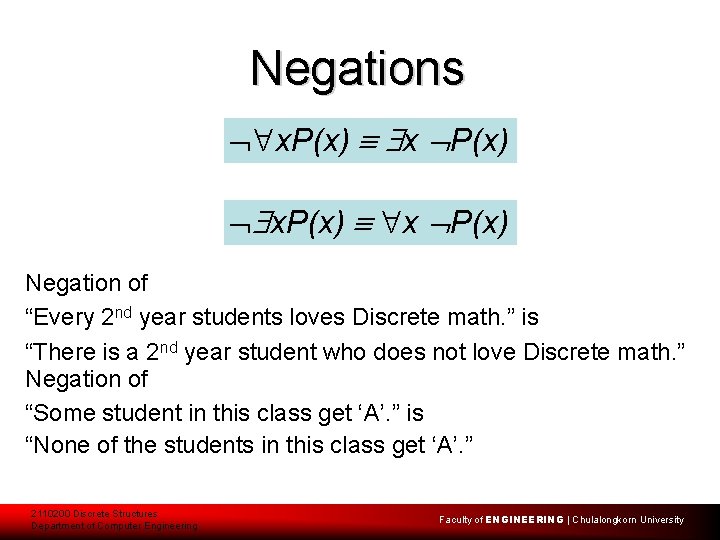
Negations x. P(x) x P(x) Negation of “Every 2 nd year students loves Discrete math. ” is “There is a 2 nd year student who does not love Discrete math. ” Negation of “Some student in this class get ‘A’. ” is “None of the students in this class get ‘A’. ” 2110200 Discrete Structures Department of Computer Engineering Faculty of ENGINEERING | Chulalongkorn University
Set 2110200 Discrete Structures Department of Computer Engineering Faculty of ENGINEERING | Chulalongkorn University
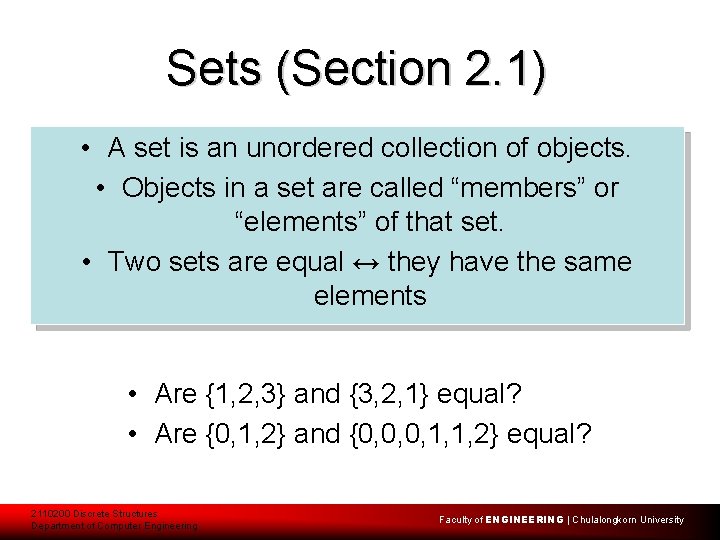
Sets (Section 2. 1) • A set is an unordered collection of objects. • Objects in a set are called “members” or “elements” of that set. • Two sets are equal ↔ they have the same elements • Are {1, 2, 3} and {3, 2, 1} equal? • Are {0, 1, 2} and {0, 0, 0, 1, 1, 2} equal? 2110200 Discrete Structures Department of Computer Engineering Faculty of ENGINEERING | Chulalongkorn University
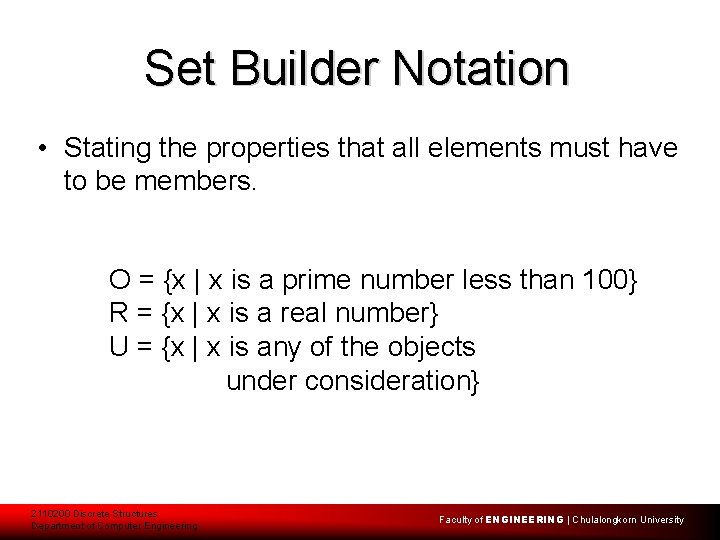
Set Builder Notation • Stating the properties that all elements must have to be members. O = {x | x is a prime number less than 100} R = {x | x is a real number} U = {x | x is any of the objects under consideration} 2110200 Discrete Structures Department of Computer Engineering Faculty of ENGINEERING | Chulalongkorn University
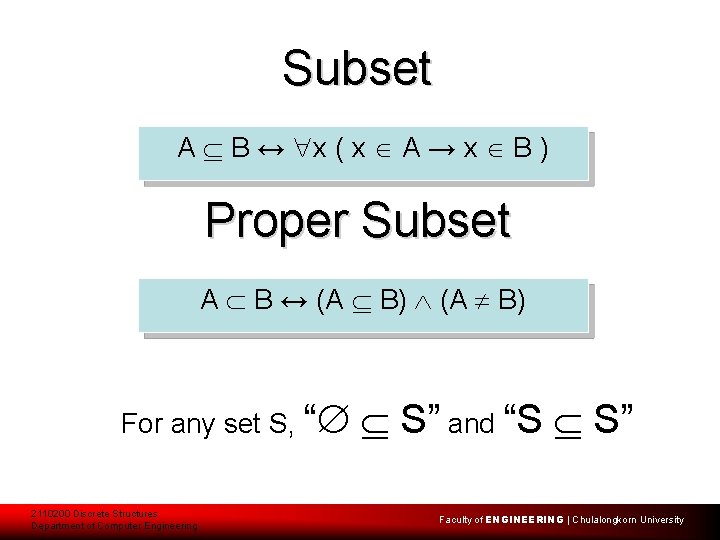
Subset A B ↔ x ( x A → x B ) Proper Subset A B ↔ (A B) For any set S, “ 2110200 Discrete Structures Department of Computer Engineering S” and “S S” Faculty of ENGINEERING | Chulalongkorn University
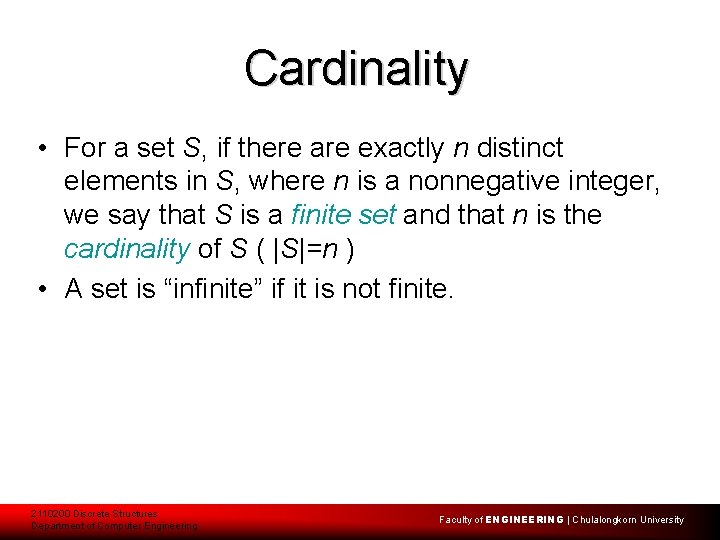
Cardinality • For a set S, if there are exactly n distinct elements in S, where n is a nonnegative integer, we say that S is a finite set and that n is the cardinality of S ( |S|=n ) • A set is “infinite” if it is not finite. 2110200 Discrete Structures Department of Computer Engineering Faculty of ENGINEERING | Chulalongkorn University
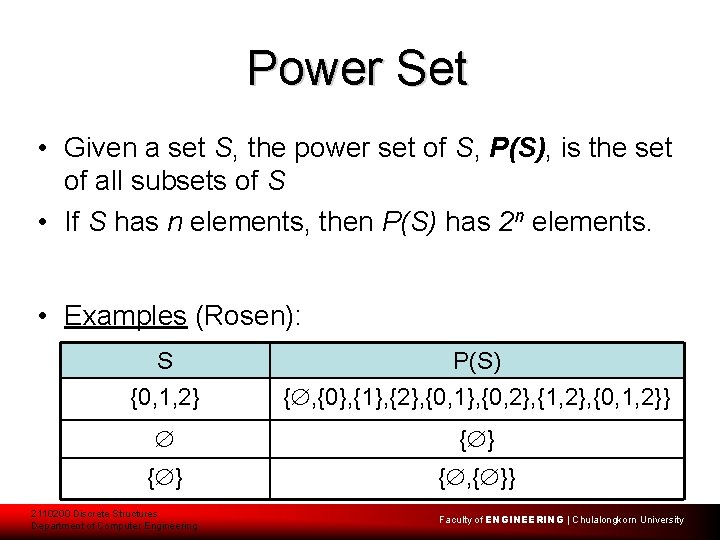
Power Set • Given a set S, the power set of S, P(S), is the set of all subsets of S • If S has n elements, then P(S) has 2 n elements. • Examples (Rosen): S {0, 1, 2} P(S) { , {0}, {1}, {2}, {0, 1}, {0, 2}, {1, 2}, {0, 1, 2}} { } { , { }} 2110200 Discrete Structures Department of Computer Engineering Faculty of ENGINEERING | Chulalongkorn University
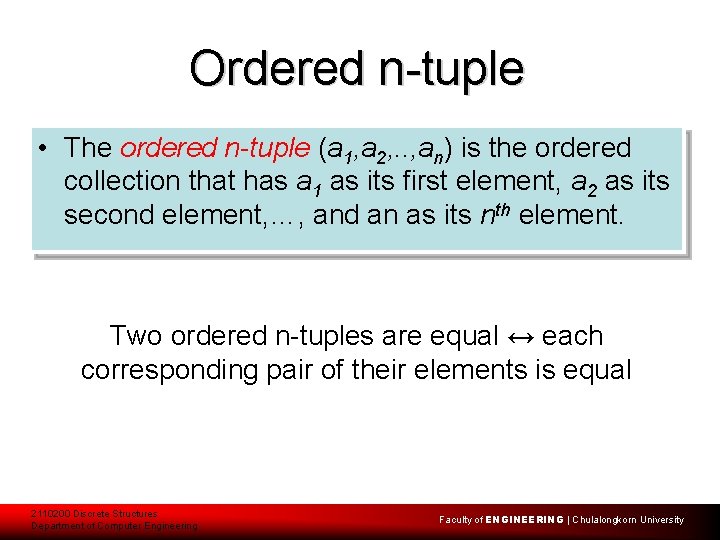
Ordered n-tuple • The ordered n-tuple (a 1, a 2, . . , an) is the ordered collection that has a 1 as its first element, a 2 as its second element, …, and an as its nth element. Two ordered n-tuples are equal ↔ each corresponding pair of their elements is equal 2110200 Discrete Structures Department of Computer Engineering Faculty of ENGINEERING | Chulalongkorn University
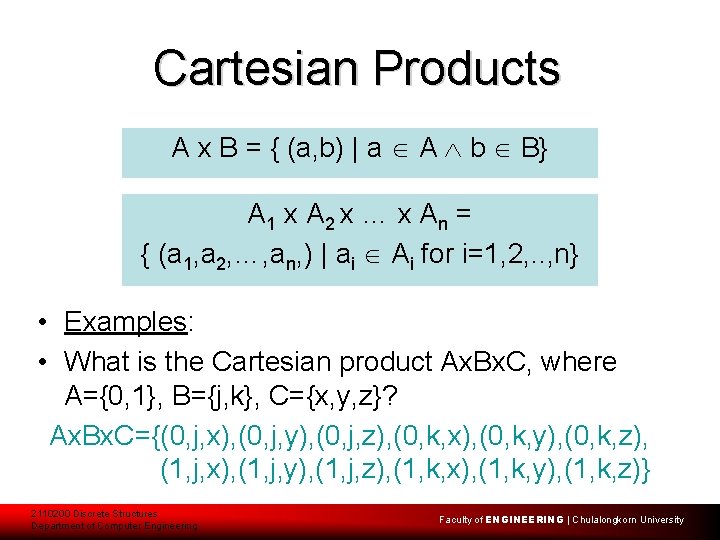
Cartesian Products A x B = { (a, b) | a A b B} A 1 x A 2 x … x A n = { (a 1, a 2, …, an, ) | ai Ai for i=1, 2, . . , n} • Examples: • What is the Cartesian product Ax. Bx. C, where A={0, 1}, B={j, k}, C={x, y, z}? Ax. Bx. C={(0, j, x), (0, j, y), (0, j, z), (0, k, x), (0, k, y), (0, k, z), (1, j, x), (1, j, y), (1, j, z), (1, k, x), (1, k, y), (1, k, z)} 2110200 Discrete Structures Department of Computer Engineering Faculty of ENGINEERING | Chulalongkorn University
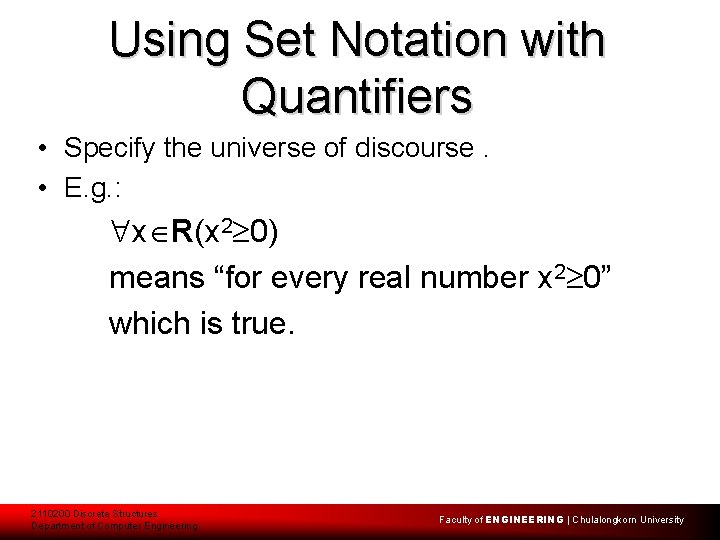
Using Set Notation with Quantifiers • Specify the universe of discourse. • E. g. : x R(x 2 0) means “for every real number x 2 0” which is true. 2110200 Discrete Structures Department of Computer Engineering Faculty of ENGINEERING | Chulalongkorn University
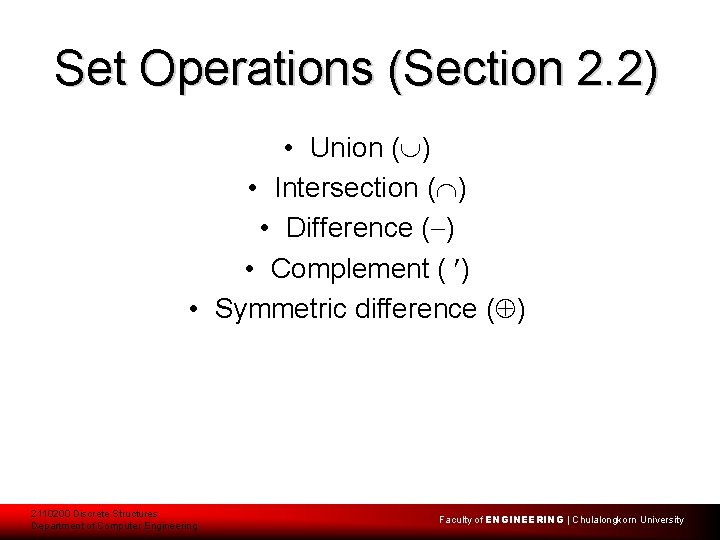
Set Operations (Section 2. 2) • Union ( ) • Intersection ( ) • Difference ( ) • Complement ( ) • Symmetric difference ( ) 2110200 Discrete Structures Department of Computer Engineering Faculty of ENGINEERING | Chulalongkorn University
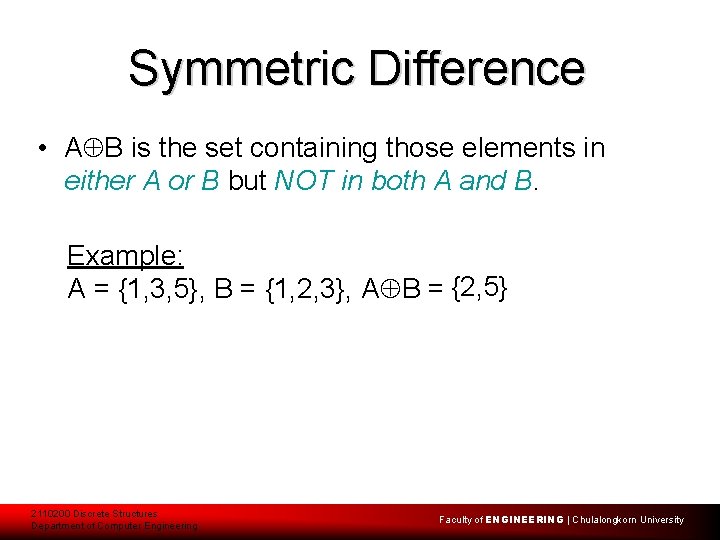
Symmetric Difference • A B is the set containing those elements in either A or B but NOT in both A and B. Example: A = {1, 3, 5}, B = {1, 2, 3}, A B = {2, 5} 2110200 Discrete Structures Department of Computer Engineering Faculty of ENGINEERING | Chulalongkorn University
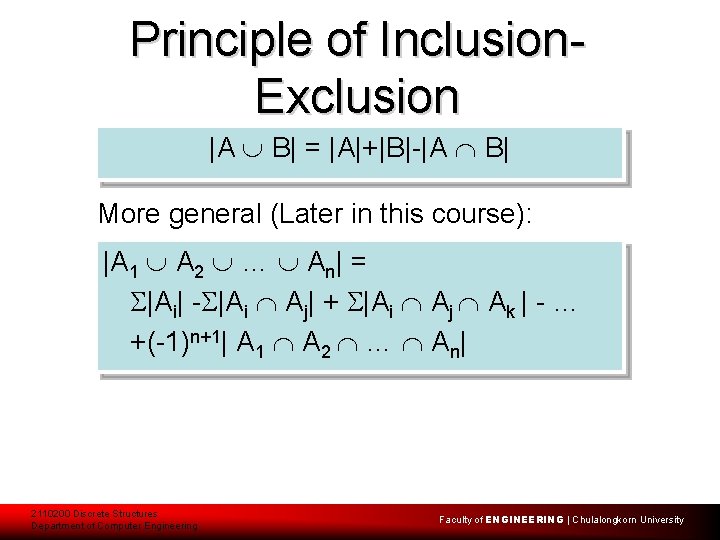
Principle of Inclusion. Exclusion |A B| = |A|+|B|-|A B| More general (Later in this course): |A 1 A 2 … An| = |Ai| - |Ai Aj| + |Ai Aj Ak | - … +(-1)n+1| A 1 A 2 … An| 2110200 Discrete Structures Department of Computer Engineering Faculty of ENGINEERING | Chulalongkorn University
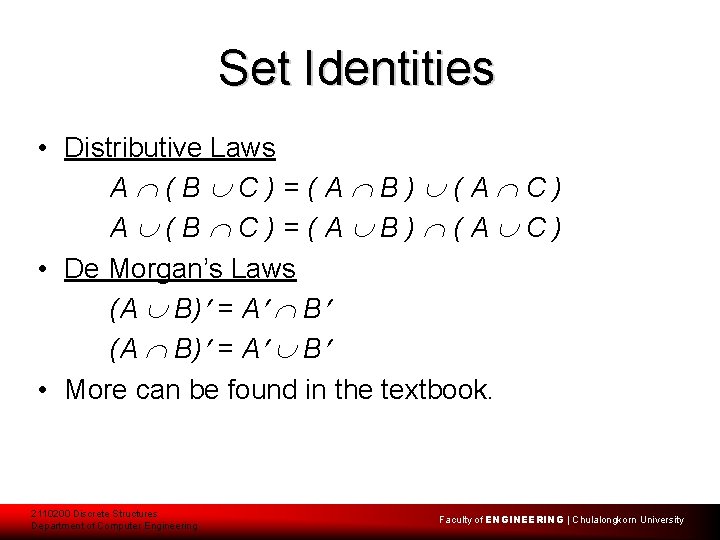
Set Identities • Distributive Laws A (B C)=(A B) (A C) • De Morgan’s Laws (A B) = A B • More can be found in the textbook. 2110200 Discrete Structures Department of Computer Engineering Faculty of ENGINEERING | Chulalongkorn University
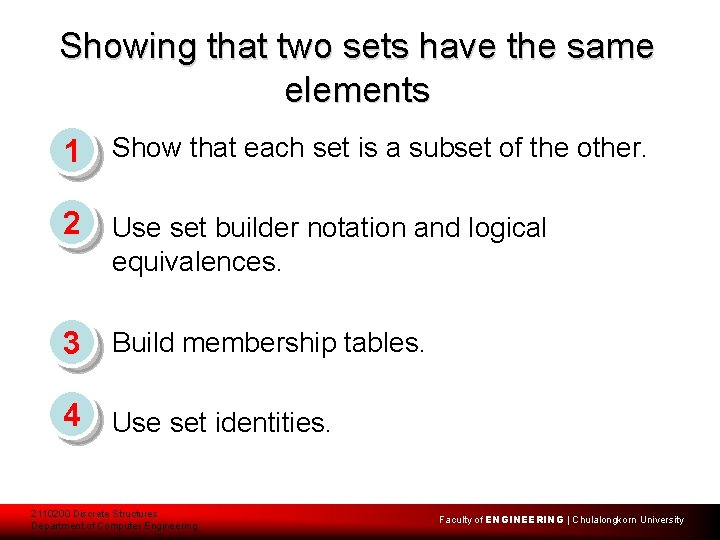
Showing that two sets have the same elements 1 Show that each set is a subset of the other. 2 Use set builder notation and logical equivalences. 3 Build membership tables. 4 Use set identities. 2110200 Discrete Structures Department of Computer Engineering Faculty of ENGINEERING | Chulalongkorn University
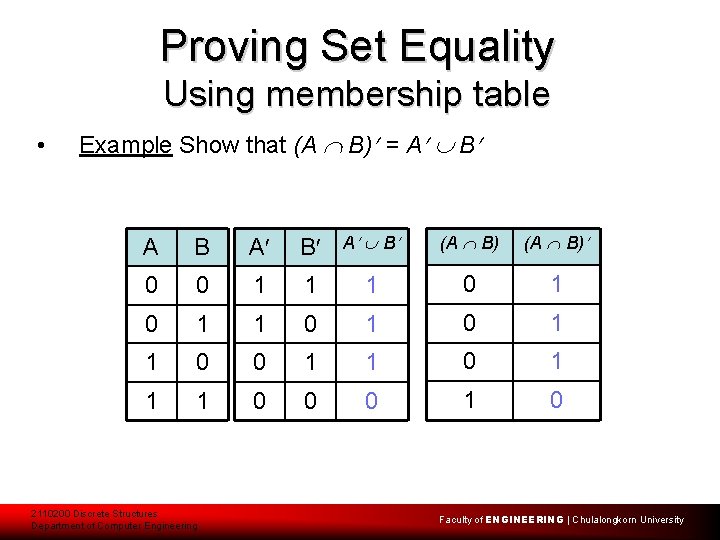
Proving Set Equality Using membership table • Example Show that (A B) = A B A B A B (A B) 0 0 1 1 1 0 1 0 1 1 0 0 1 1 1 0 0 0 1 0 2110200 Discrete Structures Department of Computer Engineering Faculty of ENGINEERING | Chulalongkorn University
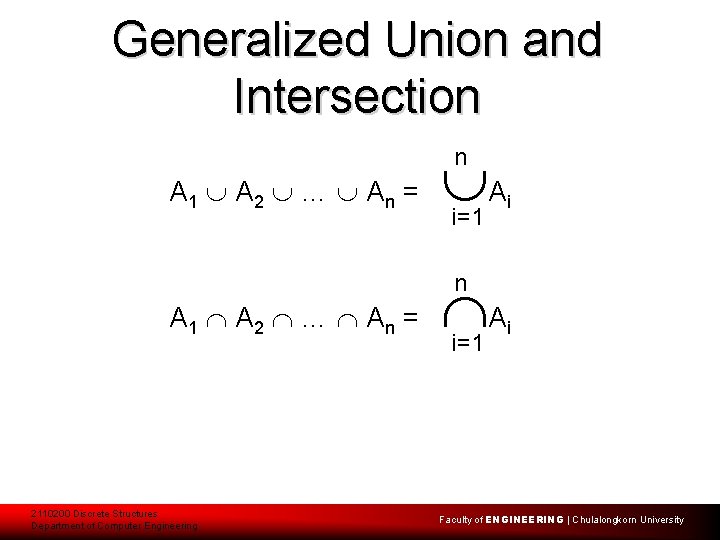
Generalized Union and Intersection A 1 A 2 … An = A i n i=1 n 2110200 Discrete Structures Department of Computer Engineering i=1 Faculty of ENGINEERING | Chulalongkorn University
n u F 2110200 Discrete Structures Department of Computer Engineering n o i t c Faculty of ENGINEERING | Chulalongkorn University
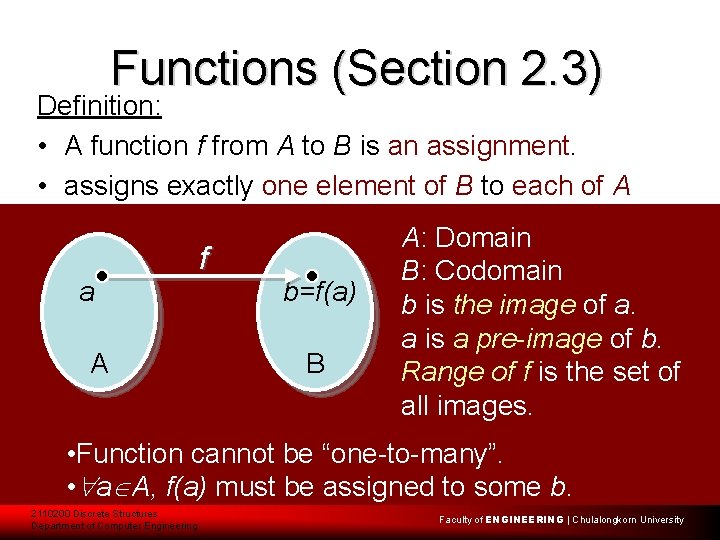
Functions (Section 2. 3) Definition: • A function f from A to B is an assignment. • assigns exactly one element of B to each of A a A f b=f(a) B A: Domain B: Codomain b is the image of a. a is a pre-image of b. Range of f is the set of all images. • Function cannot be “one-to-many”. • a A, f(a) must be assigned to some b. 2110200 Discrete Structures Department of Computer Engineering Faculty of ENGINEERING | Chulalongkorn University
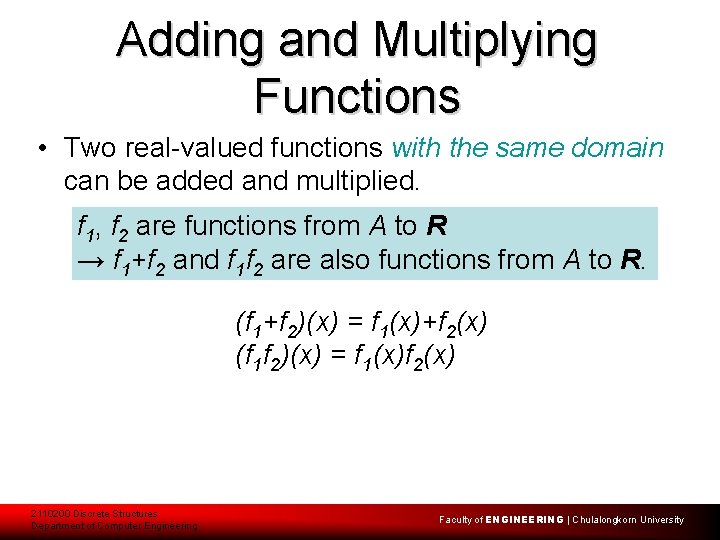
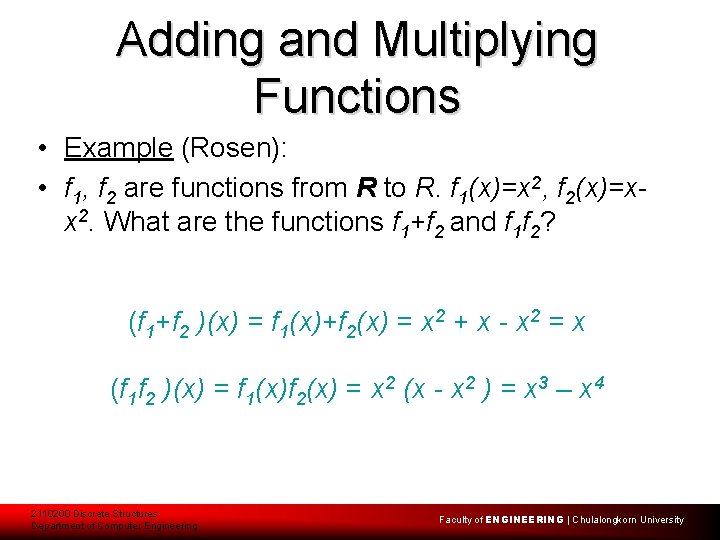
Adding and Multiplying Functions • Two real-valued functions with the same domain can be added and multiplied. f 1, f 2 are functions from A to R → f 1+f 2 and f 1 f 2 are also functions from A to R. (f 1+f 2)(x) = f 1(x)+f 2(x) (f 1 f 2)(x) = f 1(x)f 2(x) 2110200 Discrete Structures Department of Computer Engineering Faculty of ENGINEERING | Chulalongkorn University
Adding and Multiplying Functions • Example (Rosen): • f 1, f 2 are functions from R to R. f 1(x)=x 2, f 2(x)=xx 2. What are the functions f 1+f 2 and f 1 f 2? (f 1+f 2 )(x) = f 1(x)+f 2(x) = x 2 + x - x 2 = x (f 1 f 2 )(x) = f 1(x)f 2(x) = x 2 (x - x 2 ) = x 3 – x 4 2110200 Discrete Structures Department of Computer Engineering Faculty of ENGINEERING | Chulalongkorn University
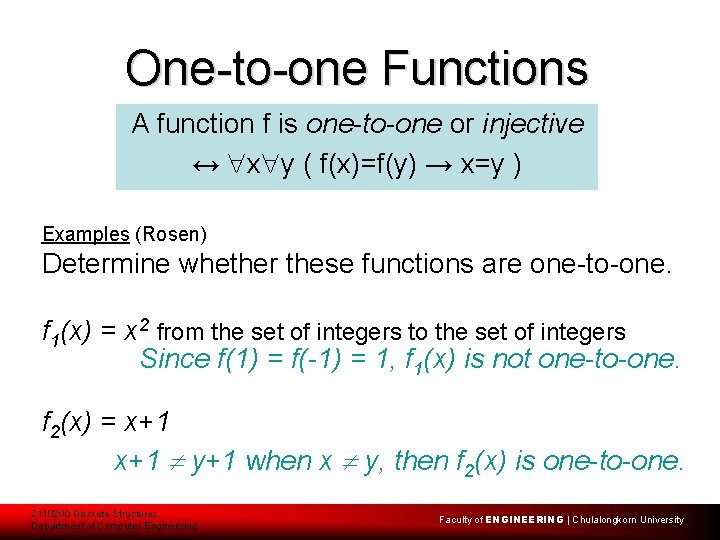
One-to-one Functions A function f is one-to-one or injective ↔ x y ( f(x)=f(y) → x=y ) Examples (Rosen) Determine whether these functions are one-to-one. f 1(x) = x 2 from the set of integers to the set of integers Since f(1) = f(-1) = 1, f 1(x) is not one-to-one. f 2(x) = x+1 y+1 when x y, then f 2(x) is one-to-one. 2110200 Discrete Structures Department of Computer Engineering Faculty of ENGINEERING | Chulalongkorn University
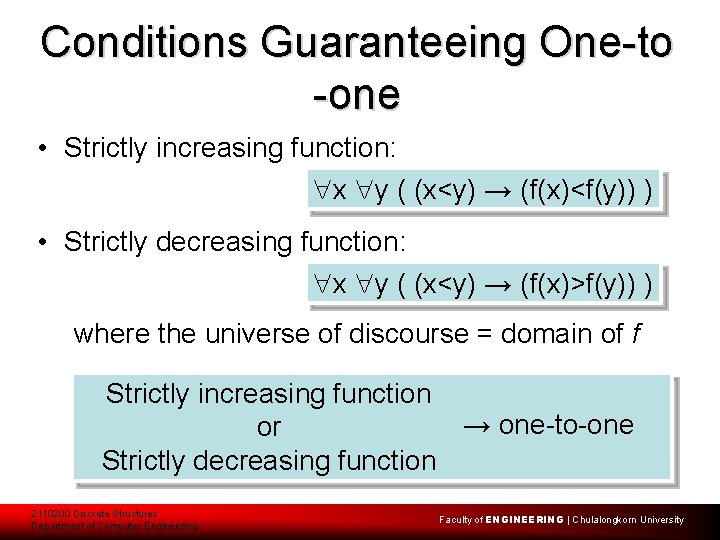
Conditions Guaranteeing One-to -one • Strictly increasing function: x y ( (x<y) → (f(x)<f(y)) ) • Strictly decreasing function: x y ( (x<y) → (f(x)>f(y)) ) where the universe of discourse = domain of f Strictly increasing function → one-to-one or Strictly decreasing function 2110200 Discrete Structures Department of Computer Engineering Faculty of ENGINEERING | Chulalongkorn University
Onto Functions A function f is onto or surjective ↔ y x ( f(x) = y ) Examples (Rosen) Determine whether these functions are onto. f 1(x) = x 2 from the set of integers to the set of integers No, since there is no integer x that f 1(x)=-1 f 2(x) = x+1 Yes, for every f 2(x)=y, there is an integer x=y-1 2110200 Discrete Structures Department of Computer Engineering Faculty of ENGINEERING | Chulalongkorn University
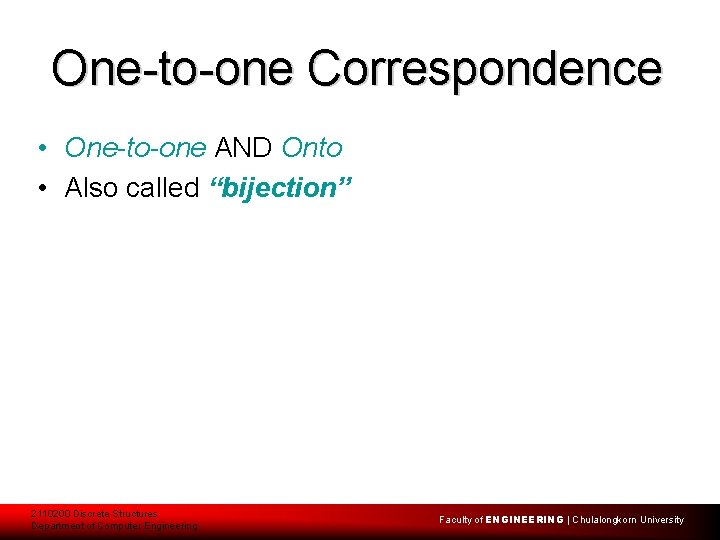
One-to-one Correspondence • One-to-one AND Onto • Also called “bijection” 2110200 Discrete Structures Department of Computer Engineering Faculty of ENGINEERING | Chulalongkorn University
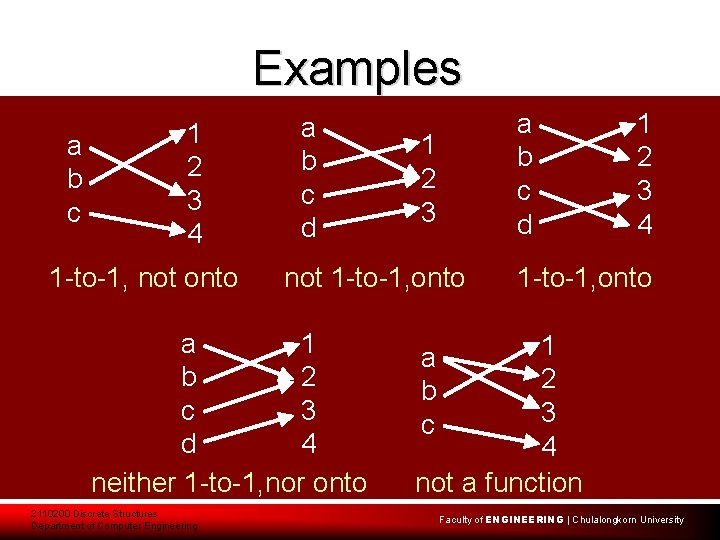
Examples a b c 1 2 3 4 1 -to-1, not onto a b c d 1 2 3 not 1 -to-1, onto a 1 b 2 c 3 d 4 neither 1 -to-1, nor onto 2110200 Discrete Structures Department of Computer Engineering a b c d 1 2 3 4 1 -to-1, onto 1 2 3 4 not a function a b c Faculty of ENGINEERING | Chulalongkorn University
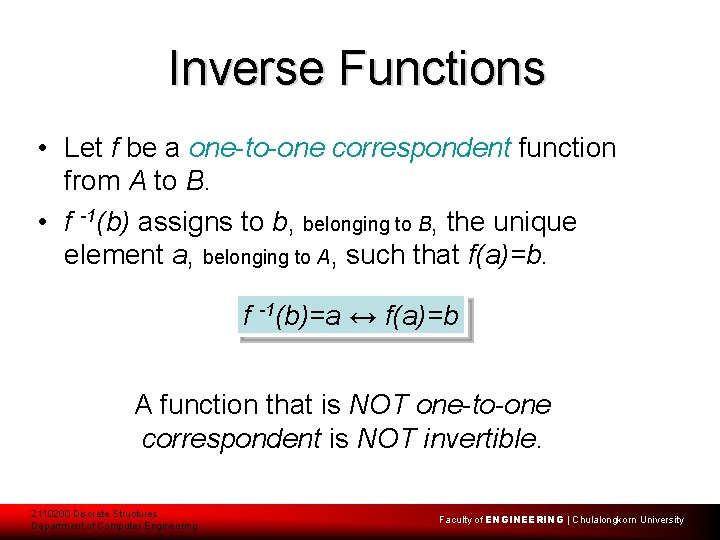
Inverse Functions • Let f be a one-to-one correspondent function from A to B. • f -1(b) assigns to b, belonging to B, the unique element a, belonging to A, such that f(a)=b. f -1(b)=a ↔ f(a)=b A function that is NOT one-to-one correspondent is NOT invertible. 2110200 Discrete Structures Department of Computer Engineering Faculty of ENGINEERING | Chulalongkorn University
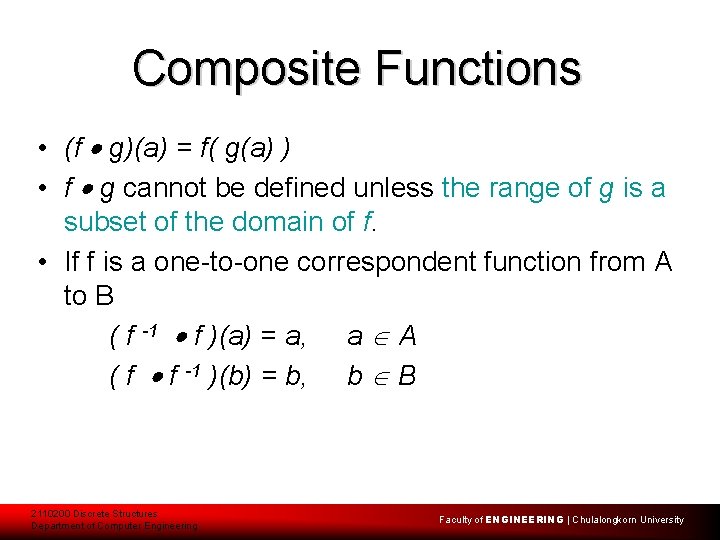
Composite Functions • (f g)(a) = f( g(a) ) • f g cannot be defined unless the range of g is a subset of the domain of f. • If f is a one-to-one correspondent function from A to B ( f -1 f )(a) = a, a A ( f f -1 )(b) = b, b B 2110200 Discrete Structures Department of Computer Engineering Faculty of ENGINEERING | Chulalongkorn University
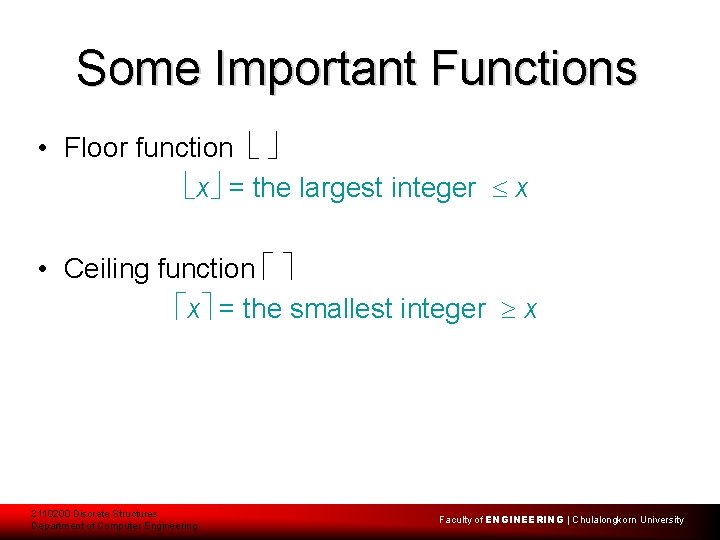
Some Important Functions • Floor function x = the largest integer x • Ceiling function x = the smallest integer x 1/2 = 2110200 Discrete Structures Department of Computer Engineering -1/2 = -1/2 = 1 = Faculty of ENGINEERING | Chulalongkorn University
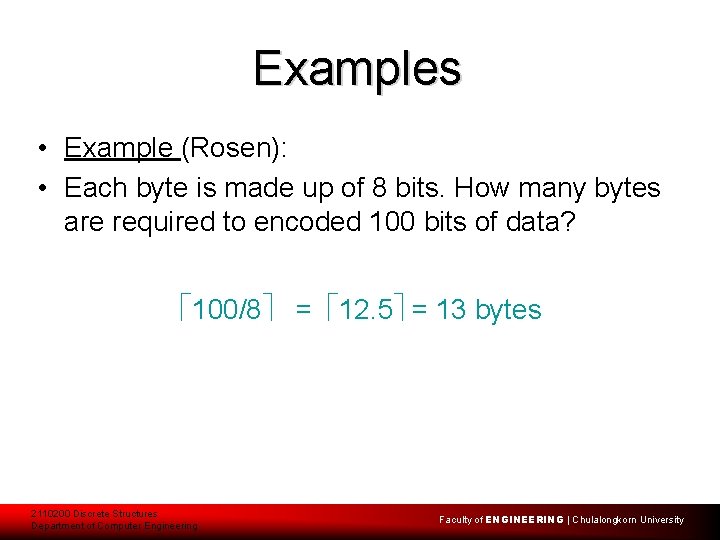
Examples • Example (Rosen): • Each byte is made up of 8 bits. How many bytes are required to encoded 100 bits of data? 100/8 = 12. 5 = 13 bytes 2110200 Discrete Structures Department of Computer Engineering Faculty of ENGINEERING | Chulalongkorn University
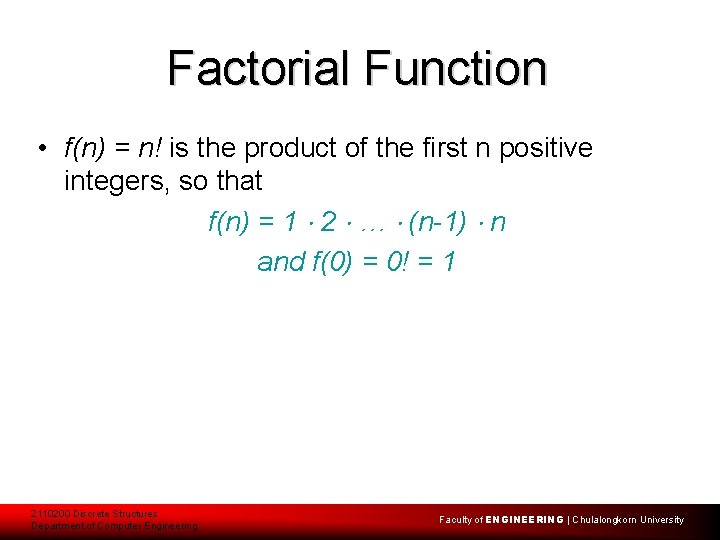
Factorial Function • f(n) = n! is the product of the first n positive integers, so that f(n) = 1 2 … (n-1) n and f(0) = 0! = 1 2110200 Discrete Structures Department of Computer Engineering Faculty of ENGINEERING | Chulalongkorn University
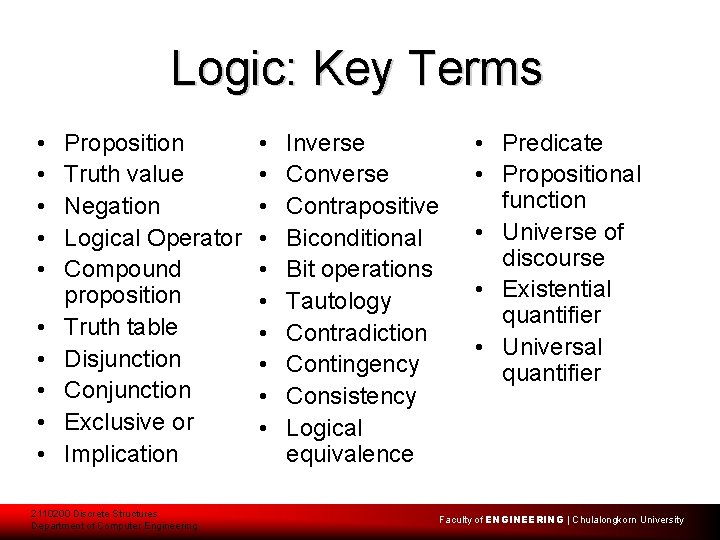
Logic: Key Terms • • • Proposition Truth value Negation Logical Operator Compound proposition Truth table Disjunction Conjunction Exclusive or Implication 2110200 Discrete Structures Department of Computer Engineering • • • Inverse Contrapositive Biconditional Bit operations Tautology Contradiction Contingency Consistency Logical equivalence • Predicate • Propositional function • Universe of discourse • Existential quantifier • Universal quantifier Faculty of ENGINEERING | Chulalongkorn University
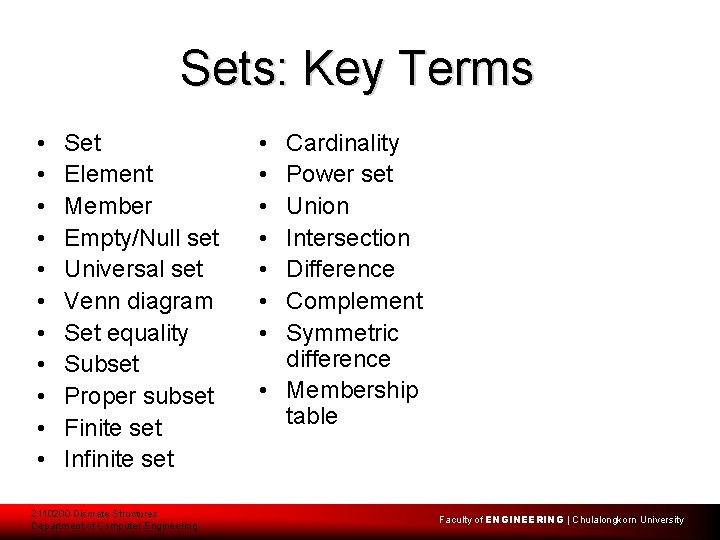
Sets: Key Terms • • • Set Element Member Empty/Null set Universal set Venn diagram Set equality Subset Proper subset Finite set Infinite set 2110200 Discrete Structures Department of Computer Engineering • • Cardinality Power set Union Intersection Difference Complement Symmetric difference • Membership table Faculty of ENGINEERING | Chulalongkorn University
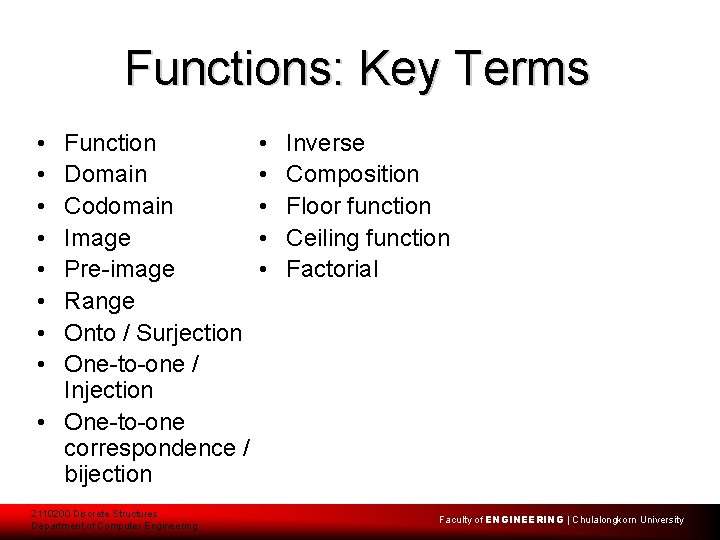
Functions: Key Terms • • Function Domain Codomain Image Pre-image Range Onto / Surjection One-to-one / Injection • One-to-one correspondence / bijection 2110200 Discrete Structures Department of Computer Engineering • • • Inverse Composition Floor function Ceiling function Factorial Faculty of ENGINEERING | Chulalongkorn University
n o it a l e R 2110200 Discrete Structures Department of Computer Engineering Faculty of ENGINEERING | Chulalongkorn University
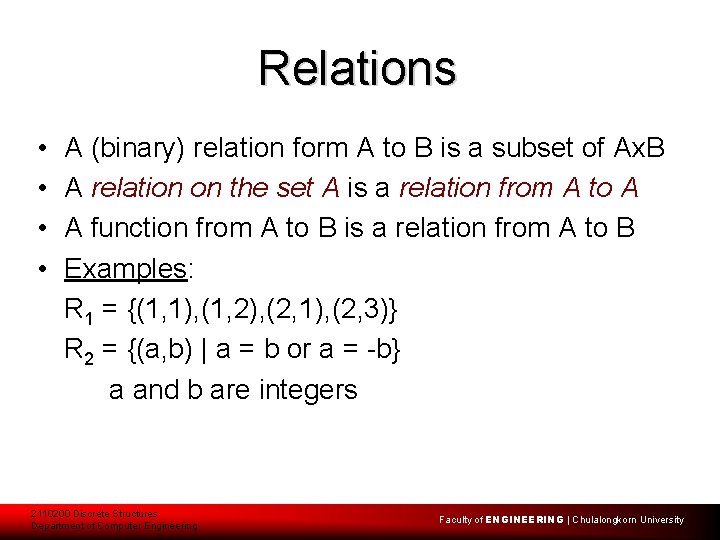
Relations • • A (binary) relation form A to B is a subset of Ax. B A relation on the set A is a relation from A to A A function from A to B is a relation from A to B Examples: R 1 = {(1, 1), (1, 2), (2, 1), (2, 3)} R 2 = {(a, b) | a = b or a = -b} a and b are integers 2110200 Discrete Structures Department of Computer Engineering Faculty of ENGINEERING | Chulalongkorn University
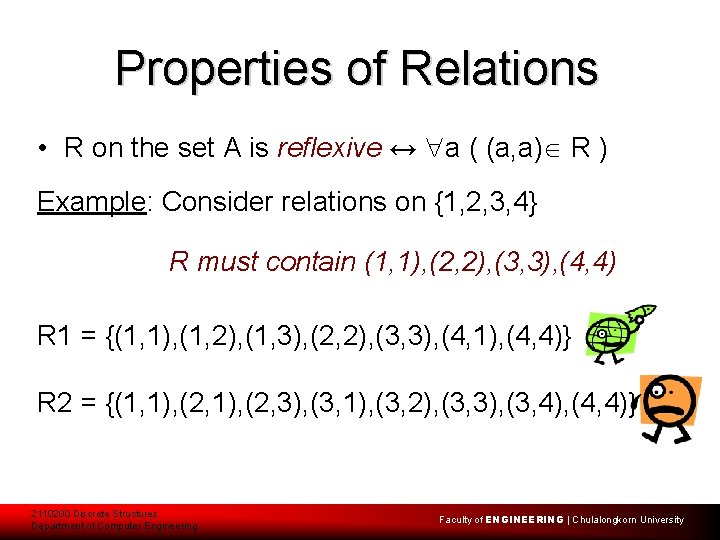
Properties of Relations • R on the set A is reflexive ↔ a ( (a, a) R ) Example: Consider relations on {1, 2, 3, 4} R must contain (1, 1), (2, 2), (3, 3), (4, 4) R 1 = {(1, 1), (1, 2), (1, 3), (2, 2), (3, 3), (4, 1), (4, 4)} R 2 = {(1, 1), (2, 3), (3, 1), (3, 2), (3, 3), (3, 4), (4, 4)} 2110200 Discrete Structures Department of Computer Engineering Faculty of ENGINEERING | Chulalongkorn University
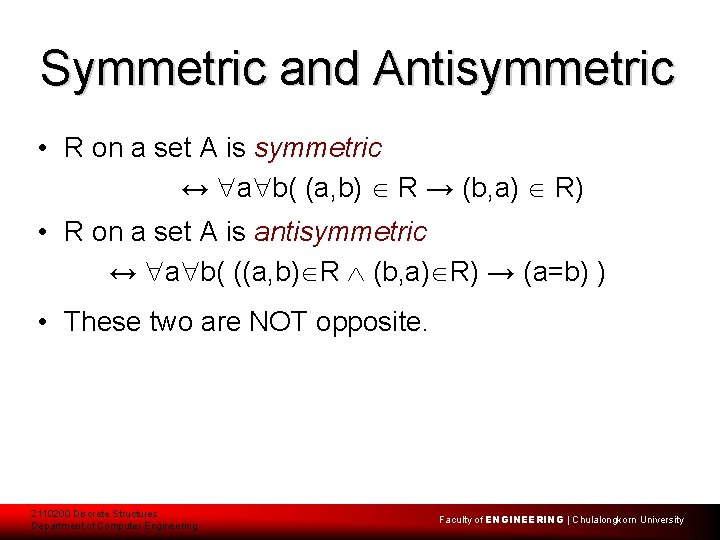
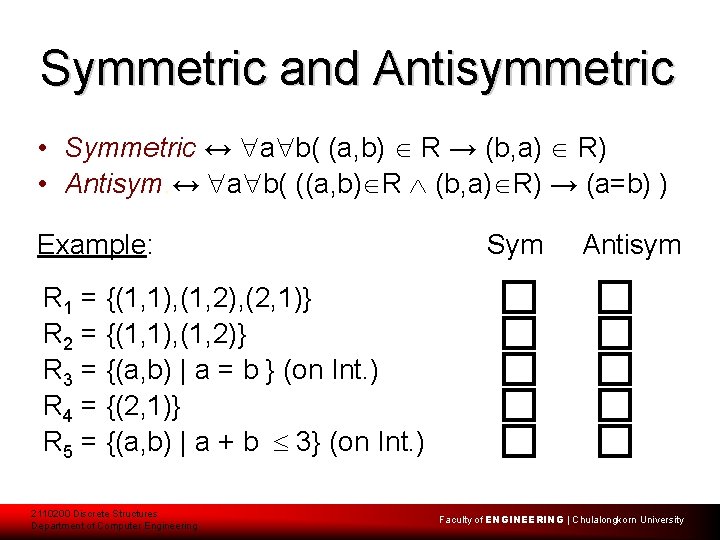
Symmetric and Antisymmetric • R on a set A is symmetric ↔ a b( (a, b) R → (b, a) R) • R on a set A is antisymmetric ↔ a b( ((a, b) R (b, a) R) → (a=b) ) • These two are NOT opposite. 2110200 Discrete Structures Department of Computer Engineering Faculty of ENGINEERING | Chulalongkorn University
Symmetric and Antisymmetric • Symmetric ↔ a b( (a, b) R → (b, a) R) • Antisym. ↔ a b( ((a, b) R (b, a) R) → (a=b) ) Example: Sym Antisym R 1 = {(1, 1), (1, 2), (2, 1)} R 2 = {(1, 1), (1, 2)} R 3 = {(a, b) | a = b } (on Int. ) R 4 = {(2, 1)} R 5 = {(a, b) | a + b 3} (on Int. ) 2110200 Discrete Structures Department of Computer Engineering Faculty of ENGINEERING | Chulalongkorn University
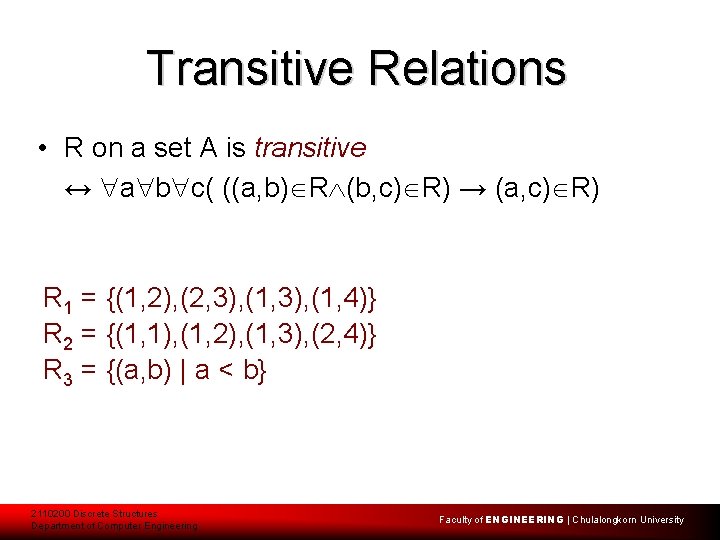
Transitive Relations • R on a set A is transitive ↔ a b c( ((a, b) R (b, c) R) → (a, c) R) Example: R 1 = {(1, 2), (2, 3), (1, 4)} R 2 = {(1, 1), (1, 2), (1, 3), (2, 4)} R 3 = {(a, b) | a < b} 2110200 Discrete Structures Department of Computer Engineering Faculty of ENGINEERING | Chulalongkorn University
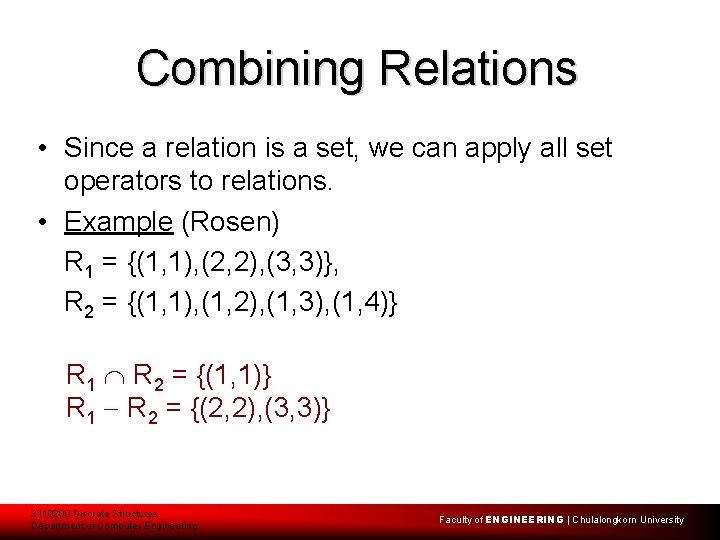
Combining Relations • Since a relation is a set, we can apply all set operators to relations. • Example (Rosen) R 1 = {(1, 1), (2, 2), (3, 3)}, R 2 = {(1, 1), (1, 2), (1, 3), (1, 4)} R 1 R 2 = {(1, 1)} R 1 R 2 = {(2, 2), (3, 3)} 2110200 Discrete Structures Department of Computer Engineering Faculty of ENGINEERING | Chulalongkorn University
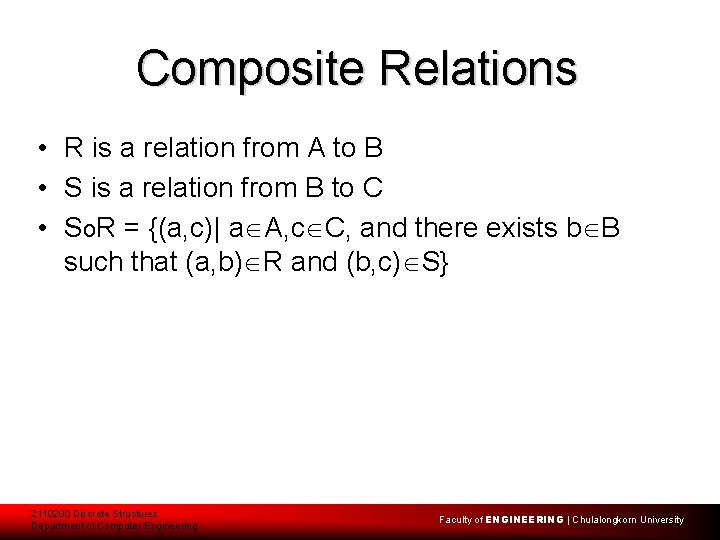
Composite Relations • R is a relation from A to B • S is a relation from B to C • So. R = {(a, c)| a A, c C, and there exists b B such that (a, b) R and (b, c) S} 2110200 Discrete Structures Department of Computer Engineering Faculty of ENGINEERING | Chulalongkorn University
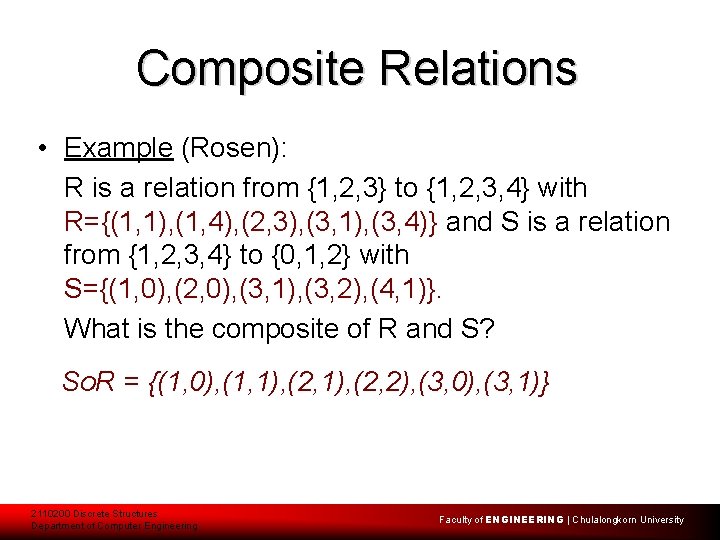
Composite Relations • Example (Rosen): R is a relation from {1, 2, 3} to {1, 2, 3, 4} with R={(1, 1), (1, 4), (2, 3), (3, 1), (3, 4)} and S is a relation from {1, 2, 3, 4} to {0, 1, 2} with S={(1, 0), (2, 0), (3, 1), (3, 2), (4, 1)}. What is the composite of R and S? So. R = {(1, 0), (1, 1), (2, 2), (3, 0), (3, 1)} 2110200 Discrete Structures Department of Computer Engineering Faculty of ENGINEERING | Chulalongkorn University