15 744 Computer Networking L7 Routing Issues Srinivasan


- Slides: 50
15 -744: Computer Networking L-7 Routing Issues © Srinivasan Seshan, 2001 LH-1; 1 -15 -00
New Routing Ideas Border Gateway Protocol (BGP) cont. • Overlay networks • Active networks • Assigned reading • • • [S+99] The End-to-End Effects of Internet Path Selection [W 99] Active network vision and reality: lessons from a capsule-based system © Srinivasan Seshan, 2002 L -7; 2 -6 -02 2
Outline • Multi-Homing • Stability Issues • Overlay Routing • Active Networks © Srinivasan Seshan, 2002 L -7; 2 -6 -02 3
Multi-homing With multi-homing, a single network has more than one connection to the Internet. • Improves reliability and performance: • • Can accommodate link failure Bandwidth is sum of links to Internet Challenges • • Getting policy right (MED, etc. . ) Addressing © Srinivasan Seshan, 2002 L -7; 2 -6 -02 4
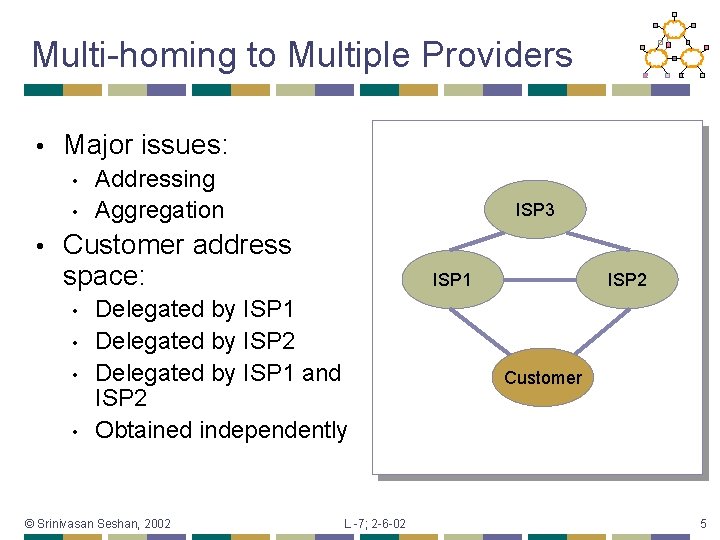
Multi-homing to Multiple Providers • Major issues: • • • Addressing Aggregation ISP 3 Customer address space: • • ISP 1 Delegated by ISP 2 Delegated by ISP 1 and ISP 2 Obtained independently © Srinivasan Seshan, 2002 L -7; 2 -6 -02 ISP 2 Customer 5
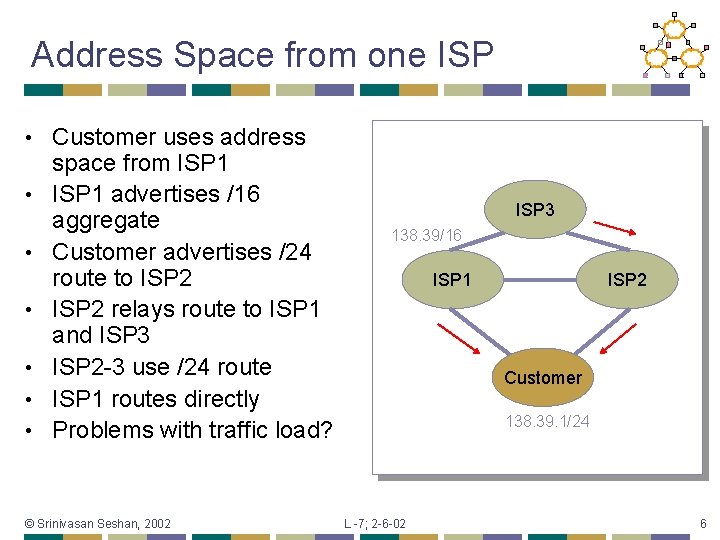
Address Space from one ISP • • Customer uses address space from ISP 1 advertises /16 aggregate Customer advertises /24 route to ISP 2 relays route to ISP 1 and ISP 3 ISP 2 -3 use /24 route ISP 1 routes directly Problems with traffic load? © Srinivasan Seshan, 2002 ISP 3 138. 39/16 ISP 1 ISP 2 Customer 138. 39. 1/24 L -7; 2 -6 -02 6
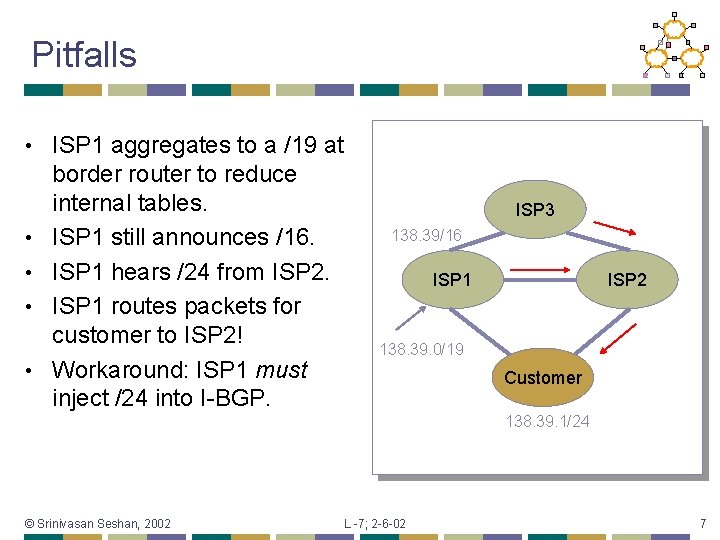
Pitfalls • • • ISP 1 aggregates to a /19 at border router to reduce internal tables. ISP 1 still announces /16. ISP 1 hears /24 from ISP 2. ISP 1 routes packets for customer to ISP 2! Workaround: ISP 1 must inject /24 into I-BGP. ISP 3 138. 39/16 ISP 1 ISP 2 138. 39. 0/19 Customer 138. 39. 1/24 © Srinivasan Seshan, 2002 L -7; 2 -6 -02 7
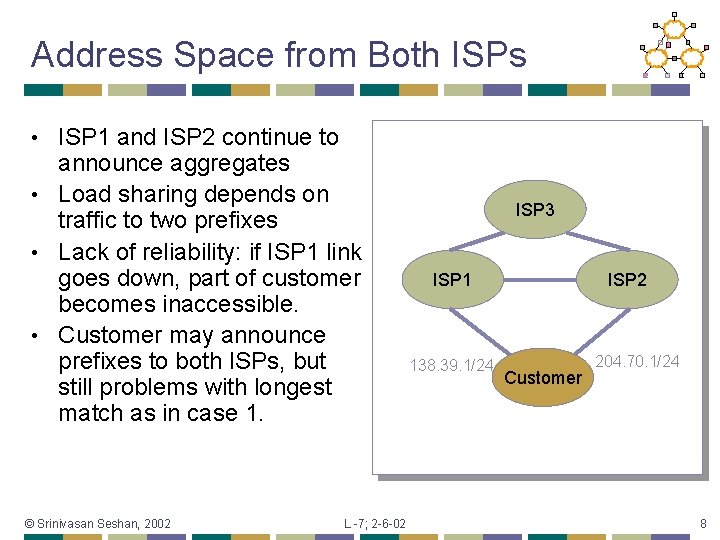
Address Space from Both ISPs ISP 1 and ISP 2 continue to announce aggregates • Load sharing depends on traffic to two prefixes • Lack of reliability: if ISP 1 link goes down, part of customer becomes inaccessible. • Customer may announce prefixes to both ISPs, but still problems with longest match as in case 1. • © Srinivasan Seshan, 2002 L -7; 2 -6 -02 ISP 3 ISP 1 138. 39. 1/24 ISP 2 Customer 204. 70. 1/24 8
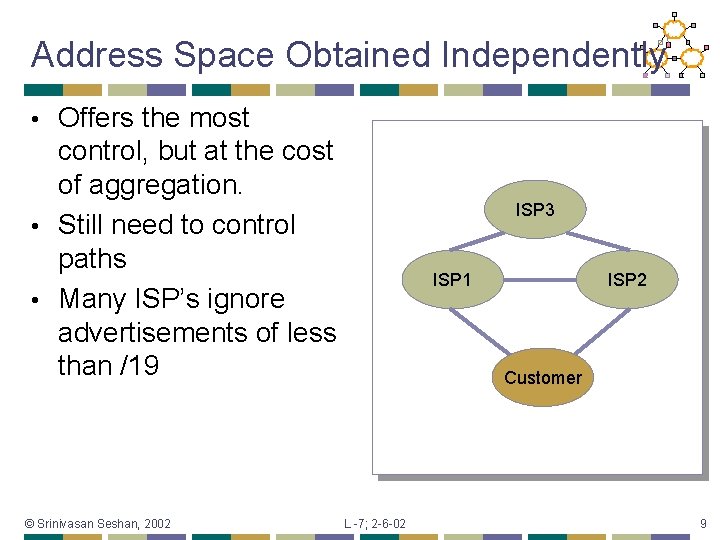
Address Space Obtained Independently Offers the most control, but at the cost of aggregation. • Still need to control paths • Many ISP’s ignore advertisements of less than /19 • © Srinivasan Seshan, 2002 ISP 3 ISP 1 ISP 2 Customer L -7; 2 -6 -02 9
Outline • Multi-Homing • Stability Issues • Overlay Routing • Active Networks © Srinivasan Seshan, 2002 L -7; 2 -6 -02 10
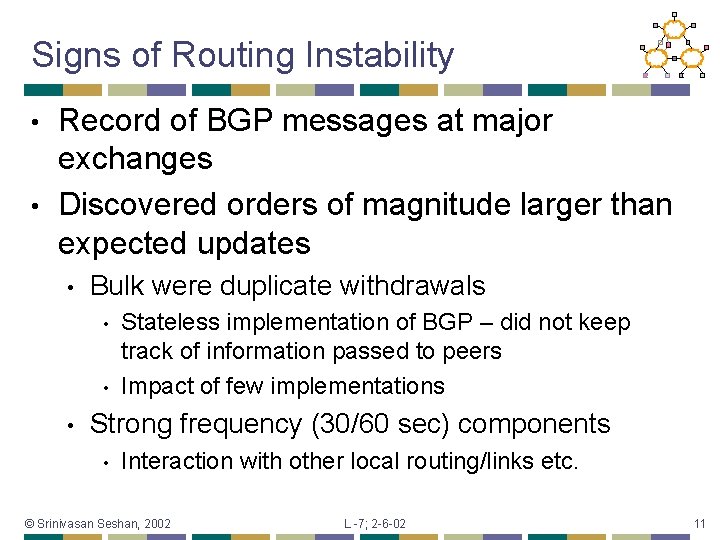
Signs of Routing Instability Record of BGP messages at major exchanges • Discovered orders of magnitude larger than expected updates • • Bulk were duplicate withdrawals • • • Stateless implementation of BGP – did not keep track of information passed to peers Impact of few implementations Strong frequency (30/60 sec) components • Interaction with other local routing/links etc. © Srinivasan Seshan, 2002 L -7; 2 -6 -02 11
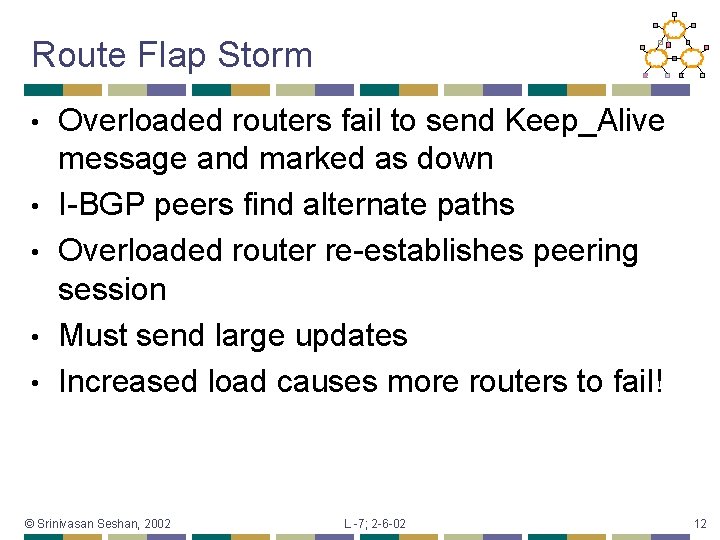
Route Flap Storm • • • Overloaded routers fail to send Keep_Alive message and marked as down I-BGP peers find alternate paths Overloaded router re-establishes peering session Must send large updates Increased load causes more routers to fail! © Srinivasan Seshan, 2002 L -7; 2 -6 -02 12
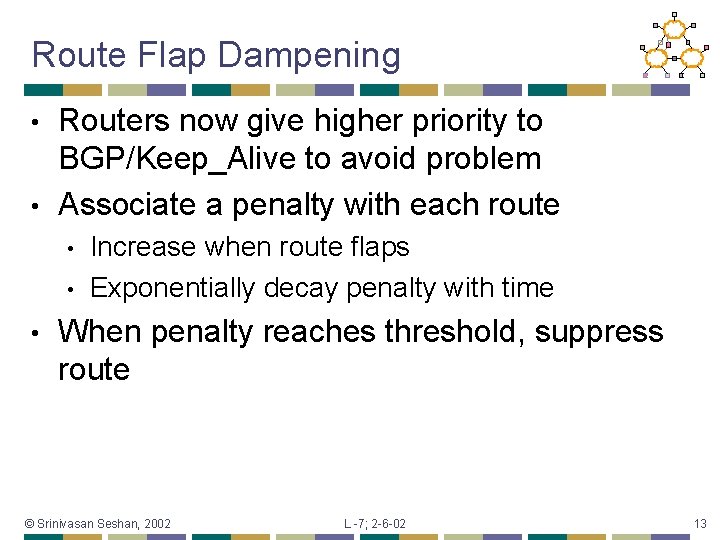
Route Flap Dampening Routers now give higher priority to BGP/Keep_Alive to avoid problem • Associate a penalty with each route • • Increase when route flaps Exponentially decay penalty with time When penalty reaches threshold, suppress route © Srinivasan Seshan, 2002 L -7; 2 -6 -02 13
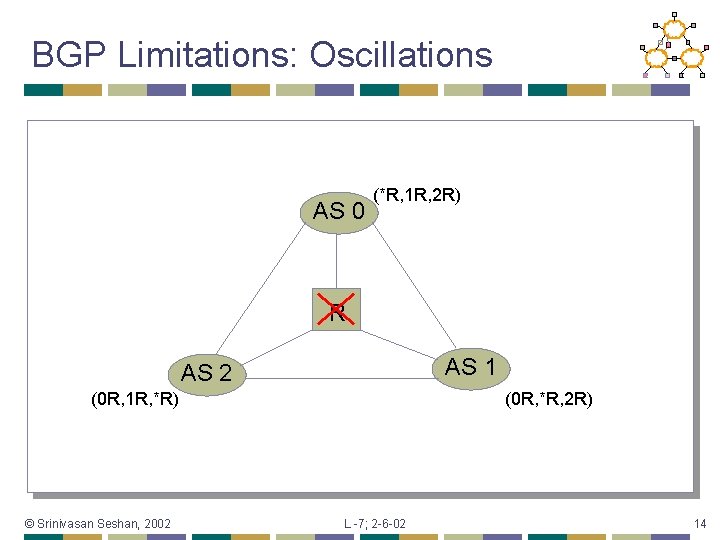
BGP Limitations: Oscillations AS 0 (*R, 1 R, 2 R) R AS 1 AS 2 (0 R, 1 R, *R) © Srinivasan Seshan, 2002 (0 R, *R, 2 R) L -7; 2 -6 -02 14
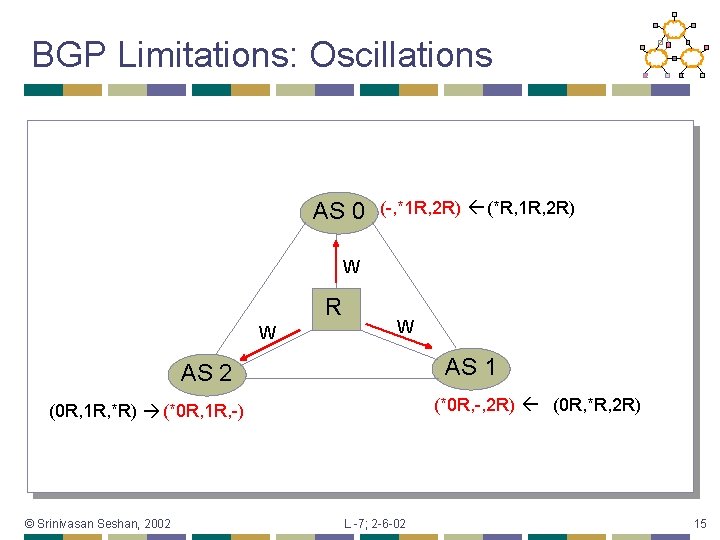
BGP Limitations: Oscillations AS 0 (-, *1 R, 2 R) (*R, 1 R, 2 R) W R W W AS 1 AS 2 (*0 R, -, 2 R) (0 R, *R, 2 R) (0 R, 1 R, *R) (*0 R, 1 R, -) © Srinivasan Seshan, 2002 L -7; 2 -6 -02 15
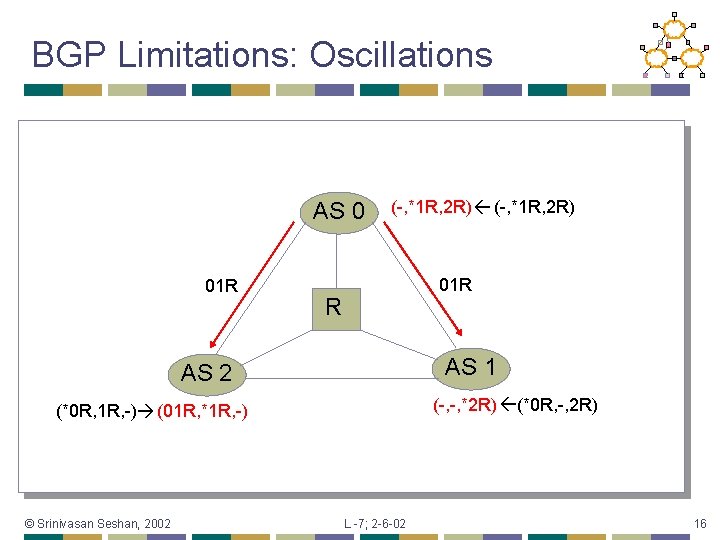
BGP Limitations: Oscillations AS 0 01 R (-, *1 R, 2 R) 01 R R AS 1 AS 2 (-, -, *2 R) (*0 R, -, 2 R) (*0 R, 1 R, -) (01 R, *1 R, -) © Srinivasan Seshan, 2002 L -7; 2 -6 -02 16
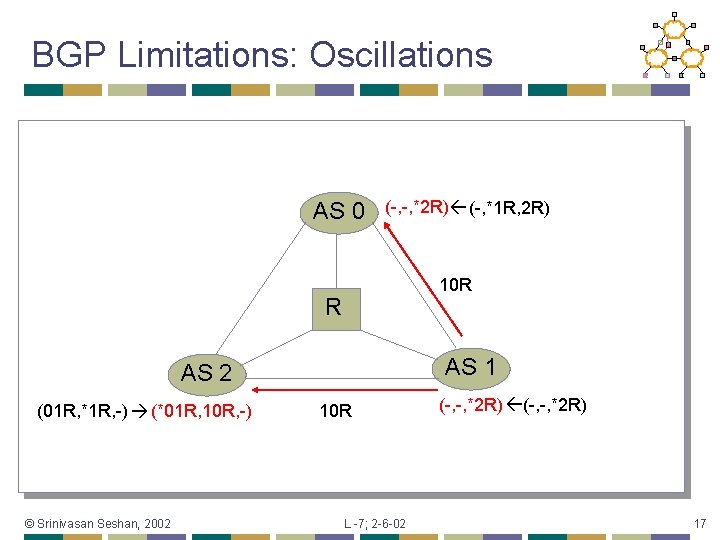
BGP Limitations: Oscillations AS 0 (-, -, *2 R) (-, *1 R, 2 R) 10 R R AS 1 AS 2 (01 R, *1 R, -) (*01 R, 10 R, -) © Srinivasan Seshan, 2002 10 R L -7; 2 -6 -02 (-, -, *2 R) 17
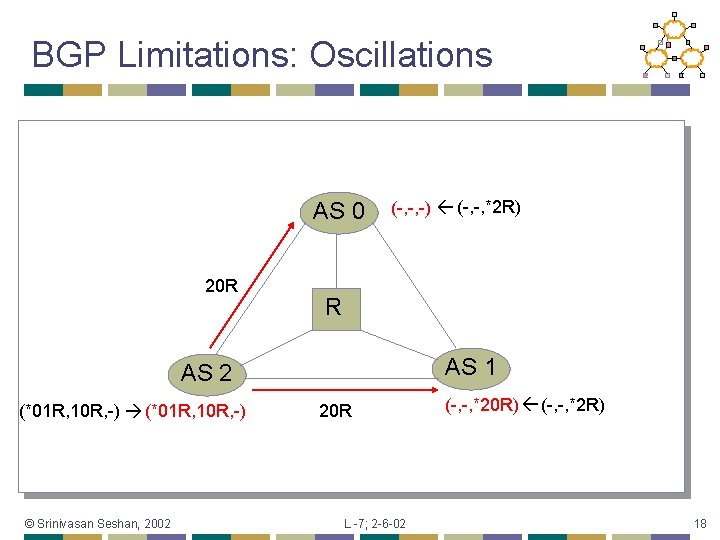
BGP Limitations: Oscillations AS 0 20 R (-, -, -) (-, -, *2 R) R AS 1 AS 2 (*01 R, 10 R, -) © Srinivasan Seshan, 2002 20 R L -7; 2 -6 -02 (-, -, *20 R) (-, -, *2 R) 18
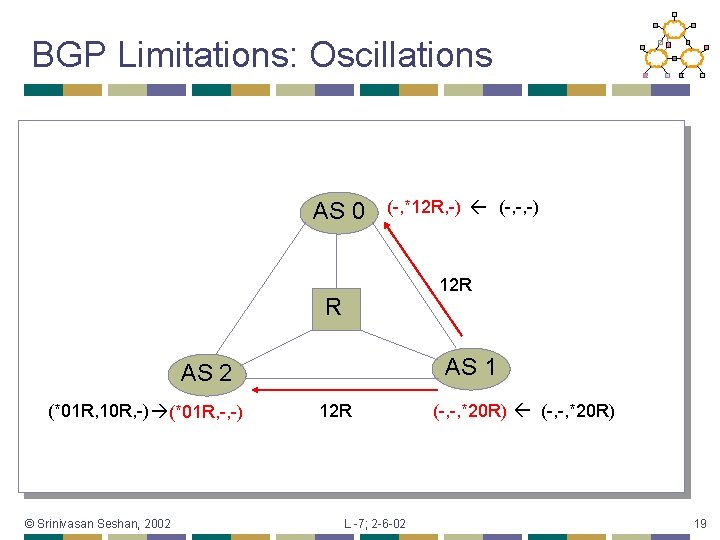
BGP Limitations: Oscillations AS 0 (-, *12 R, -) (-, -, -) 12 R R AS 1 AS 2 (*01 R, 10 R, -) (*01 R, -, -) © Srinivasan Seshan, 2002 12 R L -7; 2 -6 -02 (-, -, *20 R) 19
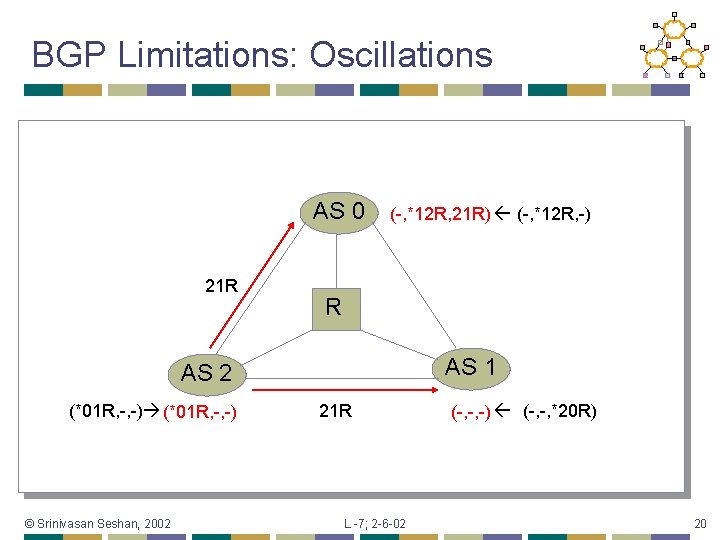
BGP Limitations: Oscillations AS 0 21 R (-, *12 R, 21 R) (-, *12 R, -) R AS 1 AS 2 (*01 R, -, -) © Srinivasan Seshan, 2002 21 R L -7; 2 -6 -02 (-, -, -) (-, -, *20 R) 20
BGP Oscillations Can possible explore every possible path through network (n-1)! Combinations • Limit between update messages (Min. Route. Adver) reduces exploration • • • Forces router to process all outstanding messages Typical Internet failover times • New/shorter link 60 seconds • • Down link 180 seconds • • Results in simple replacement at nodes Results in search of possible options Longer link 120 seconds • Results in replacement or search based on length © Srinivasan Seshan, 2002 L -7; 2 -6 -02 21
Outline • Multi-Homing • Stability Issues • Overlay Routing • Active Networks © Srinivasan Seshan, 2002 L -7; 2 -6 -02 22
Overlay Routing • Basic idea: • • • Treat multiple hops through IP network as one hop in overlay network Run routing protocol on overlay nodes Why? • • • For performance – can run more clever protocol on overlay For efficiency – can make core routers very simple For functionality – can provide new features such as multicast, active processing, IPv 6 © Srinivasan Seshan, 2002 L -7; 2 -6 -02 23
Overlay for Features • How do we add new features to the network? • • Does every router need to support new feature? Choices • • Reprogram all routers active networks Support new feature within an overlay Basic technique: tunnel packets Tunnels • • IP-in-IP encapsulation Poor interaction with firewalls, multi-path routers, etc. © Srinivasan Seshan, 2002 L -7; 2 -6 -02 24
Examples • IP V 6 & IP Multicast • • Mobile IP • • Tunnels between routers supporting feature Home agent tunnels packets to mobile host’s location QOS • Needs some support from intermediate routers © Srinivasan Seshan, 2002 L -7; 2 -6 -02 25
Overlay for Efficiency • Multi-path routing • • • More efficient use of links or QOS Need to be able to direct packets based on more than just destination address can be computationally expensive What granularity? Per source? Per connection? Per packet? • • • Per packet re-ordering Per source, per flow coarse grain vs. fine grain Take advantage of relative duration of flows • Most bytes on long flows © Srinivasan Seshan, 2002 L -7; 2 -6 -02 26
Edge vs. Core Routers Island of routers • Edges can perform complex computation to classify flow • Cores do extremely simple forwarding • How to communicate computation results • • • MPLS Dynamic packet state © Srinivasan Seshan, 2002 L -7; 2 -6 -02 27
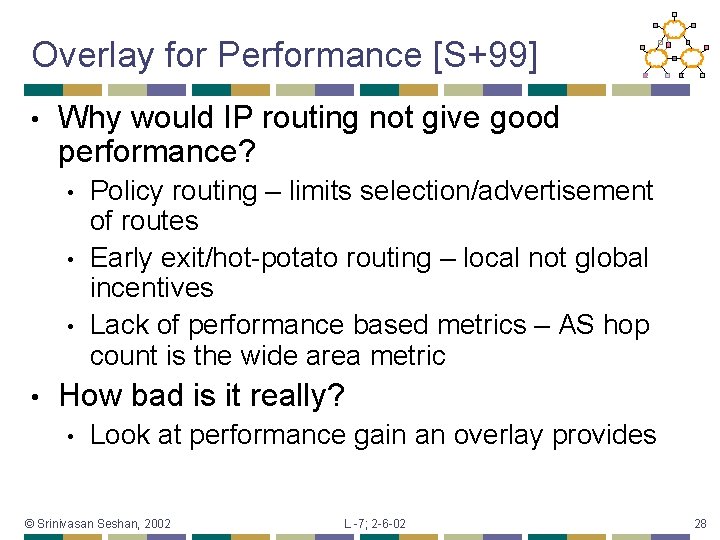
Overlay for Performance [S+99] • Why would IP routing not give good performance? • • Policy routing – limits selection/advertisement of routes Early exit/hot-potato routing – local not global incentives Lack of performance based metrics – AS hop count is the wide area metric How bad is it really? • Look at performance gain an overlay provides © Srinivasan Seshan, 2002 L -7; 2 -6 -02 28
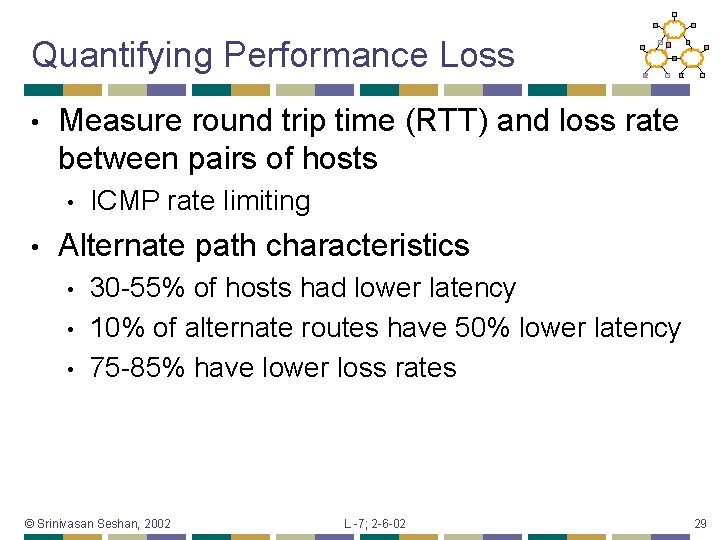
Quantifying Performance Loss • Measure round trip time (RTT) and loss rate between pairs of hosts • • ICMP rate limiting Alternate path characteristics • • • 30 -55% of hosts had lower latency 10% of alternate routes have 50% lower latency 75 -85% have lower loss rates © Srinivasan Seshan, 2002 L -7; 2 -6 -02 29
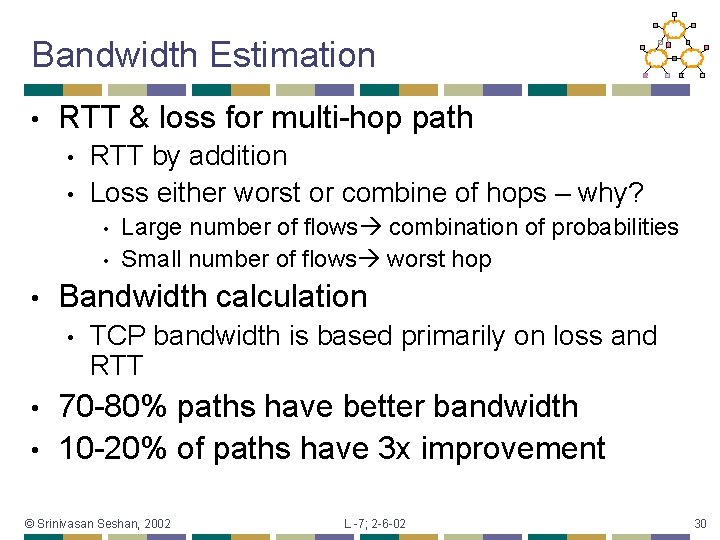
Bandwidth Estimation • RTT & loss for multi-hop path • • RTT by addition Loss either worst or combine of hops – why? • • • Large number of flows combination of probabilities Small number of flows worst hop Bandwidth calculation • TCP bandwidth is based primarily on loss and RTT 70 -80% paths have better bandwidth • 10 -20% of paths have 3 x improvement • © Srinivasan Seshan, 2002 L -7; 2 -6 -02 30
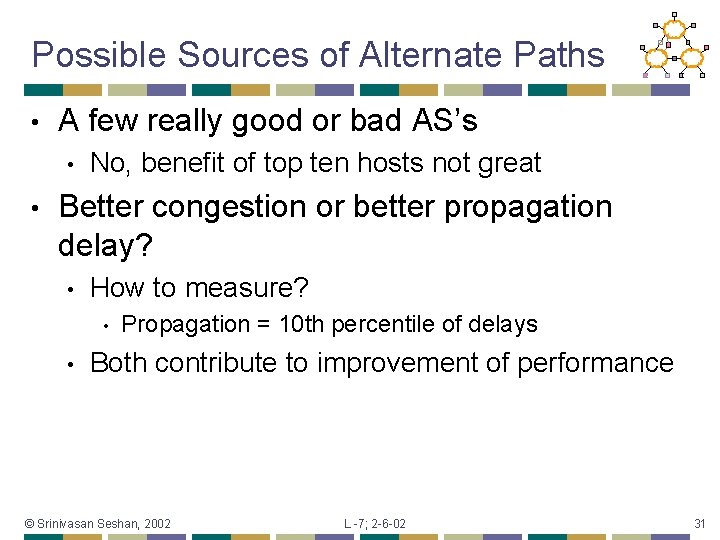
Possible Sources of Alternate Paths • A few really good or bad AS’s • • No, benefit of top ten hosts not great Better congestion or better propagation delay? • How to measure? • • Propagation = 10 th percentile of delays Both contribute to improvement of performance © Srinivasan Seshan, 2002 L -7; 2 -6 -02 31
Overlay Challenges “Routers” no longer have complete knowledge about link they are responsible for • How do you build efficient overlay • • • Probably don’t want all N 2 links – which links to create? Without direct knowledge of underlying topology how to know what’s nearby and what is efficient? © Srinivasan Seshan, 2002 L -7; 2 -6 -02 32
Future of Overlay • Application specific overlays • • Caching • • Intercept requests and create responses Transcoding • • Why should overlay nodes only do routing? Changing content of packets to match available bandwidth Peer-to-peer applications © Srinivasan Seshan, 2002 L -7; 2 -6 -02 33
Outline • Multi-Homing • Stability Issues • Overlay Routing • Active Networks © Srinivasan Seshan, 2002 L -7; 2 -6 -02 34
Why Active Networks? • Traditional networks route packets looking only at destination • • Problem • • Also, maybe source fields (e. g. multicast) Rate of deployment of new protocols and applications is too slow Solution • Allow computation in routers to support new protocol deployment © Srinivasan Seshan, 2002 L -7; 2 -6 -02 35
Active Networks • Nodes (routers) receive packets: • • Perform computation based on their internal state and control information carried in packet Forward zero or more packets to end points depending on result of the computation Users and apps can control behavior of the routers • End result: network services richer than those by the simple IP service model • © Srinivasan Seshan, 2002 L -7; 2 -6 -02 36
Why not IP? • Applications that do more than IP forwarding • • • Firewalls Web proxies and caches Transcoding services Nomadic routers (mobile IP) Transport gateways (snoop) Reliable multicast (lightweight multicast, PGM) Online auctions Sensor data mixing and fusion Active networks makes such applications easy to develop and deploy © Srinivasan Seshan, 2002 L -7; 2 -6 -02 37
Variations on Active Networks • Programmable routers • • • Active control • • • More flexible than current configuration mechanism For use by administrators or privileged users Forwarding code remains the same Useful for management/signaling/measurement of traffic “Active networks” • • • Computation occurring at the network (IP) layer of the protocol stack capsule based approach Programming can be done by any user Source of most active debate © Srinivasan Seshan, 2002 L -7; 2 -6 -02 38
Case Study: MIT ANTS System • Conventional Networks: • • Active Networks: • • All routers perform same computation Routers have same runtime system Tradeoffs between functionality, performance and security © Srinivasan Seshan, 2002 L -7; 2 -6 -02 39
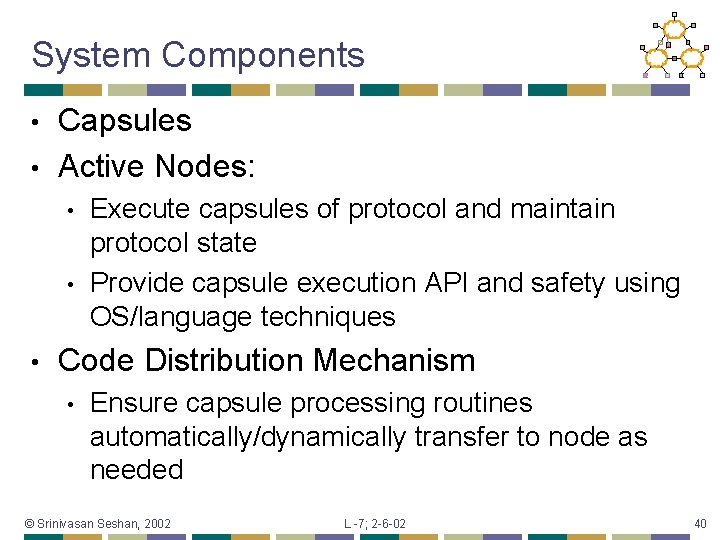
System Components Capsules • Active Nodes: • • Execute capsules of protocol and maintain protocol state Provide capsule execution API and safety using OS/language techniques Code Distribution Mechanism • Ensure capsule processing routines automatically/dynamically transfer to node as needed © Srinivasan Seshan, 2002 L -7; 2 -6 -02 40
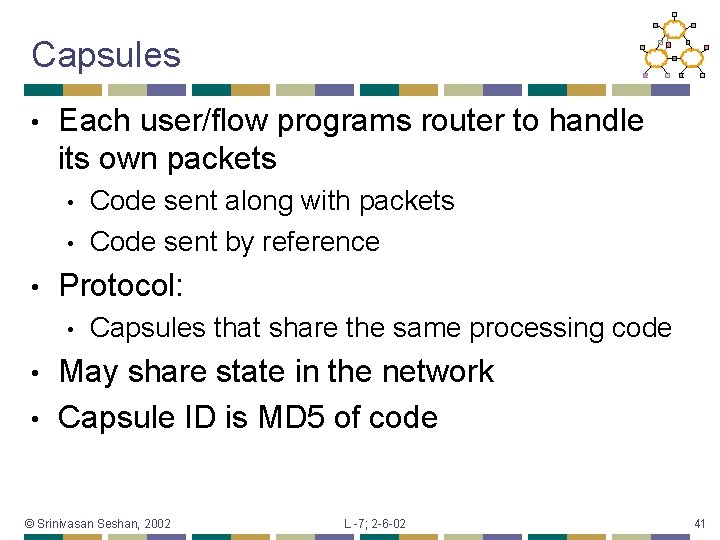
Capsules • Each user/flow programs router to handle its own packets • • • Code sent along with packets Code sent by reference Protocol: • Capsules that share the same processing code May share state in the network • Capsule ID is MD 5 of code • © Srinivasan Seshan, 2002 L -7; 2 -6 -02 41
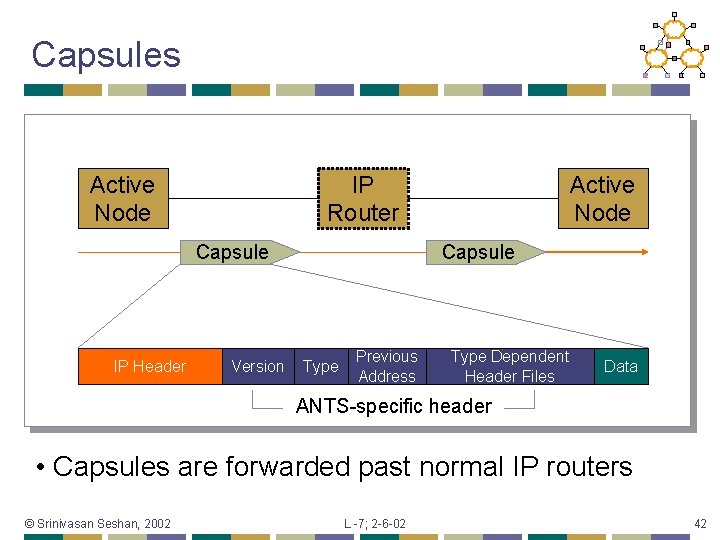
Capsules Active Node IP Router Capsule IP Header Version Active Node Capsule Type Previous Address Type Dependent Header Files Data ANTS-specific header • Capsules are forwarded past normal IP routers © Srinivasan Seshan, 2002 L -7; 2 -6 -02 42
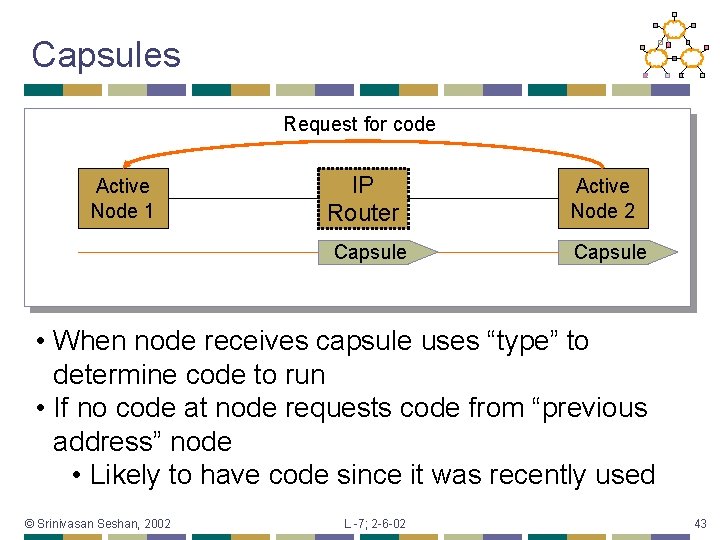
Capsules Request for code Active Node 1 IP Router Capsule Active Node 2 Capsule • When node receives capsule uses “type” to determine code to run • If no code at node requests code from “previous address” node • Likely to have code since it was recently used © Srinivasan Seshan, 2002 L -7; 2 -6 -02 43
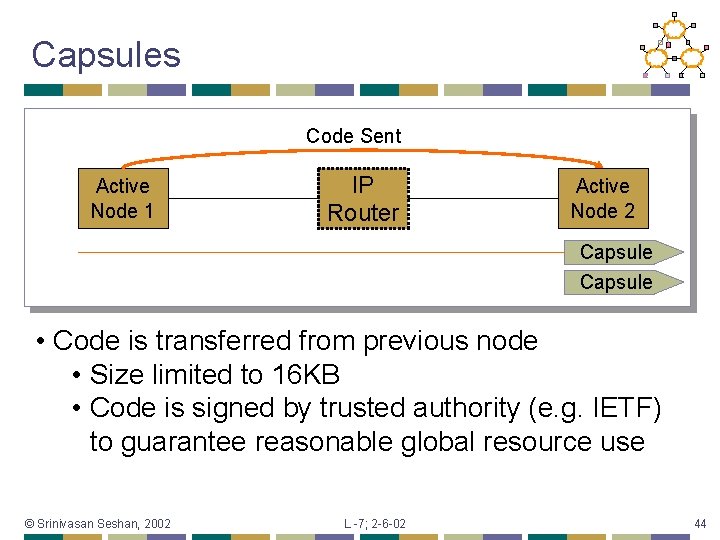
Capsules Code Sent Active Node 1 IP Router Active Node 2 Capsule • Code is transferred from previous node • Size limited to 16 KB • Code is signed by trusted authority (e. g. IETF) to guarantee reasonable global resource use © Srinivasan Seshan, 2002 L -7; 2 -6 -02 44
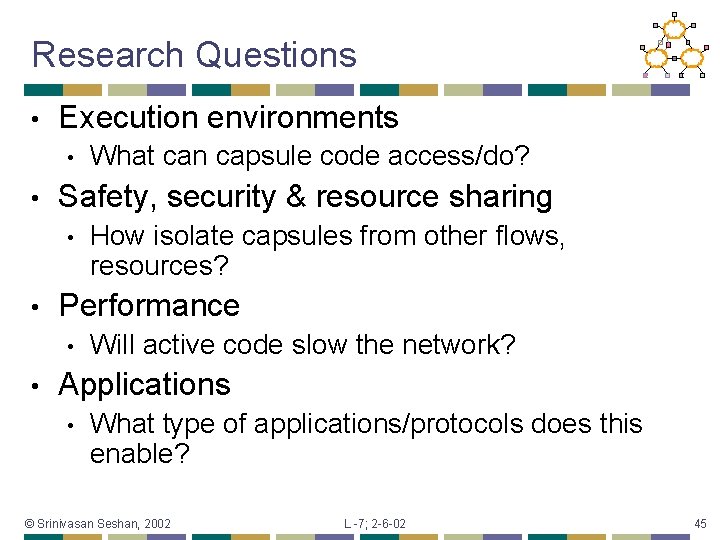
Research Questions • Execution environments • • Safety, security & resource sharing • • How isolate capsules from other flows, resources? Performance • • What can capsule code access/do? Will active code slow the network? Applications • What type of applications/protocols does this enable? © Srinivasan Seshan, 2002 L -7; 2 -6 -02 45
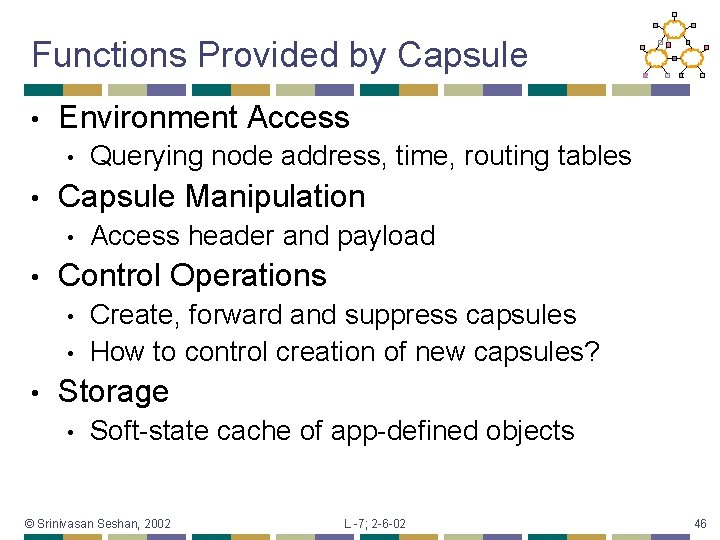
Functions Provided by Capsule • Environment Access • • Capsule Manipulation • • Access header and payload Control Operations • • • Querying node address, time, routing tables Create, forward and suppress capsules How to control creation of new capsules? Storage • Soft-state cache of app-defined objects © Srinivasan Seshan, 2002 L -7; 2 -6 -02 46
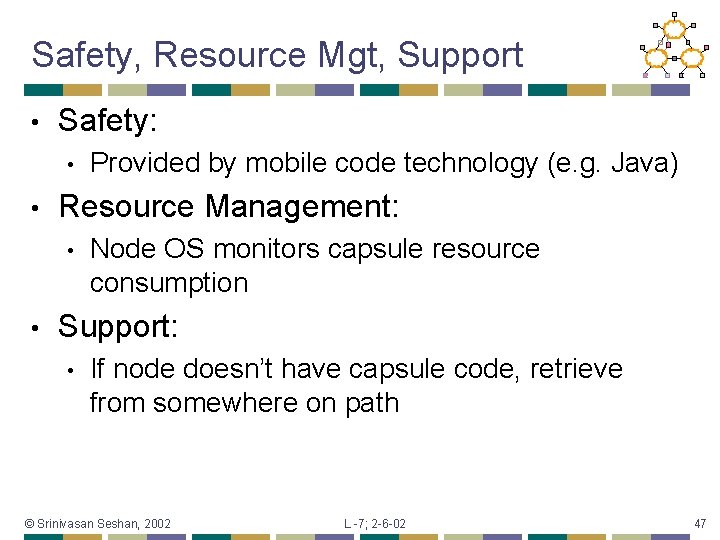
Safety, Resource Mgt, Support • Safety: • • Resource Management: • • Provided by mobile code technology (e. g. Java) Node OS monitors capsule resource consumption Support: • If node doesn’t have capsule code, retrieve from somewhere on path © Srinivasan Seshan, 2002 L -7; 2 -6 -02 47
Applications/Protocols • Limitations • • • Expressible limited by execution environment Compact less than 16 KB Fast aborted if slower than forwarding rate Incremental not all nodes will be active Proof by example • Host mobility, multicast, path MTU, Web cache routing, etc. © Srinivasan Seshan, 2002 L -7; 2 -6 -02 48
Discussion Active nodes present lots of applications with a desirable architecture • Key questions • • • Is all this necessary at the forwarding level of the network? Is ease of deploying new apps/services and protocols a reality? © Srinivasan Seshan, 2002 L -7; 2 -6 -02 49
Next Lecture: Mobile Routing Mobile IP • Ad-hoc networks • Assigned reading • • • [Joh 96] Scalable Support for Transparent Mobile Host Internetworking [BMJ+98] A Performance Comparison of Multi. Hop Wireless Ad Hoc Routing Protocols © Srinivasan Seshan, 2002 L -7; 2 -6 -02 50