
GPU Profiling for Deep Learning Frameworks CS 744
- Slides: 1
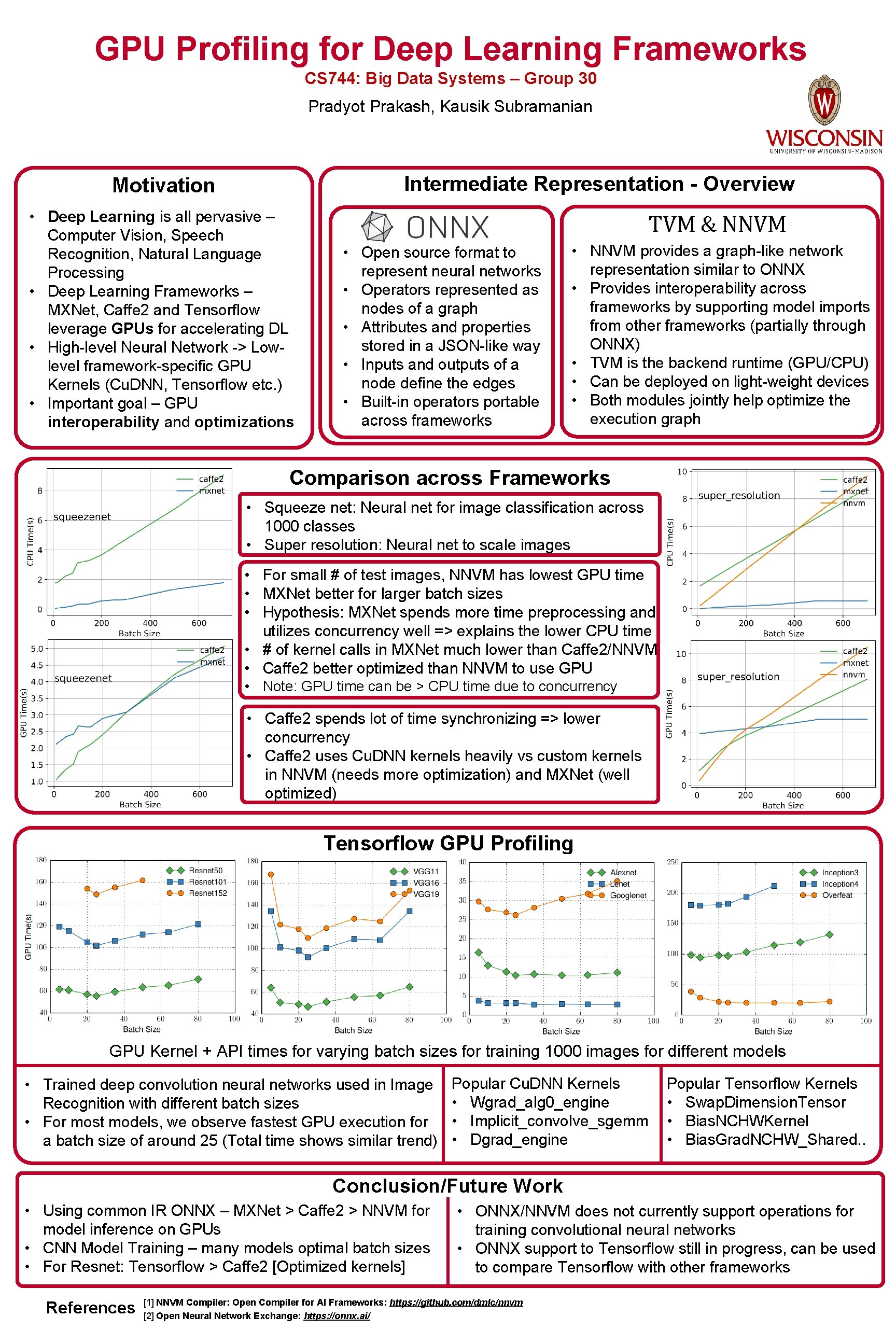
GPU Profiling for Deep Learning Frameworks CS 744: Big Data Systems – Group 30 Pradyot Prakash, Kausik Subramanian Intermediate Representation - Overview Motivation • Deep Learning is all pervasive – Computer Vision, Speech Recognition, Natural Language Processing • Deep Learning Frameworks – MXNet, Caffe 2 and Tensorflow leverage GPUs for accelerating DL • High-level Neural Network -> Lowlevel framework-specific GPU Kernels (Cu. DNN, Tensorflow etc. ) • Important goal – GPU interoperability and optimizations TVM & NNVM • Open source format to represent neural networks • Operators represented as nodes of a graph • Attributes and properties stored in a JSON-like way • Inputs and outputs of a node define the edges • Built-in operators portable across frameworks • NNVM provides a graph-like network representation similar to ONNX • Provides interoperability across frameworks by supporting model imports from other frameworks (partially through ONNX) • TVM is the backend runtime (GPU/CPU) • Can be deployed on light-weight devices • Both modules jointly help optimize the execution graph Comparison across Frameworks • Squeeze net: Neural net for image classification across 1000 classes • Super resolution: Neural net to scale images • For small # of test images, NNVM has lowest GPU time • MXNet better for larger batch sizes • Hypothesis: MXNet spends more time preprocessing and utilizes concurrency well => explains the lower CPU time • # of kernel calls in MXNet much lower than Caffe 2/NNVM • Caffe 2 better optimized than NNVM to use GPU • Note: GPU time can be > CPU time due to concurrency • Caffe 2 spends lot of time synchronizing => lower concurrency • Caffe 2 uses Cu. DNN kernels heavily vs custom kernels in NNVM (needs more optimization) and MXNet (well optimized) Tensorflow GPU Profiling GPU Kernel + API times for varying batch sizes for training 1000 images for different models • Trained deep convolution neural networks used in Image Recognition with different batch sizes • For most models, we observe fastest GPU execution for a batch size of around 25 (Total time shows similar trend) Popular Cu. DNN Kernels • Wgrad_alg 0_engine • Implicit_convolve_sgemm • Dgrad_engine Popular Tensorflow Kernels • Swap. Dimension. Tensor • Bias. NCHWKernel • Bias. Grad. NCHW_Shared. . Conclusion/Future Work • Using common IR ONNX – MXNet > Caffe 2 > NNVM for model inference on GPUs • CNN Model Training – many models optimal batch sizes • For Resnet: Tensorflow > Caffe 2 [Optimized kernels] References • ONNX/NNVM does not currently support operations for training convolutional neural networks • ONNX support to Tensorflow still in progress, can be used to compare Tensorflow with other frameworks [1] NNVM Compiler: Open Compiler for AI Frameworks: https: //github. com/dmlc/nnvm [2] Open Neural Network Exchange: https: //onnx. ai/