Yang the Second and Her Secret Admirers 392


- Slides: 40
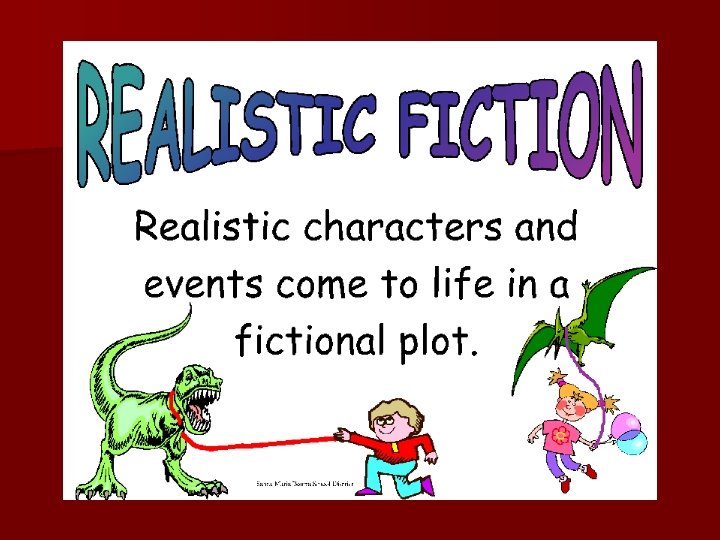
Yang the Second and Her Secret Admirers 392 A n Genre: n Realistic Fiction characters and events come to life in a fictional plot. n When n Selection Summary: Yinglan Yang is uninterested in American culture after the family’s move from China, her brother and sister plot to change her mind.
n This Background 392 K theme is about the ways in which people connect with one another. n You are about to read about a brother and sister who use a trick to try to get their older sister to connect with a boy at her school. n Read 392 -393. n What are some of your customs?
Vocabulary n accompaniment: 393 A Trans 4 -16 a musical part that adds to the performance of a singer or musician n demonstration: a process through which someone shows and explains to others how something works. n heritage: all the practices and beliefs passed down from earlier generations.
Vocabulary nimpressed: 393 A had a strong, positive effect on someone’s feeling. nnoble: showing greatness of character by unselfish behavior. nopera: a form of theater
Vocabulary 393 A nrhythmic: having a strong beat with a pattern to it n PB 232 ntradition: the passing down of culture from one generation to the next.
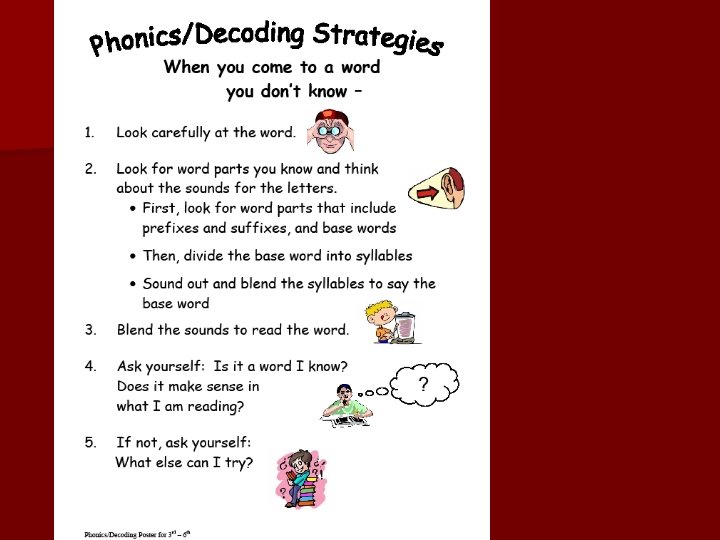
Phonics n. What 393 A are our Phonics/Decoding skills? n. They are chunking, words we know, beginning and endings, affixes, syllables, try different vowel sounds, base words or root words, blending, look carefully
Vocabulary Link n culture: the customs, beliefs, and way of life common to a set of people n customary: according to habit or tradition; usual n utensil: an instrument used to handle and eat food n consumed: eaten or used up n converse: to talk with one or more people
Phonics n. It 393 A could turn out to be really embarrassing for Second Sister. n. Help me figure out this word. What word parts do you know?
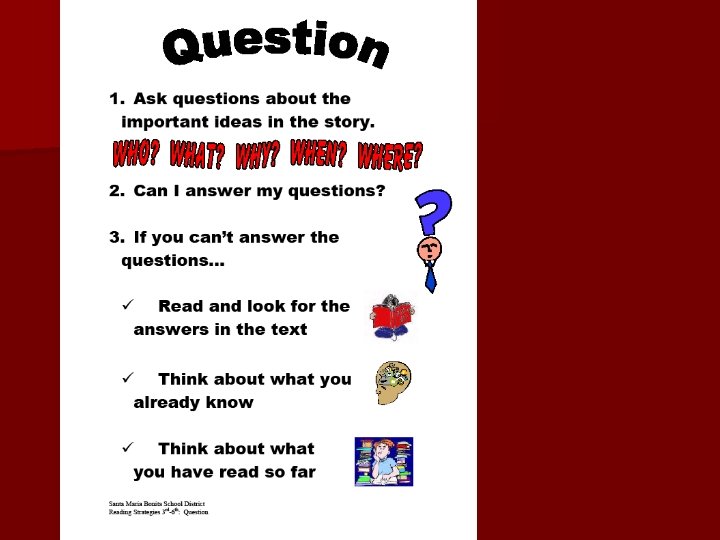
Reading Strategy 393 B n Strategy Focus: Question n Who is Yang the Second? Who secretly admires her? As you read the selection, use what you discover about characters and events to create more questions that you can ask your classmates. n By asking yourself questions about the characters and events of a story can help you better understand what is happening,
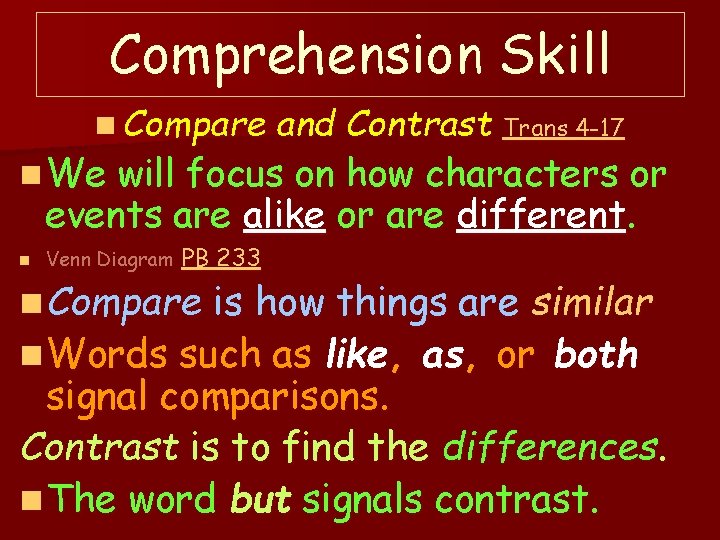
Comprehension Skill n Compare n We and Contrast Trans 4 -17 will focus on how characters or events are alike or are different. n Venn Diagram PB 233 n Compare is how things are similar n Words such as like, as, or both signal comparisons. Contrast is to find the differences. n The word but signals contrast.
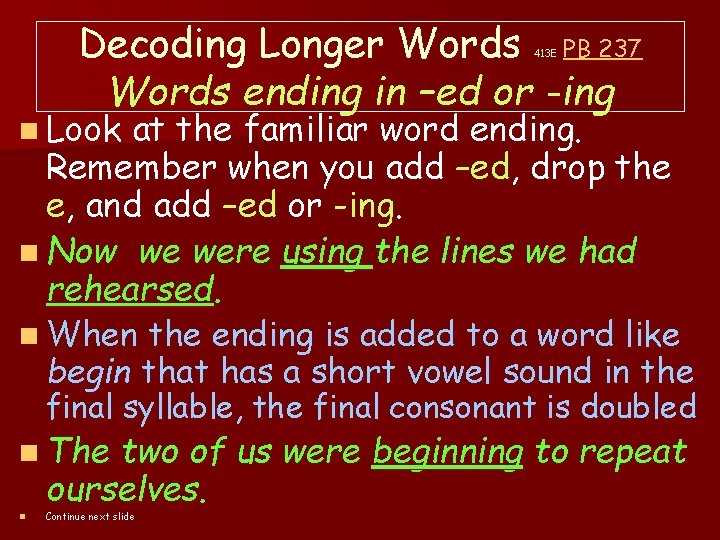
Decoding Longer Words PB 237 Words ending in –ed or -ing 413 E n Look at the familiar word ending. Remember when you add –ed, drop the e, and add –ed or -ing. n Now we were using the lines we had rehearsed. n When the ending is added to a word like begin that has a short vowel sound in the final syllable, the final consonant is doubled n The n two of us were beginning to repeat ourselves. Continue next slide
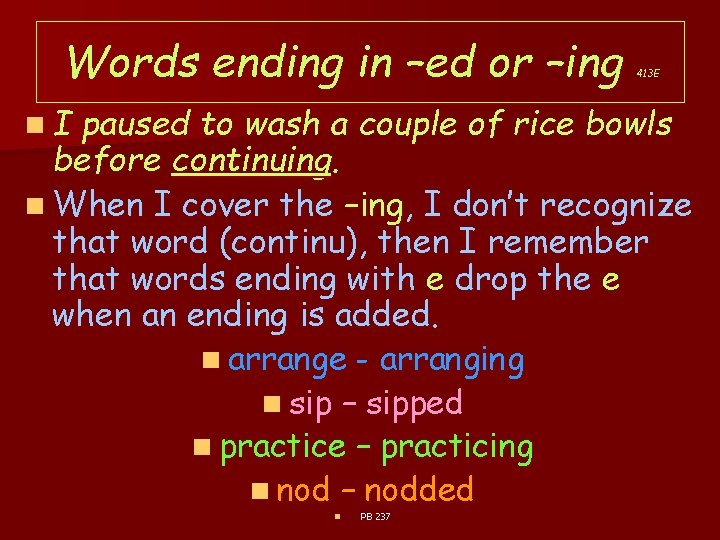
Words ending in –ed or –ing n. I 413 E paused to wash a couple of rice bowls before continuing. n When I cover the –ing, I don’t recognize that word (continu), then I remember that words ending with e drop the e when an ending is added. n arrange - arranging n sip – sipped n practice – practicing n nod – nodded n PB 237
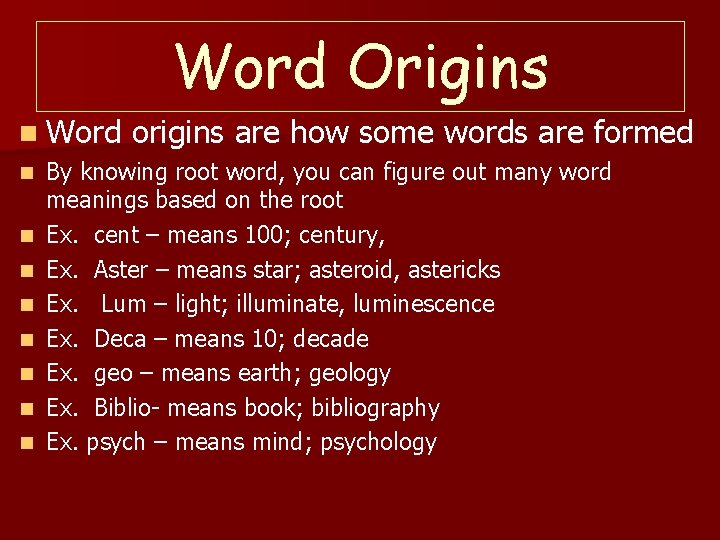
Word Origins n Word n n n n origins are how some words are formed By knowing root word, you can figure out many word meanings based on the root Ex. cent – means 100; century, Ex. Aster – means star; asteroid, astericks Ex. Lum – light; illuminate, luminescence Ex. Deca – means 10; decade Ex. geo – means earth; geology Ex. Biblio- means book; bibliography Ex. psych – means mind; psychology
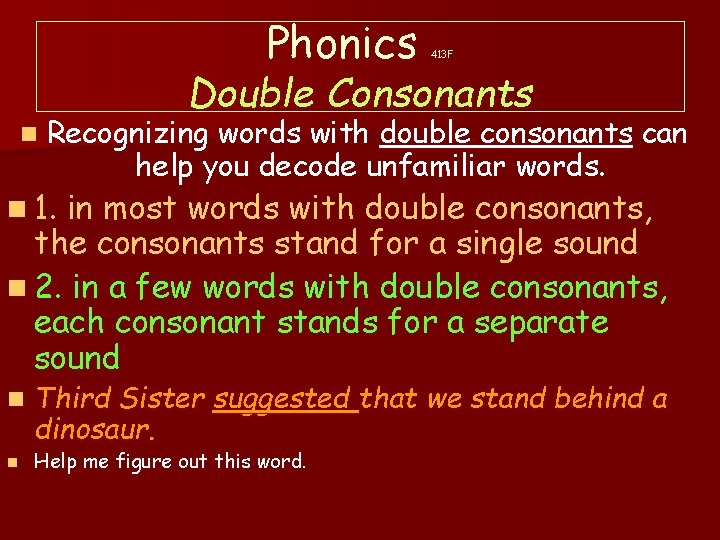
Phonics 413 F Double Consonants n Recognizing words with double consonants can help you decode unfamiliar words. n 1. in most words with double consonants, the consonants stand for a single sound n 2. in a few words with double consonants, each consonant stands for a separate sound n n Third Sister suggested that we stand behind a dinosaur. Help me figure out this word.
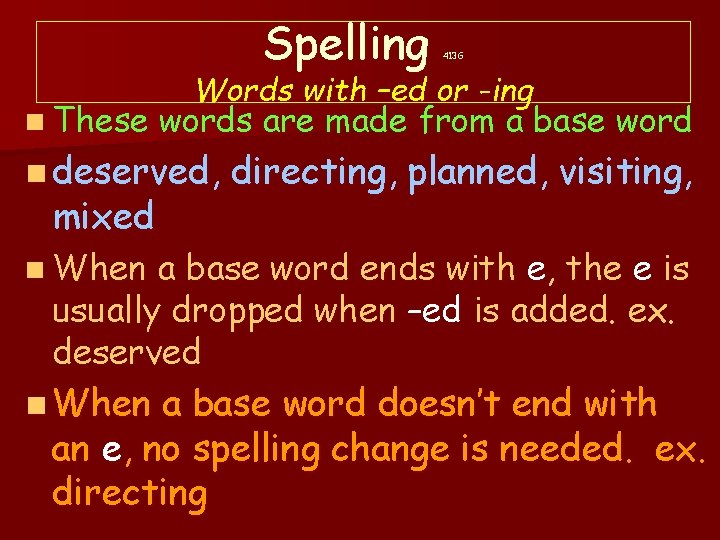
Spelling n These Words with –ed or -ing words are made from a base word n deserved, mixed 413 G directing, planned, visiting, n When a base word ends with e, the e is usually dropped when –ed is added. ex. deserved n When a base word doesn’t end with an e, no spelling change is needed. ex. directing
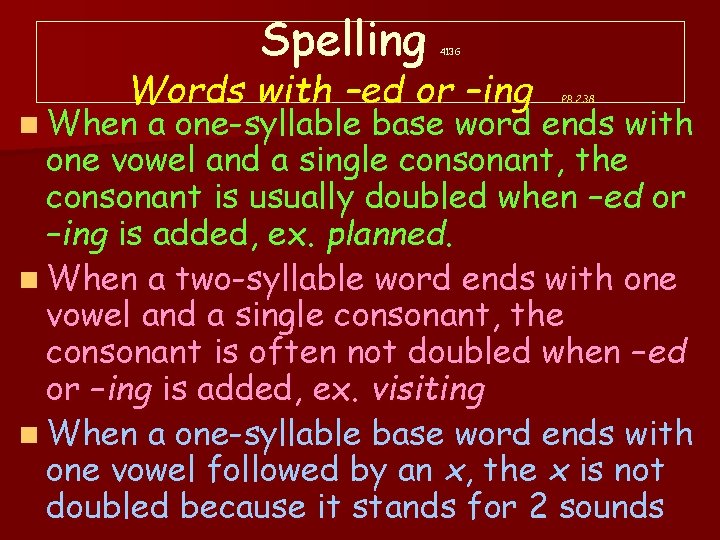
Spelling 413 G Words with –ed or –ing n When PB 238 a one-syllable base word ends with one vowel and a single consonant, the consonant is usually doubled when –ed or –ing is added, ex. planned. n When a two-syllable word ends with one vowel and a single consonant, the consonant is often not doubled when –ed or –ing is added, ex. visiting n When a one-syllable base word ends with one vowel followed by an x, the x is not doubled because it stands for 2 sounds
Vocabulary n What 413 G n Classifying PB 239 spelling words complete these word groups? n found, saw, n spotted n basketball, soccer, n swimming n funny, laughable, n amusing
Vocabulary Skills Dictionary: Prefixes 413 I n The lines suddenly sounded really stiff and unnatural. n If you recognize the base word but not the part attached to it, you may be able to figure out its meaning by looking up the word part in the dictionary. n Dictionaries list prefixes alphabetically. n What do these prefixes mean? n un, re, in, im, con PB 241
Prefixes un- mean not re- means again Prefixes are word parts added to a ‘ base word or word root that will change the meaning of the word. im- means not, or opposite Con and com mean with, together, sometimes not
Grammar n An Interjections 413 K Trans 4 -19 interjection is a word or words that expresses strong feeling. n An interjection usually appears at the beginning of a sentence. n An interjection can be followed by either a comma or an exclamation point, depending on how strong a feeling is expressed. PB. 242
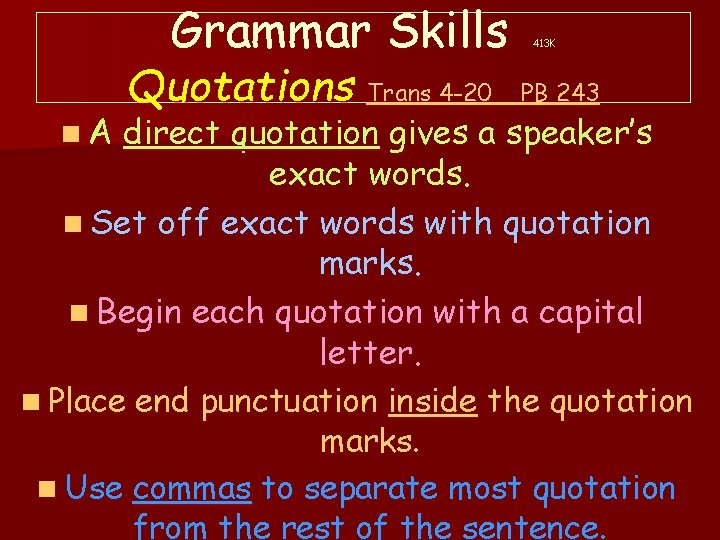
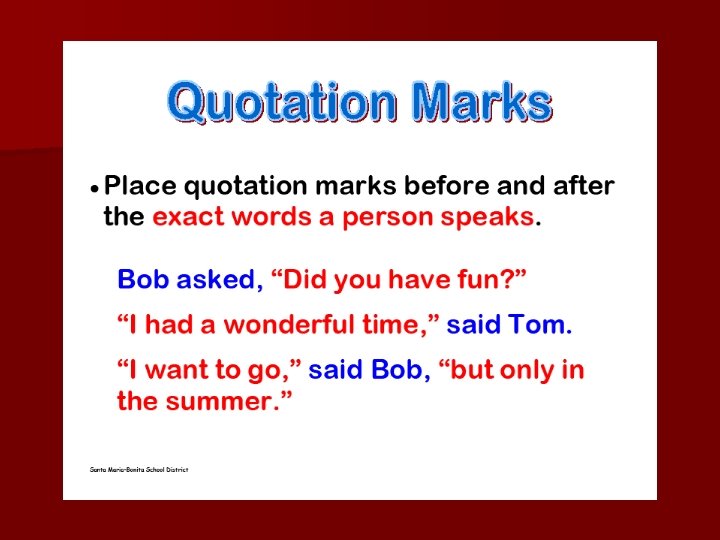
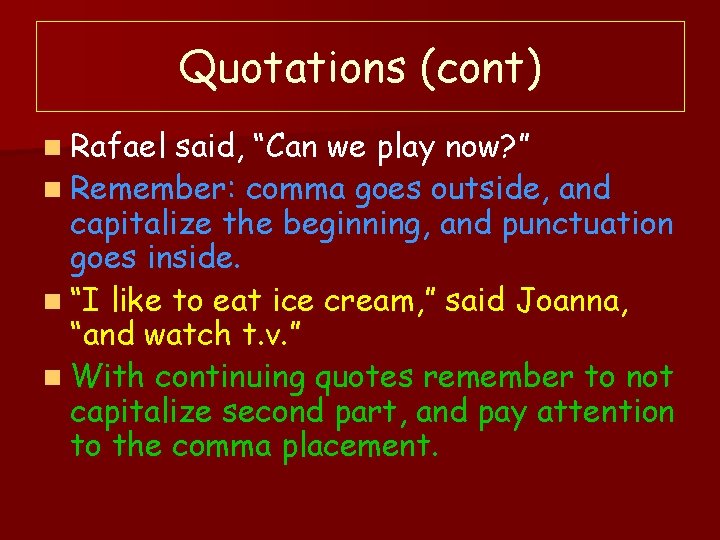
Grammar Skills n. A Quotations Trans 4 -20 413 K PB 243 direct quotation gives a speaker’s exact words. n Set off exact words with quotation marks. n Begin each quotation with a capital letter. n Place end punctuation inside the quotation marks. n Use commas to separate most quotation from the rest of the sentence.
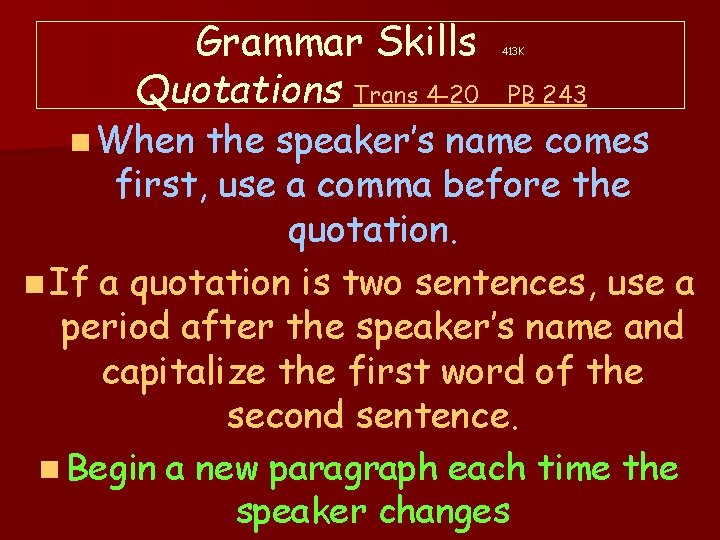
Grammar Skills Quotations Trans 4 -20 n When 413 K PB 243 the speaker’s name comes first, use a comma before the quotation. n If a quotation is two sentences, use a period after the speaker’s name and capitalize the first word of the second sentence. n Begin a new paragraph each time the speaker changes
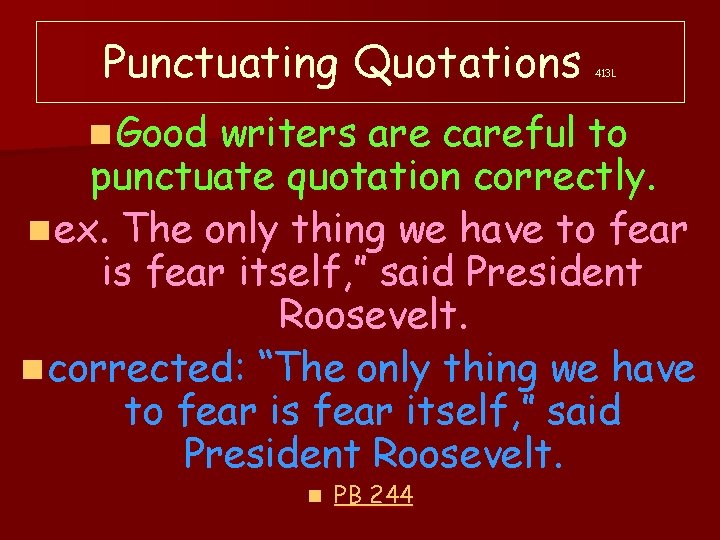
Punctuating Quotations n Good 413 L writers are careful to punctuate quotation correctly. n ex. The only thing we have to fear is fear itself, ” said President Roosevelt. n corrected: “The only thing we have to fear is fear itself, ” said President Roosevelt. n PB 244
Quotations (cont) n Rafael said, “Can we play now? ” n Remember: comma goes outside, and capitalize the beginning, and punctuation goes inside. n “I like to eat ice cream, ” said Joanna, “and watch t. v. ” n With continuing quotes remember to not capitalize second part, and pay attention to the comma placement.
Writing Skills A How-to Paragraph Trans 4 -21 413 M PB 245
Using Order Words Trans 4 -22 n PB 246 n 413 N
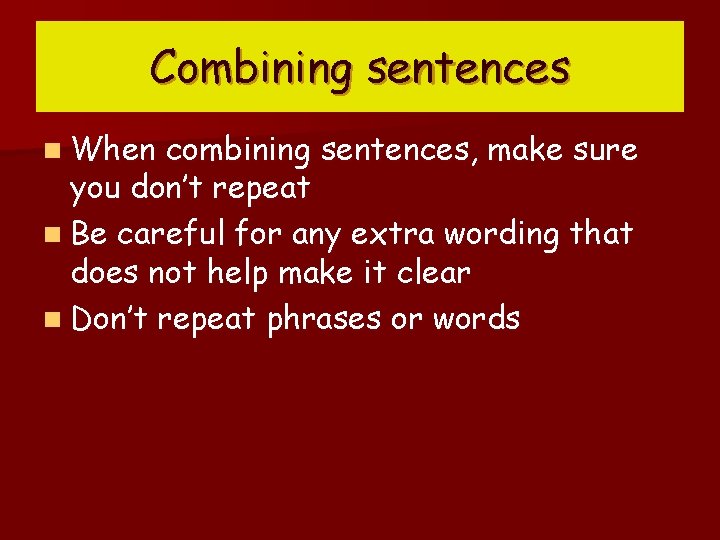
Combining sentences n When combining sentences, make sure you don’t repeat n Be careful for any extra wording that does not help make it clear n Don’t repeat phrases or words
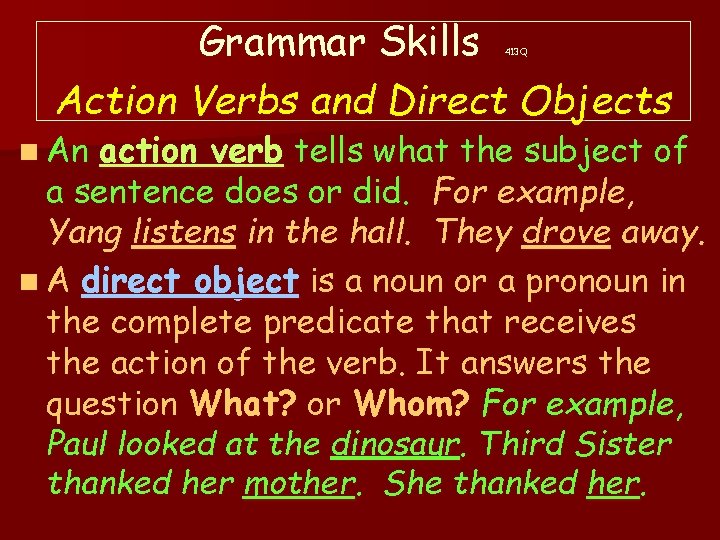
Grammar Skills Action Verbs and Direct Objects 413 Q n An action verb tells what the subject of a sentence does or did. For example, Yang listens in the hall. They drove away. n A direct object is a noun or a pronoun in the complete predicate that receives the action of the verb. It answers the question What? or Whom? For example, Paul looked at the dinosaur. Third Sister thanked her mother. She thanked her.
Direct Objects
Verbs
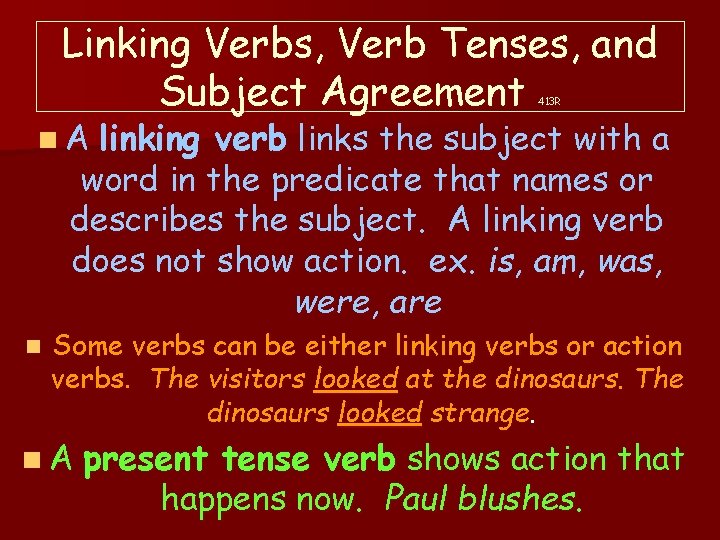
Linking Verbs, Verb Tenses, and Subject Agreement 413 R n. A linking verb links the subject with a word in the predicate that names or describes the subject. A linking verb does not show action. ex. is, am, was, were, are n Some verbs can be either linking verbs or action verbs. The visitors looked at the dinosaurs. The dinosaurs looked strange. n. A present tense verb shows action that happens now. Paul blushes.
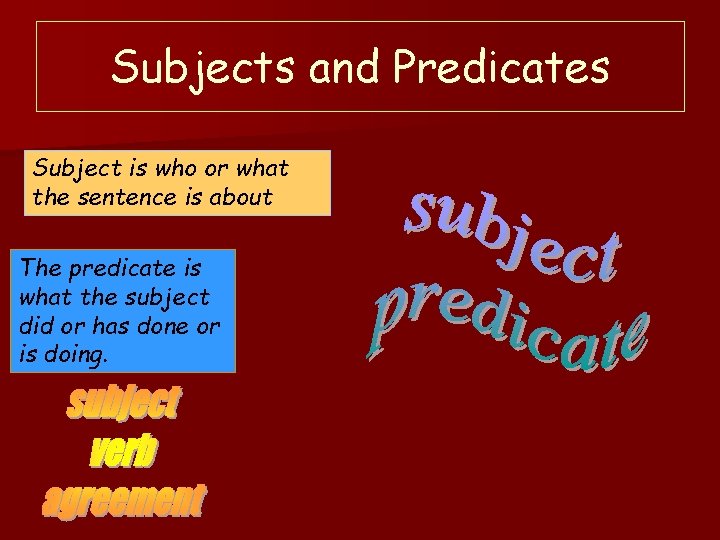
Subjects and Predicates Subject is who or what the sentence is about The predicate is what the subject did or has done or is doing.
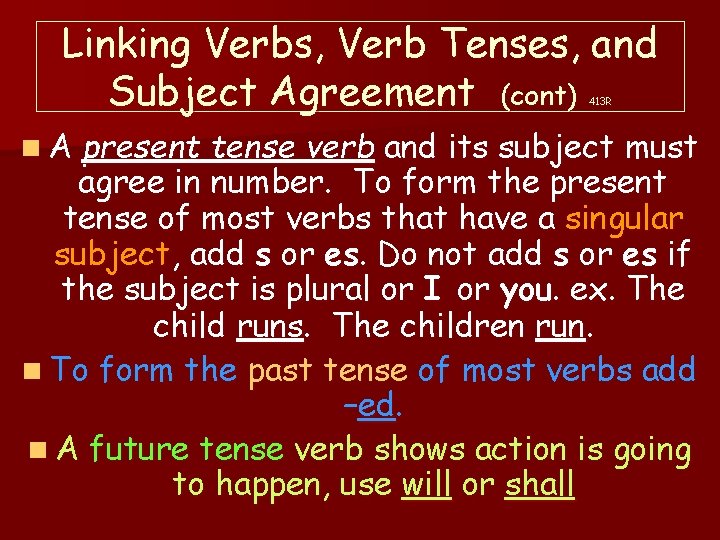
Linking Verbs, Verb Tenses, and Subject Agreement (cont) 413 R n. A present tense verb and its subject must agree in number. To form the present tense of most verbs that have a singular subject, add s or es. Do not add s or es if the subject is plural or I or you. ex. The child runs. The children run. n To form the past tense of most verbs add –ed. n A future tense verb shows action is going to happen, use will or shall
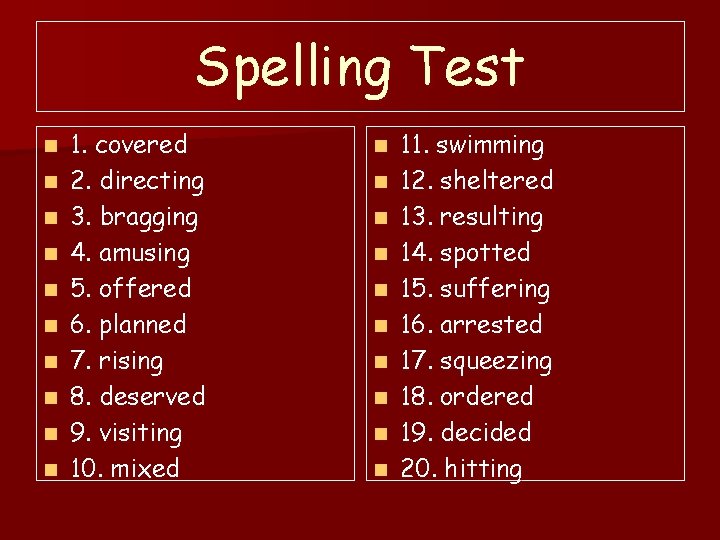
Spelling Test n n n n n 1. covered 2. directing 3. bragging 4. amusing 5. offered 6. planned 7. rising 8. deserved 9. visiting 10. mixed n n n n n 11. swimming 12. sheltered 13. resulting 14. spotted 15. suffering 16. arrested 17. squeezing 18. ordered 19. decided 20. hitting
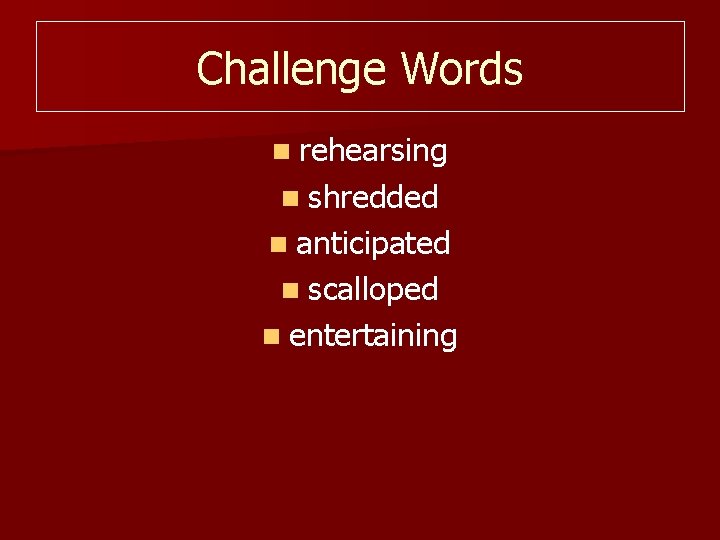
Challenge Words n rehearsing n shredded n anticipated n scalloped n entertaining
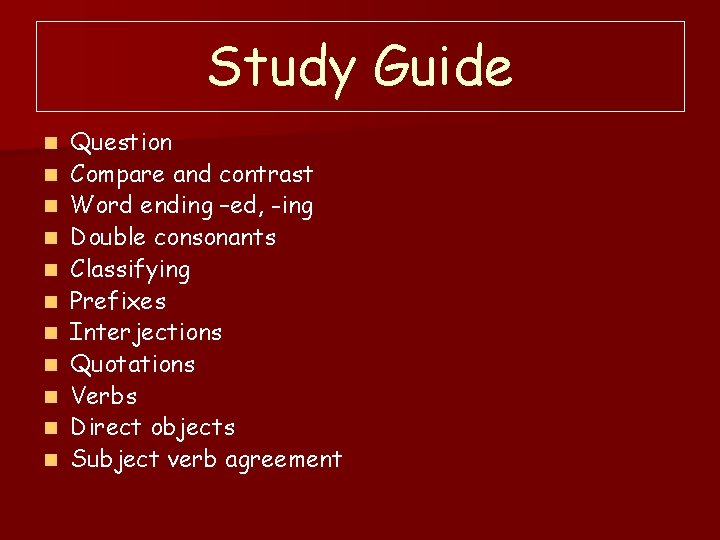
Study Guide n n n Question Compare and contrast Word ending –ed, -ing Double consonants Classifying Prefixes Interjections Quotations Verbs Direct objects Subject verb agreement