Universidad Autnoma del Estado de Mxico Centro Universitario



- Slides: 42
Universidad Autónoma del Estado de México Centro Universitario UAEM Valle de México Ingeniería en Computación Unidad de Aprendizaje Inglés C 1 Describing factual events and expressing opinions dreams and hopes First Conditional Second Conditional Octubre 2017 Guadalupe Yazmín Sosa Jiménez
SCRIPT This material contains an explanation about the correct use of First Conditional and Second Conditional, their structure and when to use each one of them. The first slides are based on the description of the form and meaning of the first grammar point. This first part of the presentation, shows how First Conditional sentences must be formed in positive, negative and questions. You will find some examples and activities with their answer key. Get advantage from it! Best regards,
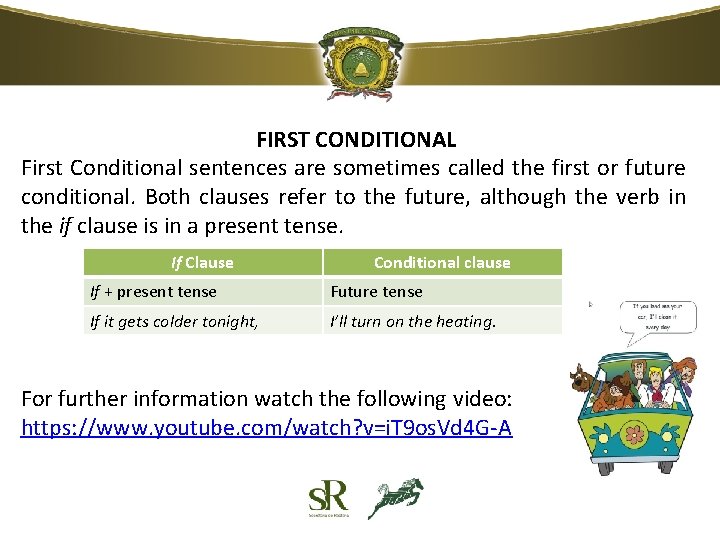
FIRST CONDITIONAL First Conditional sentences are sometimes called the first or future conditional. Both clauses refer to the future, although the verb in the if clause is in a present tense. If Clause Conditional clause If + present tense Future tense If it gets colder tonight, I’ll turn on the heating. For further information watch the following video: https: //www. youtube. com/watch? v=i. T 9 os. Vd 4 G-A
Objective of the unit of competence Students will be able to express a possible condition and a probable result in the future.
Contents • First Conditional • Describing dreams, hopes and ambitions • Describing real events • Expressing belief, opinion, agreement and disagreement politely
We often use First Conditional to express aspects of persuasion such as cajoling and negotiating and for giving warnings and making threats. Persuasion: I’ll take the children to the party if you collect them from school.
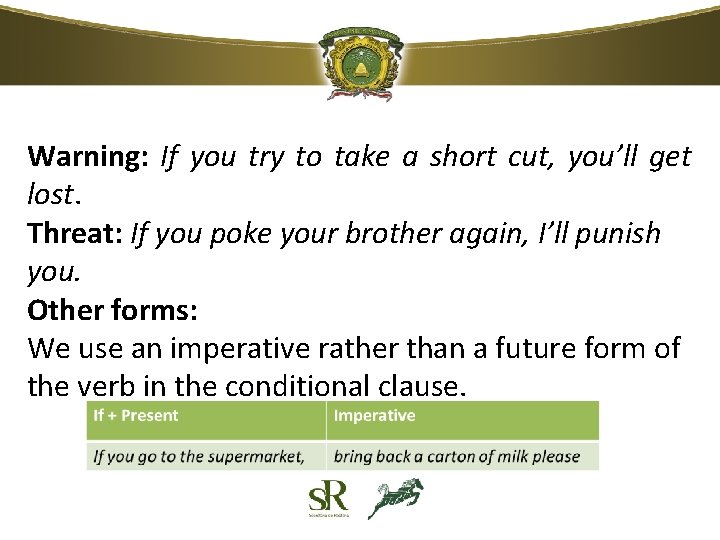
Warning: If you try to take a short cut, you’ll get lost. Threat: If you poke your brother again, I’ll punish you. Other forms: We use an imperative rather than a future form of the verb in the conditional clause.
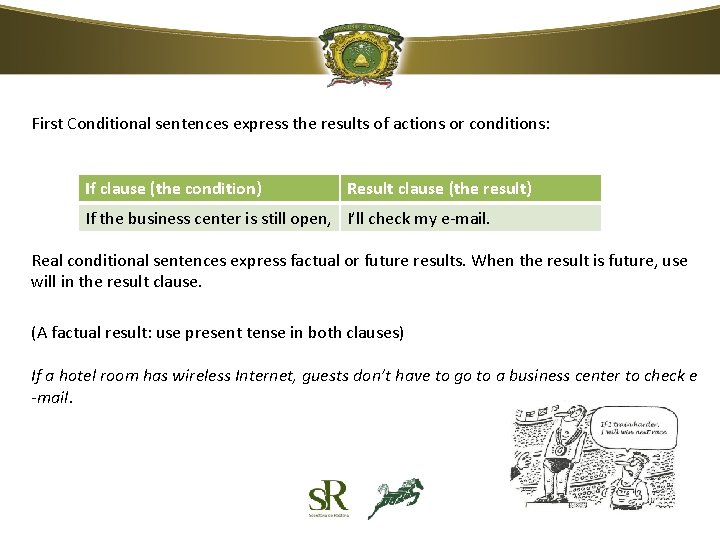
First Conditional sentences express the results of actions or conditions: If clause (the condition) Result clause (the result) If the business center is still open, I’ll check my e-mail. Real conditional sentences express factual or future results. When the result is future, use will in the result clause. (A factual result: use present tense in both clauses) If a hotel room has wireless Internet, guests don’t have to go to a business center to check e -mail.
(A future result: Use present tense in the If clause and future with will in the result clause. ) If she checks in early, she’ll get the room she wants. Questions: If they don’t have a non-smoking room, will you stay at a different hotel? Where will you go if they don’t have a room for tonight? If there are not rental cars at the airport, what will they do?
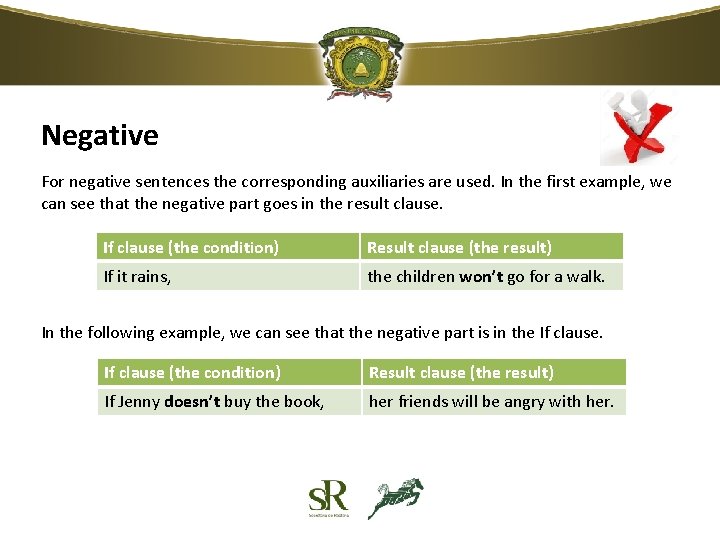
Negative For negative sentences the corresponding auxiliaries are used. In the first example, we can see that the negative part goes in the result clause. If clause (the condition) Result clause (the result) If it rains, the children won’t go for a walk. In the following example, we can see that the negative part is in the If clause (the condition) Result clause (the result) If Jenny doesn’t buy the book, her friends will be angry with her.
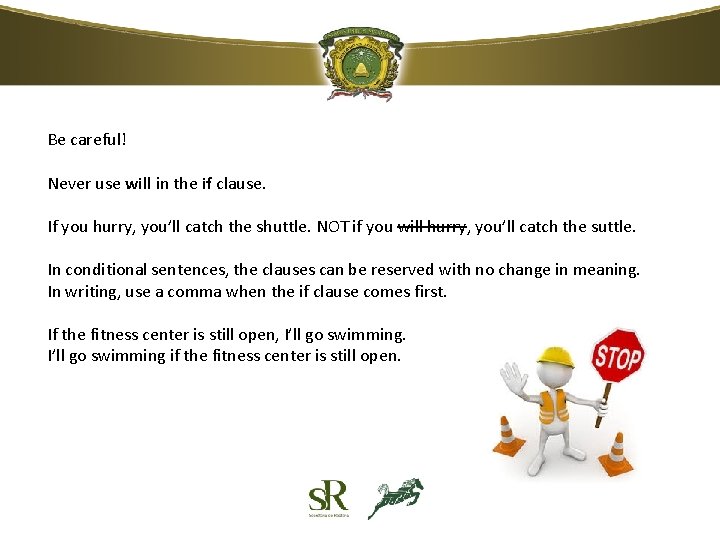
Be careful! Never use will in the if clause. If you hurry, you’ll catch the shuttle. NOT if you will hurry, you’ll catch the suttle. In conditional sentences, the clauses can be reserved with no change in meaning. In writing, use a comma when the if clause comes first. If the fitness center is still open, I’ll go swimming if the fitness center is still open.
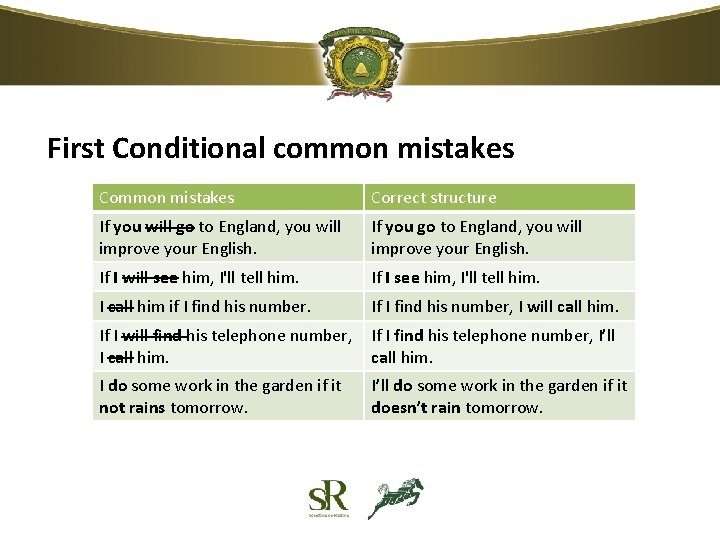
First Conditional common mistakes Common mistakes Correct structure If you will go to England, you will improve your English. If you go to England, you will improve your English. If I will see him, I'll tell him. If I see him, I'll tell him. I call him if I find his number. If I find his number, I will call him. If I will find his telephone number, If I find his telephone number, I’ll I call him. I do some work in the garden if it not rains tomorrow. I’ll do some work in the garden if it doesn’t rain tomorrow.
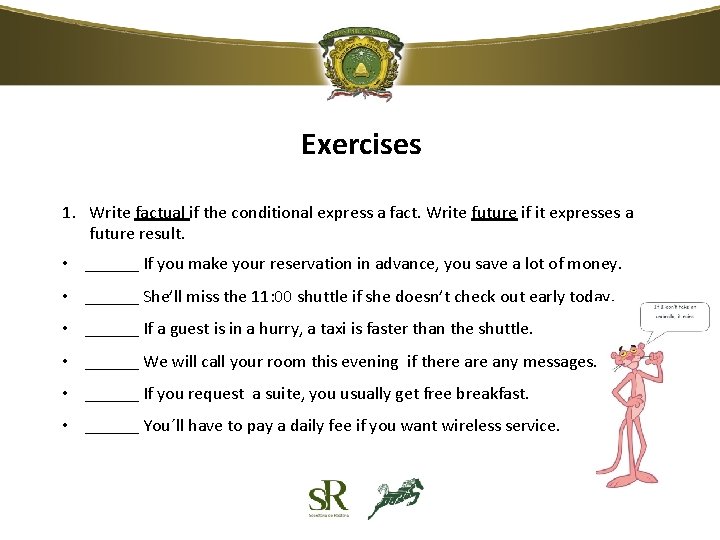
Exercises 1. Write factual if the conditional express a fact. Write future if it expresses a future result. • ______ If you make your reservation in advance, you save a lot of money. • ______ She’ll miss the 11: 00 shuttle if she doesn’t check out early today. • ______ If a guest is in a hurry, a taxi is faster than the shuttle. • ______ We will call your room this evening if there any messages. • ______ If you request a suite, you usually get free breakfast. • ______ You´ll have to pay a daily fee if you want wireless service.
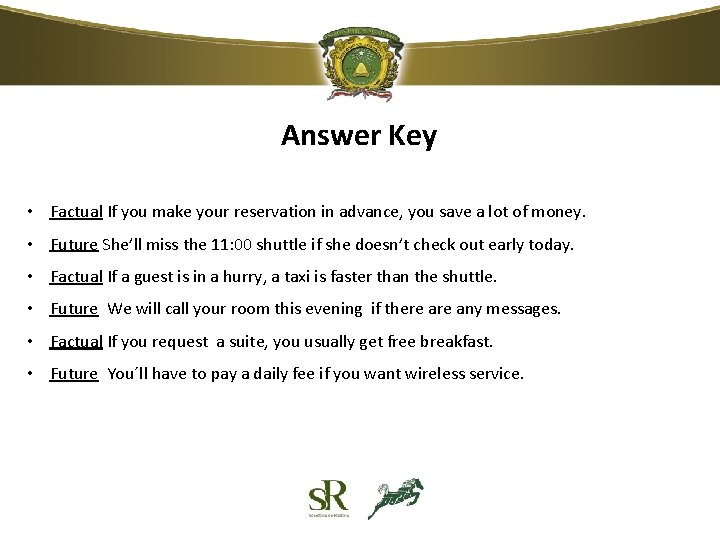
Answer Key • Factual If you make your reservation in advance, you save a lot of money. • Future She’ll miss the 11: 00 shuttle if she doesn’t check out early today. • Factual If a guest is in a hurry, a taxi is faster than the shuttle. • Future We will call your room this evening if there any messages. • Factual If you request a suite, you usually get free breakfast. • Future You´ll have to pay a daily fee if you want wireless service.
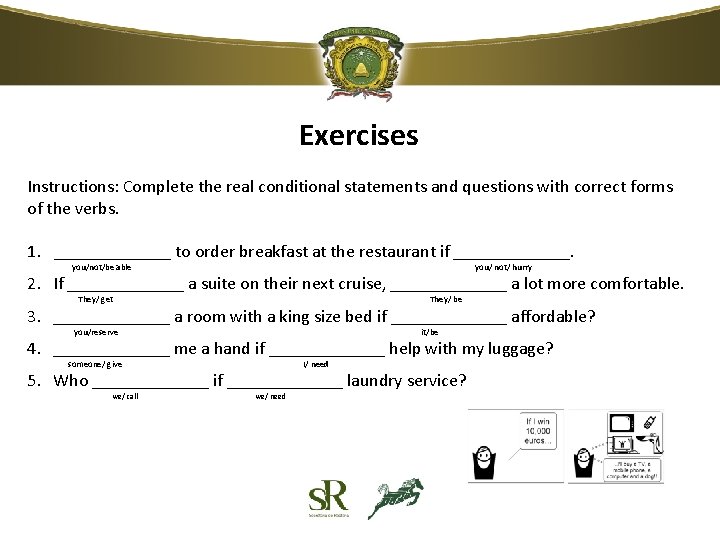
Exercises Instructions: Complete the real conditional statements and questions with correct forms of the verbs. 1. _______ to order breakfast at the restaurant if _______. you/not/be able you/ not/ hurry 2. If _______ a suite on their next cruise, _______ a lot more comfortable. They/ get They/ be 3. _______ a room with a king size bed if _______ affordable? you/reserve it/be 4. _______ me a hand if _______ help with my luggage? someone/ give I/ need 5. Who _______ if _______ laundry service? we/ call we/ need
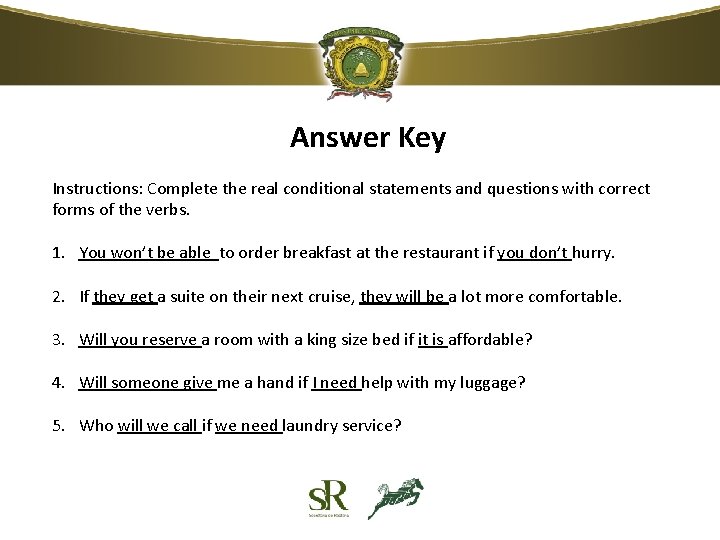
Answer Key Instructions: Complete the real conditional statements and questions with correct forms of the verbs. 1. You won’t be able to order breakfast at the restaurant if you don’t hurry. 2. If they get a suite on their next cruise, they will be a lot more comfortable. 3. Will you reserve a room with a king size bed if it is affordable? 4. Will someone give me a hand if I need help with my luggage? 5. Who will we call if we need laundry service?
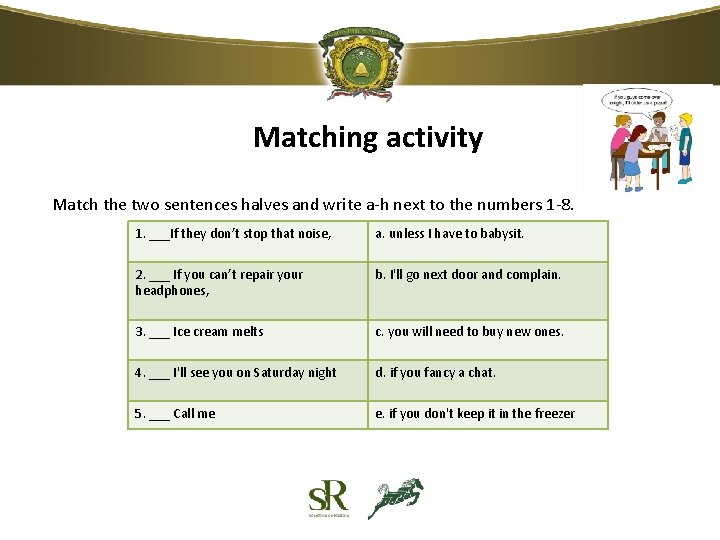
Matching activity Match the two sentences halves and write a-h next to the numbers 1 -8. 1. ___If they don’t stop that noise, a. unless I have to babysit. 2. ___ If you can’t repair your headphones, b. I'll go next door and complain. 3. ___ Ice cream melts c. you will need to buy new ones. 4. ___ I'll see you on Saturday night d. if you fancy a chat. 5. ___ Call me e. if you don't keep it in the freezer
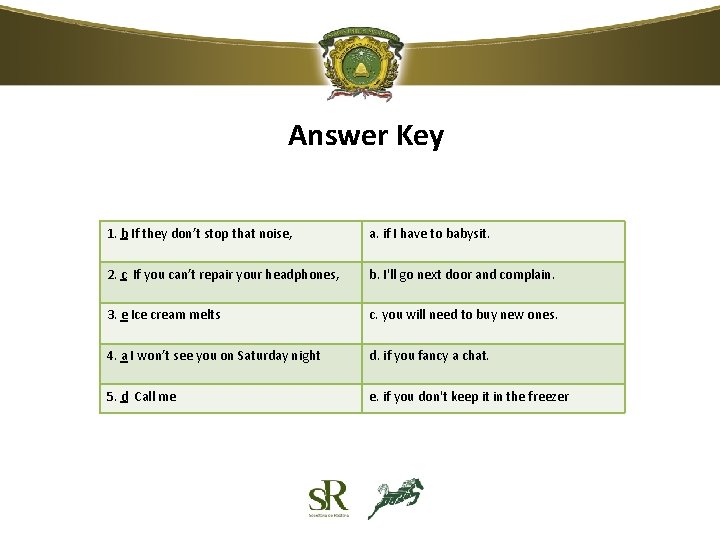
Answer Key 1. b If they don’t stop that noise, a. if I have to babysit. 2. c If you can’t repair your headphones, b. I'll go next door and complain. 3. e Ice cream melts c. you will need to buy new ones. 4. a I won’t see you on Saturday night d. if you fancy a chat. 5. d Call me e. if you don't keep it in the freezer
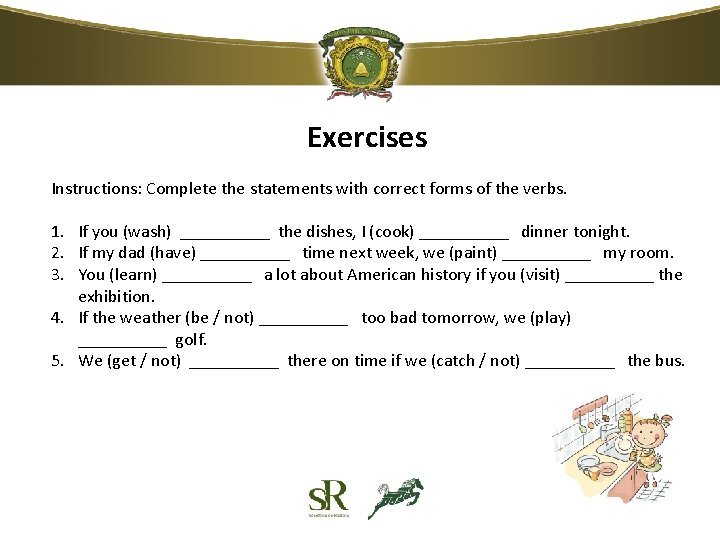
Exercises Instructions: Complete the statements with correct forms of the verbs. 1. If you (wash) _____ the dishes, I (cook) _____ dinner tonight. 2. If my dad (have) _____ time next week, we (paint) _____ my room. 3. You (learn) _____ a lot about American history if you (visit) _____ the exhibition. 4. If the weather (be / not) _____ too bad tomorrow, we (play) _____ golf. 5. We (get / not) _____ there on time if we (catch / not) _____ the bus.
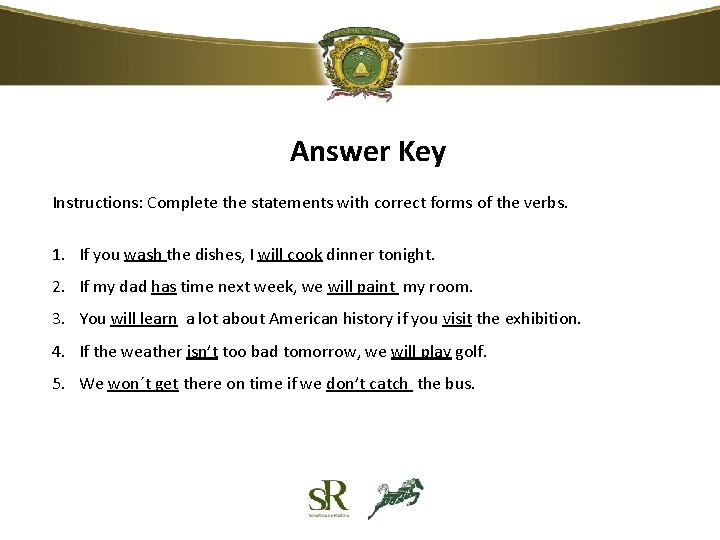
Answer Key Instructions: Complete the statements with correct forms of the verbs. 1. If you wash the dishes, I will cook dinner tonight. 2. If my dad has time next week, we will paint my room. 3. You will learn a lot about American history if you visit the exhibition. 4. If the weather isn’t too bad tomorrow, we will play golf. 5. We won´t get there on time if we don’t catch the bus.
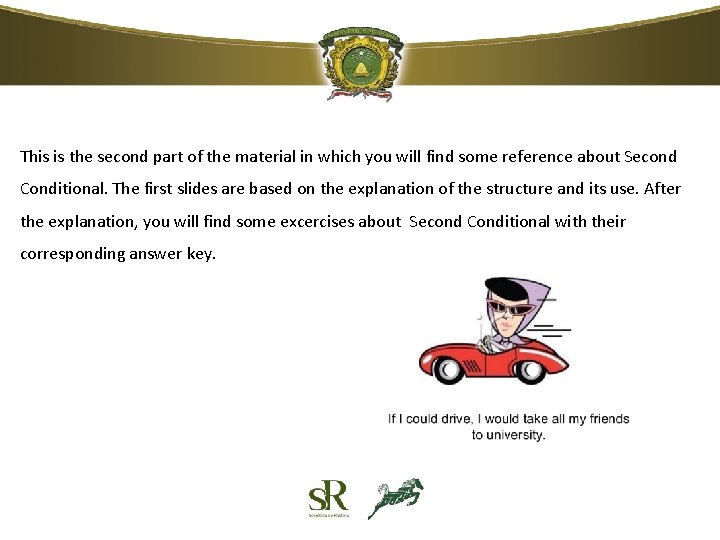
This is the second part of the material in which you will find some reference about Second Conditional. The first slides are based on the explanation of the structure and its use. After the explanation, you will find some excercises about Second Conditional with their corresponding answer key.
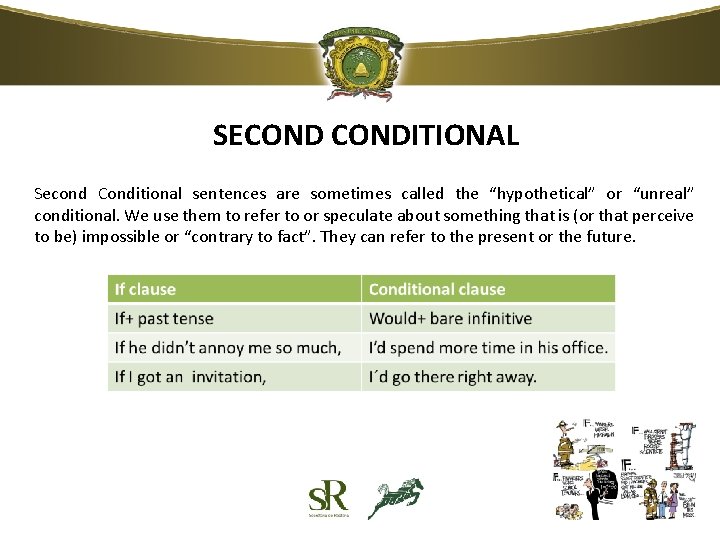
SECONDITIONAL Second Conditional sentences are sometimes called the “hypothetical” or “unreal” conditional. We use them to refer to or speculate about something that is (or that perceive to be) impossible or “contrary to fact”. They can refer to the present or the future.
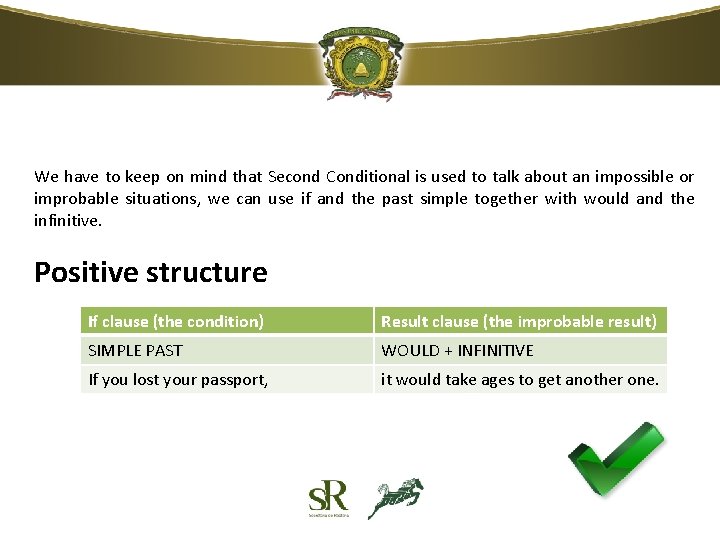
We have to keep on mind that Second Conditional is used to talk about an impossible or improbable situations, we can use if and the past simple together with would and the infinitive. Positive structure If clause (the condition) Result clause (the improbable result) SIMPLE PAST WOULD + INFINITIVE If you lost your passport, it would take ages to get another one.
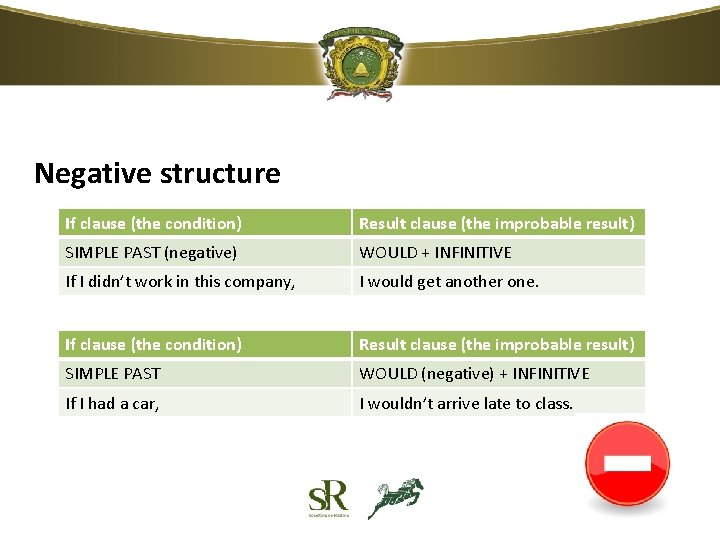
Negative structure If clause (the condition) Result clause (the improbable result) SIMPLE PAST (negative) WOULD + INFINITIVE If I didn’t work in this company, I would get another one. If clause (the condition) Result clause (the improbable result) SIMPLE PAST WOULD (negative) + INFINITIVE If I had a car, I wouldn’t arrive late to class.
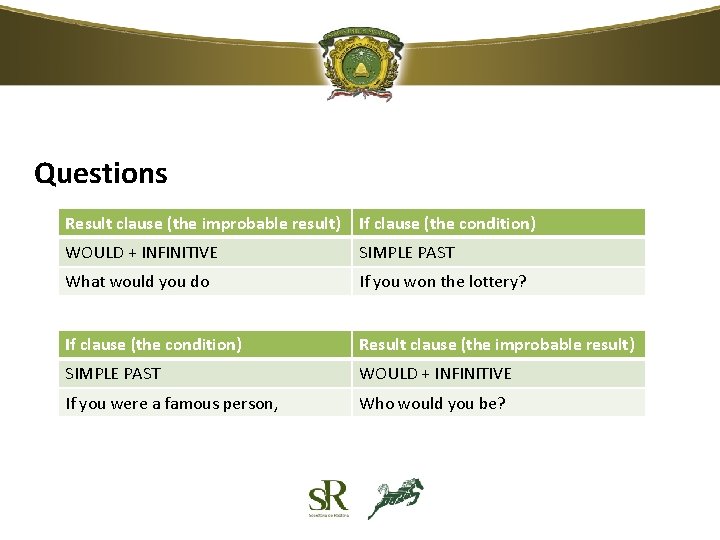
Questions Result clause (the improbable result) If clause (the condition) WOULD + INFINITIVE SIMPLE PAST What would you do If you won the lottery? If clause (the condition) Result clause (the improbable result) SIMPLE PAST WOULD + INFINITIVE If you were a famous person, Who would you be?
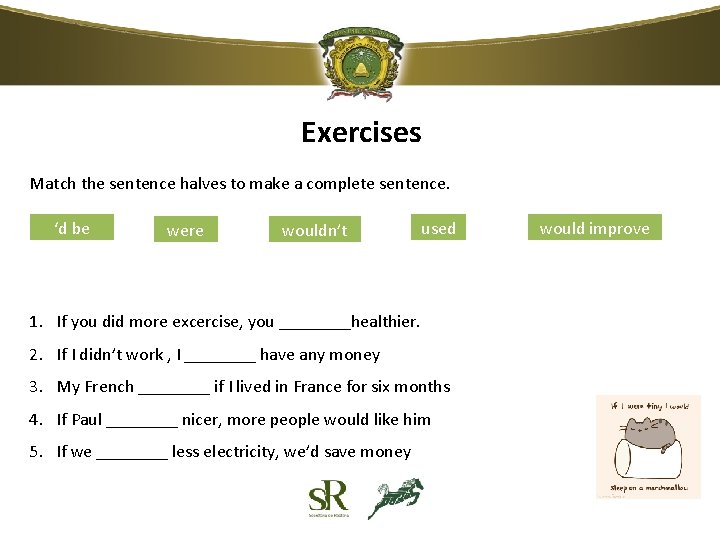
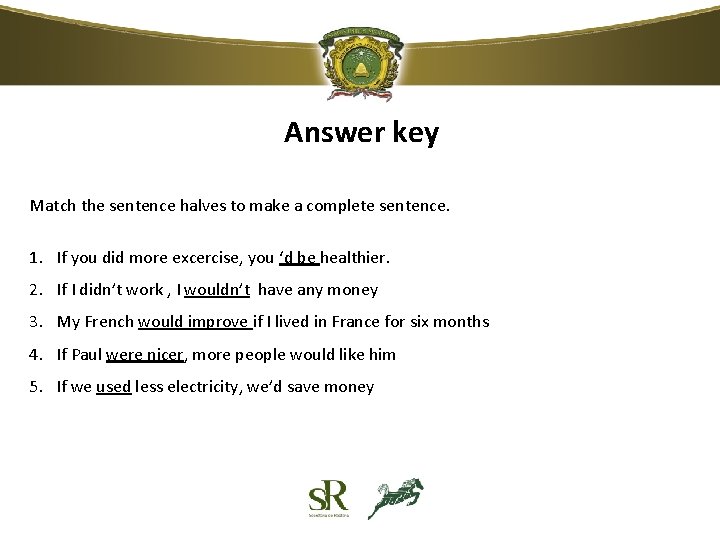
Exercises Match the sentence halves to make a complete sentence. ‘d be were wouldn’t used 1. If you did more excercise, you ____healthier. 2. If I didn’t work , I ____ have any money 3. My French ____ if I lived in France for six months 4. If Paul ____ nicer, more people would like him 5. If we ____ less electricity, we’d save money would improve
Answer key Match the sentence halves to make a complete sentence. 1. If you did more excercise, you ‘d be healthier. 2. If I didn’t work , I wouldn’t have any money 3. My French would improve if I lived in France for six months 4. If Paul were nicer, more people would like him 5. If we used less electricity, we’d save money
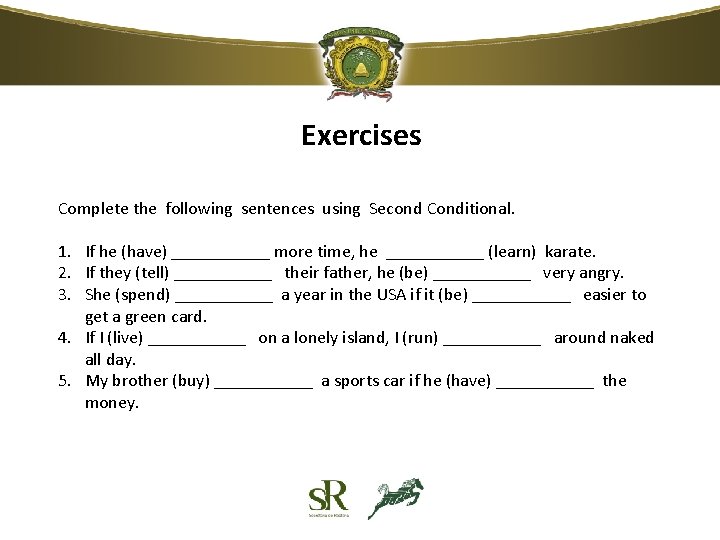
Exercises Complete the following sentences using Second Conditional. 1. If he (have) ______ more time, he ______ (learn) karate. 2. If they (tell) ______ their father, he (be) ______ very angry. 3. She (spend) ______ a year in the USA if it (be) ______ easier to get a green card. 4. If I (live) ______ on a lonely island, I (run) ______ around naked all day. 5. My brother (buy) ______ a sports car if he (have) ______ the money.
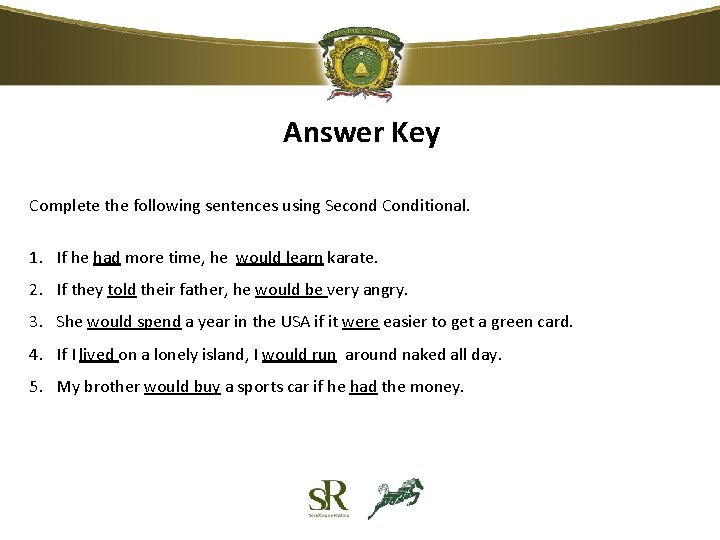
Answer Key Complete the following sentences using Second Conditional. 1. If he had more time, he would learn karate. 2. If they told their father, he would be very angry. 3. She would spend a year in the USA if it were easier to get a green card. 4. If I lived on a lonely island, I would run around naked all day. 5. My brother would buy a sports car if he had the money.
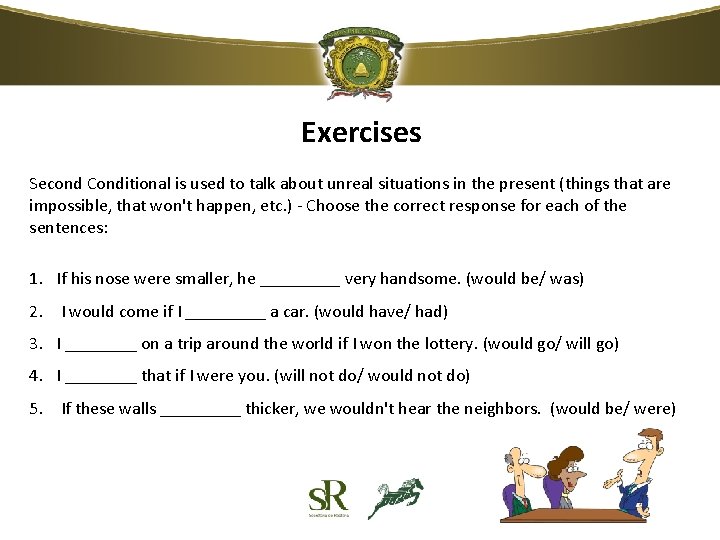
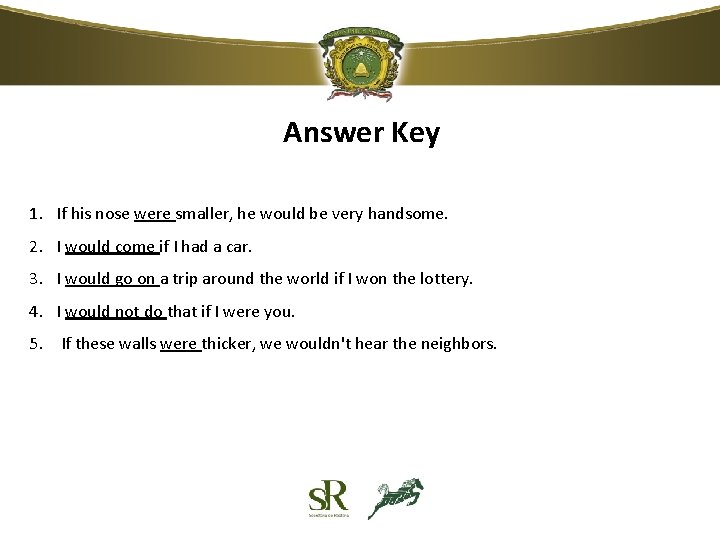
Exercises Second Conditional is used to talk about unreal situations in the present (things that are impossible, that won't happen, etc. ) - Choose the correct response for each of the sentences: 1. If his nose were smaller, he _____ very handsome. (would be/ was) 2. I would come if I _____ a car. (would have/ had) 3. I ____ on a trip around the world if I won the lottery. (would go/ will go) 4. I ____ that if I were you. (will not do/ would not do) 5. If these walls _____ thicker, we wouldn't hear the neighbors. (would be/ were)
Answer Key 1. If his nose were smaller, he would be very handsome. 2. I would come if I had a car. 3. I would go on a trip around the world if I won the lottery. 4. I would not do that if I were you. 5. If these walls were thicker, we wouldn't hear the neighbors.
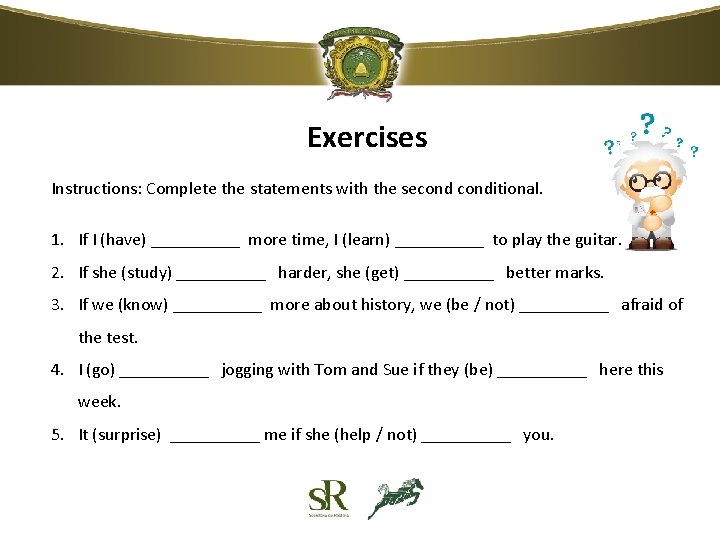
Exercises Instructions: Complete the statements with the seconditional. 1. If I (have) _____ more time, I (learn) _____ to play the guitar. 2. If she (study) _____ harder, she (get) _____ better marks. 3. If we (know) _____ more about history, we (be / not) _____ afraid of the test. 4. I (go) _____ jogging with Tom and Sue if they (be) _____ here this week. 5. It (surprise) _____ me if she (help / not) _____ you.
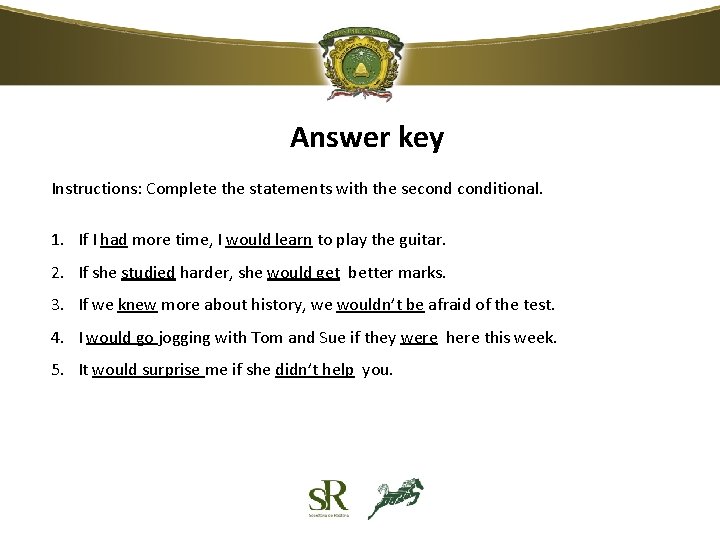
Answer key Instructions: Complete the statements with the seconditional. 1. If I had more time, I would learn to play the guitar. 2. If she studied harder, she would get better marks. 3. If we knew more about history, we wouldn’t be afraid of the test. 4. I would go jogging with Tom and Sue if they were here this week. 5. It would surprise me if she didn’t help you.
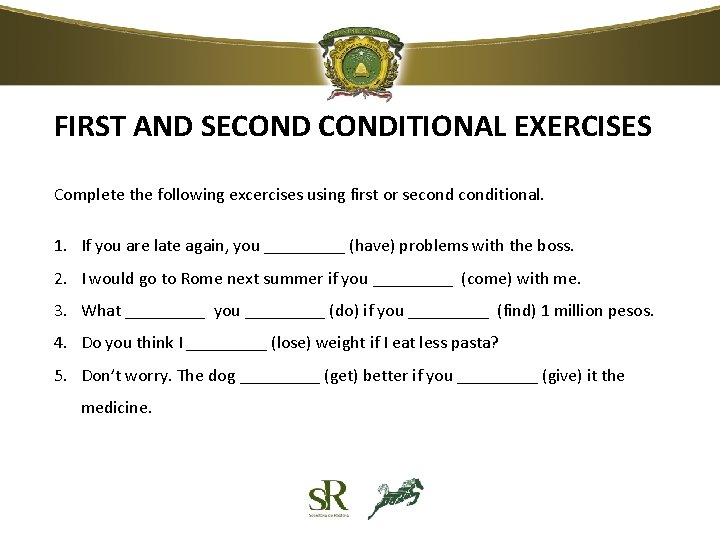
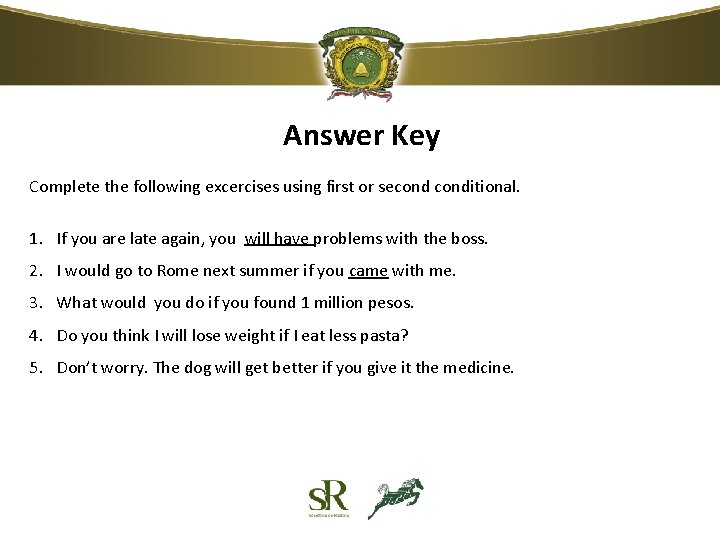
FIRST AND SECONDITIONAL EXERCISES Complete the following excercises using first or seconditional. 1. If you are late again, you _____ (have) problems with the boss. 2. I would go to Rome next summer if you _____ (come) with me. 3. What _____ you _____ (do) if you _____ (find) 1 million pesos. 4. Do you think I _____ (lose) weight if I eat less pasta? 5. Don’t worry. The dog _____ (get) better if you _____ (give) it the medicine.
Answer Key Complete the following excercises using first or seconditional. 1. If you are late again, you will have problems with the boss. 2. I would go to Rome next summer if you came with me. 3. What would you do if you found 1 million pesos. 4. Do you think I will lose weight if I eat less pasta? 5. Don’t worry. The dog will get better if you give it the medicine.
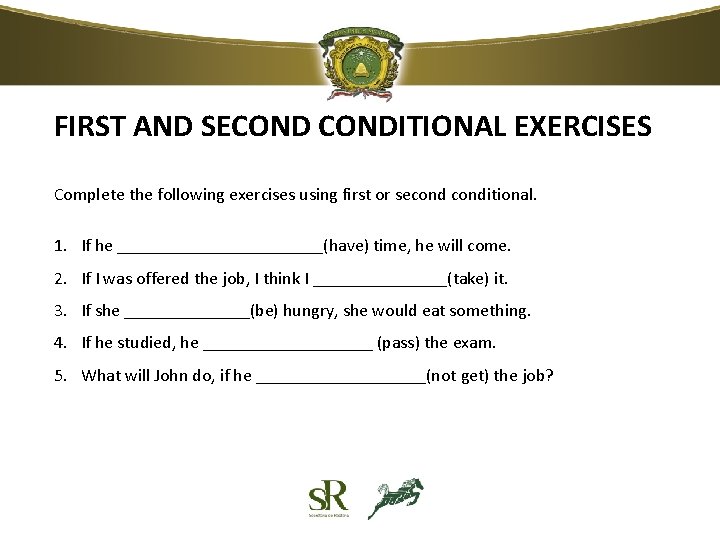
FIRST AND SECONDITIONAL EXERCISES Complete the following exercises using first or seconditional. 1. If he ____________(have) time, he will come. 2. If I was offered the job, I think I ________(take) it. 3. If she _______(be) hungry, she would eat something. 4. If he studied, he __________ (pass) the exam. 5. What will John do, if he __________(not get) the job?
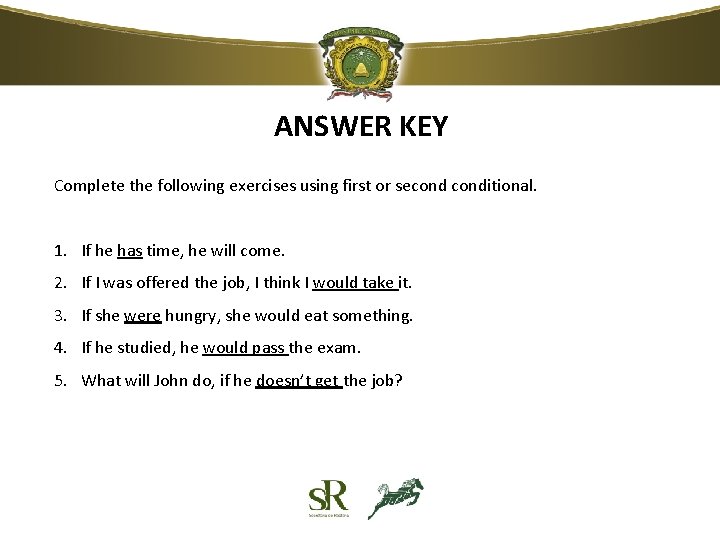
ANSWER KEY Complete the following exercises using first or seconditional. 1. If he has time, he will come. 2. If I was offered the job, I think I would take it. 3. If she were hungry, she would eat something. 4. If he studied, he would pass the exam. 5. What will John do, if he doesn’t get the job?
References: http: //dep. uaemex. mx/ http: //speak. com/resources/english-grammar-rules/conditionals/structureand-usage-of-first-conditional http: //www. bbc. co. uk/worldservice/learningenglish/radio/specials/1159_gramchall enge 38/ https: //elt. oup. com/student/solutions/preint/grammar_08_012 e? cc=mx& sel. Language=en https: //www. learnenglishfeelgood. com/grammar-seconditional 2. html https: //images. google. com/
Guadalupe Yazmín Sosa Jiménez Centro Universitario UAEM Valle de México
Octubre 2017