UNIT1 C Deepika Assistant Professor Ethics Oslo and
- Slides: 96
UNIT-1 C. Deepika, Assistant Professor
Ethics Oslo and Akershus University College and Oslo University Start January 16 2012 C. Deepika, Assistant Professor
Course Goals • Knowledge. Know key forms and issues of ethics • Criticism. Be able to argue for or against a proposition • Constructive. Be able to suggest simple ethical guidelines • International. Transpose those guidelines to an international perspective • Application. Use guidelines in daily work C. Deepika, Assistant Professor
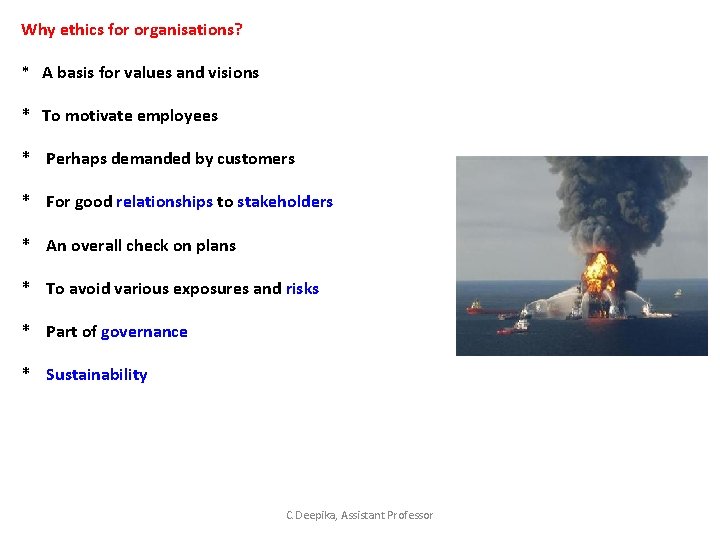
Why ethics for organisations? * A basis for values and visions * To motivate employees * Perhaps demanded by customers * For good relationships to stakeholders * An overall check on plans * To avoid various exposures and risks * Part of governance * Sustainability C. Deepika, Assistant Professor
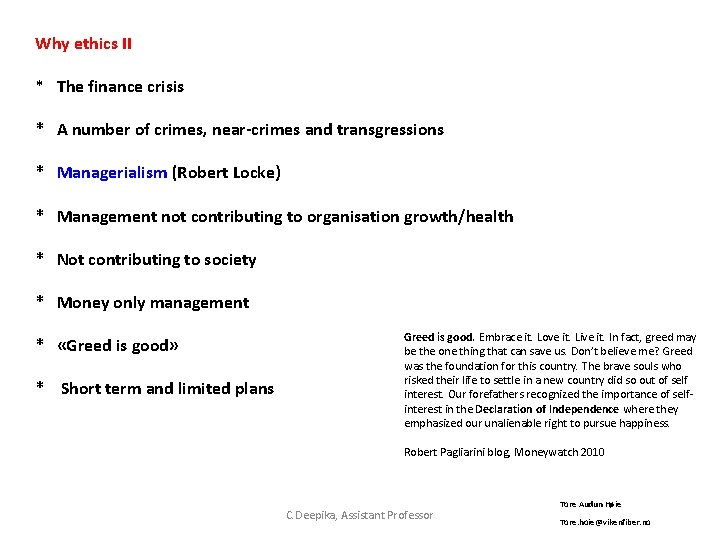
Why ethics II * The finance crisis * A number of crimes, near-crimes and transgressions * Managerialism (Robert Locke) * Management not contributing to organisation growth/health * Not contributing to society * Money only management * «Greed is good» * Short term and limited plans Greed is good. Embrace it. Love it. Live it. In fact, greed may be the one thing that can save us. Don’t believe me? Greed was the foundation for this country. The brave souls who risked their life to settle in a new country did so out of self interest. Our forefathers recognized the importance of selfinterest in the Declaration of Independence where they emphasized our unalienable right to pursue happiness. Robert Pagliarini blog, Moneywatch 2010 C. Deepika, Assistant Professor Tore Audun Høie Tore. hoie@vikenfiber. no
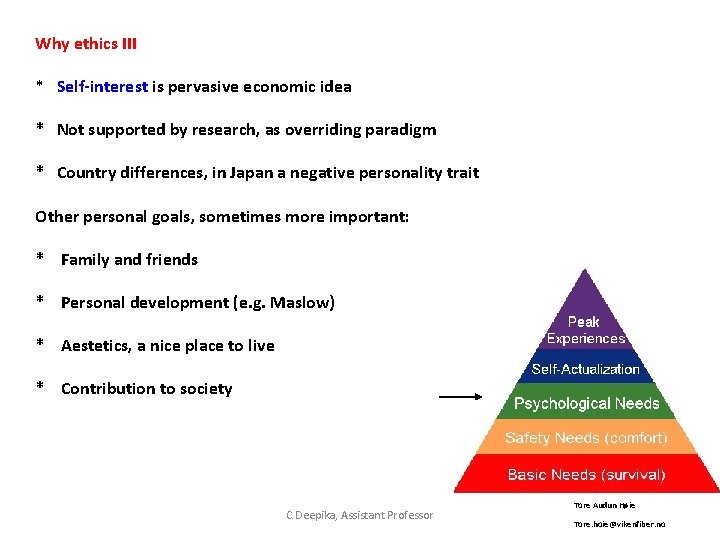
Why ethics III * Self-interest is pervasive economic idea * Not supported by research, as overriding paradigm * Country differences, in Japan a negative personality trait Other personal goals, sometimes more important: * Family and friends * Personal development (e. g. Maslow) * Aestetics, a nice place to live * Contribution to society C. Deepika, Assistant Professor Tore Audun Høie Tore. hoie@vikenfiber. no
Relevance of ethics to ICT * Do good work (Aristotle) * Plan holistically (systems theory) * Consider end use (Aristotle) * Evaluate both ends and means (Kant) * Be stakeholder oriented (ISO 26000) * Take care of the environment (ISO 26000) * Contribute to knowledge Tore Audun Høie C. Deepika, Assistant Professor Tore. hoie@vikenfiber. no
Definition Ethics Moral philosophy. Determining rights and wrongs, selecting actions to achieve good results, evaluating motives. (attempting to summarise several definitions) The achievement of wisdom, choosing actions that are benefical and acceptable long term; or sustainable. This implies a society focus. Tore Audun Høie C. Deepika, Assistant Professor Tore. hoie@vikenfiber. no
Definition Morals Beliefs and behaviour of group. The group can be: * Nation, or geographical area * Group of nations * Religious or life view groups, and subgroups * Profession or similar * Other organisation, e. g. sports, clan, NGO. . . In an international organisation there can be many morals. Tore Audun Høie Tore. hoie@vikenfiber. no C. Deepika, Assistant Professor
Positive ethics 2011: We invite you to submit a a manuscript for the Special Issue of the Journal of Business Ethics on Positive Organizational (POE). This issue targets the Journal of Business Ethics view that ethics encompasses “all human action aimed at securing a good life. ” Towards this end, more research must be directed toward the best of human functioning, especially within the context of today’s ethically challenged business environment and protracted economic downturn. www. strategie-aims. com C. Deepika, Assistant Professor Tore Audun Høie Tore. hoie@vikenfiber. no
UNIT-2 C. Deepika, Assistant Professor
Moral Development • The American psychologist Lawrence Kohlberg, for example, has concluded on the basis of over twenty years of research that there is a sequence of six identifiable stages in the development of a person’s ability to deal with moral issues. C. Deepika, Assistant Professor
• Kohlberg grouped these stages of moral development into three levels: each containing two stages. The sequence of six stages can be summarized as follows: C. Deepika, Assistant Professor
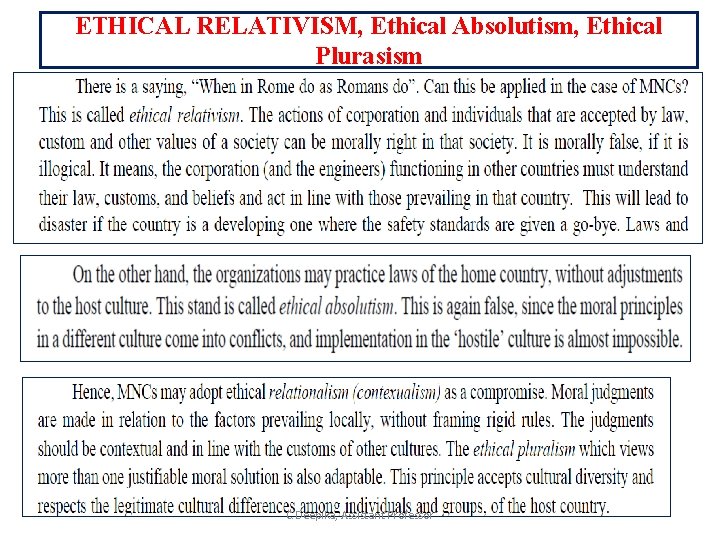
ETHICAL RELATIVISM, Ethical Absolutism, Ethical Plurasism C. Deepika, Assistant Professor
LEVELONE: PRECONVENTIONAL LEVEL • At the first two stages, the child is able to respond to rules and social expectations and can apply the labels “good”, “bad”, “right”, and “wrong”. These rules however, are seen as something externally imposed on the self. C. Deepika, Assistant Professor
• Right and wrong are interpreted in terms of the pleasant or painful consequences of actions or in terms of the physical power of those who set the rules. The child sees situations only from his or her own point of view, and since the child does not yet have the ability to identify with others to any great extent, the primary motivation is self-interest. C. Deepika, Assistant Professor
• Stage One: Punishment And Obedience Orientation At this stage the physical consequences of an act wholly determine the goodness or badness of that act. The child’s reasons for doing he right thing are to avoid punishment or to defer to the superior physical power of authorities. There is little awareness that others have needs and desires similar to one’s own. C. Deepika, Assistant Professor
• Stage Two: Instrument and Relativity Orientation At this stage right actions are those that can serve as instruments for satisfying the child’s own needs or the needs of those for whom the child cares. The child is now aware that others have needs and desires similar to his or her own and begins to defer to them in order to get them to do what he or she wants. C. Deepika, Assistant Professor
• LEVEL TWO: CONVENTIONAL LEVEL • Maintaining the expectations of one’s own family, peer group, or nation is seen as valuable in its own right, regardless of the consequences. The person does not merely conform to expectations but exhibits loyalty to the group and its norms. C. Deepika, Assistant Professor
• The person is now able to see situations from the point of view of others in the group and assumes that everyone is similar. The person is motivated to conform to the group’s norms and subordinates the needs of the individual to those of the group. C. Deepika, Assistant Professor
Stage Three: Interpersonal Concordance Orientation • Good behavior is living up to what is expected by those for whom one feels loyalty, affection, and trust, such as family and friends. Right action is conformity to what is generally expected in one’s role as a good son, daughters, brother, friend, etc. Doing what is right is motivated by the need to be a “good person” in one’s own eyes and in the eyes of others. C. Deepika, Assistant Professor
• Stage four: Law and Order Orientation. • Right and wrong are determined by loyalty to one’s own nation. Laws are to be upheld except where they conflict with other fixed social duties. The person is now able to see other people as parts of a larger social system that defines individual roles and obligations, and he or she can separate the norms generated by this system from his or her interpersonal relationships. C. Deepika, Assistant Professor
• LEVEL THREE: POSTCONVENTIONAL, AUTONOMOUS, OR PRINCIPLED LEVEL At these stages the person no longer simply accepts the values and forms of the groups to which he or she belongs. Instead the person now tries to see situations from appoint of view that impartially takes everyone’s interests into account. C. Deepika, Assistant Professor
The person questions the laws and values that society has adopted and redefines them in terms of self-chosen universal moral principles that can be justified to any rational individual. The proper laws and values are those to which any reasonable person would be motivated to commit himself or herself, whatever place the person holds in society and whatever society he or she belongs to. C. Deepika, Assistant Professor
• Stage five: Social Contract Orientation. • The person is aware that people hold a variety of conflicting personal views and opinions, and emphasizes fair ways of reaching consensus by agreement, contract, and due process. The person believes that all values and norms are relative and that apart from this democratic consensus, all should be tolerated. C. Deepika, Assistant Professor
• State Six: Universal Ethical Principles Orientation. • Right action is defined in terms of universal principles chosen because of their logical comprehensiveness, their universality, and their consistency. These ethical principles are not concrete like the Ten Commandments but abstract universal principles dealing with justice, society’s welfare, the equality of human rights, respect for the dignity of individual human beings, and with the idea that persons are ends in themselves and must be treated as such. . C. Deepika, Assistant Professor
• Kohlberg’s theory is important because it helps us understand in detail how individuals develop their moral capacities or “virtues “ through the internalization of the moral standards prevalent in their communities. It also reveals how we become increasingly sophisticated and critical in our understanding of the moral standards. C. Deepika, Assistant Professor
UNIT-3 C. Deepika, Assistant Professor
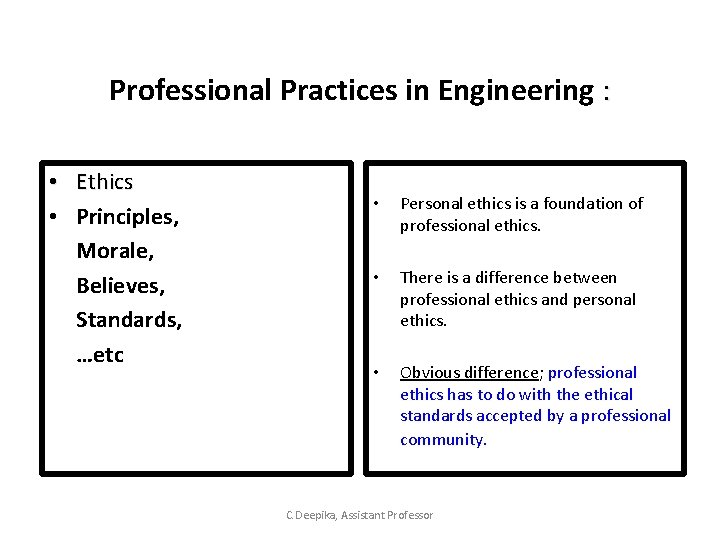
Professional Practices in Engineering : • Ethics • Principles, Morale, Believes, Standards, …etc • Personal ethics is a foundation of professional ethics. • There is a difference between professional ethics and personal ethics. • Obvious difference; professional ethics has to do with the ethical standards accepted by a professional community. C. Deepika, Assistant Professor
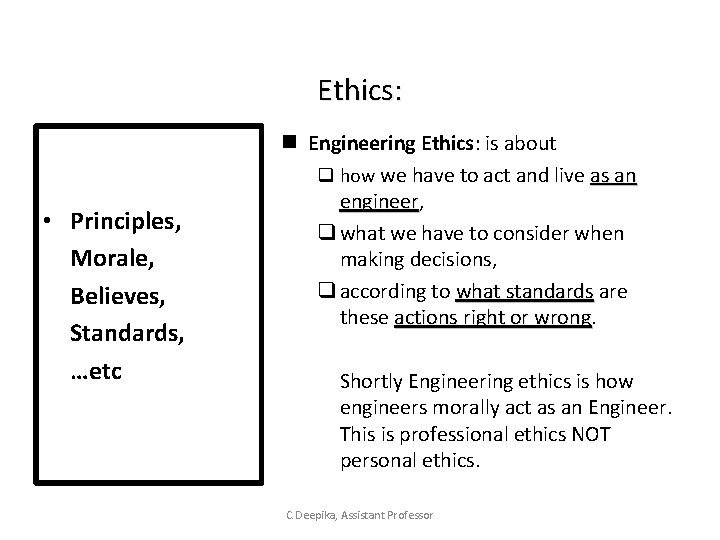
Ethics: • Principles, Morale, Believes, Standards, …etc n Engineering Ethics: is about q how we have to act and live as an engineer, engineer q what we have to consider when making decisions, q according to what standards are what standards these actions right or wrong Shortly Engineering ethics is how engineers morally act as an Engineer. This is professional ethics NOT personal ethics. C. Deepika, Assistant Professor
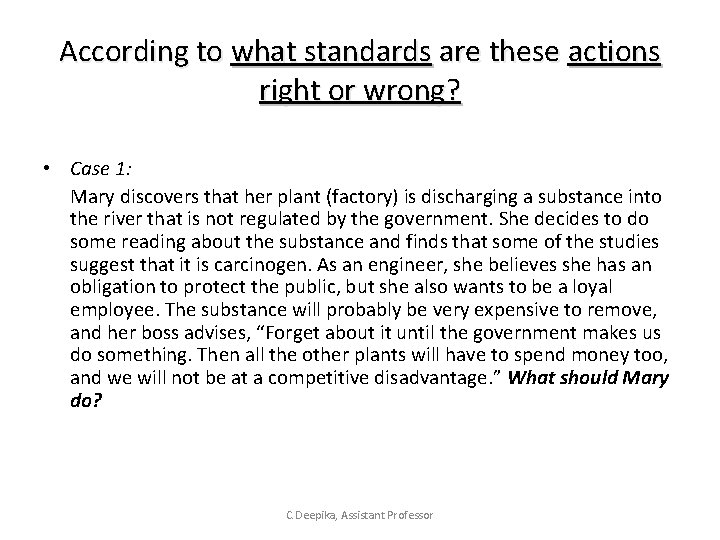
According to what standards are these actions right or wrong? • Case 1: Mary discovers that her plant (factory) is discharging a substance into the river that is not regulated by the government. She decides to do some reading about the substance and finds that some of the studies suggest that it is carcinogen. As an engineer, she believes she has an obligation to protect the public, but she also wants to be a loyal employee. The substance will probably be very expensive to remove, and her boss advises, “Forget about it until the government makes us do something. Then all the other plants will have to spend money too, and we will not be at a competitive disadvantage. ” What should Mary do? C. Deepika, Assistant Professor
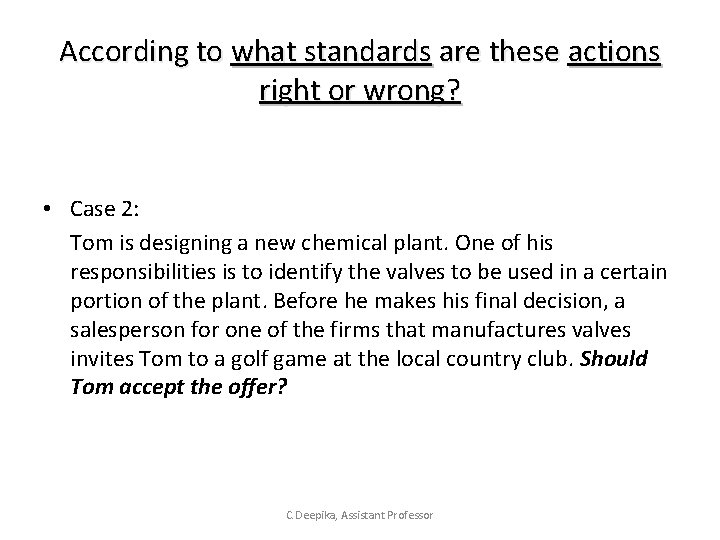
According to what standards are these actions right or wrong? • Case 2: Tom is designing a new chemical plant. One of his responsibilities is to identify the valves to be used in a certain portion of the plant. Before he makes his final decision, a salesperson for one of the firms that manufactures valves invites Tom to a golf game at the local country club. Should Tom accept the offer? C. Deepika, Assistant Professor
According to what standards are these actions right or wrong? • Consider the cases as a professional engineer. • What you have to consider when making decisions in those cases. • According to what standards are these actions right or wrong in those cases. C. Deepika, Assistant Professor
Things to consider and standards: n What are your OBLIGATIONS / RESPONSIBILITIES as a RESPONSIBILITIES professional engineer? C. Deepika, Assistant Professor
Things to consider and standards: n NSPE Codes (National Society of Professional Engineers) q As a professional engineer it is your obligation / responsibility to obey obligation / responsibility NSPE codes. Therefore; n Engineering Ethics (NSPE codes): shows you how you have to act and live as an engineer. What you have to as an engineer consider when making decisions. According to NSPE codes these actions are right or wrong. codes actions are right or wrong C. Deepika, Assistant Professor
Where to find NSPE codes? • http: //www. ie. emu. edu. tr Lecturers Orhan Korhan IE 355 Outline, NSPE codes etc. or in your textbook: page 376 (3 rd edition) C. Deepika, Assistant Professor
What is a Profession? • Paid occupation, especially one that requires advanced education, characteristics and training. C. Deepika, Assistant Professor
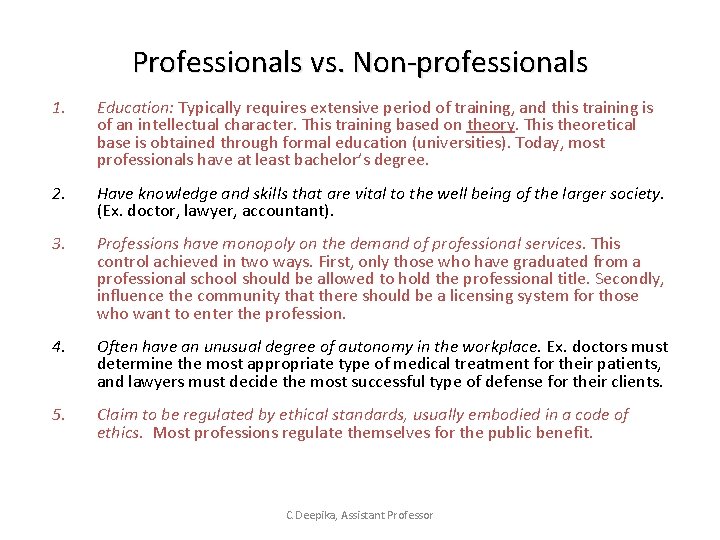
Professionals vs. Non-professionals 1. Education: Typically requires extensive period of training, and this training is of an intellectual character. This training based on theory. This theoretical base is obtained through formal education (universities). Today, most professionals have at least bachelor’s degree. 2. Have knowledge and skills that are vital to the well being of the larger society. (Ex. doctor, lawyer, accountant). 3. Professions have monopoly on the demand of professional services. This control achieved in two ways. First, only those who have graduated from a professional school should be allowed to hold the professional title. Secondly, influence the community that there should be a licensing system for those who want to enter the profession. 4. Often have an unusual degree of autonomy in the workplace. Ex. doctors must determine the most appropriate type of medical treatment for their patients, and lawyers must decide the most successful type of defense for their clients. 5. Claim to be regulated by ethical standards, usually embodied in a code of ethics. Most professions regulate themselves for the public benefit. C. Deepika, Assistant Professor
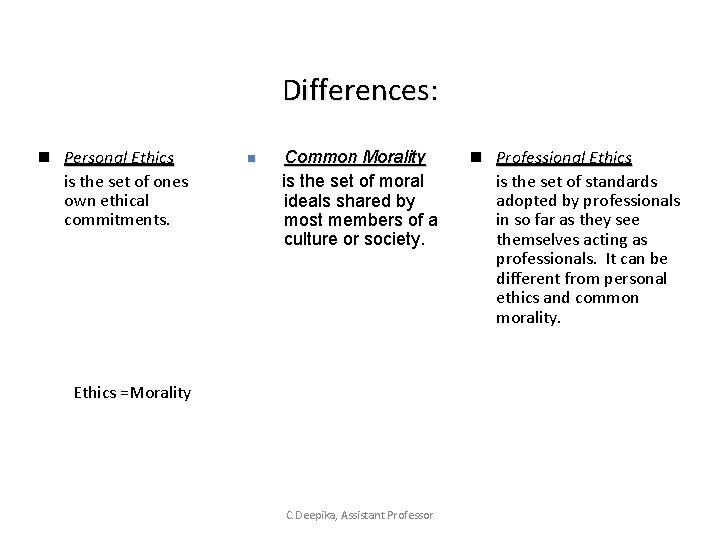
Differences: n Personal Ethics is the set of ones own ethical commitments. Common Morality is the set of moral ideals shared by most members of a culture or society. n Ethics =Morality C. Deepika, Assistant Professor n Professional Ethics is the set of standards adopted by professionals in so far as they see themselves acting as professionals. It can be different from personal ethics and common morality.
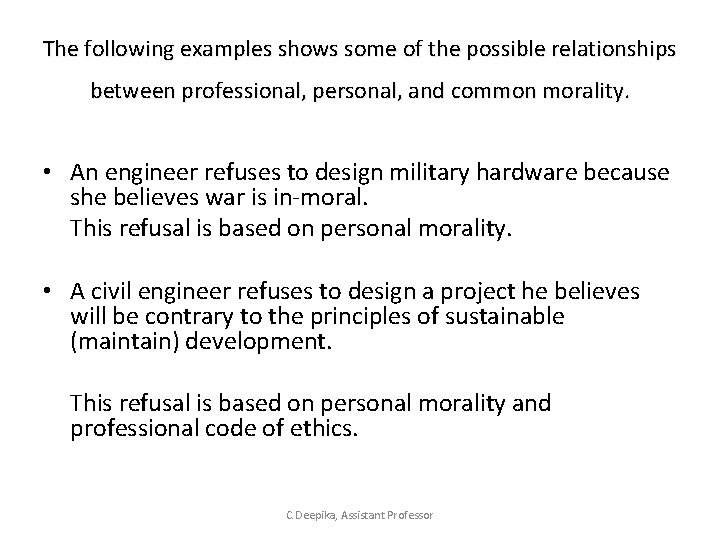
The following examples shows some of the possible relationships between professional, personal, and common morality. • An engineer refuses to design military hardware because she believes war is in-moral. This refusal is based on personal morality. • A civil engineer refuses to design a project he believes will be contrary to the principles of sustainable (maintain) development. This refusal is based on personal morality and professional code of ethics. C. Deepika, Assistant Professor
Aims of studying ethics F Moral Imagination: To minimize the chances of being taken by surprise, engineers must exercise great imagination in considering possible alternatives and their likely consequences. F Recognizing (Moral) Ethical Issues: F Analyzing Concepts: F Eliciting (Bring out) a Sense of Responsibility: F Addressing un-clarity, un-certainty, and disagreement. C. Deepika, Assistant Professor
Case: The Forklifter (PAGE 24 or page 320 in 3 rd edn) Engineering student Bryan Springer has a high paying summer job as a forklift operator. This job enables him to attend university without having to take out any student loans. He was now staring at a 50 -gallon drum filled with used machine coolant, wondering what he should do. Just moments ago, Bryan's supervisor, Max Morrison, told him to dump half of the used coolant down the drain. Bryan knew the coolant was toxic, and he mentioned this to Max. But Max was not swayed. C. Deepika, Assistant Professor
Case: The Forklifter (cont. ) Max: The toxins settle at the bottom of the drum. If you pour out half and dilute it with tap water while you're pouring it, there's no problem. Byran: I don't think that's going to work. Besides, isn't it against the law? Max: Look, kid, I don't have time for chat about a bunch of laws. If I spent my time worrying about every little regulation that comes along, I'd never get anything done -- and neither will you. Common sense is my rule. I just told you --Toxins settle at the bottom, and most of them will stay there. We've been doing this for years, and nothing's happened. Byran: You mean no one's said anything about it? That doesn't mean the environment isn't being harmed. Max: You aren't one of those "environmentalists, " are you? You students spend too much of your time with "theory”. It's time to "get real" -- and get on with the job. C. Deepika, Assistant Professor
Case: The Forklifter (cont. ) Byran: But. . Max: But nothing. Time to get real-and get on with the job. You know, you're very lucky to have a good paying job like this, kid. In three months you'll be back in your university. Meanwhile, how many other students do you think there are out there wondering if they'll be able to afford to go back - students who'd give everything to be where you are right now . Max then left, fully expecting Bryan to dump the used coolant. As Bryan stared at the drum, he pondered his options. What options do you think he has? What do you think he should do? C. Deepika, Assistant Professor
UNIT-4 C. Deepika, Assistant Professor
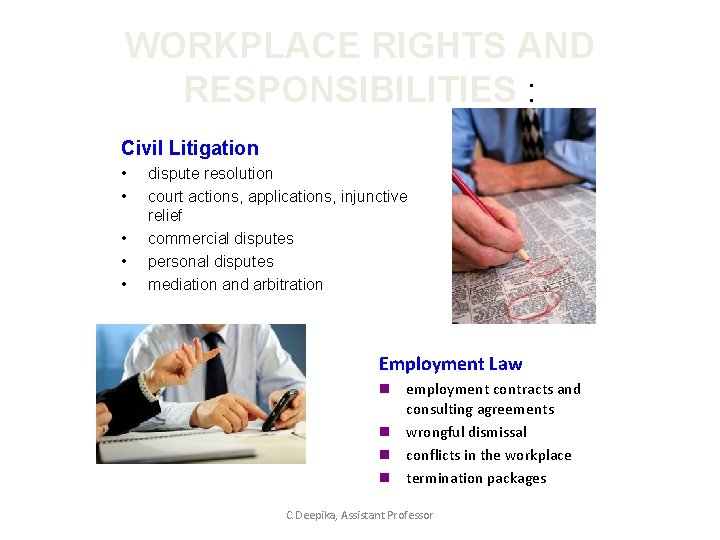
WORKPLACE RIGHTS AND RESPONSIBILITIES : Civil Litigation • • • dispute resolution court actions, applications, injunctive relief commercial disputes personal disputes mediation and arbitration Employment Law employment contracts and consulting agreements n wrongful dismissal n conflicts in the workplace n termination packages n C. Deepika, Assistant Professor
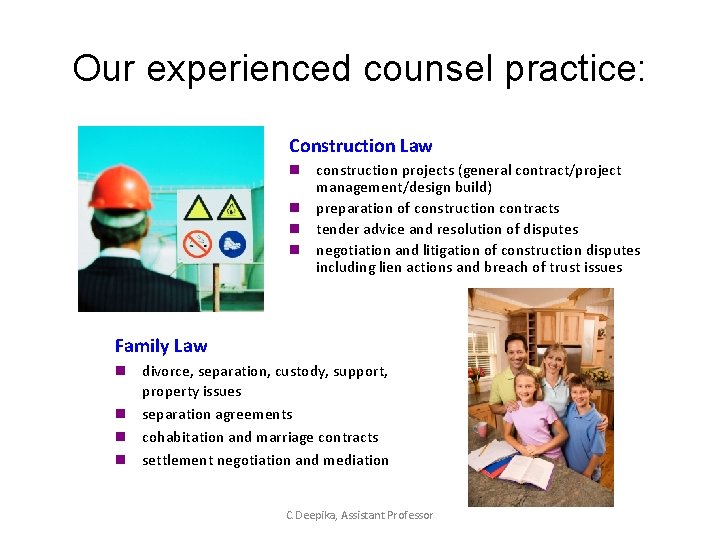
Our experienced counsel practice: Construction Law construction projects (general contract/project management/design build) n preparation of construction contracts n tender advice and resolution of disputes n negotiation and litigation of construction disputes including lien actions and breach of trust issues n Family Law divorce, separation, custody, support, property issues n separation agreements n cohabitation and marriage contracts n settlement negotiation and mediation n C. Deepika, Assistant Professor
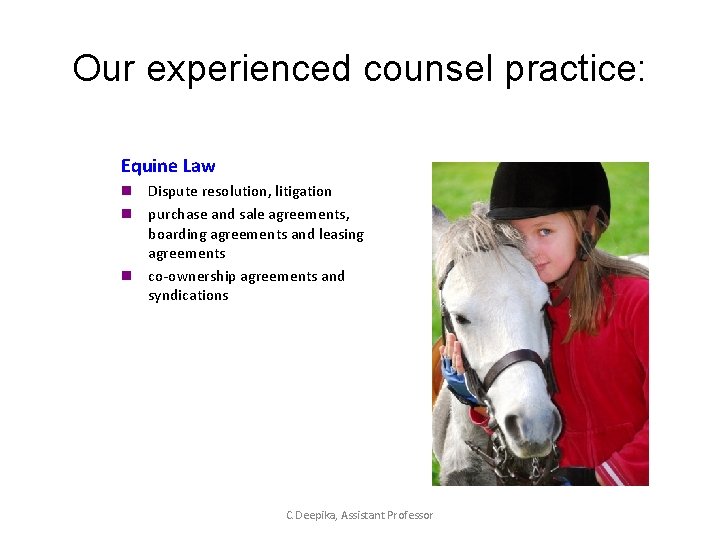
Our experienced counsel practice: Equine Law Dispute resolution, litigation n purchase and sale agreements, boarding agreements and leasing agreements n co-ownership agreements and syndications n C. Deepika, Assistant Professor
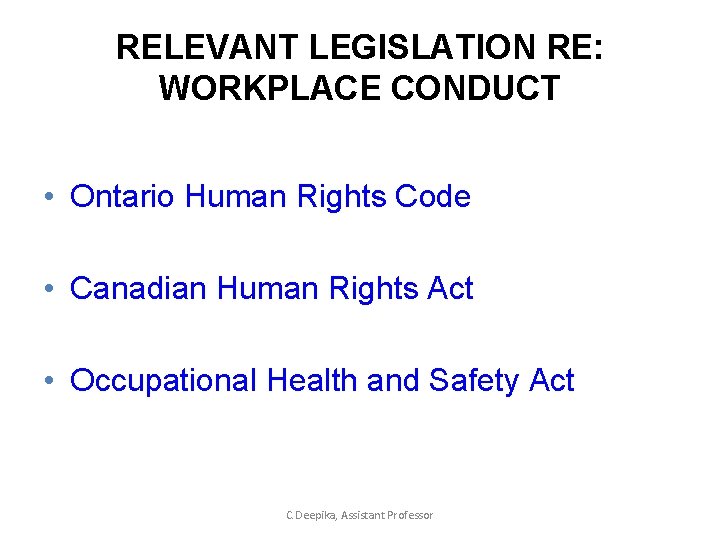
RELEVANT LEGISLATION RE: WORKPLACE CONDUCT • Ontario Human Rights Code • Canadian Human Rights Act • Occupational Health and Safety Act C. Deepika, Assistant Professor
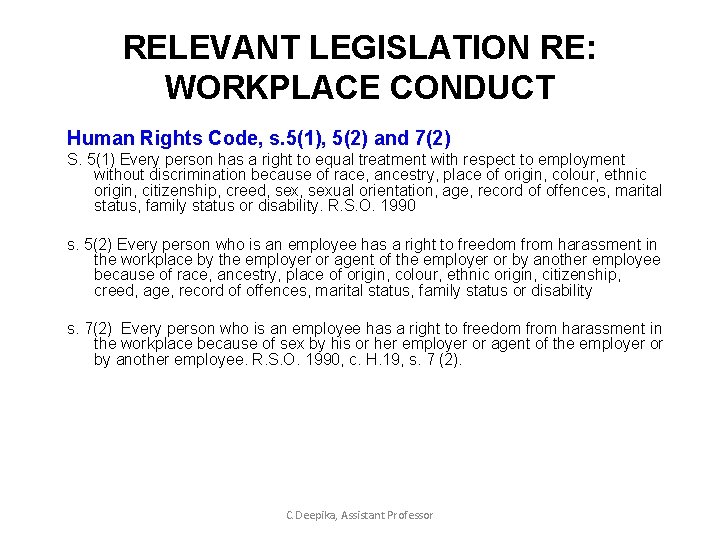
RELEVANT LEGISLATION RE: WORKPLACE CONDUCT Human Rights Code, s. 5(1), 5(2) and 7(2) S. 5(1) Every person has a right to equal treatment with respect to employment without discrimination because of race, ancestry, place of origin, colour, ethnic origin, citizenship, creed, sexual orientation, age, record of offences, marital status, family status or disability. R. S. O. 1990 s. 5(2) Every person who is an employee has a right to freedom from harassment in the workplace by the employer or agent of the employer or by another employee because of race, ancestry, place of origin, colour, ethnic origin, citizenship, creed, age, record of offences, marital status, family status or disability s. 7(2) Every person who is an employee has a right to freedom from harassment in the workplace because of sex by his or her employer or agent of the employer or by another employee. R. S. O. 1990, c. H. 19, s. 7 (2). C. Deepika, Assistant Professor
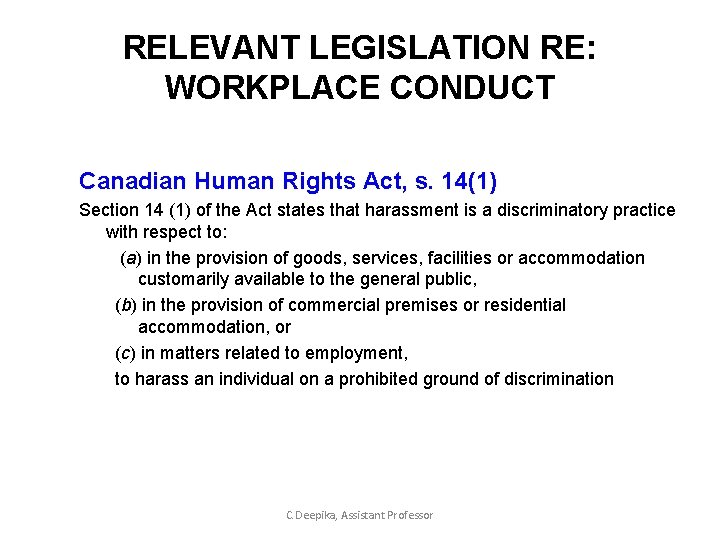
RELEVANT LEGISLATION RE: WORKPLACE CONDUCT Canadian Human Rights Act, s. 14(1) Section 14 (1) of the Act states that harassment is a discriminatory practice with respect to: (a) in the provision of goods, services, facilities or accommodation customarily available to the general public, (b) in the provision of commercial premises or residential accommodation, or (c) in matters related to employment, to harass an individual on a prohibited ground of discrimination C. Deepika, Assistant Professor
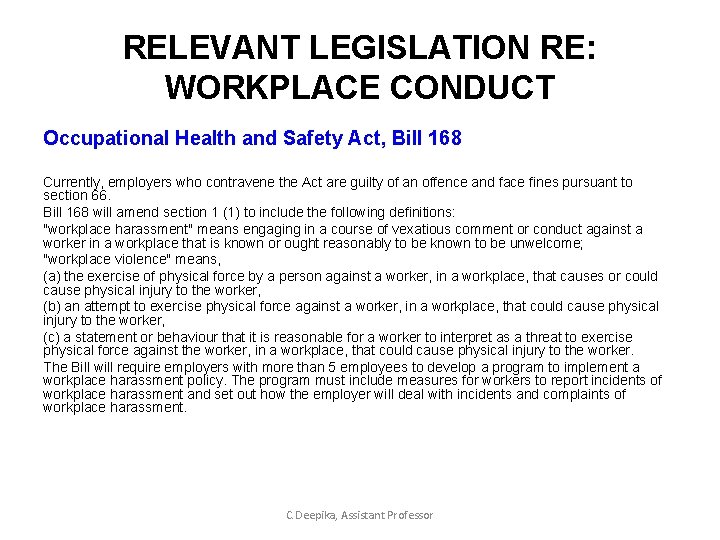
RELEVANT LEGISLATION RE: WORKPLACE CONDUCT Occupational Health and Safety Act, Bill 168 Currently, employers who contravene the Act are guilty of an offence and face fines pursuant to section 66. Bill 168 will amend section 1 (1) to include the following definitions: "workplace harassment" means engaging in a course of vexatious comment or conduct against a worker in a workplace that is known or ought reasonably to be known to be unwelcome; "workplace violence" means, (a) the exercise of physical force by a person against a worker, in a workplace, that causes or could cause physical injury to the worker, (b) an attempt to exercise physical force against a worker, in a workplace, that could cause physical injury to the worker, (c) a statement or behaviour that it is reasonable for a worker to interpret as a threat to exercise physical force against the worker, in a workplace, that could cause physical injury to the worker. The Bill will require employers with more than 5 employees to develop a program to implement a workplace harassment policy. The program must include measures for workers to report incidents of workplace harassment and set out how the employer will deal with incidents and complaints of workplace harassment. C. Deepika, Assistant Professor
HARASSMENT IN THE WORKPLACE Types of Harassment: Sexual – “intimidation, bullying or coercion of a sexual nature, or the unwelcome or inappropriate promise of rewards in exchange for sexual favours”. Non-Sexual Bullying or verbal abuse Unwarranted Discipline - where the employer's treatment of the employee makes continued employment intolerable C. Deepika, Assistant Professor
EMPLOYEE RIGHTS – Internal Complaint to Human Resources or management – Human Rights complaint under the Code – Stress Leave/Disability (if available) – Civil Action/Constructive Dismissal C. Deepika, Assistant Professor
EMPLOYER RESPONSIBILITIES • Employment Contracts • Policies (Harassment, Internet Use) • Training • Monitoring • Discipline C. Deepika, Assistant Professor
EMPLOYER RESPONSIBILITIES Employment Contract and Policies • Outline what behaviour is not acceptable in the workplace • Set out the employer’s expectations regarding proper conduct in the workplace • Advise what range of disciplinary action will be taken should an employee be found to have breached the policy C. Deepika, Assistant Professor
EMPLOYER RESPONSIBILITIES Investigation • Assess the complaint • Appoint an investigator • Conduct interviews • Make interim decisions on complainant/respondent • Process evidence and interview additional parties C. Deepika, Assistant Professor
EMPLOYER RESPONSIBILITIES Discipline - breach of the policy constitutes cause for discipline, up to and including termination of employment C. Deepika, Assistant Professor
HUMAN RIGHTS COMPLAINT • Usually arises after the Employer has either failed to respond to a complaint or has made a decision with which the Complainant disagrees • Under the current system an applicant may bring their complaint directly before the Ontario Human Rights Tribunal • Within this system a complaint may be resolved by adjudication or mediation C. Deepika, Assistant Professor
DISABILITY BENEFITS • If the harassment results in severe mental distress it may result in a claim for shortterm or long-term disability, if available • Workplace stress has rapidly becoming one of the most popular causes for employee absence and disability claims C. Deepika, Assistant Professor
CIVIL ACTION Constructive Dismissal • Where the employer's treatment of the employee makes continued employment intolerable the employee may successfully argue that they were forced to resign and claim constructive dismissal. • See Shah v. Xerox (Ont. C. A. ) to be discussed later C. Deepika, Assistant Professor
APPROPRIATE COMPUTER USAGE Employer Policies are used to: • Define use of Information Technologies • Communications guidelines • To Support Discipline • To prevent breach of confidentiality C. Deepika, Assistant Professor
INAPPROPRIATE COMPUTER USAGE (OFFENSIVE DOWNLOADS AND E-MAILS) • Not a right but a privilege subject to limitations set by employer • Useful tool for work with potential for abuse • Policies required re: propriety • Effective balance of personal needs of employees and business interests • Minimizing abuses • Reducing inefficiencies • Maximizing beneficial uses of business tools • Eastern Ontario Catholic District School Board v. O. E. C. T. A C. Deepika, Assistant Professor
UNIT-5 C. Deepika, Assistant Professor
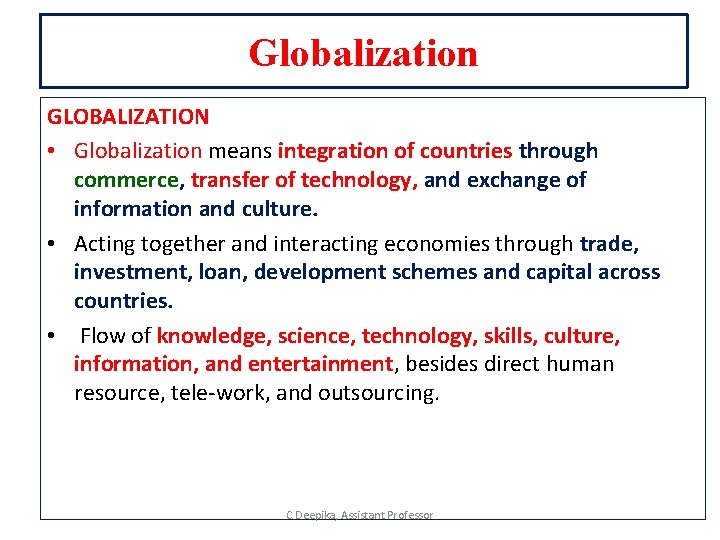
Globalization GLOBALIZATION • Globalization means integration of countries through commerce, transfer of technology, and exchange of information and culture. • Acting together and interacting economies through trade, investment, loan, development schemes and capital across countries. • Flow of knowledge, science, technology, skills, culture, information, and entertainment, besides direct human resource, tele-work, and outsourcing. C. Deepika, Assistant Professor
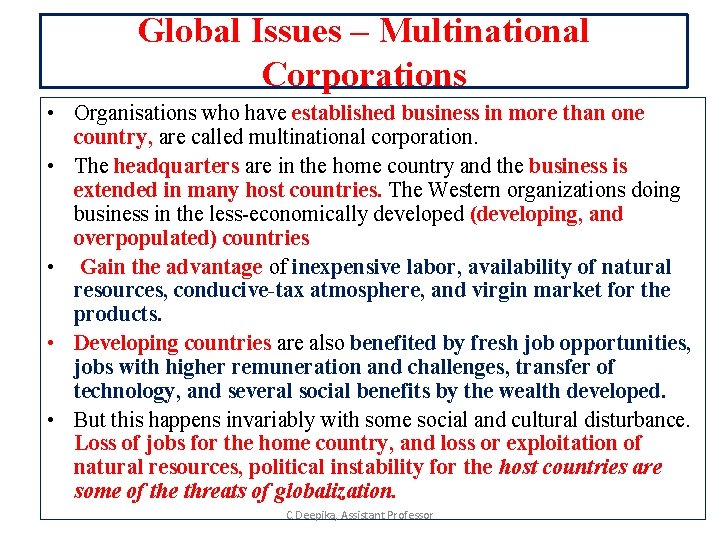
Global Issues – Multinational Corporations • Organisations who have established business in more than one country, are called multinational corporation. • The headquarters are in the home country and the business is extended in many host countries. The Western organizations doing business in the less-economically developed (developing, and overpopulated) countries • Gain the advantage of inexpensive labor, availability of natural resources, conducive-tax atmosphere, and virgin market for the products. • Developing countries are also benefited by fresh job opportunities, jobs with higher remuneration and challenges, transfer of technology, and several social benefits by the wealth developed. • But this happens invariably with some social and cultural disturbance. Loss of jobs for the home country, and loss or exploitation of natural resources, political instability for the host countries are some of the threats of globalization. C. Deepika, Assistant Professor
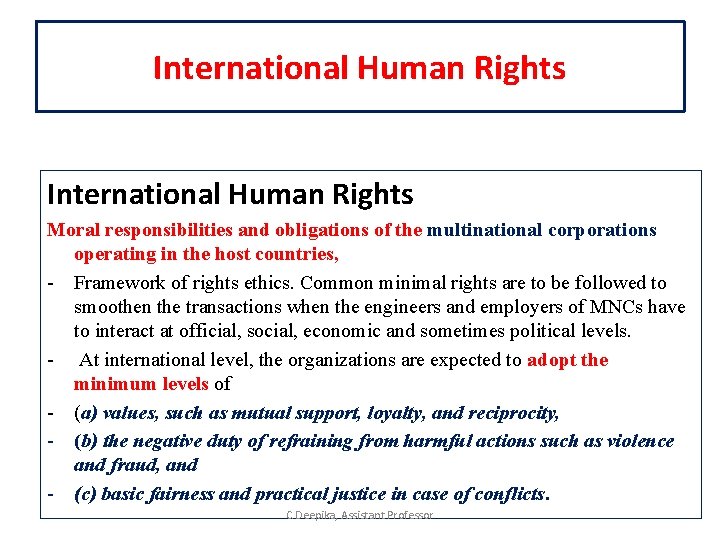
International Human Rights Moral responsibilities and obligations of the multinational corporations operating in the host countries, - Framework of rights ethics. Common minimal rights are to be followed to smoothen the transactions when the engineers and employers of MNCs have to interact at official, social, economic and sometimes political levels. - At international level, the organizations are expected to adopt the minimum levels of - (a) values, such as mutual support, loyalty, and reciprocity, - (b) the negative duty of refraining from harmful actions such as violence and fraud, and - (c) basic fairness and practical justice in case of conflicts. C. Deepika, Assistant Professor
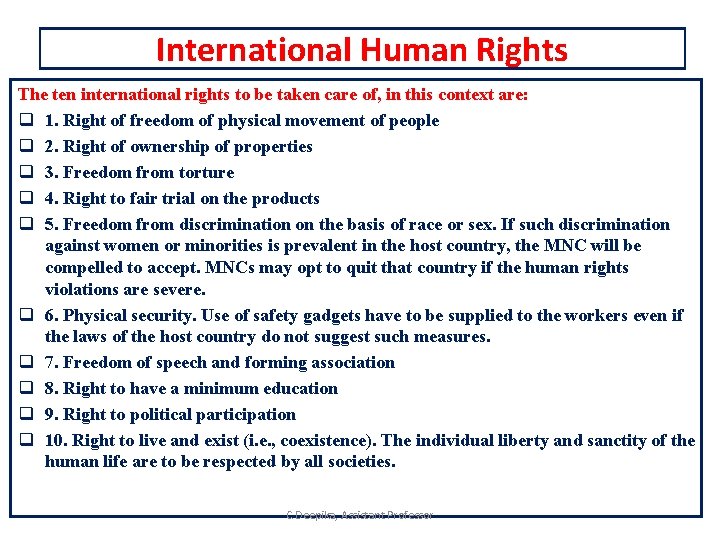
International Human Rights The ten international rights to be taken care of, in this context are: q 1. Right of freedom of physical movement of people q 2. Right of ownership of properties q 3. Freedom from torture q 4. Right to fair trial on the products q 5. Freedom from discrimination on the basis of race or sex. If such discrimination against women or minorities is prevalent in the host country, the MNC will be compelled to accept. MNCs may opt to quit that country if the human rights violations are severe. q 6. Physical security. Use of safety gadgets have to be supplied to the workers even if the laws of the host country do not suggest such measures. q 7. Freedom of speech and forming association q 8. Right to have a minimum education q 9. Right to political participation q 10. Right to live and exist (i. e. , coexistence). The individual liberty and sanctity of the human life are to be respected by all societies. C. Deepika, Assistant Professor
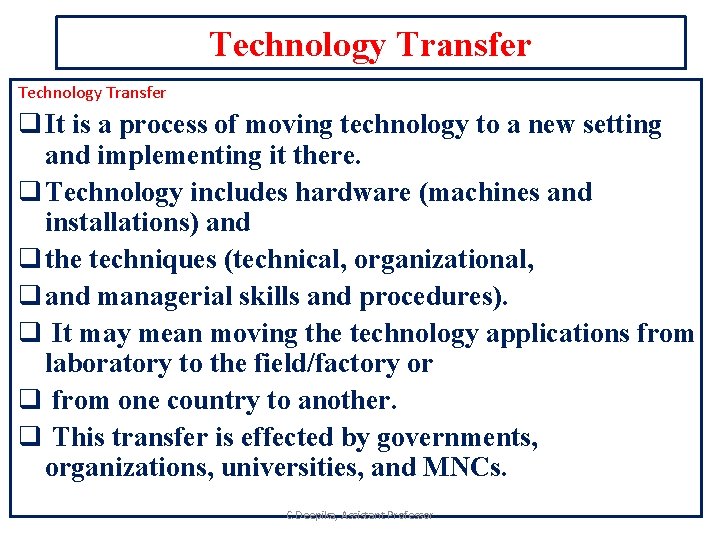
Technology Transfer q It is a process of moving technology to a new setting and implementing it there. q Technology includes hardware (machines and installations) and q the techniques (technical, organizational, q and managerial skills and procedures). q It may mean moving the technology applications from laboratory to the field/factory or q from one country to another. q This transfer is effected by governments, organizations, universities, and MNCs. C. Deepika, Assistant Professor
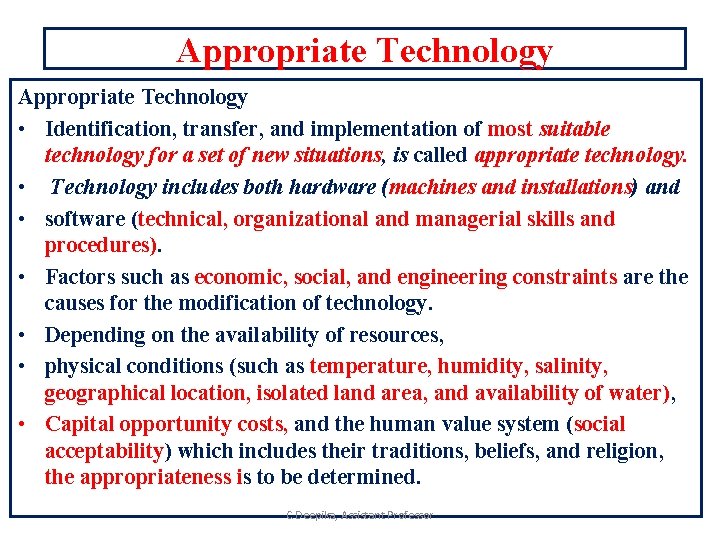
Appropriate Technology • Identification, transfer, and implementation of most suitable technology for a set of new situations, is called appropriate technology. • Technology includes both hardware (machines and installations) and • software (technical, organizational and managerial skills and procedures). • Factors such as economic, social, and engineering constraints are the causes for the modification of technology. • Depending on the availability of resources, • physical conditions (such as temperature, humidity, salinity, geographical location, isolated land area, and availability of water), • Capital opportunity costs, and the human value system (social acceptability) which includes their traditions, beliefs, and religion, the appropriateness is to be determined. C. Deepika, Assistant Professor
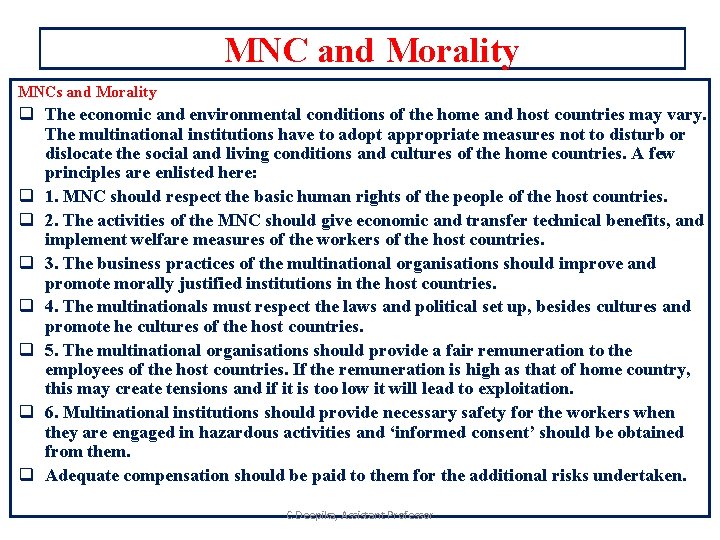
MNC and Morality MNCs and Morality q The economic and environmental conditions of the home and host countries may vary. The multinational institutions have to adopt appropriate measures not to disturb or dislocate the social and living conditions and cultures of the home countries. A few principles are enlisted here: q 1. MNC should respect the basic human rights of the people of the host countries. q 2. The activities of the MNC should give economic and transfer technical benefits, and implement welfare measures of the workers of the host countries. q 3. The business practices of the multinational organisations should improve and promote morally justified institutions in the host countries. q 4. The multinationals must respect the laws and political set up, besides cultures and promote he cultures of the host countries. q 5. The multinational organisations should provide a fair remuneration to the employees of the host countries. If the remuneration is high as that of home country, this may create tensions and if it is too low it will lead to exploitation. q 6. Multinational institutions should provide necessary safety for the workers when they are engaged in hazardous activities and ‘informed consent’ should be obtained from them. q Adequate compensation should be paid to them for the additional risks undertaken. C. Deepika, Assistant Professor
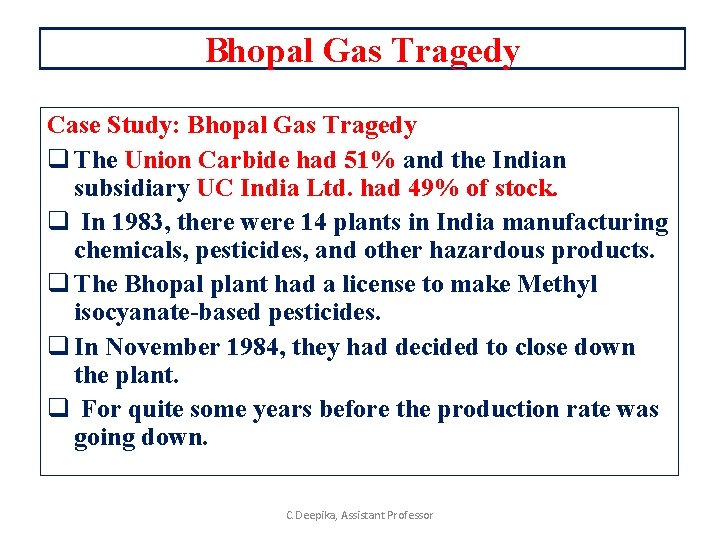
Bhopal Gas Tragedy Case Study: Bhopal Gas Tragedy q The Union Carbide had 51% and the Indian subsidiary UC India Ltd. had 49% of stock. q In 1983, there were 14 plants in India manufacturing chemicals, pesticides, and other hazardous products. q The Bhopal plant had a license to make Methyl isocyanate-based pesticides. q In November 1984, they had decided to close down the plant. q For quite some years before the production rate was going down. C. Deepika, Assistant Professor
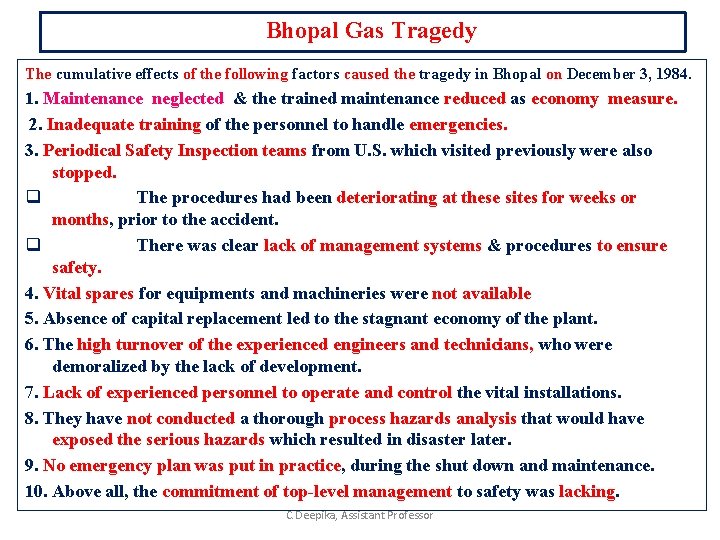
Bhopal Gas Tragedy The cumulative effects of the following factors caused the tragedy in Bhopal on December 3, 1984. 1. Maintenance neglected & the trained maintenance reduced as economy measure. 2. Inadequate training of the personnel to handle emergencies. 3. Periodical Safety Inspection teams from U. S. which visited previously were also stopped. q The procedures had been deteriorating at these sites for weeks or months, prior to the accident. q There was clear lack of management systems & procedures to ensure safety. 4. Vital spares for equipments and machineries were not available 5. Absence of capital replacement led to the stagnant economy of the plant. 6. The high turnover of the experienced engineers and technicians, who were demoralized by the lack of development. 7. Lack of experienced personnel to operate and control the vital installations. 8. They have not conducted a thorough process hazards analysis that would have exposed the serious hazards which resulted in disaster later. 9. No emergency plan was put in practice, during the shut down and maintenance. 10. Above all, the commitment of top-level management to safety was lacking. C. Deepika, Assistant Professor
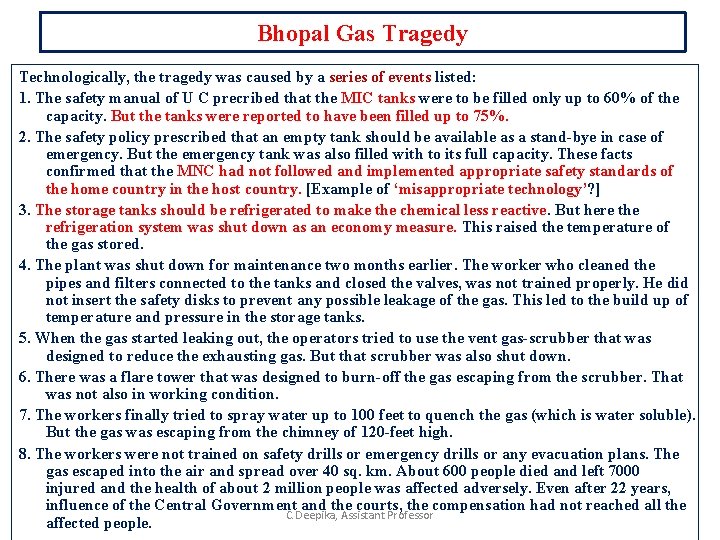
Bhopal Gas Tragedy Technologically, the tragedy was caused by a series of events listed: 1. The safety manual of U C precribed that the MIC tanks were to be filled only up to 60% of the capacity. But the tanks were reported to have been filled up to 75%. 2. The safety policy prescribed that an empty tank should be available as a stand-bye in case of emergency. But the emergency tank was also filled with to its full capacity. These facts confirmed that the MNC had not followed and implemented appropriate safety standards of the home country in the host country. [Example of ‘misappropriate technology’? ] 3. The storage tanks should be refrigerated to make the chemical less reactive. But here the refrigeration system was shut down as an economy measure. This raised the temperature of the gas stored. 4. The plant was shut down for maintenance two months earlier. The worker who cleaned the pipes and filters connected to the tanks and closed the valves, was not trained properly. He did not insert the safety disks to prevent any possible leakage of the gas. This led to the build up of temperature and pressure in the storage tanks. 5. When the gas started leaking out, the operators tried to use the vent gas-scrubber that was designed to reduce the exhausting gas. But that scrubber was also shut down. 6. There was a flare tower that was designed to burn-off the gas escaping from the scrubber. That was not also in working condition. 7. The workers finally tried to spray water up to 100 feet to quench the gas (which is water soluble). But the gas was escaping from the chimney of 120 -feet high. 8. The workers were not trained on safety drills or emergency drills or any evacuation plans. The gas escaped into the air and spread over 40 sq. km. About 600 people died and left 7000 injured and the health of about 2 million people was affected adversely. Even after 22 years, influence of the Central Government and the courts, the compensation had not reached all the C. Deepika, Assistant Professor affected people.
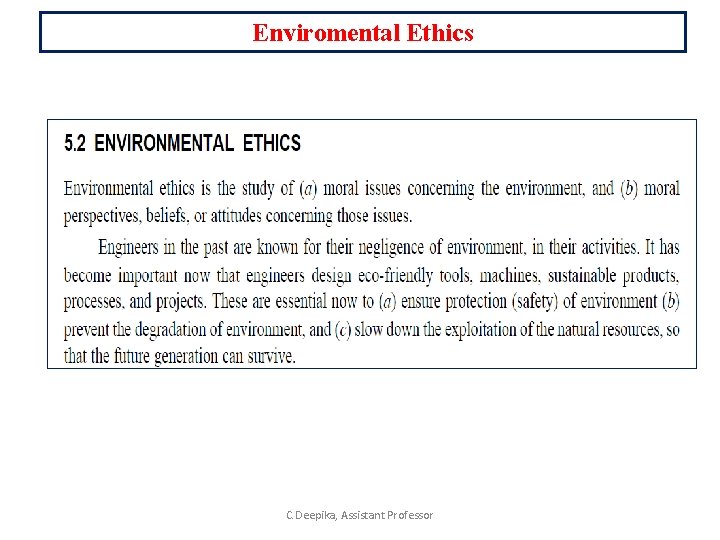
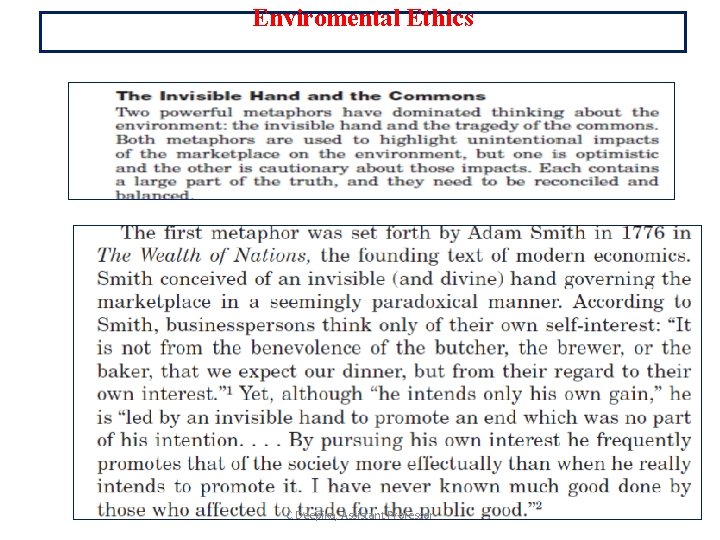
Enviromental Ethics C. Deepika, Assistant Professor
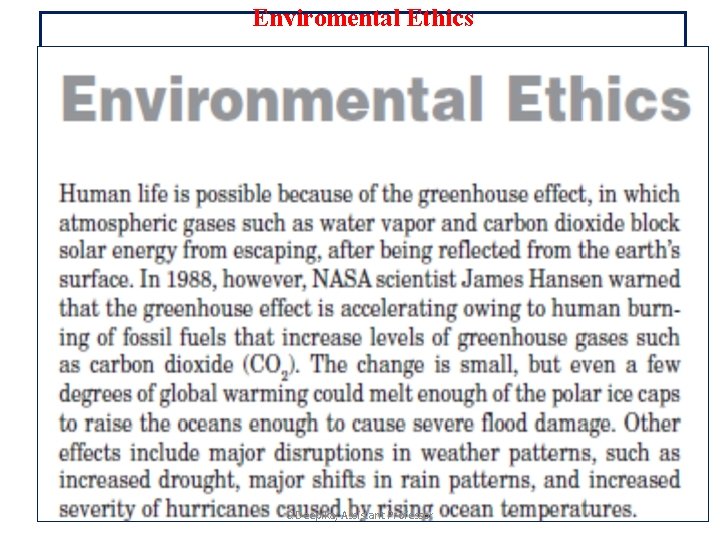
Enviromental Ethics C. Deepika, Assistant Professor
Enviromental Ethics C. Deepika, Assistant Professor
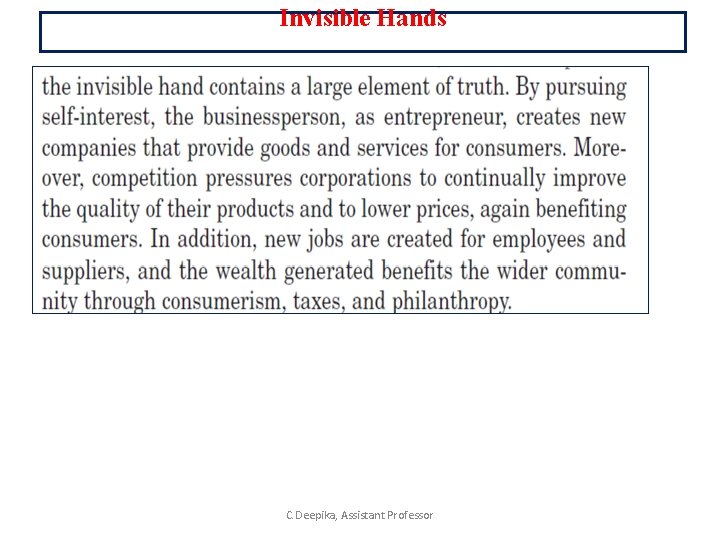
Invisible Hands C. Deepika, Assistant Professor
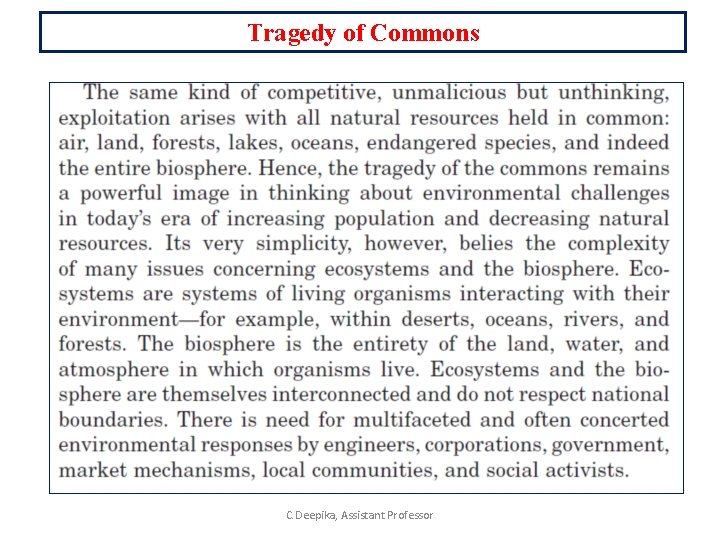
Tragedy of Commons C. Deepika, Assistant Professor
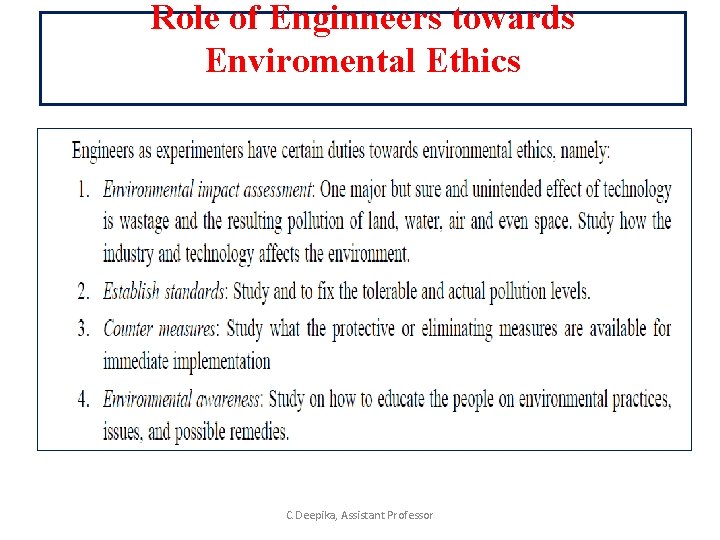
Role of Enginneers towards Enviromental Ethics C. Deepika, Assistant Professor
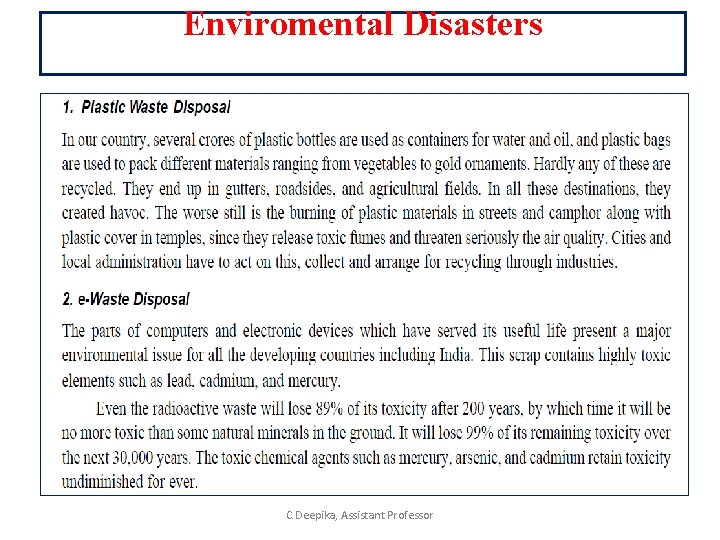
Enviromental Disasters C. Deepika, Assistant Professor
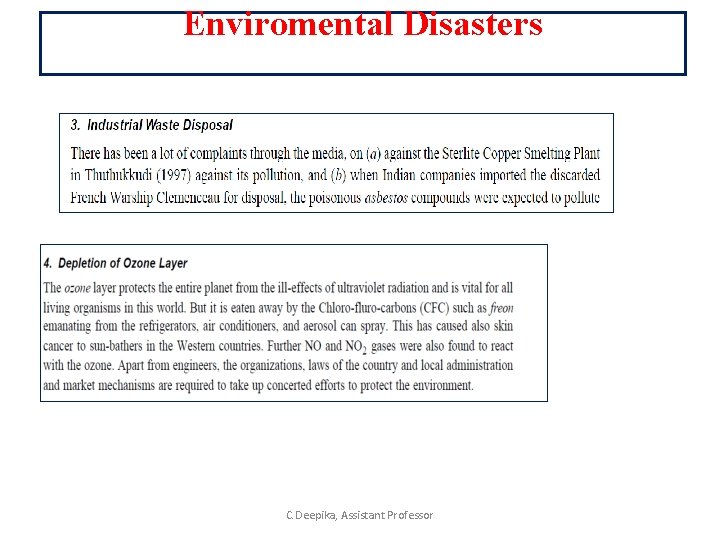
Enviromental Disasters C. Deepika, Assistant Professor
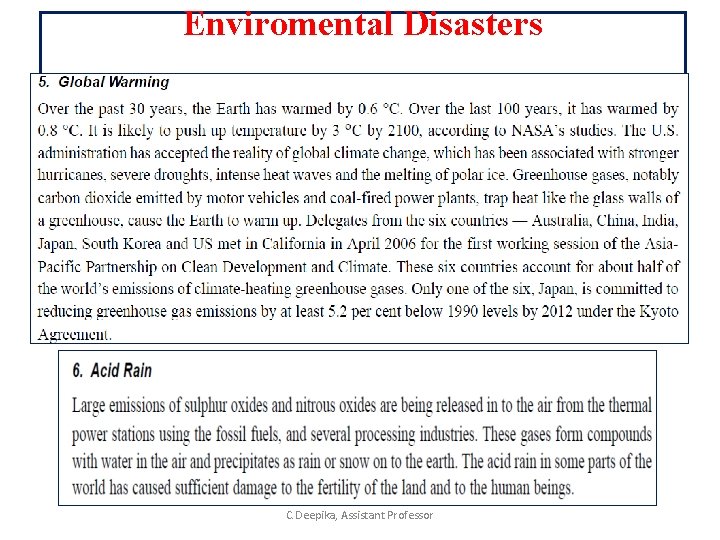
Enviromental Disasters C. Deepika, Assistant Professor
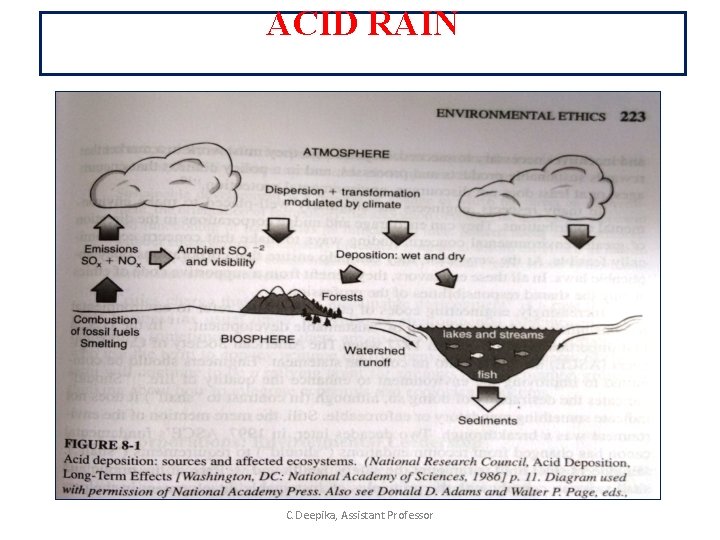
ACID RAIN C. Deepika, Assistant Professor
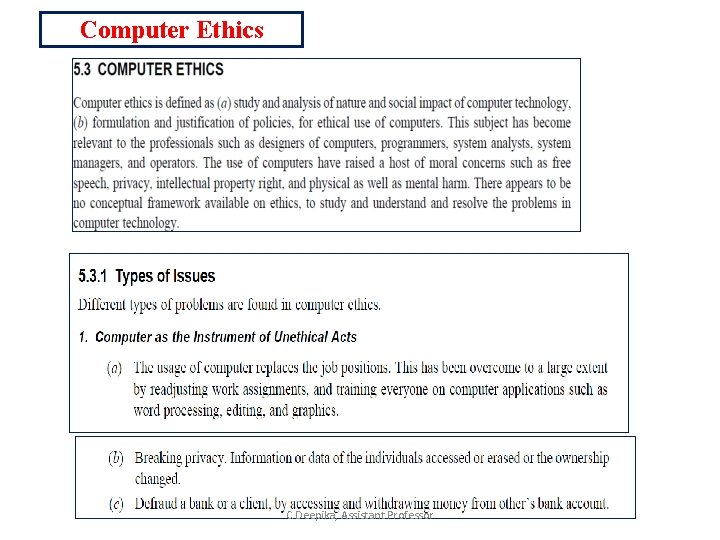
Computer Ethics C. Deepika, Assistant Professor
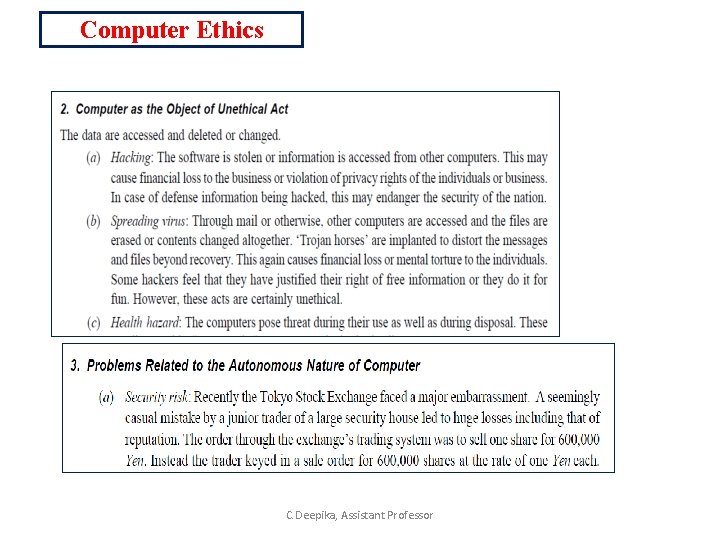
Computer Ethics C. Deepika, Assistant Professor
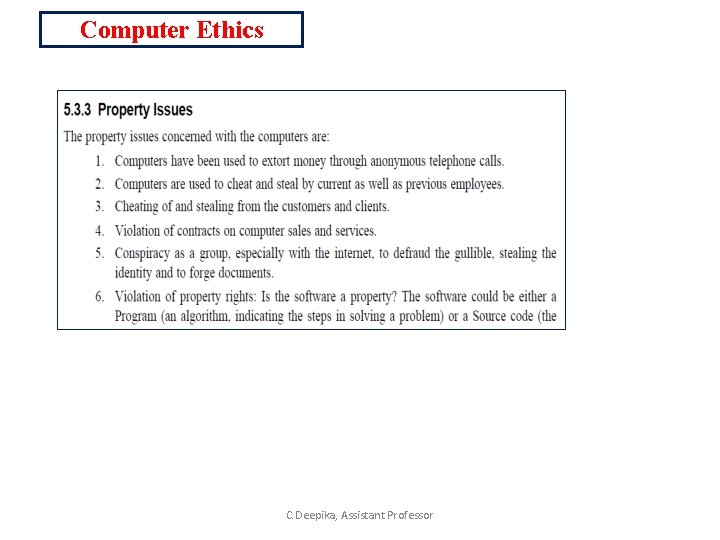
Computer Ethics C. Deepika, Assistant Professor
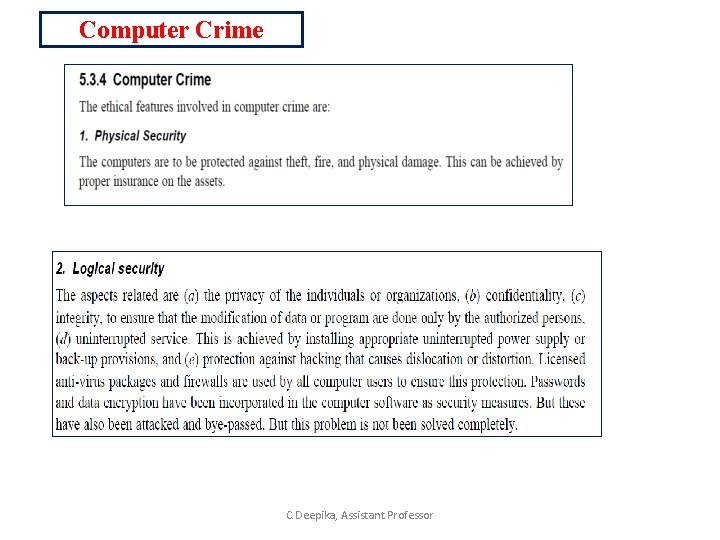
Computer Crime C. Deepika, Assistant Professor
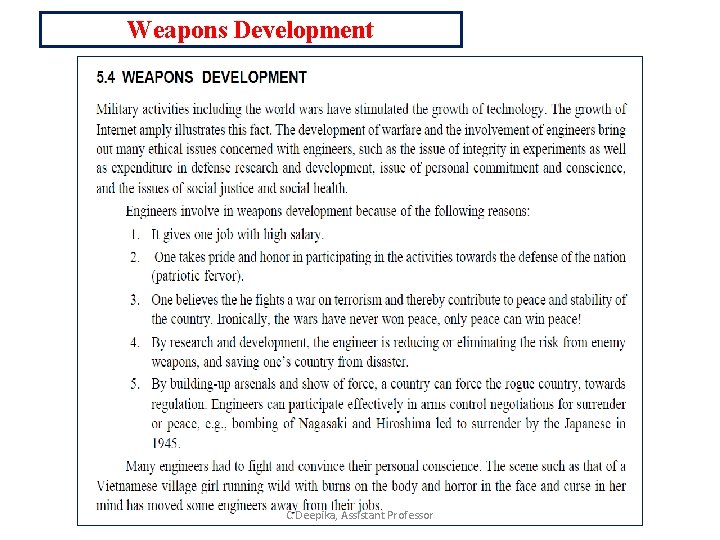
Weapons Development C. Deepika, Assistant Professor
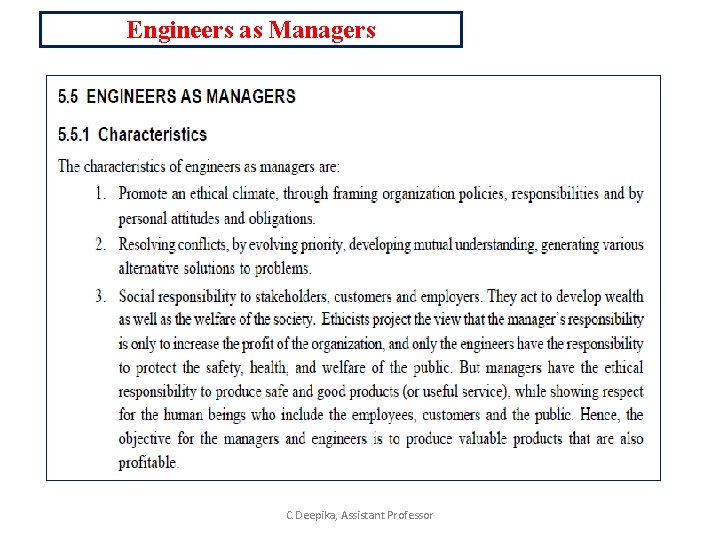
Engineers as Managers C. Deepika, Assistant Professor
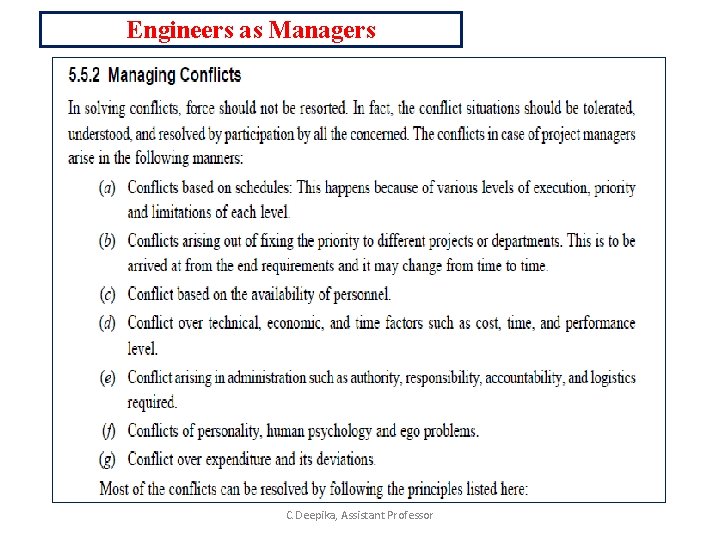
Engineers as Managers C. Deepika, Assistant Professor
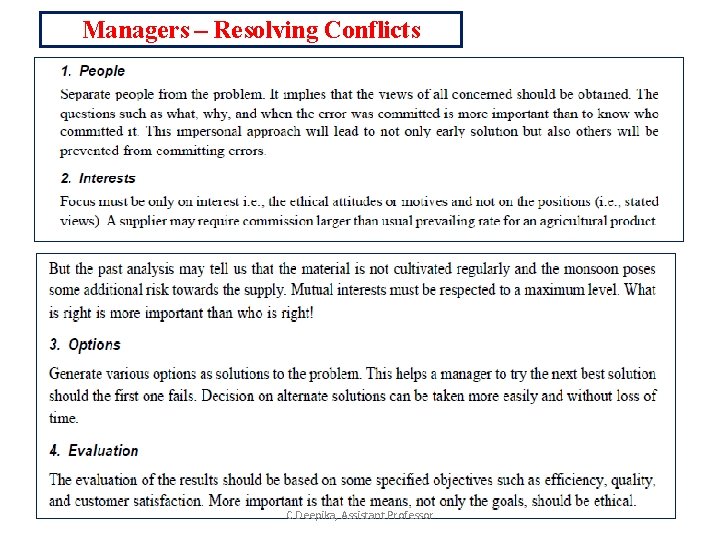
Managers – Resolving Conflicts C. Deepika, Assistant Professor
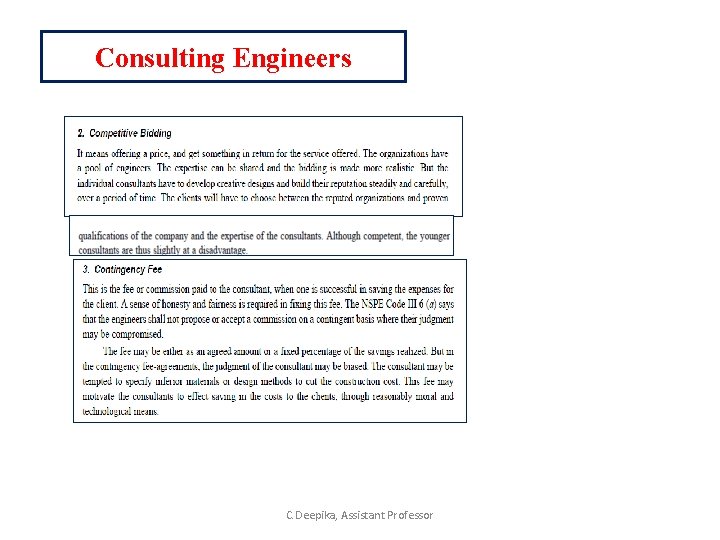
Consulting Engineers C. Deepika, Assistant Professor
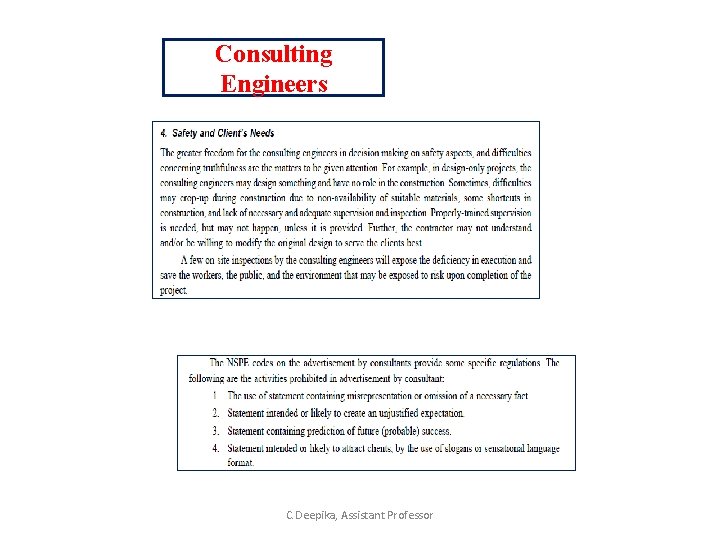
Consulting Engineers C. Deepika, Assistant Professor
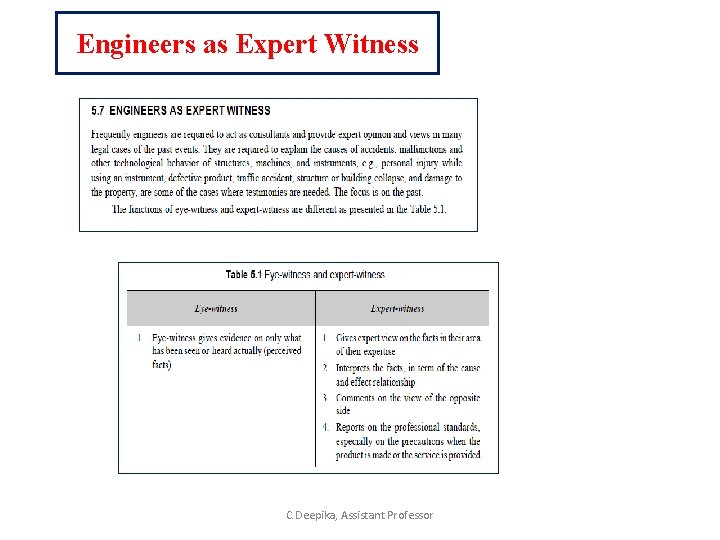
Engineers as Expert Witness C. Deepika, Assistant Professor
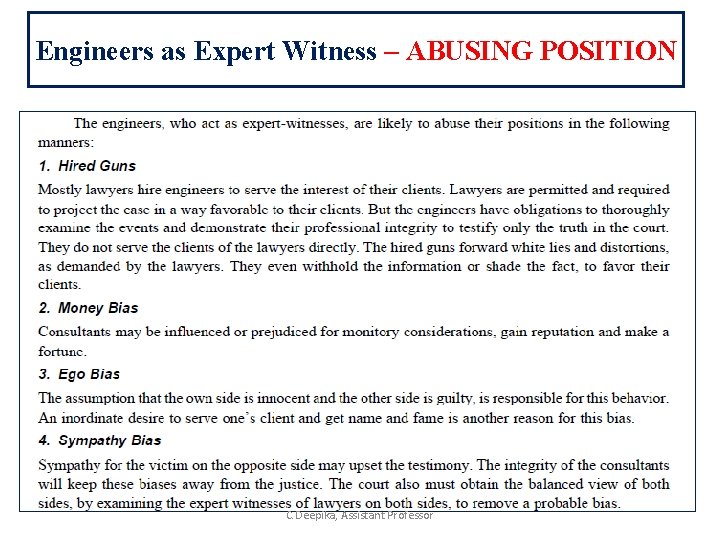
Engineers as Expert Witness – ABUSING POSITION C. Deepika, Assistant Professor