
DIRECTING Subtitle Pratap Naik Classes Directing Introduction Directing
DIRECTING Subtitle Pratap Naik Classes
Directing : Introduction Directing refers to the process of instructing, guiding, counselling, motivating and leading people in the organisation to achieve organisational objectives. § Features § § Directing initiates action takes place at every level of management is a continuous process flows from top to bottom § Importance § § § Directing helps to initiate action Integrates employees efforts Helps in realising potential and capabilities Facilitates changes Bring stability and balance in the organisation Pratap Naik Classes

Directing : Elements Pratap Naik Classes
Supervision the process of instructing, guiding, monitoring, & Observing people while they are performing in the job. § Overseeing subordinates by a Superior (Manager) § It is the work performed by a supervisor (Lower Level Management) § Importance / Function § § § § Maintains day-to-day Contact Acts as a Link Between Workers and Management Maintaining Group Unity Ensure Completion of Task Provides Training Increase Morale of Employees Provide Feedback Pratap Naik Classes
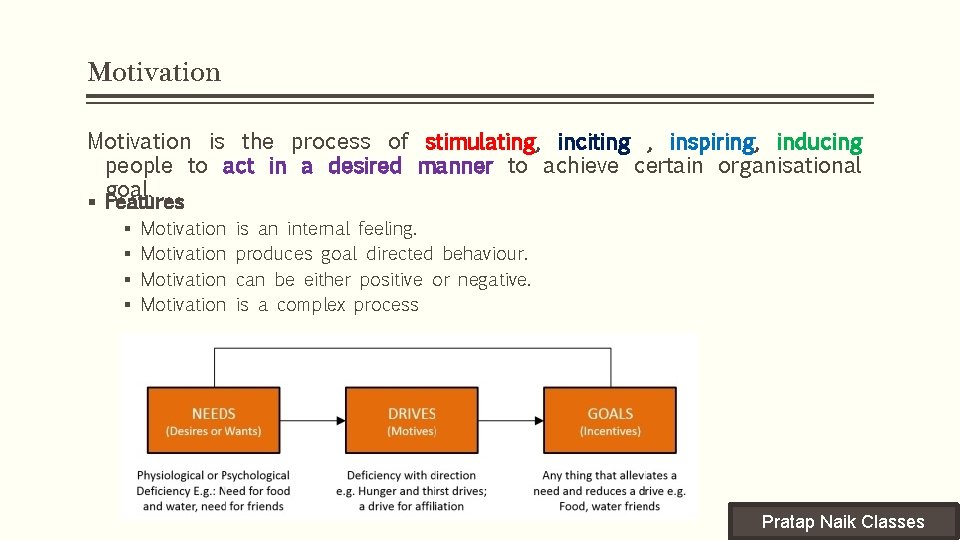
Motivation is the process of stimulating, inciting , inspiring, inducing people to act in a desired manner to achieve certain organisational goal. § Features § § Motivation is an internal feeling. produces goal directed behaviour. can be either positive or negative. is a complex process Pratap Naik Classes
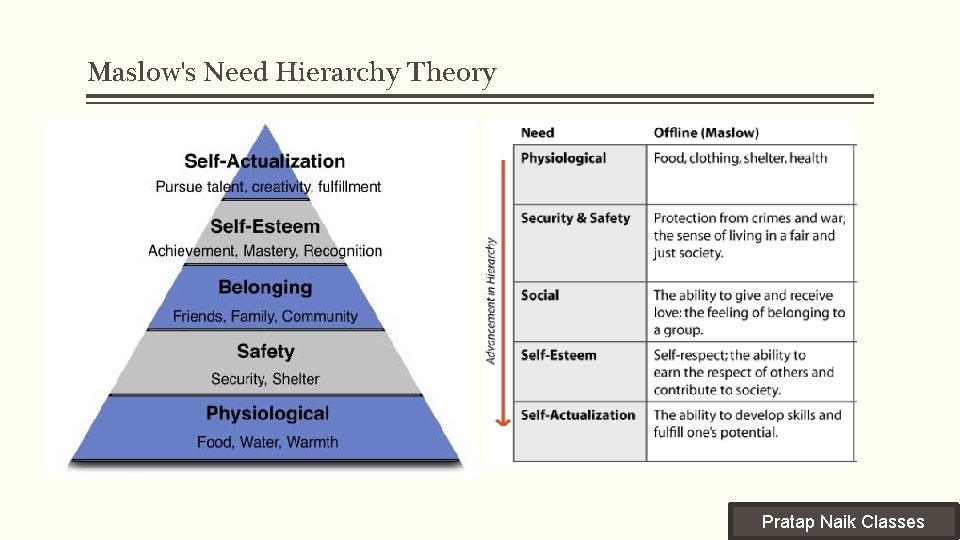
Maslow's Need Hierarchy Theory Pratap Naik Classes
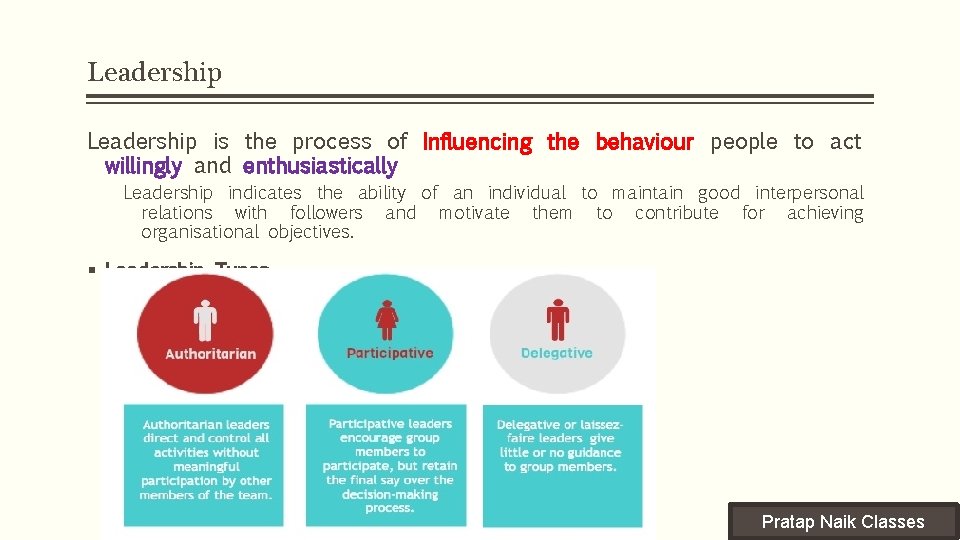
Leadership is the process of Influencing the behaviour people to act willingly and enthusiastically Leadership indicates the ability of an individual to maintain good interpersonal relations with followers and motivate them to contribute for achieving organisational objectives. § Leadership Types Pratap Naik Classes
Directing Case 1 A. S. Environs Ltd. ’ is dealing in Environment- Consultancy. To get the business, the team leader and his team used to travel to different states to give presentation to their clients. As per the policy of the company, the team leader used to travel by air whereas his team travelled by road/train. It was not only time consuming but also at times forced the female team members to travel alone. As a result, the subordinates were not acting in a desired manner to achieve organizational goals. The CEO of the company came to know about it. He called the team leader, discussed the matter with him and decided to change the travel policy of the company. It was decided that in future all the members including the leader would travel together and usefully utilize the travelling time in discussion about the presentation to be given to the clients. This made a positive impact and every member of the team started acting in a manner as desired team of leader. • State by thethe features the element of the function of management used by the CEO Pratap Naik Classes
Directing Case 1 A. S. Environs Ltd. ’ is dealing in Environment- Consultancy. To get the business, the team leader and his team used to travel to different states to give presentation to their clients. As per the policy of the company, the team leader used to travel by air whereas his team travelled by road/train. It was not only time consuming but also at times forced the female team members to travel alone. As a result, the subordinates were not acting in a desired manner to achieve organizational goals. The CEO of the company came to know about it. He called the team leader, discussed the matter with him and decided to change the travel policy of the company. It was decided that in future all the members including the leader would travel together and usefully utilize the travelling time in discussion about the presentation to be given to the clients. This made a positive impact and every member of the team started acting in a manner as by is theanteam leader. • desired Motivation internal feeling: • Motivation produces goal-directed behaviour • Motivation can be either positive or negative • Motivation is a complex process Pratap Naik Classes
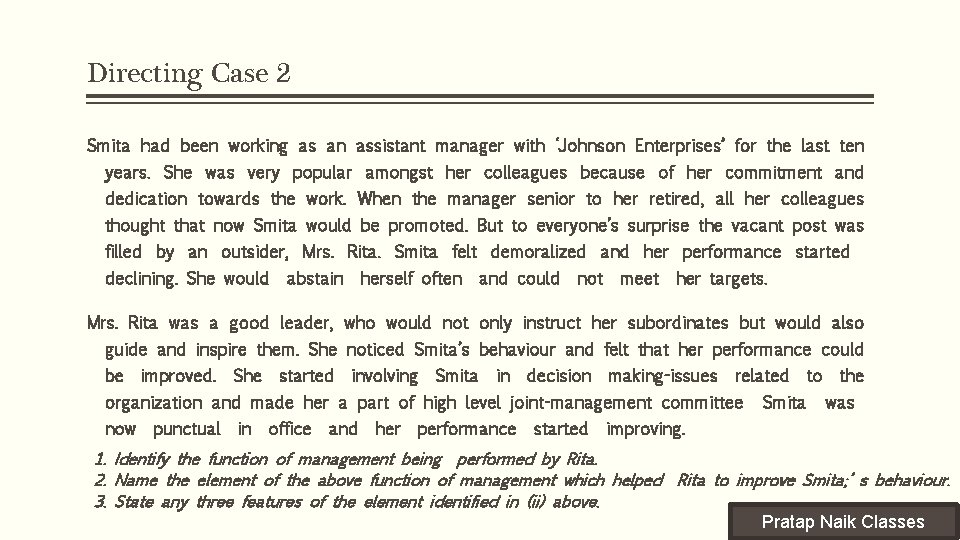
Directing Case 2 Smita had been working as an assistant manager with ‘Johnson Enterprises’ for the last ten years. She was very popular amongst her colleagues because of her commitment and dedication towards the work. When the manager senior to her retired, all her colleagues thought that now Smita would be promoted. But to everyone’s surprise the vacant post was filled by an outsider, Mrs. Rita. Smita felt demoralized and her performance started declining. She would abstain herself often and could not meet her targets. Mrs. Rita was a good leader, who would not only instruct her subordinates but would also guide and inspire them. She noticed Smita’s behaviour and felt that her performance could be improved. She started involving Smita in decision making-issues related to the organization and made her a part of high level joint-management committee now punctual in office and her performance started Smita was improving. 1. Identify the function of management being performed by Rita. 2. Name the element of the above function of management which helped Rita to improve Smita; ’ s behaviour. 3. State any three features of the element identified in (ii) above. Pratap Naik Classes
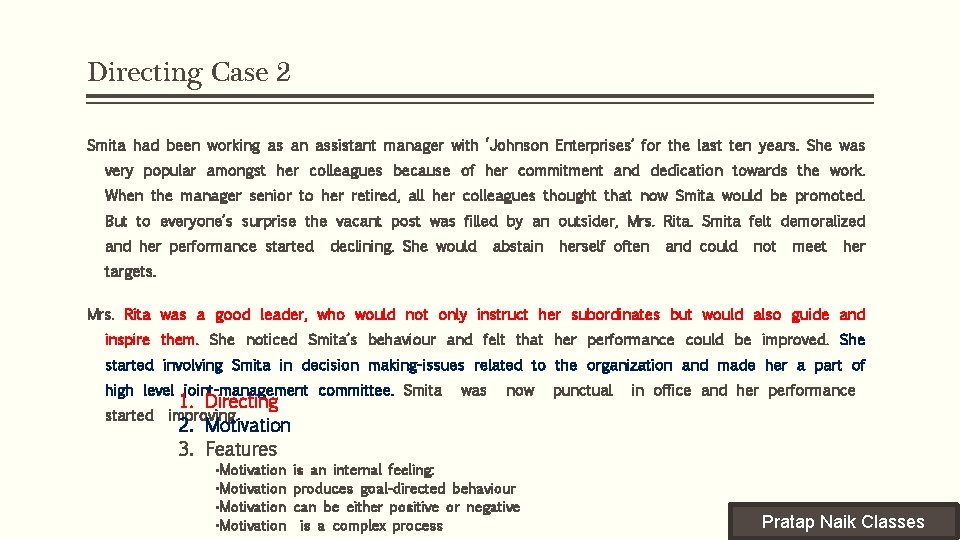
Directing Case 2 Smita had been working as an assistant manager with ‘Johnson Enterprises’ for the last ten years. She was very popular amongst her colleagues because of her commitment and dedication towards the work. When the manager senior to her retired, all her colleagues thought that now Smita would be promoted. But to everyone’s surprise the vacant post was filled by an outsider, Mrs. Rita. Smita felt demoralized and her performance started declining. She would abstain herself often and could not meet her targets. Mrs. Rita was a good leader, who would not only instruct her subordinates but would also guide and inspire them. She noticed Smita’s behaviour and felt that her performance could be improved. She started involving Smita in decision making-issues related to the organization and made her a part of high level joint-management committee. Smita 1. Directing started improving. 2. Motivation 3. Features • Motivation was now is an internal feeling: produces goal-directed behaviour can be either positive or negative is a complex process punctual in office and her performance Pratap Naik Classes
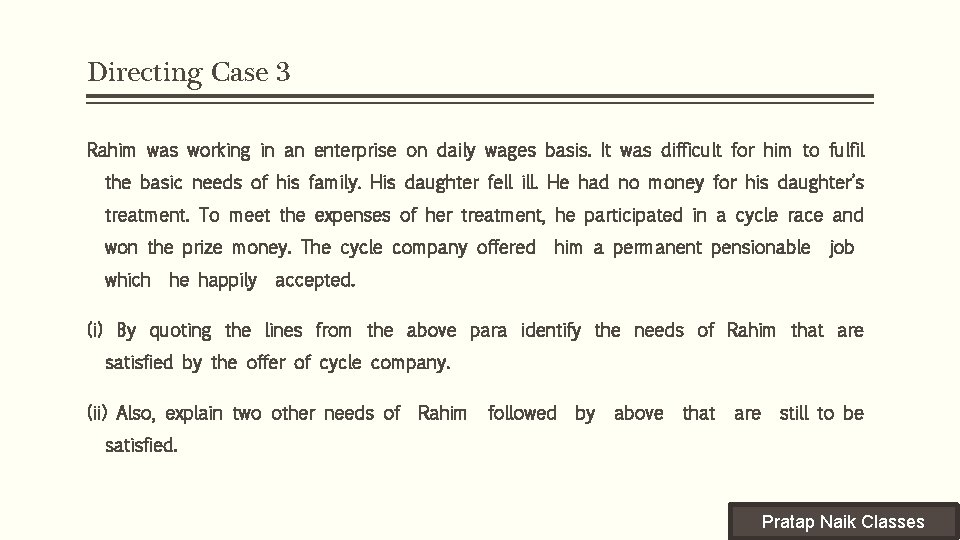
Directing Case 3 Rahim was working in an enterprise on daily wages basis. It was difficult for him to fulfil the basic needs of his family. His daughter fell ill. He had no money for his daughter’s treatment. To meet the expenses of her treatment, he participated in a cycle race and won the prize money. The cycle company offered which he happily him a permanent pensionable job accepted. (i) By quoting the lines from the above para identify the needs of Rahim that are satisfied by the offer of cycle company. (ii) Also, explain two other needs of Rahim followed by above that are still to be satisfied. Pratap Naik Classes
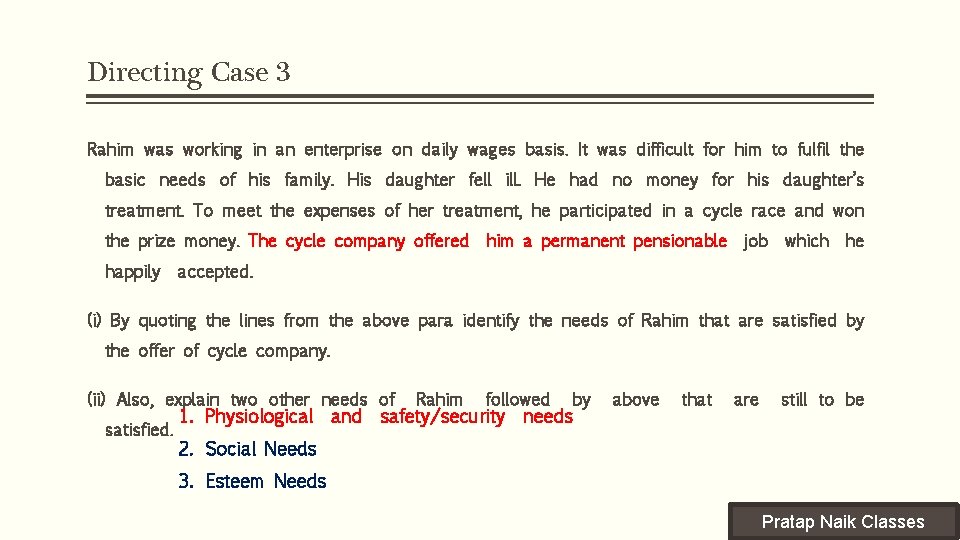
Directing Case 3 Rahim was working in an enterprise on daily wages basis. It was difficult for him to fulfil the basic needs of his family. His daughter fell ill. He had no money for his daughter’s treatment. To meet the expenses of her treatment, he participated in a cycle race and won the prize money. The cycle company offered him a permanent pensionable job which he happily accepted. (i) By quoting the lines from the above para identify the needs of Rahim that are satisfied by the offer of cycle company. (ii) Also, explain two other needs of satisfied. Rahim followed by 1. Physiological and safety/security needs above that are still to be 2. Social Needs 3. Esteem Needs Pratap Naik Classes
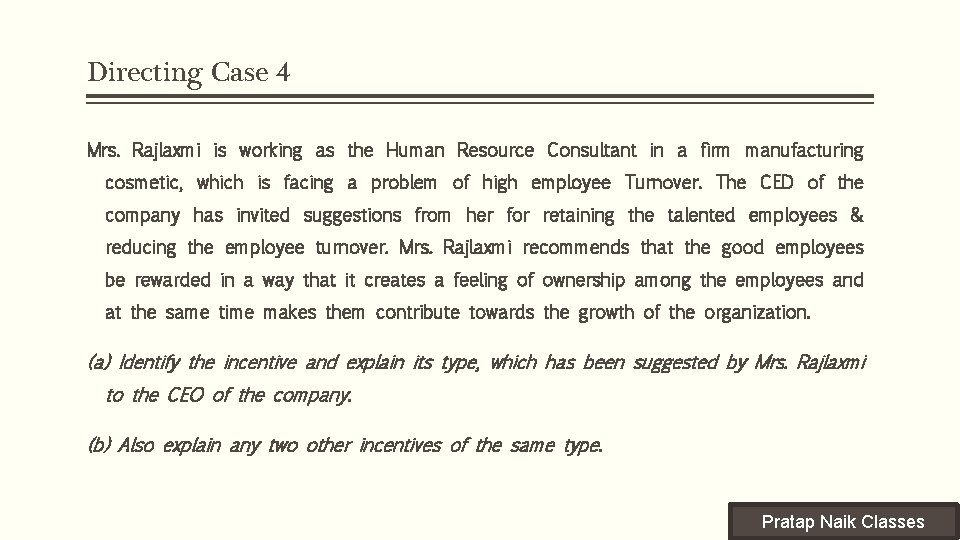
Directing Case 4 Mrs. Rajlaxmi is working as the Human Resource Consultant in a firm manufacturing cosmetic, which is facing a problem of high employee Turnover. The CED of the company has invited suggestions from her for retaining the talented employees & reducing the employee turnover. Mrs. Rajlaxmi recommends that the good employees be rewarded in a way that it creates a feeling of ownership among the employees and at the same time makes them contribute towards the growth of the organization. (a) Identify the incentive and explain its type, which has been suggested by Mrs. Rajlaxmi to the CEO of the company. (b) Also explain any two other incentives of the same type. Pratap Naik Classes
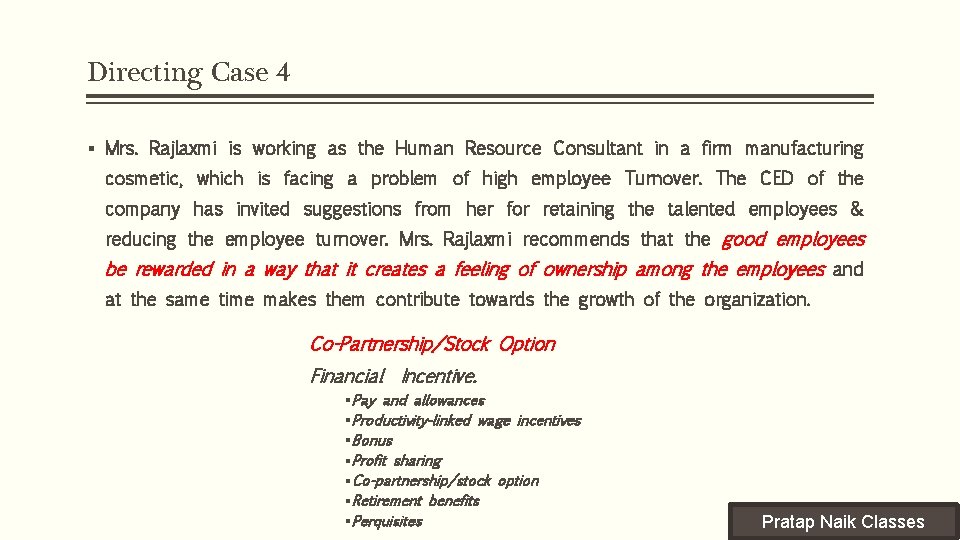
Directing Case 4 § Mrs. Rajlaxmi is working as the Human Resource Consultant in a firm manufacturing cosmetic, which is facing a problem of high employee Turnover. The CED of the company has invited suggestions from her for retaining the talented employees & reducing the employee turnover. Mrs. Rajlaxmi recommends that the good employees be rewarded in a way that it creates a feeling of ownership among the employees and at the same time makes them contribute towards the growth of the organization. Co-Partnership/Stock Option Financial Incentive. §Pay and allowances §Productivity-linked wage incentives §Bonus §Profit sharing §Co-partnership/stock option §Retirement benefits §Perquisites Pratap Naik Classes
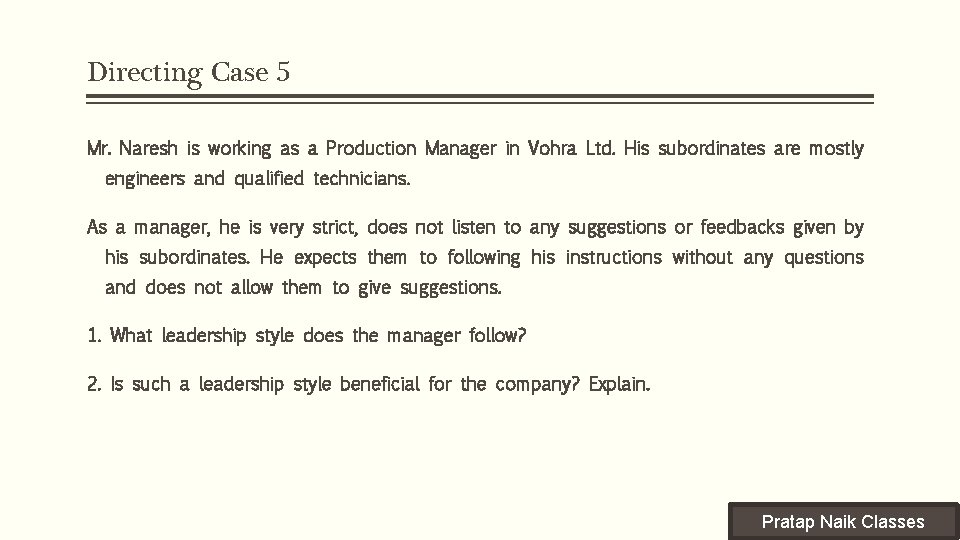
Directing Case 5 Mr. Naresh is working as a Production Manager in Vohra Ltd. His subordinates are mostly engineers and qualified technicians. As a manager, he is very strict, does not listen to any suggestions or feedbacks given by his subordinates. He expects them to following his instructions without any questions and does not allow them to give suggestions. 1. What leadership style does the manager follow? 2. Is such a leadership style beneficial for the company? Explain. Pratap Naik Classes
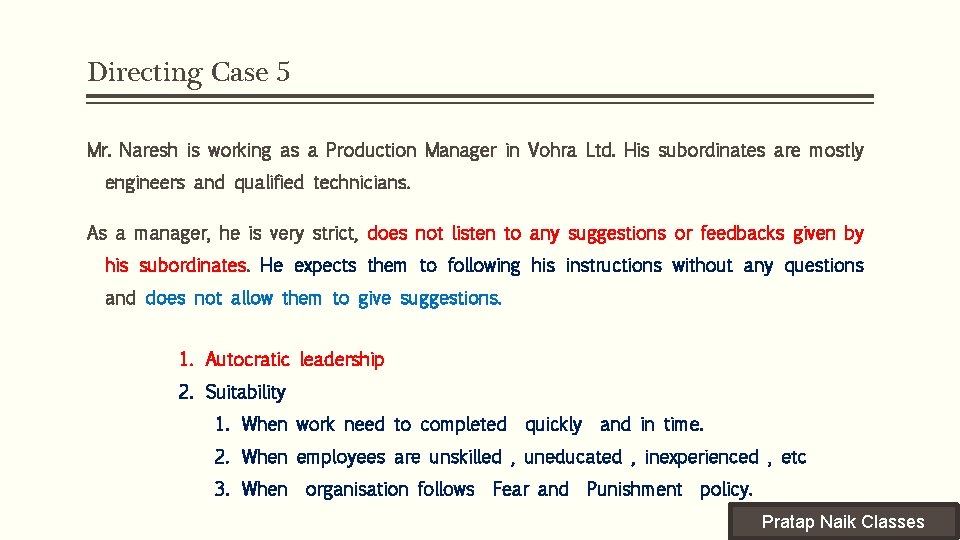
Directing Case 5 Mr. Naresh is working as a Production Manager in Vohra Ltd. His subordinates are mostly engineers and qualified technicians. As a manager, he is very strict, does not listen to any suggestions or feedbacks given by his subordinates. He expects them to following his instructions without any questions and does not allow them to give suggestions. 1. Autocratic leadership 2. Suitability 1. When work need to completed quickly and in time. 2. When employees are unskilled , uneducated , inexperienced , etc 3. When organisation follows Fear and Punishment policy. Pratap Naik Classes
Thank You… Pratap Naik Classes
- Slides: 18