Unit 8 Chemical Kinetics Chapter 14 Day 1

- Slides: 50
Unit 8: Chemical Kinetics Chapter 14 Day 1
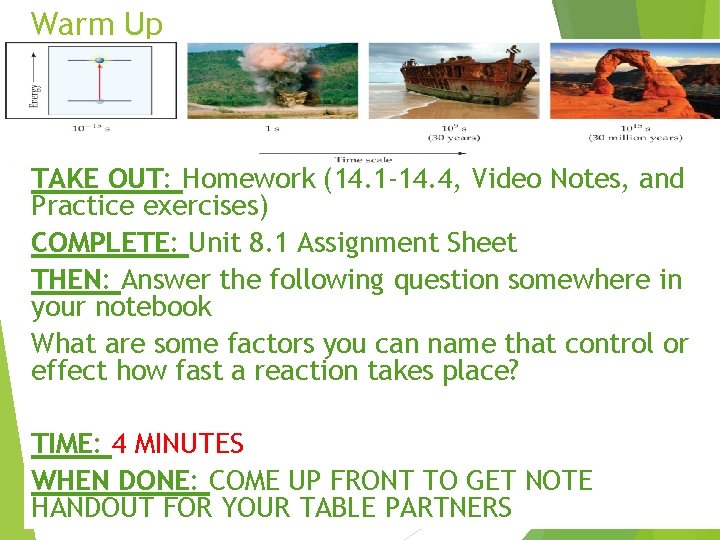
Warm Up TAKE OUT: Homework (14. 1 -14. 4, Video Notes, and Practice exercises) COMPLETE: Unit 8. 1 Assignment Sheet THEN: Answer the following question somewhere in your notebook What are some factors you can name that control or effect how fast a reaction takes place? TIME: 4 MINUTES WHEN DONE: COME UP FRONT TO GET NOTE HANDOUT FOR YOUR TABLE PARTNERS
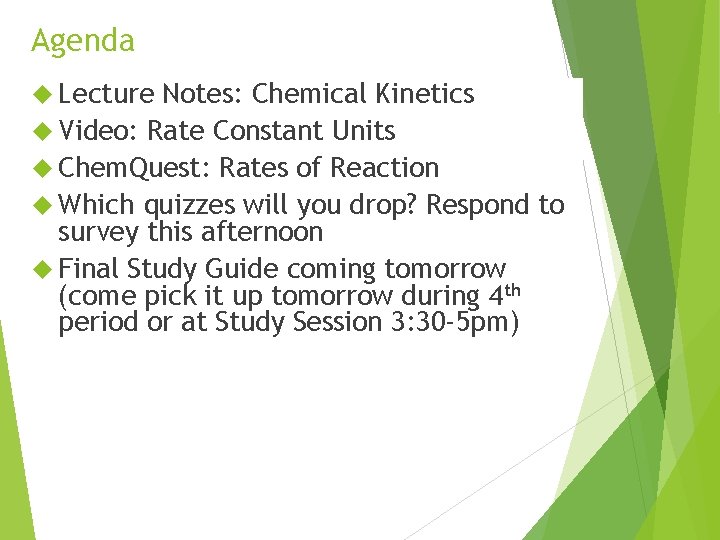
Agenda Lecture Notes: Chemical Kinetics Video: Rate Constant Units Chem. Quest: Rates of Reaction Which quizzes will you drop? Respond to survey this afternoon Final Study Guide coming tomorrow (come pick it up tomorrow during 4 th period or at Study Session 3: 30 -5 pm)
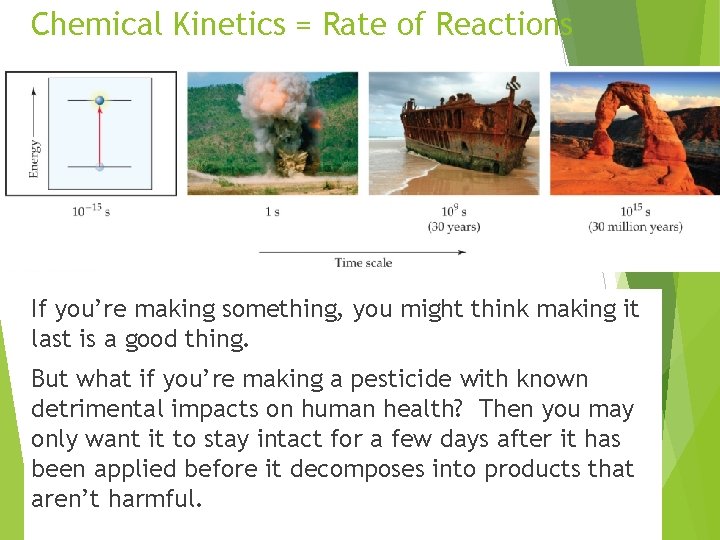
Chemical Kinetics = Rate of Reactions If you’re making something, you might think making it last is a good thing. But what if you’re making a pesticide with known detrimental impacts on human health? Then you may only want it to stay intact for a few days after it has been applied before it decomposes into products that aren’t harmful.
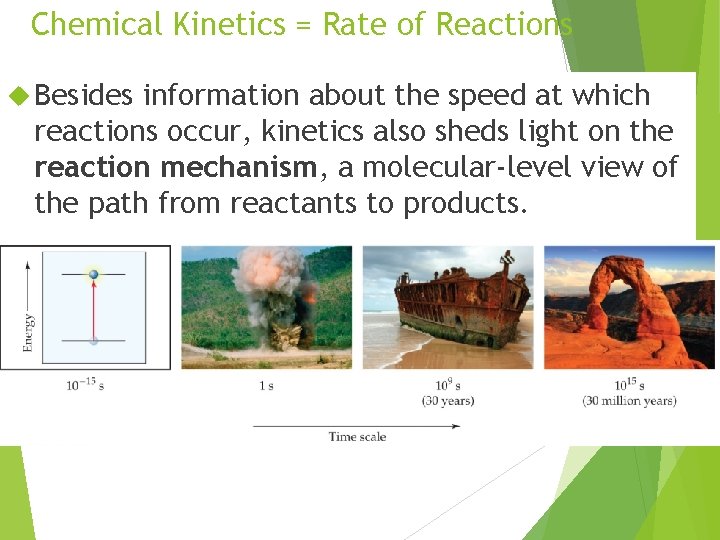
Chemical Kinetics = Rate of Reactions Besides information about the speed at which reactions occur, kinetics also sheds light on the reaction mechanism, a molecular-level view of the path from reactants to products.
Factors that Affect Reaction Rates 1) Physical state of the reactants 2) Reactant concentrations 3) Reaction temperature 4) Presence of a catalyst
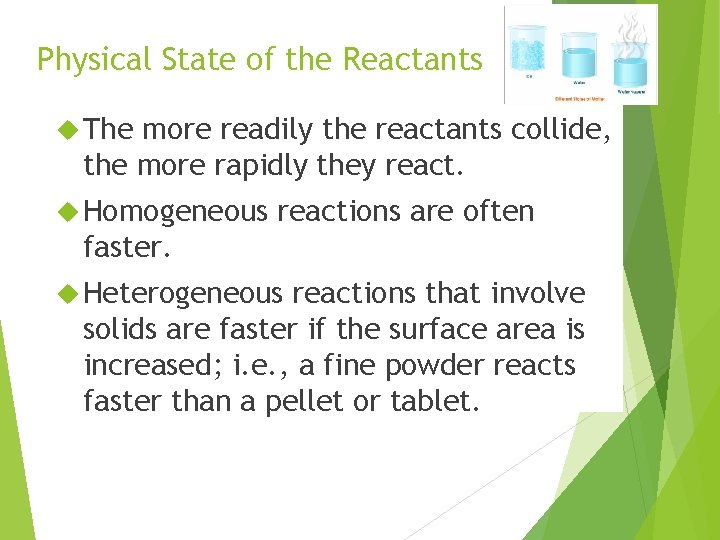
Physical State of the Reactants The more readily the reactants collide, the more rapidly they react. Homogeneous reactions are often faster. Heterogeneous reactions that involve solids are faster if the surface area is increased; i. e. , a fine powder reacts faster than a pellet or tablet.
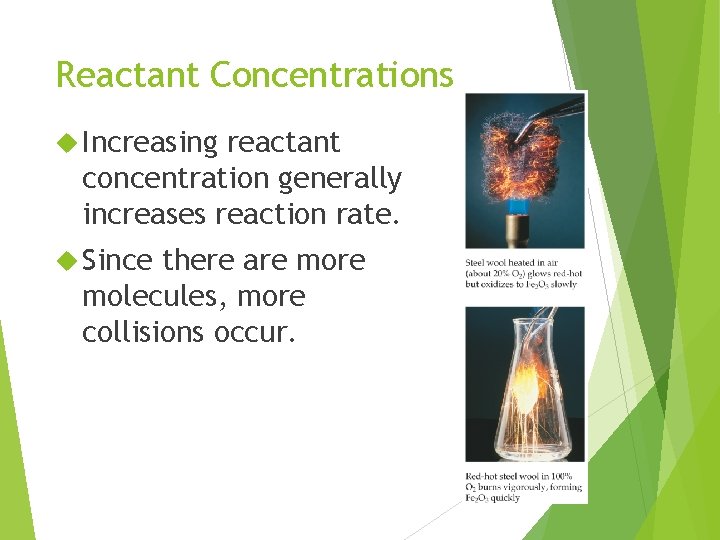
Reactant Concentrations Increasing reactant concentration generally increases reaction rate. Since there are molecules, more collisions occur.
Temperature Reaction rate generally increases with increased temperature. Kinetic energy of molecules is related to temperature. At higher temperatures, molecules move more quickly, increasing numbers of collisions and the energy the molecules possess during the collisions.
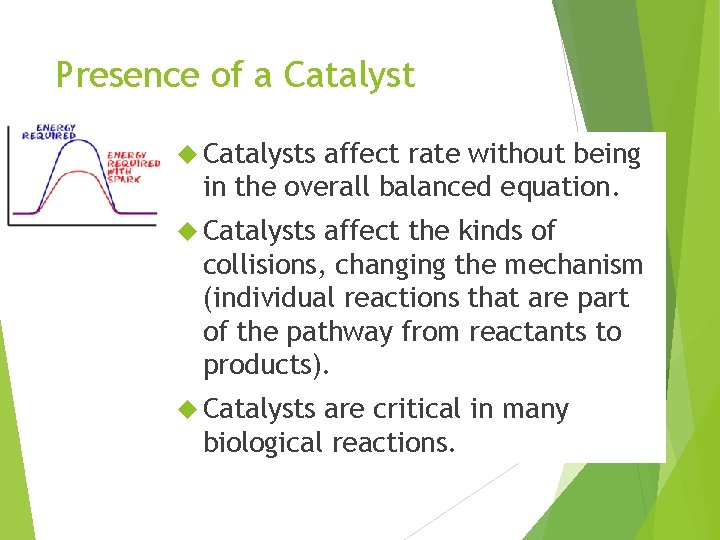
Presence of a Catalysts affect rate without being in the overall balanced equation. Catalysts affect the kinds of collisions, changing the mechanism (individual reactions that are part of the pathway from reactants to products). Catalysts are critical in many biological reactions.
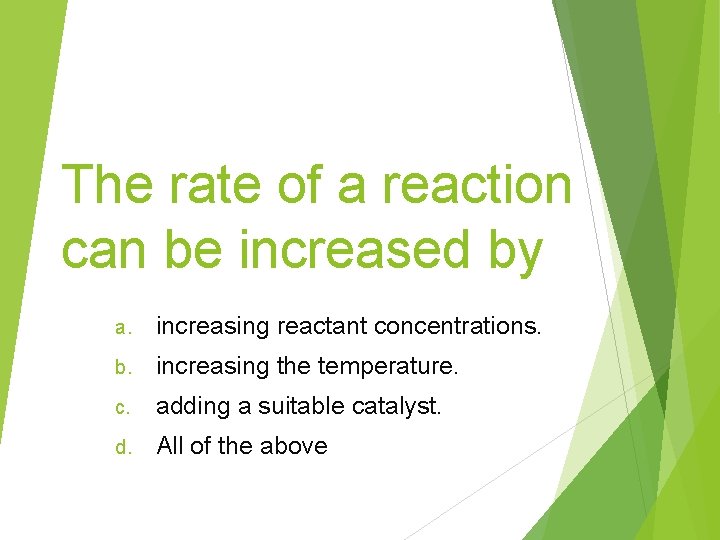
The rate of a reaction can be increased by a. increasing reactant concentrations. b. increasing the temperature. c. adding a suitable catalyst. d. All of the above
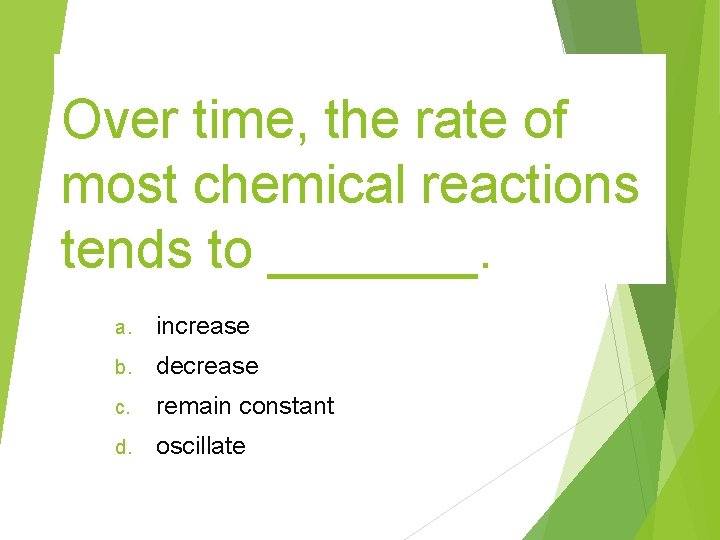
Over time, the rate of most chemical reactions tends to _______. a. increase b. decrease c. remain constant d. oscillate
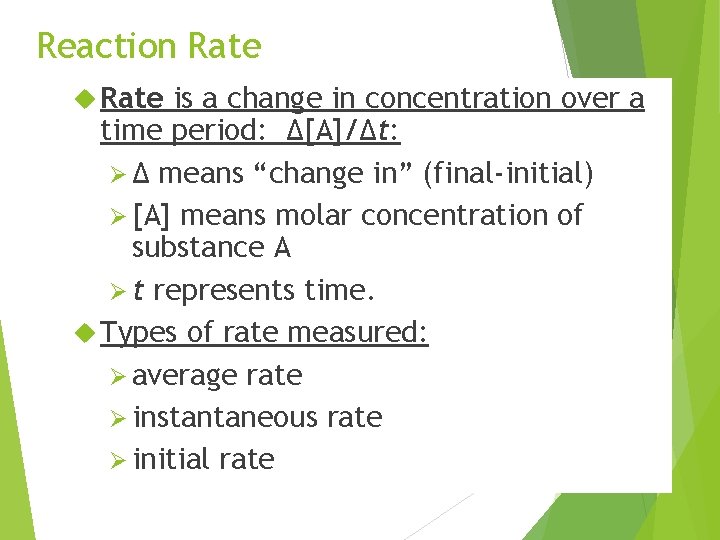
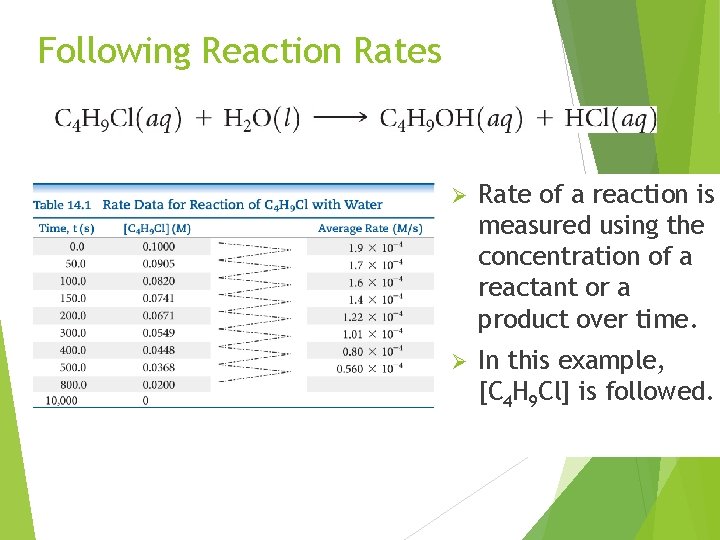
Reaction Rate is a change in concentration over a time period: Δ[A]/Δt: Ø Δ means “change in” (final-initial) Ø [A] means molar concentration of substance A Ø t represents time. Types of rate measured: Ø average rate Ø instantaneous rate Ø initial rate
Following Reaction Rates Ø Rate of a reaction is measured using the concentration of a reactant or a product over time. Ø In this example, [C 4 H 9 Cl] is followed.
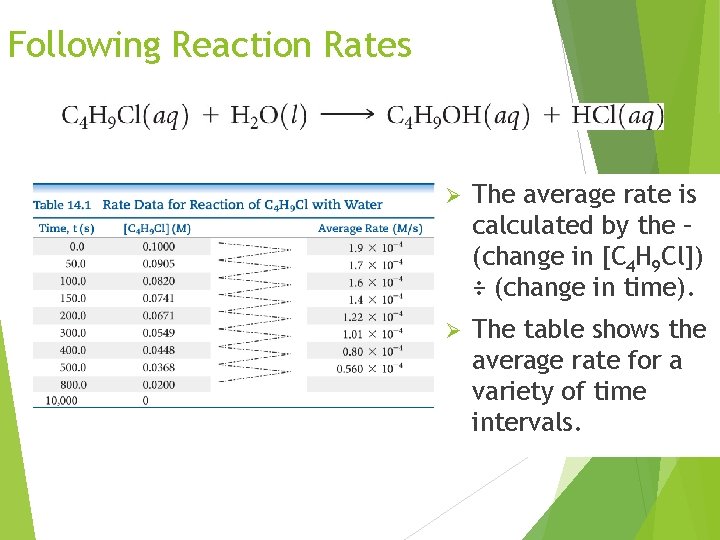
Following Reaction Rates Ø The average rate is calculated by the – (change in [C 4 H 9 Cl]) ÷ (change in time). Ø The table shows the average rate for a variety of time intervals.
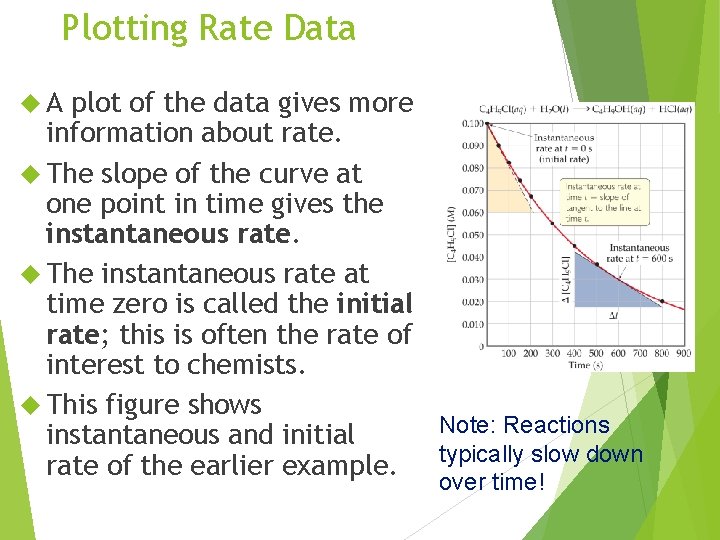
Plotting Rate Data A plot of the data gives more information about rate. The slope of the curve at one point in time gives the instantaneous rate. The instantaneous rate at time zero is called the initial rate; this is often the rate of interest to chemists. This figure shows Note: Reactions instantaneous and initial rate of the earlier example. typically slow down over time!
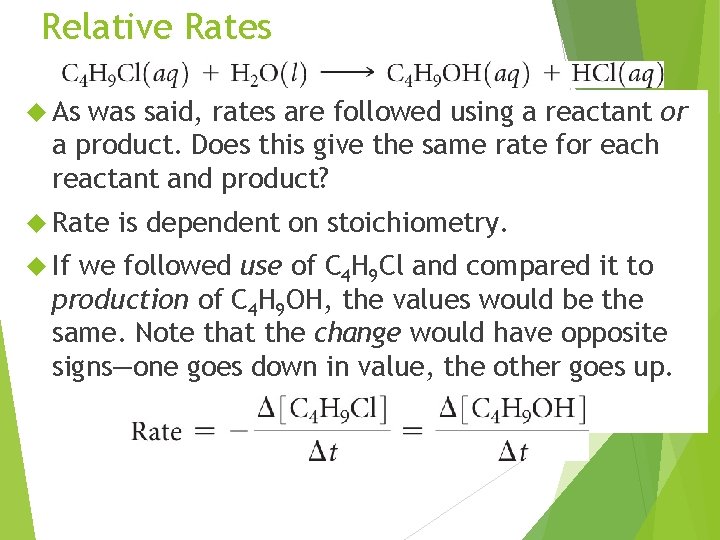
Relative Rates As was said, rates are followed using a reactant or a product. Does this give the same rate for each reactant and product? Rate If is dependent on stoichiometry. we followed use of C 4 H 9 Cl and compared it to production of C 4 H 9 OH, the values would be the same. Note that the change would have opposite signs—one goes down in value, the other goes up.
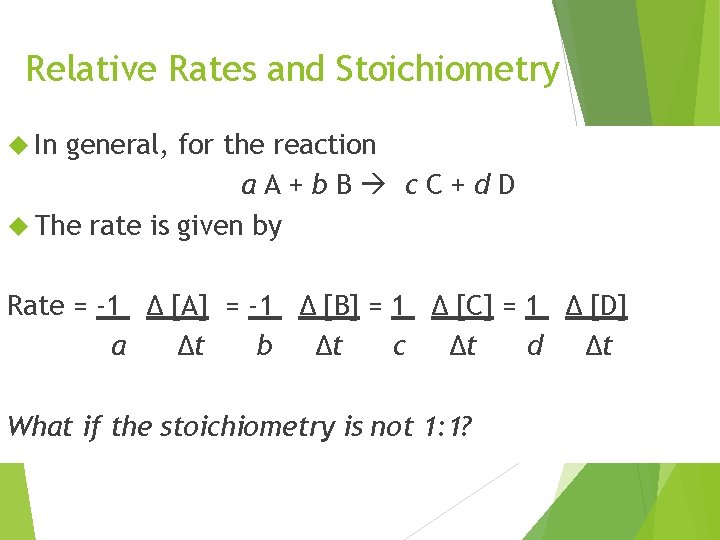
Relative Rates and Stoichiometry In general, for the reaction a. A+b. B c. C+d. D The rate is given by Rate = -1 Δ [A] = -1 Δ [B] = 1 Δ [C] = 1 Δ [D] a Δt b Δt c Δt d Δt What if the stoichiometry is not 1: 1?
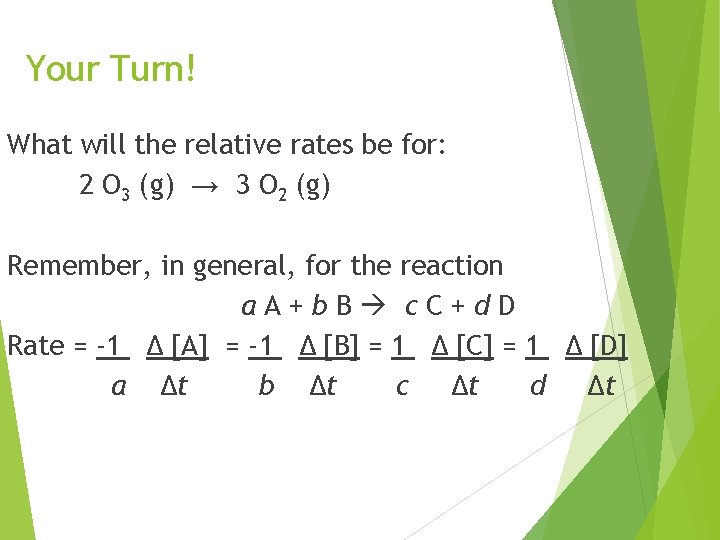
Your Turn! What will the relative rates be for: 2 O 3 (g) → 3 O 2 (g) Remember, in general, for the reaction a. A+b. B c. C+d. D Rate = -1 Δ [A] = -1 Δ [B] = 1 Δ [C] = 1 Δ [D] a Δt b Δt c Δt d Δt
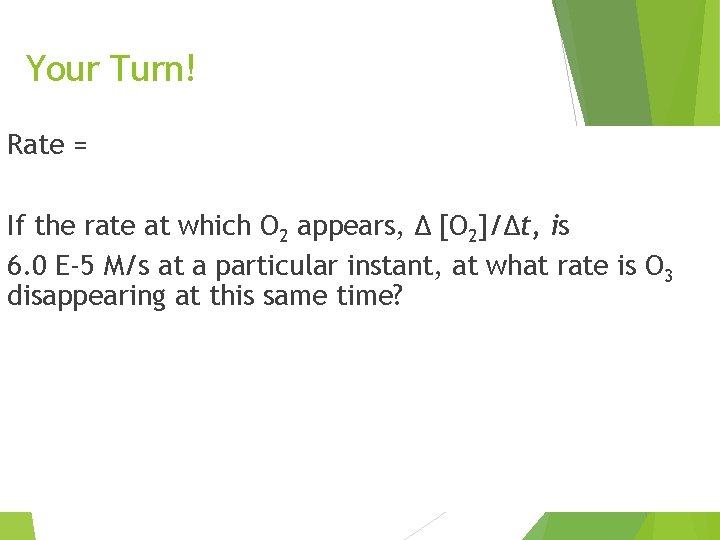
Your Turn! Rate = -1 Δ [O 3] = 1 Δ [O 2] 2 Δt 3 Δt If the rate at which O 2 appears, Δ [O 2]/Δt, is 6. 0 E-5 M/s at a particular instant, at what rate is O 3 disappearing at this same time?
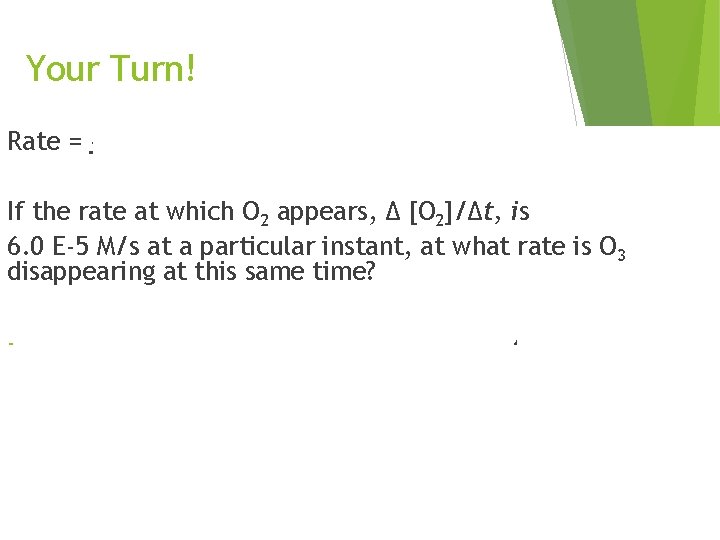
Your Turn! Rate = -1 Δ [O 3] = 1 Δ [O 2] 2 Δt 3 Δt If the rate at which O 2 appears, Δ [O 2]/Δt, is 6. 0 E-5 M/s at a particular instant, at what rate is O 3 disappearing at this same time? - -Δ [O 3] = 2 Δ [O 2] = _2_(6. 0 E-5 M/s) = 4. 0 E-5 M/s Δt 3
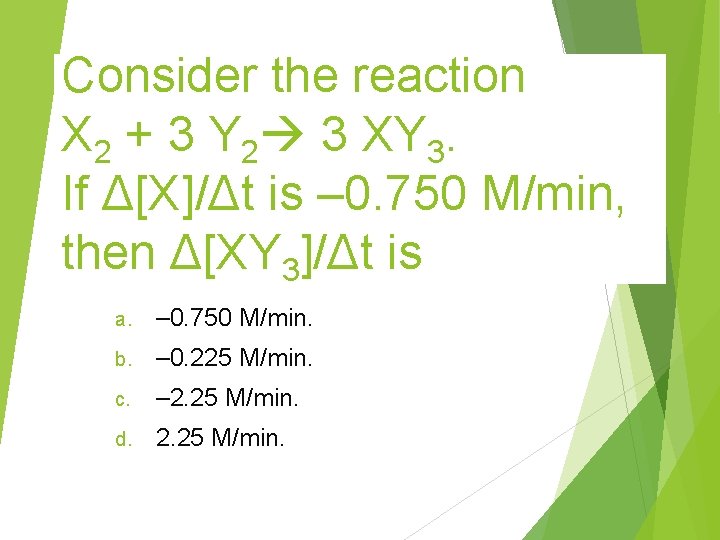
Consider the reaction X 2 + 3 Y 2 3 XY 3. If Δ[X]/Δt is – 0. 750 M/min, then Δ[XY 3]/Δt is a. – 0. 750 M/min. b. – 0. 225 M/min. c. – 2. 25 M/min. d. 2. 25 M/min.
Determining Concentration Effect on Rate How do we determine what effect the concentration of each reactant has on the rate of the reaction? We keep every concentration constant except for one reactant and see what happens to the rate. Then, we change a different reactant. We do this until we have seen how each reactant has affected the rate.
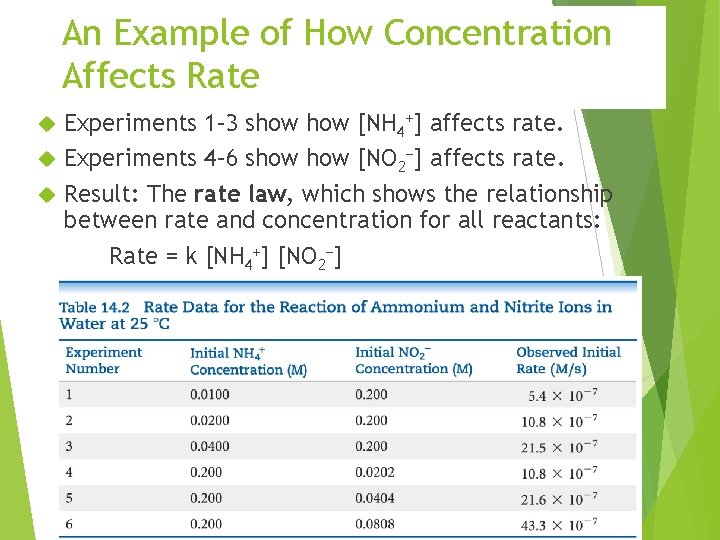
An Example of How Concentration Affects Rate Experiments 1– 3 show [NH 4+] affects rate. Experiments 4– 6 show [NO 2−] affects rate. Result: The rate law, which shows the relationship between rate and concentration for all reactants: Rate = k [NH 4+] [NO 2−]
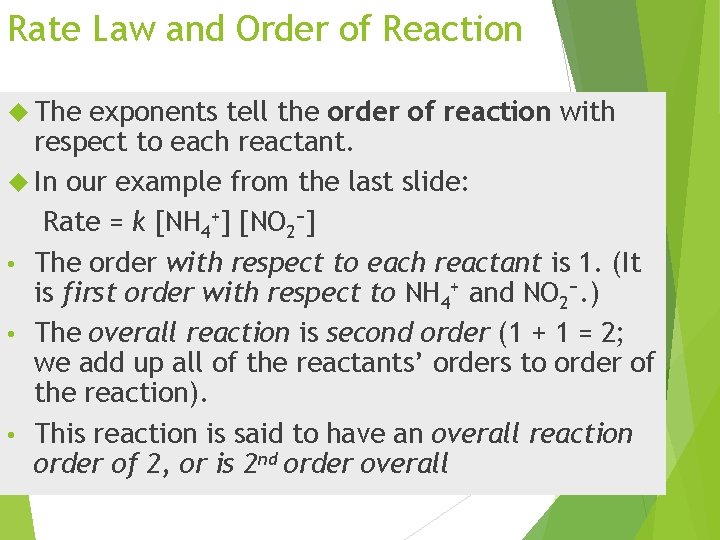
Rate Law and Order of Reaction The exponents tell the order of reaction with respect to each reactant. In our example from the last slide: Rate = k [NH 4+] [NO 2−] • The order with respect to each reactant is 1. (It is first order with respect to NH 4+ and NO 2−. ) • The overall reaction is second order (1 + 1 = 2; we add up all of the reactants’ orders to order of the reaction). • This reaction is said to have an overall reaction order of 2, or is 2 nd order overall
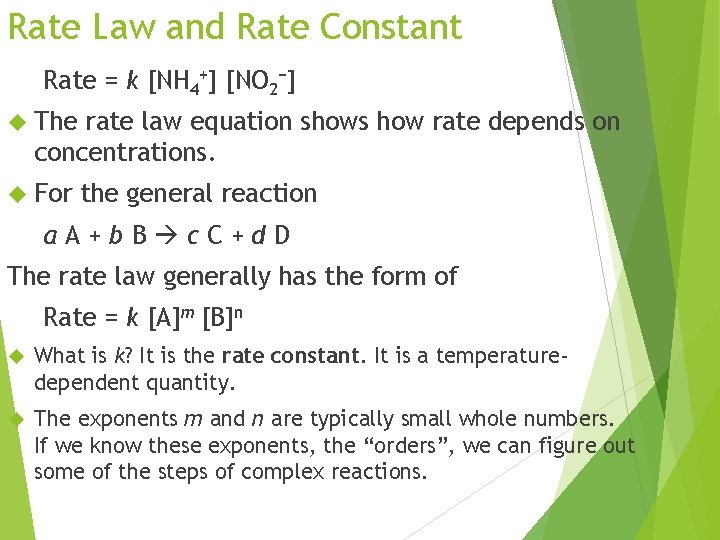
Rate Law and Rate Constant Rate = k [NH 4+] [NO 2−] The rate law equation shows how rate depends on concentrations. For the general reaction a. A+b. B c. C+d. D The rate law generally has the form of Rate = k [A]m [B]n What is k? It is the rate constant. It is a temperaturedependent quantity. The exponents m and n are typically small whole numbers. If we know these exponents, the “orders”, we can figure out some of the steps of complex reactions.
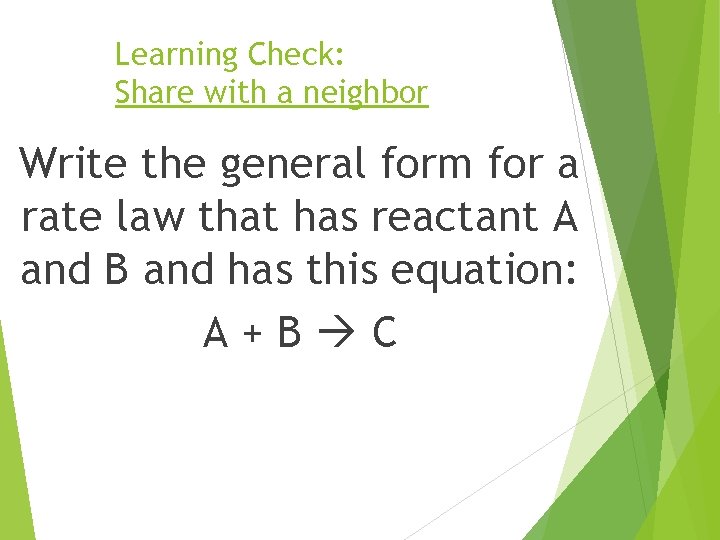
Learning Check: Share with a neighbor Write the general form for a rate law that has reactant A and B and has this equation: A+B C
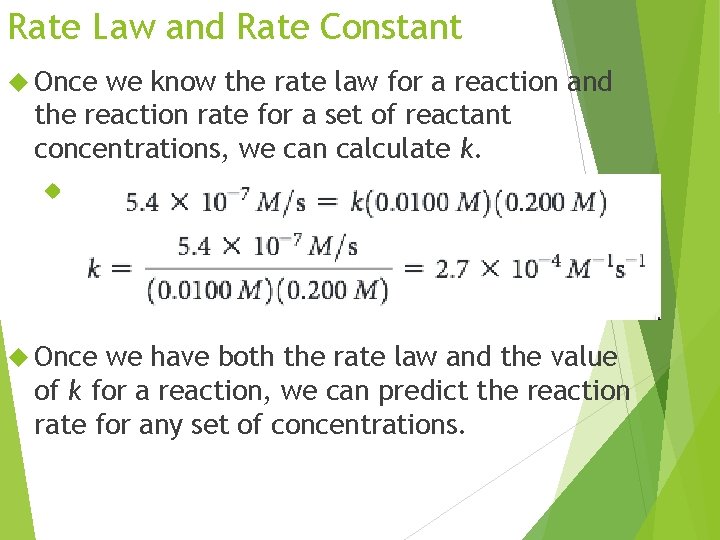
Rate Law and Rate Constant Once we know the rate law for a reaction and the reaction rate for a set of reactant concentrations, we can calculate k. Example Once page 622 we have both the rate law and the value of k for a reaction, we can predict the reaction rate for any set of concentrations.
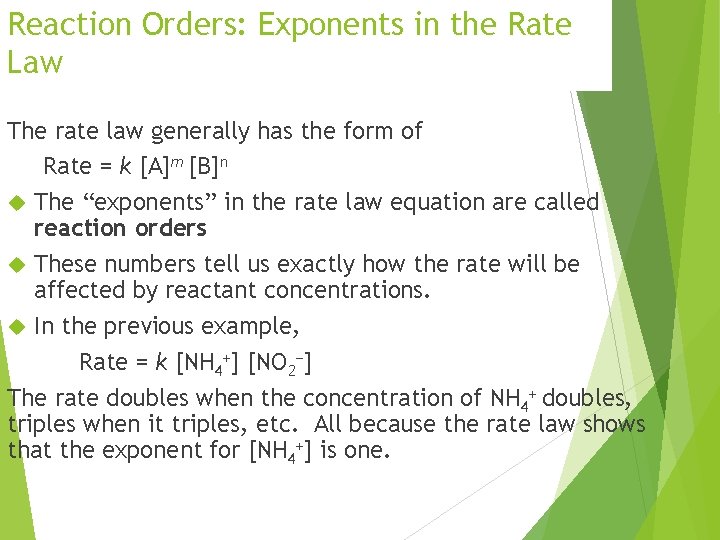
Reaction Orders: Exponents in the Rate Law The rate law generally has the form of Rate = k [A]m [B]n The “exponents” in the rate law equation are called reaction orders These numbers tell us exactly how the rate will be affected by reactant concentrations. In the previous example, Rate = k [NH 4+] [NO 2−] The rate doubles when the concentration of NH 4+ doubles, triples when it triples, etc. All because the rate law shows that the exponent for [NH 4+] is one.
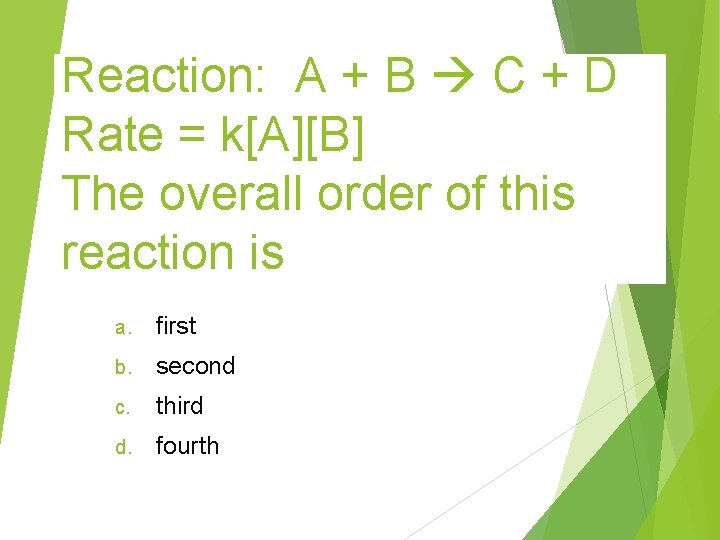
Reaction: A + B C + D Rate = k[A][B] The overall order of this reaction is a. first b. second c. third d. fourth
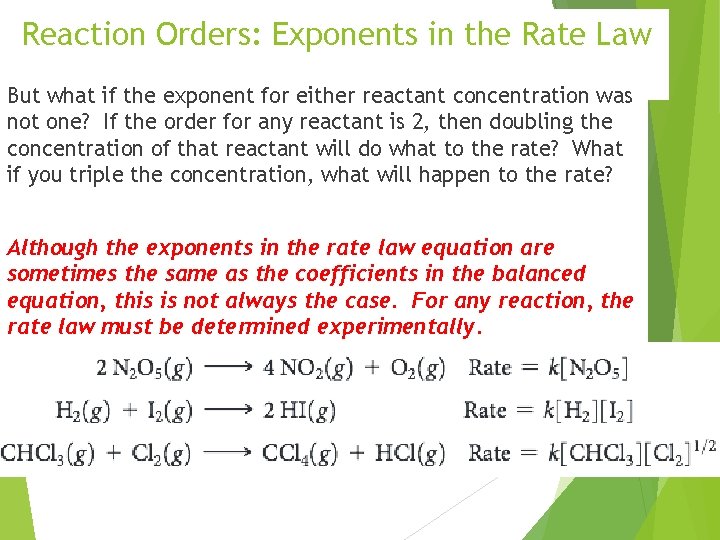
Reaction Orders: Exponents in the Rate Law But what if the exponent for either reactant concentration was not one? If the order for any reactant is 2, then doubling the concentration of that reactant will do what to the rate? What if you triple the concentration, what will happen to the rate? Although the exponents in the rate law equation are sometimes the same as the coefficients in the balanced equation, this is not always the case. For any reaction, the rate law must be determined experimentally.
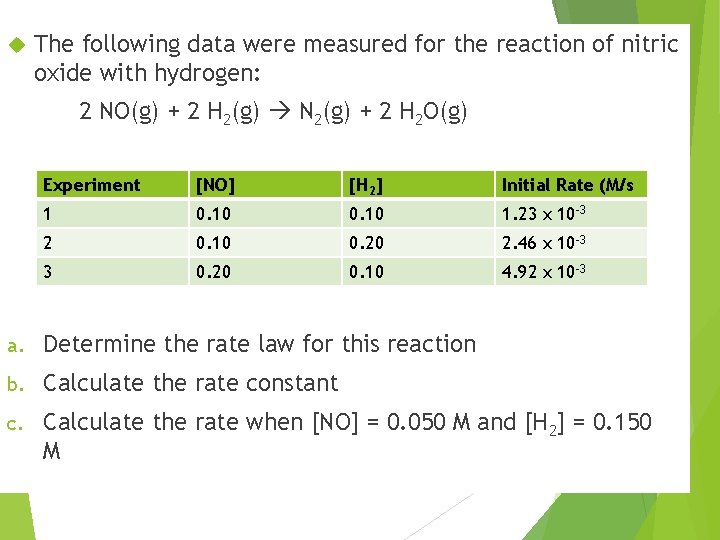
The following data were measured for the reaction of nitric oxide with hydrogen: 2 NO(g) + 2 H 2(g) N 2(g) + 2 H 2 O(g) Experiment [NO] [H 2] Initial Rate (M/s 1 0. 10 1. 23 x 10 -3 2 0. 10 0. 20 2. 46 x 10 -3 3 0. 20 0. 10 4. 92 x 10 -3 a. Determine the rate law for this reaction b. Calculate the rate constant c. Calculate the rate when [NO] = 0. 050 M and [H 2] = 0. 150 M
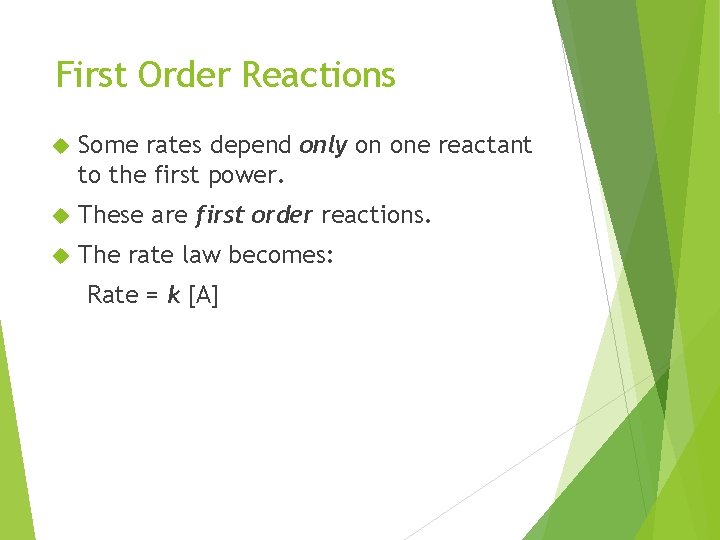
First Order Reactions Some rates depend only on one reactant to the first power. These are first order reactions. The rate law becomes: Rate = k [A]
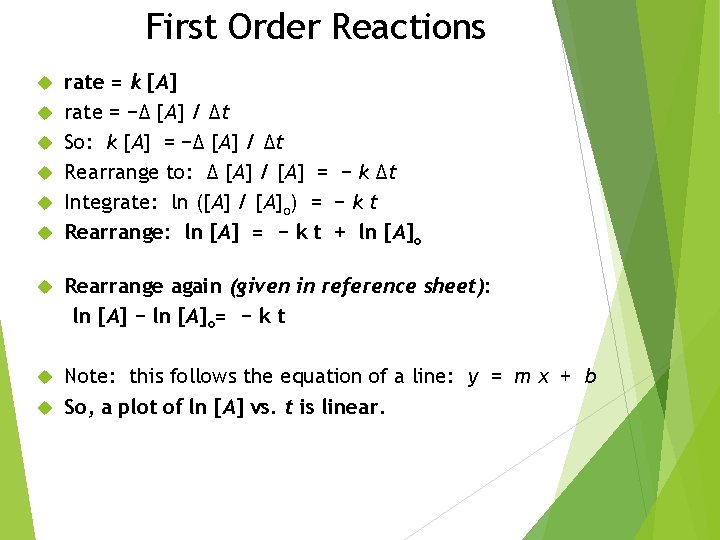
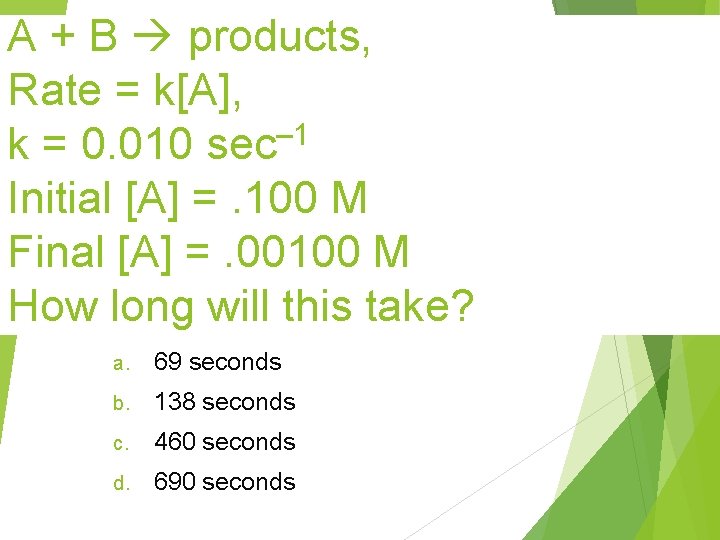
First Order Reactions rate = k [A] rate = −Δ [A] / Δt So: k [A] = −Δ [A] / Δt Rearrange to: Δ [A] / [A] = − k Δt Integrate: ln ([A] / [A]o) = − k t Rearrange: ln [A] = − k t + ln [A]o Rearrange again (given in reference sheet): ln [A] − ln [A]o= − k t Note: this follows the equation of a line: y = m x + b So, a plot of ln [A] vs. t is linear.
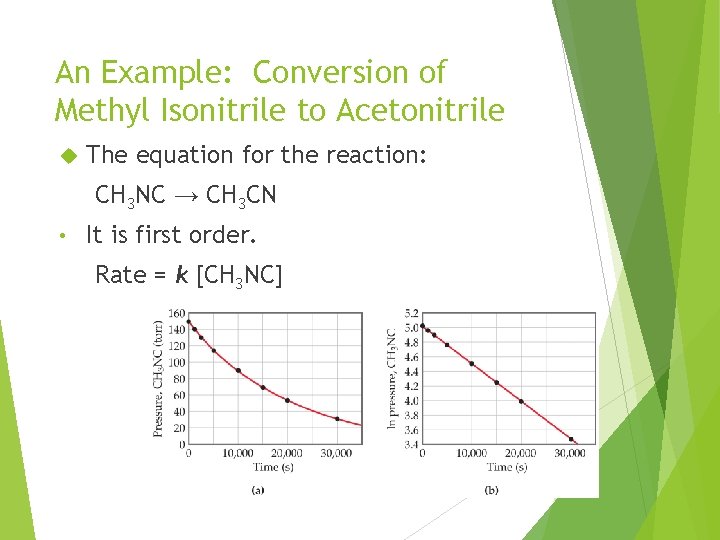
An Example: Conversion of Methyl Isonitrile to Acetonitrile The equation for the reaction: CH 3 NC → CH 3 CN • It is first order. Rate = k [CH 3 NC]
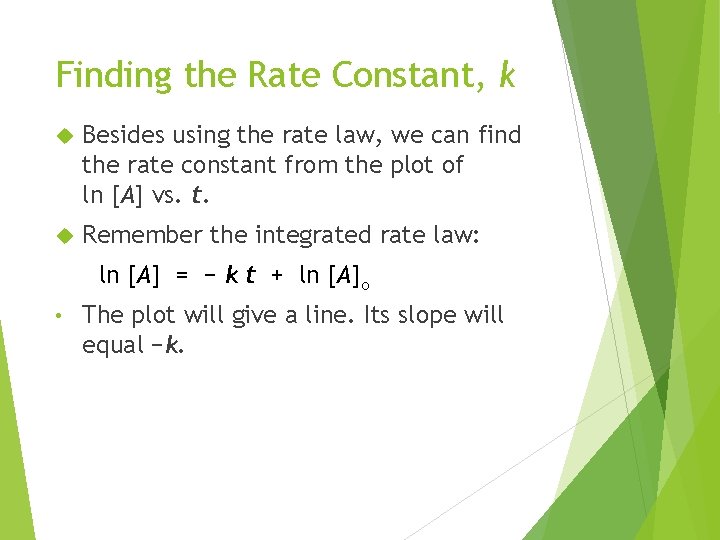
Finding the Rate Constant, k Besides using the rate law, we can find the rate constant from the plot of ln [A] vs. t. Remember the integrated rate law: ln [A] = − k t + ln [A]o • The plot will give a line. Its slope will equal −k.
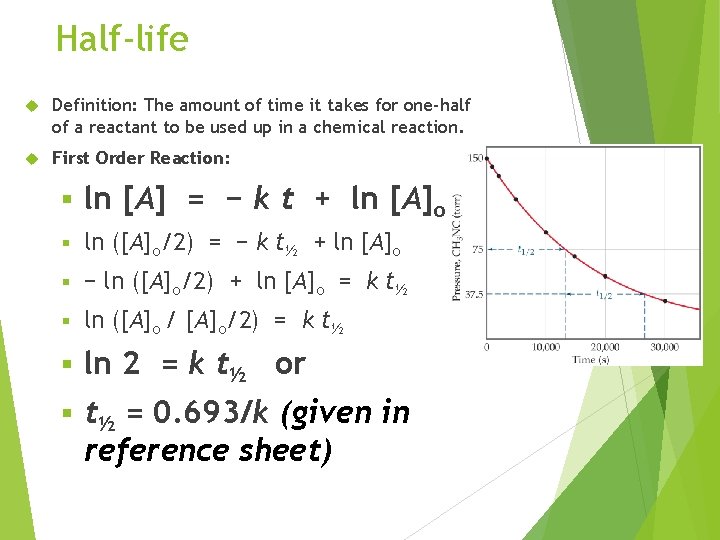
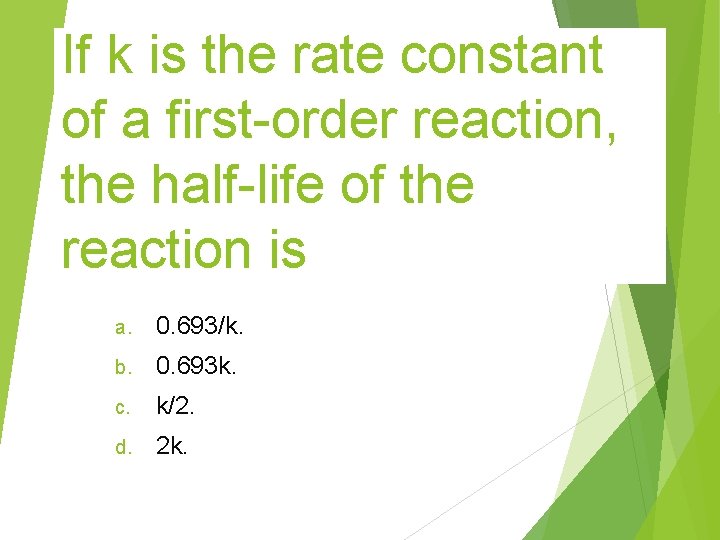
Half-life Definition: The amount of time it takes for one-half of a reactant to be used up in a chemical reaction. First Order Reaction: § ln [A] = − k t + ln [A]o § ln ([A]o/2) = − k t½ + ln [A]o § − ln ([A]o/2) + ln [A]o = k t½ § ln ([A]o / [A]o/2) = k t½ § ln 2 = k t½ or § t½ = 0. 693/k (given in reference sheet)
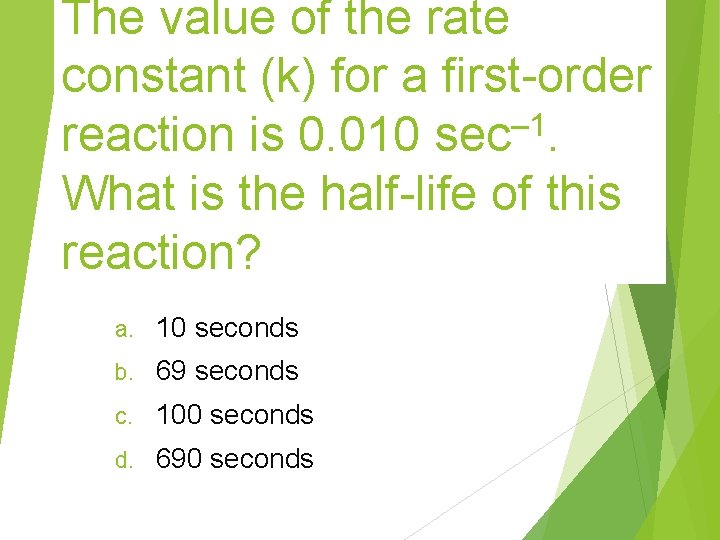
The value of the rate constant (k) for a first-order reaction is 0. 010 sec– 1. What is the half-life of this reaction? a. 10 seconds b. 69 seconds c. 100 seconds d. 690 seconds
Second Order Reactions Some rates depend only on a reactant to the second power. These are second order reactions. The rate law becomes: Rate = k [A]2
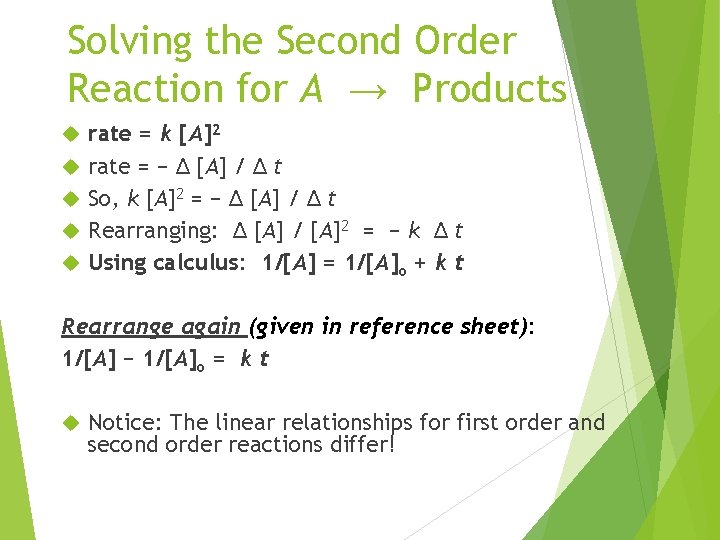
Solving the Second Order Reaction for A → Products rate = k [A]2 rate = − Δ [A] / Δ t So, k [A]2 = − Δ [A] / Δ t Rearranging: Δ [A] / [A]2 = − k Δ t Using calculus: 1/[A] = 1/[A]o + k t Rearrange again (given in reference sheet): 1/[A] − 1/[A]o = k t Notice: The linear relationships for first order and second order reactions differ!
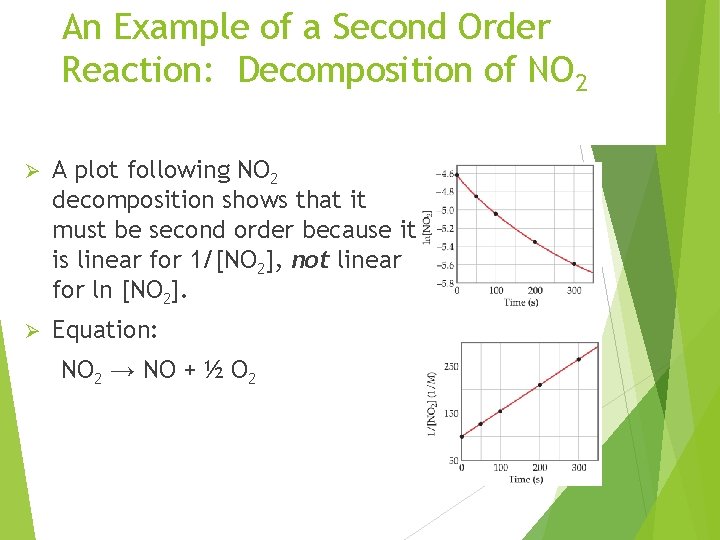
An Example of a Second Order Reaction: Decomposition of NO 2 Ø A plot following NO 2 decomposition shows that it must be second order because it is linear for 1/[NO 2], not linear for ln [NO 2]. Ø Equation: NO 2 → NO + ½ O 2
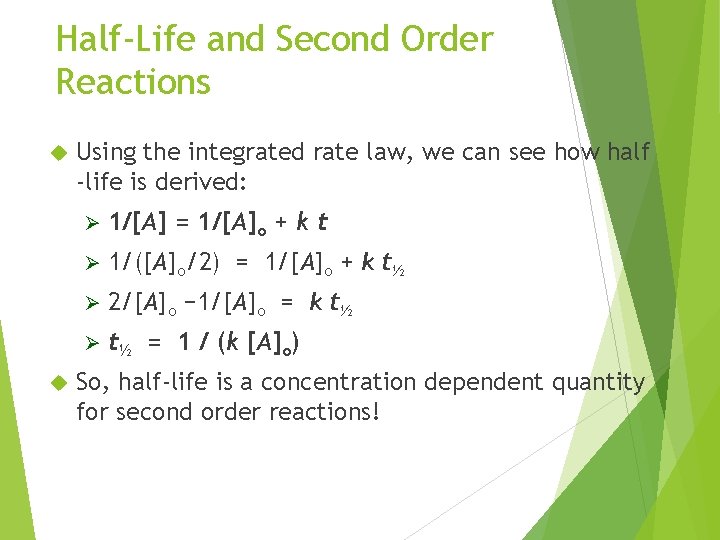
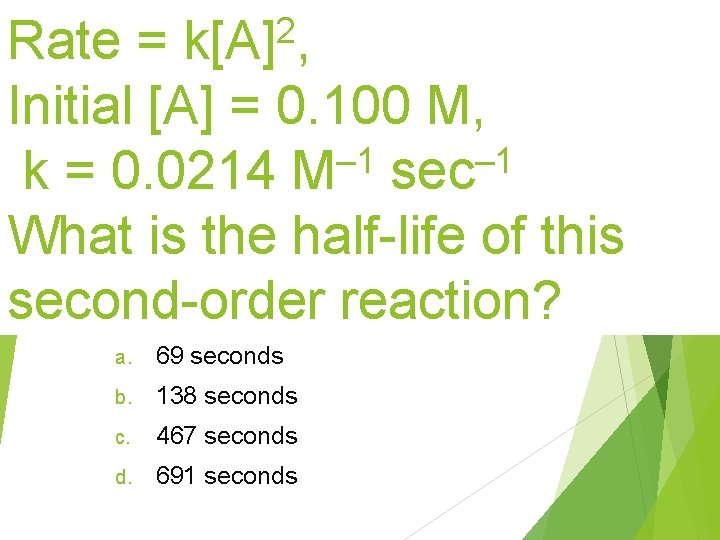
Half-Life and Second Order Reactions Using the integrated rate law, we can see how half -life is derived: Ø 1/[A] = 1/[A]o + k t Ø 1/([A]o/2) = 1/[A]o + k t½ Ø 2/[A]o − 1/[A]o = k t½ Ø t½ = 1 / (k [A]o) So, half-life is a concentration dependent quantity for second order reactions!
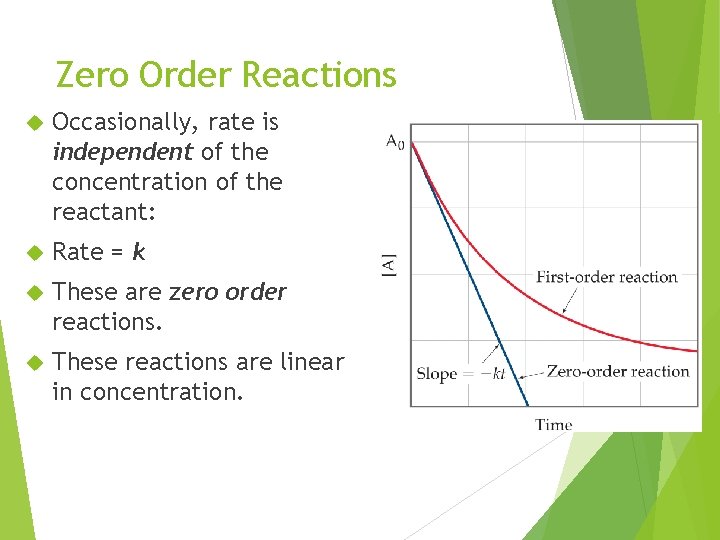
Zero Order Reactions Occasionally, rate is independent of the concentration of the reactant: Rate = k These are zero order reactions. These reactions are linear in concentration.
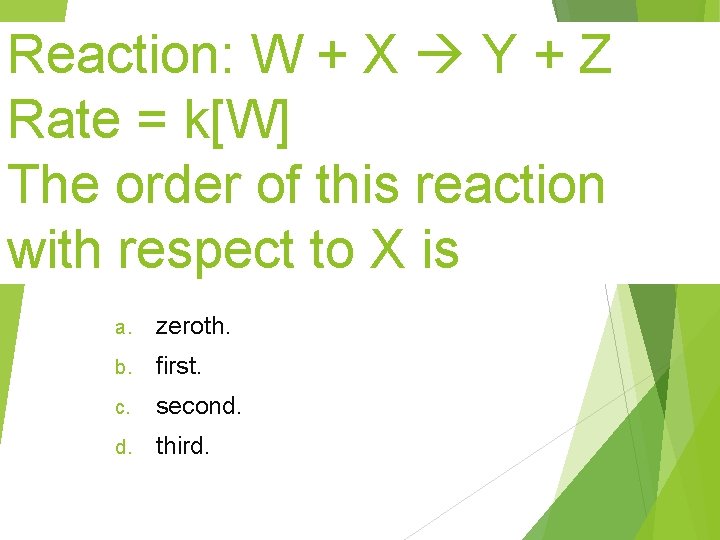
Reaction: W + X Y + Z Rate = k[W] The order of this reaction with respect to X is a. zeroth. b. first. c. second. third.
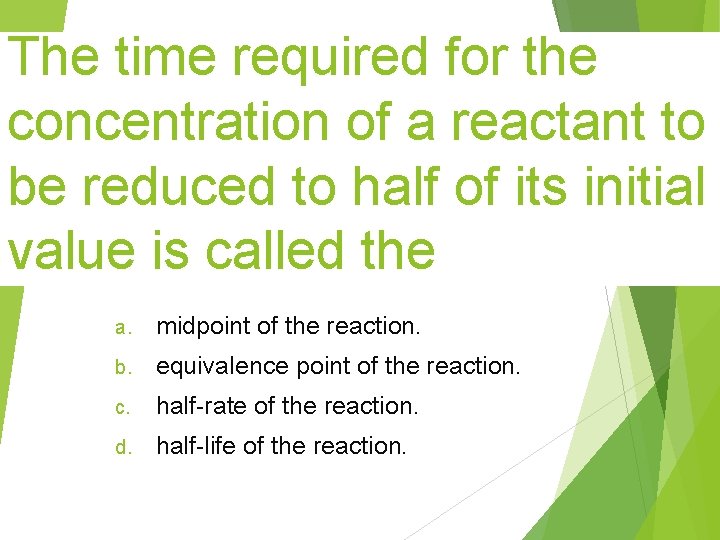
The time required for the concentration of a reactant to be reduced to half of its initial value is called the a. midpoint of the reaction. b. equivalence point of the reaction. c. half-rate of the reaction. d. half-life of the reaction.
If k is the rate constant of a first-order reaction, the half-life of the reaction is a. 0. 693/k. b. 0. 693 k. c. k/2. d. 2 k.
A + B products, Rate = k[A], k = 0. 010 sec– 1 Initial [A] =. 100 M Final [A] =. 00100 M How long will this take? a. 69 seconds b. 138 seconds c. 460 seconds d. 690 seconds
2 k[A] , Rate = Initial [A] = 0. 100 M, – 1 k = 0. 0214 M sec What is the half-life of this second-order reaction? a. 69 seconds b. 138 seconds c. 467 seconds d. 691 seconds
Open Notebook TAKE: ½ page of Notes on the following video on units for rate law constants
WORK TIME USE: This time to work on Chem. Quest 42 WORK TOGETHER: With your table partners TIME: Until End of Class