Unit 14 Stocks Stocks are the foundation of


- Slides: 23
Unit 14: Stocks “Stocks are the foundation of cooking” Auguste Escoffier American Culinary Federation: Culinary Fundamentals. © 2006, Pearson Education, Upper Saddle River, NJ 07458. All Rights Reserved.
American Culinary Federation: Culinary Fundamentals. © 2006, Pearson Education, Upper Saddle River, NJ 07458. All Rights Reserved.
What Are Stocks? • Flavorful liquids made by simmering bones, vegetables, and aromatics • Fundamental for learning about cooking techniques • Choose high-quality ingredients • Observe all standards for preparation • Evaluate what you have produced • Do not use the stock pot for a garbage pot • If you would not consume it, do not put it into the stock pot American Culinary Federation: Culinary Fundamentals. © 2006, Pearson Education, Upper Saddle River, NJ 07458. All Rights Reserved.
Types of Stock • • Basic or simple stock White stock Brown stock Fumet American Culinary Federation: Culinary Fundamentals. © 2006, Pearson Education, Upper Saddle River, NJ 07458. All Rights Reserved.
Basic Stock • Examples are chicken, vegetable, fish • Constructed by simmering bones and flavoring ingredients • Strain, cool, and reserve for sauces, soups, vegetable dishes American Culinary Federation: Culinary Fundamentals. © 2006, Pearson Education, Upper Saddle River, NJ 07458. All Rights Reserved.
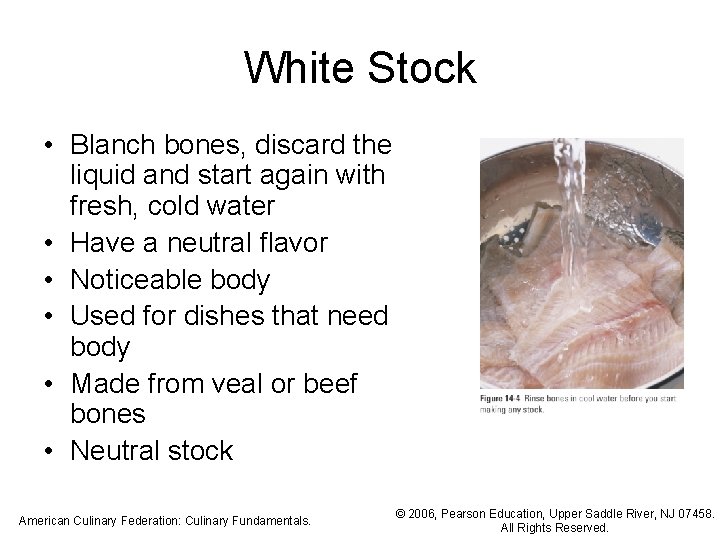
White Stock • Blanch bones, discard the liquid and start again with fresh, cold water • Have a neutral flavor • Noticeable body • Used for dishes that need body • Made from veal or beef bones • Neutral stock American Culinary Federation: Culinary Fundamentals. © 2006, Pearson Education, Upper Saddle River, NJ 07458. All Rights Reserved.
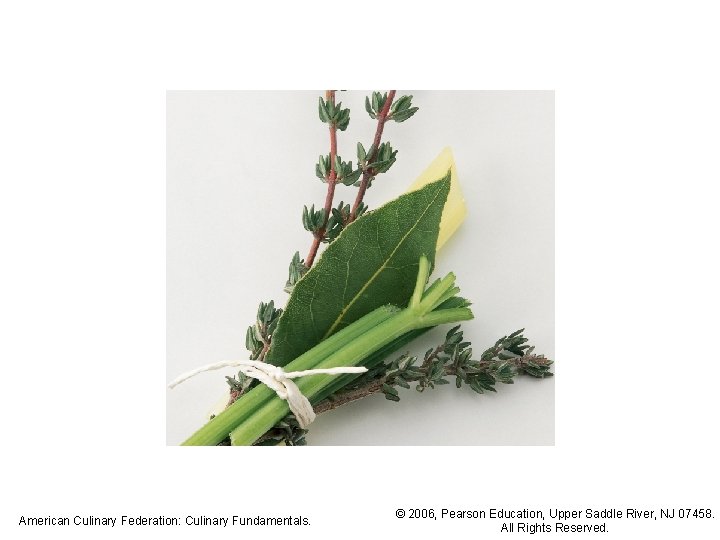
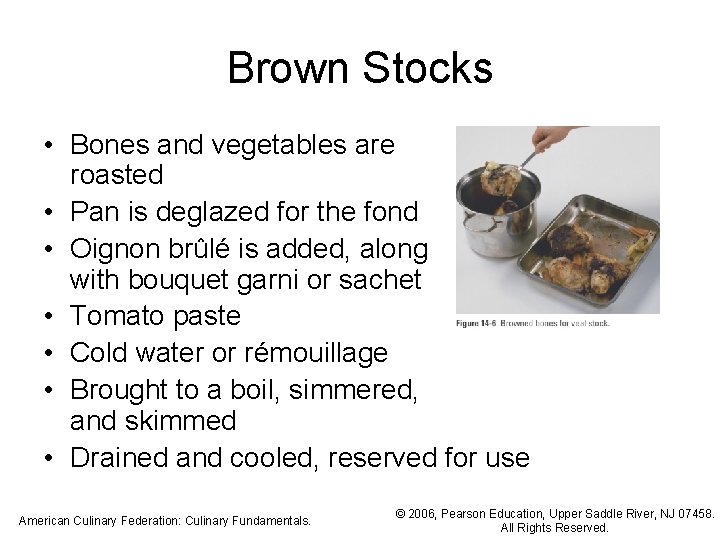
Brown Stocks • Bones and vegetables are roasted • Pan is deglazed for the fond • Oignon brûlé is added, along with bouquet garni or sachet • Tomato paste • Cold water or rémouillage • Brought to a boil, simmered, and skimmed • Drained and cooled, reserved for use American Culinary Federation: Culinary Fundamentals. © 2006, Pearson Education, Upper Saddle River, NJ 07458. All Rights Reserved.
Fumet/Shellfish stock • Fish bones, usually from white-fleshed fish • Shortest cooking time of all the major stocks • White mirepoix cooked with bones over low heat, covered for maximum extraction • Shellfish stocks are made from the shells of crustaceans • Shells are browned in hot oil instead of roasting American Culinary Federation: Culinary Fundamentals. © 2006, Pearson Education, Upper Saddle River, NJ 07458. All Rights Reserved.
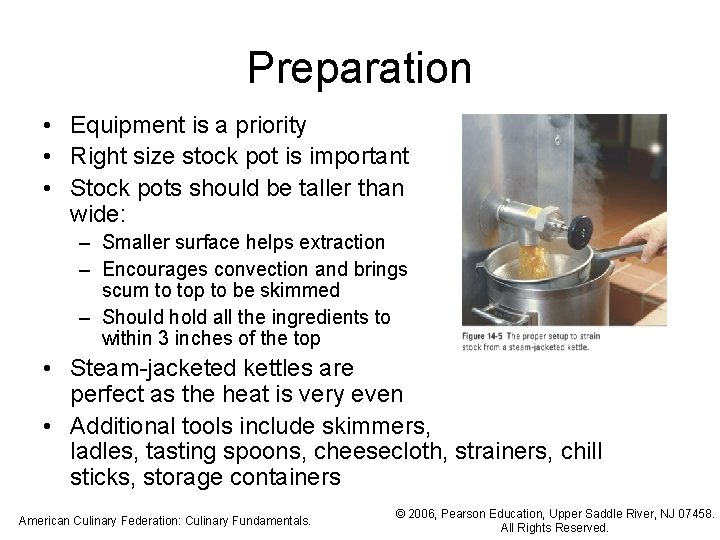
Preparation • Equipment is a priority • Right size stock pot is important • Stock pots should be taller than wide: – Smaller surface helps extraction – Encourages convection and brings scum to top to be skimmed – Should hold all the ingredients to within 3 inches of the top • Steam-jacketed kettles are perfect as the heat is very even • Additional tools include skimmers, ladles, tasting spoons, cheesecloth, strainers, chill sticks, storage containers American Culinary Federation: Culinary Fundamentals. © 2006, Pearson Education, Upper Saddle River, NJ 07458. All Rights Reserved.
Ingredients and Ratios • White or beef: 8 lbs of beef or veal bones, 6 qts of water, 1 lb of mirepoix, sachet • Poultry is the same • Brown is the same with the addition of tomato products • Fish: 11 lbs of bones, 5 qts of water, 1 lb of leeks, and mushroom trim, sachet • Shellfish, the same as fish with the addition of 2 oz of tomato paste and a standard mirepoix • Vegetables: 4 lbs of mixed vegetables, 1 gallon of water, sachet American Culinary Federation: Culinary Fundamentals. © 2006, Pearson Education, Upper Saddle River, NJ 07458. All Rights Reserved.
Meats and Large-game Stocks • Use meaty bones for a flavorful stock • Joints, necks, and knuckle bones are high in collagen, best for body • Collagen dissolves into gelatin, giving a rich mouth feel • Purchase bones cut in 2– 3 -inch pieces for easy handling and maximum extraction American Culinary Federation: Culinary Fundamentals. © 2006, Pearson Education, Upper Saddle River, NJ 07458. All Rights Reserved.
Poultry Stock • Made from any poultry bones • Remove the livers as they make the stock bitter and cloudy • Browning the bones will give a rich, roasted flavor • Cooking without browning gives a pleasant poultry flavor suitable for soups and sauces American Culinary Federation: Culinary Fundamentals. © 2006, Pearson Education, Upper Saddle River, NJ 07458. All Rights Reserved.
Vegetables for Stocks • Be sure they are fresh well trimmed and clean • Avoid starchy vegetables and vegetables that bleed or add too much color • Use vegetables in the Brassua family sparingly American Culinary Federation: Culinary Fundamentals. © 2006, Pearson Education, Upper Saddle River, NJ 07458. All Rights Reserved.
Liquids • • • Most common is cold, clean water Rémouillage may be used Vegetable juices Wine These liquids can replace all or some of the fresh water • Many fish stocks are half water and half wine American Culinary Federation: Culinary Fundamentals. © 2006, Pearson Education, Upper Saddle River, NJ 07458. All Rights Reserved.
Flavorings • Sachet d’ épices, bouquet garni • Mirepoix • A little salt American Culinary Federation: Culinary Fundamentals. © 2006, Pearson Education, Upper Saddle River, NJ 07458. All Rights Reserved.
Preparation of Ingredients • Rinse bones in cold water • Always use cold liquid for stock • Prepare the freshest vegetables and aromatics, clean them and peel if necessary, then cut/chop • Combine and heat to a boil • Turn to a simmer and begin skimming • Add flavorings when directed by the recipe • Strain, use the two-stage cooling method, and store for service • NOTE: The larger and denser the bones, the longer the cooking time American Culinary Federation: Culinary Fundamentals. © 2006, Pearson Education, Upper Saddle River, NJ 07458. All Rights Reserved.
Evaluating for Quality • Color and clarity • Flavor and aroma • Body American Culinary Federation: Culinary Fundamentals. © 2006, Pearson Education, Upper Saddle River, NJ 07458. All Rights Reserved.
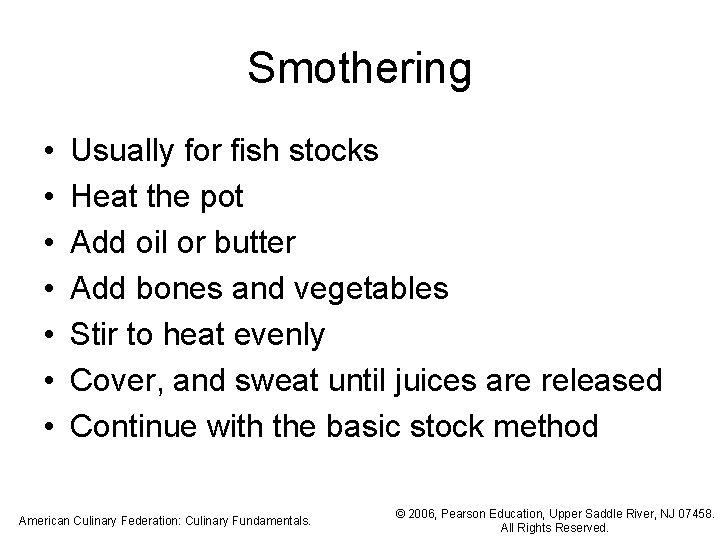
Smothering • • Usually for fish stocks Heat the pot Add oil or butter Add bones and vegetables Stir to heat evenly Cover, and sweat until juices are released Continue with the basic stock method American Culinary Federation: Culinary Fundamentals. © 2006, Pearson Education, Upper Saddle River, NJ 07458. All Rights Reserved.
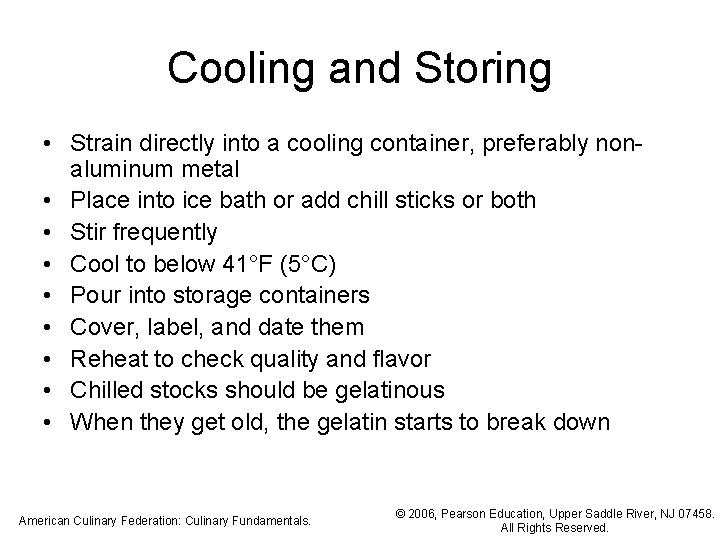
Cooling and Storing • Strain directly into a cooling container, preferably nonaluminum metal • Place into ice bath or add chill sticks or both • Stir frequently • Cool to below 41°F (5°C) • Pour into storage containers • Cover, label, and date them • Reheat to check quality and flavor • Chilled stocks should be gelatinous • When they get old, the gelatin starts to break down American Culinary Federation: Culinary Fundamentals. © 2006, Pearson Education, Upper Saddle River, NJ 07458. All Rights Reserved.
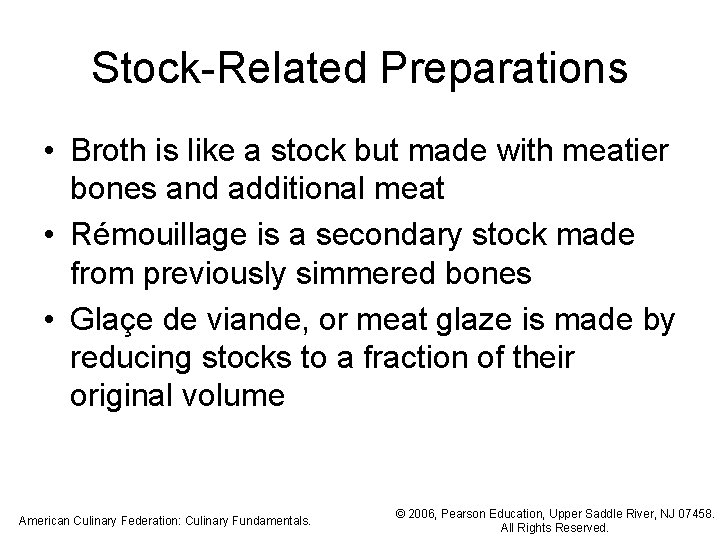
Stock-Related Preparations • Broth is like a stock but made with meatier bones and additional meat • Rémouillage is a secondary stock made from previously simmered bones • Glaçe de viande, or meat glaze is made by reducing stocks to a fraction of their original volume American Culinary Federation: Culinary Fundamentals. © 2006, Pearson Education, Upper Saddle River, NJ 07458. All Rights Reserved.
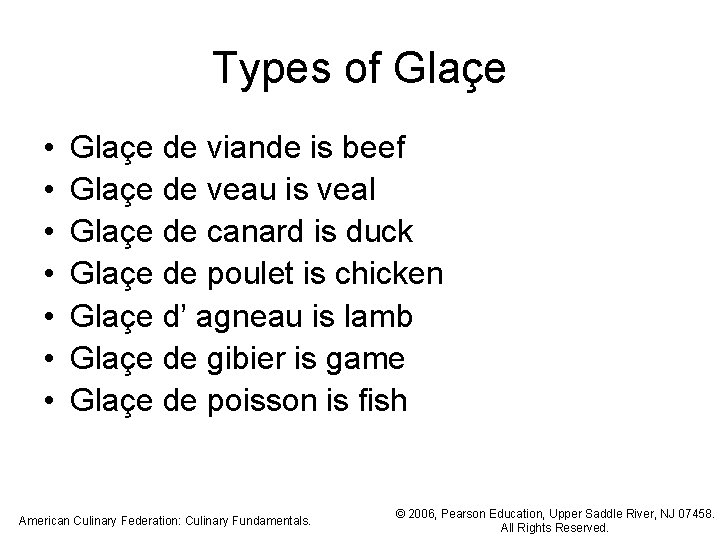
Types of Glaçe • • Glaçe de viande is beef Glaçe de veau is veal Glaçe de canard is duck Glaçe de poulet is chicken Glaçe d’ agneau is lamb Glaçe de gibier is game Glaçe de poisson is fish American Culinary Federation: Culinary Fundamentals. © 2006, Pearson Education, Upper Saddle River, NJ 07458. All Rights Reserved.
Court Boullion • • • Known as quick or short broth Used for submersion poaching Flavored with a light acid Mirepoix of ingredients called for Sachet Can be used as a sauce base American Culinary Federation: Culinary Fundamentals. © 2006, Pearson Education, Upper Saddle River, NJ 07458. All Rights Reserved.
Commercial Bases • Not all establishments have the capability to make stocks • Bases can be a reasonable substitute or a flavor enhancer for stocks and soups • Available in a range of flavors and quality • The higher the salt quantity, the lower the flavor quality • If you are using them, do not apply them directly, but dissolve them in a little hot liquid, then add them • This will prevent a guest from the possibility of getting a lump of base • Dissolving the bases also will quickly even out the flavor of the product it is added to American Culinary Federation: Culinary Fundamentals. © 2006, Pearson Education, Upper Saddle River, NJ 07458. All Rights Reserved.