U K Telecommunications Guidelines for developing future proof


- Slides: 62
U. K Telecommunications Guidelines for developing future proof infrastructure and Evolving technology systems
Outline Section 1: UK current telecommunication infrastructure market engagement status Section 2: Successful provision of infrastructure service to new developments Section 3: Barriers to engaging with infrastructure providers Section 4: Delivering a future-proof network to new sites Section 5: Types of infrastructure solutions available to UK housing developers Section 6: Regulatory requirements for providers offering telecommunication provision to new developments Section 7: Getting service on and installed Section 8: Delayed installation and service provision to new homes
Section 1 UK Current Telecommunication Infrastructure Market Engagement Status
UK current telecommunication infrastructure market engagement status • Who is who in the market place to date • Service providers of technology to new sites’ • Sustainable and future proofing - why is it important?
Who is who in the market place to date The availability of key infrastructure providers supplying new site solutions has increased in the last 7 years, with key players providing alternatives to the traditional infrastructure suppliers, such as Openreach. The primary objective was to open the market for developers to have choice and access innovation. The following providers also offer new site solutions so that traditional providers, such as Openreach, are no longer the only option available. • Virgin Media • GTC – Independent Fibre Network Limited - IFNL • Hyperoptics • Giga clear
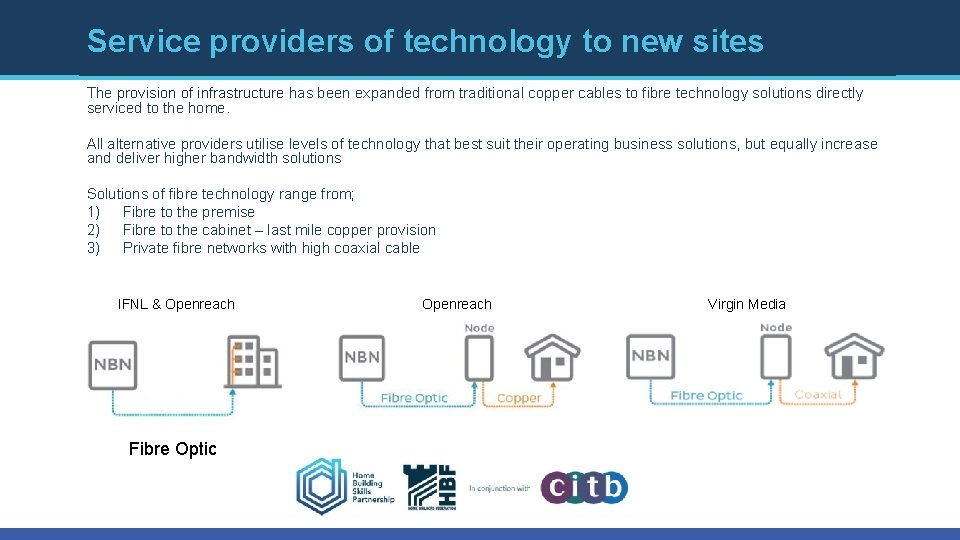
Service providers of technology to new sites The provision of infrastructure has been expanded from traditional copper cables to fibre technology solutions directly serviced to the home. All alternative providers utilise levels of technology that best suit their operating business solutions, but equally increase and deliver higher bandwidth solutions Solutions of fibre technology range from; 1) Fibre to the premise 2) Fibre to the cabinet – last mile copper provision 3) Private fibre networks with high coaxial cable IFNL & Openreach Fibre Optic Openreach Virgin Media
Sustainable and future proofing, why is it important Opportunities for using evolving broadband technology to deliver services to new developments in innovative, economical and convenient ways are acknowledged to be necessary to meet the future demand of the WWW access. Research also suggests that increased uptake of broadband technologies results in economic growth, providing strong rationale for public investment in broadband infrastructure, and future proofing new developments for sustainable access. This early recogonition and engagement with providers by the developers allows all homes to be sustainable and accessible, with no further enhancement and investment necessary as the technology evolves.
Section 2 Successful provision of infrastructure service to new developments
Successful provision of infrastructure services to new developments • When do you need to engage with an infrastructure provider? • The UK provider’s and their processes • Single – dual lay options • Self lay technology
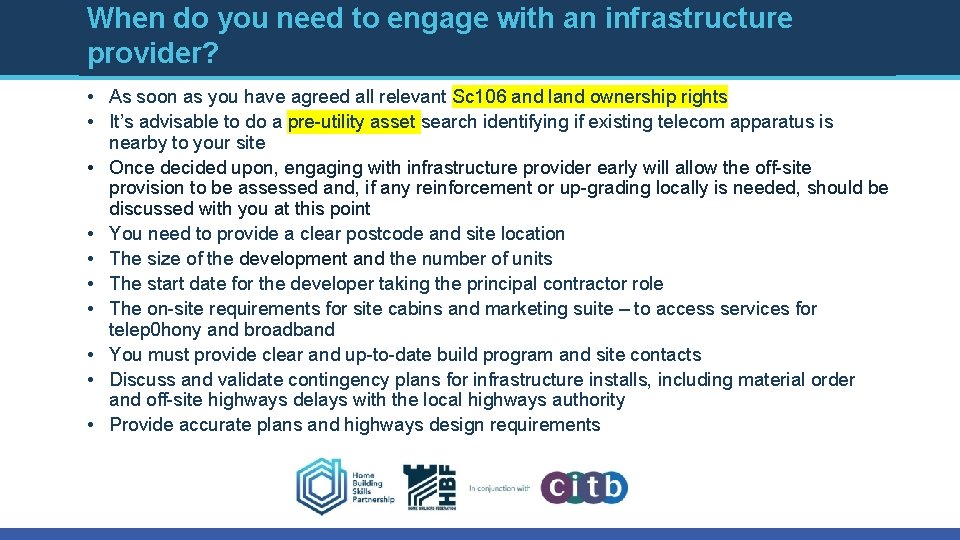
When do you need to engage with an infrastructure provider? • As soon as you have agreed all relevant Sc 106 and land ownership rights • It’s advisable to do a pre-utility asset search identifying if existing telecom apparatus is nearby to your site • Once decided upon, engaging with infrastructure provider early will allow the off-site provision to be assessed and, if any reinforcement or up-grading locally is needed, should be discussed with you at this point • You need to provide a clear postcode and site location • The size of the development and the number of units • The start date for the developer taking the principal contractor role • The on-site requirements for site cabins and marketing suite – to access services for telep 0 hony and broadband • You must provide clear and up-to-date build program and site contacts • Discuss and validate contingency plans for infrastructure installs, including material order and off-site highways delays with the local highways authority • Provide accurate plans and highways design requirements
Your infrastructure providers There are currently three main infrastructure providers in the UK used by new site developments: - • Virgin Media • IFNL – part of the GTC group • Openreach The products and services they offer and the way in which you should work with them in order to ensure the most efficient and smooth process is indicated in the following slides by each individual provider.
Virgin Media NEW SITES INFRASTRUCTURE PROVIDER
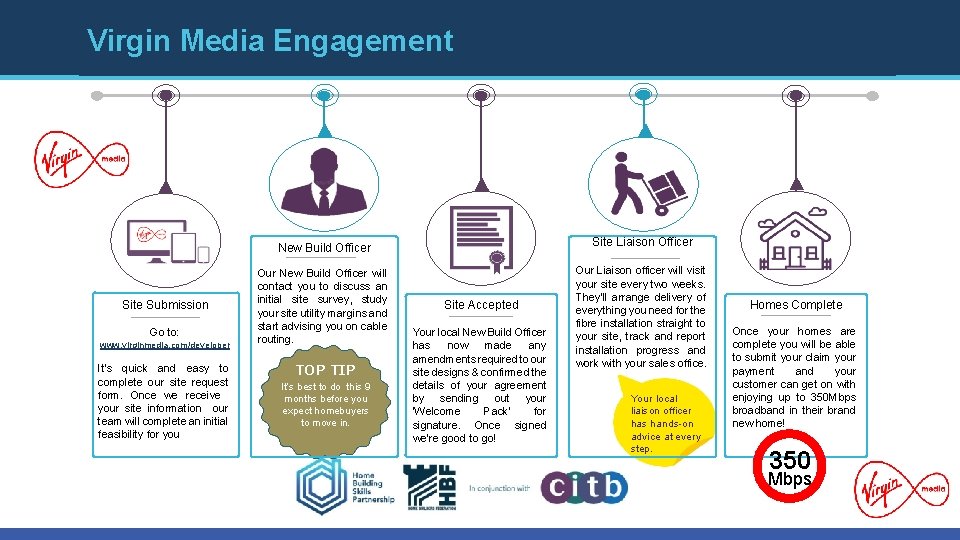
Virgin Media Engagement Site Submission Go to: www. virginmedia. com/developer It’s quick and easy to complete our site request form. Once we receive your site information our team will complete an initial feasibility for you. New Build Officer Site Liaison Officer Our New Build Officer will contact you to discuss an initial site survey, study your site utility margins and start advising you on cable routing. Our Liaison officer will visit your site every two weeks. They’ll arrange delivery of everything you need for the fibre installation straight to your site, track and report installation progress and work with your sales office. TOP TIP It’s best to do this 9 months before you expect homebuyers to move in. Site Accepted Your local New Build Officer has now made any amendments required to our site designs & confirmed the details of your agreement by sending out your ‘Welcome Pack’ for signature. Once signed we’re good to go! Your local liaison officer has hands-on advice at every step. Homes Complete Once your homes are complete you will be able to submit your claim your payment and your customer can get on with enjoying up to 350 Mbps broadband in their brand new home! 350 Mbps
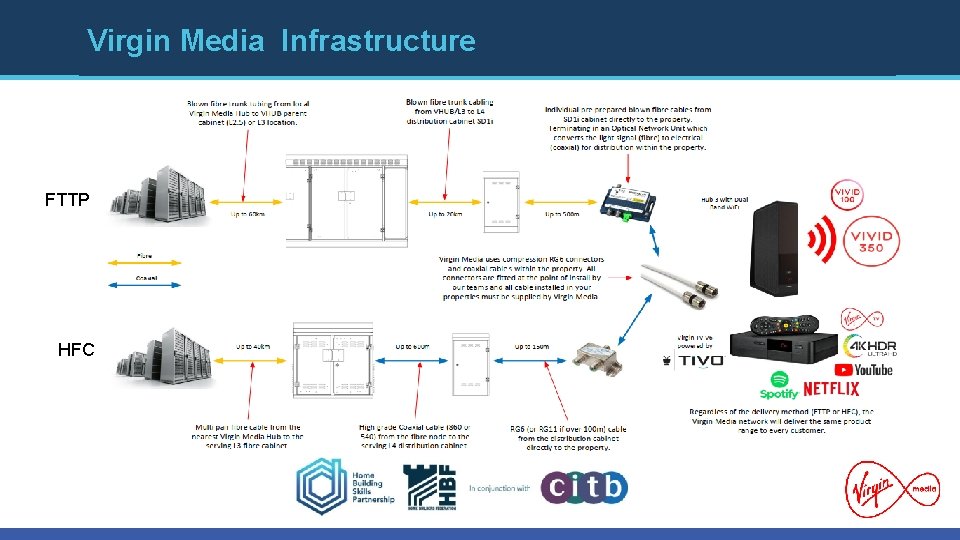
Virgin Media Infrastructure FTTP HFC
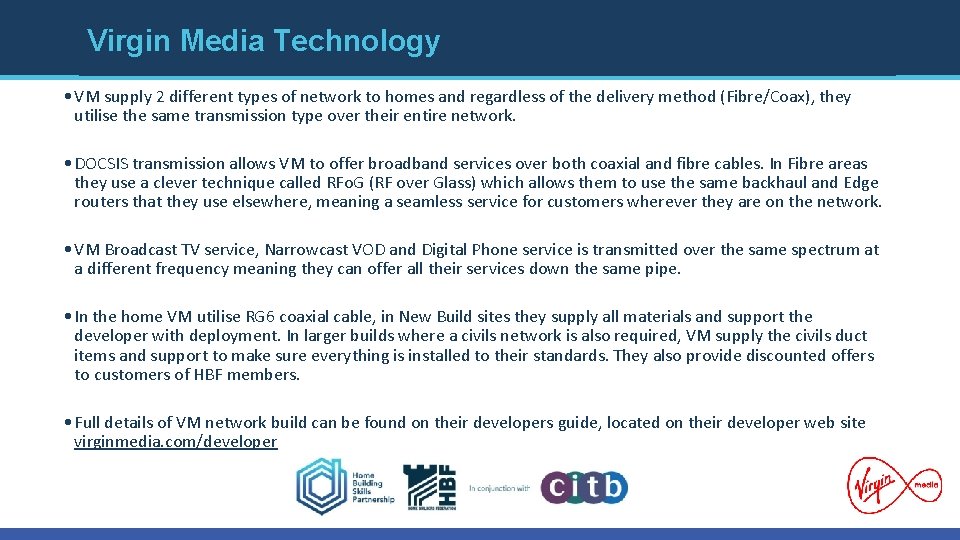
Virgin Media Technology • VM supply 2 different types of network to homes and regardless of the delivery method (Fibre/Coax), they utilise the same transmission type over their entire network. • DOCSIS transmission allows VM to offer broadband services over both coaxial and fibre cables. In Fibre areas they use a clever technique called RFo. G (RF over Glass) which allows them to use the same backhaul and Edge routers that they use elsewhere, meaning a seamless service for customers wherever they are on the network. • VM Broadcast TV service, Narrowcast VOD and Digital Phone service is transmitted over the same spectrum at a different frequency meaning they can offer all their services down the same pipe. • In the home VM utilise RG 6 coaxial cable, in New Build sites they supply all materials and support the developer with deployment. In larger builds where a civils network is also required, VM supply the civils duct items and support to make sure everything is installed to their standards. They also provide discounted offers to customers of HBF members. • Full details of VM network build can be found on their developers guide, located on their developer web site virginmedia. com/developer
IFNL – independent fibre network Ltd NEW SITES INFRASTRUCTURE PROVIDER
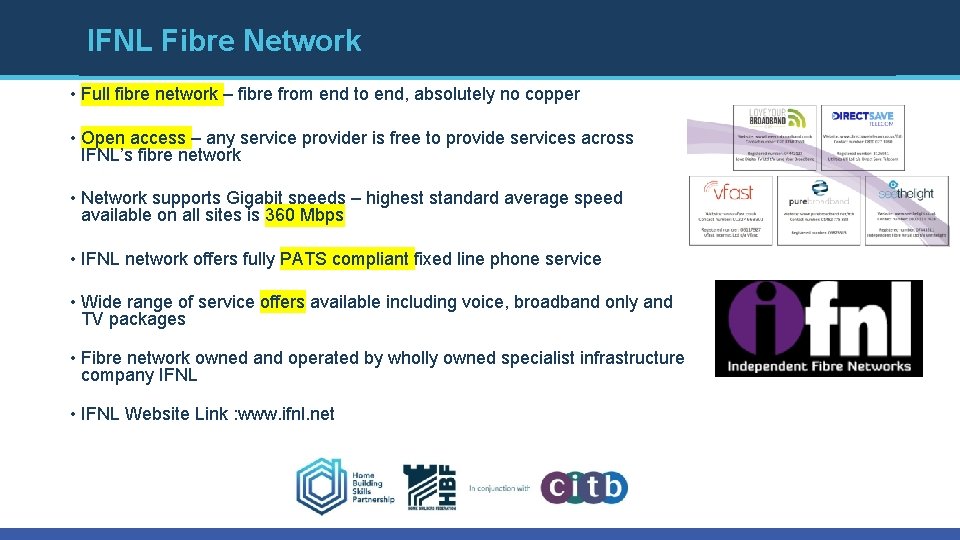
IFNL Fibre Network • Full fibre network – fibre from end to end, absolutely no copper • Open access – any service provider is free to provide services across IFNL’s fibre network • Network supports Gigabit speeds – highest standard average speed available on all sites is 360 Mbps • IFNL network offers fully PATS compliant fixed line phone service • Wide range of service offers available including voice, broadband only and TV packages • Fibre network owned and operated by wholly owned specialist infrastructure company IFNL • IFNL Website Link : www. ifnl. net
Openreach NEW SITES INFRASTRUCTURE PROVIDER
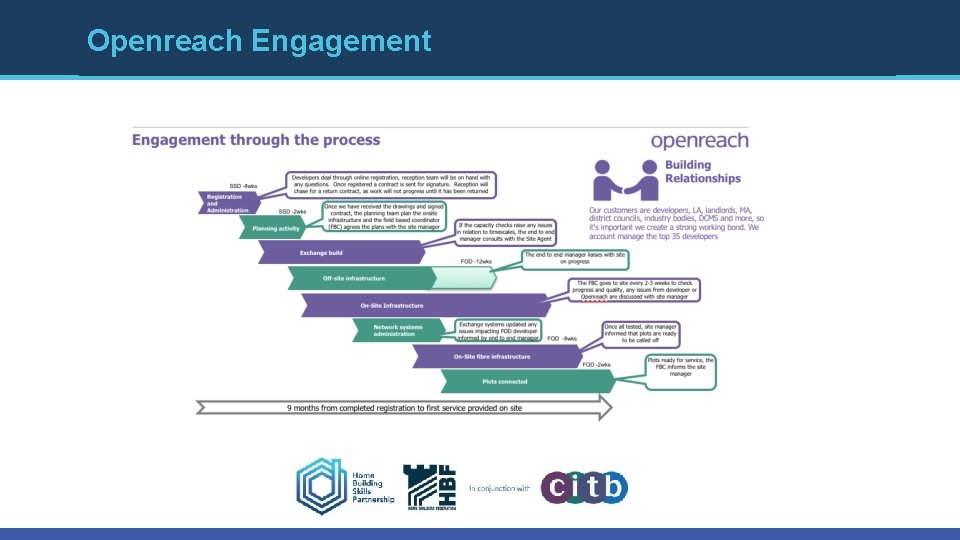
Openreach Engagement
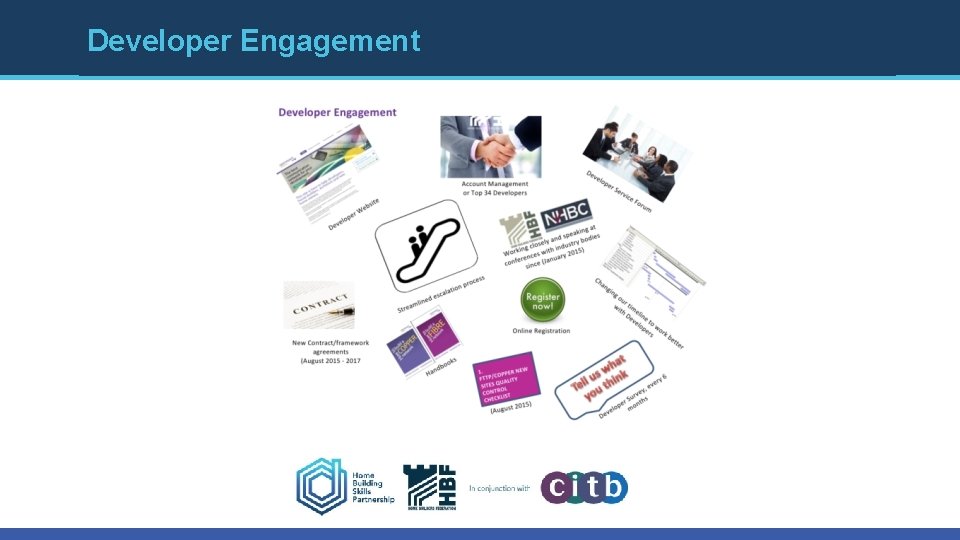
Developer Engagement
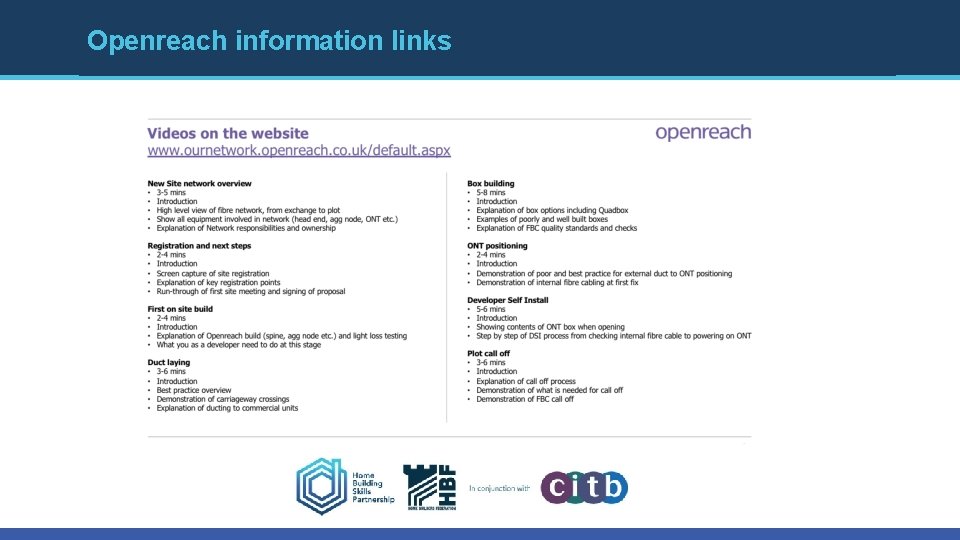
Openreach information links
How to choose a provider that suits your needs Choosing an infrastructure provider is dependent on key factors that enable a developer to find a partner who can deliver their needs in an effective and acceptable way. Below is a basic check list that can be referred to when choosing a provider – but it should obviously be considered as a guideline, rather than an exhaustive list: - • Competitive in the market • The service engagement and customer experience • Network Technology and level of support in design and on-site services • Previous established relationships We have discussed the more detailed considerations to take into account on a site-by-site basis in section 7 of this presentation.
Section 3 Barriers to engaging with infrastructure providers
Barriers to engaging with infrastructure providers • How do barriers occur within new developments? • Best solutions and options to prevent delays • Direct Relationship is key • Ability to work together
How do barriers occur within new developments? • Early engagement and discussions with key providers is vital to ensure clarity, and assist in avoiding unnecessary problems during the whole process • Understanding your development needs and requirements and homeowners feedback will prevent delays and dissatisfaction • Homeowners information packs that fully outline developers responsibilities will assist in avoiding misunderstanding, and ensure clarity for all concerned • Planning and off-site hurdles, including existing telecoms apparatus conditions in reaching a service provision to your new development can create barriers
Best solutions and options to prevent delay • Telecoms operators and highway authorities need to improve street works planning, for example by introducing more site visits, and by improving the quality of workmanship by sub-contractors through increased monitoring and incentives for quality of delivery of the infrastructure being deployed on-site • Telecoms operators and planning authorities need to engage with developers early in the deployment planning process, and work closely to prepare plans for siting of equipment. • Telecoms operators need to incorporate early engagement with all local authorities as a standard part of their deployment planning process, and to share information about their deployment plans, existing assets and reinforcing costs to serve new developments as early as possible
Direct Relationship is key Having a direct relationship with telecommunication infrastructure providers is key to forming a relationship, and allows a developer to: - 1) Create a co-ordinating end-to-end build programme for delivery of on-site and offsite works 2) Share key up-dates on project deployment of off-site infrastructure 3) Efficiently identify and co-ordinate escalation and delivery delays 4) Manage on-site teams’ build quality, and the rebate payment process
Ability to work together U. K. infrastructure technology is changing rapidly, with new and sustainable development always evolving. Therefore it’s critical for U. K. providers to have the ability to share knowledge and work together with developers. The strength of an adjoined approach to sustainable deployment creates key working abilities between industries. 1) 2) 3) 4) Fosters and creates strong understanding of industry development requirements Commercial and financial constraints can be discussed and overcome It manages end-user demand requirements It supports the government visions for future proofing a digital Britain
Section 4 Delivering a future proof network to new sites
Delivering a future proof network to new sites • Reasons for future proofing networks in telecoms • The social and www demand for fast and efficient access to technology solutions • Long term evolution
Reasons for future proofing networks in telecoms Broadband networks are built with the aim of lasting for decades, and they need to support increasingly heavy traffic at higher bandwidths. • Factors that contribute to the network’s reliability and longevity include building sustainable infrastructure on new developments • The requirement for good fibre/cable management and highly reliable connections throughout the network have been accepted as necessary. • Today’s needs mean that operators & the UK construction industry have to build networks with an eye to future requirements evolving, with new developments becoming more infrastructure sustainable and ready for technological evolution
The social and www demand for fast and efficient access to technology solutions The World Wide Web – www - was designed originally as an interactive world of shared information, through which people could communicate with each other. Since its inception in 1989 it has grown as a medium for broadcasting to the mass of Internetconnected consumers. In the future, • In the UK we look towards the web becoming a tool for even smaller groups, such as families, and personal information systems. • Other interesting developments would be the increasingly interactive nature of the interface to the user, • Increasing use of machine-readable information, with defined semantics allowing more advanced machine processing of global information - including machine-readable signed assertions (AI), interactive homes, fridges and utility services You will undoubtedly be building a full and readily accessible house to accommodate the evolving bandwidth, and allow future performance access to the www.
Long term evolution Fibre optics has helped push the telecommunications system into hyperdrive. But only when fibre connections reach all the way into the home will the technology’s promise be fully realised. It’s critical that all new developments propose a solution to build duct infrastructure that is future proof and maintainable for long term evolution by: 1) Supporting the quality build standard of the telecom duct provision needed for installation. 2) Liaising with your adopting partner to inspect and accept the duct install provision 3) Making ready provision for future-proof access for adjoining developments/strategic land access
Section 5 Types of infrastructure solutions available to UK housing developers
Types of infrastructure solutions available to the UK housing developers • Single duct solutions • Dual lay solutions • Passive Infrastructure Access - PIA - and competition of duct sharing
Single duct solutions comprise of: - 1) Laying only one singular open access provider 2) Consists of a twin duct and rider duct solution, or 3) Fibre tubing solution for FTTP
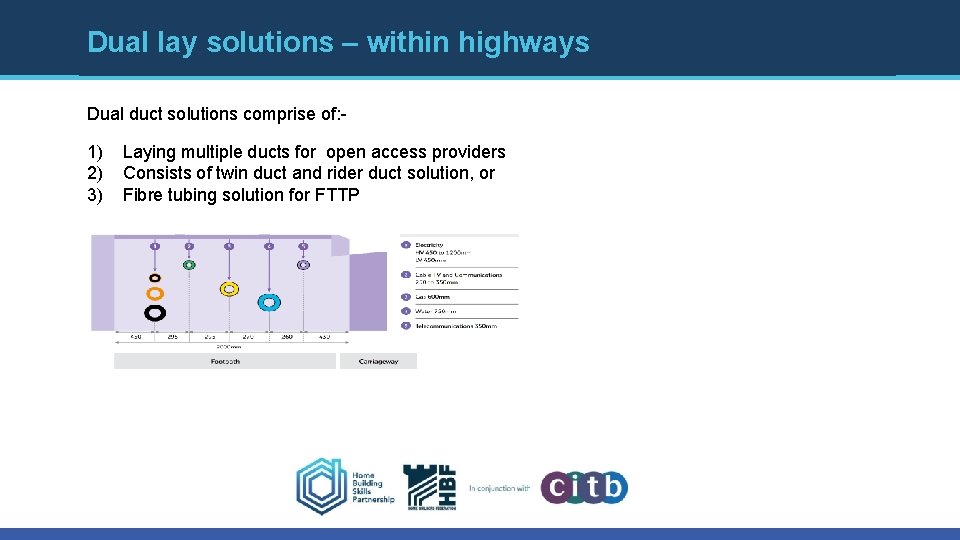
Dual lay solutions – within highways Dual duct solutions comprise of: - 1) 2) 3) Laying multiple ducts for open access providers Consists of twin duct and rider duct solution, or Fibre tubing solution for FTTP
PIA and competition of duct sharing The U. K. telecom market is still evolving, with an view to having the ability to deploy shared ducting and improved competition. However not all providers subscribe to this desire for Passive Infrastructure Access - PIA Where new sites are deploying networks, it’s envisioned that accessing the existing physical infrastructure can allow for significant savings – potentially up to 60% in some cases - as compared to excavating afresh. Owners of existing infrastructure also expected to benefit from this change - for instance, energy utilities exploiting synergies with smart grids deployment Access to passive infrastructure enhances efficiencies, minimises the costs and accelerates the deployment of telecommunication infrastructure. The U. K. markets in both telecoms service and infrastructure are currently discussing how this can evolve into a faster and more efficient deployment within new infrastructure. PIA is a long term solution for the industry
Section 6 Regulatory requirements for providers offering telecommunication provision to new developments
Regulatory requirements for developers providing telecommunication provision to new developments In this section we will discuss: - • UK regulation requirements for broadband • Provision of service to new homes for new sites – understanding the requirements • What is the Universal Service Obligation – USO – and what does ‘lock out’ mean • What happens when a USO provider can’t serve a new development • Quality and assurance duties
UK regulation requirements for broadband • The UK is delivering a future ‘Digital Britain’ footprint by improving bandwidth speeds and geographical connectivity UK wide • Investment, technology and infrastructure delivery will create wider access to improved broadband bring sustainability for a digital footprint across the UK • New developments have key opportunities to secure future proofing infrastructure, to mitigate high cost, retro-fitted infrastructure by being prepared from the outset. • The UK construction industry is not legally bound to provide bandwidth, but needs to provide effective and sustainable duct infrastructure for the UK service internet providers to serve end-consumers • The UK construction industry have been given key commercial incentives to aid in the duct infrastructure provision, ensuring the cost to construct is mitigated to some degree • All new sites payment incentives can be found on the HBF website
Provision of service to new homes for new sites – understanding the requirements • New construction sites are not obliged to service a new development with a provision of telephony or broadband service till new homes are complete • Due to the cost of retrofit and highways implications when digging up newly laid roads and footpaths, under Sc 38 or Sc 278 it is vital that developers engage with a choice of providers to establish early design and duct for the development • The UK is an open-access market, where developers have the ability to choose an infrastructure provider to service any site, selected from a variety of options • Competition is available to allow developers choice, and conforms to all OFCOM regulatory requirements and controls • The universal service obligation (USO) has no automatic rights to service new sites developments. However, in 2017 Ofcom extended their duties to incorporate an obligation to provide a minimum bandwidth – currently 20 mb.
What is the Universal Service Obligation and what does ‘lock out’ mean • The universal service obligation is the duty of Openreach/BT & Hull Telecommunications to service a dwelling/consumer with a telephony & broadband provision, if not already serviced. It is regulated under the secondary legislation of The Digital Economy Act 2017. • The USO has a duty to provide an end-user of a dwelling with a service when a request is made via one of the UK’s 400+ service providers. • Where such provision of infrastructure is not already in place, the USO provider will service the dwelling with an overhead line, pole and cable provision. • Where developers choose a provider other than a USO provider, this means the site or development effectively becomes ‘none-serviceable’ by the USO provider. This is known as ‘lock out’ • Choosing an alternative infrastructure provider does not contravene any regulations, duties or legislative obligations. • As the dwelling on new sites has not yet being constructed or occupied, the USO is not applicable, allowing freedom of competition to service, without restricting the consumer in their choice, but still meeting Public Access Telephony rules
What happens when a USO provider can’t serve a new development • Where a USO provider is not being used to service a new development, this is not unlawful or contravening any regulations associated to the rights of PAT – Public Access Telephony • The USO provider can apply to service the development after the Sc 38 and Sc 278 maintenance period, but this will almost certainly be considered commercially unviable due to below-ground infrastructure having to be installed • The consumer living on a none USO service provider development therefore has access to a wide variety of internet consumer providers under the rules of open access network choice • The UK telecoms market is freely open and competitive for developers to choose a suitable and commercially beneficial delivery partner of choice to service their developments with telephony and broadband
Quality and assurance duties • UK developers have a duty to conform to the quality assurance requirements of sustainable infrastructure build on new developments • All competitive infrastructure providers provide developer guides and quality build designs to ensure their provision of infrastructure meets the required service quality to provide a telephony and broadband service • Building an infrastructure for the provision of service requires the developers to ensure the infrastructure meets with the ‘safe and suitability’ criteria for prevention of outage, and service quality to the end users
Section 7 Getting service on and installed
Getting service on and installed • Choosing a service provider that suits your needs • The three key process stage for providers • Considerations when choosing your provider • Timelines considerations when choosing your provider • Your agreement and wayleave • Wayleave – process • Service Level Agreements – SLA’s • Homeowner service level agreement with their internet service provider and telephony provider
Choosing a service provider that suits your needs All infrastructure ducting contracts require a contract of service or single service contract agreement. This agreement can entitle an entity to be a sole provider of duct infrastructure to any new development. This is a developer choice, and depends on what they feel is most suited and appropriate for their development.
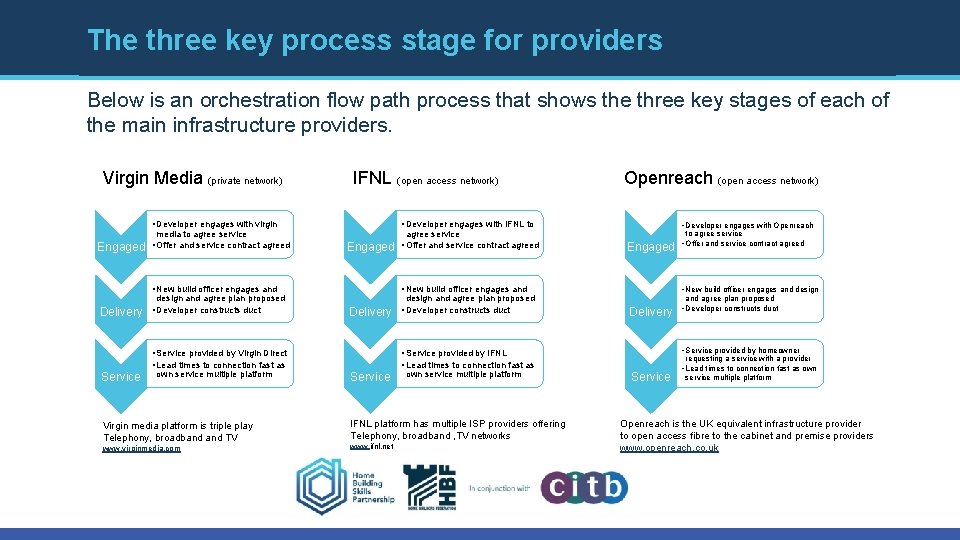
The three key process stage for providers Below is an orchestration flow path process that shows the three key stages of each of the main infrastructure providers. Virgin Media (private network) IFNL (open access network) • Developer engages with virgin Engaged media to agree service • Offer and service contract agreed • Developer engages with IFNL to Engaged • New build officer engages and Delivery design and agree plan proposed • Developer constructs duct own service multiple platform Virgin media platform is triple play Telephony, broadband TV www. virginmedia. com agree service • Offer and service contract agreed • Developer engages with Openreach to agree service Engaged • Offer and service contract agreed • New build officer engages and Delivery • Service provided by Virgin Direct • Lead times to connection fast as Service Openreach (open access network) design and agree plan proposed • Developer constructs duct • New build officer engages and design and agree plan proposed Delivery • Service provided by homeowner • Service provided by IFNL • Lead times to connection fast as Service own service multiple platform IFNL platform has multiple ISP providers offering Telephony, broadband , TV networks www. ifnl. net • Developer constructs duct requesting a service with a provider Service • Lead times to connection fast as own service multiple platform Openreach is the UK equivalent infrastructure provider to open access fibre to the cabinet and premise providers www. openreach. co. uk
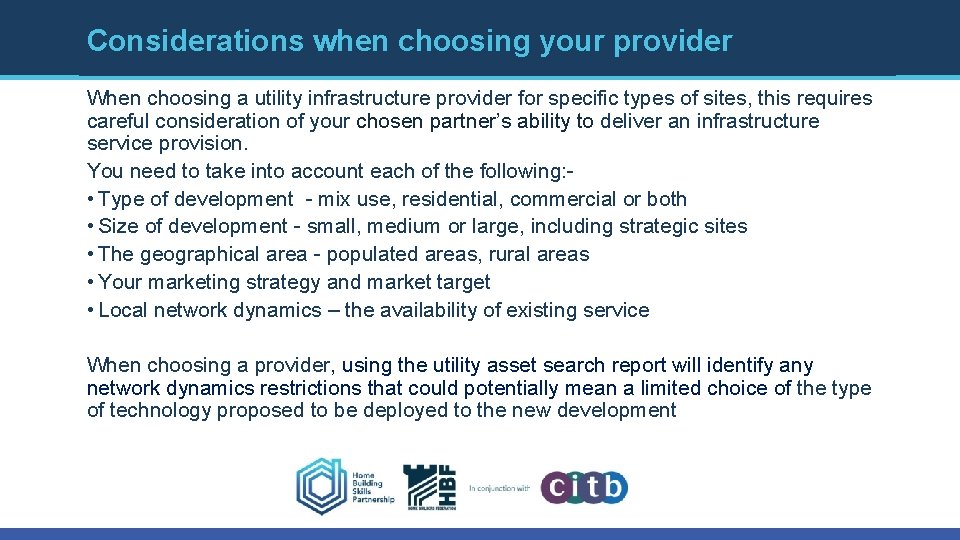
Considerations when choosing your provider When choosing a utility infrastructure provider for specific types of sites, this requires careful consideration of your chosen partner’s ability to deliver an infrastructure service provision. You need to take into account each of the following: • Type of development - mix use, residential, commercial or both • Size of development - small, medium or large, including strategic sites • The geographical area - populated areas, rural areas • Your marketing strategy and market target • Local network dynamics – the availability of existing service When choosing a provider, using the utility asset search report will identify any network dynamics restrictions that could potentially mean a limited choice of the type of technology proposed to be deployed to the new development
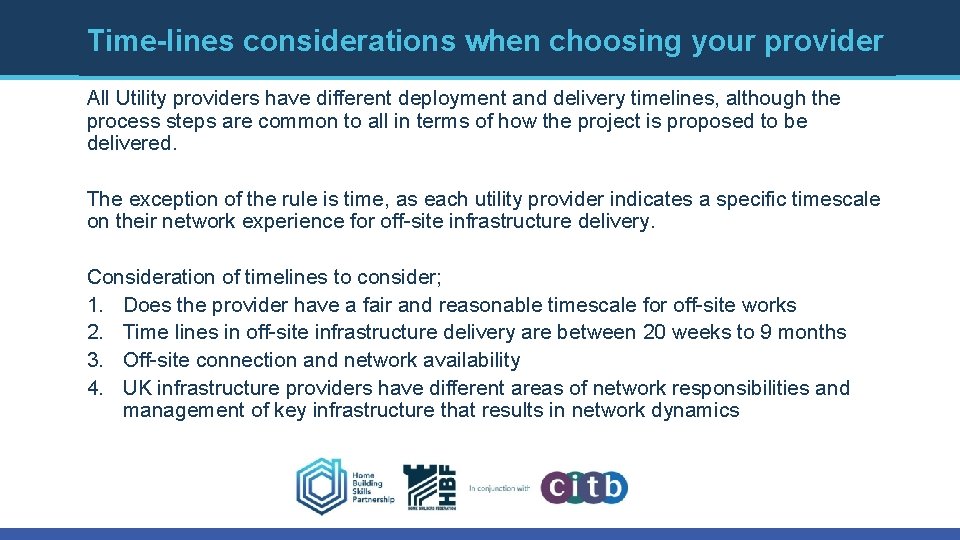
Time-lines considerations when choosing your provider All Utility providers have different deployment and delivery timelines, although the process steps are common to all in terms of how the project is proposed to be delivered. The exception of the rule is time, as each utility provider indicates a specific timescale on their network experience for off-site infrastructure delivery. Consideration of timelines to consider; 1. Does the provider have a fair and reasonable timescale for off-site works 2. Time lines in off-site infrastructure delivery are between 20 weeks to 9 months 3. Off-site connection and network availability 4. UK infrastructure providers have different areas of network responsibilities and management of key infrastructure that results in network dynamics
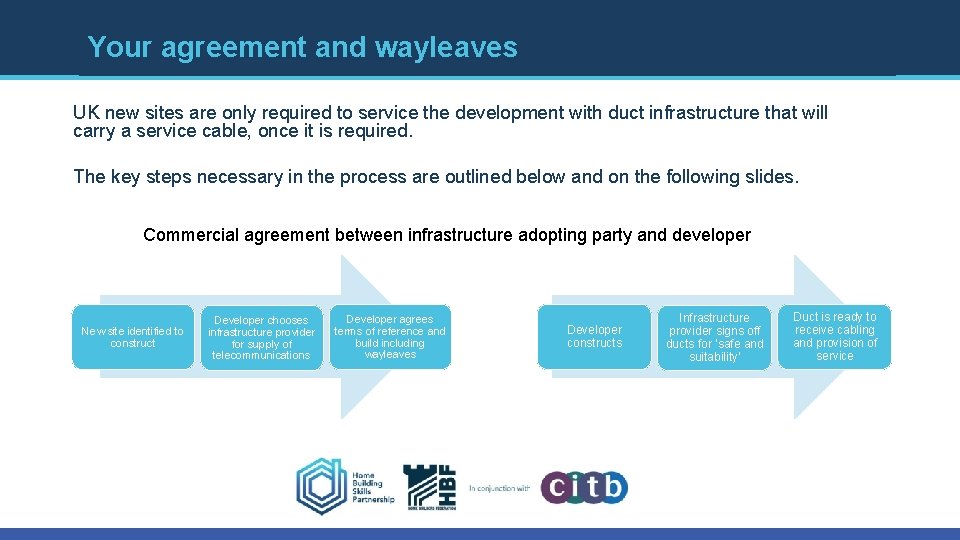
Your agreement and wayleaves UK new sites are only required to service the development with duct infrastructure that will carry a service cable, once it is required. The key steps necessary in the process are outlined below and on the following slides. Commercial agreement between infrastructure adopting party and developer New site identified to construct Developer chooses infrastructure provider for supply of telecommunications Developer agrees terms of reference and build including wayleaves Developer constructs Infrastructure provider signs off ducts for ‘safe and suitability’ Duct is ready to receive cabling and provision of service
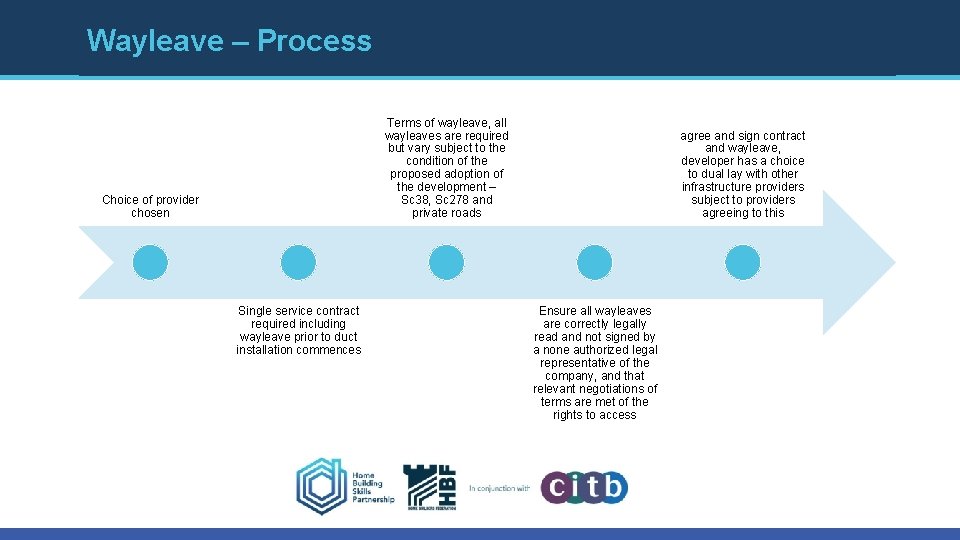
Wayleave – Process Terms of wayleave, all wayleaves are required but vary subject to the condition of the proposed adoption of the development – Sc 38, Sc 278 and private roads Choice of provider chosen Single service contract required including wayleave prior to duct installation commences agree and sign contract and wayleave, developer has a choice to dual lay with other infrastructure providers subject to providers agreeing to this Ensure all wayleaves are correctly legally read and not signed by a none authorized legal representative of the company, and that relevant negotiations of terms are met of the rights to access
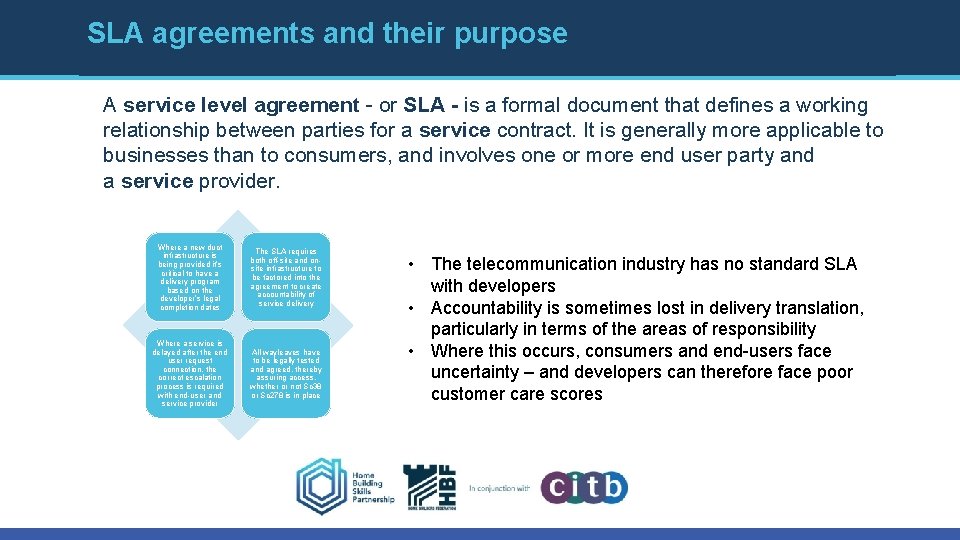
SLA agreements and their purpose A service level agreement - or SLA - is a formal document that defines a working relationship between parties for a service contract. It is generally more applicable to businesses than to consumers, and involves one or more end user party and a service provider. Where a new duct infrastructure is being provided it’s critical to have a delivery program based on the developer’s legal completion dates The SLA requires both off-site and onsite infrastructure to be factored into the agreement to create accountability of service delivery Where a service is delayed after the end user request connection, the correct escalation process is required with end-user and service provider All wayleaves have to be legally tested and agreed, thereby assuring access, whether or not Sc 38 or Sc 278 is in place • The telecommunication industry has no standard SLA with developers • Accountability is sometimes lost in delivery translation, particularly in terms of the areas of responsibility • Where this occurs, consumers and end-users face uncertainty – and developers can therefore face poor customer care scores
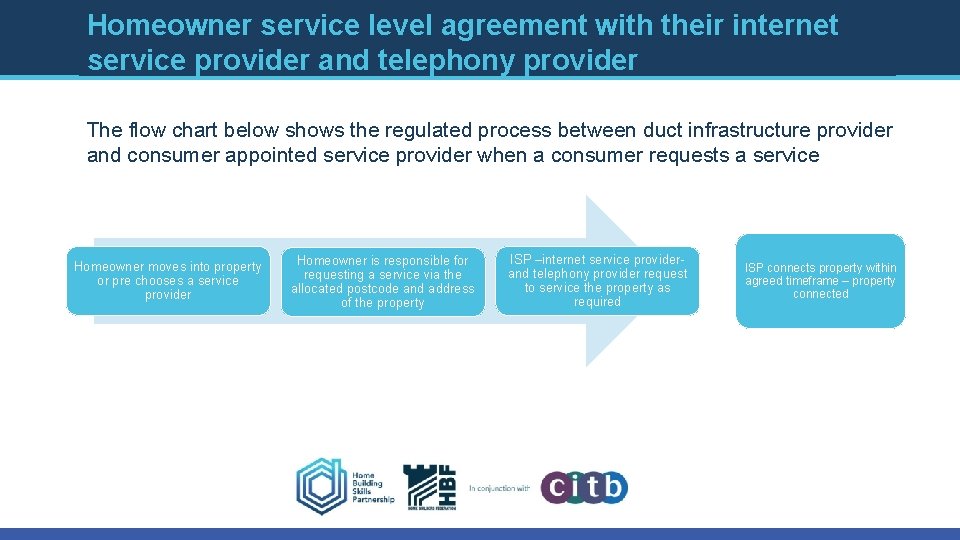
Homeowner service level agreement with their internet service provider and telephony provider The flow chart below shows the regulated process between duct infrastructure provider and consumer appointed service provider when a consumer requests a service Homeowner moves into property or pre chooses a service provider Homeowner is responsible for requesting a service via the allocated postcode and address of the property ISP –internet service provider- and telephony provider request to service the property as required ISP connects property within agreed timeframe – property connected
Section 8 Delayed installation and service provision to new homes
Delayed installation and service provision to new homes • Dealing with service delivery delays • How complaints are raised • Dealing with escalations procedures • Ofcom complaints • Industry KPIs
Dealing with service delivery delays When service delivery is delayed, it’s important to establish the impact on the development and the next steps necessary to address the issues. 1. 2. 3. 4. 5. 6. What are the new proposed time scales for the delivery of service? What are the consequences of the delay for [a] onsite or [b] offsite connections Has the homeowner moved in, and have they been awaiting a service provision? The immediate impact on the homeowner How is the infrastructure provider addressing the situation? Alternative solution – use of ‘My Wi-Fi’ or mobile devices to resolve their immediate connection issues 7. How is the escalation procedure being addressed by the provider?
How complaints should be raised Raising an official complaint is a last resort, but critical if legal completions are taking place and there’s a potential risk of homeowners not receiving a ready telecommunication service. Whilst the telecoms service doesn’t effect the CML process with the NHBC or building control, it could effect the buyers willingness to legally complete, if they won’t receive a telecommunication service 1. Address all concerns for any delay immediately with the appointed build manager from your chosen provider 2. Ascertain the actual route cause of the delay, and the immediate impact it will have 3. Formulate an agreed plan with the escalation team providing resources to address the delay 4. Road map out the timescales of fixing the delay, ensuring all parties involved are kept informed and aware of progress
Dealing with escalations procedures Escalation procedures are set out in the single contract agreement. 1. Initial discussions should be undertaken to raise a formal outlined complaint, that details the potential delay incurred on site 2. This has to be clearly communicated to the project lead rep from the infrastructure provider and any third party contractor involved 3. What Impact does this have on your development e. g. legal completions or Redcare and required service provision to vulnerable homeowners needing a provision of service. 4. The escalation negotiations need to establish immediate resource allocation and fault-finding solutions to enable a service provision to be successfully delivered.
Ofcom complaints OFCOM regulates the telecommunications and radio industry. OFCOM does not regulate the commercial infrastructure market outside a direct service provision being provided to new developments. Below is a high level overview: Regulated 1. Consumers receiving a provision of service across wireless telegraphy of the electro magnetic spectrum within the UK 2. Quality of competition and wide range of TV and radio services 3. Protection of offensive material with the public Not regulated 1. Disputes between you and telecoms provider (unless you have a service contract with a provider) 2. TV licenses , infrastructure, BBC world service , newspapers – all regulated by other entities
Industry KPI’s New sites UK new development projects fall outside the USO - ‘universal service obligation’ - and in turn, OFCOM’s policy. This results in the construction industry having to manage direct key performance indicator parameters with the provider themselves, the aim of which are to provide positive and constructive feedback and working relationships & practices.