
Statewide Telecommunications Services Contract RFP No 5000 Vendor
- Slides: 31
Statewide Telecommunications Services Contract RFP No. 5000 Vendor Conference August 22, 2017
Agenda �Introductions �Project Overview – ITS Telecommunications Services Staff �Procurement Guidelines – Michelle Smith �Questions/Answers (Answers to vendor questions during this vendor conference are not official until questions submitted in writing and answers published) �Wrap-up and Next Steps – Michelle Smith
Attendance �Roll Call �Please sign the attendance sheet and leave your business card �Attendees List and an audio recording of this Vendor Conference will be posted to the ITS website (www. its. ms. gov) �Answers to vendor questions during this vendor conference are not official until questions submitted in writing and answers published
RFP No. 5000 Goals Over the past 18 months, representatives from all areas of State government have worked together to develop the technical specifications for RFP 5000. The goals of this group were to develop specifications that: �Maintain, at a minimum, the current level of service that the State receives from the incumbent provider �Tighten the rules to correct inadequacies that exist in the current contract �Provide the State with options for high quality, reliable telecommunication services to support the various entities of State government
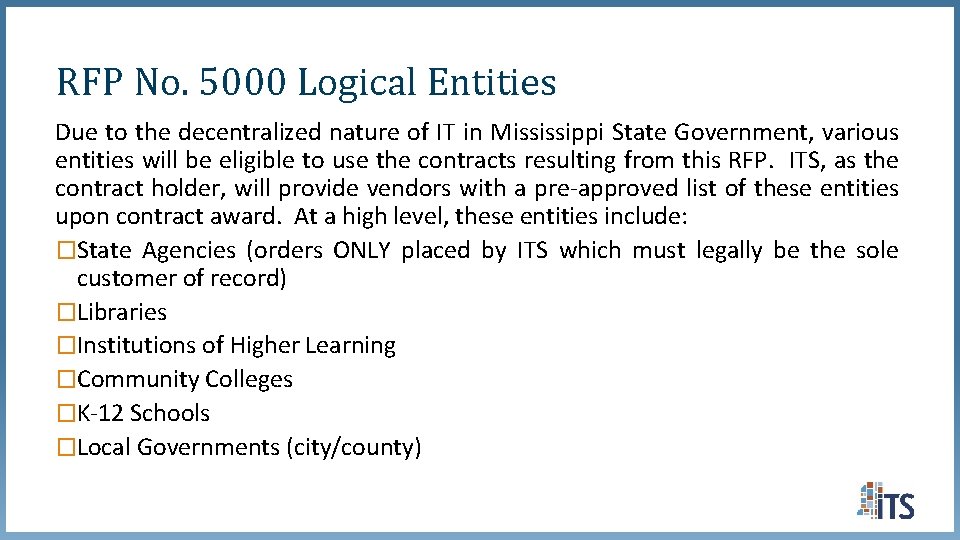
RFP No. 5000 Logical Entities Due to the decentralized nature of IT in Mississippi State Government, various entities will be eligible to use the contracts resulting from this RFP. ITS, as the contract holder, will provide vendors with a pre-approved list of these entities upon contract award. At a high level, these entities include: �State Agencies (orders ONLY placed by ITS which must legally be the sole customer of record) �Libraries �Institutions of Higher Learning �Community Colleges �K-12 Schools �Local Governments (city/county)
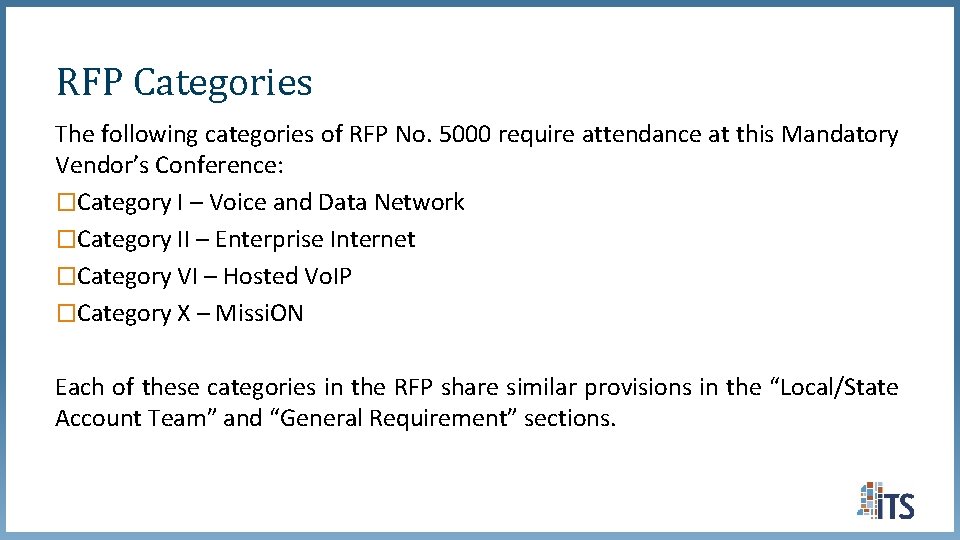
RFP Categories The following categories of RFP No. 5000 require attendance at this Mandatory Vendor’s Conference: �Category I – Voice and Data Network �Category II – Enterprise Internet �Category VI – Hosted Vo. IP �Category X – Missi. ON Each of these categories in the RFP share similar provisions in the “Local/State Account Team” and “General Requirement” sections.
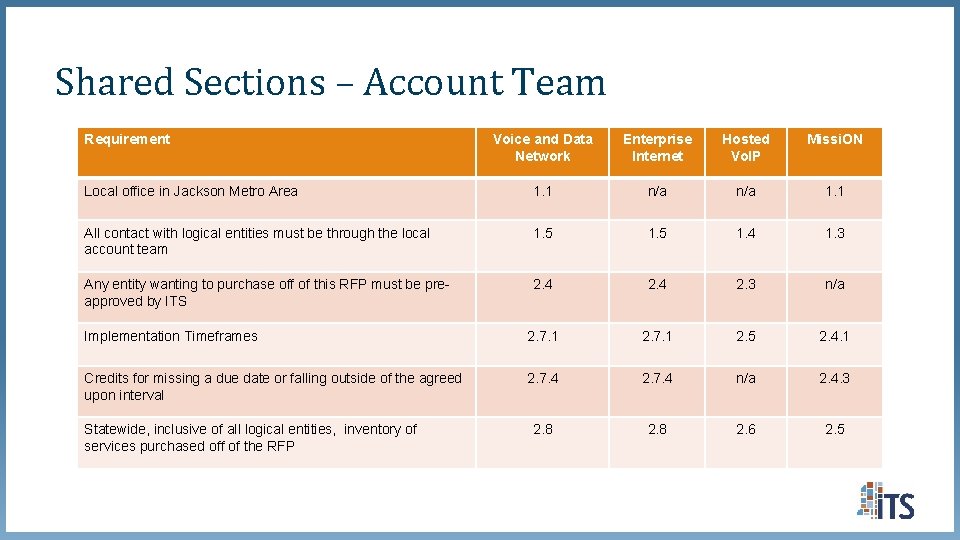
Shared Sections – Account Team Requirement Voice and Data Network Enterprise Internet Hosted Vo. IP Missi. ON Local office in Jackson Metro Area 1. 1 n/a 1. 1 All contact with logical entities must be through the local account team 1. 5 1. 4 1. 3 Any entity wanting to purchase off of this RFP must be preapproved by ITS 2. 4 2. 3 n/a Implementation Timeframes 2. 7. 1 2. 5 2. 4. 1 Credits for missing a due date or falling outside of the agreed upon interval 2. 7. 4 n/a 2. 4. 3 2. 8 2. 6 2. 5 Statewide, inclusive of all logical entities, inventory of services purchased off of the RFP
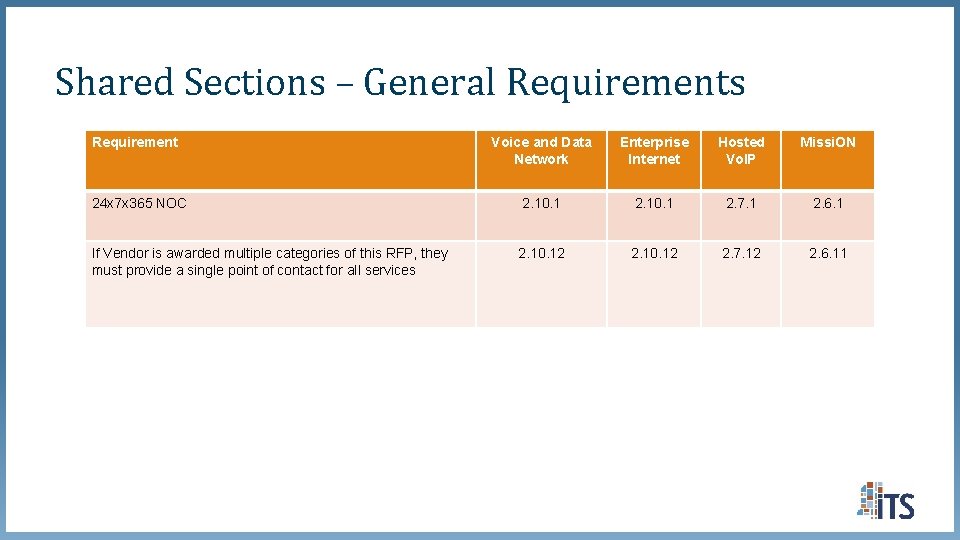
Shared Sections – General Requirements Requirement Voice and Data Network Enterprise Internet Hosted Vo. IP Missi. ON 24 x 7 x 365 NOC 2. 10. 1 2. 7. 1 2. 6. 1 If Vendor is awarded multiple categories of this RFP, they must provide a single point of contact for all services 2. 10. 12 2. 7. 12 2. 6. 11
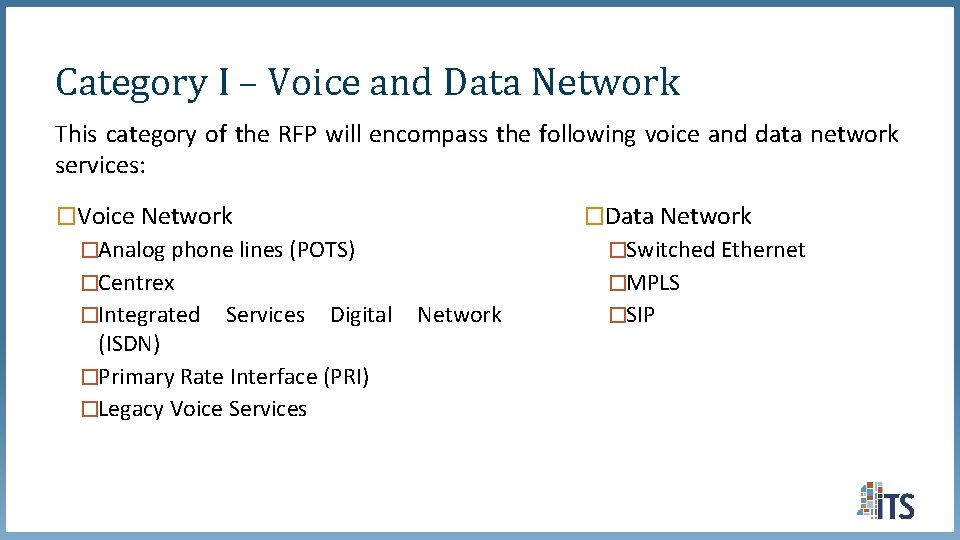
Category I – Voice and Data Network This category of the RFP will encompass the following voice and data network services: �Voice Network �Data Network �Analog phone lines (POTS) �Switched Ethernet �Centrex �MPLS �Integrated Services Digital (ISDN) �Primary Rate Interface (PRI) �Legacy Voice Services Network �SIP
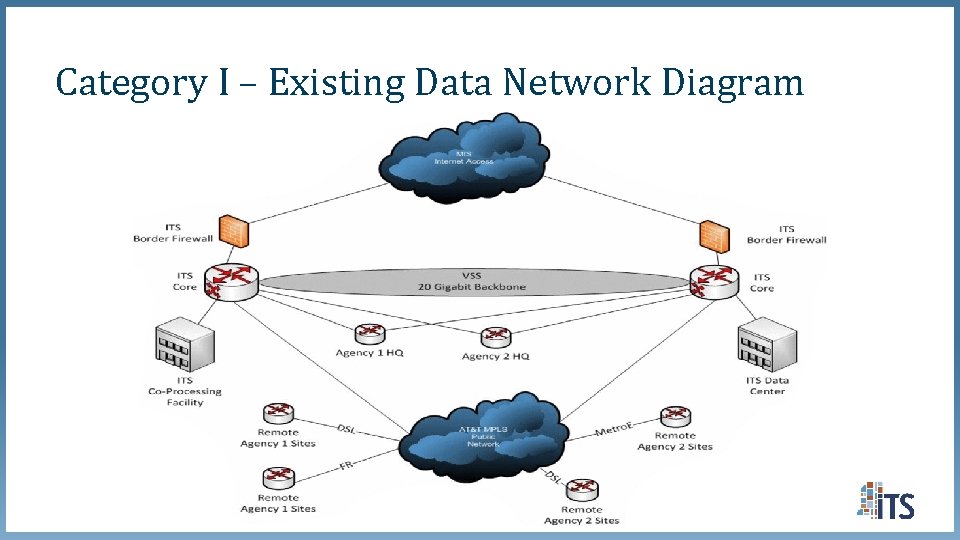
Category I – Existing Data Network Diagram
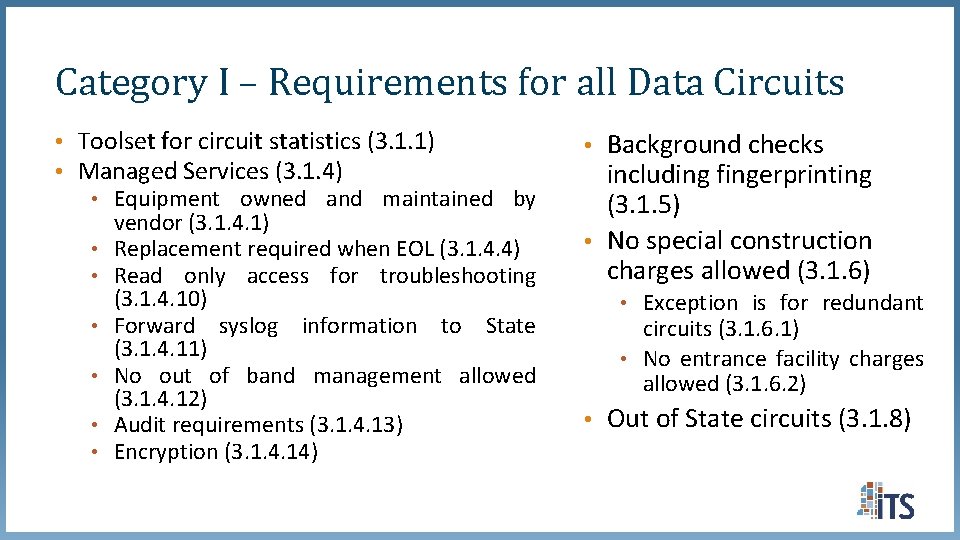
Category I – Requirements for all Data Circuits • Toolset for circuit statistics (3. 1. 1) • Managed Services (3. 1. 4) • Equipment owned and maintained by • • • vendor (3. 1. 4. 1) Replacement required when EOL (3. 1. 4. 4) Read only access for troubleshooting (3. 1. 4. 10) Forward syslog information to State (3. 1. 4. 11) No out of band management allowed (3. 1. 4. 12) Audit requirements (3. 1. 4. 13) Encryption (3. 1. 4. 14) • Background checks including fingerprinting (3. 1. 5) • No special construction charges allowed (3. 1. 6) • Exception is for redundant circuits (3. 1. 6. 1) • No entrance facility charges allowed (3. 1. 6. 2) • Out of State circuits (3. 1. 8)
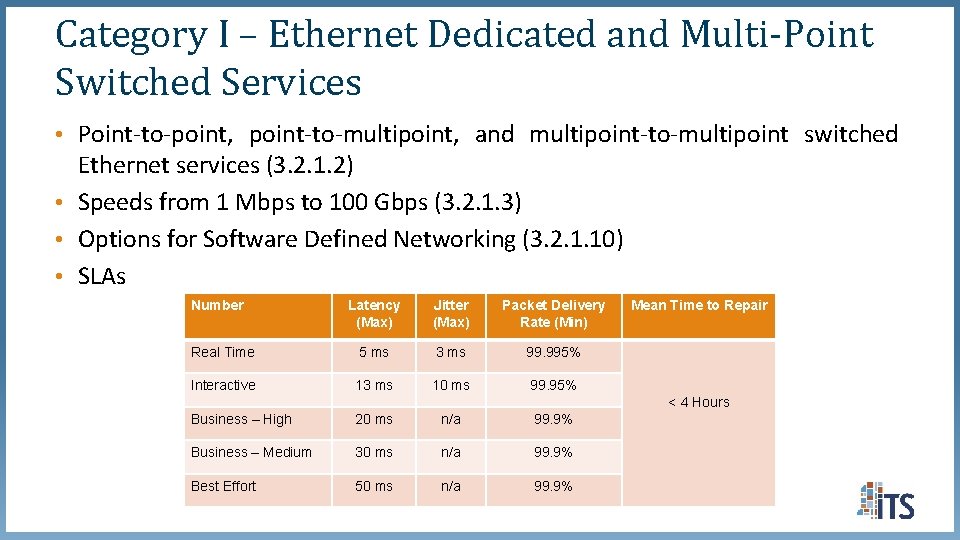
Category I – Ethernet Dedicated and Multi-Point Switched Services • Point-to-point, point-to-multipoint, and multipoint-to-multipoint switched Ethernet services (3. 2. 1. 2) • Speeds from 1 Mbps to 100 Gbps (3. 2. 1. 3) • Options for Software Defined Networking (3. 2. 1. 10) • SLAs Number Latency (Max) Jitter (Max) Packet Delivery Rate (Min) Real Time 5 ms 3 ms 99. 995% Interactive 13 ms 10 ms 99. 95% Mean Time to Repair < 4 Hours Business – High 20 ms n/a 99. 9% Business – Medium 30 ms n/a 99. 9% Best Effort 50 ms n/a 99. 9%
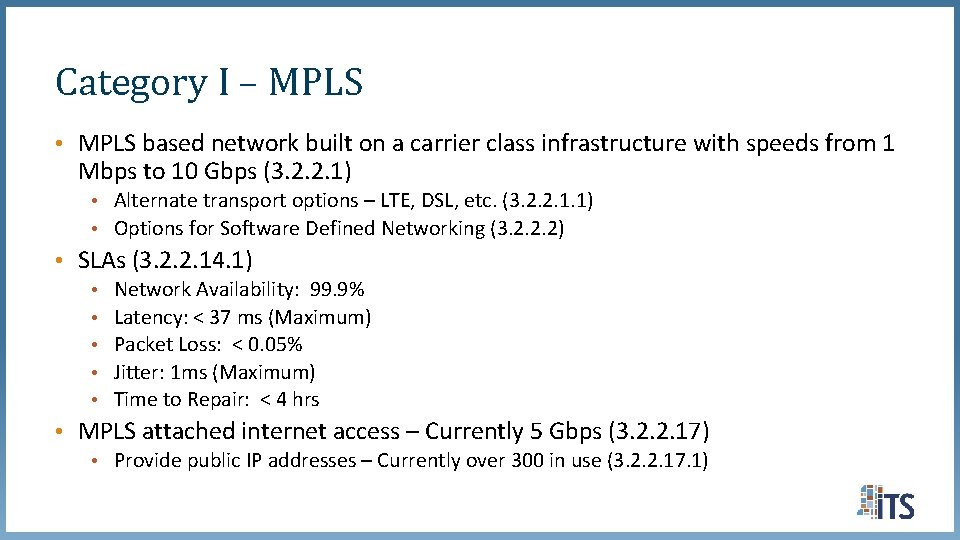
Category I – MPLS • MPLS based network built on a carrier class infrastructure with speeds from 1 Mbps to 10 Gbps (3. 2. 2. 1) • Alternate transport options – LTE, DSL, etc. (3. 2. 2. 1. 1) • Options for Software Defined Networking (3. 2. 2. 2) • SLAs (3. 2. 2. 14. 1) • Network Availability: 99. 9% • Latency: < 37 ms (Maximum) • Packet Loss: < 0. 05% • Jitter: 1 ms (Maximum) • Time to Repair: < 4 hrs • MPLS attached internet access – Currently 5 Gbps (3. 2. 2. 17) • Provide public IP addresses – Currently over 300 in use (3. 2. 2. 17. 1)
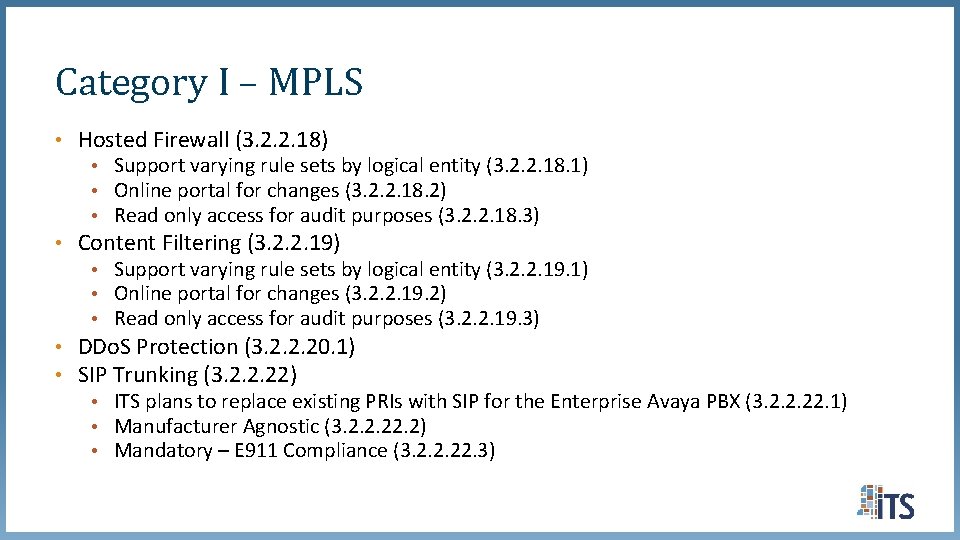
Category I – MPLS • Hosted Firewall (3. 2. 2. 18) • Support varying rule sets by logical entity (3. 2. 2. 18. 1) • Online portal for changes (3. 2. 2. 18. 2) • Read only access for audit purposes (3. 2. 2. 18. 3) • Content Filtering (3. 2. 2. 19) • Support varying rule sets by logical entity (3. 2. 2. 19. 1) • Online portal for changes (3. 2. 2. 19. 2) • Read only access for audit purposes (3. 2. 2. 19. 3) • DDo. S Protection (3. 2. 2. 20. 1) • SIP Trunking (3. 2. 2. 22) • ITS plans to replace existing PRIs with SIP for the Enterprise Avaya PBX (3. 2. 2. 22. 1) • Manufacturer Agnostic (3. 2. 2. 2) • Mandatory – E 911 Compliance (3. 2. 2. 22. 3)
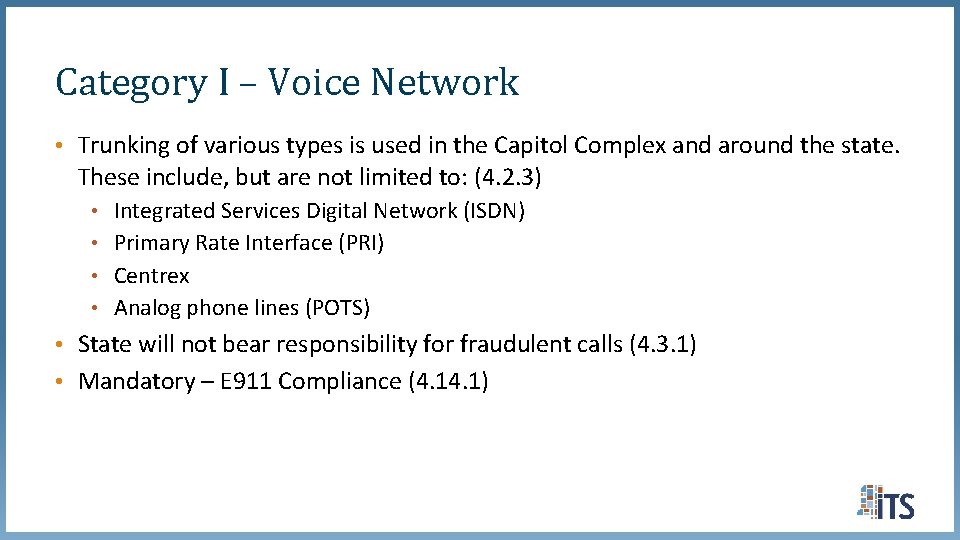
Category I – Voice Network • Trunking of various types is used in the Capitol Complex and around the state. These include, but are not limited to: (4. 2. 3) • Integrated Services Digital Network (ISDN) • Primary Rate Interface (PRI) • Centrex • Analog phone lines (POTS) • State will not bear responsibility for fraudulent calls (4. 3. 1) • Mandatory – E 911 Compliance (4. 1)
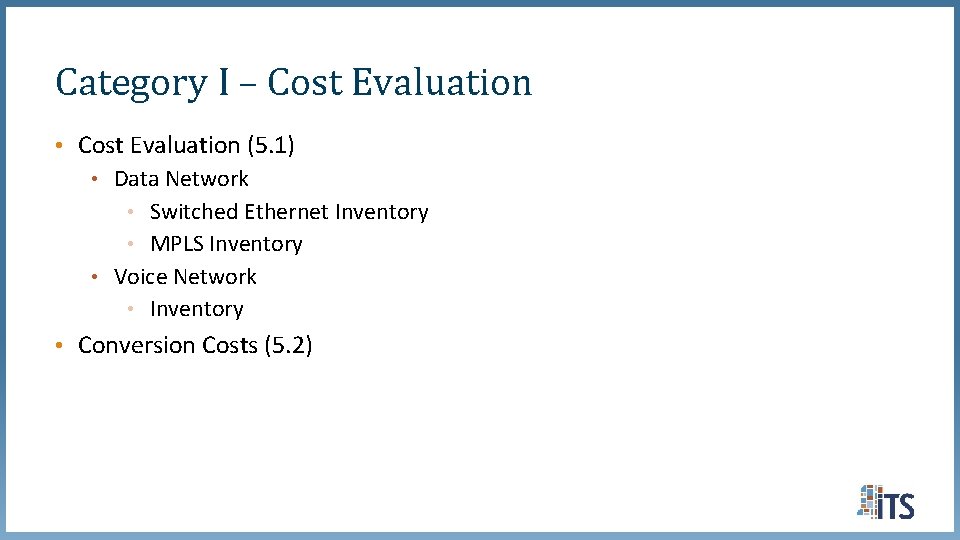
Category I – Cost Evaluation • Cost Evaluation (5. 1) • Data Network • Switched Ethernet Inventory • MPLS Inventory • Voice Network • Inventory • Conversion Costs (5. 2)
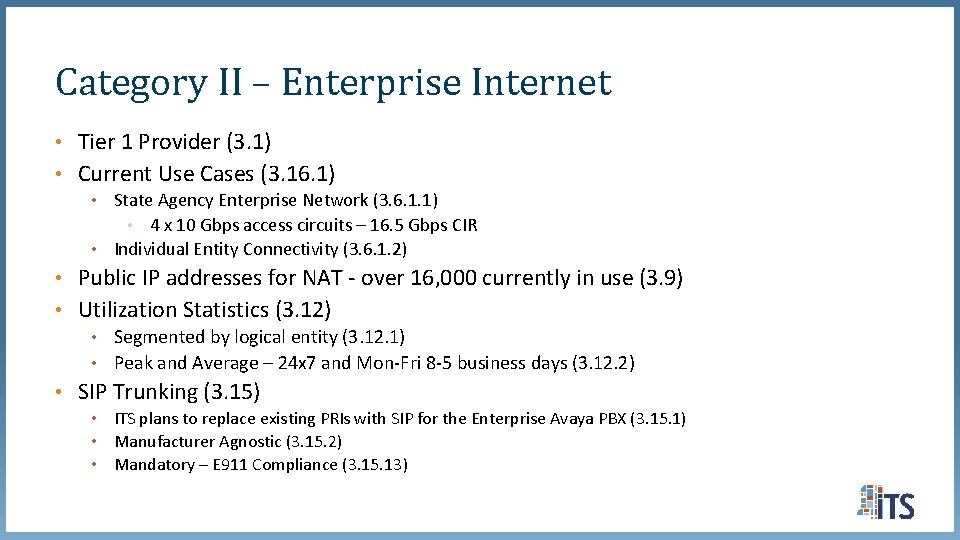
Category II – Enterprise Internet • Tier 1 Provider (3. 1) • Current Use Cases (3. 16. 1) State Agency Enterprise Network (3. 6. 1. 1) • 4 x 10 Gbps access circuits – 16. 5 Gbps CIR • Individual Entity Connectivity (3. 6. 1. 2) • • Public IP addresses for NAT - over 16, 000 currently in use (3. 9) • Utilization Statistics (3. 12) • Segmented by logical entity (3. 12. 1) • Peak and Average – 24 x 7 and Mon-Fri 8 -5 business days (3. 12. 2) • SIP Trunking (3. 15) • • • ITS plans to replace existing PRIs with SIP for the Enterprise Avaya PBX (3. 15. 1) Manufacturer Agnostic (3. 15. 2) Mandatory – E 911 Compliance (3. 15. 13)
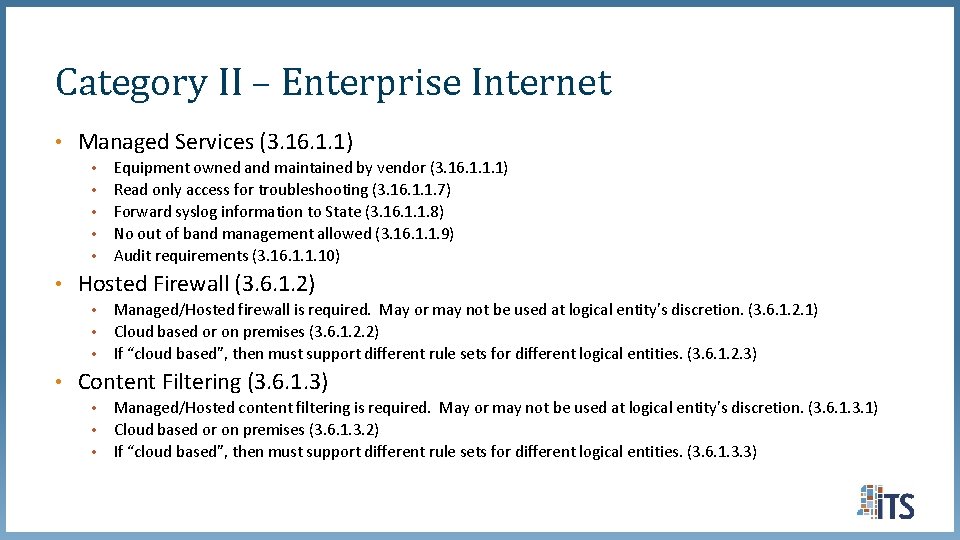
Category II – Enterprise Internet • Managed Services (3. 16. 1. 1) • • • Equipment owned and maintained by vendor (3. 16. 1. 1. 1) Read only access for troubleshooting (3. 16. 1. 1. 7) Forward syslog information to State (3. 16. 1. 1. 8) No out of band management allowed (3. 16. 1. 1. 9) Audit requirements (3. 16. 1. 1. 10) • Hosted Firewall (3. 6. 1. 2) • • • Managed/Hosted firewall is required. May or may not be used at logical entity’s discretion. (3. 6. 1. 2. 1) Cloud based or on premises (3. 6. 1. 2. 2) If “cloud based”, then must support different rule sets for different logical entities. (3. 6. 1. 2. 3) • Content Filtering (3. 6. 1. 3) • • • Managed/Hosted content filtering is required. May or may not be used at logical entity’s discretion. (3. 6. 1. 3. 1) Cloud based or on premises (3. 6. 1. 3. 2) If “cloud based”, then must support different rule sets for different logical entities. (3. 6. 1. 3. 3)
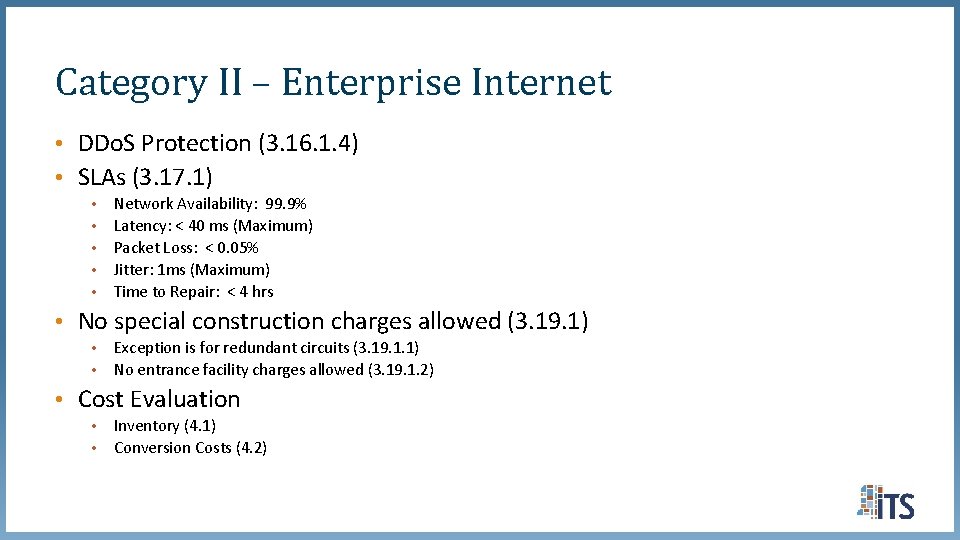
Category II – Enterprise Internet • DDo. S Protection (3. 16. 1. 4) • SLAs (3. 17. 1) • • • Network Availability: 99. 9% Latency: < 40 ms (Maximum) Packet Loss: < 0. 05% Jitter: 1 ms (Maximum) Time to Repair: < 4 hrs • No special construction charges allowed (3. 19. 1) • • Exception is for redundant circuits (3. 19. 1. 1) No entrance facility charges allowed (3. 19. 1. 2) • Cost Evaluation • • Inventory (4. 1) Conversion Costs (4. 2)
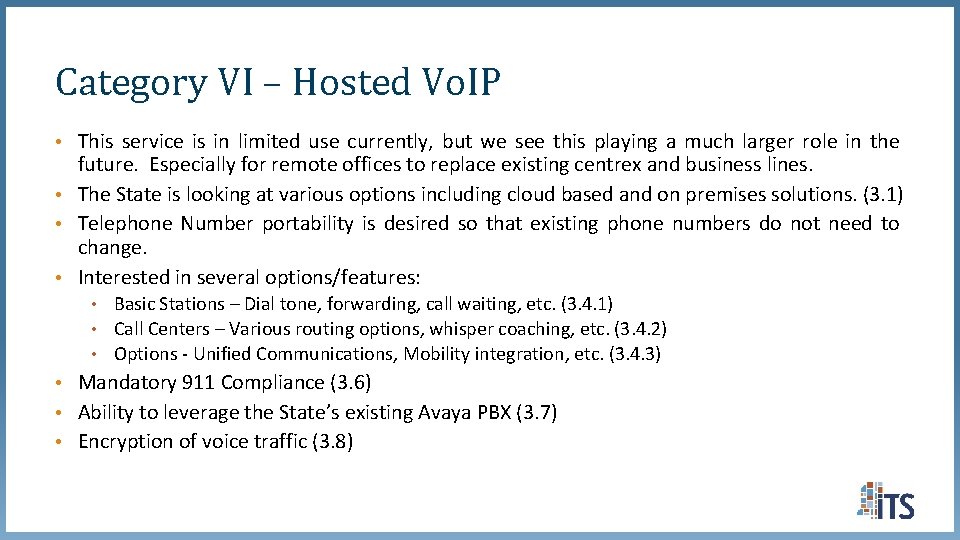
Category VI – Hosted Vo. IP • This service is in limited use currently, but we see this playing a much larger role in the future. Especially for remote offices to replace existing centrex and business lines. • The State is looking at various options including cloud based and on premises solutions. (3. 1) • Telephone Number portability is desired so that existing phone numbers do not need to change. • Interested in several options/features: • Basic Stations – Dial tone, forwarding, call waiting, etc. (3. 4. 1) • Call Centers – Various routing options, whisper coaching, etc. (3. 4. 2) • Options - Unified Communications, Mobility integration, etc. (3. 4. 3) • Mandatory 911 Compliance (3. 6) • Ability to leverage the State’s existing Avaya PBX (3. 7) • Encryption of voice traffic (3. 8)
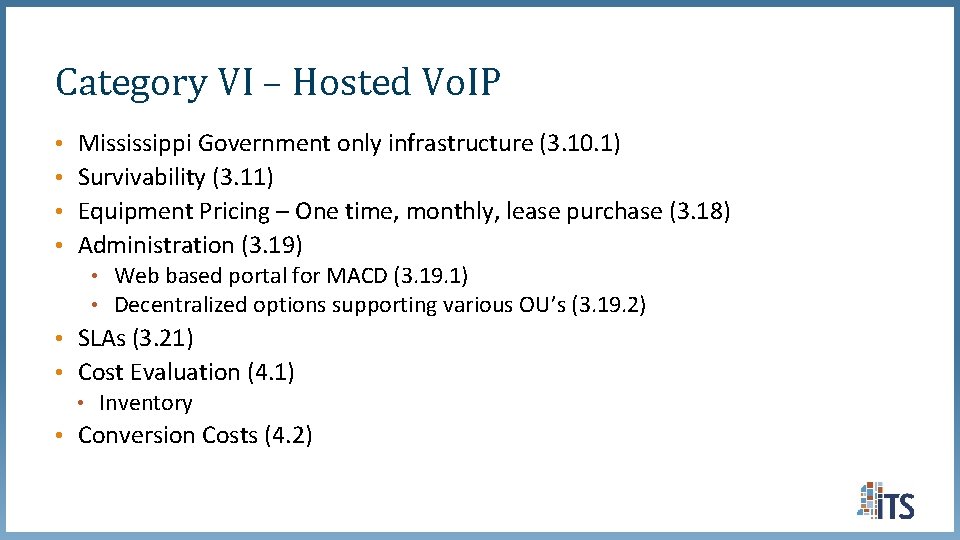
Category VI – Hosted Vo. IP • • Mississippi Government only infrastructure (3. 10. 1) Survivability (3. 11) Equipment Pricing – One time, monthly, lease purchase (3. 18) Administration (3. 19) • Web based portal for MACD (3. 19. 1) • Decentralized options supporting various OU’s (3. 19. 2) • SLAs (3. 21) • Cost Evaluation (4. 1) • Inventory • Conversion Costs (4. 2)
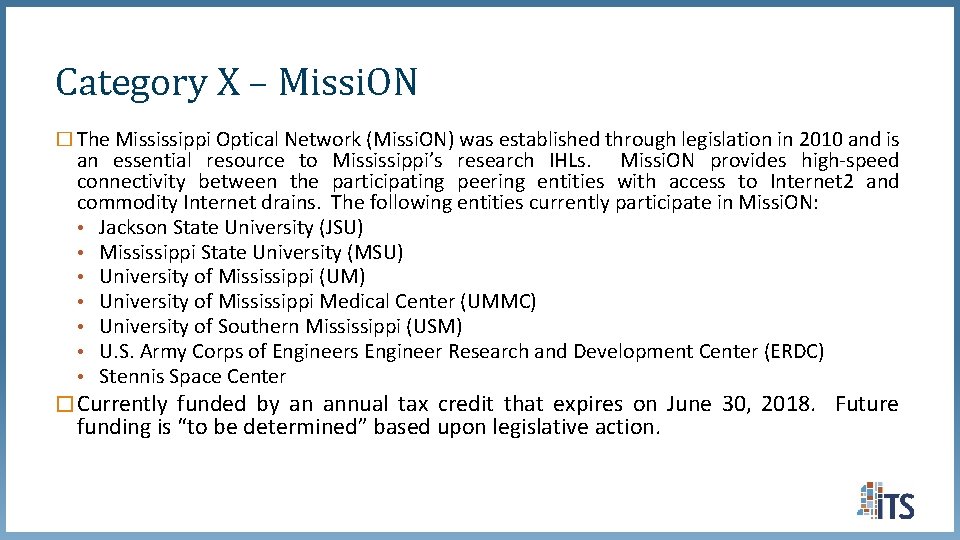
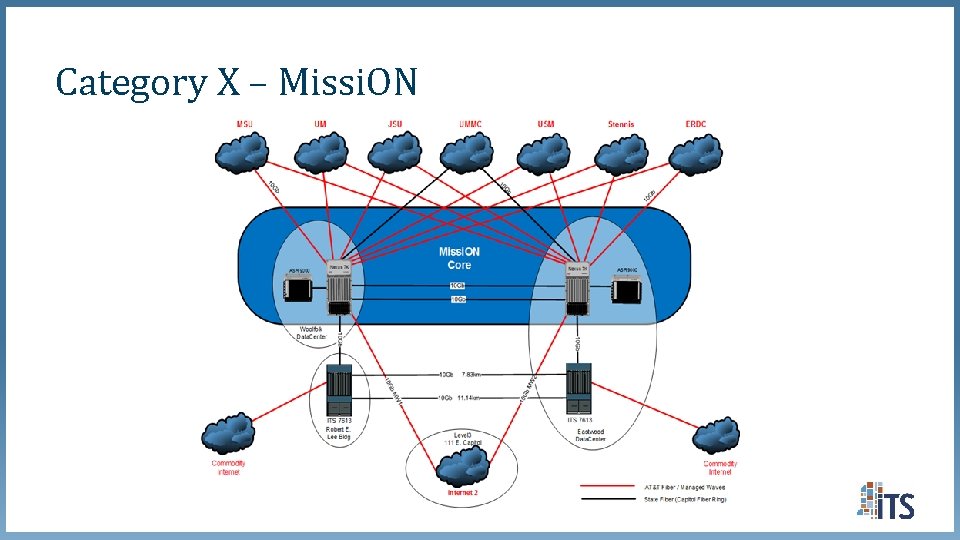
Category X – Missi. ON � The Mississippi Optical Network (Missi. ON) was established through legislation in 2010 and is an essential resource to Mississippi’s research IHLs. Missi. ON provides high-speed connectivity between the participating peering entities with access to Internet 2 and commodity Internet drains. The following entities currently participate in Missi. ON: • Jackson State University (JSU) • Mississippi State University (MSU) • University of Mississippi (UM) • University of Mississippi Medical Center (UMMC) • University of Southern Mississippi (USM) • U. S. Army Corps of Engineers Engineer Research and Development Center (ERDC) • Stennis Space Center � Currently funded by an annual tax credit that expires on June 30, 2018. Future funding is “to be determined” based upon legislative action.
Category X – Missi. ON
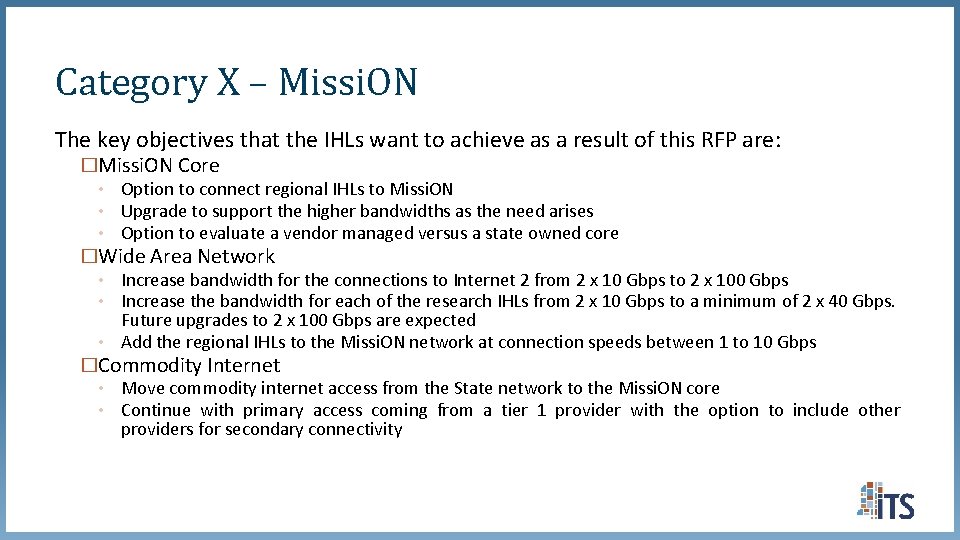
Category X – Missi. ON The key objectives that the IHLs want to achieve as a result of this RFP are: �Missi. ON Core • Option to connect regional IHLs to Missi. ON • Upgrade to support the higher bandwidths as the need arises • Option to evaluate a vendor managed versus a state owned core �Wide Area Network • Increase bandwidth for the connections to Internet 2 from 2 x 10 Gbps to 2 x 100 Gbps • Increase the bandwidth for each of the research IHLs from 2 x 10 Gbps to a minimum of 2 x 40 Gbps. Future upgrades to 2 x 100 Gbps are expected • Add the regional IHLs to the Missi. ON network at connection speeds between 1 to 10 Gbps �Commodity Internet • Move commodity internet access from the State network to the Missi. ON core • Continue with primary access coming from a tier 1 provider with the option to include other providers for secondary connectivity
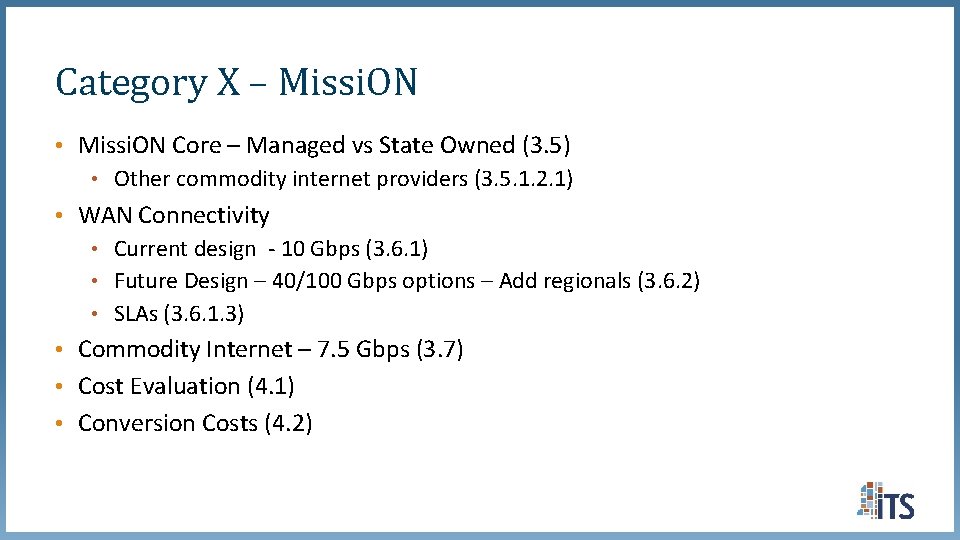
Category X – Missi. ON • Missi. ON Core – Managed vs State Owned (3. 5) • Other commodity internet providers (3. 5. 1. 2. 1) • WAN Connectivity • Current design - 10 Gbps (3. 6. 1) • Future Design – 40/100 Gbps options – Add regionals (3. 6. 2) • SLAs (3. 6. 1. 3) • Commodity Internet – 7. 5 Gbps (3. 7) • Cost Evaluation (4. 1) • Conversion Costs (4. 2)
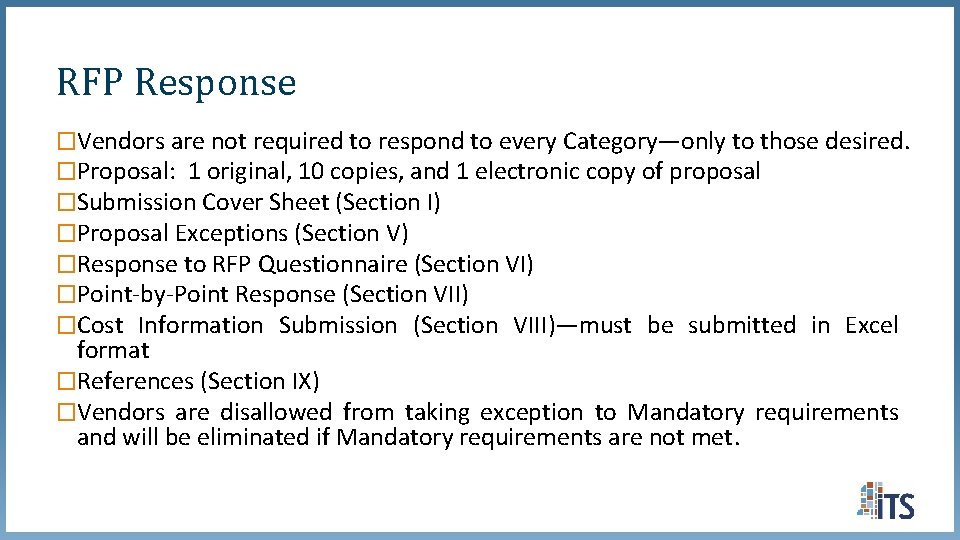
RFP Response �Vendors are not required to respond to every Category—only to those desired. �Proposal: 1 original, 10 copies, and 1 electronic copy of proposal �Submission Cover Sheet (Section I) �Proposal Exceptions (Section V) �Response to RFP Questionnaire (Section VI) �Point-by-Point Response (Section VII) �Cost Information Submission (Section VIII)—must be submitted in Excel format �References (Section IX) �Vendors are disallowed from taking exception to Mandatory requirements and will be eliminated if Mandatory requirements are not met.
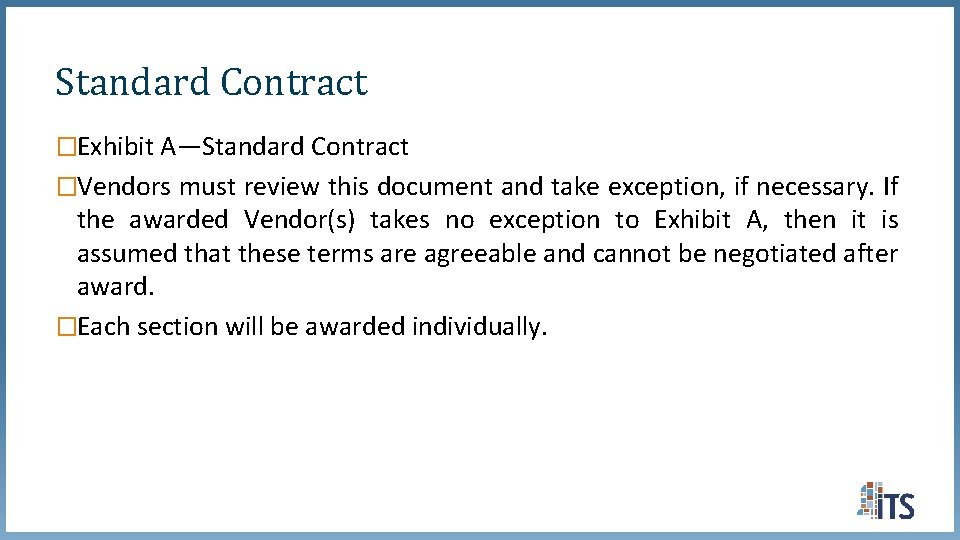
Standard Contract �Exhibit A—Standard Contract �Vendors must review this document and take exception, if necessary. If the awarded Vendor(s) takes no exception to Exhibit A, then it is assumed that these terms are agreeable and cannot be negotiated after award. �Each section will be awarded individually.
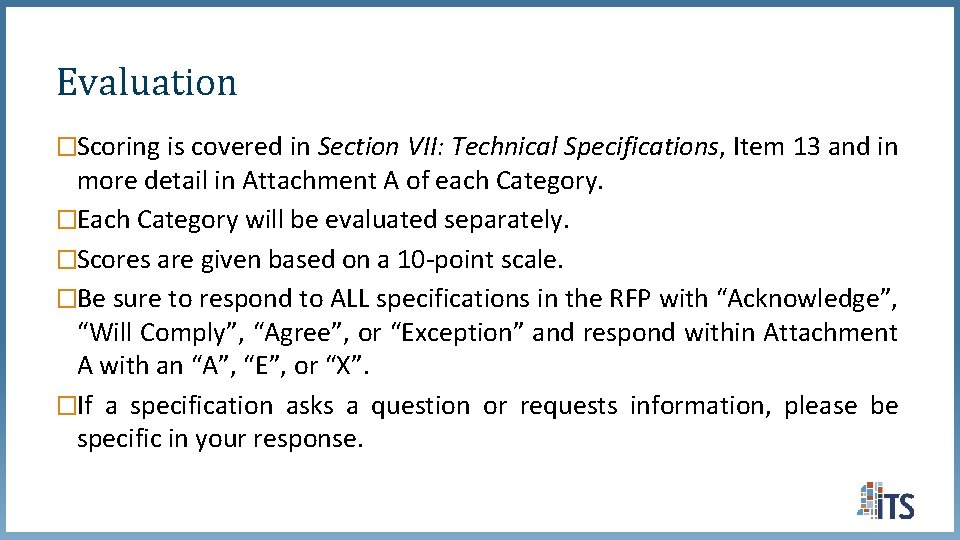
Evaluation �Scoring is covered in Section VII: Technical Specifications, Item 13 and in more detail in Attachment A of each Category. �Each Category will be evaluated separately. �Scores are given based on a 10 -point scale. �Be sure to respond to ALL specifications in the RFP with “Acknowledge”, “Will Comply”, “Agree”, or “Exception” and respond within Attachment A with an “A”, “E”, or “X”. �If a specification asks a question or requests information, please be specific in your response.
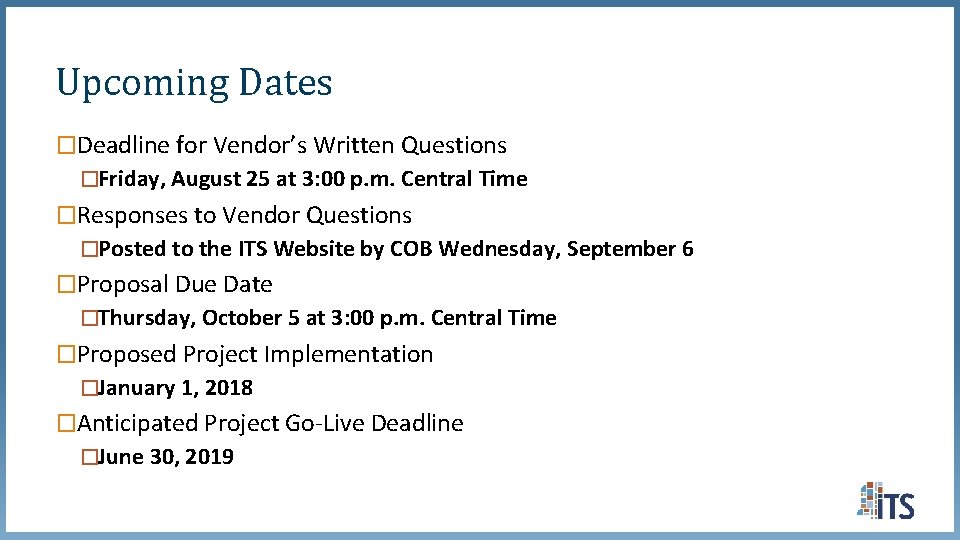
Upcoming Dates �Deadline for Vendor’s Written Questions �Friday, August 25 at 3: 00 p. m. Central Time �Responses to Vendor Questions �Posted to the ITS Website by COB Wednesday, September 6 �Proposal Due Date �Thursday, October 5 at 3: 00 p. m. Central Time �Proposed Project Implementation �January 1, 2018 �Anticipated Project Go-Live Deadline �June 30, 2019
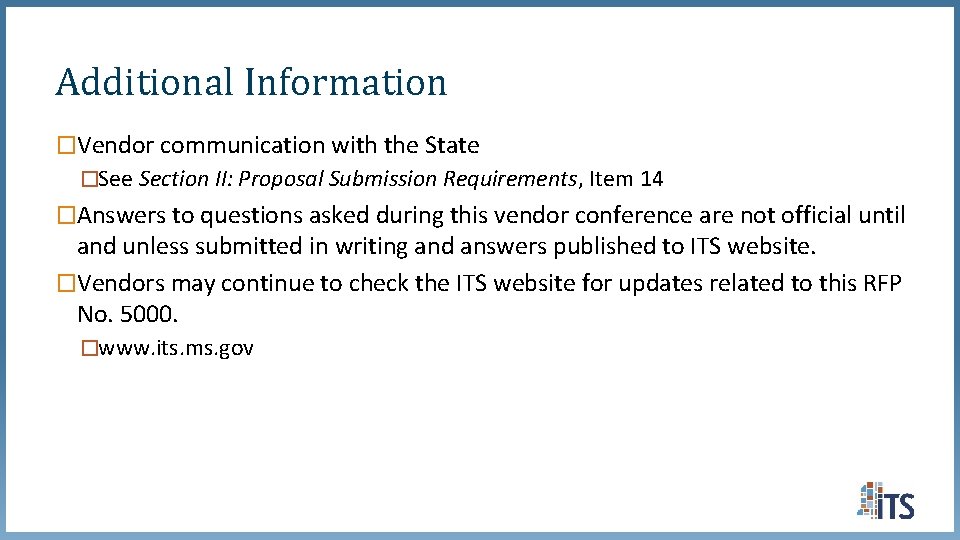
Additional Information �Vendor communication with the State �See Section II: Proposal Submission Requirements, Item 14 �Answers to questions asked during this vendor conference are not official until and unless submitted in writing and answers published to ITS website. �Vendors may continue to check the ITS website for updates related to this RFP No. 5000. �www. its. ms. gov
Questions?