Thinking Language and Intelligence Chapter 10 Chapter 11



- Slides: 103
Thinking, Language and Intelligence Chapter 10 -Chapter 11 1
Exam: Memory, Cognition, and Language Chapter 9 and Chapter 10 - Friday Midyear: Chapters 1 - Chapter 12 Self-shaping Project: January 14 th 2
Do Now: How would you define “Thinking? ” Do animals think? Do men and women think differently?
AIM: How do we think?
Thinking, or cognition: a process that involves knowing, understanding, remembering, and communicating. 5
Concept The mental grouping of similar objects, events, ideas, or people. • Schemas • Example: Chair 6
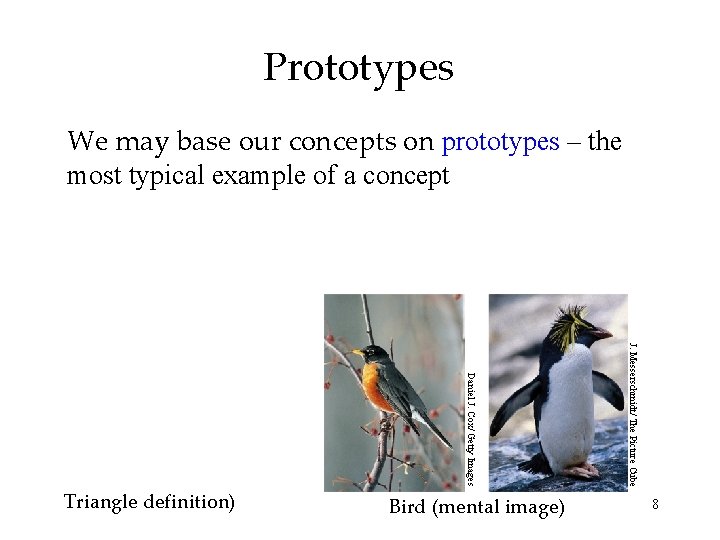
Prototypes We may base our concepts on prototypes – the most typical example of a concept Bird (mental image) J. Messerschmidt/ The Picture Cube Daniel J. Cox/ Getty Images Triangle definition) 8
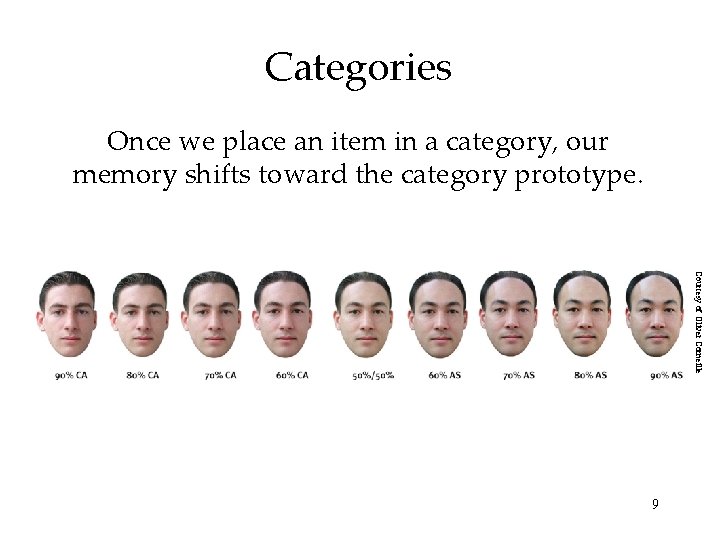
Categories Once we place an item in a category, our memory shifts toward the category prototype. Courtesy of Oliver Corneille 9
Problem Solving There are two ways to solve problems: 1)Algorithms: Methodical, logical rules or procedures that guarantee solving a particular problem. 2) Heuristics 10
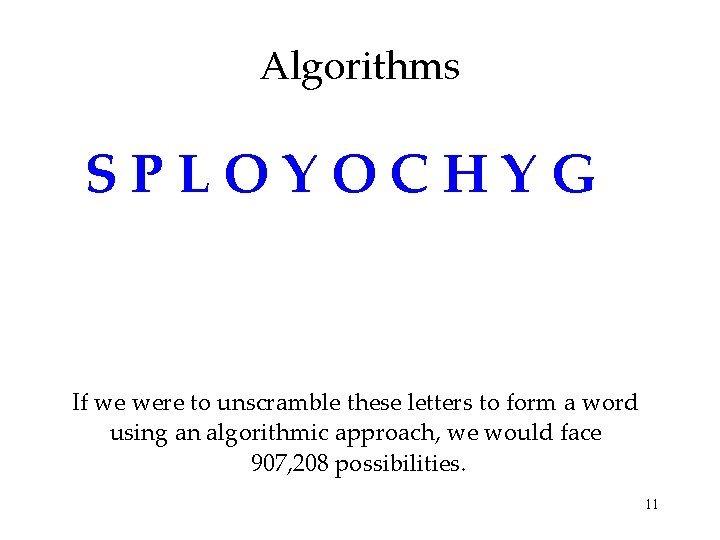
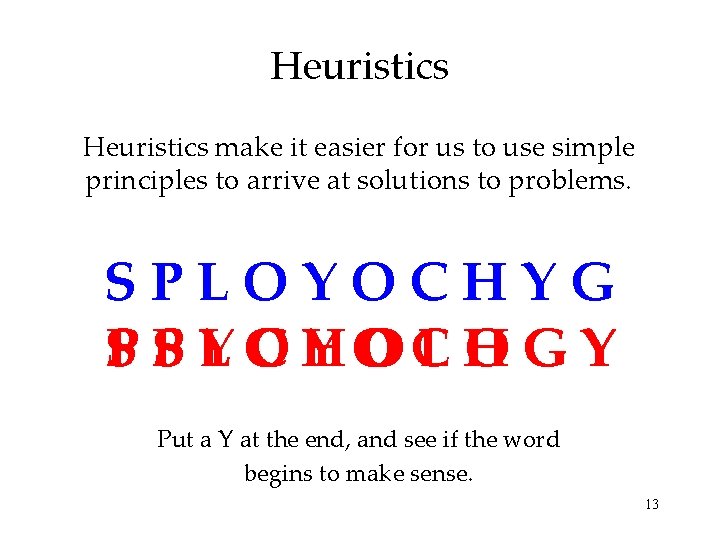
Algorithms SPLOYOCHYG If we were to unscramble these letters to form a word using an algorithmic approach, we would face 907, 208 possibilities. 11
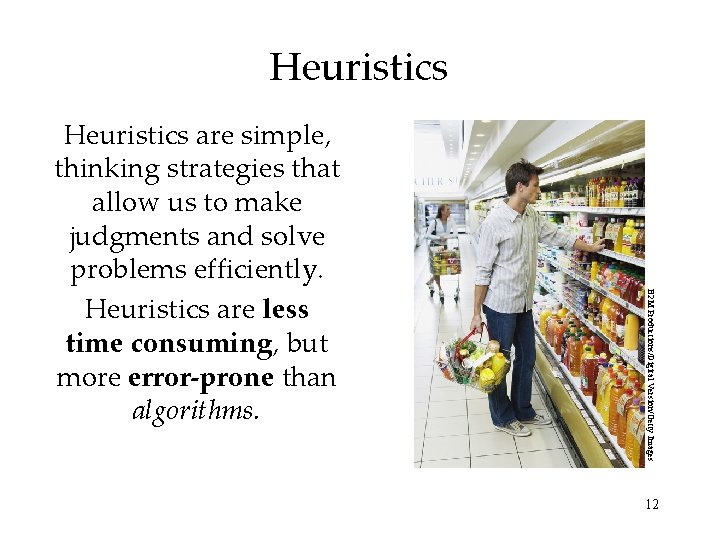
Heuristics B 2 M Productions/Digital Version/Getty Images Heuristics are simple, thinking strategies that allow us to make judgments and solve problems efficiently. Heuristics are less time consuming, but more error-prone than algorithms. 12
Heuristics make it easier for us to use simple principles to arrive at solutions to problems. SPLOYOCHYG S PP SL YO CH YO OC LH OGY Put a Y at the end, and see if the word begins to make sense. 13
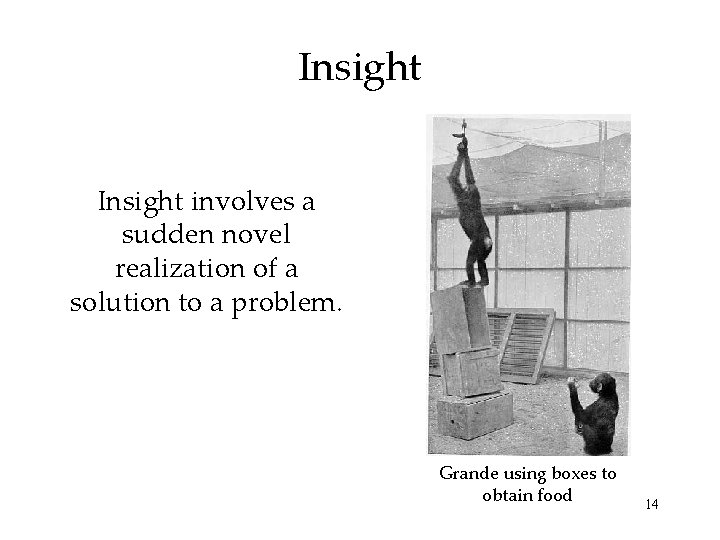
Insight involves a sudden novel realization of a solution to a problem. Grande using boxes to obtain food 14
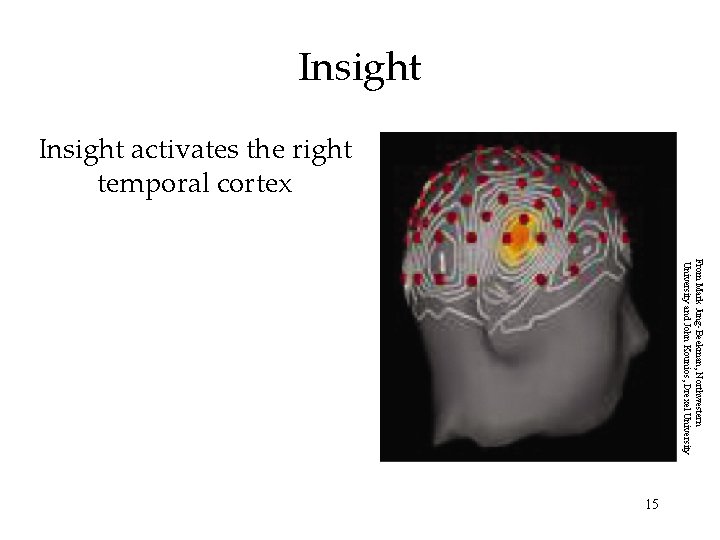
Insight activates the right temporal cortex From Mark Jung-Beekman, Northwestern University and John Kounios, Drexel University 15
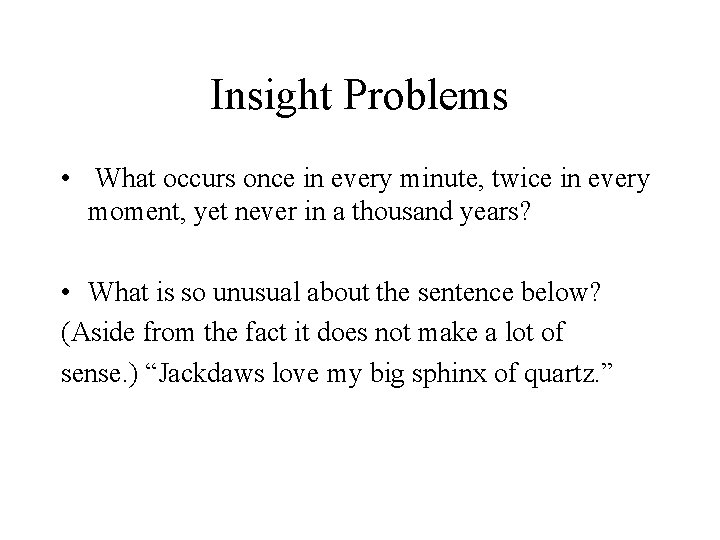
Insight Problems • What occurs once in every minute, twice in every moment, yet never in a thousand years? • What is so unusual about the sentence below? (Aside from the fact it does not make a lot of sense. ) “Jackdaws love my big sphinx of quartz. ”
Obstacles in Solving Problems Confirmation Bias: A tendency to search for information that confirms a personal bias. Example: Multiple Choice 17
Fixation: An inability to see a problem from a fresh perspective. Two examples of fixation are mental set and functional fixedness. 18
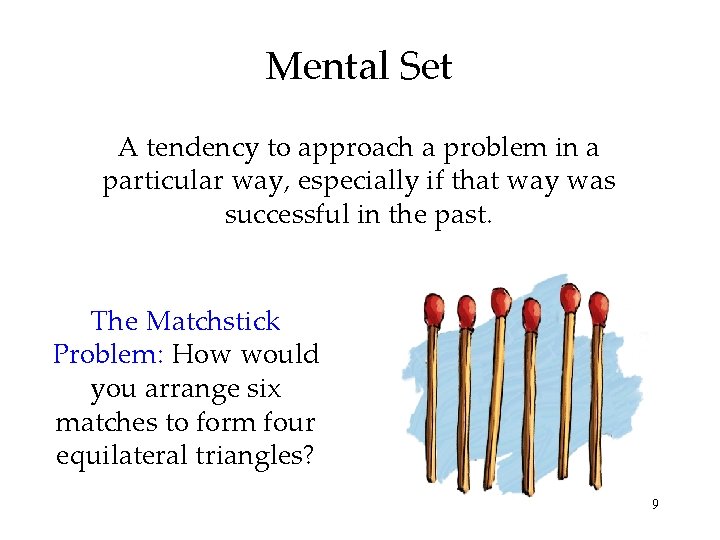
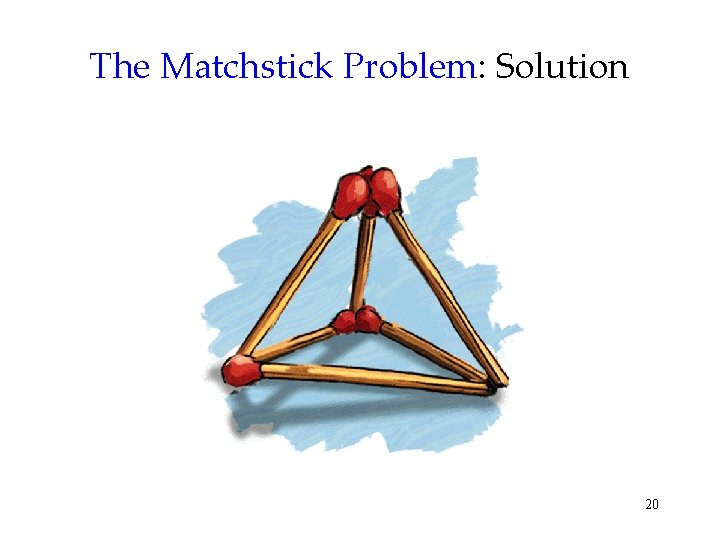
Mental Set A tendency to approach a problem in a particular way, especially if that way was successful in the past. The Matchstick Problem: How would you arrange six matches to form four equilateral triangles? 19
The Matchstick Problem: Solution 20
Functional Fixedness A tendency to think only of the familiar functions of an object. Problem: Tie the two ropes together. Use a screw driver, cotton balls and a matchbox. 21
Functional Fixedness Use the screwdriver as a weight, and tie it to the end of one rope. Swing it toward the other rope to tie the knot. The inability to think of the screwdriver as a weight is 22 functional fixedness.
Heuristics 1) representative heuristics 2) availability heuristics 23
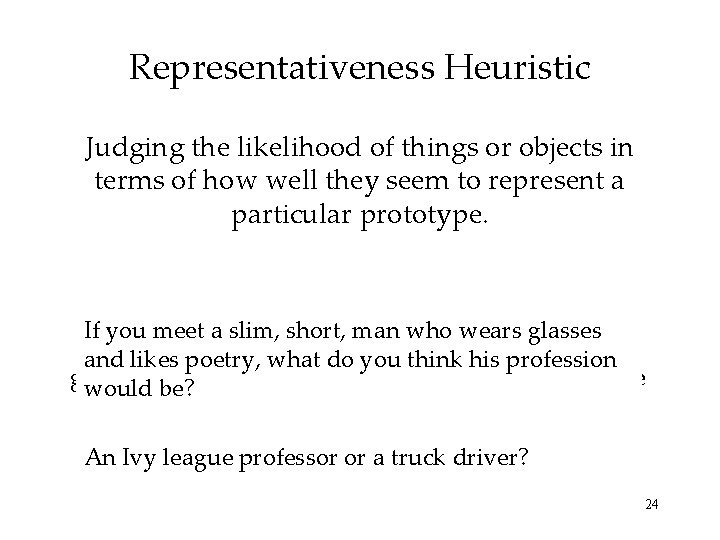
Representativeness Heuristic Judging the likelihood of things or objects in terms of how well they seem to represent a particular prototype. If you meet a slim, short, man who wears glasses Probability that what that person a truck is far and likes poetry, do youisthink hisdriver profession greater wouldthan be? an ivy league professor just because there are more truck drivers than such professors. An Ivy league professor or a truck driver? 24
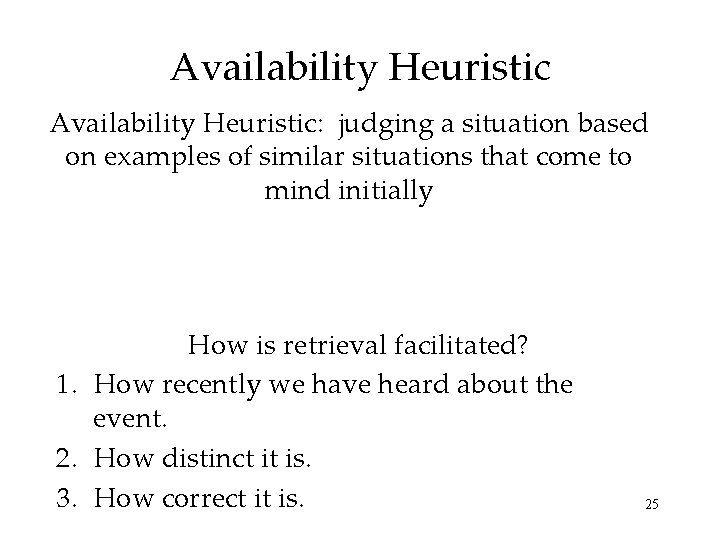
Availability Heuristic: judging a situation based on examples of similar situations that come to mind initially How is retrieval facilitated? 1. How recently we have heard about the event. 2. How distinct it is. 3. How correct it is. 25
Do Now: Distinguish between AVAILIABILITY HEURISTIC and REPRESENTATIVE HEURISTIC
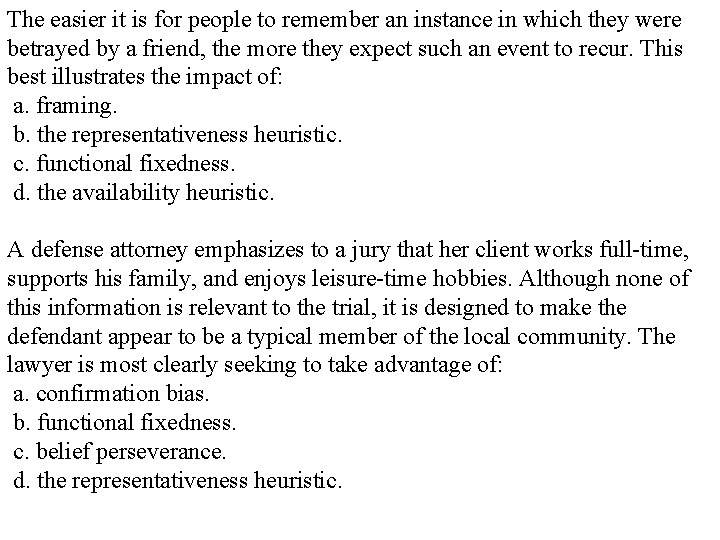
The easier it is for people to remember an instance in which they were betrayed by a friend, the more they expect such an event to recur. This best illustrates the impact of: a. framing. b. the representativeness heuristic. c. functional fixedness. d. the availability heuristic. A defense attorney emphasizes to a jury that her client works full-time, supports his family, and enjoys leisure-time hobbies. Although none of this information is relevant to the trial, it is designed to make the defendant appear to be a typical member of the local community. The lawyer is most clearly seeking to take advantage of: a. confirmation bias. b. functional fixedness. c. belief perseverance. d. the representativeness heuristic.
What are some impediments to problem solving?
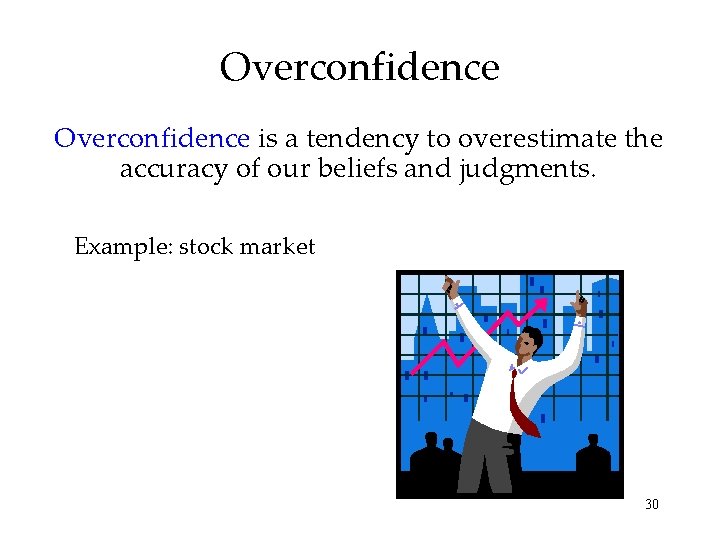
Overconfidence is a tendency to overestimate the accuracy of our beliefs and judgments. Example: stock market 30
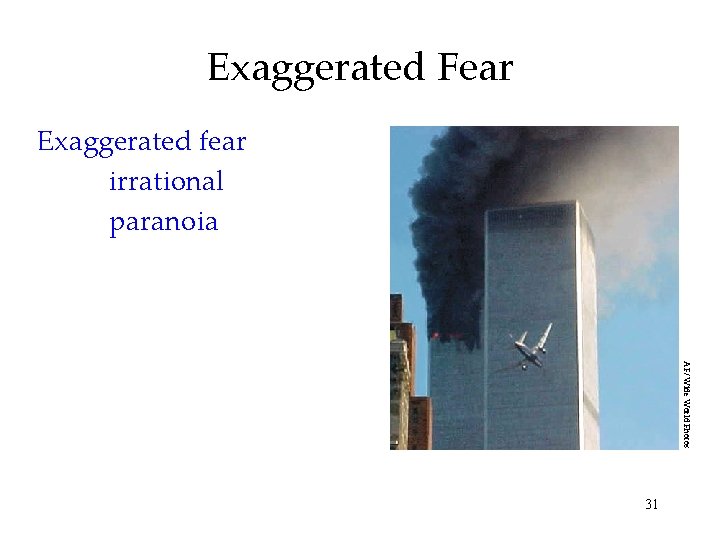
Exaggerated Fear Exaggerated fear irrational paranoia AP/ Wide World Photos 31
Framing Decisions and judgments may be significantly affected depending upon how an issue is framed or worded. Example: What is the best way to market ground beef — as 25% fat or 75% lean? 32
Belief Bias Making illogical conclusions in order to confirm our preexisting beliefs Example: Democrats support free speech Dictators are not democrats Therefore, Dictators do not support free speech 33
Belief Perseverance Belief perseverance is the tendency to cling to our beliefs in the face of contrary evidence. Example: Creationism vs Evolutionists 34
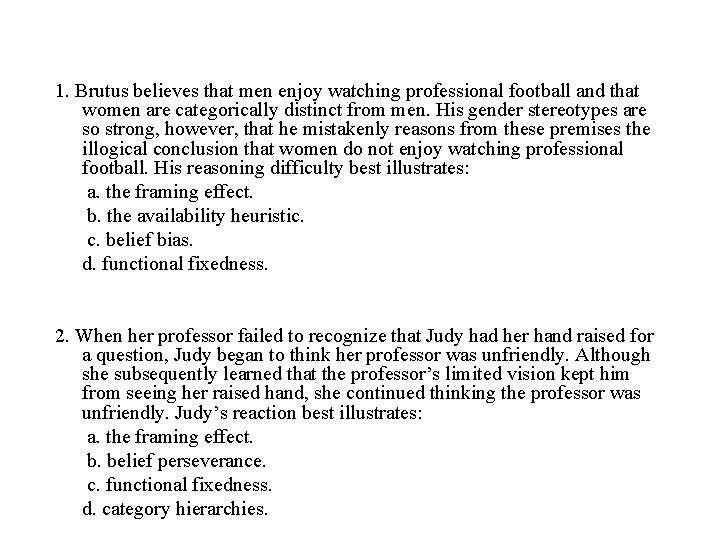
1. Brutus believes that men enjoy watching professional football and that women are categorically distinct from men. His gender stereotypes are so strong, however, that he mistakenly reasons from these premises the illogical conclusion that women do not enjoy watching professional football. His reasoning difficulty best illustrates: a. the framing effect. b. the availability heuristic. c. belief bias. d. functional fixedness. 2. When her professor failed to recognize that Judy had her hand raised for a question, Judy began to think her professor was unfriendly. Although she subsequently learned that the professor’s limited vision kept him from seeing her raised hand, she continued thinking the professor was unfriendly. Judy’s reaction best illustrates: a. the framing effect. b. belief perseverance. c. functional fixedness. d. category hierarchies.
Convergent and Divergent Thinking • Convergent Thinking- thinking pointed towards one solution – Left hemisphere Example: 4 x+2= 8 • Divergent Thinking -more than one solution - creative thinking Example: Literary analysis
How does cognition relate to language?
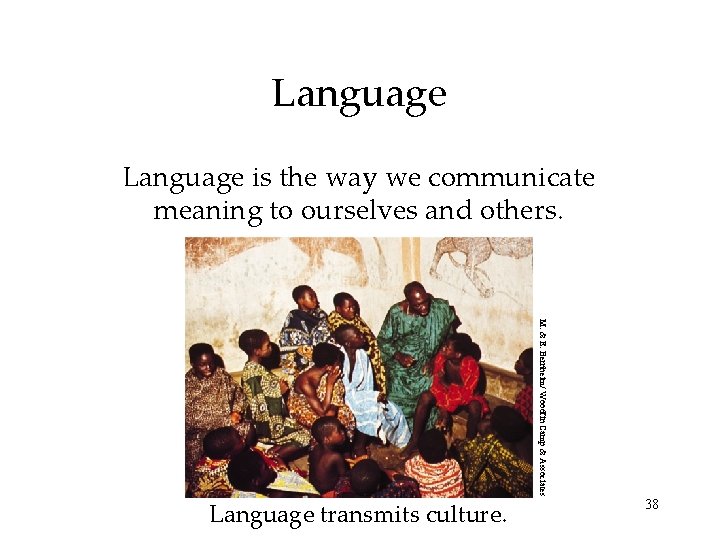
Language is the way we communicate meaning to ourselves and others. M. & E. Bernheim/ Woodfin Camp & Associates Language transmits culture. 38
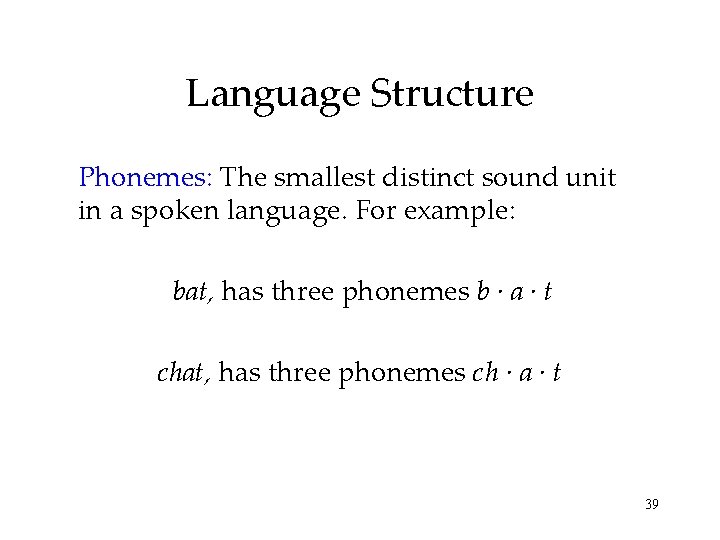
Language Structure Phonemes: The smallest distinct sound unit in a spoken language. For example: bat, has three phonemes b · a · t chat, has three phonemes ch · a · t 39
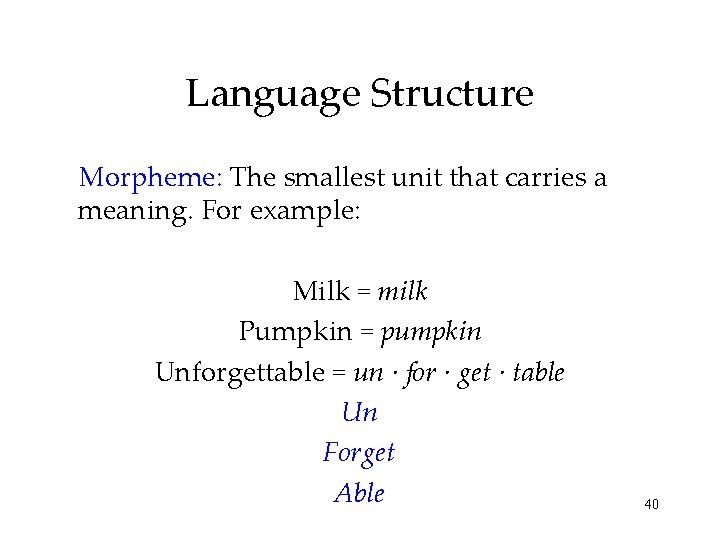
Language Structure Morpheme: The smallest unit that carries a meaning. For example: Milk = milk Pumpkin = pumpkin Unforgettable = un · for · get · table Un Forget Able 40
How many morpheme and phonemes are in the following words: • Screwdriver • Chimps • Psychology (ooo tricky!!!)
Do Now: Review homework
AIM: How do humans develop language?
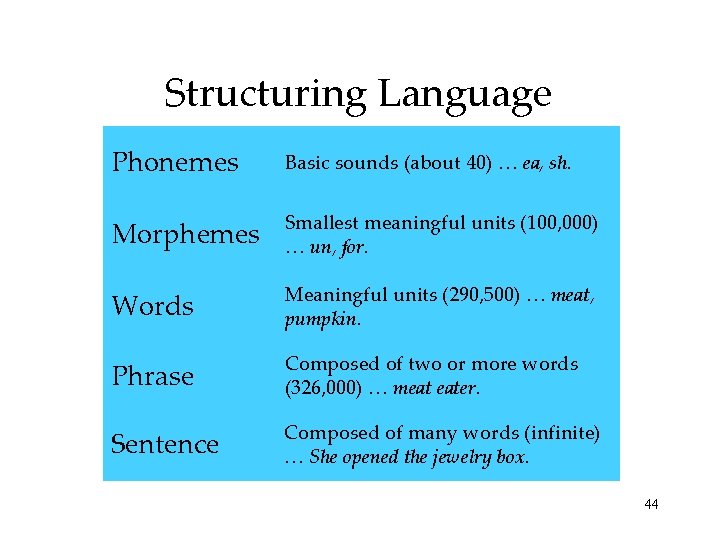
Structuring Language Phonemes Basic sounds (about 40) … ea, sh. Morphemes Smallest meaningful units (100, 000) … un, for. Words Meaningful units (290, 500) … meat, pumpkin. Phrase Composed of two or more words (326, 000) … meat eater. Sentence Composed of many words (infinite) … She opened the jewelry box. 44
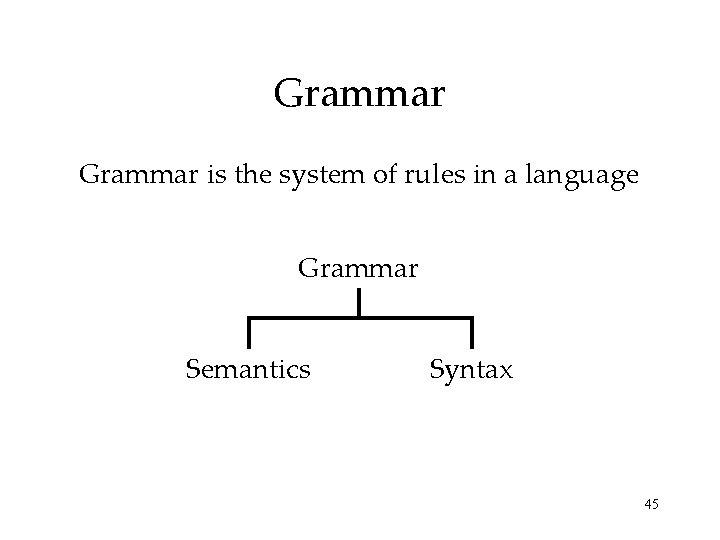
Grammar is the system of rules in a language Grammar Semantics Syntax 45
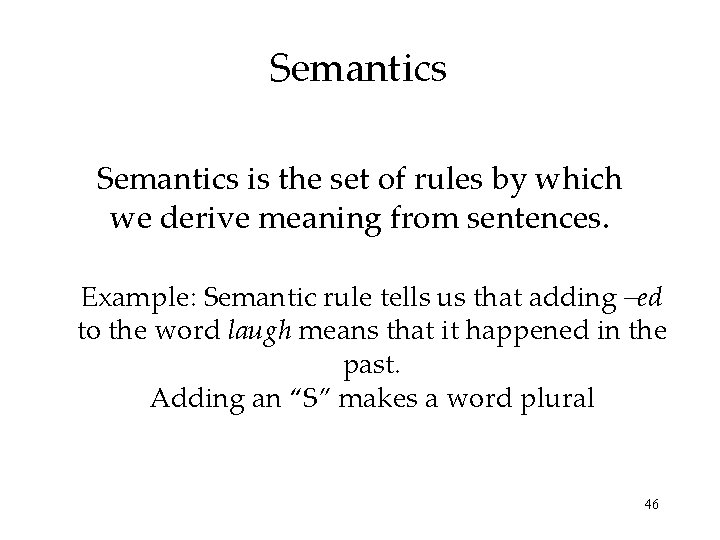
Semantics is the set of rules by which we derive meaning from sentences. Example: Semantic rule tells us that adding –ed to the word laugh means that it happened in the past. Adding an “S” makes a word plural 46
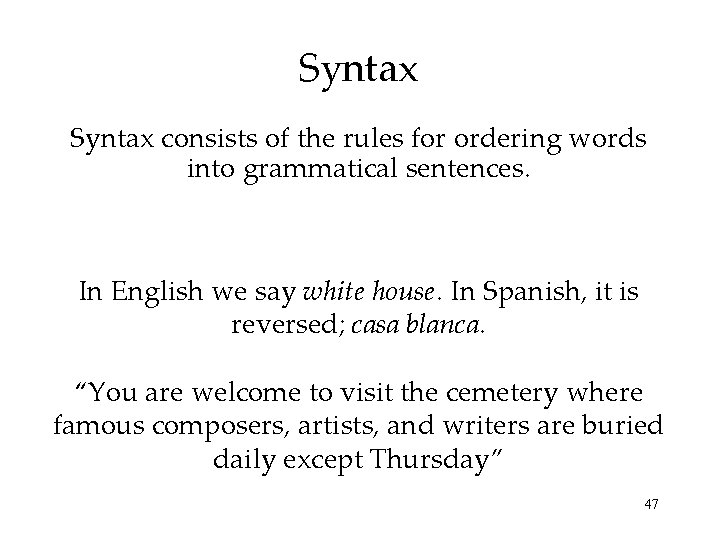
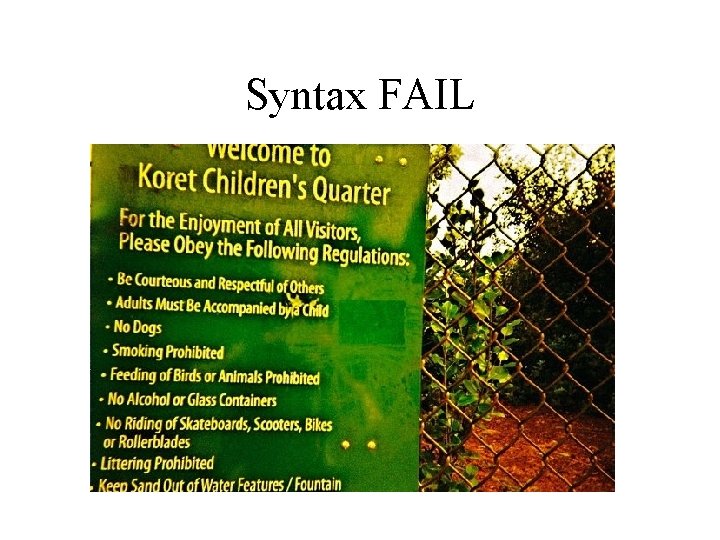
Syntax consists of the rules for ordering words into grammatical sentences. In English we say white house. In Spanish, it is reversed; casa blanca. “You are welcome to visit the cemetery where famous composers, artists, and writers are buried daily except Thursday” 47
Syntax FAIL
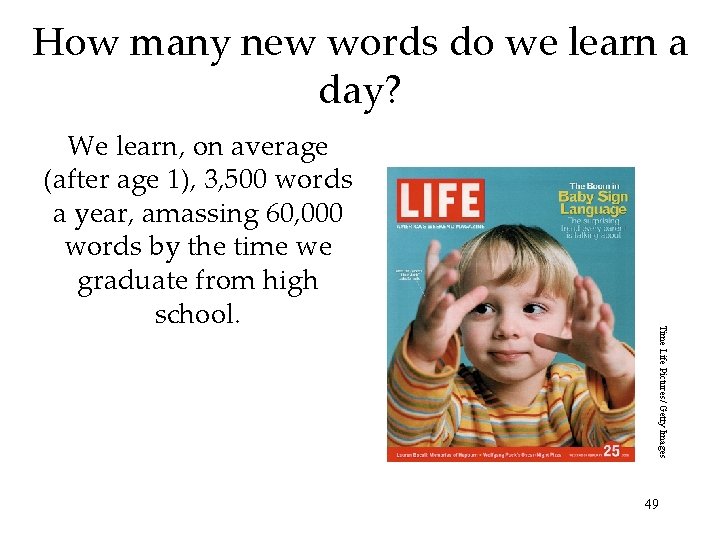
How many new words do we learn a day? Time Life Pictures/ Getty Images We learn, on average (after age 1), 3, 500 words a year, amassing 60, 000 words by the time we graduate from high school. 49
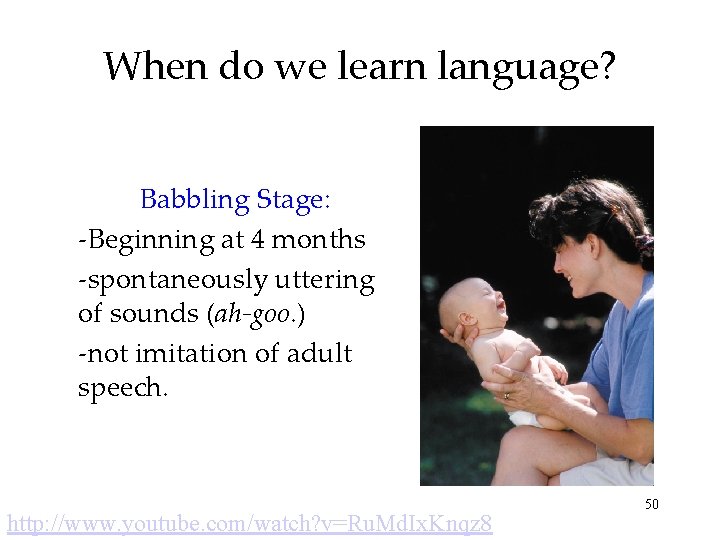
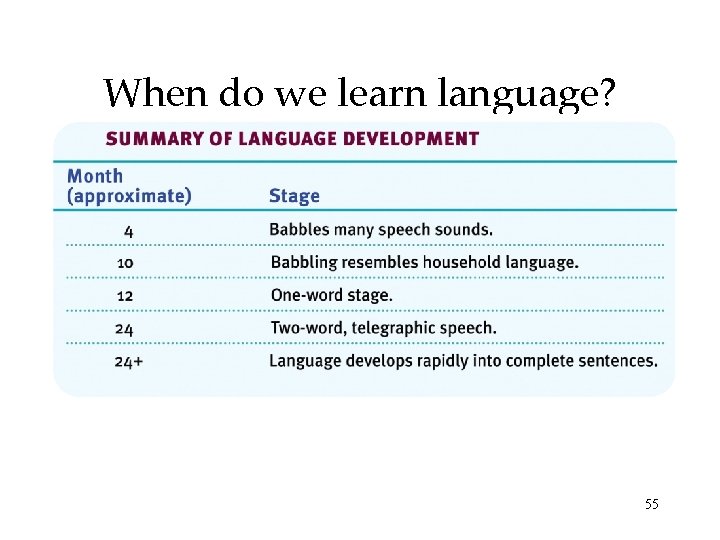
When do we learn language? Babbling Stage: -Beginning at 4 months -spontaneously uttering of sounds (ah-goo. ) -not imitation of adult speech. http: //www. youtube. com/watch? v=Ru. Md. Ix. Knqz 8 50
When do we learn language? One-Word Stage: Beginning around his/her first birthday, a child starts to speak one word at a time 51
When do we learn language? Two-Word Stage: -Starts Before Year Two -Telegraphic speech (the child speaks like a telegram) “Go car, ” means I would like to go for a ride in the car. 52
When do we learn language? 2 years: Longer phrases with syntactical sense, and by early elementary school they are employing humor. You never starve in the desert because of all the sand -which-is there. 53
Overgeneralization After 2 years of age, children may incorrectly follow the rules of grammar: Overgeneralization or overregularization Examples: “I goed to the store” “I runned outside” “There were lots of mouses”
When do we learn language? 55
What is the critical period for language? Up to 7 years
Two Theories for Language Development • Behaviorists – We develop language by imitating sounds • Nativists – Biological Predisposition for Language
Explaining Language Development: Behaviorism 1. Operant Learning: Skinner (1957, 1985) language development may be explained on the basis of learning principles A. Imitation B. Reward/Punishment 58
Explaining Language Development: Nativist 2. Language Acquisition Device: A. Linguist Noam Chomsky B. Children born with innate ability to gather rules of language C. Contrary to “blank slate” D. Critical Period 59
Proof for Language Acquisition • All languages have grammar rules • Children overgeneralize use morphemes in predictable orders: “go-ed, ” • Genes in twin studies
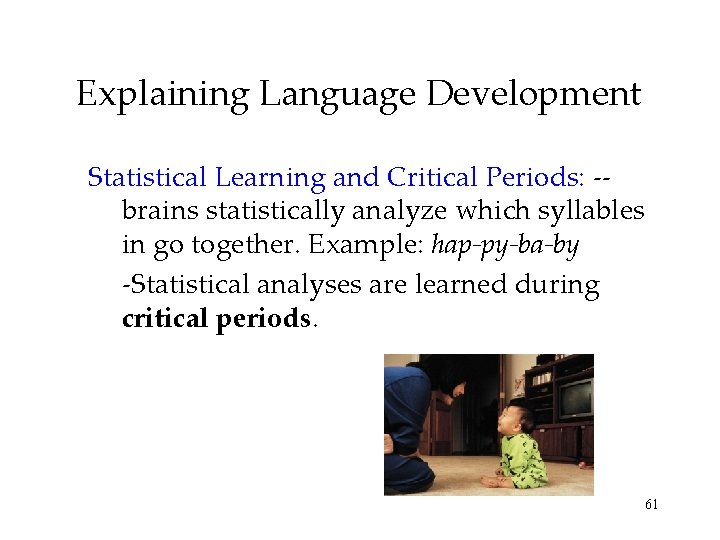
Explaining Language Development Statistical Learning and Critical Periods: -brains statistically analyze which syllables in go together. Example: hap-py-ba-by -Statistical analyses are learned during critical periods. 61
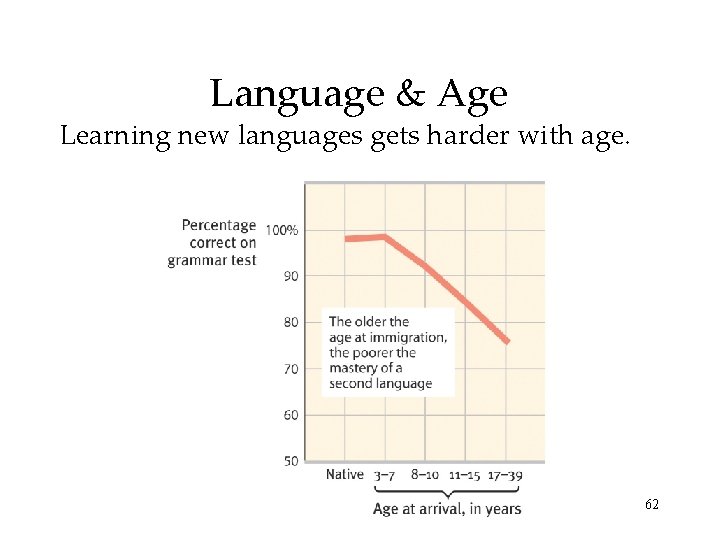
Language & Age Learning new languages gets harder with age. 62
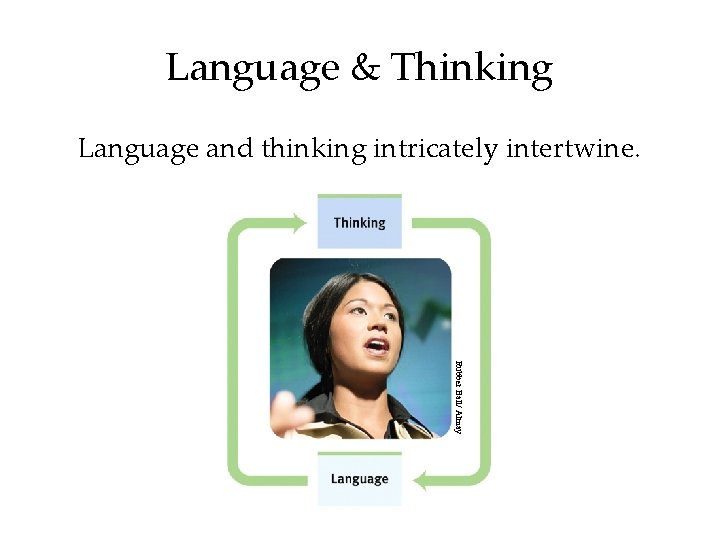
Language & Thinking Language and thinking intricately intertwine. Rubber Ball/ Almay
Language Influences Thinking Linguistic Determinism: Whorf (1956) suggested that language determines the way we think.
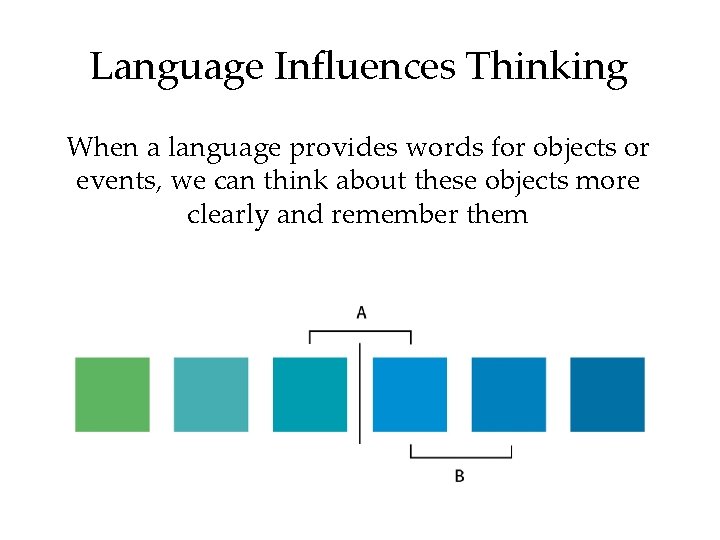
Language Influences Thinking When a language provides words for objects or events, we can think about these objects more clearly and remember them
Balanced Bilinguals are superior to monolinguals in terms of: • • Cognitive flexibility Concept formation Creativity Better ability to learn more languages
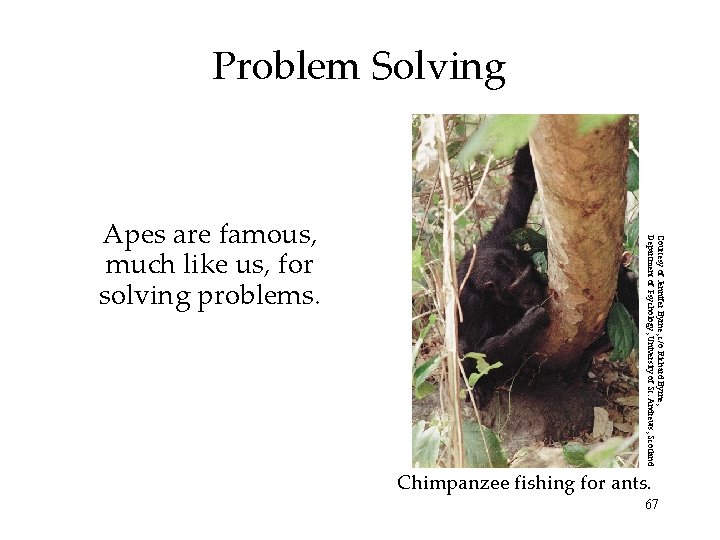
Problem Solving Courtesy of Jennifer Byrne, c/o Richard Byrne, Department of Psychology, University of St. Andrews, Scotland Apes are famous, much like us, for solving problems. Chimpanzee fishing for ants. 67
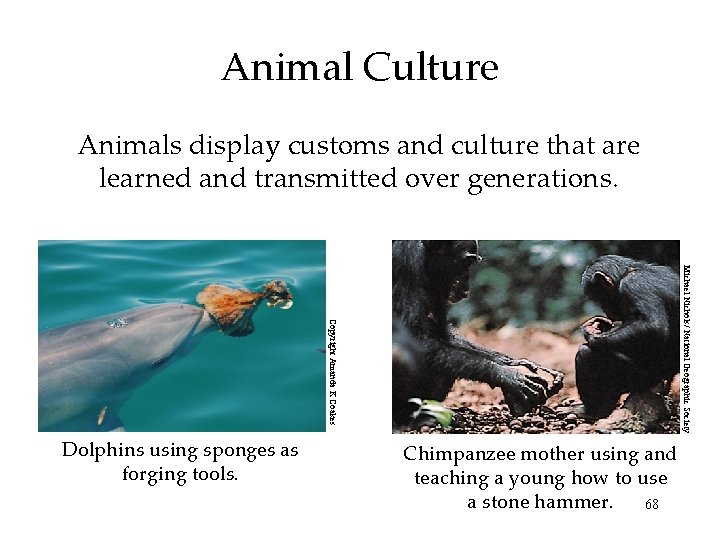
Animal Culture Animals display customs and culture that are learned and transmitted over generations. Michael Nichols/ National Geographic Society Copyright Amanda K Coakes Dolphins using sponges as forging tools. Chimpanzee mother using and teaching a young how to use a stone hammer. 68
Mental States Can animals infer mental states in themselves and others? To some extent. Chimps and orangutans (and dolphins) used mirrors to inspect themselves when a researcher put paint spots on their faces or bodies. 69
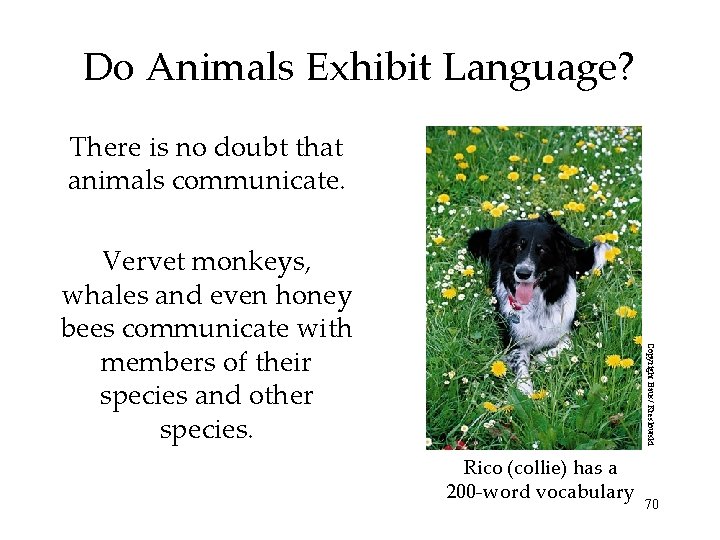
Do Animals Exhibit Language? There is no doubt that animals communicate. Copyright Baus/ Kreslowski Vervet monkeys, whales and even honey bees communicate with members of their species and other species. Rico (collie) has a 200 -word vocabulary 70
The Case of Apes Chimps do not have a vocal apparatus for human-like speech (Hayes & Hayes, 1951). Therefore, Gardner and Gardner (1969) used American Sign Language (ASL) to train Washoe, a chimp, who learned 182 signs by the age of 32. 71
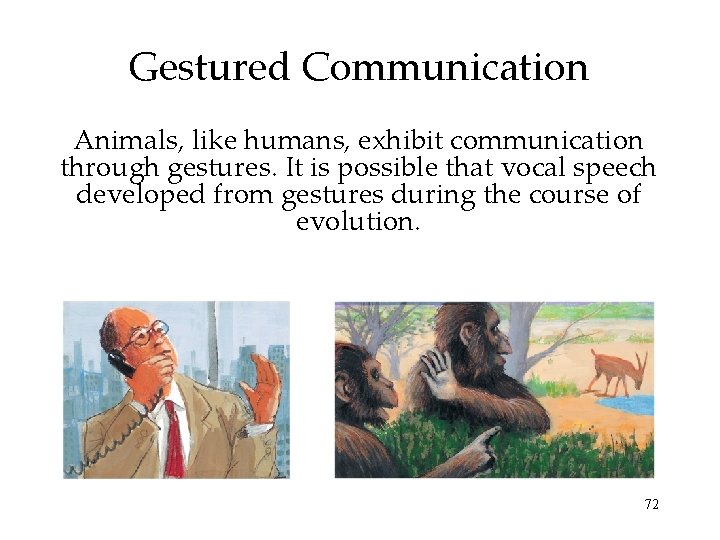
Gestured Communication Animals, like humans, exhibit communication through gestures. It is possible that vocal speech developed from gestures during the course of evolution. 72
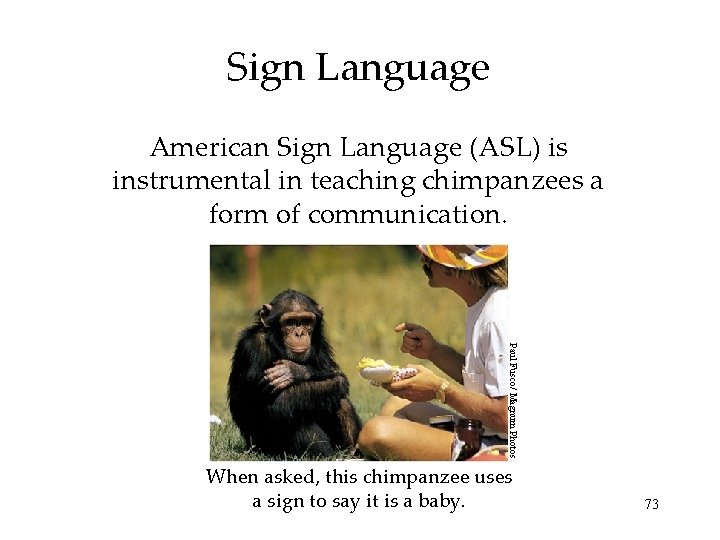
Sign Language American Sign Language (ASL) is instrumental in teaching chimpanzees a form of communication. Paul Fusco/ Magnum Photos When asked, this chimpanzee uses a sign to say it is a baby. 73
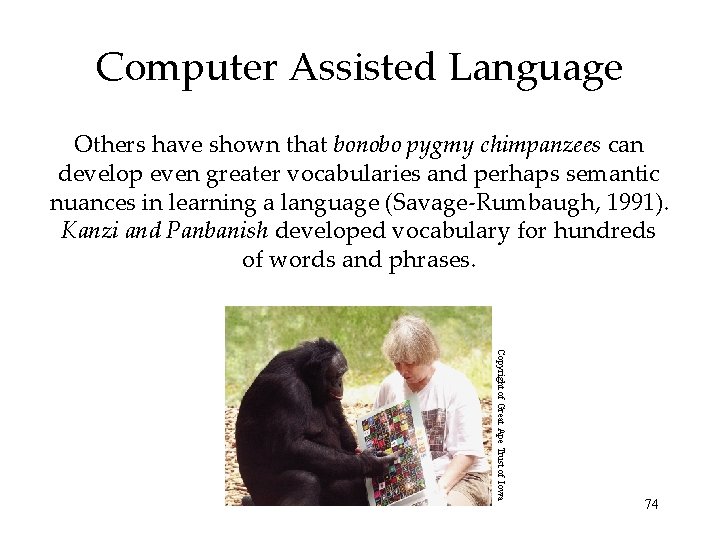
Computer Assisted Language Others have shown that bonobo pygmy chimpanzees can develop even greater vocabularies and perhaps semantic nuances in learning a language (Savage-Rumbaugh, 1991). Kanzi and Panbanish developed vocabulary for hundreds of words and phrases. Copyright of Great Ape Trust of Iowa 74
Conclusions If we say that animals can use meaningful sequences of signs to communicate a capability for language, our understanding would be naive… Steven Pinker (1995) concludes, “chimps do not develop language. ” 75
Intelligence Chapter 11 76
What is Intelligence? Intelligence is the ability to learn from experience, solve problems, and use our knowledge to adapt to new situations. In research studies, intelligence is whatever the intelligence test measures. This tends to be “school smarts. ” 77
Conceptual Difficulties Psychologists believe that intelligence is a concept and not a thing. When we think of intelligence as a trait (thing) we make an error called reification — viewing an abstract immaterial concept as if it were a concrete thing. 78
Controversies About Intelligence Despite general agreement among psychologists about the nature of intelligence, two controversies remain: 1. Is intelligence a single overall ability or is it several specific abilities? 2. With modern neuroscience techniques, can we locate and measure intelligence within the brain? 79
Intelligence: Ability or Abilities? Have you ever thought that since people’s mental abilities are so diverse, it may not be justifiable to label those abilities with only one word, intelligence? You may speculate that diverse abilities represent different kinds of intelligences. How can you test this idea? 80
AP Psychology January 7, 2010 What is intelligence? 81
Homework: 1) Read pages 434 -442 2) Complete Psych Sim
Spearman’s Studies Factor Analysis: cluster of items that measure a common ability Example: vocabulary, paragraph comprehension, Grades in English classes, SAT verbal 83
General Intelligence General intelligence (g) is a factor that underlies all intelligence. BUT…. Spearman’s Theory of General Intelligence was controversial. 84
Other Early Theories of Intelligence as Multiple Abilities -Intelligence as Seven Clusters of Primary Mental Abilities- Thurstone -General Intelligence as an evolutionary adaptation 85
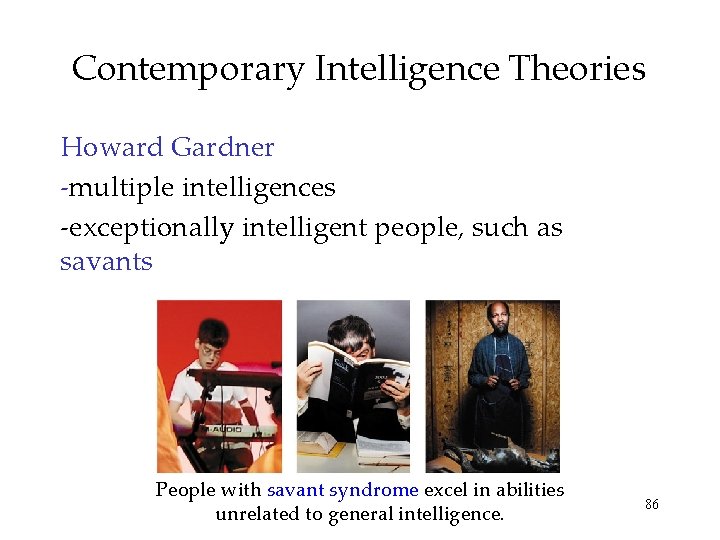
Contemporary Intelligence Theories Howard Gardner -multiple intelligences -exceptionally intelligent people, such as savants People with savant syndrome excel in abilities unrelated to general intelligence. 86
http: //www. youtube. com/watch? v=dhc. QG_KIt. ZM 87
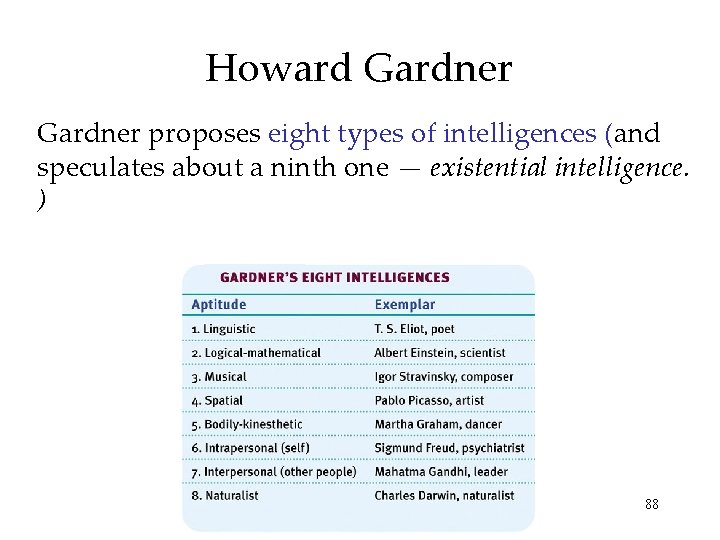
Howard Gardner proposes eight types of intelligences (and speculates about a ninth one — existential intelligence. ) 88
How is Gardner’s theory problematic? • Difficult to research • Talents or intelligences?
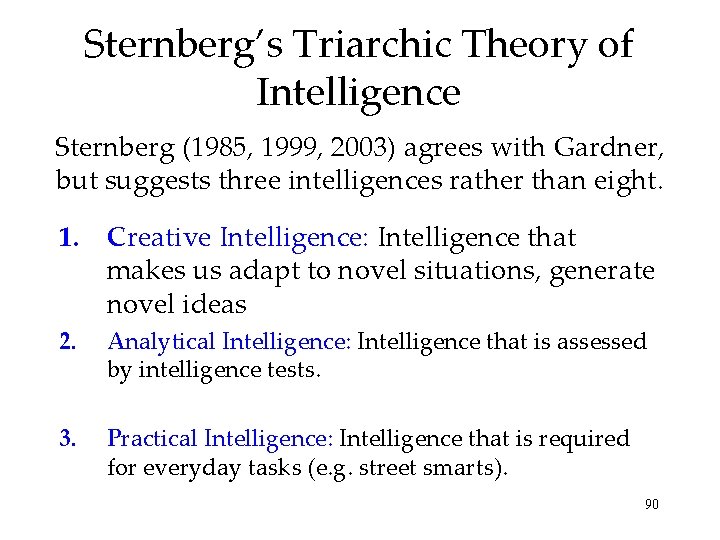
Sternberg’s Triarchic Theory of Intelligence Sternberg (1985, 1999, 2003) agrees with Gardner, but suggests three intelligences rather than eight. 1. Creative Intelligence: Intelligence that makes us adapt to novel situations, generate novel ideas 2. Analytical Intelligence: Intelligence that is assessed by intelligence tests. 3. Practical Intelligence: Intelligence that is required for everyday tasks (e. g. street smarts). 90
Sternberg and Gardner’s studies are important in broadening our definition for intelligence…… in the workplace, the classroom, on the athletic field.
Do Now: Compare and contrast Spearman, Gardner, and Sternberg’s Theories of Intelligence. Which do you think is the best theory and why?
January 8 AIM: How can we assess intelligence?
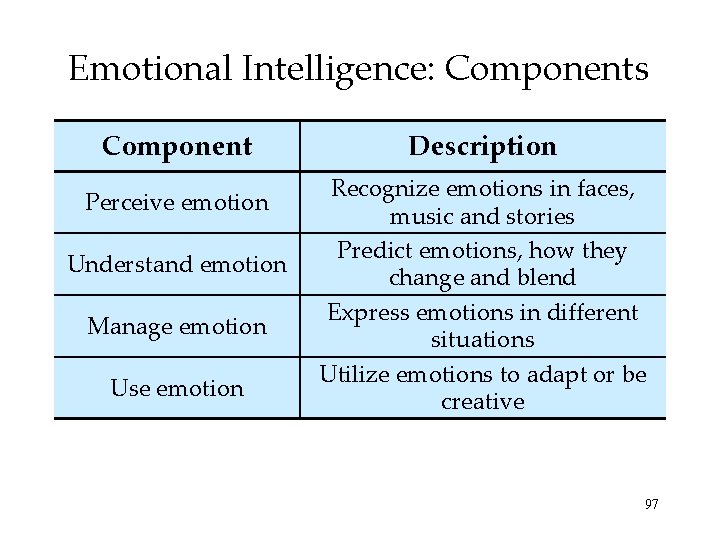
Emotional Intelligence Emotional intelligence is the ability to perceive, understand, and manage emotions -proposed by Daniel Goleman 96
Emotional Intelligence: Components Component Perceive emotion Understand emotion Manage emotion Use emotion Description Recognize emotions in faces, music and stories Predict emotions, how they change and blend Express emotions in different situations Utilize emotions to adapt or be creative 97
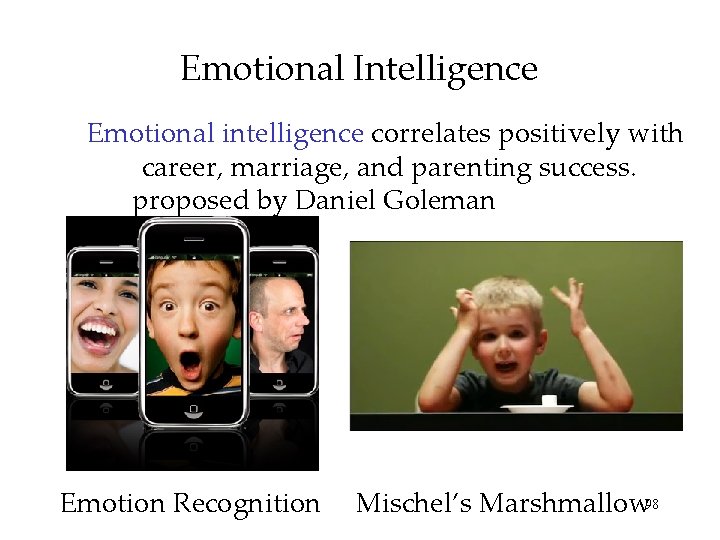
Emotional Intelligence Emotional intelligence correlates positively with career, marriage, and parenting success. proposed by Daniel Goleman Emotion Recognition Mischel’s Marshmallow 98
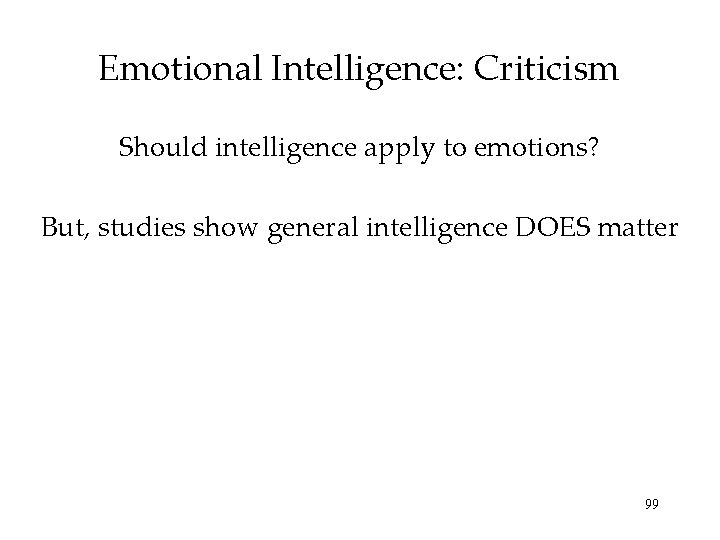
Emotional Intelligence: Criticism Should intelligence apply to emotions? But, studies show general intelligence DOES matter 99
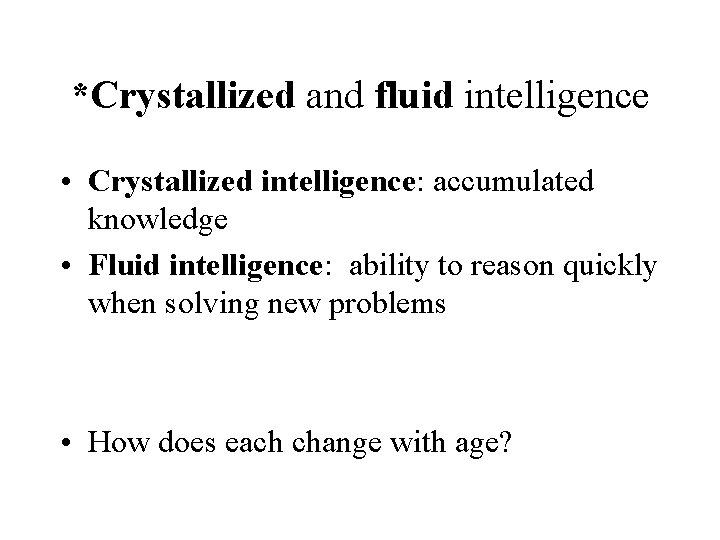
*Crystallized and fluid intelligence • Crystallized intelligence: accumulated knowledge • Fluid intelligence: ability to reason quickly when solving new problems • How does each change with age?
Intelligence and Creativity is the ability to produce ideas that are both novel and valuable. It correlates slightly with intelligence. 1. 2. 3. 4. 5. Expertise: A well-developed knowledge base. Imaginative Thinking: The ability to see things in novel ways. Adventuresome Personality: A personality that seeks new experiences rather than following the pack. Intrinsic Motivation: A motivation to be creative from within. A Creative Environment: A creative and supportive 101 environment allows creativity to bloom.
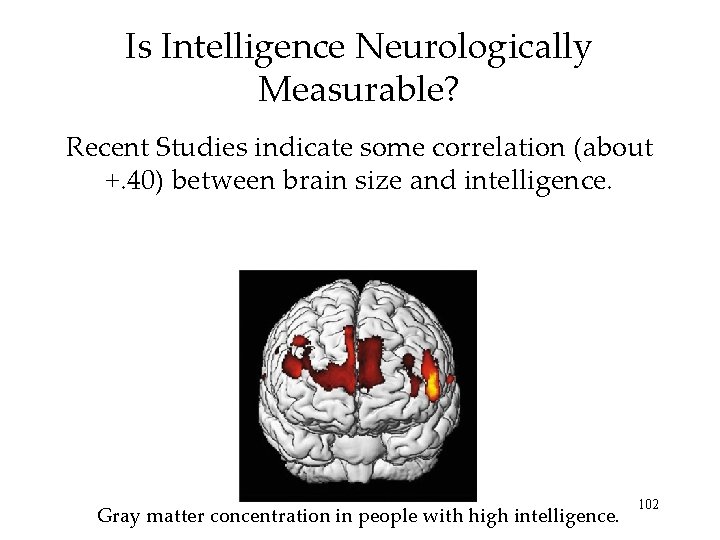
Is Intelligence Neurologically Measurable? Recent Studies indicate some correlation (about +. 40) between brain size and intelligence. Gray matter concentration in people with high intelligence. 102
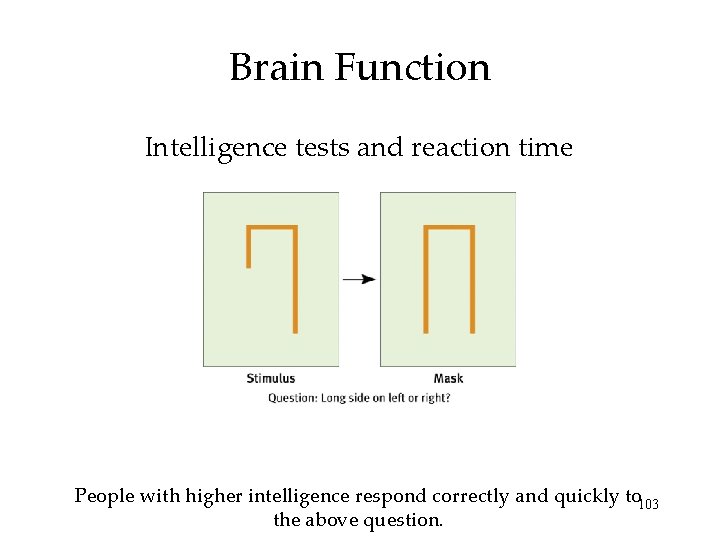
Brain Function Intelligence tests and reaction time People with higher intelligence respond correctly and quickly to 103 the above question.
Assessing Intelligence testing: a method for assessing an individual’s mental aptitudes and comparing them with others 104
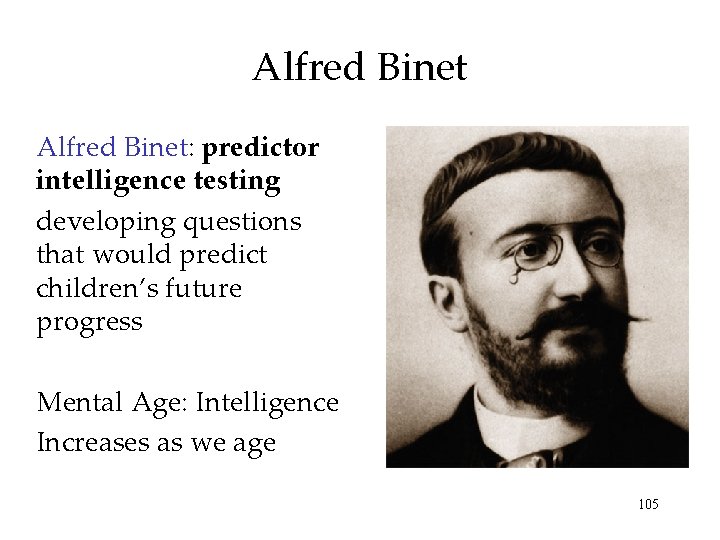
Alfred Binet: predictor intelligence testing developing questions that would predict children’s future progress Mental Age: Intelligence Increases as we age 105
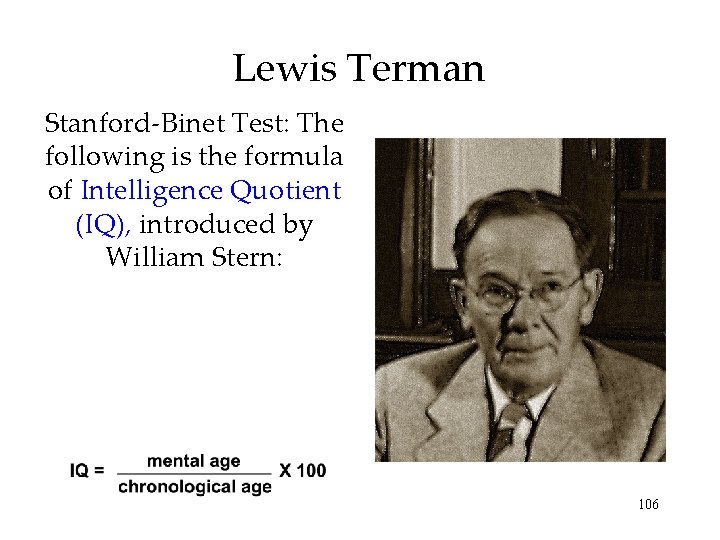
Lewis Terman Stanford-Binet Test: The following is the formula of Intelligence Quotient (IQ), introduced by William Stern: 106