
118 Review and Freebie Question 1 In psychological
11/8 • Review and Freebie Question 1. In psychological research, which of the following is most appropriate for identifying cause and effect? a. Participant Observation b. Survey Methodology c. Case Study d. Experimentation e. Correlation 2. When highly skilled people are performing a task, their brains: a. Retrieve information from memory more quickly b. Register simple stimuli more quickly c. Demonstrate a more complex brain-wave response to stimuli d. Do all the above
11/13 • You will not be getting quizzes back; I have several that still need to take it. • Think and write down the following: Self Fulfilling Prophesy- Tendency to subconsciously do what you have been given expectations of, and to do. In your years of schooling (and the numerous tests you have taken), have you found this to be true in any way?
Review… The region of the brain most involved in the experience of emotions is the A)Cerebellum B)Basal Ganglia C)Limbic System D)Reticular Activating System E) Parasympathetic Nervous System
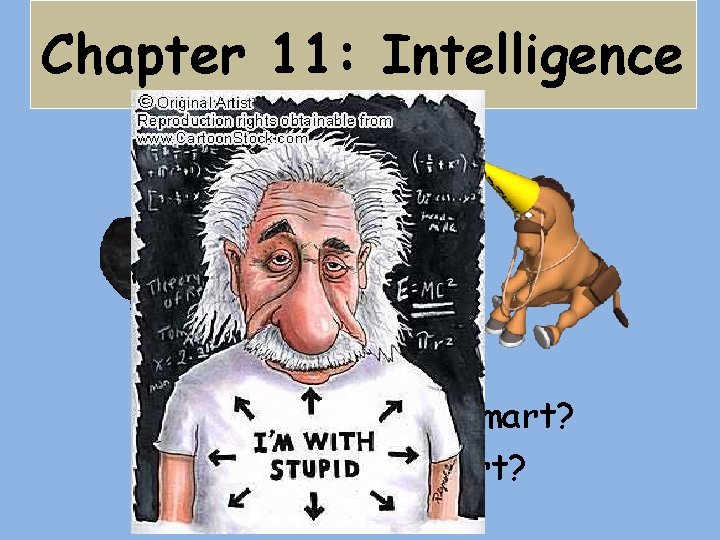
Chapter 11: Intelligence What makes us smart? Or not so smart?
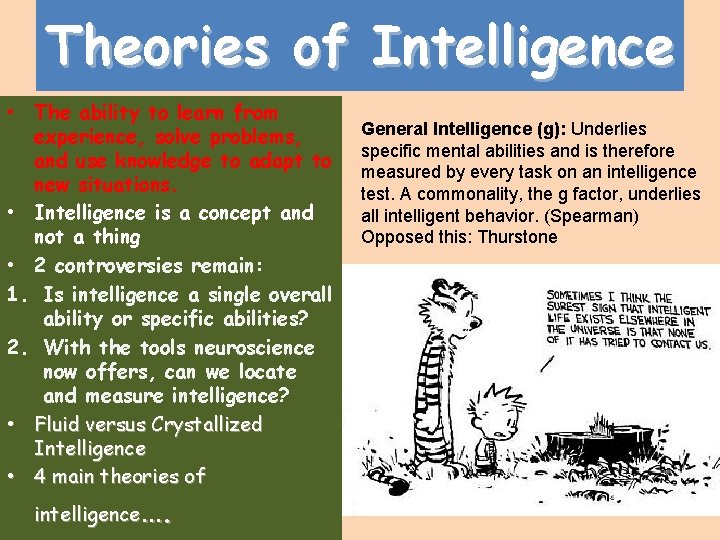
Theories of Intelligence • The ability to learn from experience, solve problems, and use knowledge to adapt to new situations. • Intelligence is a concept and not a thing • 2 controversies remain: 1. Is intelligence a single overall ability or specific abilities? 2. With the tools neuroscience now offers, can we locate and measure intelligence? • Fluid versus Crystallized Intelligence • 4 main theories of …. intelligence General Intelligence (g): Underlies specific mental abilities and is therefore measured by every task on an intelligence test. A commonality, the g factor, underlies all intelligent behavior. (Spearman) Opposed this: Thurstone
Charles Spearman and his G factor Jack Bauer is good at torturing, bomb defusing, shooting, figuring out evil plots and saving the country. Is there anything he cannot do? • Used factor analysis and discovered that we see as many different skills is actually one General Intelligence. • If you are good at one subject you are usually good at many others.
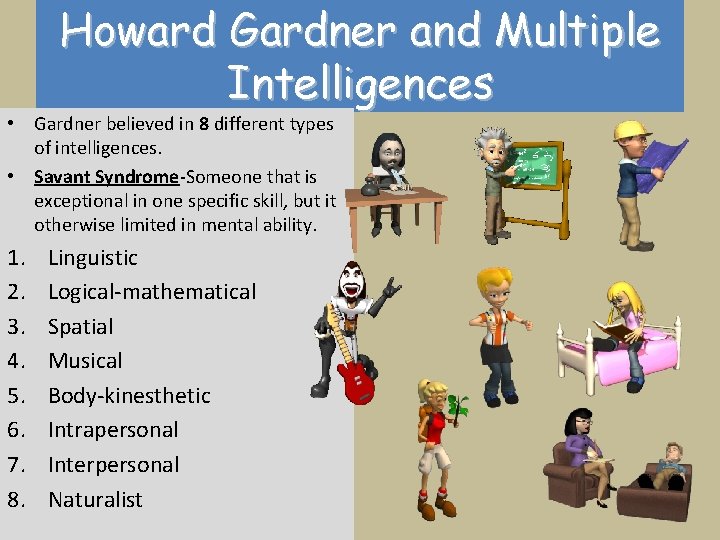
Howard Gardner and Multiple Intelligences • Gardner believed in 8 different types of intelligences. • Savant Syndrome-Someone that is exceptional in one specific skill, but it otherwise limited in mental ability. 1. 2. 3. 4. 5. 6. 7. 8. Linguistic Logical-mathematical Spatial Musical Body-kinesthetic Intrapersonal Interpersonal Naturalist
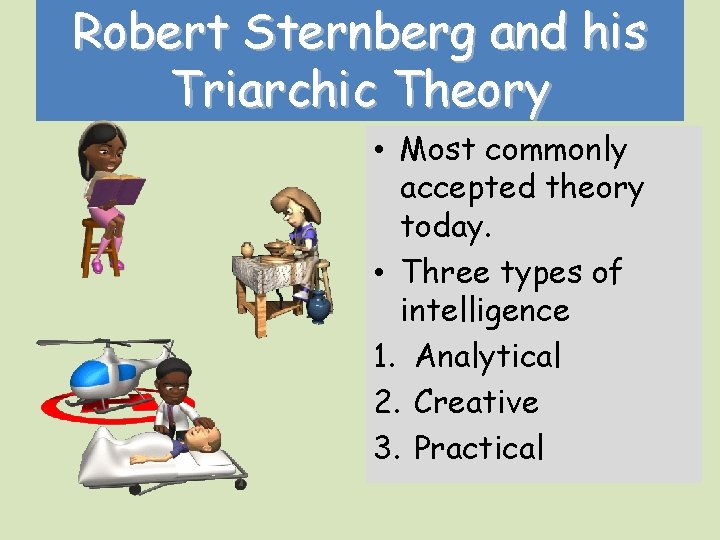
Robert Sternberg and his Triarchic Theory • Most commonly accepted theory today. • Three types of intelligence 1. Analytical 2. Creative 3. Practical
Goleman and his EQ • Emotional Intelligence • Interpersonal and intrapersonal intelligences. • Is EQ is a better predictor future success than IQ?
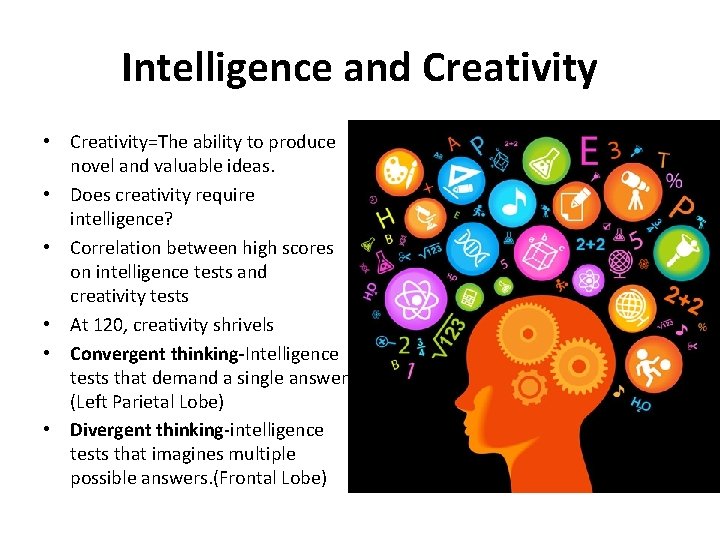
Intelligence and Creativity • Creativity=The ability to produce novel and valuable ideas. • Does creativity require intelligence? • Correlation between high scores on intelligence tests and creativity tests • At 120, creativity shrivels • Convergent thinking-Intelligence tests that demand a single answer (Left Parietal Lobe) • Divergent thinking-intelligence tests that imagines multiple possible answers. (Frontal Lobe)
5 Components of Creativity 1. 2. 3. 4. 5. Expertise-Well developed base of knowledge. “chance favors only the prepared mind. ” Imaginative Thinking Skills. Ability to see things in novel ways, to recognize patterns, to make connections. A venturesome Personality. Tolerates ambiguity and risk, perseveres, seeks new experiences. Intrinsic Motivation-Motivated by interest Creative Environment-sparks, supports, and refines creative ideas

Brain Size and Intelligence Is there a link? • Small +. 15 correlation between head size and intelligence scores (relative to body size). • Using an MRI we found +. 44 correlation with brain size and IQ score. • Gray matter (neural bodies) and white matter (dendrites and axons) • Perceptual Speed-speed of taking in perceptual information • Neurological Speed-Neural processing speed linked with IQ. Could reflect “core information processing ability. ”
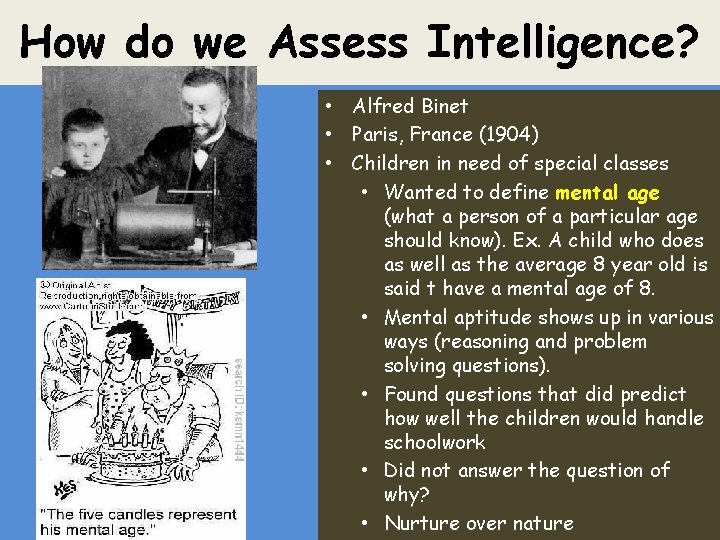
How do we Assess Intelligence? • Alfred Binet • Paris, France (1904) • Children in need of special classes • Wanted to define mental age (what a person of a particular age should know). Ex. A child who does as well as the average 8 year old is said t have a mental age of 8. • Mental aptitude shows up in various ways (reasoning and problem solving questions). • Found questions that did predict how well the children would handle schoolwork • Did not answer the question of why? • Nurture over nature
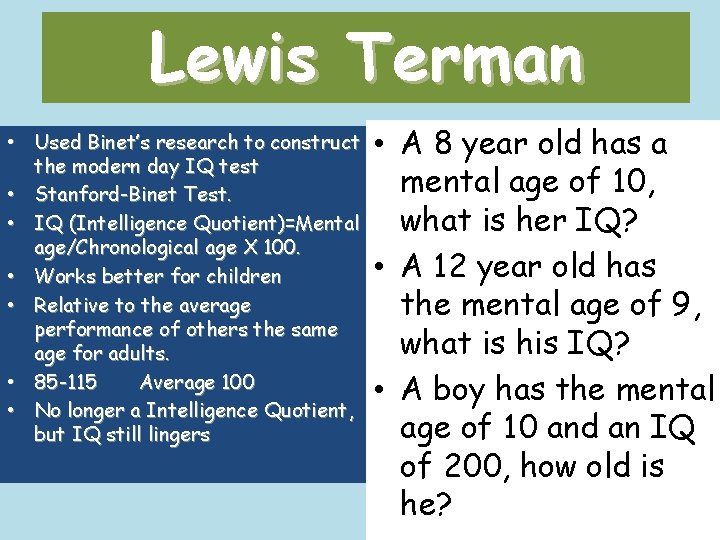
Lewis Terman • Used Binet’s research to construct the modern day IQ test • Stanford-Binet Test. • IQ (Intelligence Quotient)=Mental age/Chronological age X 100. • Works better for children • Relative to the average performance of others the same age for adults. • 85 -115 Average 100 • No longer a Intelligence Quotient, but IQ still lingers • A 8 year old has a mental age of 10, what is her IQ? • A 12 year old has the mental age of 9, what is his IQ? • A boy has the mental age of 10 and an IQ of 200, how old is he?
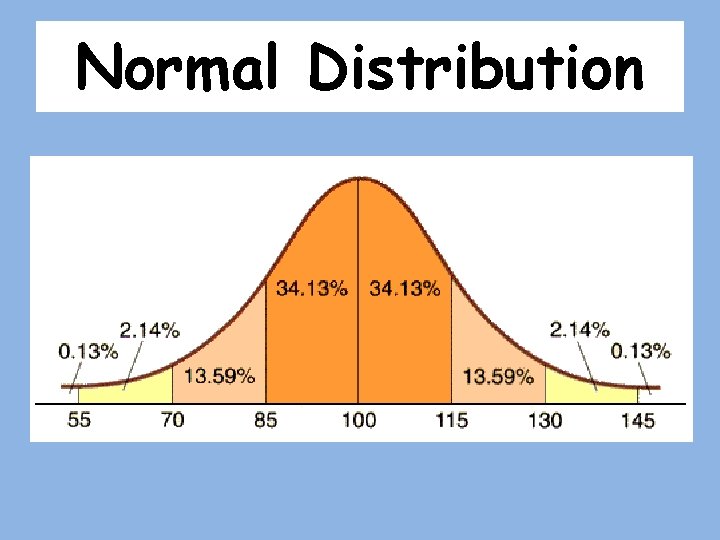
Normal Distribution

Wechsler Tests • More common way to give IQ tests…. does not use the formula but uses the same scoring system. • WAIS • WISC • WPPSI • Consists of 11 subtests. • Gives an overall score, but also gives separate scores for verbal comprehension, perceptual organization, working memory, and processing speed. • Differences can highlight possible learning disabilities or brain disorders.
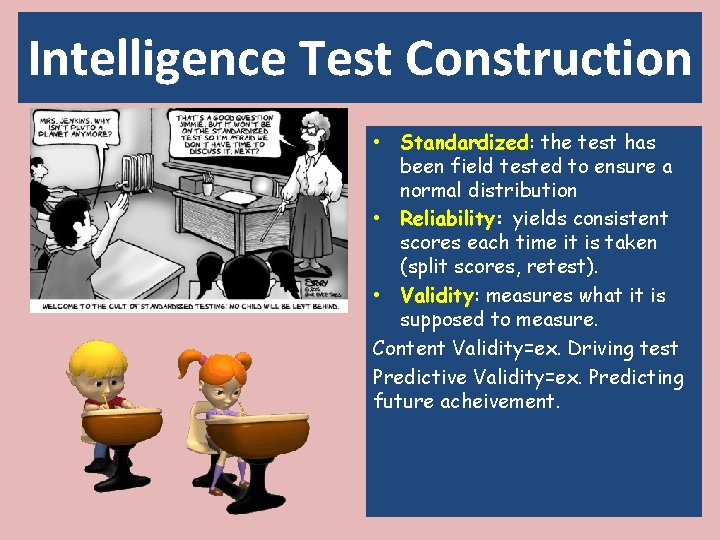
Intelligence Test Construction • Standardized: the test has been field tested to ensure a normal distribution • Reliability: yields consistent scores each time it is taken (split scores, retest). • Validity: measures what it is supposed to measure. Content Validity=ex. Driving test Predictive Validity=ex. Predicting future acheivement.
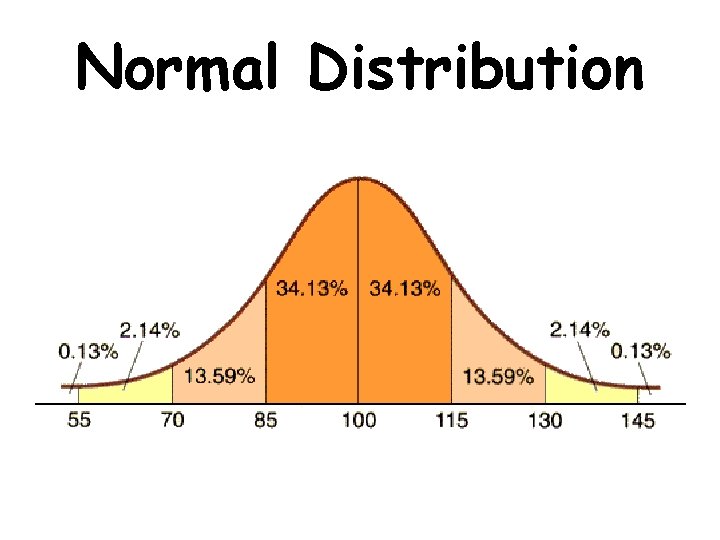
Normal Distribution

The Flynn Effect
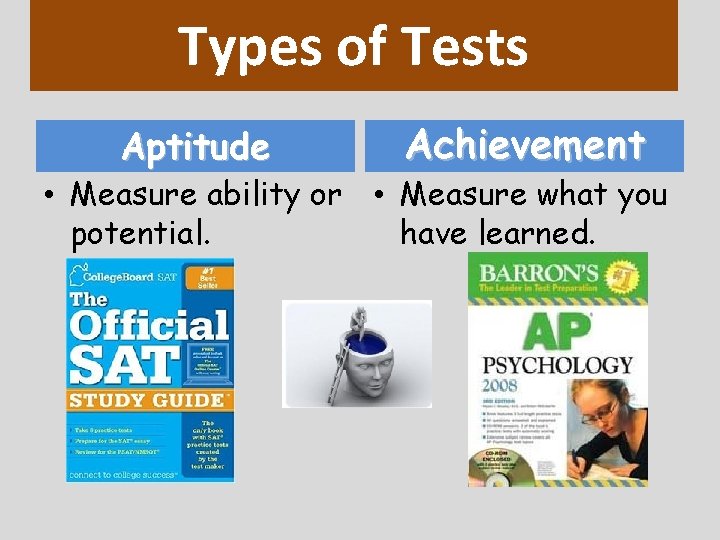
Types of Tests Aptitude Achievement • Measure ability or • Measure what you potential. have learned.
Aptitude tests predictive as reliable? No! Fairly strong in early school years (6 -12), but later weakens. • . 60 correlation for school age intelligence scores and academic success. • . 50 correlation for SAT predicting success in 1 st year of college • . 40 correlation for GRE and graduate school performance. • WHY? • The narrower the range, the lower the predictive power!
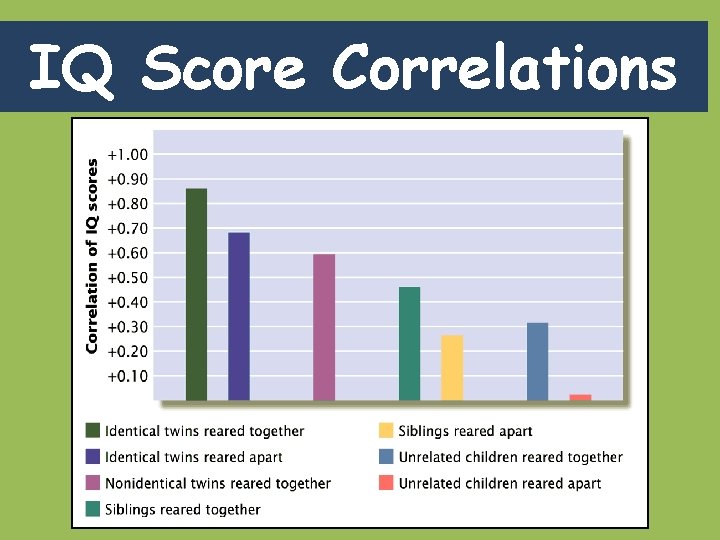
IQ Score Correlations
Stability or Change? • If we retested people periodically throughout their lives, would their intelligence scores be stable? • Typically not helpful to assess intelligence before the age of 3. At age 4, performance can predict adolescent and adult scores. • Consistency of scores over time increases with the age of the child. • SAT and GRE (consistent results) • 11 year old Scots compared with survivors near 80 years old. Correlation was high. High scoring 11 year olds were more likely to be living independently and less likely to have suffered Alzheimer’s.
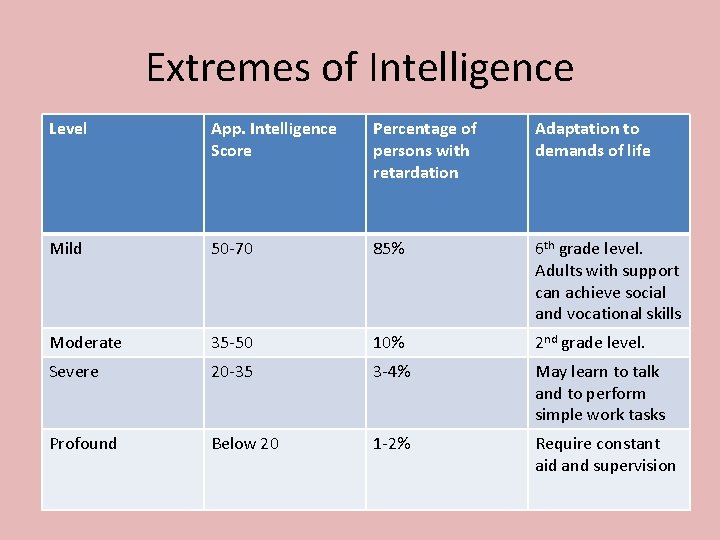
Extremes of Intelligence Level App. Intelligence Score Percentage of persons with retardation Adaptation to demands of life Mild 50 -70 85% 6 th grade level. Adults with support can achieve social and vocational skills Moderate 35 -50 10% 2 nd grade level. Severe 20 -35 3 -4% May learn to talk and to perform simple work tasks Profound Below 20 1 -2% Require constant aid and supervision
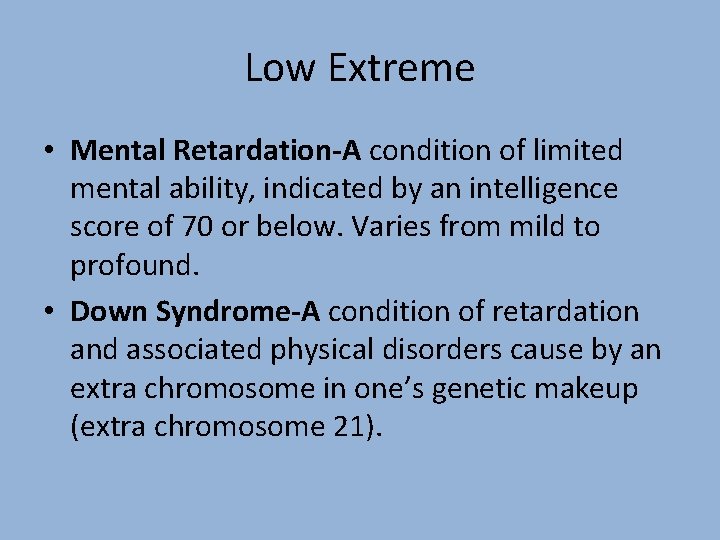
Low Extreme • Mental Retardation-A condition of limited mental ability, indicated by an intelligence score of 70 or below. Varies from mild to profound. • Down Syndrome-A condition of retardation and associated physical disorders cause by an extra chromosome in one’s genetic makeup (extra chromosome 21).
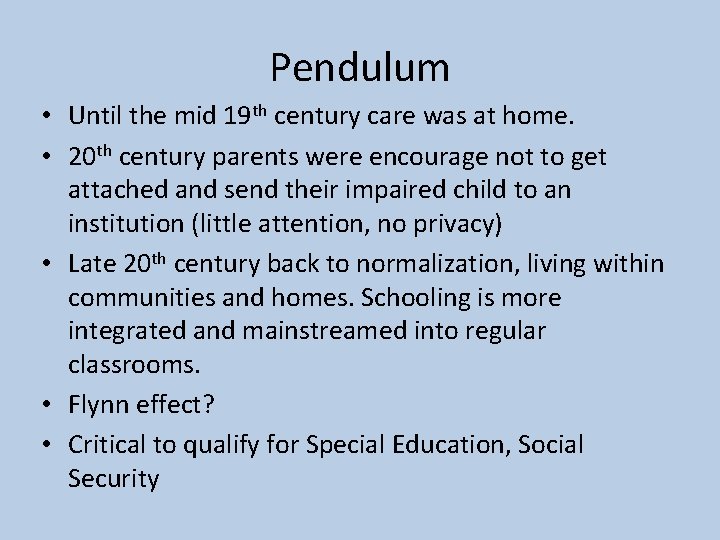
Pendulum • Until the mid 19 th century care was at home. • 20 th century parents were encourage not to get attached and send their impaired child to an institution (little attention, no privacy) • Late 20 th century back to normalization, living within communities and homes. Schooling is more integrated and mainstreamed into regular classrooms. • Flynn effect? • Critical to qualify for Special Education, Social Security
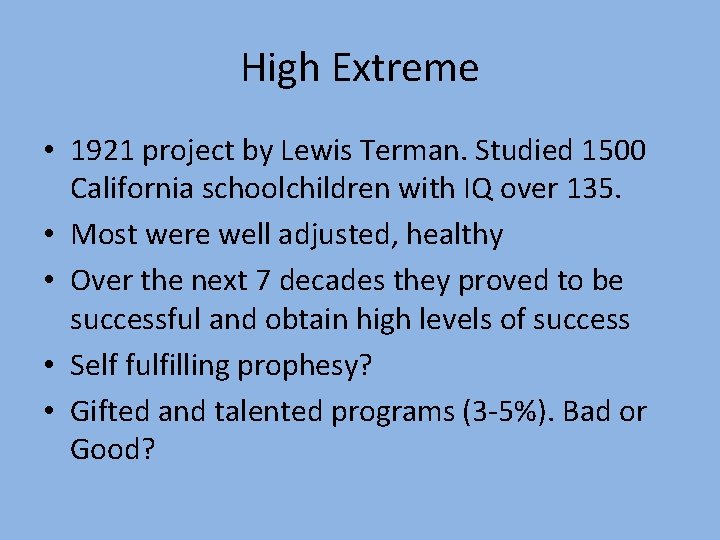
High Extreme • 1921 project by Lewis Terman. Studied 1500 California schoolchildren with IQ over 135. • Most were well adjusted, healthy • Over the next 7 decades they proved to be successful and obtain high levels of success • Self fulfilling prophesy? • Gifted and talented programs (3 -5%). Bad or Good?
Genetic Influences • Same genes=comparable mental abilities? YES • Correlation between biological parents and children increase with age in regards to intelligence • Gene-environment correlation • Genes shape the experiences that shape us.
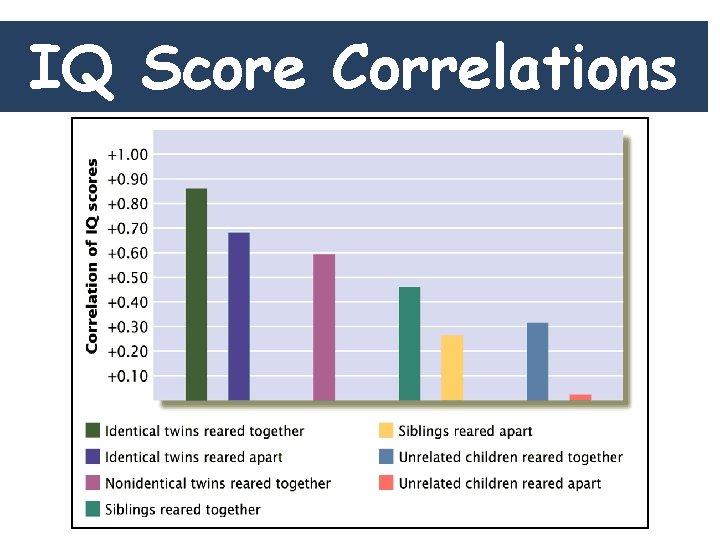
IQ Score Correlations
Environmental Influences • Destitute Iranian Orphanage (2 yrs. Sit up, 4 years walk) • J. Mc. Vicker Hunt • Severe disadvantage can take a toll • Malnutrition and cognitive development • Hunt wrote, “Intelligence and Experience” that helped launch Project Head Start (1965) • Schooling effects? Intelligence scores rise during the year…fall during the summer.
Ethnic Similarities and Differences • Focuses on groups and not the individual • White, Black, Asian
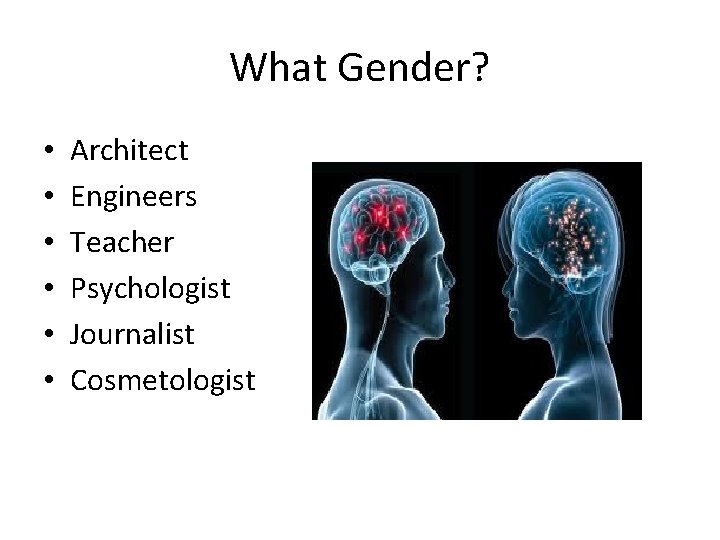
What Gender? • • • Architect Engineers Teacher Psychologist Journalist Cosmetologist
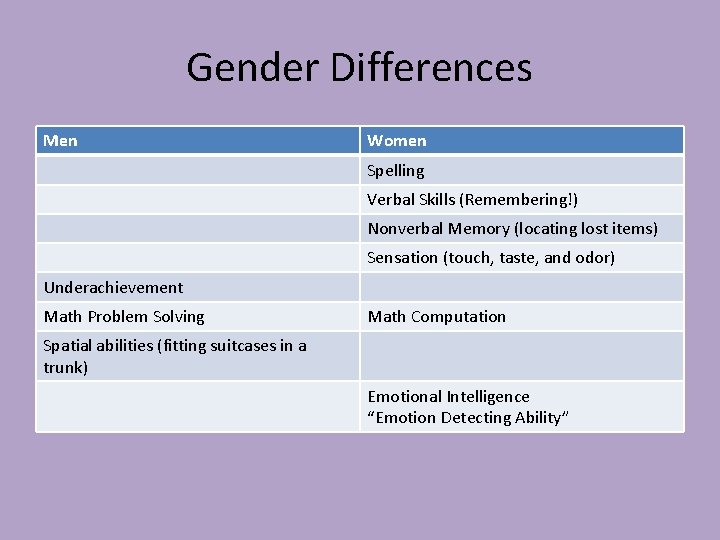
Gender Differences Men Women Spelling Verbal Skills (Remembering!) Nonverbal Memory (locating lost items) Sensation (touch, taste, and odor) Underachievement Math Problem Solving Math Computation Spatial abilities (fitting suitcases in a trunk) Emotional Intelligence “Emotion Detecting Ability”
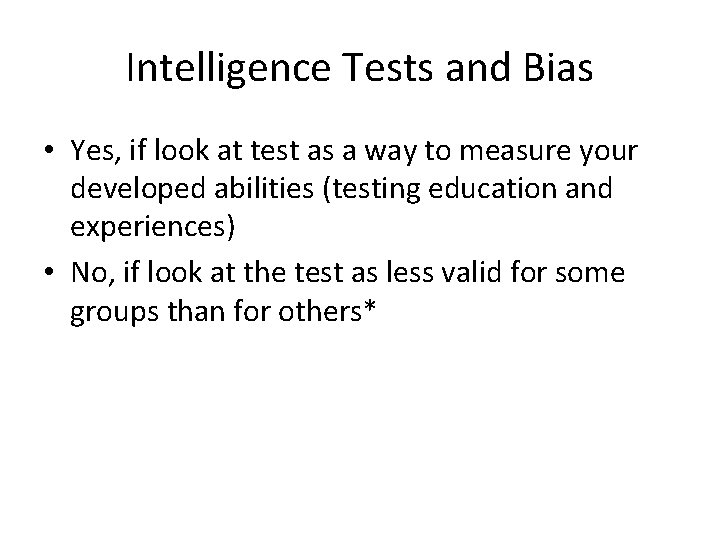
Intelligence Tests and Bias • Yes, if look at test as a way to measure your developed abilities (testing education and experiences) • No, if look at the test as less valid for some groups than for others*
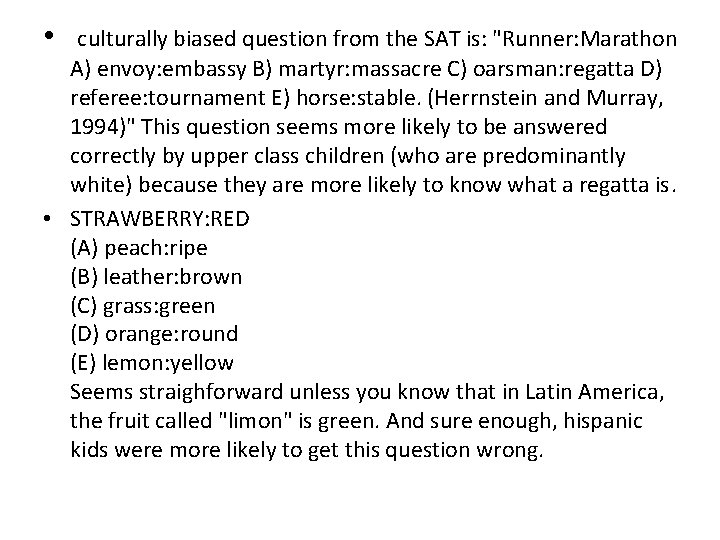
• culturally biased question from the SAT is: "Runner: Marathon A) envoy: embassy B) martyr: massacre C) oarsman: regatta D) referee: tournament E) horse: stable. (Herrnstein and Murray, 1994)" This question seems more likely to be answered correctly by upper class children (who are predominantly white) because they are more likely to know what a regatta is. • STRAWBERRY: RED (A) peach: ripe (B) leather: brown (C) grass: green (D) orange: round (E) lemon: yellow Seems straighforward unless you know that in Latin America, the fruit called "limon" is green. And sure enough, hispanic kids were more likely to get this question wrong.
- Slides: 35