
LANGUAGE ACQUISITION IN MULTILINGUAL CATALONIA STAGES OF DEVELOPMENT


- Slides: 23
LANGUAGE ACQUISITION IN MULTILINGUAL CATALONIA STAGES OF DEVELOPMENT IN LANGUAGE ACQUISITION MÀSTER DE FORMACIÓ DE PROFESSORAT DE SECUNDÀRIA BATXILLERATS I EOIs Helena Roquet Pugès Departament de Traducció i Ciències del Llenguatge Universitat Pompeu Fabra, Oct 2013 Grup d’Adquisició de Llengües de la Catalunya Multilingüe (ALLENCAM) 1
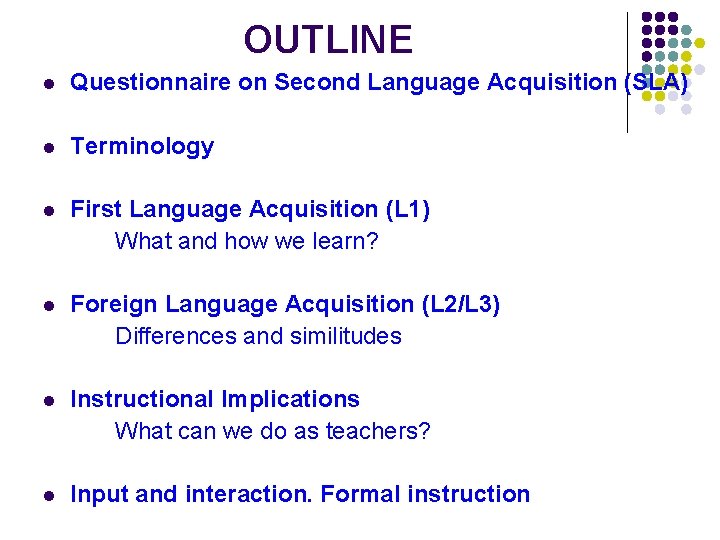
OUTLINE l Questionnaire on Second Language Acquisition (SLA) l Terminology l First Language Acquisition (L 1) What and how we learn? l Foreign Language Acquisition (L 2/L 3) Differences and similitudes l Instructional Implications What can we do as teachers? l Input and interaction. Formal instruction
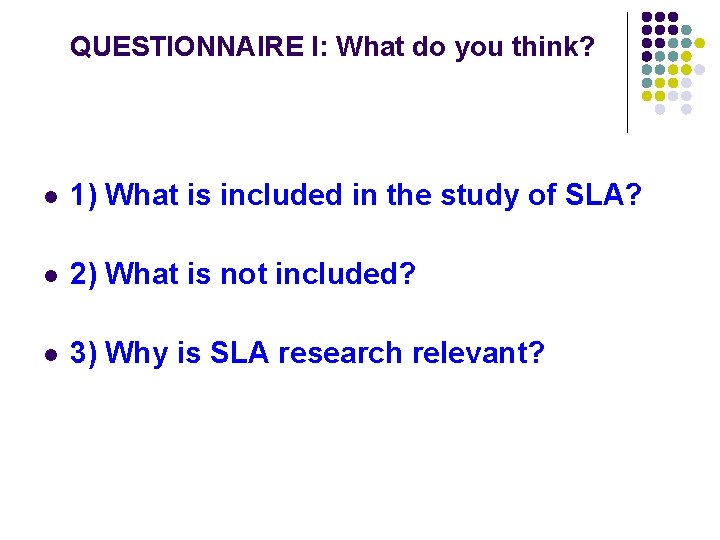
QUESTIONNAIRE I: What do you think? l 1) What is included in the study of SLA? l 2) What is not included? l 3) Why is SLA research relevant?
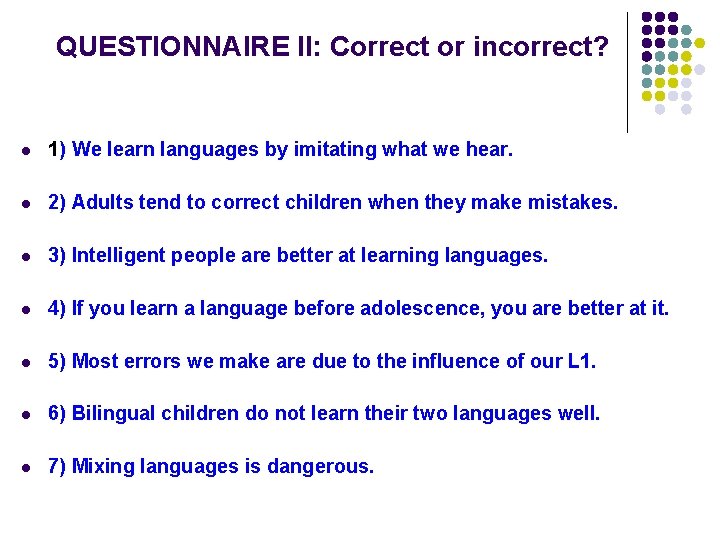
QUESTIONNAIRE II: Correct or incorrect? l 1) We learn languages by imitating what we hear. l 2) Adults tend to correct children when they make mistakes. l 3) Intelligent people are better at learning languages. l 4) If you learn a language before adolescence, you are better at it. l 5) Most errors we make are due to the influence of our L 1. l 6) Bilingual children do not learn their two languages well. l 7) Mixing languages is dangerous.
SLA main issues in a nutshell: l 1) How do learners learn an L 1, an L 2? l 2) Why do learners vary in how fast they learn an L 2? l 3) Why do most fail to achieve full TL competence?
Language Acquisition: Terminology I l First language/s: the 1 L/s one learns as a child (also mother tongue). l Second language/s: a non native L that is widely used for purposes of communication, usually as a medium of communication, government or business (i. e. English in Nigeria). l Foreign language/s: a non native language (usually taught in school) that has no status as a routine medium of communication in that country (i. e. English in Catalonia).
Language Acquisition: Terminology II l Acquisition: Natural – implicit unconscious process by which L is acquired similarly as children acquire their 1 L. “Natural” way of picking up a L by using it in natural, communicative situations. l Learning: Formal – explicit conscious knowledge about grammar and rules about a language. It takes place in classrooms when following a structured course with a teacher, so formal teaching and correction of errors are necessary for learning to occur. Main tenets of Stephen Krashen’s theory of SLA.
First Language Acquisition (L 1) l One mother tongue language : L 1 l l Monolingualism Two or more mother tongue languages: L 1 s l Bilingualism, Trilingualism, etc…
First Language Acquisition (L 1) l We all learn to speak our first language/s with the same degree of competence: (however, the same does not occur with L 2/3) l First language competence will have an effect on second/foreign language competence.
First Language Acquisition (L 1) l What do we learn? l l Language development. How do we learn? l Requisites
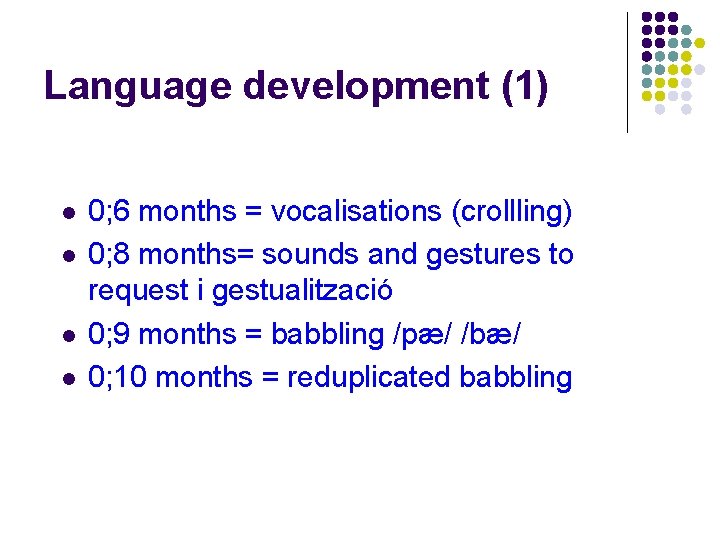
Language development (1) l l 0; 6 months = vocalisations (crollling) 0; 8 months= sounds and gestures to request i gestualització 0; 9 months = babbling /pæ/ /bæ/ 0; 10 months = reduplicated babbling
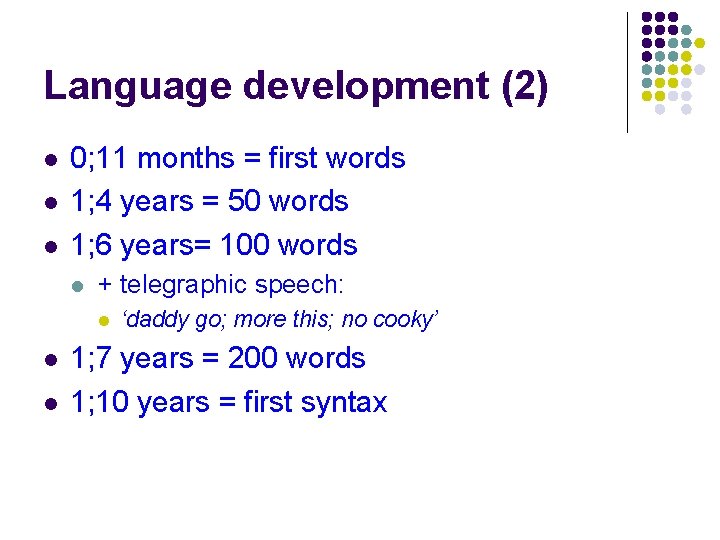
Language development (2) l l l 0; 11 months = first words 1; 4 years = 50 words 1; 6 years= 100 words l + telegraphic speech: l l l ‘daddy go; more this; no cooky’ 1; 7 years = 200 words 1; 10 years = first syntax
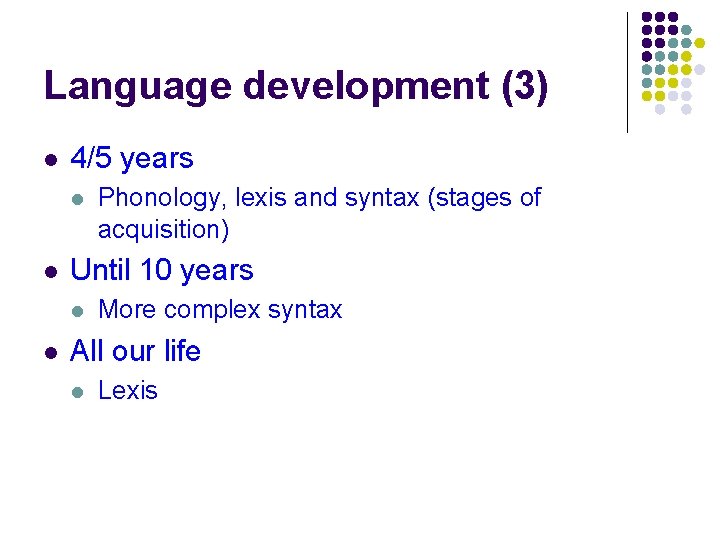
Language development (3) l 4/5 years l l Until 10 years l l Phonology, lexis and syntax (stages of acquisition) More complex syntax All our life l Lexis
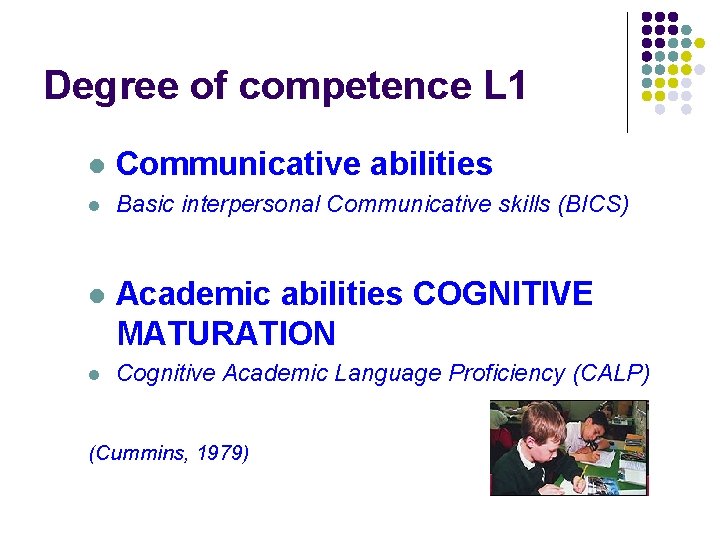
Degree of competence L 1 l Communicative abilities l Basic interpersonal Communicative skills (BICS) l l Academic abilities COGNITIVE MATURATION Cognitive Academic Language Proficiency (CALP) (Cummins, 1979)
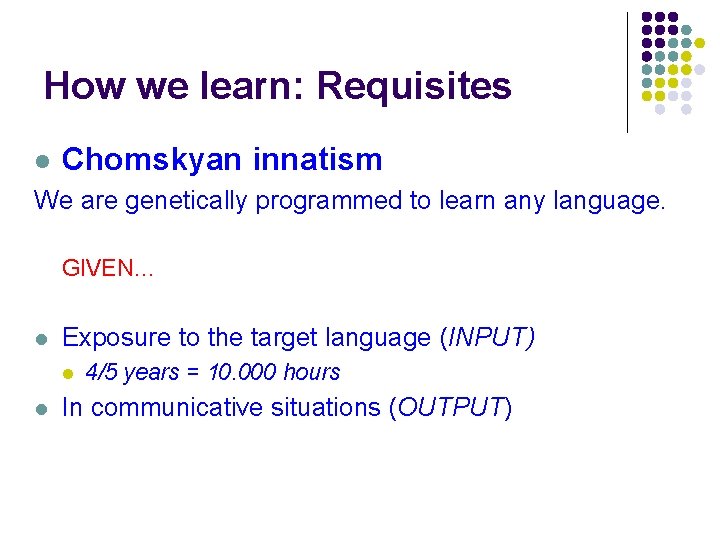
How we learn: Requisites l Chomskyan innatism We are genetically programmed to learn any language. GIVEN… l Exposure to the target language (INPUT) l l 4/5 years = 10. 000 hours In communicative situations (OUTPUT)
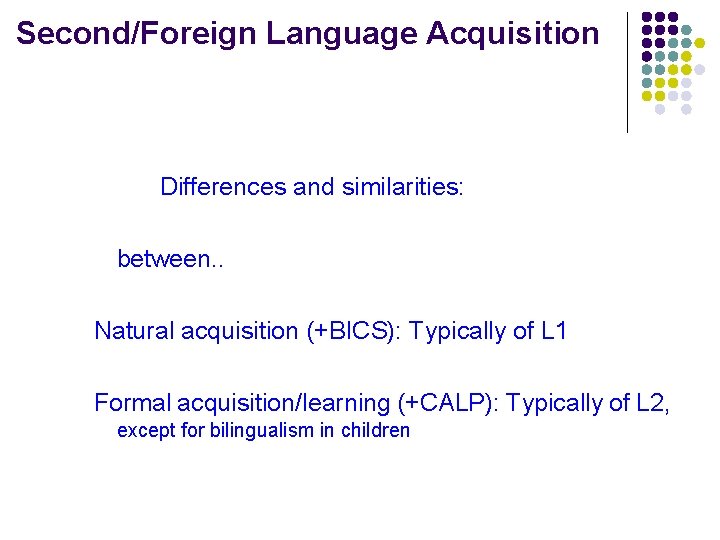
Second/Foreign Language Acquisition Differences and similarities: between. . Natural acquisition (+BICS): Typically of L 1 Formal acquisition/learning (+CALP): Typically of L 2, except for bilingualism in children
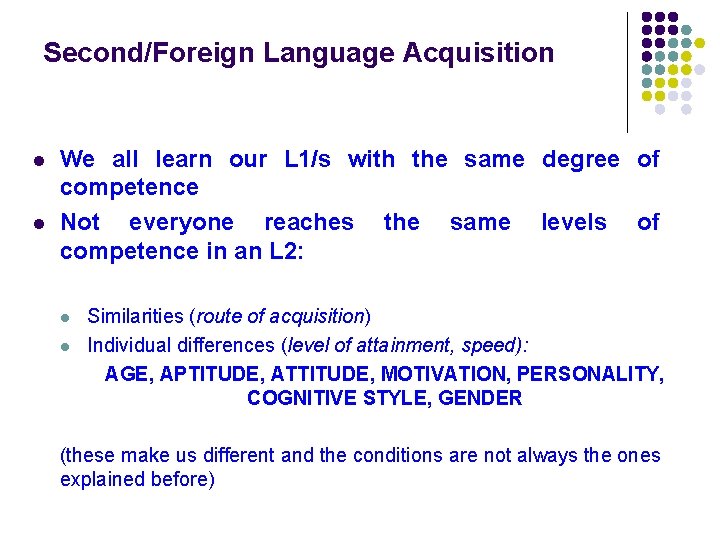
Second/Foreign Language Acquisition l l We all learn our L 1/s with the same degree of competence Not everyone reaches the same levels of competence in an L 2: l l Similarities (route of acquisition) Individual differences (level of attainment, speed): AGE, APTITUDE, ATTITUDE, MOTIVATION, PERSONALITY, COGNITIVE STYLE, GENDER (these make us different and the conditions are not always the ones explained before)
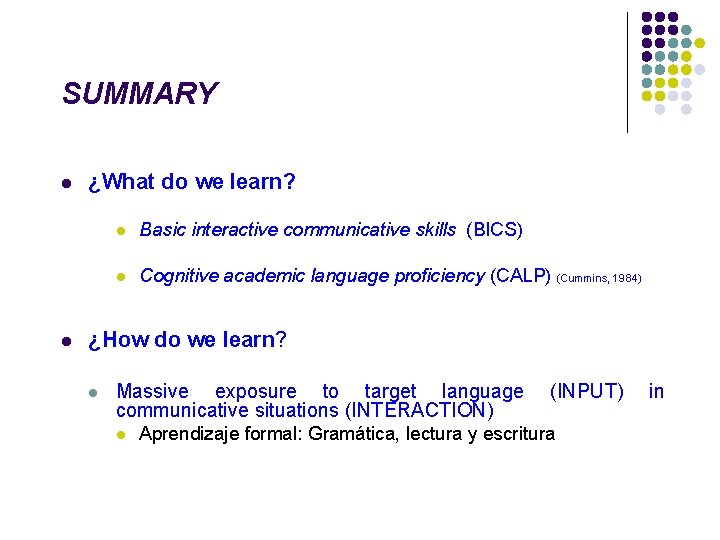
SUMMARY l l ¿What do we learn? l Basic interactive communicative skills (BICS) l Cognitive academic language proficiency (CALP) (Cummins, 1984) ¿How do we learn? l Massive exposure to target language communicative situations (INTERACTION) l (INPUT) Aprendizaje formal: Gramática, lectura y escritura in
¿Are the conditions to formal language learning in school met? l ¿Massive exposure to input? l l NO ¿In interactive contexts with attention to BICS as well as to CALP? l FEW
Instructional Implications What can we do as teachers? l l As much input as possible (always English, internet, songs, films, documentaries. . . ) Promote communicative situations with a lot of interaction CLIL ….
Second Language Acquisition l Recommendation l Focus on form: drawing students’ attention to linguistic elements as they arise incidentally in lessons whose overriding focus is on meaning or communication (Doughty & Long, 2003) l In communicative contexts l Double orientation: towards form and meaning
Second Language Acquisition l De. Keyser warning is that implicit focus on form may be insufficient if there is not massive input (De. Keyser, 2002) l Focus on forms: separate attention to grammar and subsequent integration of the knowledge provided in increasingly communicative activity (De. Keyser, 1998)
CONCLUSION Learning a second/foreign language it is not completely different from learning a first l language, yet it is not entirely the same…. .