THE MEDIA OF MASS COMMUNICATION 11 th Edition
- Slides: 20
THE MEDIA OF MASS COMMUNICATION 11 th Edition John Vivian Power. Point™ Prepared by Amy M. Carwile Texas A&M University at Texarkana This multimedia product and its contents are protected under copyright law. The following are prohibited by law: -any public performance or display, including transmission of any image over a network; -preparation of any derivative work, including the extraction, in whole or in part, of any images; -any rental, lease, or lending of the program. Copyright 2013, 2011, 2009 Pearson Education, Inc. All Rights Reserved.
Chapter 13: Mass Media Effects Thematic Chapter Overview – Media Effects – Media & Democracy – Media & Culture – Media Globalization – Elitism & Populism – Media. Copyright Economics 2013, 2011, 2009 Pearson Education, Inc. All Rights Reserved.
Effects Theories • Bullet Theory • Minimalist Effects Theory • Cumulative Effects Theory Copyright 2013, 2011, 2009 Pearson Education, Inc. All Rights Reserved.
Bullet Theory • Powerful Effects Theory – Walter Lippman • “pictures in our heads” (Public Opinion, 1992) – Harold Lasswell • W. P. Davidson – Third-Person Effect Copyright 2013, 2011, 2009 Pearson Education, Inc. All Rights Reserved.
Minimalist Effects Theory • Two-Step Flow Model – Opinion Leaders – Multistep Flow • Status Conferral – Agenda-Setting – Maxwell Mc. Combs & Don Shaw • Not “what to think” but “What to think about” • Narcoticizing Dysfunction Copyright 2013, 2011, 2009 Pearson Education, Inc. All Rights Reserved.
Cumulative Effects Theory • Elisabeth Noelle-Neumann – No one can escape the media or the media’s messages • Spiral of Silence – Majority viewpoints are continuously shared – Minority viewpoints are stifled Copyright 2013, 2011, 2009 Pearson Education, Inc. All Rights Reserved.
• In our cultural folklore, the bullet theory of mass communication effects remains alive and well. Identify an example in your recent experience and assess it. • What layers of complexity did Paul Lazarsfeld add to our understanding of the effects of mass communication? • Give an example of the spiral of silence and explain how it worked. Copyright 2013, 2011, 2009 Pearson Education, Inc. All Rights Reserved.
Lifestyle Effects • Socialization – An 18 -year-old has spent more time watching TV than any other waking activity – Prosocial • Living Patterns • Intergenerational Eavesdropping Copyright 2013, 2011, 2009 Pearson Education, Inc. All Rights Reserved.
• Why is mass communication a growing issue in child development? • What examples can you offer of mass communication reflecting lifestyles? How about the opposite – lifestyles reflecting mass communication? • How has modern media content eroded the innocence of childhood? Copyright 2013, 2011, 2009 Pearson Education, Inc. All Rights Reserved.
Attitude Effects • • Influencing opinion Role Models Stereotypes Agenda-setting and Status conferral Copyright 2013, 2011, 2009 Pearson Education, Inc. All Rights Reserved.
• How frequently does mass communication trigger sudden and drastic changes in public opinion? • Although media-perpetuated stereotypes can be false, misleading and damaging, stereotypes are nonetheless essential in mass communication, why? • How does mass communication wield power through status conferral on some issues and neglect others? Copyright 2013, 2011, 2009 Pearson Education, Inc. All Rights Reserved.
Cultural Effects • Values – Historical Transmission • Paley Center for Media • Vanderbilt Television News Archive – Contemporary Transmission • Diffusion of Innovations • Cultural Imperialism – Herbert Schiller – Post-Schiller Revisionism – Transcultural Enrichment Copyright 2013, 2011, 2009 Pearson Education, Inc. All Rights Reserved.
• How does mass communication connect us to the past, as well as help us resolve diverse contemporary values? • Can transcultural communication be enriching even if also imperialist? Why or why not? Copyright 2013, 2011, 2009 Pearson Education, Inc. All Rights Reserved.
Behavioral Effects • Motivational Messages – Sigmund Freud – Ernest Dichter • Motivational Research • Subliminal Messages – Jim Vicary – Subception Copyright 2013, 2011, 2009 Pearson Education, Inc. All Rights Reserved.
• What in the mid-20 th century American experience contributed to the belief that mass communication can trigger radical changes in our behavior? • Why does the fraudulent research of Jim Vicary persist as urban legend? Copyright 2013, 2011, 2009 Pearson Education, Inc. All Rights Reserved.
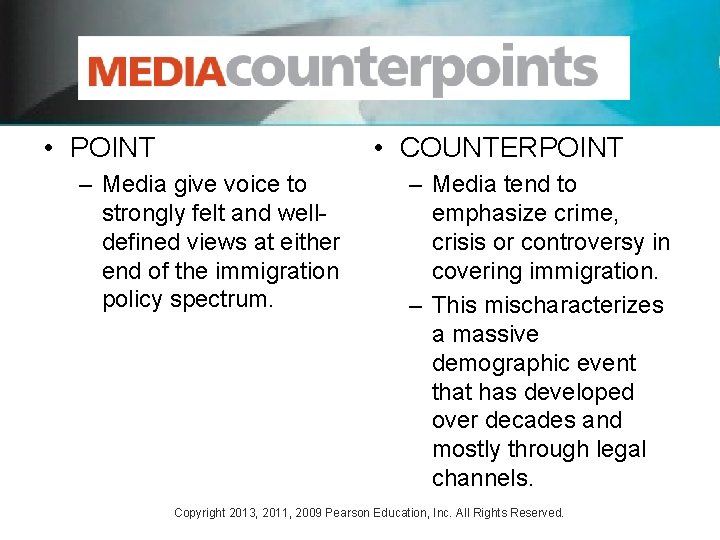
• POINT • COUNTERPOINT – Media give voice to strongly felt and welldefined views at either end of the immigration policy spectrum. – Media tend to emphasize crime, crisis or controversy in covering immigration. – This mischaracterizes a massive demographic event that has developed over decades and mostly through legal channels. Copyright 2013, 2011, 2009 Pearson Education, Inc. All Rights Reserved.
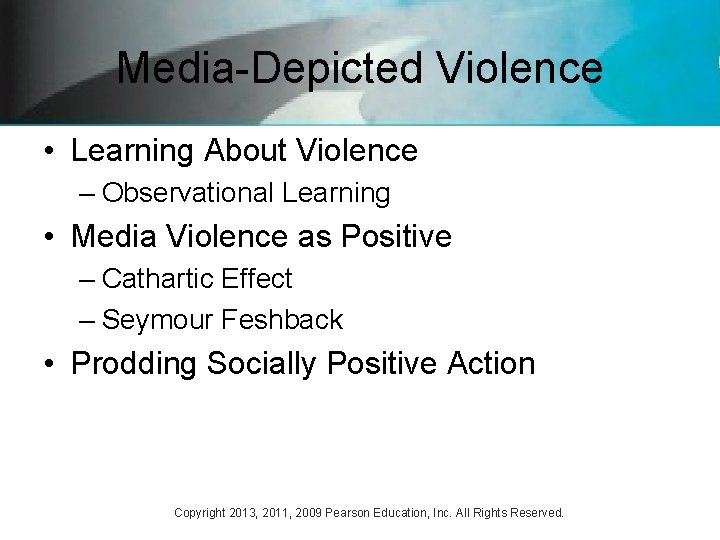
Media-Depicted Violence • Learning About Violence – Observational Learning • Media Violence as Positive – Cathartic Effect – Seymour Feshback • Prodding Socially Positive Action Copyright 2013, 2011, 2009 Pearson Education, Inc. All Rights Reserved.
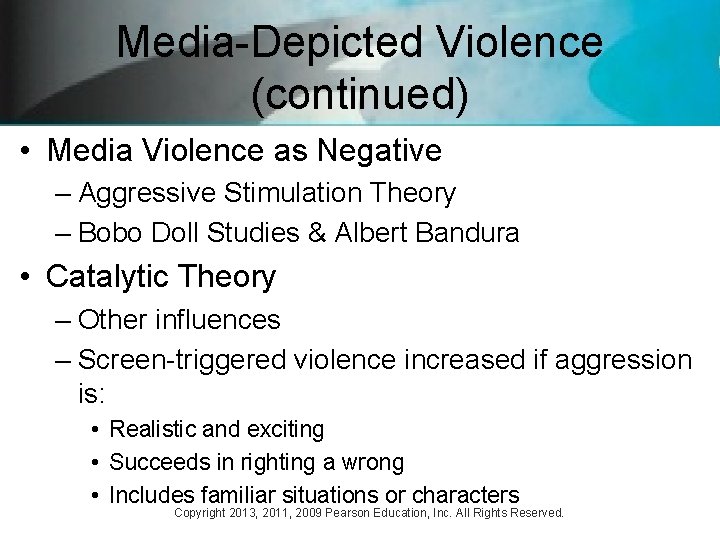
Media-Depicted Violence (continued) • Media Violence as Negative – Aggressive Stimulation Theory – Bobo Doll Studies & Albert Bandura • Catalytic Theory – Other influences – Screen-triggered violence increased if aggression is: • Realistic and exciting • Succeeds in righting a wrong • Includes familiar situations or characters Copyright 2013, 2011, 2009 Pearson Education, Inc. All Rights Reserved.
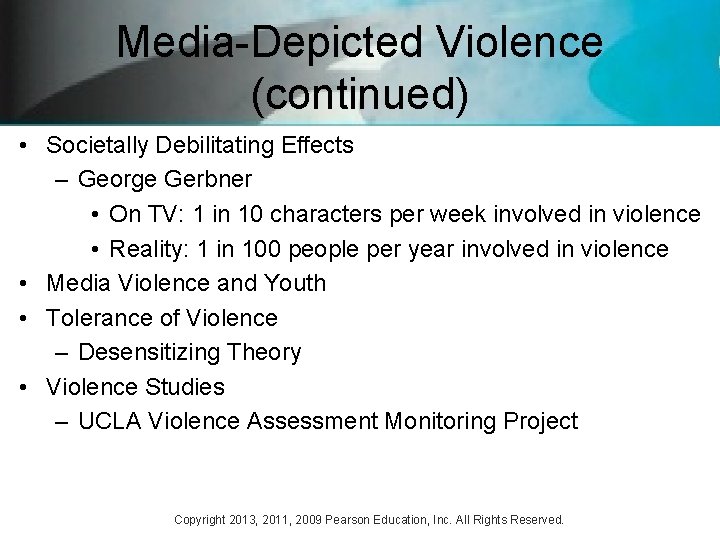
Media-Depicted Violence (continued) • Societally Debilitating Effects – George Gerbner • On TV: 1 in 10 characters per week involved in violence • Reality: 1 in 100 people per year involved in violence • Media Violence and Youth • Tolerance of Violence – Desensitizing Theory • Violence Studies – UCLA Violence Assessment Monitoring Project Copyright 2013, 2011, 2009 Pearson Education, Inc. All Rights Reserved.
• Why do courts refuse to excuse violent criminals who blame their behavior on media-depicted violence? • What variables contribute to a person’s proneness for violence after an experience with mediadepicted violence? • How can it be argued that media portrayals of deviant behavior discourage real-life deviance? • What difficulty to researchers have in measuring violent media content? Copyright 2013, 2011, 2009 Pearson Education, Inc. All Rights Reserved.