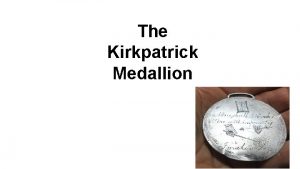
The Kirkpatrick Medallion My name is Chip Kirkpatrick

- Slides: 33
The Kirkpatrick Medallion
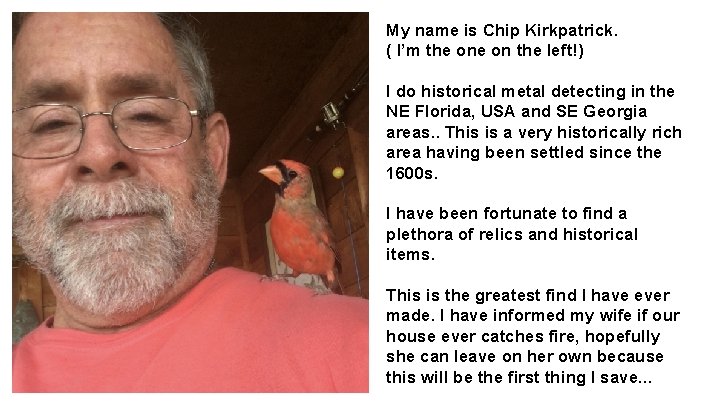
My name is Chip Kirkpatrick. ( I’m the on the left!) I do historical metal detecting in the NE Florida, USA and SE Georgia areas. . This is a very historically rich area having been settled since the 1600 s. I have been fortunate to find a plethora of relics and historical items. This is the greatest find I have ever made. I have informed my wife if our house ever catches fire, hopefully she can leave on her own because this will be the first thing I save. . .
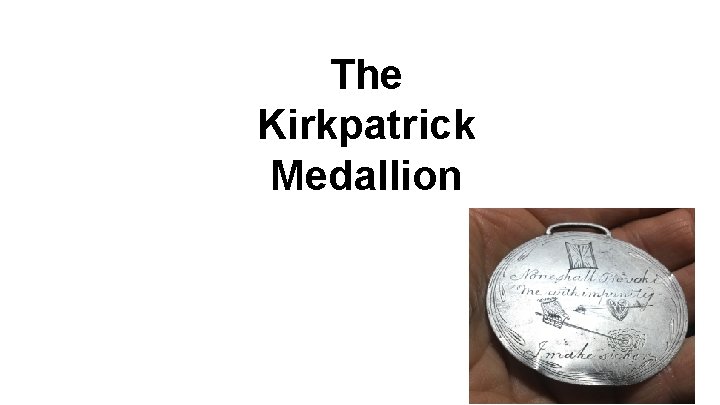
I was given permission to hunt a private home site on the Florida / Georgia state lines. I did not find much but I did find a couple of crushed cans and near them I found what appeared to be the lid to one of those cans. This object was round, flat and the right size but it was covered with a thick layer of hard-as-arock, dried on black mud. I put it into my trash bucket. At home I began to review my trash finds. Because I recycle all of this scrap metal, I hand sort each item and put them into various barrels so all of the iron goes into one barrel, aluminum into another, copper into a third and so on. Once a year I haul a trailer full of this scrap metal to the recycling center. This is extra work but I don’t mind. Occasionally this second look has revealed that some of my finds are not what I originally thought they were. And so when I picked up this “can lid”, before I tossed it some of the dried on mud broke away. What I saw was a “loop” coming out of the mud. Knowing can lids do not have loops, I decided to investigate it further. I took it into my workshop and took a soft bristled toothbrush and began to gently scrub it
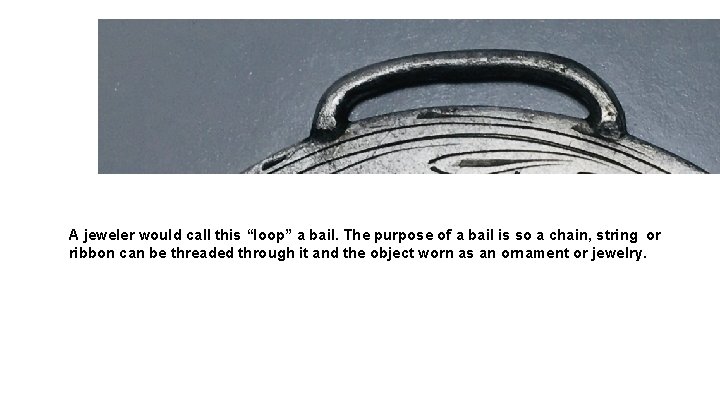
A jeweler would call this “loop” a bail. The purpose of a bail is so a chain, string or ribbon can be threaded through it and the object worn as an ornament or jewelry.
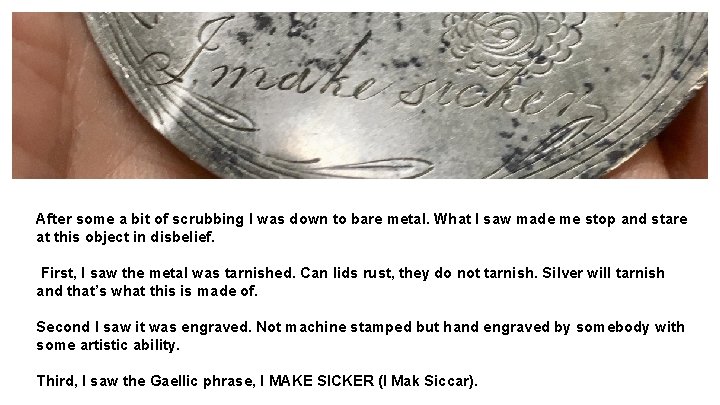
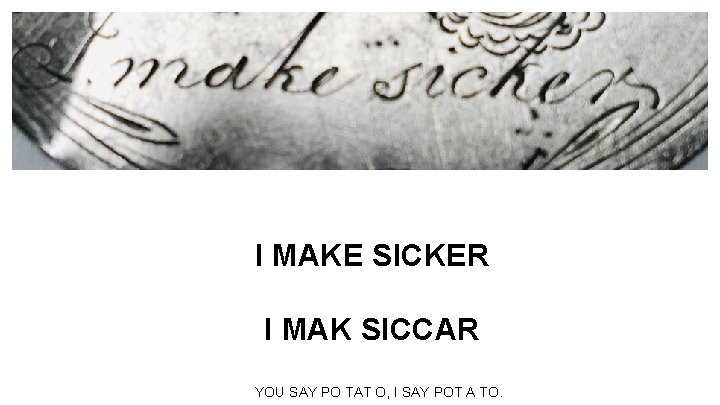
After some a bit of scrubbing I was down to bare metal. What I saw made me stop and stare at this object in disbelief. First, I saw the metal was tarnished. Can lids rust, they do not tarnish. Silver will tarnish and that’s what this is made of. Second I saw it was engraved. Not machine stamped but hand engraved by somebody with some artistic ability. Third, I saw the Gaellic phrase, I MAKE SICKER (I Mak Siccar).
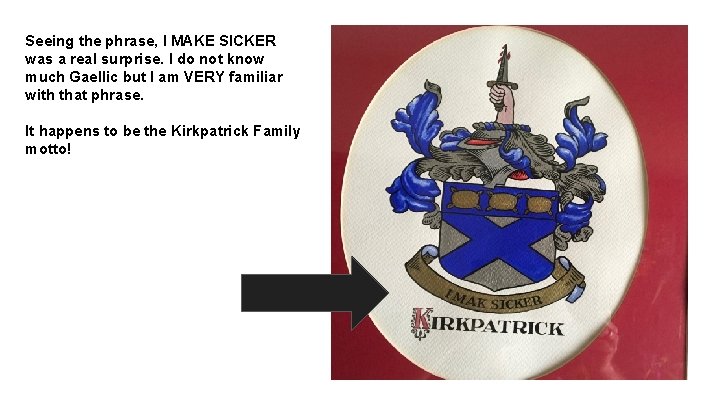
Seeing the phrase, I MAKE SICKER was a real surprise. I do not know much Gaellic but I am VERY familiar with that phrase. It happens to be the Kirkpatrick Family motto!
In 1306, Robert Bruis (Robert The Bruce) was desperately trying to become King of Scotland. But he had a very formidable opponent, John (The Red) Comyn, another noble, had a notable heritage and also wanted the crown. After William Wallace (Braveheart) stepped down as Guardian of Scotland, these two men were named co-guardians of Scotland which only ignited the hatred between the two men. At a gathering of nobles, Comyn struck Bruis. Comyn learned Bruis was making plans for a rebellion and when Bruis went to England, Comyn sent word to the English King Edward (Longshanks) of Bruis’ plans. Edward sent men to arrest Bruis but he was warned and slipped back into Scotland. There he sent word to Comyn he wanted to negotiate with him. Supposedly he offered to sign over all Bruis properties to the Comyn family if Comyn conceded the Crown to him. Or if Comyn would do likewise he could take throne. He proposed the two men meet at the altar of the Greyfriars Church in Dumfries. They would meet at the door, be searched and enter alone and unarmed. Comyn agreed because the Church was recognized as a place of sanctuary and safety. Nobody could be harmed in a Church.
The men each brought attendees, trusted family or friends. They met at the door as proposed and entered the Church. However at the altar, Bruis produces a dagger and viciously stabs Comyn and runs out of the Church. Outside he is seen by his cousin and friend, Sir Roger Kirkpatrick is alarmed at the blood on Bruis’ clothing but soon learns it is not Bruis’ blood. Kirkpatrick then asks if Comyn is dead. Bruis replies that he does not believe he is. Recognizing that Bruis will be in very serious trouble if Comyn lives and he barks out, “You doubt? I MAKE SICKER! (I Make Sure!) Kirkpatrick enters the Church to complete the butchery of John Comyn. He leaves the Church with Comyn’s head holding aloft a blood stained dagger. The Kirkpatrick Crest has a hand holding aloft a bloody dagger. The shield shows three pillows for the three nights the two men spent sleeping in the woods, while hiding from the authorities and the Comyn Family. Bruis was soon crowned King of Scotland. He should have been excommunicated for his action but the Church leaders looked the other way to allow his coronation.
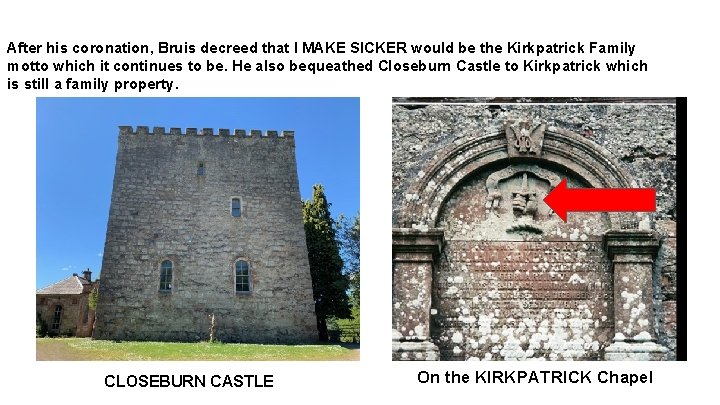
After his coronation, Bruis decreed that I MAKE SICKER would be the Kirkpatrick Family motto which it continues to be. He also bequeathed Closeburn Castle to Kirkpatrick which is still a family property. CLOSEBURN CASTLE On the KIRKPATRICK Chapel
Needless to say, I didn’t throw this into the recycling barrel! I continued to clean it and was surprised at what I found.
I was shocked at the enormity of this and what it may be and especially I wanted to learn what the various symbols, phrases, and illustrations represented. I tried consulting GOOGLE but learned very little. Supposedly Albert Einstein said, “I do not need to know everything. I simply need to know who does. ” And so I decided to follow his example. I took a number of pictures and drew up a list of various questions I had about it and then I spent almost 4 months researching researchers. I concentrated on institutions in Scotland, England the Southeastern United States. I started with Museums: The Scottish National Museum, The British Royal Museum and the Smithsonian. I looked for history staff members and sent the pictures and questions to anybody and everybody who might remotely hold information and knowledge that was applicable to this. Then I moved on to a number of lesser museums. Very helpful was the Tartan Museum in Franklin NC. After museums I started searching for historians whose expertise involved this time period. I read books and articles. I watched documentaries. I even watched an episode of ANTIQUES ROADSHOW on PBS when a man brought his collection of 19 th century Scottish silver jewelry and contacted the appraiser. I also visited several reputable silversmiths to learn how this was made and engraved.
It would have been wonderful if one person had the knowledge or time to answer all or most of the questions but instead I got little snippets and bits of information from those who replied. Putting this together has been like working on a very large and complicated jigsaw puzzle or sewing a mammoth quilt with my eyes closed. Rarely did they agree, except for a pair of responses I received from two historians, a man and a woman. Their replies were nearly verbatim to each other. Later I learned this was a transgender person and I had seen them on separate publications writing under two different names. I thank both of them for replying. And I also thank everybody who was kind enough to respond to me, even if only to say “Interesting find!” There was one person though, whom I met late into my efforts who actually did answer many of my questions and took the time to explain and give me detailed answers to my queries. Her name is Doctor Pam Illert. She is a historian and genealogist in Australia. I was introduced to her by Maria, the woman who runs Closeburn Castle. Dr Illert has written a very involved book on the Kirkpatricks and is an absolute angel as well as a fount of knowledge. Thank you again, Pam! Please remember much of this is from many SWAGs (Scientific Wild Ass Guesses) and deductions. There often were limited records and so there are naturally going to be issues of debate and conflict so please do not concentrate on those points. This is a unique one-of-akind relic so enjoy it in its totality.
This is what we know, what we think we know and what we know we do not know! I am still asking questions and trying to learn more about this.
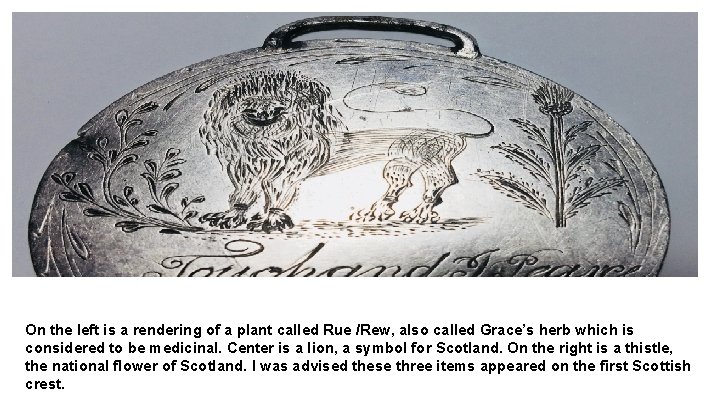
On the left is a rendering of a plant called Rue /Rew, also called Grace’s herb which is considered to be medicinal. Center is a lion, a symbol for Scotland. On the right is a thistle, the national flower of Scotland. I was advised these three items appeared on the first Scottish crest.
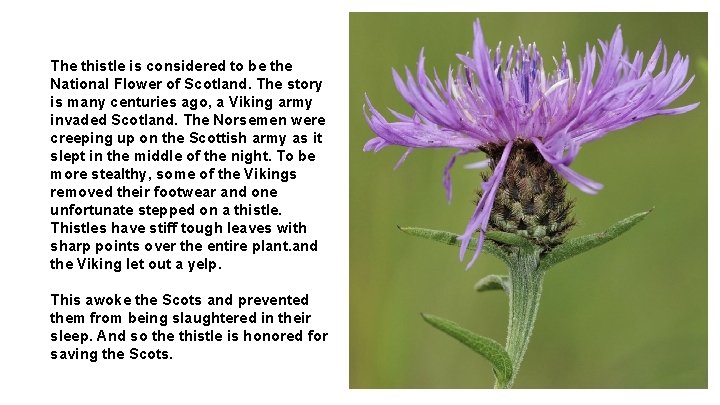
The thistle is considered to be the National Flower of Scotland. The story is many centuries ago, a Viking army invaded Scotland. The Norsemen were creeping up on the Scottish army as it slept in the middle of the night. To be more stealthy, some of the Vikings removed their footwear and one unfortunate stepped on a thistle. Thistles have stiff tough leaves with sharp points over the entire plant. and the Viking let out a yelp. This awoke the Scots and prevented them from being slaughtered in their sleep. And so the thistle is honored for saving the Scots.
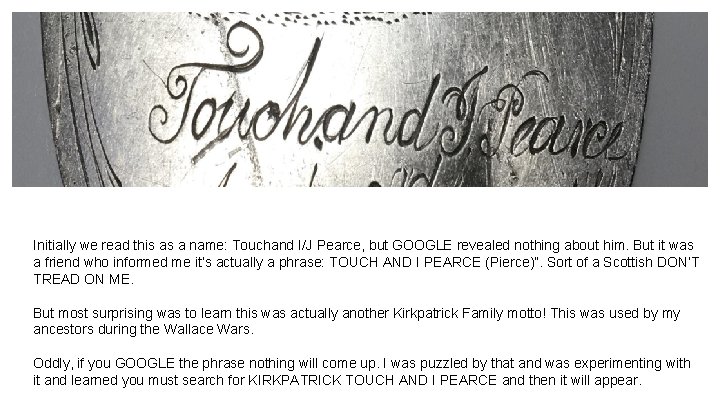
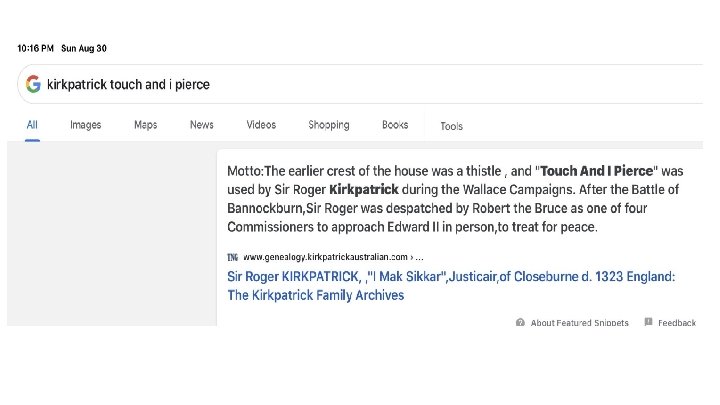
Initially we read this as a name: Touchand I/J Pearce, but GOOGLE revealed nothing about him. But it was a friend who informed me it’s actually a phrase: TOUCH AND I PEARCE (Pierce)”. Sort of a Scottish DON’T TREAD ON ME. But most surprising was to learn this was actually another Kirkpatrick Family motto! This was used by my ancestors during the Wallace Wars. Oddly, if you GOOGLE the phrase nothing will come up. I was puzzled by that and was experimenting with it and learned you must search for KIRKPATRICK TOUCH AND I PEARCE and then it will appear.
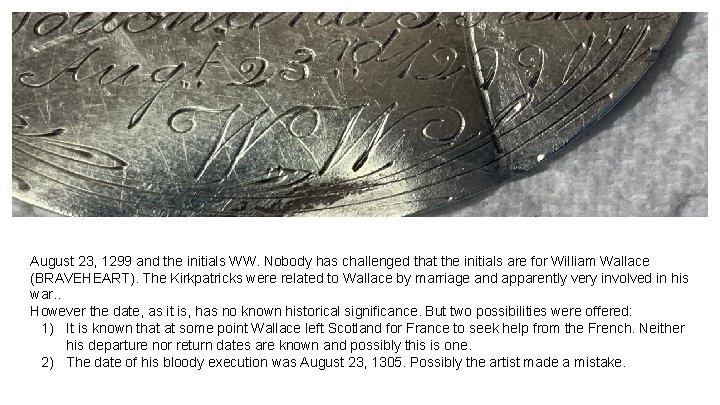
August 23, 1299 and the initials WW. Nobody has challenged that the initials are for William Wallace (BRAVEHEART). The Kirkpatricks were related to Wallace by marriage and apparently very involved in his war. . However the date, as it is, has no known historical significance. But two possibilities were offered: 1) It is known that at some point Wallace left Scotland for France to seek help from the French. Neither his departure nor return dates are known and possibly this is one. 2) The date of his bloody execution was August 23, 1305. Possibly the artist made a mistake.
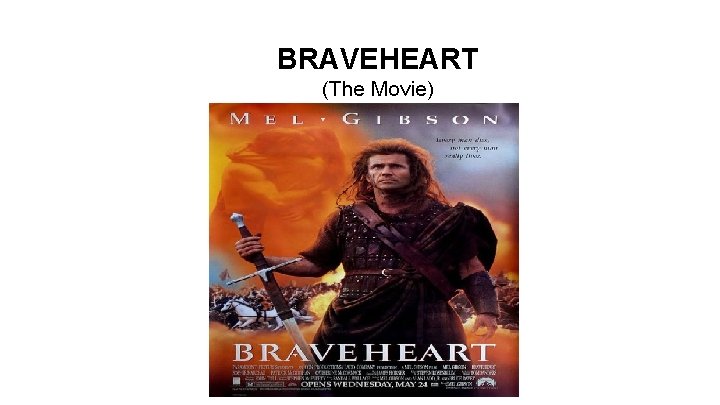
BRAVEHEART (The Movie)
BRAVEHEART was released in 1995 and won 5 Academy Awards, including BEST PICTURE. Starring and directed by Mel Gibson it was a boxoffice favorite. I have a copy myself and have watched it over and over. Here’s the sad truth. It is considered to the third most historically INACCURATE movie ever made. From the very beginning to the end, it has half truths and concocted truths. Here are just a few of my favorites: Scots did not paint their faces blue. That was the Picts, 500 years earlier. Scots did not wear kilts for another 200 years. They wore trousers. The Battle of Stirling was actually The Battle of Stirling BRIDGE. The bridge was a pivotal part of their victory The bridge was so narrow that the English Heavy Cavalry could only cross 2 -3 abreast at a time. The Scots were hidden on the far side and once enough Cavalry crossed that they could defeat and still seriously hurt the English army, the Scots closed the bridge and attacked the Cavalrymen. The lack of the bridge and stream greatly distorts the history. And lovely Isobell, whom we are led to believe met Wallace and became pregnant by him was only 3 years old at the time of his death. IF YOUR KNOWLEDGE OF s. COTTISH HISTORY IS BASED UPON THIS MOVIE. . . READ A BOOK!
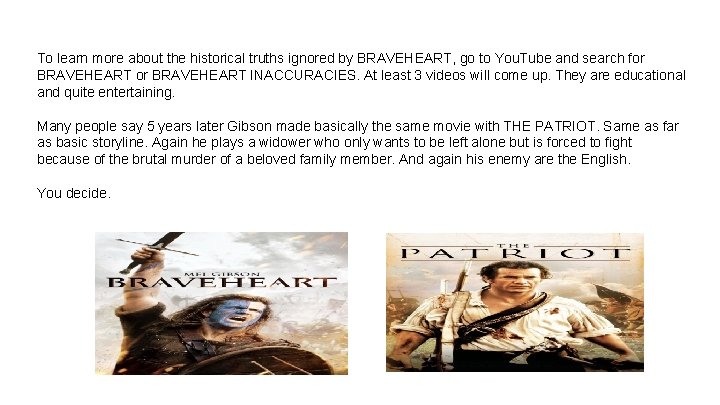
To learn more about the historical truths ignored by BRAVEHEART, go to You. Tube and search for BRAVEHEART INACCURACIES. At least 3 videos will come up. They are educational and quite entertaining. Many people say 5 years later Gibson made basically the same movie with THE PATRIOT. Same as far as basic storyline. Again he plays a widower who only wants to be left alone but is forced to fight because of the brutal murder of a beloved family member. And again his enemy are the English. You decide.
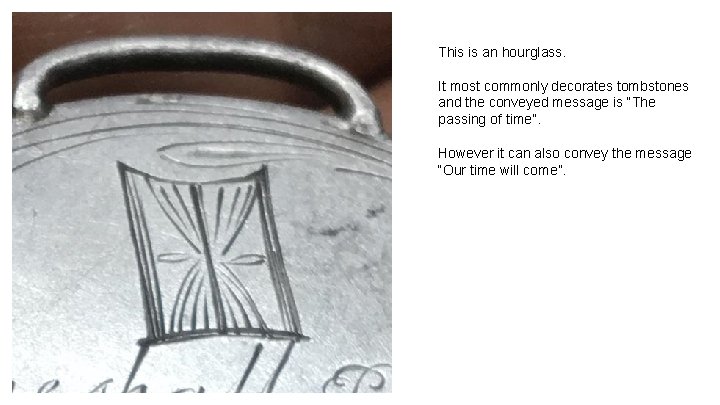
This is an hourglass. It most commonly decorates tombstones and the conveyed message is “The passing of time”. However it can also convey the message “Our time will come”.
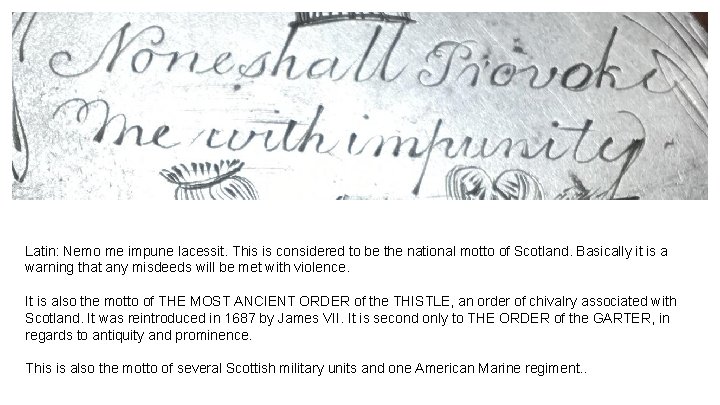
Latin: Nemo me impune lacessit. This is considered to be the national motto of Scotland. Basically it is a warning that any misdeeds will be met with violence. It is also the motto of THE MOST ANCIENT ORDER of the THISTLE, an order of chivalry associated with Scotland. It was reintroduced in 1687 by James VII. It is second only to THE ORDER of the GARTER, in regards to antiquity and prominence. This is also the motto of several Scottish military units and one American Marine regiment. .
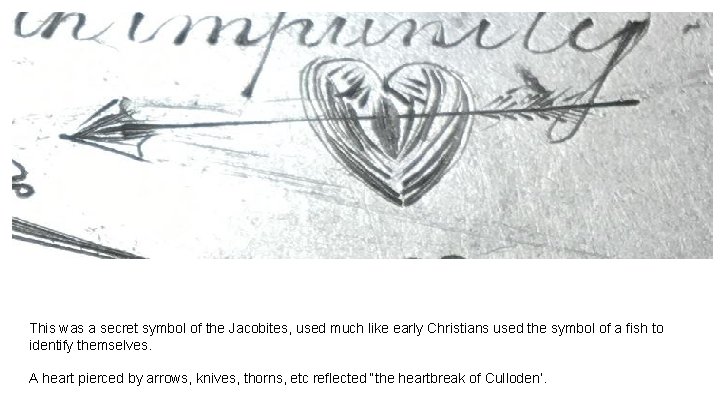
This was a secret symbol of the Jacobites, used much like early Christians used the symbol of a fish to identify themselves. A heart pierced by arrows, knives, thorns, etc reflected “the heartbreak of Culloden’.
The JACOBITES i. N THE 1600 S, England Scotland were ruled by the Stuarts. In 1688 James II was deposed, primarily because he was Catholic in a mostly Protestant area. He fled to France leaving behind many loyal followers. James in latin is Jacobus, so his followers were called JACOBITES. For many years the Jacobites caused assassinations and revolt. In 1745, charles Stuart (Bonnie Prince Charlie) returned to Scotland to regain his throne. He recruited a number of Highlanders and had several minor victories. He marched his men 30 miles without food, water or rest to face the English at Culloden. Fighting with the English was the Campbell clan. His advisors warned strongly against the fight. The men were exhausted and weak. They were terribly outnumbered and outclassed. The English had new, more accurate muskets that could be fired 3 times a minute and the Jacobites had to cross a field a mile wide. But Charles believed God was on his side and they attacked and were decimated. The battle lasted barely an hour.
Charles fled back to France, taking with him the monies collected to support his army and cause. He never returned. The English decided to destroy and further attempts by the Jacobites to regain power. All of the wounded and prisoners were executed. They and the Campbells then spent the next year scouring the Highlands of any remnants. Captured men were executed or thrown in prison. (One of my ancestors was beheaded (nobles were beheaded, commoners were hanged) and his lands seized upon suspicion of being a Jacobite). Farms and crops were destroyed, livestock stolen or slaughtered. Women and children chased off to tend for themselves. This effort not only crushed the Jacobite movement but also crushed the social and militay power of the clan system in Scotland. The wearing of tartans was banned.
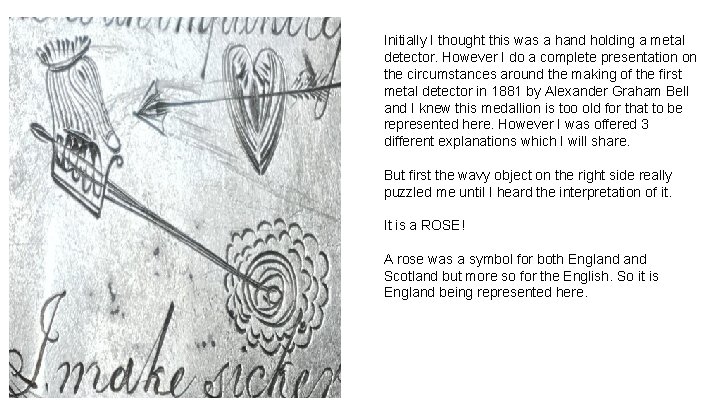
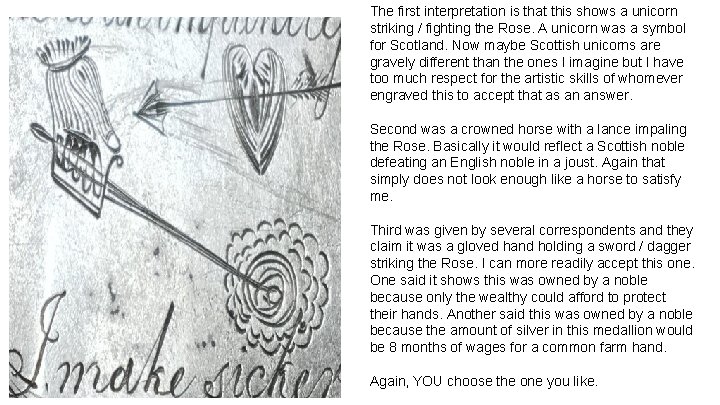
Initially I thought this was a hand holding a metal detector. However I do a complete presentation on the circumstances around the making of the first metal detector in 1881 by Alexander Graham Bell and I knew this medallion is too old for that to be represented here. However I was offered 3 different explanations which I will share. But first the wavy object on the right side really puzzled me until I heard the interpretation of it. It is a ROSE! A rose was a symbol for both England Scotland but more so for the English. So it is England being represented here.
The first interpretation is that this shows a unicorn striking / fighting the Rose. A unicorn was a symbol for Scotland. Now maybe Scottish unicorns are gravely different than the ones I imagine but I have too much respect for the artistic skills of whomever engraved this to accept that as an answer. Second was a crowned horse with a lance impaling the Rose. Basically it would reflect a Scottish noble defeating an English noble in a joust. Again that simply does not look enough like a horse to satisfy me. Third was given by several correspondents and they claim it was a gloved hand holding a sword / dagger striking the Rose. I can more readily accept this one. One said it shows this was owned by a noble because only the wealthy could afford to protect their hands. Another said this was owned by a noble because the amount of silver in this medallion would be 8 months of wages for a common farm hand. Again, YOU choose the one you like.
I MAKE SICKER I MAK SICCAR YOU SAY PO TAT O, I SAY POT A TO.
SO WHAT IS ITS PURPOSE? WHY ARE THESE SYMBOLS, PHRASES AND MOTTOS ENGRAVED ON THIS MEDALLION? Nobody knows nor will we ever have a definitive answer. BUT there is an interesting suggestion. Scotland, especially during this time period was a land of violence, intrigue and politics. If two neighboring clans were at war, often the chieftains of other neighboring clans would send men to fight for BOTH SIDES. Then whichever clan won, they would be indebted to that clan. Betrayal was a way of getting the upper hand. Was this medallion a political tool? The front side is supporting William Wallace’s position and acts as remembrance of his heroic actions. The back side serves to honor Robert Bruis and the Jacobites. The suggestion was made that when in the company of strangers, the wearer might wear it concealed around his neck. Once the popular political positions were recognized, it might be revealed with the “politically correct” opinion being shown. Maybe.
Now the question arises: HOW DID IT END UP HERE? Again, who knows? But allow me to offer my own SWAG. In 1733, JAMES OGILTHORPE, a British general, member of Parliament, philanthropist and humanitarian is granted permission to form the colony of Georgia. One of the tasks he is faced with is preventing the Spanish in St Augustine, Florida, from advancing into South Carolina. To do this he needs a strong military force and he recruits a number of Highlanders to emigrate to the new colony. They formed a militia and a township that was initially names New Inverness and later renamed Darien. It is at exit 75 of I-95. Supposedly this militia made a raid to the area near Amelia Island to avenge the murder of two Scots by Indians, friendly to and armed by the Spanish. While the medallion appears to be concave it is actually flat but there are two creases in the metal. Possibly caused by contact with a bladed weapon in combat. And maybe that was the reason for it to be lost for centuries. Until it was found by me!
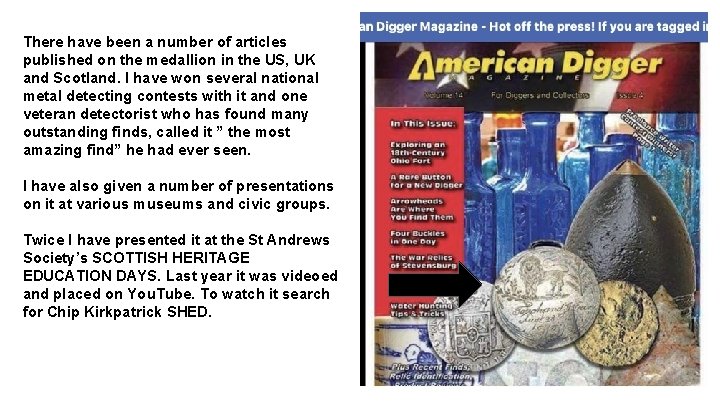
There have been a number of articles published on the medallion in the US, UK and Scotland. I have won several national metal detecting contests with it and one veteran detectorist who has found many outstanding finds, called it ” the most amazing find” he had ever seen. I have also given a number of presentations on it at various museums and civic groups. Twice I have presented it at the St Andrews Society’s SCOTTISH HERITAGE EDUCATION DAYS. Last year it was videoed and placed on You. Tube. To watch it search for Chip Kirkpatrick SHED.
At this time this is all I know, or think I know. Admittedly there are still gaps, confusion and conflict among those who offered help and information. No doubt there are plenty of disagreements, theories and ideas that I have not yet heard. If YOU have anything to share please do not hesitate to contact me with whatever you have to offer. I will be most open to your thoughts. The best way to notify me is by email. Send to chipk@bellsouth. net. Put the word MEDALLION in the subject line so I will be sure to read it. Please include your contact information in case I have questions and wish to discuss it with you. Otherwise, thank you for reading this and SCOTLAND FOREVER! Chip